NARRATIVE STRUCTURE 
AND T Y P E S
PLOT & STORY 
• A narrative is an account of connected events telling a 
story, consisting of the story and plot. 
• Story and plot are representative of difference aspects in 
narrative; the plot represents certain story events which 
are visibly and audibly present to the audience, whereas 
the story goes beyond the plot, implying events that are 
never shown to the audience or even leaving the audience 
to work them out entirely.
CLOSED NARRATIVES 
• CLOSED narratives leave no 
loose ends when the 
documentary finishes. All 
questions are answered and 
there is a clear conclusion. 
Arguably, this is the most 
common narrative, with a 
variety of documentaries 
using the structure, with 
documentaries such as Most 
Evil ending each episode with 
an answer to the question of 
“who is most evil?”
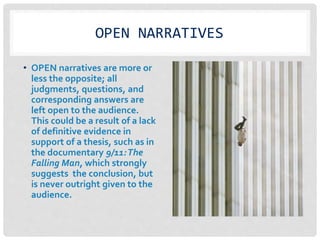
OPEN NARRATIVES 
• OPEN narratives are more or 
less the opposite; all 
judgments, questions, and 
corresponding answers are 
left open to the audience. 
This could be a result of a lack 
of definitive evidence in 
support of a thesis, such as in 
the documentary 9/11: The 
Falling Man, which strongly 
suggests the conclusion, but 
is never outright given to the 
audience.
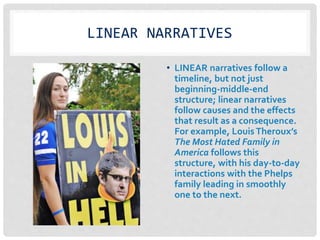
LINEAR NARRATIVES 
• LINEAR narratives follow a 
timeline, but not just 
beginning-middle-end 
structure; linear narratives 
follow causes and the effects 
that result as a consequence. 
For example, Louis Theroux’s 
The Most Hated Family in 
America follows this 
structure, with his day-to-day 
interactions with the Phelps 
family leading in smoothly 
one to the next.
NON-LINEAR NARRATIVES 
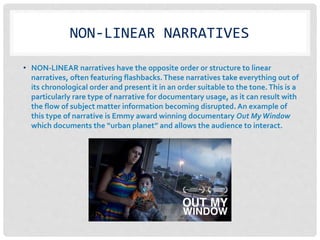
• NON-LINEAR narratives have the opposite order or structure to linear 
narratives, often featuring flashbacks. These narratives take everything out of 
its chronological order and present it in an order suitable to the tone. This is a 
particularly rare type of narrative for documentary usage, as it can result with 
the flow of subject matter information becoming disrupted. An example of 
this type of narrative is Emmy award winning documentary Out My Window 
which documents the “urban planet” and allows the audience to interact.
SINGLE-STRAND NARRATIVES 
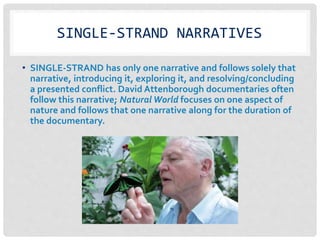
• SINGLE-STRAND has only one narrative and follows solely that 
narrative, introducing it, exploring it, and resolving/concluding 
a presented conflict. David Attenborough documentaries often 
follow this narrative; Natural World focuses on one aspect of 
nature and follows that one narrative along for the duration of 
the documentary.
MULTI-STRAND NARRATIVES 
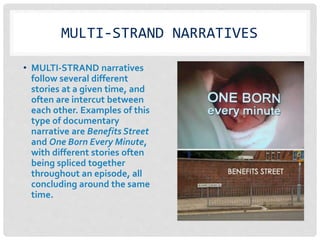
• MULTI-STRAND narratives 
follow several different 
stories at a given time, and 
often are intercut between 
each other. Examples of this 
type of documentary 
narrative are Benefits Street 
and One Born Every Minute, 
with different stories often 
being spliced together 
throughout an episode, all 
concluding around the same 
time.
CIRCULAR NARRATIVES 
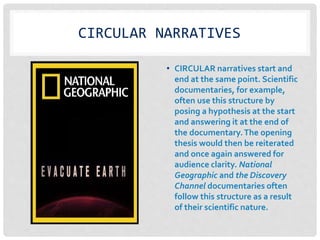
• CIRCULAR narratives start and 
end at the same point. Scientific 
documentaries, for example, 
often use this structure by 
posing a hypothesis at the start 
and answering it at the end of 
the documentary. The opening 
thesis would then be reiterated 
and once again answered for 
audience clarity. National 
Geographic and the Discovery 
Channel documentaries often 
follow this structure as a result 
of their scientific nature.

Narrative Structures

  • 1.
  • 2.
    PLOT & STORY • A narrative is an account of connected events telling a story, consisting of the story and plot. • Story and plot are representative of difference aspects in narrative; the plot represents certain story events which are visibly and audibly present to the audience, whereas the story goes beyond the plot, implying events that are never shown to the audience or even leaving the audience to work them out entirely.
  • 3.
    CLOSED NARRATIVES •CLOSED narratives leave no loose ends when the documentary finishes. All questions are answered and there is a clear conclusion. Arguably, this is the most common narrative, with a variety of documentaries using the structure, with documentaries such as Most Evil ending each episode with an answer to the question of “who is most evil?”
  • 4.
    OPEN NARRATIVES •OPEN narratives are more or less the opposite; all judgments, questions, and corresponding answers are left open to the audience. This could be a result of a lack of definitive evidence in support of a thesis, such as in the documentary 9/11: The Falling Man, which strongly suggests the conclusion, but is never outright given to the audience.
  • 5.
    LINEAR NARRATIVES •LINEAR narratives follow a timeline, but not just beginning-middle-end structure; linear narratives follow causes and the effects that result as a consequence. For example, Louis Theroux’s The Most Hated Family in America follows this structure, with his day-to-day interactions with the Phelps family leading in smoothly one to the next.
  • 6.
    NON-LINEAR NARRATIVES •NON-LINEAR narratives have the opposite order or structure to linear narratives, often featuring flashbacks. These narratives take everything out of its chronological order and present it in an order suitable to the tone. This is a particularly rare type of narrative for documentary usage, as it can result with the flow of subject matter information becoming disrupted. An example of this type of narrative is Emmy award winning documentary Out My Window which documents the “urban planet” and allows the audience to interact.
  • 7.
    SINGLE-STRAND NARRATIVES •SINGLE-STRAND has only one narrative and follows solely that narrative, introducing it, exploring it, and resolving/concluding a presented conflict. David Attenborough documentaries often follow this narrative; Natural World focuses on one aspect of nature and follows that one narrative along for the duration of the documentary.
  • 8.
    MULTI-STRAND NARRATIVES •MULTI-STRAND narratives follow several different stories at a given time, and often are intercut between each other. Examples of this type of documentary narrative are Benefits Street and One Born Every Minute, with different stories often being spliced together throughout an episode, all concluding around the same time.
  • 9.
    CIRCULAR NARRATIVES •CIRCULAR narratives start and end at the same point. Scientific documentaries, for example, often use this structure by posing a hypothesis at the start and answering it at the end of the documentary. The opening thesis would then be reiterated and once again answered for audience clarity. National Geographic and the Discovery Channel documentaries often follow this structure as a result of their scientific nature.