1
Horror Openings &
Narrative Structure
Story-telling
2
Most commercial films have a conventional narrative of a
beginning, middle and end.
This is known as the Three Act Structure.
The Set-Up
3
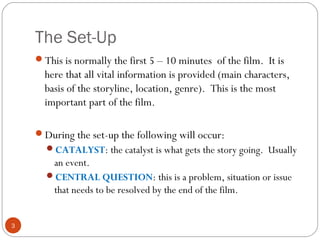
This is normally the first 5 – 10 minutes of the film. It is
here that all vital information is provided (main characters,
basis of the storyline, location, genre). This is the most
important part of the film.
During the set-up the following will occur:
CATALYST: the catalyst is what gets the story going. Usually
an event.
CENTRAL QUESTION: this is a problem, situation or issue
that needs to be resolved by the end of the film.
‘The Ring’, Dir. Gore Verbiniski
4
Last lesson we identified a couple of horror conventions
which are linked to narrative. What are they?
FALSE SCARES: this is when the audience expect to jump
or be scared but nothing happens. It can be either a noise or
an action which leads to nothing (a door opening and you
expect someone to be standing behind it but no-one’s there).
Watch the opening carefully and list the important elements
that add to the Set-Up of the narrative.
After the Set-Up…
5
Once key elements have been introduced it is important that
the narrative moves quickly so that the audience’s interest is
maintained.
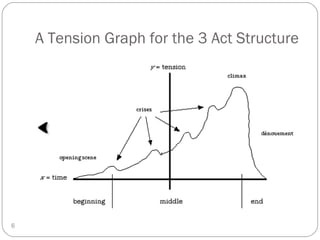
TURNING POINTS: are used to do this. These change the
direction of the story and raise the stakes. There will be a
turning point at the end of Act One and Act Two.
The moment the audience most want to see is the
CLIMAX. This is the big finish of the film – where the
good and bad guy meet.
The RESOLUTION is the final part of the film where all
loose ends are tied up (unless there’s a sequel!)
A Tension Graph for the 3 Act Structure
6
Key Words for Narrative
7
RESOLUTION
CATALYST
TURNING POINT
SET-UP
CLIMAX
CENTRAL QUESTION
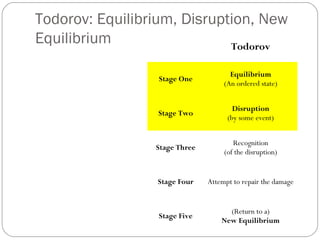
Todorov: Equilibrium, Disruption, New
Equilibrium Todorov
Stage One
Equilibrium
(An ordered state)
Stage Two
Disruption
(by some event)
Stage Three
Recognition
(of the disruption)
Stage Four Attempt to repair the damage
Stage Five
(Return to a)
New Equilibrium
Todorov
Stage One
Equilibrium
(An ordered state)
Stage Two
Disruption
(by some event)
Stage Three
Recognition
(of the disruption)
Stage Four Attempt to repair the damage
Stage Five
(Return to a)
New Equilibrium
Horror Tasks
9
1. Select 3 Past Student Horrors to watch from Student
Resources.
2. Watch each opening once and draw a tension graph as you
watch it.
3. Comment on the specific elements that made the tension
rise/fall in the opening sequence.
4. Fill in the Past Student Evaluation sheet for each film.
Horror Tasks
9
1. Select 3 Past Student Horrors to watch from Student
Resources.
2. Watch each opening once and draw a tension graph as you
watch it.
3. Comment on the specific elements that made the tension
rise/fall in the opening sequence.
4. Fill in the Past Student Evaluation sheet for each film.

02. horror & narrative structure

  • 1.
  • 2.
    Story-telling 2 Most commercial filmshave a conventional narrative of a beginning, middle and end. This is known as the Three Act Structure.
  • 3.
    The Set-Up 3 This isnormally the first 5 – 10 minutes of the film. It is here that all vital information is provided (main characters, basis of the storyline, location, genre). This is the most important part of the film. During the set-up the following will occur: CATALYST: the catalyst is what gets the story going. Usually an event. CENTRAL QUESTION: this is a problem, situation or issue that needs to be resolved by the end of the film.
  • 4.
    ‘The Ring’, Dir.Gore Verbiniski 4 Last lesson we identified a couple of horror conventions which are linked to narrative. What are they? FALSE SCARES: this is when the audience expect to jump or be scared but nothing happens. It can be either a noise or an action which leads to nothing (a door opening and you expect someone to be standing behind it but no-one’s there). Watch the opening carefully and list the important elements that add to the Set-Up of the narrative.
  • 5.
    After the Set-Up… 5 Oncekey elements have been introduced it is important that the narrative moves quickly so that the audience’s interest is maintained. TURNING POINTS: are used to do this. These change the direction of the story and raise the stakes. There will be a turning point at the end of Act One and Act Two. The moment the audience most want to see is the CLIMAX. This is the big finish of the film – where the good and bad guy meet. The RESOLUTION is the final part of the film where all loose ends are tied up (unless there’s a sequel!)
  • 6.
    A Tension Graphfor the 3 Act Structure 6
  • 7.
    Key Words forNarrative 7 RESOLUTION CATALYST TURNING POINT SET-UP CLIMAX CENTRAL QUESTION
  • 8.
    Todorov: Equilibrium, Disruption,New Equilibrium Todorov Stage One Equilibrium (An ordered state) Stage Two Disruption (by some event) Stage Three Recognition (of the disruption) Stage Four Attempt to repair the damage Stage Five (Return to a) New Equilibrium Todorov Stage One Equilibrium (An ordered state) Stage Two Disruption (by some event) Stage Three Recognition (of the disruption) Stage Four Attempt to repair the damage Stage Five (Return to a) New Equilibrium
  • 9.
    Horror Tasks 9 1. Select3 Past Student Horrors to watch from Student Resources. 2. Watch each opening once and draw a tension graph as you watch it. 3. Comment on the specific elements that made the tension rise/fall in the opening sequence. 4. Fill in the Past Student Evaluation sheet for each film.
  • 10.
    Horror Tasks 9 1. Select3 Past Student Horrors to watch from Student Resources. 2. Watch each opening once and draw a tension graph as you watch it. 3. Comment on the specific elements that made the tension rise/fall in the opening sequence. 4. Fill in the Past Student Evaluation sheet for each film.