





Nanotechnology in the High School
Curriculum: From Energy Conversion
         to Science Ethics
  REU (RET) Nanotechnology Symposium
              23 July 2004
               12-2:30 PM


          Kenneth Bowles
        Apopka High School
     NSF: NANOPAC REU Site
         Host: AMPAC-UCF
What Is All the Fuss About
Nanotechnology?
                        Any given search engine will
                          produce 1.6 million hits
  Nanotechnology is on the way to
  becoming the FIRST trillion dollar
  market


                     Nanotechnology influences almost
                     every facet of every day life such as
                     security and medicine.
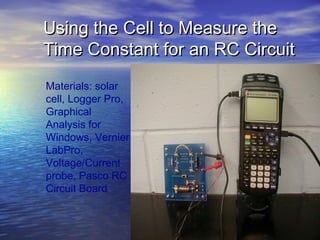
Does Nanotechnology
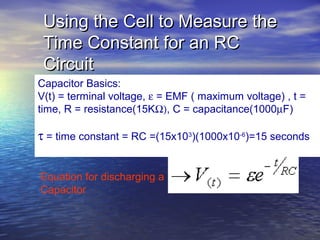
  Address Teaching
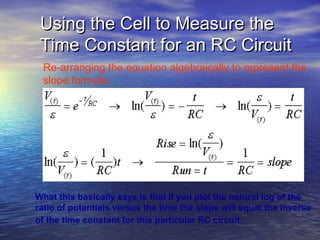
  Standards?
Physical science content standards 9-12
• Structure of atoms
• Structure and properties of matter
• Chemical reactions
• Motion and forces
• Conservation of energy and increase in
  disorder (entropy)
• Interactions of energy and matter
Does Nanotechnology
Address Teaching Standards?
Science and technology standards
• Abilities of technological design
• Understanding about science and technology
Science in personal and social perspectives
• Personal and community health
• Population growth
• Natural resources
• Environmental quality
• Natural and human-induced hazards
• Science and technology in local, national,
  and global challenges
Does Nanotechnology
Address Teaching
Standards?
History and nature of science
  standards
• Science as a human endeavor
• Nature of scientific knowledge
• Historical perspective
Does Nanotechnology
    Address Teaching Standards?
    Nanotechnology Idea              Standard it can
                                     address
    The idea of “Nano” – being       Structure of Atoms
    small
    Nanomaterials have a high        Structure and properties of
    surface area                     matter, Personal and
    (nanosensors for toxins)         Community Health
    Synthesis of nanomaterials and   Chemical Reactions
    support chemistry (space
    propulsion)
    Shape Memory Alloys              Motion and Forces, Abilities of
                                     technological design,
                                     Understanding about science and
i                                    technology
    Nanocrystalline Solar Cells      Conservation of Energy and
                                     increase in disorder (entropy),
                                     Interactions of energy and matter,
Does Nanotechnology Address
Teaching Standards?
Nanotechnology Idea               Standard it can
                                  address
Nanomaterials, such as MR         Science and technology in local,
(magneto-resistive) fluids in     national, and global challenges
security
Richard P. Feynman’s talk,        Science as a human endeavor,
“There is plenty of room at the   Nature of scientific knowledge,
bottom”. Feynman had a vision.    Historical perspective
Nanocosmetics and nanoclothing    Science as a human endeavor,
                                  Science and technology in local,
                                  national, and global challenges
Nanotechnology and Science        Science and technology in local,
Ethics                            national, and global challenges,
                                  Science as a human endeavor,
                                  Historical perspective, Natural
                                  and human-induced hazards,
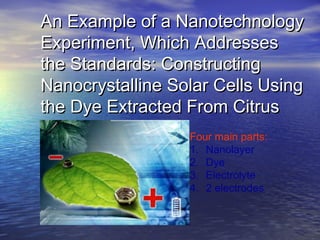
An Example of a Nanotechnology
Experiment, Which Addresses
the Standards: Constructing
Nanocrystalline Solar Cells Using
the Dye Extracted From Citrus
                  Four main parts:
                  1. Nanolayer
                  2. Dye
                  3. Electrolyte
                  4. 2 electrodes
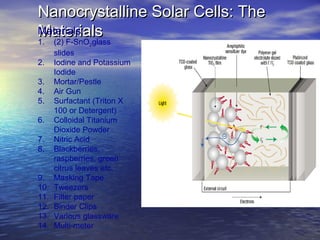
Nanocrystalline Solar Cells: The
Materials
Materials:
1. (2) F-SnO glass
               2
      slides
2.    Iodine and Potassium
      Iodide
3.    Mortar/Pestle
4.    Air Gun
5.    Surfactant (Triton X
      100 or Detergent)
6.    Colloidal Titanium
      Dioxide Powder
7.    Nitric Acid
8.    Blackberries,
      raspberries, green
      citrus leaves etc.
9.    Masking Tape
10.   Tweezers
11.   Filter paper
12.   Binder Clips
13.   Various glassware
14.   Multi-meter
Preparation of Nanotitanium and
Electrolyte Solution
Nanotitanium
1. Add 2-ml of 2,4 – Pentanedione (C 5 H 8 O 2 ) to 100-ml of
     anhydrous isopropanol [ (CH 3 ) 2 CHOH ] and stir covered
     for 20 minutes.
2.    Add 6.04-ml of titanium isopropoxide (Ti[(CH 3 ) 2 CHO] 4
     to the solution and stir for at least 2 hours.
3.   Add 2.88-ml of distilled water and stir for another 2
     hours.
4.   The solution must then age for 12 hours at room
     temperature.
5.   Since you now have a collodial suspension, the
     solvent must be evaporated off in an oven to collect
     the powder.
Electrolyte solution
1. Measure out 10-ml of ethylene glycol
2. Weigh out 0.127-g of I 2 and add it to the ethylene
   glycol and stir.
3. Weigh out 0.83 g of KI and add it to the same
   ethylene glycol.
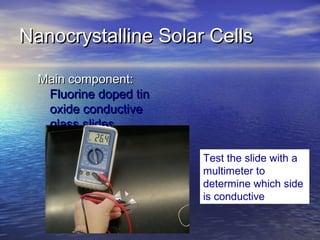
Nanocrystalline Solar Cells

  Main component:
   Fluorine doped tin
   oxide conductive
   glass slides

                        Test the slide with a
                        multimeter to
                        determine which side
                        is conductive
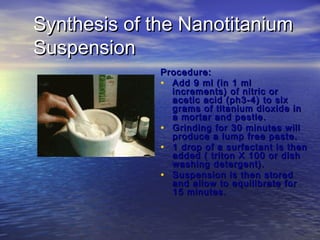
Synthesis of the Nanotitanium
Suspension
              Procedure:
              • Add 9 ml (in 1 ml
                increments) of nitric or
                acetic acid (ph3-4) to six
                grams of titanium dioxide in
                a mortar and pestle.
              • Grinding for 30 minutes will
                produce a lump free paste.
              • 1 drop of a surfactant is then
                added ( triton X 100 or dish
                washing detergent).
              • Suspension is then stored
                and allow to equilibrate for
                15 minutes.
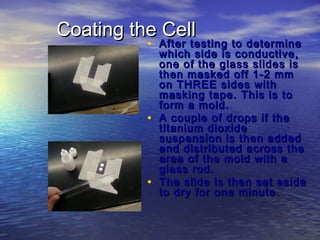
Coating the Cell
          • After testing to determine
              which side is conductive,
              one of the glass slides is
              then masked off 1-2 mm
              on THREE sides with
              masking tape. This is to
              form a mold.
          •   A couple of drops if the
              titanium dioxide
              suspension is then added
              and distributed across the
              area of the mold with a
              glass rod.
          •   The slide is then set aside
              to dry for one minute.
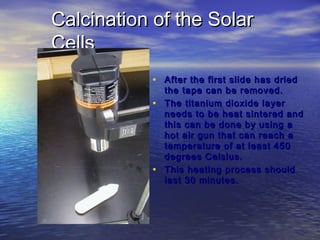
Calcination of the Solar
Cells
           • After the first slide has dried
             the tape can be removed.
           • The titanium dioxide layer
             needs to be heat sintered and
             this can be done by using a
             hot air gun that can reach a
             temperature of at least 450
             degrees Celsius.
           • This heating process should
             last 30 minutes.
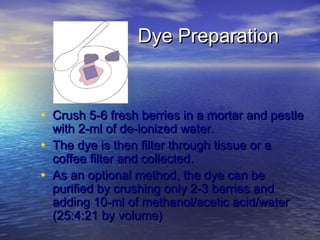
Dye Preparation


• Crush 5-6 fresh berries in a mortar and pestle
    with 2-ml of de-ionized water.
•   The dye is then filter through tissue or a
    coffee filter and collected.
•   As an optional method, the dye can be
    purified by crushing only 2-3 berries and
    adding 10-ml of methanol/acetic acid/water
    (25:4:21 by volume)
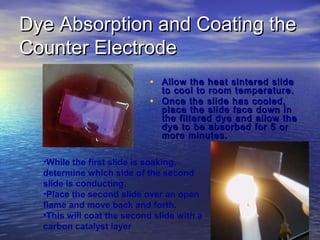
Dye Absorption and Coating the
Counter Electrode
                            • Allow the heat sintered slide
                              to cool to room temperature.
                            • Once the slide has cooled,
                              place the slide face down in
                              the filtered dye and allow the
                              dye to be absorbed for 5 or
                              more minutes.

  •While the first slide is soaking,
  determine which side of the second
  slide is conducting.
  •Place the second slide over an open
  flame and move back and forth.
  •This will coat the second slide with a
  carbon catalyst layer
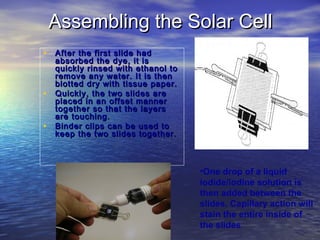
Assembling the Solar Cell
• After the first slide had
    absorbed the dye, it is
    quickly rinsed with ethanol to
    remove any water. It is then
    blotted dry with tissue paper.
•   Quickly, the two slides are
    placed in an offset manner
    together so that the layers
    are touching.
•   Binder clips can be used to
    keep the two slides together.


                                     •One drop of a liquid
                                     iodide/iodine solution is
                                     then added between the
                                     slides. Capillary action will
                                     stain the entire inside of
                                     the slides
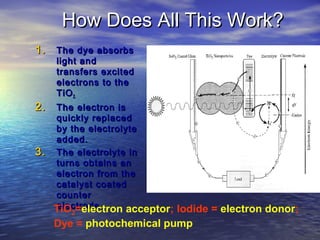
How Does All This Work?
1.   The dye absorbs
     light and
     transfers excited
     electrons to the
     TiO 2.
2. The electron is
   quickly replaced
   by the electrolyte
   added.
3. The electrolyte in
   turns obtains an
   electron from the
   catalyst coated
   counter
   electrode.
   TiO2=electron acceptor; Iodide = electron donor;
     Dye = photochemical pump
Classroom Ideas With the Cell
•   Ohm’s law
•   Electrochemistry
•   Verification of Kirchhoff’s voltage law with
    cells in series.
•   Charging capacitors
•   Measuring current and power density
•   Measuring internal resistance
•   Powering small “no-load” motors
Using the Cell to Measure the
Time Constant for an RC Circuit
Materials: solar
cell, Logger Pro,
Graphical
Analysis for
Windows, Vernier
LabPro,
Voltage/Current
probe, Pasco RC
Circuit Board
Using the Cell to Measure the
 Time Constant for an RC
 Circuit
Capacitor Basics:
V(t) = terminal voltage, ε = EMF ( maximum voltage) , t =
time, R = resistance(15KΩ), C = capacitance(1000µF)

τ = time constant = RC =(15x103)(1000x10-6)=15 seconds


Equation for discharging a
Capacitor
Using the Cell to Measure the
 Time Constant for an RC Circuit
 Re-arranging the equation algebraically to represent the
 slope formula.


What this basically says is that if you plot the natural log of the
ratio of potentials versus the time the slope will equal the inverse
of the time constant for this particular RC circuit.
Using the Cell to Measure the
Time Constant for an RC Circuit
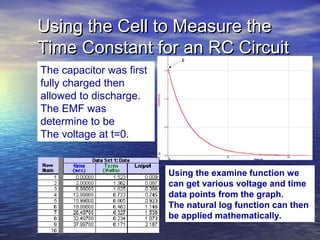
The capacitor was first
fully charged then
allowed to discharge.
The EMF was
determine to be
The voltage at t=0.


                          Using the examine function we
                          can get various voltage and time
                          data points from the graph.
                          The natural log function can then
                          be applied mathematically.
Using the Cell to Measure the
Time Constant for an RC Circuit

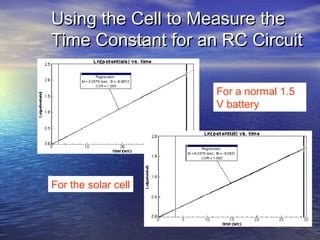
                     For a normal 1.5
                     V battery


For the solar cell
Using the Cell to Measure the
  Time Constant for an RC Circuit

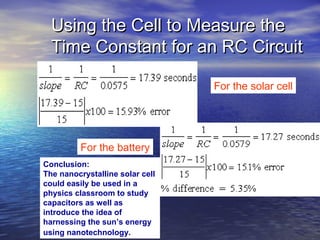
                                 For the solar cell


          For the battery
Conclusion:
The nanocrystalline solar cell
could easily be used in a
physics classroom to study
capacitors as well as
introduce the idea of
harnessing the sun’s energy
using nanotechnology.
Nanotechnology
Curriculum Overview
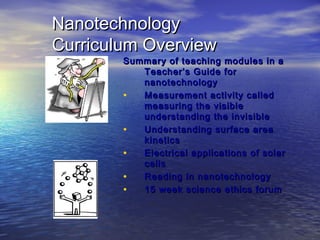
        Summary of teaching modules in a
           Teacher’s Guide for
           nanotechnology
        •  Measurement activity called
           measuring the visible
           understanding the invisible
        •  Understanding surface area
           kinetics
        •  Electrical applications of solar
           cells
        •  Reading in nanotechnology
        •  15 week science ethics forum
Nanotechnology Curriculum
Overview - Reading
               Apopka oasis reading
                 café
               • Michael Crichton’s
                 “prey”
               • John Robert
                 Marlow’s “Nano”
Nanotechnology Curriculum
Overview - Reading
Each activity is accompanied by a nanotechnology article
which includes:
• Pre-reading activities such as an anticipation guide
• Reading strategies such as questioning and prediction verification
• Post reading strategies such as the “One Sentence Summary.
Nanotechnology
and Science
Ethics
 Based on a course
 offered at Yale
 Week
 1.  Overview (Feynman’s “There is plenty of room at the
     bottom”)
 2. From Fenyman to Funding: The Mighty Dollar
 3. Super intelligence
 4. Nanotechnology
 5. Life Extension and Cryonics
 6. Pharmaceutical Enrichment ( Brave New World)
 7. Threats to Global Security
 8. Strategies for Global Security ( I,Robot)
 9. Automation
 10. Enhanced humans and Immortality
 11. Environmental Effects of nanotechnology
 12. The Gap between science and ethics.
Planned Nanotechnology
Activities
  Activities:
  1. Making magnetic tiles to simulate “self assembly”.
  2. Making Ferro Fluids to simulate the manufacture
     of projectile repellant materials.
  3. Using Decanethiol Monolayer on Silver to simulate
     nanoparticles that resist stains and water
     absorbance.
  4. A Microfluidic Nanofilter: Filtration of Gold
     Nanoparticles to simulate nanosensors.
  5. Residual Stress on Nanolayers due to Thermal
     Heating
  6. Various Shape Memory Alloy Experiments
  7. Various Nanocoating experiments using bacteria
Special Thanks
  Dr. Sudipta Seal- Nano Initiative Coordinator for
  UCF – NSF REU(RET) Site Funding

  Dr. Kumar and Dr. Peterson – UCF Mechanical,
  Materials & Aerospace Engineering –NSF RET Site
  Funding

  Dr. Aldrin Sweeney – UCF College of Education

  AMPAC

  Karen Glidewell - AMPAC Administrative Offices
For More Information

Please visit:
www.bowlesphysics.com
• Download this presentation
• Download Teaching Modules

Nanotechnology

  • 1.
    Nanotechnology in theHigh School Curriculum: From Energy Conversion to Science Ethics REU (RET) Nanotechnology Symposium 23 July 2004 12-2:30 PM Kenneth Bowles Apopka High School NSF: NANOPAC REU Site Host: AMPAC-UCF
  • 2.
    What Is Allthe Fuss About Nanotechnology? Any given search engine will produce 1.6 million hits Nanotechnology is on the way to becoming the FIRST trillion dollar market Nanotechnology influences almost every facet of every day life such as security and medicine.
  • 3.
    Does Nanotechnology Address Teaching Standards? Physical science content standards 9-12 • Structure of atoms • Structure and properties of matter • Chemical reactions • Motion and forces • Conservation of energy and increase in disorder (entropy) • Interactions of energy and matter
  • 4.
    Does Nanotechnology Address TeachingStandards? Science and technology standards • Abilities of technological design • Understanding about science and technology Science in personal and social perspectives • Personal and community health • Population growth • Natural resources • Environmental quality • Natural and human-induced hazards • Science and technology in local, national, and global challenges
  • 5.
    Does Nanotechnology Address Teaching Standards? Historyand nature of science standards • Science as a human endeavor • Nature of scientific knowledge • Historical perspective
  • 6.
    Does Nanotechnology Address Teaching Standards? Nanotechnology Idea Standard it can address The idea of “Nano” – being Structure of Atoms small Nanomaterials have a high Structure and properties of surface area matter, Personal and (nanosensors for toxins) Community Health Synthesis of nanomaterials and Chemical Reactions support chemistry (space propulsion) Shape Memory Alloys Motion and Forces, Abilities of technological design, Understanding about science and i technology Nanocrystalline Solar Cells Conservation of Energy and increase in disorder (entropy), Interactions of energy and matter,
  • 7.
    Does Nanotechnology Address TeachingStandards? Nanotechnology Idea Standard it can address Nanomaterials, such as MR Science and technology in local, (magneto-resistive) fluids in national, and global challenges security Richard P. Feynman’s talk, Science as a human endeavor, “There is plenty of room at the Nature of scientific knowledge, bottom”. Feynman had a vision. Historical perspective Nanocosmetics and nanoclothing Science as a human endeavor, Science and technology in local, national, and global challenges Nanotechnology and Science Science and technology in local, Ethics national, and global challenges, Science as a human endeavor, Historical perspective, Natural and human-induced hazards,
  • 8.
    An Example ofa Nanotechnology Experiment, Which Addresses the Standards: Constructing Nanocrystalline Solar Cells Using the Dye Extracted From Citrus Four main parts: 1. Nanolayer 2. Dye 3. Electrolyte 4. 2 electrodes
  • 9.
    Nanocrystalline Solar Cells:The Materials Materials: 1. (2) F-SnO glass 2 slides 2. Iodine and Potassium Iodide 3. Mortar/Pestle 4. Air Gun 5. Surfactant (Triton X 100 or Detergent) 6. Colloidal Titanium Dioxide Powder 7. Nitric Acid 8. Blackberries, raspberries, green citrus leaves etc. 9. Masking Tape 10. Tweezers 11. Filter paper 12. Binder Clips 13. Various glassware 14. Multi-meter
  • 10.
    Preparation of Nanotitaniumand Electrolyte Solution Nanotitanium 1. Add 2-ml of 2,4 – Pentanedione (C 5 H 8 O 2 ) to 100-ml of anhydrous isopropanol [ (CH 3 ) 2 CHOH ] and stir covered for 20 minutes. 2. Add 6.04-ml of titanium isopropoxide (Ti[(CH 3 ) 2 CHO] 4 to the solution and stir for at least 2 hours. 3. Add 2.88-ml of distilled water and stir for another 2 hours. 4. The solution must then age for 12 hours at room temperature. 5. Since you now have a collodial suspension, the solvent must be evaporated off in an oven to collect the powder. Electrolyte solution 1. Measure out 10-ml of ethylene glycol 2. Weigh out 0.127-g of I 2 and add it to the ethylene glycol and stir. 3. Weigh out 0.83 g of KI and add it to the same ethylene glycol.
  • 11.
    Nanocrystalline Solar Cells Main component: Fluorine doped tin oxide conductive glass slides Test the slide with a multimeter to determine which side is conductive
  • 12.
    Synthesis of theNanotitanium Suspension Procedure: • Add 9 ml (in 1 ml increments) of nitric or acetic acid (ph3-4) to six grams of titanium dioxide in a mortar and pestle. • Grinding for 30 minutes will produce a lump free paste. • 1 drop of a surfactant is then added ( triton X 100 or dish washing detergent). • Suspension is then stored and allow to equilibrate for 15 minutes.
  • 13.
    Coating the Cell • After testing to determine which side is conductive, one of the glass slides is then masked off 1-2 mm on THREE sides with masking tape. This is to form a mold. • A couple of drops if the titanium dioxide suspension is then added and distributed across the area of the mold with a glass rod. • The slide is then set aside to dry for one minute.
  • 14.
    Calcination of theSolar Cells • After the first slide has dried the tape can be removed. • The titanium dioxide layer needs to be heat sintered and this can be done by using a hot air gun that can reach a temperature of at least 450 degrees Celsius. • This heating process should last 30 minutes.
  • 15.
    Dye Preparation • Crush5-6 fresh berries in a mortar and pestle with 2-ml of de-ionized water. • The dye is then filter through tissue or a coffee filter and collected. • As an optional method, the dye can be purified by crushing only 2-3 berries and adding 10-ml of methanol/acetic acid/water (25:4:21 by volume)
  • 16.
    Dye Absorption andCoating the Counter Electrode • Allow the heat sintered slide to cool to room temperature. • Once the slide has cooled, place the slide face down in the filtered dye and allow the dye to be absorbed for 5 or more minutes. •While the first slide is soaking, determine which side of the second slide is conducting. •Place the second slide over an open flame and move back and forth. •This will coat the second slide with a carbon catalyst layer
  • 17.
    Assembling the SolarCell • After the first slide had absorbed the dye, it is quickly rinsed with ethanol to remove any water. It is then blotted dry with tissue paper. • Quickly, the two slides are placed in an offset manner together so that the layers are touching. • Binder clips can be used to keep the two slides together. •One drop of a liquid iodide/iodine solution is then added between the slides. Capillary action will stain the entire inside of the slides
  • 18.
    How Does AllThis Work? 1. The dye absorbs light and transfers excited electrons to the TiO 2. 2. The electron is quickly replaced by the electrolyte added. 3. The electrolyte in turns obtains an electron from the catalyst coated counter electrode. TiO2=electron acceptor; Iodide = electron donor; Dye = photochemical pump
  • 19.
    Classroom Ideas Withthe Cell • Ohm’s law • Electrochemistry • Verification of Kirchhoff’s voltage law with cells in series. • Charging capacitors • Measuring current and power density • Measuring internal resistance • Powering small “no-load” motors
  • 20.
    Using the Cellto Measure the Time Constant for an RC Circuit Materials: solar cell, Logger Pro, Graphical Analysis for Windows, Vernier LabPro, Voltage/Current probe, Pasco RC Circuit Board
  • 21.
    Using the Cellto Measure the Time Constant for an RC Circuit Capacitor Basics: V(t) = terminal voltage, ε = EMF ( maximum voltage) , t = time, R = resistance(15KΩ), C = capacitance(1000µF) τ = time constant = RC =(15x103)(1000x10-6)=15 seconds Equation for discharging a Capacitor
  • 22.
    Using the Cellto Measure the Time Constant for an RC Circuit Re-arranging the equation algebraically to represent the slope formula. What this basically says is that if you plot the natural log of the ratio of potentials versus the time the slope will equal the inverse of the time constant for this particular RC circuit.
  • 23.
    Using the Cellto Measure the Time Constant for an RC Circuit The capacitor was first fully charged then allowed to discharge. The EMF was determine to be The voltage at t=0. Using the examine function we can get various voltage and time data points from the graph. The natural log function can then be applied mathematically.
  • 24.
    Using the Cellto Measure the Time Constant for an RC Circuit For a normal 1.5 V battery For the solar cell
  • 25.
    Using the Cellto Measure the Time Constant for an RC Circuit For the solar cell For the battery Conclusion: The nanocrystalline solar cell could easily be used in a physics classroom to study capacitors as well as introduce the idea of harnessing the sun’s energy using nanotechnology.
  • 26.
    Nanotechnology Curriculum Overview Summary of teaching modules in a Teacher’s Guide for nanotechnology • Measurement activity called measuring the visible understanding the invisible • Understanding surface area kinetics • Electrical applications of solar cells • Reading in nanotechnology • 15 week science ethics forum
  • 27.
    Nanotechnology Curriculum Overview -Reading Apopka oasis reading café • Michael Crichton’s “prey” • John Robert Marlow’s “Nano”
  • 28.
    Nanotechnology Curriculum Overview -Reading Each activity is accompanied by a nanotechnology article which includes: • Pre-reading activities such as an anticipation guide • Reading strategies such as questioning and prediction verification • Post reading strategies such as the “One Sentence Summary.
  • 29.
    Nanotechnology and Science Ethics Basedon a course offered at Yale Week 1. Overview (Feynman’s “There is plenty of room at the bottom”) 2. From Fenyman to Funding: The Mighty Dollar 3. Super intelligence 4. Nanotechnology 5. Life Extension and Cryonics 6. Pharmaceutical Enrichment ( Brave New World) 7. Threats to Global Security 8. Strategies for Global Security ( I,Robot) 9. Automation 10. Enhanced humans and Immortality 11. Environmental Effects of nanotechnology 12. The Gap between science and ethics.
  • 30.
    Planned Nanotechnology Activities Activities: 1. Making magnetic tiles to simulate “self assembly”. 2. Making Ferro Fluids to simulate the manufacture of projectile repellant materials. 3. Using Decanethiol Monolayer on Silver to simulate nanoparticles that resist stains and water absorbance. 4. A Microfluidic Nanofilter: Filtration of Gold Nanoparticles to simulate nanosensors. 5. Residual Stress on Nanolayers due to Thermal Heating 6. Various Shape Memory Alloy Experiments 7. Various Nanocoating experiments using bacteria
  • 31.
    Special Thanks Dr. Sudipta Seal- Nano Initiative Coordinator for UCF – NSF REU(RET) Site Funding Dr. Kumar and Dr. Peterson – UCF Mechanical, Materials & Aerospace Engineering –NSF RET Site Funding Dr. Aldrin Sweeney – UCF College of Education AMPAC Karen Glidewell - AMPAC Administrative Offices
  • 32.
    For More Information Pleasevisit: www.bowlesphysics.com • Download this presentation • Download Teaching Modules