▪ Introduction of the company
▪ What is nanodiamond (ND), methods of ND fabrication and Market overview
▪ Technology of Laser ND Synthesis
▪ ND surface modification and fabrication of slurries
▪ CARTHER project (CARbon nanoparticles for THERanostic applications)
▪ PANDA project (Production of Advanced Nano-Diamond Additives)
▪ Looking for partners
2
1. Private Israeli company # 514305671
2. Established in August 2009 in Jerusalem, Israel
3. Scope: nanodiamond (ND) technologies
4. Website: www.nanodiamond.co.il
5. Member of Israel Association of Manufacturers
6. Licensed supplier of Israel Ministry of Defense
7. Employees: 6
Ray Techniques Ltd, Introduction
Boris Zousman,
main developer
of RAY technologies
3
• The problems we solve
• ND powders in the Market are of non-constant quality,
complicated to use in industrial scale and expensive;
• No industrial technologies for ND disaggregation & mixing;
• Insufficient number of validated ND formulations.
• Our mission is to provide consumers in various fields of industry,
energy, science & medicine with ready-to-use and efficient ND
additives to diverse materials and processes.
4
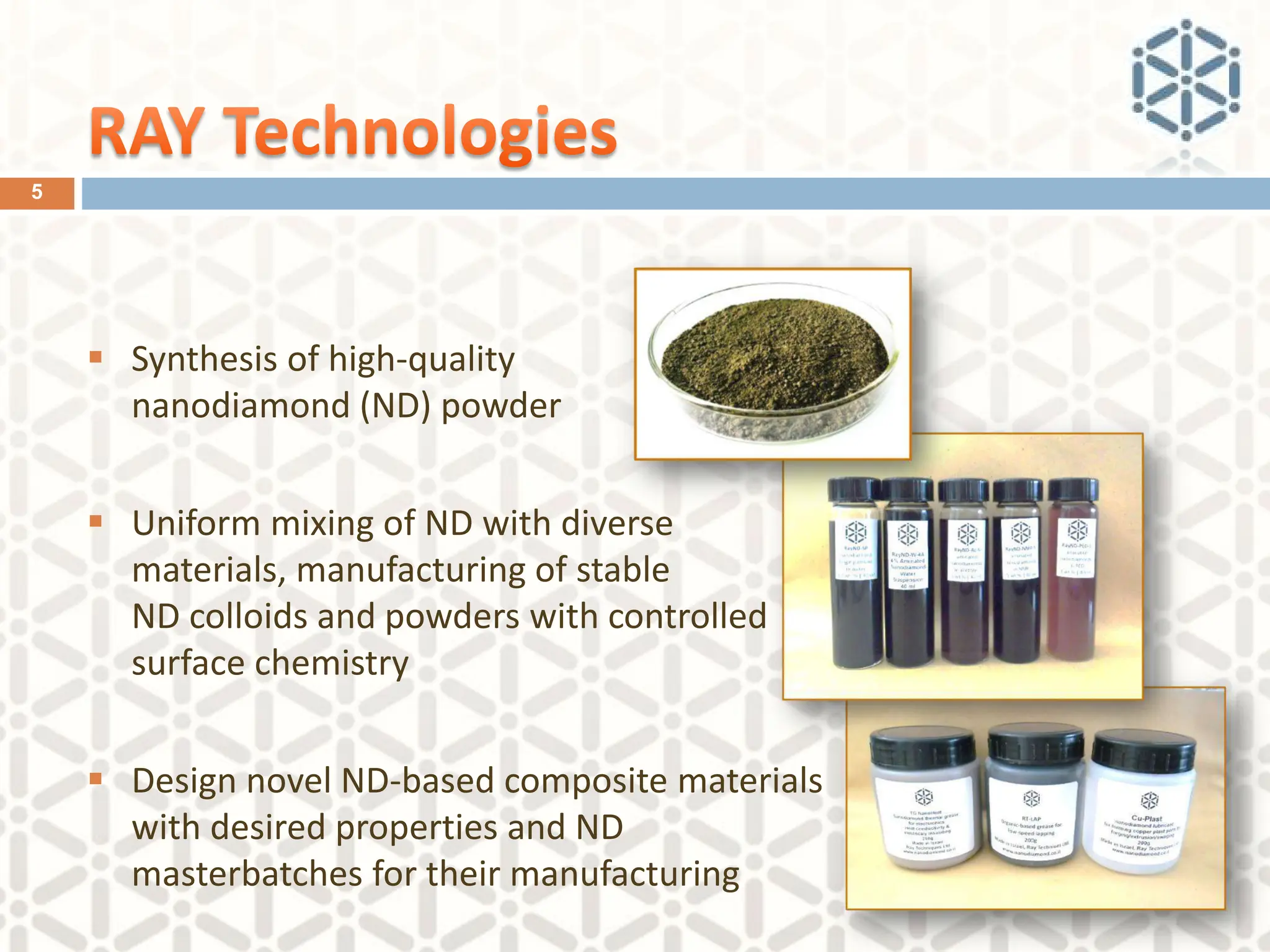
▪ Synthesis of high-quality
nanodiamond (ND) powder
▪ Uniform mixing of ND with diverse
materials, manufacturing of stable
ND colloids and powders with controlled
surface chemistry
▪ Design novel ND-based composite materials
with desired properties and ND
masterbatches for their manufacturing
5
Patents: “Method and system for controlled synthesis of
nanodiamonds”
Patents granted in USA and Japan.
Patent pending: in EU, South Korea and Israel.
Know-how: ND surface functionalization, fabrication of
nanocarbon colloids (including ND, graphene, fullerene, carbon
nanotubes (CNT)
6
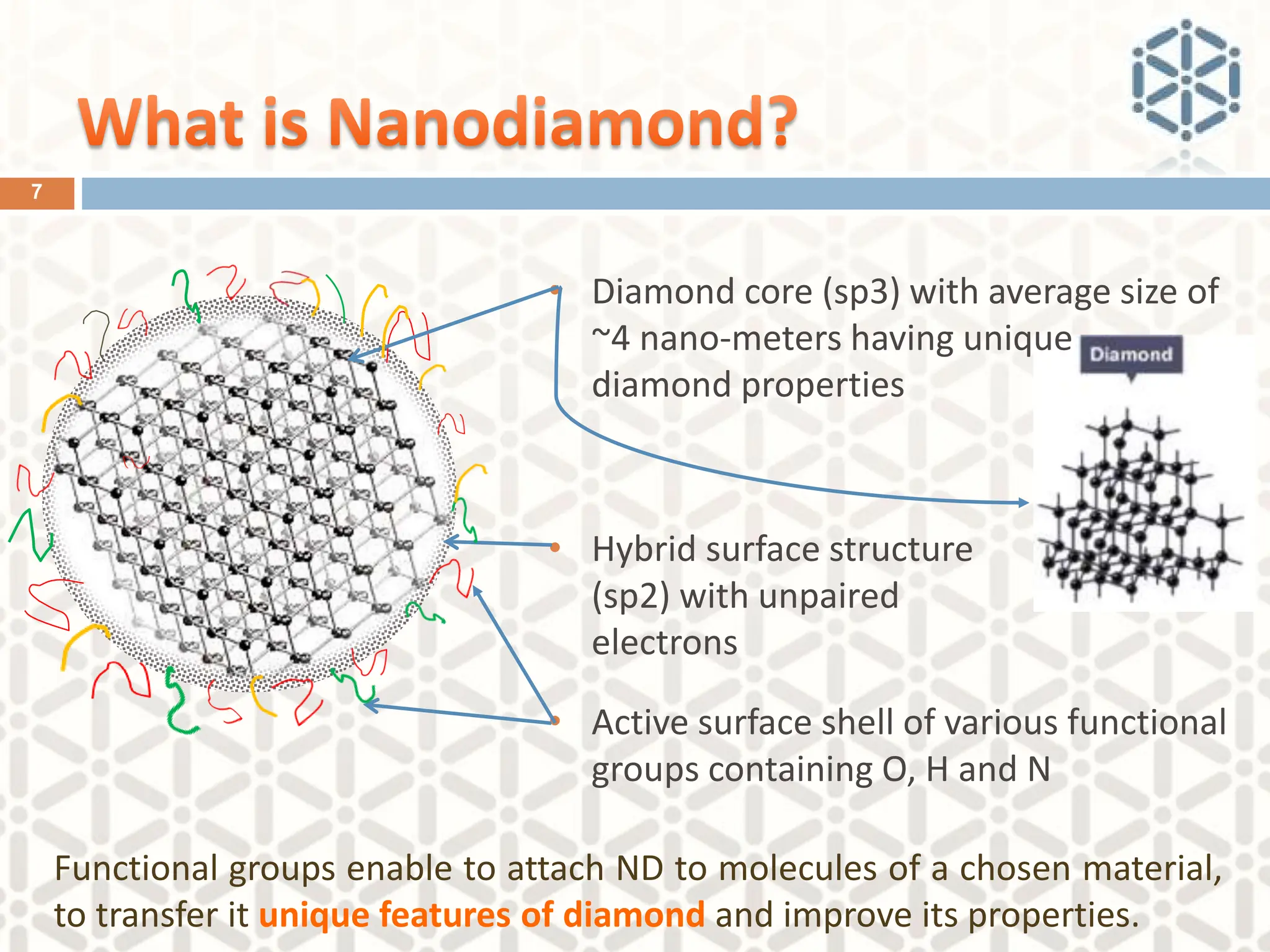
• Diamond core (sp3) with average size of
~4 nano-meters having unique
diamond properties
• Hybrid surface structure
(sp2) with unpaired
electrons
• Active surface shell of various functional
groups containing O, H and N
Functional groups enable to attach ND to molecules of a chosen material,
to transfer it unique features of diamond and improve its properties.
7
Three-dimensional cubic lattice of tetrahedral bonded carbon atoms determine
unique properties of diamond:
• Extreme mechanical hardness 98 GPa {111}
• Highest wear resistance
• Outstanding optical & electronic properties
• Wide band gap {300 K}: 5.47 eV
• Refractive index: 2.419
• Highest thermal conductivity: 2300 W/mK
• Very high electrical insulation: 10¹³ ῼcm
• Highest sound propagation velocity
• Chemical and radiation resistance
• Biological compatibility and non- cytoxity
8
Reinforcing polymer
filler (glues & paints)
Fine polishing abrasive
(magnetic disks?)
Additives in coatings
(galvanic & Electroless)
Additive to lubricants
(oils & greases)
Catalysts in chemistry &
power applications
E
x
i
s
t
i
n
g
N
D
a
p
p
l
i
c
a
t
i
o
n
s
9
Advanced ND applications are still
under development:
✓ Thermal Management
✓ Energy storage
✓ Analytical chemistry
✓ Nano-composite materials with
high radiation resistance
✓ Glass / polymer scratch
protection
✓ High refractive index polymers
✓ Efficient catalysts
✓ Bio-Med: drug delivery /
contrast agent for bio-imaging
1. Detonation of Explosives: commercially available
2. High-Pressure-High-Temperature (HPHT), crashed: commercially
available
3. Chemical Vapor Deposition (CVD), crashed: not economical
4. Other methods of ND Synthesis: not economical
1) Ultrasonic Cavitation (UC)
2) Hydrothermal Synthesis (HTS)
3) Ion Bombardment (IB)
4) Pulse Laser Ablation in liquid (PLAL)
5. Light Hydro-Dynamic Pulse (LHDP) – RAY technology
2
10
1. Non-consistency of ND quality & reactivity caused by ND structure
& the current method of ND synthesis
2. Almost no industrial technologies for ND disaggregation & uniform
mixing with various materials
3. Not enough final ND formulations: most advanced applications are
still under development
4. No fundamental understanding how ND concentration and
structure affect the performance of ND composites
5. No standards for the regulation of ND quality
6. No validation of the developed formulations by big potential
consumers
Presently ND market is still in its initial stage.
11
RAY Technology of ND Synthesis
1
• In contrast to the existing technology the process is
controllable, environment- friendly & non-hazardous
• Production at laboratory / pilot conditions
• Product of the best quality
• Patent protection
• Initial sales
12
1
• Preparation of carbon soot
from pure graphite
2
• Forming special targets from
soot & wax
3
• Laser treatment of special
targets in liquid
4
• ND separation by flotation
method, washing & drying
13
Nanodiamonds of high
purity and homogeneity
14
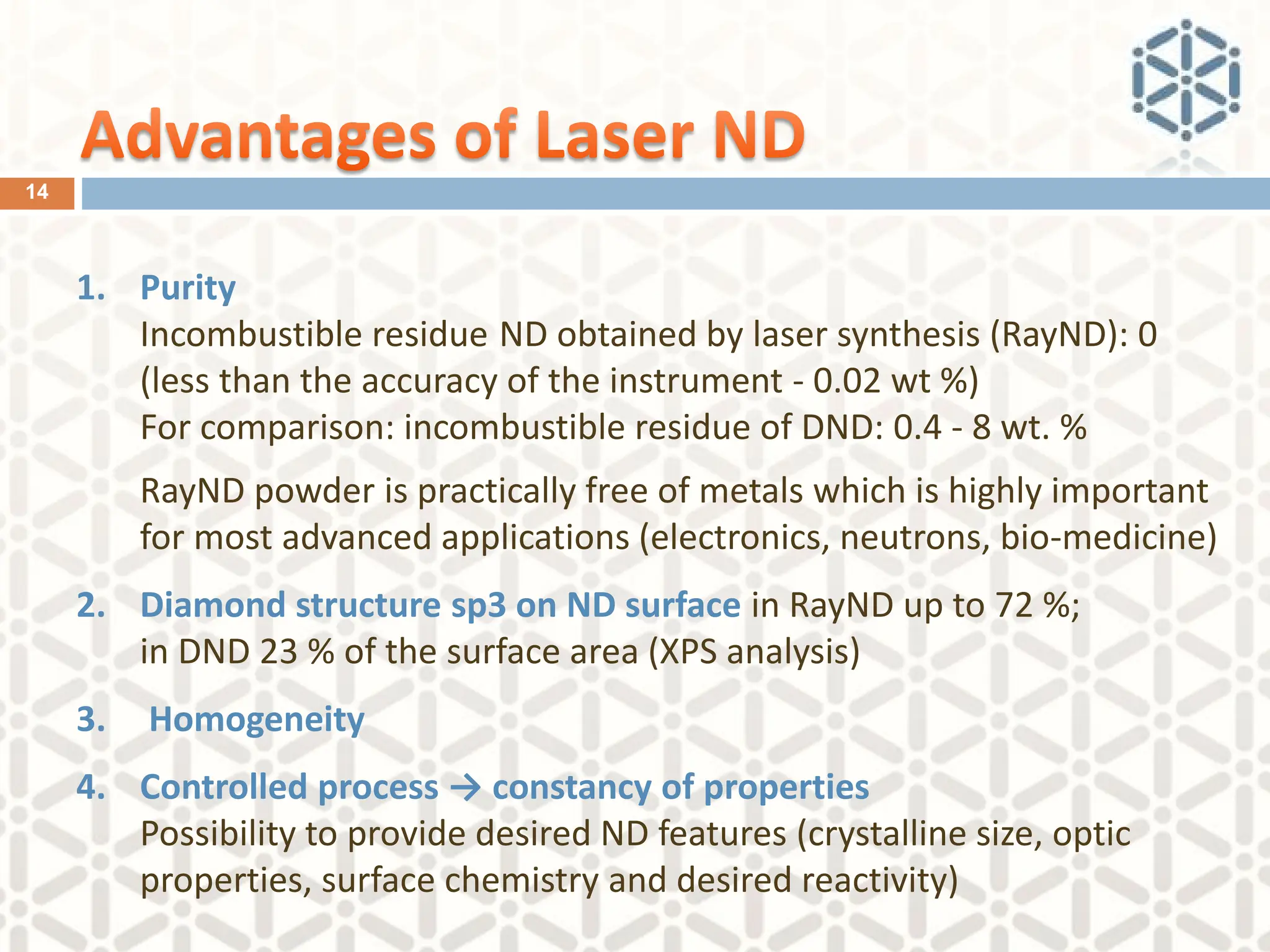
1. Purity
Incombustible residue ND obtained by laser synthesis (RayND): 0
(less than the accuracy of the instrument - 0.02 wt %)
For comparison: incombustible residue of DND: 0.4 - 8 wt. %
RayND powder is practically free of metals which is highly important
for most advanced applications (electronics, neutrons, bio-medicine)
2. Diamond structure sp3 on ND surface in RayND up to 72 %;
in DND 23 % of the surface area (XPS analysis)
3. Homogeneity
4. Controlled process → constancy of properties
Possibility to provide desired ND features (crystalline size, optic
properties, surface chemistry and desired reactivity)
RAY has developed an industrial technology for introducing
ND into various media. Special mechanical, thermal and
chemical ND surface modification results in:
• Covalent bonding with matrix’ molecules (no surfactants!)
• ND disaggregation in diverse solvents
• Uniform distribution in basic material
• High efficiency of ND in the improving performance
RAY Technology of ND Modification
2
15
16
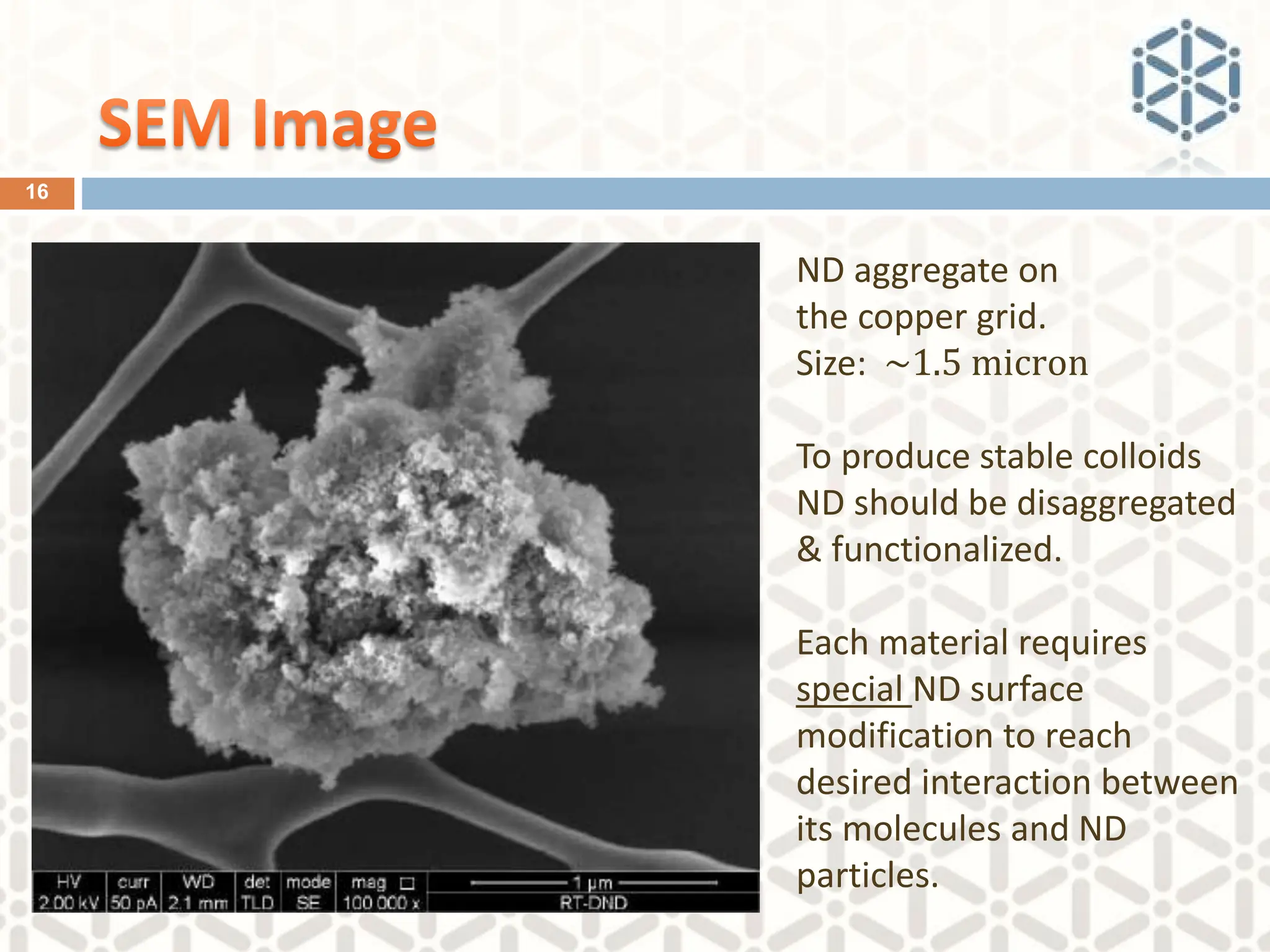
ND aggregate on
the copper grid.
Size: ~1.5 micron
To produce stable colloids
ND should be disaggregated
& functionalized.
Each material requires
special ND surface
modification to reach
desired interaction between
its molecules and ND
particles.
ND Powder with Modified Surface 4-10 wt. % ND Suspensions (Slurries)
17
Specially modified ND powders and slurries are compatible with some
polymers and solvents. They form stable suspensions with nearly
disaggregated diamond nanoparticles by regular mixing, not requiring
additional treatment and / or development.
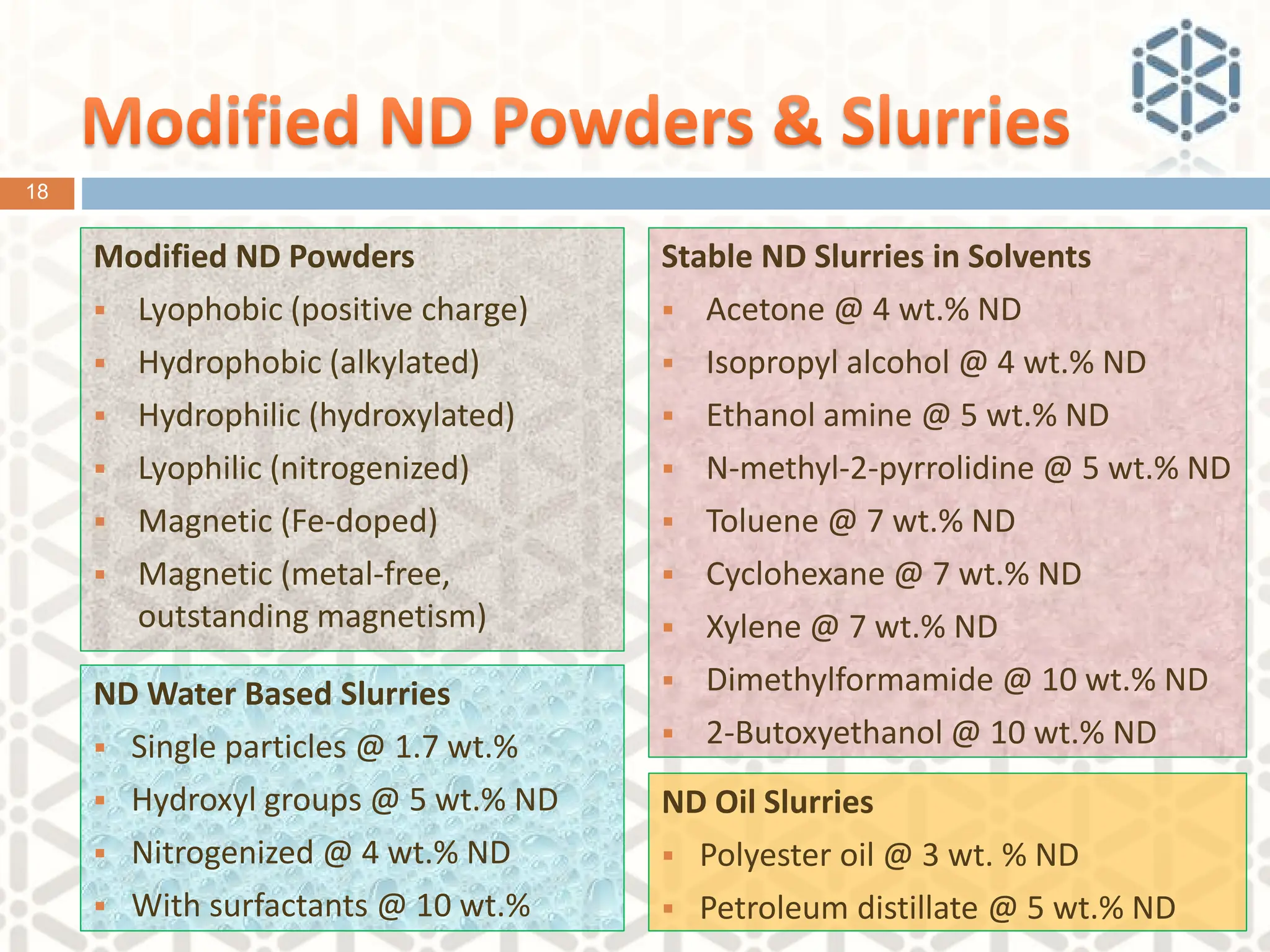
Modified ND Powders
▪ Lyophobic (positive charge)
▪ Hydrophobic (alkylated)
▪ Hydrophilic (hydroxylated)
▪ Lyophilic (nitrogenized)
▪ Magnetic (Fe-doped)
▪ Magnetic (metal-free,
outstanding magnetism)
ND Water Based Slurries
▪ Single particles @ 1.7 wt.%
▪ Hydroxyl groups @ 5 wt.% ND
▪ Nitrogenized @ 4 wt.% ND
▪ With surfactants @ 10 wt.%
Stable ND Slurries in Solvents
▪ Acetone @ 4 wt.% ND
▪ Isopropyl alcohol @ 4 wt.% ND
▪ Ethanol amine @ 5 wt.% ND
▪ N-methyl-2-pyrrolidine @ 5 wt.% ND
▪ Toluene @ 7 wt.% ND
▪ Cyclohexane @ 7 wt.% ND
▪ Xylene @ 7 wt.% ND
▪ Dimethylformamide @ 10 wt.% ND
▪ 2-Butoxyethanol @ 10 wt.% ND
ND Oil Slurries
▪ Polyester oil @ 3 wt. % ND
▪ Petroleum distillate @ 5 wt.% ND
18
▪ Antifriction compounds
▪ Polishing products
▪ Thermal conductive polymer compounds
▪ Coolants for wafers dicing
▪ Seeds for CVD diamond coatings
▪ Galvanic electrolytes
▪ Epoxy and other polymer resins
RAY Final Products: Additives
3
19
Use ND lubricants for lapping /finishing results in significant decrease of the
friction coefficient and high energy savings
• Service life of friction pairs increase by a factor of 3 and more
• Decrease in energy & fuel consumption, around 10 % savings
• Enhanced horsepower and airproof capacity of engines
• Increase in reliability
• Decrease in noise
Physical mechanism:
• Fine polishing
• ND introduce within metal surfaces
and create protective diamond nano-layer
with high wear resistance
• ND in lubricant work as nano-bearings
20
21
RT-Gel, polishing
water-based gel with
high ND concentration
RT-Lap, ND paste for
diamond, sapphire, silicon,
silicon carbide and other
materials polishing
Manufacturers of crystals and wafers are
interested to increase in the productivity
of the polishing process
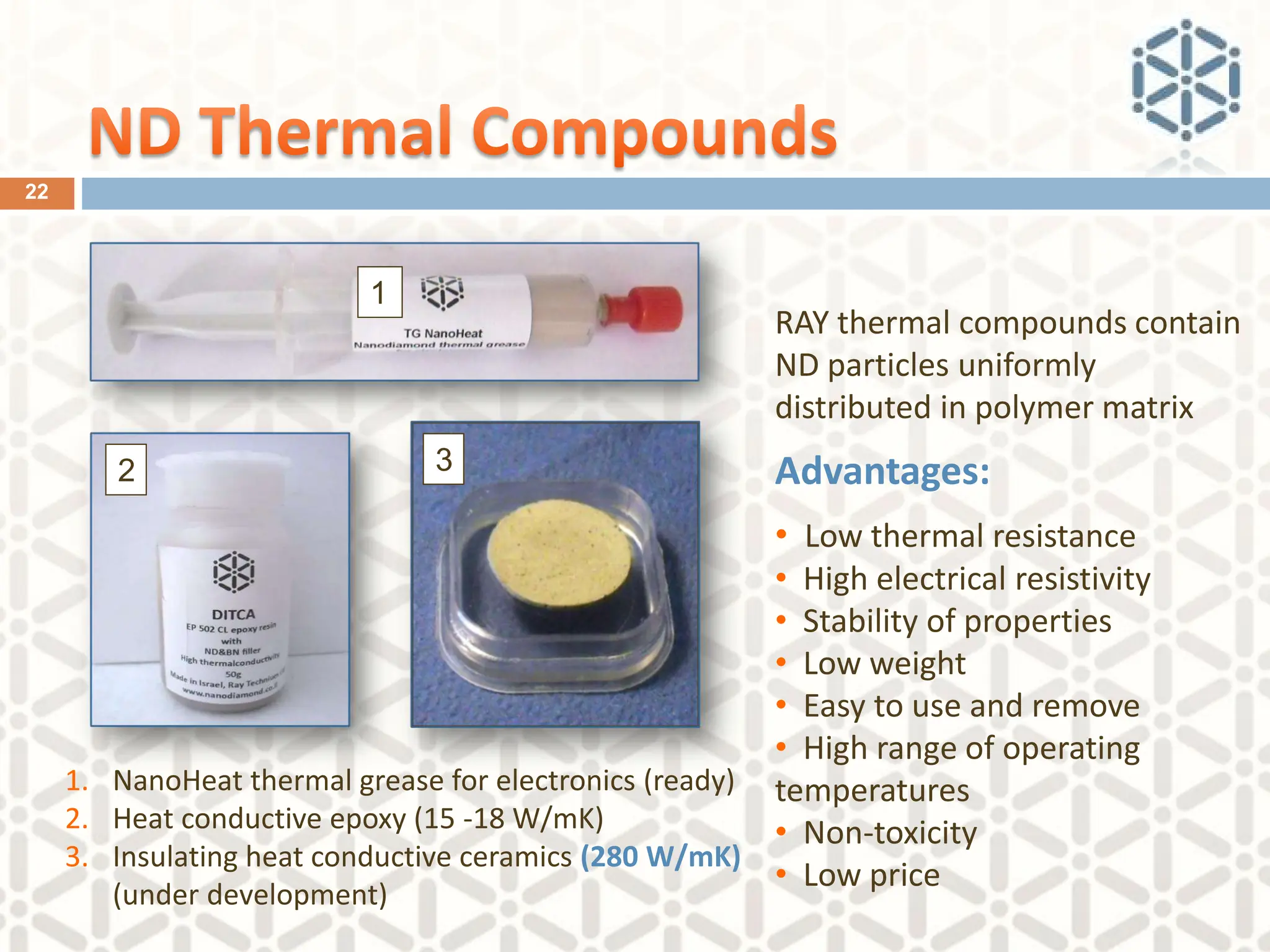
RAY thermal compounds contain
ND particles uniformly
distributed in polymer matrix
Advantages:
• Low thermal resistance
• High electrical resistivity
• Stability of properties
• Low weight
• Easy to use and remove
• High range of operating
temperatures
• Non-toxicity
• Low price
1. NanoHeat thermal grease for electronics (ready)
2. Heat conductive epoxy (15 -18 W/mK)
3. Insulating heat conductive ceramics (280 W/mK)
(under development)
2 3
22
1
Chipping and cracking caused by
overheating when non-treated
water for cooling is used
Lubricating coolant reduces hot &
friction removing chips from the
cutting zone
Coolant Material
RT-Cool-Si Silicon
RT-Cool-SiO2 Glass
23
Advantages in comparison with the existing product:
1) Quality: less micro-cracks and surface layer tensions
2) Tools durability: blade resource increases by 5 times
3) Productivity: speed of dicing can be enhanced significantly
4) Wafer cost: reduces considerably
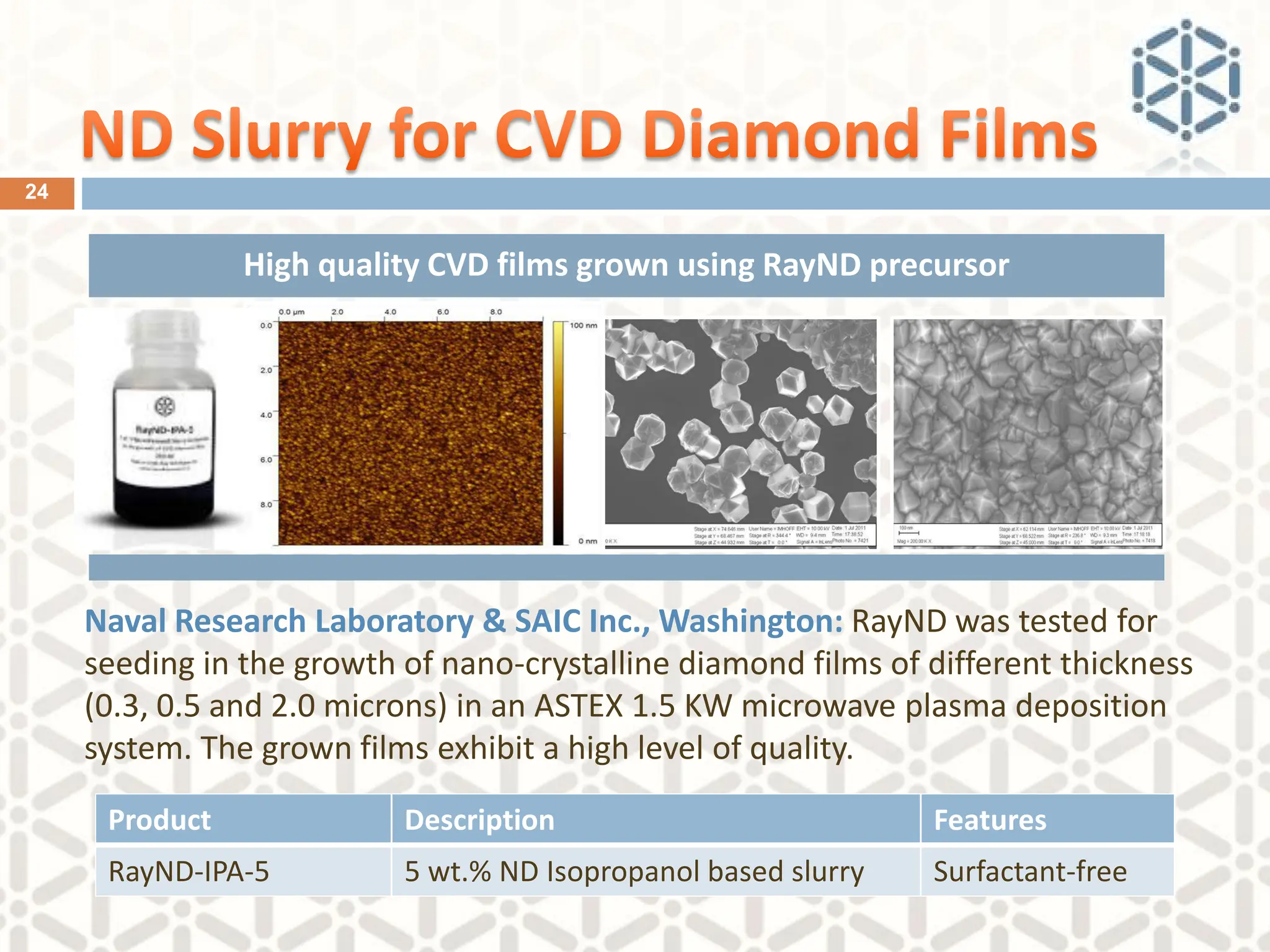
High quality CVD films grown using RayND precursor
Naval Research Laboratory & SAIC Inc., Washington: RayND was tested for
seeding in the growth of nano-crystalline diamond films of different thickness
(0.3, 0.5 and 2.0 microns) in an ASTEX 1.5 KW microwave plasma deposition
system. The grown films exhibit a high level of quality.
Product Description Features
RayND-IPA-5 5 wt.% ND Isopropanol based slurry Surfactant-free
24
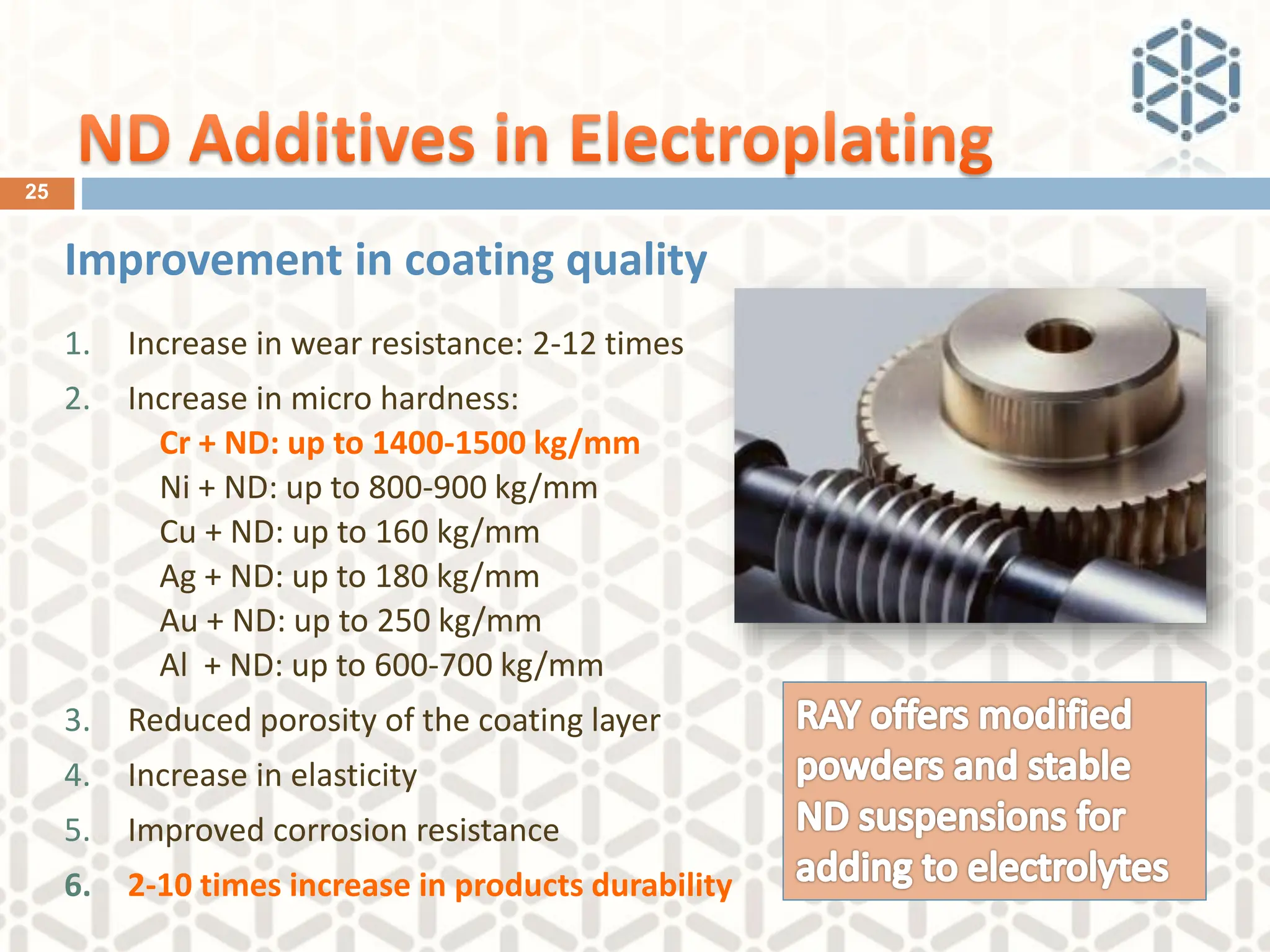
Improvement in coating quality
1. Increase in wear resistance: 2-12 times
2. Increase in micro hardness:
Cr + ND: up to 1400-1500 kg/mm
Ni + ND: up to 800-900 kg/mm
Cu + ND: up to 160 kg/mm
Ag + ND: up to 180 kg/mm
Au + ND: up to 250 kg/mm
Al + ND: up to 600-700 kg/mm
3. Reduced porosity of the coating layer
4. Increase in elasticity
5. Improved corrosion resistance
6. 2-10 times increase in products durability
25
Proposed solution
▪ Uniform dispersing specially modified ND within polymer matrix for
improving mechanical, optical and thermal properties
▪ Synergic effect of using ND and other nanoparticles
Advantages
▪ Improved performance
▪ High reliability / durability: high aging resistance chemical, frost and
radiation resistance, low thermal expansion (induced stresses) ensure
layer consistency, no cracking
▪ Environment: non-toxic (RoHS requirements, simple utilization)
▪ Manufacturability: assembly ease; no special requirements for
storage; low bond-line thickness & layer uniformity
▪ Cost effectiveness: ensure low cost of material
26
CARTHER Project
27
The goal: systematic interdisciplinary study of carbon-based
nanomaterials (particularly ND) for theranostic application:
• Efficiency and specific localization in biological cells depending on
surface chemistry
• Luminescent properties, photo-induced electrical and thermal effects
• Photo-excitation cancer therapy
• Design imaging therapeutic agents
28
RAY motivation:
Involvement in biomed research
Definition of RayND advantages for
bio-medicine
Nano-characterization opportunities
Experience with H2020
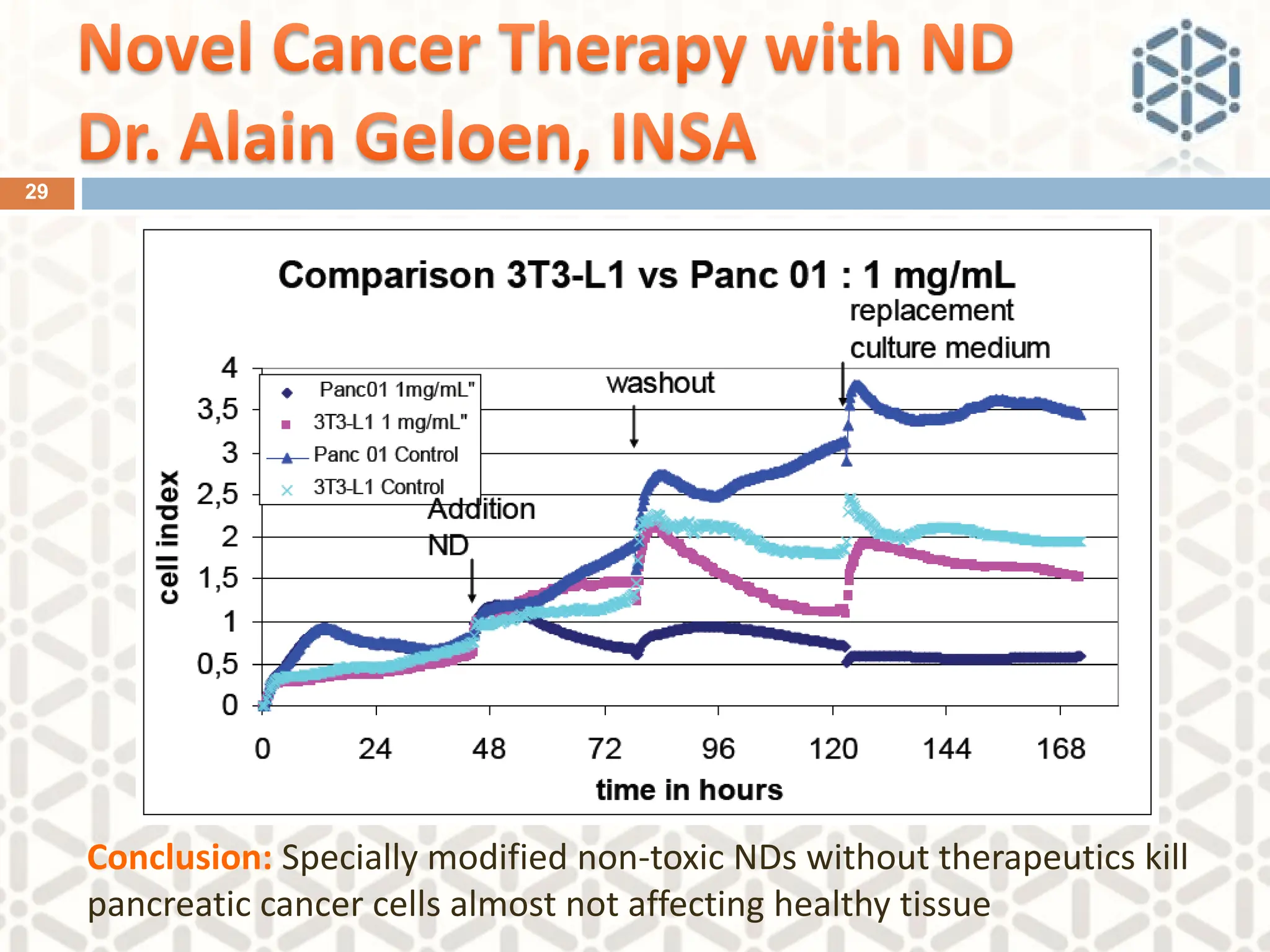
Conclusion: Specially modified non-toxic NDs without therapeutics kill
pancreatic cancer cells almost not affecting healthy tissue
29
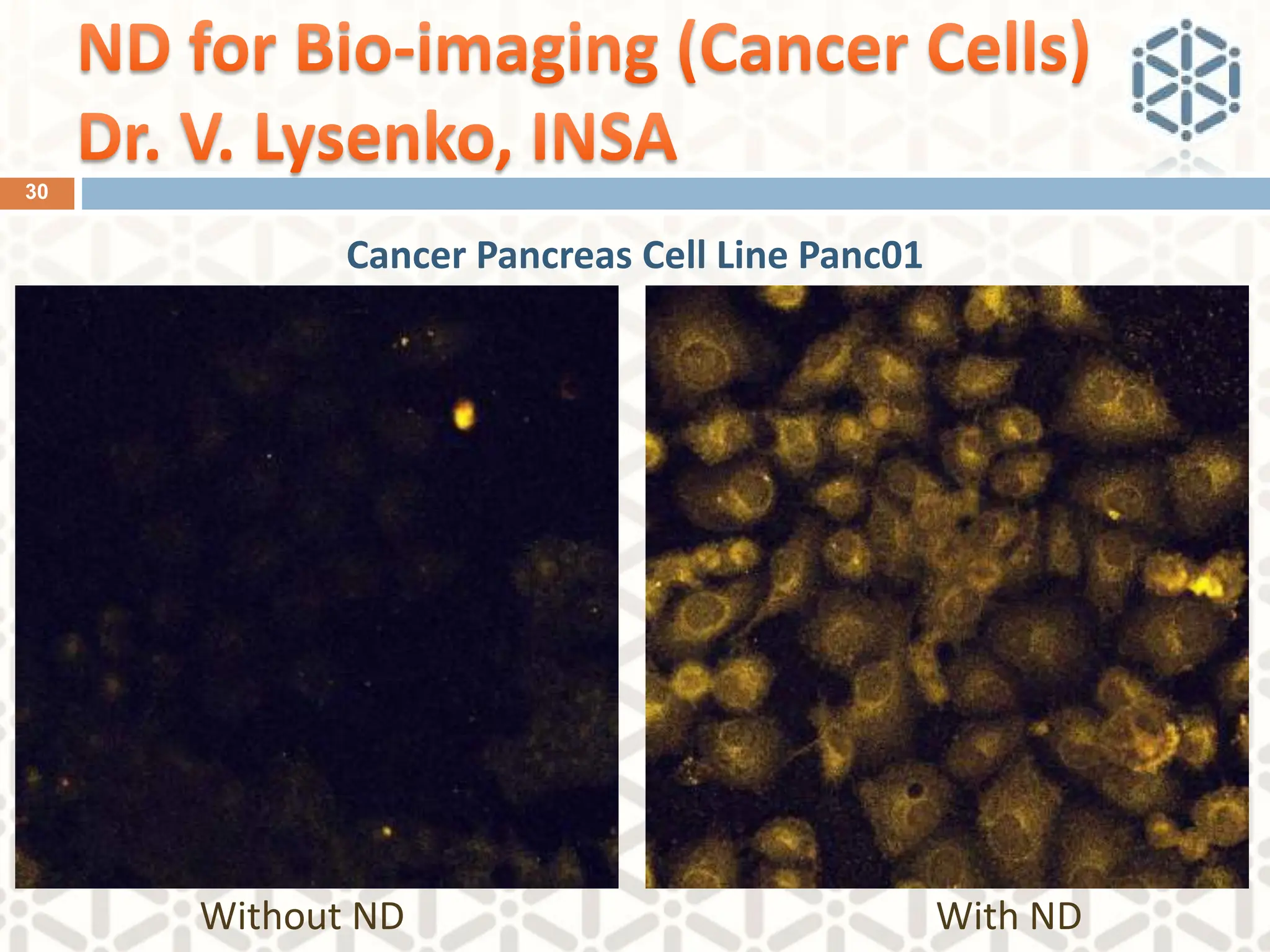
Without ND With ND
Cancer Pancreas Cell Line Panc01
30
Magnetic-modified almost metal free ND were studied for targeted
drug delivery. The goal was to combine advantages of ND and
magnetic nanoparticles.
31
L.-C. Liu, C.-Y. Song, Z.-R. Lin, Y.-C. Lin, A. Karmenyan, S. Norina, O. Levinson, B. Zousman, E.
Perevedentseva, C.-L. Cheng; Annual Meeting of the Physical Society of the Republic of China, 2016
The magnetization curve of RayND-M
(SQUID-VSM vibrating sample magnetometer
PL spectra
RAY has proposed a new mechanism of therapy using ND.
▪ Nano-capsules 100 nm in size (most suitable for passive targeting) filled with
ND with an average size of 4 nm are invasively introduced into the body.
▪ The capsules move with blood flow through healthy tissues and are collected
in the intercellular space of inflammation area due to the size of 80-120 nm.
▪ Then capsule membranes are dissolved. The released NDs are absorbed by
pathological cells freely penetrating through cell membranes.
▪ Some external impact harmless for healthy tissues (e.g. ultrasound or
electromagnetic) should be applied to cause rapid movement of ND inside
the cells or heating, resulting in mechanical / thermal destruction of cells.
▪ Then NDs leave the inflammation area with what's left of the pathological
cells not affecting healthy tissues.
▪ The process can be controlled using existing in-vivo-imaging instrumentation.
32
The frame: Horizon 2020 program H2020-SMEInst-2017
Phase 1: feasibility study and writing Business Plan
PANDA Project
33
1. Full industrial technological chain for fabrication highly pure and
uniform ND and efficient ND additives for
• Fine polishing (sapphire wafers, optical crystals, internal surfaces of
thin tubes)
• Lubricants
• Various coatings
• Diverse polymer compounds (improving wear, antiaging, radiation &
frost resistance, thermal conductivity and electrical resistivity, etc.)
• Biomedicine (cancer treatment, early diagnostics, cell imaging)
2. Scaling of RAY technology and foundation of mass production
3. Business strategy and Business Plan
34
▪ ND laser synthesis: advisability of scaling
1. Production capability more than 100 kg ND monthly
2. ND line should be operated by maximum 3 workers: soot
production, target preparation and its delivery to the laser
irradiation zone and post-synthesis treatment (isolation,
washing & drying).
3. The key factor: possibility to optimize laser beam parameters
increasing in the output by the factor of 200.
▪ PANDA: principal design of 2 manufacturing lines: for ND synthesis
and for manufacturing of ND additives
▪ Market research, business strategy and Business Plan
35
36
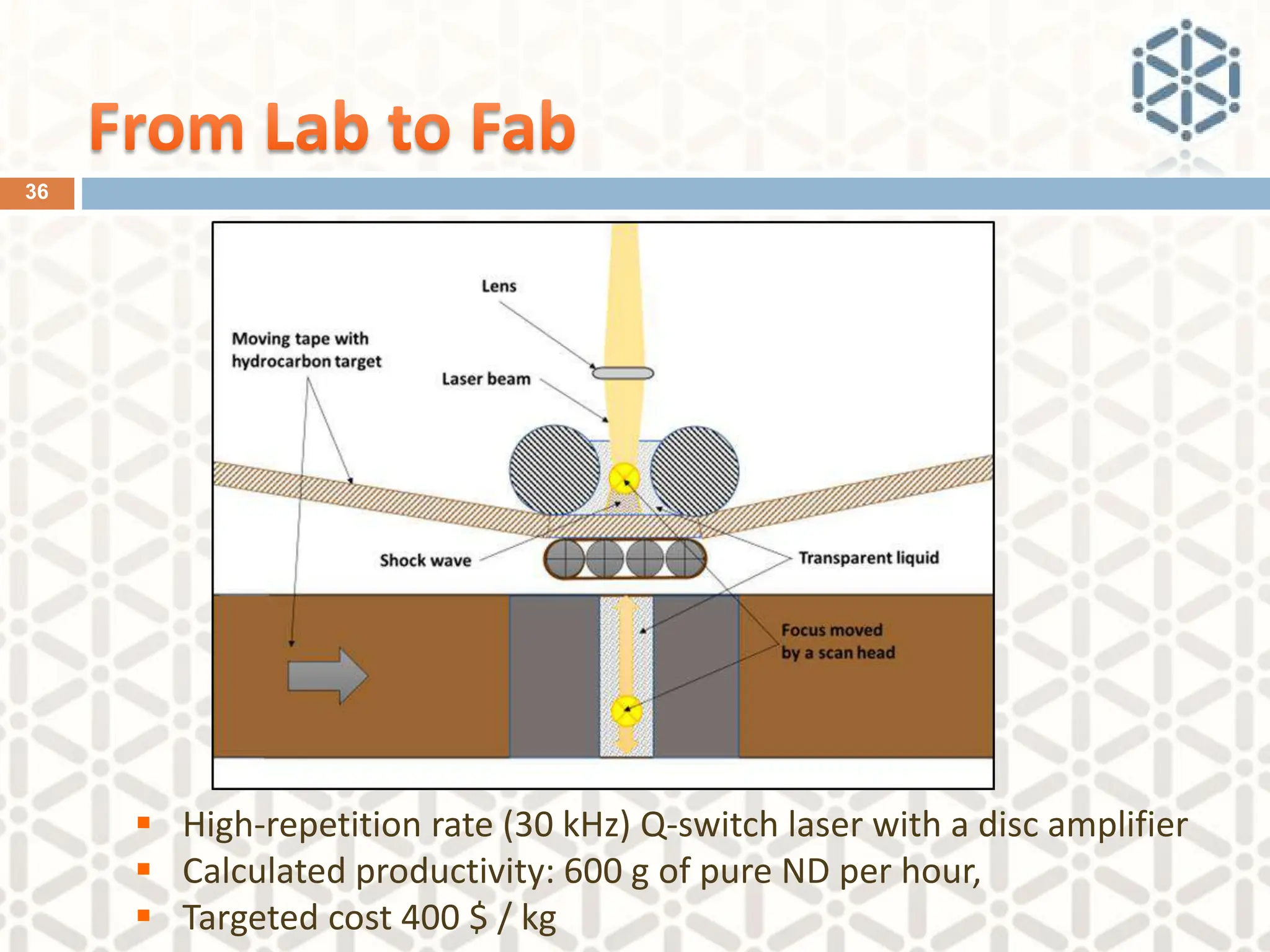
▪ High-repetition rate (30 kHz) Q-switch laser with a disc amplifier
▪ Calculated productivity: 600 g of pure ND per hour,
▪ Targeted cost 400 $ / kg
1. Aggressive marketing: the first step 5 project / product managers: 1)
polymers, 2) polishing slurries and pastes, 3) additives lubricants, 4)
additives to galvanic and other coatings, 5) coordination of Biomed
research, providing ND samples
2. Establishing PANDA Manufacturing Line for upgrading purchased ND
and producing ready-to-use additives in the form of modified
powders, slurries and masterbatches
3. Establishing Laser ND Manufacturing Line (LaND) for providing PANDA
Line with raw material and bio-med research market
4. Development of novel ND-based products for various industries,
patenting of final formulations & licensing
5. Participation in joint R&D programs in the field of ND applications
with leading academia groups and industrial partners
37
38
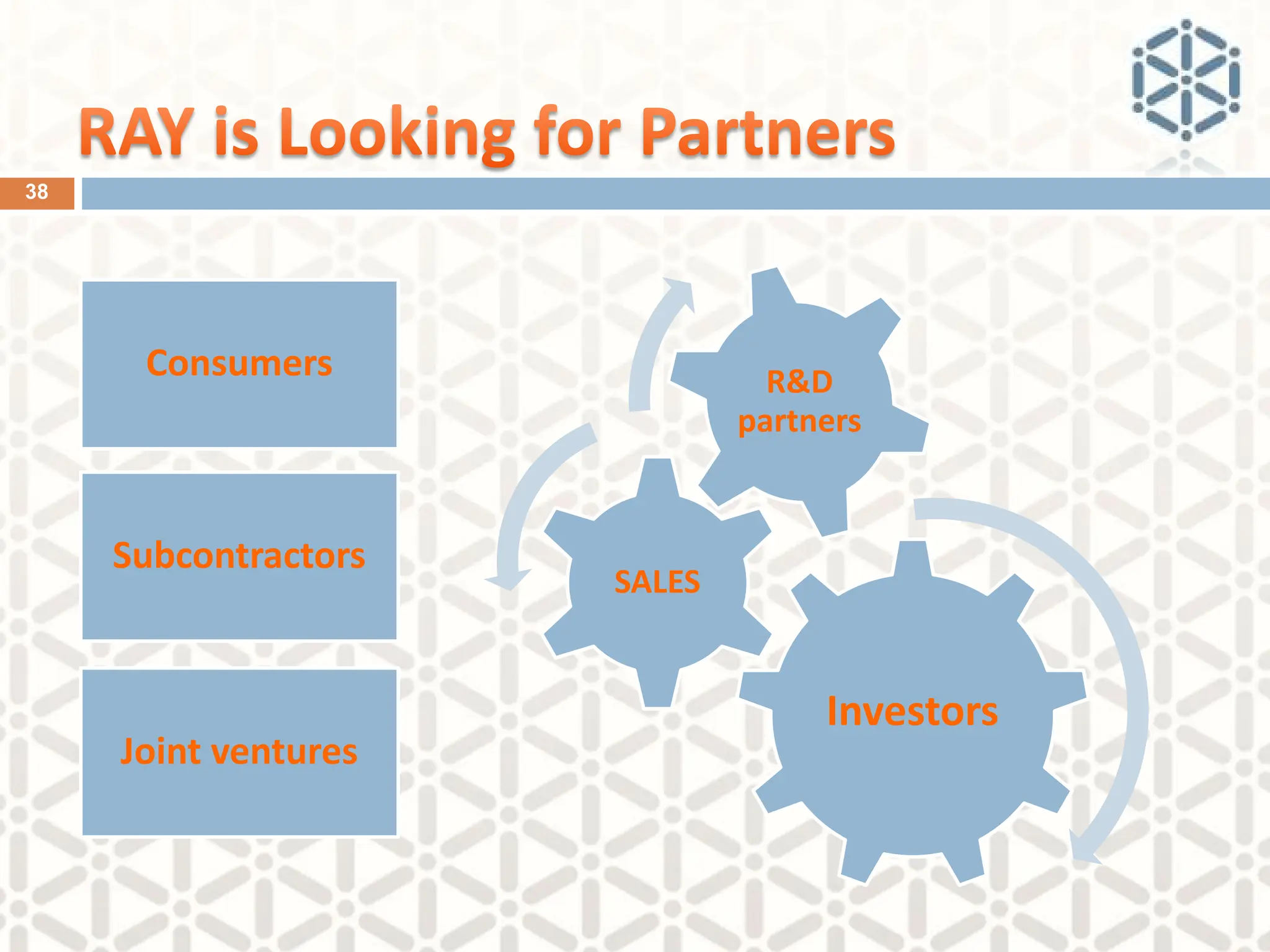
Consumers
Subcontractors
Joint ventures
Investors
SALES
R&D
partners
• Unique RAY Technology
• Market demand in wide range of applications
• Already established contacts with leading players in the market
• Final products already developed and tested
• Promising preliminary results in new applications
• Various joint R&D opportunities => international research
cooperation programs
• Unique RT team expertise combination enabling implementation
of various technological projects
• Unique combination DIAMOND + NANO + Israeli Start-up
39
• Nanodiamond edited by Prof.
Oliver Williams, RSC Nanoscience
& Nanotechnology, London, 2014
• Chapter 5: Pure nanodiamonds
produced by laser-assisted
technique, B. Zousman and O.
Levinson, Ray Techniques Ltd.
• Contact:
olga.levinson@nanodiamond.co.il
40

Nanodiamonds of Laser syntehsis Ray tech

  • 2.
    ▪ Introduction ofthe company ▪ What is nanodiamond (ND), methods of ND fabrication and Market overview ▪ Technology of Laser ND Synthesis ▪ ND surface modification and fabrication of slurries ▪ CARTHER project (CARbon nanoparticles for THERanostic applications) ▪ PANDA project (Production of Advanced Nano-Diamond Additives) ▪ Looking for partners 2
  • 3.
    1. Private Israelicompany # 514305671 2. Established in August 2009 in Jerusalem, Israel 3. Scope: nanodiamond (ND) technologies 4. Website: www.nanodiamond.co.il 5. Member of Israel Association of Manufacturers 6. Licensed supplier of Israel Ministry of Defense 7. Employees: 6 Ray Techniques Ltd, Introduction Boris Zousman, main developer of RAY technologies 3
  • 4.
    • The problemswe solve • ND powders in the Market are of non-constant quality, complicated to use in industrial scale and expensive; • No industrial technologies for ND disaggregation & mixing; • Insufficient number of validated ND formulations. • Our mission is to provide consumers in various fields of industry, energy, science & medicine with ready-to-use and efficient ND additives to diverse materials and processes. 4
  • 5.
    ▪ Synthesis ofhigh-quality nanodiamond (ND) powder ▪ Uniform mixing of ND with diverse materials, manufacturing of stable ND colloids and powders with controlled surface chemistry ▪ Design novel ND-based composite materials with desired properties and ND masterbatches for their manufacturing 5
  • 6.
    Patents: “Method andsystem for controlled synthesis of nanodiamonds” Patents granted in USA and Japan. Patent pending: in EU, South Korea and Israel. Know-how: ND surface functionalization, fabrication of nanocarbon colloids (including ND, graphene, fullerene, carbon nanotubes (CNT) 6
  • 7.
    • Diamond core(sp3) with average size of ~4 nano-meters having unique diamond properties • Hybrid surface structure (sp2) with unpaired electrons • Active surface shell of various functional groups containing O, H and N Functional groups enable to attach ND to molecules of a chosen material, to transfer it unique features of diamond and improve its properties. 7
  • 8.
    Three-dimensional cubic latticeof tetrahedral bonded carbon atoms determine unique properties of diamond: • Extreme mechanical hardness 98 GPa {111} • Highest wear resistance • Outstanding optical & electronic properties • Wide band gap {300 K}: 5.47 eV • Refractive index: 2.419 • Highest thermal conductivity: 2300 W/mK • Very high electrical insulation: 10¹³ ῼcm • Highest sound propagation velocity • Chemical and radiation resistance • Biological compatibility and non- cytoxity 8
  • 9.
    Reinforcing polymer filler (glues& paints) Fine polishing abrasive (magnetic disks?) Additives in coatings (galvanic & Electroless) Additive to lubricants (oils & greases) Catalysts in chemistry & power applications E x i s t i n g N D a p p l i c a t i o n s 9 Advanced ND applications are still under development: ✓ Thermal Management ✓ Energy storage ✓ Analytical chemistry ✓ Nano-composite materials with high radiation resistance ✓ Glass / polymer scratch protection ✓ High refractive index polymers ✓ Efficient catalysts ✓ Bio-Med: drug delivery / contrast agent for bio-imaging
  • 10.
    1. Detonation ofExplosives: commercially available 2. High-Pressure-High-Temperature (HPHT), crashed: commercially available 3. Chemical Vapor Deposition (CVD), crashed: not economical 4. Other methods of ND Synthesis: not economical 1) Ultrasonic Cavitation (UC) 2) Hydrothermal Synthesis (HTS) 3) Ion Bombardment (IB) 4) Pulse Laser Ablation in liquid (PLAL) 5. Light Hydro-Dynamic Pulse (LHDP) – RAY technology 2 10
  • 11.
    1. Non-consistency ofND quality & reactivity caused by ND structure & the current method of ND synthesis 2. Almost no industrial technologies for ND disaggregation & uniform mixing with various materials 3. Not enough final ND formulations: most advanced applications are still under development 4. No fundamental understanding how ND concentration and structure affect the performance of ND composites 5. No standards for the regulation of ND quality 6. No validation of the developed formulations by big potential consumers Presently ND market is still in its initial stage. 11
  • 12.
    RAY Technology ofND Synthesis 1 • In contrast to the existing technology the process is controllable, environment- friendly & non-hazardous • Production at laboratory / pilot conditions • Product of the best quality • Patent protection • Initial sales 12
  • 13.
    1 • Preparation ofcarbon soot from pure graphite 2 • Forming special targets from soot & wax 3 • Laser treatment of special targets in liquid 4 • ND separation by flotation method, washing & drying 13 Nanodiamonds of high purity and homogeneity
  • 14.
    14 1. Purity Incombustible residueND obtained by laser synthesis (RayND): 0 (less than the accuracy of the instrument - 0.02 wt %) For comparison: incombustible residue of DND: 0.4 - 8 wt. % RayND powder is practically free of metals which is highly important for most advanced applications (electronics, neutrons, bio-medicine) 2. Diamond structure sp3 on ND surface in RayND up to 72 %; in DND 23 % of the surface area (XPS analysis) 3. Homogeneity 4. Controlled process → constancy of properties Possibility to provide desired ND features (crystalline size, optic properties, surface chemistry and desired reactivity)
  • 15.
    RAY has developedan industrial technology for introducing ND into various media. Special mechanical, thermal and chemical ND surface modification results in: • Covalent bonding with matrix’ molecules (no surfactants!) • ND disaggregation in diverse solvents • Uniform distribution in basic material • High efficiency of ND in the improving performance RAY Technology of ND Modification 2 15
  • 16.
    16 ND aggregate on thecopper grid. Size: ~1.5 micron To produce stable colloids ND should be disaggregated & functionalized. Each material requires special ND surface modification to reach desired interaction between its molecules and ND particles.
  • 17.
    ND Powder withModified Surface 4-10 wt. % ND Suspensions (Slurries) 17 Specially modified ND powders and slurries are compatible with some polymers and solvents. They form stable suspensions with nearly disaggregated diamond nanoparticles by regular mixing, not requiring additional treatment and / or development.
  • 18.
    Modified ND Powders ▪Lyophobic (positive charge) ▪ Hydrophobic (alkylated) ▪ Hydrophilic (hydroxylated) ▪ Lyophilic (nitrogenized) ▪ Magnetic (Fe-doped) ▪ Magnetic (metal-free, outstanding magnetism) ND Water Based Slurries ▪ Single particles @ 1.7 wt.% ▪ Hydroxyl groups @ 5 wt.% ND ▪ Nitrogenized @ 4 wt.% ND ▪ With surfactants @ 10 wt.% Stable ND Slurries in Solvents ▪ Acetone @ 4 wt.% ND ▪ Isopropyl alcohol @ 4 wt.% ND ▪ Ethanol amine @ 5 wt.% ND ▪ N-methyl-2-pyrrolidine @ 5 wt.% ND ▪ Toluene @ 7 wt.% ND ▪ Cyclohexane @ 7 wt.% ND ▪ Xylene @ 7 wt.% ND ▪ Dimethylformamide @ 10 wt.% ND ▪ 2-Butoxyethanol @ 10 wt.% ND ND Oil Slurries ▪ Polyester oil @ 3 wt. % ND ▪ Petroleum distillate @ 5 wt.% ND 18
  • 19.
    ▪ Antifriction compounds ▪Polishing products ▪ Thermal conductive polymer compounds ▪ Coolants for wafers dicing ▪ Seeds for CVD diamond coatings ▪ Galvanic electrolytes ▪ Epoxy and other polymer resins RAY Final Products: Additives 3 19
  • 20.
    Use ND lubricantsfor lapping /finishing results in significant decrease of the friction coefficient and high energy savings • Service life of friction pairs increase by a factor of 3 and more • Decrease in energy & fuel consumption, around 10 % savings • Enhanced horsepower and airproof capacity of engines • Increase in reliability • Decrease in noise Physical mechanism: • Fine polishing • ND introduce within metal surfaces and create protective diamond nano-layer with high wear resistance • ND in lubricant work as nano-bearings 20
  • 21.
    21 RT-Gel, polishing water-based gelwith high ND concentration RT-Lap, ND paste for diamond, sapphire, silicon, silicon carbide and other materials polishing Manufacturers of crystals and wafers are interested to increase in the productivity of the polishing process
  • 22.
    RAY thermal compoundscontain ND particles uniformly distributed in polymer matrix Advantages: • Low thermal resistance • High electrical resistivity • Stability of properties • Low weight • Easy to use and remove • High range of operating temperatures • Non-toxicity • Low price 1. NanoHeat thermal grease for electronics (ready) 2. Heat conductive epoxy (15 -18 W/mK) 3. Insulating heat conductive ceramics (280 W/mK) (under development) 2 3 22 1
  • 23.
    Chipping and crackingcaused by overheating when non-treated water for cooling is used Lubricating coolant reduces hot & friction removing chips from the cutting zone Coolant Material RT-Cool-Si Silicon RT-Cool-SiO2 Glass 23 Advantages in comparison with the existing product: 1) Quality: less micro-cracks and surface layer tensions 2) Tools durability: blade resource increases by 5 times 3) Productivity: speed of dicing can be enhanced significantly 4) Wafer cost: reduces considerably
  • 24.
    High quality CVDfilms grown using RayND precursor Naval Research Laboratory & SAIC Inc., Washington: RayND was tested for seeding in the growth of nano-crystalline diamond films of different thickness (0.3, 0.5 and 2.0 microns) in an ASTEX 1.5 KW microwave plasma deposition system. The grown films exhibit a high level of quality. Product Description Features RayND-IPA-5 5 wt.% ND Isopropanol based slurry Surfactant-free 24
  • 25.
    Improvement in coatingquality 1. Increase in wear resistance: 2-12 times 2. Increase in micro hardness: Cr + ND: up to 1400-1500 kg/mm Ni + ND: up to 800-900 kg/mm Cu + ND: up to 160 kg/mm Ag + ND: up to 180 kg/mm Au + ND: up to 250 kg/mm Al + ND: up to 600-700 kg/mm 3. Reduced porosity of the coating layer 4. Increase in elasticity 5. Improved corrosion resistance 6. 2-10 times increase in products durability 25
  • 26.
    Proposed solution ▪ Uniformdispersing specially modified ND within polymer matrix for improving mechanical, optical and thermal properties ▪ Synergic effect of using ND and other nanoparticles Advantages ▪ Improved performance ▪ High reliability / durability: high aging resistance chemical, frost and radiation resistance, low thermal expansion (induced stresses) ensure layer consistency, no cracking ▪ Environment: non-toxic (RoHS requirements, simple utilization) ▪ Manufacturability: assembly ease; no special requirements for storage; low bond-line thickness & layer uniformity ▪ Cost effectiveness: ensure low cost of material 26
  • 27.
  • 28.
    The goal: systematicinterdisciplinary study of carbon-based nanomaterials (particularly ND) for theranostic application: • Efficiency and specific localization in biological cells depending on surface chemistry • Luminescent properties, photo-induced electrical and thermal effects • Photo-excitation cancer therapy • Design imaging therapeutic agents 28 RAY motivation: Involvement in biomed research Definition of RayND advantages for bio-medicine Nano-characterization opportunities Experience with H2020
  • 29.
    Conclusion: Specially modifiednon-toxic NDs without therapeutics kill pancreatic cancer cells almost not affecting healthy tissue 29
  • 30.
    Without ND WithND Cancer Pancreas Cell Line Panc01 30
  • 31.
    Magnetic-modified almost metalfree ND were studied for targeted drug delivery. The goal was to combine advantages of ND and magnetic nanoparticles. 31 L.-C. Liu, C.-Y. Song, Z.-R. Lin, Y.-C. Lin, A. Karmenyan, S. Norina, O. Levinson, B. Zousman, E. Perevedentseva, C.-L. Cheng; Annual Meeting of the Physical Society of the Republic of China, 2016 The magnetization curve of RayND-M (SQUID-VSM vibrating sample magnetometer PL spectra
  • 32.
    RAY has proposeda new mechanism of therapy using ND. ▪ Nano-capsules 100 nm in size (most suitable for passive targeting) filled with ND with an average size of 4 nm are invasively introduced into the body. ▪ The capsules move with blood flow through healthy tissues and are collected in the intercellular space of inflammation area due to the size of 80-120 nm. ▪ Then capsule membranes are dissolved. The released NDs are absorbed by pathological cells freely penetrating through cell membranes. ▪ Some external impact harmless for healthy tissues (e.g. ultrasound or electromagnetic) should be applied to cause rapid movement of ND inside the cells or heating, resulting in mechanical / thermal destruction of cells. ▪ Then NDs leave the inflammation area with what's left of the pathological cells not affecting healthy tissues. ▪ The process can be controlled using existing in-vivo-imaging instrumentation. 32
  • 33.
    The frame: Horizon2020 program H2020-SMEInst-2017 Phase 1: feasibility study and writing Business Plan PANDA Project 33
  • 34.
    1. Full industrialtechnological chain for fabrication highly pure and uniform ND and efficient ND additives for • Fine polishing (sapphire wafers, optical crystals, internal surfaces of thin tubes) • Lubricants • Various coatings • Diverse polymer compounds (improving wear, antiaging, radiation & frost resistance, thermal conductivity and electrical resistivity, etc.) • Biomedicine (cancer treatment, early diagnostics, cell imaging) 2. Scaling of RAY technology and foundation of mass production 3. Business strategy and Business Plan 34
  • 35.
    ▪ ND lasersynthesis: advisability of scaling 1. Production capability more than 100 kg ND monthly 2. ND line should be operated by maximum 3 workers: soot production, target preparation and its delivery to the laser irradiation zone and post-synthesis treatment (isolation, washing & drying). 3. The key factor: possibility to optimize laser beam parameters increasing in the output by the factor of 200. ▪ PANDA: principal design of 2 manufacturing lines: for ND synthesis and for manufacturing of ND additives ▪ Market research, business strategy and Business Plan 35
  • 36.
    36 ▪ High-repetition rate(30 kHz) Q-switch laser with a disc amplifier ▪ Calculated productivity: 600 g of pure ND per hour, ▪ Targeted cost 400 $ / kg
  • 37.
    1. Aggressive marketing:the first step 5 project / product managers: 1) polymers, 2) polishing slurries and pastes, 3) additives lubricants, 4) additives to galvanic and other coatings, 5) coordination of Biomed research, providing ND samples 2. Establishing PANDA Manufacturing Line for upgrading purchased ND and producing ready-to-use additives in the form of modified powders, slurries and masterbatches 3. Establishing Laser ND Manufacturing Line (LaND) for providing PANDA Line with raw material and bio-med research market 4. Development of novel ND-based products for various industries, patenting of final formulations & licensing 5. Participation in joint R&D programs in the field of ND applications with leading academia groups and industrial partners 37
  • 38.
  • 39.
    • Unique RAYTechnology • Market demand in wide range of applications • Already established contacts with leading players in the market • Final products already developed and tested • Promising preliminary results in new applications • Various joint R&D opportunities => international research cooperation programs • Unique RT team expertise combination enabling implementation of various technological projects • Unique combination DIAMOND + NANO + Israeli Start-up 39
  • 40.
    • Nanodiamond editedby Prof. Oliver Williams, RSC Nanoscience & Nanotechnology, London, 2014 • Chapter 5: Pure nanodiamonds produced by laser-assisted technique, B. Zousman and O. Levinson, Ray Techniques Ltd. • Contact: olga.levinson@nanodiamond.co.il 40