United Nations A/67/88–E/2012/75 
General Assembly 
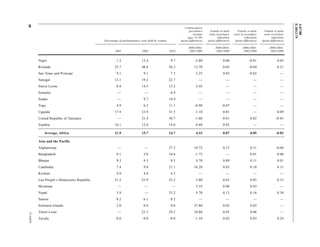
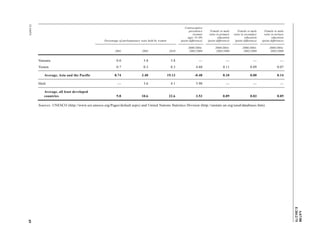
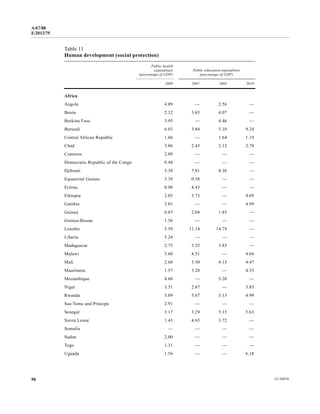
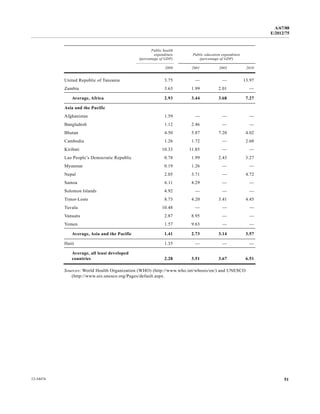
Economic and Social Council 
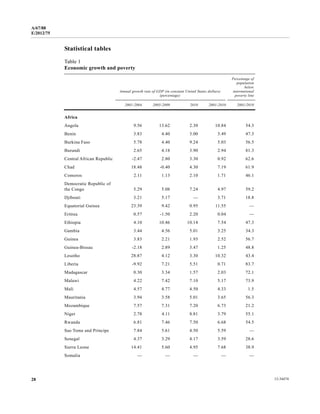
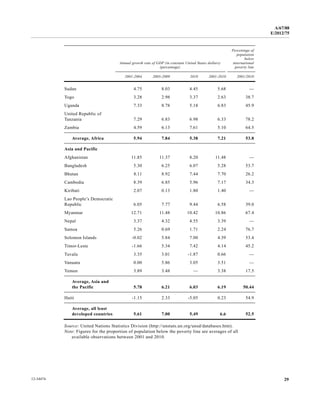
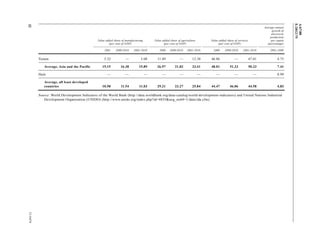
Distr.: General 
17 May 2012 
Original: English 
General Assembly Economic and Social Council 
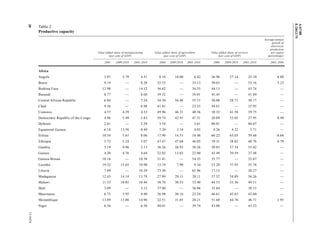
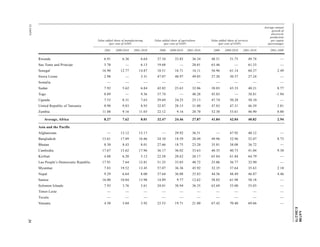
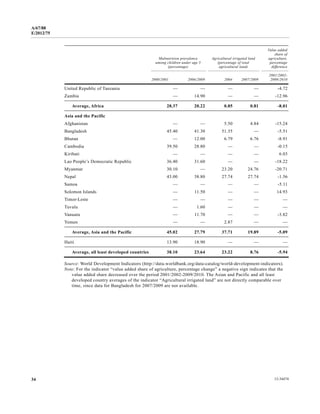
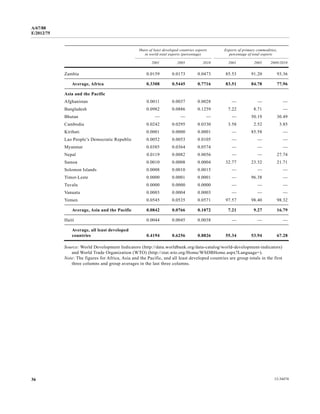
Sixty-seventh session 
Item 24 (a) of the preliminary list* 
Groups of countries in special situations: follow-up to 
the Fourth United Nations Conference on the Least 
Developed Countries 
12-34474 (E) 050712 
*1234474* 
Substantive session of 2012 
New York, 2-27 July 2012 
Item 6 (b) of the provisional agenda** 
Implementation of and follow-up to major 
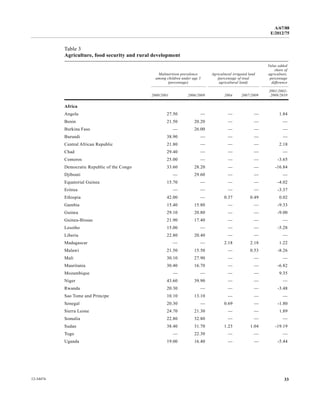
international United Nations conferences and 
summits: review and coordination of the 
implementation of the Istanbul Programme of 
Action for the Least Developed Countries for 
the Decade 2011-2020 
Implementation of the Programme of Action for the Least 
Developed Countries for the Decade 2011 to 2020 
Report of the Secretary-General 
Summary 
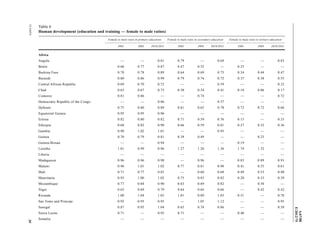
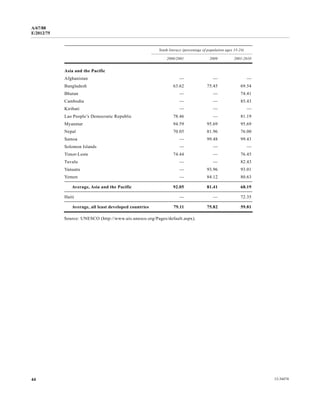
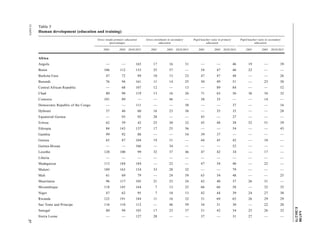
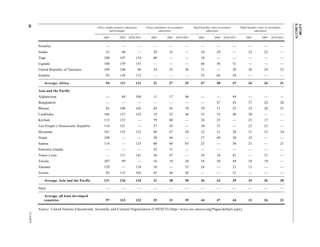
The present report is submitted pursuant to General Assembly resolution 
66/213 and Economic and Social Council resolution 2011/9, in which the Secretary- 
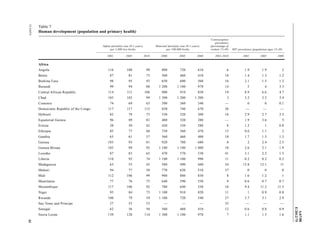
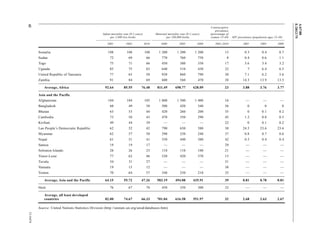
General was requested to submit a progress report on the implementation of the 
Programme of Action for the Least Developed Countries for the Decade 2011-2020 
(Istanbul Programme of Action). It includes a section on graduation and smooth 
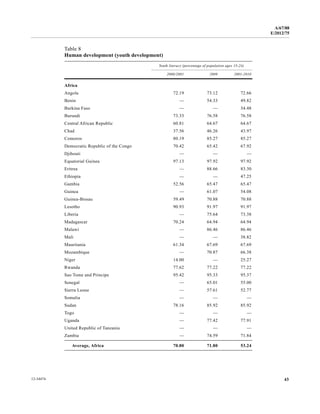
transition as requested by the Assembly in its resolution 65/171. 
* A/67/50. 
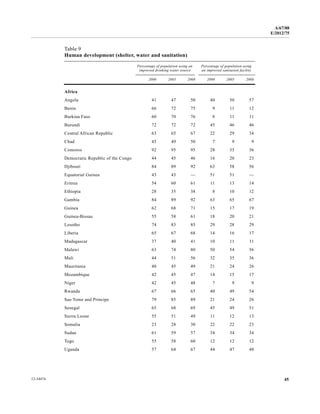
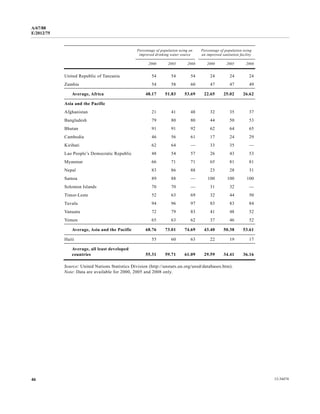
** E/2012/100.
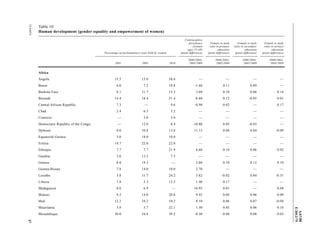
A/67/88 
E/2012/75 
1. This first report assesses initial progress in the implementation of the Istanbul 
Programme of Action and challenges ahead. It analyses progress achieved in the 
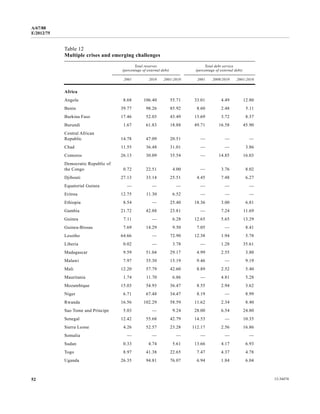
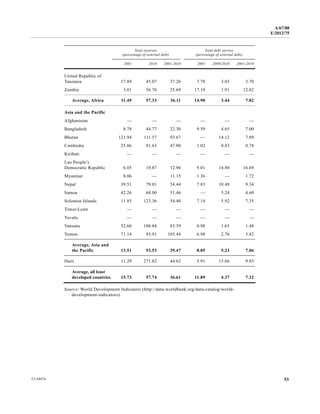
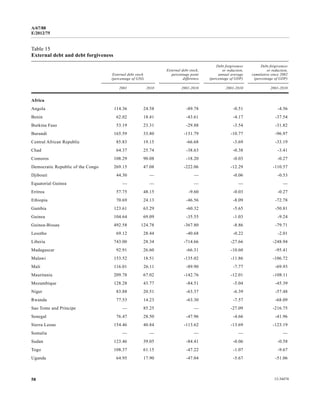
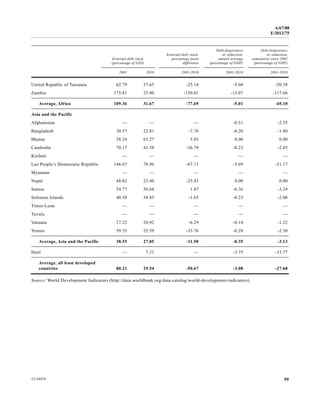
past decade in the eight priority areas for action, thus providing a benchmark against 
which future progress will be measured. It also covers activities by all relevant 
stakeholders/vehicles including least developed countries and their development 
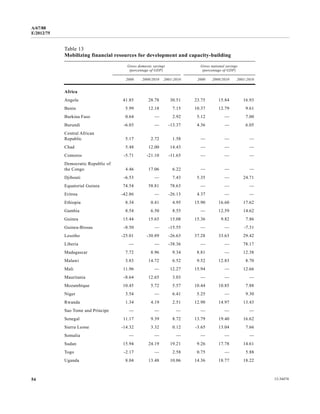
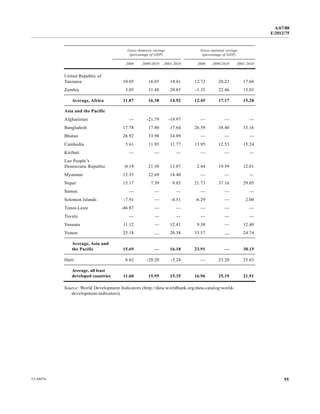
partners, South-South cooperation, parliaments, civil society, the private sector and 
the United Nations system. A section on graduation and smooth transition 
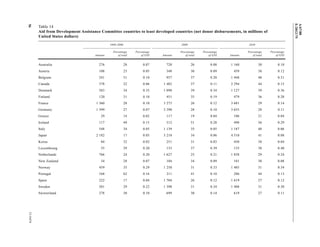
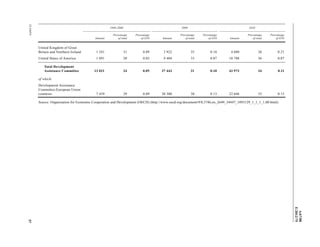
summarizes recent developments in this area. The report concludes with policy 
recommendations. 
I. Recent trends in the goals and targets of the priority areas 
for action of the Istanbul Programme of Action 
2. The Istanbul Programme of Action was adopted in May 2011. Because of the 
time lag in data generation, the assessment of progress in attaining the goals and 
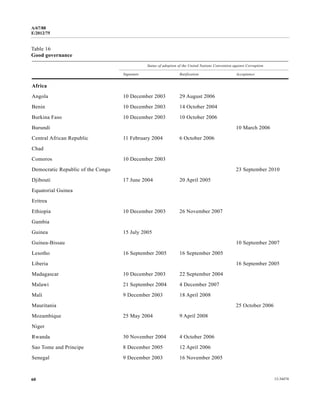
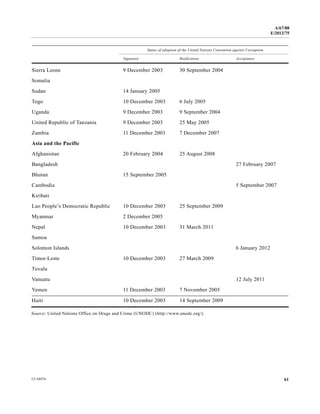
targets — using statistical inference — will be included in subsequent reports only. 
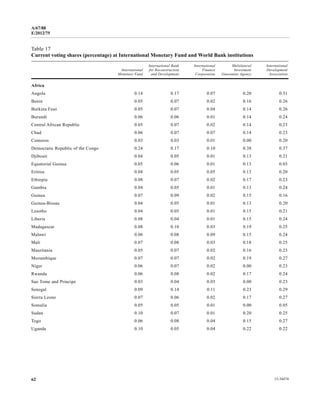
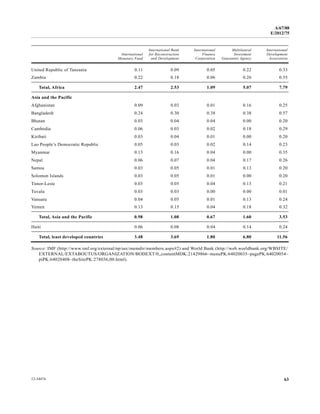
However, since this is the first in a series of reports on the implementation of the 
Programme, this section analyses progress achieved in the past decade1 and the 
current situation in the eight priority areas for action.2 The analysis therefore 
provides a baseline against which future progress will be gauged.3 
3. The least developed country group as a whole saw its growth performance 
improve considerably in the past decade. On average, gross domestic product (GDP) 
expanded annually by 6.6 per cent between 2001 and 2010, compared to the less 
than 4 per cent recorded during the period 1991-2000. This growth acceleration was 
underpinned by higher production and prices of primary commodities, increased 
investment in infrastructure development, good macroeconomic management, an 
improved political situation in many least developed countries, rising foreign direct 
investment (FDI) and remittance flows, and increased donor support in the form of 
aid and debt relief. However, the average for the decade stood below the 7 per cent 
target set in the Brussels Programme of Action and reiterated in the Istanbul 
Programme of Action. 
4. The rate of economic growth varied among least developed countries and 
across time. Of the 47 countries for which data are available, 11 saw their GDP 
increase by more than 7 per cent per annum. The pace at which GDP grew also 
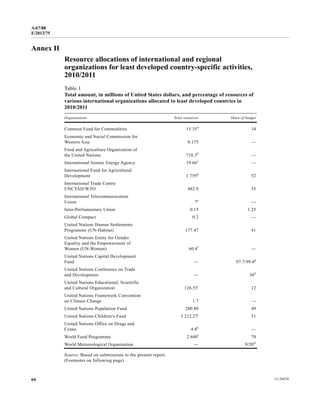
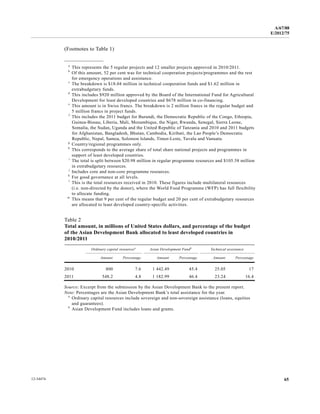
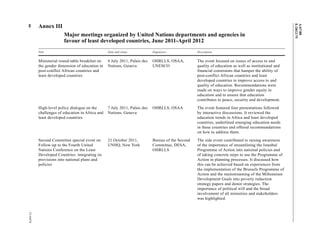
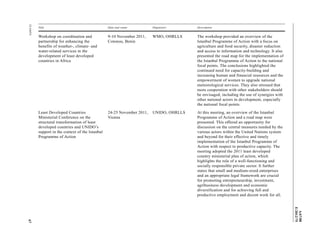
varied across the decade. The strongest growth rates were recorded between 2004 
and 2008. GDP growth for the least developed country group as a whole reached its 
lowest level, at 4.5 per cent in 2009, when the global economy slid into recession. 
5. Although recovery has been under way since 2010, it has been halting. In the 
wake of the recent sovereign crisis in Europe and growing financial sector fragility, 
__________________ 
1 The analysis differs from that of the 2011 report of the Secretary-General on the Ten-year 
appraisal and review of the implementation of the Brussels Programme of Action for the Least 
Developed Countries for the Decade 2001-2010 (A/66/66-E/2011/78) at least on two counts. The 
analysis focuses on the goals and targets of the Istanbul Programme of Action, which are not the 
same as those of the Brussels Programme of Action, and covers 2010. 
2 The wording of the priority areas for action in the Istanbul Programme of Action is used as 
subheadings in this section. 
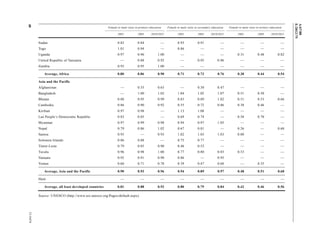
3 Statistical data for the goals and targets covered below are presented in annex I to the present 
document. 
2 12-34474
A/67/88 
E/2012/75 
many advanced economies adopted fiscal austerity measures and experienced rising 
unemployment, contributing to a depression in domestic demand and GDP growth 
with spillover effects in least developed countries. In addition, there is the risk of 
declining official development assistance (ODA), with aid delivery also becoming 
more pro-cyclical and volatile. GDP growth in least developed countries is 
estimated to have decelerated to 4.9 per cent in 2011, down from the 5.5 per cent 
recorded in 2010. 
6. The poverty headcount in least developed countries trended downward but 
remained high. The percentage of the population living on less than $1.25 a day 
stood at 53.4 per cent in 2005. In view of the above mixed developments, the 
challenge before many least developed countries is to secure growth that delivers 
decent jobs and enables these countries to make significant strides towards poverty 
reduction and broader social development. 
Productive capacity 
7. The strong economic growth posted by most least developed countries was not 
accompanied by increased value-addition in sectors with high employment-generation 
potential. On average, the share of agriculture dropped from 29 per cent 
of GDP in 2000 to 23 per cent in 2009/2010. This decline was more severe in 
African least developed countries (-8 per cent) than in Asian and Pacific least 
developed countries (-5 per cent). The share of services increased marginally, but 
mainly in the low-productivity informal sector. Similarly, the share of 
manufacturing remained virtually unchanged, accounting on average for 10 to 
11 per cent of GDP. This development illustrates persistent challenges faced by most 
least developed countries in their quest to develop a vibrant manufacturing sector 
and to move up the value chain. By contrast, owing to stronger prices and output, 
natural resource-based sectors, such as mining and hydrocarbon industries, 
expanded significantly, especially in Africa. 
8. The above trends suggest limited structural change towards high-productivity 
and labour-intensive sectors in most least developed countries. As a result, these 
countries were unable to generate a sufficient number of decent jobs for their 
growing working-age populations. 
9. Progress with respect to infrastructure was also mixed. The strongest growth in 
information and communications technology across least developed countries was 
recorded in mobile communications, where subscriptions grew at staggering rates in 
the past decade. In 2001, only three least developed countries had a subscription rate 
of more than 3 per cent. By 2010, 33 least developed countries, or almost 70 per 
cent, posted a rate of more than 30 per cent. The liberalization of markets in least 
developed countries and increased competition among mobile operators along with 
the provision of services tailored to the needs and purchasing power of low-income 
households contributed to the rapid expansion of mobile communications. 
10. By contrast, access to the Internet, although increasing steadily, remained low 
in the majority of least developed countries, with only 4 out of 100 people being 
Internet users in 2010. This average masks important disparities among least 
developed countries. The ratio of Internet users per 100 people in 2010 ranged from 
0.21 in Timor-Leste to 25 in Tuvalu. Limited availability and high prices restricted 
access to the Internet together with limited use of computers, limited and unreliable 
supply of energy, scant access to the broadband radio spectrum and poor backbone 
12-34474 3
A/67/88 
E/2012/75 
network infrastructure. Significant strides towards reaching the target of 100 per 
cent access to the Internet by 2020 cannot be achieved unless these obstacles are 
removed. 
11. Although electricity generation in least developed countries increased in the 
past decade, the level of power supply was still far below the growing needs of this 
group of countries. Per capita electricity production in least developed countries 
rose from 132.49 kWh in 2001 to 193.15 kWh in 2009,4 just 8 per cent of the level 
of per capita power generation of other developing countries. 
12. The majority of least developed countries are endowed with vast sources of 
renewable energy — hydropower, thermal and solar resources — which they could 
tap into. Besides harnessing their power generation potential, better use of existing 
resources, including through improving the quality of power lines, better regulation, 
and pooling power into regional grids, could also contribute to increasing access to 
energy. 
13. The Istanbul Programme of Action sets a target of substantively increasing 
combined rail and paved road mileage and sea and air networks by 2020. Limited 
available data suggest that progress in expanding these modes of transport is rather 
mixed. On average, total road mileage increased at a varying pace, with increases by 
more than 40 per cent in Ethiopia, Guinea, Mauritania and Togo. The quality of the 
roads, as mirrored by the relative size of the paved road network, did not keep up 
with the expansion of the road network, despite institutional reforms implemented 
by many least developed countries, including the establishment of second-generation 
road facilities funded through fuel levies, autonomous road agencies and 
maintenance management agencies. 
14. Data on the state of railway systems are scant but generally indicate that little 
improvement occurred in the past decade. Passenger and freight traffic declined or 
at best stagnated in the majority of least developed countries for which data are 
available. 
15. Air traffic increased in the majority of least developed countries, particularly 
in Asia and the Pacific, where steady growth was partially driven by tourism. The 
demise of national and regional airlines affected regional and international 
connectivity in many West African and Central African least developed countries, 
therefore reducing air traffic. Overall, air transport markets in the majority of least 
developed countries continued to be confronted with limited competition — which 
kept prices high — as well as safety issues. 
16. Maritime transport in many least developed countries featured high tariffs 
caused by shallow shipping markets and long handling and processing times, which 
dampened traffic. Limited transportation links between ports and the hinterland 
further increased the shipping costs of landlocked least developed countries. 
17. Least developed countries did not fare well compared to other developing 
countries both in terms of resources allocated to science, technology and innovation 
and the magnitude of knowledge production. As a result, least developed countries 
generated very little knowledge and very few modern technologies. Another 
challenge was aligning research with the specific needs of least developed countries. 
In addition, these countries were not able to exploit the existing flexibilities in 
__________________ 
4 The latest year for which data are available. 
4 12-34474
A/67/88 
E/2012/75 
intellectual property right regimes and the World Trade Organization (WTO) 
Agreement on Trade-Related Aspects of Intellectual Property Rights (TRIPS 
Agreement) in order to gain access to essential technologies that are used to produce 
essential goods and services for their populations. 
Agriculture, food security and rural development 
18. The majority of least developed countries did not witness a significant 
transformation of their agriculture sector in the past decade owing to scant funding 
for agricultural research and technology, little use of yield-enhancing practices and 
technologies, poor infrastructure, environmental degradation, unfavourable policy 
and regulatory frameworks — both domestically and internationally — along with 
emerging challenges such as climate change. 
19. Surprisingly, food security in least developed countries seems to have 
improved. The prevalence of malnutrition among children under age 5 dropped in 
most of them. The multiplication of institutional innovations such as social safety 
nets contributed in part to improved food availability, access and adequacy in some 
least developed countries. 
Trade 
20. The share of least developed country exports in global exports more than 
doubled over the course of the past decade. Yet, much of this increase was driven by 
oil exports from Angola, Equatorial Guinea and the Sudan, exports of metals from 
the Democratic Republic of the Congo and Zambia, and, to a lesser extent, garment 
exports from Bangladesh. Elsewhere across the least developed countries, exports 
stagnated or declined marginally. In all, least developed country exports remained 
heavily dependent on natural resources and low-skilled manufactured goods. 
21. Continued preferential market access was granted to least developed countries 
in the past decade. There were, however, some variations in the coverage of these 
preferential regimes, with the most generous schemes providing 100 per cent duty-free 
quota-free access combined with limited constraints regarding rules of origin.5 
Many emerging countries joined developed countries in according greater market 
access to least developed country products. 
22. However, these preferences were not as effective as expected owing to 
preference erosion, non-tariff barriers and restrictive rules of origin, which limited 
the scope for regional and transregional cumulation between least developed 
countries and their trading partners. Furthermore, least developed countries 
continued to be confronted with severe supply constraints and trade-related 
infrastructure deficits. 
23. Samoa finalized its WTO accession in May 2012. Vanuatu will become a 
member of WTO 30 days after notifying the secretariat of the domestic ratification 
of its accession package. 
24. Three decisions pertaining to least developed countries were taken at the 
eighth session of the WTO Ministerial Conference, held in Geneva in December 
__________________ 
5 The new European Union rules of origin for the Generalized System of Preferences, which 
became effective in 2011, have been simplified and relaxed, with more generous rules for least 
developed countries. 
12-34474 5
A/67/88 
E/2012/75 
2011. The first directs WTO members to streamline and operationalize, by July 
2012, the 2002 least developed country Accession Guidelines (document 
WT/L/846). The second decision encourages the provision of special concessions in 
the area of trade in services to least developed countries and for least developed 
country service suppliers. The third decision calls on the TRIPS Council to give full 
consideration to a duly motivated request from least developed countries for an 
extension of their transition period before the present deadline ends in mid-2013. 
Commodities 
25. The production base of the majority of least developed countries was 
dominated by natural resource-based sectors. The share of these sectors even 
increased, owing to the recent commodity boom. On average, the share of primary 
commodity exports in total exports grew from 55 per cent in 2001 to 67 per cent in 
2009/10. Countries as Bhutan, the Gambia, Samoa, the Sudan and Togo managed to 
increase their exports of services and/or manufacturing goods. 
26. Commodity prices fluctuated significantly in the past decade. In 2007/2008, 
commodity prices doubled. Sharp declines then followed as the global economy 
tipped into recession and overall price volatility increased. Because of the structure 
of their economies and limited shock-smoothing instruments at their disposal, least 
developed countries were the most affected by this volatility. 
Human and social development 
27. Improvements in education outcomes, which started in the 1990s, were 
nurtured and expanded during the 2000s. Primary enrolment in least developed 
countries improved significantly. International initiatives, namely the Millennium 
Development Goals and Education for All, strong political commitment and 
significant policy changes, including the abolition of school fees, largely 
contributed to this. Concomitantly, the increasing numbers of children completing 
primary school caused gross enrolment in secondary education to rise significantly, 
from 25 per cent in 2001 to 39 per cent in 2010/11. A similar trend took hold in 
tertiary education. 
28. Despite this progress, there are concerns about the quality of education and 
training at all levels as evidenced, for instance, by high repetition rates. A related 
issue is skill mismatch, with the knowledge acquired by secondary, technical and 
vocational, and tertiary education graduates not always being in line with labour 
market demand. Also, overall progress in education and training hides important 
disparities across geographic location, gender and social and economic status. 
29. In the past decade, infant and child mortality rates fell in nearly all least 
developed countries, although at varying speed. Cambodia, Rwanda and Timor- 
Leste witnessed the largest reductions, with both their infant and child mortality 
rates declining by 40 per cent or more. Despite this progress, mortality rates 
continued to be abnormally high in most least developed countries. 
30. Maternal mortality rates were also on the decline but still standing at very high 
levels in most least developed countries, with 1,000 maternal deaths or more per 
100,000 live births in four of them. Least developed countries were among the 
countries with the highest unmet need for contraceptives and family planning in the 
world. 
6 12-34474
A/67/88 
E/2012/75 
31. Despite the continued reduction in new HIV infections, many least developed 
countries still had the highest rates in the world. The percentage of population aged 
15 to 49 living with HIV in the most affected least developed countries ranged from 
14 to 24 per cent. Improved access to antiretroviral treatment for HIV/AIDS reduced 
the number of AIDS-related deaths. The burden of malaria and tuberculosis, albeit 
still heavy, also eased in most least developed countries owing to bold global and 
domestic initiatives. 
32. Strong demographic growth led to a large and growing youth population in 
least developed countries; almost 60 per cent of the population is under the age of 
25. Improvements in secondary, technical and vocational and tertiary education 
were not as outstanding as those in primary education. Thus, high unemployment 
rates among the educated occurred in a context of significant skill shortages. 
33. Growing populations in least developed countries created a strong demand for 
housing, particularly in cities where demographic expansion was the strongest. The 
convergence of, inter alia, rapid urbanization, inadequate land administration 
systems and insufficient investment in basic infrastructure, led to the proliferation of 
slums. Through effective urban planning and building regulations, a number of least 
developed countries were able to reduce the slum phenomenon. 
34. Access to improved water sources and sanitation facilities expanded in an 
overwhelming majority of least developed countries. However, only 61 per cent of 
the population was served with improved water sources in 2008 compared to 55 per 
cent eight years earlier. The deficit in sanitation was even more severe, with only 
36 per cent of the population using an improved sanitation facility in 2008. This was 
still a slight improvement over the 30 per cent level of access in 2000. Differences 
in access to improved water sources and sanitation between rural and urban areas 
continued to be significant. Insufficient investment in the sector, poor operation and 
maintenance and inadequate management practices, among other things, contributed 
to the slow progress recorded over the last decade. 
35. Progress in gender equality and the empowerment of women was strong. 
Gender disparity in education consistently decreased across least developed 
countries, with 10 of them reaching parity in primary education. Although 
significant gains were recorded in tertiary education, women students remained at a 
distinct disadvantage in most least developed countries. On average, in 2010/11 
56 women were enrolled in tertiary education for every 100 men. 
36. Concerning economic participation, and particularly job opportunities, scarce 
available data indicate that employment rates for women increased. However, 
women still accounted for the majority of employment in agriculture and the 
informal sector, where productivity and wages are low. 
37. Political participation was the area where gains appeared to have been the 
greatest. The percentage of parliamentary seats held by women, for instance, more 
than doubled, jumping from 10 per cent in 2001 to almost 23 per cent in 2010. 
Affirmative action policies, such as electoral quotas and reserved seats, and gender-sensitive 
electoral systems contributed to improving the level of women’s political 
participation in many countries. 
38. To respond to emergency situations and crises that occurred during the decade, 
a large number of least developed countries designed or expanded safety net 
programmes, specifically targeting poor and vulnerable groups. Social protection 
12-34474 7
A/67/88 
E/2012/75 
programmes helped to protect some poor and marginalized groups from hunger and 
malnutrition and to sustain their access to basic education and health in times of 
crisis. Yet, most of these programmes are still in the initial stages, covering only a 
small share of the population of least developed countries, and face financial 
sustainability and administrative problems. 
Multiple crises and other emerging challenges 
39. Favourable external conditions, including rising commodity prices and 
increasing financial flows, combined with prudent macroeconomic policies, enabled 
least developed countries to build significant buffers in the form of, for instance, 
foreign reserve accumulation and lower domestic debt. On average, total reserves as 
a percentage of external debt swelled from 15.7 per cent in 2001 to 57.7 per cent in 
2010. In the meantime, the share of debt service as a percentage of external debt 
declined markedly from 11.9 per cent in 2001 to 4.4 per cent in 2010. These 
macroeconomic policy buffers provided many least developed countries with some 
space to withstand relatively well the various crises that erupted during the last part 
of the decade, which nevertheless affected least developed countries seriously. 
40. The record of least developed countries with respect to environmental 
sustainability is mixed. The proportion of land area covered by forest declined from 
31 per cent in 2000 to 29.6 per cent in 2010. However, the proportion of protected 
terrestrial and marine areas increased from 9.5 per cent in 2000 to 9.8 per cent in 
2010. This could contribute to protect biodiversity in least developed countries. In 
addition, carbon dioxide emissions per capita remained constant at 0.2 per cent, 
which was around 7 per cent of the average for all developing countries. 
Challenges and progress in least developed countries with respect to 
adaptation to climate change 
Recent international negotiations, including the 17th Conference of 
the Parties to the United Nations Framework Convention on Climate 
Change, held in Durban, South Africa in December 2011, have led to 
very limited success with respect to climate change mitigation, making 
the challenges of adapting to the effects of climate change even more 
urgent, especially for least developed countries. 
Their lack of economic diversification and reliance on climate-sensitive 
commodities for export, such as agricultural products, expose 
least developed countries to the double threat of economic and 
environmental shocks. It is estimated that for every 1 degree Celsius rise 
in average global temperatures, average annual growth in least developed 
countries could drop by 2 to 3 percentage points.a Land degradation and 
desertification in least developed countries could also carry a high human 
cost as people are uprooted from their traditional lands. African least 
developed countries in particular face the risk of losing large portions of 
their arable land, with not only dire consequences in terms of poverty and 
hunger but also political instability and social breakdown. Water shortage 
is also threatening sustainable livelihoods, especially of the rural poor. 
Furthermore, the frequency and intensity of extreme weather events in 
least developed countries has increased fivefold in the past three decades 
and the number of people affected by these weather events has almost 
8 12-34474
A/67/88 
E/2012/75 
doubled. Least developed countries therefore have one of the largest 
burdens of climate-sensitive diseases. 
Consequently, it is of vital importance to least developed countries 
to intensify their adaptation efforts, with support from the United Nations 
system through a variety of measures, including scaling up investment 
for sustainable agricultural intensification; adopting climate-smart 
approaches to rural development; greater attention to risk and resilience 
in order to manage environment- and natural resource-related shocks; 
engagement in value chains to drive green growth; improved governance 
of natural assets for poor rural people by strengthening land tenure and 
community-led empowerment; equality and empowerment for women 
and indigenous peoples in managing natural resources; and increased 
access by poor rural communities to environment and climate finance. 
In a March 2012 communication, the High-level Task Force on 
Global Food Security emphasized that the adoption of climate-smart 
agriculture and strategies to help small-scale producers, who are often 
women, to connect to markets can increase their resilience to climate 
shocks. Reducing losses and waste in food production is also a relevant 
strategy in that respect. 
One of the main tools available to least developed countries with 
respect to adaptation to climate change is the national adaptation 
programmes of action, which most least developed countries have 
prepared and started to implement. This process has increased knowledge 
and awareness of climate change, developed best practices and taught 
valuable lessons. The simplified project cycle for Least Developed 
Country Fund projects has made it easier for these countries to access 
funds under the Global Environment Facility. As at December 2011, the 
Fund had approved some $217 million for projects and mobilized more 
than $919 million in co-financing. However, more funds are needed to 
scale up the programme and implement all national adaptation 
programmes of action; at the end of 2011, only $537 million had been 
pledged for all of the 48 least developed countries. 
At the Conference of the Parties to the United Nations Framework 
Convention on Climate Change in Durban, a decision was taken to 
launch the Green Climate Fund and to make provisions for allocating a 
minimum amount of resources for countries particularly vulnerable to 
climate change, such as least developed countries (decision 3/CP.17). It 
was also decided to balance the allocation of the Green Climate Fund 
resources between adaptation and mitigation activities, and to have 
dedicated seats for least developed countries and small island developing 
States on the governing board. However, the precise volume of finance to 
be channelled through the Fund remains unclear. 
12-34474 9
A/67/88 
E/2012/75 
In conclusion, the mainstreaming of adaptation measures into 
relevant national policies is of great importance for least developed 
countries. Various sources of international funding and risk tools could 
be accessed to help to finance capital and capacity-building costs for 
adaptation to climate change in least developed countries. These include 
existing climate-related schemes such as those established by the World 
Bank and other development banks. 
a See United Nations Conference on Trade and Development (UNCTAD), The 
Least Developed Countries Report 2010: Towards a New International 
Development Architecture for LDCs (UNCTAD/LDC/2010). 
41. In the past decade, disaster reduction gained growing recognition among 
policymakers in many least developed countries. Several started to build or 
strengthen disaster management capacities and to implement the Hyogo Framework 
for Action, with the aim of building or improving early warning, preparedness and 
response systems. Given the cross-border nature of some hazards and in order to 
build synergies among national disaster management strategies, regional 
organizations also played an important role in these efforts. 
Mobilizing financial resources for development and capacity-building 
42. Domestic saving rates increased in least developed countries, rising from 
11.6 per cent in 2000 to 15.9 per cent in 2009/10, driven largely by the performance 
of African least developed countries. Despite this increase, savings rates were 
largely below levels reached by other developing countries, therefore limiting the 
ability of least developed countries to invest and grow. 
43. Domestic tax revenues and public savings increased in many countries, driven 
in part by improved tax administration. On the spending side, public expenditure 
management reforms helped many least developed countries to make progress in 
budget preparation, execution, and monitoring. The challenge ahead is to 
consolidate and expand these gains. 
44. Net ODA disbursements to least developed countries increased significantly in 
the past decade to $44 billion in 2010. This represents 0.11 per cent of the gross 
national income of Development Assistance Committee members, up from 0.05 per 
cent in 1999/00. Also, the share of total aid channelled to least developed countries 
rose by 10 percentage points in the same period, suggesting that priority is 
increasingly being given to least developed countries in aid allocation. Despite these 
achievements, the level of the ODA-to-gross domestic income ratio fell short of the 
target of 0.15-0.2 per cent reaffirmed in the Istanbul Programme of Action. 
However, net bilateral ODA flows to least developed countries are estimated to have 
recently dropped by 8.9 per cent in real terms to $27.7 billion in 2011, whereas 
overall ODA declined by only 3 per cent. The aid landscape in least developed 
countries also changed, with a number of emerging countries, such as Brazil, China, 
South Africa and Turkey, and private foundations and philanthropists becoming 
important aid providers. 
45. While some aspects of aid effectiveness, particularly the strengthening of 
public financial management systems, saw some improvements, progress in others, 
10 12-34474
A/67/88 
E/2012/75 
particularly the use of recipient-country systems and the reduction of transaction 
costs associated with the provision of aid, was slow. There were important strides 
towards formally untying aid, although de facto tying of aid persisted. 
46. As a result of a series of debt relief initiatives, including the Heavily Indebted 
Poor Countries (HIPC) Initiative and the Multilateral Debt Relief Initiative, the debt 
burden of many least developed countries, particularly those that had reached the 
completion point of these initiatives, lessened. However, the global crisis that 
erupted during the end of the decade increased markedly the debt vulnerabilities of 
many least developed countries, with many of them in a situation of debt stress or at 
high risk of debt stress. Further, not all least developed countries were eligible for 
these international debt relief initiatives. As at January 2012, 25 of the 32 countries 
that had reached the completion point of the HIPC Initiative were least developed 
countries. 
47. During the past decade, FDI in least developed countries increased at a much 
faster pace than the GDP and trade of this group of countries, helped largely by 
rising commodity prices, ongoing privatization processes, improved growth 
prospects, greater openness to FDI and greater integration in international 
production networks. Despite this increase, least developed countries accounted for 
a marginal share of total FDI flows to developing countries and, more worrisome, 
FDI to least developed countries declined in 2009 and 2010. After reaching 
$17 billion in 2008 — up from $6.6 billion in 2001 — net FDI inflows to least 
developed countries declined to $14 billion in 2010. 
48. Remittances to least developed countries also increased significantly, soaring 
from $6.8 billion in 2001 to $24.8 billion in 2010. The size of remittances was 
particularly important in Asian least developed countries, where they largely 
outpaced other traditional sources of financing, such as ODA. However, a major 
challenge associated with remittances is brain drain, particularly in African least 
developed countries. 
Good governance at all levels 
49. Political governance improved in least developed countries, although progress 
was uneven. Several democratic elections were conducted in the past decade, and 
checks and balances on the executive branch of government increasingly took hold. 
50. Commitment to the fight against corruption was also strong, as half of the least 
developed countries signed and ratified the United Nations Convention against 
Corruption and nine others accepted it. Between April 2010 and April 2012, the 
number of least developed countries complying with the Extractive Industries 
Transparency Initiative increased from one to six, namely the Central African 
Republic, Liberia, Mali, Mauritania, the Niger and Timor-Leste. These countries 
make information on revenue data from extractive industries publicly available. 
Most least developed countries undertook public financial management reforms, 
particularly public procurement, payroll management and internal control systems. 
This resulted in better budget execution and reporting and, ultimately, better use of 
resources. Again, improvements varied considerably across least developed 
countries and progress was constrained in part by limited capacity, particularly in 
those emerging from conflict. 
12-34474 11
A/67/88 
E/2012/75 
51. Progress was made in ensuring that least developed countries have greater 
voice in global governance. Owing to the quota and voice reforms, the voting shares 
of least developed countries in the Bretton Woods institutions increased. Yet, except 
for the International Development Agency (IDA), where least developed countries 
account for 11.56 per cent of the voting shares, least developed country voting 
shares remain low and are not commensurate with their demographic weight and 
their share in the total activities of international financial organizations. 
II. Initial efforts to ensure the implementation of the Istanbul 
Programme of Action 
Mainstreaming the Istanbul Programme of Action into national development and 
cooperation frameworks 
52. The Istanbul Programme of Action places great emphasis on the Programme 
being mainstreamed into relevant planning documents by least developed countries, 
partner countries and the international community. Several least developed 
countries, particularly Bangladesh, Cambodia, Ethiopia, the Lao People’s 
Democratic Republic, Malawi and Mauritania, have started to align their 
development plans and frameworks with the priority areas of action of the Istanbul 
Programme of Action, to foster development and achieve graduation. The seventh 
National Socioeconomic Development Plan, 2011-15, of the Lao People’s 
Democratic Republic, for instance, aims to secure at least 8 per cent GDP growth 
per annum, achieve the Millennium Development Goals by 2015, and take 
substantial steps towards graduation from least developed country status by 2020. 
53. Strong political will at the highest level and broad participation have 
underpinned these mainstreaming efforts. The Prime Minister of Bangladesh, for 
instance, held a cabinet meeting dedicated to the implementation of the Istanbul 
Programme of Action, thus raising awareness among all line ministries. Further, the 
involvement of all stakeholders is foreseen in the implementation of the Malawi 
Growth and Development Strategy for 2011-2016. In Cambodia, the parliament, in 
collaboration with the Ministry of Planning, the Inter-Parliamentary Union (IPU) 
and the Office of the High Representative for the Least Developed Countries, 
Landlocked Developing Countries and Small Island Developing States organized a 
meeting with the aim of disseminating the Istanbul Programme of Action, creating a 
platform to identify mechanisms for information-sharing among the Parliament, the 
Government, international organizations and civil society organizations and 
agreeing on recommendations for its effective implementation. 
54. Many more least developed countries are in the process of formulating new 
national development plans. This provides an opportunity to mainstream the 
Istanbul Programme of Action at the national level. An increased focus of national 
policies and plans on the priorities of the Programme of Action in line with national 
priorities could greatly enhance the implementation of the Istanbul Programme of 
Action as compared to the Brussels Programme of Action. 
55. While hardly any reference to the Brussels Programme of Action could be 
found in donor strategies for the period 2001-2010, several development partners 
have started to mention least developed countries and the Istanbul Programme of 
Action in relevant documents. The recent European Union document entitled 
12 12-34474
A/67/88 
E/2012/75 
“Council conclusions on the European Union’s approach to trade, growth and 
development in the next decade”6 calls for greater differentiation in the design and 
implementation of European Union trade, investment and development policies in 
order to further sharpen the focus on least developed countries. Specifically, the 
European Union envisages focusing Aid for Trade more on least developed 
countries and supporting and facilitating their accession to WTO. Similarly, 
Australia committed to prioritizing the particular needs of least developed countries 
as expressed in the Istanbul Programme of Action in its development cooperation 
strategy. Furthermore, many aid agencies of Development Assistance Committee 
donors refer to least developed countries in their documents. However, the focus of 
support towards these countries by most donors is still limited. 
56. South-South cooperation also has an important role in the implementation of 
the Istanbul Programme of Action and several developing countries have taken 
action in this respect. At the Fourth United Nations Conference on the Least 
Developed Countries, Turkey announced a support package for least developed 
countries that includes financial and technical support, scholarships, the promotion 
of FDI and support for monitoring the implementation of the Istanbul Programme of 
Action. Brazil, China, India and others have committed to increasing their support 
to least developed countries and promoting an exchange of experiences. 
57. Immediately after the above-mentioned Conference, the Office of the High 
Representative for the Least Developed Countries, Landlocked Developing 
Countries and Small Island Developing States prepared a road map for the 
implementation of the Istanbul Programme of Action in collaboration with the 
United Nations system, other international organizations and Member States. The 
aim of the road map is to mobilize the active and constructive engagement of all the 
development partners of least developed countries by proposing specific roles for 
the various actors, including the United Nations system, in a targeted and time-bound 
manner. 
58. An important element of the road map is the creation of task forces to 
establish, inter alia, a technology bank and a science, technology and innovation 
support mechanism dedicated to least developed countries. Several working groups, 
including those on indicators for measuring progress towards reaching the goals and 
targets, crisis mitigation and resilience-building, resource mobilization in support of 
the implementation of the Istanbul Programme of Action and agriculture and food 
security have also been established. Their aim is to propose practical ways and 
means to implement broad commitments contained in the Programme of Action. The 
working group on indicators has proposed, reviewed and finalized a set of indicators 
for the monitoring, follow-up and review of the Programme of Action. This set of 
indicators is expected to inform the national, regional and global monitoring, 
follow-up and review of the Istanbul Programme of Action.7 
59. There has been impressive progress in mainstreaming the Istanbul Programme 
of Action into development policies and strategies of least developed countries and 
development cooperation frameworks of development partners, particularly in view 
of the short time that has elapsed since the adoption of the Programme of Action. 
__________________ 
6 3154th Foreign Affairs (Trade) Council meeting, 16 March 2012. 
7 See further explanation in annex I to the present document. 
12-34474 13
A/67/88 
E/2012/75 
The crucial step ahead is for all development partners to follow and implement 
concrete measures in the priority areas for action. 
Engagement of different stakeholders in the implementation of the Istanbul 
Programme of Action 
60. The recognition of the role and contribution of actors such as parliaments, the 
private sector, and civil society in the implementation, monitoring, follow-up and 
review of the Istanbul Programme of Action is one of its novelties. 
61. The Istanbul Programme of Action clearly states that parliaments have an 
important role in debating development strategies and overseeing their 
implementation and in the effective monitoring and follow-up of the Programme of 
Action. IPU organized a briefing session on the Programme of Action in October 
2011 that sought to raise awareness of the Programme in the parliamentary 
community, both in least and non-least developed countries, and highlight the 
important role of parliaments reflected in the Programme of Action. IPU launched 
guidelines on how to mainstream the Programme of Action into the work of national 
parliaments and the strengthening of the parliamentary focal point mechanism. Least 
developed country parliaments are encouraged to nominate focal points for the least 
developed country process and to share all relevant information with each other. 
Parliaments are also encouraged to adopt national parliamentary action plans. 
62. In addition, a joint IPU-United Nations Office of the High Representative for 
the Least Developed Countries, Landlocked Developing Countries and Small Island 
Developing States project on “Promoting parliamentary contributions to the 
implementation of the Istanbul Programme of Action for the least developed 
countries” aims at strengthening the ability of least developed country parliaments 
to design, implement, monitor, assess and provide follow-up to the Istanbul 
Programme of Action. The project would reinforce the contribution of parliaments 
to development, promote the exchange of knowledge and best practices, foster 
discussions on current development topics among parliaments, promote research and 
training in development matters and ensure the presence of parliamentary voices in 
global decision-making. 
63. Civil society country consultations were held in the Democratic Republic of 
the Congo, the Lao People’s Democratic Republic, Madagascar, Malawi, Rwanda 
and the United Republic of Tanzania. A Pacific regional meeting of civil society 
organizations was organized in Auckland, New Zealand, in September 2011 to 
identify common aims and objectives of civil society groups in the Pacific in order 
to support collaboration. Civil society organization meetings are also planned for the 
African and Asian least developed countries, with the aim of disseminating the 
content of the Istanbul Programme of Action among civil society organizations from 
least developed countries and facilitating in-depth discussions on some of the 
priority areas of the Programme of Action. In addition, the participants intend to 
agree on regional strategies for the implementation of the Programme of Action. 
64. Academia is increasingly involved in the implementation and monitoring of 
the Istanbul Programme of Action. A group of think tanks and academic institutions 
from least developed countries and partner countries established an independent 
monitoring mechanism for the implementation of the Programme of Action. The 
14 12-34474
A/67/88 
E/2012/75 
new initiative, called “LDC IV Monitor”,8 is planning to undertake policy research, 
organize dialogues and conduct outreach activities. It will complement the official 
follow-up and review mechanism of the Istanbul Programme of Action. 
65. As regards the private sector contribution, several initiatives were started at 
the Istanbul Conference. The Private Sector Steering Committee9 provided a series 
of recommendations to Governments to support entrepreneurship and private 
enterprise, promote domestic markets, invest in infrastructure, connectivity and 
workforce development, encourage foreign investment, increase international trade 
and engage in partnerships. It was agreed to explore developing a mentoring system 
for least developed country stock exchanges with developed and emerging market 
exchanges. 
66. The Global Compact has stepped up the establishment of local networks in 
least developed countries, with 10 new networks established in 2011/12. These 
networks are helping to advance sustainable business development; creating special 
forums for enterprises and other stakeholders to dialogue on challenging issues and 
advance joint solutions; and connecting least developed countries to the broader 
global economy and related supply chains. The Private Sector Steering Committee 
has agreed to establish a well-structured platform, which will facilitate collaboration 
and interaction among least developed country and non-least developed country 
private sectors regarding the implementation of the Istanbul Programme of Action. 
67. Parliaments, civil society and the private sector not only actively participated 
in the Istanbul Conference but have also started contributing to the implementation 
of the Istanbul Programme of Action in their respective areas. They also need to be 
more involved in intergovernmental processes. 
Support by the United Nations system, regional and international organizations 
for least developed country priorities 
68. The Office of the High Representative for the Least Developed Countries, 
Landlocked Developing Countries and Small Island Developing States has been 
tasked with the full mobilization and coordination of the United Nations system for 
the implementation of the Istanbul Programme of Action. Since May 2011, it has 
organized several inter-agency consultative meetings in this respect. 
69. A number of United Nations entities have already taken decisions to 
mainstream the Istanbul Programme of Action and integrate its provisions into their 
work programmes, including the International Atomic Energy Agency (IAEA), the 
International Telecommunication Union (ITU), the United Nations Capital 
Development Fund, the United Nations Conference on Trade and Development 
(UNCTAD), the United Nations Development Programme (UNDP), the Economic 
and Social Commission for Asia and the Pacific (ESCAP), the United Nations 
Educational, Scientific and Cultural Organization (UNESCO), the United Nations 
Population Fund (UNFPA), the United Nations Children’s Fund (UNICEF), the 
__________________ 
8 See http://www.ldc4monitor.org. 
9 The Private Sector Steering Committee was established prior to the Fourth United Nations 
Conference on the Least Developed Countries. It comprises private sector representatives from 
least developed countries and their development partners and aims to elevate private sector 
investment in least developed countries and mobilize business engagement towards development 
objectives. 
12-34474 15
A/67/88 
E/2012/75 
United Nations Industrial Development Organization (UNIDO), the United Nations 
Framework Convention on Climate Change, the United Nations Office for Project 
Services (UNOPS), the United Nations Entity for Gender Equality and the 
Empowerment of Women (UN-Women), the World Food Programme (WFP), the 
World Intellectual Property Organization (WIPO) and the World Meteorological 
Organization (WMO). In several others, the issue will be on the agenda of the next 
meeting of their governing bodies. Many agencies are also allocating 50 per cent or 
more of their budget to least developed countries (see annex II to the present 
document). Several United Nations entities organized meetings to support least 
developed countries in the implementation of the Istanbul Programme of Action, 
mostly in collaboration with the Office of the High Representative for the Least 
Developed Countries, Landlocked Developing Countries and Small Island 
Developing States (see annex III). Concomitantly, such United Nations coordination 
mechanisms as the High-level Committee on Programmes and the Chief Executives 
Board for Coordination (CEB), have taken up the issue of the implementation of the 
Istanbul Programme of Action. 
70. IPU was also requested by its members to mobilize support for the 
implementation of the Istanbul Programme of Action. The WTO membership is 
expected to institutionally mainstream the trade-related elements of the Programme 
of Action into its work by revising the work programme of its subcommittee on least 
developed countries. 
71. Policy-oriented research and analysis on development issues of interest to least 
developed countries constitute an important component of the work of the 
Department of Economic and Social Affairs of the Secretariat, the Economic 
Commission for Africa (ECA), the Economic Commission for Latin America and 
the Caribbean (ECLAC), ESCAP, the Economic and Social Commission for Western 
Asia (ESCWA), the International Monetary Fund (IMF), UNCTAD and the World 
Bank. Their publications, such as UNCTAD’s LDC reports, have contributed to 
generating a body of knowledge on a wide range of issues relevant to least 
developed countries, informing global and regional consensus-building and 
providing an informed basis both for capacity-building and advisory services and 
financial assistance in support of least developed country development. The least 
developed country information portal of the Department of Economic and Social 
Affairs pertains to international support and smooth transition measures and 
provides relevant information to least developed countries in this respect.10 
72. Operational activities undertaken by the United Nations and other 
organizations cover all the eight priority areas of the Istanbul Programme of Action. 
This summary highlights some of the efforts of the United Nations and other 
regional and international organizations in support of least developed country 
development. 
73. The consensus on the centrality of productive capacity-building for sustainable 
development is reflected in the theme of the 2012 Economic and Social Council 
annual ministerial review, which will provide a platform to share experiences in 
implementing policies geared towards building and enhancing productive capacity 
in order to achieve internationally agreed employment-related development goals. 
__________________ 
10 See www. un.org/ldcportal. 
16 12-34474
A/67/88 
E/2012/75 
74. The World Bank and such regional banks as the Asian and African 
Development Banks, have supported the infrastructure sectors of least developed 
countries, covering energy, transport, irrigation, water and sanitation, and 
information and communications technology. This assistance has targeted both the 
physical infrastructure and regulation and national policies. 
75. ITU has developed modalities to support least developed countries in reducing 
their digital gap, creating and maintaining an enabling telecommunication/ 
information and communications technology policy and regulatory environment and 
building the required human and institutional capacity. IAEA has activities relating 
to coordinating and supporting energy planning. 
76. Science, technology and innovation has also received growing attention in the 
programmatic work of a number of United Nations agencies. UNESCO has assisted 
24 least developed countries in designing and implementing their national science, 
technology and innovation policies and in building the related capacities. Similarly, 
WIPO has supported several least developed countries in the area of innovation and 
creativity, especially to strengthen intellectual property and innovation policies and 
strategies and to improve access to knowledge. 
77. Supporting a greater engagement between subnational governments and the 
private sector is an important part of the work of the United Nations Capital 
Development Fund on productive capacity-building in least developed countries. 
The Fund’s local economic development initiatives are designed to leverage the 
ability of local governments to engage with the private sector in attracting needed 
investments and generating employment. 
78. In the services sector, eight agencies instituted the United Nations Steering 
Committee on Tourism for Development in order to unlock the full potential of 
tourism in least developed countries by helping them to articulate their specific 
tourism-related needs and identifying the agency capabilities that could be used to 
address those needs. With respect to the mining sector, IAEA is providing technical 
cooperation services to some least developed countries. This assistance is aimed at 
improving safety and security standards of uranium mining. 
79. The Food and Agriculture Organization of the United Nations (FAO) has 
engaged in a wide range of activities in least developed countries covering 
agriculture, food and nutrition, fisheries, forestry and sustainable development. 
These activities are designed to secure increased and more effective public and 
private investment in agriculture and rural development, sustainable management 
and use of natural resources, and improved food security and better nutrition. 
Similarly, some of the interventions of the United Nations Capital Development 
Fund lend technical support and advice to local leaders on ways and means to 
integrate food security strategies into the investment planning of subnational 
governments. The improvement of agricultural productivity and food security is also 
pursued through the UN-Women programme “Securing the rights and livelihoods of 
rural women in the context of the food crisis and climate change”. 
80. One example of a global initiative aimed at responding to the food crisis is the 
Comprehensive Framework for Action, which brought together a large number of 
organizations, including FAO, the International Fund for Agricultural Development 
(IFAD) and the World Bank. The Comprehensive Framework for Action 
recommended specific measures aimed at, among other things, relieving the 
12-34474 17
A/67/88 
E/2012/75 
immediate plight of vulnerable consumers and boosting small farmer food 
production. Many least developed countries have benefited from the Global Food 
Crisis Response Programme, which is an implementing instrument of the 
Comprehensive Framework for Action. 
81. In the area of trade, WTO continues to support least developed countries, in 
particular through biennial technical assistance plans, the Enhanced Integrated 
Framework and the Standards and Trade Development Facility. The Enhanced 
Integrated Framework supported the efforts of least developed countries to integrate 
trade issues into their national development strategies, establish structures for a 
coordinated delivery of trade-related assistance and build capacity to trade, 
including the removal of supply-side bottlenecks. Thirty least developed countries 
have benefited from this programme, with some tangible results in the areas of trade 
mainstreaming and the coordination of Aid for Trade. 
82. Some agencies, such as the International Trade Centre (ITC), have provided 
least developed countries with trade-related information through web portals. This 
information not only improves the transparency of global trade and market access 
but also helps least developed country exporters to make informed decisions. A 
similar initiative has been promoted by the World Bank and the Department of 
Economic and Social Affairs in the context of aid for trade research partnerships. 
83. Least developed countries have also benefited from the Standards and Trade 
Development Facility, which is managed and run by WTO. The purpose of this 
facility is to enable countries to meet international sanitary and phytosanitary 
standards, guidelines and recommendations, therefore securing access to 
international markets. 
84. The Common Fund for Commodities has initiated and implemented projects 
across least developed countries, with a view to supporting them in developing 
commodity value chains. These projects encompass all dimensions of commodity-related 
opportunities and vulnerabilities, including production and productivity, 
horizontal and vertical diversification, value addition, price risk management, 
experience-sharing and capacity-building. 
85. Interventions undertaken by the United Nations and other international 
organizations have covered practically all dimensions of human and social 
development. In the context of promoting quality education for all in least 
developed countries, UNESCO has paid particular attention to 20 such countries 
where education outcomes are the lowest, focusing on literacy, teachers, skills for 
the world of work, and education sector-wide policy and planning. 
86. With respect to population and health, UNFPA has supported least developed 
countries in population situation analysis, assessment of the nexus between 
population dynamics and development challenges, the development and 
implementation of censuses and the analysis of census data. Similarly, UNICEF has 
joined hands with other United Nations agencies in generating a body of knowledge 
on child-centred Millennium Development Goals, which has spurred action in 
support of maternal and child health. Furthermore, the Joint United Nations 
Programme on HIV/AIDS (UNAIDS) supports least developed countries in 
formulating and implementing effective and comprehensive responses to the 
HIV/AIDS pandemic. 
18 12-34474
A/67/88 
E/2012/75 
87. As far as youth is concerned, the United Nations Capital Development Fund, 
with seed capital provided by the MasterCard Foundation, has launched “Youth 
Start”, a programme designed to enable 10 financial service providers in seven 
African least developed countries to develop and deliver relevant financial services 
to younger clients. Regarding shelter, the United Nations Human Settlements 
Programme (UN-Habitat) has supported a number of least developed countries in 
addressing their needs in terms of urban planning and development, land and 
housing through a number of interventions. 
88. As regards gender equality and the empowerment of women, the protection of 
women’s and children’s rights features prominently in the activities of UNICEF, 
UNFPA and UN-Women, including assistance in mainstreaming gender into their 
national development plans and policies. Similarly, gender responsiveness in 
strategic planning, including at the local level, and economic empowerment has also 
received attention. The United Nations Capital Development Fund and UN-Women 
are in the process of formulating the Access for Women’s Empowerment Facility, 
with a view to enabling more women to access appropriate and effective financial 
and non-financial services. 
89. Several organizations are supporting least developed countries in the area of 
multiple crises and other emerging challenges. To help low-income countries, many 
of which are least developed countries, to withstand the effects of economic shocks, 
IMF established, under the umbrella of the Poverty Reduction and Growth Trust, 
three new concessional lending instruments, namely the Extended Credit Facility, 
the Standby Credit Facility and the Rapid Credit Facility, which range from short-term 
and emergency financing to medium-term balance of payment support. 
90. The United Nations Environment Programme (UNEP) has concentrated its 
support on enhancing the capacity of least developed countries to incorporate 
climate change responses into national development processes. Its activities are 
aimed at assisting least developed countries in adapting to climate change, 
mitigating its effects, reducing emissions from deforestation and expanding 
knowledge and communication on climate change. UNESCO is contributing to 
global responses to climate change by, inter alia, expanding the knowledge base on 
climate change, promoting public awareness and offering policy and planning 
advice. 
91. The Strategic Initiative to Address Climate Change in the least developed 
countries is one of the major instruments of UNDP to support such countries in 
addressing their climate change challenges. Areas covered by this instrument 
include capacity-building for the international climate negotiations, access to 
climate finance, and the mainstreaming of climate change into national development 
processes. 
92. Within the context of the Climate Investment Funds, the World Bank and other 
international and regional organizations established the pilot programme for climate 
resilience to support least developed countries in factoring resilience and adaptation 
into their national development plans and strategies. 
93. Climate change-related assistance to least developed countries also pertains to 
finance. The United Nations Capital Development Fund has developed the Local 
Adaptive Living Facility, with the aim of channelling to municipal governments 
12-34474 19
A/67/88 
E/2012/75 
additional funds needed for climate-change and natural-disaster mitigating 
interventions. 
94. A new activity in which the United Nations Capital Development Fund is 
partnering with UNDP is CleanStart, which is meant to deliver financing and 
technical assistance to microfinance institutions with the aim of enabling them to 
facilitate the adoption and use of clean energy technologies by the poor. 
95. WMO has supplied some least developed countries with weather-observing 
systems and climate data management systems, thus helping them to generate 
essential weather and water-related information and services, which are central to 
better management of climate change and weather risks. Along with the provision of 
equipment, WMO has also offered these countries advocacy and capacity-building 
services. 
96. The parties to the United Nations Convention to Combat Desertification have 
teamed up with a number of United Nations specialized agencies and regional 
commissions, particularly with a view to supporting the efforts of some least 
developed countries to combat desertification, land degradation and drought. As part 
of its technical cooperation programme, IAEA has supported least developed 
countries in acquiring a better understanding and quantifiable estimates of the 
groundwater and surface water sources. This knowledge contributes to better 
planning and efficient management of these resources. 
97. UNEP provides assistance for the management of harmful substances and 
hazardous waste to enable least developed countries to institute appropriate policy 
and control systems and to meet international obligations pertaining to harmful 
substances and hazardous waste. 
98. UN-Habitat has been involved in a number of activities that contribute to 
disaster reduction including, for example, support for local mitigation interventions 
for decreasing vulnerabilities to cyclones and earthquakes in Mozambique. 
99. Another example of initiatives aimed at alleviating the impact of natural 
disasters is the Global Facility for Disaster Reduction and Recovery, which was 
established by the World Bank in partnership with 39 countries and eight 
international organizations. The Facility has extended grant financing and a slew of 
analytical and advisory services to help low-income countries, most of which are 
least developed countries, to reduce their vulnerability to natural hazards and adapt 
to climate change. UNEP has been active in helping least developed countries tackle 
vulnerability to conflicts and natural hazards. This support includes both prevention 
and response to these crisis situations. 
100. As regards the mobilization of financial resources, the United Nations Capital 
Development Fund has established the Local Finance Initiative, which is geared 
towards mobilizing domestic capital and directing it to viable small-scale, 
traditional and industrial infrastructure projects. With the financial support of the 
Gates Foundation and the MasterCard Foundation, the Fund has contributed to 
building the capacity of financial services providers in least developed countries to 
offer saving services. 
101. As far as ODA is concerned, the Development Cooperation Forum of the 
Economic and Social Council conducts discussions on a strengthened mutual 
accountability framework between the least developed countries and their 
20 12-34474
A/67/88 
E/2012/75 
development partners. The Forum also covers the issues of aid quantity and quality 
and contributes to an improved global assessment of progress in the implementation 
of least developed country-related aid commitments. 
102. The Organization for Economic Cooperation and Development (OECD) and 
several United Nations entities are involved in the follow-up to the Fourth High-level 
Forum on Aid Effectiveness, including OECD work on indicators relating to 
the commitments made at the Forum, which was held in Busan, Republic of Korea, 
at the end of 2011. However, it is worth noting that the new Busan Partnership for 
Effective Development Cooperation did not specifically mention least developed 
countries. OECD also plans to continue monitoring the commitments agreed upon at 
the High-level Forum on Aid Effectiveness in Paris and at the Third High-level 
Forum, in Accra, which have major implications for least developed country 
development. 
103. An essential part of UNDP’s assistance to least developed countries in the area 
of governance relates to enhancing the democratic process, strengthening 
institutions, including parliaments and judiciary systems, and promoting the rule of 
law. The Office of the United Nations High Commissioner for Human Rights 
(OHCHR), the Office of the High Representative for the Least Developed Countries, 
Landlocked Developing Countries and Small Island Developing States and other 
United Nations organizations are developing educational materials that highlight, in 
the context of least developed countries, the nexus between human rights, 
particularly the right to development, and such issues as trade and FDI. UN-Women 
assisted many least developed countries in scaling up women’s participation and 
representation in the decision-making process, including by advocating in favour of 
a quota system in parliaments. 
104. In the areas of macroeconomic management, public financial management 
systems, the fight against corruption and recovery of stolen assets, and post-conflict 
management, specific programmes dedicated to least developed countries have been 
implemented. Through its technical assistance, IMF has supported many least 
developed countries in building their capacities in such areas as macroeconomic 
policy, tax policy and revenue administration, expenditure management, exchange 
rate systems, and macroeconomic and financial statistics. The United Nations 
Capital Development Fund has initiated programmes to address the procurement and 
financial administration challenges facing local governments. 
105. Regarding the fight against corruption, the United Nations Office on Drugs 
and Crime (UNODC) has contributed to advancing the United Nations Convention 
against Corruption in least developed countries through, inter alia, the assessment of 
national anti-corruption legislation and practices with a view to identifying 
shortcomings, and the reform and drafting of anti-corruption legislation. Many least 
developed countries have benefited from the Stolen Asset Recovery Initiative, which 
is a joint UNODC and World Bank initiative designed to prevent the laundering of 
stolen assets and facilitate their recovery. 
III. Progress towards graduation and smooth transition 
106. The triennial review of the list of least developed countries conducted by the 
Committee for Development Policy in 2012 indicated that six least developed 
countries meet the criteria for graduation. These countries either exceed the 
12-34474 21
A/67/88 
E/2012/75 
graduation thresholds for two out of the three least developed country criteria, 
namely gross national income per capita, the human assets index and the economic 
vulnerability index, or meet the income criteria only with gross international income 
per capita of more than twice the graduation threshold. Samoa continues to meet the 
graduation criteria and will graduate in 2014. Equatorial Guinea is again exceeding 
the threshold for the income criteria only, after having been recommended for 
graduation by the Economic and Social Council in 2009. Tuvalu and Vanuatu are 
meeting the criteria for the third time, both exceeding the income threshold and the 
threshold for the human assets index. Kiribati is exceeding the income and human 
assets index thresholds, while Angola is meeting the income criteria only. Both have 
therefore reached graduation thresholds for the first time. 
107. In its resolution 65/171, the General Assembly requested the Secretary- 
General to report on the national transition strategies of graduating countries and the 
support measures provided by development and trading partners. In its resolution 
59/209, the Assembly identified broad areas of international support in which 
smooth transition measures are recommended. These smooth transition measures 
include the extension of duty-free quota-free market access through the “Everything 
but arms” initiative for at least three additional years after graduation by the 
European Union. The Board of the Enhanced Integrated Framework decided to 
extend access to the programme to graduated countries by three years, with the 
possibility of extension on a case-by-case basis. Similarly, access to the Least 
Developed Countries Fund of GEF can be extended to graduated countries for 
projects already in the pipeline. In 2011, the General Assembly decided, in its 
resolution 65/286, to extend United Nations travel-related support, within existing 
resources, to graduated least developed countries for a period appropriate to their 
development situation and for a maximum of three years. 
108. UNCTAD and the respective United Nations regional commissions supported 
graduating countries in the formulation and adoption of transition strategies by 
analysing the extent to which retaining least developed country-specific treatment is 
deemed vital for the continuation of the development progress. A significant number 
of multilateral and bilateral partners were involved in the consultations with 
development and trading partners on the transition strategy of Cape Verde and the 
Maldives. 
109. In 2006, Cape Verde set up a donor support group to prepare its transition 
strategy, with support from UNDP. It adopted a declaration supporting Cape Verde’s 
socioeconomic transformation agenda based on studies on the economic impact of 
the country’s graduation in 2007. Total ODA to Cape Verde increased from 
$172 million in 2007 to $337 million in 2010, with some partners scaling down their 
assistance and others maintaining or increasing previous levels. The European 
Union extended “Everything but arms” treatment for two additional years — until 
January 2012 — after the expiration of the general three-year extension. Some other 
trading partners have extended or phased out trade preferences to Cape Verde. Cape 
Verde’s access to the Enhanced Integrated Framework was extended for three years. 
For the Maldives, there was a less formal process but several trading partners 
extended trade preferences and access to the Enhanced Integrated Framework was 
prolonged. Samoa has started the process of developing a transition strategy. 
110. At the time countries are recommended for graduation, they are still highly 
vulnerable and face structural handicaps, despite considerable progress made in 
22 12-34474
A/67/88 
E/2012/75 
addressing these challenges. However, there is a lack of clarity regarding what 
support graduated countries will receive from their development and trading 
partners. The implementation of General Assembly resolution 59/209 has been 
limited, leaving all initiatives to graduating countries, and there is virtually no 
monitoring of the process of smooth transition. 
111. To address these shortcomings, the General Assembly adopted resolution 
66/213 in December 2011, establishing an ad hoc open-ended working group to 
further study and strengthen the smooth transition process for the countries 
graduating from the least developed country category. The working group held 
several substantive meetings in 2012. 
IV. Conclusions and policy recommendations 
112. In line with the ambitious goal of the Istanbul Programme of Action of 
half of the least developed countries reaching the criteria for graduation, 
stronger incentives for graduating countries and the strengthening of the 
graduation process are needed. On the one hand, development and trading 
partners should consider extending or gradually phasing out least developed 
country-specific support measures for all graduated countries in the areas of 
financial and technical support and trade. On the other hand, graduating 
countries should be supported in formulating, implementing and monitoring 
their smooth transition strategies. The General Assembly may therefore wish to 
consider the adoption of a resolution building on the recommendations of the 
ad hoc working group on smooth transition. 
113. Although the Fourth United Nations Conference on the Least Developed 
Countries was held Only a year ago, both least developed countries and 
development partners have started mainstreaming the Istanbul Programme of 
Action into both their national development and development cooperation 
strategies. Least developed countries should take the lead in further 
mainstreaming the Programme of Action into national strategies so as to fully 
implement it. Similarly, development partners should give priority to least 
developed countries and align their support with least developed country 
priorities, including through South-South and triangular cooperation. 
114. Many of the relevant organizations of the United Nations system have 
taken decisions to implement the Istanbul Programme of Action and have 
organized several meetings in this respect. To accelerate the mainstreaming of 
the Programme of Action, further support from the United Nations system is 
needed, including at the national level. Wider recognition of least developed 
country status, including by international financial institutions, would also 
stimulate and facilitate better mainstreaming of the Programme of Action. 
115. Similarly, other stakeholders, including parliaments, civil society and the 
private sector have started the implementation of the Istanbul Programme of 
Action within their respective areas. However, these processes need to be 
accelerated and better integrated, including through an increased flow of 
information. In addition, further advocacy activities to enhance knowledge 
about the content and relevance of the Programme of Action for different 
stakeholders need to be pursued. 
12-34474 23
A/67/88 
E/2012/75 
116. Progress was made in all the priority areas of the Istanbul Programme of 
Action in the decade 2001-2010 but, in most cases, the rate of progress is not 
sufficient to reach the goals and targets. Realizing the overarching goal of the 
Istanbul Programme of Action would require bold actions by least developed 
countries and their development partners in implementing the actions agreed 
upon under the eight priority areas. The following policy conclusions can be 
drawn from the current trends described above: 
(a) Increasing productive capacity, including in the agricultural sector, 
needs to be at the centre of the development strategies of least developed 
countries and should be supported by development partners, with a focus on 
infrastructure development, institutional reforms and employment generation 
policies; 
(b) Increasing access to knowledge and technology is crucial for 
structural transformation, with high priority for the establishment of a 
technology bank and a science, technology and innovation support mechanism; 
(c) The commitments on duty-free quota-free market access, reduction 
of non-tariff barriers, Aid for Trade and the recent WTO decisions need to be 
implemented on a priority basis; 
(d) Human and social development needs to be strengthened further by 
focusing on the quality of service delivery and improved coverage of social 
protection schemes. Special attention needs to be given to inequalities with 
respect to location, gender and social and economic status; 
(e) Resilience to economic and natural shocks needs to be increased 
including through targeted, timely and adequate support to the least developed 
countries, peer-learning and experience-sharing on shock management and the 
promotion of economic diversification; 
(f) The operationalization of the Green Climate Fund and the allocation 
of a minimum amount of resources for least developed countries need to be 
accelerated and other resources for the adaptation of least developed countries 
to climate change need to be increased; 
(g) Climate change research should be supported to better understand 
global and regional climate change effects, and green technology, including for 
renewable energy production, should be made available to least developed 
countries; 
(h) Efforts to increase the volume and quality of financial support need 
to be stepped up. Donor countries and other developing countries that are in a 
position to do so should set progressive quantitative aid targets for least 
developed countries reversing the most recent decline in net bilateral ODA 
flows to this group of countries. The allocation of ODA to individual countries 
should also take into account their special circumstances and vulnerability. 
Similarly, ODA should be used to leverage other financing, including FDI and 
remittances; 
(i) In addition to further improvements in governance of least developed 
countries, greater participation and voice of least developed countries in 
international decision-making processes is needed. 
24 12-34474
A/67/88 
E/2012/75 
117. In order to improve the monitoring of the implementation of the Istanbul 
Programme of Action, its priorities should receive full attention at relevant 
international meetings. Existing platforms to discuss the renewed partnership 
for least developed countries, such as the Development Cooperation Forum of 
the Economic and Social Council, should be strengthened. In addition, data 
availability for the tracking of the goals and targets of the Istanbul Programme 
of Action needs to be enhanced. 
12-34474 25
A/67/88 
E/2012/75 
Annex I 
List of indicators for the monitoring, implementation, 
review and follow-up of the Istanbul Programme of Action 
The Istanbul Programme of Action spelled out a vision for securing sustainable 
growth and development in least developed countries for the next decade, with a 
focus on eight priority areas for action. Goals and targets, both qualitative and 
quantitative, are included for each priority area, totalling 47. They are largely in line 
with the criteria used for the identification of least developed countries, namely per 
capita income, human assets and economic vulnerability. The Istanbul Programme 
of Action contains provisions for effective and complementary follow-up and 
monitoring mechanisms at the national, regional and global levels. These 
mechanisms can be effective only if backed by indicators for which there are data 
that are reliable, comparable across time and countries and easy to collect and to 
interpret. 
In consultation with other United Nations and international organizations, the 
Office of the High Representative for the Least Developed Countries, Landlocked 
Developing Countries and Small Island Developing States established, within the 
context of the Inter-Agency Consultative Group, a working group on the indicators 
for the monitoring, follow-up and review of the Istanbul Programme of Action. This 
working group came up with a list of indicators to measure the rate of progress in 
achieving the broader objectives and the 47 goals and targets of the eight priority 
areas of the Programme of Action. 
Three main considerations underpinned the selection of the proposed 
indicators. First was the attempt to rely on well-established indicators. This implied 
selecting indicators that had already been used for other global frameworks. Where 
the existing frameworks did not offer the right indicators, efforts were made to 
identify indicators that could not only provide relevant and clear measures of the 
goal or target of interest but were also anchored on international standards, 
recommendations and best practices. The third and last consideration was to ensure, 
as much as possible, that the selected indicators captured not only outcomes and 
outputs but also inputs, therefore making it possible to assess efforts deployed by 
various stakeholders in living up to their respective commitments. 
In total, 121 distinct quantitative indicators were identified for the 47 goals 
and targets of the Istanbul Programme of Action. In addition to these 121 
quantitative indicators, 3 additional indicators were exceptionally proposed for the 
monitoring of the first objective of the Programme of Action. No indicator was 
specifically recommended for the other four objectives, since their content is to a 
large degree reflected in the eight priority areas for action. 
In addition to the 124 quantitative indicators proposed for the 8 priority areas 
and for the first objective of the Programme of Action, qualitative information is 
also used to monitor the rate of progress in achieving the goals and targets. 
A file describing all the proposed indicators and a set of tables with available 
data for these indicators are posted on the website of the Office of the High 
Representative for the Least Developed Countries, Landlocked Developing 
Countries and Small Island Developing States at http://www.unohrlls.org/en/ldc/962/. 
26 12-34474
A/67/88 
E/2012/75 
Owing to space limitations, only a selected number of indicators are included in the 
present report. 
Data 
The tables contained in the present annex were largely compiled from official, 
published international sources by the United Nations Office of the High 
Representative for the Least Developed Countries, Landlocked Developing 
Countries and Small Island Developing States. The published sources are cited with 
each table. Since national data sources have improved, international estimates were 
rarely used, except to adjust national data for comparability. Where sources made 
retrospective adjustments to data, the newer data were incorporated in the tables. As 
a result, some of the data may differ from those published in previous years. 
Where shown, totals and averages for the least developed countries and 
developing regions are weighted by absolute numbers of population or economic 
variable used in the denominator. 
Explanatory notes for tables 
1. Years separated by a hyphen (such as 2001-2010) indicate data based on 
averages in the period shown, unless otherwise indicated in the notes to the tables. 
Years separated by a slash (such as 2009/2010) indicate that data are shown for the 
latest year available in the period. 
2. Figures may not add to totals, owing to rounding. 
12-34474 27
A/67/88 
E/2012/75 
Statistical tables 
Table 1 
Economic growth and poverty 
Annual growth rate of GDP (in constant United States dollars) 
(percentage) 
Percentage of 
population 
below 
international 
poverty line 
2001-2004 2005-2009 2010 2001-2010 2001/2010 
Africa 
Angola 9.56 13.62 2.30 10.84 54.3 
Benin 3.83 4.40 3.00 3.49 47.3 
Burkina Faso 5.78 4.40 9.24 5.03 56.5 
Burundi 2.65 4.18 3.90 2.94 81.3 
Central African Republic -2.47 2.80 3.30 0.92 62.6 
Chad 18.48 -0.40 4.30 7.19 61.9 
Comoros 2.11 1.13 2.10 1.71 46.1 
Democratic Republic of 
the Congo 5.29 5.08 7.24 4.97 59.2 
Djibouti 3.21 5.17 — 3.71 18.8 
Equatorial Guinea 23.39 9.42 0.95 11.55 — 
Eritrea 0.57 -1.50 2.20 0.04 — 
Ethiopia 4.10 10.46 10.14 7.54 47.3 
Gambia 3.44 4.56 5.01 3.25 34.3 
Guinea 3.83 2.21 1.93 2.52 56.7 
Guinea-Bissau -2.18 2.89 3.47 1.25 48.8 
Lesotho 28.87 4.12 3.30 10.32 43.4 
Liberia -9.92 7.21 5.51 0.71 83.7 
Madagascar 0.30 3.34 1.57 2.03 72.1 
Malawi 4.22 7.42 7.10 5.17 73.9 
Mali 4.57 4.77 4.50 4.33 1.5 
Mauritania 3.94 3.58 5.01 3.65 56.3 
Mozambique 7.57 7.31 7.20 6.73 21.2 
Niger 2.78 4.11 8.81 3.79 55.1 
Rwanda 6.81 7.46 7.50 6.68 54.5 
Sao Tome and Principe 7.84 5.61 4.50 5.59 — 
Senegal 4.37 3.29 4.17 3.59 28.6 
Sierra Leone 14.41 5.60 4.95 7.68 38.9 
Somalia — — — — — 
28 12-34474
A/67/88 
E/2012/75 
Annual growth rate of GDP (in constant United States dollars) 
(percentage) 
Percentage of 
population 
below 
international 
poverty line 
2001-2004 2005-2009 2010 2001-2010 2001/2010 
Sudan 4.75 8.03 4.45 5.68 — 
Togo 3.28 2.98 3.37 2.63 38.7 
Uganda 7.33 8.78 5.18 6.83 45.9 
United Republic of 
Tanzania 7.29 6.83 6.98 6.33 78.2 
Zambia 4.59 6.13 7.61 5.10 64.5 
Average, Africa 5.94 7.84 5.38 7.21 53.8 
Asia and Pacific 
Afghanistan 11.85 11.37 8.20 11.48 — 
Bangladesh 5.30 6.25 6.07 5.28 53.7 
Bhutan 8.11 8.92 7.44 7.70 26.2 
Cambodia 8.39 6.85 5.96 7.17 34.3 
Kiribati 2.07 0.13 1.80 1.40 — 
Lao People’s Democratic 
Republic 6.05 7.77 9.44 6.58 39.0 
Myanmar 12.71 11.48 10.42 10.86 67.4 
Nepal 3.37 4.32 4.55 3.39 — 
Samoa 5.26 0.69 1.71 2.24 76.7 
Solomon Islands -0.02 5.84 7.00 4.39 53.4 
Timor-Leste -1.66 5.34 7.42 4.14 45.2 
Tuvalu 3.35 3.01 -1.87 0.66 — 
Vanuatu 0.00 5.86 3.05 3.51 — 
Yemen 3.89 3.48 — 3.38 17.5 
Average, Asia and 
the Pacific 5.78 6.21 6.03 6.19 50.44 
Haiti -1.15 2.33 -5.05 0.23 54.9 
Average, all least 
developed countries 5.61 7.00 5.49 6.6 52.5 
Source: United Nations Statistics Division (http://unstats.un.org/unsd/databases.htm). 
Note: Figures for the proportion of population below the poverty line are averages of all 
available observations between 2001 and 2010. 
12-34474 29
A/67/88 
E/2012/75 
30 12-34474 
Table 2 
Productive capacity 
Value added share of manufacturing 
(per cent of GDP) 
Value added share of agriculture 
(per cent of GDP) 
Value added share of services 
(per cent of GDP) 
Average annual 
growth of 
electricity 
production 
per capita 
(percentage) 
2001 2009/2010 2001-2010 2000 2009/2010 2001-2010 2000 2009/2010 2001-2010 2001-2009 
Africa 
Angola 3.87 5.79 4.51 8.16 10.00 8.42 26.96 27.14 25.10 8.88 
Benin 9.19 — 8.28 35.53 — 33.13 50.03 — 53.16 5.23 
Burkina Faso 12.98 — 14.12 36.62 — 34.55 44.13 — 43.74 — 
Burundi 8.77 — 8.60 39.52 — 39.01 41.45 — 41.89 — 
Central African Republic 6.84 — 7.24 54.30 56.48 55.15 30.08 28.71 30.17 — 
Chad 9.56 — 6.98 41.81 — 23.55 44.61 — 35.95 — 
Comoros 4.57 4.29 4.33 49.96 46.31 48.36 38.32 41.58 39.75 — 
Democratic Republic of the Congo 4.86 5.49 5.83 59.74 42.91 47.31 20.09 33.05 27.95 0.49 
Djibouti 2.61 — 2.59 3.54 — 3.61 80.81 — 80.07 — 
Equatorial Guinea 6.18 13.58 8.49 7.20 3.18 4.05 4.26 4.22 3.71 — 
Eritrea 10.54 5.65 8.06 17.90 14.53 18.48 60.22 63.03 59.48 -0.68 
Ethiopia 5.72 5.24 5.07 47.67 47.68 46.05 39.31 38.03 40.76 6.79 
Gambia 5.19 4.96 5.13 36.26 26.93 30.26 50.83 57.34 55.42 — 
Guinea 4.20 4.76 4.04 22.02 13.03 22.00 43.49 39.59 37.48 — 
Guinea-Bissau 10.16 — 10.38 51.41 — 54.35 35.77 — 32.67 — 
Lesotho 19.32 15.65 19.90 13.19 7.90 9.34 53.20 57.93 55.78 — 
Liberia 7.09 — 10.29 73.30 — 65.96 17.15 — 20.27 — 
Madagascar 12.43 14.14 13.79 27.89 29.11 28.11 57.52 54.89 56.26 — 
Malawi 11.53 10.05 10.44 38.78 30.53 33.40 44.53 53.36 49.51 — 
Mali 3.09 — 3.12 37.80 — 36.86 35.84 — 38.15 — 
Mauritania 6.72 3.95 4.90 26.98 20.16 22.24 46.61 42.83 43.60 — 
Mozambique 13.89 13.08 14.96 22.51 31.85 28.21 51.68 44.76 46.71 1.95 
Niger 6.56 — 6.50 40.01 — 39.74 43.00 — 43.23 —
A/67/88 
E/2012/75 
12-34474 31 
Value added share of manufacturing 
(per cent of GDP) 
Value added share of agriculture 
(per cent of GDP) 
Value added share of services 
(per cent of GDP) 
Average annual 
growth of 
electricity 
production 
per capita 
(percentage) 
2001 2009/2010 2001-2010 2000 2009/2010 2001-2010 2000 2009/2010 2001-2010 2001-2009 
Rwanda 6.91 6.36 6.64 37.34 33.85 36.34 48.51 51.75 49.74 — 
Sao Tome and Principe 5.70 — 6.13 19.68 — 20.01 63.46 — 61.33 — 
Senegal 16.90 12.77 14.87 18.51 16.71 16.11 56.96 61.14 60.37 2.49 
Sierra Leone 2.98 — 3.31 47.07 48.97 49.05 27.20 30.37 27.24 — 
Somalia — — — — — — — — — — 
Sudan 7.92 5.62 6.84 42.82 23.63 32.86 38.03 43.33 40.21 8.77 
Togo 8.89 — 9.36 37.74 — 40.28 45.03 — 38.81 -1.94 
Uganda 7.53 8.31 7.63 29.69 24.25 25.13 47.74 50.28 50.10 — 
United Republic of Tanzania 8.98 9.83 8.93 32.87 28.15 31.00 47.83 47.31 46.39 3.81 
Zambia 11.08 9.16 11.03 22.12 9.16 20.70 52.30 53.61 46.90 0.80 
Average, Africa 8.27 7.62 8.01 32.47 24.46 27.87 41.84 42.04 40.82 2.94 
Asia and the Pacific 
Afghanistan — 13.12 15.17 — 29.92 36.51 — 47.92 40.12 — 
Bangladesh 15.61 17.89 16.86 24.10 18.59 20.49 49.96 52.96 52.07 8.73 
Bhutan 8.30 8.43 8.01 27.66 18.75 23.20 35.81 38.08 36.72 — 
Cambodia 17.67 15.62 17.96 36.17 36.02 33.63 40.35 40.73 41.04 9.30 
Kiribati 4.88 6.20 5.12 22.58 28.62 26.17 65.84 61.84 64.79 — 
Lao People’s Democratic Republic 17.91 7.64 12.81 51.25 33.03 40.72 25.06 36.77 32.90 — 
Myanmar 7.83 19.52 13.45 57.07 36.36 45.92 32.35 37.64 35.63 2.18 
Nepal 9.29 6.64 8.00 37.64 36.08 35.83 44.56 48.49 46.87 4.46 
Samoa 16.00 10.04 13.98 14.89 9.77 12.62 58.02 61.98 58.18 — 
Solomon Islands 7.93 3.76 5.61 24.01 38.94 36.35 63.69 55.00 55.03 — 
Timor-Leste — — — — — — — — — — 
Tuvalu — — — — — — — — — — 
Vanuatu 4.50 3.04 3.92 23.53 19.71 21.80 67.42 70.40 69.66 —
A/67/88 
E/2012/75 
32 12-34474 
Value added share of manufacturing 
(per cent of GDP) 
Value added share of agriculture 
(per cent of GDP) 
Value added share of services 
(per cent of GDP) 
Average annual 
growth of 
electricity 
production 
per capita 
(percentage) 
2001 2009/2010 2001-2010 2000 2009/2010 2001-2010 2000 2009/2010 2001-2010 2001-2009 
Yemen 5.32 — 5.08 11.49 — 12.30 46.86 — 47.01 4.75 
Average, Asia and the Pacific 15.15 16.38 15.89 26.97 21.82 23.41 48.01 51.23 50.23 7.41 
Haiti — — — — — — — — — 0.99 
Average, all least developed 
countries 10.58 11.54 11.03 29.21 23.27 25.84 44.47 46.06 44.58 4.83 
Source: World Development Indicators of the World Bank (http://data.worldbank.org/data-catalog/world-development-indicators) and United Nations Industrial 
Development Organization (UNIDO) (http://www.unido.org/index.php?id=4835&ucg_no64=1/data/ida.cfm).
A/67/88 
E/2012/75 
Table 3 
Agriculture, food security and rural development 
Malnutrition prevalence 
among children under age 5 
(percentage) 
Agricultural irrigated land 
(percentage of total 
agricultural land) 
Value added 
share of 
agriculture, 
percentage 
difference 
2000/2001 2006/2009 2004 2007/2009 
2001/2002- 
2009/2010 
Africa 
Angola 27.50 — — — 1.84 
Benin 21.50 20.20 — — — 
Burkina Faso — 26.00 — — — 
Burundi 38.90 — — — — 
Central African Republic 21.80 — — — 2.18 
Chad 29.40 — — — — 
Comoros 25.00 — — — -3.65 
Democratic Republic of the Congo 33.60 28.20 — — -16.84 
Djibouti — 29.60 — — — 
Equatorial Guinea 15.70 — — — -4.02 
Eritrea — — — — -3.37 
Ethiopia 42.00 — 0.37 0.49 0.02 
Gambia 15.40 15.80 — — -9.33 
Guinea 29.10 20.80 — — -9.00 
Guinea-Bissau 21.90 17.40 — — — 
Lesotho 15.00 — — — -5.28 
Liberia 22.80 20.40 — — — 
Madagascar — — 2.18 2.18 1.22 
Malawi 21.50 15.50 — 0.53 -8.26 
Mali 30.10 27.90 — — — 
Mauritania 30.40 16.70 — — -6.82 
Mozambique — — — — 9.35 
Niger 43.60 39.90 — — — 
Rwanda 20.30 — — — -3.48 
Sao Tome and Principe 10.10 13.10 — — — 
Senegal 20.30 — 0.69 — -1.80 
Sierra Leone 24.70 21.30 — — 1.89 
Somalia 22.80 32.80 — — — 
Sudan 38.40 31.70 1.23 1.04 -19.19 
Togo — 22.30 — — — 
Uganda 19.00 16.40 — — -5.44 
12-34474 33
A/67/88 
E/2012/75 
Malnutrition prevalence 
among children under age 5 
(percentage) 
Agricultural irrigated land 
(percentage of total 
agricultural land) 
Value added 
share of 
agriculture, 
percentage 
difference 
2000/2001 2006/2009 2004 2007/2009 
2001/2002- 
2009/2010 
United Republic of Tanzania — — — — -4.72 
Zambia — 14.90 — — -12.96 
Average, Africa 28.37 20.22 0.85 0.81 -8.01 
Asia and the Pacific 
Afghanistan — — 5.50 4.84 -15.24 
Bangladesh 45.40 41.30 51.35 — -5.51 
Bhutan — 12.00 6.79 6.76 -8.91 
Cambodia 39.50 28.80 — — -0.15 
Kiribati — — — — 6.03 
Lao People’s Democratic Republic 36.40 31.60 — — -18.22 
Myanmar 30.10 — 23.20 24.76 -20.71 
Nepal 43.00 38.80 27.74 27.74 -1.56 
Samoa — — — — -5.11 
Solomon Islands — 11.50 — — 14.93 
Timor-Leste — — — — — 
Tuvalu — 1.60 — — — 
Vanuatu — 11.70 — — -3.82 
Yemen — — 2.87 — — 
Average, Asia and the Pacific 45.02 27.79 37.71 19.89 -5.09 
Haiti 13.90 18.90 — — — 
Average, all least developed countries 38.10 23.64 23.22 8.76 -5.94 
Source: World Development Indicators (http://data.worldbank.org/data-catalog/world-development-indicators). 
Note: For the indicator “value added share of agriculture, percentage change” a negative sign indicates that the 
value added share decreased over the period 2001/2002-2009/2010. The Asian and Pacific and all least 
developed country averages of the indicator “Agricultural irrigated land” are not directly comparable over 
time, since data for Bangladesh for 2007/2009 are not available. 
34 12-34474
A/67/88 
E/2012/75 
Table 4 
Trade and commodities 
Share of least developed countries exports 
in world total exports (percentage) 
Exports of primary commodities, 
percentage of total exports 
2001 2005 2010 2001 2005 2009/2010 
Africa 
Angola 0.1055 0.2299 0.3511 — — — 
Benin 0.0060 0.0055 0.0079 82.89 90.77 — 
Burkina Faso 0.0036 0.0045 0.0085 82.95 92.28 90.92 
Burundi 0.0006 0.0006 0.0007 — 93.66 93.85 
Central African Republic 0.0023 0.0012 0.0009 50.96 62.18 — 
Chad 0.0031 0.0294 0.0226 — — — 
Comoros 0.0003 0.0001 0.0001 96.04 — — 
Democratic Republic of the Congo 0.0142 0.0229 0.0348 — — — 
Djibouti 0.0005 0.0004 0.0006 — — 7.23 
Equatorial Guinea 0.0280 0.0673 0.0689 — — — 
Eritrea 0.0003 0.0001 0.0001 49.28 — — 
Ethiopia 0.0073 0.0086 0.0147 86.57 — 90.18 
Gambia 0.0002 0.0001 0.0001 96.38 — 60.89 
Guinea 0.0118 0.0081 0.0082 71.67 87.42 — 
Guinea-Bissau 0.0010 0.0009 0.0008 — — — 
Lesotho 0.0045 0.0062 0.0054 17.30 — — 
Liberia 0.0021 0.0013 0.0015 — — — 
Madagascar 0.0150 0.0081 0.0072 54.26 43.85 45.97 
Malawi 0.0073 0.0049 0.0070 89.76 83.55 91.03 
Mali 0.0117 0.0105 0.0154 76.48 82.63 78.55 
Mauritania 0.0057 0.0060 0.0133 — — 88.30 
Mozambique 0.0114 0.0170 0.0210 89.94 93.47 94.21 
Niger — — — 91.69 83.65 85.34 
Rwanda 0.0014 0.0012 0.0020 97.32 96.60 92.36 
Sao Tome and Principe 0.0000 0.0001 0.0001 — — — 
Senegal 0.0162 0.0150 0.0142 70.80 54.78 59.81 
Sierra Leone 0.0005 0.0015 0.0022 — — — 
Somalia — — — — — — 
Sudan 0.0274 0.0460 0.0751 98.66 99.36 99.30 
Togo 0.0058 0.0063 0.0053 50.32 41.89 25.66 
Uganda 0.0073 0.0077 0.0106 94.46 88.45 77.12 
United Republic of Tanzania 0.0138 0.0160 0.0242 83.30 85.73 75.56 
12-34474 35
A/67/88 
E/2012/75 
Share of least developed countries exports 
in world total exports (percentage) 
Exports of primary commodities, 
percentage of total exports 
2001 2005 2010 2001 2005 2009/2010 
Zambia 0.0159 0.0173 0.0473 85.53 91.20 93.36 
Average, Africa 0.3308 0.5445 0.7716 83.51 84.78 77.96 
Asia and the Pacific 
Afghanistan 0.0011 0.0037 0.0028 — — — 
Bangladesh 0.0982 0.0886 0.1259 7.22 8.71 — 
Bhutan — — — — 50.19 30.49 
Cambodia 0.0242 0.0295 0.0330 3.58 2.52 3.85 
Kiribati 0.0001 0.0000 0.0001 — 85.58 — 
Lao People’s Democratic Republic 0.0052 0.0053 0.0105 — — — 
Myanmar 0.0385 0.0364 0.0574 — — — 
Nepal 0.0119 0.0082 0.0056 — — 27.74 
Samoa 0.0010 0.0008 0.0004 32.77 23.32 21.71 
Solomon Islands 0.0008 0.0010 0.0015 — — — 
Timor-Leste 0.0000 0.0001 0.0001 — 96.38 — 
Tuvalu 0.0000 0.0000 0.0000 — — — 
Vanuatu 0.0003 0.0004 0.0003 — — — 
Yemen 0.0545 0.0535 0.0571 97.57 98.40 98.32 
Average, Asia and the Pacific 0.0842 0.0766 0.1072 7.21 9.27 16.79 
Haiti 0.0044 0.0045 0.0038 — — — 
Average, all least developed 
countries 0.4194 0.6256 0.8826 55.34 53.94 67.28 
Source: World Development Indicators (http://data.worldbank.org/data-catalog/world-development-indicators) 
and World Trade Organization (WTO) (http://stat.wto.org/Home/WSDBHome.aspx?Language=). 
Note: The figures for Africa, Asia and the Pacific, and all least developed countries are group totals in the first 
three columns and group averages in the last three columns. 
36 12-34474
A/67/88 
E/2012/75 
12-34474 37 
Table 5 
Human development (education and training) 
Gross intake primary education 
(percentage) 
Gross enrolment in secondary 
education 
Pupil/teacher ratio in primary 
education 
Pupil/teacher ratio in secondary 
education 
2001 2005 2010/2011 2001 2005 2010/2011 2001 2005 2010/2011 2001 2005 2010/2011 
Africa 
Angola — — 165 17 16 31 — — 46 19 — 39 
Benin 106 112 153 25 37 — 54 47 46 22 — — 
Burkina Faso 47 72 89 10 13 23 47 47 48 — — 26 
Burundi 76 94 161 11 14 25 50 49 51 — 23 30 
Central African Republic — 68 107 12 — 13 — 89 84 — — 52 
Chad 80 98 119 13 16 26 71 63 56 36 34 32 
Comoros 101 89 — — 46 — 38 35 — — 14 — 
Democratic Republic of the Congo — — 111 — — 38 — — 37 — — 16 
Djibouti 37 46 60 16 23 36 — 35 35 — — 28 
Equatorial Guinea — 93 92 28 — — 43 — 27 — — — 
Eritrea 62 59 42 25 30 32 45 48 38 52 51 39 
Ethiopia 84 143 137 17 25 36 — — 54 — — 43 
Gambia 99 92 88 — — 54 39 37 — — — — 
Guinea 65 87 104 19 31 — 44 45 42 — 34 — 
Guinea-Bissau — — 166 — 34 — — — 52 — — — 
Lesotho 128 100 99 32 37 46 47 42 34 — 17 — 
Liberia — — — — — — — — — — — — 
Madagascar 113 184 184 — 22 — 47 54 40 — 22 — 
Malawi 189 163 154 33 28 32 — — 79 — — — 
Mali 61 69 79 — 24 39 63 54 48 — — 25 
Mauritania 96 117 105 21 23 24 42 40 37 26 31 — 
Mozambique 118 145 164 7 13 25 66 66 58 — 32 35 
Niger 47 62 95 7 10 13 42 44 39 24 27 30 
Rwanda 122 191 184 11 16 32 51 69 65 26 29 29 
Sao Tome and Principe 116 110 112 — 46 59 34 31 30 — 22 20 
Senegal 80 94 103 17 23 37 51 42 34 25 26 32 
Sierra Leone — — 127 28 — — 37 — 31 27 — —
A/67/88 
E/2012/75 
38 12-34474 
Gross intake primary education 
(percentage) 
Gross enrolment in secondary 
education 
Pupil/teacher ratio in primary 
education 
Pupil/teacher ratio in secondary 
education 
2001 2005 2010/2011 2001 2005 2010/2011 2001 2005 2010/2011 2001 2005 2010/2011 
Somalia — — — — — — — — — — — — 
Sudan 52 60 — 29 32 — 24 29 — 22 22 — 
Togo 108 107 154 80 — — 18 — — — — — 
Uganda 180 159 155 — — — 46 56 51 — — — 
United Republic of Tanzania 109 108 96 34 55 56 51 — 30 28 24 23 
Zambia 92 128 115 — — — 55 66 58 — — — 
Average, Africa 94 111 131 21 27 35 47 50 47 26 26 31 
Asia and the Pacific 
Afghanistan — 84 108 11 17 46 — — 44 — — — 
Bangladesh — — — — — — — 47 43 37 24 28 
Bhutan 83 100 102 44 45 70 39 31 25 32 28 21 
Cambodia 146 137 143 19 35 46 53 53 48 20 — — 
Kiribati 113 133 — 79 88 — 24 25 — 21 17 — 
Lao People’s Democratic Republic 116 121 — 37 45 — 30 31 — 23 25 — 
Myanmar 141 133 152 40 47 54 32 31 28 31 33 34 
Nepal 108 — — 38 46 — 37 40 30 33 — — 
Samoa 114 — 125 80 84 85 25 — 30 21 — 21 
Solomon Islands — — — 25 31 — — — — — — — 
Timor-Leste — 111 141 36 47 — 34 34 41 — 31 — 
Tuvalu 107 99 — 16 19 28 54 50 49 18 19 — 
Vanuatu 129 — 124 36 — 55 24 — 22 15 — — 
Yemen 92 115 103 45 46 44 — — 31 — — — 
Average, Asia and the Pacific 121 126 134 31 38 50 36 43 39 34 26 30 
Haiti — — — — — — — — — — — — 
Average, all least developed 
countries 97 113 132 25 31 39 44 47 44 31 26 31 
Source: United Nations Educational, Scientific and Cultural Organization (UNESCO) (http://www.uis.unesco.org/Pages/default.aspx).
A/67/88 
E/2012/75 
12-34474 39 
Table 6 
Human development (education and training — female to male ratios) 
Female to male ratio in primary education Female to male ratio in secondary education Female to male ratio in tertiary education 
2001 2005 2010/2011 2001 2005 2010/2011 2001 2005 2010/2011 
Africa 
Angola — — 0.81 0.79 — 0.69 — — 0.83 
Benin 0.68 0.77 0.87 0.47 0.55 — 0.25 — — 
Burkina Faso 0.70 0.78 0.89 0.64 0.69 0.75 0.34 0.44 0.47 
Burundi 0.80 0.86 0.99 0.79 0.74 0.72 0.37 0.38 0.55 
Central African Republic 0.69 0.70 0.72 — — 0.59 — — 0.32 
Chad 0.63 0.67 0.73 0.30 0.34 0.41 0.18 0.06 0.17 
Comoros 0.81 0.86 — — 0.74 — — — 0.72 
Democratic Republic of the Congo — — 0.86 — — 0.57 — — — 
Djibouti 0.75 0.80 0.89 0.61 0.65 0.78 0.72 0.72 0.66 
Equatorial Guinea 0.95 0.95 0.96 — — — — — — 
Eritrea 0.82 0.80 0.82 0.71 0.59 0.76 0.15 — 0.33 
Ethiopia 0.68 0.82 0.90 0.66 0.59 0.81 0.27 0.32 0.36 
Gambia 0.90 1.02 1.01 — — 0.95 — — — 
Guinea 0.70 0.79 0.81 0.39 0.49 — — 0.23 — 
Guinea-Bissau — — 0.94 — — — 0.19 — — 
Lesotho 1.01 0.99 0.96 1.27 1.26 1.36 1.74 1.32 — 
Liberia — — — — — — — — — 
Madagascar 0.96 0.96 0.98 — 0.96 — 0.83 0.89 0.91 
Malawi 0.96 1.01 1.02 0.77 0.81 0.90 0.41 0.55 0.61 
Mali 0.71 0.77 0.85 — 0.60 0.68 0.49 0.53 0.40 
Mauritania 0.93 1.00 1.02 0.75 0.85 0.82 0.20 0.33 0.39 
Mozambique 0.77 0.84 0.90 0.63 0.69 0.82 — 0.50 — 
Niger 0.65 0.69 0.79 0.64 0.64 0.66 — 0.42 0.42 
Rwanda 1.00 1.04 1.03 1.01 0.89 1.03 0.51 — 0.78 
Sao Tome and Principe 0.92 0.95 0.95 — 1.05 1.12 — — 0.95 
Senegal 0.87 0.95 1.04 0.65 0.74 0.86 — — 0.59 
Sierra Leone 0.71 — 0.95 0.71 — — 0.40 — — 
Somalia — — — — — — — — —
A/67/88 
E/2012/75 
40 12-34474 
Female to male ratio in primary education Female to male ratio in secondary education Female to male ratio in tertiary education 
2001 2005 2010/2011 2001 2005 2010/2011 2001 2005 2010/2011 
Sudan 0.82 0.84 — 0.93 0.91 — — — — 
Togo 1.01 0.94 — 0.86 — — — — — 
Uganda 0.97 0.96 1.00 — — — 0.31 0.48 0.82 
United Republic of Tanzania — 0.88 0.92 — 0.95 0.96 — — — 
Zambia 0.93 0.95 1.00 — — — — — — 
Average, Africa 0.80 0.86 0.90 0.71 0.73 0.76 0.38 0.44 0.54 
Asia and the Pacific 
Afghanistan — 0.55 0.65 — 0.30 0.47 — — — 
Bangladesh — 1.00 1.02 1.04 1.02 1.07 0.51 0.50 — 
Bhutan 0.88 0.95 0.99 0.83 0.89 1.02 0.51 0.53 0.66 
Cambodia 0.86 0.90 0.92 0.55 0.72 0.86 0.38 0.46 — 
Kiribati 0.97 0.98 — 1.13 1.08 — — — — 
Lao People’s Democratic Republic 0.83 0.85 — 0.69 0.74 — 0.58 0.70 — 
Myanmar 0.97 0.99 0.98 0.94 0.97 1.05 — — — 
Nepal 0.79 0.86 1.02 0.67 0.81 — 0.26 — 0.68 
Samoa 0.93 — 0.93 1.02 1.03 1.03 0.80 — — 
Solomon Islands 0.86 0.88 — 0.75 0.77 — — — — 
Timor-Leste 0.79 0.85 0.90 0.46 0.53 — — — — 
Tuvalu 0.96 0.98 1.00 0.77 0.80 0.85 0.53 — — 
Vanuatu 0.92 0.91 0.90 0.86 — 0.95 — — — 
Yemen 0.60 0.71 0.78 0.39 0.47 0.60 — 0.35 — 
Average, Asia and the Pacific 0.90 0.93 0.96 0.94 0.89 0.97 0.48 0.51 0.68 
Haiti — — — — — — — — — 
Average, all least developed countries 0.81 0.88 0.92 0.80 0.79 0.84 0.42 0.46 0.56 
Source: UNESCO (http://www.uis.unesco.org/Pages/default.aspx).
A/67/88 
E/2012/75 
12-34474 41 
Table 7 
Human development (population and primary health) 
Infant mortality rate (0-1 years) 
per 1,000 live births 
Maternal mortality rate (0-1 years) 
per 100,000 births 
Contraceptive 
prevalence 
(percentage of 
women 15-49) HIV prevalence (population ages 15-49) 
2001 2005 2010 2000 2005 2008 2001-2010 2001 2005 2009 
Africa 
Angola 116 108 98 880 720 610 6 1.9 1.9 2 
Benin 87 81 73 560 460 410 18 1.4 1.3 1.2 
Burkina Faso 98 95 93 650 600 560 16 2.1 1.5 1.2 
Burundi 99 94 88 1 200 1 100 970 14 5 4 3.3 
Central African Republic 114 111 106 900 910 850 19 8.9 6.6 4.7 
Chad 105 102 99 1 300 1 200 1 200 3 3.2 3.5 3.4 
Comoros 74 69 63 390 360 340 — 0 0 0.1 
Democratic Republic of the Congo 117 117 112 850 740 670 26 — — — 
Djibouti 82 78 73 330 320 300 16 2.9 2.7 2.5 
Equatorial Guinea 96 89 81 480 320 280 — 1.9 3.6 5 
Eritrea 58 50 42 420 330 280 8 1.2 1 0.8 
Ethiopia 85 77 68 750 560 470 15 0.6 1.1 2 
Gambia 65 61 57 560 460 400 18 1.7 1.5 1.3 
Guinea 103 93 81 920 780 680 8 2 2.4 2.5 
Guinea-Bissau 105 99 92 1 100 1 100 1 000 10 2.6 2.1 1.9 
Lesotho 87 83 65 470 570 530 41 3.1 2.2 1.5 
Liberia 110 92 74 1 100 1 100 990 11 0.2 0.2 0.2 
Madagascar 63 53 43 580 490 440 34 13.8 12.1 11 
Malawi 94 77 58 770 620 510 37 0 0 0 
Mali 112 106 99 980 880 830 8 1.6 1.2 1 
Mauritania 77 76 75 640 590 550 9 0.6 0.7 0.7 
Mozambique 117 106 92 780 640 550 16 9.4 11.2 11.5 
Niger 95 84 73 1 100 910 820 11 1 0.9 0.8 
Rwanda 100 79 59 1 100 720 540 27 3.7 3.1 2.9 
Sao Tome and Principe 57 55 53 — — — 35 — — — 
Senegal 62 56 50 560 460 410 12 0.6 0.8 0.9 
Sierra Leone 139 128 114 1 300 1 100 970 7 1.1 1.5 1.6
A/67/88 
E/2012/75 
42 12-34474 
Infant mortality rate (0-1 years) 
per 1,000 live births 
Maternal mortality rate (0-1 years) 
per 100,000 births 
Contraceptive 
prevalence 
(percentage of 
women 15-49) HIV prevalence (population ages 15-49) 
2001 2005 2010 2000 2005 2008 2001-2010 2001 2005 2009 
Somalia 108 108 108 1 200 1 200 1 200 15 0.3 0.4 0.7 
Sudan 72 69 66 770 760 750 8 0.4 0.6 1.1 
Togo 75 71 66 450 380 350 17 3.6 3.4 3.2 
Uganda 85 75 63 640 510 430 22 7 6.4 6.5 
United Republic of Tanzania 77 65 50 920 860 790 30 7.1 6.2 5.6 
Zambia 91 84 69 600 560 470 38 14.3 13.9 13.5 
Average, Africa 92.64 85.55 76.48 811.49 698.77 628.09 23 3.88 3.76 3.77 
Asia and the Pacific 
Afghanistan 104 104 103 1 800 1 500 1 400 16 — — — 
Bangladesh 60 49 38 500 420 340 56 0 0 0 
Bhutan 63 53 44 420 260 200 35 0 0.1 0.2 
Cambodia 73 58 43 470 350 290 45 1.2 0.8 0.5 
Kiribati 49 44 39 — — — 22 0 0.1 0.2 
Lao People’s Democratic Republic 62 52 42 790 650 580 38 24.5 23.6 23.6 
Myanmar 62 57 50 290 250 240 37 0.8 0.7 0.6 
Nepal 61 51 41 550 440 380 42 0.5 0.4 0.4 
Samoa 19 19 17 — — — 29 — — — 
Solomon Islands 28 26 23 110 110 100 21 — — — 
Timor-Leste 77 62 46 520 420 370 15 — — — 
Tuvalu 34 31 27 — — — 31 — — — 
Vanuatu 19 15 12 — — — 38 — — — 
Yemen 70 64 57 340 250 210 25 — — — 
Average, Asia and the Pacific 64.15 55.72 47.26 583.19 494.08 435.91 39 0.81 0.78 0.81 
Haiti 76 67 70 450 350 300 32 — — — 
Average, all least developed 
countries 82.00 74.67 66.33 701.04 616.58 551.97 32 2.68 2.63 2.67 
Source: United Nations Statistics Division (http://unstats.un.org/unsd/databases.htm).
A/67/88 
E/2012/75 
Table 8 
Human development (youth development) 
Youth literacy (percentage of population ages 15-24) 
2000/2001 2009 2001-2010 
Africa 
Angola 72.19 73.12 72.66 
Benin — 54.33 49.82 
Burkina Faso — — 34.48 
Burundi 73.33 76.58 76.58 
Central African Republic 60.81 64.67 64.67 
Chad 37.56 46.26 43.97 
Comoros 80.19 85.27 85.27 
Democratic Republic of the Congo 70.42 65.42 67.92 
Djibouti — — — 
Equatorial Guinea 97.13 97.92 97.92 
Eritrea — 88.66 83.30 
Ethiopia — — 47.25 
Gambia 52.56 65.47 65.47 
Guinea — 61.07 54.08 
Guinea-Bissau 59.49 70.88 70.88 
Lesotho 90.93 91.97 91.97 
Liberia — 75.64 73.38 
Madagascar 70.24 64.94 64.94 
Malawi — 86.46 86.46 
Mali — — 38.82 
Mauritania 61.34 67.69 67.69 
Mozambique — 70.87 66.38 
Niger 14.00 — 25.27 
Rwanda 77.62 77.22 77.22 
Sao Tome and Principe 95.42 95.33 95.37 
Senegal — 65.01 55.00 
Sierra Leone — 57.61 52.77 
Somalia — — — 
Sudan 78.16 85.92 85.92 
Togo — — — 
Uganda — 77.42 77.91 
United Republic of Tanzania — — — 
Zambia — 74.59 71.84 
Average, Africa 70.80 71.80 53.24 
12-34474 43
A/67/88 
E/2012/75 
Youth literacy (percentage of population ages 15-24) 
2000/2001 2009 2001-2010 
Asia and the Pacific 
Afghanistan — — — 
Bangladesh 63.62 75.45 69.54 
Bhutan — — 74.41 
Cambodia — — 85.43 
Kiribati — — — 
Lao People’s Democratic Republic 78.46 — 81.19 
Myanmar 94.59 95.69 95.69 
Nepal 70.05 81.96 76.00 
Samoa — 99.48 99.43 
Solomon Islands — — — 
Timor-Leste 74.44 — 76.45 
Tuvalu — — 82.43 
Vanuatu — 93.96 93.01 
Yemen — 84.12 80.63 
Average, Asia and the Pacific 92.05 81.41 68.19 
Haiti — — 72.35 
Average, all least developed countries 79.11 75.82 59.81 
Source: UNESCO (http://www.uis.unesco.org/Pages/default.aspx). 
44 12-34474
A/67/88 
E/2012/75 
Table 9 
Human development (shelter, water and sanitation) 
Percentage of population using an 
improved drinking water source 
Percentage of population using 
an improved sanitation facility 
2000 2005 2008 2000 2005 2008 
Africa 
Angola 41 47 50 40 50 57 
Benin 66 72 75 9 11 12 
Burkina Faso 60 70 76 8 11 11 
Burundi 72 72 72 45 46 46 
Central African Republic 63 65 67 22 29 34 
Chad 45 49 50 7 9 9 
Comoros 92 95 95 28 35 36 
Democratic Republic of the Congo 44 45 46 16 20 23 
Djibouti 84 89 92 63 58 56 
Equatorial Guinea 43 43 — 51 51 — 
Eritrea 54 60 61 11 13 14 
Ethiopia 28 35 38 8 10 12 
Gambia 84 89 92 63 65 67 
Guinea 62 68 71 15 17 19 
Guinea-Bissau 55 58 61 18 20 21 
Lesotho 74 83 85 29 28 29 
Liberia 65 67 68 14 16 17 
Madagascar 37 40 41 10 11 11 
Malawi 63 74 80 50 54 56 
Mali 44 51 56 32 35 36 
Mauritania 40 45 49 21 24 26 
Mozambique 42 45 47 14 15 17 
Niger 42 45 48 7 9 9 
Rwanda 67 66 65 40 49 54 
Sao Tome and Principe 79 85 89 21 24 26 
Senegal 65 68 69 45 49 51 
Sierra Leone 55 51 49 11 12 13 
Somalia 23 28 30 22 22 23 
Sudan 61 59 57 34 34 34 
Togo 55 58 60 12 12 12 
Uganda 57 64 67 44 47 48 
12-34474 45
A/67/88 
E/2012/75 
Percentage of population using an 
improved drinking water source 
Percentage of population using 
an improved sanitation facility 
2000 2005 2008 2000 2005 2008 
United Republic of Tanzania 54 54 54 24 24 24 
Zambia 54 58 60 47 47 49 
Average, Africa 48.17 51.83 53.69 22.65 25.02 26.62 
Asia and the Pacific 
Afghanistan 21 41 48 32 35 37 
Bangladesh 79 80 80 44 50 53 
Bhutan 91 91 92 62 64 65 
Cambodia 46 56 61 17 24 29 
Kiribati 62 64 — 33 35 — 
Lao People’s Democratic Republic 48 54 57 26 43 53 
Myanmar 66 71 71 65 81 81 
Nepal 83 86 88 23 28 31 
Samoa 89 88 — 100 100 100 
Solomon Islands 70 70 — 31 32 — 
Timor-Leste 52 63 69 32 44 50 
Tuvalu 94 96 97 83 83 84 
Vanuatu 72 79 83 41 48 52 
Yemen 65 63 62 37 46 52 
Average, Asia and the Pacific 68.76 73.01 74.69 43.40 50.38 53.61 
Haiti 55 60 63 22 19 17 
Average, all least developed 
countries 55.31 59.71 61.09 29.59 34.41 36.16 
Source: United Nations Statistics Division (http://unstats.un.org/unsd/databases.htm). 
Note: Data are available for 2000, 2005 and 2008 only. 
46 12-34474
A/67/88 
E/2012/75 
12-34474 47 
Table 10 
Human development (gender equality and empowerment of women) 
Percentage of parliamentary seats held by women 
Contraceptive 
prevalence 
(women 
ages 15-49) 
(point difference) 
Female to male 
ratio in primary 
education 
(point difference) 
Female to male 
ratio in secondary 
education 
(point difference) 
Female to male 
ratio in tertiary 
education 
(point difference) 
2001 2005 2010 
2000/2004- 
2005/2009 
2000/2004- 
2005/2009 
2000/2004- 
2005/2009 
2000/2004- 
2005/2009 
Africa 
Angola 15.5 15.0 38.6 — — — — 
Benin 6.0 7.2 10.8 -1.60 0.11 0.09 — 
Burkina Faso 8.1 11.7 15.3 3.60 0.10 0.06 0.14 
Burundi 14.4 18.4 31.4 -8.60 0.12 -0.05 0.01 
Central African Republic 7.3 — 9.6 -8.90 0.02 — 0.17 
Chad 2.4 6.5 5.2 — — — — 
Comoros — 3.0 3.0 — — — — 
Democratic Republic of the Congo — 12.0 8.4 -10.80 0.05 -0.03 — 
Djibouti 0.0 10.8 13.8 11.15 0.09 0.04 -0.09 
Equatorial Guinea 5.0 18.0 10.0 — — — — 
Eritrea 14.7 22.0 22.0 — — — — 
Ethiopia 7.7 7.7 21.9 6.60 0.16 0.06 0.02 
Gambia 2.0 13.2 7.5 — — — — 
Guinea 8.8 19.3 — 2.60 0.10 0.12 0.10 
Guinea-Bissau 7.8 14.0 10.0 2.70 — — — 
Lesotho 3.8 11.7 24.2 5.82 -0.02 0.04 -0.31 
Liberia 7.8 5.3 12.5 1.40 0.17 — — 
Madagascar 8.0 6.9 — 16.95 0.01 — 0.04 
Malawi 9.3 14.0 20.8 9.45 0.04 0.06 0.09 
Mali 12.2 10.2 10.2 0.10 0.06 0.07 -0.04 
Mauritania 3.8 3.7 22.1 1.30 0.05 0.06 0.10 
Mozambique 30.0 34.8 39.2 -0.30 0.08 0.08 0.03
A/67/88 
E/2012/75 
48 12-34474 
Percentage of parliamentary seats held by women 
Contraceptive 
prevalence 
(women 
ages 15-49) 
(point difference) 
Female to male 
ratio in primary 
education 
(point difference) 
Female to male 
ratio in secondary 
education 
(point difference) 
Female to male 
ratio in tertiary 
education 
(point difference) 
2001 2005 2010 
2000/2004- 
2005/2009 
2000/2004- 
2005/2009 
2000/2004- 
2005/2009 
2000/2004- 
2005/2009 
Niger 1.2 12.4 9.7 -2.80 0.06 -0.01 0.03 
Rwanda 25.7 48.8 56.3 13.70 0.03 -0.04 0.21 
Sao Tome and Principe 9.1 9.1 7.3 5.25 0.03 -0.02 — 
Senegal 12.1 19.2 22.7 — — — — 
Sierra Leone 8.8 14.5 13.2 2.45 — — — 
Somalia — — 6.9 — — — — 
Sudan — 9.7 18.9 — — — — 
Togo 4.9 6.2 11.1 -8.90 -0.07 — — 
Uganda 17.8 23.9 31.5 -1.10 0.01 — 0.09 
United Republic of Tanzania — 21.4 30.7 -1.80 0.01 0.02 -0.45 
Zambia 10.1 12.0 14.0 6.60 0.03 — — 
Average, Africa 11.9 15.7 24.7 4.33 0.07 0.05 -0.02 
Asia and the Pacific 
Afghanistan — — 27.3 10.73 0.13 0.11 -0.04 
Bangladesh 9.1 2.0 18.6 -1.75 — 0.01 0.06 
Bhutan 9.3 9.3 8.5 4.70 0.09 0.11 0.01 
Cambodia 7.4 9.8 21.1 16.20 0.03 0.18 0.11 
Kiribati 4.9 4.8 4.3 — — — — 
Lao People’s Democratic Republic 21.2 22.9 25.2 5.80 0.03 0.05 0.15 
Myanmar — — — 5.35 0.00 0.03 — 
Nepal 5.9 — 33.2 9.70 0.13 0.16 0.34 
Samoa 8.2 6.1 8.2 — — — — 
Solomon Islands 2.0 0.0 0.0 27.80 0.02 0.02 — 
Timor-Leste — 25.3 29.2 10.80 0.05 0.06 — 
Tuvalu 0.0 0.0 0.0 -1.10 0.03 0.03 0.24
A/67/88 
E/2012/75 
12-34474 49 
Percentage of parliamentary seats held by women 
Contraceptive 
prevalence 
(women 
ages 15-49) 
(point difference) 
Female to male 
ratio in primary 
education 
(point difference) 
Female to male 
ratio in secondary 
education 
(point difference) 
Female to male 
ratio in tertiary 
education 
(point difference) 
2001 2005 2010 
2000/2004- 
2005/2009 
2000/2004- 
2005/2009 
2000/2004- 
2005/2009 
2000/2004- 
2005/2009 
Vanuatu 0.0 3.8 3.8 — — — — 
Yemen 0.7 0.3 0.3 4.60 0.11 0.09 0.07 
Average, Asia and the Pacific 8.74 3.40 19.13 -0.48 0.10 0.00 0.14 
Haiti — 3.6 4.1 3.90 — — — 
Average, all least developed 
countries 9.8 10.6 22.6 3.53 0.09 0.03 0.05 
Sources: UNESCO (http://www.uis.unesco.org/Pages/default.aspx) and United Nations Statistics Division (http://unstats.un.org/unsd/databases.htm).
A/67/88 
E/2012/75 
Table 11 
Human development (social protection) 
Public health 
expenditure 
(percentage of GDP) 
Public education expenditure 
(percentage of GDP) 
2009 2001 2005 2010 
Africa 
Angola 4.09 — 2.56 — 
Benin 2.32 3.65 4.07 — 
Burkina Faso 3.95 — 4.46 — 
Burundi 6.03 3.84 5.10 9.24 
Central African Republic 1.66 — 1.64 1.19 
Chad 3.86 2.43 2.12 2.78 
Comoros 2.09 — — — 
Democratic Republic of the Congo 0.48 — — — 
Djibouti 5.38 7.81 8.36 — 
Equatorial Guinea 3.39 0.58 — — 
Eritrea 0.98 4.43 — — 
Ethiopia 2.05 3.73 — 4.69 
Gambia 3.01 — — 4.99 
Guinea 0.87 2.04 1.85 — 
Guinea-Bissau 1.56 — — — 
Lesotho 5.59 11.14 14.79 — 
Liberia 5.24 — — — 
Madagascar 2.75 3.25 3.85 — 
Malawi 3.60 4.51 — 4.64 
Mali 2.68 3.50 4.15 4.47 
Mauritania 1.57 3.28 — 4.33 
Mozambique 4.68 — 5.20 — 
Niger 3.51 2.87 — 3.85 
Rwanda 3.89 5.67 3.13 4.99 
Sao Tome and Principe 2.91 — — — 
Senegal 3.17 3.29 5.15 5.63 
Sierra Leone 1.43 4.65 3.72 — 
Somalia — — — — 
Sudan 2.00 — — — 
Togo 1.31 — — — 
Uganda 1.56 — — 6.18 
50 12-34474
A/67/88 
E/2012/75 
Public health 
expenditure 
(percentage of GDP) 
Public education expenditure 
(percentage of GDP) 
2009 2001 2005 2010 
United Republic of Tanzania 3.75 — — 13.97 
Zambia 3.63 1.99 2.01 — 
Average, Africa 2.93 3.44 3.68 7.27 
Asia and the Pacific 
Afghanistan 1.59 — — — 
Bangladesh 1.12 2.46 — — 
Bhutan 4.50 5.87 7.20 4.02 
Cambodia 1.26 1.72 — 2.60 
Kiribati 10.33 11.85 — — 
Lao People’s Democratic Republic 0.78 1.99 2.43 3.27 
Myanmar 0.19 1.26 — — 
Nepal 2.05 3.71 — 4.72 
Samoa 6.11 4.29 — — 
Solomon Islands 4.92 — — — 
Timor-Leste 8.73 4.20 3.41 4.45 
Tuvalu 10.48 — — — 
Vanuatu 2.87 8.95 — — 
Yemen 1.57 9.63 — — 
Average, Asia and the Pacific 1.41 2.73 3.14 3.57 
Haiti 1.35 — — — 
Average, all least developed 
countries 2.28 3.51 3.67 6.51 
Sources: World Health Organization (WHO) (http://www.who.int/whosis/en/) and UNESCO 
(http://www.uis.unesco.org/Pages/default.aspx. 
12-34474 51
A/67/88 
E/2012/75 
Table 12 
Multiple crises and emerging challenges 
Total reserves 
(percentage of external debt) 
Total debt service 
(percentage of external debt) 
2001 2010 2001-2010 2001 2009/2010 2001-2010 
Africa 
Angola 8.68 106.40 55.71 33.01 4.49 12.80 
Benin 39.77 98.26 85.92 8.60 2.48 5.11 
Burkina Faso 17.46 52.03 43.49 13.69 3.72 8.37 
Burundi 1.67 61.83 18.88 49.71 16.58 45.90 
Central African 
Republic 14.78 47.09 20.51 — — — 
Chad 11.55 36.48 31.01 — — 3.86 
Comoros 26.13 30.09 35.54 — 14.85 16.03 
Democratic Republic of 
the Congo 0.72 22.51 4.00 — 3.76 8.02 
Djibouti 27.13 33.14 25.51 4.45 7.48 6.27 
Equatorial Guinea — — — — — — 
Eritrea 12.75 11.30 6.52 — — — 
Ethiopia 8.54 — 25.40 18.36 3.00 6.81 
Gambia 21.72 42.88 23.81 — 7.24 11.69 
Guinea 7.11 — 6.28 12.65 5.65 13.29 
Guinea-Bissau 7.69 14.29 9.50 7.05 — 8.41 
Lesotho 64.66 — 72.90 12.38 1.94 5.78 
Liberia 0.02 — 3.78 — 1.28 35.61 
Madagascar 9.59 51.04 29.17 4.99 2.55 3.80 
Malawi 7.97 35.30 15.19 9.46 — 9.19 
Mali 12.20 57.79 42.60 8.89 2.52 5.40 
Mauritania 1.74 11.70 6.86 — 4.81 5.28 
Mozambique 15.03 54.93 36.47 8.55 2.94 3.62 
Niger 6.71 67.48 34.47 8.19 — 8.99 
Rwanda 16.56 102.29 58.59 11.62 2.34 8.40 
Sao Tome and Principe 5.03 — 9.24 28.00 6.54 24.80 
Senegal 12.42 55.68 42.79 14.53 — 10.35 
Sierra Leone 4.26 52.57 23.28 112.17 2.56 16.86 
Somalia — — — — — — 
Sudan 0.33 4.74 5.61 13.66 4.17 6.93 
Togo 8.97 41.38 22.65 7.47 4.37 4.78 
Uganda 26.35 94.81 76.07 6.94 1.84 6.04 
52 12-34474
A/67/88 
E/2012/75 
Total reserves 
(percentage of external debt) 
Total debt service 
(percentage of external debt) 
2001 2010 2001-2010 2001 2009/2010 2001-2010 
United Republic of 
Tanzania 17.89 45.07 37.26 7.78 3.03 3.70 
Zambia 3.01 56.76 25.69 17.19 1.91 12.82 
Average, Africa 11.49 57.33 36.11 14.90 3.44 7.82 
Asia and the Pacific 
Afghanistan — — — — — — 
Bangladesh 8.78 44.77 22.30 9.59 4.65 7.00 
Bhutan 121.94 111.57 93.67 — 14.12 7.89 
Cambodia 25.86 81.63 47.00 1.02 0.83 0.78 
Kiribati — — — — — — 
Lao People’s 
Democratic Republic 6.05 19.87 12.96 9.01 14.80 16.69 
Myanmar 8.06 — 11.15 1.36 — 1.72 
Nepal 39.51 79.01 54.44 7.83 10.48 9.34 
Samoa 42.26 68.00 51.46 — 5.24 4.60 
Solomon Islands 11.85 123.36 54.40 7.14 5.92 7.35 
Timor-Leste — — — — — — 
Tuvalu — — — — — — 
Vanuatu 52.60 108.84 83.39 0.98 1.65 1.48 
Yemen 71.14 93.91 105.44 6.98 2.76 3.82 
Average, Asia and 
the Pacific 13.51 53.53 29.47 8.85 5.23 7.06 
Haiti 11.29 271.82 44.62 5.91 15.66 9.85 
Average, all least 
developed countries 15.73 57.74 36.61 11.89 4.37 7.32 
Source: World Development Indicators (http://data.worldbank.org/data-catalog/world-development- 
indicators). 
12-34474 53
A/67/88 
E/2012/75 
Table 13 
Mobilizing financial resources for development and capacity-building 
Gross domestic savings 
(percentage of GDP) 
Gross national savings 
(percentage of GDP) 
2000 2009/2010 2001-2010 2000 2009/2010 2001-2010 
Africa 
Angola 41.85 28.78 30.51 23.75 15.84 16.93 
Benin 5.99 12.18 7.15 10.37 12.79 9.61 
Burkina Faso 0.64 — 2.92 5.12 — 7.00 
Burundi -6.03 — -13.37 4.36 — 6.05 
Central African 
Republic 5.17 2.72 1.58 — — — 
Chad 5.48 12.00 14.43 — — — 
Comoros -5.71 -21.10 -11.65 — — — 
Democratic Republic of 
the Congo 4.46 17.06 6.22 — — — 
Djibouti -6.53 — 7.43 5.35 — 24.71 
Equatorial Guinea 74.54 58.81 78.63 — — — 
Eritrea -42.86 — -26.13 4.37 — — 
Ethiopia 8.34 0.41 4.95 15.90 16.60 17.62 
Gambia 8.54 6.50 8.55 — 12.59 14.62 
Guinea 15.44 15.65 15.08 15.36 9.82 7.86 
Guinea-Bissau -8.50 — -15.55 — — -7.31 
Lesotho -25.01 -30.89 -26.63 37.28 33.63 29.42 
Liberia — — -38.36 — — 78.17 
Madagascar 7.72 8.96 9.34 8.81 — 12.38 
Malawi 3.83 14.72 6.52 9.52 12.83 8.70 
Mali 11.96 — 12.27 15.94 — 12.66 
Mauritania -8.64 12.65 3.03 — — — 
Mozambique 10.45 5.72 5.57 10.44 10.85 7.88 
Niger 3.54 — 6.41 5.25 — 9.30 
Rwanda 1.34 4.19 2.51 12.90 14.97 13.43 
Sao Tome and Principe — — — — — — 
Senegal 11.17 9.39 8.72 13.79 19.40 16.62 
Sierra Leone -14.32 3.32 0.12 -3.65 13.04 7.66 
Somalia — — — — — — 
Sudan 15.94 24.19 19.21 9.26 17.78 14.61 
Togo -2.17 — 2.58 0.75 — 5.88 
Uganda 8.04 13.48 10.06 14.36 18.77 18.22 
54 12-34474
A/67/88 
E/2012/75 
Gross domestic savings 
(percentage of GDP) 
Gross national savings 
(percentage of GDP) 
2000 2009/2010 2001-2010 2000 2009/2010 2001-2010 
United Republic of 
Tanzania 10.05 16.85 14.41 12.72 20.23 17.66 
Zambia 3.05 31.48 20.85 -1.35 22.46 15.03 
Average, Africa 11.87 16.38 14.92 12.45 17.17 15.28 
Asia and the Pacific 
Afghanistan — -21.79 -19.97 — — — 
Bangladesh 17.78 17.80 17.64 26.59 38.40 33.16 
Bhutan 26.92 33.98 34.89 — — — 
Cambodia 5.61 11.93 11.77 13.95 12.53 15.24 
Kiribati — — — — — — 
Lao People’s 
Democratic Republic -0.19 21.50 13.07 2.44 19.59 12.01 
Myanmar 12.35 22.69 14.40 — — — 
Nepal 15.17 7.39 9.85 21.73 37.16 29.05 
Samoa — — — — — — 
Solomon Islands -7.91 — -4.51 -6.29 — 2.00 
Timor-Leste -46.87 — — — — — 
Tuvalu — — — — — — 
Vanuatu 11.12 — 12.41 9.30 — 12.40 
Yemen 25.18 — 20.38 33.57 — 24.74 
Average, Asia and 
the Pacific 15.69 — 16.18 23.91 — 30.15 
Haiti 6.62 -20.20 -2.24 — 23.20 25.63 
Average, all least 
developed countries 11.60 15.95 15.35 16.96 25.19 21.91 
Source: World Development Indicators (http://data.worldbank.org/data-catalog/world-development- 
indicators). 
12-34474 55
A/67/88 
E/2012/75 
56 12-34474 
Table 14 
Aid from Development Assistance Committee countries to least developed countries (net donor disbursements, in millions of 
United States dollars) 
1999-2000 2009 2010 
Amount 
Percentage 
of total 
Percentage 
of GNI Amount 
Percentage 
of total 
Percentage 
of GNI Amount 
Percentage 
of total 
Percentage 
of GNI 
Australia 276 28 0.07 728 26 0.08 1 160 30 0.10 
Austria 108 23 0.05 348 30 0.09 459 38 0.12 
Belgium 241 31 0.10 957 37 0.20 1 448 48 0.31 
Canada 378 22 0.06 1 482 37 0.11 2 294 44 0.15 
Denmark 583 34 0.35 1 098 39 0.34 1 127 39 0.36 
Finland 120 31 0.10 451 35 0.19 479 36 0.20 
France 1 360 28 0.10 3 273 26 0.12 3 681 29 0.14 
Germany 1 399 27 0.07 3 390 28 0.10 3 655 28 0.11 
Greece 29 14 0.02 117 19 0.04 106 21 0.04 
Ireland 117 49 0.15 512 51 0.28 498 56 0.29 
Italy 548 34 0.05 1 139 35 0.05 1 187 40 0.06 
Japan 2 182 17 0.05 3 218 34 0.06 4 510 41 0.08 
Korea 84 32 0.02 251 31 0.03 450 38 0.04 
Luxembourg 35 29 0.20 153 37 0.39 155 38 0.40 
Netherlands 766 24 0.20 1 627 25 0.21 1 858 29 0.24 
New Zealand 34 28 0.07 104 34 0.09 101 30 0.08 
Norway 459 35 0.29 1 258 31 0.33 1 405 31 0.34 
Portugal 168 62 0.16 211 41 0.10 286 44 0.13 
Spain 222 17 0.04 1 704 26 0.12 1 619 27 0.12 
Sweden 501 29 0.22 1 398 31 0.34 1 408 31 0.30 
Switzerland 278 30 0.10 699 30 0.14 619 27 0.11
A/67/88 
E/2012/75 
12-34474 57 1999-2000 2009 2010 
Amount 
Percentage 
of total 
Percentage 
of GNI Amount 
Percentage 
of total 
Percentage 
of GNI Amount 
Percentage 
of total 
Percentage 
of GNI 
United Kingdom of Great 
Britain and Northern Ireland 1 241 31 0.09 3 922 35 0.18 4 680 36 0.21 
United States of America 1 891 20 0.02 9 404 33 0.07 10 788 36 0.07 
Total Development 
Assistance Committee 13 021 24 0.05 37 443 31 0.10 43 973 34 0.11 
of which: 
Development Assistance 
Committee-European Union 
countries 7 439 29 0.09 20 300 30 0.13 22 646 33 0.15 
Source: Organization for Economic Cooperation and Development (OECD) (http://www.oecd.org/document/9/0,3746,en_2649_34447_1893129_1_1_1_1,00.html).
A/67/88 
E/2012/75 
Table 15 
External debt and debt forgiveness 
External debt stock 
(percentage of GNI) 
External debt stock, 
percentage point 
difference 
Debt forgiveness 
or reduction, 
annual average 
(percentage of GDP) 
Debt forgiveness 
or reduction, 
cumulative since 2002 
(percentage of GDP) 
2001 2010 2001-2010 2001-2010 2001-2010 
Africa 
Angola 114.36 24.58 -89.78 -0.51 -4.56 
Benin 62.02 18.41 -43.61 -4.17 -37.54 
Burkina Faso 53.19 23.31 -29.88 -3.54 -31.82 
Burundi 165.59 33.80 -131.79 -10.77 -96.97 
Central African Republic 85.83 19.15 -66.68 -3.69 -33.19 
Chad 64.37 25.74 -38.63 -0.38 -3.41 
Comoros 108.29 90.08 -18.20 -0.03 -0.27 
Democratic Republic of the Congo 269.15 47.08 -222.06 -12.29 -110.57 
Djibouti 44.30 — — -0.06 -0.53 
Equatorial Guinea — — — — — 
Eritrea 57.75 48.15 -9.60 -0.03 -0.27 
Ethiopia 70.69 24.13 -46.56 -8.09 -72.78 
Gambia 123.61 63.29 -60.32 -5.65 -50.81 
Guinea 104.64 69.09 -35.55 -1.03 -9.24 
Guinea-Bissau 492.58 124.78 -367.80 -8.86 -79.71 
Lesotho 69.12 28.44 -40.68 -0.22 -2.01 
Liberia 743.00 28.34 -714.66 -27.66 -248.94 
Madagascar 92.91 26.60 -66.31 -10.60 -95.41 
Malawi 153.52 18.51 -135.02 -11.86 -106.72 
Mali 116.01 26.11 -89.90 -7.77 -69.93 
Mauritania 209.78 67.02 -142.76 -12.01 -108.11 
Mozambique 128.28 43.77 -84.51 -5.04 -45.39 
Niger 83.88 20.51 -63.37 -6.39 -57.48 
Rwanda 77.53 14.23 -63.30 -7.57 -68.09 
Sao Tome and Principe — 85.25 — -27.09 -216.75 
Senegal 76.47 28.50 -47.96 -4.66 -41.96 
Sierra Leone 154.46 40.84 -113.62 -13.69 -123.19 
Somalia — — — — — 
Sudan 123.46 39.05 -84.41 -0.06 -0.58 
Togo 108.37 61.15 -47.22 -1.07 -9.67 
Uganda 64.95 17.90 -47.04 -5.67 -51.06 
58 12-34474
A/67/88 
E/2012/75 
External debt stock 
(percentage of GNI) 
External debt stock, 
percentage point 
difference 
Debt forgiveness 
or reduction, 
annual average 
(percentage of GDP) 
Debt forgiveness 
or reduction, 
cumulative since 2002 
(percentage of GDP) 
2001 2010 2001-2010 2001-2010 2001-2010 
United Republic of Tanzania 62.79 37.65 -25.14 -5.60 -50.38 
Zambia 175.81 25.80 -150.01 -13.07 -117.66 
Average, Africa 109.36 31.67 -77.69 -5.01 -45.10 
Asia and the Pacific 
Afghanistan — — — -0.51 -2.55 
Bangladesh 30.57 22.81 -7.76 -0.20 -1.80 
Bhutan 58.24 63.27 5.03 0.00 0.00 
Cambodia 70.17 43.38 -26.79 -0.23 -2.03 
Kiribati — — — — — 
Lao People’s Democratic Republic 146.67 78.96 -67.71 -5.69 -51.17 
Myanmar — — — — — 
Nepal 48.82 23.40 -25.43 0.00 0.00 
Samoa 54.77 56.64 1.87 -0.36 -3.24 
Solomon Islands 40.50 38.85 -1.65 -0.23 -2.08 
Timor-Leste — — — — — 
Tuvalu — — — — — 
Vanuatu 27.22 20.92 -6.29 -0.14 -1.22 
Yemen 59.35 25.59 -33.76 -0.28 -2.50 
Average, Asia and the Pacific 38.55 27.05 -11.50 -0.35 -3.13 
Haiti — 7.31 — -3.75 -33.77 
Average, all least developed 
countries 80.21 29.54 -50.67 -3.08 -27.68 
Source: World Development Indicators (http://data.worldbank.org/data-catalog/world-development-indicators). 
12-34474 59
A/67/88 
E/2012/75 
Table 16 
Good governance 
Status of adoption of the United Nations Convention against Corruption 
Signature Ratification Acceptance 
Africa 
Angola 10 December 2003 29 August 2006 
Benin 10 December 2003 14 October 2004 
Burkina Faso 10 December 2003 10 October 2006 
Burundi 10 March 2006 
Central African Republic 11 February 2004 6 October 2006 
Chad 
Comoros 10 December 2003 
Democratic Republic of the Congo 23 September 2010 
Djibouti 17 June 2004 20 April 2005 
Equatorial Guinea 
Eritrea 
Ethiopia 10 December 2003 26 November 2007 
Gambia 
Guinea 15 July 2005 
Guinea-Bissau 10 September 2007 
Lesotho 16 September 2005 16 September 2005 
Liberia 16 September 2005 
Madagascar 10 December 2003 22 September 2004 
Malawi 21 September 2004 4 December 2007 
Mali 9 December 2003 18 April 2008 
Mauritania 25 October 2006 
Mozambique 25 May 2004 9 April 2008 
Niger 
Rwanda 30 November 2004 4 October 2006 
Sao Tome and Principe 8 December 2005 12 April 2006 
Senegal 9 December 2003 16 November 2005 
60 12-34474
A/67/88 
E/2012/75 
Status of adoption of the United Nations Convention against Corruption 
Signature Ratification Acceptance 
Sierra Leone 9 December 2003 30 September 2004 
Somalia 
Sudan 14 January 2005 
Togo 10 December 2003 6 July 2005 
Uganda 9 December 2003 9 September 2004 
United Republic of Tanzania 9 December 2003 25 May 2005 
Zambia 11 December 2003 7 December 2007 
Asia and the Pacific 
Afghanistan 20 February 2004 25 August 2008 
Bangladesh 27 February 2007 
Bhutan 15 September 2005 
Cambodia 5 September 2007 
Kiribati 
Lao People’s Democratic Republic 10 December 2003 25 September 2009 
Myanmar 2 December 2005 
Nepal 10 December 2003 31 March 2011 
Samoa 
Solomon Islands 6 January 2012 
Timor-Leste 10 December 2003 27 March 2009 
Tuvalu 
Vanuatu 12 July 2011 
Yemen 11 December 2003 7 November 2005 
Haiti 10 December 2003 14 September 2009 
Source: United Nations Office on Drugs and Crime (UNODC) (http://www.unodc.org/). 
12-34474 61
A/67/88 
E/2012/75 
Table 17 
Current voting shares (percentage) at International Monetary Fund and World Bank institutions 
International 
Monetary Fund 
International Bank 
for Reconstruction 
and Development 
International 
Finance 
Corporation 
Multilateral 
Investment 
Guarantee Agency 
International 
Development 
Association 
Africa 
Angola 0.14 0.17 0.07 0.20 0.31 
Benin 0.05 0.07 0.02 0.16 0.26 
Burkina Faso 0.05 0.07 0.04 0.14 0.26 
Burundi 0.06 0.06 0.01 0.14 0.24 
Central African Republic 0.05 0.07 0.02 0.14 0.23 
Chad 0.06 0.07 0.07 0.14 0.23 
Comoros 0.03 0.03 0.01 0.00 0.20 
Democratic Republic of the Congo 0.24 0.17 0.10 0.38 0.37 
Djibouti 0.04 0.05 0.01 0.13 0.21 
Equatorial Guinea 0.05 0.06 0.01 0.13 0.03 
Eritrea 0.04 0.05 0.05 0.13 0.20 
Ethiopia 0.08 0.07 0.02 0.17 0.23 
Gambia 0.04 0.05 0.01 0.13 0.24 
Guinea 0.07 0.09 0.02 0.15 0.16 
Guinea-Bissau 0.04 0.05 0.01 0.13 0.20 
Lesotho 0.04 0.05 0.01 0.15 0.21 
Liberia 0.08 0.04 0.01 0.15 0.24 
Madagascar 0.08 0.10 0.03 0.19 0.25 
Malawi 0.06 0.08 0.09 0.15 0.24 
Mali 0.07 0.08 0.03 0.18 0.25 
Mauritania 0.05 0.07 0.02 0.16 0.23 
Mozambique 0.07 0.07 0.02 0.19 0.27 
Niger 0.06 0.07 0.02 0.00 0.23 
Rwanda 0.06 0.08 0.02 0.17 0.24 
Sao Tome and Principe 0.03 0.04 0.03 0.00 0.23 
Senegal 0.09 0.14 0.11 0.23 0.29 
Sierra Leone 0.07 0.06 0.02 0.17 0.27 
Somalia 0.05 0.05 0.01 0.00 0.05 
Sudan 0.10 0.07 0.01 0.20 0.25 
Togo 0.06 0.08 0.04 0.15 0.27 
Uganda 0.10 0.05 0.04 0.22 0.22 
62 12-34474
A/67/88 
E/2012/75 
International 
Monetary Fund 
International Bank 
for Reconstruction 
and Development 
International 
Finance 
Corporation 
Multilateral 
Investment 
Guarantee Agency 
International 
Development 
Association 
United Republic of Tanzania 0.11 0.09 0.05 0.22 0.33 
Zambia 0.22 0.18 0.06 0.26 0.35 
Total, Africa 2.47 2.53 1.09 5.07 7.79 
Asia and the Pacific 
Afghanistan 0.09 0.03 0.01 0.16 0.25 
Bangladesh 0.24 0.30 0.38 0.38 0.57 
Bhutan 0.03 0.04 0.04 0.00 0.20 
Cambodia 0.06 0.03 0.02 0.18 0.29 
Kiribati 0.03 0.04 0.01 0.00 0.20 
Lao People’s Democratic Republic 0.05 0.03 0.02 0.14 0.23 
Myanmar 0.13 0.16 0.04 0.00 0.35 
Nepal 0.06 0.07 0.04 0.17 0.26 
Samoa 0.03 0.05 0.01 0.13 0.20 
Solomon Islands 0.03 0.05 0.01 0.00 0.20 
Timor-Leste 0.03 0.05 0.04 0.13 0.21 
Tuvalu 0.03 0.03 0.00 0.00 0.01 
Vanuatu 0.04 0.05 0.01 0.13 0.24 
Yemen 0.13 0.15 0.04 0.18 0.32 
Total, Asia and the Pacific 0.98 1.08 0.67 1.60 3.53 
Haiti 0.06 0.08 0.04 0.14 0.24 
Total, least developed countries 3.48 3.69 1.80 6.80 11.56 
Source: IMF (http://www.imf.org/external/np/sec/memdir/members.aspx#2) and World Bank (http://web.worldbank.org/WBSITE/ 
EXTERNAL/EXTABOUTUS/ORGANIZATION/BODEXT/0,,contentMDK:21429866~menuPK:64020035~pagePK:64020054~ 
piPK:64020408~theSitePK:278036,00.html). 
12-34474 63
A/67/88 
E/2012/75 
Annex II 
Resource allocations of international and regional 
organizations for least developed country-specific activities, 
2010/2011 
Table 1 
Total amount, in millions of United States dollars, and percentage of resources of 
various international organizations allocated to least developed countries in 
2010/2011 
Organizations Total resources Share of budget 
Common Fund for Commodities 15.35a 34 
Economic and Social Commission for 
Western Asia 0.175 — 
Food and Agriculture Organization of 
the United Nations 710.3b — 
International Atomic Energy Agency 19.66c — 
International Fund for Agricultural 
Development 1 759d 52 
International Trade Centre 
UNCTAD/WTO 482.9 55 
International Telecommunication 
Union 7e — 
Inter-Parliamentary Union 0.15 1.25 
Global Compact 0.2 — 
United Nations Human Settlements 
Programme (UN-Habitat) 177.47 41 
United Nations Entity for Gender 
Equality and the Empowerment of 
Women (UN-Women) 60.8f — 
United Nations Capital Development 
Fund — 97.7/99.4g 
United Nations Conference on Trade 
and Development — 36h 
United Nations Educational, Scientific 
and Cultural Organization 126.55i 12 
United Nations Framework Convention 
on Climate Change 1.7 — 
United Nations Population Fund 280.80 49 
United Nations Children’s Fund 3 212.27j 51 
United Nations Office on Drugs and 
Crime 4.8k — 
World Food Programme 2 600l 70 
World Meteorological Organization — 9/20m 
Source: Based on submissions to the present report. 
(Footnotes on following page) 
64 12-34474
A/67/88 
E/2012/75 
(Footnotes to Table 1) 
______________ 
a This represents the 5 regular projects and 12 smaller projects approved in 2010/2011. 
b Of this amount, 52 per cent was for technical cooperation projects/programmes and the rest 
for emergency operations and assistance. 
c The breakdown is $18.04 million in technical cooperation funds and $1.62 million in 
extrabudgetary funds. 
d This includes $920 million approved by the Board of the International Fund for Agricultural 
Development for least developed countries and $678 million in co-financing. 
e This amount is in Swiss francs. The breakdown is 2 million francs in the regular budget and 
5 million francs in project funds. 
f This includes the 2011 budget for Burundi, the Democratic Republic of the Congo, Ethiopia, 
Guinea-Bissau, Liberia, Mali, Mozambique, the Niger, Rwanda, Senegal, Sierra Leone, 
Somalia, the Sudan, Uganda and the United Republic of Tanzania and 2010 and 2011 budgets 
for Afghanistan, Bangladesh, Bhutan, Cambodia, Kiribati, the Lao People’s Democratic 
Republic, Nepal, Samoa, Solomon Islands, Timor-Leste, Tuvalu and Vanuatu. 
g Country/regional programmes only. 
h This corresponds to the average share of total share national projects and programmes in 
support of least developed countries. 
i The total is split between $20.98 million in regular programme resources and $105.58 million 
in extrabudgetary resources. 
j Includes core and non-core programme resources. 
k For good governance at all levels. 
l This is the total resources received in 2010. These figures include multilateral resources 
(i.e. non-directed by the donor), where the World Food Programme (WFP) has full flexibility 
to allocate funding. 
m This means that 9 per cent of the regular budget and 20 per cent of extrabudgetary resources 
are allocated to least developed country-specific activities. 
Table 2 
Total amount, in millions of United States dollars, and percentage of the budget 
of the Asian Development Bank allocated to least developed countries in 
2010/2011 
Ordinary capital resourcesa Asian Development Fundb Technical assistance 
Amount Percentage Amount Percentage Amount Percentage 
2010 800 7.6 1 442.49 45.4 25.05 17 
2011 548.2 4.8 1 182.99 46.4 23.24 16.4 
Source: Excerpt from the submission by the Asian Development Bank to the present report. 
Note: Percentages are the Asian Development Bank’s total assistance for the year. 
a Ordinary capital resources include sovereign and non-sovereign assistance (loans, equities 
and guarantees). 
b Asian Development Fund includes loans and grants. 
12-34474 65
A/67/88 
E/2012/75 
66 12-34474 
Annex III 
Major meetings organized by United Nations departments and agencies in 
favour of least developed countries, June 2011-April 2012 
Title Date and venue Organizers Description 
Ministerial round-table breakfast on 
6 July 2011, Palais des 
OHRLLS, OSAA, 
the gender dimension of education in 
Nations, Geneva 
UNESCO 
post-conflict African countries and 
least developed countries 
The event focused on issues of access to and 
quality of education as well as institutional and 
financial constraints that hamper the ability of 
post-conflict African countries and least 
developed countries to improve access to and 
quality of education. Recommendations were 
made on ways to improve gender equity in 
education and to ensure that education 
contributes to peace, security and development. 
High-level policy dialogue on the 
challenges of education in Africa and 
least developed countries 
7 July 2011, Palais des 
Nations, Geneva 
OHRLLS, OSAA The event featured four presentations followed 
by interactive discussions. It reviewed the 
education trends in Africa and least developed 
countries, underlined emerging education needs 
in these countries and offered recommendations 
on how to address them. 
Second Committee special event on 
Follow-up to the Fourth United 
Nations Conference on the Least 
Developed Countries: integrating its 
provisions into national plans and 
policies 
21 October 2011, 
UNHQ, New York 
Bureau of the Second 
Committee, DESA, 
OHRLLS 
The side event contributed to raising awareness 
of the importance of streamlining the Istanbul 
Programme of Action into national policies and 
of taking concrete steps to use the Programme of 
Action in planning processes. It discussed how 
this can be achieved based on experiences from 
the implementation of the Brussels Programme of 
Action and the mainstreaming of the Millennium 
Development Goals into poverty reduction 
strategy papers and donor strategies. The 
importance of political will and the broad 
involvement of all ministries and stakeholders 
was highlighted.
A/67/88 
E/2012/75 
12-34474 67 
Title Date and venue Organizers Description 
Workshop on coordination and 
9-10 November 2011, 
partnership for enhancing the 
Cotonou, Benin 
benefits of weather-, climate- and 
water-related services in the 
development of least developed 
countries in Africa 
WMO, OHRLLS The workshop provided an overview of the 
Istanbul Programme of Action with a focus on 
agriculture and food security, disaster reduction 
and access to information and technology. It also 
presented the road map for the implementation of 
the Istanbul Programme of Action to the national 
focal points. The conclusions highlighted the 
continued need for capacity-building and 
increasing human and financial resources and the 
empowerment of women to upgrade national 
meteorological services. They also stressed that 
more cooperation with other stakeholders should 
be envisaged, including the use of synergies with 
other national actors in development, especially 
the national focal points. 
Least Developed Countries 
Ministerial Conference on the 
structural transformation of least 
developed countries and UNIDO’s 
support in the context of the Istanbul 
Programme of Action 
24-25 November 2011, 
Vienna 
UNIDO, OHRLLS At this meeting, an overview of the Istanbul 
Programme of Action and a road map were 
presented. This offered an opportunity for 
discussion on the central measures needed by the 
various actors within the United Nations system 
and beyond for their effective and timely 
implementation of the Istanbul Programme of 
Action with respect to productive capacity. The 
meeting adopted the 2011 least developed 
country ministerial plan of action, which 
highlights the role of a well-functioning and 
socially responsible private sector. It further 
states that small and medium-sized enterprises 
and an appropriate legal framework are crucial 
for promoting entrepreneurship, investment, 
agribusiness development and economic 
diversification and for achieving full and 
productive employment and decent work for all.
A/67/88 
E/2012/75 
68 12-34474 
Title Date and venue Organizers Description 
Side event on aid and development 
30 November 2011, 
Government of Nepal, 
effectiveness in the least developed 
Busan, Republic of 
OHRLLS, LDC Watch 
countries for the implementation of 
Korea 
the Istanbul Programme of Action 
The meeting was held on the margins of the 
Fourth High-level Forum on Aid Effectiveness, 
held in Busan, Republic of Korea, from 
29 November to 1 December 2011. The side 
event emphasized that integration of the Istanbul 
Programme of Action into least developed 
country development strategies and donor 
policies is an important step towards the 
alignment of aid with national priorities. There 
was also a consensus that improved ownership 
and leadership are required for improved aid and 
development effectiveness and for the effective 
implementation of the Istanbul Programme of 
Action in least developed countries. Other 
essential ingredients of success include broader 
participation and contribution to all stakeholders, 
stronger involvement of all, a bold reflection of 
gender dimensions in policymaking process, 
deserved attention to the peace and security 
agenda and strong monitoring and evaluation 
frameworks underpinned by verifiable indicators. 
Asia-Pacific regional meeting on the 
implementation of the Istanbul 
Programme of Action 
14-16 December 2011, 
Bangkok 
ESCAP, OHRLLS The meeting brought together all key 
stakeholders of the Istanbul Programme of 
Action, including member Governments, the 
United Nations system, relevant regional 
organizations, development partners and wider 
civil society from Asia and the Pacific region. 
The meeting adopted a regional road map for 
implementing the Istanbul Programme of Action 
in Asia and the Pacific region for the decade 
2011-2020. It contains a set of capacity 
development activities aimed at delivering 
knowledge products, dissemination and 
advocacy, expert services, and reviews, 
monitoring and evaluation, and provides a basis 
for formulating technical assistance programmes 
and projects at the regional, subregional and 
national levels.
A/67/88 
E/2012/75 
12-34474 69 
Title Date and venue Organizers Description 
Joint meeting of the Executive 
30 January 2012, 
UNDP, UNFPA, 
Boards of UNDP/UNFPA/UNOPS, 
UNHQ, New York 
UNOPS, UNICEF, 
UNICEF, UN-Women and WFP. 
UN-Women, WFP 
Discussion on United Nations 
collaborative contribution to the 
implementation of the Istanbul 
Programme of Action 
The collaborative contribution to the 
implementation of the Istanbul Programme of 
Action was discussed. In this context, the 
alignment of support with least developed 
country priorities, including productive capacity 
and employment, the reduction of transaction 
costs and the need to involve country offices in 
the support for mainstreaming the Istanbul 
Programme of Action into national development 
plans was emphasized. The agencies involved are 
planning to focus on four tasks that need to be 
accomplished if least developed countries are to 
achieve their overall goals, namely: build 
national capacities for effective delivery of basic 
services, mainstream the Istanbul Programme of 
Action into national plans and programmes, help 
youth to develop and strengthen resilience, 
including to climate change. 
Breakfast meeting: Building 
productive capacity for achieving the 
Millennium Development Goals: 
leveraging the role of the Economic 
and Social Council for the 
implementation of the Istanbul 
Programme of Action 
9 March 2012, 
Permanent Mission of 
Turkey to the United 
Nations, New York 
President of the 
Economic and Social 
Council, OHRLLS 
Participants discussed ways to promote dialogue 
on key policies and support measures required to 
foster productive capacity and inclusive and 
sustainable economic growth in least developed 
countries. They concluded that least developed 
country-specific needs should be incorporated 
into the post-Rio and post-2015 development 
agenda; wider development partners should be 
included in the Economic and Social Council to 
ensure coherent and integrated approaches to 
least developed countries, with special focus on 
strengthening policy coherence with the Bretton 
Woods institutions and WTO; and least 
developed country priorities should be 
mainstreamed in all Economic and Social 
Council forums.
A/67/88 
E/2012/75 
70 12-34474 
Title Date and venue Organizers Description 
Academic round table: Economic 
9 March 2012, 
growth and structural change: 
Columbia University, 
Priorities for the least developed 
New York City 
countries 
World Bank 
(Development 
Research Group), 
OHRLLS, Columbia 
University 
It was highlighted that the Istanbul Programme of 
Action calls for a shift in the development 
paradigm, with a rebalancing of priorities 
between the productive and social sectors as well 
as a balanced role of the State and the market. 
Justin Lin, Chief Economist of the World Bank, 
recommended that by following their 
comparative advantage, least developed countries 
can attract some of the jobs that will no longer be 
competitive in China owing to increasing wages, 
in line with his theory of new structural 
economics. Other panellists emphasized the role 
of the state in promoting change, mobilizing 
resources and expanding trade opportunities. 
High-level event on the 
implementation of the Istanbul 
Programme of Action for the least 
developed countries 
24 April 2012, Doha UNCTAD, OHRLLS The event was organized as part of the UNCTAD 
XIII conference. It examined the challenges 
associated with graduation from least developed 
country status and the actions that both the least 
developed countries and their development 
partners need to take to ensure a smooth 
transition within the agreed timetable. It was 
concluded that the business-as-usual approach to 
policymaking is not sufficient to place the least 
developed countries on the path of more dynamic 
and inclusive development and to enable half of 
them to meet the graduation criteria by 2020.

N1234474

  • 1.
    United Nations A/67/88–E/2012/75 General Assembly Economic and Social Council Distr.: General 17 May 2012 Original: English General Assembly Economic and Social Council Sixty-seventh session Item 24 (a) of the preliminary list* Groups of countries in special situations: follow-up to the Fourth United Nations Conference on the Least Developed Countries 12-34474 (E) 050712 *1234474* Substantive session of 2012 New York, 2-27 July 2012 Item 6 (b) of the provisional agenda** Implementation of and follow-up to major international United Nations conferences and summits: review and coordination of the implementation of the Istanbul Programme of Action for the Least Developed Countries for the Decade 2011-2020 Implementation of the Programme of Action for the Least Developed Countries for the Decade 2011 to 2020 Report of the Secretary-General Summary The present report is submitted pursuant to General Assembly resolution 66/213 and Economic and Social Council resolution 2011/9, in which the Secretary- General was requested to submit a progress report on the implementation of the Programme of Action for the Least Developed Countries for the Decade 2011-2020 (Istanbul Programme of Action). It includes a section on graduation and smooth transition as requested by the Assembly in its resolution 65/171. * A/67/50. ** E/2012/100.
  • 2.
    A/67/88 E/2012/75 1.This first report assesses initial progress in the implementation of the Istanbul Programme of Action and challenges ahead. It analyses progress achieved in the past decade in the eight priority areas for action, thus providing a benchmark against which future progress will be measured. It also covers activities by all relevant stakeholders/vehicles including least developed countries and their development partners, South-South cooperation, parliaments, civil society, the private sector and the United Nations system. A section on graduation and smooth transition summarizes recent developments in this area. The report concludes with policy recommendations. I. Recent trends in the goals and targets of the priority areas for action of the Istanbul Programme of Action 2. The Istanbul Programme of Action was adopted in May 2011. Because of the time lag in data generation, the assessment of progress in attaining the goals and targets — using statistical inference — will be included in subsequent reports only. However, since this is the first in a series of reports on the implementation of the Programme, this section analyses progress achieved in the past decade1 and the current situation in the eight priority areas for action.2 The analysis therefore provides a baseline against which future progress will be gauged.3 3. The least developed country group as a whole saw its growth performance improve considerably in the past decade. On average, gross domestic product (GDP) expanded annually by 6.6 per cent between 2001 and 2010, compared to the less than 4 per cent recorded during the period 1991-2000. This growth acceleration was underpinned by higher production and prices of primary commodities, increased investment in infrastructure development, good macroeconomic management, an improved political situation in many least developed countries, rising foreign direct investment (FDI) and remittance flows, and increased donor support in the form of aid and debt relief. However, the average for the decade stood below the 7 per cent target set in the Brussels Programme of Action and reiterated in the Istanbul Programme of Action. 4. The rate of economic growth varied among least developed countries and across time. Of the 47 countries for which data are available, 11 saw their GDP increase by more than 7 per cent per annum. The pace at which GDP grew also varied across the decade. The strongest growth rates were recorded between 2004 and 2008. GDP growth for the least developed country group as a whole reached its lowest level, at 4.5 per cent in 2009, when the global economy slid into recession. 5. Although recovery has been under way since 2010, it has been halting. In the wake of the recent sovereign crisis in Europe and growing financial sector fragility, __________________ 1 The analysis differs from that of the 2011 report of the Secretary-General on the Ten-year appraisal and review of the implementation of the Brussels Programme of Action for the Least Developed Countries for the Decade 2001-2010 (A/66/66-E/2011/78) at least on two counts. The analysis focuses on the goals and targets of the Istanbul Programme of Action, which are not the same as those of the Brussels Programme of Action, and covers 2010. 2 The wording of the priority areas for action in the Istanbul Programme of Action is used as subheadings in this section. 3 Statistical data for the goals and targets covered below are presented in annex I to the present document. 2 12-34474
  • 3.
    A/67/88 E/2012/75 manyadvanced economies adopted fiscal austerity measures and experienced rising unemployment, contributing to a depression in domestic demand and GDP growth with spillover effects in least developed countries. In addition, there is the risk of declining official development assistance (ODA), with aid delivery also becoming more pro-cyclical and volatile. GDP growth in least developed countries is estimated to have decelerated to 4.9 per cent in 2011, down from the 5.5 per cent recorded in 2010. 6. The poverty headcount in least developed countries trended downward but remained high. The percentage of the population living on less than $1.25 a day stood at 53.4 per cent in 2005. In view of the above mixed developments, the challenge before many least developed countries is to secure growth that delivers decent jobs and enables these countries to make significant strides towards poverty reduction and broader social development. Productive capacity 7. The strong economic growth posted by most least developed countries was not accompanied by increased value-addition in sectors with high employment-generation potential. On average, the share of agriculture dropped from 29 per cent of GDP in 2000 to 23 per cent in 2009/2010. This decline was more severe in African least developed countries (-8 per cent) than in Asian and Pacific least developed countries (-5 per cent). The share of services increased marginally, but mainly in the low-productivity informal sector. Similarly, the share of manufacturing remained virtually unchanged, accounting on average for 10 to 11 per cent of GDP. This development illustrates persistent challenges faced by most least developed countries in their quest to develop a vibrant manufacturing sector and to move up the value chain. By contrast, owing to stronger prices and output, natural resource-based sectors, such as mining and hydrocarbon industries, expanded significantly, especially in Africa. 8. The above trends suggest limited structural change towards high-productivity and labour-intensive sectors in most least developed countries. As a result, these countries were unable to generate a sufficient number of decent jobs for their growing working-age populations. 9. Progress with respect to infrastructure was also mixed. The strongest growth in information and communications technology across least developed countries was recorded in mobile communications, where subscriptions grew at staggering rates in the past decade. In 2001, only three least developed countries had a subscription rate of more than 3 per cent. By 2010, 33 least developed countries, or almost 70 per cent, posted a rate of more than 30 per cent. The liberalization of markets in least developed countries and increased competition among mobile operators along with the provision of services tailored to the needs and purchasing power of low-income households contributed to the rapid expansion of mobile communications. 10. By contrast, access to the Internet, although increasing steadily, remained low in the majority of least developed countries, with only 4 out of 100 people being Internet users in 2010. This average masks important disparities among least developed countries. The ratio of Internet users per 100 people in 2010 ranged from 0.21 in Timor-Leste to 25 in Tuvalu. Limited availability and high prices restricted access to the Internet together with limited use of computers, limited and unreliable supply of energy, scant access to the broadband radio spectrum and poor backbone 12-34474 3
  • 4.
    A/67/88 E/2012/75 networkinfrastructure. Significant strides towards reaching the target of 100 per cent access to the Internet by 2020 cannot be achieved unless these obstacles are removed. 11. Although electricity generation in least developed countries increased in the past decade, the level of power supply was still far below the growing needs of this group of countries. Per capita electricity production in least developed countries rose from 132.49 kWh in 2001 to 193.15 kWh in 2009,4 just 8 per cent of the level of per capita power generation of other developing countries. 12. The majority of least developed countries are endowed with vast sources of renewable energy — hydropower, thermal and solar resources — which they could tap into. Besides harnessing their power generation potential, better use of existing resources, including through improving the quality of power lines, better regulation, and pooling power into regional grids, could also contribute to increasing access to energy. 13. The Istanbul Programme of Action sets a target of substantively increasing combined rail and paved road mileage and sea and air networks by 2020. Limited available data suggest that progress in expanding these modes of transport is rather mixed. On average, total road mileage increased at a varying pace, with increases by more than 40 per cent in Ethiopia, Guinea, Mauritania and Togo. The quality of the roads, as mirrored by the relative size of the paved road network, did not keep up with the expansion of the road network, despite institutional reforms implemented by many least developed countries, including the establishment of second-generation road facilities funded through fuel levies, autonomous road agencies and maintenance management agencies. 14. Data on the state of railway systems are scant but generally indicate that little improvement occurred in the past decade. Passenger and freight traffic declined or at best stagnated in the majority of least developed countries for which data are available. 15. Air traffic increased in the majority of least developed countries, particularly in Asia and the Pacific, where steady growth was partially driven by tourism. The demise of national and regional airlines affected regional and international connectivity in many West African and Central African least developed countries, therefore reducing air traffic. Overall, air transport markets in the majority of least developed countries continued to be confronted with limited competition — which kept prices high — as well as safety issues. 16. Maritime transport in many least developed countries featured high tariffs caused by shallow shipping markets and long handling and processing times, which dampened traffic. Limited transportation links between ports and the hinterland further increased the shipping costs of landlocked least developed countries. 17. Least developed countries did not fare well compared to other developing countries both in terms of resources allocated to science, technology and innovation and the magnitude of knowledge production. As a result, least developed countries generated very little knowledge and very few modern technologies. Another challenge was aligning research with the specific needs of least developed countries. In addition, these countries were not able to exploit the existing flexibilities in __________________ 4 The latest year for which data are available. 4 12-34474
  • 5.
    A/67/88 E/2012/75 intellectualproperty right regimes and the World Trade Organization (WTO) Agreement on Trade-Related Aspects of Intellectual Property Rights (TRIPS Agreement) in order to gain access to essential technologies that are used to produce essential goods and services for their populations. Agriculture, food security and rural development 18. The majority of least developed countries did not witness a significant transformation of their agriculture sector in the past decade owing to scant funding for agricultural research and technology, little use of yield-enhancing practices and technologies, poor infrastructure, environmental degradation, unfavourable policy and regulatory frameworks — both domestically and internationally — along with emerging challenges such as climate change. 19. Surprisingly, food security in least developed countries seems to have improved. The prevalence of malnutrition among children under age 5 dropped in most of them. The multiplication of institutional innovations such as social safety nets contributed in part to improved food availability, access and adequacy in some least developed countries. Trade 20. The share of least developed country exports in global exports more than doubled over the course of the past decade. Yet, much of this increase was driven by oil exports from Angola, Equatorial Guinea and the Sudan, exports of metals from the Democratic Republic of the Congo and Zambia, and, to a lesser extent, garment exports from Bangladesh. Elsewhere across the least developed countries, exports stagnated or declined marginally. In all, least developed country exports remained heavily dependent on natural resources and low-skilled manufactured goods. 21. Continued preferential market access was granted to least developed countries in the past decade. There were, however, some variations in the coverage of these preferential regimes, with the most generous schemes providing 100 per cent duty-free quota-free access combined with limited constraints regarding rules of origin.5 Many emerging countries joined developed countries in according greater market access to least developed country products. 22. However, these preferences were not as effective as expected owing to preference erosion, non-tariff barriers and restrictive rules of origin, which limited the scope for regional and transregional cumulation between least developed countries and their trading partners. Furthermore, least developed countries continued to be confronted with severe supply constraints and trade-related infrastructure deficits. 23. Samoa finalized its WTO accession in May 2012. Vanuatu will become a member of WTO 30 days after notifying the secretariat of the domestic ratification of its accession package. 24. Three decisions pertaining to least developed countries were taken at the eighth session of the WTO Ministerial Conference, held in Geneva in December __________________ 5 The new European Union rules of origin for the Generalized System of Preferences, which became effective in 2011, have been simplified and relaxed, with more generous rules for least developed countries. 12-34474 5
  • 6.
    A/67/88 E/2012/75 2011.The first directs WTO members to streamline and operationalize, by July 2012, the 2002 least developed country Accession Guidelines (document WT/L/846). The second decision encourages the provision of special concessions in the area of trade in services to least developed countries and for least developed country service suppliers. The third decision calls on the TRIPS Council to give full consideration to a duly motivated request from least developed countries for an extension of their transition period before the present deadline ends in mid-2013. Commodities 25. The production base of the majority of least developed countries was dominated by natural resource-based sectors. The share of these sectors even increased, owing to the recent commodity boom. On average, the share of primary commodity exports in total exports grew from 55 per cent in 2001 to 67 per cent in 2009/10. Countries as Bhutan, the Gambia, Samoa, the Sudan and Togo managed to increase their exports of services and/or manufacturing goods. 26. Commodity prices fluctuated significantly in the past decade. In 2007/2008, commodity prices doubled. Sharp declines then followed as the global economy tipped into recession and overall price volatility increased. Because of the structure of their economies and limited shock-smoothing instruments at their disposal, least developed countries were the most affected by this volatility. Human and social development 27. Improvements in education outcomes, which started in the 1990s, were nurtured and expanded during the 2000s. Primary enrolment in least developed countries improved significantly. International initiatives, namely the Millennium Development Goals and Education for All, strong political commitment and significant policy changes, including the abolition of school fees, largely contributed to this. Concomitantly, the increasing numbers of children completing primary school caused gross enrolment in secondary education to rise significantly, from 25 per cent in 2001 to 39 per cent in 2010/11. A similar trend took hold in tertiary education. 28. Despite this progress, there are concerns about the quality of education and training at all levels as evidenced, for instance, by high repetition rates. A related issue is skill mismatch, with the knowledge acquired by secondary, technical and vocational, and tertiary education graduates not always being in line with labour market demand. Also, overall progress in education and training hides important disparities across geographic location, gender and social and economic status. 29. In the past decade, infant and child mortality rates fell in nearly all least developed countries, although at varying speed. Cambodia, Rwanda and Timor- Leste witnessed the largest reductions, with both their infant and child mortality rates declining by 40 per cent or more. Despite this progress, mortality rates continued to be abnormally high in most least developed countries. 30. Maternal mortality rates were also on the decline but still standing at very high levels in most least developed countries, with 1,000 maternal deaths or more per 100,000 live births in four of them. Least developed countries were among the countries with the highest unmet need for contraceptives and family planning in the world. 6 12-34474
  • 7.
    A/67/88 E/2012/75 31.Despite the continued reduction in new HIV infections, many least developed countries still had the highest rates in the world. The percentage of population aged 15 to 49 living with HIV in the most affected least developed countries ranged from 14 to 24 per cent. Improved access to antiretroviral treatment for HIV/AIDS reduced the number of AIDS-related deaths. The burden of malaria and tuberculosis, albeit still heavy, also eased in most least developed countries owing to bold global and domestic initiatives. 32. Strong demographic growth led to a large and growing youth population in least developed countries; almost 60 per cent of the population is under the age of 25. Improvements in secondary, technical and vocational and tertiary education were not as outstanding as those in primary education. Thus, high unemployment rates among the educated occurred in a context of significant skill shortages. 33. Growing populations in least developed countries created a strong demand for housing, particularly in cities where demographic expansion was the strongest. The convergence of, inter alia, rapid urbanization, inadequate land administration systems and insufficient investment in basic infrastructure, led to the proliferation of slums. Through effective urban planning and building regulations, a number of least developed countries were able to reduce the slum phenomenon. 34. Access to improved water sources and sanitation facilities expanded in an overwhelming majority of least developed countries. However, only 61 per cent of the population was served with improved water sources in 2008 compared to 55 per cent eight years earlier. The deficit in sanitation was even more severe, with only 36 per cent of the population using an improved sanitation facility in 2008. This was still a slight improvement over the 30 per cent level of access in 2000. Differences in access to improved water sources and sanitation between rural and urban areas continued to be significant. Insufficient investment in the sector, poor operation and maintenance and inadequate management practices, among other things, contributed to the slow progress recorded over the last decade. 35. Progress in gender equality and the empowerment of women was strong. Gender disparity in education consistently decreased across least developed countries, with 10 of them reaching parity in primary education. Although significant gains were recorded in tertiary education, women students remained at a distinct disadvantage in most least developed countries. On average, in 2010/11 56 women were enrolled in tertiary education for every 100 men. 36. Concerning economic participation, and particularly job opportunities, scarce available data indicate that employment rates for women increased. However, women still accounted for the majority of employment in agriculture and the informal sector, where productivity and wages are low. 37. Political participation was the area where gains appeared to have been the greatest. The percentage of parliamentary seats held by women, for instance, more than doubled, jumping from 10 per cent in 2001 to almost 23 per cent in 2010. Affirmative action policies, such as electoral quotas and reserved seats, and gender-sensitive electoral systems contributed to improving the level of women’s political participation in many countries. 38. To respond to emergency situations and crises that occurred during the decade, a large number of least developed countries designed or expanded safety net programmes, specifically targeting poor and vulnerable groups. Social protection 12-34474 7
  • 8.
    A/67/88 E/2012/75 programmeshelped to protect some poor and marginalized groups from hunger and malnutrition and to sustain their access to basic education and health in times of crisis. Yet, most of these programmes are still in the initial stages, covering only a small share of the population of least developed countries, and face financial sustainability and administrative problems. Multiple crises and other emerging challenges 39. Favourable external conditions, including rising commodity prices and increasing financial flows, combined with prudent macroeconomic policies, enabled least developed countries to build significant buffers in the form of, for instance, foreign reserve accumulation and lower domestic debt. On average, total reserves as a percentage of external debt swelled from 15.7 per cent in 2001 to 57.7 per cent in 2010. In the meantime, the share of debt service as a percentage of external debt declined markedly from 11.9 per cent in 2001 to 4.4 per cent in 2010. These macroeconomic policy buffers provided many least developed countries with some space to withstand relatively well the various crises that erupted during the last part of the decade, which nevertheless affected least developed countries seriously. 40. The record of least developed countries with respect to environmental sustainability is mixed. The proportion of land area covered by forest declined from 31 per cent in 2000 to 29.6 per cent in 2010. However, the proportion of protected terrestrial and marine areas increased from 9.5 per cent in 2000 to 9.8 per cent in 2010. This could contribute to protect biodiversity in least developed countries. In addition, carbon dioxide emissions per capita remained constant at 0.2 per cent, which was around 7 per cent of the average for all developing countries. Challenges and progress in least developed countries with respect to adaptation to climate change Recent international negotiations, including the 17th Conference of the Parties to the United Nations Framework Convention on Climate Change, held in Durban, South Africa in December 2011, have led to very limited success with respect to climate change mitigation, making the challenges of adapting to the effects of climate change even more urgent, especially for least developed countries. Their lack of economic diversification and reliance on climate-sensitive commodities for export, such as agricultural products, expose least developed countries to the double threat of economic and environmental shocks. It is estimated that for every 1 degree Celsius rise in average global temperatures, average annual growth in least developed countries could drop by 2 to 3 percentage points.a Land degradation and desertification in least developed countries could also carry a high human cost as people are uprooted from their traditional lands. African least developed countries in particular face the risk of losing large portions of their arable land, with not only dire consequences in terms of poverty and hunger but also political instability and social breakdown. Water shortage is also threatening sustainable livelihoods, especially of the rural poor. Furthermore, the frequency and intensity of extreme weather events in least developed countries has increased fivefold in the past three decades and the number of people affected by these weather events has almost 8 12-34474
  • 9.
    A/67/88 E/2012/75 doubled.Least developed countries therefore have one of the largest burdens of climate-sensitive diseases. Consequently, it is of vital importance to least developed countries to intensify their adaptation efforts, with support from the United Nations system through a variety of measures, including scaling up investment for sustainable agricultural intensification; adopting climate-smart approaches to rural development; greater attention to risk and resilience in order to manage environment- and natural resource-related shocks; engagement in value chains to drive green growth; improved governance of natural assets for poor rural people by strengthening land tenure and community-led empowerment; equality and empowerment for women and indigenous peoples in managing natural resources; and increased access by poor rural communities to environment and climate finance. In a March 2012 communication, the High-level Task Force on Global Food Security emphasized that the adoption of climate-smart agriculture and strategies to help small-scale producers, who are often women, to connect to markets can increase their resilience to climate shocks. Reducing losses and waste in food production is also a relevant strategy in that respect. One of the main tools available to least developed countries with respect to adaptation to climate change is the national adaptation programmes of action, which most least developed countries have prepared and started to implement. This process has increased knowledge and awareness of climate change, developed best practices and taught valuable lessons. The simplified project cycle for Least Developed Country Fund projects has made it easier for these countries to access funds under the Global Environment Facility. As at December 2011, the Fund had approved some $217 million for projects and mobilized more than $919 million in co-financing. However, more funds are needed to scale up the programme and implement all national adaptation programmes of action; at the end of 2011, only $537 million had been pledged for all of the 48 least developed countries. At the Conference of the Parties to the United Nations Framework Convention on Climate Change in Durban, a decision was taken to launch the Green Climate Fund and to make provisions for allocating a minimum amount of resources for countries particularly vulnerable to climate change, such as least developed countries (decision 3/CP.17). It was also decided to balance the allocation of the Green Climate Fund resources between adaptation and mitigation activities, and to have dedicated seats for least developed countries and small island developing States on the governing board. However, the precise volume of finance to be channelled through the Fund remains unclear. 12-34474 9
  • 10.
    A/67/88 E/2012/75 Inconclusion, the mainstreaming of adaptation measures into relevant national policies is of great importance for least developed countries. Various sources of international funding and risk tools could be accessed to help to finance capital and capacity-building costs for adaptation to climate change in least developed countries. These include existing climate-related schemes such as those established by the World Bank and other development banks. a See United Nations Conference on Trade and Development (UNCTAD), The Least Developed Countries Report 2010: Towards a New International Development Architecture for LDCs (UNCTAD/LDC/2010). 41. In the past decade, disaster reduction gained growing recognition among policymakers in many least developed countries. Several started to build or strengthen disaster management capacities and to implement the Hyogo Framework for Action, with the aim of building or improving early warning, preparedness and response systems. Given the cross-border nature of some hazards and in order to build synergies among national disaster management strategies, regional organizations also played an important role in these efforts. Mobilizing financial resources for development and capacity-building 42. Domestic saving rates increased in least developed countries, rising from 11.6 per cent in 2000 to 15.9 per cent in 2009/10, driven largely by the performance of African least developed countries. Despite this increase, savings rates were largely below levels reached by other developing countries, therefore limiting the ability of least developed countries to invest and grow. 43. Domestic tax revenues and public savings increased in many countries, driven in part by improved tax administration. On the spending side, public expenditure management reforms helped many least developed countries to make progress in budget preparation, execution, and monitoring. The challenge ahead is to consolidate and expand these gains. 44. Net ODA disbursements to least developed countries increased significantly in the past decade to $44 billion in 2010. This represents 0.11 per cent of the gross national income of Development Assistance Committee members, up from 0.05 per cent in 1999/00. Also, the share of total aid channelled to least developed countries rose by 10 percentage points in the same period, suggesting that priority is increasingly being given to least developed countries in aid allocation. Despite these achievements, the level of the ODA-to-gross domestic income ratio fell short of the target of 0.15-0.2 per cent reaffirmed in the Istanbul Programme of Action. However, net bilateral ODA flows to least developed countries are estimated to have recently dropped by 8.9 per cent in real terms to $27.7 billion in 2011, whereas overall ODA declined by only 3 per cent. The aid landscape in least developed countries also changed, with a number of emerging countries, such as Brazil, China, South Africa and Turkey, and private foundations and philanthropists becoming important aid providers. 45. While some aspects of aid effectiveness, particularly the strengthening of public financial management systems, saw some improvements, progress in others, 10 12-34474
  • 11.
    A/67/88 E/2012/75 particularlythe use of recipient-country systems and the reduction of transaction costs associated with the provision of aid, was slow. There were important strides towards formally untying aid, although de facto tying of aid persisted. 46. As a result of a series of debt relief initiatives, including the Heavily Indebted Poor Countries (HIPC) Initiative and the Multilateral Debt Relief Initiative, the debt burden of many least developed countries, particularly those that had reached the completion point of these initiatives, lessened. However, the global crisis that erupted during the end of the decade increased markedly the debt vulnerabilities of many least developed countries, with many of them in a situation of debt stress or at high risk of debt stress. Further, not all least developed countries were eligible for these international debt relief initiatives. As at January 2012, 25 of the 32 countries that had reached the completion point of the HIPC Initiative were least developed countries. 47. During the past decade, FDI in least developed countries increased at a much faster pace than the GDP and trade of this group of countries, helped largely by rising commodity prices, ongoing privatization processes, improved growth prospects, greater openness to FDI and greater integration in international production networks. Despite this increase, least developed countries accounted for a marginal share of total FDI flows to developing countries and, more worrisome, FDI to least developed countries declined in 2009 and 2010. After reaching $17 billion in 2008 — up from $6.6 billion in 2001 — net FDI inflows to least developed countries declined to $14 billion in 2010. 48. Remittances to least developed countries also increased significantly, soaring from $6.8 billion in 2001 to $24.8 billion in 2010. The size of remittances was particularly important in Asian least developed countries, where they largely outpaced other traditional sources of financing, such as ODA. However, a major challenge associated with remittances is brain drain, particularly in African least developed countries. Good governance at all levels 49. Political governance improved in least developed countries, although progress was uneven. Several democratic elections were conducted in the past decade, and checks and balances on the executive branch of government increasingly took hold. 50. Commitment to the fight against corruption was also strong, as half of the least developed countries signed and ratified the United Nations Convention against Corruption and nine others accepted it. Between April 2010 and April 2012, the number of least developed countries complying with the Extractive Industries Transparency Initiative increased from one to six, namely the Central African Republic, Liberia, Mali, Mauritania, the Niger and Timor-Leste. These countries make information on revenue data from extractive industries publicly available. Most least developed countries undertook public financial management reforms, particularly public procurement, payroll management and internal control systems. This resulted in better budget execution and reporting and, ultimately, better use of resources. Again, improvements varied considerably across least developed countries and progress was constrained in part by limited capacity, particularly in those emerging from conflict. 12-34474 11
  • 12.
    A/67/88 E/2012/75 51.Progress was made in ensuring that least developed countries have greater voice in global governance. Owing to the quota and voice reforms, the voting shares of least developed countries in the Bretton Woods institutions increased. Yet, except for the International Development Agency (IDA), where least developed countries account for 11.56 per cent of the voting shares, least developed country voting shares remain low and are not commensurate with their demographic weight and their share in the total activities of international financial organizations. II. Initial efforts to ensure the implementation of the Istanbul Programme of Action Mainstreaming the Istanbul Programme of Action into national development and cooperation frameworks 52. The Istanbul Programme of Action places great emphasis on the Programme being mainstreamed into relevant planning documents by least developed countries, partner countries and the international community. Several least developed countries, particularly Bangladesh, Cambodia, Ethiopia, the Lao People’s Democratic Republic, Malawi and Mauritania, have started to align their development plans and frameworks with the priority areas of action of the Istanbul Programme of Action, to foster development and achieve graduation. The seventh National Socioeconomic Development Plan, 2011-15, of the Lao People’s Democratic Republic, for instance, aims to secure at least 8 per cent GDP growth per annum, achieve the Millennium Development Goals by 2015, and take substantial steps towards graduation from least developed country status by 2020. 53. Strong political will at the highest level and broad participation have underpinned these mainstreaming efforts. The Prime Minister of Bangladesh, for instance, held a cabinet meeting dedicated to the implementation of the Istanbul Programme of Action, thus raising awareness among all line ministries. Further, the involvement of all stakeholders is foreseen in the implementation of the Malawi Growth and Development Strategy for 2011-2016. In Cambodia, the parliament, in collaboration with the Ministry of Planning, the Inter-Parliamentary Union (IPU) and the Office of the High Representative for the Least Developed Countries, Landlocked Developing Countries and Small Island Developing States organized a meeting with the aim of disseminating the Istanbul Programme of Action, creating a platform to identify mechanisms for information-sharing among the Parliament, the Government, international organizations and civil society organizations and agreeing on recommendations for its effective implementation. 54. Many more least developed countries are in the process of formulating new national development plans. This provides an opportunity to mainstream the Istanbul Programme of Action at the national level. An increased focus of national policies and plans on the priorities of the Programme of Action in line with national priorities could greatly enhance the implementation of the Istanbul Programme of Action as compared to the Brussels Programme of Action. 55. While hardly any reference to the Brussels Programme of Action could be found in donor strategies for the period 2001-2010, several development partners have started to mention least developed countries and the Istanbul Programme of Action in relevant documents. The recent European Union document entitled 12 12-34474
  • 13.
    A/67/88 E/2012/75 “Councilconclusions on the European Union’s approach to trade, growth and development in the next decade”6 calls for greater differentiation in the design and implementation of European Union trade, investment and development policies in order to further sharpen the focus on least developed countries. Specifically, the European Union envisages focusing Aid for Trade more on least developed countries and supporting and facilitating their accession to WTO. Similarly, Australia committed to prioritizing the particular needs of least developed countries as expressed in the Istanbul Programme of Action in its development cooperation strategy. Furthermore, many aid agencies of Development Assistance Committee donors refer to least developed countries in their documents. However, the focus of support towards these countries by most donors is still limited. 56. South-South cooperation also has an important role in the implementation of the Istanbul Programme of Action and several developing countries have taken action in this respect. At the Fourth United Nations Conference on the Least Developed Countries, Turkey announced a support package for least developed countries that includes financial and technical support, scholarships, the promotion of FDI and support for monitoring the implementation of the Istanbul Programme of Action. Brazil, China, India and others have committed to increasing their support to least developed countries and promoting an exchange of experiences. 57. Immediately after the above-mentioned Conference, the Office of the High Representative for the Least Developed Countries, Landlocked Developing Countries and Small Island Developing States prepared a road map for the implementation of the Istanbul Programme of Action in collaboration with the United Nations system, other international organizations and Member States. The aim of the road map is to mobilize the active and constructive engagement of all the development partners of least developed countries by proposing specific roles for the various actors, including the United Nations system, in a targeted and time-bound manner. 58. An important element of the road map is the creation of task forces to establish, inter alia, a technology bank and a science, technology and innovation support mechanism dedicated to least developed countries. Several working groups, including those on indicators for measuring progress towards reaching the goals and targets, crisis mitigation and resilience-building, resource mobilization in support of the implementation of the Istanbul Programme of Action and agriculture and food security have also been established. Their aim is to propose practical ways and means to implement broad commitments contained in the Programme of Action. The working group on indicators has proposed, reviewed and finalized a set of indicators for the monitoring, follow-up and review of the Programme of Action. This set of indicators is expected to inform the national, regional and global monitoring, follow-up and review of the Istanbul Programme of Action.7 59. There has been impressive progress in mainstreaming the Istanbul Programme of Action into development policies and strategies of least developed countries and development cooperation frameworks of development partners, particularly in view of the short time that has elapsed since the adoption of the Programme of Action. __________________ 6 3154th Foreign Affairs (Trade) Council meeting, 16 March 2012. 7 See further explanation in annex I to the present document. 12-34474 13
  • 14.
    A/67/88 E/2012/75 Thecrucial step ahead is for all development partners to follow and implement concrete measures in the priority areas for action. Engagement of different stakeholders in the implementation of the Istanbul Programme of Action 60. The recognition of the role and contribution of actors such as parliaments, the private sector, and civil society in the implementation, monitoring, follow-up and review of the Istanbul Programme of Action is one of its novelties. 61. The Istanbul Programme of Action clearly states that parliaments have an important role in debating development strategies and overseeing their implementation and in the effective monitoring and follow-up of the Programme of Action. IPU organized a briefing session on the Programme of Action in October 2011 that sought to raise awareness of the Programme in the parliamentary community, both in least and non-least developed countries, and highlight the important role of parliaments reflected in the Programme of Action. IPU launched guidelines on how to mainstream the Programme of Action into the work of national parliaments and the strengthening of the parliamentary focal point mechanism. Least developed country parliaments are encouraged to nominate focal points for the least developed country process and to share all relevant information with each other. Parliaments are also encouraged to adopt national parliamentary action plans. 62. In addition, a joint IPU-United Nations Office of the High Representative for the Least Developed Countries, Landlocked Developing Countries and Small Island Developing States project on “Promoting parliamentary contributions to the implementation of the Istanbul Programme of Action for the least developed countries” aims at strengthening the ability of least developed country parliaments to design, implement, monitor, assess and provide follow-up to the Istanbul Programme of Action. The project would reinforce the contribution of parliaments to development, promote the exchange of knowledge and best practices, foster discussions on current development topics among parliaments, promote research and training in development matters and ensure the presence of parliamentary voices in global decision-making. 63. Civil society country consultations were held in the Democratic Republic of the Congo, the Lao People’s Democratic Republic, Madagascar, Malawi, Rwanda and the United Republic of Tanzania. A Pacific regional meeting of civil society organizations was organized in Auckland, New Zealand, in September 2011 to identify common aims and objectives of civil society groups in the Pacific in order to support collaboration. Civil society organization meetings are also planned for the African and Asian least developed countries, with the aim of disseminating the content of the Istanbul Programme of Action among civil society organizations from least developed countries and facilitating in-depth discussions on some of the priority areas of the Programme of Action. In addition, the participants intend to agree on regional strategies for the implementation of the Programme of Action. 64. Academia is increasingly involved in the implementation and monitoring of the Istanbul Programme of Action. A group of think tanks and academic institutions from least developed countries and partner countries established an independent monitoring mechanism for the implementation of the Programme of Action. The 14 12-34474
  • 15.
    A/67/88 E/2012/75 newinitiative, called “LDC IV Monitor”,8 is planning to undertake policy research, organize dialogues and conduct outreach activities. It will complement the official follow-up and review mechanism of the Istanbul Programme of Action. 65. As regards the private sector contribution, several initiatives were started at the Istanbul Conference. The Private Sector Steering Committee9 provided a series of recommendations to Governments to support entrepreneurship and private enterprise, promote domestic markets, invest in infrastructure, connectivity and workforce development, encourage foreign investment, increase international trade and engage in partnerships. It was agreed to explore developing a mentoring system for least developed country stock exchanges with developed and emerging market exchanges. 66. The Global Compact has stepped up the establishment of local networks in least developed countries, with 10 new networks established in 2011/12. These networks are helping to advance sustainable business development; creating special forums for enterprises and other stakeholders to dialogue on challenging issues and advance joint solutions; and connecting least developed countries to the broader global economy and related supply chains. The Private Sector Steering Committee has agreed to establish a well-structured platform, which will facilitate collaboration and interaction among least developed country and non-least developed country private sectors regarding the implementation of the Istanbul Programme of Action. 67. Parliaments, civil society and the private sector not only actively participated in the Istanbul Conference but have also started contributing to the implementation of the Istanbul Programme of Action in their respective areas. They also need to be more involved in intergovernmental processes. Support by the United Nations system, regional and international organizations for least developed country priorities 68. The Office of the High Representative for the Least Developed Countries, Landlocked Developing Countries and Small Island Developing States has been tasked with the full mobilization and coordination of the United Nations system for the implementation of the Istanbul Programme of Action. Since May 2011, it has organized several inter-agency consultative meetings in this respect. 69. A number of United Nations entities have already taken decisions to mainstream the Istanbul Programme of Action and integrate its provisions into their work programmes, including the International Atomic Energy Agency (IAEA), the International Telecommunication Union (ITU), the United Nations Capital Development Fund, the United Nations Conference on Trade and Development (UNCTAD), the United Nations Development Programme (UNDP), the Economic and Social Commission for Asia and the Pacific (ESCAP), the United Nations Educational, Scientific and Cultural Organization (UNESCO), the United Nations Population Fund (UNFPA), the United Nations Children’s Fund (UNICEF), the __________________ 8 See http://www.ldc4monitor.org. 9 The Private Sector Steering Committee was established prior to the Fourth United Nations Conference on the Least Developed Countries. It comprises private sector representatives from least developed countries and their development partners and aims to elevate private sector investment in least developed countries and mobilize business engagement towards development objectives. 12-34474 15
  • 16.
    A/67/88 E/2012/75 UnitedNations Industrial Development Organization (UNIDO), the United Nations Framework Convention on Climate Change, the United Nations Office for Project Services (UNOPS), the United Nations Entity for Gender Equality and the Empowerment of Women (UN-Women), the World Food Programme (WFP), the World Intellectual Property Organization (WIPO) and the World Meteorological Organization (WMO). In several others, the issue will be on the agenda of the next meeting of their governing bodies. Many agencies are also allocating 50 per cent or more of their budget to least developed countries (see annex II to the present document). Several United Nations entities organized meetings to support least developed countries in the implementation of the Istanbul Programme of Action, mostly in collaboration with the Office of the High Representative for the Least Developed Countries, Landlocked Developing Countries and Small Island Developing States (see annex III). Concomitantly, such United Nations coordination mechanisms as the High-level Committee on Programmes and the Chief Executives Board for Coordination (CEB), have taken up the issue of the implementation of the Istanbul Programme of Action. 70. IPU was also requested by its members to mobilize support for the implementation of the Istanbul Programme of Action. The WTO membership is expected to institutionally mainstream the trade-related elements of the Programme of Action into its work by revising the work programme of its subcommittee on least developed countries. 71. Policy-oriented research and analysis on development issues of interest to least developed countries constitute an important component of the work of the Department of Economic and Social Affairs of the Secretariat, the Economic Commission for Africa (ECA), the Economic Commission for Latin America and the Caribbean (ECLAC), ESCAP, the Economic and Social Commission for Western Asia (ESCWA), the International Monetary Fund (IMF), UNCTAD and the World Bank. Their publications, such as UNCTAD’s LDC reports, have contributed to generating a body of knowledge on a wide range of issues relevant to least developed countries, informing global and regional consensus-building and providing an informed basis both for capacity-building and advisory services and financial assistance in support of least developed country development. The least developed country information portal of the Department of Economic and Social Affairs pertains to international support and smooth transition measures and provides relevant information to least developed countries in this respect.10 72. Operational activities undertaken by the United Nations and other organizations cover all the eight priority areas of the Istanbul Programme of Action. This summary highlights some of the efforts of the United Nations and other regional and international organizations in support of least developed country development. 73. The consensus on the centrality of productive capacity-building for sustainable development is reflected in the theme of the 2012 Economic and Social Council annual ministerial review, which will provide a platform to share experiences in implementing policies geared towards building and enhancing productive capacity in order to achieve internationally agreed employment-related development goals. __________________ 10 See www. un.org/ldcportal. 16 12-34474
  • 17.
    A/67/88 E/2012/75 74.The World Bank and such regional banks as the Asian and African Development Banks, have supported the infrastructure sectors of least developed countries, covering energy, transport, irrigation, water and sanitation, and information and communications technology. This assistance has targeted both the physical infrastructure and regulation and national policies. 75. ITU has developed modalities to support least developed countries in reducing their digital gap, creating and maintaining an enabling telecommunication/ information and communications technology policy and regulatory environment and building the required human and institutional capacity. IAEA has activities relating to coordinating and supporting energy planning. 76. Science, technology and innovation has also received growing attention in the programmatic work of a number of United Nations agencies. UNESCO has assisted 24 least developed countries in designing and implementing their national science, technology and innovation policies and in building the related capacities. Similarly, WIPO has supported several least developed countries in the area of innovation and creativity, especially to strengthen intellectual property and innovation policies and strategies and to improve access to knowledge. 77. Supporting a greater engagement between subnational governments and the private sector is an important part of the work of the United Nations Capital Development Fund on productive capacity-building in least developed countries. The Fund’s local economic development initiatives are designed to leverage the ability of local governments to engage with the private sector in attracting needed investments and generating employment. 78. In the services sector, eight agencies instituted the United Nations Steering Committee on Tourism for Development in order to unlock the full potential of tourism in least developed countries by helping them to articulate their specific tourism-related needs and identifying the agency capabilities that could be used to address those needs. With respect to the mining sector, IAEA is providing technical cooperation services to some least developed countries. This assistance is aimed at improving safety and security standards of uranium mining. 79. The Food and Agriculture Organization of the United Nations (FAO) has engaged in a wide range of activities in least developed countries covering agriculture, food and nutrition, fisheries, forestry and sustainable development. These activities are designed to secure increased and more effective public and private investment in agriculture and rural development, sustainable management and use of natural resources, and improved food security and better nutrition. Similarly, some of the interventions of the United Nations Capital Development Fund lend technical support and advice to local leaders on ways and means to integrate food security strategies into the investment planning of subnational governments. The improvement of agricultural productivity and food security is also pursued through the UN-Women programme “Securing the rights and livelihoods of rural women in the context of the food crisis and climate change”. 80. One example of a global initiative aimed at responding to the food crisis is the Comprehensive Framework for Action, which brought together a large number of organizations, including FAO, the International Fund for Agricultural Development (IFAD) and the World Bank. The Comprehensive Framework for Action recommended specific measures aimed at, among other things, relieving the 12-34474 17
  • 18.
    A/67/88 E/2012/75 immediateplight of vulnerable consumers and boosting small farmer food production. Many least developed countries have benefited from the Global Food Crisis Response Programme, which is an implementing instrument of the Comprehensive Framework for Action. 81. In the area of trade, WTO continues to support least developed countries, in particular through biennial technical assistance plans, the Enhanced Integrated Framework and the Standards and Trade Development Facility. The Enhanced Integrated Framework supported the efforts of least developed countries to integrate trade issues into their national development strategies, establish structures for a coordinated delivery of trade-related assistance and build capacity to trade, including the removal of supply-side bottlenecks. Thirty least developed countries have benefited from this programme, with some tangible results in the areas of trade mainstreaming and the coordination of Aid for Trade. 82. Some agencies, such as the International Trade Centre (ITC), have provided least developed countries with trade-related information through web portals. This information not only improves the transparency of global trade and market access but also helps least developed country exporters to make informed decisions. A similar initiative has been promoted by the World Bank and the Department of Economic and Social Affairs in the context of aid for trade research partnerships. 83. Least developed countries have also benefited from the Standards and Trade Development Facility, which is managed and run by WTO. The purpose of this facility is to enable countries to meet international sanitary and phytosanitary standards, guidelines and recommendations, therefore securing access to international markets. 84. The Common Fund for Commodities has initiated and implemented projects across least developed countries, with a view to supporting them in developing commodity value chains. These projects encompass all dimensions of commodity-related opportunities and vulnerabilities, including production and productivity, horizontal and vertical diversification, value addition, price risk management, experience-sharing and capacity-building. 85. Interventions undertaken by the United Nations and other international organizations have covered practically all dimensions of human and social development. In the context of promoting quality education for all in least developed countries, UNESCO has paid particular attention to 20 such countries where education outcomes are the lowest, focusing on literacy, teachers, skills for the world of work, and education sector-wide policy and planning. 86. With respect to population and health, UNFPA has supported least developed countries in population situation analysis, assessment of the nexus between population dynamics and development challenges, the development and implementation of censuses and the analysis of census data. Similarly, UNICEF has joined hands with other United Nations agencies in generating a body of knowledge on child-centred Millennium Development Goals, which has spurred action in support of maternal and child health. Furthermore, the Joint United Nations Programme on HIV/AIDS (UNAIDS) supports least developed countries in formulating and implementing effective and comprehensive responses to the HIV/AIDS pandemic. 18 12-34474
  • 19.
    A/67/88 E/2012/75 87.As far as youth is concerned, the United Nations Capital Development Fund, with seed capital provided by the MasterCard Foundation, has launched “Youth Start”, a programme designed to enable 10 financial service providers in seven African least developed countries to develop and deliver relevant financial services to younger clients. Regarding shelter, the United Nations Human Settlements Programme (UN-Habitat) has supported a number of least developed countries in addressing their needs in terms of urban planning and development, land and housing through a number of interventions. 88. As regards gender equality and the empowerment of women, the protection of women’s and children’s rights features prominently in the activities of UNICEF, UNFPA and UN-Women, including assistance in mainstreaming gender into their national development plans and policies. Similarly, gender responsiveness in strategic planning, including at the local level, and economic empowerment has also received attention. The United Nations Capital Development Fund and UN-Women are in the process of formulating the Access for Women’s Empowerment Facility, with a view to enabling more women to access appropriate and effective financial and non-financial services. 89. Several organizations are supporting least developed countries in the area of multiple crises and other emerging challenges. To help low-income countries, many of which are least developed countries, to withstand the effects of economic shocks, IMF established, under the umbrella of the Poverty Reduction and Growth Trust, three new concessional lending instruments, namely the Extended Credit Facility, the Standby Credit Facility and the Rapid Credit Facility, which range from short-term and emergency financing to medium-term balance of payment support. 90. The United Nations Environment Programme (UNEP) has concentrated its support on enhancing the capacity of least developed countries to incorporate climate change responses into national development processes. Its activities are aimed at assisting least developed countries in adapting to climate change, mitigating its effects, reducing emissions from deforestation and expanding knowledge and communication on climate change. UNESCO is contributing to global responses to climate change by, inter alia, expanding the knowledge base on climate change, promoting public awareness and offering policy and planning advice. 91. The Strategic Initiative to Address Climate Change in the least developed countries is one of the major instruments of UNDP to support such countries in addressing their climate change challenges. Areas covered by this instrument include capacity-building for the international climate negotiations, access to climate finance, and the mainstreaming of climate change into national development processes. 92. Within the context of the Climate Investment Funds, the World Bank and other international and regional organizations established the pilot programme for climate resilience to support least developed countries in factoring resilience and adaptation into their national development plans and strategies. 93. Climate change-related assistance to least developed countries also pertains to finance. The United Nations Capital Development Fund has developed the Local Adaptive Living Facility, with the aim of channelling to municipal governments 12-34474 19
  • 20.
    A/67/88 E/2012/75 additionalfunds needed for climate-change and natural-disaster mitigating interventions. 94. A new activity in which the United Nations Capital Development Fund is partnering with UNDP is CleanStart, which is meant to deliver financing and technical assistance to microfinance institutions with the aim of enabling them to facilitate the adoption and use of clean energy technologies by the poor. 95. WMO has supplied some least developed countries with weather-observing systems and climate data management systems, thus helping them to generate essential weather and water-related information and services, which are central to better management of climate change and weather risks. Along with the provision of equipment, WMO has also offered these countries advocacy and capacity-building services. 96. The parties to the United Nations Convention to Combat Desertification have teamed up with a number of United Nations specialized agencies and regional commissions, particularly with a view to supporting the efforts of some least developed countries to combat desertification, land degradation and drought. As part of its technical cooperation programme, IAEA has supported least developed countries in acquiring a better understanding and quantifiable estimates of the groundwater and surface water sources. This knowledge contributes to better planning and efficient management of these resources. 97. UNEP provides assistance for the management of harmful substances and hazardous waste to enable least developed countries to institute appropriate policy and control systems and to meet international obligations pertaining to harmful substances and hazardous waste. 98. UN-Habitat has been involved in a number of activities that contribute to disaster reduction including, for example, support for local mitigation interventions for decreasing vulnerabilities to cyclones and earthquakes in Mozambique. 99. Another example of initiatives aimed at alleviating the impact of natural disasters is the Global Facility for Disaster Reduction and Recovery, which was established by the World Bank in partnership with 39 countries and eight international organizations. The Facility has extended grant financing and a slew of analytical and advisory services to help low-income countries, most of which are least developed countries, to reduce their vulnerability to natural hazards and adapt to climate change. UNEP has been active in helping least developed countries tackle vulnerability to conflicts and natural hazards. This support includes both prevention and response to these crisis situations. 100. As regards the mobilization of financial resources, the United Nations Capital Development Fund has established the Local Finance Initiative, which is geared towards mobilizing domestic capital and directing it to viable small-scale, traditional and industrial infrastructure projects. With the financial support of the Gates Foundation and the MasterCard Foundation, the Fund has contributed to building the capacity of financial services providers in least developed countries to offer saving services. 101. As far as ODA is concerned, the Development Cooperation Forum of the Economic and Social Council conducts discussions on a strengthened mutual accountability framework between the least developed countries and their 20 12-34474
  • 21.
    A/67/88 E/2012/75 developmentpartners. The Forum also covers the issues of aid quantity and quality and contributes to an improved global assessment of progress in the implementation of least developed country-related aid commitments. 102. The Organization for Economic Cooperation and Development (OECD) and several United Nations entities are involved in the follow-up to the Fourth High-level Forum on Aid Effectiveness, including OECD work on indicators relating to the commitments made at the Forum, which was held in Busan, Republic of Korea, at the end of 2011. However, it is worth noting that the new Busan Partnership for Effective Development Cooperation did not specifically mention least developed countries. OECD also plans to continue monitoring the commitments agreed upon at the High-level Forum on Aid Effectiveness in Paris and at the Third High-level Forum, in Accra, which have major implications for least developed country development. 103. An essential part of UNDP’s assistance to least developed countries in the area of governance relates to enhancing the democratic process, strengthening institutions, including parliaments and judiciary systems, and promoting the rule of law. The Office of the United Nations High Commissioner for Human Rights (OHCHR), the Office of the High Representative for the Least Developed Countries, Landlocked Developing Countries and Small Island Developing States and other United Nations organizations are developing educational materials that highlight, in the context of least developed countries, the nexus between human rights, particularly the right to development, and such issues as trade and FDI. UN-Women assisted many least developed countries in scaling up women’s participation and representation in the decision-making process, including by advocating in favour of a quota system in parliaments. 104. In the areas of macroeconomic management, public financial management systems, the fight against corruption and recovery of stolen assets, and post-conflict management, specific programmes dedicated to least developed countries have been implemented. Through its technical assistance, IMF has supported many least developed countries in building their capacities in such areas as macroeconomic policy, tax policy and revenue administration, expenditure management, exchange rate systems, and macroeconomic and financial statistics. The United Nations Capital Development Fund has initiated programmes to address the procurement and financial administration challenges facing local governments. 105. Regarding the fight against corruption, the United Nations Office on Drugs and Crime (UNODC) has contributed to advancing the United Nations Convention against Corruption in least developed countries through, inter alia, the assessment of national anti-corruption legislation and practices with a view to identifying shortcomings, and the reform and drafting of anti-corruption legislation. Many least developed countries have benefited from the Stolen Asset Recovery Initiative, which is a joint UNODC and World Bank initiative designed to prevent the laundering of stolen assets and facilitate their recovery. III. Progress towards graduation and smooth transition 106. The triennial review of the list of least developed countries conducted by the Committee for Development Policy in 2012 indicated that six least developed countries meet the criteria for graduation. These countries either exceed the 12-34474 21
  • 22.
    A/67/88 E/2012/75 graduationthresholds for two out of the three least developed country criteria, namely gross national income per capita, the human assets index and the economic vulnerability index, or meet the income criteria only with gross international income per capita of more than twice the graduation threshold. Samoa continues to meet the graduation criteria and will graduate in 2014. Equatorial Guinea is again exceeding the threshold for the income criteria only, after having been recommended for graduation by the Economic and Social Council in 2009. Tuvalu and Vanuatu are meeting the criteria for the third time, both exceeding the income threshold and the threshold for the human assets index. Kiribati is exceeding the income and human assets index thresholds, while Angola is meeting the income criteria only. Both have therefore reached graduation thresholds for the first time. 107. In its resolution 65/171, the General Assembly requested the Secretary- General to report on the national transition strategies of graduating countries and the support measures provided by development and trading partners. In its resolution 59/209, the Assembly identified broad areas of international support in which smooth transition measures are recommended. These smooth transition measures include the extension of duty-free quota-free market access through the “Everything but arms” initiative for at least three additional years after graduation by the European Union. The Board of the Enhanced Integrated Framework decided to extend access to the programme to graduated countries by three years, with the possibility of extension on a case-by-case basis. Similarly, access to the Least Developed Countries Fund of GEF can be extended to graduated countries for projects already in the pipeline. In 2011, the General Assembly decided, in its resolution 65/286, to extend United Nations travel-related support, within existing resources, to graduated least developed countries for a period appropriate to their development situation and for a maximum of three years. 108. UNCTAD and the respective United Nations regional commissions supported graduating countries in the formulation and adoption of transition strategies by analysing the extent to which retaining least developed country-specific treatment is deemed vital for the continuation of the development progress. A significant number of multilateral and bilateral partners were involved in the consultations with development and trading partners on the transition strategy of Cape Verde and the Maldives. 109. In 2006, Cape Verde set up a donor support group to prepare its transition strategy, with support from UNDP. It adopted a declaration supporting Cape Verde’s socioeconomic transformation agenda based on studies on the economic impact of the country’s graduation in 2007. Total ODA to Cape Verde increased from $172 million in 2007 to $337 million in 2010, with some partners scaling down their assistance and others maintaining or increasing previous levels. The European Union extended “Everything but arms” treatment for two additional years — until January 2012 — after the expiration of the general three-year extension. Some other trading partners have extended or phased out trade preferences to Cape Verde. Cape Verde’s access to the Enhanced Integrated Framework was extended for three years. For the Maldives, there was a less formal process but several trading partners extended trade preferences and access to the Enhanced Integrated Framework was prolonged. Samoa has started the process of developing a transition strategy. 110. At the time countries are recommended for graduation, they are still highly vulnerable and face structural handicaps, despite considerable progress made in 22 12-34474
  • 23.
    A/67/88 E/2012/75 addressingthese challenges. However, there is a lack of clarity regarding what support graduated countries will receive from their development and trading partners. The implementation of General Assembly resolution 59/209 has been limited, leaving all initiatives to graduating countries, and there is virtually no monitoring of the process of smooth transition. 111. To address these shortcomings, the General Assembly adopted resolution 66/213 in December 2011, establishing an ad hoc open-ended working group to further study and strengthen the smooth transition process for the countries graduating from the least developed country category. The working group held several substantive meetings in 2012. IV. Conclusions and policy recommendations 112. In line with the ambitious goal of the Istanbul Programme of Action of half of the least developed countries reaching the criteria for graduation, stronger incentives for graduating countries and the strengthening of the graduation process are needed. On the one hand, development and trading partners should consider extending or gradually phasing out least developed country-specific support measures for all graduated countries in the areas of financial and technical support and trade. On the other hand, graduating countries should be supported in formulating, implementing and monitoring their smooth transition strategies. The General Assembly may therefore wish to consider the adoption of a resolution building on the recommendations of the ad hoc working group on smooth transition. 113. Although the Fourth United Nations Conference on the Least Developed Countries was held Only a year ago, both least developed countries and development partners have started mainstreaming the Istanbul Programme of Action into both their national development and development cooperation strategies. Least developed countries should take the lead in further mainstreaming the Programme of Action into national strategies so as to fully implement it. Similarly, development partners should give priority to least developed countries and align their support with least developed country priorities, including through South-South and triangular cooperation. 114. Many of the relevant organizations of the United Nations system have taken decisions to implement the Istanbul Programme of Action and have organized several meetings in this respect. To accelerate the mainstreaming of the Programme of Action, further support from the United Nations system is needed, including at the national level. Wider recognition of least developed country status, including by international financial institutions, would also stimulate and facilitate better mainstreaming of the Programme of Action. 115. Similarly, other stakeholders, including parliaments, civil society and the private sector have started the implementation of the Istanbul Programme of Action within their respective areas. However, these processes need to be accelerated and better integrated, including through an increased flow of information. In addition, further advocacy activities to enhance knowledge about the content and relevance of the Programme of Action for different stakeholders need to be pursued. 12-34474 23
  • 24.
    A/67/88 E/2012/75 116.Progress was made in all the priority areas of the Istanbul Programme of Action in the decade 2001-2010 but, in most cases, the rate of progress is not sufficient to reach the goals and targets. Realizing the overarching goal of the Istanbul Programme of Action would require bold actions by least developed countries and their development partners in implementing the actions agreed upon under the eight priority areas. The following policy conclusions can be drawn from the current trends described above: (a) Increasing productive capacity, including in the agricultural sector, needs to be at the centre of the development strategies of least developed countries and should be supported by development partners, with a focus on infrastructure development, institutional reforms and employment generation policies; (b) Increasing access to knowledge and technology is crucial for structural transformation, with high priority for the establishment of a technology bank and a science, technology and innovation support mechanism; (c) The commitments on duty-free quota-free market access, reduction of non-tariff barriers, Aid for Trade and the recent WTO decisions need to be implemented on a priority basis; (d) Human and social development needs to be strengthened further by focusing on the quality of service delivery and improved coverage of social protection schemes. Special attention needs to be given to inequalities with respect to location, gender and social and economic status; (e) Resilience to economic and natural shocks needs to be increased including through targeted, timely and adequate support to the least developed countries, peer-learning and experience-sharing on shock management and the promotion of economic diversification; (f) The operationalization of the Green Climate Fund and the allocation of a minimum amount of resources for least developed countries need to be accelerated and other resources for the adaptation of least developed countries to climate change need to be increased; (g) Climate change research should be supported to better understand global and regional climate change effects, and green technology, including for renewable energy production, should be made available to least developed countries; (h) Efforts to increase the volume and quality of financial support need to be stepped up. Donor countries and other developing countries that are in a position to do so should set progressive quantitative aid targets for least developed countries reversing the most recent decline in net bilateral ODA flows to this group of countries. The allocation of ODA to individual countries should also take into account their special circumstances and vulnerability. Similarly, ODA should be used to leverage other financing, including FDI and remittances; (i) In addition to further improvements in governance of least developed countries, greater participation and voice of least developed countries in international decision-making processes is needed. 24 12-34474
  • 25.
    A/67/88 E/2012/75 117.In order to improve the monitoring of the implementation of the Istanbul Programme of Action, its priorities should receive full attention at relevant international meetings. Existing platforms to discuss the renewed partnership for least developed countries, such as the Development Cooperation Forum of the Economic and Social Council, should be strengthened. In addition, data availability for the tracking of the goals and targets of the Istanbul Programme of Action needs to be enhanced. 12-34474 25
  • 26.
    A/67/88 E/2012/75 AnnexI List of indicators for the monitoring, implementation, review and follow-up of the Istanbul Programme of Action The Istanbul Programme of Action spelled out a vision for securing sustainable growth and development in least developed countries for the next decade, with a focus on eight priority areas for action. Goals and targets, both qualitative and quantitative, are included for each priority area, totalling 47. They are largely in line with the criteria used for the identification of least developed countries, namely per capita income, human assets and economic vulnerability. The Istanbul Programme of Action contains provisions for effective and complementary follow-up and monitoring mechanisms at the national, regional and global levels. These mechanisms can be effective only if backed by indicators for which there are data that are reliable, comparable across time and countries and easy to collect and to interpret. In consultation with other United Nations and international organizations, the Office of the High Representative for the Least Developed Countries, Landlocked Developing Countries and Small Island Developing States established, within the context of the Inter-Agency Consultative Group, a working group on the indicators for the monitoring, follow-up and review of the Istanbul Programme of Action. This working group came up with a list of indicators to measure the rate of progress in achieving the broader objectives and the 47 goals and targets of the eight priority areas of the Programme of Action. Three main considerations underpinned the selection of the proposed indicators. First was the attempt to rely on well-established indicators. This implied selecting indicators that had already been used for other global frameworks. Where the existing frameworks did not offer the right indicators, efforts were made to identify indicators that could not only provide relevant and clear measures of the goal or target of interest but were also anchored on international standards, recommendations and best practices. The third and last consideration was to ensure, as much as possible, that the selected indicators captured not only outcomes and outputs but also inputs, therefore making it possible to assess efforts deployed by various stakeholders in living up to their respective commitments. In total, 121 distinct quantitative indicators were identified for the 47 goals and targets of the Istanbul Programme of Action. In addition to these 121 quantitative indicators, 3 additional indicators were exceptionally proposed for the monitoring of the first objective of the Programme of Action. No indicator was specifically recommended for the other four objectives, since their content is to a large degree reflected in the eight priority areas for action. In addition to the 124 quantitative indicators proposed for the 8 priority areas and for the first objective of the Programme of Action, qualitative information is also used to monitor the rate of progress in achieving the goals and targets. A file describing all the proposed indicators and a set of tables with available data for these indicators are posted on the website of the Office of the High Representative for the Least Developed Countries, Landlocked Developing Countries and Small Island Developing States at http://www.unohrlls.org/en/ldc/962/. 26 12-34474
  • 27.
    A/67/88 E/2012/75 Owingto space limitations, only a selected number of indicators are included in the present report. Data The tables contained in the present annex were largely compiled from official, published international sources by the United Nations Office of the High Representative for the Least Developed Countries, Landlocked Developing Countries and Small Island Developing States. The published sources are cited with each table. Since national data sources have improved, international estimates were rarely used, except to adjust national data for comparability. Where sources made retrospective adjustments to data, the newer data were incorporated in the tables. As a result, some of the data may differ from those published in previous years. Where shown, totals and averages for the least developed countries and developing regions are weighted by absolute numbers of population or economic variable used in the denominator. Explanatory notes for tables 1. Years separated by a hyphen (such as 2001-2010) indicate data based on averages in the period shown, unless otherwise indicated in the notes to the tables. Years separated by a slash (such as 2009/2010) indicate that data are shown for the latest year available in the period. 2. Figures may not add to totals, owing to rounding. 12-34474 27
  • 28.
    A/67/88 E/2012/75 Statisticaltables Table 1 Economic growth and poverty Annual growth rate of GDP (in constant United States dollars) (percentage) Percentage of population below international poverty line 2001-2004 2005-2009 2010 2001-2010 2001/2010 Africa Angola 9.56 13.62 2.30 10.84 54.3 Benin 3.83 4.40 3.00 3.49 47.3 Burkina Faso 5.78 4.40 9.24 5.03 56.5 Burundi 2.65 4.18 3.90 2.94 81.3 Central African Republic -2.47 2.80 3.30 0.92 62.6 Chad 18.48 -0.40 4.30 7.19 61.9 Comoros 2.11 1.13 2.10 1.71 46.1 Democratic Republic of the Congo 5.29 5.08 7.24 4.97 59.2 Djibouti 3.21 5.17 — 3.71 18.8 Equatorial Guinea 23.39 9.42 0.95 11.55 — Eritrea 0.57 -1.50 2.20 0.04 — Ethiopia 4.10 10.46 10.14 7.54 47.3 Gambia 3.44 4.56 5.01 3.25 34.3 Guinea 3.83 2.21 1.93 2.52 56.7 Guinea-Bissau -2.18 2.89 3.47 1.25 48.8 Lesotho 28.87 4.12 3.30 10.32 43.4 Liberia -9.92 7.21 5.51 0.71 83.7 Madagascar 0.30 3.34 1.57 2.03 72.1 Malawi 4.22 7.42 7.10 5.17 73.9 Mali 4.57 4.77 4.50 4.33 1.5 Mauritania 3.94 3.58 5.01 3.65 56.3 Mozambique 7.57 7.31 7.20 6.73 21.2 Niger 2.78 4.11 8.81 3.79 55.1 Rwanda 6.81 7.46 7.50 6.68 54.5 Sao Tome and Principe 7.84 5.61 4.50 5.59 — Senegal 4.37 3.29 4.17 3.59 28.6 Sierra Leone 14.41 5.60 4.95 7.68 38.9 Somalia — — — — — 28 12-34474
  • 29.
    A/67/88 E/2012/75 Annualgrowth rate of GDP (in constant United States dollars) (percentage) Percentage of population below international poverty line 2001-2004 2005-2009 2010 2001-2010 2001/2010 Sudan 4.75 8.03 4.45 5.68 — Togo 3.28 2.98 3.37 2.63 38.7 Uganda 7.33 8.78 5.18 6.83 45.9 United Republic of Tanzania 7.29 6.83 6.98 6.33 78.2 Zambia 4.59 6.13 7.61 5.10 64.5 Average, Africa 5.94 7.84 5.38 7.21 53.8 Asia and Pacific Afghanistan 11.85 11.37 8.20 11.48 — Bangladesh 5.30 6.25 6.07 5.28 53.7 Bhutan 8.11 8.92 7.44 7.70 26.2 Cambodia 8.39 6.85 5.96 7.17 34.3 Kiribati 2.07 0.13 1.80 1.40 — Lao People’s Democratic Republic 6.05 7.77 9.44 6.58 39.0 Myanmar 12.71 11.48 10.42 10.86 67.4 Nepal 3.37 4.32 4.55 3.39 — Samoa 5.26 0.69 1.71 2.24 76.7 Solomon Islands -0.02 5.84 7.00 4.39 53.4 Timor-Leste -1.66 5.34 7.42 4.14 45.2 Tuvalu 3.35 3.01 -1.87 0.66 — Vanuatu 0.00 5.86 3.05 3.51 — Yemen 3.89 3.48 — 3.38 17.5 Average, Asia and the Pacific 5.78 6.21 6.03 6.19 50.44 Haiti -1.15 2.33 -5.05 0.23 54.9 Average, all least developed countries 5.61 7.00 5.49 6.6 52.5 Source: United Nations Statistics Division (http://unstats.un.org/unsd/databases.htm). Note: Figures for the proportion of population below the poverty line are averages of all available observations between 2001 and 2010. 12-34474 29
  • 30.
    A/67/88 E/2012/75 3012-34474 Table 2 Productive capacity Value added share of manufacturing (per cent of GDP) Value added share of agriculture (per cent of GDP) Value added share of services (per cent of GDP) Average annual growth of electricity production per capita (percentage) 2001 2009/2010 2001-2010 2000 2009/2010 2001-2010 2000 2009/2010 2001-2010 2001-2009 Africa Angola 3.87 5.79 4.51 8.16 10.00 8.42 26.96 27.14 25.10 8.88 Benin 9.19 — 8.28 35.53 — 33.13 50.03 — 53.16 5.23 Burkina Faso 12.98 — 14.12 36.62 — 34.55 44.13 — 43.74 — Burundi 8.77 — 8.60 39.52 — 39.01 41.45 — 41.89 — Central African Republic 6.84 — 7.24 54.30 56.48 55.15 30.08 28.71 30.17 — Chad 9.56 — 6.98 41.81 — 23.55 44.61 — 35.95 — Comoros 4.57 4.29 4.33 49.96 46.31 48.36 38.32 41.58 39.75 — Democratic Republic of the Congo 4.86 5.49 5.83 59.74 42.91 47.31 20.09 33.05 27.95 0.49 Djibouti 2.61 — 2.59 3.54 — 3.61 80.81 — 80.07 — Equatorial Guinea 6.18 13.58 8.49 7.20 3.18 4.05 4.26 4.22 3.71 — Eritrea 10.54 5.65 8.06 17.90 14.53 18.48 60.22 63.03 59.48 -0.68 Ethiopia 5.72 5.24 5.07 47.67 47.68 46.05 39.31 38.03 40.76 6.79 Gambia 5.19 4.96 5.13 36.26 26.93 30.26 50.83 57.34 55.42 — Guinea 4.20 4.76 4.04 22.02 13.03 22.00 43.49 39.59 37.48 — Guinea-Bissau 10.16 — 10.38 51.41 — 54.35 35.77 — 32.67 — Lesotho 19.32 15.65 19.90 13.19 7.90 9.34 53.20 57.93 55.78 — Liberia 7.09 — 10.29 73.30 — 65.96 17.15 — 20.27 — Madagascar 12.43 14.14 13.79 27.89 29.11 28.11 57.52 54.89 56.26 — Malawi 11.53 10.05 10.44 38.78 30.53 33.40 44.53 53.36 49.51 — Mali 3.09 — 3.12 37.80 — 36.86 35.84 — 38.15 — Mauritania 6.72 3.95 4.90 26.98 20.16 22.24 46.61 42.83 43.60 — Mozambique 13.89 13.08 14.96 22.51 31.85 28.21 51.68 44.76 46.71 1.95 Niger 6.56 — 6.50 40.01 — 39.74 43.00 — 43.23 —
  • 31.
    A/67/88 E/2012/75 12-3447431 Value added share of manufacturing (per cent of GDP) Value added share of agriculture (per cent of GDP) Value added share of services (per cent of GDP) Average annual growth of electricity production per capita (percentage) 2001 2009/2010 2001-2010 2000 2009/2010 2001-2010 2000 2009/2010 2001-2010 2001-2009 Rwanda 6.91 6.36 6.64 37.34 33.85 36.34 48.51 51.75 49.74 — Sao Tome and Principe 5.70 — 6.13 19.68 — 20.01 63.46 — 61.33 — Senegal 16.90 12.77 14.87 18.51 16.71 16.11 56.96 61.14 60.37 2.49 Sierra Leone 2.98 — 3.31 47.07 48.97 49.05 27.20 30.37 27.24 — Somalia — — — — — — — — — — Sudan 7.92 5.62 6.84 42.82 23.63 32.86 38.03 43.33 40.21 8.77 Togo 8.89 — 9.36 37.74 — 40.28 45.03 — 38.81 -1.94 Uganda 7.53 8.31 7.63 29.69 24.25 25.13 47.74 50.28 50.10 — United Republic of Tanzania 8.98 9.83 8.93 32.87 28.15 31.00 47.83 47.31 46.39 3.81 Zambia 11.08 9.16 11.03 22.12 9.16 20.70 52.30 53.61 46.90 0.80 Average, Africa 8.27 7.62 8.01 32.47 24.46 27.87 41.84 42.04 40.82 2.94 Asia and the Pacific Afghanistan — 13.12 15.17 — 29.92 36.51 — 47.92 40.12 — Bangladesh 15.61 17.89 16.86 24.10 18.59 20.49 49.96 52.96 52.07 8.73 Bhutan 8.30 8.43 8.01 27.66 18.75 23.20 35.81 38.08 36.72 — Cambodia 17.67 15.62 17.96 36.17 36.02 33.63 40.35 40.73 41.04 9.30 Kiribati 4.88 6.20 5.12 22.58 28.62 26.17 65.84 61.84 64.79 — Lao People’s Democratic Republic 17.91 7.64 12.81 51.25 33.03 40.72 25.06 36.77 32.90 — Myanmar 7.83 19.52 13.45 57.07 36.36 45.92 32.35 37.64 35.63 2.18 Nepal 9.29 6.64 8.00 37.64 36.08 35.83 44.56 48.49 46.87 4.46 Samoa 16.00 10.04 13.98 14.89 9.77 12.62 58.02 61.98 58.18 — Solomon Islands 7.93 3.76 5.61 24.01 38.94 36.35 63.69 55.00 55.03 — Timor-Leste — — — — — — — — — — Tuvalu — — — — — — — — — — Vanuatu 4.50 3.04 3.92 23.53 19.71 21.80 67.42 70.40 69.66 —
  • 32.
    A/67/88 E/2012/75 3212-34474 Value added share of manufacturing (per cent of GDP) Value added share of agriculture (per cent of GDP) Value added share of services (per cent of GDP) Average annual growth of electricity production per capita (percentage) 2001 2009/2010 2001-2010 2000 2009/2010 2001-2010 2000 2009/2010 2001-2010 2001-2009 Yemen 5.32 — 5.08 11.49 — 12.30 46.86 — 47.01 4.75 Average, Asia and the Pacific 15.15 16.38 15.89 26.97 21.82 23.41 48.01 51.23 50.23 7.41 Haiti — — — — — — — — — 0.99 Average, all least developed countries 10.58 11.54 11.03 29.21 23.27 25.84 44.47 46.06 44.58 4.83 Source: World Development Indicators of the World Bank (http://data.worldbank.org/data-catalog/world-development-indicators) and United Nations Industrial Development Organization (UNIDO) (http://www.unido.org/index.php?id=4835&ucg_no64=1/data/ida.cfm).
  • 33.
    A/67/88 E/2012/75 Table3 Agriculture, food security and rural development Malnutrition prevalence among children under age 5 (percentage) Agricultural irrigated land (percentage of total agricultural land) Value added share of agriculture, percentage difference 2000/2001 2006/2009 2004 2007/2009 2001/2002- 2009/2010 Africa Angola 27.50 — — — 1.84 Benin 21.50 20.20 — — — Burkina Faso — 26.00 — — — Burundi 38.90 — — — — Central African Republic 21.80 — — — 2.18 Chad 29.40 — — — — Comoros 25.00 — — — -3.65 Democratic Republic of the Congo 33.60 28.20 — — -16.84 Djibouti — 29.60 — — — Equatorial Guinea 15.70 — — — -4.02 Eritrea — — — — -3.37 Ethiopia 42.00 — 0.37 0.49 0.02 Gambia 15.40 15.80 — — -9.33 Guinea 29.10 20.80 — — -9.00 Guinea-Bissau 21.90 17.40 — — — Lesotho 15.00 — — — -5.28 Liberia 22.80 20.40 — — — Madagascar — — 2.18 2.18 1.22 Malawi 21.50 15.50 — 0.53 -8.26 Mali 30.10 27.90 — — — Mauritania 30.40 16.70 — — -6.82 Mozambique — — — — 9.35 Niger 43.60 39.90 — — — Rwanda 20.30 — — — -3.48 Sao Tome and Principe 10.10 13.10 — — — Senegal 20.30 — 0.69 — -1.80 Sierra Leone 24.70 21.30 — — 1.89 Somalia 22.80 32.80 — — — Sudan 38.40 31.70 1.23 1.04 -19.19 Togo — 22.30 — — — Uganda 19.00 16.40 — — -5.44 12-34474 33
  • 34.
    A/67/88 E/2012/75 Malnutritionprevalence among children under age 5 (percentage) Agricultural irrigated land (percentage of total agricultural land) Value added share of agriculture, percentage difference 2000/2001 2006/2009 2004 2007/2009 2001/2002- 2009/2010 United Republic of Tanzania — — — — -4.72 Zambia — 14.90 — — -12.96 Average, Africa 28.37 20.22 0.85 0.81 -8.01 Asia and the Pacific Afghanistan — — 5.50 4.84 -15.24 Bangladesh 45.40 41.30 51.35 — -5.51 Bhutan — 12.00 6.79 6.76 -8.91 Cambodia 39.50 28.80 — — -0.15 Kiribati — — — — 6.03 Lao People’s Democratic Republic 36.40 31.60 — — -18.22 Myanmar 30.10 — 23.20 24.76 -20.71 Nepal 43.00 38.80 27.74 27.74 -1.56 Samoa — — — — -5.11 Solomon Islands — 11.50 — — 14.93 Timor-Leste — — — — — Tuvalu — 1.60 — — — Vanuatu — 11.70 — — -3.82 Yemen — — 2.87 — — Average, Asia and the Pacific 45.02 27.79 37.71 19.89 -5.09 Haiti 13.90 18.90 — — — Average, all least developed countries 38.10 23.64 23.22 8.76 -5.94 Source: World Development Indicators (http://data.worldbank.org/data-catalog/world-development-indicators). Note: For the indicator “value added share of agriculture, percentage change” a negative sign indicates that the value added share decreased over the period 2001/2002-2009/2010. The Asian and Pacific and all least developed country averages of the indicator “Agricultural irrigated land” are not directly comparable over time, since data for Bangladesh for 2007/2009 are not available. 34 12-34474
  • 35.
    A/67/88 E/2012/75 Table4 Trade and commodities Share of least developed countries exports in world total exports (percentage) Exports of primary commodities, percentage of total exports 2001 2005 2010 2001 2005 2009/2010 Africa Angola 0.1055 0.2299 0.3511 — — — Benin 0.0060 0.0055 0.0079 82.89 90.77 — Burkina Faso 0.0036 0.0045 0.0085 82.95 92.28 90.92 Burundi 0.0006 0.0006 0.0007 — 93.66 93.85 Central African Republic 0.0023 0.0012 0.0009 50.96 62.18 — Chad 0.0031 0.0294 0.0226 — — — Comoros 0.0003 0.0001 0.0001 96.04 — — Democratic Republic of the Congo 0.0142 0.0229 0.0348 — — — Djibouti 0.0005 0.0004 0.0006 — — 7.23 Equatorial Guinea 0.0280 0.0673 0.0689 — — — Eritrea 0.0003 0.0001 0.0001 49.28 — — Ethiopia 0.0073 0.0086 0.0147 86.57 — 90.18 Gambia 0.0002 0.0001 0.0001 96.38 — 60.89 Guinea 0.0118 0.0081 0.0082 71.67 87.42 — Guinea-Bissau 0.0010 0.0009 0.0008 — — — Lesotho 0.0045 0.0062 0.0054 17.30 — — Liberia 0.0021 0.0013 0.0015 — — — Madagascar 0.0150 0.0081 0.0072 54.26 43.85 45.97 Malawi 0.0073 0.0049 0.0070 89.76 83.55 91.03 Mali 0.0117 0.0105 0.0154 76.48 82.63 78.55 Mauritania 0.0057 0.0060 0.0133 — — 88.30 Mozambique 0.0114 0.0170 0.0210 89.94 93.47 94.21 Niger — — — 91.69 83.65 85.34 Rwanda 0.0014 0.0012 0.0020 97.32 96.60 92.36 Sao Tome and Principe 0.0000 0.0001 0.0001 — — — Senegal 0.0162 0.0150 0.0142 70.80 54.78 59.81 Sierra Leone 0.0005 0.0015 0.0022 — — — Somalia — — — — — — Sudan 0.0274 0.0460 0.0751 98.66 99.36 99.30 Togo 0.0058 0.0063 0.0053 50.32 41.89 25.66 Uganda 0.0073 0.0077 0.0106 94.46 88.45 77.12 United Republic of Tanzania 0.0138 0.0160 0.0242 83.30 85.73 75.56 12-34474 35
  • 36.
    A/67/88 E/2012/75 Shareof least developed countries exports in world total exports (percentage) Exports of primary commodities, percentage of total exports 2001 2005 2010 2001 2005 2009/2010 Zambia 0.0159 0.0173 0.0473 85.53 91.20 93.36 Average, Africa 0.3308 0.5445 0.7716 83.51 84.78 77.96 Asia and the Pacific Afghanistan 0.0011 0.0037 0.0028 — — — Bangladesh 0.0982 0.0886 0.1259 7.22 8.71 — Bhutan — — — — 50.19 30.49 Cambodia 0.0242 0.0295 0.0330 3.58 2.52 3.85 Kiribati 0.0001 0.0000 0.0001 — 85.58 — Lao People’s Democratic Republic 0.0052 0.0053 0.0105 — — — Myanmar 0.0385 0.0364 0.0574 — — — Nepal 0.0119 0.0082 0.0056 — — 27.74 Samoa 0.0010 0.0008 0.0004 32.77 23.32 21.71 Solomon Islands 0.0008 0.0010 0.0015 — — — Timor-Leste 0.0000 0.0001 0.0001 — 96.38 — Tuvalu 0.0000 0.0000 0.0000 — — — Vanuatu 0.0003 0.0004 0.0003 — — — Yemen 0.0545 0.0535 0.0571 97.57 98.40 98.32 Average, Asia and the Pacific 0.0842 0.0766 0.1072 7.21 9.27 16.79 Haiti 0.0044 0.0045 0.0038 — — — Average, all least developed countries 0.4194 0.6256 0.8826 55.34 53.94 67.28 Source: World Development Indicators (http://data.worldbank.org/data-catalog/world-development-indicators) and World Trade Organization (WTO) (http://stat.wto.org/Home/WSDBHome.aspx?Language=). Note: The figures for Africa, Asia and the Pacific, and all least developed countries are group totals in the first three columns and group averages in the last three columns. 36 12-34474
  • 37.
    A/67/88 E/2012/75 12-3447437 Table 5 Human development (education and training) Gross intake primary education (percentage) Gross enrolment in secondary education Pupil/teacher ratio in primary education Pupil/teacher ratio in secondary education 2001 2005 2010/2011 2001 2005 2010/2011 2001 2005 2010/2011 2001 2005 2010/2011 Africa Angola — — 165 17 16 31 — — 46 19 — 39 Benin 106 112 153 25 37 — 54 47 46 22 — — Burkina Faso 47 72 89 10 13 23 47 47 48 — — 26 Burundi 76 94 161 11 14 25 50 49 51 — 23 30 Central African Republic — 68 107 12 — 13 — 89 84 — — 52 Chad 80 98 119 13 16 26 71 63 56 36 34 32 Comoros 101 89 — — 46 — 38 35 — — 14 — Democratic Republic of the Congo — — 111 — — 38 — — 37 — — 16 Djibouti 37 46 60 16 23 36 — 35 35 — — 28 Equatorial Guinea — 93 92 28 — — 43 — 27 — — — Eritrea 62 59 42 25 30 32 45 48 38 52 51 39 Ethiopia 84 143 137 17 25 36 — — 54 — — 43 Gambia 99 92 88 — — 54 39 37 — — — — Guinea 65 87 104 19 31 — 44 45 42 — 34 — Guinea-Bissau — — 166 — 34 — — — 52 — — — Lesotho 128 100 99 32 37 46 47 42 34 — 17 — Liberia — — — — — — — — — — — — Madagascar 113 184 184 — 22 — 47 54 40 — 22 — Malawi 189 163 154 33 28 32 — — 79 — — — Mali 61 69 79 — 24 39 63 54 48 — — 25 Mauritania 96 117 105 21 23 24 42 40 37 26 31 — Mozambique 118 145 164 7 13 25 66 66 58 — 32 35 Niger 47 62 95 7 10 13 42 44 39 24 27 30 Rwanda 122 191 184 11 16 32 51 69 65 26 29 29 Sao Tome and Principe 116 110 112 — 46 59 34 31 30 — 22 20 Senegal 80 94 103 17 23 37 51 42 34 25 26 32 Sierra Leone — — 127 28 — — 37 — 31 27 — —
  • 38.
    A/67/88 E/2012/75 3812-34474 Gross intake primary education (percentage) Gross enrolment in secondary education Pupil/teacher ratio in primary education Pupil/teacher ratio in secondary education 2001 2005 2010/2011 2001 2005 2010/2011 2001 2005 2010/2011 2001 2005 2010/2011 Somalia — — — — — — — — — — — — Sudan 52 60 — 29 32 — 24 29 — 22 22 — Togo 108 107 154 80 — — 18 — — — — — Uganda 180 159 155 — — — 46 56 51 — — — United Republic of Tanzania 109 108 96 34 55 56 51 — 30 28 24 23 Zambia 92 128 115 — — — 55 66 58 — — — Average, Africa 94 111 131 21 27 35 47 50 47 26 26 31 Asia and the Pacific Afghanistan — 84 108 11 17 46 — — 44 — — — Bangladesh — — — — — — — 47 43 37 24 28 Bhutan 83 100 102 44 45 70 39 31 25 32 28 21 Cambodia 146 137 143 19 35 46 53 53 48 20 — — Kiribati 113 133 — 79 88 — 24 25 — 21 17 — Lao People’s Democratic Republic 116 121 — 37 45 — 30 31 — 23 25 — Myanmar 141 133 152 40 47 54 32 31 28 31 33 34 Nepal 108 — — 38 46 — 37 40 30 33 — — Samoa 114 — 125 80 84 85 25 — 30 21 — 21 Solomon Islands — — — 25 31 — — — — — — — Timor-Leste — 111 141 36 47 — 34 34 41 — 31 — Tuvalu 107 99 — 16 19 28 54 50 49 18 19 — Vanuatu 129 — 124 36 — 55 24 — 22 15 — — Yemen 92 115 103 45 46 44 — — 31 — — — Average, Asia and the Pacific 121 126 134 31 38 50 36 43 39 34 26 30 Haiti — — — — — — — — — — — — Average, all least developed countries 97 113 132 25 31 39 44 47 44 31 26 31 Source: United Nations Educational, Scientific and Cultural Organization (UNESCO) (http://www.uis.unesco.org/Pages/default.aspx).
  • 39.
    A/67/88 E/2012/75 12-3447439 Table 6 Human development (education and training — female to male ratios) Female to male ratio in primary education Female to male ratio in secondary education Female to male ratio in tertiary education 2001 2005 2010/2011 2001 2005 2010/2011 2001 2005 2010/2011 Africa Angola — — 0.81 0.79 — 0.69 — — 0.83 Benin 0.68 0.77 0.87 0.47 0.55 — 0.25 — — Burkina Faso 0.70 0.78 0.89 0.64 0.69 0.75 0.34 0.44 0.47 Burundi 0.80 0.86 0.99 0.79 0.74 0.72 0.37 0.38 0.55 Central African Republic 0.69 0.70 0.72 — — 0.59 — — 0.32 Chad 0.63 0.67 0.73 0.30 0.34 0.41 0.18 0.06 0.17 Comoros 0.81 0.86 — — 0.74 — — — 0.72 Democratic Republic of the Congo — — 0.86 — — 0.57 — — — Djibouti 0.75 0.80 0.89 0.61 0.65 0.78 0.72 0.72 0.66 Equatorial Guinea 0.95 0.95 0.96 — — — — — — Eritrea 0.82 0.80 0.82 0.71 0.59 0.76 0.15 — 0.33 Ethiopia 0.68 0.82 0.90 0.66 0.59 0.81 0.27 0.32 0.36 Gambia 0.90 1.02 1.01 — — 0.95 — — — Guinea 0.70 0.79 0.81 0.39 0.49 — — 0.23 — Guinea-Bissau — — 0.94 — — — 0.19 — — Lesotho 1.01 0.99 0.96 1.27 1.26 1.36 1.74 1.32 — Liberia — — — — — — — — — Madagascar 0.96 0.96 0.98 — 0.96 — 0.83 0.89 0.91 Malawi 0.96 1.01 1.02 0.77 0.81 0.90 0.41 0.55 0.61 Mali 0.71 0.77 0.85 — 0.60 0.68 0.49 0.53 0.40 Mauritania 0.93 1.00 1.02 0.75 0.85 0.82 0.20 0.33 0.39 Mozambique 0.77 0.84 0.90 0.63 0.69 0.82 — 0.50 — Niger 0.65 0.69 0.79 0.64 0.64 0.66 — 0.42 0.42 Rwanda 1.00 1.04 1.03 1.01 0.89 1.03 0.51 — 0.78 Sao Tome and Principe 0.92 0.95 0.95 — 1.05 1.12 — — 0.95 Senegal 0.87 0.95 1.04 0.65 0.74 0.86 — — 0.59 Sierra Leone 0.71 — 0.95 0.71 — — 0.40 — — Somalia — — — — — — — — —
  • 40.
    A/67/88 E/2012/75 4012-34474 Female to male ratio in primary education Female to male ratio in secondary education Female to male ratio in tertiary education 2001 2005 2010/2011 2001 2005 2010/2011 2001 2005 2010/2011 Sudan 0.82 0.84 — 0.93 0.91 — — — — Togo 1.01 0.94 — 0.86 — — — — — Uganda 0.97 0.96 1.00 — — — 0.31 0.48 0.82 United Republic of Tanzania — 0.88 0.92 — 0.95 0.96 — — — Zambia 0.93 0.95 1.00 — — — — — — Average, Africa 0.80 0.86 0.90 0.71 0.73 0.76 0.38 0.44 0.54 Asia and the Pacific Afghanistan — 0.55 0.65 — 0.30 0.47 — — — Bangladesh — 1.00 1.02 1.04 1.02 1.07 0.51 0.50 — Bhutan 0.88 0.95 0.99 0.83 0.89 1.02 0.51 0.53 0.66 Cambodia 0.86 0.90 0.92 0.55 0.72 0.86 0.38 0.46 — Kiribati 0.97 0.98 — 1.13 1.08 — — — — Lao People’s Democratic Republic 0.83 0.85 — 0.69 0.74 — 0.58 0.70 — Myanmar 0.97 0.99 0.98 0.94 0.97 1.05 — — — Nepal 0.79 0.86 1.02 0.67 0.81 — 0.26 — 0.68 Samoa 0.93 — 0.93 1.02 1.03 1.03 0.80 — — Solomon Islands 0.86 0.88 — 0.75 0.77 — — — — Timor-Leste 0.79 0.85 0.90 0.46 0.53 — — — — Tuvalu 0.96 0.98 1.00 0.77 0.80 0.85 0.53 — — Vanuatu 0.92 0.91 0.90 0.86 — 0.95 — — — Yemen 0.60 0.71 0.78 0.39 0.47 0.60 — 0.35 — Average, Asia and the Pacific 0.90 0.93 0.96 0.94 0.89 0.97 0.48 0.51 0.68 Haiti — — — — — — — — — Average, all least developed countries 0.81 0.88 0.92 0.80 0.79 0.84 0.42 0.46 0.56 Source: UNESCO (http://www.uis.unesco.org/Pages/default.aspx).
  • 41.
    A/67/88 E/2012/75 12-3447441 Table 7 Human development (population and primary health) Infant mortality rate (0-1 years) per 1,000 live births Maternal mortality rate (0-1 years) per 100,000 births Contraceptive prevalence (percentage of women 15-49) HIV prevalence (population ages 15-49) 2001 2005 2010 2000 2005 2008 2001-2010 2001 2005 2009 Africa Angola 116 108 98 880 720 610 6 1.9 1.9 2 Benin 87 81 73 560 460 410 18 1.4 1.3 1.2 Burkina Faso 98 95 93 650 600 560 16 2.1 1.5 1.2 Burundi 99 94 88 1 200 1 100 970 14 5 4 3.3 Central African Republic 114 111 106 900 910 850 19 8.9 6.6 4.7 Chad 105 102 99 1 300 1 200 1 200 3 3.2 3.5 3.4 Comoros 74 69 63 390 360 340 — 0 0 0.1 Democratic Republic of the Congo 117 117 112 850 740 670 26 — — — Djibouti 82 78 73 330 320 300 16 2.9 2.7 2.5 Equatorial Guinea 96 89 81 480 320 280 — 1.9 3.6 5 Eritrea 58 50 42 420 330 280 8 1.2 1 0.8 Ethiopia 85 77 68 750 560 470 15 0.6 1.1 2 Gambia 65 61 57 560 460 400 18 1.7 1.5 1.3 Guinea 103 93 81 920 780 680 8 2 2.4 2.5 Guinea-Bissau 105 99 92 1 100 1 100 1 000 10 2.6 2.1 1.9 Lesotho 87 83 65 470 570 530 41 3.1 2.2 1.5 Liberia 110 92 74 1 100 1 100 990 11 0.2 0.2 0.2 Madagascar 63 53 43 580 490 440 34 13.8 12.1 11 Malawi 94 77 58 770 620 510 37 0 0 0 Mali 112 106 99 980 880 830 8 1.6 1.2 1 Mauritania 77 76 75 640 590 550 9 0.6 0.7 0.7 Mozambique 117 106 92 780 640 550 16 9.4 11.2 11.5 Niger 95 84 73 1 100 910 820 11 1 0.9 0.8 Rwanda 100 79 59 1 100 720 540 27 3.7 3.1 2.9 Sao Tome and Principe 57 55 53 — — — 35 — — — Senegal 62 56 50 560 460 410 12 0.6 0.8 0.9 Sierra Leone 139 128 114 1 300 1 100 970 7 1.1 1.5 1.6
  • 42.
    A/67/88 E/2012/75 4212-34474 Infant mortality rate (0-1 years) per 1,000 live births Maternal mortality rate (0-1 years) per 100,000 births Contraceptive prevalence (percentage of women 15-49) HIV prevalence (population ages 15-49) 2001 2005 2010 2000 2005 2008 2001-2010 2001 2005 2009 Somalia 108 108 108 1 200 1 200 1 200 15 0.3 0.4 0.7 Sudan 72 69 66 770 760 750 8 0.4 0.6 1.1 Togo 75 71 66 450 380 350 17 3.6 3.4 3.2 Uganda 85 75 63 640 510 430 22 7 6.4 6.5 United Republic of Tanzania 77 65 50 920 860 790 30 7.1 6.2 5.6 Zambia 91 84 69 600 560 470 38 14.3 13.9 13.5 Average, Africa 92.64 85.55 76.48 811.49 698.77 628.09 23 3.88 3.76 3.77 Asia and the Pacific Afghanistan 104 104 103 1 800 1 500 1 400 16 — — — Bangladesh 60 49 38 500 420 340 56 0 0 0 Bhutan 63 53 44 420 260 200 35 0 0.1 0.2 Cambodia 73 58 43 470 350 290 45 1.2 0.8 0.5 Kiribati 49 44 39 — — — 22 0 0.1 0.2 Lao People’s Democratic Republic 62 52 42 790 650 580 38 24.5 23.6 23.6 Myanmar 62 57 50 290 250 240 37 0.8 0.7 0.6 Nepal 61 51 41 550 440 380 42 0.5 0.4 0.4 Samoa 19 19 17 — — — 29 — — — Solomon Islands 28 26 23 110 110 100 21 — — — Timor-Leste 77 62 46 520 420 370 15 — — — Tuvalu 34 31 27 — — — 31 — — — Vanuatu 19 15 12 — — — 38 — — — Yemen 70 64 57 340 250 210 25 — — — Average, Asia and the Pacific 64.15 55.72 47.26 583.19 494.08 435.91 39 0.81 0.78 0.81 Haiti 76 67 70 450 350 300 32 — — — Average, all least developed countries 82.00 74.67 66.33 701.04 616.58 551.97 32 2.68 2.63 2.67 Source: United Nations Statistics Division (http://unstats.un.org/unsd/databases.htm).
  • 43.
    A/67/88 E/2012/75 Table8 Human development (youth development) Youth literacy (percentage of population ages 15-24) 2000/2001 2009 2001-2010 Africa Angola 72.19 73.12 72.66 Benin — 54.33 49.82 Burkina Faso — — 34.48 Burundi 73.33 76.58 76.58 Central African Republic 60.81 64.67 64.67 Chad 37.56 46.26 43.97 Comoros 80.19 85.27 85.27 Democratic Republic of the Congo 70.42 65.42 67.92 Djibouti — — — Equatorial Guinea 97.13 97.92 97.92 Eritrea — 88.66 83.30 Ethiopia — — 47.25 Gambia 52.56 65.47 65.47 Guinea — 61.07 54.08 Guinea-Bissau 59.49 70.88 70.88 Lesotho 90.93 91.97 91.97 Liberia — 75.64 73.38 Madagascar 70.24 64.94 64.94 Malawi — 86.46 86.46 Mali — — 38.82 Mauritania 61.34 67.69 67.69 Mozambique — 70.87 66.38 Niger 14.00 — 25.27 Rwanda 77.62 77.22 77.22 Sao Tome and Principe 95.42 95.33 95.37 Senegal — 65.01 55.00 Sierra Leone — 57.61 52.77 Somalia — — — Sudan 78.16 85.92 85.92 Togo — — — Uganda — 77.42 77.91 United Republic of Tanzania — — — Zambia — 74.59 71.84 Average, Africa 70.80 71.80 53.24 12-34474 43
  • 44.
    A/67/88 E/2012/75 Youthliteracy (percentage of population ages 15-24) 2000/2001 2009 2001-2010 Asia and the Pacific Afghanistan — — — Bangladesh 63.62 75.45 69.54 Bhutan — — 74.41 Cambodia — — 85.43 Kiribati — — — Lao People’s Democratic Republic 78.46 — 81.19 Myanmar 94.59 95.69 95.69 Nepal 70.05 81.96 76.00 Samoa — 99.48 99.43 Solomon Islands — — — Timor-Leste 74.44 — 76.45 Tuvalu — — 82.43 Vanuatu — 93.96 93.01 Yemen — 84.12 80.63 Average, Asia and the Pacific 92.05 81.41 68.19 Haiti — — 72.35 Average, all least developed countries 79.11 75.82 59.81 Source: UNESCO (http://www.uis.unesco.org/Pages/default.aspx). 44 12-34474
  • 45.
    A/67/88 E/2012/75 Table9 Human development (shelter, water and sanitation) Percentage of population using an improved drinking water source Percentage of population using an improved sanitation facility 2000 2005 2008 2000 2005 2008 Africa Angola 41 47 50 40 50 57 Benin 66 72 75 9 11 12 Burkina Faso 60 70 76 8 11 11 Burundi 72 72 72 45 46 46 Central African Republic 63 65 67 22 29 34 Chad 45 49 50 7 9 9 Comoros 92 95 95 28 35 36 Democratic Republic of the Congo 44 45 46 16 20 23 Djibouti 84 89 92 63 58 56 Equatorial Guinea 43 43 — 51 51 — Eritrea 54 60 61 11 13 14 Ethiopia 28 35 38 8 10 12 Gambia 84 89 92 63 65 67 Guinea 62 68 71 15 17 19 Guinea-Bissau 55 58 61 18 20 21 Lesotho 74 83 85 29 28 29 Liberia 65 67 68 14 16 17 Madagascar 37 40 41 10 11 11 Malawi 63 74 80 50 54 56 Mali 44 51 56 32 35 36 Mauritania 40 45 49 21 24 26 Mozambique 42 45 47 14 15 17 Niger 42 45 48 7 9 9 Rwanda 67 66 65 40 49 54 Sao Tome and Principe 79 85 89 21 24 26 Senegal 65 68 69 45 49 51 Sierra Leone 55 51 49 11 12 13 Somalia 23 28 30 22 22 23 Sudan 61 59 57 34 34 34 Togo 55 58 60 12 12 12 Uganda 57 64 67 44 47 48 12-34474 45
  • 46.
    A/67/88 E/2012/75 Percentageof population using an improved drinking water source Percentage of population using an improved sanitation facility 2000 2005 2008 2000 2005 2008 United Republic of Tanzania 54 54 54 24 24 24 Zambia 54 58 60 47 47 49 Average, Africa 48.17 51.83 53.69 22.65 25.02 26.62 Asia and the Pacific Afghanistan 21 41 48 32 35 37 Bangladesh 79 80 80 44 50 53 Bhutan 91 91 92 62 64 65 Cambodia 46 56 61 17 24 29 Kiribati 62 64 — 33 35 — Lao People’s Democratic Republic 48 54 57 26 43 53 Myanmar 66 71 71 65 81 81 Nepal 83 86 88 23 28 31 Samoa 89 88 — 100 100 100 Solomon Islands 70 70 — 31 32 — Timor-Leste 52 63 69 32 44 50 Tuvalu 94 96 97 83 83 84 Vanuatu 72 79 83 41 48 52 Yemen 65 63 62 37 46 52 Average, Asia and the Pacific 68.76 73.01 74.69 43.40 50.38 53.61 Haiti 55 60 63 22 19 17 Average, all least developed countries 55.31 59.71 61.09 29.59 34.41 36.16 Source: United Nations Statistics Division (http://unstats.un.org/unsd/databases.htm). Note: Data are available for 2000, 2005 and 2008 only. 46 12-34474
  • 47.
    A/67/88 E/2012/75 12-3447447 Table 10 Human development (gender equality and empowerment of women) Percentage of parliamentary seats held by women Contraceptive prevalence (women ages 15-49) (point difference) Female to male ratio in primary education (point difference) Female to male ratio in secondary education (point difference) Female to male ratio in tertiary education (point difference) 2001 2005 2010 2000/2004- 2005/2009 2000/2004- 2005/2009 2000/2004- 2005/2009 2000/2004- 2005/2009 Africa Angola 15.5 15.0 38.6 — — — — Benin 6.0 7.2 10.8 -1.60 0.11 0.09 — Burkina Faso 8.1 11.7 15.3 3.60 0.10 0.06 0.14 Burundi 14.4 18.4 31.4 -8.60 0.12 -0.05 0.01 Central African Republic 7.3 — 9.6 -8.90 0.02 — 0.17 Chad 2.4 6.5 5.2 — — — — Comoros — 3.0 3.0 — — — — Democratic Republic of the Congo — 12.0 8.4 -10.80 0.05 -0.03 — Djibouti 0.0 10.8 13.8 11.15 0.09 0.04 -0.09 Equatorial Guinea 5.0 18.0 10.0 — — — — Eritrea 14.7 22.0 22.0 — — — — Ethiopia 7.7 7.7 21.9 6.60 0.16 0.06 0.02 Gambia 2.0 13.2 7.5 — — — — Guinea 8.8 19.3 — 2.60 0.10 0.12 0.10 Guinea-Bissau 7.8 14.0 10.0 2.70 — — — Lesotho 3.8 11.7 24.2 5.82 -0.02 0.04 -0.31 Liberia 7.8 5.3 12.5 1.40 0.17 — — Madagascar 8.0 6.9 — 16.95 0.01 — 0.04 Malawi 9.3 14.0 20.8 9.45 0.04 0.06 0.09 Mali 12.2 10.2 10.2 0.10 0.06 0.07 -0.04 Mauritania 3.8 3.7 22.1 1.30 0.05 0.06 0.10 Mozambique 30.0 34.8 39.2 -0.30 0.08 0.08 0.03
  • 48.
    A/67/88 E/2012/75 4812-34474 Percentage of parliamentary seats held by women Contraceptive prevalence (women ages 15-49) (point difference) Female to male ratio in primary education (point difference) Female to male ratio in secondary education (point difference) Female to male ratio in tertiary education (point difference) 2001 2005 2010 2000/2004- 2005/2009 2000/2004- 2005/2009 2000/2004- 2005/2009 2000/2004- 2005/2009 Niger 1.2 12.4 9.7 -2.80 0.06 -0.01 0.03 Rwanda 25.7 48.8 56.3 13.70 0.03 -0.04 0.21 Sao Tome and Principe 9.1 9.1 7.3 5.25 0.03 -0.02 — Senegal 12.1 19.2 22.7 — — — — Sierra Leone 8.8 14.5 13.2 2.45 — — — Somalia — — 6.9 — — — — Sudan — 9.7 18.9 — — — — Togo 4.9 6.2 11.1 -8.90 -0.07 — — Uganda 17.8 23.9 31.5 -1.10 0.01 — 0.09 United Republic of Tanzania — 21.4 30.7 -1.80 0.01 0.02 -0.45 Zambia 10.1 12.0 14.0 6.60 0.03 — — Average, Africa 11.9 15.7 24.7 4.33 0.07 0.05 -0.02 Asia and the Pacific Afghanistan — — 27.3 10.73 0.13 0.11 -0.04 Bangladesh 9.1 2.0 18.6 -1.75 — 0.01 0.06 Bhutan 9.3 9.3 8.5 4.70 0.09 0.11 0.01 Cambodia 7.4 9.8 21.1 16.20 0.03 0.18 0.11 Kiribati 4.9 4.8 4.3 — — — — Lao People’s Democratic Republic 21.2 22.9 25.2 5.80 0.03 0.05 0.15 Myanmar — — — 5.35 0.00 0.03 — Nepal 5.9 — 33.2 9.70 0.13 0.16 0.34 Samoa 8.2 6.1 8.2 — — — — Solomon Islands 2.0 0.0 0.0 27.80 0.02 0.02 — Timor-Leste — 25.3 29.2 10.80 0.05 0.06 — Tuvalu 0.0 0.0 0.0 -1.10 0.03 0.03 0.24
  • 49.
    A/67/88 E/2012/75 12-3447449 Percentage of parliamentary seats held by women Contraceptive prevalence (women ages 15-49) (point difference) Female to male ratio in primary education (point difference) Female to male ratio in secondary education (point difference) Female to male ratio in tertiary education (point difference) 2001 2005 2010 2000/2004- 2005/2009 2000/2004- 2005/2009 2000/2004- 2005/2009 2000/2004- 2005/2009 Vanuatu 0.0 3.8 3.8 — — — — Yemen 0.7 0.3 0.3 4.60 0.11 0.09 0.07 Average, Asia and the Pacific 8.74 3.40 19.13 -0.48 0.10 0.00 0.14 Haiti — 3.6 4.1 3.90 — — — Average, all least developed countries 9.8 10.6 22.6 3.53 0.09 0.03 0.05 Sources: UNESCO (http://www.uis.unesco.org/Pages/default.aspx) and United Nations Statistics Division (http://unstats.un.org/unsd/databases.htm).
  • 50.
    A/67/88 E/2012/75 Table11 Human development (social protection) Public health expenditure (percentage of GDP) Public education expenditure (percentage of GDP) 2009 2001 2005 2010 Africa Angola 4.09 — 2.56 — Benin 2.32 3.65 4.07 — Burkina Faso 3.95 — 4.46 — Burundi 6.03 3.84 5.10 9.24 Central African Republic 1.66 — 1.64 1.19 Chad 3.86 2.43 2.12 2.78 Comoros 2.09 — — — Democratic Republic of the Congo 0.48 — — — Djibouti 5.38 7.81 8.36 — Equatorial Guinea 3.39 0.58 — — Eritrea 0.98 4.43 — — Ethiopia 2.05 3.73 — 4.69 Gambia 3.01 — — 4.99 Guinea 0.87 2.04 1.85 — Guinea-Bissau 1.56 — — — Lesotho 5.59 11.14 14.79 — Liberia 5.24 — — — Madagascar 2.75 3.25 3.85 — Malawi 3.60 4.51 — 4.64 Mali 2.68 3.50 4.15 4.47 Mauritania 1.57 3.28 — 4.33 Mozambique 4.68 — 5.20 — Niger 3.51 2.87 — 3.85 Rwanda 3.89 5.67 3.13 4.99 Sao Tome and Principe 2.91 — — — Senegal 3.17 3.29 5.15 5.63 Sierra Leone 1.43 4.65 3.72 — Somalia — — — — Sudan 2.00 — — — Togo 1.31 — — — Uganda 1.56 — — 6.18 50 12-34474
  • 51.
    A/67/88 E/2012/75 Publichealth expenditure (percentage of GDP) Public education expenditure (percentage of GDP) 2009 2001 2005 2010 United Republic of Tanzania 3.75 — — 13.97 Zambia 3.63 1.99 2.01 — Average, Africa 2.93 3.44 3.68 7.27 Asia and the Pacific Afghanistan 1.59 — — — Bangladesh 1.12 2.46 — — Bhutan 4.50 5.87 7.20 4.02 Cambodia 1.26 1.72 — 2.60 Kiribati 10.33 11.85 — — Lao People’s Democratic Republic 0.78 1.99 2.43 3.27 Myanmar 0.19 1.26 — — Nepal 2.05 3.71 — 4.72 Samoa 6.11 4.29 — — Solomon Islands 4.92 — — — Timor-Leste 8.73 4.20 3.41 4.45 Tuvalu 10.48 — — — Vanuatu 2.87 8.95 — — Yemen 1.57 9.63 — — Average, Asia and the Pacific 1.41 2.73 3.14 3.57 Haiti 1.35 — — — Average, all least developed countries 2.28 3.51 3.67 6.51 Sources: World Health Organization (WHO) (http://www.who.int/whosis/en/) and UNESCO (http://www.uis.unesco.org/Pages/default.aspx. 12-34474 51
  • 52.
    A/67/88 E/2012/75 Table12 Multiple crises and emerging challenges Total reserves (percentage of external debt) Total debt service (percentage of external debt) 2001 2010 2001-2010 2001 2009/2010 2001-2010 Africa Angola 8.68 106.40 55.71 33.01 4.49 12.80 Benin 39.77 98.26 85.92 8.60 2.48 5.11 Burkina Faso 17.46 52.03 43.49 13.69 3.72 8.37 Burundi 1.67 61.83 18.88 49.71 16.58 45.90 Central African Republic 14.78 47.09 20.51 — — — Chad 11.55 36.48 31.01 — — 3.86 Comoros 26.13 30.09 35.54 — 14.85 16.03 Democratic Republic of the Congo 0.72 22.51 4.00 — 3.76 8.02 Djibouti 27.13 33.14 25.51 4.45 7.48 6.27 Equatorial Guinea — — — — — — Eritrea 12.75 11.30 6.52 — — — Ethiopia 8.54 — 25.40 18.36 3.00 6.81 Gambia 21.72 42.88 23.81 — 7.24 11.69 Guinea 7.11 — 6.28 12.65 5.65 13.29 Guinea-Bissau 7.69 14.29 9.50 7.05 — 8.41 Lesotho 64.66 — 72.90 12.38 1.94 5.78 Liberia 0.02 — 3.78 — 1.28 35.61 Madagascar 9.59 51.04 29.17 4.99 2.55 3.80 Malawi 7.97 35.30 15.19 9.46 — 9.19 Mali 12.20 57.79 42.60 8.89 2.52 5.40 Mauritania 1.74 11.70 6.86 — 4.81 5.28 Mozambique 15.03 54.93 36.47 8.55 2.94 3.62 Niger 6.71 67.48 34.47 8.19 — 8.99 Rwanda 16.56 102.29 58.59 11.62 2.34 8.40 Sao Tome and Principe 5.03 — 9.24 28.00 6.54 24.80 Senegal 12.42 55.68 42.79 14.53 — 10.35 Sierra Leone 4.26 52.57 23.28 112.17 2.56 16.86 Somalia — — — — — — Sudan 0.33 4.74 5.61 13.66 4.17 6.93 Togo 8.97 41.38 22.65 7.47 4.37 4.78 Uganda 26.35 94.81 76.07 6.94 1.84 6.04 52 12-34474
  • 53.
    A/67/88 E/2012/75 Totalreserves (percentage of external debt) Total debt service (percentage of external debt) 2001 2010 2001-2010 2001 2009/2010 2001-2010 United Republic of Tanzania 17.89 45.07 37.26 7.78 3.03 3.70 Zambia 3.01 56.76 25.69 17.19 1.91 12.82 Average, Africa 11.49 57.33 36.11 14.90 3.44 7.82 Asia and the Pacific Afghanistan — — — — — — Bangladesh 8.78 44.77 22.30 9.59 4.65 7.00 Bhutan 121.94 111.57 93.67 — 14.12 7.89 Cambodia 25.86 81.63 47.00 1.02 0.83 0.78 Kiribati — — — — — — Lao People’s Democratic Republic 6.05 19.87 12.96 9.01 14.80 16.69 Myanmar 8.06 — 11.15 1.36 — 1.72 Nepal 39.51 79.01 54.44 7.83 10.48 9.34 Samoa 42.26 68.00 51.46 — 5.24 4.60 Solomon Islands 11.85 123.36 54.40 7.14 5.92 7.35 Timor-Leste — — — — — — Tuvalu — — — — — — Vanuatu 52.60 108.84 83.39 0.98 1.65 1.48 Yemen 71.14 93.91 105.44 6.98 2.76 3.82 Average, Asia and the Pacific 13.51 53.53 29.47 8.85 5.23 7.06 Haiti 11.29 271.82 44.62 5.91 15.66 9.85 Average, all least developed countries 15.73 57.74 36.61 11.89 4.37 7.32 Source: World Development Indicators (http://data.worldbank.org/data-catalog/world-development- indicators). 12-34474 53
  • 54.
    A/67/88 E/2012/75 Table13 Mobilizing financial resources for development and capacity-building Gross domestic savings (percentage of GDP) Gross national savings (percentage of GDP) 2000 2009/2010 2001-2010 2000 2009/2010 2001-2010 Africa Angola 41.85 28.78 30.51 23.75 15.84 16.93 Benin 5.99 12.18 7.15 10.37 12.79 9.61 Burkina Faso 0.64 — 2.92 5.12 — 7.00 Burundi -6.03 — -13.37 4.36 — 6.05 Central African Republic 5.17 2.72 1.58 — — — Chad 5.48 12.00 14.43 — — — Comoros -5.71 -21.10 -11.65 — — — Democratic Republic of the Congo 4.46 17.06 6.22 — — — Djibouti -6.53 — 7.43 5.35 — 24.71 Equatorial Guinea 74.54 58.81 78.63 — — — Eritrea -42.86 — -26.13 4.37 — — Ethiopia 8.34 0.41 4.95 15.90 16.60 17.62 Gambia 8.54 6.50 8.55 — 12.59 14.62 Guinea 15.44 15.65 15.08 15.36 9.82 7.86 Guinea-Bissau -8.50 — -15.55 — — -7.31 Lesotho -25.01 -30.89 -26.63 37.28 33.63 29.42 Liberia — — -38.36 — — 78.17 Madagascar 7.72 8.96 9.34 8.81 — 12.38 Malawi 3.83 14.72 6.52 9.52 12.83 8.70 Mali 11.96 — 12.27 15.94 — 12.66 Mauritania -8.64 12.65 3.03 — — — Mozambique 10.45 5.72 5.57 10.44 10.85 7.88 Niger 3.54 — 6.41 5.25 — 9.30 Rwanda 1.34 4.19 2.51 12.90 14.97 13.43 Sao Tome and Principe — — — — — — Senegal 11.17 9.39 8.72 13.79 19.40 16.62 Sierra Leone -14.32 3.32 0.12 -3.65 13.04 7.66 Somalia — — — — — — Sudan 15.94 24.19 19.21 9.26 17.78 14.61 Togo -2.17 — 2.58 0.75 — 5.88 Uganda 8.04 13.48 10.06 14.36 18.77 18.22 54 12-34474
  • 55.
    A/67/88 E/2012/75 Grossdomestic savings (percentage of GDP) Gross national savings (percentage of GDP) 2000 2009/2010 2001-2010 2000 2009/2010 2001-2010 United Republic of Tanzania 10.05 16.85 14.41 12.72 20.23 17.66 Zambia 3.05 31.48 20.85 -1.35 22.46 15.03 Average, Africa 11.87 16.38 14.92 12.45 17.17 15.28 Asia and the Pacific Afghanistan — -21.79 -19.97 — — — Bangladesh 17.78 17.80 17.64 26.59 38.40 33.16 Bhutan 26.92 33.98 34.89 — — — Cambodia 5.61 11.93 11.77 13.95 12.53 15.24 Kiribati — — — — — — Lao People’s Democratic Republic -0.19 21.50 13.07 2.44 19.59 12.01 Myanmar 12.35 22.69 14.40 — — — Nepal 15.17 7.39 9.85 21.73 37.16 29.05 Samoa — — — — — — Solomon Islands -7.91 — -4.51 -6.29 — 2.00 Timor-Leste -46.87 — — — — — Tuvalu — — — — — — Vanuatu 11.12 — 12.41 9.30 — 12.40 Yemen 25.18 — 20.38 33.57 — 24.74 Average, Asia and the Pacific 15.69 — 16.18 23.91 — 30.15 Haiti 6.62 -20.20 -2.24 — 23.20 25.63 Average, all least developed countries 11.60 15.95 15.35 16.96 25.19 21.91 Source: World Development Indicators (http://data.worldbank.org/data-catalog/world-development- indicators). 12-34474 55
  • 56.
    A/67/88 E/2012/75 5612-34474 Table 14 Aid from Development Assistance Committee countries to least developed countries (net donor disbursements, in millions of United States dollars) 1999-2000 2009 2010 Amount Percentage of total Percentage of GNI Amount Percentage of total Percentage of GNI Amount Percentage of total Percentage of GNI Australia 276 28 0.07 728 26 0.08 1 160 30 0.10 Austria 108 23 0.05 348 30 0.09 459 38 0.12 Belgium 241 31 0.10 957 37 0.20 1 448 48 0.31 Canada 378 22 0.06 1 482 37 0.11 2 294 44 0.15 Denmark 583 34 0.35 1 098 39 0.34 1 127 39 0.36 Finland 120 31 0.10 451 35 0.19 479 36 0.20 France 1 360 28 0.10 3 273 26 0.12 3 681 29 0.14 Germany 1 399 27 0.07 3 390 28 0.10 3 655 28 0.11 Greece 29 14 0.02 117 19 0.04 106 21 0.04 Ireland 117 49 0.15 512 51 0.28 498 56 0.29 Italy 548 34 0.05 1 139 35 0.05 1 187 40 0.06 Japan 2 182 17 0.05 3 218 34 0.06 4 510 41 0.08 Korea 84 32 0.02 251 31 0.03 450 38 0.04 Luxembourg 35 29 0.20 153 37 0.39 155 38 0.40 Netherlands 766 24 0.20 1 627 25 0.21 1 858 29 0.24 New Zealand 34 28 0.07 104 34 0.09 101 30 0.08 Norway 459 35 0.29 1 258 31 0.33 1 405 31 0.34 Portugal 168 62 0.16 211 41 0.10 286 44 0.13 Spain 222 17 0.04 1 704 26 0.12 1 619 27 0.12 Sweden 501 29 0.22 1 398 31 0.34 1 408 31 0.30 Switzerland 278 30 0.10 699 30 0.14 619 27 0.11
  • 57.
    A/67/88 E/2012/75 12-3447457 1999-2000 2009 2010 Amount Percentage of total Percentage of GNI Amount Percentage of total Percentage of GNI Amount Percentage of total Percentage of GNI United Kingdom of Great Britain and Northern Ireland 1 241 31 0.09 3 922 35 0.18 4 680 36 0.21 United States of America 1 891 20 0.02 9 404 33 0.07 10 788 36 0.07 Total Development Assistance Committee 13 021 24 0.05 37 443 31 0.10 43 973 34 0.11 of which: Development Assistance Committee-European Union countries 7 439 29 0.09 20 300 30 0.13 22 646 33 0.15 Source: Organization for Economic Cooperation and Development (OECD) (http://www.oecd.org/document/9/0,3746,en_2649_34447_1893129_1_1_1_1,00.html).
  • 58.
    A/67/88 E/2012/75 Table15 External debt and debt forgiveness External debt stock (percentage of GNI) External debt stock, percentage point difference Debt forgiveness or reduction, annual average (percentage of GDP) Debt forgiveness or reduction, cumulative since 2002 (percentage of GDP) 2001 2010 2001-2010 2001-2010 2001-2010 Africa Angola 114.36 24.58 -89.78 -0.51 -4.56 Benin 62.02 18.41 -43.61 -4.17 -37.54 Burkina Faso 53.19 23.31 -29.88 -3.54 -31.82 Burundi 165.59 33.80 -131.79 -10.77 -96.97 Central African Republic 85.83 19.15 -66.68 -3.69 -33.19 Chad 64.37 25.74 -38.63 -0.38 -3.41 Comoros 108.29 90.08 -18.20 -0.03 -0.27 Democratic Republic of the Congo 269.15 47.08 -222.06 -12.29 -110.57 Djibouti 44.30 — — -0.06 -0.53 Equatorial Guinea — — — — — Eritrea 57.75 48.15 -9.60 -0.03 -0.27 Ethiopia 70.69 24.13 -46.56 -8.09 -72.78 Gambia 123.61 63.29 -60.32 -5.65 -50.81 Guinea 104.64 69.09 -35.55 -1.03 -9.24 Guinea-Bissau 492.58 124.78 -367.80 -8.86 -79.71 Lesotho 69.12 28.44 -40.68 -0.22 -2.01 Liberia 743.00 28.34 -714.66 -27.66 -248.94 Madagascar 92.91 26.60 -66.31 -10.60 -95.41 Malawi 153.52 18.51 -135.02 -11.86 -106.72 Mali 116.01 26.11 -89.90 -7.77 -69.93 Mauritania 209.78 67.02 -142.76 -12.01 -108.11 Mozambique 128.28 43.77 -84.51 -5.04 -45.39 Niger 83.88 20.51 -63.37 -6.39 -57.48 Rwanda 77.53 14.23 -63.30 -7.57 -68.09 Sao Tome and Principe — 85.25 — -27.09 -216.75 Senegal 76.47 28.50 -47.96 -4.66 -41.96 Sierra Leone 154.46 40.84 -113.62 -13.69 -123.19 Somalia — — — — — Sudan 123.46 39.05 -84.41 -0.06 -0.58 Togo 108.37 61.15 -47.22 -1.07 -9.67 Uganda 64.95 17.90 -47.04 -5.67 -51.06 58 12-34474
  • 59.
    A/67/88 E/2012/75 Externaldebt stock (percentage of GNI) External debt stock, percentage point difference Debt forgiveness or reduction, annual average (percentage of GDP) Debt forgiveness or reduction, cumulative since 2002 (percentage of GDP) 2001 2010 2001-2010 2001-2010 2001-2010 United Republic of Tanzania 62.79 37.65 -25.14 -5.60 -50.38 Zambia 175.81 25.80 -150.01 -13.07 -117.66 Average, Africa 109.36 31.67 -77.69 -5.01 -45.10 Asia and the Pacific Afghanistan — — — -0.51 -2.55 Bangladesh 30.57 22.81 -7.76 -0.20 -1.80 Bhutan 58.24 63.27 5.03 0.00 0.00 Cambodia 70.17 43.38 -26.79 -0.23 -2.03 Kiribati — — — — — Lao People’s Democratic Republic 146.67 78.96 -67.71 -5.69 -51.17 Myanmar — — — — — Nepal 48.82 23.40 -25.43 0.00 0.00 Samoa 54.77 56.64 1.87 -0.36 -3.24 Solomon Islands 40.50 38.85 -1.65 -0.23 -2.08 Timor-Leste — — — — — Tuvalu — — — — — Vanuatu 27.22 20.92 -6.29 -0.14 -1.22 Yemen 59.35 25.59 -33.76 -0.28 -2.50 Average, Asia and the Pacific 38.55 27.05 -11.50 -0.35 -3.13 Haiti — 7.31 — -3.75 -33.77 Average, all least developed countries 80.21 29.54 -50.67 -3.08 -27.68 Source: World Development Indicators (http://data.worldbank.org/data-catalog/world-development-indicators). 12-34474 59
  • 60.
    A/67/88 E/2012/75 Table16 Good governance Status of adoption of the United Nations Convention against Corruption Signature Ratification Acceptance Africa Angola 10 December 2003 29 August 2006 Benin 10 December 2003 14 October 2004 Burkina Faso 10 December 2003 10 October 2006 Burundi 10 March 2006 Central African Republic 11 February 2004 6 October 2006 Chad Comoros 10 December 2003 Democratic Republic of the Congo 23 September 2010 Djibouti 17 June 2004 20 April 2005 Equatorial Guinea Eritrea Ethiopia 10 December 2003 26 November 2007 Gambia Guinea 15 July 2005 Guinea-Bissau 10 September 2007 Lesotho 16 September 2005 16 September 2005 Liberia 16 September 2005 Madagascar 10 December 2003 22 September 2004 Malawi 21 September 2004 4 December 2007 Mali 9 December 2003 18 April 2008 Mauritania 25 October 2006 Mozambique 25 May 2004 9 April 2008 Niger Rwanda 30 November 2004 4 October 2006 Sao Tome and Principe 8 December 2005 12 April 2006 Senegal 9 December 2003 16 November 2005 60 12-34474
  • 61.
    A/67/88 E/2012/75 Statusof adoption of the United Nations Convention against Corruption Signature Ratification Acceptance Sierra Leone 9 December 2003 30 September 2004 Somalia Sudan 14 January 2005 Togo 10 December 2003 6 July 2005 Uganda 9 December 2003 9 September 2004 United Republic of Tanzania 9 December 2003 25 May 2005 Zambia 11 December 2003 7 December 2007 Asia and the Pacific Afghanistan 20 February 2004 25 August 2008 Bangladesh 27 February 2007 Bhutan 15 September 2005 Cambodia 5 September 2007 Kiribati Lao People’s Democratic Republic 10 December 2003 25 September 2009 Myanmar 2 December 2005 Nepal 10 December 2003 31 March 2011 Samoa Solomon Islands 6 January 2012 Timor-Leste 10 December 2003 27 March 2009 Tuvalu Vanuatu 12 July 2011 Yemen 11 December 2003 7 November 2005 Haiti 10 December 2003 14 September 2009 Source: United Nations Office on Drugs and Crime (UNODC) (http://www.unodc.org/). 12-34474 61
  • 62.
    A/67/88 E/2012/75 Table17 Current voting shares (percentage) at International Monetary Fund and World Bank institutions International Monetary Fund International Bank for Reconstruction and Development International Finance Corporation Multilateral Investment Guarantee Agency International Development Association Africa Angola 0.14 0.17 0.07 0.20 0.31 Benin 0.05 0.07 0.02 0.16 0.26 Burkina Faso 0.05 0.07 0.04 0.14 0.26 Burundi 0.06 0.06 0.01 0.14 0.24 Central African Republic 0.05 0.07 0.02 0.14 0.23 Chad 0.06 0.07 0.07 0.14 0.23 Comoros 0.03 0.03 0.01 0.00 0.20 Democratic Republic of the Congo 0.24 0.17 0.10 0.38 0.37 Djibouti 0.04 0.05 0.01 0.13 0.21 Equatorial Guinea 0.05 0.06 0.01 0.13 0.03 Eritrea 0.04 0.05 0.05 0.13 0.20 Ethiopia 0.08 0.07 0.02 0.17 0.23 Gambia 0.04 0.05 0.01 0.13 0.24 Guinea 0.07 0.09 0.02 0.15 0.16 Guinea-Bissau 0.04 0.05 0.01 0.13 0.20 Lesotho 0.04 0.05 0.01 0.15 0.21 Liberia 0.08 0.04 0.01 0.15 0.24 Madagascar 0.08 0.10 0.03 0.19 0.25 Malawi 0.06 0.08 0.09 0.15 0.24 Mali 0.07 0.08 0.03 0.18 0.25 Mauritania 0.05 0.07 0.02 0.16 0.23 Mozambique 0.07 0.07 0.02 0.19 0.27 Niger 0.06 0.07 0.02 0.00 0.23 Rwanda 0.06 0.08 0.02 0.17 0.24 Sao Tome and Principe 0.03 0.04 0.03 0.00 0.23 Senegal 0.09 0.14 0.11 0.23 0.29 Sierra Leone 0.07 0.06 0.02 0.17 0.27 Somalia 0.05 0.05 0.01 0.00 0.05 Sudan 0.10 0.07 0.01 0.20 0.25 Togo 0.06 0.08 0.04 0.15 0.27 Uganda 0.10 0.05 0.04 0.22 0.22 62 12-34474
  • 63.
    A/67/88 E/2012/75 International Monetary Fund International Bank for Reconstruction and Development International Finance Corporation Multilateral Investment Guarantee Agency International Development Association United Republic of Tanzania 0.11 0.09 0.05 0.22 0.33 Zambia 0.22 0.18 0.06 0.26 0.35 Total, Africa 2.47 2.53 1.09 5.07 7.79 Asia and the Pacific Afghanistan 0.09 0.03 0.01 0.16 0.25 Bangladesh 0.24 0.30 0.38 0.38 0.57 Bhutan 0.03 0.04 0.04 0.00 0.20 Cambodia 0.06 0.03 0.02 0.18 0.29 Kiribati 0.03 0.04 0.01 0.00 0.20 Lao People’s Democratic Republic 0.05 0.03 0.02 0.14 0.23 Myanmar 0.13 0.16 0.04 0.00 0.35 Nepal 0.06 0.07 0.04 0.17 0.26 Samoa 0.03 0.05 0.01 0.13 0.20 Solomon Islands 0.03 0.05 0.01 0.00 0.20 Timor-Leste 0.03 0.05 0.04 0.13 0.21 Tuvalu 0.03 0.03 0.00 0.00 0.01 Vanuatu 0.04 0.05 0.01 0.13 0.24 Yemen 0.13 0.15 0.04 0.18 0.32 Total, Asia and the Pacific 0.98 1.08 0.67 1.60 3.53 Haiti 0.06 0.08 0.04 0.14 0.24 Total, least developed countries 3.48 3.69 1.80 6.80 11.56 Source: IMF (http://www.imf.org/external/np/sec/memdir/members.aspx#2) and World Bank (http://web.worldbank.org/WBSITE/ EXTERNAL/EXTABOUTUS/ORGANIZATION/BODEXT/0,,contentMDK:21429866~menuPK:64020035~pagePK:64020054~ piPK:64020408~theSitePK:278036,00.html). 12-34474 63
  • 64.
    A/67/88 E/2012/75 AnnexII Resource allocations of international and regional organizations for least developed country-specific activities, 2010/2011 Table 1 Total amount, in millions of United States dollars, and percentage of resources of various international organizations allocated to least developed countries in 2010/2011 Organizations Total resources Share of budget Common Fund for Commodities 15.35a 34 Economic and Social Commission for Western Asia 0.175 — Food and Agriculture Organization of the United Nations 710.3b — International Atomic Energy Agency 19.66c — International Fund for Agricultural Development 1 759d 52 International Trade Centre UNCTAD/WTO 482.9 55 International Telecommunication Union 7e — Inter-Parliamentary Union 0.15 1.25 Global Compact 0.2 — United Nations Human Settlements Programme (UN-Habitat) 177.47 41 United Nations Entity for Gender Equality and the Empowerment of Women (UN-Women) 60.8f — United Nations Capital Development Fund — 97.7/99.4g United Nations Conference on Trade and Development — 36h United Nations Educational, Scientific and Cultural Organization 126.55i 12 United Nations Framework Convention on Climate Change 1.7 — United Nations Population Fund 280.80 49 United Nations Children’s Fund 3 212.27j 51 United Nations Office on Drugs and Crime 4.8k — World Food Programme 2 600l 70 World Meteorological Organization — 9/20m Source: Based on submissions to the present report. (Footnotes on following page) 64 12-34474
  • 65.
    A/67/88 E/2012/75 (Footnotesto Table 1) ______________ a This represents the 5 regular projects and 12 smaller projects approved in 2010/2011. b Of this amount, 52 per cent was for technical cooperation projects/programmes and the rest for emergency operations and assistance. c The breakdown is $18.04 million in technical cooperation funds and $1.62 million in extrabudgetary funds. d This includes $920 million approved by the Board of the International Fund for Agricultural Development for least developed countries and $678 million in co-financing. e This amount is in Swiss francs. The breakdown is 2 million francs in the regular budget and 5 million francs in project funds. f This includes the 2011 budget for Burundi, the Democratic Republic of the Congo, Ethiopia, Guinea-Bissau, Liberia, Mali, Mozambique, the Niger, Rwanda, Senegal, Sierra Leone, Somalia, the Sudan, Uganda and the United Republic of Tanzania and 2010 and 2011 budgets for Afghanistan, Bangladesh, Bhutan, Cambodia, Kiribati, the Lao People’s Democratic Republic, Nepal, Samoa, Solomon Islands, Timor-Leste, Tuvalu and Vanuatu. g Country/regional programmes only. h This corresponds to the average share of total share national projects and programmes in support of least developed countries. i The total is split between $20.98 million in regular programme resources and $105.58 million in extrabudgetary resources. j Includes core and non-core programme resources. k For good governance at all levels. l This is the total resources received in 2010. These figures include multilateral resources (i.e. non-directed by the donor), where the World Food Programme (WFP) has full flexibility to allocate funding. m This means that 9 per cent of the regular budget and 20 per cent of extrabudgetary resources are allocated to least developed country-specific activities. Table 2 Total amount, in millions of United States dollars, and percentage of the budget of the Asian Development Bank allocated to least developed countries in 2010/2011 Ordinary capital resourcesa Asian Development Fundb Technical assistance Amount Percentage Amount Percentage Amount Percentage 2010 800 7.6 1 442.49 45.4 25.05 17 2011 548.2 4.8 1 182.99 46.4 23.24 16.4 Source: Excerpt from the submission by the Asian Development Bank to the present report. Note: Percentages are the Asian Development Bank’s total assistance for the year. a Ordinary capital resources include sovereign and non-sovereign assistance (loans, equities and guarantees). b Asian Development Fund includes loans and grants. 12-34474 65
  • 66.
    A/67/88 E/2012/75 6612-34474 Annex III Major meetings organized by United Nations departments and agencies in favour of least developed countries, June 2011-April 2012 Title Date and venue Organizers Description Ministerial round-table breakfast on 6 July 2011, Palais des OHRLLS, OSAA, the gender dimension of education in Nations, Geneva UNESCO post-conflict African countries and least developed countries The event focused on issues of access to and quality of education as well as institutional and financial constraints that hamper the ability of post-conflict African countries and least developed countries to improve access to and quality of education. Recommendations were made on ways to improve gender equity in education and to ensure that education contributes to peace, security and development. High-level policy dialogue on the challenges of education in Africa and least developed countries 7 July 2011, Palais des Nations, Geneva OHRLLS, OSAA The event featured four presentations followed by interactive discussions. It reviewed the education trends in Africa and least developed countries, underlined emerging education needs in these countries and offered recommendations on how to address them. Second Committee special event on Follow-up to the Fourth United Nations Conference on the Least Developed Countries: integrating its provisions into national plans and policies 21 October 2011, UNHQ, New York Bureau of the Second Committee, DESA, OHRLLS The side event contributed to raising awareness of the importance of streamlining the Istanbul Programme of Action into national policies and of taking concrete steps to use the Programme of Action in planning processes. It discussed how this can be achieved based on experiences from the implementation of the Brussels Programme of Action and the mainstreaming of the Millennium Development Goals into poverty reduction strategy papers and donor strategies. The importance of political will and the broad involvement of all ministries and stakeholders was highlighted.
  • 67.
    A/67/88 E/2012/75 12-3447467 Title Date and venue Organizers Description Workshop on coordination and 9-10 November 2011, partnership for enhancing the Cotonou, Benin benefits of weather-, climate- and water-related services in the development of least developed countries in Africa WMO, OHRLLS The workshop provided an overview of the Istanbul Programme of Action with a focus on agriculture and food security, disaster reduction and access to information and technology. It also presented the road map for the implementation of the Istanbul Programme of Action to the national focal points. The conclusions highlighted the continued need for capacity-building and increasing human and financial resources and the empowerment of women to upgrade national meteorological services. They also stressed that more cooperation with other stakeholders should be envisaged, including the use of synergies with other national actors in development, especially the national focal points. Least Developed Countries Ministerial Conference on the structural transformation of least developed countries and UNIDO’s support in the context of the Istanbul Programme of Action 24-25 November 2011, Vienna UNIDO, OHRLLS At this meeting, an overview of the Istanbul Programme of Action and a road map were presented. This offered an opportunity for discussion on the central measures needed by the various actors within the United Nations system and beyond for their effective and timely implementation of the Istanbul Programme of Action with respect to productive capacity. The meeting adopted the 2011 least developed country ministerial plan of action, which highlights the role of a well-functioning and socially responsible private sector. It further states that small and medium-sized enterprises and an appropriate legal framework are crucial for promoting entrepreneurship, investment, agribusiness development and economic diversification and for achieving full and productive employment and decent work for all.
  • 68.
    A/67/88 E/2012/75 6812-34474 Title Date and venue Organizers Description Side event on aid and development 30 November 2011, Government of Nepal, effectiveness in the least developed Busan, Republic of OHRLLS, LDC Watch countries for the implementation of Korea the Istanbul Programme of Action The meeting was held on the margins of the Fourth High-level Forum on Aid Effectiveness, held in Busan, Republic of Korea, from 29 November to 1 December 2011. The side event emphasized that integration of the Istanbul Programme of Action into least developed country development strategies and donor policies is an important step towards the alignment of aid with national priorities. There was also a consensus that improved ownership and leadership are required for improved aid and development effectiveness and for the effective implementation of the Istanbul Programme of Action in least developed countries. Other essential ingredients of success include broader participation and contribution to all stakeholders, stronger involvement of all, a bold reflection of gender dimensions in policymaking process, deserved attention to the peace and security agenda and strong monitoring and evaluation frameworks underpinned by verifiable indicators. Asia-Pacific regional meeting on the implementation of the Istanbul Programme of Action 14-16 December 2011, Bangkok ESCAP, OHRLLS The meeting brought together all key stakeholders of the Istanbul Programme of Action, including member Governments, the United Nations system, relevant regional organizations, development partners and wider civil society from Asia and the Pacific region. The meeting adopted a regional road map for implementing the Istanbul Programme of Action in Asia and the Pacific region for the decade 2011-2020. It contains a set of capacity development activities aimed at delivering knowledge products, dissemination and advocacy, expert services, and reviews, monitoring and evaluation, and provides a basis for formulating technical assistance programmes and projects at the regional, subregional and national levels.
  • 69.
    A/67/88 E/2012/75 12-3447469 Title Date and venue Organizers Description Joint meeting of the Executive 30 January 2012, UNDP, UNFPA, Boards of UNDP/UNFPA/UNOPS, UNHQ, New York UNOPS, UNICEF, UNICEF, UN-Women and WFP. UN-Women, WFP Discussion on United Nations collaborative contribution to the implementation of the Istanbul Programme of Action The collaborative contribution to the implementation of the Istanbul Programme of Action was discussed. In this context, the alignment of support with least developed country priorities, including productive capacity and employment, the reduction of transaction costs and the need to involve country offices in the support for mainstreaming the Istanbul Programme of Action into national development plans was emphasized. The agencies involved are planning to focus on four tasks that need to be accomplished if least developed countries are to achieve their overall goals, namely: build national capacities for effective delivery of basic services, mainstream the Istanbul Programme of Action into national plans and programmes, help youth to develop and strengthen resilience, including to climate change. Breakfast meeting: Building productive capacity for achieving the Millennium Development Goals: leveraging the role of the Economic and Social Council for the implementation of the Istanbul Programme of Action 9 March 2012, Permanent Mission of Turkey to the United Nations, New York President of the Economic and Social Council, OHRLLS Participants discussed ways to promote dialogue on key policies and support measures required to foster productive capacity and inclusive and sustainable economic growth in least developed countries. They concluded that least developed country-specific needs should be incorporated into the post-Rio and post-2015 development agenda; wider development partners should be included in the Economic and Social Council to ensure coherent and integrated approaches to least developed countries, with special focus on strengthening policy coherence with the Bretton Woods institutions and WTO; and least developed country priorities should be mainstreamed in all Economic and Social Council forums.
  • 70.
    A/67/88 E/2012/75 7012-34474 Title Date and venue Organizers Description Academic round table: Economic 9 March 2012, growth and structural change: Columbia University, Priorities for the least developed New York City countries World Bank (Development Research Group), OHRLLS, Columbia University It was highlighted that the Istanbul Programme of Action calls for a shift in the development paradigm, with a rebalancing of priorities between the productive and social sectors as well as a balanced role of the State and the market. Justin Lin, Chief Economist of the World Bank, recommended that by following their comparative advantage, least developed countries can attract some of the jobs that will no longer be competitive in China owing to increasing wages, in line with his theory of new structural economics. Other panellists emphasized the role of the state in promoting change, mobilizing resources and expanding trade opportunities. High-level event on the implementation of the Istanbul Programme of Action for the least developed countries 24 April 2012, Doha UNCTAD, OHRLLS The event was organized as part of the UNCTAD XIII conference. It examined the challenges associated with graduation from least developed country status and the actions that both the least developed countries and their development partners need to take to ensure a smooth transition within the agreed timetable. It was concluded that the business-as-usual approach to policymaking is not sufficient to place the least developed countries on the path of more dynamic and inclusive development and to enable half of them to meet the graduation criteria by 2020.