Economic Commission for Europe 
Economic and Social Commission for Asia and the Pacific, 
Economic Commission for Latin America and the Caribbean, 
Economic Commission for Africa 
and Economic and Social Commission for Western Asia 
A Regional Perspective on the Post‐2015 
United Nations Development Agenda 
United Nations
E/ESCWA/OES/2013/2 
13-0077
iii 
Preface 
As we approach the deadline for the implementation of the Millennium Development Goals 
(MDGs), the five Regional Commissions - Economic Commission for Europe (ECE), Economic 
and Social Commission for Asia and the Pacific (ESCAP), Economic Commission for Latin 
America and the Caribbean (ECLAC), Economic Commission for Africa (ECA) and Economic and 
Social Commission for Western Asia (ESCWA) - have come together to propose a joint regional 
perspective on the ongoing global debate on the post-2015 United Nations development agenda. 
The origins of this report can be traced back to a meeting held in Beirut in October 2011, when 
the Executive Secretaries of the Regional Commissions agreed on the need for a joint report on the 
development options beyond 2015. The preparation of the report has been coordinated by ESCWA 
– in its capacity as the previous coordinator of the Regional Commissions – in close collaboration 
with the other four Regional Commissions. 
The key objective of the report is to identify key regional priority areas for a global development 
agenda from a regional perspective. It also underlines the need to adapt global goals to regional and 
national ones. It assesses the political and socioeconomic context in which the current MDG agenda 
was formulated and the challenges and opportunities it presented. With the goal of learning from 
this experience, the report assesses the progress achieved in the implementation of MDGs. While 
there are many commonalities among the regions, their different circumstances also call for 
a nuanced approach that addresses regional specificities within the global development agenda. 
These regional specificities can be summarized as follows: 
In Africa, rapid growth in the last decade has been associated with improvements in primary 
enrollment, HIV/AIDS and gender parity. However, given the initially low levels of development, 
most countries are unlikely to achieve MDGs. This is particularly true for the health targets. Even 
where progress has been substantial, the quality of service delivery remains poor and aggregate 
performance masks subregional and country disparities. In general, North Africa has made more 
progress on MDGs than Southern, East, West and Central Africa, and rural areas tend to lag behind 
urban areas in MDG performance. Spatial and gender inequalities in terms of access to services, 
coupled with high unemployment rates and a lack of decent jobs, are typical features of African 
economies. 
However, those features are not homogeneously characteristic of all subregions. Unlike North 
Africa, where the availability of jobs is the main challenge, in Southern, East, West and Central 
Africa the large informal sector combined with weak social protection systems have nurtured a
A Regional Perspective on the Post-2015 iv United Nations Development Agenda 
large pool of vulnerable jobs that barely meet the basic needs of the workforce. Notwithstanding its 
marginal contribution to climate change, Africa is highly exposed to climate-related hazards but has 
limited capacity to adapt to such challenges. The continent’s vulnerability to natural and economic 
shocks stems largely from the primarily mineral and commodity -based structure of African 
economies, which also suffer from enclave sectors and producers that are confined to the low-value 
end of the spectrum in the global value chain. Not only does that undermine the ability of the 
continent to create jobs and generate revenue, it also compromises its fiscal capacity to invest 
adequately in social services. A transformation agenda that prioritizes inclusive growth underpinned 
by commodity-based industrialization is likely to promote job creation and generate the needed 
resources for social development and climate-change adaptation. Furthermore, by creating 
alternative sources of livelihood, economic diversification minimizes exposure to external shocks 
and contributes to sustainable human and social development. 
In Europe, the most immediate need is to restore growth and reduce unemployment. The current 
weak performance of the region should be addressed through appropriate macroeconomic policies. 
Those need to be accompanied by public investment in education and infrastructure and by private 
sector investment and innovation. Better regulation of the financial sector is required to promote 
stability, and the growing economic inequality within countries should be addressed through 
policies that focus more on redistribution. In addition, established social safety nets should be more 
finely targeted to the needs of the disadvantaged in order to improve their effectiveness and make 
them more fiscally sustainable over the long term. Health insurance should become universal and 
public health policy should prioritize the most afflicted groups. Labour market institutions also need 
to be reformed to encourage formal employment, higher wages, safer workplaces and more 
inclusive decision-making. Anti-discrimination policies should ensure that minorities and other 
groups facing discrimination are treated more equitably. The region’s rapidly ageing populations 
will require a redesign of cities, transportation systems, work life and pension systems. Energy 
efficiency should be improved from source to end use, while the share of renewables in the energy 
mix should be increased. Further measures are required to reverse the declining biodiversity of the 
region, and more regional cooperation is needed to address other transboundary environmental 
issues including the management of shared water basins. Economic governance should be 
improved, and the deterioration in human and political rights in some of the transitional economies 
should be reversed. Compromises to the frozen political conflicts of the region should be found, 
including through policies that further promote economic integration throughout the region. The 
middle-income countries of the region are increasingly becoming donors and therefore should be 
more engaged in the global partnership for development. 
These are the fundamental challenges confronting the region in the next several decades, and 
ECE is working with its member States, the United Nations system in the region and other 
stakeholders to ensure that those issues are firmly addressed in the post-2015 framework.
Preface v 
A new development agenda should be conceived as a global endeavour involving developing 
and developed countries, while taking into account regional specificities, challenges and 
lessons learned. 
In the case of Latin America and the Caribbean, the discussion of a post-2015 development 
agenda comes at a relatively auspicious moment. In the last ten years the region has witnessed 
continued democratic governance, greater economic growth, diminishing levels of poverty and even 
a slight reduction of inequality in the distribution of income, though the region still has some of the 
highest rates of inequality in the world. Latin America and the Caribbean has made significant 
progress in meeting several MDGs since the 1990 base year. Although there are marked differences 
among and within countries, poverty and extreme poverty rates have declined from 48.4 per cent 
and 22.6 per cent respectively in 1990 to 29.4 per cent and 11.5 per cent in 2011, with further 
reductions forecast for 2012. The region has also made progress in reducing malnutrition and child 
mortality rates, achieving universal primary education and providing access to safe drinking water 
and to basic sanitation. However, insufficient progress has been made in reducing hunger and 
undernourishment, achieving gender parity in the workplace and national parliaments and reducing 
maternal mortality. Although the consumption of ozone-depleting substances has decreased, the 
region shows increasing rates of deforestation and carbon dioxide emissions and has been unable to 
stop environmental degradation, protect biodiversity and ensure environmental sustainability, thus 
falling short of meeting the targets set under MDG 7. A number of targets under MDG 8 have also 
been missed, especially those mostly depending on a global partnership for development, such as 
achieving fair and balanced trade, enhancing technology transfer, and instituting a reformed global 
financial architecture that facilitates better access to adequate sources of financing for development. 
MDG 8 also calls for an improved framework for dealing with external debt issues. 
The global financial crisis of 2008 made clear that the region has become more resilient to 
economic turmoil in spite of an increasingly volatile international context. However, that positive 
trend also shed light on numerous gaps and structural shortcomings that signal the limits of the 
current model of development. As an example, despite important strides made in reducing poverty 
rates, there are still 167 million poor people in the region, pointing to the many challenges ahead 
and the need for a more ambitious yet realistic agenda for the future. Experience in the Latin 
American and Caribbean region also shows that economic growth fails to achieve sustainability 
when it does not address the issues of environmental protection, consumption patterns and energy 
waste and pollution; it also fails to address inequality in the absence of public policies. Reductions 
in extreme poverty rates are of limited value if the threat of falling back into poverty persists and if 
inequalities based on gender, ethnicity and territorial factors remain.
A Regional Perspective on the Post-2015 vi United Nations Development Agenda 
The transformative potential of public policy is not achieved by purely managing public finances 
and keeping inflation under control. States need to assume a leading role in promoting sustainable 
development and structural change. Finally, targeted social policies and programmes are of limited 
impact if not implemented as part of a universal and distributive social protection system that 
reduces vulnerability and disrupts the intergenerational transmission mechanisms of social 
exclusion and inequality. 
With more than half of the world’s population, more than a third of the global economic output, 
the highest average regional growth in the world and more than 40 per cent of global energy 
demands, all issues in the Asia-Pacific context are a matter of scale. Asia-Pacific economic growth 
has anchored the world economy during the current global economic crisis and lifted tens of 
millions of people out of poverty in the last few decades. Although its economies are resilient, the 
region still remains home to roughly two-thirds of the world’s poor. In addition, human and 
economic insecurity levels remain elevated, as the people of the region are buffeted by high, 
volatile prices of food and fuel, problems that are further compounded by devastating natural 
disasters and climate change. The poorest and most vulnerable communities have been the hardest 
hit in the absence of adequate and comprehensive social protection measures. 
The Asia-Pacific economies are in a time of great transition and confront major challenges. The 
region faces persistent problems of poverty, hunger and vulnerable jobs; growing inequality within 
and among countries; deficit in critical infrastructure; and shortages in energy and water. Violence 
against women and girls is still entrenched in the region. It also faces multiple emerging threats to 
development and an ever-growing number of transboundary issues such as financial crises, 
commodity price volatility, natural disasters and climate change. In the face of this global 
turbulence, uncertainty and volatility, the Asia-Pacific experience shows that countries cannot 
continue to grow first and distribute later, nor can they grow first and clean up later. We cannot 
hope to burn and consume our way to future prosperity. The resource and carbon-intensive, 
environmentally damaging and socially inequitable development path, followed by so many 
including industrialized Western countries, is a dead end. Therefore, key priority areas for the Asia- 
Pacific region ought to be strengthened resilience, more inclusive and more equitable development 
paths, and a more resource-efficient, low-carbon environmental strategy for shared prosperity. 
In the past decade the Arab region has witnessed marked socioeconomic improvement. 
Considerable progress was achieved especially in meeting health and education goals. The region 
saw improvement in net school enrolment rates, literacy of young adults aged 15-24 and gender 
parity in primary schooling. Infant mortality rates were halved in most Arab countries. Yet this 
reassuring picture tells only one part of the story. The region continued to suffer during the period 
from persistent poverty and inequality, the highest youth unemployment rate in the world 
particularly among women, a governance deficit, and a destabilizing erosion of human welfare due
Preface vii 
to conflict and foreign occupation. Ironically, some of the best regional performers in meeting 
MDGs include Egypt, Tunisia and Syria, three countries where long-standing grievances led to the 
toppling of regimes in two and to a violent civil war in the other. The discrepancy between 
measures of MDG achievement and actual well-being in those countries highlights more than 
anything the shortcomings of the measures and the risk of ignoring other essential components of 
human development, namely freedom, good governance and human security. 
As we move forward to 2015, it is not difficult to determine what the priorities of the Arab 
region should be. Millions have said it loud and clear in the streets and squares of Arab towns and 
cities: freedom, dignity and social justice. Each of those demands is complex and multilayered. 
In short, freedom is not simply freedom from poverty, hunger and oppression but extends to the 
freedom of nations and peoples from the confiscation of their collective rights by foreign powers. 
The world may have folded the era of colonialism and foreign occupation as it closed the books on 
the twentieth century, but the region has not. The Israeli occupation of Palestine and other Arab 
territories remains the only and longest-lasting occupation in modern history, violating not only the 
rights of people directly suffering from it but also the will of the international community. In order 
to achieve human development that some consider synonymous with freedom, ridding the world of 
foreign occupation must be a priority for humanity in the post-2015 period. 
Social justice and dignity go beyond decent work, better distribution of income and adequate 
access to public services to include an end to the marginalization and exclusion of the weaker 
segments of society. Achieving this alone requires that States become States for all their peoples 
and not solely for one ethnic group or the adherents of a single religion. Social justice and dignity 
also entail showing zero tolerance for discrimination against women, moving toward inclusive 
democratic governance based on the full respect for human rights and ensuring simultaneously the 
rule of the majority while protecting the rights of the minority. As we chart our way forward, only 
an honest and committed effort by all to “listen to the voices of the people” will take us out of the 
vicious cycle of poverty, exclusion, conflict and instability. 
Sven Alkalaj, 
Executive 
Secretary, ECE 
Noeleen Heyzer, 
Executive 
Secretary, ESCAP 
Alicia Bárcena, 
Executive 
Secretary, ECLAC 
Carlos Lopes, 
Executive 
Secretary, ECA 
Rima Khalaf, 
Executive 
Secretary, 
ESCWA
ix 
Acknowledgements 
The report consists of four chapters addressing thematic issues, with selected Regional 
Commissions as initial lead authors for the first three chapters: chapter I was coordinated by 
ESCWA; chapter II by ESCAP; and chapter III by ECA. ESCWA took the lead in consolidating 
the main issues addressed by the report and the major findings, recommendations and policy 
options contained in chapter IV, based on the inputs received from partnering Regional 
Commissions. Both ECLAC and ECE provided their comments on the chapters of the report and, 
together with the other partners, provided information on the development priorities in their 
respective regions. 
The report underwent many stages of drafting and review, either by the Regional Commissions 
or by the Advisory Board members who were nominated by four respective Regional Commissions. 
Nonetheless, special thanks need to be extended to major actors who helped shape and finalize the 
report. Inputs to the drafting of the report, reviews and comments benefited from the contributions 
of: Khaled Abu Ismail, Tarik Alami, Nadine Chalak, Karima El Korri, Haidar Fraihat, Vito Inti, 
Neda Jafar, Nadim Khouri, Roula Majdalani, Tanja Sejersen, Paul Tacon and Dina Tannir from 
ESCWA, and Sahar Raad, from SOAS, University of London, as a consultant managed by 
ESCWA; Bartholomew Armah, Julianne Deitch, Adrian Gauci and Emmanuel Nnadozie from 
ECA; A.S.M. Anisuzzaman Chowdhury, Haishan Fu, Shun-ichi Murata, Syed Nuruzzaman, 
Teerapong Praphotjanaporn, Isabel Pereira Rodrigues and Harumi Shibata Salazar from ESCAP; 
Martin Hopenhayn, Arturo León, Carlos Maldonado and Cielo Morales from ECLAC; Jaromir 
Cekota, Zamira Eshmambetova, Robert C. Shelburne and Claudia Trentini from ECE. 
Acknowledgment for valuable comments and insights is also extended to Amr Nour, from the 
Regional Commissions New York Office, Diana Alarcon and Robert P. Vos, from the United 
Nations Department of Economic and Social Affairs. Acknowledgment goes also to Lourdes 
Arizpe, former Assistant Director-General for Culture at the United Nations Educational, Scientific 
and Cultural Organization, José Antonio Ocampo and John Ohiorhenuan, University of Columbia, 
for their valuable comments as external peer reviewers and Advisory Board members. 
Last but not least, it is important to acknowledge the work done by Frederico Neto assisted by 
Naela Haddad, from ESCWA, and Terry McKinley, from SOAS, University of London, to fine tune 
the report and produce it in its final version by reviewing and editing the final draft and 
incorporating as much as possible the comments received from the various partners and peer 
reviewers while ensuring the consistency and focus of the report. 
Feedback from readers would be welcomed, and comments and suggestions may be sent to 
SDD-escwa@un.org.
xi 
Contents 
Preface............................................................................................................... iii 
Acknowledgements ........................................................................................... ix 
List of acronyms................................................................................................ xv 
Introduction ....................................................................................................... 1 
I. A HISTORICAL PERSPECTIVE ON THE CURRENT MDG AGENDA ...... 5 
A. Introduction ..................................................................................... 5 
B. The political origins of MDGs ........................................................ 7 
C. The prevailing development paradigm............................................ 13 
D. Global and regional development perspectives .............................. 19 
E. Concluding remarks ........................................................................ 24 
II. REVIEW OF PROGRESS IN IMPLEMENTING MDGS.............................. 25 
A. Introduction ..................................................................................... 25 
B. An assessment of progress in the implementation of MDGs 
at the regional level ......................................................................... 25 
C. Review of MDG progress from an inequality perspective .............. 32 
D. An assessment of MDG progress using an acceleration method..... 40 
E. The policy influence of the MDG agenda ....................................... 45 
F. Lessons learned and concluding remarks ........................................ 56 
III. REGIONAL DEVELOPMENT PRIORITY ISSUES BEYOND 2015 ............. 59 
A. Introduction ..................................................................................... 59 
B. The context for the post-2015 development agenda........................ 60 
C. Regional priorities in the post-2015 development agenda .............. 68 
D. Conclusion and key messages ......................................................... 80 
IV. THE WAY FORWARD: MAIN FINDINGS AND RECOMMENDATIONS.... 81 
A. Introduction ..................................................................................... 81 
B. A historical perspective on the current MDG agenda ..................... 82 
C. Review of progress in implementing MDGs................................... 83
A Regional Perspective on the Post-2015 xii United Nations Development Agenda 
D. Institutional mechanisms for regional cooperation ......................... 84 
E. Regional priority development issues beyond 2015 ....................... 86 
F. Key regional messages.................................................................... 90 
LIST OF TABLES 
1. Sectoral allocation of net ODA disbursement by OECD/DAC 
members, 1980-2008 .............................................................................. 14 
2. Progress in Africa ................................................................................... 26 
3. Progress in Asia and the Pacific and selected country groups................ 28 
4. Progress in Latin America and the Caribbean ........................................ 31 
5. Top 22 countries in the world where the rate of progress has 
improved in most indicators ................................................................... 44 
6. Percentage of countries according to their acceleration status ............... 45 
7. International capital flows, annual average growth rate ......................... 48 
8. Regional institutions supporting development........................................ 49 
9. Public expenditure by sector................................................................... 51 
10. Estimates of poverty on poverty line of US$1.25, by region 
(1990-2015) ............................................................................................ 62 
11. Regional priorities for the post-2015 development agenda .................... 72 
12. Selected indicators by region, 2011........................................................ 74 
13. Examples of specific concerns by region................................................ 75 
LIST OF FIGURES 
I. Progress in the Arab countries ............................................................. 32 
II. MDG progress in developing country regions, selected indicators...... 34 
III. The MDG progress chart...................................................................... 35 
IV. Gender parity index in primary level enrolment, 2010 ........................ 37 
V. Urban-rural gaps in under-5 children underweight by wealth 
quintiles, India 2005............................................................................. 39 
VI. Rural and urban population below national poverty line, 
latest data.............................................................................................. 40 
VII. Distribution of total ODA, from all donors, by sector ......................... 47 
VIII. International capital flows.................................................................... 47 
IX. Discrepancy level between national and global sources 
for available data points by goal in the ESCWA region, 2012 ............ 55
Contents xiii 
LIST OF BOXES 
1. Emerging perspectives from Africa on the post-2015 development 
agenda ..................................................................................................... 76 
2. Emerging policy directions in Latin America and the Caribbean ........... 77 
3. Emerging proposals for accelerating the implementation 
of MDGs in the Arab region ................................................................... 78 
4. A vision for the post-2015 development framework 
for the ECE region .................................................................................. 79 
ANNEXES 
I. The Millennium Development Goals, Targets and Indicators ................ 99 
II. The International Development Goals .................................................... 103 
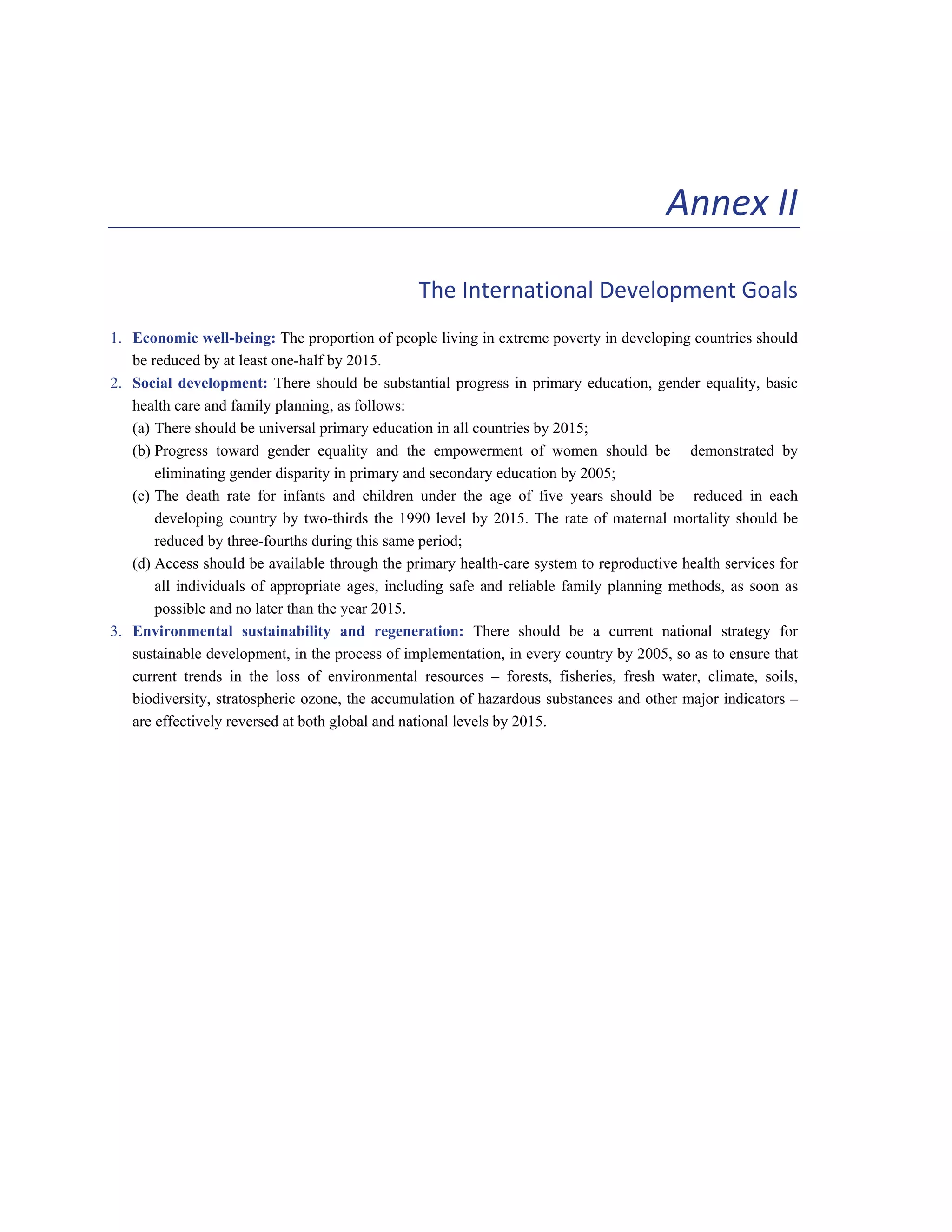
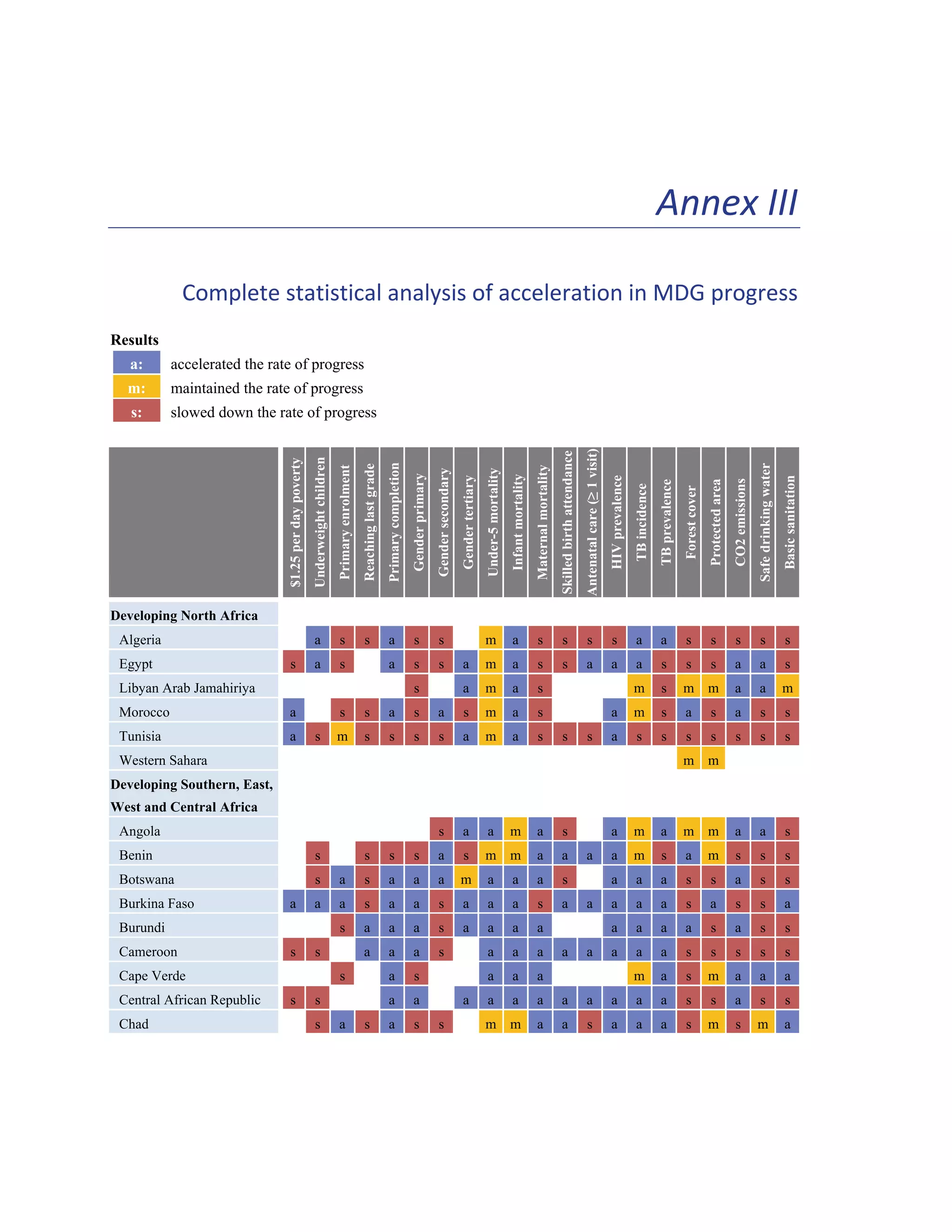
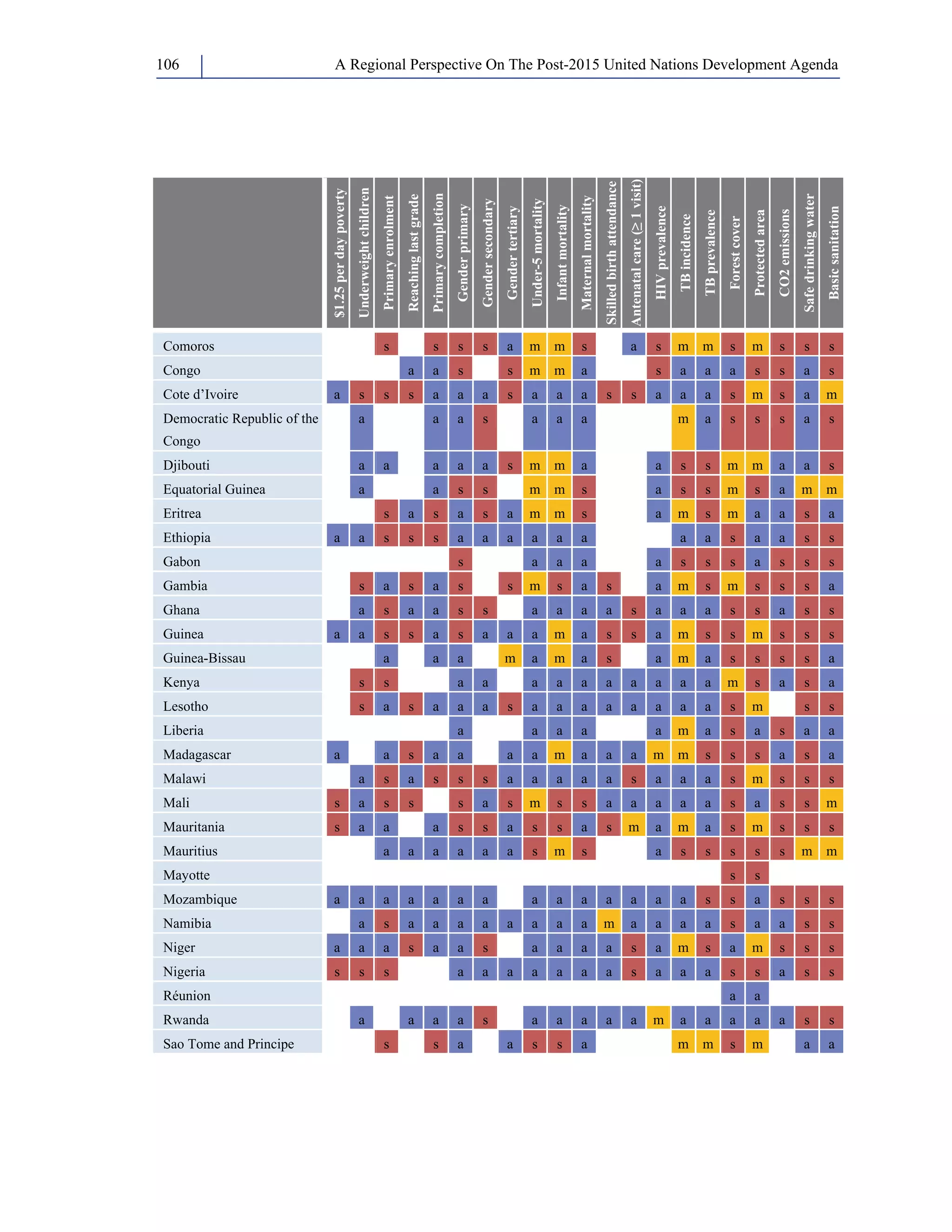
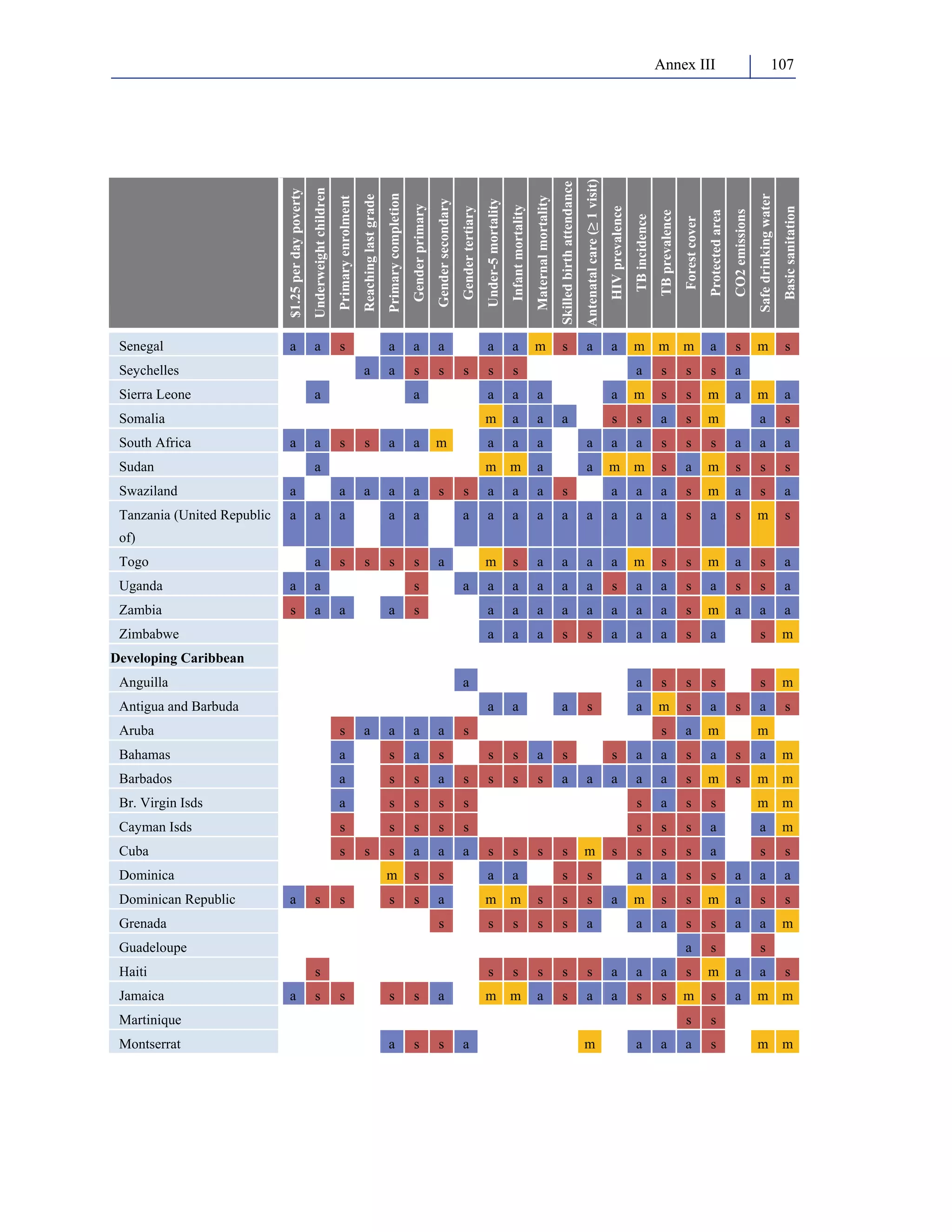
III. Complete statistical analysis of acceleration in MDG progress.............. 105 
IV. National adaptation of MDGs ................................................................. 113 
Bibliography...................................................................................................... 121
xv 
List of Acronyms 
AARR Average Annual Rate of Reduction 
ADB Asian Development Bank 
AfDB African Development Bank 
AIDS Acquired Immune Deficiency Syndrome 
ASEAN Association of Southeast Asian Nations 
AUC African Union Commission 
DAC Development Assistance Committee 
DESA United Nations Department of Economic and Social Affairs 
ECA Economic Commission for Africa 
ECE Economic Commission for Europe 
ECLAC Economic Commission for Latin America and the Caribbean 
ECOSOC United Nations Economic and Social Council 
ECOWAS Economic Community of West African States 
ESCAP Economic and Social Commission for Asia and the Pacific 
ESCWA Economic and Social Commission for Western Asia 
FDI Foreign Direct Investment 
G-20 The Group of Twenty 
GDP Gross Domestic Product 
GPI Gender Parity Index 
HIV Human Immunodeficiency Virus 
ICT Information and Communication Technology 
IDGs International Development Goals 
IFIs International Financial Institutions 
ILO International Labour Organization 
IMF International Monetary Fund 
LDCs Least Developed Countries 
LLDCs Landlocked Developing Countries 
MENA Middle East and North Africa 
MDGs Millennium Development Goals
A Regional Perspective on the Post-2015 xvi United Nations Development Agenda 
MKUKUTA Tanzania National Strategy for Growth and Reduction of Poverty 
NEPAD New Partnership for Africa’s Development 
NGOs Non Governmental Organizations 
ODA Official Development Assistance 
OECD Organization for Economic Co-operation and Development 
PPP Purchasing Power Parity 
PRSP Poverty Reduction Strategy Paper 
SAARC South Asian Association for Regional Cooperation 
SAPs Structural Adjustment Programmes 
SDGs Sustainable Development Goals 
SIDS Small Island Developing States 
SPPRSD 
Azerbaijan State Programme on Poverty Reduction and Sustainable 
Development 
TB Tuberculosis 
UNCSD United Nations Conference on Sustainable Development 
UNCTAD United Nations Conference on Trade and Development 
UNDP United Nations Development Programme 
UNICEF United Nations Children's Fund 
UNRISD United Nations Research Institute for Social Development 
UNSD United Nations Statistics Division 
UNTT 
United Nations System Task Team on the Post-2015 United Nations 
Development Agenda 
UN Women United Nations Entity for Gender Equality and the Empowerment of Women
1 
Introduction 
In September 2011, the Secretary-General 
requested Under-Secretary-General for 
Economic and Social Affairs and the 
Administrator of the United Nations 
Development Programme (UNDP) “to 
establish a core group of dedicated senior 
technical experts to coordinate system-wide 
preparations on ongoing efforts and propose a 
unified vision and road map for the definition 
of a United Nations development agenda post- 
2015, in consultation with all stakeholders.”1 
As a result of this request, the United 
Nations System Task Team on the Post-2015 
United Nations Development Agenda (UNTT) 
was established and launched in January 2012. 
UNTT is co-chaired by the United Nations 
Department of Economic and Social Affairs 
(DESA) and UNDP, and is composed of more 
than 60 entities of the United Nations system, 
including all the Regional Commissions. Its 
terms of reference include the formulation of a 
system-wide vision and road map to contribute 
to the global debate on the post-2015 United 
Nations development agenda. 
In June 2012, UNTT issued a report to the 
Secretary-General entitled “Realizing the 
Future We Want for All”.2 The report identifies 
a future vision based on the core values of 
human rights, equality and sustainability, and 
proposes to reorganize a post-MDG framework 
along four dimensions: (i) inclusive social 
development; (ii) inclusive economic 
development, (iii) environmental sustainability, 
and (iv) peace and security. The report 
concludes by stressing the need to develop 
a post-2015 agenda that responds to people’s 
aspirations through “clear, easy-to-communicate 
goals that will help guide 
coherent policy action at the global, regional 
and national levels.”3 The present report is 
designed to make a regional contribution to 
that global policy debate, including by 
identifying practical difficulties in achieving 
such policy coherence at different levels. 
In August 2012, the Secretary-General 
issued a landmark annual report on 
“Accelerating Progress towards the 
Millennium Development Goals: Options for 
Sustained and Inclusive Growth and Issues for 
Advancing the United Nations Development 
Agenda beyond 2015”.4 The Secretary- 
General’s report summarizes the recent 
progress towards achieving MDGs and 
provides general recommendations on how to 
continue advancing the development agenda 
beyond 2015, including taking action to ensure 
coherence between the follow-up to the 2012 
United Nations Conference on Sustainable 
Development, held in Rio de Janeiro, and the 
preparations for a post-2015 agenda. 
While the report of the Secretary-General 
advocates a development agenda that maintains 
a clear strategic focus on human development, 
it also stresses that the post-2015 strategy will 
have to confront new global challenges. 
However, what is often overlooked in the 
discussions of such global challenges is that 
they often manifest themselves in different 
ways at the regional and subregional levels. 
Thus, the strategic responses to such
A Regional Perspective on the Post-2015 2 United Nations Development Agenda 
challenges will also have to be variegated 
at those levels. This recognition underlines 
the importance of clarifying ‘regional 
perspectives’ and strengthening regional 
cooperation in pursuing the post-2015 
development agenda. In assessing the MDG 
agenda, a great deal of discussion has focused 
on the tension between maintaining clear 
global goals and targets and adapting such 
goals and targets to national realities. 
A significant number of commentators have 
remarked that the MDG agenda has been too 
focused on the global level and has not taken 
due account of national specificities. 
Many of the MDG goals have been framed 
as general relative targets, including the well-known 
poverty target, namely halving the 
proportion of people in extreme poverty by 
2015. A country’s capacity to reach such a 
target depends a great deal on its concrete 
starting-point. For example, if in 1990 (the 
MDG base year), a large proportion of 
a country’s population was extremely poor, it 
might have had great difficulty in halving 
poverty. However, even though it might miss 
the 2015 ‘target reduction’, some analysts have 
argued that it could still be considered 
successful if it had significantly accelerated the 
rate at which it reduced poverty, compared to 
its previous pre-MDG trend. 
The debate on the most appropriate measure 
of a country’s performance has focused on the 
national level. But one of the important points 
that this publication stresses is that in particular 
regions or subregions, there might be a 
substantial number of countries with similar 
disadvantaged starting-points. Conversely, 
there might be a substantial number with more 
advantaged starting-points where targets, and 
perhaps even goals, might be more ambitious. 
Those differences in initial conditions, 
whether positive or negative, need to be taken 
into account when development strategies are 
formulated. Such conditions could relate, for 
example, to the degree of poverty and 
inequality, the character of demographic trends 
(such as ageing or a growing ‘youth bulge’), 
the nature of natural disasters (such as 
desertification), the severity of common health 
challenges (such as HIV/AIDS), and so forth. 
The regional level can therefore represent 
a promising practical level at which countries 
can usefully caucus and confer among one 
another on their comparative experiences. But 
the benefits of such a regional approach have 
not been highlighted in strategic discussions 
about the MDG agenda. Hopefully, this kind of 
approach will change in the post-2015 strategy. 
This report is designed to make a significant 
contribution towards strengthening regional 
perspectives on the formulation of the post- 
2015 agenda. Enhanced awareness of such 
regional commonalities implies that regional 
organizations, such as the Regional 
Commissions, are well placed to help bridge 
the gap between global goals and national 
realities. For example, recent sociopolitical 
developments in the Arab region help to 
inform the post-2015 debate by highlighting 
that making national progress on existing 
MDG indicators does not always mean that the 
development expectations of the majority of 
the population are met. Therefore, attempts 
should be made to better cover missing 
economic, social and political dimensions in 
the future debate. In other words, intervening
Introduction 3 
at the regional level on the MDG agenda does, 
indeed, make strategic sense. 
Current global economic trends also suggest 
that there will likely be greater cooperation at 
the regional level in the future, especially 
considering ongoing difficulties in reaching 
multilateral agreements on how to effectively 
address economic, social and environmental 
challenges. The so-called ‘Rise of the Global 
South’, marked by the economic ascendency of 
such major emerging economies as China, 
India and Brazil, can also bolster more 
concerted regional initiatives as well as the 
expansion of South-South cooperation. Such a 
strategic option appears increasingly attractive 
as the developed world continues to experience 
economic stagnation and fiscal austerity and 
retreats from giving priority to providing 
international development assistance. 
Efforts could accelerate, in particular, on 
strengthening regional financial institutions, 
such as those recently initiated in South 
America and Southeast Asia (for example, 
Banco del Sur and the Chiang Mai Initiative). 
If properly designed, such new potentially 
expanded sources of development financing 
could support more ambitious forms of 
regional cooperation. All in all, the viability of 
development cooperation at the regional level 
appears to be increasing. Hence, what we have 
called the ‘missing dimension’ of regional 
cooperation with regard to the current MDG 
agenda could become a much more prominent 
dimension of post-2015 development efforts. 
Regional organizations could have an 
important role to play in helping countries set 
‘realistically’ ambitious development targets. 
Just as importantly, such organizations could 
also help countries identify the most 
appropriate means to achieve their own 
development targets. The MDG framework has 
been frequently criticized for setting goals but 
providing very scant practical advice on how to 
attain them. 
In various consultations on the post-2015 
development agenda, there is now considerable 
discussion on how organizations of the United 
Nations system could offer more useful 
practical advice on achieving the next set of 
global development goals. But there is also 
concern that such organizations should not 
succumb to being prescriptive, particularly 
since ‘Washington Consensus’-endorsed5 
policy coherence has already provided 
a negative example of such an approach. 
Hence, trying to achieve policy coherence on 
a post-2015 development agenda at the global, 
regional and national level appears to be 
a particularly complicated endeavour. 
In response to such contradictions, active 
consultations among countries at the regional 
or subregional level appear to be a promising 
avenue for assisting countries in identifying 
practical policy options that are both suited to 
their development conditions – that is, their 
MDG starting-points – and consistent with the 
guiding principles and pathways identified by 
a global development agenda. Such an 
approach holds out the promise of being able to 
combine both strategic coherence and practical 
flexibility in the pursuit of commonly agreed 
global goals. 
If this view is indeed correct, then it is 
imperative to begin investigating the potential 
for organizing and financing regional 
institutional mechanisms that can provide a
A Regional Perspective on the Post-2015 4 United Nations Development Agenda 
meaningful bridge between the formulation of 
globally agreed goals and the identification of 
realistic national targets and relevant national 
policies and programmes to achieve them. 
In this endeavour, the Regional 
Commissions can play a critically important 
intermediary role in bringing national 
policymakers together at both the regional and 
subregional levels to compare development 
realities and experiences. They can also 
identify the most appropriate level of ambition 
and the most relevant policy and financing 
modalities to achieve progress at the national 
level towards the post-2015 development goals 
collectively agreed by the international 
community. This report is designed as a 
platform to further develop those ideas and 
thus strengthen the role of the Regional 
Commissions as institutional conduits between 
the global and national levels. 
In particular, the report aims to address the 
relevance and significance of the regional 
perspective in formulating a post-2015 
development agenda. It is also designed to 
identify a few key priority areas and messages 
for the post-2015 period. 
The report is composed of four chapters, 
which follow this introduction. Chapter I 
provides a historical perspective on the 
development of the current MDG agenda. 
Chapter II reviews the progress in 
implementing MDGs. Chapter III seeks to 
identify the key regional development issues 
that need to be addressed in a post-2015 
development agenda. Chapter IV synthesizes 
the contributions of the previous chapters, 
provides key recommendations on policy 
directions and offers some suggestions on 
implementation mechanisms for a post-2015 
United Nations development agenda.
5 
I. A Historical Perspective on 
the Current MDG Agenda 
A. Introduction 
The beginning of the millennium witnessed the 
adoption of the United Nations Millennium 
Declaration by the General Assembly. In the 
Declaration, representatives of United Nations 
Member States committed their nations to a 
new global partnership for development by 
establishing a series of time-bound targets, 
with a deadline of 2015.1 The adoption of this 
Declaration led to the subsequent elaboration 
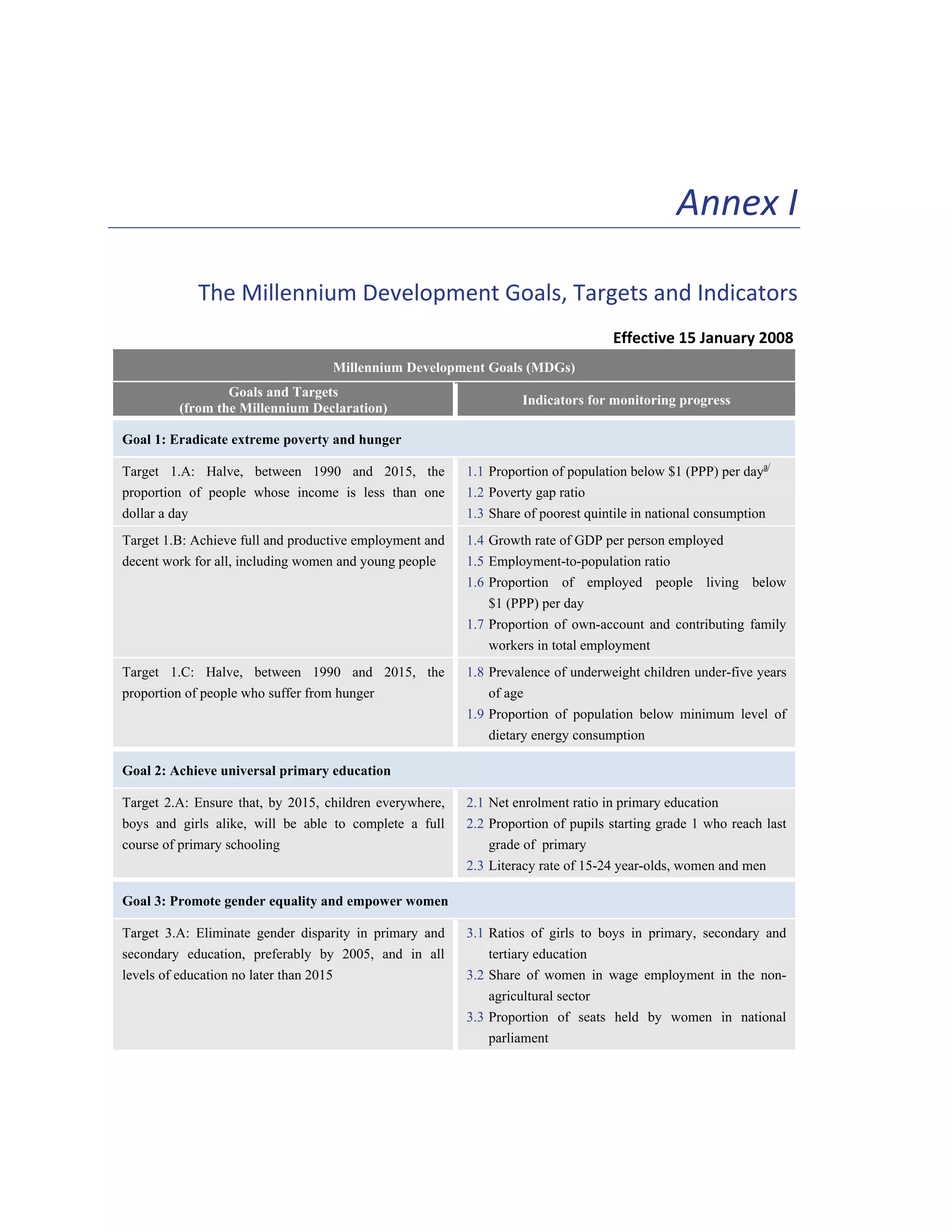
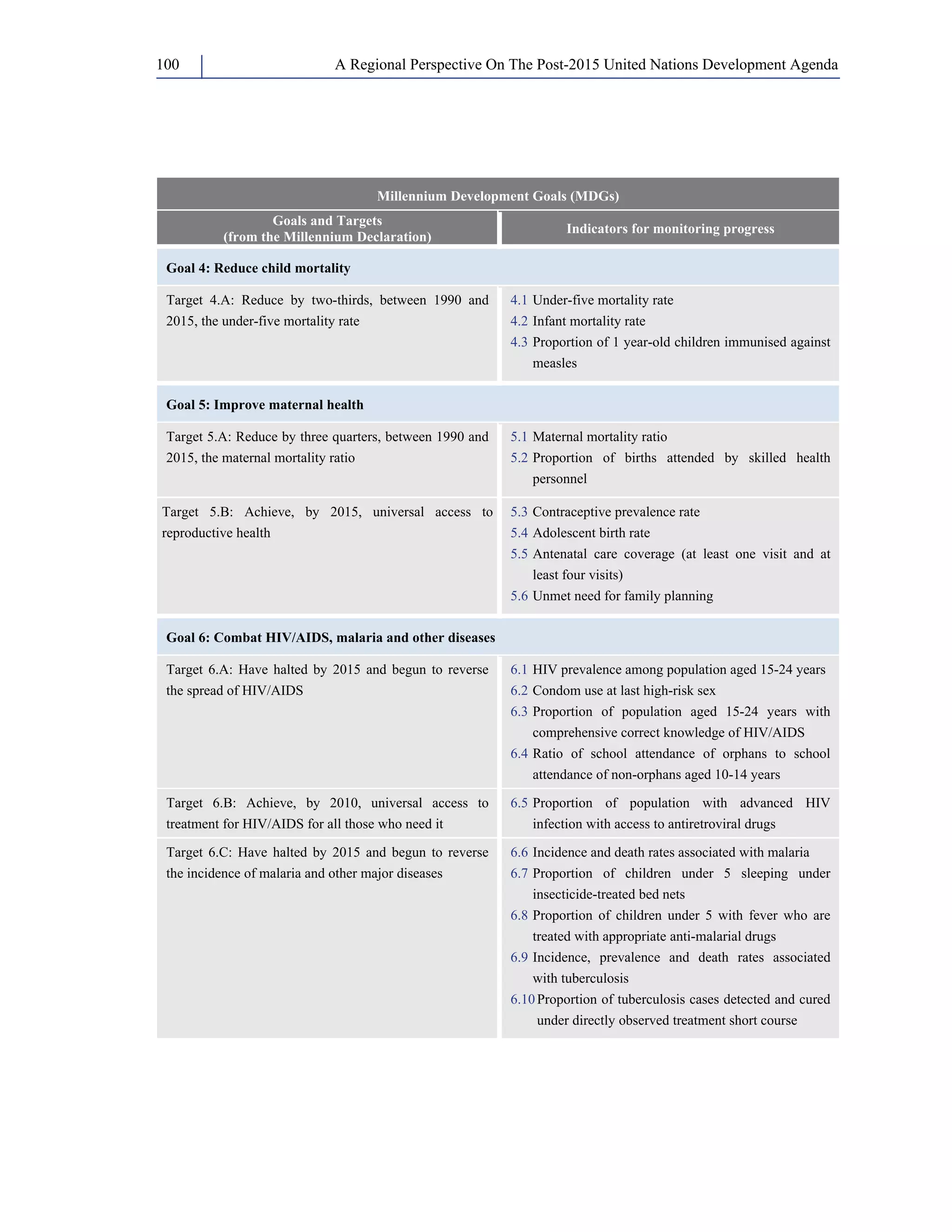
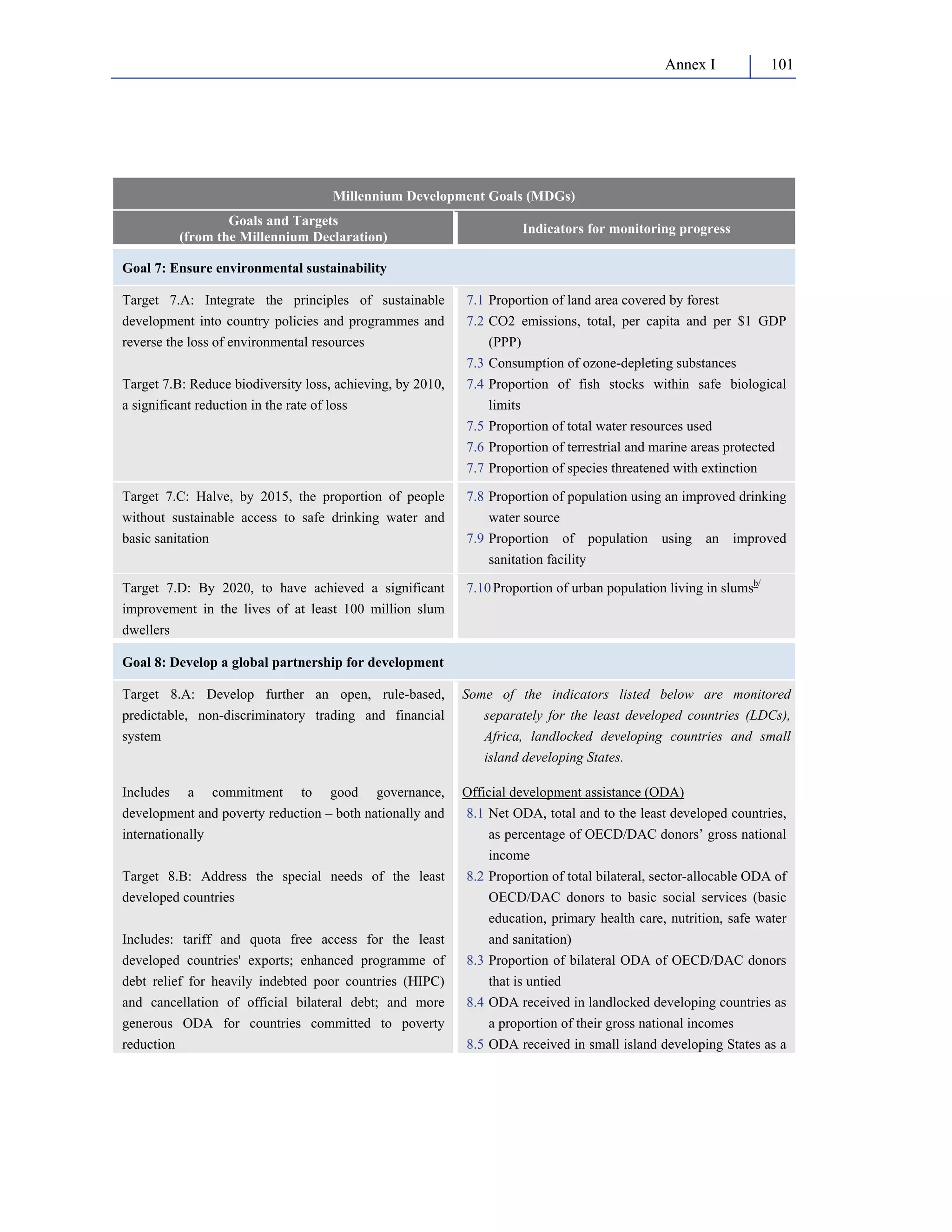
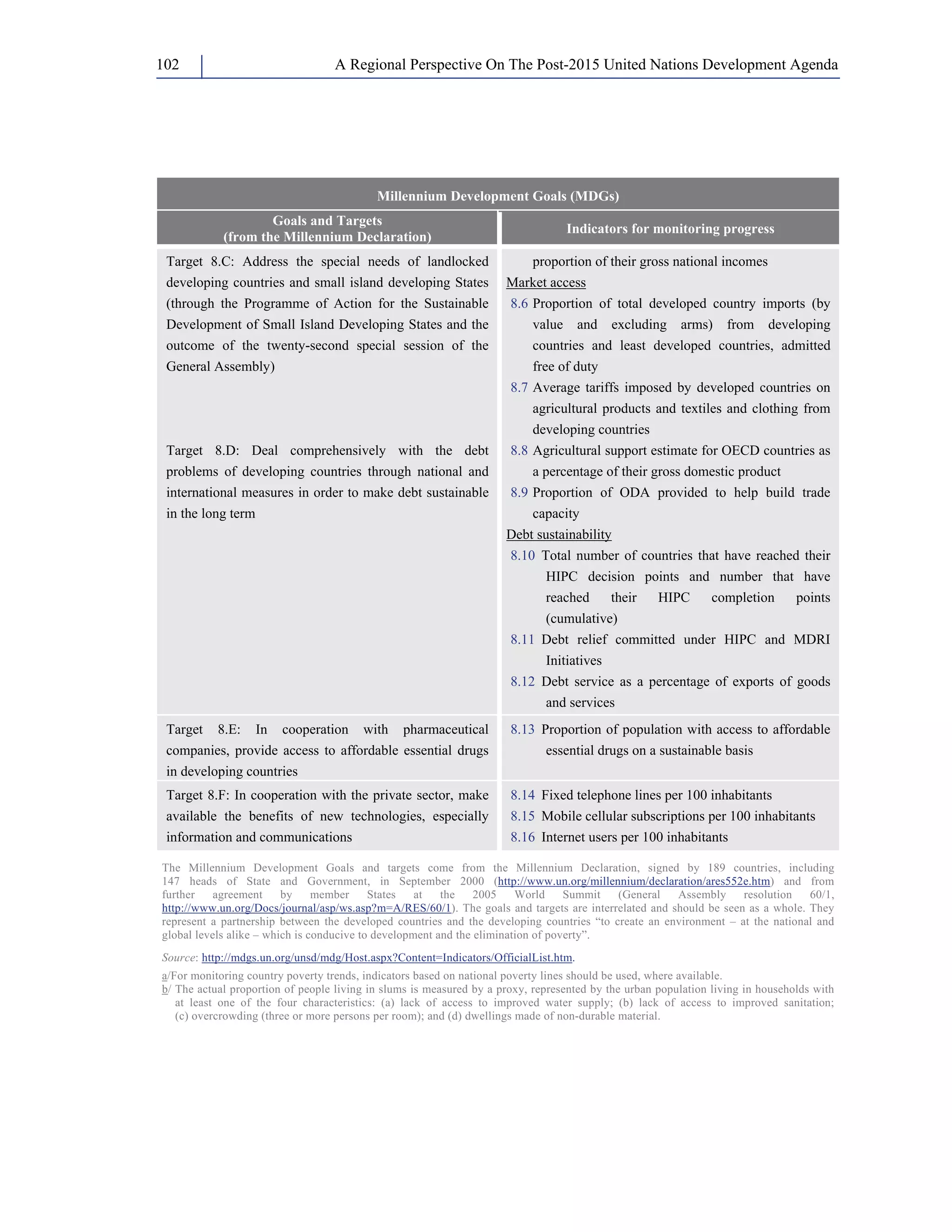
of MDGs (see annex I). 
The eight MDGs marked a significant step 
in the international development agenda as 
they offered a unique opportunity for focusing 
international policies and economic resources 
on achieving progress on human development 
priorities around the world. They contributed 
to cementing a new global partnership to tackle 
key development challenges and to galvanizing 
international attention and resources to address 
those challenges. 
Some of the MDGs strengths in terms of 
conceptualization, format and implementation 
are widely recognized by the international 
community.2 The MDG framework is simple, 
transparent and serves as a benchmark to 
measure progress over time and across regions. 
This integrated framework has influenced 
policy formulation in terms of setting human 
development priorities across different regions. 
It has also served to channel global and 
national resources towards the implementation 
of those development priorities. The clear 
definition of goals and targets further 
contributed to improving policy monitoring 
and building capacity at the national level. 
The value of the goals can be seen from 
three different perspectives: (i) as a clear set of 
global norms for development; (ii) as an 
incentive for policy change at the national level 
(notably in developing countries) and (iii) as a 
positive influence on the aid budgets of 
traditional donors.3 
At the same time, it is now recognized that 
the MDG approach had some weaknesses, 
including4 (i) not adequately incorporating some 
of the important concepts contained in the 
Millennium Declaration and not paying enough 
attention to some key strategic development 
issues; (ii) inadequate consultation with 
the representatives of developing countries, 
which weakened local ownership and “led to 
the perception of a donor-centric agenda”; 
(iii) insufficient attention to the importance of 
different initial levels of human development 
across countries and regions; and (iv) insufficient 
priority accorded to the “enablers of 
development”, such as national policies and 
international support needed to advance the 
MDG agenda. The last point is particularly 
important since the MDG framework has
A Regional Perspective on the Post-2015 6 United Nations Development Agenda 
focused on the outcomes of development, as 
opposed to the means to achieve those outcomes. 
Similarly, the format of the MDG framework 
has been criticised for lacking clarity “on how to 
tailor global targets to national realities and 
regional dynamics”5. This is an important 
consideration that will be addressed in more 
detail in this report. In addition, the MDG 
framework pays insufficient attention to the 
conditions of vulnerable groups and does not 
address the qualitative dimensions of service 
provision, such as health and education. Other 
key development areas are inadequately 
addressed, including violence against women, 
productive employment, social exclusion, 
inequality, reproductive health, biodiversity and 
governance, amongst others. Some of the targets 
have also been criticized for being imprecise. 
This applies, in particular, to the urban slum 
dwellers target of MDG-7 and to several of the 
targets in MDG-8. 
Some of these format weaknesses might 
have led, in turn, to implementation problems, 
including not taking into sufficient account 
nationally specific conditions, the complexities 
of the development process, the need for 
structural transformation and the importance of 
institution-building. There have also been some 
weaknesses in achieving an effective global 
partnership for development, notably in the 
areas of debt sustainability, market access, and 
in terms of access to essential medicines and 
new technology.6 
These shortcomings raise important 
questions about how to frame a post-2015 
development agenda. There is also the need to 
take into consideration the uneven progress 
achieved across goals and targets. As the next 
chapter discusses more fully, while 
considerable progress has been recorded on the 
attainment of many MDGs, serious challenges 
remain with regard to some of the goals and 
targets. 
There is no doubt that significant progress 
has been achieved at the global level.7 Such 
progress includes: 
• The achievement of the global poverty 
reduction target and a substantial reduction 
of extreme poverty in most regions; 
• The general achievement of parity between 
girls and boys in primary education; 
• The general achievement of the target of 
halving the share of people without access 
to improved drinking water sources; 
• Important strides in achieving universal 
primary education and reducing child 
mortality in many countries, notably in 
regions that are facing the greatest 
challenges, such as in most parts of Africa; 
• A significant decline in global malaria 
deaths and the spread of tuberculosis, 
together with significant increases in 
the access to treatment of people living 
with HIV. 
At the same time, progress has been 
unequally distributed among and within 
regions. And the recent global crises have had a 
detrimental impact on attaining several MDGs 
and targets. Some key areas where progress has 
lagged behind expectations include:8 
• Hunger, which continues to be a critical 
global challenge, including in highly 
populated subregions, such as South Asia; 
• Vulnerable employment, which has declined 
relatively little and remains a major problem 
for women and youth in many regions;
A Historical Perspective on the Current MDG Agenda 7 
• Maternal mortality rates, in which the 
decline is certainly not on track to meet the 
MDG target by 2015; 
• Disparities between rural and urban areas in 
terms of access to safe drinking water; 
• The considerable growth of the world’s 
slum-dwelling population well beyond the 
100 million maximum slum dwellers 
targeted by MDG-7. 
The fact that some MDGs have not been 
achieved in many developing countries 
highlights the need for a more comprehensive 
approach to development that takes into 
account important political, economic, social 
and environmental factors across different 
regions and countries. Particular attention 
needs to be paid to the outcome of the 2012 
United Nations Conference on Sustainable 
Development,9 and the development and 
incorporation of sustainable development goals 
(SDGs) into a post-2015 framework. In 
addition, the MDG framework does not give 
sufficient attention to issues of income 
inequality, wealth and opportunities, women’s 
empowerment and the empowerment of the 
poor.10 Those weaknesses call for a revised 
approach to a post-2015 development agenda 
in order to align goals and targets more 
meaningfully with regional and national 
development challenges and priorities. Those 
weaknesses also highlight the importance of 
placing responsibility on both the developed 
and developing world for the attainment of 
human development at the global level. 
Rather than focus on the content of MDGs 
per se, this chapter examines the political and 
economic processes, circumstances and 
paradigms that gave rise to the creation and 
specification of MDGs. An analysis of such 
processes and paradigms is important not only 
for understanding the origins and the 
conceptual bases of MDGs, but also for 
highlighting the areas of change and reform 
required for the identification of a future 
development agenda. This chapter will 
underscore the need, in particular, for aligning 
a global development agenda more realistically 
with national and regional realities and trends. 
As elaborated in chapter 2, such an 
objective stresses the importance of assessing 
progress toward MDGs on the basis of the 
starting points and historical trends in each 
region and subregion. This approach will 
safeguard against exerting unfair pressure on 
less developed countries to meet globally 
defined goals. A strong regional dimension to 
analysis and policy-setting is also required in 
order to keep pace with changing regional 
socioeconomic and political dynamics. 
Region-specific developmental challenges 
require, to some degree, regional solutions that 
are based on the formulation and 
implementation of more carefully identified 
policy responses. Such an approach also calls 
for a more ‘bottom‐up’ approach to the global 
debate on the future United Nations 
development agenda by better reflecting the 
concerns and aspirations of those mostly 
affected by that debate. 
B. The Political Origins of MDGs 
Understanding the nature of the political 
context and processes that resulted in the 
creation of MDGs can provide significant
A Regional Perspective on the Post-2015 8 United Nations Development Agenda 
insights into how they were formulated and 
help inform the discussion on formulating a 
future global development agenda. MDGs were 
not only an articulation of the increasing 
international concern with issues of poverty 
and underdevelopment, which had come to 
prominence in the preceding decades, but were 
also the logical consequence of decisions made 
at a series of international development 
summits and diplomatic negotiations. 
This section seeks to shed some light on 
what could be called a “global public policy 
framework” for understanding the structural 
forces and the dynamic links between actors 
that helped shape, together with other key 
factors, the emergence of MDGs.11 This 
approach helps highlight the “fluid, dynamic 
and intermeshed relations of politics, markets, 
culture and society” that resulted in the 
complex interaction of actors, some of whom 
are “more visible, persuasive and powerful 
than others”.12 Such processes and interactions 
have played a key role in the creation and 
articulation of MDGs. 
The 1980s and the aftermath of the debt 
crisis marked a major shift in global 
development thinking. That decade witnessed 
the rising importance of the Washington-based 
International Financial Institutions (IFIs), 
notably the International Monetary Fund (IMF) 
and the World Bank, as the trend-setters of the 
global development agenda. This trend was 
largely due to their increased lending, in the 
form of Structural Adjustment Programmes 
(SAPs), to debt-burdened developing countries. 
Also, the collapse of the Soviet Union gave 
rise to a period of socioeconomic crisis in the 
transition economies as they went through 
a “second cycle of primary capitalist 
accumulation”,13 with their social-welfare 
systems under attack. Their conversion to 
capitalist economic systems also generated a 
sense of ‘market triumph’ and provided a wider 
platform for the dominance of market-based 
ideological frameworks in various economic 
and political spheres. 
This trend was reflected in the 
implementation of market-based reform policies 
and privatization strategies in countries that 
adopted SAPs. The growing influence of the 
Washington-based IFIs came at the expense of 
the role and involvement of the non-funding 
bodies within the United Nations. However, the 
failure, or at best, the limited success of SAPs in 
generating the promised economic stabilization, 
which left recipient countries with high levels of 
inflation, unemployment, poverty and 
inequality,14 resulted in an inevitable 
resurgence of the United Nations in the early 
1990s, motivated by the objectives of promoting 
human development and reducing poverty. 
The 1990s was also a decade of economic, 
political and environmental turmoil around the 
world, making the call for more ambitious 
development priorities by the end of the decade 
even more urgent. The first Gulf War of 1991, 
the economic and financial meltdown in Japan, 
the financial crisis in Mexico (1994), the Asian 
financial crisis affecting Thailand, the 
Democratic People’s Republic of Korea, 
Malaysia and Indonesia (1997-1998), and the 
financial crises in Brazil (1999) and Argentina 
(2001) were among some of the recurrent crises 
that reinforced the worsening conditions of the 
poorest segments of the society, those most 
vulnerable to unemployment and cuts in wages
A Historical Perspective on the Current MDG Agenda 9 
and social benefits. The mid-1990s also brought 
about an increase in the number of cataclysmic 
natural disasters, such as the Mozambican 
floods, Hurricane Mitch, and the Chinese, 
Indian and Iranian earthquakes. At the same 
time, the health pandemic of HIV/AIDS had 
reached full scale, with dire prognoses for 
Africa and Asia. Political crises and turmoil 
persisted (and worsened) in parts of Central and 
Western Asia,15 from Afghanistan to Palestine. 
As a result of those trends—and despite the 
relatively strong performance of China and 
India—the average annual Gross Domestic 
Product (GDP) per capita growth rates for 
Latin America and the Caribbean, and 
Southern, East, West and Central Africa in the 
1990s were 1.3 per cent and −0.6 per cent, 
respectively. In developing countries as a whole, 
the average annual rate of growth of gross 
capital formation (public and private investment) 
slowed down from 2.1 per cent during the period 
1980-1990 to 1.7 per cent during 1990-2002.16 
In low-income countries, where investment 
growth is critical to reaching MDGs, the growth 
rate slowed from 4.7 per cent to 4.2 per cent, and 
it dropped sharply in lower middle-income 
countries, from 3.4 per cent to 0.3 per cent.17 
The publication of UNDP’s first Human 
Development Report in 1990 and the re-activation 
of United Nations Summits and 
Conferences18 in the same year initiated a 
decade of summits that would highlight the 
issue of poverty reduction as a central global 
development objective. The Children’s Summit 
of 1990 is considered of particular significance 
in highlighting the challenges of poverty, 
health care and primary education and 
generating political and financial commitments 
towards that end, renewing energy and hope in 
the effectiveness of the United Nations as a 
vehicle for debates, declarations and 
commitments to global developmental issues.19 
Other key events included the United Nations 
Conference on Environment and Development 
(The “Rio Summit”), which focused public 
attention on the issues of environment and 
development, and resulted in some critical 
outcomes that have shaped the global sustainable 
development agenda, including Agenda 21, as 
well as treaties on climate change, desertification 
and biodiversity20. This event was followed by 
the more low-key 1992 International 
Conference on Food and Nutrition in Rome, 
which set the target of halving the number of 
hungry people in the world, a target that would 
later gain much significance within the MDG 
framework. The World Conference on Human 
Rights in Vienna in 1993 re-affirmed the 
commitment of United Nations members to 
human rights and fundamental freedoms and 
propelled forward the process leading to the 
establishment of the Office of the High 
Commissioner for Human Rights. The 1994 
International Conference on Population and 
Development in Cairo was significant for the 
MDGs process as its deliberations, for the first 
time, explicitly expanded into development and 
discussions of rights-based approaches to 
development, moving away from the 
demography and family planning focus of 
earlier such summits.21 
The mid-1990s witnessed two key global 
social conferences: the World Summit on 
Social Development held in Copenhagen in 
March 1995 and the United Nations Fourth 
World Conference on Women held in Beijing
A Regional Perspective on the Post-2015 10 United Nations Development Agenda 
only six months later. The Copenhagen summit 
was structured around the three pillars of 
poverty reduction, employment and social 
integration, with poverty reduction attracting the 
most attention. Many United Nations agencies 
and Non-Governmental Organizations (NGOs) 
were quick to endorse the summit’s focus on 
eradicating poverty, and were followed by 
many multilateral and bilateral agencies, which 
began to adopt poverty reduction as their 
key developmental objective in the ensuing 
period. The Beijing conference was important 
for providing a high-profile platform for 
strengthening the women’s movement and its 
lobbying power for gender equality. 
The next step in this process was to secure 
financing for the ambitious promises made at 
those global summits. However, that was 
a difficult task as a result of the end of the Cold 
War and the resultant “aid fatigue” of the mid- 
1990s, which came on the heels of the mixed 
experience of policies tied to the aid 
conditionalities of SAPs. The creation of 
Groupe de Reflexion in 1995 by the 
Development Assistance Committee (DAC) of 
the Organization for Economic Co-operation 
and Development (OECD)22 was an attempt to 
re-energize aid efforts by advocating for an 
understanding of aid as an investment rather 
than as a current expenditure. The two major 
areas of the Groupe’s negotiations were, first, 
the reduction of income poverty through 
economic growth and, second, the importance 
of gender equality and empowerment. These 
efforts evolved into what later became known 
as the DAC International Development Goals 
(IDGs), formulated in 1996 and approved by 
the OECD members (see annex II). 
The IDGs’ initial impact was minimal, both 
amongst the larger donor countries and 
multinational institutions, as well as among 
developing countries, especially because the 
latter had almost no involvement in 
formulating IDGs beyond attending a few 
consultation conferences. IDGs were reduced 
into two achievable, measurable and popular 
goals within OECD circles: eradicating poverty 
and promoting gender empowerment. 
Structural issues such as reducing income 
inequalities between the developed and 
developing countries and minimizing the 
negative effects of globalization would not 
have gained OECD backing at that time. 
Although the non-governmental community 
and civil society organizations endorsed the 
OECD concern with promoting universal 
primary education and reducing child and 
infant mortality rates, they remained critical of 
the fact that some of the actions under the 
control of the OECD member countries, such 
as increased aid, more debt forgiveness, and 
fairer trade, were not included in IDGs and that 
the narrow framework of the reduction of 
extreme poverty did not allow for broader, 
more inclusive rights-based approaches to 
development. 
The full impact of IDGs would depend on 
the adoption by IFI of these goals. Although 
they went relatively unnoticed at the IMF, the 
World Bank’s 1997 Global Monitoring Report 
featured IDGs as a monitoring framework to 
highlight the Bank’s advantage in collecting 
data, analysing development indicators and 
measuring development.23 While reflecting the 
broad concerns expressed at the United Nations 
summits of the previous decade, DAC’s
A Historical Perspective on the Current MDG Agenda 11 
leadership of the international development 
agenda, based on support from OECD members, 
meant that developed-country priorities tended 
to determine the specific content of IDGs. 
This trend was further apparent in the 
contrast between the DAC’s approach of 
results-based management versus the United 
Nations’ more encompassing development 
vision. For example, while UNDP highlighted 
“moderating inequality [as] the first step in 
ending poverty”, DAC avoided any discussion 
of global income and asset inequalities.24 
Concerning policy ownership, while the United 
Nations emphasized global goals with national 
targets and policies, DAC advocated 
partnerships among actors in order to achieve 
globally set goals and policies. This growing 
divide in the international policy debates and 
DAC’s increasing prominence set the basis for 
the ways in which MDGs were formulated and 
structured a few years later. 
Following a decade of summits, the highly-anticipated 
United Nations General Assembly 
in New York in 2000 resulted in the 
Millennium Declaration, which was based on a 
document submitted as a report of the 
Secretary-General, entitled We the Peoples: 
The Role of the United Nations in the 21st 
Century. This declaration was designed to 
provide the Millennium Summit with a 
background document upon which agreement 
could be forged. It tended to reinforce poverty 
eradication as the leading global issue, though 
it took a strategic approach that was different 
from IDGs’ poverty reduction stance. This 
United Nations document sharpened the focus 
on the importance of pro-poor economic 
growth and technological advancement as a 
way of leapfrogging earlier stages of 
development. It also called for renewed focus 
on the problems of Africa. However, it did not 
provide a strong emphasis on gender equality 
or stress the importance of addressing 
reproductive health. The emphasis on the 
role of Information and Communication 
Technologies (ICTs) and the benefits of 
widely-available technology originated in the 
speculative Internet bubble, formed in 2000 
and led by the financial services sector which 
is a strong advocate of ICTs and their ability to 
lead to a sustained increase in economic 
productivity. The focus on the problems of 
Africa was the result of the continent’s 
completion of its second ‘lost decade’ of 
development and poverty reduction. 
As a way of setting goals also for the rich 
countries, the text of the Millennium 
Declaration placed major emphasis on trade 
access, debt relief, and official development 
assistance (ODA) to developing countries, 
while stressing the importance of working with 
the pharmaceutical industry to bring about 
breakthroughs in developing HIV/AIDS 
vaccines and related drugs. Although such 
concerns were not fully reflected in MDGs, 
they were nevertheless recognized by the 
Millennium Declaration as key aspects of 
poverty reduction in developing countries. 
Diplomatic discussions took place in 
summer 2000 in order to negotiate the final 
text of the Millennium Declaration. As a result, 
extreme poverty retained top priority; 
education was emphasized; infant, child and 
maternal mortality were retained at the expense 
of the more controversial reproductive and 
sexual health rights;25 and tackling major
A Regional Perspective on the Post-2015 12 United Nations Development Agenda 
diseases such as HIV/AIDS and malaria were 
highlighted. Other important targets, such as 
achieving decent work for youth and the 
benefits of new technologies were maintained 
though they were not ascribed priority. Though 
the goals for the actions of rich countries 
to support global poverty reduction were 
mentioned, no targets were specified and 
thus these countries were not subject to any 
binding commitments. 
The unanimous approval of the Millennium 
Declaration in September 2000 set the stage 
for the next task of defining the specific goals 
and targets for development before allocating 
tasks to different multilateral organizations and 
raising the funds for achieving those goals. 
Efforts by high-level technical experts from 
DAC and United Nations organizations, which 
were tasked with harmonizing IDGs and the 
Declaration’s goals at a World Bank meeting 
in March 2001, finally resulted in the adoption 
and publication of MDGs. Negotiations 
resulted in defining the goals in clear and 
quantifiable terms. To a certain extent, IDGs 
formed the basis of MDGs, with the clear 
exception of the issue of reproductive health, 
which proved to be politically unacceptable to 
some important United Nations member 
countries. However, gender equality and 
women’s empowerment, although presented 
primarily through the channel of educational 
access, became an explicit goal. 
A significant addition to the Millennium 
Declaration was MDG-8, which highlighted 
the responsibilities of developed countries in 
achieving the universal development targets. 
Although discussions over the latter countries’ 
aid and debt relief commitments had already 
taken place, no explicit goals had yet been set. 
The MDGs technical team identified seven 
targets and 17 indicators for Goal 8,26 
including increasing the quantity and 
improving the quality of ODA, improving 
market access for poor countries, debt relief, 
employment generation and increased access to 
technology and essential drugs. However, 
unlike for the other seven MDG indicators, 
many of the MDG-8 indicators were not 
quantifiable. Participants in the Financing for 
Development Conference in Monterrey in 2002 
also approved MDGs and explicit donor 
commitments were made, but those 
commitments proved to be below expected 
levels.27 
It can be argued that the leadership of the 
processes of formulating and implementing 
MDGs has had a large bearing on the nature of 
their specific goals. During their evolution, 
MDGs were determined initially by the 
outcomes of United Nations summits, with the 
leadership transferring to DAC in the mid- 
1990s, and once again passing back to the 
United Nations Secretariat and the General 
Assembly in the late 1990s in the lead-up to 
the Millennium Summit. The final political and 
technical negotiations that defined MDGs in 
2001 were conducted by a taskforce from the 
United Nations, OECD, the World Bank and 
IMF. Although the initial implementation was 
influenced by the Poverty Reduction Strategy 
Paper28 (PRSP) initiative of the World Bank 
and IMF, and by the United Nations’ 
Millennium Project,29 today there are a larger 
number of actors involved in the process. 
What emerges from the above review is that 
MDGs were born as a result of a multifaceted
A Historical Perspective on the Current MDG Agenda 13 
process over a long period of time, emerging 
from various global summits and conferences 
and involving a large number of actors and 
institutions, finally brought together through 
the momentum created by the turn of the 
millennium. Many analysts contend that the 
outcomes of these processes appear to have 
been predominantly influenced, in the end, by 
the priorities and objectives of large donor 
countries rather than the needs and priorities of 
developing countries. Moreover, it can be 
argued that the MDGs framework does not 
take adequate account of the underlying 
structural problems and disparities in global 
economic structures nor does it adequately 
reflect the development challenges at both the 
regional and national level. In framing a new 
post-2015 development framework, these 
concerns should be thoroughly discussed and 
assessed since they are bound to have a bearing 
on the choice of both goals and targets, on the 
one hand, and the strategies and programmes 
chosen to achieve them, on the other. 
C. The Prevailing Development 
Paradigm 
The Millennium Declaration projected the 
intention of broadening the focus of 
development to include human-centred, 
sustainable and equitable development, and to 
expand the concept of poverty from income 
poverty to multidimensional human poverty. 
However, the growth, aid and governance 
agendas have also had a strong influence on the 
process of MDG formulation . It could be 
argued that within the mainstream economic 
discourse, development is perceived as growth-mediated, 
aid-mediated or, more recently, 
governance-mediated.30 
The growth agenda argues that trade 
liberalization, privatization and deregulation of 
the economy are required in order to achieve 
MDGs; the aid agenda maintains that an 
injection of external resources into such sectors 
as health, education and agriculture is crucial 
for achieving MDGs; and, finally, the 
governance agenda argues that to foster 
development, it is essential to reform the 
institutional structures of developing countries 
in line with a global set of institutional values 
and practices. 31 
The growth agenda’s strong focus on macro-level 
growth has tended to ignore the problem 
of structural inequalities within and between 
countries, which militate against efforts to 
advance people’s well-being. This approach has 
also tended to rely on external resources for 
financing reforms, with little attention paid to 
issues of distributional equity. Recent efforts, 
such as the emergence of ‘inclusive growth’ or 
even “inclusive green growth”32 as a strategic 
framework and the new focus on ‘multi-dimensional’ 
poverty33, have moved the debate 
towards a more socially focused agenda, even if 
policy-level activities still tend to focus on 
issues such as income poverty. 
Another major challenge that needs to be 
addressed is the gradual decline in the levels of 
developmental and infrastructural aid and a rise 
in ‘softer’ areas of assistance, including 
institution-building and governance reforms.34 
Since the 1980s, for example, ODA to 
agriculture and industry has declined sharply. 
Some analysts have also argued that the
A Regional Perspective on the Post-2015 14 United Nations Development Agenda 
adoption of MDGs has accelerated this trend 
since this framework has tended to put the 
emphasis on basic education as opposed to 
tertiary and vocational education and has 
placed little emphasis on developing 
productive capacities or basic infrastructure in 
developing countries. Some critics have 
provocatively called this approach “a promotion 
of welfare and aid dependence over growth and 
self-reliance”.35 As table 1 shows, the first 
phase of MDG implementation (2000-08) 
experienced a significant increase in ODA 
allocation to social infrastructure, social 
services and debt relief – in comparison with 
the 1990-99 period and even the 1980-89 
one – at the expense of economic infrastructure 
and production sectors. This issue will be 
further discussed in chapter II. 
A different but equally important challenge 
that should be better addressed is the need to 
promote socioeconomic development approaches 
that are environmentally sustainable and thus 
take into account post-MDG dramatic changes 
in environmental conditions. For example, recent 
research identifying planetary boundaries and 
critical environmental thresholds to human 
development should be taken into consideration.36 
In addition, the recent report of the United 
Nations Environment Programme on the green 
economy outlines several concurrent crises that 
have either sprung up or accelerated during 
the last decade.37 These include crises in 
climate, biodiversity, fuel, food, water and more 
recently in the financial system. Accelerating 
climate-changing emissions indicate a mounting 
threat of runaway climate change, with 
potentially disastrous human consequences. 
Those challenges are poorly addressed in the 
existing MDG framework and should be further 
developed in a future global development agenda. 
Table 1. Sectoral allocation of net ODA disbursement by OECD/DAC members, 1980‐2008 
(percentage) 
SECTOR 1980-1989 1990-1999 2000-2008 
Social infrastructure and services 25.22 26.94 33.96 
Economic infrastructure and services 19.05 19.79 13.03 
Production sectors 23.95 16.28 13.31 
Commodity support/General programme assistance 15.86 9.96 4.59 
Debt relief 2.58 10.31 16.08 
Humanitarian aid 1.72 4.72 6.28 
Administrative costs of donors 2.32 4.48 5.14 
Support to non-governmental organizations 1.41 1.31 2.85 
Refugees in donor countries --- 0.91 2.32 
Unallocated/unspecified 7.88 5.27 2.44 
Source: United Nations, 2010b. 
Notes: Figures refer to period averages as a proportion of total ODA disbursed by member countries of the OECD’s Development Assistance 
Committee (OECD/DAC).
A Historical Perspective on the Current MDG Agenda 15 
Besides some key gaps in the identification 
of MDG focus areas, there are also critical 
shortcomings in MDG implementation. Those 
shortcomings can be grouped together into three 
areas: (1) impact of the dominant policy package 
in place before and during the formulation 
of MDGs, (2) MDGs as means versus ends and 
(3) quantification of development. 
1. The dominant policy package 
The emergence and expansion of the so-called 
‘Washington Consensus’ in the 1980s and 
1990s was based on policy packages that often 
worked against the implementation of the 
human development agenda embodied in most 
MDGs.38 Generally speaking, the ‘Washington 
Consensus’ tended to focus on tight fiscal and 
monetary policy, reduction of the role of the 
State, trade liberalization, privatization and 
financial deregulation. This development 
approach provided a policy framework for 
structural adjustment programmes introduced 
in many developing countries before and 
during the formulation of the MDG 
framework. However, there is evidence to 
show that the economic reforms contained in 
structural adjustment programmes rarely 
produced the desired economic growth and 
social progress, including poverty reduction 
and employment generation.39 
Expansionary fiscal policies, centred on 
public investment, are crucial elements of 
growth and the reduction of poverty and 
inequality in less developed countries. This 
became particularly evident during and after 
the 2008-09 global financial crisis. Public 
investment is crucial for achieving MDGs, not 
only through building basic social and 
economic infrastructure, but also by generating 
employment and providing a more efficient 
context for attracting private investment. Those 
factors will in turn help to expand both the 
aggregate demand for goods and services and an 
economy’s aggregate supply (namely, its 
productive capacity). As a recent United 
Nations flagship economic and social 
publication concludes, “fiscal policies should be 
counter-cyclical and supportive of employment 
creation and human development.”40 Needless 
to say, it is not only the quantity of public 
investment but also its quality that are of 
critical importance. 
However, the quality of such investments 
depends to a large extent on their structure: if 
they are capital-intensive, rely on large 
contractors or depend heavily on imported 
materials, then their benefits could be marginal 
to the economy, whereas investment in 
employment-intensive public investment 
projects, which hire or subcontract small and 
medium-sized contractors and use local 
suppliers of materials, could often utilize 
public resources more optimally. To maximize 
its impact on poverty reduction, public 
investment needs to expand from providing 
basic education and health to constructing such 
essential infrastructure as rural roads, energy 
grids and irrigation works. A general increase 
in the economy’s growth rate will not 
necessarily trickle-down to the poorest unless 
public investment is targeted towards rural and 
agricultural development, especially in more 
remote or less developed areas. China’s Great 
Western Development Strategy is a good 
recent example of focusing public investment 
on poor regions.41
A Regional Perspective on the Post-2015 16 United Nations Development Agenda 
Similarly, there is a need to align counter-cyclical 
monetary policies with capital account 
movements. As also shown in the above-mentioned 
United Nations flagship publication, 
“conducting counter-cyclical monetary policies 
has become increasingly difficult … [in 
countries with] open capital accounts”.42 United 
Nations member states such as Chile and 
Malaysia have managed to make monetary 
policies more effective by controlling and 
regulating international capital flows. As the 
recent East Asian experience shows, monetary 
policy should “be coordinated with financial 
sector and industrial policies, including directed 
and subsidized credit schemes and managed 
interest rates, so as to directly influence 
investment and savings.”43 From this 
perspective, monetary policies are also essential 
for accommodating expansionary, investment-focused 
fiscal policies that can have a positive 
impact on poverty reduction, employment 
generation and human development. 44 
The negative social impact of the 1997 
Asian financial crisis eventually led to the 
realization that an “augmented Washington 
Consensus” was required.45 This augmented 
policy framework included social safety nets 
and poverty reduction strategies. Those 
strategies were best reflected in the formulation 
of PRSPs in the late 1990s as a social 
development component of a debt-relief 
strategy for poor developing countries. 
However the PRSP strategy continued to be 
dominated by orthodox economic policies 
which tended to undermine poverty reduction 
and employment generation. According to the 
above-mentioned United Nations flagship 
publication, “PRSPs turned out to be more 
a set of compensatory social policies 
constrained by external pressures related to 
fiscal consolidation than examples of 
coherence over the broader range of 
development policies”.46 
The 2008-2009 global financial crisis has 
highlighted the dangers of the unbounded 
deregulation of the financial system, 
particularly in terms of triggering economic 
instability and contributing to unequal access 
to financial services. The weakened financial 
sectors of less developed countries have failed 
to mobilize the required domestic financial 
resources or maintain national oversight over 
the efficient allocation of these resources to 
productive investment. Such policies are 
critical for stimulating economic activity, 
expanding employment and reducing poverty. 
Monetary and financial policies should thus 
be conducive to the development of productive 
sectors, including labour-intensive small and 
medium enterprises, agricultural and rural non-farm 
activities. In other words, financial 
inclusion should be a prominent feature of 
monetary and financial policies. It is also worth 
stressing the asymmetric impact of financial 
crises. This means that the recovery of poverty 
rates to pre-crisis levels is slow compared to 
the pace of recovery of per capita income 
levels. In the case of Latin America, for 
example, ECLAC has shown that this dynamic 
has continued to affect the most vulnerable 
populations and has hindered further progress 
towards achieving several MDGs.47 
2. MDGs as ‘ends’ versus ‘means’ 
A key aspect of the development orthodoxy, 
which has been reflected in the formulation
A Historical Perspective on the Current MDG Agenda 17 
and implementation of the MDGs, is the 
distinction between means and ends with 
regard to economic development. Mainstream 
economic thinking has tended to regard 
policies such as tight macroeconomic policies, 
trade liberalization, privatization and financial 
deregulation as ends in their own right, rather 
than as possible means towards the ultimate 
objectives of expanding employment or 
reducing poverty. 
This approach has affected how the MDG 
framework has been implemented in many 
countries. Originally designed with overriding 
human development goals in mind, such as the 
reduction of poverty, hunger and illiteracy, the 
MDG framework has been unable to identify 
the specific means or policies through which 
these objectives could be achieved. For 
example, would such ends be advanced 
through public or private investment, fiscal 
stimulus or austerity, employment generation 
or the control of inflation? This inability to 
influence the choice of policy options has left 
the field open to more conservative approaches 
to macroeconomic and structural policies and 
a heavy reliance on ODA as the engine 
of change.48 
As discussed in a recent United Nations 
report on the post-2015 agenda, the original 
MDG framework has provided few 
recommendations on ‘development enablers’, 
and this inability has led to “rigid national policy 
agendas, following international benchmarks, 
rather than local conditions”.49 As discussed in 
the next chapter, it has become increasingly 
clear that success in achieving MDGs 
requires developing country-specific strategies, 
namely policies adapted to each country’s 
socioeconomic structures, historical trajectory 
and future developmental priorities. This 
concrete approach assumes that there are no 
ready-made recipes or one-size-fits-all remedies. 
As countries have striven to adapt the MDG 
framework to their national conditions, it has 
become more evident that global development 
agendas should be adjusted to the concrete 
realities in each country as well as to each 
subregion and region. Such an approach would 
confer the added benefit of promoting greater 
national ownership of any new global 
development agenda. Such an approach would 
also call for practical recognition of the 
differences among countries: not only the 
differences in their level of development, but 
also the differences in their political regimes, 
social conditions and cultural backgrounds. 
This approach would also take into account 
important differences across regions and 
subregions and the need for consultation 
processes at these levels in order to identify the 
appropriate policy measures. 
3. The pros and cons of the quantification 
of development 
The MDG framework has been heavily 
influenced by the realization that global targets 
should be quantifiable. This has involved 
relying on setting numerical objectives, using 
quantitative indicators of success and basing 
evaluation methods on quantitative outcomes. 
While quantification approaches are no doubt 
important for measuring development progress, 
quantifiable indicators must be complemented 
by information on quality dimensions. 
It is clear that there are strengths in 
establishing quantifiable indicators and targets,
A Regional Perspective on the Post-2015 18 United Nations Development Agenda 
in terms of their comparability across regions 
and their adaptability in measuring progress on 
development dimensions over time. As 
recently argued by a leading development 
economist, any development strategy “that is 
concrete and implementable needs to monitor 
the results, and setting clear numerical targets 
is the best way to do so.”50 Establishing targets 
and indicators also has advantages in terms of 
advocacy and directing global and national 
efforts and resources towards human 
development priorities.51 In fact, as discussed 
above, one of the weaknesses in the 
formulation of Goal 8 is precisely that, unlike 
the other MDGs, many of its indicators are not 
quantifiable and there are no specific deadlines 
for their implementation. 
At the same time, the quantification 
approach also has its limitations. For example, 
the MDG approach to poverty reduction relies 
on the methodologically and conceptually 
problematic indicator used by the World 
Bank, namely, the international poverty line 
of 1.25 United States dollars (US$) per person 
per day, in 2005 purchasing power parity 
terms.52 The shortcomings of this income 
poverty line include its inability to consider 
the multidimensional nature of poverty and 
the inherent difficulties in applying it to 
nationally specific poverty conditions in many 
developing countries.53 While international 
poverty lines can play an important role in 
monitoring global and regional trends, the 
multidimensional nature of poverty at the 
national level should incorporate important 
non-income dimensions of deprivation, 
including various dimensions of inequality 
and social exclusion.54 
Since the MDG-1 poverty target does not 
include those non-income dimensions, 
multidimensional alternatives should be 
considered for a post-2015 framework.55 For 
example, in the Arab world, poverty 
measurements at the national level, either in 
terms of income or human capabilities, reflect 
“the convergence of social, economic and 
political exclusion, which is glaring for the 
majority of the Arab rural population.”56 But a 
different picture emerges in the region when the 
international poverty line of US$ 1.25 per day 
is used, since it suggests a “very low poverty 
incidence … [given that] this poverty line is too 
low to allow for any objective comparison of 
money-metric poverty in Arab countries 
relative to other developing regions.”57 
Similarly, in the area of education, boosting 
enrolment ratios does not take into account the 
quality of educational outcomes in many 
developing countries. Other indicators, such as 
drop-out rates or the level of educational 
resources available per child, might be needed 
in order to develop a more accurate portrayal 
of educational outcomes. In many developing 
countries, there is a considerable discrepancy 
between the share of children who enrol 
in primary school and the share of children 
who graduate with the ability to actually read 
and write. 
Sometimes the Millennium Development 
Goal does not match the target. This is the case 
with regard to the ambitious task of achieving 
gender equality and empowerment, reduced in 
MDG-3 to sex parity primarily in the education 
sector. In other cases, the quantifiable target is 
poorly constructed. This is the case with regard 
to the target of significantly improving the
A Historical Perspective on the Current MDG Agenda 19 
lives of 100 million urban slum-dwellers 
between 1990 and 2015. In fact, the total 
number of slum-dwellers has already increased 
well beyond 100 million since 1990.58 
Given the impact that quantification 
methods can have on policy prescriptions, 
more effort is needed to devise new methods of 
measuring development, together with 
promoting greater national capacity-building 
and ownership of the monitoring and 
evaluation of outcomes. There should also be a 
greater effort to assess the quality of outcomes. 
Much of this kind of effort will probably have 
to be concentrated at the regional or 
subregional level, where capacity-building 
initiatives, often spearheaded by the Regional 
Commissions, have already been undertaken. 
Improving the quality of the data that 
are already being collected to measure 
MDG progress is also needed. For 
example, the quality of data for some of the 
MDG health indicators needs substantial 
improvement. This is the case for basic life 
indicators, since births and deaths are 
frequently not fully registered in the 
poorest countries. 
D. Global and Regional 
Development Perspectives 
1. Addressing the inequality gap 
As will be elaborated in the next chapter, 
progress on attaining MDGs has been 
unequally distributed across regions, subregions 
and countries. One of the major shortcomings 
of the formulation of the MDG framework has 
been the inadequate attention paid to 
inequality, both within developed and 
developing countries and between them. 
The issue of unequal income distribution 
has gained increasing importance for 
international development institutions in recent 
years. For example, the United Nations, in its 
2010 report on the World Social Situation, 
stresses the central importance that the 
distribution of income and assets plays in 
achieving poverty reduction. In particular, the 
report concludes that a “high premium must be 
placed on interventions that correct inequalities 
in the initial distributions of assets, including 
human resources, in an egalitarian manner in 
order to foster more inclusive growth”.59 
Inequality matters in development because 
it affects people’s effective access and 
entitlement to resources. Inequality in income 
and wealth is usually intimately related to 
social marginalisation and exclusion. Many 
poor people face discrimination based on sex, 
race, religion and ethnicity.60 These socially 
excluded groups also frequently suffer from 
spatial inequalities. This condition implies that 
they are physically concentrated in 
disadvantaged locations such as remote and 
challenging rural terrains or overcrowded slum 
neighbourhoods. Social, economic and spatial 
inequalities together can result in political 
exclusion, since the poor are often denied voice 
and influence in collective social decisions and 
political realms. 
There is thus a need to focus on the critical 
importance of extreme inequalities in 
hampering the reduction in absolute poverty. 
There is evidence to show that higher levels of 
inequality tend to slow down the degree to 
which a given rate of growth translates into
A Regional Perspective on the Post-2015 20 United Nations Development Agenda 
poverty reduction.61 Hence, economic growth 
can contribute to promoting the quest for social 
justice only if it is accompanied by policies 
which support a more equitable distribution of 
resources, assets and opportunities. 
One possible illustration of the insufficient 
attention paid to inequalities at the national 
level in the current MDG framework is the fact 
that economic disparities are only considered 
in the third indicator of the first target of the 
first goal. This indicator is the share of the 
poorest quintile in national consumption. This 
is a very limited indicator, which is often 
disregarded in most MDG assessments since it 
shows little variation over time. The reason is 
that “there [can] be dramatic shifts at the other 
[rich] end of the distribution without shifting 
the relative position of the poorest too much”.62 
It is also worth emphasizing in this context 
that MDG-1 was amended in 2008 to include 
access to productive and decent employment in 
recognition that poverty cannot be structurally 
addressed, nor inequality reduced, without the 
widespread generation of opportunities for 
decent work. However, success in this 
endeavour requires a broader approach to 
macro-economic policy and the effective 
integration of social, labour-market and 
industrial policies.63 
Similarly, the issue of gender equality and 
empowerment has been articulated solely in 
relation to the goal of primary education. In 
fact, in a significant number of developing 
countries, females outperform males at every 
level of education except the primary level. For 
example, there are often more women than men 
enrolled in universities.64 However, progress in 
this sphere does not usually translate into 
higher levels of employment or income for 
women. Gender equality and women’s 
empowerment are thus critical development 
dimensions that are inadequately addressed in 
the existing MDG framework. They should be 
approached from a human rights and 
democratic governance perspective, including 
adequate representation in all key government 
institutions, as well as in employment and civil 
society. The key issue is to ensure that women 
are empowered to participate equally in 
decision-making processes at all levels, from 
the household and community levels to the 
global and national ones. 
In addition to addressing inequalities within 
countries, it is critical to address deep-rooted 
structural inequalities between developed 
countries and developing countries. A prime 
example of such inequalities is the use of farm 
subsidies by many developed OECD countries. 
Even though assumptions about the benefits of 
competition in global markets would suggest 
that such subsidies should be removed, there is 
no target date for their abolition in several 
major industrialized countries.65 
MDG-8 was supposedly designed to set 
ambitious goals and targets for reforms in 
developed countries. However, not only does 
MDG-8 fail to address the unequal structural 
nature of the relationships between developed 
and developing countries, as is manifested in 
unequal relations in trade, finance and 
migration, but it is also the only MDG in which 
there are no meaningful targets that oblige 
developed countries to make significant 
changes in their policies and practices. 
Virtually the only ‘targets’ set for those 
countries are the objective of allocating 0.7
A Historical Perspective on the Current MDG Agenda 21 
per cent of GDP to ODA and some clauses 
related to debt relief. According to some 
critics, the global partnership for development 
that should be the basis of MDG 8 is little more 
than an attempt to reinforce a conditional aid 
agenda. Even with regard to debt relief and 
debt sustainability, this MDG does not address 
the root causes of the problem. It does not 
oblige developed countries to conduct the kind 
of financial auditing that would help improve 
the classification of debts or enact the 
legislation needed to resolve outstanding 
disputes.66 
In the efforts initiated to begin framing a 
new global development framework, it will be 
necessary to acknowledge that the global 
institutions and practices governing the 
relationships between developed countries and 
developing countries will need substantial 
reform. There has to be more meaningful 
progress towards building a genuine 
partnership of equals at the global level.67 Part 
of this effort will no doubt be mounted at the 
regional level, where developing countries are 
likely to form stronger bonds of regional 
cooperation. If global cooperation falters in the 
future, there is still likely to be significant 
initiatives at the regional and subregional level 
with regard to development cooperation. 
2. Addressing the missing regional dimension 
The global food, energy and financial crises 
of 2007-2010 highlighted the fragility of global 
food supply systems and exposed systemic 
failures in the workings of financial and 
commodity markets and major weaknesses in 
the mechanisms of global governance. The 
rapid worldwide spread of the financial crisis 
in the United States and, more recently, the 
uncertainty in global financial markets 
generated by the sovereign debt crises in Europe 
have underscored the interconnectedness of the 
global economy. Higher and much more volatile 
world food and energy prices reflect decades-long 
neglect of agriculture, negative impacts of 
climate change, higher exposure and 
vulnerability to disasters, the use of land for 
bio-fuel production at the expense of food 
production, as well as energy and commodity 
market speculation. These international crises 
have posed serious challenges to progress on 
achieving the MDGs and increased the 
difficulties of elaborating a post-2015 
development framework. 
Long-term trends also pose serious 
challenges to development. For example, world 
population has increased by two billion over the 
past quarter century, with about 78 million 
people being added to the world’s population 
every year. The demographic explosion in some 
of the poorer countries in the world implies that 
employment generation will continue to be one 
of the major global economic challenges of the 
coming decades. Estimates show that by 2050 
the global economy would need to be able to 
provide a decent living for more than 9 billion 
people, of whom 85 per cent would be living in 
today’s developing world. 
Within the developing world, Africa alone 
is projected to account for about half of the 
absolute increase in population and to be home 
to nearly one quarter of the world’s population 
by 2050.68 Furthermore, it is also estimated that 
by 2050, 70 per cent of the world’s population 
is projected to live in urban areas. Many of the 
new urban dwellers are likely to be
A Regional Perspective on the Post-2015 22 United Nations Development Agenda 
concentrated in developing countries, many of 
which would be least able to cope with the 
pressing demands for decent jobs, adequate 
housing and basic urban services.69 
Within the context of such global difficulties 
and contradictions, a stronger regional dimension 
to analysis and policy-setting, especially among 
developing countries, appears to be appropriate. 
When new global goals are set by a post-2015 
development framework, greater attention will 
have to be paid to regional priorities and regional 
solutions. The Arab region provides concrete 
evidence of the importance of taking regional 
perspectives into consideration when setting 
global development objectives and performance 
criteria. For example, the employment of youth 
(15-24 years old) is a particularly daunting 
challenge in the region. Although the absolute 
growth in employed youth has been impressive 
over the last two decades, due to fast Arab 
population growth, the overall youth 
employment-to-population ratio in the region fell 
from 27.2 per cent to 24.3 per cent between 1991 
and 2009.70 Furthermore, in 2009, while 41 
per cent of young men were employed, the rate 
for young women was only 14 per cent. As a 
result, youth unemployment poses a major 
challenge in this region. Youth unemployment 
was estimated to be as high as 24 per cent during 
2005-2011. This level was more than double the 
world average and accounted for more than half 
of all unemployed in the region.71 
This employment challenge – notably youth 
employment – can be considered as one of 
the main drivers of recent sociopolitical 
developments in the Arab region, although other 
forms of youth exclusion, such as lack of 
political participation, have also played a key 
role. In fact, increasing segments of the Arab 
population are now striving to identify a new 
development paradigm based not only on 
economic growth and decent employment, but 
also on the broader concerns of inclusiveness, 
participation, social justice, democratic 
governance and political freedom. Moreover, 
“growth dividends have become increasingly 
concentrated in the hands of political and 
economic elites” of countries in the region which 
have imposed a social contract based on the 
exchange of political freedom for “the provision 
of certain services, such as public employment, 
access to public healthcare and education and 
exemption from or low taxation”72 as well as 
subsidies on food and energy. There is also an 
urgent need in this region to address the 
multidimensional pattern of exclusion, which is 
not adequately captured in the current MDG 
framework.73 In addition, the illegal Israeli 
occupation of Palestine must end, given not only 
its harsh socioeconomic development impact on 
the Palestinians, but also its threats to regional 
security and stability. In light of such 
considerations, a regional perspective has the 
potential to provide a viable concrete foundation 
for a development agenda that has relevance to 
the problems faced by countries in this region. 
A regional analytical lens can also help 
produce more appropriate policy responses to 
global crises. For example, while many Arab 
countries have been protected from the recent 
global economic crisis or have been able to 
employ countercyclical policies to good effect, the 
less developed Arab countries have been severely 
constrained in the deployment of both fiscal and 
monetary instruments, and their continued 
progress on many MDGs has been threatened.
A Historical Perspective on the Current MDG Agenda 23 
These differential effects of the crisis 
underline a key broad message: regional 
solutions are required to address regional 
challenges. For example, it is increasingly 
recognized that jobs are fundamental 
to sustained poverty reduction and the 
creation of conditions for the sustainable 
achievement of MDGs. But at the same time, 
the effective use of structural policies for 
trade and investment, along with progressive 
macroeconomic policies and regional 
coordination mechanisms, can help generate 
the kind of widespread productive 
employment that would be necessary to 
continue progress against poverty, hunger, 
illness and illiteracy. Some of the recent 
development successes in East Asia point out 
the importance of adopting such policies. 
The usefulness of a stronger regional 
perspective on MDGs suggests that greater 
efforts should be mounted to identify and build 
up institutional mechanisms that can help 
advance development efforts at this level. 
There is the clear need, for example, for 
vehicles that can facilitate greater consultation 
and cooperation among countries in the same 
region or even subregion. As will be discussed 
in the next chapter, the Regional Commissions 
have been successful in initiating capacity-building 
efforts to gather data, develop 
statistics and monitor progress on goals and 
targets. They could also play a critical role in 
helping countries adapt any new set of global 
development goals to regional and subregional 
conditions, and in fostering the exchange of 
regional best practices. No doubt, such a role 
would involve some kind of policy advisory 
function, helping Governments to translate 
global goals into realistic national targets and 
identifying the policy and fiscal means 
necessary to reach those targets. But it 
is important to stress that such a role should 
be designed primarily to afford national 
Governments the ‘policy space’ to 
meaningfully assess various options and help 
them select those policies that are considered 
the most relevant to overcoming their 
specific challenges. 
For such regional initiatives to achieve 
sufficient momentum, there needs to be an 
adjustment at the level of global governance 
structures to allow for the pursuit of regional 
priorities and policies. A global framework that 
allows for specific regional analysis of 
development challenges and needs will not 
only encourage the identification of more 
effective policy responses at the regional level 
but will also facilitate the overall achievement 
of global development objectives. 
Such a change in approach would require 
a restructuring of global thinking and 
institutional structures to allow for such 
regional approaches to be meaningfully 
applied. Currently, the multilateral trade, 
finance and environmental architectures lack 
the required coherence. They differ in 
constituencies and in the distribution of voice 
and power among their respective 
memberships. Moreover, there have been 
innumerable voices raising the problem of 
‘democratic deficits’ at the level of 
international financial institutions. Such 
deficits, as well as the failure to approve 
multilateral frameworks, have spurred 
countries to seek regional solutions, 
especially on trade and financial policies.
A Regional Perspective on the Post-2015 24 United Nations Development Agenda 
E. Concluding Remarks 
MDGs have probably been more influential in 
setting the United Nations international 
development agenda than any other globally 
coordinated initiative in the past, including 
during the four United Nations development 
decades between 1960 and 2000. MDGs have 
been instrumental in placing key development 
issues at the centre of international debate and 
action, including poverty, hunger, gender 
equality, access to water supply and sanitation, 
external debt and international aid. The MDG 
framework has also contributed to cementing a 
new global partnership for development on the 
basis of agreed priorities and galvanizing 
international efforts to meet those priorities. 
However, as this chapter has argued, there is 
a clear need to improve the MDG development 
agenda. For example, a post-2015 development 
agenda needs to place greater emphasis on goals 
and policy areas that can now be identified as 
being critical to future progress on human 
development. Probably more important will be 
the challenge of incorporating into a new global 
development framework SDGs, which have 
risen in importance partly as a result of the 
United Nations Conference on Sustainable 
Development (UNCSD or Rio+20) – held in 
Rio de Janeiro, Brazil, in June 2012 – and most 
importantly as a result of recent dramatic 
changes in environmental conditions. It is 
widely recognized and acknowledged that a 
Sustainable Development Framework and a new 
International Development Framework born out 
of discussions and evaluations of MDGs) cannot 
make significant progress along separate, 
disconnected tracks. They must be united under 
the framework of one comprehensive United 
Nations global development framework. 
There is increasing agreement on the need 
for a “truly global agenda with shared 
responsibilities for all countries”, which will 
also require reformed global governance 
mechanisms.74 There is also significant 
agreement that such a global agenda has 
to be anchored in four key development 
dimensions: inclusive economic development, 
inclusive social development, environmental 
sustainability and peace and security. 
The distinctive contribution of this joint 
report of the five Regional Commissions is to 
strengthen the regional perspective on 
development, as one of the most important 
means for successfully linking a global 
development agenda to national implementation. 
As the discussion of the Arab uprisings in this 
chapter has helped to show, region-specific 
developmental challenges are largely dependent 
on regional solutions.
25 
II. Review of Progress 
in Implementing MDGs 
A. Introduction 
MDGs have provided a development 
framework with a clear focus on measurable 
and time-bound targets. This chapter reviews 
progress in their implementation and assesses 
the influence of the MDG framework on policy 
debates and priorities. Specifically, the chapter 
will evaluate the progress made in achieving 
MDGs from an inequality perspective. 
B. An assessment of progress in 
the implementation of MDGs at 
the regional level 
As discussed in chapter I, the MDG framework 
has provided a common worldwide platform to 
address poverty and has put human progress at 
the forefront of the global development 
agenda. One of the strengths of the framework 
is its simple definition as a set of concrete and 
time-bound goals and targets that can be 
monitored by indicators. This framework has 
allowed comprehensive assessments of 
progress in implementation at all levels 
(global, regional and national). For example, 
the Millennium Development Goals Report 
20121 presents charts for different regions of 
the world with the levels of the indicators in 
selected years compared to the 2015 target. At 
the regional level, Regional Commissions have 
also assessed the progress of countries towards 
MDGs and published the results in regional 
MDG reports. Some of these results are 
presented in the rest of this section. It is 
important to note that these results are not 
totally comparable due to different 
methodologies used in those regional reports. 
1. Progress in Africa 
ECA has produced a series of reports 
presenting current status of the MDG 
performance and progress in the African 
continent. In 2012, ECA, in collaboration 
with the African Union Commission (AUC), 
the African Development Bank (AfDB), 
and the United Nations Development 
Programme–Regional Bureau for Africa 
jointly published a report on assessing MDG 
progress in Africa.2 The status of progress is 
reported both at the indicator level and the 
goal level. The performance of 44 MDG 
indicators is monitored according to the 
following categories: rapid progress, good 
progress, moderate progress, little progress, 
slow progress, no progress and no updated 
data. Table 2 summarizes the progress in 
implementation at the goal level in Africa 
as a whole. 
Poverty has been decreasing in Africa due 
to steady economic growth in the past decade.
A Regional Perspective on the Post-2015 26 United Nations Development Agenda 
Table 2. Progress in Africa 
Goals and Targets 
(from the Millennium Declaration) 
Status Remarks 
Goal 1: Eradicate extreme poverty 
and hunger 
Off track • US$1.25-a-day poverty in Southern, 
East, West and Central Africa declined 
from 56.5% to 47.5% during 1990-2008 
Goal 2: Achieve universal primary 
education 
On track: net 
enrolment 
• Average enrolment exceeds 80% 
• Issues of quality remain 
• Most countries are not expected to meet 
the completion target 
Goal 3: Promote gender equality 
and empower women 
On track • Good progress at primary level but weak 
parity at secondary and tertiary levels of 
education 
• High representation in parliament 
Goal 4: Reduce child mortality Off track • Declining, but slowly 
Goal 5: Improve maternal health Off track • Declining, but slowly 
Goal 6: Combat HIV/AIDS, malaria 
and other diseases 
Off track • HIV/AIDS on the decline, especially in 
Southern Africa, due to behavioral 
change and access to antiretroviral 
therapy, but this decline is not rapid 
enough to meet the target. 
Goal 7: Ensure environmental 
sustainability 
On track: 
improved water 
supply 
• Few countries have reforestation plans 
• Emissions minimal for most countries 
with little increase 
• Most countries reduced consumption of 
ozone- depleting substances by more 
than 50% 
Source: ECA, 2012a. 
The region is also doing well in several 
indicators, such as universal primary 
education, gender parity in primary school 
enrolment, the proportion of seats held by 
women in national parliament, HIV/AIDS 
prevalence rates, access to antiretroviral drugs 
and the share of women in nonagricultural 
wage employment. Although indicators 
relating to goals 4, 5, and 6 have shown 
positive progress, the level of child and 
maternal mortality is still alarmingly high in 
many countries in the region. The report also
Review of Progress in Implementing MDGs 27 
looks into several dimensions of inequality, 
including spatial, income, social and 
geographical dimensions. It proposes that 
policymakers improve the quality and unequal 
distribution of social services in the continent. 
2. Progress in Asia and the Pacific 
ESCAP, the Asian Development Bank (ADB) 
and UNDP have produced a series of regional 
MDG reports, which examine progress towards 
the achievement of MDGs not only for the 
Asia and the Pacific region as a whole, but 
also its subregions and individual countries. 
The data underlying the MDG progress 
classification tables are from the global MDG 
database.3 Using at least two data points which 
are at least three years apart since 1990, a 
country, region or subregion is grouped into 
the following four categories: 
Early achiever: Already achieved the 
2015 target 
On track: Expected to meet the target 
by 2015 
Off track-Slow: Expected to meet the 
target, but after 2015 
Off track-No progress/regressing: 
Stagnating or slipping backwards 
According to the latest Asia-Pacific MDG 
Report,4 the region as a whole has already 
reached the targets of reducing by half 
the proportion of people living on less than 
US$1.25 per day and halving the proportion 
of people without safe drinking water. 
Some other areas where progress has been 
achieved include: ensuring gender parity at the 
three educational levels; reversing the spread 
of HIV and tuberculosis; increasing the areas 
covered by forests and those with protected 
status; and reducing the consumption of ozone-depleting 
substances. Furthermore, the region 
is on track to ensure that all children attend 
primary school. 
Conversely, the region is classified as a 
slow achiever in: the reduction of the 
proportion of children under 5 years who are 
underweight; the reduction of child, infant and 
maternal mortality; the increase of access to 
maternal health care services; and the increase 
of access to basic sanitation. The report pays 
particular attention to closing the gaps in health 
and nutrition outcomes in the region. In 
addition, the region has been unable to keep 
children enroled in primary school. The region 
is classified as regressing or making no 
progress only in one of the tracked indicators: 
the level of carbon dioxide emissions. 
However, excluding China and India, the 
region has also regressed with regard to the 
forest cover indicator. 
Table 3 presents a summary of the progress 
of the region as a whole and selected country 
groups in specific indicators. As shown in the 
table, the progress has not been even across 
subregions and country groups. North and 
Central Asia and South-East Asia are the 
subregions with the highest progress, having 
the largest number of indicators classified 
as early achiever or on-track. But in South- 
East Asia, there has been no progress or 
regress with regard to two indicators: forest 
cover and carbon dioxide emissions. Forest 
cover has also declined in South Asia (excluding 
India), and in the Pacific subregion. At the 
country level, middle income countries have 
made more progress than low-income countries.
A Regional Perspective on the Post-2015 28 United Nations Development Agenda 
Table 3. Progress in Asia and the Pacific and selected country groups 
Source: Economic and Social Commission for Asia and the Pacific, Asian Development Bank, and United Nations Development Programme 
(2012). Accelerating equitable achievement of the MDGs: Closing gaps in health and nutrition outcomes. Bangkok: Economic and Social 
Commission for Asia and the Pacific. 
However, there are areas where progress 
in every subregion or country group presented 
has been slow, such as in the reduction of 
child, infant and maternal mortality. Country-level 
progress classification reveals that 
disparities are more visible at this level and 
progress has not been even, as mentioned in 
the next section. 
3. Progress in Europe and Central Asia5 
Significant progress in achieving MDGs in the 
ECE region was being made in almost every 
area prior to the global financial crisis of 2008- 
2009, but the severe downturn during the crisis 
and sluggish recovery since 2009 has resulted 
in slower improvement. The crisis increased 
unemployment and poverty in much of the 
region and has significantly weakened 
government finances so that less resources 
were available for improving educational and 
health infrastructure and providing income 
maintenance for low-income families. The 
deteriorating sovereign debt situation in the 
advanced economies has resulted in a scaling 
back of ODA for closing the financing gap in 
much of the developing world. Unfortunately 
the economic outlook for the coming year for 
the ECE region is quite subdued and thus 
without a more focused effort by its member 
States the achievement of some of the goals by
Review of Progress in Implementing MDGs 29 
2015 may not be possible. In the emerging 
economies of Europe, the Caucasus, and 
Central Asia, poverty and hunger and lack of 
access to education and health care are not as 
widespread as in parts of the developing world. 
These deprivations are thus increasingly 
confined to marginalized groups including 
ethnic minorities, indigenous peoples, 
migrants, persons with disabilities, the long-term 
unemployed and, in few cases, women 
and girls. 
Progress in MDG implementation could be 
accelerated at minimal cost if the social and 
economic policies of Governments would 
focus on creating more equitable societies and 
improving living standards with better 
designed policies for reaching those 
disadvantaged groups. Generally, progress has 
been greater in the new European Union 
member States from Central Europe and 
European Union candidate countries from 
South-Eastern Europe. However, higher 
unemployment and/or lower incomes have 
forced households in those countries to 
economize not only on luxuries and 
conveniences but also on necessities. 
The lower income countries from the 
Caucasus and Central Asia as well as the 
relatively less advanced transition economies 
of South-Eastern Europe whose economic and 
political transition has been delayed or 
sidetracked have been less successful in 
achieving MDGs. In those emerging 
economies, progress in the health sector has 
deteriorated because a number of Governments 
have reduced public spending or restricted 
access to health services, leaving income-constrained 
families unable to pay the 
difference and actually having to further cut 
out-of-pocket expenditures on medical care 
and pharmaceutical products. Progress in 
addressing HIV and multi-drug resistant 
tuberculosis epidemics has been especially 
disappointing in much of the region. Education 
expenditures, both public and private, have 
been better protected. There are some targets, 
especially in the environmental area, however, 
where the lack of progress is more widespread 
and there is a need for changes in economy-wide 
activities; some of these goals remain 
unfilled even in the region’s advanced 
economies of Western Europe and North 
America. 
Throughout the region the fiscal 
sustainability of existing social safety nets and 
social insurance systems are of increasing 
concern given the large increases in sovereign 
debt resulting from the crisis, the relatively 
poor growth performance of the region, and the 
ageing of the population. Significant changes 
will be necessary in the institutional design of 
those systems. 
4. Progress in Latin America and the 
Caribbean 
ECLAC has prepared several reports which 
examine the progress in the region towards 
MDGs. The latest report was published in 
2010. The assessment focuses on quantitative 
targets and indicators have been adapted to 
reflect regional realities. In the case of extreme 
poverty, national poverty lines that are 
comparable among countries in Latin America 
were used. Those lines tend to be higher than 
the one set at the international level (US$ 1.25 
per day), and therefore the level of extreme
A Regional Perspective on the Post-2015 30 United Nations Development Agenda 
poverty for the region tends to be higher. In the 
case of MDG-2, the assessment of progress 
was based on the completion of primary 
education as reported in household surveys. 
Because of this, the results presented in the 
regional report of ECLAC differ from those 
published in the global MDG Report.6 
According to the report, MDG progress 
made by the region as a whole, especially in 
reducing extreme poverty, took place between 
2002 and 2008, prior to the global financial 
crisis. One of the main challenges faced by the 
region is to maintain that pace of progress. Latin 
America and the Caribbean as a whole is on 
track to reach the targets related to extreme 
poverty, child mortality and access to safe 
drinking water and sanitation. However, there 
has been insufficient progress in four of the nine 
targets assessed, including undernourishment, 
completion of primary education, gender parity 
in national parliaments and maternal mortality. 
Table 4 presents the results of the progress 
assessment in the region as a whole and in its 
two broad subregions (Latin America and the 
Caribbean subregions).7 The table shows that the 
Latin American subregion has made the same 
progress as the region as a whole. However, the 
Caribbean subregion has been progressing faster 
in reducing undernourishment than the region as 
a whole. Conversely, the Caribbean subregion 
has been slower in ensuring that children 
complete primary education, reducing child 
mortality and extending the access to sanitation 
to the population. 
5. Progress in the Arab countries 
In the Arab region, ESCWA has produced 
a series of Arab MDG Reports – covering both 
review of progress in implementation and 
policy analysis – in cooperation with the 
League of Arab States and regional United 
Nations agencies. The 2011 Arab MDG report 
notes that “the failure of the developmental 
strategies of the past … was triggered by the 
need for political change”, which points to the 
interdependence of the Arab uprisings and the 
implementation of MDGs.8 The report 
identifies a series of current regional 
challenges, including (i) lack of democracy, 
weak governance and ineffective institutions; 
(ii) unemployment, expansion of the informal 
sector and low productivity; (iii) poverty 
and inequality; (iv) discrimination against 
women and youth; (v) conflict and foreign 
occupation; (vi) lack of regional integration; 
(vii) unsustainable natural resource management; 
and (viii) poor data availability and quality. 
The forthcoming 2013 Arab MDG report – 
being prepared in collaboration with the 
League of Arab States – also looks at progress 
in implementation and examines what worked 
and what did not work well in the region. The 
report will present four specific policy 
proposals both for the short and medium-to-long 
terms (that is, beyond 2015), covering 
immediate relief measures, social protection, 
governance reform and regional partnerships. 
In addition, ESCWA has produced a 
statistical report to chart the progress of MDGs 
in the Arab region,9 which assesses the 
prospects of achieving the MDG goals and 
targets, and sets out the need for targeted 
policymaking where necessary. Highlighting 
disparities at the subregional,10 national and 
subnational levels, the report focuses on 
inequality between urban and rural areas,
Review of Progress in Implementing MDGs 31 
women and men, and girls and boys. According 
to the report, enrolment and survival rates for 
children in primary education are on track, and 
elimination of gender disparity in education has 
been attained in both primary and secondary 
education. However, the empowerment of 
women remains a distant goal, while levels of 
poverty, child malnutrition and population 
suffering from undernourishment remain high 
and are not on track to achieve the target. There 
have been significant reductions made in both 
infant and child mortality. The region is 
progressing well towards meeting its target, and 
despite a marked increase in the number of 
births attended by skilled health personnel since 
the early 1990s, recent data show alarming rates 
of both maternal mortality and adolescent births. 
Moreover, there has been only a marginal 
decrease in the incidence of tuberculosis since 
1990. With regard to MDG-7, the region has 
considerably decreased its consumption of 
ozone-depleting substances. However, it has 
significantly increased both its use of water 
resources and its carbon dioxide emissions since 
the 1990s. 
ESCWA has also produced several wall 
charts and the Arab MDG Atlas,11 which 
provides a visual comparative mapping of 
indicators and trends over the past years with 
a brief descriptive analysis of progress and 
regression. Those documents help to highlight 
good practices and achievements made in 
attaining national goals. Figure I presents the 
summary of progress in achieving MDGs by 
2010 in the 22 Arab countries by targets and 
goals (weighed averages). 
Table 4. Progress in Latin America and the Caribbean 
Goal 1 Goal 2 Goal 3 Goal 4 Goal 5 Goal 7 
Target 
1.A Target 1.C Target 2.A Target 3.A Target 4.A Target 
5.A Target 7.C 
Extreme 
poverty Underweight Undernouri 
shment 
Completion 
of primary 
education 
Women in 
national 
parliaments 
Child 
mortality 
Maternal 
mortality 
Access to 
safe 
drinking 
water 
Access to 
sanitation 
Latin 
America and 
the 
Caribbean 
moderate moderate moderate high moderate moderate high high Low 
Latin 
America 
moderate moderate moderate high moderate moderate high high Low 
The 
Caribbean 
moderate moderate moderate moderate Low moderate high high moderate 
The region/subregion has already met the target or is close to meeting the target 
The region/subregion is on track and will reach the target if prevailing trends persist 
The region/subregion is not on track and will not reach the target if prevailing trends persist 
The region/subregion has made no progress towards the target or there has been a setback 
Missing or insufficient data 
Source: ECLAC. (2010). Achieving the Millennium Development Goals with equality in Latin America and the Caribbean: Progress and 
challenges. Santiago, Economic Commission for Latin America and the Caribbean, available from http://www.eclac.cl/cgi-bin/ 
getprod.asp?xml=/publicaciones/xml/5/39995/P39995.xml&xsl=/mdg/tpl-i/p9f.xsl&base=/mdg/tpl-i/top-bottom.xsl.
A Regional Perspective on the Post-2015 32 United Nations Development Agenda 
Figure I. Progress in the Arab countries12 
Source: Arab Millennium Development Goals Atlas (E/ESCWA/SD/2011/Technical paper.1). 
Notes: The indicators in the bar charts are as follows: 
I1.5: Employment-to-population ratio, both sexes, percentage. 
I1.8: Children under 5 moderately or severely underweight, percentage. 
I1.9: Population undernourished, percentage. 
I2.3: Literacy rates of 15-24 year olds, both sexes, percentage. 
I3.3: Seats held by women in national parliament, percentage. 
I4.2: Infant mortality rate (0-1 year) per 1,000 live births. 
I5.1: Maternal mortality ratio per 100,000 live births. 
I5.4: Adolescent birth rate, per 1,000 women. 
I6.9: Tuberculosis incidence rate per year per 100,000 population (mid-point). 
I7.2: Carbon dioxide emissions (CO2), thousand metric tons of CO2. 
I7.3: Consumption of all Ozone-Depleting Substances in Ozone Depletion Potential metric tons. 
I7.9: Proportion of the population using improved sanitation facilities, total. 
I8.16: Internet users per 100 population. 
C. Review of MDG progress 
from an inequality perspective 
Since 2000, the implementation of MDGs has 
contributed to reducing extreme poverty, 
hunger, illiteracy and disease; expanding 
women’s and girls’ opportunities; as well as 
promoting an environmentally sustainable 
society. These impressive results partly reflect 
their focus on the implementation of clear 
targets. However, this focus on targets, 
particularly those monitored in terms of 
national and global averages, can mask 
growing disparities. This section underscores 
the disparity/inequality aspect of MDGs from 
the global to the intra-national level. 
1. Global progress 
As chapter I shows with regard to the overall 
progress in the implementation of MDGs at the 
global level, several targets have already been 
achieved or are close to achievement by the
Review of Progress in Implementing MDGs 33 
2015 deadline.13 This includes the poverty 
reduction target, parity between boys and girls 
in primary education and access to improved 
water sources. However, there has been slow 
progress in other areas, as the selected 
indicators in figure II below show. For 
example, the proportion of own-account and 
unpaid family workers in total employment, 
which is considered a proxy for vulnerable 
employment, has dropped from 67 per cent in 
1991 to an estimated 58 per cent in all 
developing regions in 2011. Although 
maternal mortality has considerably declined 
between 1990 and 2010, this reduction is still 
far from the 2015 target. Furthermore, the 
number of both undernourished people and 
slum dwellers has continued to grow. The 
estimated number of people suffering from 
hunger in developing regions has increased 
from 791 million in the 1995-1997 period to 
836 million in 2000-2002 and reached 850 
million in 2006-2008, which was comparable 
to that of the 1990-1992 period. 
2. Regional disparities 
The progress towards the achievement of MDGs 
has not only varied across different targets and 
indicators, but has also been unequally 
distributed across regions, subregions and 
countries, as well as among different population 
groups within countries. The regional disparities 
are shown in the progress chart below 
(figure III). The chart provides information on 
progress in the implementation of 16 indicators 
in 9 subregions, according to four categories: 
(i) target already met or expected to be met 
by 2015; (ii) progress insufficient to reach the 
target if prevailing trends persist; (iii) no 
progress or deterioration; and (iv) missing 
or insufficient data. Given that different regions 
are characterized by different initial 
development conditions and face different 
development challenges, caution should be 
taken when comparing their performance. Thus, 
a subregion may appear to lag behind other 
regions, but it may have actually made 
considerable progress when compared to its 
historical record, and given its initial conditions 
and development challenges.14 
Figure III shows that some subregions have 
experienced greater progress than others. For 
example, East Asia is the best performer among 
the nine subregions. Out of 16 targets, it has 
already achieved or is expected to achieve 12 
targets by 2015. This subregion is followed by 
North Africa and South-East Asia, both 
of which have achieved or will achieve 9 out of 
16 targets, and Latin America and the Caribbean 
and the Caucasus and Central Asia (8 out of 
16 targets). 
In the African continent, North Africa 
performs better than the rest of Africa in 
almost all targets presented in the chart, except 
the target relating to HIV/AIDS, where there is 
no progress or deterioration in North Africa, 
albeit at low numbers of infected people. 
Within the Asian continent as a whole, there 
has also been mixed progress towards the 
achievement of MDGs, ranging from East Asia 
with the highest number of targets expected to 
be achieved by 2015, to South Asia (6 targets) 
and Western Asia15 (4 targets). However, both 
East Asia and Western Asia share the number 
of targets in which there has been no progress 
or deterioration: universal primary education 
and the political representation of women in
A Regional Perspective on the Post-2015 34 United Nations Development Agenda 
the case of the former; and hunger and 
improvement in the lives of slum dwellers in 
the case of the latter. In fact, within the broader 
Asia and Pacific region, Oceania is the 
subregion with the highest number of targets 
which are unlikely to be met (5 targets). 
Figure II. MDG progress in developing country regions, selected indicators 
Proportion of people living on less than $1.25 a day 
24 
47 
0 20 40 60 80 100 
1990 
2008 
Percentage 
Proportion of own‐account and contributing family 
workers in total employment 
58 
67 
0 20 40 60 80 100 
1991 
2011* 
Percentage 
* estimated 
Proportion of children under age five who are 
18 
moderately or severely underweight 
29 
0 20 40 60 80 100 
1990 
2010 
Percentage 
Adjusted net enrolment rate in primary education 
90 
82 
0 20 40 60 80 100 
1999 
2010 
Percentage 
97 
Gender parity index for gross enrolment ratios in 
91 
primary education 
0 20 40 60 80 100 
1999 
2010 
Girls per 100 boys 
Employees in non‐agricultural wage employment who 
are women 
48 
44 
0 20 40 60 80 100 
1990 
2010 
Percentage 
Under‐five mortality rate 
63 
97 
0 20 40 60 80 100 
1990 
2010 
Deaths per 1,000 live births 
Maternal mortality ratio 
240 
440 
0 100 200 300 400 500 
1990 
2010 
Deaths per 100 000 live births, women aged 15‐49 
Proportion of deliveries attended by skilled health 
65 
personnel 
55 
0 20 40 60 80 100 
1990 
2010 
Percentage 
Proportion of women aged 15‐49 attended at least once 
by skilled health personnel during pregnancy 
80 
63 
0 20 40 60 80 100 
1990 
2010 
Percentage 
HIV incidence rates (Estimated number) 
0.07 
0.09 
0 0.02 0.04 0.06 0.08 0.1 
2001 
2010 
HIV infections per year per 100 people aged 15‐49 
Number of new tuberculosis (Incidence), including 
people who are HIV‐positive 
151 
174 
0 50 100 150 200 
1990 
2010 
Cases per 100,000 population 
16.9 
Emissions of carbon dioxide 
6.7 
0 5 10 15 20 
1990 
2009 
Billions of metric tonnes 
Proportion of population using an improved water 
86 
70 
source 
0 20 40 60 80 100 
1990 
2010 
Percentage 
Proportion of population using an improved sanitation 
facility 
56 
36 
0 20 40 60 80 100 
1990 
2010 
Percentage 
Source: The Millennium Development Goals Report 2012. 
Note: The graphs present aggregated values of selected MDG indicators of all developing regions which include North Africa, Southern, East, West 
and Central Africa, Latin America and the Caribbean, Caucasus and Central Asia, East Asia, South Asia, South-east Asia, Western Asia and Oceania.
Review of Progress in Implementing MDGs 35 
Figure III. The MDG progress chart 
Source: The Millennium Development Goals Report 2012.
A Regional Perspective on the Post-2015 36 United Nations Development Agenda 
Latin America, the Caribbean and Caucasus 
and Central Asia have shown comparable 
performance in terms of the number of targets 
achieved, but also have different priority areas 
for future attention. In Latin America and the 
Caribbean, areas in which there has been 
insufficient progress include poverty reduction, 
employment generation and improvement in 
the lives of slum dwellers. In the Caucasus 
and Central Asia, three particular areas 
of concern – where there has been no progress 
or deterioration – are universal primary 
education, HIV/AIDS and access to improved 
drinking water. 
The above summary shows that monitoring 
MDGs at an aggregated level can disguise 
disparities at a lower level of disaggregation. In 
other words, an achievement of MDG targets at 
the global level does not necessarily imply 
subregional accomplishment. For example, the 
world has achieved the MDG-7 target on 
improved drinking water five years ahead of 
the 2015 deadline. Nevertheless, there has been 
no progress in two subregions (Oceania and 
Caucasus and Central Asia) and insufficient 
progress in three other subregions (North 
Africa; Southern, East, West and Central 
Africa; and Western Asia), although the levels 
of coverage in these subregions vary widely. 
The same global-regional picture emerges in 
other key areas, such as poverty reduction and 
universal primary education. 
Furthermore, the global targets do not allow 
for monitoring and reporting on regional 
specific challenges affecting the achievement 
of the goals set out in the Millennium 
Declaration. For example, while the 
Declaration aims to improve access to water 
supply and sanitation, the methodology applied 
for monitoring progress on these goals is 
framed from a health perspective. In doing so, 
the methodology does not consider the 
continuity, reliability or quality of access to 
water supply and sanitation services as the 
measure of achievement but is simply limited 
to improved access. This is particularly 
problematic in the Arab region where progress 
appears to be achieved in meeting the water 
supply target, even though many countries in 
the region reporting 100 per cent access to 
water supply services actually have access to 
water for only a few hours once or twice a 
week. In order to address this challenge and in 
preparation for a post-2015 development 
framework, ESCWA is implementing an 
MDG+ Initiative at the request of the Arab 
Ministerial Water Council. This initiative 
establishes a regional monitoring mechanism 
for improved reporting on water supply and 
sanitation targets that build on the MDG 
targets and are based on a set of region-specific 
indicators. These indicators have been vetted 
and approved by the League of Arab States and 
its associated intergovernmental bodies.16 
3. National disparities 
Between-country disparities are also masked 
when the regional averages are reported. This 
is the case for many MDG indicators, if not all, 
at a national level. One clear example is gender 
equality in primary school, an indicator that is 
at parity or close to parity in the nine above-mentioned 
subregions. Nonetheless, the ratio 
of girls to boys in primary education remains 
unevenly shared in different countries in each 
subregion (figure IV). In the countries for
Review of Progress in Implementing MDGs 37 
which data were available in 2010, the gender 
parity index in primary level enrolment ranged 
from 0.69 to 1.02 in South Asia; 0.71 to 1.06 
in Southern, East, West and Central Africa; 
0.82 to 1 in Western Asia17; 0.88 to 1.04 in 
Latin America the Caribbean; 0.93 to 1.02 in 
South-East Asia; 0.94 to 0.96 in North Africa; 
0.95 to 1.02 in Oceania; 0.96 to 1.03 in 
Caucasus and Central Asia; and 0.98 to 1.03 in 
East Asia. These data show important 
disparities in the achievement of gender 
equality in primary education. 
Another example demonstrating between-country 
disparities is the prevalence of 
tuberculosis (TB). Looking at countries in East 
Asia, for example, TB prevalence rate per 
100,000 people in 2010 ranged from as low as 
100 in Hong Kong, China to as high as 399 in 
the Democratic People's Republic of Korea. 
TB is more prevalent in Mongolia, with 331 
cases in every 100,000 population, than 22 out 
of 48 countries in Southern, East, West and 
Central Africa.18 Furthermore, despite 
significant progress in reaching the target of 
the Goal 1 on poverty reduction in Latin 
America and the Caribbean, a report by 
the United Nations Human Settlements 
Programme (UN-Habitat) indicates that the 
wealth gap in Latin America and the Caribbean 
has been widening with the richest 20 per cent 
of the population on average earning 20 times 
more than the poorest 20 per cent.19 Similarly, 
within the broader Arab region, there are 
significant disparities in under-five mortality, 
maternal mortality, adolescent fertility and the 
prevalence of tuberculosis in the four major 
categories of countries of the region.20 
While progress towards the achievement of 
MDGs is related to a series of economic 
factors, such as levels of national income and 
development, political vulnerability should 
also be taken into consideration. Fragile and 
conflict-affected States have shown the slowest 
progress towards MDGs. This may be due to 
weak capabilities and the inability of those 
States to deliver basic services to their citizens. 
Figure IV. Gender parity index in primary level enrolment, 2010 
1.1 
1 
0.9 
0.8 
0.7 
0.6 
Parity 
Source: The United Nations MDG Database.
A Regional Perspective on the Post-2015 38 United Nations Development Agenda 
4. Intranational disparities 
Even within a nation, regardless of the speed of 
progress, the implementation of MDGs does 
not benefit the entire population equitably. 
This is confirmed in the Asia and the Pacific 
region by examining within-country disparities 
of health-related MDG outcomes of 22 
countries in the region.21 Statistical results 
suggest that within-country differences in MDG 
achievements can be explained by gender, 
wealth status of households, urban/rural 
residence and level of education. Wealth and 
education tend to be the two most important 
factors. Other determinants of intra-country 
disparities include ethnicity, language, social 
class and geographical area of residence. These 
sociocultural forces persist even after taking 
into account wealth and education. For 
instance, prevalence of underweight children is 
significantly higher in some castes and tribes in 
India and Nepal. Similarly, in the Philippines 
and Pakistan, children born to families of some 
ethno-linguistic groups have distinctly lower 
under-five mortality rates. Significant 
disparities also exist between states, regions 
and/or provinces, which are partly associated 
with specific policies and programmes of 
different local administrations. One explanation 
could be differences in household wealth and 
levels of education between administrative 
divisions. However, results from statistical 
analysis reveal that, after factoring in relevant 
individual and household characteristics, some 
states, regions and provinces still appear to 
perform better than others. 
This phenomenon is undoubtedly not 
unique to Asia and the Pacific countries. 
Rather, it is true to probably every single 
country. Not surprisingly, within the most 
unequal region in the world, Latin America 
and the Caribbean, there are considerable 
inequalities in different population groups. In 
Panama and Peru, for example, the number of 
rural people living under extreme poverty in 
2008 was estimated to be five times higher than 
those living in cities. In addition, there are 
significant gender differences within urban 
areas. In Panama in 2008, for example, for 
people aged 20 to 59 who lived in urban areas, 
extreme poverty was nearly twice more 
prevalent among women than men.22 
Among drivers of within-country 
disparities, the urban-rural divide has been 
repeatedly reported for most MDG indicators. 
In developing countries, children living in rural 
areas are almost twice more likely to be 
underweight and less likely to celebrate their 
fifth birthday than those living in urban areas. 
Although the target of ensuring access to 
improved drinking water has been globally 
met, the provision of drinking water in rural 
areas is lagging behind the coverage in cities. 
Moreover, urban populations had 1.7 times 
higher access to improved sanitation facilities 
than their rural counterparts in the developing 
world in 2010. At the same time, there are 
often greater disparities within both urban and 
rural areas. This is illustrated in figure V in 
terms of the prevalence of moderately and 
severely underweight children in India in 2005. 
Figure V presents averages of underweight 
prevalence in Indian urban areas (38 per cent) 
and rural ones (51 per cent), which also shows a 
considerable urban-rural gap in the nutritional 
status of children. Urban and rural populations 
are disaggregated into quintiles by household
Review of Progress in Implementing MDGs 39 
wealth, measured in terms of asset ownership. 
Several conclusions can be drawn from figure V 
in terms of disparities. Children of the 
wealthiest 20 per cent of rural households are 
much better nourished than those living in urban 
areas on average as well as those from the 
poorest 60 per cent of urban households, while 
the nutritional condition of the urban poor in 
India is even worse than the rural average. In 
addition, although urban children are better 
nourished than rural ones in general, the gaps 
are comparable. The difference in underweight 
prevalence between the richest and poorest 
quintiles is 32 percentage points in urban areas 
and 30 percentage points in the rural areas. 
Similarly, in most Arab countries, the 
incidence of poverty tends to be higher in 
rural areas and increases at a faster rate than 
urban poverty. In Jordan, for example, the 
rural-urban gap has narrowed over the years 
as poverty has decreased, while in Morocco 
it has widened as poverty has increased. 
Although most of the poor in the region live 
in rural areas, urban poverty is also a concern 
in many Arab countries as a result of 
increasing rural migration to the cities.23 
Figure VI below shows the gap between 
those living below the national poverty 
line in rural and urban areas in selected 
Arab countries. 
Figure V. Urban‐rural gaps in under‐5 children underweight by wealth quintiles, India 2005 
Source: The Asia-Pacific Regional MDG Report 2011/12.
A Regional Perspective on the Post-2015 40 United Nations Development Agenda 
Figure VI. Rural and urban population below national poverty line, latest data (percentage) 
Source: ESCWA, Charting the progress of the Millennium Development Goals in the Arab region: A Statistical Portrait 
(ESCWA/SD/2009/Technical Paper. 5). 
D. An assessment of MDG 
progress using an acceleration 
method 
The MDG framework has recognized strengths 
but also problems and challenges to its 
implementation, which has generated several 
criticisms on how to monitor progress. As 
discussed in chapter I, the framework tends to 
focus on the targets rather than on the means to 
achieve them and the quality of outcomes. 
There are also questions about global versus 
national monitoring. The co-chair of the United 
Nations inter-agency group that developed 
MDGs has argued that since the goals are 
globally defined and based on global trends, 
the assessment of progress for meeting the 
targets by 2015 can only be done at the global 
level.24 Other analysts argue that the nature of 
the goal should determine whether it would 
apply at the national level or not.25 For 
example, universal primary education can only 
be attained globally if all countries achieve 
it. Other targets can be achieved even if not 
all countries are on track to do so, such as 
halving the proportion of people who suffer 
from hunger. 
It is also clear that the different 
development needs and initial conditions of 
countries were not reflected in the selection of 
targets. The MDG framework does not take 
into consideration the differences in efforts that 
countries would need to make in order to 
achieve the same relative degree of progress or
Review of Progress in Implementing MDGs 41 
to accelerate progress, nor does it account for 
differences in population size and the scale of 
existing deprivation. One leading analyst, for 
example, argues that the goals were “poorly 
and arbitrarily designed to measure progress 
against poverty and deprivation”.26 The 
arbitrary selection of targets (absolute or 
relative) and the lack of clarity on whether they 
should apply to individual countries or not has 
led to what has been described as unrealistic 
goals, especially for Africa. Finally, the fact 
that some targets were defined numerically or 
quantitatively and others were not formulated 
in explicit or numeric terms (such as 6.A, 6.C, 
7.A, 7.B, 7.D and those under Goal 8) is often 
mentioned as creating an additional challenge 
to monitoring progress. 
1. The acceleration method 
As a response to the problem of measuring 
countries’ progress, it is proposed that the 
focus of the discussion be changed. Instead of 
analyzing whether targets were met or not, it 
would be more important to consider the 
influence of MDGs on the development 
agenda, and whether they adequately account 
for the considerable acceleration in progress 
made by countries with low initial levels of 
development. 
One approach to assess progress is to use a 
time-distance measure, which is defined as the 
difference in time when two events occurred or 
two units reached a given level of an 
indicator.27 This approach compares time series 
in the horizontal dimension. Another way to 
examine national progress in achieving the 
MDG targets is to use a linear annualized rate 
of improvement required to reach the 2015 
goal from the reference year. A country is said 
to be on track if the latest observed MDG 
performance stands in a better position than the 
calculated position, otherwise the country is 
considered off track. 28 
In addition, other researchers have focused 
on whether the introduction of MDGs has 
contributed to the acceleration of progress in 
key development areas.29 This assessment 
makes more sense at the national level than at 
the global one. Comparisons are made 
between the rates of change for the periods 
before and after MDGs are introduced to 
determine whether an acceleration of 
improvement takes place. In this case, the rate 
of change is assumed to be linear. The new 
assessment of progress differs from the 
traditional assessment method. For example, 
access to safe water is traditionally considered 
an MDG success, but with the new method, 
only one-third of the countries improved in 
terms of the rate of progress. This idea has 
been further developed by including two new 
features: the recognition of a non-linear trend 
(the rate of progress in MDG indicators is not 
linear across time) and the “effort 
appreciation”, which means that it is more 
difficult for countries to make progress when 
indicators are closer to the upper or lower 
limit: at higher levels, it is harder to make 
further improvements.30 
This analysis shows three important results. 
First, many African countries improved their 
rate of progress: even assuming that they are 
not on-track to reach MDGs by 2015, they are 
making more progress than any of the other 
countries. Second, least developed countries 
(LDCs) are accelerating faster in progress than
A Regional Perspective on the Post-2015 42 United Nations Development Agenda 
non-LDCs. Third, most progress in acceleration 
has been made in goals 1, 2, 4, 6, and 8, while 
the least acceleration in progress has occurred 
in goals 3, 5, and 7. 
However, one problem with those 
acceleration methods is that they only 
consider two data points for the calculation of 
either rate of progress, that is, before and 
after the implementation of MDG. In order to 
partly address this problem, the United 
Nation Children’s Fund (UNICEF) has 
introduced the average annual rate of 
reduction (AARR) as a measure to monitor 
and evaluate the global trend in underweight 
prevalence among children under five and 
child mortality. AARR quantifies the rate of 
change of a given indicator from a baseline to 
the current year. When estimates are 
available for multiple years, this method 
allows the calculation of AARR using a 
regression analysis. This measure has been 
used in several recurrent reports entitled “The 
State of the World’s Children”. In the latest 
report prepared by UNICEF31, AARR is 
calculated for all countries worldwide for two 
indicators (under-five mortality rate and the 
total fertility rate) and two different periods 
of time (from 1970 to 1990 and from 1990 to 
2010). The report notes that many of the 
countries that have achieved significant 
reductions in their under-five mortality rate 
have also achieved significant reductions in 
fertility. The UNICEF method has been 
adapted and applied to analyze progress 
in achieving MDGs. It tends to capture 
better the rates of change in different areas 
by comparing the more recent trends with 
past trends. 
2. Results of the acceleration method 
This subsection provides a comparative 
analysis of the pre-2000 and post-MDG period 
to determine if the introduction of MDGs has 
helped accelerate the rate of progress in 
development. One limitation of this analysis is 
data availability. For four of the assessed 
indicators (poverty, children underweight, 
reaching last grade of primary education and 
antenatal care), less than half of the 169 
countries have enough data to calculate the rate 
of progress, suggesting the need for the 
improvement of the information systems 
of countries to produce internationally 
comparable data. 
As shown in table 5, four African countries, 
Burkina Faso, Mozambique, Namibia and 
Tanzania lead the list of countries ranking at 
the top for accelerating the rate of progress in 
most of the indicators accessed (15 out of 21). 
In general, it is possible to see that a significant 
number of African countries have improved 
their rate of progress significantly and figure 
among the top 22 countries worldwide. 
From the complete results analysis 
presented in Annex III, it is clear that eleven 
LDCs are among the top 22 countries where 
the rate of progress has improved in most 
indicators. More than half of LDCs have 
improved or maintained their rate of progress 
in at least half of the assessed indicators. 
Among the top 22 countries where the rate of 
progress has improved in most of the 
indicators, there are 12 Landlocked Developing 
Countries (LLDCs). Almost all LLDCs have 
managed to accelerate or maintain their rate of 
progress in at least half of the assessed 
indicators. None of the Small Island
Review of Progress in Implementing MDGs 43 
Developing States (SIDS) figures among the 
top 22 countries with most acceleration. In 
general, the acceleration of progress in SIDS 
has been slower than in other countries. 
Among SIDS, Maldives exhibits significant 
progress – with an acceleration or maintenance 
in more than half of the indicators – and is 
followed by Jamaica and Trinidad and Tobago. 
In the Caribbean, only two countries have 
accelerated or maintained their rate of progress 
in at least half of the indicators: Jamaica and 
Trinidad and Tobago. In Oceania, Tonga is the 
only country where the rate of progress has 
been accelerated or maintained in 10 out of the 
21 indicators, followed by Papua New Guinea 
with only 9 indicators.32 
Eight out of the 22 developing countries in 
Latin America have accelerated or maintained 
their rate of progress between the two periods of 
time in more than half of the indicators. The list 
in this subregion is headed by Honduras and 
Colombia. In North Africa, only Egypt has been 
able to accelerate or maintain the rate of progress 
in 10 indicators, followed by Morocco and Libya 
with 9 indicators. In the rest of Africa, 31 out of 
50 countries have accelerated or maintained the 
rate of progress in at least 11 indicators between 
pre- and post-2000 periods. In Western Asia, 
five of the countries have managed to maintain 
or accelerate their rate of progress of 
improvement in most indicators (Iraq is among 
the countries at the top of the list in this 
subregion).33 In the Caucasus and Central Asia, 
four out of eight countries present acceleration or 
maintenance of the rate of progress in at least 
half of the indicators. In South Asia, all countries 
have been maintaining or accelerating the rate of 
progress in at least half of the indicators, except 
for Sri Lanka, Afghanistan and Pakistan. In 
South-East Asia, only 4 out of 11 countries have 
managed to maintain or accelerate the rate of 
progress. In East Asia, Mongolia, China and the 
Republic of Korea are heading the list of 
countries with the highest number of indicators 
accelerating, followed by the Democratic 
People’s Republic of Korea. 
The acceleration method also offers 
interesting insights into the achievement of 
key goals and targets. For example, with 
regard to the poverty target, most of the 
countries for which enough data are available 
have accelerated their rate of reduction of the 
proportion of people living with less than 
US$1.25 a day. The acceleration in the rate of 
reduction of the proportion of under-five 
children who are underweight is only observed 
in about two thirds of the countries with 
enough data points for this analysis. 
Conversely, although the 2012 global MDG 
report34 notes that the world has met the target 
of halving the proportion of people without 
access to improved water resources, only 27 
per cent of the countries with enough data for 
this analysis have managed to accelerate the 
rate of increase in the proportion of the 
population using an improved drinking water 
source, and an additional 20 per cent of the 
countries managed to maintain their rate of 
acceleration, which amounts to only 47 per 
cent of the countries. On a more positive note, 
while the 2012 global MDG report also notes 
that progress in the reduction of maternal 
deaths has been slow and far from the 2015 
target, in fact 61.5 per cent of the countries 
with sufficient data for this analysis show an 
acceleration in their rate of reduction.
A Regional Perspective on the Post-2015 44 United Nations Development Agenda 
Table 5. Top 22 countries in the world where the rate of progress has improved in most 
indicators 
Goal 1 Goal 2 Goal 3 Goal 4 Goal 5 Goal 6 Goal 7 
$1.25 per day poverty 
Underweight children 
Primary enrolment 
Reaching last grade 
Primary completion 
Gender primary 
Gender secondary 
Gender tertiary 
Under-5 mortality 
Infant mortality 
Maternal mortality 
Skilled birth attendance 
Antenatal care (≥ 1 visit) 
HIV prevalence 
TB incidence 
TB prevalence 
Forest cover 
Protected area 
CO2 emissions 
Safe drinking water 
Basic sanitation 
accelerated 
Burkina 
Faso 
a a a s a a s a a a s a a a a a s a s s A 15 
Mozambique a a a a a a a a a a a a a a s s a s s S 15 
Namibia a s a a a a a a a a m a a a a s a a s S 15 
Tanzania 
a a a a a a a a a a a a a a s a s m S 15 
(United 
Republic 
of) 
Azerbaijan a a s a a a a a a a a a a s m s m s a a A 15 
Rwanda a a a a s a a a a a m a a a a a s S 14 
Zambia s a a a s a a a a a a a a s m a a A 14 
South 
a a s s a a m a a a a a a s s s a a A 13 
Africa 
Swaziland a a a a a s s a a a s a a a s m a s A 13 
Honduras s a a a a s s m a a a a a a a a s a s S 13 
Tajikistan a a a a a a a a a a a s s m s s a A 13 
Turkey a a s a a a s a a a a m a a a a s s s M 13 
Burundi s a a a s a a a a a a a a s a s S 12 
Central 
s s a a a a a a a a a a a s s a s S 12 
African 
Republic 
Ethiopia a a s s s a a a a a a a a s a a s S 12 
Kenya s s a a a a a a a a a a m s a s A 12 
Lesotho s a s a a a s a a a a a a a a s m s S 12 
Uganda a a s a a a a a a s a a s a s s A 12 
Armenia a s a m a a a s a a a s a a a A 12 
India a m a a s a a a s a a a a a s a s S 12 
Cambodia a a s s a a a a a a a a s a s s a m S 12 
Iraq a a a a a a a a a a m s s m s a A 12 
Source: ESCAP based on data from the United Nations MDG Database accessed on 16 October 2012. 
Notes: (a) accelerated the rate of progress, (m): maintained the rate of progress (s): slowed down the rate of progress. The different colors also 
refer to these different categories for ease of reference.
Review of Progress in Implementing MDGs 45 
Table 6. Percentage of countries according to their acceleration status 
Percentage 
(%) 
$1.25 per day poverty 
Underweight children 
Primary enrolment 
Reaching last grade 
Primary completion 
Gender primary 
Gender secondary 
Gender tertiary 
Under-5 mortality 
Infant mortality 
Maternal mortality 
Skilled birth attendance 
Antenatal care (≥ 1 visit) 
HIV prevalence 
TB incidence 
TB prevalence 
Forest cover 
Protected area 
CO2 emissions 
Safe drinking water 
Basic sanitation 
Accelerated 82 61 36 42 59 47 44 52 45 53 61 57 46 77 46 60 22 20 52 27 30 
Maintained 2 0 2 0 2 2 1 3 37 28 4 1 9 3 33 5 20 22 1 20 16 
Slowed 
down 
17 39 62 58 39 51 55 45 18 19 34 42 45 20 21 35 58 59 47 53 54 
# of 
countries 
with 
enough 
data out of 
169 
60 71 92 69 112 133 119 87 145 145 135 100 80 104 159 161 167 169 134 152 150 
Source: ESCAP based on data from the United Nations MDG Database, accessed on 16 October 2012. 
In sum, according to this new analysis, most 
progress has been made in accelerating the 
reduction of the proportion of people living 
with less than US$1.25 a day and HIV/AIDS 
prevalence, followed by the proportion of 
underweight children, the ratio of maternal 
mortality and TB prevalence. There has been a 
significant acceleration of progress in the 
proportion of pupils completing primary school 
and in the proportion of births attended by 
skilled health personnel. Moderate progress has 
been observed in the reduction of infant 
mortality rates, carbon dioxide emissions and in 
the achievement of gender parity in tertiary 
education. Table 6 summarizes these results. 
E. The Policy influence of the 
MDG agenda 
The previous section discussed the 
implementation of the MDG framework in 
terms of the progress registered in several 
goals and targets. An equally interesting 
question would be to examine the policy 
influence of the MDG agenda. This section 
will thus discuss the impact of MDGs on 
policy design, implementation, monitoring 
and evaluation at global, regional and 
national levels. 
1. Impact on international and regional policy 
There is a general consensus that MDGs have 
enormously influenced the global development 
discourse. World leaders globally adopted the 
vision of pro-poor development aiming to 
reduce poverty in its several components of 
income, nutrition, health and education 
deprivations, and in the last decades this 
framework has been generally used by the 
international community.35 One key related 
question is whether this adoption has been 
translated into an increased allocation of 
international resources to the MDG agenda. 
The total amount of ODA from donors to 
social infrastructure and services increased 
more than three times in the last two decades, 
from less than US$20 billion in 1990 to more 
than US$60 billion in 2010. At the same time, 
the amount of ODA allocated to production
A Regional Perspective on the Post-2015 46 United Nations Development Agenda 
sectors increased by only 12 per cent, from 
almost US$12 billion to US$13.4 billion. This 
pattern of an increasing proportion of aid 
allocated to the social sector may be 
interpreted as evidence of the international 
commitment towards MDGs. However, the 
simultaneous decrease in the proportion of 
ODA towards production sectors may have 
had consequences yet to be clearly identified, 
especially in terms of the impact on the 
economic development capacity of countries 
(figure VII)36. In addition, the overall issue of 
aid effectiveness becomes critical in terms of 
its contribution to attaining poverty reduction 
and other key MDG targets.37 
Although aid is an important source of 
funding for development, several other capital 
flows have emerged with as high international 
significance (figure VIII). For example, while 
worldwide remittance inflows were almost as 
large as ODA in 1990, by 2010 they had 
become more than three times larger than 
ODA. Similarly, Foreign Direct Investment 
(FDI) flows rose from being less than 4 times 
larger than ODA flows in 1990 to more than 10 
times the value of ODA in 2010. And while 
exports were 60 times larger than ODA in 
1990, by 2010 that figure had become almost 
120 times larger than ODA. 
Moving to the regional level, as shown in 
table 7, the highest annual average growth in 
ODA happened in Africa and Asia in the first 
half of the 2000s. This could be connected to 
the greater international emphasis on the 
implementation of MDGs in those regions. In 
terms of other international capital flows, the 
highest annual average increase in inward 
FDI in developing countries was registered 
in Latin America during the late 1990s and 
early 2000s, and more recently in developing 
countries in Oceania. Regarding trade, the 
highest increase in merchandise exports has 
taken place in Asian developing countries - 
both in terms of annual average growth rate 
and in absolute terms - with the value of 
exports rising from US$590 billion in 1990 
to more than US$5 trillion in 2010. This 
shows that, although ODA as a source of 
development funding may be important, it is 
not the most important source of 
development funding. In order to build 
a more holistic approach to sustaining 
development, other international capital 
flows must be considered, including 
trade, FDI and remittances, the volume and 
pattern of which are not determined by the 
MDG agenda. 
The implementation of MDGs has also 
helped to highlight the increasingly important 
role of the regional (and subregional) 
dimensions of development, including 
regional integration and intraregional 
cooperation. United Nations regional bodies 
have supported their respective member 
States to develop and strengthen their 
capacities to attain MDGs. For example, 
ESCAP has mainstreamed MDGs into its 
work since 2002.38 Other Regional 
Commissions, United Nations agencies, funds 
and programmes, multilateral organizations 
and global NGOs have also provided both 
technical and financial support to make 
progress in MDG implementation at the 
national level. Some other regional 
institutions supporting the MDG process are 
listed by region in table 8.
Review of Progress in Implementing MDGs 47 
1999 
2002 
International flows, World 
100% 
80% 
60% 
40% 
20% 
1991 
20,000,000 
18,000,000 
16,000,000 
14,000,000 
12,000,000 
10,000,000 
8,000,000 
6,000,000 
4,000,000 
2,000,000 
0 
1990 
1993 
1992 
1994 
1996 
1998 
2000 
2002 
2004 
2006 
2008 
2008 
2010 
2010 
Year 
USD millions 
Values of 
merchandise exports 
Inward FDI flows 
Migrants' remittances, 
receipts 
Total official 
development 
assistance net 
Figure VII. Distribution of total ODA, from all donors, by sector 
ODA by sector allocation 
0% 
1990 
1992 
1994 
1995 
1996 
1997 
1998 
2000 
2001 
2003 
2004 
2005 
2006 
2007 
2009 
Year 
% ODA 
Multisector/ Cross-cutting 
Production sectors 
Economic Infrastructure and Services 
Social Infrastructure and Services 
Source: OECD, http://stats.oecd.org/ accessed on 17 August 2012. 
Figure VIII. International capital flows 
Source: UNCTAD, http://unctadstat.unctad.org/ accessed on 22 August 2012. 
Note: values in United States dollars at current prices and current exchange rates in millions.
A Regional Perspective on the Post-2015 48 United Nations Development Agenda 
Table 7. International capital flows, annual average growth rate (percentage) 
World 1995-90 2000-95 2005-00 2010-05 
Total ODA net 22 18 55 27 
Inward FDI flows 39 126 15 31 
Values of merchandise exports 35 28 39 34 
Migrants’ remittances, receipts 30 30 49 39 
Developing economies: Africa 1995-90 2000-95 2005-00 2010-05 
Total ODA net 18 15 59 31 
Inward FDI flows 49 41 88 33 
Values of merchandise exports 24 30 53 38 
Migrants’ remittances, receipts 25 25 48 40 
Developing economies: America 1995-90 2000-95 2005-00 2010-05 
Total ODA net 28 16 32 38 
Inward FDI flows 94 94 17 62 
Values of merchandise exports 38 38 37 36 
Migrants’ remittances, receipts 62 35 62 26 
Developing economies: Asia 1995-90 2000-95 2005-00 2010-05 
Total ODA net 21 19 83 17 
Inward FDI flows 104 44 34 42 
Values of merchandise exports 45 33 46 41 
Migrants’ remittances, receipts 39 37 50 50 
Developing economies: Oceania 1995-90 2000-95 2005-00 2010-05 
Total ODA net 31 9 33 42 
Inward FDI flows 27 8 27 378 
Values of merchandise exports 40 25 30 30 
Migrants’ remittances, receipts 23 30 679 26 
Source: UNCTAD, http://unctadstat.unctad.org/ accessed on 22 August 2012. 
Note: Regional groups are based on UNCTAD classification.
Review of Progress in Implementing MDGs 49 
Table 8. Regional institutions supporting development 
Africa Asia and the Pacific 
Latin America and the 
Caribbean 
Arab region 
• AUC and its NEPAD 
programme 
• ECOWAS 
• East African Community 
• Economic Community for 
Central African States 
• The Community of Sahel- 
Saharan States 
• Common Market for Eastern 
and Southern Africa 
• The Intergovernmental 
Authority on Development 
• The Southern African 
Development Community 
• ASEAN 
• SAARC 
• Secretariat of the 
Pacific Community 
• Association of 
Caribbean States 
• Caribbean Community 
• Andean Community of 
Nations 
• Central American 
Integration System 
• Latin America 
Integration Association 
• Organization of Islamic 
Cooperation 
• League of Arab States 
In Africa, the New Partnership for Africa’s 
Development (NEPAD) is an African Union 
strategic framework for pan-African 
socioeconomic development, formed to 
address critical challenges facing the 
continent: poverty, development and Africa’s 
international marginalization. It aims to 
promote cooperation between countries in the 
region and international partners in six 
thematic areas: agriculture and food security; 
climate change and natural resource 
management; regional integration and 
infrastructure; human development; economic 
and corporate governance; and cross cutting 
issues including gender, capacity development 
and ICT.39 The Economic Community of West 
African States (ECOWAS) has also developed 
a regional strategy and plan of action aiming at 
regional integration for growth and poverty 
reduction in West Africa.40 
In Asia and the Pacific, coordinated regional 
activities have raised MDGs and discussions on 
the post-2015 process high up in the political 
agenda, as demonstrated by the programme of 
the tripartite partnership between ESCAP, ADB 
and UNDP. Several regional projects have been 
developed to strengthen national capacities to 
formulate, implement and monitor development 
strategies, such as the ESCAP and ECE41 
project to support MDGs. In addition, the 
Association of Southeast Asian Nations 
(ASEAN) developed in 2011 the ASEAN 
Roadmap for the Attainment of MDGs42 which 
aims at facilitating closer collaboration within 
and among sectors in ASEAN and collectively 
helping each other in accelerating the attainment 
of MDGs. The South Asian Association for 
Regional Cooperation (SAARC) has set the 
SAARC Development Goals (2007-2012) 
which are expected to help member States
A Regional Perspective on the Post-2015 50 United Nations Development Agenda 
galvanize their development efforts and enhance 
regional cooperation.43 Similarly, in the Arab 
region, the League of Arab States has 
collaborated closely with ESCWA in the 
preparation of regional MDG reports. 
2. Impact on national policy 
Impact analyses of MDGs can also be done at 
the national level by examining how they have 
influenced policy planning, budget 
commitments and implementation initiatives. 
Several countries have integrated MDGs into 
their national political discourses and, more 
importantly, into their national development 
strategies and plans, such as five or ten-year 
development plans and national development 
strategies.44 Examples of national adaptation 
of MDGs include the adaptation of the 
framework to country-specific priorities and 
budgets. For example, in some cases, as in 
Thailand, the global targets were not 
sufficiently challenging and more ambitious 
ones have been defined. In others, there has 
not been the capacity and clarity on how to 
adapt global targets and implement them at the 
national level. In other cases, as in Papua New 
Guinea, the redefinition of national targets 
(lower than the global ones) took into account 
developmental constraints and shortfalls. 
More examples of several countries around 
the world are presented in annex IV. 
Governments’ commitments to MDGs are also 
reflected in the way countries factor in the cost 
of achieving MDGs and how their expenditure 
priorities are aligned with MDGs in terms of 
public expenditure by sector (table 9). 
The national pattern of public expenditure 
in selected regions shows, for example, that in 
Asia and the Pacific,45 governmental 
commitment to health varies. In some 
countries, health was deprioritized in the 
allocation of public resources between 2000 
and 2009. The per capita governmental 
expenditure on health in the region in 2009, 
expressed in Purchasing Power Parity (PPP) 
rates, ranged from $0 to $34 in 7 countries and 
from $35 to $60 in 5 other countries, below the 
level of PPP$60 recommended by the World 
Health Organization. This insufficient 
spending is seen as a major factor in the 
lagging performance in health-related MDGs 
in the region. In the MENA region46, public 
health expenditure as a percentage of total 
health expenditure increased from 46 per cent 
in 1995 to 50 per cent in 2010. Although total 
public spending on education as a percentage 
of governmental expenditure in the region has 
decreased from 19.8 per cent in 2006 to 16 
per cent in 2008, it is still within the 
recommended levels of 15 to 20 per cent. 
Planning and allocating resources are 
critical in the implementation of MDGs at 
national and local levels. Governments may 
choose between different implementation 
mechanisms involving local governments, 
community mechanisms or a mix of both. 
Local government approaches, where decisions 
on investments and service provision are 
municipally decided and delivered, require a 
delicate balance between central control and 
local autonomy to ensure local accountability 
and quality of services.47 Community-based 
programmes can play a vital role in reaching 
targeted people. For instance, in an attempt to 
reduce acute malnutrition in Niger, a country 
with intolerable levels of malnutrition due to
Review of Progress in Implementing MDGs 51 
drought, recurring food crises, poor feeding 
practices and inadequate access to health 
services, a community-based approach was 
used for the first time in the last decade. 
Severely malnourished children were treated at 
home with ready-to-use therapeutic food. With 
this effort, the number of acute malnutrition 
treatment facilities rose from 75 in 2005 to 941 
in 2007. Despite progress in effectively 
treating acutely malnourished children in 
Niger, the prevalence remains high. The 
challenge is to educate parents, in particular 
mothers, about preventive practices such as 
breastfeeding and improving complementary 
feeding which will improve the overall 
nutritional status of children.48 
Table 9. Public expenditure by sector 
East Asia & Pacific (developing only) 1990-94 1995-99 2000-04 2005-09 2010 
Expense (% of GDP) 12.11 
Public health expenditure 
8.91 
(% of government expenditure) 
Public health expenditure 
(% of total health expenditure) 
44.60 39 46.40 53 
Public spending on education 
(% of government expenditure) 
14.11 16.26 16.55 
Interest payments 
(% of government expense) 
9.12 6.91 6.70 
Military expenditure 
(% of central government expenditure) 
18 13.85 
Europe & Central Asia 
(developing only) 1990-94 1995-99 2000-04 2005-09 2010 
Expense (% of GDP) 25.55 28.81 
Public health expenditure 
11.15 10.63 9.79 
(% of government expenditure) 
Public health expenditure 
(% of total health expenditure) 
67 62 64 65 
Public spending on education 
(% of government expenditure) 
15.40 14.09 
Interest payments 
(% of government expense) 
5.18 2.43 3.05 
Military expenditure 
(% of central government expenditure) 
13.19 11.17
A Regional Perspective on the Post-2015 52 United Nations Development Agenda 
Latin America & Caribbean 
(developing only) 1990-94 1995-99 2000-04 2005-09 2010 
Expense (% of GDP) 22.68 18.89 21.16 
Public health expenditure 
9.18 8.98 
(% of government expenditure) 
Public health expenditure 
(% of total health expenditure) 
48.40 48.80 48.20 50 
Public spending on education 
(% of government expenditure) 
15.71 14.63 
Interest payments 
(% of government expense) 
13.40 10.29 8.09 
Military expenditure 
(% of central government expenditure) 
5 6.78 7.17 
Caribbean small States 1990-94 1995-99 2000-04 2005-09 2010 
Expense (% of GDP) 25.11 27.65 
Public health expenditure 
7.68 8.32 
(% of government expenditure) 
Public health expenditure 
(% of total health expenditure) 
53 53 54 57 
Public spending on education 
(% of government expenditure) 
13.10 11.42 8.76 11.48 
Interest payments 
(% of government expense) 
21.64 19.68 23.91 23.33 31.43 
Military expenditure 
(% of central government expenditure) 
Middle East & North Africa 
(developing only) 1990-94 1995-99 2000-04 2005-09 2010 
Expense (% of GDP) 26.56 
Public health expenditure 
8.55 
(% of government expenditure) 
Public health expenditure 
(% of total health expenditure) 
46 45.60 50 50 
Public spending on education 
(% of government expenditure) 
19.24 
Interest payments 
(% of government expense) 
11.33 7.41 
Military expenditure 
(% of central government expenditure) 
12.71 12.19
Review of Progress in Implementing MDGs 53 
Sub-Sahran Africa (developing only) 1990-94 1995-99 2000-04 2005-09 2010 
Expense (% of GDP) 22.95 23.15 
Public health expenditure 
9.83 10.52 
(% of government expenditure) 
Public health expenditure 
(% of total health expenditure) 
38 39 42 45 
Public spending on education 
(% of government expenditure) 
18.85 
Interest payments 
(% of government expense) 
Military expenditure 
(% of central government expenditure) 
Source: WDI database http://data.worldbank.org/ accessed on 22 August 2012. 
Note: Numbers are averages over the reference period. Empty cells indicate non-available data. Regional groups based on the World Bank 
classification. 
Specific policy programmes linking 
monetary or in-kind transfers to the work of 
parents and the education and health of 
children can also support addressing transitory 
poverty situations and chronic poverty. 
Successful examples can be found in many 
countries: public programmes of food for work 
and food for education in Bangladesh; 
practices to offer free basic education and 
school meals in Bhutan; midwifery support for 
safe delivery in the public health sector in 
Cambodia; and the “One tambon – one 
product” programme in Thailand encouraging 
the production of typical products in villages as 
a source of extra income.49 
There is also evidence to show that 
countries with a strong focus on reducing 
inequality have obtained marked improvement 
in MDG progress. For example, Brazil’s Bolsa 
Familia and Mexico’s Oportunidades 
programmes have contributed to reducing 
poverty and improving health and education 
conditions.50 In Jordan, the knowledge-based 
industries initiative and policy on education 
for all, paying particular attention to rural 
areas, has contributed to increasing the 
net primary enrolment rate from 87 to 98 
per cent for both girls and boys between 1990 
and 2009.51 Similarly, since the country gained 
independence, successive Governments in Sri 
Lanka have continued to implement primary 
health care policy particularly on maternal and 
child health in rural areas, which has resulted 
in the best MDG indicators relating to maternal 
and child health in South Asia.52 In Ghana, a 
sweeping water reform programme introduced 
by the Government in the early 1990s targeting 
the provision in villages has reduced urban-rural 
differences in access to improved water 
sources.53 
These success stories point to three 
important lessons. First of all, by targeting the 
most disadvantaged or marginalized, countries 
can reduce disparities together with an increase
A Regional Perspective on the Post-2015 54 United Nations Development Agenda 
in the overall level of MDG attainment. 
Second, political commitment is a critical 
condition for countries to achieve the goals, as 
the cases of Sri Lanka, Brazil, Mexico and 
Jordan show. Thirdly, community-based 
approaches can play a crucial role in reaching 
the most disadvantaged people, as the above-mentioned 
case of Niger shows, even if much 
greater progress is required. 
3. Impact on policy monitoring and evaluation 
Tracking progress enables the identification 
of the areas that need special policy attention, 
and the segments of the population that are 
vulnerable to unmet targets. However, 
tracking progress to support the formulation 
and implementation of evidence-based 
policies requires that: (i) statistical systems 
and policymakers have an agreed focus 
on the most adequate set of indicators for 
the needs of the regions and the countries; 
(ii) processes be in place to collect reliable 
and timely data; (iii) concise models and 
classification rules be applied to identify 
important national and regional policy 
questions; and (iv) data analysis be 
disseminated in a way that enables their use 
for policy decisions.54 
Many developing countries around the 
world have weak statistical capacities, scarce 
resources for collecting and compiling data 
and low technical skills. However, the 
experience during recent years in which the 
MDG framework has been adopted shows an 
increasing commitment by national 
Governments and international development 
partners to evidence-based policymaking, 
contributing to an improvement in the 
capacity of countries to produce and 
disseminate data. Overall, the number of 
countries for which data is available for a 
large number of indicator series (between 16 
and 22) has increased from 0 in 2003 to 84 in 
2006 and 101 in 2011.55 
In the Asia and the Pacific region, 
statistical capacity varies widely across 
countries but there has been considerable 
overall improvement. Comparing the data 
available in November 2004 and August 2010 
for 18 MDG indicators, all but one of the 
developing member States of ESCAP 
improved on the number of indicators meeting 
the minimum data requirements to track 
progress, and several countries more than 
doubled it.56 ESCAP has been actively 
supporting countries in the region to improve 
their statistical capacity. Examples of such 
initiatives include the regional programmes to 
improve economic statistics, gender statistics, 
population and social statistics, and civil 
registration and vital statistics.57 
Similarly, ESCWA has tracked the 
availability of MDG data to capture national 
statistical capacities since 2008. The assessment 
results show an overall improvement of the 
average availability of the MDG indicators in 
the countries of the region of about 17 per 
cent between 2008 and 2010, thereby 
indicating significant progress in data 
compilation and dissemination to monitor 
MDGs.58 ESCWA has recently assessed the 
capacity of its member countries to produce 
data in policy areas. The assessment of the 
level of consistency in value between national 
and international data by goal in 2012 shows 
weak national capacity to produce quality
Review of Progress in Implementing MDGs 55 
statistics59 to effectively monitor policy areas 
related to poverty, employment, literacy, 
maternal health, tuberculosis, water and slum 
population, as shown in figure IX. ESCWA is 
implementing a regional plan for capacity-building 
activities focusing on these policy 
areas in collaboration with the specialized 
agencies. 
In Africa, MDG monitoring at the national 
level has been a challenge. At the regional 
level, ECA, AUC and AfDB have embarked on 
the development of programmes that directly 
respond to this challenge and improve the 
statistical capacity of African countries. Those 
programmes include: the Africa Symposium 
for Statistics Development, an advocacy 
framework for censuses and civil registration 
and vital statistics; the African Charter on 
Statistics, constituting a framework for the 
coordination of statistical activities in the 
continent; and the Strategy for the 
Harmonization of Statistics in Africa, which 
provides guidance on the statistics 
harmonization process in Africa. 
In Latin America and the Caribbean, 
ECLAC’s MDG Statistical Programme, in 
collaboration with the Statistical Conference 
of the Americas, has been working on 
increasing the availability of reliable and high-quality 
statistical data for monitoring country 
progress towards the achievement of MDGs in 
the region. 
Figure IX. Discrepancy level between national and global sources for available data points by 
goal in the ESCWA region, 2012 
Source: ESCWA, 2012c. 
Note: The global sources are derived from UNSD databases. 
ECA, ECE, ECLAC, ESCAP and ESCWA 
have been implementing a United Nations 
Development Account project on 
“Strengthening statistical and inter-institutional 
capacities for monitoring MDGs through 
interregional cooperation and knowledge 
sharing”. The project aims to have more up-to-date 
and comparable MDG data at the national,
A Regional Perspective on the Post-2015 56 United Nations Development Agenda 
regional and global levels by improving 
statistical capacities and institutional 
coordination to invigorate the production of 
MDG indicators, decreasing statistical 
discrepancies between national, regional and 
global sources, and strengthening regional 
MDG networks. This joint project offers a 
good example of close collaboration among the 
Regional Commissions to facilitate the 
implementation of the MDG agenda. 
However, challenges remain. The use of 
household survey data to obtain information on 
indicators, such as the proportion of population 
below US$1.25 a day or under-five children 
who are underweight, poses constraints on the 
timeliness and frequency of updated 
information. Limitations in the number of 
available observations also impact the 
assessment of progress and its projections, 
especially in the areas of poverty reduction, 
child mortality and maternal mortality. In 
addition, disaggregated data, which enable the 
identification of disparities within different 
geographical areas of a country or between 
different segments of population, are often 
inadequate. Those challenges emphasize the 
need for continuous efforts towards statistical 
capacity development of many developing 
countries to support policymakers and to 
enable citizens to hold their Governments and 
institutions accountable for the delivery of 
services and achievements. 
Finally, it is worth noting that ICT could 
provide an important means to enhance service 
delivery and promote easily accessed services 
to citizens. By building national capacity and 
improving access to information and by 
enabling communication, notably in 
developing countries, ICT can play a major 
role in contributing to the elimination of 
extreme poverty, combating serious diseases, 
achieving universal primary education, 
promoting gender equality and empowering 
women. Key global and national development 
priority areas, such as health, education, 
employment and governance can all benefit 
from increased utilization of ICT applications 
and e-services (such as e-government, 
e-commerce, e-learning, e-employment, 
e-health). In this context, The Geneva Plan 
of Action60 of the World Summit on 
the Information Society stressed that 
ICT applications (e-services), if streamlined 
in traditional services, can support sustainable 
development leading to numerous benefits 
such as: improving efficiency, reducing 
processing times, promoting citizen 
participation and governance, enhancing 
transparency, and facilitating access to 
governmental services and public information. 
E. Lessons learned and 
concluding remarks 
Progress towards achieving MDGs has not 
only varied across different goals, targets and 
indicators, but also shown significant regional, 
subregional and national disparities, including 
disparities among different population groups 
in each country. Efforts to accelerate the rate 
of implementation before the 2015 deadline 
should thus not neglect those who lagged 
behind. Instead of focusing on MDG 
implementation at an aggregate level, placing 
the most vulnerable groups of people and
Review of Progress in Implementing MDGs 57 
countries at the centre of policies and 
programmes to achieve implementation would 
not only reduce those disparities but also 
effectively lift the overall progress. This 
should also hold as a regional lesson for the 
post-2015 agenda. 
The process of MDG implementation has 
thus helped to highlight the vital role of the 
regional dimensions of development and 
promoted the growth of regional integration 
initiatives and many forms of intra-regional 
cooperation. MDGs have also been adopted into 
national contexts, influencing policy planning, 
budget commitments and implementation 
initiatives. Several countries around the world 
have adapted the framework to their specific 
priorities and budgets. 
As far as policy implementation is 
concerned, experience has shown the added 
value of approaches involving local 
governments, community based mechanisms 
and targeted programmes. Each approach has 
its own challenges, but also successful stories, 
highlighting that there is no one-size-fits-all 
solution. Overall, there is plenty of national 
and regional evidence to show that the MDG 
framework has been influential in terms of 
political commitment and overall awareness 
of the importance of reducing deprivations. It 
has provided benchmarks to evaluate progress 
and made a positive contribution to the 
mobilization of efforts and resources around a 
common cause. 
Finally, by providing a limited set of 
concrete and time-bound goals and targets, the 
MDG framework has produced significant 
impact in terms of the demand for data and the 
recognition of the role of statistical assessment 
of progress. In most cases, data availability for 
MDG monitoring has been significantly 
increased and statistical capacity-building 
activities have been a priority. Statistical 
system coordination between national and 
international institutions has improved, as well 
as the use of data in support of the decision-making 
process. However, the statistical 
capacity to provide data for monitoring 
purposes has not been sufficient in many 
countries and more efforts should be made in 
this regard at all levels. This provides an 
important lesson for the formulation, 
implementation and monitoring of the post- 
2015 agenda.
58
59 
III. Regional Development 
Priority Issues Beyond 2015 
A. Introduction 
The Millennium Development Goals have 
been at the core of the development 
narrative since 2000. In one way, however, 
that narrative represented a significant 
discontinuity with the post-war development 
narrative. The development narrative of the 
first five decades after the Second World 
War was concerned with the relative wealth 
of nations. In comparison, the MDG 
narrative has been more focused on the 
absolute poverty of individuals. The 
conceptualization of development shifted 
from a process concerned primarily with the 
structure and dynamics of national 
economies to one concerned with individual 
well-being. 
The accelerated growth ambition of poor 
countries during the UN development 
decades of the 1960s to the 1990s was 
aimed at narrowing the standard of living 
gap between them and the industrial 
countries. The discourse on the 
development process was mainly concerned 
with finding the motive force of 
development. Conversely, the MDG 
framework emphasizes poverty reduction 
and human development, but provides no 
link or proposed policy options to the 
processes of national long-term economic 
growth, as discussed in chapter I. 
This chapter examines the perspective of 
the different regions and locates their 
priorities within the context of global 
priority development issues as the end date 
of the MDGs approaches. The chapter is 
informed by: 
(a) The priorities and concerns that 
emerged from the meetings and reports 
on the post 2015 development agenda 
that were organized by the Regional 
Commissions; 
(b) The discussions of the UN system-wide 
working group on the post-2015 
development agenda, and 
(c) The outcomes of the Rio+20 Conference 
and in particular, the report of the 
Secretary General. 
The next section examines the 
socioeconomic and political context for a 
new global development agenda, and 
highlights the main elements of a post-2015 
development agenda that have emerged 
from the various consultations and analyses. 
Section C indicates the priorities of the 
regions and identifies some commonalities 
and differences. The final section provides a 
summary and outlines the main messages of 
the chapter.
A Regional Perspective on the Post-2015 60 United Nations Development Agenda 
B. The Context for the Post‐ 
2015 Development Agenda 
1. The evolving socioeconomic and political 
global context for development in the post- 
2015 world 
(a) The political economy of development 
The process of developing a post-2015 
agenda will take place in an environment 
substantially different from that of the 1990s 
when MDGs were negotiated. Among other 
things, the optimism and international goodwill 
of that time are not as strong today. There is 
now broad agreement that the new 
development agenda must take into account 
major emerging global challenges. These 
include changing population dynamics, 
changes in North-South political economy 
relations, instabilities in the global food and 
financial markets, and greater demand for 
social justice, rights and freedoms. There is 
also much more wariness and a strong concern 
about conflict and security. The world of 2015 
will also reflect the growing concern about 
inequalities within and between countries, 
employment generation and the continuing 
concern about climate change and other forms 
of environmental degradation. 
As discussed in chapter I, a major 
implication of the evolving population 
dynamics is the need to ensure that the 
priorities of the new agenda are well aligned 
with the different demographic characteristics 
of the regions. United Nations estimates are 
that between 2011 and 2050, the world 
population will increase by 2.3 billion to a total 
of 9.3 billion.1 The new global agenda must 
address the possible implications of the 
demographic dynamics for global economic 
production, migration capital flows and even 
security. It will be crucial, among other things, 
to establish policies across the regions that 
address the implications of increasing numbers 
of unemployed youth while continuing to 
meet the needs of the elderly. Close attention 
should also be paid to increasing numbers of 
migrants (both internal and international) and 
refugees, and to the impacts of the increasing 
process of urbanization, both globally and in 
several regions. 
As noted in the introduction of this report, 
another significant element of the changing 
global context is the growing international role 
of the larger countries of the South such as 
Brazil, India and particularly, China. This 
development is changing the calculus of power 
in international relations and will be an 
important factor in determining the post-2015 
agenda. The Group of Twenty (G-20) Finance 
Ministers and Central Bank Governors 
established in 1999 is gradually becoming a 
leading vehicle in the management of the 
global economy and financial system. The 
growing shift in world economic power was 
reflected in the increase of the voting rights of 
China and India in the World Bank at its spring 
2010 meeting. It is still unclear, however, 
whether or not this shift will facilitate the 
adoption of a new agenda that will be more 
auspicious for developing countries. The 
instability of global markets and the need to 
consider a different international financial 
architecture should constitute central themes in 
the discussion of the new global agenda. This 
is clearly indicated by the enormous impact 
that global financial crises and fluctuations in
Regional Development Priority Issues Beyond 2015 61 
commodity prices have had on poverty levels 
and progress towards attaining MDGs. Many 
large economies have not emerged fully from 
the crisis and some major European ones have 
fallen back into recession, generating 
existential uncertainty about the Euro. The 
recovery in the United States has also been 
much slower than hoped and unemployment 
rates remain high.2 All this has continuing 
negative consequence for growth and 
development in developing countries. 
A fourth major trend is the struggle for 
rights, freedoms and social justice arising from 
recent sociopolitical developments in the Arab 
region. Following previous similar struggles in 
Latin America and Eastern Europe, the 
unfolding events in the Arab region can be 
discussed in the context of a “third wave of 
democratization.”3 At the same time, those 
sociopolitical developments are intrinsically 
connected to critical socioeconomic 
challenges, including unemployment and 
unequal access to services and opportunities. 
As shown in a recent UNDP regional report, 
the ongoing struggle for economic, social and 
political inclusion calls for “new development 
pathways that give greater prominence to the 
interlocking issues of democratic governance, 
social justice and decent employment”.4 
(b) Unemployment 
The phenomenon of ‘jobless growth’ has 
been pervasive in Africa as growth has not 
generated jobs nor led to significant productivity 
increases. Although not as widespread, jobless 
growth is also significant in Asia, especially 
India, and to some extent in Latin America. In 
the Arab region, an impressive employment 
annual growth rate of 3.3 per cent between 1991 
and 2009 – which is among the highest in 
developing country regions – is closely 
associated with poor growth in labour 
productivity and alarmingly high levels of youth 
unemployment.5 According to the International 
Labour Organization (ILO)6, around 40 per cent 
of workers worldwide do not earn enough 
to keep their families above the US$2 a day 
poverty line. The employment component 
of a sustainable development strategy should 
aim to raise productivity, especially of the 
poorest workers. 
Employment will be a particularly complex 
challenge in the post-2015 development 
agenda, as the “classical” route from 
agriculture into manufacturing does not seem 
particularly viable in many countries.7 The 
share of agriculture in employment globally 
has declined from 40 per cent in 2000 to 34 per 
cent in 2011. However, only 1.7 percentage 
points (of the 6 per cent decline) went to 
industry. The bigger balance of 4.3 percentage 
points went to services. In East Asia, the share 
of agriculture was down from 47.7 per cent to 
35.4 per cent but industry was up by only 4.8 
percentage points while services were up by 
7.4 percentage points.8 In the ESCWA region, 
some of the sectors with the highest shares of 
employment (as a percentage of total 
employment), such as construction and the 
governmental sector, also have the lowest 
labour productivity rates, which poses a major 
obstacle to future employment-rich, economic 
growth strategies.9 
(c) Poverty and inequality 
The World Bank estimates that the number 
of poor people (using the US$1.25 per day 
international poverty line) globally will decline
A Regional Perspective on the Post-2015 62 United Nations Development Agenda 
to just over 1 billion in 2015, from 1.9 billion in 
1990 (table 10). The Asia region has been 
making the most progress towards eradicating 
extreme poverty, with particularly impressive 
results from China. By 2015, the absolutely 
poor (living on less than US$1.25 a day) will 
have declined to 24 per cent in South Asia and 
8 per cent in East Asia and the Pacific. 
However, the region will still have the largest 
number of poor people. South Asia will have 
419 million people living on less than US$1.25 
per day. East Asia and the Pacific will have 159 
million people in absolute poverty. In Southern, 
East, West and Central Africa, the proportion of 
the population living on less than US$1.25 a 
day will have declined significantly in 2015, to 
41 per cent from 57 per cent in 1990. Despite 
decreasing poverty rates, however, the absolute 
number of poor people will be about 397 
million by 2015 from 290 million in 1990. 
Table 10. Estimates of poverty on the poverty line of US$1.25, by region (1990‐2015) 
Population poor (percentage) 
1990 2005 2008 2015 
East Asia and the Pacific 56.2 16.8 14.3 7.7 
Of which, China 60.2 16.3 13.1 –– 
Europe and Central Asia 1.9 1.3 0.5 0.3 
Latin America and the Caribbean 12.2 8.7 6.5 5.5 
Middle East and North Africa 5.8 3.5 2.7 2.7 
South Asia 53.8 39.4 36.0 23.9 
Southern, East, West and Central Africa 56.5 52.3 47.5 41.2 
Total 43.1 25.0 22.4 16.3 
Total minus China 37.2 27.7 25.2 –– 
Poor people (millions)* 
1990 2005 2008 2015 
East Asia and the Pacific 926.4 332.1 284.4 159.3 
Of which, China 683.2 211.9 173.0 –– 
Europe and Central Asia 8.9 6.3 2.2 1.4 
Latin America and the Caribbean 53.4 47.6 36.8 33.6 
Middle East and North Africa 13.0 10.5 8.6 9.7 
South Asia 617.3 598.3 570.9 418.7 
Southern, East, West and Central Africa 289.7 394.9 386.0 397.2 
Total 1908.6 1389.6 1289.0 1019.9 
Total minus China 1225.4 1177.7 1116.0 –– 
Source: World Bank (2012a, Box 1, p.3). Global Monitoring Report. World Bank: Washington DC. 
* Below US$1.25 a day (2005 PPP).
Regional Development Priority Issues Beyond 2015 63 
Furthermore, progress within each of the 
regions has been uneven. In Latin America, for 
example, while the region as a whole will meet 
the poverty goal, the poorest countries would 
have made the least progress and will not have 
achieved the goal by 2015. The incidence of 
extreme income poverty in the MENA region10 
is officially low when compared with other 
developing country regions, including East 
Asia, and the proportion of people in extreme 
poverty is estimated to have fallen between 
1990 and 2008.11 However, the difficulties of 
applying international income poverty line 
approaches in most Arab countries calls for a 
close look at alternative approaches focused on 
multidimensional poverty.12 In addition, given 
the significant proportion of the population 
lying just above the extreme international 
income poverty line in the Arab region, any 
economic (or sociopolitical) shock on disposal 
income “can produce a significant impact on 
poverty in this region.”13 
Inequality within and among countries has 
also emerged as a potential central objective in 
the new development agenda. In particular 
from a historical perspective, reducing 
inequalities within countries is a necessary 
condition for breaking the mechanisms of the 
intergenerational transmission of poverty, 
which in turn contributes to higher rates of 
sustained economic growth. Among other 
things, high levels of inequality make it harder 
to reduce poverty through economic growth, 
and tend to create polarized societies through 
disarticulated provision of social services (for 
example, with high-quality education and 
health for those who can afford it and poorly 
funded public services for the poor).14 High 
levels of inequality, especially those 
manifested as disparities among various groups 
in multi-ethnic societies, may also generate 
tensions and undermine social cohesion. 
(d) Environmental sustainability 
At the global level, increased levels of 
human activity, particularly since the last 
century, have cumulated into serious 
challenges to environmental sustainability. The 
post-2015 development agenda must be better 
focused on the sustainable management of 
biodiversity and ecosystem services. Climate 
change has also exacerbated deforestation, soil 
erosion and degradation of natural coastal 
protection. The result is an increased likelihood 
that weather shocks will turn into human 
disasters, destroying livelihoods and 
investment and weakening infrastructure. The 
Internal Displacement Monitoring Centre 
reports that there were 36 million people newly 
displaced by sudden-onset disasters in 2008, 17 
million in 2009 and over 42 million in 201015. 
About 90 per cent of those displacements were 
due to climate related events (primarily floods 
and storms). Although other key environmental 
challenges must be addressed, climate change 
and biodiversity loss are at the core of 
environmental sustainability, although they 
were not effectively addressed in the MDG 
framework. Climate change is an inherently 
global issue, but its impact is felt differently 
across the world. Regions (and countries 
within regions) vary in their relative 
vulnerability to changes in temperature, 
precipitation and extreme weather events and 
their ability to cope with such changes. The 
projected impacts of climate change on the 
regions depend on the specific climatic
A Regional Perspective on the Post-2015 64 United Nations Development Agenda 
experience of each one, its geography and its 
socioeconomic circumstances. The main 
sectors affected, albeit to differing degrees, 
include: agriculture, water resources, human 
health, terrestrial ecosystems, biodiversity and 
coastal zones. 
Moving beyond climate change, as the 
UNTT Report on the Post-2015 United Nations 
Development Agenda suggests, the goals and 
targets for environmental sustainability need to 
become broader and more meaningful, 
encompassing such concerns as “ensuring a 
stable climate, stopping ocean acidification, 
preventing land degradation and unsustainable 
water use, sustainably managing natural 
resources and protecting the natural resources 
base, including biodiversity”.16 
At the regional level, expert reports17 
summarize the main regional vulnerabilities 
as follows: 
• Africa is likely to be the most vulnerable. 
Two-thirds of the surface area of the 
continent is desert or dry land. It is also 
highly exposed to droughts and floods, 
which are forecast to increase with further 
climate change. The risk it faces includes 
declining food security and agricultural 
productivity, increased water stress, 
increased exposure to disease and, as a result 
of all these, increased risks to human health. 
• Water is the major vulnerability in the Arab 
region, the world’s driest region. Per capita 
water availability is predicted to halve by 
2050 even without the effects of climate 
change. Water scarcity will threaten 
agriculture and food security severely, and 
pose an “increasingly binding constraint on 
Arab development”.18 Its impact on 
agriculture, which supports the bulk of the 
poor, can heighten social and political 
tensions. The geopolitical implications of 
water stress in occupied Palestine are also 
potentially a major source of conflict in 
the region. 
• A major driver of vulnerability in East Asia 
and the Pacific is the large number of 
people living along the coast and on low-lying 
islands. South Asia has an already 
stressed and largely degraded natural 
resource base resulting from geography 
coupled with high levels of poverty and 
population density. Approximately 1 billion 
people are expected to face increased risks 
from reduced water supplies, decreased 
agricultural productivity and increased risks 
of floods, droughts and cholera. 
• In Latin America and the Caribbean, 
perhaps over a hundred million people 
would face increased risk of water stress. 
Low-lying, densely populated coastal 
areas are very likely to face risks from 
sea-level rise and more intense extreme 
events. The most disastrous impact in the 
region would likely be the possible 
dieback of the Amazon rain forest and a 
conversion of large areas to savannah, 
with severe consequences for the region 
and the world. 
• The long-term sustainability of SIDS is at 
great risk from climate change, with sea-level 
rise and extreme events posing 
particular challenges on account of their 
limited size, proneness to natural hazards 
and external shocks combined with limited 
adaptive capacity and high costs relative 
to GDP.
Regional Development Priority Issues Beyond 2015 65 
(e) Urbanization 
Another dimension to environmental 
sustainability has to do with urban growth. The 
global urban population is projected to increase 
from 3.6 billion to 6.3 billion between 2011 
and 2015, with this growth concentrated in the 
less developed regions.19 By 2050, the urban 
population is projected to have increased by 
1.4 billion in Asia, by 0.9 billion in Africa and 
by 0.2 billion in Latin America and the 
Caribbean. Similarly, the share of the urban 
population in the ESCWA region is expected 
to rise from 54 per cent in 2010 to 72 per cent 
in 2050. In fact the average urban annual 
growth rate in the ESCWA region in the 2000- 
2005 period was higher than the average world 
rate during that period and is expected to 
remain higher in subsequent five-year periods 
up to 2030.20 
However, Latin America and the Caribbean 
will continue to be the most highly urbanized 
region, with an urban ratio of 83 per cent 
compared to 47 per cent for Africa. Close to 
one billion people or 33 per cent of the urban 
population in developing countries currently 
live in slums in wretched and often life-threatening 
conditions. Population growth will 
exacerbate the already heavy strain on the 
capacity of developing countries to provide 
employment, housing and basic services. This 
will also vary by region, but Africa will 
continue to be particularly vulnerable given its 
relative poverty and the expectation that in 
twenty years, the continent’s population will 
exceed one billion, with half that number under 
the age of 24. In the ESCWA region, key 
development challenges arising from rapid 
urbanization include rising levels of urban 
poverty and unemployment, lack of access to 
adequate housing and urban services and 
increasing social tensions. 
2. The intellectual context of the post-2015 
world development agenda 
The Millennium Declaration reaffirmed 
international commitment to certain 
fundamental principles that ought to be the 
foundation for international relations in the 
twenty-first century. However, there is 
growing consensus that the post-2015 
development agenda should do better in 
incorporating these values. Nowhere is this 
consensus better reflected than in the many-layered 
conversations within the ambit of 
the United Nations. 
(a) United Nations System Discussions 
At the 2010 High-level Plenary Meeting of 
the General Assembly on the Millennium 
Development Goals, United Nations Member 
States reaffirmed their commitment to MDGs 
but also recognized the need to consider a global 
development agenda beyond 2015. As we 
approach 2015, several United Nations work 
streams on the post-2015 agenda have emerged. 
(i) The United Nations Economic and Social 
Council 
The United Nations Economic and Social 
Council (ECOSOC) Committee for 
Development Policy has suggested a re-grounding 
of the new development agenda in 
the Millennium Declaration. It recommends 
that the global development agenda beyond 
2015 be anchored on the issues of 
improvement in human lives, sustainability, 
equity and security.21 It specifically 
recommends, among other things:
A Regional Perspective on the Post-2015 66 United Nations Development Agenda 
• More robust action on reducing inequality 
among and within nations; 
• Sharper focus on carbon emissions as a 
dimension of environmental sustainability; 
• Improved human security and the inclusion 
of targets on political freedoms. 
(ii) The United Nations System-wide Task Team 
on the Post-2015 United Nations 
Development Agenda 
UNTT suggests a similar agenda22. As 
discussed in the introduction of this report 
and in chapter I, the UNTT report 
recommends a vision for the future that is 
anchored in the Millennium Declaration’s 
core values of human rights, equality and 
sustainability, and builds on the three pillars 
of sustainable development.23 Specifically, 
it recommends that the new global agenda 
be constructed around four dimensions 
that are integral to the notion 
of sustainable development: inclusive 
social development, inclusive economic 
development, environmental sustainability, 
and peace and security. 
(iii) The High-Level Panel of Eminent Persons 
on the Post-2015 Agenda 
The UNTT report will provide the initial 
basis for the work of the High-Level Panel 
of Eminent Persons, appointed by the 
Secretary-General in July 2012, to advise 
him on the post-2015 development agenda. 
The Panel was mandated by the 2010 MDG 
Summit at which Member States called for 
inclusive consultations involving all key 
stakeholders at global and regional levels in 
order to advance the post-2015 
development agenda. A report on the work 
of the Panel will be submitted to the 
Secretary-General in May 2013. 
(iv) The United Nations Conference on 
Sustainable Development (Rio+20) 
The United Nations Conference on 
Sustainable Development was convened in 
Rio in June 2012 to take stock of the results 
of earlier major conferences and chart new 
directions. It was following up on the first 
Rio conference held in 1992, the United 
Nations Conference on Environment and 
Development, and on the 2001 World 
Summit on Sustainable Development held 
in Johannesburg in 2002. The first Rio 
conference had produced the Rio Principles 
and Agenda 21. The Johannesburg Summit 
marked the tenth anniversary of Rio and 
produced a Plan of Implementation. The 
2012 Conference reaffirmed much that had 
been agreed at the earlier events. 
The Rio+20 outcome document24 discussed 
some key elements of any future agenda for 
sustainable development: 
• Poverty eradication (described as the 
greatest global challenge facing the world 
today and an indispensable requirement for 
sustainable development); 
• Integration of economic, social and 
environmental aspects and recognition of 
their interlinkages; 
• Promotion of sustainable patterns of 
consumption and production; 
• Protection and effective management of the 
natural resources and ecosystems that 
support economic, social and human 
development and facilitate ecosystem 
conservation, regeneration and restoration;
Regional Development Priority Issues Beyond 2015 67 
• Promotion of sustained, inclusive and 
equitable economic growth, creating greater 
opportunities for all, reducing inequalities 
and raising basic standards of living; 
• Fostering equitable social development and 
inclusion; 
• Promotion of freedom, peace and security, 
respect for all human rights, including the 
right to development, and the right to an 
adequate standard of living, the right to 
food, the rule of law, gender equality and 
the empowerment of women; 
• Strengthening the institutional framework 
for sustainable development to enable 
coherent and effective responses to current 
and future challenges; 
• Nurturing an institutional framework that 
is inclusive, transparent and effective 
and promotes common solutions related 
to global challenges to sustainable 
development; 
• Fostering effective governance at local, 
subnational, national, regional and global 
levels; 
• Incorporation of national priorities and 
development strategies as well as regional 
specificities in the global agenda. 
(v) The Intergovernmental Process on 
Sustainable Development Goals 
The Rio+20 outcome document also 
resolved “to establish an inclusive and 
transparent intergovernmental process on 
sustainable development goals that is open 
to all stakeholders, with a view to 
developing global sustainable development 
goals to be agreed by the General 
Assembly.” It further states that the future 
sustainable development process “needs to 
be coordinated and coherent with the 
processes to consider the post-2015 
development agenda.”25 
In July 2012, following Rio+20, the 
Secretary-General requested DESA and 
UNDP to make arrangements for UNTT to 
support an intergovernmental open working 
group on SDGs. The open working group 
was set up in January 2013 and is composed 
of 30 countries from different regions. It 
will prepare and submit a report to the 
sixty-eighth session of the General 
Assembly. As noted above, the process on 
SDGs will be integrated with the post-2015 
agenda. 
(b) Youth perspectives 
The 2011 World Youth Report 26 was 
essentially based on extensive online 
consultation with young people around the 
world. The focus of the report was the 
transition of young people from schools and 
training institutions into the labour market. The 
young people who participated in the 
discussions were concerned about several 
aspects of their employment circumstances, 
including: 
• Limited availability of decent work, 
especially in developing countries; 
• Job insecurity, given the prevalence of 
short-term contracts; 
• The prevalence of low wages in the face of 
rising costs of living; 
• Difficulties in acquiring adequate practical 
work experience; 
• Limited opportunities for workplace 
advancement. 
While these challenges apply in all regions, 
their manifestations differ between developed
A Regional Perspective on the Post-2015 68 United Nations Development Agenda 
and developing economies. On the one hand, 
the core challenge of the industrialized 
countries is to provide work opportunities for 
young people who are entering the labour 
market. On the other hand, young people in 
developing countries are typically under-employed 
and are working in the informal 
economy under poor conditions. The core 
challenge of those countries is not only to 
generate new employment opportunities for 
young people, but also improve the quality of 
jobs available to them. Young people in 
developing countries also face additional 
difficulties. Having no social safety nets to 
fall back on, they cannot afford to stay out of 
work for long and often have no choice but to 
accept any job. 
Youth unemployment is thus likely to 
become an issue of deeper concern in 
the post-2015 agenda in addition to other 
youth development dimensions. In fact, the 
debate on the incorporation of the youth 
dimension in the new agenda should move 
well beyond employment to cover other 
critical areas, such as education, poverty 
and hunger, the environment, drug abuse, 
juvenile delinquency, leisure-time activities, 
health, girls and young women, HIV/ 
AIDS, information and communications 
technology, intergenerational issues, armed 
conflict, the mixed impact of globalization, 
and the full and effective participation of 
youth in society and in decision-making.27 
As the recent socioeconomic developments 
in the Arab region shows, it is essential to 
create the conditions for the full 
participation of youth in economic, social, 
environmental and political affairs. 
C. Regional Priorities in the 
Post‐2015 Development 
Agenda 
The regional priorities identified by the United 
Nations Regional Commissions in the near to 
medium-term may be summarized as follows: 
1. Regional Priorities: Africa28 
• Develop productive capacities and create 
decent employment; 
• Design mechanisms to foster economic 
transformation as well as inclusive and 
equitable growth; 
• Strengthen national governance mechanisms, 
institutions and capacity; 
• Develop capacities in science, technology 
and innovation; 
• Develop a resource framework broader than 
aid, which would include the mobilization of 
investment (foreign and domestic), remittances 
and innovative financing for development; 
• Promote “enablers”, including peace and 
security, and infrastructure development; 
• Increase domestic resource mobilization; 
• Address issues of climate change 
mitigation, adaptation and financing, 
disaster risk reduction, and the effects of 
climate change on rural-urban migration; 
• Foster global security, while ensuring that 
security considerations do not crowd out 
development goals; 
• Improve global and regional governance, 
coordination and partnerships. 
2. Regional Priorities: Asia and the Pacific29 
• Ensure access to basic needs, food security 
and sovereignty;
Regional Development Priority Issues Beyond 2015 69 
• Promote equitable income distribution; 
• Provide opportunities for a better life in an 
inclusive and sustainable way; 
• Improve energy access and natural resource 
management with particular emphasis on 
the management of marine ecosystems; 
• Address the challenges of climate change 
and provide support specifically for SIDS 
and farmers; 
• Harmonize rapid economic growth with 
employment generation and environmental 
sustainability; 
• Promote sustainable urban development and 
transport; 
• Enhance ecological carrying capacity; 
• Improve water resource management for 
sustainable development; 
• Enhance resilience to climate change and 
natural disasters; 
• Provide the technology, financing and 
capacity-building to support sustainable 
development. 
3. Regional Priorities: Arab Countries30 
• Ensure human rights, freedoms and social 
justice in order to promote inclusive and 
equitable development; 
• Strengthen governance, effective institutions, 
democracy and the rule of law; 
• End the occupation of Palestine; address the 
root causes and foster the resolutions of 
conflict and war, as well as their regional 
spillover effects; 
• Address the different dimensions of poverty 
and exclusion; reduce the different 
dimensions of inequality – income, 
geographical and social (gender, age, ethnic, 
etc.) – and promote human development; 
• Ensure a more comprehensive coverage of 
gender equality and empowerment of women; 
• Promote a comprehensive approach to 
youth development in its economic, social, 
environmental and political dimensions; 
• Promote employment generation – including 
for youth and women – through the creation 
of productive jobs; 
• Provide universal access to basic services 
and innovative mechanisms for more 
effective social protection; 
• Promote inclusive growth and structural 
transformation though industrial and 
agricultural policy; 
• Promote regional cooperation and 
integration linkages to help overcome 
intraregional disparities in levels of 
development and resource endowment; 
• Accelerate access to ICT and strengthen 
cultural dimensions, such as knowledge and 
skills; 
• Address climate change and sustainable 
natural resource management, and promote 
water and food security; 
• Act on the challenges and opportunities of 
rapid urbanization and migration. 
4. Regional Priorities: Latin America and 
Caribbean31 
• Promote a global partnership for 
development especially in the aftermath of 
the global crisis; 
• Incorporate sustainable development 
principles into the policies and development 
strategies of countries; 
• Bridge gaps in well-being, and inequities 
that perpetuate the intergenerational 
transmission of inequality.
A Regional Perspective on the Post-2015 70 United Nations Development Agenda 
• Create productive employment and decent 
work for all; 
• Address extreme poverty and hunger; 
• Intensify the diversification of production; 
• Promote international development 
cooperation and strive for the attainment of 
the ODA target of 0.7 per cent of gross 
national income. 
• Identify innovative sources of additional 
financing for development, such as taxes on 
financial transactions and tax havens; 
• Address climate change and minimize the 
loss of biodiversity; 
• Promote inclusion and effective 
participation by citizens in economic and 
social development, especially nurture 
gender equality and foster respect for 
ethnic and racial diversity; 
• Close productivity gaps between different 
sectors and strata of the economy, and in 
the area of social protection. 
5. Regional Priorities: Europe and Central 
Asia32 
• Eliminate extreme poverty in all countries of 
the region and further reduce relative poverty; 
• Ensure access for all to decent education, 
health and social services; 
• Address different dimensions of social 
exclusion and promote inclusive participation; 
• Promote a more equitable distribution of 
income and wealth while targeting 
explicitly full employment; 
• Promote economic diversification in the 
production structure of the commodity-rich 
transition economies; 
• Ensure that social protection systems are well 
targeted and compatible with work incentives; 
• Ensure that public pension systems are 
actuarially fair, equitable and financially 
sustainable; 
• Strengthen governance, democratic 
institutions and freedom of the press; 
• Provide incentives for sustainable production 
and consumption; 
• Promote sustainable urban development and 
mobility; 
• Enhance resilience to climate change and 
natural disasters; 
• Improve regional cooperation and economic 
integration; 
• Contain the HIV/AIDS and multi-drug 
resistant tuberculosis epidemic in Eastern 
Europe; 
• Promote development cooperation with the 
region’s advanced economies by reaching 
or exceeding the ODA target of 0.7 per cent 
of gross national income; 
• Encourage the region’s middle income 
countries to become aid donors and play a 
larger role in fostering a global partnership 
for development. 
Building on the outcome of Rio+20, these 
regional priorities may be recast in the language 
of sustainable development.33 This would also be 
in tune with the UNTT discourse on the post- 
2015 agenda. Accordingly, the regional priorities 
can be clustered around four themes, namely 
economic sustainability; social sustainability, 
environmental sustainability; and governance 
and institutions. Economic sustainability relates 
to issues of growth and productivity, 
employment and poverty and inequality. Social 
sustainability encompasses issues of human 
rights and access, the empowerment of women, 
youth development and social protection.
Regional Development Priority Issues Beyond 2015 71 
Environmental sustainability encompasses issues 
of climate change, disaster risk reduction, 
urbanization, the management of natural capital 
and the protection of the ecosystem. 
Governance and institutions are included as 
an overarching category. Democratic 
governance, effective institutions and 
accountability at local, national, regional and 
global levels are critical for advancing 
sustainable development. At the local and 
national levels, recent events in several Arab 
countries have forcefully focused world 
attention on the critical importance of correcting 
deficits in governance, freedoms and social 
justice. In developing the new global agenda, it 
is important to address issues of democracy, rule 
of law and respect for human rights. This would 
help ensure that the majority of the population 
would accept the legitimacy of development 
policies deriving from the new agenda. 
Regional governance mechanisms have 
increased and improved in effectiveness over 
the last 25 years. This has partly been the 
outcome of internal dynamics and partly the 
result of the perception that there are substantial 
deficits in prevailing global governance 
arrangements that regional arrangements can 
correct for. New regional mechanisms have 
included free trade and common market 
agreements, financial cooperation arrangements 
and even broader development cooperation 
arrangements. Emerging cross-country 
partnerships include more robust multilateral 
and bilateral South-South cooperation and 
Triangular cooperation. These new forms of 
partnerships should be included in the 
discussion of global partnerships for the post- 
2015 global development agenda. 
For ease of comparison, these priorities are 
clustered in table 11 into the four domains 
described above. All four regions prioritize 
economic diversification and employment, 
inclusion and social protection and the building of 
resilience to economic and environmental shocks. 
They all stress the importance of democracy, 
accountability, human rights, peace, security and 
conflict resolution, and the need to reexamine 
international governance mechanisms. 
It is important to note, however, that while 
the priorities are broadly similar, there are also 
important regional nuances that must be 
considered in the new global agenda. Many of 
these differences arise from the marked 
differences in the level of development of 
countries in each of the regions. As may be seen 
in table 12, there is significant variation among 
the regions in social and economic performance. 
The Human Development Index varies from a 
low 0.463 for Southern, East, West and Central 
Africa to a high of 0.731 in Latin America and 
the Caribbean; it also varies widely within 
regions, such as the Arab region where some 
oil-producing countries fall within the very high 
human development bracket, whereas some 
LDCs are placed in the low human development 
one.34 Correspondingly, there is similar 
variation in life expectancy and educational 
attainment. On the economic side, Gross 
National Income per capita varies from 
US$2251 and US$3319 for Southern, East, 
West and Central Africa, and South Asia 
respectively, to US$9636 and US$11823 for the 
Arab region and Latin America and the 
Caribbean. The Asian region also substantially 
out-performs other regions in terms of savings 
and investment.
A Regional Perspective on the Post-2015 72 United Nations Development Agenda 
Table 11. Regional priorities for the post‐2015 development agenda 
Economic 
sustainability 
Social 
sustainability 
Environmental 
sustainability 
Governance 
and institutions 
Africa Economic growth and 
transformation; poverty 
reduction; employment, 
especially youth 
employment; food 
security; trade, 
investment and 
technology; income 
inequality. 
Education; 
health; 
gender equality 
and women’s 
empowerment; 
social protection. 
Climate change; 
disaster risk 
reduction; 
desertification; 
biodiversity; 
urbanization. 
Democracy and the 
rule of law; affective 
institutions; conflict 
resolution and 
citizen security; 
global governance. 
Latin America 
and the Caribbean 
Economic growth and 
diversification; 
employment; trade, 
investment and 
technology; 
income inequality. 
Education; 
health; gender 
equality and 
women’s 
empowerment; 
social protection. 
Climate change; 
biodiversity; disaster 
risk reduction; 
urbanization. 
Democracy and the 
rule of law; effective 
institutions; armed 
violence and citizen 
security; global 
governance. 
Asia and 
the Pacific 
Economic growth; 
poverty reduction; 
employment; food 
security; trade, 
investment and 
technology; income 
inequality. 
Education; 
health; gender 
equality and 
women’s 
empowerment; 
social protection. 
Climate change 
disaster risk 
reduction; 
biodiversity; 
urbanization. 
Democracy and the 
rule of law; effective 
institutions; citizen 
security; global 
governance. 
Western Asia35 Inclusive growth and 
diversification; adequate 
mapping and reduction 
of poverty; 
employment, especially 
youth and women; 
trade, investment and 
technology; 
regional cooperation and 
integration. 
Education; 
health; gender 
equality and 
women’s 
empowerment; 
social protection; 
social justice. 
Climate change; 
water and food 
security; 
desertification; 
urbanization. 
Democracy and the 
rule of law; effective 
institutions; rights 
and freedoms; 
conflict resolution 
and self-determination; 
global and regional 
governance. 
Europe 
and Central Asia 
Full employment; 
reduction of the 
informal sector; income 
and wealth inequality; 
regional cooperation 
and economic 
integration. 
Education; 
health; gender 
equality; social 
protection; 
equitable pension 
systems. 
Climate change; 
disaster risk 
reduction; 
biodiversity; food 
security; 
urbanization. 
Democracy, free 
press and the rule of 
law; effective 
institutions; citizen 
security; global 
governance. 
In addition, as indicated in table 10, much 
better progress has been made in East Asia than 
in Africa on the challenge of reducing poverty. 
Similarly, the integration of the Latin America 
region into the global economy is currently 
deeper than that of Africa or the Arab region.
Regional Development Priority Issues Beyond 2015 73 
The challenge of economic transformation will 
thus be qualitatively different in the respective 
regions. For instance, Africa and the Arab 
countries need to strengthen their capacity to 
participate in global trade. Both regions need to 
diversify their economies and strengthen efforts 
to add value to raw materials. In particular 
Africa should be prioritizing a shift from its raw 
material-based structural transformation path to 
one based on low-wage manufacturing, services 
or high-value agriculture. Similarly, the Arab 
countries should be concerned with shifting from 
a growth model based on fossil fuels to one 
based on manufacturing and services, and the 
expansion of the regional market. As for Latin 
America, it needs to strengthen its capacity to 
compete. Indeed, it sees the combination of 
active industrial policies and the promotion of 
knowledge-intensive sectors as essential to its 
international competitiveness. Finally, Asia 
should be expanding internal demand and 
moving away from low-wage to high-value 
manufacturing to place itself even higher up on 
the value chain. 
In the area of social sustainability, all regions 
are concerned with employment, social 
protection and the empowerment of women 
among other issues. However, corresponding 
policies within this domain are likely to vary 
because of the different regional contexts. On 
social protection, for instance, Latin America 
already has some good practices of putting in 
place effective social protection mechanisms. 
But it still aims for the eradication of all kinds of 
discrimination. As for Africa, it must address the 
challenges of installing basic social protection 
systems, even as it copes with a major youth 
unemployment crisis. Asia also still has further 
to go to extend social protection systems to its 
very large numbers of chronic poor. Finally, the 
Arab region has much work to do in 
empowering women and addressing different 
forms of youth exclusion, including youth 
employment. In fact, high rates of youth 
unemployment pose a particular area of 
sociopolitical concern in the Arab world as 
a whole.36 In addition, there remains the long-standing 
regional demand to end human 
deprivation under occupation, which has had a 
negative impact on the implementation of 
MDGs. In fact, the Palestinian demand for 
statehood should be considered as part and 
parcel of the broader struggle for rights and 
freedom in the region.37 
In terms of environmental sustainability, 
the regions and countries vary in their relative 
vulnerability to changes in temperature, 
precipitation and extreme weather events and 
their ability to cope with and adapt to such 
changes. The World Risk Report 201138 
indicates that, of the fifteen countries most 
exposed to extreme hazard events globally, 
seven are in the Asia Pacific region.39 With 
respect to vulnerability, which combines 
susceptibility, coping capacities and adaptive 
capacities, Afghanistan has the worst 
performance, followed by eight African 
countries40 and then Haiti as the tenth most 
vulnerable country. Overall, disaster risk is 
highest for Asian and Pacific countries, which 
have eleven of the fifteen countries with 
the highest risk.41 Three Latin American 
countries (Guatemala, Costa Rica and 
El Salvador) and one African country 
(Madagascar) make up the balance. 
Comparatively, Africa would probably
A Regional Perspective on the Post-2015 74 United Nations Development Agenda 
emphasize food insecurity induced by slow 
onset climate related hazards, particularly 
drought. Latin America and the Caribbean 
would be most concerned with biodiversity 
protection and the challenges of SIDS. 
Asia and the Pacific would be very concerned 
with large internal displacement caused by 
floods and storms,42 and by the possibility of 
small island inundation due to global 
warming. Like Africa, the ESCWA region 
would be most concerned with food insecurity 
and water stress. 
The urban growth dimension of 
environmental sustainability will also impact 
the regions differently. While the urban growth 
rates of Asia, Africa and the ESCWA region 
will be higher than that of Latin America and 
the Caribbean, the latter will continue to be the 
most highly urbanized, as noted before. Urban 
population growth will further stretch the 
capacity of each region to provide 
employment, housing and basic services. 
This will also vary by region and should 
be reflected in defining the new global 
agenda. In particular, it is probable that 
Africa would prioritize the problems of 
urban slum growth; Asia would be most 
concerned with the logistic and security 
challenges of its many mega cities;43 and the 
ESCWA region would prioritize employment 
generation and the provision of adequate 
urban services for all.44 
Table 12. Selected indicators by region, 2011 
Human 
Development 
Index 
Life 
expectancy at 
birth (years) 
Mean years of 
Schooling 
Gross 
National 
Income per 
capita 
(current $) 
Gross capital 
formation (% 
of GDP) 
Gross 
domestic 
savings 
(% of GDP) 
Arab 
countries 
0.641 70.5 5.9 9636.43 
East Asia and 
the Pacific 
0.671 72.5 7.2 7312.15 43.07 46.87 
Latin America 
and the 
Caribbean 
0.731 74.4 7.8 11823.41 21.89 21.42 
South Asia 0.548 65.9 4.6 3319.10 32.24 26.51 
Southern, 
0.463 54.4 4.5 2251.06 21.20 17.10 
East, West 
and Central 
Africa 
Source: UNDP, Human Development Report 2011, Statistical Annex, available from http://hdr.undp.org/en/reports/global/hdr2011/download/; 
World Bank, World data Bank, available from http://databank.worldbank.org/data/home.aspx accessed on 9 October 2012.
Regional Development Priority Issues Beyond 2015 75 
Table 13. Examples of specific concerns by region 
Economic 
sustainability Social sustainability Environmental 
sustainability 
Governance 
and institutions 
Africa Absolute poverty 
levels; adding value 
to raw material-based 
growth; 
enhancement of 
resilience to external 
shocks. 
Youth 
unemployment; 
provision of basic 
social safety nets. 
Urban slum growth; 
food insecurity 
induced by drought. 
Reduction of conflict 
risk; strengthening of 
state capacity. 
Latin America and 
the Caribbean 
Income inequality; 
international 
competitiveness; 
promotion of 
knowledge-intensive 
sectors. 
Reducing inequities 
based on gender, 
race, ethnicity, age 
and location; 
guaranteeing social 
protection. 
Biodiversity 
protection; floods 
and storms; small 
island inundation/sea 
water incursion 
internalizing the 
environmental and 
social costs (and 
benefits) of public 
and private 
economic decisions. 
Efficiency of state 
and economic 
governance 
institutions; need of 
a social covenant in 
order to reach a 
fiscal pact that 
enables higher social 
and productive 
public investments. 
Asia and the Pacific Absolute poverty 
levels; promotion of 
high-value 
manufacturing; 
building domestic 
demand. 
Strengthening and 
extension of social 
protection systems. 
Large internal 
displacement 
induced by floods 
and storms; small 
island inundation/sea 
water incursion; 
megacity challenges. 
Decentralization and 
devolution of 
governmental 
services. 
Western Asia45 Inclusive growth; 
employment 
generation; 
economic 
diversification; 
regional integration. 
Reduction of 
inequalities; 
strengthening social 
protection; youth 
exclusion and 
unemployment; 
women’s 
empowerment; broad 
participation. 
Water scarcity; 
sustainable natural 
resource 
management; food 
insecurity. 
Set-up of democratic 
institutions; 
strengthening 
governance; security 
sector reform and 
rule of law; freedom 
of information; 
managing conflict; 
ending Israeli 
occupation of 
Palestine. 
Europe and Central 
Asia 
Income inequality; 
unemployment; 
economic 
diversification; 
innovation and 
international 
competitiveness; 
population ageing. 
Social exclusion; 
unsustainable and 
poorly targeted 
social protection and 
pension systems; 
women’s 
empowerment. 
Climate change; 
resource depletion 
and environmental 
degradation; water 
basin management; 
energy efficiency 
and security. 
Government 
effectiveness; 
evolution of 
democratic 
institutions; human 
rights. 
In the governance domain, all five regions 
consider governance and institutions as key 
elements of a new development agenda. 
However, while Africa would still be
A Regional Perspective on the Post-2015 76 United Nations Development Agenda 
concerned with installing all the elements of a 
capable state, Latin America and the Caribbean 
would be more focused on raising effectiveness 
and efficiency, especially of economic 
governance institutions. Asia would probably 
prioritize decentralization and the devolution 
of government services. Finally, Africa and the 
ESCWA region would likely be more 
concerned with the reduction of conflict risk 
than the other regions. Recent sociopolitical 
developments in the broader Arab region show 
that it would need to pay particular attention to 
the development of a democratic framework 
that responds to the aspirations of its people for 
rights, freedoms and social justice. 
Those examples - summarized in table 13 - 
show that there are significant variations 
within each domain. It should be emphasized 
that they are merely indicative. As the United 
Nations enters the post-2015 development era, 
each region will need to analyze each 
dimension in depth through an inclusive 
process and bring the results to bear on the 
region's goals and indicators. Examples of 
emerging perspectives arising from analyses 
of MDG performance in the ECA, ECLAC, 
ESCWA and ECE regions – which are 
relevant to the post-2015 agenda – are 
presented in boxes 1, 2, 3 and 4 at the end of 
this section. 
Box 1. Emerging perspectives from Africa on the post-2015 development agenda 
The pan-African institutions - AUC together with ECA, ADB and UNDP- have facilitated subregional 
and regional consultations with national, subregional and regional stakeholders as mandated by the 
African Heads of State to develop the African Common Position on the post-2015 agenda. 
• Consultations with African member States so far point toward a development agenda that adapts the 
current framework to new and emerging development challenges. 
• The post-2015 agenda must seek to promote the resilience of African countries to socioeconomic and 
climate-related shocks by addressing associated vulnerabilities. The agenda must be convergent with 
Rio +20; promote inclusive economic growth and structural transformation; reorient the development 
paradigm away from externally-driven initiatives towards initiatives that are grounded in national 
priorities and ownership; and take into account the initial conditions of States. Furthermore, it must 
prioritize equity and social inclusion and measure progress in terms of both the availability and 
quality of service delivery. 
• The post-2015 development agenda must reflect an appropriate balance of development enablers and 
outcomes. MDGs have focused largely on development outcomes and less on the means or processes 
required to achieve the goals. The post-2015 agenda must provide broad indications of development 
enablers while taking note of country and regional specificities. 
• Important enablers for the development of African countries include enhanced peace and security; 
good governance; human rights for all; strengthened access to justice and equality; a credible 
participatory process; and enhanced capacity to measure progress and ensure accountability. 
• Structural transformation; technology transfer and innovation; and human development were 
identified as the priority outcomes desired by African stakeholders. 
• Sustainable human and social development must be underpinned by economic transformation and 
inclusive growth. 
_______________________ 
Source: ECA, 2012a.
Regional Development Priority Issues Beyond 2015 77 
Box 2. Emerging policy directions in Latin America and the Caribbean 
The 2010 MDG assessment report in Latin America and the Caribbean identifies six pillars for 
meeting MDGs with a focus on equality, which are also relevant for the post-2015 agenda. 
1. Greater cooperation between the developed and less developed countries and, in the case of 
Latin America in particular, South-South cooperation. This entails the diversification of 
production and exports in order to integrate global value chains, decisive action from industrialized 
countries to reduce agricultural subsidies, the prompt conclusion of the Doha Round, closer 
partnerships with Asia, fulfilling the agreements adopted at Monterrey and reviewing the operational 
definition of middle-income countries as a criterion for allocating ODA, among other elements. 
2. Incorporating sustainable development principles in national policies and programmes and 
stemming the loss of environmental resources. This entails imposing appropriate taxes and 
regulations that take into account the negative externalities of pressures exerted on energy resources, 
water, forests, protected areas and endangered species, and efforts to internalize the costs of 
biodiversity loss, the destruction of ecosystems, deforestation, and emissions of carbon dioxide and 
ozone depletion. 
3. Closing the principal well-being gaps and addressing factors that perpetuate the 
intergenerational transmission of poverty and inequality in order to move towards more 
egalitarian societies through affordable and universal access to quality education (including pre-school 
education and completion of secondary education) and to health services by expansion of the 
basic level of primary health care. The expansion of health care should be particularly focused on the 
provision of skilled professional care during delivery and emergency, obstetric care, expanded 
vaccination programs against pneumococcal disease, greater access to HIV tests, especially for young 
people at risk, and proper regulation and distribution of generic medicines to low-income sectors. 
Attention should also be paid to achieving effective economic and physical autonomy for women and 
their empowerment in decision-making through access to reproductive health, action against labor 
discrimination, access to care services and quota laws to increase their political representation. 
4. Achieving full and productive employment and decent work for all through policies in the area of 
production and technology in order to close productivity gaps between different sectors and strata of 
the economy; and through policies in the area of social protection in order to ensure adequate levels 
of security and well-being in the case of unemployment, and to achieve sufficient income levels for 
retirement as well as to ensure access to health care. 
5. Addressing the most extreme situations of poverty, hunger and lack of basic services by 
progressively building a social safety net that includes at least: (i) a non-contributory income transfer 
system to supplement employment income and soften the impact of exogenous or biographical 
shocks; (ii) a health care system that does not depend on formality or ability to pay; and (iii) an 
expanded system of basic services for young children and the elderly. 
6. Establishing a social covenant that leads to a fiscal covenant to support the strategy for 
achieving MDGs with equality. The challenge is to agree on an agenda for development that focuses 
on equality in which universal access to social protection and social security is provided to all 
segments of the population. 
_______________________ 
Source: ECLAC, 2012.
A Regional Perspective on the Post-2015 78 United Nations Development Agenda 
Box 3. Emerging proposals for accelerating the implementation of MDGs in the Arab region 
The forthcoming 2013 Arab MDGs report – being prepared in collaboration with the League of Arab 
States – reviews the progress achieved on MDGs in the Arab region and puts forward four key 
substantive proposals for the short, medium and long terms (that is, beyond 2015). 
1. As a result of the growing food insecurity in the region, the first immediate action is to provide relief 
operations for the population in need of immediate food assistance but not covered by existing 
programs (mainly in Somalia and Yemen). One way of doing so is to create an Arab Food Security 
Bank to provide assistance to those countries where food security is a major threat to achieving 
MDGs. This strategy will be complemented by the already ongoing social protection programmes 
which provide relief to those who do not have access to enough food by the World Food Programme 
or other international bodies. 
2. However, social protection programmes in the region are (i) not universal in terms of coverage 
(notably for informal workers, small businesses and other parts of the private sector), (ii) fragmented 
and poorly coordinated and (iii) characterized by weak institutional frameworks and social dialogue 
mechanisms linking providers to beneficiaries. Consequently, the second proposal put forward in the 
report is to revise social protection systems in Arab countries to include popular demands of social 
justice and a social protection floor as recommended by the United Nations and its agencies. This 
will ensure that there is adequate social transfer to the most vulnerable together with well-functioning 
public services such as education, health and water supply. 
3. Moving to the medium and long terms, the third proposal is to revisit the current development 
monitoring framework and set in motion the much needed political and governance reforms in the 
region by (a) including governance reform as a key driver and manifestation of development success 
based on participation, accountability and institutional effectiveness as demanded by the Arab 
popular uprisings; (b) including subnational inequality as a key driver and manifestation of 
development failures; (c) including measures to monitor quality of services on health and education 
as opposed to budget allocation measures; (d) redefining poverty measurements to better reflect the 
national contexts based on national poverty lines and average per capita expenditure across all 
developing countries; and (e) adopting a nationally tailored approach to establishing global goals so 
that it is context specific. 
4. Finally, the fourth proposal is to redesign and rethink the global and regional partnerships to address 
the failures in achieving MDGs by including new modalities for financing development. In this 
respect, financing of development through ODA should be reoriented towards a genuine bottom-up 
approach which is conducted in a transparent way. This proposal includes the creation of a regional 
mechanism in the form of an Arab development cooperation agency to provide the necessary 
development assistance to the countries in need. This agency should help countries in implementing 
national policies, developing sound macroeconomic policies, planning for development and 
elaborating a regional response to national and global challenges. Transparency and democratic 
governance will be central to the functioning of this agency. 
_______________________ 
Source: ESCWA and the League of Arab States, The Fourth Arab Report on the Millennium Development Goals (provisional title), 
forthcoming.
Regional Development Priority Issues Beyond 2015 79 
Box 4. A vision for the post-2015 development framework for the ECE region 
The forthcoming United Nations interagency report on the post-2015 development agenda in the ECE 
region elaborates on the meaning of the agenda’s four dimensions for its regional vision. 
1. Inclusive social development. Social protection for all is needed because the erosion of social 
protection schemes in Western Europe and North America and structural weakness of such 
schemes in Eastern Europe and Central Asia have moved a large number of families into poverty in 
recent years. Furthermore, equal access to quality education and universal health coverage is 
essential because health and education are a precondition for, as well as an indicator and an 
outcome of, progress in sustainable development. Although the most overt forms of gender 
discrimination have been addressed in most of the region, more nuanced forms such as gender 
stereotyping in schools, occupational choice and family roles continue to limit the potential of 
women throughout the region. Numerous ethnic groups, religious and racial minorities, migrants, 
the sick and disabled and those with alternative sexual orientations continue to face discrimination 
in various ways throughout the region. 
2. Inclusive economic development. The recent financial crisis hit ECE harder than any other region, 
manifesting itself in slow or negative growth and rising joblessness in many countries. Extremely 
high rates of youth unemployment in some European countries threaten social cohesion and may lead 
to political extremism. Therefore, it is important to boost job creation with the aid of anti-cyclical 
macroeconomic management, equitable labour market reforms and active employment policies. The 
ageing of the populations will require a redesign in work patterns, alterations in city planning and 
transportation networks, and changes in pension systems. Tax reforms are essential for addressing the 
region’s increasing inequality. Moreover, it will be essential to transform production patterns because 
most countries of the region have lost a large part of their manufacturing, which is largely due to their 
lack of competitiveness in both domestic and global markets. Economic diversification is needed for 
the commodity-rich transition economies if they are to become dynamic innovative economies. 
3. Environmental sustainability. Most countries of the region have experienced natural resource 
depletion and environmental degradation while consumption patterns and levels remain 
unsustainable. Given the acceleration of climate change in spite of the progress made in reducing 
greenhouse gas emissions and increasing energy efficiency in the region, responsible management of 
the global commons and a transformation of unsustainable consumer behaviour with the aid of 
incentives and stricter product standards are needed. Reducing the loss of biodiversity, improving the 
management of the forest and water basins are also high priorities. 
4. Peace and security. Frozen conflicts and political and social tensions persist in a number of 
countries of the region, discouraging investment and economic development. Other forms of ethnic 
and regional inequalities and social exclusion more generally are important sources of conflicts and 
social unrest. The regional experience suggests that in order to effectively address the root causes of 
human insecurity, it is essential to reform both governance and institutions. An important historical 
lesson from Europe is the important role that regional economic integration can play in encouraging 
regional cooperation and thereby containing conflicts. 
_______________________ 
Source: ECE and UNDP, Building Inclusive and Sustainable Societies in Europe, Central Asia and North America: A common United 
Nations vision for the post-2015 development agenda (provisional title), forthcoming, spring 2013.
A Regional Perspective on the Post-2015 80 United Nations Development Agenda 
D. Conclusion and Key 
Messages 
As the new agenda unfolds, there is broad 
agreement on the need to take into account 
regional specificities and priorities. The key 
elements of regional priorities may be clustered 
within the analytical framework that has 
emerged in the evolving international dialogue. 
This framework is anchored in the notion of 
sustainable development and its pillars of 
governance and effective institutions; economic 
sustainability; social sustainability and 
environmental sustainability. The framework 
permits taking into account many of the key 
global challenges, including: 
• Growth, employment, productivity and 
economic transformation, the multidimensional 
essence of poverty, and intra-State and 
interregional inequality; 
• Inclusion, empowerment of women, youth 
development and social protection; 
• Climate change adaptation and mitigation, 
disaster risk reduction and resilience, 
ecosystem and natural resource management, 
and urban growth; 
• Democracy, rule of law and accountability, 
national and international security, 
international governance and international 
development cooperation. 
The key message is that there are many 
commonalities among the regions, but their 
different circumstances strongly suggest a 
nuanced approach. There are also important 
lessons and good practices to be shared across 
the regions, precisely because of their different 
circumstances. For instance, the experience of 
some countries in East Asia in substantially 
reducing poverty suggests that this can be 
accomplished, among other means, by 
maintaining strong economic growth over a 
long period and ensuring that it is broad-based. 
Many countries have made substantial 
progress in instituting mechanisms to increase 
the proportion of women in decision-making 
and managerial positions. There are good and 
scalable examples in the various regions of 
targeted programmes to build the 
empowerment of women and enhance their 
leadership role in research, science, business 
and politics. Similarly, there are some very 
good practices of putting in place effective 
social protection mechanisms in Latin 
America that could be emulated in other 
regions. Moreover, the new demands for 
democratic governance and social justice in 
several Arab countries point to the need for 
a new development agenda that goes beyond 
the current MDG framework. Given those 
regional differences, the new development 
agenda should leave space for regional (and 
subregional) target setting. Regional targets 
that differ from global targets could be an 
important link between the global and national 
level and enhance ownership of Governments 
and other actors in a region in devising and 
implementing policies to achieve the new 
development goals.
81 
IV. The Way Forward: Main 
Findings and 
Recommendations 
A. Introduction 
This report has drawn on the joint efforts of the 
United Nations Regional Commissions in 
presenting recommendations for a new global 
development framework after 2015. The 
centerpiece of this publication is its emphasis 
on how regional perspectives on implementing 
a post-2015 agenda can make valuable 
contributions to achieving further progress on 
human development. 
The MDG framework has been marked by 
many successes. It has succeeded in 
presenting a clear, simple and transparent set 
of global goals for human development, 
motivating policy change at the national level 
in pursuit of these goals and galvanizing 
substantially more resources from the aid 
budgets of developed countries. 
Yet one of its often-noted problems is the 
inherent tension between setting global targets 
and taking into due account the variety of 
national development realities. What has often 
been neglected in the discussions, however, is 
the practical advantage of taking differing 
regional realities into account. This is an area 
on which the Regional Commissions command 
distinctive expertise and can make valuable 
contributions to the framing of an effective 
post-2015 development agenda. While global 
goals might continue to apply across all 
regions, the targets might be adjusted to be 
consistent with regional or subregional 
conditions. Or certain goals and targets might 
be accorded added importance in view of the 
distinctive conditions in certain regions. 
The differential rates of progress on 
achieving the various MDG targets at the 
regional and subregional level point to 
important differences in conditions and 
capabilities that will need to be taken much 
more into account in the future. For example, 
progress on such difficult issues as hunger, 
employment, maternal mortality, access to safe 
drinking water and the reduction of the number 
of people in slums has varied significantly 
across regions. Those differences point to the 
need for strengthening regional consultation 
and cooperation in order to make more rapid 
progress in such areas. 
This report maintains that the success of a 
global post-2015 development agenda will 
depend, in good measure, on the success of 
regional efforts in adapting globally agreed 
goals and policy priorities to nationally specific 
realities. If this is true, then it makes sense that 
such regional efforts receive greater 
prioritization in a new global development
A Regional Perspective on the Post-2015 82 United Nations Development Agenda 
framework of action. Moreover, the 
institutional means and financing capabilities 
for stronger regional initiatives should be 
incorporated into this framework’s future plans. 
It is also the case that some issues that have 
become increasingly important in recent years 
have not been adequately addressed in the 
MDG framework. They include such problems 
as rising inequalities (both within and among 
countries), increasing demographic challenges 
such as rapid increases in the elderly or the 
young population, and environmental 
sustainability, particularly with regard to 
biodiversity, carbon emissions and energy 
security. In addition, the issues of democratic 
governance, human rights, peace and security, 
and participation have gradually moved to the 
top of the global and regional development 
agenda. It is noteworthy that many of these 
relatively neglected development challenges 
have had distinctive regional impacts. 
B. A Historical Perspective on 
the Current MDG Agenda 
This report began with a historical perspective 
on the current MDG agenda. Such a 
perspective should help us to gain greater 
insight into both the strengths and the 
weaknesses of the MDG framework. As 
chapter I explains, MDGs were developed in 
the wake of the decisions made at various 
international development conferences and 
summits, particularly during the 1990s. Those 
meetings followed the difficulties of the 1980s, 
during which many developing countries were 
obliged to undergo strenuous and lengthy 
programmes of stabilization and structural 
adjustment in response to the debt crisis of the 
late 1970s. Economic concerns, such as 
stabilizing economies, reducing inflation and 
reviving growth were then considered 
paramount concerns. 
A common concern at the time, voiced 
by developing countries themselves and 
many international NGOs, was that the 
preferences of developed countries 
(particularly through the vehicle of OECD) 
exerted a disproportionate influence on the 
framing of international development 
priorities. In the process, the concrete and 
more complex array of development priorities 
at both national and regional levels appeared to 
be taking a back seat in international 
discussions. It is therefore essential to adopt a 
different pattern in the decision-making of a 
post-2015 development agenda, whereby the 
objectives and interests of developing countries 
are fully incorporated and emphasized. 
This widespread concern carried over to the 
follow-up to the Millennium Summit itself, 
held in 2000. Though the Millennium 
Declaration was unanimously endorsed, the 
more difficult tasks of identifying global 
goals, setting concrete targets and developing 
appropriate monitoring indicators were left 
to an Inter-Agency Expert Group on 
MDG indicators formed in 2001 of experts 
primarily from the OECD/DAC, the World 
Bank and United Nations organizations. This 
was the group that created MDGs, which 
were then approved by the ECOSOC 
Statistical Commission. 
Though there was considerable discussion 
within this inter-agency group on how to
The Way Forward: Main Findings and Recommendations 83 
implement MDGs at the national level, the 
goals and targets that emerged from its 
deliberations were primarily regarded as 
global in nature. While this global orientation 
succeeded in mounting a powerful advocacy 
campaign and mobilizing a substantial 
increase in ODA, it still exhibited some 
practical weaknesses of implementation at 
both the national and the regional level, where 
there remained a wide diversity of 
development challenges. 
Irrespective of their diverse circumstances, 
the economic strategies that developing 
countries have been encouraged to adopt since 
at least the 1990s have fit into a fairly uniform 
mould. These strategies have usually involved 
fairly restrictive fiscal and monetary policies 
along with the liberalization of the economy 
and privatization of public assets and services. 
As a result of the adherence to such policies, 
there has been a lack of policy space for 
evaluating various alternatives and thus a lack 
of genuine national ownership of development 
strategies. 
Regional organizations, such as the 
United Nations Regional Commissions, 
have the potential to play an invaluable role 
in highlighting the diversity of development 
challenges and policy options at the 
regional and subregional level and thus 
helping to open up more policy space for 
national Governments—and emerging 
organizations of regional cooperation—to 
tailor their economic and social strategies to 
address the concrete practical problems that 
they face in advancing human development 
in response to their particular concrete 
circumstances. 
C. Review of the Progress in 
Implementing MDGs 
Chapter II documents that progress in attaining 
MDGs has been unequally distributed across 
regions, subregions and countries. This is one 
reason why addressing inequality among 
countries (and within countries) is now being 
emphasized as an important dimension of 
a post-2015 agenda. Most Governments in 
developing countries are convinced that there 
are structural inequalities in the economic and 
political relationships between developed 
countries and developing countries. This deep-seated 
concern cuts across issues of trade, 
finance, migration and environmental 
sustainability. 
This concern also applies to institutions of 
global governance (such as the Bretton Woods 
institutions in particular) because developing 
countries feel that they are still unable to wield 
the kind of influence in those organizations 
that is commensurate with their growing 
weight in the global economy. Those concerns 
have been heightened in the wake of recent 
economic and financial crises. Such trends 
appear to be one reason that many countries are 
now attaching greater importance to building-up 
viable organs of regional cooperation. For 
addressing common regional and subregional 
development challenges, such an effort holds 
considerable promise. 
Such considerations underline the 
importance of conducting a thorough review of 
the progress in implementing MDGs. Chapter II 
also provides comprehensive information on 
progress towards the MDG targets in each of 
the major regions of the world. This
A Regional Perspective on the Post-2015 84 United Nations Development Agenda 
information is drawn largely from both global 
and regional MDG reports. Those reports are 
important because they highlight both the 
common regional development challenges and 
the differential rates of progress experienced by 
each region in its efforts to implement the 
MDG agenda. The key findings of the regional 
reports – produced by the Regional 
Commissions in conjunction with other 
development organizations – point toward the 
need for more concentrated cooperation at the 
regional level in order to accelerate progress 
towards any new set of post-2015 MDG targets. 
Chapter II focuses much of its attention on 
how the achievement of MDGs has been 
unequally distributed across regions, 
subregions and countries, as well as across 
different population groups within countries. 
The regional disaggregation of progress on 
MDGs presented in this report helps to clarify 
that although an MDG target could be reached 
at the global level, this overall achievement can 
mask considerable disparities within and 
among different regions. This implies that 
more concerted efforts need to be made in the 
regions where the lack of progress on certain 
MDGs presents a major problem. But the 
reporting of MDG progress at the broad 
regional level can also conceal progress, or the 
lack of it, at the subregional level. 
Chapter II also offers some practical 
suggestions on devising more realistic targets 
for the post-2015 MDG framework. One of the 
innovations that it emphasizes is the use of the 
‘acceleration method’ in assessing MDG 
progress. It argues that when the global targets 
were chosen (such as halving extreme income 
poverty), adequate attention was not paid to 
differences in the starting points across 
countries, that is, their initial development 
conditions. In response, the chapter 
recommends that greater consideration should 
be given to those countries that achieve the 
greatest ‘acceleration’ in their progress towards 
the global targets, even if they do not succeed in 
reaching them because of their disadvantaged 
starting points. When this method is applied to 
analyzing MDG progress, the results confirm 
that many countries in Africa, for example, 
should be considered as ‘success stories’ even if 
they still confront large development shortfalls 
relative to global MDG targets. 
Thus, it is important that any post-2015 
MDG agenda adopt a set of complementary 
evaluation tools that can provide a more 
comprehensive and meaningful assessment of 
progress towards any agreed global goals and 
targets. Such assessment tools will play an 
especially important role at the regional and 
subregional level. 
D. Institutional Mechanisms for 
Regional Cooperation 
The development of statistical assessment tools 
along with the improved efforts to gather data 
for the MDG indicators also underline the 
importance of capacity-building for advancing 
the post-2015 MDG agenda, particularly at the 
regional level. In fact¸ the Regional 
Commissions have been playing a leading role 
in this area in tandem with other regional 
institutions. As a result, considerable progress 
on statistical capacity building has already 
been made since 2000.
The Way Forward: Main Findings and Recommendations 85 
In Asia and the Pacific between 2004 and 
2010, for example, all of the member States of 
ESCAP except one succeeded in meeting the 
minimum data requirements to track MDG 
progress. In Africa, where data have often not 
been available for key MDG indicators, 
regional organizations such as AUC, ECA and 
AfDB have embarked on a substantial effort to 
build up statistical capacities at the national 
level. In Latin America and the Caribbean, 
ECLAC has developed a special MDG 
Statistical Programme, in collaboration with 
the Statistical Conference of the Americas, to 
increase the availability of high-quality MDG-related 
data for the purposes of monitoring 
country progress. Similarly, ESCWA has 
closely monitored the statistical capacity of 
Arab countries since 2008, which has been 
accompanied by considerable progress in 
national MDG data collection, dissemination 
and monitoring. 
All of those efforts point to the importance 
of enhanced coordination at the regional and 
subregional level in advancing the current 
MDG development agenda. For the post-2015 
agenda, such regional efforts should receive 
even greater prioritization, and the institutional 
means should be set up to strengthen such 
regional coordination. Those efforts also 
underline the importance of identifying 
institutional vehicles or mechanisms for 
advancing MDG achievement at the regional 
level. Such mechanisms could operate at 
several levels. Greater consultation and 
cooperation among the Regional Commissions 
– such as that evidenced in preparing this 
report – could form an important foundation 
for future progress at the regional level. This is 
also likely to include similar joint efforts in the 
future, including with regard to SDGs. 
The continuing efforts of the Regional 
Commissions to link up in each region with 
other United Nations organizations – such as 
UNDP and other specialized agencies – and 
with regional development banks represent 
another level of cooperation that could help 
advance regional MDG initiatives. Particularly 
important manifestations of such efforts have 
been the various capacity-building initiatives 
on gathering data, developing indicators and 
monitoring MDGs. 
The efforts of the Regional Commissions 
and other development agencies to link up with 
independently emerging institutions of regional 
cooperation, such as ASEAN, the New 
Partnership for Africa’s Development, the 
Southern African Development Community 
and the League of Arab States, appears to 
represent the most promising avenue for 
strengthening regional perspectives, initiatives 
and forms of financing for a post-MDG 
agenda. This report has helped to illuminate the 
need for such forms of regional cooperation, 
and the consequent need for strengthening 
institutional mechanisms at the regional level 
and adequately financing them. If there is 
indeed significant variance in development 
conditions across regions and subregions, then 
it makes sense to forge the needed vehicles at 
the regional level to advance the post-2015 
development agenda. 
The Regional Commissions can play a 
critical role in advancing regional MDG-related 
initiatives. They have already 
demonstrated their ability to initiate capacity-building 
efforts to gather data, develop
A Regional Perspective on the Post-2015 86 United Nations Development Agenda 
statistics and monitor MDG progress. They can 
also play a prominent role in adapting any new 
set of global development goals to regional and 
subregional conditions. This role will 
undoubtedly involve engaging in a policy 
advisory function, helping Governments to 
translate global goals into realistic national 
targets and identifying the policy and financing 
means to help reach those targets. This 
function should not be prescriptive but instead 
should afford national Governments the policy 
space to consider various potential options and 
help them select those policies and 
programmes that are deemed most appropriate 
to their concrete conditions and to addressing 
their specific challenges. Conversely, the 
Regional Commissions are also perfectly 
positioned to inform the global debate on 
regional priorities and specificities that can 
make the post-2015 agenda more easily 
adaptable to regional realities. 
E. Regional Priority 
Development Issues beyond 
2015 
The Regional Commissions have been active 
in contributing to both global and regional 
consultations on the post-2015 development 
agenda. This has led to the identification 
of regional priorities within the existing global 
development agenda. As elaborated in chapter 
III, this contribution can be divided into 
four broad areas: (i) economic sustainability; 
(ii) social sustainability; (iii) environmental 
sustainability; and (iv) governance and 
institutions. 
1. Economic sustainability 
Many of the economic challenges that different 
regions face are common: the need to maintain 
rapid but sustainable rates of economic growth, 
diversify their economies, raise their labour 
productivity, enhance their international 
competitiveness and translate their economic 
gains into widespread productive employment. 
However, there are marked differences in the 
level of economic development both across and 
within regions. Regional (and sometimes 
subregional) strategic priorities are therefore 
inevitably bound to differ to a significant 
degree. 
For example, Africa and the ESCWA 
region need to strengthen their capacity to 
make gains from international trade as both 
face the demanding challenge of succeeding in 
diversifying their economies. Africa needs to 
shift out of its prolonged dependence on 
exporting raw materials; and the ESCWA 
region needs to shift progressively over time 
away from its heavy reliance on exporting 
fossil fuels. Both regions have to find ways to 
build up higher-productivity sectors in 
manufacturing and services, and even in 
agriculture. 
In contrast, while Latin America and the 
Caribbean is more industrialized than 
either Africa or the ESCWA region, it still 
needs to find ways to compete more 
effectively internationally (particularly 
with Asia) and to build up a more 
successful export sector. This region might 
well be able to make progress on using 
active industrial policies and promoting 
knowledge-intensive sectors to sharpen its 
international competitiveness.
The Way Forward: Main Findings and Recommendations 87 
Asia is likely to need a different route: it 
needs to emphasize stimulating more growth 
within its domestic markets in order to 
overcome its over-reliance on exports and its 
unbalanced growth path. In the process, it would 
have to move away from its reliance on low-wage 
manufactured exports and attempt to 
position itself higher up on the international 
manufacturing value chain. Asia has a generally 
impressive record on generating fairly rapid 
rates of economic growth, often based on an 
intensive investment model of development. 
However, its record on employment is less 
stellar. Vulnerable employment is still 
widespread in the region and only relative 
minorities of workers in most Asian countries 
are engaged in formal wage employment and 
receive decent pay. Moreover, minimum wage 
guarantees are virtually non-existent. Thus, it is 
not surprising that inequality appears to be on 
the rise throughout the region. 
Although living standards are generally high 
in the pan-European region, growth has been 
relatively slow, especially in the advanced 
economies. Although growth over the last decade 
has been better in the transition economies given 
the large declines in their GDPs during the 
1990s, per capita income today is not 
significantly higher than in 1989 in many of these 
economies. A significant increase in inequality 
throughout the region has meant that average 
living standards have improved even less than 
national income. Unemployment has been 
exceedingly high in much of South-East Europe. 
2. Social sustainability 
While all regions are faced with formidable 
challenges in continuously generating 
widespread productive employment, they also 
need to build effective systems of social 
protection and address social inequalities. 
Some regions have indeed made more progress 
than others in these areas. 
Although certain countries, such as China 
and Vietnam in Asia, have recently made 
important strides in setting up universal 
systems of social protection, in most countries 
such systems remain underdeveloped, 
particularly in contrast to the impressive 
economic strides that countries have made. 
On social protection, Latin America and the 
Caribbean is significantly ahead of Asia, partly 
because it industrialized much earlier, basing 
its initial success on import-substitution 
models of development, domestically-oriented 
economic development and the growth of wage 
employment. In recent years, the region has 
also managed to begin practically addressing 
its relatively high levels of inequality by 
introducing some successful forms of social 
protection, such as large cash transfer 
programmes and basic non-contributory 
pension schemes. While such programmes 
have proven to be valuable initiatives, further 
progress is still needed to build a 
comprehensive social protection system that 
ensures minimum levels of well-being against 
a spectrum of shocks, such as economic 
downturns, natural disasters and food and 
financial crises. 
In the past, the Arab region had somewhat 
extensive social protection systems, including 
widespread food subsidies. The public sector 
also managed to provide employment security 
to a substantial proportion of the workforce. 
However, these advantages have progressively
A Regional Perspective on the Post-2015 88 United Nations Development Agenda 
eroded and the popular uprisings in the Arab 
region have exposed serious developmental 
and governance failures that include an 
outdated social contract based on unsustainable 
national development strategies, insufficient 
job creation and weak political participation. 
The private sector has been unable to provide 
alternative avenues for productive 
employment. And the region’s job crisis has 
become more concentrated among the growing 
population of young workers. This problem has 
been exacerbated by the stark difficulties 
which women face in finding gainful 
employment. 
In terms of social protection, Africa 
continues to lag significantly behind other 
regions. Like the Arab region, Africa faces the 
huge problem of a rapidly growing working-age 
population coupled with an endemic 
inability to generate jobs that can employ this 
group productively. Not surprisingly then, the 
forms of social protection in Africa remain 
rudimentary, often confined to the small 
pockets of formal-sector workers employed by 
the government or a few large private 
enterprises. Where cash transfer programmes 
have been implemented, they are usually 
small-scale and experimental in scope. 
The social protection systems in East and 
South-East Europe, the Caucasus and Central 
Asia went through major reforms in the 1990s. 
As a result, large segments of the poor have 
been left with little social support. Although 
some progress has been made in reestablishing 
social protection systems over the last decade, 
they still need to be better designed to reach 
the most vulnerable while remaining 
financially sustainable. 
3. Environmental sustainability 
Some experts regard Africa as being the most 
environmentally vulnerable region. Two-thirds 
of its continental surface area is desert or dry 
land. It has been highly exposed not only to 
droughts but also to floods, and its 
vulnerability in this respect is projected to 
intensify. As a result, it faces the challenge of a 
widespread decline in food security and 
agricultural productivity. 
The lack and inefficient use of water – 
together with drought and desertification – is 
the dominant vulnerability in the Arab region. 
These two areas are considered the world’s 
driest. Without even taking into account 
climate change, the per capita water 
availability in Africa and the Arab region is 
predicted to fall by half by 2050. Rapid 
population growth has also contributed to 
increase the environmental vulnerability of 
those two regions. 
The major vulnerability in the region of 
Asia and the Pacific derives from the 
condition that a large number of people in 
its countries live along the coast and on 
low-lying islands. In South Asia, in 
particular, the resource base is largely 
degraded due to its low-lying geography, 
high levels of poverty and high density 
of populations. 
In Latin America and the Caribbean, 
probably over one hundred million people face 
the risk of water stress. And low-lying, densely 
populated coastal areas face the risk of rising 
sea levels and the increasing frequency of 
extreme weather events. Deforestation and land 
degradation could also pose serious 
environmental challenges.
The Way Forward: Main Findings and Recommendations 89 
While the pan-European region has made 
some progress in reducing carbon emissions, it 
is not on track to achieve the level of 
reductions consistent with environmental 
sustainability. The region’s progress in halting 
biodiversity loss has also been poor. Most 
countries in the region have made significant 
progress in providing access to safe water and 
basic sanitation but problems remain in a few 
countries, especially in rural areas. 
These growing environmental problems and 
related natural disasters underline the 
importance of agreeing on a post-2015 
development agenda that more assertively 
addresses the need for the sustainable 
management of biodiversity and ecosystem 
services. For instance, the incidence of natural 
disasters is reported to have increased five-fold 
since the 1970s. In 2010 alone, over 42 million 
people were displaced by sudden-onset 
disasters (such as floods and storms). 
4. Governance and institutions 
The recent sociopolitical developments in Arab 
countries have brought to the fore the various 
economic, social and political exclusions that 
prevail in the Arab region, as well as the 
governance and development failures of the 
past decades. It is remarkable to observe that 
the countries that triggered the Arab uprisings 
(Tunisia and Egypt) are in some respects 
among the best MDG performers for the 
region, while Syria was among the leading 
MDG achievers. Since the existing MDG 
agenda has been unable to effectively 
incorporate the critical exclusion and 
governance dimensions, progress in achieving 
MDGs also appears to have been accompanied 
by popular discontent with the existing 
development model in the region, which 
contributed to the uprisings. 
The popular uprisings against a development 
model characterized by socioeconomic 
exclusion and political repression have provided 
evidence to show that democratic governance 
(free and fair elections, citizen participation, 
public sector accountability and institutional 
effectiveness), social justice and, ultimately, 
human rights are prerequisites for achieving a 
sustainable path to development. Indeed, the 
broad-based nature of mobilizations in the 
context of the Arab uprisings which included 
youth, women and, in many instances, better-off 
segments of the middle classes who benefited 
from the previous economic policies, also 
highlight the vital importance of political 
reforms to the process of development. In the 
absence of basic rights such as freedom of 
expression and information, or self-determination, 
development gains may not be 
maintained and could in fact be reversed. 
In addition, the gender dimension must be 
taken into consideration in this context. As 
discussed in previous chapters, the 
empowerment of women is a critical 
development dimension that needs to be seen 
from human rights and democratic governance 
perspectives. Beyond the issue of bridging the 
gender gap in various dimensions, gender 
relationships are rooted in social, cultural and 
political norms at the national and regional 
levels. Women and youth must be praised for 
their contribution to triggering the process of 
democratic change in the region and should be 
supported to participate fully in decision-making 
at all levels.
A Regional Perspective on the Post-2015 90 United Nations Development Agenda 
The popular uprisings and process of 
democratic transition in such countries as 
Egypt, Libya, Syria, Tunisia and Yemen are 
likely to have an adverse impact on progress in 
achieving the several goals and targets in those 
countries, at least in the short term and 
possibly in the lead-up to 2015. Looking 
beyond those countries in democratic 
transition, one can also trace a series of 
spillover effects across the region. At one 
level, neighbouring countries face increasing 
pressures on their limited resources and 
declining revenues. Jordan and Lebanon both 
have, for instance, hosted successive waves of 
refugees fleeing from Syria, while 
simultaneously witnessing declines in 
remittances from tourism and foreign 
investment levels. At another level, as some 
regimes have sought to stem similar processes 
of change in their countries, they have been 
redirecting resources away from investment to 
consumption and security needs, thereby 
jeopardizing long-term development goals. It is 
thus fair to assume that inadequate attention to 
democratic governance in the current MDG 
framework might have undermined its 
implementation. These lessons should be taken 
seriously into consideration as the international 
community moves forward with the 
formulation of a post-2015 development 
agenda. 
F. Key Regional Messages 
Building on the historical perspective on the 
adoption of MDGs and the evaluation of the 
progress in achieving them to date, this report 
identifies the key regional issues in need of 
emphasis in a post-2015 MDG development 
agenda. This effort started with an analysis of 
how the global political and intellectual 
environment has changed since the adoption of 
the MDGs in the year 2000. 
In this regard, some emerging issues 
highlighted in this report include: (a) changes 
in population dynamics; (b) transformations in 
relations between developed and developing 
countries in terms of political economy; 
(c) increased instability in global food and 
financial markets; and (d) the importance of 
rights, freedom and social justice. More 
specifically, the report contributes key 
messages to the ongoing debate of the post- 
2015 UN development agenda centered on four 
key areas: employment, inequality, 
environmental sustainability, and democratic 
governance. 
1. Emerging regional issues for a post-2015 
agenda 
This report maintains that any new global 
development framework will have to take into 
account regional demographic differences. 
Overall, the global population is projected to 
increase by 2.3 billion people between 2011 
and 2050, reaching a total of 9.3 billion. But 
some regions, such as East Asia and Europe, 
will have to confront problems associated with 
the rapid ageing of their populations. Africa 
and the Arab region will have to respond to 
dramatic increases in their young populations, 
potentially placing intense pressure on their 
economies to create new jobs rapidly. 
Partly as a result of the ‘youth bulge’ in 
Africa, the Arab region and other parts of Asia,
The Way Forward: Main Findings and Recommendations 91 
a major challenge that cuts across many 
developing countries is the need to create 
productive and sustainable employment. 
According to ILO, for example, about 40 per 
cent of workers worldwide do not earn enough 
to maintain their families at an income level of 
above US$2 a day per person. These are the 
‘working poor’. Since industry does not act as 
a “growth sector” in most developing 
countries, it offers only meager opportunities 
for decent work. Hence, the lack of the 
traditional industry-driven kind of structural 
change that can lead to higher-productivity 
employment for a majority of the workforce in 
most developing countries poses daunting 
challenges for the success of a post-2015 
development strategy. 
This challenge is compounded by the rapid 
process of urbanization that is occurring across 
the developing world, but particularly in less 
developed regions. Around one third of the 
urban population in the developing world 
already lives in slums. Even during the period 
1990-2015, the number of people living in 
slums is expected to increase rather than 
decrease, thus falling short of MDG targets. 
These population dynamics will exert 
incredible pressures on the capacity of 
economies to generate employment and on the 
abilities of Governments to provide essential 
urban basic services such as health, education, 
housing, access to water, and sanitation. As 
discussed in chapter II, the use of ICT 
applications and e-services can provide an 
efficient tool to enhance service delivery and 
support capacity building efforts. 
The growing economic and political 
influence of such large developing countries as 
China, India and Brazil suggests that new 
organizations that can more effectively take the 
power of those countries into account (such as 
G-20) could gain additional influence while 
less representative ones, the Bretton Woods 
institutions for example, are likely to lose 
influence. One of the potentially promising 
aspects of such a shift would be the opening up 
of greater policy space for new approaches 
to development. Such a trend would be 
especially important at the regional level, 
and the Regional Commissions are well 
placed organizations to respond to such a 
positive trend. 
The instability of global financial markets 
and the resultant recessionary conditions in the 
developed world cast a dark cloud on future 
economic prospects at the global level. Any 
future progress on a new MDG agenda will 
have to deal with these powerful headwinds, 
particularly in terms of mobilizing additional 
development financing. 
Last but not least, recent sociopolitical 
developments in the Arab region have 
reminded us that economic, social and political 
exclusions must be addressed in any future 
agenda by paying adequate attention to the 
close interaction between human development 
and democratic governance. 
2. Four key regional messages 
It has become increasingly apparent over time 
that the MDG framework has not been able to 
address adequately some of the most important 
development challenges that have recently 
risen to prominence. In assessing the priorities 
for a post-2015 development agenda, the 
Regional Commissions are well positioned to
A Regional Perspective on the Post-2015 92 United Nations Development Agenda 
highlight the different regionally-based 
challenges that developing countries will 
continue to face after 2015. By drawing on 
their diversified experience, the Commissions 
can also make important contributions in 
identifying a new set of global development 
priorities. 
In evaluating the degree of progress on the 
MDG agenda and assessing obstacles 
encountered along the way, all five Regional 
Commissions have highlighted in this report 
the need to formulate such new priorities. 
As noted in the previous section, key messages 
proposed by this report can be encapsulated 
into four areas: (a) employment generation; 
(b) tackling inequality; (c) environmental 
sustainability; and (d) democratic governance. 
(a) Employment generation 
Most of the developed world has 
experienced recession, economic stagnation or 
slow growth (or a combination of all three 
patterns) since the global financial crisis; 
however, many parts of the developing world 
have continued to register historically above-average 
rates of economic growth. 
Nevertheless, there remain serious questions 
about the economic sustainability of those 
growth rates. One of the fundamental problems 
seems to be that the growth rates of GDP of 
many developing countries is not translating 
into a commensurate increase in productive 
employment. 
In fact, employment was only added as an 
important issue to the MDG framework several 
years after the 2000 Millennium Summit. 
Moreover, the objective of “achieving full and 
productive employment and decent work for 
all” was only incorporated as a target under 
MDG-1. Given its central importance as a 
critical means to achieve overall human 
development, productive employment should 
become a broad goal (with separate targets) in 
its own right in a post-2015 development 
framework. 
According to ILO estimates1, 
unemployment continues to increase globally 
and is projected to define the economic 
condition of 206 million workers in 2016. 
The ratio of employment-to-working age 
population currently stands at about 60 
per cent. This signifies that 40 per cent of the 
world’s working age population is 
unemployed, inactive or discouraged from 
finding work, bearing in mind that many of the 
world’s poor cannot ‘afford’ to be 
unemployed. They have to engage constantly 
in some kind of economic activity in order to 
survive, many of them obliged to engage in 
‘vulnerable employment’, as own-account or 
contributing family workers, often earning 
pitifully low incomes. The latest global 
estimates suggest that there are 1.5 billion 
vulnerable workers in this category. Also, 
according to ILO estimates, there are 910 
million ‘working poor’ in the world. These are 
defined as workers who are members of 
households with incomes per person lower than 
US$2 per day. 
One of the likely reasons why the current 
MDG framework has not given sufficient 
attention to increasing productive employment 
is that its goals and targets have focused on 
advances in social sectors such as health and 
education. Thus, it has overlooked the 
deteriorating conditions in the productive 
sectors of many developing countries. The lack
The Way Forward: Main Findings and Recommendations 93 
of progressive structural change in the majority 
of such countries has implied that many 
workers have been pushed into low-productivity 
and low-paid employment. Jobs in 
higher-productivity sectors and access to 
adequate social protection should have been 
secured instead. 
Only a new global development agenda can 
give the issue of productive employment and 
decent work the critical importance it deserves. 
As boldly proposed above, achieving 
productive employment should become a goal 
in its own right, with separate targets focusing 
on different development dimensions of 
employment, including youth employment, and 
social protection. As discussed in previous 
chapters, the post-2015 agenda should include 
appropriate mechanisms to target and monitor 
universal social protection – currently missing 
from the MDG framework – in order to guide 
rights-based policies that are also able to 
mitigate the impact of recurrent global and 
regional crises, and promote greater equality. 
Greater attention should also be paid to 
developing the kind of indicators and targets 
that are most appropriate for reaching 
employment goals. Much more attention will 
need to be devoted, for instance, to improving 
existing employment indicators. Additionally, 
in order to monitor effectively the progress 
made on productive employment, more 
informative employment modules will have to 
be incorporated as regular, essential features of 
all income and expenditure surveys. In this 
way, the employment information about 
household members could be tied directly to 
their income flows, and thus could provide a 
basis to judge how many working members of 
a household are ‘working poor’ and how many 
of them are trapped in ‘vulnerable 
employment’. 
(b) Tackling inequality 
Since 1990, many developing countries 
have made substantial progress in health and 
education. This progress is reflected in many of 
the MDG indicators, such as the under-five 
mortality rate or the primary school enrolment 
rate. Developing countries have also 
succeeded, as a whole, in reducing extreme 
income poverty, defined as the US$1.25 
per day international poverty line. Numbers of 
the extreme poor were reduced, for example, 
from 1.9 billion in 1990 to 1.3 billion in 2008. 
Yet while poverty has been decreasing, 
inequalities in income and wealth have been on 
the rise since the 1990s. Such trends have been 
reflected in indicators such as the Gini 
coefficient of income distribution, which has 
risen in many countries. For example, while 
China has had undoubted success in reducing 
extreme poverty, its income inequality has shot 
up dramatically since the late 1980s. Such 
trends suggest that a larger grouping of the 
population than the poor per se is being put at a 
development disadvantage. Some of the 
standard measures of income inequality, such 
as the Gini index, can be used in a post-2015 
development framework to identify 
pronounced upward or downward trends in 
such inequality. But there is no meaningful 
measure for income inequality in the sense of 
reducing it to a universally-agreed level. 
A supplementary indicator to the Gini, 
which measures inequality across all household 
members, could be the income share of the 
poorest 60 per cent of the population (that is,
A Regional Perspective on the Post-2015 94 United Nations Development Agenda 
the bottom three quintiles or three fifths of the 
population). These bottom three quintiles 
invariably have an income share that is smaller 
than their population share (that is, they receive 
less than 60 per cent of total household 
income). In other words, they are at a relative 
strategic disadvantage in terms of their access 
to economic assets and opportunities. If their 
income share declines over time, this is a 
serious warning that a country’s income 
distribution is becoming more regressive. 
While inequality in access to income is an 
important barometer in its own right of 
improvement in the conditions conducive to 
human development, the lack of equity in the 
access to economic assets and opportunities 
also results in disparities in access to social 
resources such as health care, education and 
social protection in general. This is why it is 
important for any post-2015 development 
agenda to closely monitor disparities in basic 
achievements in human development, starting 
with the disparities between the poor and the 
non-poor and, if possible, between income 
quintiles. For example, the richest quintile (and 
often especially the richest tenth of the 
population) usually registers much more 
improvement in human development 
outcomes, such as health conditions and 
educational attainment, than the poorest 60 per 
cent of the population. When such a gap in 
achievement widens appreciably, this should 
be a matter of grave concern. 
Hence, a post-2015 development agenda 
should take into account both income 
and non-income inequalities, including 
multidimensional approaches to poverty. Most 
importantly, it should strive to disaggregate 
overall achievements in human development, 
such as reductions in under-five mortality rates 
or increases in access to adequate sanitation or 
safe water, at least into the respective 
achievements of the poor and the non-poor 
and, preferably, into the comparative 
achievements of the quintiles of the income 
distribution. Also critically important would be 
gender-based disaggregation of achievements 
in human development since in some domains, 
such as employment or political representation, 
the achievement of women tends to fall 
significantly short of the achievement of men. 
As chapter II shows, the MDGs focus on 
global and even regional averages conceals 
disparities both among and within countries. It is 
widely recognized that high levels of inequality 
can have detrimental consequences not only on 
poverty reduction and social development but 
also on economic growth and political stability.2 
There is thus a strong case for effectively 
addressing equality of opportunities and equality 
of outcomes in the post-2015 agenda through 
either a specific goal on inequality or measuring 
inequality systematically in other human 
development related goals. 
(c) Environmental sustainability 
It is widely recognized that the MDG 
framework has not adequately addressed the 
environmental challenges that the world now 
faces. Among its goals have been the objective 
of “integrating the principles of sustainable 
development in country policies and 
programmes” (Target 7.A) and “[reducing] 
biodiversity loss, achieving, by 2010, a 
significant reduction in the rate of loss” (Target 
7.B). However, there has been no real target, 
for example, on such related environmental
The Way Forward: Main Findings and Recommendations 95 
conditions as carbon dioxide emissions or the 
proportion of land covered by forest. 
Moreover, among the goals for 
environmental sustainability are “halving, by 
2015, the proportion of people without 
sustainable access to safe drinking water and 
basic sanitation” (Target 7.C). But such a goal 
can be understood more directly as an 
achievement in the area of human 
development. Lastly, Target 7.D focuses 
narrowly on the number of urban dwellers 
living in slums as a key indicator of 
environmental sustainability. In addition to 
using a poorly conceived indicator, this target 
is narrowly framed for the purposes of tracking 
environmental conditions. Unfortunately, since 
available statistics suggest that the number 
of urban slum dwellers has been clearly on 
the rise since 1990, there has been a setback 
in meeting this MDG target. If, on the one 
hand, it is possible to achieve improvements in 
the lives of 100 million slum dwellers at the 
global level, on the other hand, the global 
urban slum population is expected to radically 
increase by 2020. 
In other words, only a relatively confined 
subset of environmental issues has been 
addressed by the MDG framework, and some 
of those issues have been poorly framed. 
Various important issues, such as 
desertification, land degradation and the 
sustainable management of natural resources, 
have not been adequately addressed. Those 
weaknesses suggest that more work will need 
to be undertaken to strengthen the dimension 
of environmental sustainability in a post-2015 
development framework. As noted in chapter 
III, global environmental risks are already 
appearing to exceed the earth’s capacity to 
absorb them in several critical dimensions, 
such as greenhouse gas emissions, biodiversity 
loss and ocean acidification. 
There is thus a growing global consensus 
that the current MDG agenda has not made 
enough progress on environmental issues. There 
is also an acute awareness that the global 
environmental agenda and the MDG 
development agenda must be made compatible 
in order to create one internally coherent 
strategic framework at the global, regional and 
national levels. The Regional Commissions 
have consistently emphasized that 
environmental impacts are not solely global in 
character. Instead, the regional impact of global 
environmental trends depends very much on 
each region’s specific climatic experiences, its 
particular geography, and its distinctive 
socioeconomic circumstances and capacity to 
cope with environmental challenges. Thus 
regions (as well as individual countries) vary in 
important ways in their relative vulnerability to 
changes in temperature, precipitation and 
extreme weather events, and in their ability to 
cope with such changes. 
As discussed in chapter III, future 
environmental sustainability goals and targets 
should be more comprehensive and encompass 
such issues as ensuring a stable climate, 
reducing ocean acidification, and preventing 
land degradation and unsustainable water use. 
The urgent need to manage natural resources 
sustainably and protect the natural resources 
base, including biodiversity and ecosystem 
services should also be addressed. Just as 
importantly, realistic but ambitious targets need 
to be set for many of those critical dimensions.
A Regional Perspective on the Post-2015 96 United Nations Development Agenda 
The Regional Commissions are confident that 
significant progress can be made on these fronts. 
It is crucial that the human development 
imperatives and sustainable development 
imperatives be brought together in a powerful, 
internally consistent and synergistic development 
framework. The theoretical basis for doing so 
was established some time ago by Amartya Sen 
for the Human Development Report series. The 
idea is that environmental sustainability be 
framed in terms of intergenerational equity on 
human development. However, attention should 
also be paid to development dimensions that go 
beyond the conventional economic, social and 
environmental ones, such as governance, peace 
and security. 
The international development community 
cannot afford to be governed by two 
overarching development strategies, running in 
parallel. SDGs will have to be integrated into 
the broader post-2015 development agenda, 
and the resultant goals and targets will have 
to be internally consistent and mutually 
supportive. To this end, the Regional 
Commissions are keen to contribute to the 
merging of SDGs and post-2015 processes 
through (i) continued participation in the 
UNTT Technical Support Team on SDGs; 
(ii) the provision of analytical support and 
policy options to the development of SDGs, 
including inputs to the report of the Secretary- 
General to be submitted to the sixty-eighth 
session of the General Assembly; and, in 
the process, (iii) support for the outcome of 
the recently established open working group 
on SDGs. The role of the regional commissions 
in facilitating regional consultations and 
cooperation should also be highlighted since 
they have already conducted and will continue 
to conduct such consultations to assist both 
SDG and post-2015 processes.. 
(d) Democratic governance 
The Millennium Declaration pays particular 
attention to human rights, democracy and good 
governance. It stresses that “men and women 
have the right to live their lives and raise their 
children in dignity, free from hunger and from 
the fear of violence, oppression or injustice” 
and concludes that “democratic and 
participatory governance based on the will of 
the people best assures these rights.”3 
However, these critical development 
dimensions have not been adequately reflected 
in the MDG framework. 
At the national level, governance can be 
broadly defined as the use of administrative 
and political authority based upon two key 
dimensions: (i) the work of accountable and 
effective public administration institutions and 
(ii) democracy and the rule of law, including 
“rights-based claims to equality before the law, 
judicial independence, participation in the 
conduct of public affairs, electoral integrity, 
political plurality, freedom of expression and 
media independence.”4 
The more effective incorporation of 
democratic governance dimensions in a post- 
2015 agenda will require a thorough debate on 
how those dimensions could be reflected – and 
measured – in a global development framework. 
This debate will include the alternative options 
for the consideration of member States, ranging 
from the incorporation of a set of non-binding 
governance principles to the formulation of a 
practical governance goal in a future global 
development framework.
The Way Forward: Main Findings and Recommendations 97 
As the post-2015 debate moves forward, the 
Regional Commissions and other key regional 
institutions can play a constructive role in 
advancing the democratic governance agenda 
by developing regional governance architecture 
options. One good example was the 
transformation of the Organization of African 
Unity into the African Union with the aim of 
“unifying its member States politically, 
socially and economically, while promoting 
adherence by its members to democracy, 
human rights and good governance.”5 The 
expansion of the European Union is another 
example of a regional institution that has 
successfully promoted democratic governance 
among its member States. In a different way, 
the on-going socio-political developments in 
the Arab region will also contribute to the 
formulation of a new governance dimension of 
the future global development agenda. In fact, 
as the Arab countries in democratic transition 
develop their new development paradigms, 
they are likely to become particularly relevant 
to the four key development dimensions of the 
new agenda: inclusive economic development, 
inclusive social development, environmental 
sustainability, and peace and security. 
Moving from the national to the global 
level, this report has also shown the importance 
of a more equal approach to global governance 
in both the existing MDG framework and in a 
future development agenda. It is essential to 
adopt a different pattern in the decision-making 
of a post-2015 development agenda, whereby 
the objectives and interests of developing 
countries are fully incorporated and 
emphasized. Once again, there is a critical role 
for regional institutions such as the Regional 
Commissions to link increasingly influential 
regional governance mechanisms to global 
governance arrangements. Instead of 
considering this increasing ‘regionalism’ as a 
challenge to global arrangements, the 
international community in general, and the 
United Nations system in particular, should 
build on its potential contribution to 
multilateralism. As concluded in one of the 
main recommendations of a previous joint 
Regional Commissions report, “the rising 
importance of the regional dimension of 
development, and its critical role as a vital 
effective and efficient link between the global 
and national levels, has to be acknowledged 
and taken into account in all global 
development processes.”6 This includes, of 
course, the formulation of the post-2015 
United Nations development agenda. 
3. Summing Up 
This chapter has attempted to highlight some 
of the key challenges, including incorporating 
new dimensions, which confront the 
formulation of a post-2015 United Nations 
development framework. Drawing on the 
expertise of the Regional Commissions, it has 
also striven to point out some of the key 
differences in the development challenges that 
are faced by regions in attempting to achieve 
economic sustainability, social sustainability, 
environmental sustainability, and improved 
governance. The differences that have been 
showcased are meant to be indicative only. 
It is important to stress that, as the United 
Nations leads further high-level discussions on 
the broad parameters of a post-2015 
development agenda through different work
A Regional Perspective on the Post-2015 98 United Nations Development Agenda 
streams and processes, the Regional 
Commissions will strive to play a critical role — 
along with other regional institutions — in 
carrying out in-depth consultations at the 
regional level on the MDG goals, indicators and 
targets considered most relevant to each region 
and the corresponding strategies and policies 
that stand the greatest chance of success. 
Finally, the report also identifies several 
regional priorities and the following four key 
messages to inform the global debate: 
• The importance of placing employment 
generation at the centre of the post-2015 
agenda; 
• The need for more effective approaches to 
tackle inequality; 
• The need to incorporate a more 
comprehensive approach to environmental 
sustainability; 
• The effective incorporation of democratic 
governance into the post-2015 debate.
99 
Annex I 
The Millennium Development Goals, Targets and Indicators 
Effective 15 January 2008 
Millennium Development Goals (MDGs) 
Goals and Targets 
(from the Millennium Declaration) Indicators for monitoring progress 
Goal 1: Eradicate extreme poverty and hunger 
Target 1.A: Halve, between 1990 and 2015, the 
proportion of people whose income is less than one 
dollar a day 
1.1 Proportion of population below $1 (PPP) per daya/ 
1.2 Poverty gap ratio 
1.3 Share of poorest quintile in national consumption 
Target 1.B: Achieve full and productive employment and 
decent work for all, including women and young people 
1.4 Growth rate of GDP per person employed 
1.5 Employment-to-population ratio 
1.6 Proportion of employed people living below 
$1 (PPP) per day 
1.7 Proportion of own-account and contributing family 
workers in total employment 
Target 1.C: Halve, between 1990 and 2015, the 
proportion of people who suffer from hunger 
1.8 Prevalence of underweight children under-five years 
of age 
1.9 Proportion of population below minimum level of 
dietary energy consumption 
Goal 2: Achieve universal primary education 
Target 2.A: Ensure that, by 2015, children everywhere, 
boys and girls alike, will be able to complete a full 
course of primary schooling 
2.1 Net enrolment ratio in primary education 
2.2 Proportion of pupils starting grade 1 who reach last 
grade of primary 
2.3 Literacy rate of 15-24 year-olds, women and men 
Goal 3: Promote gender equality and empower women 
Target 3.A: Eliminate gender disparity in primary and 
secondary education, preferably by 2005, and in all 
levels of education no later than 2015 
3.1 Ratios of girls to boys in primary, secondary and 
tertiary education 
3.2 Share of women in wage employment in the non-agricultural 
sector 
3.3 Proportion of seats held by women in national 
parliament
A Regional Perspective On The Post-100 2015 United Nations Development Agenda 
Millennium Development Goals (MDGs) 
Goals and Targets 
(from the Millennium Declaration) Indicators for monitoring progress 
Goal 4: Reduce child mortality 
Target 4.A: Reduce by two-thirds, between 1990 and 
2015, the under-five mortality rate 
4.1 Under-five mortality rate 
4.2 Infant mortality rate 
4.3 Proportion of 1 year-old children immunised against 
measles 
Goal 5: Improve maternal health 
Target 5.A: Reduce by three quarters, between 1990 and 
2015, the maternal mortality ratio 
5.1 Maternal mortality ratio 
5.2 Proportion of births attended by skilled health 
personnel 
Target 5.B: Achieve, by 2015, universal access to 
reproductive health 
5.3 Contraceptive prevalence rate 
5.4 Adolescent birth rate 
5.5 Antenatal care coverage (at least one visit and at 
least four visits) 
5.6 Unmet need for family planning 
Goal 6: Combat HIV/AIDS, malaria and other diseases 
Target 6.A: Have halted by 2015 and begun to reverse 
the spread of HIV/AIDS 
6.1 HIV prevalence among population aged 15-24 years 
6.2 Condom use at last high-risk sex 
6.3 Proportion of population aged 15-24 years with 
comprehensive correct knowledge of HIV/AIDS 
6.4 Ratio of school attendance of orphans to school 
attendance of non-orphans aged 10-14 years 
Target 6.B: Achieve, by 2010, universal access to 
treatment for HIV/AIDS for all those who need it 
6.5 Proportion of population with advanced HIV 
infection with access to antiretroviral drugs 
Target 6.C: Have halted by 2015 and begun to reverse 
the incidence of malaria and other major diseases 
6.6 Incidence and death rates associated with malaria 
6.7 Proportion of children under 5 sleeping under 
insecticide-treated bed nets 
6.8 Proportion of children under 5 with fever who are 
treated with appropriate anti-malarial drugs 
6.9 Incidence, prevalence and death rates associated 
with tuberculosis 
6.10 Proportion of tuberculosis cases detected and cured 
under directly observed treatment short course
Annex I 101 
Millennium Development Goals (MDGs) 
Goals and Targets 
(from the Millennium Declaration) Indicators for monitoring progress 
Goal 7: Ensure environmental sustainability 
Target 7.A: Integrate the principles of sustainable 
development into country policies and programmes and 
reverse the loss of environmental resources 
Target 7.B: Reduce biodiversity loss, achieving, by 2010, 
a significant reduction in the rate of loss 
7.1 Proportion of land area covered by forest 
7.2 CO2 emissions, total, per capita and per $1 GDP 
(PPP) 
7.3 Consumption of ozone-depleting substances 
7.4 Proportion of fish stocks within safe biological 
limits 
7.5 Proportion of total water resources used 
7.6 Proportion of terrestrial and marine areas protected 
7.7 Proportion of species threatened with extinction 
Target 7.C: Halve, by 2015, the proportion of people 
without sustainable access to safe drinking water and 
basic sanitation 
7.8 Proportion of population using an improved drinking 
water source 
7.9 Proportion of population using an improved 
sanitation facility 
Target 7.D: By 2020, to have achieved a significant 
improvement in the lives of at least 100 million slum 
dwellers 
7.10 Proportion of urban population living in slumsb/ 
Goal 8: Develop a global partnership for development 
Target 8.A: Develop further an open, rule-based, 
predictable, non-discriminatory trading and financial 
system 
Includes a commitment to good governance, 
development and poverty reduction – both nationally and 
internationally 
Target 8.B: Address the special needs of the least 
developed countries 
Includes: tariff and quota free access for the least 
developed countries' exports; enhanced programme of 
debt relief for heavily indebted poor countries (HIPC) 
and cancellation of official bilateral debt; and more 
generous ODA for countries committed to poverty 
reduction 
Some of the indicators listed below are monitored 
separately for the least developed countries (LDCs), 
Africa, landlocked developing countries and small 
island developing States. 
Official development assistance (ODA) 
8.1 Net ODA, total and to the least developed countries, 
as percentage of OECD/DAC donors’ gross national 
income 
8.2 Proportion of total bilateral, sector-allocable ODA of 
OECD/DAC donors to basic social services (basic 
education, primary health care, nutrition, safe water 
and sanitation) 
8.3 Proportion of bilateral ODA of OECD/DAC donors 
that is untied 
8.4 ODA received in landlocked developing countries as 
a proportion of their gross national incomes 
8.5 ODA received in small island developing States as a
A Regional Perspective On The Post-102 2015 United Nations Development Agenda 
Millennium Development Goals (MDGs) 
Goals and Targets 
(from the Millennium Declaration) Indicators for monitoring progress 
Target 8.C: Address the special needs of landlocked 
developing countries and small island developing States 
(through the Programme of Action for the Sustainable 
Development of Small Island Developing States and the 
outcome of the twenty-second special session of the 
General Assembly) 
Target 8.D: Deal comprehensively with the debt 
problems of developing countries through national and 
international measures in order to make debt sustainable 
in the long term 
proportion of their gross national incomes 
Market access 
8.6 Proportion of total developed country imports (by 
value and excluding arms) from developing 
countries and least developed countries, admitted 
free of duty 
8.7 Average tariffs imposed by developed countries on 
agricultural products and textiles and clothing from 
developing countries 
8.8 Agricultural support estimate for OECD countries as 
a percentage of their gross domestic product 
8.9 Proportion of ODA provided to help build trade 
capacity 
Debt sustainability 
8.10 Total number of countries that have reached their 
HIPC decision points and number that have 
reached their HIPC completion points 
(cumulative) 
8.11 Debt relief committed under HIPC and MDRI 
Initiatives 
8.12 Debt service as a percentage of exports of goods 
and services 
Target 8.E: In cooperation with pharmaceutical 
companies, provide access to affordable essential drugs 
in developing countries 
8.13 Proportion of population with access to affordable 
essential drugs on a sustainable basis 
Target 8.F: In cooperation with the private sector, make 
available the benefits of new technologies, especially 
information and communications 
8.14 Fixed telephone lines per 100 inhabitants 
8.15 Mobile cellular subscriptions per 100 inhabitants 
8.16 Internet users per 100 inhabitants 
The Millennium Development Goals and targets come from the Millennium Declaration, signed by 189 countries, including 
147 heads of State and Government, in September 2000 (http://www.un.org/millennium/declaration/ares552e.htm) and from 
further agreement by member States at the 2005 World Summit (General Assembly resolution 60/1, 
http://www.un.org/Docs/journal/asp/ws.asp?m=A/RES/60/1). The goals and targets are interrelated and should be seen as a whole. They 
represent a partnership between the developed countries and the developing countries “to create an environment – at the national and 
global levels alike – which is conducive to development and the elimination of poverty”. 
Source: http://mdgs.un.org/unsd/mdg/Host.aspx?Content=Indicators/OfficialList.htm. 
a/For monitoring country poverty trends, indicators based on national poverty lines should be used, where available. 
b/ The actual proportion of people living in slums is measured by a proxy, represented by the urban population living in households with 
at least one of the four characteristics: (a) lack of access to improved water supply; (b) lack of access to improved sanitation; 
(c) overcrowding (three or more persons per room); and (d) dwellings made of non-durable material.
103 
Annex II 
The International Development Goals 
1. Economic well-being: The proportion of people living in extreme poverty in developing countries should 
be reduced by at least one-half by 2015. 
2. Social development: There should be substantial progress in primary education, gender equality, basic 
health care and family planning, as follows: 
(a) There should be universal primary education in all countries by 2015; 
(b) Progress toward gender equality and the empowerment of women should be demonstrated by 
eliminating gender disparity in primary and secondary education by 2005; 
(c) The death rate for infants and children under the age of five years should be reduced in each 
developing country by two-thirds the 1990 level by 2015. The rate of maternal mortality should be 
reduced by three-fourths during this same period; 
(d) Access should be available through the primary health-care system to reproductive health services for 
all individuals of appropriate ages, including safe and reliable family planning methods, as soon as 
possible and no later than the year 2015. 
3. Environmental sustainability and regeneration: There should be a current national strategy for 
sustainable development, in the process of implementation, in every country by 2005, so as to ensure that 
current trends in the loss of environmental resources – forests, fisheries, fresh water, climate, soils, 
biodiversity, stratospheric ozone, the accumulation of hazardous substances and other major indicators – 
are effectively reversed at both global and national levels by 2015.
104
105 
Annex III 
Complete statistical analysis of acceleration in MDG progress 
Results 
a: accelerated the rate of progress 
m: maintained the rate of progress 
s: slowed down the rate of progress 
$1.25 per day poverty 
Underweight children 
Primary enrolment 
Reaching last grade 
Primary completion 
Gender primary 
Gender secondary 
Gender tertiary 
Under-5 mortality 
Infant mortality 
Maternal mortality 
Skilled birth attendance 
Antenatal care (≥ 1 visit) 
HIV prevalence 
TB incidence 
TB prevalence 
Forest cover 
Protected area 
CO2 emissions 
Safe drinking water 
Basic sanitation 
Developing North Africa 
Algeria a s s a s s m a s s s s a a s s s s s 
Egypt s a s a s s a m a s s a a a s s s a a s 
Libyan Arab Jamahiriya s a m a s m s m m a a m 
Morocco a s s a s a s m a s a m s a s a s s 
Tunisia a s m s s s s a m a s s s a s s s s s s s 
Western Sahara m m 
Developing Southern, East, 
West and Central Africa 
Angola s a a m a s a m a m m a a s 
Benin s s s s a s m m a a a a m s a m s s s 
Botswana s a s a a a m a a a s a a a s s a s s 
Burkina Faso a a a s a a s a a a s a a a a a s a s s a 
Burundi s a a a s a a a a a a a a s a s s 
Cameroon s s a a a s a a a a a a a a s s s s s 
Cape Verde s a s a a a m a s m a a a 
Central African Republic s s a a a a a a a a a a a s s a s s 
Chad s a s a s s m m a a s a a a s m s m a
A Regional Perspective On The Post-106 2015 United Nations Development Agenda 
$1.25 per day poverty 
Underweight children 
Primary enrolment 
Reaching last grade 
Primary completion 
Gender primary 
Gender secondary 
Gender tertiary 
Under-5 mortality 
Infant mortality 
Maternal mortality 
Skilled birth attendance 
Antenatal care (≥ 1 visit) 
HIV prevalence 
TB incidence 
TB prevalence 
Forest cover 
Protected area 
CO2 emissions 
Safe drinking water 
Basic sanitation 
Comoros s s s s a m m s a s m m s m s s s 
Congo a a s s m m a s a a a s s a s 
Cote d’Ivoire a s s s a a a s a a a s s a a a s m s a m 
Democratic Republic of the 
a a a s a a a m a s s s a s 
Congo 
Djibouti a a a a a s m m a a s s m m a a s 
Equatorial Guinea a a s s m m s a s s m s a m m 
Eritrea s a s a s a m m s a m s m a a s a 
Ethiopia a a s s s a a a a a a a a s a a s s 
Gabon s a a a a s s s a s s s 
Gambia s a s a s s m s a s a m s m s s s a 
Ghana a s a a s s a a a a s a a a s s a s s 
Guinea a a s s a s a a a m a s s a m s s m s s s 
Guinea-Bissau a a a m a m a s a m a s s s s a 
Kenya s s a a a a a a a a a a m s a s a 
Lesotho s a s a a a s a a a a a a a a s m s s 
Liberia a a a a a m a s a s a a 
Madagascar a a s a a a a m a a a m m s s s a s a 
Malawi a s a s s s a a a a a s a a a s m s s s 
Mali s a s s s a s m s s a a a a a s a s s m 
Mauritania s a a a s s a s s a s m a m a s m s s s 
Mauritius a a a a a a s m s a s s s s s m m 
Mayotte s s 
Mozambique a a a a a a a a a a a a a a s s a s s s 
Namibia a s a a a a a a a a m a a a a s a a s s 
Niger a a a s a a s a a a a s a m s a m s s s 
Nigeria s s s a a a a a a a s a a a s s a s s 
Réunion a a 
Rwanda a a a a s a a a a a m a a a a a s s 
Sao Tome and Principe s s a a s s a m m s m a a
Annex III 107 
$1.25 per day poverty 
Underweight children 
Primary enrolment 
Reaching last grade 
Primary completion 
Gender primary 
Gender secondary 
Gender tertiary 
Under-5 mortality 
Infant mortality 
Maternal mortality 
Skilled birth attendance 
Antenatal care (≥ 1 visit) 
HIV prevalence 
TB incidence 
TB prevalence 
Forest cover 
Protected area 
CO2 emissions 
Safe drinking water 
Basic sanitation 
Senegal a a s a a a a a m s a a m m m a s m s 
Seychelles a a s s s s s a s s s a 
Sierra Leone a a a a a a m s s m a m a 
Somalia m a a a s s a s m a s 
South Africa a a s s a a m a a a a a a s s s a a a 
Sudan a m m a a m m s a m s s s 
Swaziland a a a a a s s a a a s a a a s m a s a 
Tanzania (United Republic 
a a a a a a a a a a a a a a s a s m s 
of) 
Togo a s s s s a m s a a a a m s s m a s a 
Uganda a a s a a a a a a s a a s a s s a 
Zambia s a a a s a a a a a a a a s m a a a 
Zimbabwe a a a s s a a a s a s m 
Developing Caribbean 
Anguilla a a s s s s m 
Antigua and Barbuda a a a s a m s a s a s 
Aruba s a a a a s s a m m 
Bahamas a s a s s s a s s a a s a s a m 
Barbados a s s a s s s s a a a a a s m s m m 
Br. Virgin Isds a s s s s s a s s m m 
Cayman Isds s s s s s s s s a a m 
Cuba s s s a a a s s s s m s s s s a s s 
Dominica m s s a a s s a a s s a a a 
Dominican Republic a s s s s a m m s s s a m s s m a s s 
Grenada s s s s s a a a s s a a m 
Guadeloupe a s s 
Haiti s s s s s s a a a s m a a s 
Jamaica a s s s s a m m a s a a s s m s a m m 
Martinique s s 
Montserrat a s s a m a a a s m m
A Regional Perspective On The Post-108 2015 United Nations Development Agenda 
$1.25 per day poverty 
Underweight children 
Primary enrolment 
Reaching last grade 
Primary completion 
Gender primary 
Gender secondary 
Gender tertiary 
Under-5 mortality 
Infant mortality 
Maternal mortality 
Skilled birth attendance 
Antenatal care (≥ 1 visit) 
HIV prevalence 
TB incidence 
TB prevalence 
Forest cover 
Protected area 
CO2 emissions 
Safe drinking water 
Basic sanitation 
Neth. Antilles s m a s s a m s 
Puerto Rico a a a s s 
Saint Kitts and Nevis a a a s a a s m a m m 
Saint Lucia s a s s s s s s a a a s m a m s 
Saint Vincent and the 
a s a s s a s s a a s m s 
Grenadines 
Trinidad and Tobago m a s s s m m s a a a m s s a m a 
Turks and Caicos Islands s a a a s s m a 
United States Virgin Islands s a s 
Developing Latin America 
Argentina a s s a a a a a a s s a s m s a s s s s 
Belize s s a s s s a a m s m s a s a 
Bolivia a a s a s s s a a s s s a m s s s s s s 
Brazil a a a s a s a a s s m a m s s s s 
Chile m a a s s a a s s s s a s s s s s s s 
Colombia a s s a s a a s m a a a s a m a m a s s s 
Costa Rica a s s a s s s a a m a a a a s s a s 
Ecuador a s s s a a s s s a m s s s a s s 
El Salvador a s s s a a a a a m a s a s a s a a s s 
Falkland Isds (Malvinas) a m 
French Guiana s s m a 
Guatemala s a s s a s s m s a s a m a s s a s s 
Guyana s s s a s a a s a s a a s s a a a 
Honduras s a a a a s s m a a a a a a a a s a s s 
Mexico a s s s s a s a a a s s a a a s s s s 
Nicaragua a a s s s a a s m m a a s a m a s s a s s 
Panama a a s a s m a s m m a s a s s a s a s s 
Paraguay a s s s a a a m m a a s a s s m s a s s 
Peru a s s a a s a m a a a s a m a s a s s s 
Suriname s s m a a s a s s s s a a s
Annex III 109 
$1.25 per day poverty 
Underweight children 
Primary enrolment 
Reaching last grade 
Primary completion 
Gender primary 
Gender secondary 
Gender tertiary 
Under-5 mortality 
Infant mortality 
Maternal mortality 
Skilled birth attendance 
Antenatal care (≥ 1 visit) 
HIV prevalence 
TB incidence 
TB prevalence 
Forest cover 
Protected area 
CO2 emissions 
Safe drinking water 
Basic sanitation 
Uruguay a a s a a a a a s a s a s m a 
Venezuela a s s s a s s a a s a m s m s a s s 
Developing Caucasus and 
Central Asia 
Armenia a s a m a a a s a a a s a a a a 
Azerbaijan a a s a a a a a a a a a a s m s m s a a a 
Georgia a a s a s a a a s a s s m s s s s m a 
Kazakhstan a s s s a a a a s a a a s a s s 
Kyrgyzstan a a a a a s a m m a s s s a s a a a 
Tajikistan a a a a a a a a a a a s s m s s a a 
Turkmenistan m m a a a a s m a a m 
Uzbekistan a a s s a s m m s a s s m s s s a s a 
Developing East Asia 
China a a s s a a s s s m a a s m s s 
DPR Korea s a a a s a s a s a 
Hong Kong, China a s a a s s 
Macao, China s a s a s a a m a 
Mongolia a s s a s s a a a a s s a s s s s s a a 
Republic of Korea s a s s s s s s a a s m a a s a m 
Developing South Asia 
Afghanistan a a s s a m a m m s a 
Bangladesh a s s a a a s a m a m a m s a a s 
Bhutan s a a s s a m m m a s a a m s a a a 
India a m a a s a a a s a a a a a s a s s 
Iran (Islamic Rep. of) a s a a s s a a s a a a a m s a s s 
Maldives a s s a a a s a a m a m m a m a 
Nepal a a s a a s a m m m a a a m s a s a s s 
Pakistan a s m m a a a s m a m m s s s 
Sri Lanka a s s s s m a a a s a m a a s a s s 
Developing South-east Asia
A Regional Perspective On The Post-110 2015 United Nations Development Agenda 
$1.25 per day poverty 
Underweight children 
Primary enrolment 
Reaching last grade 
Primary completion 
Gender primary 
Gender secondary 
Gender tertiary 
Under-5 mortality 
Infant mortality 
Maternal mortality 
Skilled birth attendance 
Antenatal care (≥ 1 visit) 
HIV prevalence 
TB incidence 
TB prevalence 
Forest cover 
Protected area 
CO2 emissions 
Safe drinking water 
Basic sanitation 
Brunei Darussalam s s a s a a a s a a s s s 
Cambodia a a s s a a a a a a a a s a s s a m s 
Indonesia a s a s a a s m m s s s s m a a s a s s 
Lao PDR a a a a a s a s m m m s s a m s s a a 
Malaysia a s s a a s s s s m s a s s s s s s s 
Myanmar s s s s m m s s a a a a a s a a a 
Philippines s s a s s s s m a s s a a m a s s a s s 
Singapore s s a a a a m s s m s 
Thailand a a a s s s a s a m a a s a s s 
Timor-Leste a a a a a s s a a 
Viet Nam a s s s s s a a m a s a a a a s s s a s s 
Developing Western Asia 
Bahrain a s a s s s s a s m a a a 
Iraq a a a a a a a a a a m s s m s a a 
Jordan a a s s a s s m m m s s s s s m s s a s 
Kuwait a a s a s s a s s s a a s m s m m 
Lebanon s a a a a s s a s a m s 
Occupied Palestinian 
a a a s s s s s s s a a m s s s a 
Territories 
Oman s s a s s a a a s s s s s s a s s a a 
Qatar s s s a a m m a a a a a s s m m 
Saudi Arabia s m a s a a m s a 
Syrian Arab Republic s a s a a s s s s s m s s a s a a 
Turkey a a s a a a s a a a a m a a a a s s s m 
United Arab Emirates a s a a a s m m s a a s a s m a 
Yemen s s s s a m m a a m a a m s a a s 
Developing Oceania 
American Samoa s s s a 
Cook Islands s s s a a a a a s s s s 
Fiji s s a a s m m a a s s s a s s s s
Annex III 111 
$1.25 per day poverty 
Underweight children 
Primary enrolment 
Reaching last grade 
Primary completion 
Gender primary 
Gender secondary 
Gender tertiary 
Under-5 mortality 
Infant mortality 
Maternal mortality 
Skilled birth attendance 
Antenatal care (≥ 1 visit) 
HIV prevalence 
TB incidence 
TB prevalence 
Forest cover 
Protected area 
CO2 emissions 
Safe drinking water 
Basic sanitation 
French Polynesia a a s s m m 
Guam s s s s m m 
Kiribati a a a s m m s a a s a s s s 
Marshall Islands s a a m m m a s s s s 
Micronesia (F.S.) m m a a m a s s s s a 
Nauru m a s s a m s s 
New Caledonia s s s a 
Niue s s a a a s a a m s m m 
Northern Mariana Is. a a s a m s 
Palau s a a s s a a s s a s s 
Papua New Guinea a m m a a m s m s a a s 
Samoa a a s s a s s s a a s a s m a 
Solomon Islands s s m m a m a m s a s s 
Tokelau s a s a s a s 
Tonga s s a s s m m a a a m m s s m m 
Tuvalu s a a s m a s s s s 
Vanuatu s s s s m a s m a s s s s a 
Source: ESCAP, based on data from the United Nations MDG Database, accessed on 16 October 2012. 
Notes: Western Asia in this context refers to the region used for MDG monitoring purposes. See also footnote 20.
113 
Annex IV 
National adaptation of MDGs 
Country MDG adaptation strategy 
Afghanistan In 2004, the country committed to pursue the MDGs, and made the target date 2020 
instead of 2015. Besides the direct implication of this change of date on the goals, there 
were further changes, both in targets (e.g., maternal mortality) and in goals (new goal 
added – MGD9 on “Enhance security”). 
Armenia In the MGD 2010 country progress report, there was a refinement of the MDGs, with 
changes of targets and indicators to update and address the main challenges of the 
country, such as: target 1 of MDG1 aiming to reduce the poverty level to lower than in 
1990 by 2015; MDG2 changed to “Achieve Universal High Quality Secondary 
Education”; target of MDG3 changed to “Increase, by 2015, of women’s participation in 
political decision making”; MDG4, immunization rate modified to cover other major 
diseases, such as measles; MDG7 has two new indicators added “Number of towns 
served by wastewater treatment plants”, and “average duration of water supply in the 
small and medium towns of the country”; MDG8 was revised to include good 
governance principles. 
Azerbaijan The country developed a “State Programme on Poverty Reduction and Sustainable 
Development in the Republic of Azerbaijan for 2008-2015” (SPPRSD), adopted by 
Decree of the President of the Republic of Azerbaijan in September 2008, as the 
Government’s principal instrument for addressing the main development challenges and 
meeting the MDGs by 2015. 
Bahrain During the past few years, Bahrain has been able to develop its perspective of the MDGs 
by making them more suitable to specific national conditions. It introduced a new target 
to reduce adult illiteracy by half, as well as proxy and disaggregated indicators, such as: 
average monthly wages of Bahrainis, number of Bahrainis with low salary, wage gap 
between Bahrainis and expatriate workers, number of beneficiaries from the 
Unemployment Insurance Scheme, ratio of women in senior management positions, and 
average wages of women in Bahrain as compared to those of men
A Regional Perspective On The Post-114 2015 United Nations Development Agenda 
Country MDG adaptation strategy 
Bangladesh MDGs with targets have been incorporated into first PRSP (2005) and Medium Term 
Budgetary Framework ; MDGs were extended to 2021 
Bhutan Refinement of the nationalized MDGs, with changes of targets and indicators to update 
and address the main challenges of the country, such as: MDG1, the indicators changed 
to below national poverty line (%), the human poverty index (HPI-1), the percentage of 
under height under-five children; MDG2, an indicator of pupils who reach grade 7 was 
added; MDG4, has been changed to include children covered under the immunization 
programme; MDG6, changed indicator to HIV/AIDS cases detected. 
Cambodia MDGs were incorporated into the National Strategic Development Plan. 
China China has formulated the 12th Five-Year-Plan (2011-2015), the goals for which far 
exceed the MDGs. The plan focuses on the disparities that have emerged in China as it 
has developed, in particular the income gap and the inequality of access to quality 
medical care and educational services. 
Egypt Egypt has added new indicators in its 2010 national MDG report relating to 
communicable diseases such as the occurrence of Schistosomiasis and that of Hepatitis B 
and C which form major health threats in Egypt. The national report made use of 
national surveys data and provided disaggregated data by sex, age and region 
(governorates/directorates) for example on poverty, undernourishment, child mortality 
rates, contraceptive use. The report has also included over 45 additional, proxy and 
disaggregated indicators. 
Ethiopia Ethiopia adopted its Plan for Accelerated and Sustained Development to End Poverty 
(PASDEP) to guide its strategic framework for poverty eradication for 2005/06-2009/10. 
PASDEP is outcome oriented and defines Ethiopia’s overall development strategy and 
vision to reach the level of middle income countries through an aggressive program me 
to bring about accelerated and sustained development, with a major focus on sustainable 
growth of the agriculture, industry and private sector development, and scaling up of 
efforts to achieve the MDGs. 
Fiji In the 2004 National Report, there was a refinement of the MDGs, with changes of targets 
and indicators to update and address the main challenges of the country, such as: MDG1, 
changed to reduce poverty by 5% each year; MDG2, added a programme to promote food 
and income security affected by 2003; MDG3, added women’s access to micro-credit 
assistance improved by 50% by 2004 and access to formal credit through affirmative 
action programmes improved by 30% by 2004; MDG4, added health promotion activities
Annex IV 115 
Country MDG adaptation strategy 
integrated into rural and community health programmes; MDG5, added health promotion 
activities integrated into rural and community health programmes; MDG6, added 
sustained prevention and control of HIV/AIDS; MDG8, redefined targets by removing 
target 8a, 8b, adjusting 8c to address the special needs of small island developing states, 
added the target of “in cooperation with developing countries, and develop and implement 
strategies for decent and productive work for youth”. 
Georgia Refinement of the MDGs, with changes of targets and indicators, such as: MDG1, halve 
the proportion of people that have unbalanced diets and ensure socio-economic 
rehabilitation and civil integration of population affected and displaced as a result of 
conflicts and natural calamities; MDG2, ensure coherence of Georgian education 
systems with educational systems of developed countries through improved quality and 
institutional set-up; MDG3, promote gender equality and empower women, ensure 
gender equality in employment, ensure equal access to activity in the political domain 
and all levels of management; MDG7, harmonization of the housing sector with 
international standards, including the development of municipal (social) tenure 
component; MDG8, added targets that deal comprehensively with Georgia’s debt 
problems, to ensure improved accessibility to communication systems countrywide, and 
to minimize digital inequality between urban and rural areas. 
India The Eleventh National Plan (2008-2012) had 27 monitorable targets, 13 of which were 
disaggregated at the State level. 
Iran (Islamic 
Republic of) 
There were changes in the indicators, including: MDG6, added indicator of condom use 
rate of the contraceptive prevalence rate and number of children orphaned by 
HIV/AIDS; MDG8, added target of develop and implement strategies for decent and 
productive work for youth and added target of to make available the benefits of new 
technologies especially ICT. 
Iraq Iraq has integrated MDGs into the national strategy for poverty alleviation. A new target 
has been set (reduce poverty by one third). In addition, special groups included in the 
national strategy for the relief of unemployment (youth, people affected by internal 
migration and business owners affected by conflicts). Iraq included over 15 additional 
and proxy indicators in its last MDG Report of 2010. Lately Iraq produced MDG reports 
for each of its governorates. 
Jordan Jordan has included over 40 additional and proxy indicators in its last 2010 MDG report 
such as Gini index, Youth literacy rate analyzed by governorate, Female to male ratio in
A Regional Perspective On The Post-116 2015 United Nations Development Agenda 
Country MDG adaptation strategy 
Jordanian universities and community colleges across various major specialties, 
Percentage of women representation in various leadership positions, Proportion of 
individual borrowers from micro-credit funds, holders of securities, owners of land and 
holders of land possession disaggregated by sex, Proportion of the population with high 
cholesterol levels, Proportion of total water resources used for agriculture, industry 
and drinking water, Consumption of basic energy, National exports growth rate, 
Remittances to GDP ratio, FDI to GDP ratio, and Outstanding external public debt 
balance to GDP ratio. 
Kazakhstan There was a refinement of the nationalized MDGs, with changes of targets and 
indicators, such as: MDG1, changed to halve, between 1990 and 2015, the proportion of 
people whose income is below the subsistence minimum; MDG2, added national goal to 
achieve universal secondary education; MDG3, added national goals of to ensure 
adoption and implementation of measures aimed at increasing representation of women 
in legislative and executive bodies, to ensure legislative and enforcement measures to 
prevent and eliminate violence against women, and to ensure sustainable gender 
mainstreaming of national planning and budgeting, especially aiming at minimizing the 
gender wage gap. 
Kuwait The 2010 national MDG report features two additional sections: the impact of the global 
financial crisis on progress towards achieving the MDGs in Kuwait; and, the possible 
impact of climate change on attaining the various relevant aspects of MDGs. Kuwait 
also included additional, proxy and disaggregated indicators in such as : Average 
consumption expenditure of the poorest, Percentage of heads of households who are self-employed, 
Number of HIV/AIDS cases disaggregated by sex and for the age group 15 to 
29 years, ratio of ODA to Gross National Product. 
Kyrgyzstan The Country Development Strategy (2009-2011) includes 19 key MDG indicators. In 
2009, it established a Coordination Committee to oversee implementation of the MDG 
agenda by all government bodies. 
Lao PDR The 6th Five Year National Socio-Economic Development Plan includes MDGs. 
Mongolia A parliamentary resolution in 2005 established Mongolia-specific MDG targets. 
Morocco Engendered MDG implementation
Annex IV 117 
Country MDG adaptation strategy 
Nepal The Tenth PRSP strategic framework (2002/03-2006/07) includes MDGs. 
Pakistan There was a refinement of the MDGs, with changes of targets and indicators, such as: 
MDG1, changed the indicators to proportion of population below the calorie based food 
plus non-food national poverty line; MDG3, changed the indicators to Gender Parity 
Index (GPI) for primary, secondary and tertiary education, youth literacy GPI, and 
proportion of seats held by women in National Assembly and Senate, provincial 
assemblies and local councils; MDG4, indicators now include proportion of children 
under five who suffered from diarrhea in the last 30 days and received Oral Rehydration 
Therapy and Lady Health Workers’ coverage of target population; MDG5, indicators 
now include total fertility rate, and proportion of women 15-49 years who had given 
birth during last 3 years; MDG6, indicators now include HIV/AIDS prevalence among 
15-24 year old pregnant women, HIV/AIDS prevalence among vulnerable groups (e.g., 
active sex workers), proportion of population in malaria risk areas using effective 
malaria prevention and treatment measures, incidence of tuberculosis per 100,000 
population, and proportion of TB cases detected and cured under Directly Observed 
Treatment Short Course; MDG7, indicators of forest cover including state-owned and 
private forest and farmlands, land area protected for the conservation of wildlife, GDP 
per unit of energy use (as a proxy for energy efficiency), number of vehicles using 
compressed natural gas fuel, sulphur content in high speed diesel (as a proxy for ambient 
air quality), proportion of urban and rural population with access to improved sanitation 
and proportion of katchiabadis (slums) regularized. 
Palestine An advanced MDG adaptation process is undertaken in order to develop a national MDG 
action plan in line with the National Development Plan 2011-2013. 
Papua New 
Guinea 
There was a refinement of the MDGs, with changes of targets and indicators, such as: 
MDG1, the target is to decrease the proportion of people below the poverty line by 10 
per cent, increase by 10 per cent the total amount of agriculture commercially produced 
and the amount of subsistence agriculture production by 34 per cent using 2004 as the 
base year; MDG2, the national target is to achieve a Gross Enrolment Rate of 85 per cent 
at the primary level by 2015, a retention rate at this level of 70 per cent by that year, and 
an increase in the youth literacy (15-24) to 70 per cent by target year; MDG3, the goal is 
to eliminate gender disparity at the primary and lower secondary level by 2015 and at the 
upper secondary level and above by 2030; MDG4, target of reducing the infant mortality 
rate to 44 per thousand, and the Under Five Mortality Rate to 72 per thousand by 2015; 
MDG5, tailored target in the National Health Plan aiming to reduce maternal mortality
A Regional Perspective On The Post-118 2015 United Nations Development Agenda 
Country MDG adaptation strategy 
rate to 274 per 100,000 live births. 
Qatar Qatar’s national MDG report stresses the need to integrate MDGs into national planning 
processes and strategies. Goal 8 has been extensively enriched with additional and proxy 
indicators such as: FDI flows, Proportion of ODA to GDP , Geographical distribution 
of assistance offered by Qatar, List of the non-governmental national donors of aid 
and development assistance, and Total assistance provided by Qatar by sector to 
total assistance 
Russian 
Federation 
(the) 
The Russian Federation has developed the MDGs for its national context, entitled the 
MDGs+ Agenda, adapted in 2005 in the Human Development Report, with the report 
analyzing human development in the country through the prism of MDGs. 
Saudi Arabia Saudi Arabia’s Eighth and Ninth Development Plans seek to effectively link national and 
global efforts aimed at creating a world of peace, security and development, within the 
framework of the MDGs. In its latest report on MDG, Saudi Arabia included over 25 
additional and proxy indicators. 
Tanzania In 2005, Tanzania adopted its National Strategy for Growth and Reduction of Poverty, 
(known by its Swahili acronym as MKUKUTA) to provide a development framework 
for 2005-2010. MKUKUTA forms part of the Tanzania’s efforts to deliver on its 
national Vision 2025. MKUKUTA is organized around three broad clusters of outcomes: 
growth and reduction of income poverty; improved quality of life and social well-being, 
and governance and accountability. The strategies of MKUKUTA are MDGs-based and 
its goals are aligned to the MDGs. Key to the implementation on MKUKUTA is 
government budgeting. To ensure that MKUKUTA priority outcomes are adequately 
financed, the Tanzanian government has linked MKUKUTA to the national budget 
through its Strategic Budget Allocation System. Successful implementation of 
MKUKUTA has required the strengthening of the Public Expenditure Review/Medium 
Term Expenditure Framework process to ensure resource allocation reflects poverty 
reduction priorities, reforming the monetary and financial sectors to ensure macro-economic 
stability and an investment-friendly environment, and initiating programmes 
aimed at ensuring financial access to disadvantaged communities. 
Thailand Commitments to a set of more ambitious targets, called MDG Plus, beyond the global 
MDGs in areas such as: MDG1, new goal is to reduce poverty to below 4 per cent; 
MDG2, aims to achieve universal secondary education; MDG6, the target is to reduce
Annex IV 119 
Country MDG adaptation strategy 
incidence of HIV/AIDS among productive adults to 1 per cent. 
Turkmenistan Turkmenistan has adopted the MDGs but developed its own targets suitable for its 
national context, and has 13 national MDGs. 
Uzbekistan National MDG goals and indicators have been incorporated into the 2005 interim - 
Welfare Improvement Strategy Paper(i-WISP), which includes: Goal 1, improve living 
standards and reduce malnutrition; Goal 2, improve the quality of primary and general 
secondary education while maintaining universal access; Goal 8, Uzbekistan and Global 
Partnership for Development. 
Yemen The 2010 national report serves as a key reference document in the preparation of the 
fourth National Development Plan (2011-2015), the implementation of which will 
coincide with the last five years of the MDGs remaining cycle (2010-2015). The report 
highlights the problem of educational efficiency (repetition of classes is a major problem 
in Yemen) and illiteracy of women. 
Source: For Asia and the Pacific region, MDG country reports available from http://www.undg.org/ accessed on 22 August 2012, and UNDP 
(2009). For the ESCWA region, Arab MDG country reports are available at ESCWA Virtual Library on the following link: 
http://www.escwa.un.org/divisions/scu/coun_report.html.
120
121 
Bibliography 
Amin, S. (2006). The Millennium Development 
Goals: A Critique from the South. Monthly 
Review, 57(10), (March). 
Anand, S., Segal, P. and Stiglitz, J.E. (eds.) (2010). 
Debates on the Measurement of Global Poverty. 
New York: Oxford University Press. 
Antrobus, P. (2003). The Millennium Development 
Goals (MDGs): Major Distracting Gimmicks or 
Strategic Entry Points for Addressing Inequality 
Between People and Nations?, adapted from a 
presentation at the UNDP Caribbean Regional 
MDGs Conference held in Barbados, 7-9 July 
2003.http://www.aidtransparency.org/at/images/obs_a 
fricain/omd/CONTEXTUALIZING%20MDGs.pdf. 
Asia Pacific Community of Practice on Managing 
for Development Results (APCoP-MfDR) 
(2012). Regional Conference on Public Sector 
Management in support of the MDGs: 
Conference report, 13-15 June, Bangkok. 
Berthelemy, J., Kauffman, C., Valfort, M. and 
Wegner, L. (2003). Privatisation in Sub- 
Saharan Africa: Where Do We Stand? 
Development Centre Studies, Organization for 
Economic Co-operation and Development, 
Paris: OECD. 
Bierbaum, R. and Ross-Larson B., eds., Fay, 
M. (2009). World Development Report 
2010: Development and Climate Change. 
World Development Report. Washington 
D.C.: The World Bank. Available from: 
http://documents.worldbank.org/curated/en/201 
0/01/11831971/world-development-report-2010 
-development-climate-change. 
Burnside, C. and Dollar, D. (1997). Aid, Policies, 
and Growth. Policy Research Working Paper, 
No. 1777. Washington D.C.: World Bank. 
Burnside, C. and Dollar, D. (2004). Aid, Policies, 
and Growth: Revisiting the Evidence. Policy 
Research Working Paper, No. 3251. 
Washington D.C.: The World Bank. 
Cavanagh, J., Welch, C. and S. Retallack (2000). 
The IMF Formula: Generating Poverty. The 
Ecologist, (September). 
Centre for International Governance Innovation 
(CIGI, 2011). Toward A Post-2015 
Development Paradigm (II). Conference Report, 
June 20-24, 2011. Bellagio, Italy. 
Chowdhury, Anis (2012). Structural Adjustment 
and Crises – Which Way Now? International 
Journal of Institutions and Economies Vol. 4, 
No. 1, April 2012, pp. 85-118. 
Clemens, M., T. Moss and C. Kenny (2004). The 
Trouble with the MDGs: Confronting Expectations 
of Aid and Development Success. Global 
Development Working Paper, No. 40.Washington 
D.C.: Center for Global Development. 
CROP (2010). Millions Killed by Clever Dilution of 
Our Promise. CROP Poverty Brief (August). 
Deaton, A. (2006). Measuring poverty. In 
Understanding poverty, A. V. Banerjee, R. 
Benabou, and D. Mookherjee, eds., Oxford: 
Oxford University Press. 
Deaton, A. (2005). ‘Measuring Poverty in a 
Growing World” (or “Measuring Growth in a 
Poor World”)’, Review of Economics and 
Statistics, LXXXVII, pp. 1-19.
A Regional Perspective On The Post-122 2015 United Nations Development Agenda 
Department of Economic and Social Affairs - 
Population Division (DESA, 2007). World 
Population 2006. Wallchart. Available from 
http://www.un.org/esa/population/publications/ 
wpp2006/wpp2006wc.htm. 
DESA - Population Division (2011). World 
Population Prospects: The 2010 Revision. 
Retrieved August 22, 2012 from 
http://esa.un.org/wpp/Excel-Data/population.htm. 
DESA- Population Division (2012). World 
Urbanization Prospects, the 2011 Revision: 
Highlights. New York: United Nations. Available 
from http://esa.un.org/unup/Documentation/ 
highlights.htm. 
Easterly, W. (1999). The Effect of International 
Monetary Fund and World Bank Programs on 
Poverty, Policy Research Working Paper, No. 
2517. Washington D.C.: World Bank. 
Easterly, W. (2009). How the Millennium 
Development Goals are Unfair to Africa. World 
Development, No 37 (1), pp. 26-35. 
Economic Commission for Africa (ECA, 2012a). 
MDG Report 2012: Assessing Progress in 
Africa toward the Millennium Development 
Goals. Addis Ababa. 
ECA (2012b). Note for the High Level Panel 
Discussion on “Articulating a Post-2015 MDG 
Agenda”. Addis Ababa. 
ECA (2012c). Progress towards Sustainable 
Development in Africa. Addis Ababa. 
Economic Commission for Europe (ECE, 2011a). 
The UNECE Report on Achieving the 
Millennium Development Goals in Europe and 
Central Asia. Geneva. 
ECE (2011b). Report of the Regional 
Preparatory Meeting for the United Nations 
Conference on Sustainable Development 
(E/ECE/RPM/2011/2/Add.1). Geneva. 
ECE (2012). The UNECE Report on Achieving the 
Millennium Development Goals in Europe and 
Central Asia. Geneva. 
ECE, United Nations Economic and Social 
Commission for Asia and the Pacific (ESCAP), 
United Nations Department of Economic and 
Social Affairs (DESA), United Nations 
Children’s Fund (UNICEF), United Nations 
Research Institute for Social Development 
(UNRISD), United Nations Entity for Gender 
Equality and the Empowerment of Women (UN 
Women) (2012). Addressing Inequalities: 
The Heart of the post-2015 development agenda 
and the Future We Want for All: Thematic 
Think Piece. United Nations System Task Team 
on the Post-2015 UN Development Agenda 
(UNTT). May. 
ECE, United Nations Development Programme 
(UNDP, 2013, forthcoming). Building Inclusive 
and Sustainable Societies in Europe, Central Asia 
and North America: A Common United Nations 
Vision for the Post-2015 Development Agenda 
(provisional title), a European Regional 
Coordination Mechanism report. Geneva and 
New York: United Nations. 
Economic Commission for Latin America and the 
Caribbean (ECLAC, 2010). Achieving the 
Millennium Development Goals with equality in 
Latin America and the Caribbean: Progress and 
challenges. Santiago. 
ECLAC (2012). Sustainable development 20 Years 
on from the Earth Summit: Progress, gaps and 
strategic guidelines for Latin America and the 
Caribbean. Santiago. 
Economic and Social Council (ECOSOC, 2012). 
Concept Note. The United Nations 
Development Strategy for Transformative 
Changes Beyond 2015: A panel discussion of
Bibliography 123 
the Economic and Social Council and the 
Committee for Development Policy, 2012 
Substantive Session - General Segment, 23 July. 
Economic and Social Commission for Asia and 
the Pacific (ESCAP, 2002). Resolutions of the 
58th session of the Commission. Retrieved 
September 6, 2012, from the ESCAP website: 
http://www.unescap.org/EDC/sessions.asp. 
ESCAP (2010). Availability and use of data on the 
MDG indicators in Asia and the Pacific. Paper 
for the Second session of the Committee on 
Statistics. Bangkok. 
ESCAP (2011a). Economic and Social Survey 
of Asia and the Pacific 2011- Sustaining 
Dynamism and Inclusive Development: 
Connectivity in the Region and Productive 
Capacity in Least Developed Countries. 
ST/ESCAP/2586. Sales No. E.11.II.F.2. 
Bangkok. 
ESCAP (2011b). Statistical Yearbook. Bangkok. 
ESCAP (2011c). Sustainable development in Asia 
and the Pacific: Key challenges and 
opportunities; The Asian and Pacific Regional 
Preparatory Meeting for the United Nations 
Conference on Sustainable Development. Seoul, 
19-20 October. 
ESCAP (2012). Supporting Millennium 
Development Goals (MDGs) – Based 
development strategies through integrated 
regional action. Evaluation report of the 
project. Bangkok. 
ESCAP, Asian Development Bank (ADB), UNDP. 
(2010). Asia-Pacific Regional MDG Report 
2010/11. Bangkok. 
ESCAP, ADB, UNDP. (2012). Asia-Pacific 
Regional MDG Report 2011/12. Bangkok. 
Economic and Social Commission for Western Asia 
(ESCWA, 2009). Charting the progress of the 
Millennium Development Goals in the 
Arab region-A Statistical Portrait. 
ESCWA/SD/2009/Technical Paper. 5. Beirut. 
ESCWA (2010). Report on Millennium 
Development Goals and Gender Indicators. 
E/ESCWA/SD/2010/IG.1/9. Beirut. 
ESCWA (2011a). Report of the Expert Group 
Meeting on National and Regional Priorities 
for the Millennium Development Goals in 
the Arab Region, Beirut, 19-20 July 2011. 
E/ESCWA/EDGD/2011/WG.5/Report. Beirut. 
ESCWA (2011b). Youth Exclusion in the ESCWA 
Region: Demographic, Economic, Educational 
and Cultural Factors. Population and 
Development Report No. 5. Beirut. 
ESCWA (2011c). Bridging the Urban Divide in 
the ESCWA Region: Towards Inclusive 
Cities. Beirut. 
ESCWA (2011d). Arab Millennium Development Goals 
Atlas. E/ESCWA/SD/2011/Technical paper.1. 
Beirut. 
ESCWA (2011e). Regional Initiative for the 
Development of a Mechanism to Monitor the 
Implementation of the Millennium Development 
Goals Related to Water and Sanitation in the Arab 
Region (MDG+). E/ESCWA/SDPD/2011/IG.1/4. 
ESCWA (2012a). Labour Markets and Labour 
Market Policy in the ESCWA Region. Integrated 
Social Policy Report No IV. Beirut. 
ESCWA (2012b). Arab Millennium Development 
Goals Report 2011: An inclusive approach to 
development in a time of transition. Beirut. 
ESCWA (2012c). Report on the Millennium 
Development Goals: Data Quality and Quantity. 
E/ESCWA/SD/2012/IG.1/CRP.6. Beirut. 
Fukuda-Parr, S. and J. Greenstein (2010). How Should 
MDG Implementation Be Measured: Faster 
Progress or Meeting Targets? International Policy
A Regional Perspective On The Post-124 2015 United Nations Development Agenda 
Centre for Inclusive Growth (IPC-IG) Working 
Paper. Brasilia. 
Fukuda-Parr, S. and J. Greenstein (2011). 
Accountability and MDGs: Methodology for 
measuring government performance for global 
goals, UNICEF Social and Economic Policy 
Working Paper. June. 
Garuda, G. (2000). ‘The Distributional Effects of 
IMF Programs: A Cross-Country Analysis’, 
World Development, Vol. 28, No 6: 1021-1051. 
Go, D. S. and J.A. Quijada (2011). Assessing the 
Odds of Achieving the MDGs. World Bank 
Working Paper. Washington D.C.: World Bank. 
Hailu, D. and R. Tsukada (2011). Achieving the 
Millennium Development Goals: A Measure of 
Progress. IPC-IG Working Paper. Brasilia. 
Handa, S., and D. King (1997). Structural 
Adjustment Policies, Income Distribution and 
Poverty: A Review of the Jamaican Experience. 
World Development, Volume 25: 915-930. 
Hulme, D. and Sakiko Fukuda-Parr (2009). 
International Norm Dynamics and ‘the End of 
Poverty’: Understanding the Millennium 
Development Goals (MDGs). Brooks World 
Poverty Institute Working Paper 96, University 
of Manchester: BWPI. 
Hulme, D. (2009). The Millennium Development 
Goals (MDGs): A Short History of the World’s 
Biggest Promise. Brooks World Poverty 
Institute Working Paper 100, University of 
Manchester: BWPI. 
Internal Displacement Monitoring Centre (IDMC, 
2011). Displacement due to natural hazard-induced 
disasters: Global estimates for 2009 and 2010. 
June. Geneva. Available from: http://www.internal-displacement. 
org/8025708F004BE3B1/(httpInfoFil 
es)/15D7ACEC7ED1836EC12578A7002B9B8A/$ 
file/IDMC_natural-disasters_2009-2010.pdf. 
International Labour Organization (ILO, 2012a). 
Emerging Development Challenges for the post- 
2015 United Nations Development Agenda: 
Employment Think Piece [for UNTT]. 
ILO (2012b). Global Employment Trends 2012. 
Geneva: ILO. 
Intergovernmental Panel on Climate Change (2007). 
Climate Change 2007: Impacts, Adaptation and 
Vulnerability. Contribution of Working Group II 
to the Fourth Assessment Report of the 
Intergovernmental Panel on Climate Change, 
M.L. Parry, O.F. Canziani, J.P. Palutikof, P.J. 
van der Linden and C.E. Hanson, Eds., 
Cambridge University Press, Cambridge, UK. 
Janvry, A. d., Finan, F., Sadoulet, E., et al. (2004). 
Brazil’s Bolsa Escola Program: The Role of Local 
Governance in Decentralized Implementation. 
Social Safety Nets Primer Series, Washington 
D.C.: The World Bank. 
Jordan (Ministry of Planning and International 
Cooperation) and United Nations in Jordan 
(2010). Keeping the Promise and Achieving 
Aspirations, Second National Millennium 
Development Goals Report, n.p. 
Jomo, K.S. and Chowdhury, A. (2011). Poor 
Poverty: The Impoverishment of Analysis, 
Measurement and Policies, London  New York: 
United Nations  Bloomsbury Academic. 
Jomo, K.S. and Chowdhury, A. (eds.) (2012). Is 
Good Governance Good for Development?, 
London  New York, United Nations  
Bloomsbury Academic. 
Kabeer, N. (2010). Can the MDGs Provide a Pathway 
to Social Justice? The Challenge of Intersecting 
Inequalities, Institute of Development Studies. 
Kakwani, N. (1993). Statistical Inference in the 
Measurement of Poverty. Review of Economics 
and Statistics, 75:4.
Bibliography 125 
Koehler, G., M. Cali, and M. Stirbu (2009). Social 
protection in South Asia: A Review, UNICEF 
Regional Office for South Asia. 
Lane, J. (2004). Ghana, Lesotho and South Africa: 
Regional Expansion of Water Supply in Rural 
Areas, Scaling Up Poverty Reduction. A Global 
Learning Process and Conference, Shanghai, 
China, 25–27 May 2004. 
Manning, R. (2009). Using indicators to encourage 
development: Learning lessons from the MDGs, 
Copenhagen, Danish Institute for International 
Studies. 
Manning, R. (2010). The Impact and Design of the 
MDGs: Some Reflections. IDS (Institute of 
Development Studies) Bulletin. Vol. 41 No. 1 
(January). 
Martens (2010). Thinking Ahead: Development 
Models and Indicators of Well-being Beyond the 
MDGs, Global Policy Forum. 
McGillivray, M., and H. White (1992). Measuring 
development? A statistical critique of the 
UNDP’s Human Development Index, Institute of 
Social Studies Working Paper No. 135, Institute 
of Social Studies, The Hague. 
McGillivray, M., ed. (2006). Human well-being: 
Concept and measurement. Basingstoke, 
England: Palgrave Macmillan. 
McKinley, T. (2005). MDG-Based PRSPs Need 
More Ambitious Economic Policies, UNDP 
Poverty Group, Bureau for Development Policy, 
Policy Discussion Paper, January. 
Melamed, C. (2012). After 2015: contexts, politics 
and processes for a post-2015 global agreement 
on development, ODI, London, January. 
Oberdabernig, D. A. (2010). The Effects of 
Structural Adjustment Programs on Poverty and 
Income Distribution, The Vienna Institute for 
International Economic Studies, Seminar in 
International Economics, March. 
Organization for Economic Co-operation and 
Development (OECD, n.d.). The Paris 
Declaration on Aid Effectiveness and the Accra 
Agenda for Action. Available from 
http://www.oecd.org/development/effectiveness/ 
34428351.pdf. 
OECD (2011). Development aid reaches an historic 
high in 2010, Press release. Available from 
http://www.oecd.org/documentprint/0,3455,en_ 
2649_34447_47515235_1_1_1_1,00.html. 
OECD (2012). Development Co-operation 
Directorate. Development: Aid to developing 
countries falls because of global recession. 
April 4, 2012 http://www.oecd.org/dac/ 
developmentaidtodevelopingcountriesfallsbecau 
seofglobalrecession.htm. 
Pogge, T. and S. Reddy (2006). Unknown: Extent, 
Distribution and Trend of Global Income 
Poverty. Economic and Political Weekly 41.22: 
2241-47. 
Reddy, S. G. and A. Heuty (2006). Achieving the 
Millennium Development Goals: What’s wrong 
with existing analytical models?. DESA 
Working Paper No. 30. 
Reddy, S., and T. Pogge (2005). How Not to Count 
the Poor, Version 6.2, October 29. Available 
from www.socialanalysis.org. 
Rockström, J. et al. (2009). A safe operating space 
for humanity. Nature, Vol. 461, pp. 472-475. 
Roggemann, K., Shukri, M. (2010). Active-learning 
pedagogies as a reform initiative: The 
case of Jordan. American Institutes for 
Research, Washington D.C. 
Saith, A. (2006). From Universal Values to 
Millennium Development Goals: Lost in
A Regional Perspective On The Post-126 2015 United Nations Development Agenda 
Translation. Development and Change, Vol. 37, 
No.6, pp.1167-1199. 
Sala-i-Martin, X. (2006). The World Distribution of 
Income: Falling Poverty and...Convergence, 
Period. Quarterly Journal of Economics, Vol. 
No.121(2), pp. 351-397. 
Sarihan, Ali (2012). Is the Arab Spring in the third 
wave of democratization? The Case of Syria and 
Egypt. Turkish Journal of Politics, Vol.3, No. 1, 
Summer 2012. 
Sen, A. (1999) Development as freedom, New 
York: Anchor Books. 
Sen, A. (2000) Social Exclusion: Concept, 
Application, and Scrutiny. Social Development 
Paper No. 1, ADB, Manila, June. 
Sicherl, P. (2004). Time-distance Analysis: Method 
and Applications. eWISDOM, Vol 2a. 
Sicherl, P. (2006). Measuring Progress of Societies. 
16th Statistical Days, Radenci November 6-8. 
Smit, J. (2012). Monitoring and Evaluation of the 
MDGs at the regional level, presentation at the 
Conference on Public Sector management in 
support of the MDGs, 13-15 June, Bangkok 
United Nations (1993). Agenda 21 – The United 
Nations Programme of Action from Rio. New 
York (Sales No. E.93.I.11). 
United Nations (2002). Report of the International 
Conference on Financing for Development 
(A/CONF.198/11). Monterrey, Mexico, 18-22 
March. 
United Nations (2003). Monterrey Consensus of the 
International Conference on Financing for 
Development. New York,. 
United Nations (2007). The United Nations 
Development Agenda: Development for All. 
New York. 
United Nations (2009a). Rethinking Poverty: Report 
on the World Social Situation 2010. New York. 
United Nations (2009b). The Millennium 
Development Goals Report 2009. New York. 
United Nations (2010a). World Economic and 
Social Survey 2010. New York. 
United Nations (2010b). The Millennium 
Development Goals Report 2010.New York. 
United Nations (2011). Programme of Action for 
the Least Developed Countries for the Decade 
2011-2020. A/CONF.219/3. 
United Nations. Interoffice Memorandum No. 11- 
08757. 19 September 2011. New York. 
United Nations (2012a). MDG Gap Task force report 
2012: The Global partnership for Development – 
Making Rhetoric a Reality. New York. 
United Nations (2012b). The Millennium 
Development Goals Report 2012. New York. 
United Nations General Assembly (2001). 
Roadmap towards the implementation of the 
United Nations Millennium Declaration. Report 
of the Secretary-General to the fifty-sixth 
General Assembly. Available from 
http://www.un.org/documents/ga/docs/56/a5632 
6.pdf. 
United Nations General Assembly (2005). Fifty-ninth 
Session. In larger freedom: towards 
development, security and human rights for all. 
Report of the Secretary-General. Available from 
http://www.un.org/largerfreedom/contents.htm. 
United Nations General Assembly (2012b). Sixty-seventh 
session Agenda item 114 on the Follow-up 
to the outcome of the Millennium Summit. 
Accelerating progress towards the Millennium 
Development Goals: Options for sustained and 
inclusive growth and issues for advancing the 
United Nations development agenda Beyond 
2015. Annual Report of the Secretary General 
(A/67/257).
Bibliography 127 
United Nations General Assembly. Resolution 66/288 
of 11 September 2012 on The Future We Want. 
United Nations. Country Level Data: Millennium 
Development Goals Indicators. Available from 
http://unstats.un.org/unsd/mdg/Data.aspx. 
United Nations Conference on Trade and 
Development (UNCTAD, 2006). The Least 
Developed Countries Report 2006. Geneva and 
New York, United Nations. 
UNDP (2004). The Macroeconomics of Poverty 
Reduction: The Case of China, Asia-Pacific 
Regional Programme on Macroeconomics of 
Poverty Reduction. 
UNDP (2009). Beyond the Midpoint: Accelerating 
support for MDG achievements. New York. 
UNDP (2010). Human Development Report 2010 – 
The Real Wealth of Nations: Pathways to 
Human Development – Twentieth Anniversary 
Edition. New York. 
UNDP (2011). Arab Development Challenges 
Report 2011: Towards the Developmental State 
in the Arab Region. Cairo. 
United Nations Human Settlements Programme (UN-Habitat, 
2012). State of the Latin America and the 
Caribbean Cities report (in Spanish). Rio de 
Janeiro. 
UNICEF (2009). Tracking progress on child and 
maternal nutrition: A survival and development 
priority. New York. 
UNICEF (2010). Progress For Children: Achieving 
the MDGs with Equity. New York. 
UNICEF (2012). State of the World’s Children. 
New York. 
UNRISD (2010). Combating Poverty and 
Inequality. Geneva. 
United Nations Statistics Division (UNSD, 2011). 
Development indicators for monitoring the 
Millennium Development Goals, Report to the 
Secretary-General, forty-third session of the 
Statistical Commission. 
United Nations System Task Team on The Post- 
2015 UN Development Agenda (UNTT, 2012a). 
Addressing inequalities: The heart of the post- 
2015 agenda and the future we want for all. 
New York. 
UNTT (2012b). Realizing the Future We Want 
for All. Report to the Secretary-General. 
New York. 
United Nations and the League of Arab States 
(2010). The Third Arab Report on the 
Millennium Development Goals 2010 and the 
Impact of the Global Economic Crisis. New 
York. 
Vandemoortele J. (2007). The MDGs: ‘M’ for 
Misunderstood?.WIDER Angle, No. 1/2007, 
World Institute for Development Economics 
Research. Helsinki. 
Vandemoortele, J. (2009). The MDG Conundrum: 
Meeting the Targets Without Missing the Point. 
Development Policy Review, Vol.27, No. 4, pp. 355- 
371. 
Vandemoortele, J. (2010). Changing the Discourse 
of MDGs by Changing the Discourse, Real 
Instituto Elcano, No. 132. 
Vandemoortele, J. (2012). Advancing the global 
development agenda post-2015: some 
practical suggestions. Bruges. 
Vandemoortele, J. and R. Roy (2004). Making Sense 
of MDG Costing, Published by the Finnish 
Ministry of Foreign Affairs as part of the 
Helsinki Process on ‘Globalization and 
Democracy’ in the Series of its 2nd Track on the 
‘Global Economic Agenda’. 
Waage et al. (2010). The Millennium Development 
Goals: a cross-sectoral analysis and principles 
for goal setting after 2015. Lancet and
A Regional Perspective On The Post-128 2015 United Nations Development Agenda 
London International Development 
Commission. September 13. Available from: 
www.thelancet.com/journals/lancet/article/PIIS0 
140- 6736(10)61196-8/fulltext. 
Watkins, K. (2008). The Millennium Development 
Goals: Three Proposals for Renewing the Vision 
and Reshaping the Future, Paris: UNESCO. 
World Bank (2004). Mexico’s Oportunidades 
Program. Case study presented at the World 
Bank Shanghai conference on its Reducing 
Poverty: Sustaining Growth initiative. 
World Bank (2007). Global Monitoring Report 
(2007) Millennium Development Goals: 
Confronting the Challenges of Gender Equality 
and Fragile States. Washington D.C. 
World Bank (2010a). Global Monitoring Report 2010: 
The MDGs after the Crisis. Washington D.C. 
World Bank (2012a). Global Monitoring Report 
2012: Food Prices, Nutrition, and the 
Millennium Development Goals. Washington. 
World Bank (2012b). Inclusive Green Growth – 
The Pathway to Sustainable Development. 
Washington D.C. Available from: 
http://siteresources.worldbank.org/EXTSDNET/Re 
sources/Inclusive_Green_Growth_May_2012.pdf. 
World Health Organization, World Food 
Programme, United Nations System Standing 
Committee on Nutrition and UNICEF (2007). 
Community-based Management of Severe Acute 
Malnutrition: A joint statement by the World 
Health Organization, the World Food 
Programme, the United Nations System 
Standing Committee on Nutrition and the United 
Nations Children’s Fund. Geneva, Rome and 
New York. 
Wilkinson R. and Pickett K. (2009). The Spirit 
Level – Why More Equal Societies Almost 
Always Do Better, London: Allen Lane. 
World Risk Report (2011). Bündnis Entwicklung Hilft 
(Alliance Development Works) in cooperation with 
United Nations University. Available from 
http://www.worldriskreport.com/Bericht.435. 
0.html?L=3. 
Zohir, S. (2010). A framework for integrating 
MDGs in national development strategies: a 
review of regional experiences and lessons for 
accelerated MDG implementation. Bangkok. 
ESCAP.
129 
Endnotes 
1 Interoffice Memorandum No. 11-08757. 19 
September 2011. 
2 UNTT, 2012b. 
3 Ibid., paragraphs 137-138. 
4 United Nations General Assembly, 2012b. 
5 See footnote 43 for a definition of the ‘Washington 
Consensus’. 
6 United Nations General Assembly resolution 
A/RES/55/2 on United Nations Millennium 
Declaration, adopted on 8 September 2000 and 
published on 2 August 2001. 
7 The internationally recognized strengths (and 
weaknesses) of the MDG framework are identified in 
UNTT (2012). 
8 See Manning, 2010; Hulme, 2009 and Melamed, 
2012. 
9 The perceived weaknesses and quotes in this section 
are sourced from UNTT, 2012b: Annex 2. 
10 UNTT, 2012b, Annex 2. 
11 United Nations, 2012a. 
12 United Nations, 2012b. 
13 Ibid. 
14 See United Nations, 2012, The Future We Want, 
available from http://www.uncsd2012.org/content/ 
documents/727The%20Future%20We%20Want%201 
9%20June%201230pm.pdf. 
15 Saith, 2006; McKinley, 2005; Watkins, 2008; 
Vandemoortele 2009. 
16 Hulme, 2009:5. 
17 Ibid., 6. 
18 Saith, 2006:1168. 
19 See for example, United Nations, 2010a; 
Oberdabernig, 2010; Cavanagh, et al., 2000; Easterly, 
1999; Garuda, 2000; Handa and King, 1997; 
Chowdhury, 2012 and United Nations, 2009a. 
20 This report uses the following different country 
groupings: (i) “the Arab countries” is used to cover 
all 22 Arab countries; and (ii) the ESCWA region is 
used to cover the 14 Arab countries members of 
ESCWA (before 2012). These countries are: Bahrain, 
Egypt, Iraq, Jordan, Kuwait, Lebanon, Oman, 
Palestine, Qatar, Saudi Arabia, the Sudan, the Syrian 
Arab Republic, the United Arab Emirates, and 
Yemen. In 2012, three other Arab countries joined 
ESCWA (Libya, Morocco and Tunisia). In ESCWA 
publications and analyses (before 2012), the term 
“Western Asia” is used to cover the 14 above-mentioned 
countries that were members of ESCWA 
before 2012. However, all data for “Western Asia” 
derived from global MDG databases excludes Egypt 
and the Sudan (and the other three countries that 
recently joined ESCWA) and includes three non- 
ESCWA countries. “North Africa” refers to the Arab 
countries geographically located in the region, usually 
including Algeria, Egypt, Libya, Morocco and 
Tunisia. Finally, the Middle East and North Africa 
(MENA) region is often used to refer to most Arab 
countries (with the exception of Comoros, Djibouti 
and, sometimes, Mauritania and the Sudan), together 
with non-Arab countries such as Iran and Turkey. 
21 McKinley, 2005: 12. 
22 Ibid.
A Regional Perspective on the Post-2015 130 United Nations Development Agenda 
23 These involve the United Nations General Assembly 
agreeing that an ad hoc conference should be 
convened to look at an issue of particular 
international importance. Four such conferences were 
held in 1990: the World Conference on Education for 
All, the United Nations World Summit for Children, 
the UNCTAD Conference on the Least Developed 
Countries and the Children’s Summit. 
24 See United Nations, 2007 for a comprehensive summary 
of United Nations Conferences and Summits, leading to 
the Internationally Agreed Development Goals. 
25 See United Nations, 1993. 
26 At Cairo, debates became heated, as many delegates 
adopted rights-based approaches promoting the ideas 
of sexual and reproductive health and women’s 
empowerment, which were opposed by others on 
moral grounds. 
27 OECD currently has 34 members, including countries 
in Asia and Latin America that are sometimes also 
considered as developing countries. Its DAC groups 
together the following 23 major donor countries (in 
addition to the European Union): Australia, Austria, 
Belgium, Canada, Denmark, Finland, France, 
Germany, Greece, Ireland, Italy, Japan, Korea 
(Republic of), Luxembourg, the Netherlands, New 
Zealand, Norway, Portugal, Spain, Sweden, 
Switzerland, United Kingdom and United States. 
28 Hulme, 2009:17. 
29 Ibid., 19-20. 
30 The 2005 Millennium Summit agreed to incorporate 
new targets to the MDG framework, dealing with 
reproductive health, HIV treatment, employment and 
biodiversity. In 2007, the framework was revised to 
include 21 targets and 60 indicators, which became 
effective in January 2008. The new framework also 
recommended that all indicators be disaggregated by 
sex and urban/rural areas as far as possible. 
31 In January 2008, Goal 8 was revised to include 6 
targets and 16 indicators. 
32 See United Nations, 2003. 
33 PRSPs were required by the World Bank and IMF to 
consider the provision of debt relief to low-income 
countries. 
34 The Millennium Project was commissioned by the 
Secretary-General in 2002 to develop a concrete 
action plan to achieve MDGs. 
35 Vandemoortele, 2010:3. 
36 Vandemoortele, 2010:3. See Jomo and Chowdhury (eds.) 
2012 for a critique of the “good governance” agenda. 
37 See World Bank, 2012. 
38 UNDP, 2010. 
39 See Burnside and Dollar, 1997; 2004. 
40 Manning, 2010:8. 
41 Rockström, J. et al. 2009. 
42 United Nations Environment Programme, 2011. 
43 The concept of the ‘Washington Consensus’ was 
originally developed by Williamson (1989) to include 
a set of ten policy recommendations. A broader 
definition was later developed from different 
perspectives and tended to emphasize a general move 
from State-led to market-based development 
approaches. Some leading economists have proposed 
that this broader interpretation of the Washington 
Consensus was still present (though not as 
dominantly as in the 1990s) as late as the onset of the 
recent (2008-2009) financial crisis (Skidelski, 2009). 
44 United Nations, 2010a. 
45 See United Nations, 2010a. 
46 See for example, UNDP, 2004. 
47 United Nations, 2010a. 
48 Ibid. 
49 McKinley (2005: 14) argues that slow economic 
growth and low employment – compared with 
inflation – can be particularly detrimental to the poor
Endnotes 131 
more than anyone else. In fact, while moderate 
inflation can be compatible with economic growth, it 
can also be argued that “low inflation can be as 
harmful as high inflation. When low-inflation policies 
keep the economy mired in stagnation or drive it into 
recession, the poor lose out, often for years thereafter, 
as their meagre stocks of wealth are wiped out or 
their human capabilities seriously impaired.” 
50 See Rodrik (2006), which identifies a set of ten new 
policy areas not covered by the original ten 
components of the ‘Washington Consensus’. 
51 United Nations, 2010a. 
52 See also United Nations, 2009b and 2010b. 
53 Vandemoortele, 2009:355-56. 
54 UNTT, 2012b:47. 
55 D. Rodrik, “After the Millennium Development 
Goals”, 10 October 2012, available from 
http://www.project-syndicate.org/commentary/after-the- 
millennium-development-goals-by-dani-rodrik. 
56 UNTT, 2012b: annex 2. 
57 See for example, Anand, Segal and Stiglitz (eds.), 
2010; Sala-i-Martin, 2006; Deaton, 2005, 2006; 
McGillivray, 2006; and Pogge and Reddy, 2006, and 
Jomo and Chowdhury (eds.) 2011. The initial MDG-1 
threshold for extreme poverty was US$1 per person 
per day but this international poverty line was revised 
upwards to US$1.25 in 2008 (in 2005 PPPs) by the 
World Bank because new data revealed that the cost 
of living in the developing world had been higher 
than previously estimated. 
58 United Nations, 2009a. 
59 See Sen, 2000; 1999. 
60 UNDP and Oxford University introduced a 
Multidimensional Poverty Index in the 2010 edition 
of UNDP’s Human Development Report. The 
multidimensional poverty index measures critical 
deprivations at the household level and comprises ten 
indicators in the areas of education, health and 
standard of living. In addition, UNRISD (2010) has 
formulated an alternative framework to combat 
poverty and inequality based on three components of 
an inclusive development strategy: (i) patterns of 
growth and structural change that create decent jobs, 
(ii) comprehensive social policies focusing on human 
rights, social cohesion and democratic governance, 
and (iii) protection of civil rights. 
61 See UNDP, 2011. The reports also stresses that 
severe rural poverty is closely associated with the 
failure of rural policies in the region: while around 
half of the Arab population lives in rural areas, 
agriculture accounts for only 15 per cent of the 
region’s GDP. 
62 Ibid. This UNDP report thus recommends a different 
methodology that “allows poverty lines to vary 
according the country’s level of income.” 
63 United Nations, 2012b. 
64 United Nations, 2009a: 154. 
65 Kabeer, 2010:6. 
66 United Nations, 2010a 
67 Saith, 2006:1184. 
68 See United Nations, 2010a. 
69 Antrobus, 2003. 
70 Saith, 2006: 1190. 
71 See Amin, 2006:5. 
72 UNTT, 2012b: 25. 
73 UNTT, 2012b:9. 
74 Ibid. 
75 UNDP, 2011. The report also shows that the region’s 
youth employment growth rate was the second 
highest among developing country regions. 
76 Ibid. 
77 Ibid. 
78 United Nations and the League of Arab States, 2010. 
See also UNDP, 2011.
A Regional Perspective on the Post-2015 132 United Nations Development Agenda 
79 See UNTT, 2012b. 
80 United Nations, 2012b 
81 See ECA, 2012a. 
82 See http://unstats.un.org/unsd/mdg/. 
83 ESCAP, ADB, UNDP, 2012. 
84 The information provided in this section is based on 
the ECE 2012 MDG report, which is available from: 
www.unece.org/fileadmin/DAM/publications/oes/UN 
ECE_MDG_Report_2012.pdf. 
85 United Nations, 2010b. 
86 For more information on the method to calculate 
the progress towards MDGs, please see 
http://www.eclac.cl/publicaciones/xml/5/39995/2010- 
623-ODM_INGLES_statisticalannex.pdf. 
87 See ESCWA, 2012b. 
88 E/ESCWA/SD/2009/Technical Paper.5. 
89 Arab Mashreq, Arab Maghreb, Gulf Cooperation 
Council and Arab least developed countries. 
90 ESCWA, 2011d. 
91 See Annex I for the respective MDG indicators. 
92 See also United Nations, 2012b. 
93 See Easterly (2009). 
94 Please refer to footnote 20 for the definition of 
Western Asia for MDG monitoring purposes. 
95 ESCWA, 2011e, Regional Initiative for the 
Development of a Mechanism to Monitor the 
Implementation of the Millennium Development 
Goals Related to Water and Sanitation in the Arab 
Region (MDG+), E/ESCWA/SDPD/2011/IG.1/4. 
96 Please refer to footnote 20 for the definition of 
Western Asia for MDG monitoring purposes. 
97 There are 50 countries in Southern, East, West and 
Central Africa classified in the official Millennium 
Development Goals Indicators website. 
98 United Nations Human Settlements Programme 
(UN-Habitat), 2012. 
99 ESCWA, 2012b. 
100 ESCAP, ADB and UNDP, 2012. 
101 ECLAC, 2010. 
102 See, for example, ESCWA, 2011c. 
103 Vandemoortele, 2007. 
104 Clemens et al., 2004. 
105 Easterly, 2009. 
106 See Sicherl, 2004. 
107 Go and Quijada, 2011. 
108 Fukuda-Parr and Greenstein, 2010. 
109 See Hailu and Tsukada, 2011. 
110 See UNICEF, 2012. Also used in Fukuda-Parr and 
Greenstein, 2010. 
111 It is worth noting, however, that data availability for 
SIDS, especially in the Caribbean and in Oceania 
subregions, is very limited. 
112 Please note that for MDG monitoring purposes, 
Western Asia is different from the ESCWA region. See 
also footnote 20. 
113 United Nations, 2012. 
114 See Watkins, 2008; Manning, 2009. 
115 See also table 1 in chapter I for more detailed 
information on ODA allocation among different 
sectors covering the period between 1980 and 2008. 
116 See OECD, n.d. 
117 ESCAP, 2002. 
118 http://www.nepad.org. 
119 http://www.ecowas.int/publications/en/macro/srrp.pdf. 
120 http://www.un.org/esa/devaccount/projects/2006/ 
0607AL.html. 
121 http://www.aseansec.org/documents/19th%20summit/ 
MDG-Roadmap.pdf. 
122 http://www.saarc-sec.org/uploads/publications/file/ 
TAKING%20SDGs%20FORWARD%20(saarc-sec_ 
20100616032736.pdf. 
123 See ESCAP, 2012. 
124 ESCAP, 2011a  2011b.
Endnotes 133 
125 Please refer to footnote 20 for the definition of the 
MENA region. 
126 Asia Pacific Community of Practice on Managing for 
Development Results (APCoP-MfDR), 2012. 
127 UNICEF, 2009; World Health Organization, World 
Food Programme, United Nations System Standing 
Committee on Nutrition and UNICEF, 2007. 
128 Zohir, 2010; ESCAP, ADB and UNDP, 2012. 
129 The World Bank, 2004; Janvry, et al., 2004. 
130 See Jordan and United Nations, 2010 and also 
Roggemann and Shukri, 2010. 
131 UNICEF, 2010. 
132 Lane, 2004. 
133 Smit, 2012. 
134 United Nations Statistics Division (UNSD), 2011. 
135 ESCAP, 2010. 
136 http://www.unescap.org/stat/. 
137 See ESCWA, 2010. 
138 Capacity of member countries to produce relevant 
MDG indicators is measured by having 4 or more 
data points during the period 1990-2011. 
139 Geneva Plan of Action, First Phase of the World 
Summit on the Information Society, (10-12 December 
2003, Geneva).WSIS-03/GENEVA/DOC/0005, action 
line “C7”, available from http://www.itu.int/dms_pub/ 
itu-s/md/03/wsis/doc/S03-WSIS-DOC-0005!!MSW-E.doc. 
140 DESA 2012. 
141 United Nations 2012a. 
142 See, for example, Sarihan, 2012. 
143 UNDP, 2011. 
144 UNDP, 2011.Despite the number of jobs created, 
simultaneous population growth means that a smaller 
proportion of the population are actually working. 
145 ILO, 2012b. 
146 ILO, 2012a. 
147 ILO, 2012a. 
148 ESCWA, 2012a. 
149 Please refer to footnote 20 for the definition of the 
MENA region. 
150 United Nations 2012b. However, the aggregate value 
is based on only 5 countries. See also ESCWA, 2009. 
151 ESCWA, 2012b. 
152 UNDP, 2011. 
153 ECE, ESCAP, DESA, UNICEF, UNRISD and UN 
Women, 2012. 
154 Internal Displacement Monitoring Centre (IDMC), 2011. 
155 UNTT, 2012b, paragraphs 72-79. 
156 Intergovernmental Panel on Climate Change 2007; 
World Bank, 2010b. 
157 UNDP, 2011. 
158 DESA, 2012. 
159 ESCWA, 2011c. 
160 ECOSOC, 2012. 
161 UNTT, 2012b. 
162 UNTT, 2012b. 
163 Contained in the General Assembly resolution 66/288 
of 11 September 2012 entitled “The Future We Want”. 
164 Ibid., paragraphs 248 and 249 respectively. 
165 DESA, 2012. 
166 Together with employment, these are the 15 priority 
areas of the United Nations’ World Programme of 
Action for Youth, designed to provide a framework 
for national action to improve the well-being and 
livelihood of young people. See General Assembly 
resolution 50/81 of 13 March 1996 on the World 
Programme of Action for Youth for the Year 2000 
and beyond and resolution 62/126 of 5 February 2008 
on Policies and programmes involving youth: youth 
in the global economy – promoting youth 
participation in social and economic development. 
167 Key documents include ECA, 2012b and ECA, 2012c. 
168 Key documents include ESCAP, 2011c. 
169 Key documents include ESCWA, 2011a; ESCWA, 
2012b; and UNDP, 2011.
A Regional Perspective on the Post-2015 134 United Nations Development Agenda 
170 Key documents include ECLAC, 2010 and ECLAC, 
2012. 
171 These priorities do not come from a regional 
consultation of the post-2015 agenda but from a 
regional preparatory meeting for the Rio+20 
Conference (ECE, 2011b), from a forthcoming 
publication by the pan-European Regional 
Consultation Mechanism on the post-2015 agenda 
(ECE and UNDP, 2013), and from previous MDG 
reports of the region (ECE, 2011a; ECE, 2012). 
172 The most widely recognized definition of sustainable 
development is still the one proposed in 1987 by the 
World Commission on Environment and Development, 
popularly called the Brundtland Commission. That 
Commission had defined sustainable development as 
development that meets the needs of the present 
without compromising the ability of future generations 
to meet their own needs. It is now generally held that 
there are three pillars to the concept, namely economic 
sustainability, social sustainability and environmental 
sustainability. 
173 UNDP, 2010. 
174 Western Asia here is used to refer to the 17 member 
countries of ESCWA. 
175 ESCWA, 2011b. 
176 See, in particular, UNDP, 2011:21, Box 1 on human 
deprivation in the Occupied Palestinian Territory. 
177 The World Risk Report is published annually by 
Bündnis Entwicklung Hilft (Alliance Development 
Works). The report includes the World Risk Index, 
which attempts to capture the risk to natural hazards 
that countries face. The index combines indicators in 
four areas: (i) exposure, (ii) susceptibility, (iii) coping 
and (iv) adaptation. 
178 Bangladesh, Brunei Darussalam , Japan, Philippines, 
Solomon Islands, Tonga and Vanuatu. 
179 Burundi, Central African Republic, Chad, Eritrea, 
Liberia, Mozambique, Niger and Sierra Leone. 
180 Afghanistan, Bangladesh, Brunei Darussalam, 
Cambodia, Papua New Guinea, Philippines, Solomon 
Islands, Timor-Leste, Tonga and Vanuatu. 
181 Of 16.7 million newly displaced in 2009, 87 per cent 
were in Asia, with the rest almost equally located in 
Africa and the Americas. (IDMC, 2011: 8). 
182 Eleven of the world’s 19 megacities (cities with 
population  10 million), including 6 of the world’s 
10 largest cities, are in Asia and the Pacific. 
183 See ESCWA, 2011c. 
184 Western Asia is used here to refer to the 17 member 
countries of ESCWA. 
185 ILO, 2012b. 
186 See, for example, ECE, ESCAP, DESA, UNICEF, 
UNRISD and UN Women (2012), “Addressing 
inequalities: The heart of the post-2015 agenda and 
the future we want for all”, UNTT Thematic Think 
Piece, available from http://www.un.org/en/development/ 
desa/policy/untaskteam_undf/them_tp.shtml. 
187 United Nations General Assembly resolution 55/2 
of 8 September 2000 on United Nations Millennium 
Declaration, paragraph 6 (see also paragraphs 13, 
24 and 25). 
188 See DESA, UNDP, UNESCO, 2012, “Governance 
and Development”, UNTT Thematic Think Piece, 
available from http://www.un.org/en/development/desa/ 
policy/untaskteam_undf/them_tp.shtml. 
189 ECA, ECE, ECLAC, ESCAP and ESCWA, 2011, The 
Regional Dimension of Development and the United 
Nations System, United Nations, New York, p.5. 
190 Ibid., paragraph 14.

Regional commissions-report

  • 1.
    Economic Commission forEurope Economic and Social Commission for Asia and the Pacific, Economic Commission for Latin America and the Caribbean, Economic Commission for Africa and Economic and Social Commission for Western Asia A Regional Perspective on the Post‐2015 United Nations Development Agenda United Nations
  • 2.
  • 3.
    iii Preface Aswe approach the deadline for the implementation of the Millennium Development Goals (MDGs), the five Regional Commissions - Economic Commission for Europe (ECE), Economic and Social Commission for Asia and the Pacific (ESCAP), Economic Commission for Latin America and the Caribbean (ECLAC), Economic Commission for Africa (ECA) and Economic and Social Commission for Western Asia (ESCWA) - have come together to propose a joint regional perspective on the ongoing global debate on the post-2015 United Nations development agenda. The origins of this report can be traced back to a meeting held in Beirut in October 2011, when the Executive Secretaries of the Regional Commissions agreed on the need for a joint report on the development options beyond 2015. The preparation of the report has been coordinated by ESCWA – in its capacity as the previous coordinator of the Regional Commissions – in close collaboration with the other four Regional Commissions. The key objective of the report is to identify key regional priority areas for a global development agenda from a regional perspective. It also underlines the need to adapt global goals to regional and national ones. It assesses the political and socioeconomic context in which the current MDG agenda was formulated and the challenges and opportunities it presented. With the goal of learning from this experience, the report assesses the progress achieved in the implementation of MDGs. While there are many commonalities among the regions, their different circumstances also call for a nuanced approach that addresses regional specificities within the global development agenda. These regional specificities can be summarized as follows: In Africa, rapid growth in the last decade has been associated with improvements in primary enrollment, HIV/AIDS and gender parity. However, given the initially low levels of development, most countries are unlikely to achieve MDGs. This is particularly true for the health targets. Even where progress has been substantial, the quality of service delivery remains poor and aggregate performance masks subregional and country disparities. In general, North Africa has made more progress on MDGs than Southern, East, West and Central Africa, and rural areas tend to lag behind urban areas in MDG performance. Spatial and gender inequalities in terms of access to services, coupled with high unemployment rates and a lack of decent jobs, are typical features of African economies. However, those features are not homogeneously characteristic of all subregions. Unlike North Africa, where the availability of jobs is the main challenge, in Southern, East, West and Central Africa the large informal sector combined with weak social protection systems have nurtured a
  • 4.
    A Regional Perspectiveon the Post-2015 iv United Nations Development Agenda large pool of vulnerable jobs that barely meet the basic needs of the workforce. Notwithstanding its marginal contribution to climate change, Africa is highly exposed to climate-related hazards but has limited capacity to adapt to such challenges. The continent’s vulnerability to natural and economic shocks stems largely from the primarily mineral and commodity -based structure of African economies, which also suffer from enclave sectors and producers that are confined to the low-value end of the spectrum in the global value chain. Not only does that undermine the ability of the continent to create jobs and generate revenue, it also compromises its fiscal capacity to invest adequately in social services. A transformation agenda that prioritizes inclusive growth underpinned by commodity-based industrialization is likely to promote job creation and generate the needed resources for social development and climate-change adaptation. Furthermore, by creating alternative sources of livelihood, economic diversification minimizes exposure to external shocks and contributes to sustainable human and social development. In Europe, the most immediate need is to restore growth and reduce unemployment. The current weak performance of the region should be addressed through appropriate macroeconomic policies. Those need to be accompanied by public investment in education and infrastructure and by private sector investment and innovation. Better regulation of the financial sector is required to promote stability, and the growing economic inequality within countries should be addressed through policies that focus more on redistribution. In addition, established social safety nets should be more finely targeted to the needs of the disadvantaged in order to improve their effectiveness and make them more fiscally sustainable over the long term. Health insurance should become universal and public health policy should prioritize the most afflicted groups. Labour market institutions also need to be reformed to encourage formal employment, higher wages, safer workplaces and more inclusive decision-making. Anti-discrimination policies should ensure that minorities and other groups facing discrimination are treated more equitably. The region’s rapidly ageing populations will require a redesign of cities, transportation systems, work life and pension systems. Energy efficiency should be improved from source to end use, while the share of renewables in the energy mix should be increased. Further measures are required to reverse the declining biodiversity of the region, and more regional cooperation is needed to address other transboundary environmental issues including the management of shared water basins. Economic governance should be improved, and the deterioration in human and political rights in some of the transitional economies should be reversed. Compromises to the frozen political conflicts of the region should be found, including through policies that further promote economic integration throughout the region. The middle-income countries of the region are increasingly becoming donors and therefore should be more engaged in the global partnership for development. These are the fundamental challenges confronting the region in the next several decades, and ECE is working with its member States, the United Nations system in the region and other stakeholders to ensure that those issues are firmly addressed in the post-2015 framework.
  • 5.
    Preface v Anew development agenda should be conceived as a global endeavour involving developing and developed countries, while taking into account regional specificities, challenges and lessons learned. In the case of Latin America and the Caribbean, the discussion of a post-2015 development agenda comes at a relatively auspicious moment. In the last ten years the region has witnessed continued democratic governance, greater economic growth, diminishing levels of poverty and even a slight reduction of inequality in the distribution of income, though the region still has some of the highest rates of inequality in the world. Latin America and the Caribbean has made significant progress in meeting several MDGs since the 1990 base year. Although there are marked differences among and within countries, poverty and extreme poverty rates have declined from 48.4 per cent and 22.6 per cent respectively in 1990 to 29.4 per cent and 11.5 per cent in 2011, with further reductions forecast for 2012. The region has also made progress in reducing malnutrition and child mortality rates, achieving universal primary education and providing access to safe drinking water and to basic sanitation. However, insufficient progress has been made in reducing hunger and undernourishment, achieving gender parity in the workplace and national parliaments and reducing maternal mortality. Although the consumption of ozone-depleting substances has decreased, the region shows increasing rates of deforestation and carbon dioxide emissions and has been unable to stop environmental degradation, protect biodiversity and ensure environmental sustainability, thus falling short of meeting the targets set under MDG 7. A number of targets under MDG 8 have also been missed, especially those mostly depending on a global partnership for development, such as achieving fair and balanced trade, enhancing technology transfer, and instituting a reformed global financial architecture that facilitates better access to adequate sources of financing for development. MDG 8 also calls for an improved framework for dealing with external debt issues. The global financial crisis of 2008 made clear that the region has become more resilient to economic turmoil in spite of an increasingly volatile international context. However, that positive trend also shed light on numerous gaps and structural shortcomings that signal the limits of the current model of development. As an example, despite important strides made in reducing poverty rates, there are still 167 million poor people in the region, pointing to the many challenges ahead and the need for a more ambitious yet realistic agenda for the future. Experience in the Latin American and Caribbean region also shows that economic growth fails to achieve sustainability when it does not address the issues of environmental protection, consumption patterns and energy waste and pollution; it also fails to address inequality in the absence of public policies. Reductions in extreme poverty rates are of limited value if the threat of falling back into poverty persists and if inequalities based on gender, ethnicity and territorial factors remain.
  • 6.
    A Regional Perspectiveon the Post-2015 vi United Nations Development Agenda The transformative potential of public policy is not achieved by purely managing public finances and keeping inflation under control. States need to assume a leading role in promoting sustainable development and structural change. Finally, targeted social policies and programmes are of limited impact if not implemented as part of a universal and distributive social protection system that reduces vulnerability and disrupts the intergenerational transmission mechanisms of social exclusion and inequality. With more than half of the world’s population, more than a third of the global economic output, the highest average regional growth in the world and more than 40 per cent of global energy demands, all issues in the Asia-Pacific context are a matter of scale. Asia-Pacific economic growth has anchored the world economy during the current global economic crisis and lifted tens of millions of people out of poverty in the last few decades. Although its economies are resilient, the region still remains home to roughly two-thirds of the world’s poor. In addition, human and economic insecurity levels remain elevated, as the people of the region are buffeted by high, volatile prices of food and fuel, problems that are further compounded by devastating natural disasters and climate change. The poorest and most vulnerable communities have been the hardest hit in the absence of adequate and comprehensive social protection measures. The Asia-Pacific economies are in a time of great transition and confront major challenges. The region faces persistent problems of poverty, hunger and vulnerable jobs; growing inequality within and among countries; deficit in critical infrastructure; and shortages in energy and water. Violence against women and girls is still entrenched in the region. It also faces multiple emerging threats to development and an ever-growing number of transboundary issues such as financial crises, commodity price volatility, natural disasters and climate change. In the face of this global turbulence, uncertainty and volatility, the Asia-Pacific experience shows that countries cannot continue to grow first and distribute later, nor can they grow first and clean up later. We cannot hope to burn and consume our way to future prosperity. The resource and carbon-intensive, environmentally damaging and socially inequitable development path, followed by so many including industrialized Western countries, is a dead end. Therefore, key priority areas for the Asia- Pacific region ought to be strengthened resilience, more inclusive and more equitable development paths, and a more resource-efficient, low-carbon environmental strategy for shared prosperity. In the past decade the Arab region has witnessed marked socioeconomic improvement. Considerable progress was achieved especially in meeting health and education goals. The region saw improvement in net school enrolment rates, literacy of young adults aged 15-24 and gender parity in primary schooling. Infant mortality rates were halved in most Arab countries. Yet this reassuring picture tells only one part of the story. The region continued to suffer during the period from persistent poverty and inequality, the highest youth unemployment rate in the world particularly among women, a governance deficit, and a destabilizing erosion of human welfare due
  • 7.
    Preface vii toconflict and foreign occupation. Ironically, some of the best regional performers in meeting MDGs include Egypt, Tunisia and Syria, three countries where long-standing grievances led to the toppling of regimes in two and to a violent civil war in the other. The discrepancy between measures of MDG achievement and actual well-being in those countries highlights more than anything the shortcomings of the measures and the risk of ignoring other essential components of human development, namely freedom, good governance and human security. As we move forward to 2015, it is not difficult to determine what the priorities of the Arab region should be. Millions have said it loud and clear in the streets and squares of Arab towns and cities: freedom, dignity and social justice. Each of those demands is complex and multilayered. In short, freedom is not simply freedom from poverty, hunger and oppression but extends to the freedom of nations and peoples from the confiscation of their collective rights by foreign powers. The world may have folded the era of colonialism and foreign occupation as it closed the books on the twentieth century, but the region has not. The Israeli occupation of Palestine and other Arab territories remains the only and longest-lasting occupation in modern history, violating not only the rights of people directly suffering from it but also the will of the international community. In order to achieve human development that some consider synonymous with freedom, ridding the world of foreign occupation must be a priority for humanity in the post-2015 period. Social justice and dignity go beyond decent work, better distribution of income and adequate access to public services to include an end to the marginalization and exclusion of the weaker segments of society. Achieving this alone requires that States become States for all their peoples and not solely for one ethnic group or the adherents of a single religion. Social justice and dignity also entail showing zero tolerance for discrimination against women, moving toward inclusive democratic governance based on the full respect for human rights and ensuring simultaneously the rule of the majority while protecting the rights of the minority. As we chart our way forward, only an honest and committed effort by all to “listen to the voices of the people” will take us out of the vicious cycle of poverty, exclusion, conflict and instability. Sven Alkalaj, Executive Secretary, ECE Noeleen Heyzer, Executive Secretary, ESCAP Alicia Bárcena, Executive Secretary, ECLAC Carlos Lopes, Executive Secretary, ECA Rima Khalaf, Executive Secretary, ESCWA
  • 9.
    ix Acknowledgements Thereport consists of four chapters addressing thematic issues, with selected Regional Commissions as initial lead authors for the first three chapters: chapter I was coordinated by ESCWA; chapter II by ESCAP; and chapter III by ECA. ESCWA took the lead in consolidating the main issues addressed by the report and the major findings, recommendations and policy options contained in chapter IV, based on the inputs received from partnering Regional Commissions. Both ECLAC and ECE provided their comments on the chapters of the report and, together with the other partners, provided information on the development priorities in their respective regions. The report underwent many stages of drafting and review, either by the Regional Commissions or by the Advisory Board members who were nominated by four respective Regional Commissions. Nonetheless, special thanks need to be extended to major actors who helped shape and finalize the report. Inputs to the drafting of the report, reviews and comments benefited from the contributions of: Khaled Abu Ismail, Tarik Alami, Nadine Chalak, Karima El Korri, Haidar Fraihat, Vito Inti, Neda Jafar, Nadim Khouri, Roula Majdalani, Tanja Sejersen, Paul Tacon and Dina Tannir from ESCWA, and Sahar Raad, from SOAS, University of London, as a consultant managed by ESCWA; Bartholomew Armah, Julianne Deitch, Adrian Gauci and Emmanuel Nnadozie from ECA; A.S.M. Anisuzzaman Chowdhury, Haishan Fu, Shun-ichi Murata, Syed Nuruzzaman, Teerapong Praphotjanaporn, Isabel Pereira Rodrigues and Harumi Shibata Salazar from ESCAP; Martin Hopenhayn, Arturo León, Carlos Maldonado and Cielo Morales from ECLAC; Jaromir Cekota, Zamira Eshmambetova, Robert C. Shelburne and Claudia Trentini from ECE. Acknowledgment for valuable comments and insights is also extended to Amr Nour, from the Regional Commissions New York Office, Diana Alarcon and Robert P. Vos, from the United Nations Department of Economic and Social Affairs. Acknowledgment goes also to Lourdes Arizpe, former Assistant Director-General for Culture at the United Nations Educational, Scientific and Cultural Organization, José Antonio Ocampo and John Ohiorhenuan, University of Columbia, for their valuable comments as external peer reviewers and Advisory Board members. Last but not least, it is important to acknowledge the work done by Frederico Neto assisted by Naela Haddad, from ESCWA, and Terry McKinley, from SOAS, University of London, to fine tune the report and produce it in its final version by reviewing and editing the final draft and incorporating as much as possible the comments received from the various partners and peer reviewers while ensuring the consistency and focus of the report. Feedback from readers would be welcomed, and comments and suggestions may be sent to SDD-escwa@un.org.
  • 11.
    xi Contents Preface...............................................................................................................iii Acknowledgements ........................................................................................... ix List of acronyms................................................................................................ xv Introduction ....................................................................................................... 1 I. A HISTORICAL PERSPECTIVE ON THE CURRENT MDG AGENDA ...... 5 A. Introduction ..................................................................................... 5 B. The political origins of MDGs ........................................................ 7 C. The prevailing development paradigm............................................ 13 D. Global and regional development perspectives .............................. 19 E. Concluding remarks ........................................................................ 24 II. REVIEW OF PROGRESS IN IMPLEMENTING MDGS.............................. 25 A. Introduction ..................................................................................... 25 B. An assessment of progress in the implementation of MDGs at the regional level ......................................................................... 25 C. Review of MDG progress from an inequality perspective .............. 32 D. An assessment of MDG progress using an acceleration method..... 40 E. The policy influence of the MDG agenda ....................................... 45 F. Lessons learned and concluding remarks ........................................ 56 III. REGIONAL DEVELOPMENT PRIORITY ISSUES BEYOND 2015 ............. 59 A. Introduction ..................................................................................... 59 B. The context for the post-2015 development agenda........................ 60 C. Regional priorities in the post-2015 development agenda .............. 68 D. Conclusion and key messages ......................................................... 80 IV. THE WAY FORWARD: MAIN FINDINGS AND RECOMMENDATIONS.... 81 A. Introduction ..................................................................................... 81 B. A historical perspective on the current MDG agenda ..................... 82 C. Review of progress in implementing MDGs................................... 83
  • 12.
    A Regional Perspectiveon the Post-2015 xii United Nations Development Agenda D. Institutional mechanisms for regional cooperation ......................... 84 E. Regional priority development issues beyond 2015 ....................... 86 F. Key regional messages.................................................................... 90 LIST OF TABLES 1. Sectoral allocation of net ODA disbursement by OECD/DAC members, 1980-2008 .............................................................................. 14 2. Progress in Africa ................................................................................... 26 3. Progress in Asia and the Pacific and selected country groups................ 28 4. Progress in Latin America and the Caribbean ........................................ 31 5. Top 22 countries in the world where the rate of progress has improved in most indicators ................................................................... 44 6. Percentage of countries according to their acceleration status ............... 45 7. International capital flows, annual average growth rate ......................... 48 8. Regional institutions supporting development........................................ 49 9. Public expenditure by sector................................................................... 51 10. Estimates of poverty on poverty line of US$1.25, by region (1990-2015) ............................................................................................ 62 11. Regional priorities for the post-2015 development agenda .................... 72 12. Selected indicators by region, 2011........................................................ 74 13. Examples of specific concerns by region................................................ 75 LIST OF FIGURES I. Progress in the Arab countries ............................................................. 32 II. MDG progress in developing country regions, selected indicators...... 34 III. The MDG progress chart...................................................................... 35 IV. Gender parity index in primary level enrolment, 2010 ........................ 37 V. Urban-rural gaps in under-5 children underweight by wealth quintiles, India 2005............................................................................. 39 VI. Rural and urban population below national poverty line, latest data.............................................................................................. 40 VII. Distribution of total ODA, from all donors, by sector ......................... 47 VIII. International capital flows.................................................................... 47 IX. Discrepancy level between national and global sources for available data points by goal in the ESCWA region, 2012 ............ 55
  • 13.
    Contents xiii LISTOF BOXES 1. Emerging perspectives from Africa on the post-2015 development agenda ..................................................................................................... 76 2. Emerging policy directions in Latin America and the Caribbean ........... 77 3. Emerging proposals for accelerating the implementation of MDGs in the Arab region ................................................................... 78 4. A vision for the post-2015 development framework for the ECE region .................................................................................. 79 ANNEXES I. The Millennium Development Goals, Targets and Indicators ................ 99 II. The International Development Goals .................................................... 103 III. Complete statistical analysis of acceleration in MDG progress.............. 105 IV. National adaptation of MDGs ................................................................. 113 Bibliography...................................................................................................... 121
  • 15.
    xv List ofAcronyms AARR Average Annual Rate of Reduction ADB Asian Development Bank AfDB African Development Bank AIDS Acquired Immune Deficiency Syndrome ASEAN Association of Southeast Asian Nations AUC African Union Commission DAC Development Assistance Committee DESA United Nations Department of Economic and Social Affairs ECA Economic Commission for Africa ECE Economic Commission for Europe ECLAC Economic Commission for Latin America and the Caribbean ECOSOC United Nations Economic and Social Council ECOWAS Economic Community of West African States ESCAP Economic and Social Commission for Asia and the Pacific ESCWA Economic and Social Commission for Western Asia FDI Foreign Direct Investment G-20 The Group of Twenty GDP Gross Domestic Product GPI Gender Parity Index HIV Human Immunodeficiency Virus ICT Information and Communication Technology IDGs International Development Goals IFIs International Financial Institutions ILO International Labour Organization IMF International Monetary Fund LDCs Least Developed Countries LLDCs Landlocked Developing Countries MENA Middle East and North Africa MDGs Millennium Development Goals
  • 16.
    A Regional Perspectiveon the Post-2015 xvi United Nations Development Agenda MKUKUTA Tanzania National Strategy for Growth and Reduction of Poverty NEPAD New Partnership for Africa’s Development NGOs Non Governmental Organizations ODA Official Development Assistance OECD Organization for Economic Co-operation and Development PPP Purchasing Power Parity PRSP Poverty Reduction Strategy Paper SAARC South Asian Association for Regional Cooperation SAPs Structural Adjustment Programmes SDGs Sustainable Development Goals SIDS Small Island Developing States SPPRSD Azerbaijan State Programme on Poverty Reduction and Sustainable Development TB Tuberculosis UNCSD United Nations Conference on Sustainable Development UNCTAD United Nations Conference on Trade and Development UNDP United Nations Development Programme UNICEF United Nations Children's Fund UNRISD United Nations Research Institute for Social Development UNSD United Nations Statistics Division UNTT United Nations System Task Team on the Post-2015 United Nations Development Agenda UN Women United Nations Entity for Gender Equality and the Empowerment of Women
  • 17.
    1 Introduction InSeptember 2011, the Secretary-General requested Under-Secretary-General for Economic and Social Affairs and the Administrator of the United Nations Development Programme (UNDP) “to establish a core group of dedicated senior technical experts to coordinate system-wide preparations on ongoing efforts and propose a unified vision and road map for the definition of a United Nations development agenda post- 2015, in consultation with all stakeholders.”1 As a result of this request, the United Nations System Task Team on the Post-2015 United Nations Development Agenda (UNTT) was established and launched in January 2012. UNTT is co-chaired by the United Nations Department of Economic and Social Affairs (DESA) and UNDP, and is composed of more than 60 entities of the United Nations system, including all the Regional Commissions. Its terms of reference include the formulation of a system-wide vision and road map to contribute to the global debate on the post-2015 United Nations development agenda. In June 2012, UNTT issued a report to the Secretary-General entitled “Realizing the Future We Want for All”.2 The report identifies a future vision based on the core values of human rights, equality and sustainability, and proposes to reorganize a post-MDG framework along four dimensions: (i) inclusive social development; (ii) inclusive economic development, (iii) environmental sustainability, and (iv) peace and security. The report concludes by stressing the need to develop a post-2015 agenda that responds to people’s aspirations through “clear, easy-to-communicate goals that will help guide coherent policy action at the global, regional and national levels.”3 The present report is designed to make a regional contribution to that global policy debate, including by identifying practical difficulties in achieving such policy coherence at different levels. In August 2012, the Secretary-General issued a landmark annual report on “Accelerating Progress towards the Millennium Development Goals: Options for Sustained and Inclusive Growth and Issues for Advancing the United Nations Development Agenda beyond 2015”.4 The Secretary- General’s report summarizes the recent progress towards achieving MDGs and provides general recommendations on how to continue advancing the development agenda beyond 2015, including taking action to ensure coherence between the follow-up to the 2012 United Nations Conference on Sustainable Development, held in Rio de Janeiro, and the preparations for a post-2015 agenda. While the report of the Secretary-General advocates a development agenda that maintains a clear strategic focus on human development, it also stresses that the post-2015 strategy will have to confront new global challenges. However, what is often overlooked in the discussions of such global challenges is that they often manifest themselves in different ways at the regional and subregional levels. Thus, the strategic responses to such
  • 18.
    A Regional Perspectiveon the Post-2015 2 United Nations Development Agenda challenges will also have to be variegated at those levels. This recognition underlines the importance of clarifying ‘regional perspectives’ and strengthening regional cooperation in pursuing the post-2015 development agenda. In assessing the MDG agenda, a great deal of discussion has focused on the tension between maintaining clear global goals and targets and adapting such goals and targets to national realities. A significant number of commentators have remarked that the MDG agenda has been too focused on the global level and has not taken due account of national specificities. Many of the MDG goals have been framed as general relative targets, including the well-known poverty target, namely halving the proportion of people in extreme poverty by 2015. A country’s capacity to reach such a target depends a great deal on its concrete starting-point. For example, if in 1990 (the MDG base year), a large proportion of a country’s population was extremely poor, it might have had great difficulty in halving poverty. However, even though it might miss the 2015 ‘target reduction’, some analysts have argued that it could still be considered successful if it had significantly accelerated the rate at which it reduced poverty, compared to its previous pre-MDG trend. The debate on the most appropriate measure of a country’s performance has focused on the national level. But one of the important points that this publication stresses is that in particular regions or subregions, there might be a substantial number of countries with similar disadvantaged starting-points. Conversely, there might be a substantial number with more advantaged starting-points where targets, and perhaps even goals, might be more ambitious. Those differences in initial conditions, whether positive or negative, need to be taken into account when development strategies are formulated. Such conditions could relate, for example, to the degree of poverty and inequality, the character of demographic trends (such as ageing or a growing ‘youth bulge’), the nature of natural disasters (such as desertification), the severity of common health challenges (such as HIV/AIDS), and so forth. The regional level can therefore represent a promising practical level at which countries can usefully caucus and confer among one another on their comparative experiences. But the benefits of such a regional approach have not been highlighted in strategic discussions about the MDG agenda. Hopefully, this kind of approach will change in the post-2015 strategy. This report is designed to make a significant contribution towards strengthening regional perspectives on the formulation of the post- 2015 agenda. Enhanced awareness of such regional commonalities implies that regional organizations, such as the Regional Commissions, are well placed to help bridge the gap between global goals and national realities. For example, recent sociopolitical developments in the Arab region help to inform the post-2015 debate by highlighting that making national progress on existing MDG indicators does not always mean that the development expectations of the majority of the population are met. Therefore, attempts should be made to better cover missing economic, social and political dimensions in the future debate. In other words, intervening
  • 19.
    Introduction 3 atthe regional level on the MDG agenda does, indeed, make strategic sense. Current global economic trends also suggest that there will likely be greater cooperation at the regional level in the future, especially considering ongoing difficulties in reaching multilateral agreements on how to effectively address economic, social and environmental challenges. The so-called ‘Rise of the Global South’, marked by the economic ascendency of such major emerging economies as China, India and Brazil, can also bolster more concerted regional initiatives as well as the expansion of South-South cooperation. Such a strategic option appears increasingly attractive as the developed world continues to experience economic stagnation and fiscal austerity and retreats from giving priority to providing international development assistance. Efforts could accelerate, in particular, on strengthening regional financial institutions, such as those recently initiated in South America and Southeast Asia (for example, Banco del Sur and the Chiang Mai Initiative). If properly designed, such new potentially expanded sources of development financing could support more ambitious forms of regional cooperation. All in all, the viability of development cooperation at the regional level appears to be increasing. Hence, what we have called the ‘missing dimension’ of regional cooperation with regard to the current MDG agenda could become a much more prominent dimension of post-2015 development efforts. Regional organizations could have an important role to play in helping countries set ‘realistically’ ambitious development targets. Just as importantly, such organizations could also help countries identify the most appropriate means to achieve their own development targets. The MDG framework has been frequently criticized for setting goals but providing very scant practical advice on how to attain them. In various consultations on the post-2015 development agenda, there is now considerable discussion on how organizations of the United Nations system could offer more useful practical advice on achieving the next set of global development goals. But there is also concern that such organizations should not succumb to being prescriptive, particularly since ‘Washington Consensus’-endorsed5 policy coherence has already provided a negative example of such an approach. Hence, trying to achieve policy coherence on a post-2015 development agenda at the global, regional and national level appears to be a particularly complicated endeavour. In response to such contradictions, active consultations among countries at the regional or subregional level appear to be a promising avenue for assisting countries in identifying practical policy options that are both suited to their development conditions – that is, their MDG starting-points – and consistent with the guiding principles and pathways identified by a global development agenda. Such an approach holds out the promise of being able to combine both strategic coherence and practical flexibility in the pursuit of commonly agreed global goals. If this view is indeed correct, then it is imperative to begin investigating the potential for organizing and financing regional institutional mechanisms that can provide a
  • 20.
    A Regional Perspectiveon the Post-2015 4 United Nations Development Agenda meaningful bridge between the formulation of globally agreed goals and the identification of realistic national targets and relevant national policies and programmes to achieve them. In this endeavour, the Regional Commissions can play a critically important intermediary role in bringing national policymakers together at both the regional and subregional levels to compare development realities and experiences. They can also identify the most appropriate level of ambition and the most relevant policy and financing modalities to achieve progress at the national level towards the post-2015 development goals collectively agreed by the international community. This report is designed as a platform to further develop those ideas and thus strengthen the role of the Regional Commissions as institutional conduits between the global and national levels. In particular, the report aims to address the relevance and significance of the regional perspective in formulating a post-2015 development agenda. It is also designed to identify a few key priority areas and messages for the post-2015 period. The report is composed of four chapters, which follow this introduction. Chapter I provides a historical perspective on the development of the current MDG agenda. Chapter II reviews the progress in implementing MDGs. Chapter III seeks to identify the key regional development issues that need to be addressed in a post-2015 development agenda. Chapter IV synthesizes the contributions of the previous chapters, provides key recommendations on policy directions and offers some suggestions on implementation mechanisms for a post-2015 United Nations development agenda.
  • 21.
    5 I. AHistorical Perspective on the Current MDG Agenda A. Introduction The beginning of the millennium witnessed the adoption of the United Nations Millennium Declaration by the General Assembly. In the Declaration, representatives of United Nations Member States committed their nations to a new global partnership for development by establishing a series of time-bound targets, with a deadline of 2015.1 The adoption of this Declaration led to the subsequent elaboration of MDGs (see annex I). The eight MDGs marked a significant step in the international development agenda as they offered a unique opportunity for focusing international policies and economic resources on achieving progress on human development priorities around the world. They contributed to cementing a new global partnership to tackle key development challenges and to galvanizing international attention and resources to address those challenges. Some of the MDGs strengths in terms of conceptualization, format and implementation are widely recognized by the international community.2 The MDG framework is simple, transparent and serves as a benchmark to measure progress over time and across regions. This integrated framework has influenced policy formulation in terms of setting human development priorities across different regions. It has also served to channel global and national resources towards the implementation of those development priorities. The clear definition of goals and targets further contributed to improving policy monitoring and building capacity at the national level. The value of the goals can be seen from three different perspectives: (i) as a clear set of global norms for development; (ii) as an incentive for policy change at the national level (notably in developing countries) and (iii) as a positive influence on the aid budgets of traditional donors.3 At the same time, it is now recognized that the MDG approach had some weaknesses, including4 (i) not adequately incorporating some of the important concepts contained in the Millennium Declaration and not paying enough attention to some key strategic development issues; (ii) inadequate consultation with the representatives of developing countries, which weakened local ownership and “led to the perception of a donor-centric agenda”; (iii) insufficient attention to the importance of different initial levels of human development across countries and regions; and (iv) insufficient priority accorded to the “enablers of development”, such as national policies and international support needed to advance the MDG agenda. The last point is particularly important since the MDG framework has
  • 22.
    A Regional Perspectiveon the Post-2015 6 United Nations Development Agenda focused on the outcomes of development, as opposed to the means to achieve those outcomes. Similarly, the format of the MDG framework has been criticised for lacking clarity “on how to tailor global targets to national realities and regional dynamics”5. This is an important consideration that will be addressed in more detail in this report. In addition, the MDG framework pays insufficient attention to the conditions of vulnerable groups and does not address the qualitative dimensions of service provision, such as health and education. Other key development areas are inadequately addressed, including violence against women, productive employment, social exclusion, inequality, reproductive health, biodiversity and governance, amongst others. Some of the targets have also been criticized for being imprecise. This applies, in particular, to the urban slum dwellers target of MDG-7 and to several of the targets in MDG-8. Some of these format weaknesses might have led, in turn, to implementation problems, including not taking into sufficient account nationally specific conditions, the complexities of the development process, the need for structural transformation and the importance of institution-building. There have also been some weaknesses in achieving an effective global partnership for development, notably in the areas of debt sustainability, market access, and in terms of access to essential medicines and new technology.6 These shortcomings raise important questions about how to frame a post-2015 development agenda. There is also the need to take into consideration the uneven progress achieved across goals and targets. As the next chapter discusses more fully, while considerable progress has been recorded on the attainment of many MDGs, serious challenges remain with regard to some of the goals and targets. There is no doubt that significant progress has been achieved at the global level.7 Such progress includes: • The achievement of the global poverty reduction target and a substantial reduction of extreme poverty in most regions; • The general achievement of parity between girls and boys in primary education; • The general achievement of the target of halving the share of people without access to improved drinking water sources; • Important strides in achieving universal primary education and reducing child mortality in many countries, notably in regions that are facing the greatest challenges, such as in most parts of Africa; • A significant decline in global malaria deaths and the spread of tuberculosis, together with significant increases in the access to treatment of people living with HIV. At the same time, progress has been unequally distributed among and within regions. And the recent global crises have had a detrimental impact on attaining several MDGs and targets. Some key areas where progress has lagged behind expectations include:8 • Hunger, which continues to be a critical global challenge, including in highly populated subregions, such as South Asia; • Vulnerable employment, which has declined relatively little and remains a major problem for women and youth in many regions;
  • 23.
    A Historical Perspectiveon the Current MDG Agenda 7 • Maternal mortality rates, in which the decline is certainly not on track to meet the MDG target by 2015; • Disparities between rural and urban areas in terms of access to safe drinking water; • The considerable growth of the world’s slum-dwelling population well beyond the 100 million maximum slum dwellers targeted by MDG-7. The fact that some MDGs have not been achieved in many developing countries highlights the need for a more comprehensive approach to development that takes into account important political, economic, social and environmental factors across different regions and countries. Particular attention needs to be paid to the outcome of the 2012 United Nations Conference on Sustainable Development,9 and the development and incorporation of sustainable development goals (SDGs) into a post-2015 framework. In addition, the MDG framework does not give sufficient attention to issues of income inequality, wealth and opportunities, women’s empowerment and the empowerment of the poor.10 Those weaknesses call for a revised approach to a post-2015 development agenda in order to align goals and targets more meaningfully with regional and national development challenges and priorities. Those weaknesses also highlight the importance of placing responsibility on both the developed and developing world for the attainment of human development at the global level. Rather than focus on the content of MDGs per se, this chapter examines the political and economic processes, circumstances and paradigms that gave rise to the creation and specification of MDGs. An analysis of such processes and paradigms is important not only for understanding the origins and the conceptual bases of MDGs, but also for highlighting the areas of change and reform required for the identification of a future development agenda. This chapter will underscore the need, in particular, for aligning a global development agenda more realistically with national and regional realities and trends. As elaborated in chapter 2, such an objective stresses the importance of assessing progress toward MDGs on the basis of the starting points and historical trends in each region and subregion. This approach will safeguard against exerting unfair pressure on less developed countries to meet globally defined goals. A strong regional dimension to analysis and policy-setting is also required in order to keep pace with changing regional socioeconomic and political dynamics. Region-specific developmental challenges require, to some degree, regional solutions that are based on the formulation and implementation of more carefully identified policy responses. Such an approach also calls for a more ‘bottom‐up’ approach to the global debate on the future United Nations development agenda by better reflecting the concerns and aspirations of those mostly affected by that debate. B. The Political Origins of MDGs Understanding the nature of the political context and processes that resulted in the creation of MDGs can provide significant
  • 24.
    A Regional Perspectiveon the Post-2015 8 United Nations Development Agenda insights into how they were formulated and help inform the discussion on formulating a future global development agenda. MDGs were not only an articulation of the increasing international concern with issues of poverty and underdevelopment, which had come to prominence in the preceding decades, but were also the logical consequence of decisions made at a series of international development summits and diplomatic negotiations. This section seeks to shed some light on what could be called a “global public policy framework” for understanding the structural forces and the dynamic links between actors that helped shape, together with other key factors, the emergence of MDGs.11 This approach helps highlight the “fluid, dynamic and intermeshed relations of politics, markets, culture and society” that resulted in the complex interaction of actors, some of whom are “more visible, persuasive and powerful than others”.12 Such processes and interactions have played a key role in the creation and articulation of MDGs. The 1980s and the aftermath of the debt crisis marked a major shift in global development thinking. That decade witnessed the rising importance of the Washington-based International Financial Institutions (IFIs), notably the International Monetary Fund (IMF) and the World Bank, as the trend-setters of the global development agenda. This trend was largely due to their increased lending, in the form of Structural Adjustment Programmes (SAPs), to debt-burdened developing countries. Also, the collapse of the Soviet Union gave rise to a period of socioeconomic crisis in the transition economies as they went through a “second cycle of primary capitalist accumulation”,13 with their social-welfare systems under attack. Their conversion to capitalist economic systems also generated a sense of ‘market triumph’ and provided a wider platform for the dominance of market-based ideological frameworks in various economic and political spheres. This trend was reflected in the implementation of market-based reform policies and privatization strategies in countries that adopted SAPs. The growing influence of the Washington-based IFIs came at the expense of the role and involvement of the non-funding bodies within the United Nations. However, the failure, or at best, the limited success of SAPs in generating the promised economic stabilization, which left recipient countries with high levels of inflation, unemployment, poverty and inequality,14 resulted in an inevitable resurgence of the United Nations in the early 1990s, motivated by the objectives of promoting human development and reducing poverty. The 1990s was also a decade of economic, political and environmental turmoil around the world, making the call for more ambitious development priorities by the end of the decade even more urgent. The first Gulf War of 1991, the economic and financial meltdown in Japan, the financial crisis in Mexico (1994), the Asian financial crisis affecting Thailand, the Democratic People’s Republic of Korea, Malaysia and Indonesia (1997-1998), and the financial crises in Brazil (1999) and Argentina (2001) were among some of the recurrent crises that reinforced the worsening conditions of the poorest segments of the society, those most vulnerable to unemployment and cuts in wages
  • 25.
    A Historical Perspectiveon the Current MDG Agenda 9 and social benefits. The mid-1990s also brought about an increase in the number of cataclysmic natural disasters, such as the Mozambican floods, Hurricane Mitch, and the Chinese, Indian and Iranian earthquakes. At the same time, the health pandemic of HIV/AIDS had reached full scale, with dire prognoses for Africa and Asia. Political crises and turmoil persisted (and worsened) in parts of Central and Western Asia,15 from Afghanistan to Palestine. As a result of those trends—and despite the relatively strong performance of China and India—the average annual Gross Domestic Product (GDP) per capita growth rates for Latin America and the Caribbean, and Southern, East, West and Central Africa in the 1990s were 1.3 per cent and −0.6 per cent, respectively. In developing countries as a whole, the average annual rate of growth of gross capital formation (public and private investment) slowed down from 2.1 per cent during the period 1980-1990 to 1.7 per cent during 1990-2002.16 In low-income countries, where investment growth is critical to reaching MDGs, the growth rate slowed from 4.7 per cent to 4.2 per cent, and it dropped sharply in lower middle-income countries, from 3.4 per cent to 0.3 per cent.17 The publication of UNDP’s first Human Development Report in 1990 and the re-activation of United Nations Summits and Conferences18 in the same year initiated a decade of summits that would highlight the issue of poverty reduction as a central global development objective. The Children’s Summit of 1990 is considered of particular significance in highlighting the challenges of poverty, health care and primary education and generating political and financial commitments towards that end, renewing energy and hope in the effectiveness of the United Nations as a vehicle for debates, declarations and commitments to global developmental issues.19 Other key events included the United Nations Conference on Environment and Development (The “Rio Summit”), which focused public attention on the issues of environment and development, and resulted in some critical outcomes that have shaped the global sustainable development agenda, including Agenda 21, as well as treaties on climate change, desertification and biodiversity20. This event was followed by the more low-key 1992 International Conference on Food and Nutrition in Rome, which set the target of halving the number of hungry people in the world, a target that would later gain much significance within the MDG framework. The World Conference on Human Rights in Vienna in 1993 re-affirmed the commitment of United Nations members to human rights and fundamental freedoms and propelled forward the process leading to the establishment of the Office of the High Commissioner for Human Rights. The 1994 International Conference on Population and Development in Cairo was significant for the MDGs process as its deliberations, for the first time, explicitly expanded into development and discussions of rights-based approaches to development, moving away from the demography and family planning focus of earlier such summits.21 The mid-1990s witnessed two key global social conferences: the World Summit on Social Development held in Copenhagen in March 1995 and the United Nations Fourth World Conference on Women held in Beijing
  • 26.
    A Regional Perspectiveon the Post-2015 10 United Nations Development Agenda only six months later. The Copenhagen summit was structured around the three pillars of poverty reduction, employment and social integration, with poverty reduction attracting the most attention. Many United Nations agencies and Non-Governmental Organizations (NGOs) were quick to endorse the summit’s focus on eradicating poverty, and were followed by many multilateral and bilateral agencies, which began to adopt poverty reduction as their key developmental objective in the ensuing period. The Beijing conference was important for providing a high-profile platform for strengthening the women’s movement and its lobbying power for gender equality. The next step in this process was to secure financing for the ambitious promises made at those global summits. However, that was a difficult task as a result of the end of the Cold War and the resultant “aid fatigue” of the mid- 1990s, which came on the heels of the mixed experience of policies tied to the aid conditionalities of SAPs. The creation of Groupe de Reflexion in 1995 by the Development Assistance Committee (DAC) of the Organization for Economic Co-operation and Development (OECD)22 was an attempt to re-energize aid efforts by advocating for an understanding of aid as an investment rather than as a current expenditure. The two major areas of the Groupe’s negotiations were, first, the reduction of income poverty through economic growth and, second, the importance of gender equality and empowerment. These efforts evolved into what later became known as the DAC International Development Goals (IDGs), formulated in 1996 and approved by the OECD members (see annex II). The IDGs’ initial impact was minimal, both amongst the larger donor countries and multinational institutions, as well as among developing countries, especially because the latter had almost no involvement in formulating IDGs beyond attending a few consultation conferences. IDGs were reduced into two achievable, measurable and popular goals within OECD circles: eradicating poverty and promoting gender empowerment. Structural issues such as reducing income inequalities between the developed and developing countries and minimizing the negative effects of globalization would not have gained OECD backing at that time. Although the non-governmental community and civil society organizations endorsed the OECD concern with promoting universal primary education and reducing child and infant mortality rates, they remained critical of the fact that some of the actions under the control of the OECD member countries, such as increased aid, more debt forgiveness, and fairer trade, were not included in IDGs and that the narrow framework of the reduction of extreme poverty did not allow for broader, more inclusive rights-based approaches to development. The full impact of IDGs would depend on the adoption by IFI of these goals. Although they went relatively unnoticed at the IMF, the World Bank’s 1997 Global Monitoring Report featured IDGs as a monitoring framework to highlight the Bank’s advantage in collecting data, analysing development indicators and measuring development.23 While reflecting the broad concerns expressed at the United Nations summits of the previous decade, DAC’s
  • 27.
    A Historical Perspectiveon the Current MDG Agenda 11 leadership of the international development agenda, based on support from OECD members, meant that developed-country priorities tended to determine the specific content of IDGs. This trend was further apparent in the contrast between the DAC’s approach of results-based management versus the United Nations’ more encompassing development vision. For example, while UNDP highlighted “moderating inequality [as] the first step in ending poverty”, DAC avoided any discussion of global income and asset inequalities.24 Concerning policy ownership, while the United Nations emphasized global goals with national targets and policies, DAC advocated partnerships among actors in order to achieve globally set goals and policies. This growing divide in the international policy debates and DAC’s increasing prominence set the basis for the ways in which MDGs were formulated and structured a few years later. Following a decade of summits, the highly-anticipated United Nations General Assembly in New York in 2000 resulted in the Millennium Declaration, which was based on a document submitted as a report of the Secretary-General, entitled We the Peoples: The Role of the United Nations in the 21st Century. This declaration was designed to provide the Millennium Summit with a background document upon which agreement could be forged. It tended to reinforce poverty eradication as the leading global issue, though it took a strategic approach that was different from IDGs’ poverty reduction stance. This United Nations document sharpened the focus on the importance of pro-poor economic growth and technological advancement as a way of leapfrogging earlier stages of development. It also called for renewed focus on the problems of Africa. However, it did not provide a strong emphasis on gender equality or stress the importance of addressing reproductive health. The emphasis on the role of Information and Communication Technologies (ICTs) and the benefits of widely-available technology originated in the speculative Internet bubble, formed in 2000 and led by the financial services sector which is a strong advocate of ICTs and their ability to lead to a sustained increase in economic productivity. The focus on the problems of Africa was the result of the continent’s completion of its second ‘lost decade’ of development and poverty reduction. As a way of setting goals also for the rich countries, the text of the Millennium Declaration placed major emphasis on trade access, debt relief, and official development assistance (ODA) to developing countries, while stressing the importance of working with the pharmaceutical industry to bring about breakthroughs in developing HIV/AIDS vaccines and related drugs. Although such concerns were not fully reflected in MDGs, they were nevertheless recognized by the Millennium Declaration as key aspects of poverty reduction in developing countries. Diplomatic discussions took place in summer 2000 in order to negotiate the final text of the Millennium Declaration. As a result, extreme poverty retained top priority; education was emphasized; infant, child and maternal mortality were retained at the expense of the more controversial reproductive and sexual health rights;25 and tackling major
  • 28.
    A Regional Perspectiveon the Post-2015 12 United Nations Development Agenda diseases such as HIV/AIDS and malaria were highlighted. Other important targets, such as achieving decent work for youth and the benefits of new technologies were maintained though they were not ascribed priority. Though the goals for the actions of rich countries to support global poverty reduction were mentioned, no targets were specified and thus these countries were not subject to any binding commitments. The unanimous approval of the Millennium Declaration in September 2000 set the stage for the next task of defining the specific goals and targets for development before allocating tasks to different multilateral organizations and raising the funds for achieving those goals. Efforts by high-level technical experts from DAC and United Nations organizations, which were tasked with harmonizing IDGs and the Declaration’s goals at a World Bank meeting in March 2001, finally resulted in the adoption and publication of MDGs. Negotiations resulted in defining the goals in clear and quantifiable terms. To a certain extent, IDGs formed the basis of MDGs, with the clear exception of the issue of reproductive health, which proved to be politically unacceptable to some important United Nations member countries. However, gender equality and women’s empowerment, although presented primarily through the channel of educational access, became an explicit goal. A significant addition to the Millennium Declaration was MDG-8, which highlighted the responsibilities of developed countries in achieving the universal development targets. Although discussions over the latter countries’ aid and debt relief commitments had already taken place, no explicit goals had yet been set. The MDGs technical team identified seven targets and 17 indicators for Goal 8,26 including increasing the quantity and improving the quality of ODA, improving market access for poor countries, debt relief, employment generation and increased access to technology and essential drugs. However, unlike for the other seven MDG indicators, many of the MDG-8 indicators were not quantifiable. Participants in the Financing for Development Conference in Monterrey in 2002 also approved MDGs and explicit donor commitments were made, but those commitments proved to be below expected levels.27 It can be argued that the leadership of the processes of formulating and implementing MDGs has had a large bearing on the nature of their specific goals. During their evolution, MDGs were determined initially by the outcomes of United Nations summits, with the leadership transferring to DAC in the mid- 1990s, and once again passing back to the United Nations Secretariat and the General Assembly in the late 1990s in the lead-up to the Millennium Summit. The final political and technical negotiations that defined MDGs in 2001 were conducted by a taskforce from the United Nations, OECD, the World Bank and IMF. Although the initial implementation was influenced by the Poverty Reduction Strategy Paper28 (PRSP) initiative of the World Bank and IMF, and by the United Nations’ Millennium Project,29 today there are a larger number of actors involved in the process. What emerges from the above review is that MDGs were born as a result of a multifaceted
  • 29.
    A Historical Perspectiveon the Current MDG Agenda 13 process over a long period of time, emerging from various global summits and conferences and involving a large number of actors and institutions, finally brought together through the momentum created by the turn of the millennium. Many analysts contend that the outcomes of these processes appear to have been predominantly influenced, in the end, by the priorities and objectives of large donor countries rather than the needs and priorities of developing countries. Moreover, it can be argued that the MDGs framework does not take adequate account of the underlying structural problems and disparities in global economic structures nor does it adequately reflect the development challenges at both the regional and national level. In framing a new post-2015 development framework, these concerns should be thoroughly discussed and assessed since they are bound to have a bearing on the choice of both goals and targets, on the one hand, and the strategies and programmes chosen to achieve them, on the other. C. The Prevailing Development Paradigm The Millennium Declaration projected the intention of broadening the focus of development to include human-centred, sustainable and equitable development, and to expand the concept of poverty from income poverty to multidimensional human poverty. However, the growth, aid and governance agendas have also had a strong influence on the process of MDG formulation . It could be argued that within the mainstream economic discourse, development is perceived as growth-mediated, aid-mediated or, more recently, governance-mediated.30 The growth agenda argues that trade liberalization, privatization and deregulation of the economy are required in order to achieve MDGs; the aid agenda maintains that an injection of external resources into such sectors as health, education and agriculture is crucial for achieving MDGs; and, finally, the governance agenda argues that to foster development, it is essential to reform the institutional structures of developing countries in line with a global set of institutional values and practices. 31 The growth agenda’s strong focus on macro-level growth has tended to ignore the problem of structural inequalities within and between countries, which militate against efforts to advance people’s well-being. This approach has also tended to rely on external resources for financing reforms, with little attention paid to issues of distributional equity. Recent efforts, such as the emergence of ‘inclusive growth’ or even “inclusive green growth”32 as a strategic framework and the new focus on ‘multi-dimensional’ poverty33, have moved the debate towards a more socially focused agenda, even if policy-level activities still tend to focus on issues such as income poverty. Another major challenge that needs to be addressed is the gradual decline in the levels of developmental and infrastructural aid and a rise in ‘softer’ areas of assistance, including institution-building and governance reforms.34 Since the 1980s, for example, ODA to agriculture and industry has declined sharply. Some analysts have also argued that the
  • 30.
    A Regional Perspectiveon the Post-2015 14 United Nations Development Agenda adoption of MDGs has accelerated this trend since this framework has tended to put the emphasis on basic education as opposed to tertiary and vocational education and has placed little emphasis on developing productive capacities or basic infrastructure in developing countries. Some critics have provocatively called this approach “a promotion of welfare and aid dependence over growth and self-reliance”.35 As table 1 shows, the first phase of MDG implementation (2000-08) experienced a significant increase in ODA allocation to social infrastructure, social services and debt relief – in comparison with the 1990-99 period and even the 1980-89 one – at the expense of economic infrastructure and production sectors. This issue will be further discussed in chapter II. A different but equally important challenge that should be better addressed is the need to promote socioeconomic development approaches that are environmentally sustainable and thus take into account post-MDG dramatic changes in environmental conditions. For example, recent research identifying planetary boundaries and critical environmental thresholds to human development should be taken into consideration.36 In addition, the recent report of the United Nations Environment Programme on the green economy outlines several concurrent crises that have either sprung up or accelerated during the last decade.37 These include crises in climate, biodiversity, fuel, food, water and more recently in the financial system. Accelerating climate-changing emissions indicate a mounting threat of runaway climate change, with potentially disastrous human consequences. Those challenges are poorly addressed in the existing MDG framework and should be further developed in a future global development agenda. Table 1. Sectoral allocation of net ODA disbursement by OECD/DAC members, 1980‐2008 (percentage) SECTOR 1980-1989 1990-1999 2000-2008 Social infrastructure and services 25.22 26.94 33.96 Economic infrastructure and services 19.05 19.79 13.03 Production sectors 23.95 16.28 13.31 Commodity support/General programme assistance 15.86 9.96 4.59 Debt relief 2.58 10.31 16.08 Humanitarian aid 1.72 4.72 6.28 Administrative costs of donors 2.32 4.48 5.14 Support to non-governmental organizations 1.41 1.31 2.85 Refugees in donor countries --- 0.91 2.32 Unallocated/unspecified 7.88 5.27 2.44 Source: United Nations, 2010b. Notes: Figures refer to period averages as a proportion of total ODA disbursed by member countries of the OECD’s Development Assistance Committee (OECD/DAC).
  • 31.
    A Historical Perspectiveon the Current MDG Agenda 15 Besides some key gaps in the identification of MDG focus areas, there are also critical shortcomings in MDG implementation. Those shortcomings can be grouped together into three areas: (1) impact of the dominant policy package in place before and during the formulation of MDGs, (2) MDGs as means versus ends and (3) quantification of development. 1. The dominant policy package The emergence and expansion of the so-called ‘Washington Consensus’ in the 1980s and 1990s was based on policy packages that often worked against the implementation of the human development agenda embodied in most MDGs.38 Generally speaking, the ‘Washington Consensus’ tended to focus on tight fiscal and monetary policy, reduction of the role of the State, trade liberalization, privatization and financial deregulation. This development approach provided a policy framework for structural adjustment programmes introduced in many developing countries before and during the formulation of the MDG framework. However, there is evidence to show that the economic reforms contained in structural adjustment programmes rarely produced the desired economic growth and social progress, including poverty reduction and employment generation.39 Expansionary fiscal policies, centred on public investment, are crucial elements of growth and the reduction of poverty and inequality in less developed countries. This became particularly evident during and after the 2008-09 global financial crisis. Public investment is crucial for achieving MDGs, not only through building basic social and economic infrastructure, but also by generating employment and providing a more efficient context for attracting private investment. Those factors will in turn help to expand both the aggregate demand for goods and services and an economy’s aggregate supply (namely, its productive capacity). As a recent United Nations flagship economic and social publication concludes, “fiscal policies should be counter-cyclical and supportive of employment creation and human development.”40 Needless to say, it is not only the quantity of public investment but also its quality that are of critical importance. However, the quality of such investments depends to a large extent on their structure: if they are capital-intensive, rely on large contractors or depend heavily on imported materials, then their benefits could be marginal to the economy, whereas investment in employment-intensive public investment projects, which hire or subcontract small and medium-sized contractors and use local suppliers of materials, could often utilize public resources more optimally. To maximize its impact on poverty reduction, public investment needs to expand from providing basic education and health to constructing such essential infrastructure as rural roads, energy grids and irrigation works. A general increase in the economy’s growth rate will not necessarily trickle-down to the poorest unless public investment is targeted towards rural and agricultural development, especially in more remote or less developed areas. China’s Great Western Development Strategy is a good recent example of focusing public investment on poor regions.41
  • 32.
    A Regional Perspectiveon the Post-2015 16 United Nations Development Agenda Similarly, there is a need to align counter-cyclical monetary policies with capital account movements. As also shown in the above-mentioned United Nations flagship publication, “conducting counter-cyclical monetary policies has become increasingly difficult … [in countries with] open capital accounts”.42 United Nations member states such as Chile and Malaysia have managed to make monetary policies more effective by controlling and regulating international capital flows. As the recent East Asian experience shows, monetary policy should “be coordinated with financial sector and industrial policies, including directed and subsidized credit schemes and managed interest rates, so as to directly influence investment and savings.”43 From this perspective, monetary policies are also essential for accommodating expansionary, investment-focused fiscal policies that can have a positive impact on poverty reduction, employment generation and human development. 44 The negative social impact of the 1997 Asian financial crisis eventually led to the realization that an “augmented Washington Consensus” was required.45 This augmented policy framework included social safety nets and poverty reduction strategies. Those strategies were best reflected in the formulation of PRSPs in the late 1990s as a social development component of a debt-relief strategy for poor developing countries. However the PRSP strategy continued to be dominated by orthodox economic policies which tended to undermine poverty reduction and employment generation. According to the above-mentioned United Nations flagship publication, “PRSPs turned out to be more a set of compensatory social policies constrained by external pressures related to fiscal consolidation than examples of coherence over the broader range of development policies”.46 The 2008-2009 global financial crisis has highlighted the dangers of the unbounded deregulation of the financial system, particularly in terms of triggering economic instability and contributing to unequal access to financial services. The weakened financial sectors of less developed countries have failed to mobilize the required domestic financial resources or maintain national oversight over the efficient allocation of these resources to productive investment. Such policies are critical for stimulating economic activity, expanding employment and reducing poverty. Monetary and financial policies should thus be conducive to the development of productive sectors, including labour-intensive small and medium enterprises, agricultural and rural non-farm activities. In other words, financial inclusion should be a prominent feature of monetary and financial policies. It is also worth stressing the asymmetric impact of financial crises. This means that the recovery of poverty rates to pre-crisis levels is slow compared to the pace of recovery of per capita income levels. In the case of Latin America, for example, ECLAC has shown that this dynamic has continued to affect the most vulnerable populations and has hindered further progress towards achieving several MDGs.47 2. MDGs as ‘ends’ versus ‘means’ A key aspect of the development orthodoxy, which has been reflected in the formulation
  • 33.
    A Historical Perspectiveon the Current MDG Agenda 17 and implementation of the MDGs, is the distinction between means and ends with regard to economic development. Mainstream economic thinking has tended to regard policies such as tight macroeconomic policies, trade liberalization, privatization and financial deregulation as ends in their own right, rather than as possible means towards the ultimate objectives of expanding employment or reducing poverty. This approach has affected how the MDG framework has been implemented in many countries. Originally designed with overriding human development goals in mind, such as the reduction of poverty, hunger and illiteracy, the MDG framework has been unable to identify the specific means or policies through which these objectives could be achieved. For example, would such ends be advanced through public or private investment, fiscal stimulus or austerity, employment generation or the control of inflation? This inability to influence the choice of policy options has left the field open to more conservative approaches to macroeconomic and structural policies and a heavy reliance on ODA as the engine of change.48 As discussed in a recent United Nations report on the post-2015 agenda, the original MDG framework has provided few recommendations on ‘development enablers’, and this inability has led to “rigid national policy agendas, following international benchmarks, rather than local conditions”.49 As discussed in the next chapter, it has become increasingly clear that success in achieving MDGs requires developing country-specific strategies, namely policies adapted to each country’s socioeconomic structures, historical trajectory and future developmental priorities. This concrete approach assumes that there are no ready-made recipes or one-size-fits-all remedies. As countries have striven to adapt the MDG framework to their national conditions, it has become more evident that global development agendas should be adjusted to the concrete realities in each country as well as to each subregion and region. Such an approach would confer the added benefit of promoting greater national ownership of any new global development agenda. Such an approach would also call for practical recognition of the differences among countries: not only the differences in their level of development, but also the differences in their political regimes, social conditions and cultural backgrounds. This approach would also take into account important differences across regions and subregions and the need for consultation processes at these levels in order to identify the appropriate policy measures. 3. The pros and cons of the quantification of development The MDG framework has been heavily influenced by the realization that global targets should be quantifiable. This has involved relying on setting numerical objectives, using quantitative indicators of success and basing evaluation methods on quantitative outcomes. While quantification approaches are no doubt important for measuring development progress, quantifiable indicators must be complemented by information on quality dimensions. It is clear that there are strengths in establishing quantifiable indicators and targets,
  • 34.
    A Regional Perspectiveon the Post-2015 18 United Nations Development Agenda in terms of their comparability across regions and their adaptability in measuring progress on development dimensions over time. As recently argued by a leading development economist, any development strategy “that is concrete and implementable needs to monitor the results, and setting clear numerical targets is the best way to do so.”50 Establishing targets and indicators also has advantages in terms of advocacy and directing global and national efforts and resources towards human development priorities.51 In fact, as discussed above, one of the weaknesses in the formulation of Goal 8 is precisely that, unlike the other MDGs, many of its indicators are not quantifiable and there are no specific deadlines for their implementation. At the same time, the quantification approach also has its limitations. For example, the MDG approach to poverty reduction relies on the methodologically and conceptually problematic indicator used by the World Bank, namely, the international poverty line of 1.25 United States dollars (US$) per person per day, in 2005 purchasing power parity terms.52 The shortcomings of this income poverty line include its inability to consider the multidimensional nature of poverty and the inherent difficulties in applying it to nationally specific poverty conditions in many developing countries.53 While international poverty lines can play an important role in monitoring global and regional trends, the multidimensional nature of poverty at the national level should incorporate important non-income dimensions of deprivation, including various dimensions of inequality and social exclusion.54 Since the MDG-1 poverty target does not include those non-income dimensions, multidimensional alternatives should be considered for a post-2015 framework.55 For example, in the Arab world, poverty measurements at the national level, either in terms of income or human capabilities, reflect “the convergence of social, economic and political exclusion, which is glaring for the majority of the Arab rural population.”56 But a different picture emerges in the region when the international poverty line of US$ 1.25 per day is used, since it suggests a “very low poverty incidence … [given that] this poverty line is too low to allow for any objective comparison of money-metric poverty in Arab countries relative to other developing regions.”57 Similarly, in the area of education, boosting enrolment ratios does not take into account the quality of educational outcomes in many developing countries. Other indicators, such as drop-out rates or the level of educational resources available per child, might be needed in order to develop a more accurate portrayal of educational outcomes. In many developing countries, there is a considerable discrepancy between the share of children who enrol in primary school and the share of children who graduate with the ability to actually read and write. Sometimes the Millennium Development Goal does not match the target. This is the case with regard to the ambitious task of achieving gender equality and empowerment, reduced in MDG-3 to sex parity primarily in the education sector. In other cases, the quantifiable target is poorly constructed. This is the case with regard to the target of significantly improving the
  • 35.
    A Historical Perspectiveon the Current MDG Agenda 19 lives of 100 million urban slum-dwellers between 1990 and 2015. In fact, the total number of slum-dwellers has already increased well beyond 100 million since 1990.58 Given the impact that quantification methods can have on policy prescriptions, more effort is needed to devise new methods of measuring development, together with promoting greater national capacity-building and ownership of the monitoring and evaluation of outcomes. There should also be a greater effort to assess the quality of outcomes. Much of this kind of effort will probably have to be concentrated at the regional or subregional level, where capacity-building initiatives, often spearheaded by the Regional Commissions, have already been undertaken. Improving the quality of the data that are already being collected to measure MDG progress is also needed. For example, the quality of data for some of the MDG health indicators needs substantial improvement. This is the case for basic life indicators, since births and deaths are frequently not fully registered in the poorest countries. D. Global and Regional Development Perspectives 1. Addressing the inequality gap As will be elaborated in the next chapter, progress on attaining MDGs has been unequally distributed across regions, subregions and countries. One of the major shortcomings of the formulation of the MDG framework has been the inadequate attention paid to inequality, both within developed and developing countries and between them. The issue of unequal income distribution has gained increasing importance for international development institutions in recent years. For example, the United Nations, in its 2010 report on the World Social Situation, stresses the central importance that the distribution of income and assets plays in achieving poverty reduction. In particular, the report concludes that a “high premium must be placed on interventions that correct inequalities in the initial distributions of assets, including human resources, in an egalitarian manner in order to foster more inclusive growth”.59 Inequality matters in development because it affects people’s effective access and entitlement to resources. Inequality in income and wealth is usually intimately related to social marginalisation and exclusion. Many poor people face discrimination based on sex, race, religion and ethnicity.60 These socially excluded groups also frequently suffer from spatial inequalities. This condition implies that they are physically concentrated in disadvantaged locations such as remote and challenging rural terrains or overcrowded slum neighbourhoods. Social, economic and spatial inequalities together can result in political exclusion, since the poor are often denied voice and influence in collective social decisions and political realms. There is thus a need to focus on the critical importance of extreme inequalities in hampering the reduction in absolute poverty. There is evidence to show that higher levels of inequality tend to slow down the degree to which a given rate of growth translates into
  • 36.
    A Regional Perspectiveon the Post-2015 20 United Nations Development Agenda poverty reduction.61 Hence, economic growth can contribute to promoting the quest for social justice only if it is accompanied by policies which support a more equitable distribution of resources, assets and opportunities. One possible illustration of the insufficient attention paid to inequalities at the national level in the current MDG framework is the fact that economic disparities are only considered in the third indicator of the first target of the first goal. This indicator is the share of the poorest quintile in national consumption. This is a very limited indicator, which is often disregarded in most MDG assessments since it shows little variation over time. The reason is that “there [can] be dramatic shifts at the other [rich] end of the distribution without shifting the relative position of the poorest too much”.62 It is also worth emphasizing in this context that MDG-1 was amended in 2008 to include access to productive and decent employment in recognition that poverty cannot be structurally addressed, nor inequality reduced, without the widespread generation of opportunities for decent work. However, success in this endeavour requires a broader approach to macro-economic policy and the effective integration of social, labour-market and industrial policies.63 Similarly, the issue of gender equality and empowerment has been articulated solely in relation to the goal of primary education. In fact, in a significant number of developing countries, females outperform males at every level of education except the primary level. For example, there are often more women than men enrolled in universities.64 However, progress in this sphere does not usually translate into higher levels of employment or income for women. Gender equality and women’s empowerment are thus critical development dimensions that are inadequately addressed in the existing MDG framework. They should be approached from a human rights and democratic governance perspective, including adequate representation in all key government institutions, as well as in employment and civil society. The key issue is to ensure that women are empowered to participate equally in decision-making processes at all levels, from the household and community levels to the global and national ones. In addition to addressing inequalities within countries, it is critical to address deep-rooted structural inequalities between developed countries and developing countries. A prime example of such inequalities is the use of farm subsidies by many developed OECD countries. Even though assumptions about the benefits of competition in global markets would suggest that such subsidies should be removed, there is no target date for their abolition in several major industrialized countries.65 MDG-8 was supposedly designed to set ambitious goals and targets for reforms in developed countries. However, not only does MDG-8 fail to address the unequal structural nature of the relationships between developed and developing countries, as is manifested in unequal relations in trade, finance and migration, but it is also the only MDG in which there are no meaningful targets that oblige developed countries to make significant changes in their policies and practices. Virtually the only ‘targets’ set for those countries are the objective of allocating 0.7
  • 37.
    A Historical Perspectiveon the Current MDG Agenda 21 per cent of GDP to ODA and some clauses related to debt relief. According to some critics, the global partnership for development that should be the basis of MDG 8 is little more than an attempt to reinforce a conditional aid agenda. Even with regard to debt relief and debt sustainability, this MDG does not address the root causes of the problem. It does not oblige developed countries to conduct the kind of financial auditing that would help improve the classification of debts or enact the legislation needed to resolve outstanding disputes.66 In the efforts initiated to begin framing a new global development framework, it will be necessary to acknowledge that the global institutions and practices governing the relationships between developed countries and developing countries will need substantial reform. There has to be more meaningful progress towards building a genuine partnership of equals at the global level.67 Part of this effort will no doubt be mounted at the regional level, where developing countries are likely to form stronger bonds of regional cooperation. If global cooperation falters in the future, there is still likely to be significant initiatives at the regional and subregional level with regard to development cooperation. 2. Addressing the missing regional dimension The global food, energy and financial crises of 2007-2010 highlighted the fragility of global food supply systems and exposed systemic failures in the workings of financial and commodity markets and major weaknesses in the mechanisms of global governance. The rapid worldwide spread of the financial crisis in the United States and, more recently, the uncertainty in global financial markets generated by the sovereign debt crises in Europe have underscored the interconnectedness of the global economy. Higher and much more volatile world food and energy prices reflect decades-long neglect of agriculture, negative impacts of climate change, higher exposure and vulnerability to disasters, the use of land for bio-fuel production at the expense of food production, as well as energy and commodity market speculation. These international crises have posed serious challenges to progress on achieving the MDGs and increased the difficulties of elaborating a post-2015 development framework. Long-term trends also pose serious challenges to development. For example, world population has increased by two billion over the past quarter century, with about 78 million people being added to the world’s population every year. The demographic explosion in some of the poorer countries in the world implies that employment generation will continue to be one of the major global economic challenges of the coming decades. Estimates show that by 2050 the global economy would need to be able to provide a decent living for more than 9 billion people, of whom 85 per cent would be living in today’s developing world. Within the developing world, Africa alone is projected to account for about half of the absolute increase in population and to be home to nearly one quarter of the world’s population by 2050.68 Furthermore, it is also estimated that by 2050, 70 per cent of the world’s population is projected to live in urban areas. Many of the new urban dwellers are likely to be
  • 38.
    A Regional Perspectiveon the Post-2015 22 United Nations Development Agenda concentrated in developing countries, many of which would be least able to cope with the pressing demands for decent jobs, adequate housing and basic urban services.69 Within the context of such global difficulties and contradictions, a stronger regional dimension to analysis and policy-setting, especially among developing countries, appears to be appropriate. When new global goals are set by a post-2015 development framework, greater attention will have to be paid to regional priorities and regional solutions. The Arab region provides concrete evidence of the importance of taking regional perspectives into consideration when setting global development objectives and performance criteria. For example, the employment of youth (15-24 years old) is a particularly daunting challenge in the region. Although the absolute growth in employed youth has been impressive over the last two decades, due to fast Arab population growth, the overall youth employment-to-population ratio in the region fell from 27.2 per cent to 24.3 per cent between 1991 and 2009.70 Furthermore, in 2009, while 41 per cent of young men were employed, the rate for young women was only 14 per cent. As a result, youth unemployment poses a major challenge in this region. Youth unemployment was estimated to be as high as 24 per cent during 2005-2011. This level was more than double the world average and accounted for more than half of all unemployed in the region.71 This employment challenge – notably youth employment – can be considered as one of the main drivers of recent sociopolitical developments in the Arab region, although other forms of youth exclusion, such as lack of political participation, have also played a key role. In fact, increasing segments of the Arab population are now striving to identify a new development paradigm based not only on economic growth and decent employment, but also on the broader concerns of inclusiveness, participation, social justice, democratic governance and political freedom. Moreover, “growth dividends have become increasingly concentrated in the hands of political and economic elites” of countries in the region which have imposed a social contract based on the exchange of political freedom for “the provision of certain services, such as public employment, access to public healthcare and education and exemption from or low taxation”72 as well as subsidies on food and energy. There is also an urgent need in this region to address the multidimensional pattern of exclusion, which is not adequately captured in the current MDG framework.73 In addition, the illegal Israeli occupation of Palestine must end, given not only its harsh socioeconomic development impact on the Palestinians, but also its threats to regional security and stability. In light of such considerations, a regional perspective has the potential to provide a viable concrete foundation for a development agenda that has relevance to the problems faced by countries in this region. A regional analytical lens can also help produce more appropriate policy responses to global crises. For example, while many Arab countries have been protected from the recent global economic crisis or have been able to employ countercyclical policies to good effect, the less developed Arab countries have been severely constrained in the deployment of both fiscal and monetary instruments, and their continued progress on many MDGs has been threatened.
  • 39.
    A Historical Perspectiveon the Current MDG Agenda 23 These differential effects of the crisis underline a key broad message: regional solutions are required to address regional challenges. For example, it is increasingly recognized that jobs are fundamental to sustained poverty reduction and the creation of conditions for the sustainable achievement of MDGs. But at the same time, the effective use of structural policies for trade and investment, along with progressive macroeconomic policies and regional coordination mechanisms, can help generate the kind of widespread productive employment that would be necessary to continue progress against poverty, hunger, illness and illiteracy. Some of the recent development successes in East Asia point out the importance of adopting such policies. The usefulness of a stronger regional perspective on MDGs suggests that greater efforts should be mounted to identify and build up institutional mechanisms that can help advance development efforts at this level. There is the clear need, for example, for vehicles that can facilitate greater consultation and cooperation among countries in the same region or even subregion. As will be discussed in the next chapter, the Regional Commissions have been successful in initiating capacity-building efforts to gather data, develop statistics and monitor progress on goals and targets. They could also play a critical role in helping countries adapt any new set of global development goals to regional and subregional conditions, and in fostering the exchange of regional best practices. No doubt, such a role would involve some kind of policy advisory function, helping Governments to translate global goals into realistic national targets and identifying the policy and fiscal means necessary to reach those targets. But it is important to stress that such a role should be designed primarily to afford national Governments the ‘policy space’ to meaningfully assess various options and help them select those policies that are considered the most relevant to overcoming their specific challenges. For such regional initiatives to achieve sufficient momentum, there needs to be an adjustment at the level of global governance structures to allow for the pursuit of regional priorities and policies. A global framework that allows for specific regional analysis of development challenges and needs will not only encourage the identification of more effective policy responses at the regional level but will also facilitate the overall achievement of global development objectives. Such a change in approach would require a restructuring of global thinking and institutional structures to allow for such regional approaches to be meaningfully applied. Currently, the multilateral trade, finance and environmental architectures lack the required coherence. They differ in constituencies and in the distribution of voice and power among their respective memberships. Moreover, there have been innumerable voices raising the problem of ‘democratic deficits’ at the level of international financial institutions. Such deficits, as well as the failure to approve multilateral frameworks, have spurred countries to seek regional solutions, especially on trade and financial policies.
  • 40.
    A Regional Perspectiveon the Post-2015 24 United Nations Development Agenda E. Concluding Remarks MDGs have probably been more influential in setting the United Nations international development agenda than any other globally coordinated initiative in the past, including during the four United Nations development decades between 1960 and 2000. MDGs have been instrumental in placing key development issues at the centre of international debate and action, including poverty, hunger, gender equality, access to water supply and sanitation, external debt and international aid. The MDG framework has also contributed to cementing a new global partnership for development on the basis of agreed priorities and galvanizing international efforts to meet those priorities. However, as this chapter has argued, there is a clear need to improve the MDG development agenda. For example, a post-2015 development agenda needs to place greater emphasis on goals and policy areas that can now be identified as being critical to future progress on human development. Probably more important will be the challenge of incorporating into a new global development framework SDGs, which have risen in importance partly as a result of the United Nations Conference on Sustainable Development (UNCSD or Rio+20) – held in Rio de Janeiro, Brazil, in June 2012 – and most importantly as a result of recent dramatic changes in environmental conditions. It is widely recognized and acknowledged that a Sustainable Development Framework and a new International Development Framework born out of discussions and evaluations of MDGs) cannot make significant progress along separate, disconnected tracks. They must be united under the framework of one comprehensive United Nations global development framework. There is increasing agreement on the need for a “truly global agenda with shared responsibilities for all countries”, which will also require reformed global governance mechanisms.74 There is also significant agreement that such a global agenda has to be anchored in four key development dimensions: inclusive economic development, inclusive social development, environmental sustainability and peace and security. The distinctive contribution of this joint report of the five Regional Commissions is to strengthen the regional perspective on development, as one of the most important means for successfully linking a global development agenda to national implementation. As the discussion of the Arab uprisings in this chapter has helped to show, region-specific developmental challenges are largely dependent on regional solutions.
  • 41.
    25 II. Reviewof Progress in Implementing MDGs A. Introduction MDGs have provided a development framework with a clear focus on measurable and time-bound targets. This chapter reviews progress in their implementation and assesses the influence of the MDG framework on policy debates and priorities. Specifically, the chapter will evaluate the progress made in achieving MDGs from an inequality perspective. B. An assessment of progress in the implementation of MDGs at the regional level As discussed in chapter I, the MDG framework has provided a common worldwide platform to address poverty and has put human progress at the forefront of the global development agenda. One of the strengths of the framework is its simple definition as a set of concrete and time-bound goals and targets that can be monitored by indicators. This framework has allowed comprehensive assessments of progress in implementation at all levels (global, regional and national). For example, the Millennium Development Goals Report 20121 presents charts for different regions of the world with the levels of the indicators in selected years compared to the 2015 target. At the regional level, Regional Commissions have also assessed the progress of countries towards MDGs and published the results in regional MDG reports. Some of these results are presented in the rest of this section. It is important to note that these results are not totally comparable due to different methodologies used in those regional reports. 1. Progress in Africa ECA has produced a series of reports presenting current status of the MDG performance and progress in the African continent. In 2012, ECA, in collaboration with the African Union Commission (AUC), the African Development Bank (AfDB), and the United Nations Development Programme–Regional Bureau for Africa jointly published a report on assessing MDG progress in Africa.2 The status of progress is reported both at the indicator level and the goal level. The performance of 44 MDG indicators is monitored according to the following categories: rapid progress, good progress, moderate progress, little progress, slow progress, no progress and no updated data. Table 2 summarizes the progress in implementation at the goal level in Africa as a whole. Poverty has been decreasing in Africa due to steady economic growth in the past decade.
  • 42.
    A Regional Perspectiveon the Post-2015 26 United Nations Development Agenda Table 2. Progress in Africa Goals and Targets (from the Millennium Declaration) Status Remarks Goal 1: Eradicate extreme poverty and hunger Off track • US$1.25-a-day poverty in Southern, East, West and Central Africa declined from 56.5% to 47.5% during 1990-2008 Goal 2: Achieve universal primary education On track: net enrolment • Average enrolment exceeds 80% • Issues of quality remain • Most countries are not expected to meet the completion target Goal 3: Promote gender equality and empower women On track • Good progress at primary level but weak parity at secondary and tertiary levels of education • High representation in parliament Goal 4: Reduce child mortality Off track • Declining, but slowly Goal 5: Improve maternal health Off track • Declining, but slowly Goal 6: Combat HIV/AIDS, malaria and other diseases Off track • HIV/AIDS on the decline, especially in Southern Africa, due to behavioral change and access to antiretroviral therapy, but this decline is not rapid enough to meet the target. Goal 7: Ensure environmental sustainability On track: improved water supply • Few countries have reforestation plans • Emissions minimal for most countries with little increase • Most countries reduced consumption of ozone- depleting substances by more than 50% Source: ECA, 2012a. The region is also doing well in several indicators, such as universal primary education, gender parity in primary school enrolment, the proportion of seats held by women in national parliament, HIV/AIDS prevalence rates, access to antiretroviral drugs and the share of women in nonagricultural wage employment. Although indicators relating to goals 4, 5, and 6 have shown positive progress, the level of child and maternal mortality is still alarmingly high in many countries in the region. The report also
  • 43.
    Review of Progressin Implementing MDGs 27 looks into several dimensions of inequality, including spatial, income, social and geographical dimensions. It proposes that policymakers improve the quality and unequal distribution of social services in the continent. 2. Progress in Asia and the Pacific ESCAP, the Asian Development Bank (ADB) and UNDP have produced a series of regional MDG reports, which examine progress towards the achievement of MDGs not only for the Asia and the Pacific region as a whole, but also its subregions and individual countries. The data underlying the MDG progress classification tables are from the global MDG database.3 Using at least two data points which are at least three years apart since 1990, a country, region or subregion is grouped into the following four categories: Early achiever: Already achieved the 2015 target On track: Expected to meet the target by 2015 Off track-Slow: Expected to meet the target, but after 2015 Off track-No progress/regressing: Stagnating or slipping backwards According to the latest Asia-Pacific MDG Report,4 the region as a whole has already reached the targets of reducing by half the proportion of people living on less than US$1.25 per day and halving the proportion of people without safe drinking water. Some other areas where progress has been achieved include: ensuring gender parity at the three educational levels; reversing the spread of HIV and tuberculosis; increasing the areas covered by forests and those with protected status; and reducing the consumption of ozone-depleting substances. Furthermore, the region is on track to ensure that all children attend primary school. Conversely, the region is classified as a slow achiever in: the reduction of the proportion of children under 5 years who are underweight; the reduction of child, infant and maternal mortality; the increase of access to maternal health care services; and the increase of access to basic sanitation. The report pays particular attention to closing the gaps in health and nutrition outcomes in the region. In addition, the region has been unable to keep children enroled in primary school. The region is classified as regressing or making no progress only in one of the tracked indicators: the level of carbon dioxide emissions. However, excluding China and India, the region has also regressed with regard to the forest cover indicator. Table 3 presents a summary of the progress of the region as a whole and selected country groups in specific indicators. As shown in the table, the progress has not been even across subregions and country groups. North and Central Asia and South-East Asia are the subregions with the highest progress, having the largest number of indicators classified as early achiever or on-track. But in South- East Asia, there has been no progress or regress with regard to two indicators: forest cover and carbon dioxide emissions. Forest cover has also declined in South Asia (excluding India), and in the Pacific subregion. At the country level, middle income countries have made more progress than low-income countries.
  • 44.
    A Regional Perspectiveon the Post-2015 28 United Nations Development Agenda Table 3. Progress in Asia and the Pacific and selected country groups Source: Economic and Social Commission for Asia and the Pacific, Asian Development Bank, and United Nations Development Programme (2012). Accelerating equitable achievement of the MDGs: Closing gaps in health and nutrition outcomes. Bangkok: Economic and Social Commission for Asia and the Pacific. However, there are areas where progress in every subregion or country group presented has been slow, such as in the reduction of child, infant and maternal mortality. Country-level progress classification reveals that disparities are more visible at this level and progress has not been even, as mentioned in the next section. 3. Progress in Europe and Central Asia5 Significant progress in achieving MDGs in the ECE region was being made in almost every area prior to the global financial crisis of 2008- 2009, but the severe downturn during the crisis and sluggish recovery since 2009 has resulted in slower improvement. The crisis increased unemployment and poverty in much of the region and has significantly weakened government finances so that less resources were available for improving educational and health infrastructure and providing income maintenance for low-income families. The deteriorating sovereign debt situation in the advanced economies has resulted in a scaling back of ODA for closing the financing gap in much of the developing world. Unfortunately the economic outlook for the coming year for the ECE region is quite subdued and thus without a more focused effort by its member States the achievement of some of the goals by
  • 45.
    Review of Progressin Implementing MDGs 29 2015 may not be possible. In the emerging economies of Europe, the Caucasus, and Central Asia, poverty and hunger and lack of access to education and health care are not as widespread as in parts of the developing world. These deprivations are thus increasingly confined to marginalized groups including ethnic minorities, indigenous peoples, migrants, persons with disabilities, the long-term unemployed and, in few cases, women and girls. Progress in MDG implementation could be accelerated at minimal cost if the social and economic policies of Governments would focus on creating more equitable societies and improving living standards with better designed policies for reaching those disadvantaged groups. Generally, progress has been greater in the new European Union member States from Central Europe and European Union candidate countries from South-Eastern Europe. However, higher unemployment and/or lower incomes have forced households in those countries to economize not only on luxuries and conveniences but also on necessities. The lower income countries from the Caucasus and Central Asia as well as the relatively less advanced transition economies of South-Eastern Europe whose economic and political transition has been delayed or sidetracked have been less successful in achieving MDGs. In those emerging economies, progress in the health sector has deteriorated because a number of Governments have reduced public spending or restricted access to health services, leaving income-constrained families unable to pay the difference and actually having to further cut out-of-pocket expenditures on medical care and pharmaceutical products. Progress in addressing HIV and multi-drug resistant tuberculosis epidemics has been especially disappointing in much of the region. Education expenditures, both public and private, have been better protected. There are some targets, especially in the environmental area, however, where the lack of progress is more widespread and there is a need for changes in economy-wide activities; some of these goals remain unfilled even in the region’s advanced economies of Western Europe and North America. Throughout the region the fiscal sustainability of existing social safety nets and social insurance systems are of increasing concern given the large increases in sovereign debt resulting from the crisis, the relatively poor growth performance of the region, and the ageing of the population. Significant changes will be necessary in the institutional design of those systems. 4. Progress in Latin America and the Caribbean ECLAC has prepared several reports which examine the progress in the region towards MDGs. The latest report was published in 2010. The assessment focuses on quantitative targets and indicators have been adapted to reflect regional realities. In the case of extreme poverty, national poverty lines that are comparable among countries in Latin America were used. Those lines tend to be higher than the one set at the international level (US$ 1.25 per day), and therefore the level of extreme
  • 46.
    A Regional Perspectiveon the Post-2015 30 United Nations Development Agenda poverty for the region tends to be higher. In the case of MDG-2, the assessment of progress was based on the completion of primary education as reported in household surveys. Because of this, the results presented in the regional report of ECLAC differ from those published in the global MDG Report.6 According to the report, MDG progress made by the region as a whole, especially in reducing extreme poverty, took place between 2002 and 2008, prior to the global financial crisis. One of the main challenges faced by the region is to maintain that pace of progress. Latin America and the Caribbean as a whole is on track to reach the targets related to extreme poverty, child mortality and access to safe drinking water and sanitation. However, there has been insufficient progress in four of the nine targets assessed, including undernourishment, completion of primary education, gender parity in national parliaments and maternal mortality. Table 4 presents the results of the progress assessment in the region as a whole and in its two broad subregions (Latin America and the Caribbean subregions).7 The table shows that the Latin American subregion has made the same progress as the region as a whole. However, the Caribbean subregion has been progressing faster in reducing undernourishment than the region as a whole. Conversely, the Caribbean subregion has been slower in ensuring that children complete primary education, reducing child mortality and extending the access to sanitation to the population. 5. Progress in the Arab countries In the Arab region, ESCWA has produced a series of Arab MDG Reports – covering both review of progress in implementation and policy analysis – in cooperation with the League of Arab States and regional United Nations agencies. The 2011 Arab MDG report notes that “the failure of the developmental strategies of the past … was triggered by the need for political change”, which points to the interdependence of the Arab uprisings and the implementation of MDGs.8 The report identifies a series of current regional challenges, including (i) lack of democracy, weak governance and ineffective institutions; (ii) unemployment, expansion of the informal sector and low productivity; (iii) poverty and inequality; (iv) discrimination against women and youth; (v) conflict and foreign occupation; (vi) lack of regional integration; (vii) unsustainable natural resource management; and (viii) poor data availability and quality. The forthcoming 2013 Arab MDG report – being prepared in collaboration with the League of Arab States – also looks at progress in implementation and examines what worked and what did not work well in the region. The report will present four specific policy proposals both for the short and medium-to-long terms (that is, beyond 2015), covering immediate relief measures, social protection, governance reform and regional partnerships. In addition, ESCWA has produced a statistical report to chart the progress of MDGs in the Arab region,9 which assesses the prospects of achieving the MDG goals and targets, and sets out the need for targeted policymaking where necessary. Highlighting disparities at the subregional,10 national and subnational levels, the report focuses on inequality between urban and rural areas,
  • 47.
    Review of Progressin Implementing MDGs 31 women and men, and girls and boys. According to the report, enrolment and survival rates for children in primary education are on track, and elimination of gender disparity in education has been attained in both primary and secondary education. However, the empowerment of women remains a distant goal, while levels of poverty, child malnutrition and population suffering from undernourishment remain high and are not on track to achieve the target. There have been significant reductions made in both infant and child mortality. The region is progressing well towards meeting its target, and despite a marked increase in the number of births attended by skilled health personnel since the early 1990s, recent data show alarming rates of both maternal mortality and adolescent births. Moreover, there has been only a marginal decrease in the incidence of tuberculosis since 1990. With regard to MDG-7, the region has considerably decreased its consumption of ozone-depleting substances. However, it has significantly increased both its use of water resources and its carbon dioxide emissions since the 1990s. ESCWA has also produced several wall charts and the Arab MDG Atlas,11 which provides a visual comparative mapping of indicators and trends over the past years with a brief descriptive analysis of progress and regression. Those documents help to highlight good practices and achievements made in attaining national goals. Figure I presents the summary of progress in achieving MDGs by 2010 in the 22 Arab countries by targets and goals (weighed averages). Table 4. Progress in Latin America and the Caribbean Goal 1 Goal 2 Goal 3 Goal 4 Goal 5 Goal 7 Target 1.A Target 1.C Target 2.A Target 3.A Target 4.A Target 5.A Target 7.C Extreme poverty Underweight Undernouri shment Completion of primary education Women in national parliaments Child mortality Maternal mortality Access to safe drinking water Access to sanitation Latin America and the Caribbean moderate moderate moderate high moderate moderate high high Low Latin America moderate moderate moderate high moderate moderate high high Low The Caribbean moderate moderate moderate moderate Low moderate high high moderate The region/subregion has already met the target or is close to meeting the target The region/subregion is on track and will reach the target if prevailing trends persist The region/subregion is not on track and will not reach the target if prevailing trends persist The region/subregion has made no progress towards the target or there has been a setback Missing or insufficient data Source: ECLAC. (2010). Achieving the Millennium Development Goals with equality in Latin America and the Caribbean: Progress and challenges. Santiago, Economic Commission for Latin America and the Caribbean, available from http://www.eclac.cl/cgi-bin/ getprod.asp?xml=/publicaciones/xml/5/39995/P39995.xml&xsl=/mdg/tpl-i/p9f.xsl&base=/mdg/tpl-i/top-bottom.xsl.
  • 48.
    A Regional Perspectiveon the Post-2015 32 United Nations Development Agenda Figure I. Progress in the Arab countries12 Source: Arab Millennium Development Goals Atlas (E/ESCWA/SD/2011/Technical paper.1). Notes: The indicators in the bar charts are as follows: I1.5: Employment-to-population ratio, both sexes, percentage. I1.8: Children under 5 moderately or severely underweight, percentage. I1.9: Population undernourished, percentage. I2.3: Literacy rates of 15-24 year olds, both sexes, percentage. I3.3: Seats held by women in national parliament, percentage. I4.2: Infant mortality rate (0-1 year) per 1,000 live births. I5.1: Maternal mortality ratio per 100,000 live births. I5.4: Adolescent birth rate, per 1,000 women. I6.9: Tuberculosis incidence rate per year per 100,000 population (mid-point). I7.2: Carbon dioxide emissions (CO2), thousand metric tons of CO2. I7.3: Consumption of all Ozone-Depleting Substances in Ozone Depletion Potential metric tons. I7.9: Proportion of the population using improved sanitation facilities, total. I8.16: Internet users per 100 population. C. Review of MDG progress from an inequality perspective Since 2000, the implementation of MDGs has contributed to reducing extreme poverty, hunger, illiteracy and disease; expanding women’s and girls’ opportunities; as well as promoting an environmentally sustainable society. These impressive results partly reflect their focus on the implementation of clear targets. However, this focus on targets, particularly those monitored in terms of national and global averages, can mask growing disparities. This section underscores the disparity/inequality aspect of MDGs from the global to the intra-national level. 1. Global progress As chapter I shows with regard to the overall progress in the implementation of MDGs at the global level, several targets have already been achieved or are close to achievement by the
  • 49.
    Review of Progressin Implementing MDGs 33 2015 deadline.13 This includes the poverty reduction target, parity between boys and girls in primary education and access to improved water sources. However, there has been slow progress in other areas, as the selected indicators in figure II below show. For example, the proportion of own-account and unpaid family workers in total employment, which is considered a proxy for vulnerable employment, has dropped from 67 per cent in 1991 to an estimated 58 per cent in all developing regions in 2011. Although maternal mortality has considerably declined between 1990 and 2010, this reduction is still far from the 2015 target. Furthermore, the number of both undernourished people and slum dwellers has continued to grow. The estimated number of people suffering from hunger in developing regions has increased from 791 million in the 1995-1997 period to 836 million in 2000-2002 and reached 850 million in 2006-2008, which was comparable to that of the 1990-1992 period. 2. Regional disparities The progress towards the achievement of MDGs has not only varied across different targets and indicators, but has also been unequally distributed across regions, subregions and countries, as well as among different population groups within countries. The regional disparities are shown in the progress chart below (figure III). The chart provides information on progress in the implementation of 16 indicators in 9 subregions, according to four categories: (i) target already met or expected to be met by 2015; (ii) progress insufficient to reach the target if prevailing trends persist; (iii) no progress or deterioration; and (iv) missing or insufficient data. Given that different regions are characterized by different initial development conditions and face different development challenges, caution should be taken when comparing their performance. Thus, a subregion may appear to lag behind other regions, but it may have actually made considerable progress when compared to its historical record, and given its initial conditions and development challenges.14 Figure III shows that some subregions have experienced greater progress than others. For example, East Asia is the best performer among the nine subregions. Out of 16 targets, it has already achieved or is expected to achieve 12 targets by 2015. This subregion is followed by North Africa and South-East Asia, both of which have achieved or will achieve 9 out of 16 targets, and Latin America and the Caribbean and the Caucasus and Central Asia (8 out of 16 targets). In the African continent, North Africa performs better than the rest of Africa in almost all targets presented in the chart, except the target relating to HIV/AIDS, where there is no progress or deterioration in North Africa, albeit at low numbers of infected people. Within the Asian continent as a whole, there has also been mixed progress towards the achievement of MDGs, ranging from East Asia with the highest number of targets expected to be achieved by 2015, to South Asia (6 targets) and Western Asia15 (4 targets). However, both East Asia and Western Asia share the number of targets in which there has been no progress or deterioration: universal primary education and the political representation of women in
  • 50.
    A Regional Perspectiveon the Post-2015 34 United Nations Development Agenda the case of the former; and hunger and improvement in the lives of slum dwellers in the case of the latter. In fact, within the broader Asia and Pacific region, Oceania is the subregion with the highest number of targets which are unlikely to be met (5 targets). Figure II. MDG progress in developing country regions, selected indicators Proportion of people living on less than $1.25 a day 24 47 0 20 40 60 80 100 1990 2008 Percentage Proportion of own‐account and contributing family workers in total employment 58 67 0 20 40 60 80 100 1991 2011* Percentage * estimated Proportion of children under age five who are 18 moderately or severely underweight 29 0 20 40 60 80 100 1990 2010 Percentage Adjusted net enrolment rate in primary education 90 82 0 20 40 60 80 100 1999 2010 Percentage 97 Gender parity index for gross enrolment ratios in 91 primary education 0 20 40 60 80 100 1999 2010 Girls per 100 boys Employees in non‐agricultural wage employment who are women 48 44 0 20 40 60 80 100 1990 2010 Percentage Under‐five mortality rate 63 97 0 20 40 60 80 100 1990 2010 Deaths per 1,000 live births Maternal mortality ratio 240 440 0 100 200 300 400 500 1990 2010 Deaths per 100 000 live births, women aged 15‐49 Proportion of deliveries attended by skilled health 65 personnel 55 0 20 40 60 80 100 1990 2010 Percentage Proportion of women aged 15‐49 attended at least once by skilled health personnel during pregnancy 80 63 0 20 40 60 80 100 1990 2010 Percentage HIV incidence rates (Estimated number) 0.07 0.09 0 0.02 0.04 0.06 0.08 0.1 2001 2010 HIV infections per year per 100 people aged 15‐49 Number of new tuberculosis (Incidence), including people who are HIV‐positive 151 174 0 50 100 150 200 1990 2010 Cases per 100,000 population 16.9 Emissions of carbon dioxide 6.7 0 5 10 15 20 1990 2009 Billions of metric tonnes Proportion of population using an improved water 86 70 source 0 20 40 60 80 100 1990 2010 Percentage Proportion of population using an improved sanitation facility 56 36 0 20 40 60 80 100 1990 2010 Percentage Source: The Millennium Development Goals Report 2012. Note: The graphs present aggregated values of selected MDG indicators of all developing regions which include North Africa, Southern, East, West and Central Africa, Latin America and the Caribbean, Caucasus and Central Asia, East Asia, South Asia, South-east Asia, Western Asia and Oceania.
  • 51.
    Review of Progressin Implementing MDGs 35 Figure III. The MDG progress chart Source: The Millennium Development Goals Report 2012.
  • 52.
    A Regional Perspectiveon the Post-2015 36 United Nations Development Agenda Latin America, the Caribbean and Caucasus and Central Asia have shown comparable performance in terms of the number of targets achieved, but also have different priority areas for future attention. In Latin America and the Caribbean, areas in which there has been insufficient progress include poverty reduction, employment generation and improvement in the lives of slum dwellers. In the Caucasus and Central Asia, three particular areas of concern – where there has been no progress or deterioration – are universal primary education, HIV/AIDS and access to improved drinking water. The above summary shows that monitoring MDGs at an aggregated level can disguise disparities at a lower level of disaggregation. In other words, an achievement of MDG targets at the global level does not necessarily imply subregional accomplishment. For example, the world has achieved the MDG-7 target on improved drinking water five years ahead of the 2015 deadline. Nevertheless, there has been no progress in two subregions (Oceania and Caucasus and Central Asia) and insufficient progress in three other subregions (North Africa; Southern, East, West and Central Africa; and Western Asia), although the levels of coverage in these subregions vary widely. The same global-regional picture emerges in other key areas, such as poverty reduction and universal primary education. Furthermore, the global targets do not allow for monitoring and reporting on regional specific challenges affecting the achievement of the goals set out in the Millennium Declaration. For example, while the Declaration aims to improve access to water supply and sanitation, the methodology applied for monitoring progress on these goals is framed from a health perspective. In doing so, the methodology does not consider the continuity, reliability or quality of access to water supply and sanitation services as the measure of achievement but is simply limited to improved access. This is particularly problematic in the Arab region where progress appears to be achieved in meeting the water supply target, even though many countries in the region reporting 100 per cent access to water supply services actually have access to water for only a few hours once or twice a week. In order to address this challenge and in preparation for a post-2015 development framework, ESCWA is implementing an MDG+ Initiative at the request of the Arab Ministerial Water Council. This initiative establishes a regional monitoring mechanism for improved reporting on water supply and sanitation targets that build on the MDG targets and are based on a set of region-specific indicators. These indicators have been vetted and approved by the League of Arab States and its associated intergovernmental bodies.16 3. National disparities Between-country disparities are also masked when the regional averages are reported. This is the case for many MDG indicators, if not all, at a national level. One clear example is gender equality in primary school, an indicator that is at parity or close to parity in the nine above-mentioned subregions. Nonetheless, the ratio of girls to boys in primary education remains unevenly shared in different countries in each subregion (figure IV). In the countries for
  • 53.
    Review of Progressin Implementing MDGs 37 which data were available in 2010, the gender parity index in primary level enrolment ranged from 0.69 to 1.02 in South Asia; 0.71 to 1.06 in Southern, East, West and Central Africa; 0.82 to 1 in Western Asia17; 0.88 to 1.04 in Latin America the Caribbean; 0.93 to 1.02 in South-East Asia; 0.94 to 0.96 in North Africa; 0.95 to 1.02 in Oceania; 0.96 to 1.03 in Caucasus and Central Asia; and 0.98 to 1.03 in East Asia. These data show important disparities in the achievement of gender equality in primary education. Another example demonstrating between-country disparities is the prevalence of tuberculosis (TB). Looking at countries in East Asia, for example, TB prevalence rate per 100,000 people in 2010 ranged from as low as 100 in Hong Kong, China to as high as 399 in the Democratic People's Republic of Korea. TB is more prevalent in Mongolia, with 331 cases in every 100,000 population, than 22 out of 48 countries in Southern, East, West and Central Africa.18 Furthermore, despite significant progress in reaching the target of the Goal 1 on poverty reduction in Latin America and the Caribbean, a report by the United Nations Human Settlements Programme (UN-Habitat) indicates that the wealth gap in Latin America and the Caribbean has been widening with the richest 20 per cent of the population on average earning 20 times more than the poorest 20 per cent.19 Similarly, within the broader Arab region, there are significant disparities in under-five mortality, maternal mortality, adolescent fertility and the prevalence of tuberculosis in the four major categories of countries of the region.20 While progress towards the achievement of MDGs is related to a series of economic factors, such as levels of national income and development, political vulnerability should also be taken into consideration. Fragile and conflict-affected States have shown the slowest progress towards MDGs. This may be due to weak capabilities and the inability of those States to deliver basic services to their citizens. Figure IV. Gender parity index in primary level enrolment, 2010 1.1 1 0.9 0.8 0.7 0.6 Parity Source: The United Nations MDG Database.
  • 54.
    A Regional Perspectiveon the Post-2015 38 United Nations Development Agenda 4. Intranational disparities Even within a nation, regardless of the speed of progress, the implementation of MDGs does not benefit the entire population equitably. This is confirmed in the Asia and the Pacific region by examining within-country disparities of health-related MDG outcomes of 22 countries in the region.21 Statistical results suggest that within-country differences in MDG achievements can be explained by gender, wealth status of households, urban/rural residence and level of education. Wealth and education tend to be the two most important factors. Other determinants of intra-country disparities include ethnicity, language, social class and geographical area of residence. These sociocultural forces persist even after taking into account wealth and education. For instance, prevalence of underweight children is significantly higher in some castes and tribes in India and Nepal. Similarly, in the Philippines and Pakistan, children born to families of some ethno-linguistic groups have distinctly lower under-five mortality rates. Significant disparities also exist between states, regions and/or provinces, which are partly associated with specific policies and programmes of different local administrations. One explanation could be differences in household wealth and levels of education between administrative divisions. However, results from statistical analysis reveal that, after factoring in relevant individual and household characteristics, some states, regions and provinces still appear to perform better than others. This phenomenon is undoubtedly not unique to Asia and the Pacific countries. Rather, it is true to probably every single country. Not surprisingly, within the most unequal region in the world, Latin America and the Caribbean, there are considerable inequalities in different population groups. In Panama and Peru, for example, the number of rural people living under extreme poverty in 2008 was estimated to be five times higher than those living in cities. In addition, there are significant gender differences within urban areas. In Panama in 2008, for example, for people aged 20 to 59 who lived in urban areas, extreme poverty was nearly twice more prevalent among women than men.22 Among drivers of within-country disparities, the urban-rural divide has been repeatedly reported for most MDG indicators. In developing countries, children living in rural areas are almost twice more likely to be underweight and less likely to celebrate their fifth birthday than those living in urban areas. Although the target of ensuring access to improved drinking water has been globally met, the provision of drinking water in rural areas is lagging behind the coverage in cities. Moreover, urban populations had 1.7 times higher access to improved sanitation facilities than their rural counterparts in the developing world in 2010. At the same time, there are often greater disparities within both urban and rural areas. This is illustrated in figure V in terms of the prevalence of moderately and severely underweight children in India in 2005. Figure V presents averages of underweight prevalence in Indian urban areas (38 per cent) and rural ones (51 per cent), which also shows a considerable urban-rural gap in the nutritional status of children. Urban and rural populations are disaggregated into quintiles by household
  • 55.
    Review of Progressin Implementing MDGs 39 wealth, measured in terms of asset ownership. Several conclusions can be drawn from figure V in terms of disparities. Children of the wealthiest 20 per cent of rural households are much better nourished than those living in urban areas on average as well as those from the poorest 60 per cent of urban households, while the nutritional condition of the urban poor in India is even worse than the rural average. In addition, although urban children are better nourished than rural ones in general, the gaps are comparable. The difference in underweight prevalence between the richest and poorest quintiles is 32 percentage points in urban areas and 30 percentage points in the rural areas. Similarly, in most Arab countries, the incidence of poverty tends to be higher in rural areas and increases at a faster rate than urban poverty. In Jordan, for example, the rural-urban gap has narrowed over the years as poverty has decreased, while in Morocco it has widened as poverty has increased. Although most of the poor in the region live in rural areas, urban poverty is also a concern in many Arab countries as a result of increasing rural migration to the cities.23 Figure VI below shows the gap between those living below the national poverty line in rural and urban areas in selected Arab countries. Figure V. Urban‐rural gaps in under‐5 children underweight by wealth quintiles, India 2005 Source: The Asia-Pacific Regional MDG Report 2011/12.
  • 56.
    A Regional Perspectiveon the Post-2015 40 United Nations Development Agenda Figure VI. Rural and urban population below national poverty line, latest data (percentage) Source: ESCWA, Charting the progress of the Millennium Development Goals in the Arab region: A Statistical Portrait (ESCWA/SD/2009/Technical Paper. 5). D. An assessment of MDG progress using an acceleration method The MDG framework has recognized strengths but also problems and challenges to its implementation, which has generated several criticisms on how to monitor progress. As discussed in chapter I, the framework tends to focus on the targets rather than on the means to achieve them and the quality of outcomes. There are also questions about global versus national monitoring. The co-chair of the United Nations inter-agency group that developed MDGs has argued that since the goals are globally defined and based on global trends, the assessment of progress for meeting the targets by 2015 can only be done at the global level.24 Other analysts argue that the nature of the goal should determine whether it would apply at the national level or not.25 For example, universal primary education can only be attained globally if all countries achieve it. Other targets can be achieved even if not all countries are on track to do so, such as halving the proportion of people who suffer from hunger. It is also clear that the different development needs and initial conditions of countries were not reflected in the selection of targets. The MDG framework does not take into consideration the differences in efforts that countries would need to make in order to achieve the same relative degree of progress or
  • 57.
    Review of Progressin Implementing MDGs 41 to accelerate progress, nor does it account for differences in population size and the scale of existing deprivation. One leading analyst, for example, argues that the goals were “poorly and arbitrarily designed to measure progress against poverty and deprivation”.26 The arbitrary selection of targets (absolute or relative) and the lack of clarity on whether they should apply to individual countries or not has led to what has been described as unrealistic goals, especially for Africa. Finally, the fact that some targets were defined numerically or quantitatively and others were not formulated in explicit or numeric terms (such as 6.A, 6.C, 7.A, 7.B, 7.D and those under Goal 8) is often mentioned as creating an additional challenge to monitoring progress. 1. The acceleration method As a response to the problem of measuring countries’ progress, it is proposed that the focus of the discussion be changed. Instead of analyzing whether targets were met or not, it would be more important to consider the influence of MDGs on the development agenda, and whether they adequately account for the considerable acceleration in progress made by countries with low initial levels of development. One approach to assess progress is to use a time-distance measure, which is defined as the difference in time when two events occurred or two units reached a given level of an indicator.27 This approach compares time series in the horizontal dimension. Another way to examine national progress in achieving the MDG targets is to use a linear annualized rate of improvement required to reach the 2015 goal from the reference year. A country is said to be on track if the latest observed MDG performance stands in a better position than the calculated position, otherwise the country is considered off track. 28 In addition, other researchers have focused on whether the introduction of MDGs has contributed to the acceleration of progress in key development areas.29 This assessment makes more sense at the national level than at the global one. Comparisons are made between the rates of change for the periods before and after MDGs are introduced to determine whether an acceleration of improvement takes place. In this case, the rate of change is assumed to be linear. The new assessment of progress differs from the traditional assessment method. For example, access to safe water is traditionally considered an MDG success, but with the new method, only one-third of the countries improved in terms of the rate of progress. This idea has been further developed by including two new features: the recognition of a non-linear trend (the rate of progress in MDG indicators is not linear across time) and the “effort appreciation”, which means that it is more difficult for countries to make progress when indicators are closer to the upper or lower limit: at higher levels, it is harder to make further improvements.30 This analysis shows three important results. First, many African countries improved their rate of progress: even assuming that they are not on-track to reach MDGs by 2015, they are making more progress than any of the other countries. Second, least developed countries (LDCs) are accelerating faster in progress than
  • 58.
    A Regional Perspectiveon the Post-2015 42 United Nations Development Agenda non-LDCs. Third, most progress in acceleration has been made in goals 1, 2, 4, 6, and 8, while the least acceleration in progress has occurred in goals 3, 5, and 7. However, one problem with those acceleration methods is that they only consider two data points for the calculation of either rate of progress, that is, before and after the implementation of MDG. In order to partly address this problem, the United Nation Children’s Fund (UNICEF) has introduced the average annual rate of reduction (AARR) as a measure to monitor and evaluate the global trend in underweight prevalence among children under five and child mortality. AARR quantifies the rate of change of a given indicator from a baseline to the current year. When estimates are available for multiple years, this method allows the calculation of AARR using a regression analysis. This measure has been used in several recurrent reports entitled “The State of the World’s Children”. In the latest report prepared by UNICEF31, AARR is calculated for all countries worldwide for two indicators (under-five mortality rate and the total fertility rate) and two different periods of time (from 1970 to 1990 and from 1990 to 2010). The report notes that many of the countries that have achieved significant reductions in their under-five mortality rate have also achieved significant reductions in fertility. The UNICEF method has been adapted and applied to analyze progress in achieving MDGs. It tends to capture better the rates of change in different areas by comparing the more recent trends with past trends. 2. Results of the acceleration method This subsection provides a comparative analysis of the pre-2000 and post-MDG period to determine if the introduction of MDGs has helped accelerate the rate of progress in development. One limitation of this analysis is data availability. For four of the assessed indicators (poverty, children underweight, reaching last grade of primary education and antenatal care), less than half of the 169 countries have enough data to calculate the rate of progress, suggesting the need for the improvement of the information systems of countries to produce internationally comparable data. As shown in table 5, four African countries, Burkina Faso, Mozambique, Namibia and Tanzania lead the list of countries ranking at the top for accelerating the rate of progress in most of the indicators accessed (15 out of 21). In general, it is possible to see that a significant number of African countries have improved their rate of progress significantly and figure among the top 22 countries worldwide. From the complete results analysis presented in Annex III, it is clear that eleven LDCs are among the top 22 countries where the rate of progress has improved in most indicators. More than half of LDCs have improved or maintained their rate of progress in at least half of the assessed indicators. Among the top 22 countries where the rate of progress has improved in most of the indicators, there are 12 Landlocked Developing Countries (LLDCs). Almost all LLDCs have managed to accelerate or maintain their rate of progress in at least half of the assessed indicators. None of the Small Island
  • 59.
    Review of Progressin Implementing MDGs 43 Developing States (SIDS) figures among the top 22 countries with most acceleration. In general, the acceleration of progress in SIDS has been slower than in other countries. Among SIDS, Maldives exhibits significant progress – with an acceleration or maintenance in more than half of the indicators – and is followed by Jamaica and Trinidad and Tobago. In the Caribbean, only two countries have accelerated or maintained their rate of progress in at least half of the indicators: Jamaica and Trinidad and Tobago. In Oceania, Tonga is the only country where the rate of progress has been accelerated or maintained in 10 out of the 21 indicators, followed by Papua New Guinea with only 9 indicators.32 Eight out of the 22 developing countries in Latin America have accelerated or maintained their rate of progress between the two periods of time in more than half of the indicators. The list in this subregion is headed by Honduras and Colombia. In North Africa, only Egypt has been able to accelerate or maintain the rate of progress in 10 indicators, followed by Morocco and Libya with 9 indicators. In the rest of Africa, 31 out of 50 countries have accelerated or maintained the rate of progress in at least 11 indicators between pre- and post-2000 periods. In Western Asia, five of the countries have managed to maintain or accelerate their rate of progress of improvement in most indicators (Iraq is among the countries at the top of the list in this subregion).33 In the Caucasus and Central Asia, four out of eight countries present acceleration or maintenance of the rate of progress in at least half of the indicators. In South Asia, all countries have been maintaining or accelerating the rate of progress in at least half of the indicators, except for Sri Lanka, Afghanistan and Pakistan. In South-East Asia, only 4 out of 11 countries have managed to maintain or accelerate the rate of progress. In East Asia, Mongolia, China and the Republic of Korea are heading the list of countries with the highest number of indicators accelerating, followed by the Democratic People’s Republic of Korea. The acceleration method also offers interesting insights into the achievement of key goals and targets. For example, with regard to the poverty target, most of the countries for which enough data are available have accelerated their rate of reduction of the proportion of people living with less than US$1.25 a day. The acceleration in the rate of reduction of the proportion of under-five children who are underweight is only observed in about two thirds of the countries with enough data points for this analysis. Conversely, although the 2012 global MDG report34 notes that the world has met the target of halving the proportion of people without access to improved water resources, only 27 per cent of the countries with enough data for this analysis have managed to accelerate the rate of increase in the proportion of the population using an improved drinking water source, and an additional 20 per cent of the countries managed to maintain their rate of acceleration, which amounts to only 47 per cent of the countries. On a more positive note, while the 2012 global MDG report also notes that progress in the reduction of maternal deaths has been slow and far from the 2015 target, in fact 61.5 per cent of the countries with sufficient data for this analysis show an acceleration in their rate of reduction.
  • 60.
    A Regional Perspectiveon the Post-2015 44 United Nations Development Agenda Table 5. Top 22 countries in the world where the rate of progress has improved in most indicators Goal 1 Goal 2 Goal 3 Goal 4 Goal 5 Goal 6 Goal 7 $1.25 per day poverty Underweight children Primary enrolment Reaching last grade Primary completion Gender primary Gender secondary Gender tertiary Under-5 mortality Infant mortality Maternal mortality Skilled birth attendance Antenatal care (≥ 1 visit) HIV prevalence TB incidence TB prevalence Forest cover Protected area CO2 emissions Safe drinking water Basic sanitation accelerated Burkina Faso a a a s a a s a a a s a a a a a s a s s A 15 Mozambique a a a a a a a a a a a a a a s s a s s S 15 Namibia a s a a a a a a a a m a a a a s a a s S 15 Tanzania a a a a a a a a a a a a a a s a s m S 15 (United Republic of) Azerbaijan a a s a a a a a a a a a a s m s m s a a A 15 Rwanda a a a a s a a a a a m a a a a a s S 14 Zambia s a a a s a a a a a a a a s m a a A 14 South a a s s a a m a a a a a a s s s a a A 13 Africa Swaziland a a a a a s s a a a s a a a s m a s A 13 Honduras s a a a a s s m a a a a a a a a s a s S 13 Tajikistan a a a a a a a a a a a s s m s s a A 13 Turkey a a s a a a s a a a a m a a a a s s s M 13 Burundi s a a a s a a a a a a a a s a s S 12 Central s s a a a a a a a a a a a s s a s S 12 African Republic Ethiopia a a s s s a a a a a a a a s a a s S 12 Kenya s s a a a a a a a a a a m s a s A 12 Lesotho s a s a a a s a a a a a a a a s m s S 12 Uganda a a s a a a a a a s a a s a s s A 12 Armenia a s a m a a a s a a a s a a a A 12 India a m a a s a a a s a a a a a s a s S 12 Cambodia a a s s a a a a a a a a s a s s a m S 12 Iraq a a a a a a a a a a m s s m s a A 12 Source: ESCAP based on data from the United Nations MDG Database accessed on 16 October 2012. Notes: (a) accelerated the rate of progress, (m): maintained the rate of progress (s): slowed down the rate of progress. The different colors also refer to these different categories for ease of reference.
  • 61.
    Review of Progressin Implementing MDGs 45 Table 6. Percentage of countries according to their acceleration status Percentage (%) $1.25 per day poverty Underweight children Primary enrolment Reaching last grade Primary completion Gender primary Gender secondary Gender tertiary Under-5 mortality Infant mortality Maternal mortality Skilled birth attendance Antenatal care (≥ 1 visit) HIV prevalence TB incidence TB prevalence Forest cover Protected area CO2 emissions Safe drinking water Basic sanitation Accelerated 82 61 36 42 59 47 44 52 45 53 61 57 46 77 46 60 22 20 52 27 30 Maintained 2 0 2 0 2 2 1 3 37 28 4 1 9 3 33 5 20 22 1 20 16 Slowed down 17 39 62 58 39 51 55 45 18 19 34 42 45 20 21 35 58 59 47 53 54 # of countries with enough data out of 169 60 71 92 69 112 133 119 87 145 145 135 100 80 104 159 161 167 169 134 152 150 Source: ESCAP based on data from the United Nations MDG Database, accessed on 16 October 2012. In sum, according to this new analysis, most progress has been made in accelerating the reduction of the proportion of people living with less than US$1.25 a day and HIV/AIDS prevalence, followed by the proportion of underweight children, the ratio of maternal mortality and TB prevalence. There has been a significant acceleration of progress in the proportion of pupils completing primary school and in the proportion of births attended by skilled health personnel. Moderate progress has been observed in the reduction of infant mortality rates, carbon dioxide emissions and in the achievement of gender parity in tertiary education. Table 6 summarizes these results. E. The Policy influence of the MDG agenda The previous section discussed the implementation of the MDG framework in terms of the progress registered in several goals and targets. An equally interesting question would be to examine the policy influence of the MDG agenda. This section will thus discuss the impact of MDGs on policy design, implementation, monitoring and evaluation at global, regional and national levels. 1. Impact on international and regional policy There is a general consensus that MDGs have enormously influenced the global development discourse. World leaders globally adopted the vision of pro-poor development aiming to reduce poverty in its several components of income, nutrition, health and education deprivations, and in the last decades this framework has been generally used by the international community.35 One key related question is whether this adoption has been translated into an increased allocation of international resources to the MDG agenda. The total amount of ODA from donors to social infrastructure and services increased more than three times in the last two decades, from less than US$20 billion in 1990 to more than US$60 billion in 2010. At the same time, the amount of ODA allocated to production
  • 62.
    A Regional Perspectiveon the Post-2015 46 United Nations Development Agenda sectors increased by only 12 per cent, from almost US$12 billion to US$13.4 billion. This pattern of an increasing proportion of aid allocated to the social sector may be interpreted as evidence of the international commitment towards MDGs. However, the simultaneous decrease in the proportion of ODA towards production sectors may have had consequences yet to be clearly identified, especially in terms of the impact on the economic development capacity of countries (figure VII)36. In addition, the overall issue of aid effectiveness becomes critical in terms of its contribution to attaining poverty reduction and other key MDG targets.37 Although aid is an important source of funding for development, several other capital flows have emerged with as high international significance (figure VIII). For example, while worldwide remittance inflows were almost as large as ODA in 1990, by 2010 they had become more than three times larger than ODA. Similarly, Foreign Direct Investment (FDI) flows rose from being less than 4 times larger than ODA flows in 1990 to more than 10 times the value of ODA in 2010. And while exports were 60 times larger than ODA in 1990, by 2010 that figure had become almost 120 times larger than ODA. Moving to the regional level, as shown in table 7, the highest annual average growth in ODA happened in Africa and Asia in the first half of the 2000s. This could be connected to the greater international emphasis on the implementation of MDGs in those regions. In terms of other international capital flows, the highest annual average increase in inward FDI in developing countries was registered in Latin America during the late 1990s and early 2000s, and more recently in developing countries in Oceania. Regarding trade, the highest increase in merchandise exports has taken place in Asian developing countries - both in terms of annual average growth rate and in absolute terms - with the value of exports rising from US$590 billion in 1990 to more than US$5 trillion in 2010. This shows that, although ODA as a source of development funding may be important, it is not the most important source of development funding. In order to build a more holistic approach to sustaining development, other international capital flows must be considered, including trade, FDI and remittances, the volume and pattern of which are not determined by the MDG agenda. The implementation of MDGs has also helped to highlight the increasingly important role of the regional (and subregional) dimensions of development, including regional integration and intraregional cooperation. United Nations regional bodies have supported their respective member States to develop and strengthen their capacities to attain MDGs. For example, ESCAP has mainstreamed MDGs into its work since 2002.38 Other Regional Commissions, United Nations agencies, funds and programmes, multilateral organizations and global NGOs have also provided both technical and financial support to make progress in MDG implementation at the national level. Some other regional institutions supporting the MDG process are listed by region in table 8.
  • 63.
    Review of Progressin Implementing MDGs 47 1999 2002 International flows, World 100% 80% 60% 40% 20% 1991 20,000,000 18,000,000 16,000,000 14,000,000 12,000,000 10,000,000 8,000,000 6,000,000 4,000,000 2,000,000 0 1990 1993 1992 1994 1996 1998 2000 2002 2004 2006 2008 2008 2010 2010 Year USD millions Values of merchandise exports Inward FDI flows Migrants' remittances, receipts Total official development assistance net Figure VII. Distribution of total ODA, from all donors, by sector ODA by sector allocation 0% 1990 1992 1994 1995 1996 1997 1998 2000 2001 2003 2004 2005 2006 2007 2009 Year % ODA Multisector/ Cross-cutting Production sectors Economic Infrastructure and Services Social Infrastructure and Services Source: OECD, http://stats.oecd.org/ accessed on 17 August 2012. Figure VIII. International capital flows Source: UNCTAD, http://unctadstat.unctad.org/ accessed on 22 August 2012. Note: values in United States dollars at current prices and current exchange rates in millions.
  • 64.
    A Regional Perspectiveon the Post-2015 48 United Nations Development Agenda Table 7. International capital flows, annual average growth rate (percentage) World 1995-90 2000-95 2005-00 2010-05 Total ODA net 22 18 55 27 Inward FDI flows 39 126 15 31 Values of merchandise exports 35 28 39 34 Migrants’ remittances, receipts 30 30 49 39 Developing economies: Africa 1995-90 2000-95 2005-00 2010-05 Total ODA net 18 15 59 31 Inward FDI flows 49 41 88 33 Values of merchandise exports 24 30 53 38 Migrants’ remittances, receipts 25 25 48 40 Developing economies: America 1995-90 2000-95 2005-00 2010-05 Total ODA net 28 16 32 38 Inward FDI flows 94 94 17 62 Values of merchandise exports 38 38 37 36 Migrants’ remittances, receipts 62 35 62 26 Developing economies: Asia 1995-90 2000-95 2005-00 2010-05 Total ODA net 21 19 83 17 Inward FDI flows 104 44 34 42 Values of merchandise exports 45 33 46 41 Migrants’ remittances, receipts 39 37 50 50 Developing economies: Oceania 1995-90 2000-95 2005-00 2010-05 Total ODA net 31 9 33 42 Inward FDI flows 27 8 27 378 Values of merchandise exports 40 25 30 30 Migrants’ remittances, receipts 23 30 679 26 Source: UNCTAD, http://unctadstat.unctad.org/ accessed on 22 August 2012. Note: Regional groups are based on UNCTAD classification.
  • 65.
    Review of Progressin Implementing MDGs 49 Table 8. Regional institutions supporting development Africa Asia and the Pacific Latin America and the Caribbean Arab region • AUC and its NEPAD programme • ECOWAS • East African Community • Economic Community for Central African States • The Community of Sahel- Saharan States • Common Market for Eastern and Southern Africa • The Intergovernmental Authority on Development • The Southern African Development Community • ASEAN • SAARC • Secretariat of the Pacific Community • Association of Caribbean States • Caribbean Community • Andean Community of Nations • Central American Integration System • Latin America Integration Association • Organization of Islamic Cooperation • League of Arab States In Africa, the New Partnership for Africa’s Development (NEPAD) is an African Union strategic framework for pan-African socioeconomic development, formed to address critical challenges facing the continent: poverty, development and Africa’s international marginalization. It aims to promote cooperation between countries in the region and international partners in six thematic areas: agriculture and food security; climate change and natural resource management; regional integration and infrastructure; human development; economic and corporate governance; and cross cutting issues including gender, capacity development and ICT.39 The Economic Community of West African States (ECOWAS) has also developed a regional strategy and plan of action aiming at regional integration for growth and poverty reduction in West Africa.40 In Asia and the Pacific, coordinated regional activities have raised MDGs and discussions on the post-2015 process high up in the political agenda, as demonstrated by the programme of the tripartite partnership between ESCAP, ADB and UNDP. Several regional projects have been developed to strengthen national capacities to formulate, implement and monitor development strategies, such as the ESCAP and ECE41 project to support MDGs. In addition, the Association of Southeast Asian Nations (ASEAN) developed in 2011 the ASEAN Roadmap for the Attainment of MDGs42 which aims at facilitating closer collaboration within and among sectors in ASEAN and collectively helping each other in accelerating the attainment of MDGs. The South Asian Association for Regional Cooperation (SAARC) has set the SAARC Development Goals (2007-2012) which are expected to help member States
  • 66.
    A Regional Perspectiveon the Post-2015 50 United Nations Development Agenda galvanize their development efforts and enhance regional cooperation.43 Similarly, in the Arab region, the League of Arab States has collaborated closely with ESCWA in the preparation of regional MDG reports. 2. Impact on national policy Impact analyses of MDGs can also be done at the national level by examining how they have influenced policy planning, budget commitments and implementation initiatives. Several countries have integrated MDGs into their national political discourses and, more importantly, into their national development strategies and plans, such as five or ten-year development plans and national development strategies.44 Examples of national adaptation of MDGs include the adaptation of the framework to country-specific priorities and budgets. For example, in some cases, as in Thailand, the global targets were not sufficiently challenging and more ambitious ones have been defined. In others, there has not been the capacity and clarity on how to adapt global targets and implement them at the national level. In other cases, as in Papua New Guinea, the redefinition of national targets (lower than the global ones) took into account developmental constraints and shortfalls. More examples of several countries around the world are presented in annex IV. Governments’ commitments to MDGs are also reflected in the way countries factor in the cost of achieving MDGs and how their expenditure priorities are aligned with MDGs in terms of public expenditure by sector (table 9). The national pattern of public expenditure in selected regions shows, for example, that in Asia and the Pacific,45 governmental commitment to health varies. In some countries, health was deprioritized in the allocation of public resources between 2000 and 2009. The per capita governmental expenditure on health in the region in 2009, expressed in Purchasing Power Parity (PPP) rates, ranged from $0 to $34 in 7 countries and from $35 to $60 in 5 other countries, below the level of PPP$60 recommended by the World Health Organization. This insufficient spending is seen as a major factor in the lagging performance in health-related MDGs in the region. In the MENA region46, public health expenditure as a percentage of total health expenditure increased from 46 per cent in 1995 to 50 per cent in 2010. Although total public spending on education as a percentage of governmental expenditure in the region has decreased from 19.8 per cent in 2006 to 16 per cent in 2008, it is still within the recommended levels of 15 to 20 per cent. Planning and allocating resources are critical in the implementation of MDGs at national and local levels. Governments may choose between different implementation mechanisms involving local governments, community mechanisms or a mix of both. Local government approaches, where decisions on investments and service provision are municipally decided and delivered, require a delicate balance between central control and local autonomy to ensure local accountability and quality of services.47 Community-based programmes can play a vital role in reaching targeted people. For instance, in an attempt to reduce acute malnutrition in Niger, a country with intolerable levels of malnutrition due to
  • 67.
    Review of Progressin Implementing MDGs 51 drought, recurring food crises, poor feeding practices and inadequate access to health services, a community-based approach was used for the first time in the last decade. Severely malnourished children were treated at home with ready-to-use therapeutic food. With this effort, the number of acute malnutrition treatment facilities rose from 75 in 2005 to 941 in 2007. Despite progress in effectively treating acutely malnourished children in Niger, the prevalence remains high. The challenge is to educate parents, in particular mothers, about preventive practices such as breastfeeding and improving complementary feeding which will improve the overall nutritional status of children.48 Table 9. Public expenditure by sector East Asia & Pacific (developing only) 1990-94 1995-99 2000-04 2005-09 2010 Expense (% of GDP) 12.11 Public health expenditure 8.91 (% of government expenditure) Public health expenditure (% of total health expenditure) 44.60 39 46.40 53 Public spending on education (% of government expenditure) 14.11 16.26 16.55 Interest payments (% of government expense) 9.12 6.91 6.70 Military expenditure (% of central government expenditure) 18 13.85 Europe & Central Asia (developing only) 1990-94 1995-99 2000-04 2005-09 2010 Expense (% of GDP) 25.55 28.81 Public health expenditure 11.15 10.63 9.79 (% of government expenditure) Public health expenditure (% of total health expenditure) 67 62 64 65 Public spending on education (% of government expenditure) 15.40 14.09 Interest payments (% of government expense) 5.18 2.43 3.05 Military expenditure (% of central government expenditure) 13.19 11.17
  • 68.
    A Regional Perspectiveon the Post-2015 52 United Nations Development Agenda Latin America & Caribbean (developing only) 1990-94 1995-99 2000-04 2005-09 2010 Expense (% of GDP) 22.68 18.89 21.16 Public health expenditure 9.18 8.98 (% of government expenditure) Public health expenditure (% of total health expenditure) 48.40 48.80 48.20 50 Public spending on education (% of government expenditure) 15.71 14.63 Interest payments (% of government expense) 13.40 10.29 8.09 Military expenditure (% of central government expenditure) 5 6.78 7.17 Caribbean small States 1990-94 1995-99 2000-04 2005-09 2010 Expense (% of GDP) 25.11 27.65 Public health expenditure 7.68 8.32 (% of government expenditure) Public health expenditure (% of total health expenditure) 53 53 54 57 Public spending on education (% of government expenditure) 13.10 11.42 8.76 11.48 Interest payments (% of government expense) 21.64 19.68 23.91 23.33 31.43 Military expenditure (% of central government expenditure) Middle East & North Africa (developing only) 1990-94 1995-99 2000-04 2005-09 2010 Expense (% of GDP) 26.56 Public health expenditure 8.55 (% of government expenditure) Public health expenditure (% of total health expenditure) 46 45.60 50 50 Public spending on education (% of government expenditure) 19.24 Interest payments (% of government expense) 11.33 7.41 Military expenditure (% of central government expenditure) 12.71 12.19
  • 69.
    Review of Progressin Implementing MDGs 53 Sub-Sahran Africa (developing only) 1990-94 1995-99 2000-04 2005-09 2010 Expense (% of GDP) 22.95 23.15 Public health expenditure 9.83 10.52 (% of government expenditure) Public health expenditure (% of total health expenditure) 38 39 42 45 Public spending on education (% of government expenditure) 18.85 Interest payments (% of government expense) Military expenditure (% of central government expenditure) Source: WDI database http://data.worldbank.org/ accessed on 22 August 2012. Note: Numbers are averages over the reference period. Empty cells indicate non-available data. Regional groups based on the World Bank classification. Specific policy programmes linking monetary or in-kind transfers to the work of parents and the education and health of children can also support addressing transitory poverty situations and chronic poverty. Successful examples can be found in many countries: public programmes of food for work and food for education in Bangladesh; practices to offer free basic education and school meals in Bhutan; midwifery support for safe delivery in the public health sector in Cambodia; and the “One tambon – one product” programme in Thailand encouraging the production of typical products in villages as a source of extra income.49 There is also evidence to show that countries with a strong focus on reducing inequality have obtained marked improvement in MDG progress. For example, Brazil’s Bolsa Familia and Mexico’s Oportunidades programmes have contributed to reducing poverty and improving health and education conditions.50 In Jordan, the knowledge-based industries initiative and policy on education for all, paying particular attention to rural areas, has contributed to increasing the net primary enrolment rate from 87 to 98 per cent for both girls and boys between 1990 and 2009.51 Similarly, since the country gained independence, successive Governments in Sri Lanka have continued to implement primary health care policy particularly on maternal and child health in rural areas, which has resulted in the best MDG indicators relating to maternal and child health in South Asia.52 In Ghana, a sweeping water reform programme introduced by the Government in the early 1990s targeting the provision in villages has reduced urban-rural differences in access to improved water sources.53 These success stories point to three important lessons. First of all, by targeting the most disadvantaged or marginalized, countries can reduce disparities together with an increase
  • 70.
    A Regional Perspectiveon the Post-2015 54 United Nations Development Agenda in the overall level of MDG attainment. Second, political commitment is a critical condition for countries to achieve the goals, as the cases of Sri Lanka, Brazil, Mexico and Jordan show. Thirdly, community-based approaches can play a crucial role in reaching the most disadvantaged people, as the above-mentioned case of Niger shows, even if much greater progress is required. 3. Impact on policy monitoring and evaluation Tracking progress enables the identification of the areas that need special policy attention, and the segments of the population that are vulnerable to unmet targets. However, tracking progress to support the formulation and implementation of evidence-based policies requires that: (i) statistical systems and policymakers have an agreed focus on the most adequate set of indicators for the needs of the regions and the countries; (ii) processes be in place to collect reliable and timely data; (iii) concise models and classification rules be applied to identify important national and regional policy questions; and (iv) data analysis be disseminated in a way that enables their use for policy decisions.54 Many developing countries around the world have weak statistical capacities, scarce resources for collecting and compiling data and low technical skills. However, the experience during recent years in which the MDG framework has been adopted shows an increasing commitment by national Governments and international development partners to evidence-based policymaking, contributing to an improvement in the capacity of countries to produce and disseminate data. Overall, the number of countries for which data is available for a large number of indicator series (between 16 and 22) has increased from 0 in 2003 to 84 in 2006 and 101 in 2011.55 In the Asia and the Pacific region, statistical capacity varies widely across countries but there has been considerable overall improvement. Comparing the data available in November 2004 and August 2010 for 18 MDG indicators, all but one of the developing member States of ESCAP improved on the number of indicators meeting the minimum data requirements to track progress, and several countries more than doubled it.56 ESCAP has been actively supporting countries in the region to improve their statistical capacity. Examples of such initiatives include the regional programmes to improve economic statistics, gender statistics, population and social statistics, and civil registration and vital statistics.57 Similarly, ESCWA has tracked the availability of MDG data to capture national statistical capacities since 2008. The assessment results show an overall improvement of the average availability of the MDG indicators in the countries of the region of about 17 per cent between 2008 and 2010, thereby indicating significant progress in data compilation and dissemination to monitor MDGs.58 ESCWA has recently assessed the capacity of its member countries to produce data in policy areas. The assessment of the level of consistency in value between national and international data by goal in 2012 shows weak national capacity to produce quality
  • 71.
    Review of Progressin Implementing MDGs 55 statistics59 to effectively monitor policy areas related to poverty, employment, literacy, maternal health, tuberculosis, water and slum population, as shown in figure IX. ESCWA is implementing a regional plan for capacity-building activities focusing on these policy areas in collaboration with the specialized agencies. In Africa, MDG monitoring at the national level has been a challenge. At the regional level, ECA, AUC and AfDB have embarked on the development of programmes that directly respond to this challenge and improve the statistical capacity of African countries. Those programmes include: the Africa Symposium for Statistics Development, an advocacy framework for censuses and civil registration and vital statistics; the African Charter on Statistics, constituting a framework for the coordination of statistical activities in the continent; and the Strategy for the Harmonization of Statistics in Africa, which provides guidance on the statistics harmonization process in Africa. In Latin America and the Caribbean, ECLAC’s MDG Statistical Programme, in collaboration with the Statistical Conference of the Americas, has been working on increasing the availability of reliable and high-quality statistical data for monitoring country progress towards the achievement of MDGs in the region. Figure IX. Discrepancy level between national and global sources for available data points by goal in the ESCWA region, 2012 Source: ESCWA, 2012c. Note: The global sources are derived from UNSD databases. ECA, ECE, ECLAC, ESCAP and ESCWA have been implementing a United Nations Development Account project on “Strengthening statistical and inter-institutional capacities for monitoring MDGs through interregional cooperation and knowledge sharing”. The project aims to have more up-to-date and comparable MDG data at the national,
  • 72.
    A Regional Perspectiveon the Post-2015 56 United Nations Development Agenda regional and global levels by improving statistical capacities and institutional coordination to invigorate the production of MDG indicators, decreasing statistical discrepancies between national, regional and global sources, and strengthening regional MDG networks. This joint project offers a good example of close collaboration among the Regional Commissions to facilitate the implementation of the MDG agenda. However, challenges remain. The use of household survey data to obtain information on indicators, such as the proportion of population below US$1.25 a day or under-five children who are underweight, poses constraints on the timeliness and frequency of updated information. Limitations in the number of available observations also impact the assessment of progress and its projections, especially in the areas of poverty reduction, child mortality and maternal mortality. In addition, disaggregated data, which enable the identification of disparities within different geographical areas of a country or between different segments of population, are often inadequate. Those challenges emphasize the need for continuous efforts towards statistical capacity development of many developing countries to support policymakers and to enable citizens to hold their Governments and institutions accountable for the delivery of services and achievements. Finally, it is worth noting that ICT could provide an important means to enhance service delivery and promote easily accessed services to citizens. By building national capacity and improving access to information and by enabling communication, notably in developing countries, ICT can play a major role in contributing to the elimination of extreme poverty, combating serious diseases, achieving universal primary education, promoting gender equality and empowering women. Key global and national development priority areas, such as health, education, employment and governance can all benefit from increased utilization of ICT applications and e-services (such as e-government, e-commerce, e-learning, e-employment, e-health). In this context, The Geneva Plan of Action60 of the World Summit on the Information Society stressed that ICT applications (e-services), if streamlined in traditional services, can support sustainable development leading to numerous benefits such as: improving efficiency, reducing processing times, promoting citizen participation and governance, enhancing transparency, and facilitating access to governmental services and public information. E. Lessons learned and concluding remarks Progress towards achieving MDGs has not only varied across different goals, targets and indicators, but also shown significant regional, subregional and national disparities, including disparities among different population groups in each country. Efforts to accelerate the rate of implementation before the 2015 deadline should thus not neglect those who lagged behind. Instead of focusing on MDG implementation at an aggregate level, placing the most vulnerable groups of people and
  • 73.
    Review of Progressin Implementing MDGs 57 countries at the centre of policies and programmes to achieve implementation would not only reduce those disparities but also effectively lift the overall progress. This should also hold as a regional lesson for the post-2015 agenda. The process of MDG implementation has thus helped to highlight the vital role of the regional dimensions of development and promoted the growth of regional integration initiatives and many forms of intra-regional cooperation. MDGs have also been adopted into national contexts, influencing policy planning, budget commitments and implementation initiatives. Several countries around the world have adapted the framework to their specific priorities and budgets. As far as policy implementation is concerned, experience has shown the added value of approaches involving local governments, community based mechanisms and targeted programmes. Each approach has its own challenges, but also successful stories, highlighting that there is no one-size-fits-all solution. Overall, there is plenty of national and regional evidence to show that the MDG framework has been influential in terms of political commitment and overall awareness of the importance of reducing deprivations. It has provided benchmarks to evaluate progress and made a positive contribution to the mobilization of efforts and resources around a common cause. Finally, by providing a limited set of concrete and time-bound goals and targets, the MDG framework has produced significant impact in terms of the demand for data and the recognition of the role of statistical assessment of progress. In most cases, data availability for MDG monitoring has been significantly increased and statistical capacity-building activities have been a priority. Statistical system coordination between national and international institutions has improved, as well as the use of data in support of the decision-making process. However, the statistical capacity to provide data for monitoring purposes has not been sufficient in many countries and more efforts should be made in this regard at all levels. This provides an important lesson for the formulation, implementation and monitoring of the post- 2015 agenda.
  • 74.
  • 75.
    59 III. RegionalDevelopment Priority Issues Beyond 2015 A. Introduction The Millennium Development Goals have been at the core of the development narrative since 2000. In one way, however, that narrative represented a significant discontinuity with the post-war development narrative. The development narrative of the first five decades after the Second World War was concerned with the relative wealth of nations. In comparison, the MDG narrative has been more focused on the absolute poverty of individuals. The conceptualization of development shifted from a process concerned primarily with the structure and dynamics of national economies to one concerned with individual well-being. The accelerated growth ambition of poor countries during the UN development decades of the 1960s to the 1990s was aimed at narrowing the standard of living gap between them and the industrial countries. The discourse on the development process was mainly concerned with finding the motive force of development. Conversely, the MDG framework emphasizes poverty reduction and human development, but provides no link or proposed policy options to the processes of national long-term economic growth, as discussed in chapter I. This chapter examines the perspective of the different regions and locates their priorities within the context of global priority development issues as the end date of the MDGs approaches. The chapter is informed by: (a) The priorities and concerns that emerged from the meetings and reports on the post 2015 development agenda that were organized by the Regional Commissions; (b) The discussions of the UN system-wide working group on the post-2015 development agenda, and (c) The outcomes of the Rio+20 Conference and in particular, the report of the Secretary General. The next section examines the socioeconomic and political context for a new global development agenda, and highlights the main elements of a post-2015 development agenda that have emerged from the various consultations and analyses. Section C indicates the priorities of the regions and identifies some commonalities and differences. The final section provides a summary and outlines the main messages of the chapter.
  • 76.
    A Regional Perspectiveon the Post-2015 60 United Nations Development Agenda B. The Context for the Post‐ 2015 Development Agenda 1. The evolving socioeconomic and political global context for development in the post- 2015 world (a) The political economy of development The process of developing a post-2015 agenda will take place in an environment substantially different from that of the 1990s when MDGs were negotiated. Among other things, the optimism and international goodwill of that time are not as strong today. There is now broad agreement that the new development agenda must take into account major emerging global challenges. These include changing population dynamics, changes in North-South political economy relations, instabilities in the global food and financial markets, and greater demand for social justice, rights and freedoms. There is also much more wariness and a strong concern about conflict and security. The world of 2015 will also reflect the growing concern about inequalities within and between countries, employment generation and the continuing concern about climate change and other forms of environmental degradation. As discussed in chapter I, a major implication of the evolving population dynamics is the need to ensure that the priorities of the new agenda are well aligned with the different demographic characteristics of the regions. United Nations estimates are that between 2011 and 2050, the world population will increase by 2.3 billion to a total of 9.3 billion.1 The new global agenda must address the possible implications of the demographic dynamics for global economic production, migration capital flows and even security. It will be crucial, among other things, to establish policies across the regions that address the implications of increasing numbers of unemployed youth while continuing to meet the needs of the elderly. Close attention should also be paid to increasing numbers of migrants (both internal and international) and refugees, and to the impacts of the increasing process of urbanization, both globally and in several regions. As noted in the introduction of this report, another significant element of the changing global context is the growing international role of the larger countries of the South such as Brazil, India and particularly, China. This development is changing the calculus of power in international relations and will be an important factor in determining the post-2015 agenda. The Group of Twenty (G-20) Finance Ministers and Central Bank Governors established in 1999 is gradually becoming a leading vehicle in the management of the global economy and financial system. The growing shift in world economic power was reflected in the increase of the voting rights of China and India in the World Bank at its spring 2010 meeting. It is still unclear, however, whether or not this shift will facilitate the adoption of a new agenda that will be more auspicious for developing countries. The instability of global markets and the need to consider a different international financial architecture should constitute central themes in the discussion of the new global agenda. This is clearly indicated by the enormous impact that global financial crises and fluctuations in
  • 77.
    Regional Development PriorityIssues Beyond 2015 61 commodity prices have had on poverty levels and progress towards attaining MDGs. Many large economies have not emerged fully from the crisis and some major European ones have fallen back into recession, generating existential uncertainty about the Euro. The recovery in the United States has also been much slower than hoped and unemployment rates remain high.2 All this has continuing negative consequence for growth and development in developing countries. A fourth major trend is the struggle for rights, freedoms and social justice arising from recent sociopolitical developments in the Arab region. Following previous similar struggles in Latin America and Eastern Europe, the unfolding events in the Arab region can be discussed in the context of a “third wave of democratization.”3 At the same time, those sociopolitical developments are intrinsically connected to critical socioeconomic challenges, including unemployment and unequal access to services and opportunities. As shown in a recent UNDP regional report, the ongoing struggle for economic, social and political inclusion calls for “new development pathways that give greater prominence to the interlocking issues of democratic governance, social justice and decent employment”.4 (b) Unemployment The phenomenon of ‘jobless growth’ has been pervasive in Africa as growth has not generated jobs nor led to significant productivity increases. Although not as widespread, jobless growth is also significant in Asia, especially India, and to some extent in Latin America. In the Arab region, an impressive employment annual growth rate of 3.3 per cent between 1991 and 2009 – which is among the highest in developing country regions – is closely associated with poor growth in labour productivity and alarmingly high levels of youth unemployment.5 According to the International Labour Organization (ILO)6, around 40 per cent of workers worldwide do not earn enough to keep their families above the US$2 a day poverty line. The employment component of a sustainable development strategy should aim to raise productivity, especially of the poorest workers. Employment will be a particularly complex challenge in the post-2015 development agenda, as the “classical” route from agriculture into manufacturing does not seem particularly viable in many countries.7 The share of agriculture in employment globally has declined from 40 per cent in 2000 to 34 per cent in 2011. However, only 1.7 percentage points (of the 6 per cent decline) went to industry. The bigger balance of 4.3 percentage points went to services. In East Asia, the share of agriculture was down from 47.7 per cent to 35.4 per cent but industry was up by only 4.8 percentage points while services were up by 7.4 percentage points.8 In the ESCWA region, some of the sectors with the highest shares of employment (as a percentage of total employment), such as construction and the governmental sector, also have the lowest labour productivity rates, which poses a major obstacle to future employment-rich, economic growth strategies.9 (c) Poverty and inequality The World Bank estimates that the number of poor people (using the US$1.25 per day international poverty line) globally will decline
  • 78.
    A Regional Perspectiveon the Post-2015 62 United Nations Development Agenda to just over 1 billion in 2015, from 1.9 billion in 1990 (table 10). The Asia region has been making the most progress towards eradicating extreme poverty, with particularly impressive results from China. By 2015, the absolutely poor (living on less than US$1.25 a day) will have declined to 24 per cent in South Asia and 8 per cent in East Asia and the Pacific. However, the region will still have the largest number of poor people. South Asia will have 419 million people living on less than US$1.25 per day. East Asia and the Pacific will have 159 million people in absolute poverty. In Southern, East, West and Central Africa, the proportion of the population living on less than US$1.25 a day will have declined significantly in 2015, to 41 per cent from 57 per cent in 1990. Despite decreasing poverty rates, however, the absolute number of poor people will be about 397 million by 2015 from 290 million in 1990. Table 10. Estimates of poverty on the poverty line of US$1.25, by region (1990‐2015) Population poor (percentage) 1990 2005 2008 2015 East Asia and the Pacific 56.2 16.8 14.3 7.7 Of which, China 60.2 16.3 13.1 –– Europe and Central Asia 1.9 1.3 0.5 0.3 Latin America and the Caribbean 12.2 8.7 6.5 5.5 Middle East and North Africa 5.8 3.5 2.7 2.7 South Asia 53.8 39.4 36.0 23.9 Southern, East, West and Central Africa 56.5 52.3 47.5 41.2 Total 43.1 25.0 22.4 16.3 Total minus China 37.2 27.7 25.2 –– Poor people (millions)* 1990 2005 2008 2015 East Asia and the Pacific 926.4 332.1 284.4 159.3 Of which, China 683.2 211.9 173.0 –– Europe and Central Asia 8.9 6.3 2.2 1.4 Latin America and the Caribbean 53.4 47.6 36.8 33.6 Middle East and North Africa 13.0 10.5 8.6 9.7 South Asia 617.3 598.3 570.9 418.7 Southern, East, West and Central Africa 289.7 394.9 386.0 397.2 Total 1908.6 1389.6 1289.0 1019.9 Total minus China 1225.4 1177.7 1116.0 –– Source: World Bank (2012a, Box 1, p.3). Global Monitoring Report. World Bank: Washington DC. * Below US$1.25 a day (2005 PPP).
  • 79.
    Regional Development PriorityIssues Beyond 2015 63 Furthermore, progress within each of the regions has been uneven. In Latin America, for example, while the region as a whole will meet the poverty goal, the poorest countries would have made the least progress and will not have achieved the goal by 2015. The incidence of extreme income poverty in the MENA region10 is officially low when compared with other developing country regions, including East Asia, and the proportion of people in extreme poverty is estimated to have fallen between 1990 and 2008.11 However, the difficulties of applying international income poverty line approaches in most Arab countries calls for a close look at alternative approaches focused on multidimensional poverty.12 In addition, given the significant proportion of the population lying just above the extreme international income poverty line in the Arab region, any economic (or sociopolitical) shock on disposal income “can produce a significant impact on poverty in this region.”13 Inequality within and among countries has also emerged as a potential central objective in the new development agenda. In particular from a historical perspective, reducing inequalities within countries is a necessary condition for breaking the mechanisms of the intergenerational transmission of poverty, which in turn contributes to higher rates of sustained economic growth. Among other things, high levels of inequality make it harder to reduce poverty through economic growth, and tend to create polarized societies through disarticulated provision of social services (for example, with high-quality education and health for those who can afford it and poorly funded public services for the poor).14 High levels of inequality, especially those manifested as disparities among various groups in multi-ethnic societies, may also generate tensions and undermine social cohesion. (d) Environmental sustainability At the global level, increased levels of human activity, particularly since the last century, have cumulated into serious challenges to environmental sustainability. The post-2015 development agenda must be better focused on the sustainable management of biodiversity and ecosystem services. Climate change has also exacerbated deforestation, soil erosion and degradation of natural coastal protection. The result is an increased likelihood that weather shocks will turn into human disasters, destroying livelihoods and investment and weakening infrastructure. The Internal Displacement Monitoring Centre reports that there were 36 million people newly displaced by sudden-onset disasters in 2008, 17 million in 2009 and over 42 million in 201015. About 90 per cent of those displacements were due to climate related events (primarily floods and storms). Although other key environmental challenges must be addressed, climate change and biodiversity loss are at the core of environmental sustainability, although they were not effectively addressed in the MDG framework. Climate change is an inherently global issue, but its impact is felt differently across the world. Regions (and countries within regions) vary in their relative vulnerability to changes in temperature, precipitation and extreme weather events and their ability to cope with such changes. The projected impacts of climate change on the regions depend on the specific climatic
  • 80.
    A Regional Perspectiveon the Post-2015 64 United Nations Development Agenda experience of each one, its geography and its socioeconomic circumstances. The main sectors affected, albeit to differing degrees, include: agriculture, water resources, human health, terrestrial ecosystems, biodiversity and coastal zones. Moving beyond climate change, as the UNTT Report on the Post-2015 United Nations Development Agenda suggests, the goals and targets for environmental sustainability need to become broader and more meaningful, encompassing such concerns as “ensuring a stable climate, stopping ocean acidification, preventing land degradation and unsustainable water use, sustainably managing natural resources and protecting the natural resources base, including biodiversity”.16 At the regional level, expert reports17 summarize the main regional vulnerabilities as follows: • Africa is likely to be the most vulnerable. Two-thirds of the surface area of the continent is desert or dry land. It is also highly exposed to droughts and floods, which are forecast to increase with further climate change. The risk it faces includes declining food security and agricultural productivity, increased water stress, increased exposure to disease and, as a result of all these, increased risks to human health. • Water is the major vulnerability in the Arab region, the world’s driest region. Per capita water availability is predicted to halve by 2050 even without the effects of climate change. Water scarcity will threaten agriculture and food security severely, and pose an “increasingly binding constraint on Arab development”.18 Its impact on agriculture, which supports the bulk of the poor, can heighten social and political tensions. The geopolitical implications of water stress in occupied Palestine are also potentially a major source of conflict in the region. • A major driver of vulnerability in East Asia and the Pacific is the large number of people living along the coast and on low-lying islands. South Asia has an already stressed and largely degraded natural resource base resulting from geography coupled with high levels of poverty and population density. Approximately 1 billion people are expected to face increased risks from reduced water supplies, decreased agricultural productivity and increased risks of floods, droughts and cholera. • In Latin America and the Caribbean, perhaps over a hundred million people would face increased risk of water stress. Low-lying, densely populated coastal areas are very likely to face risks from sea-level rise and more intense extreme events. The most disastrous impact in the region would likely be the possible dieback of the Amazon rain forest and a conversion of large areas to savannah, with severe consequences for the region and the world. • The long-term sustainability of SIDS is at great risk from climate change, with sea-level rise and extreme events posing particular challenges on account of their limited size, proneness to natural hazards and external shocks combined with limited adaptive capacity and high costs relative to GDP.
  • 81.
    Regional Development PriorityIssues Beyond 2015 65 (e) Urbanization Another dimension to environmental sustainability has to do with urban growth. The global urban population is projected to increase from 3.6 billion to 6.3 billion between 2011 and 2015, with this growth concentrated in the less developed regions.19 By 2050, the urban population is projected to have increased by 1.4 billion in Asia, by 0.9 billion in Africa and by 0.2 billion in Latin America and the Caribbean. Similarly, the share of the urban population in the ESCWA region is expected to rise from 54 per cent in 2010 to 72 per cent in 2050. In fact the average urban annual growth rate in the ESCWA region in the 2000- 2005 period was higher than the average world rate during that period and is expected to remain higher in subsequent five-year periods up to 2030.20 However, Latin America and the Caribbean will continue to be the most highly urbanized region, with an urban ratio of 83 per cent compared to 47 per cent for Africa. Close to one billion people or 33 per cent of the urban population in developing countries currently live in slums in wretched and often life-threatening conditions. Population growth will exacerbate the already heavy strain on the capacity of developing countries to provide employment, housing and basic services. This will also vary by region, but Africa will continue to be particularly vulnerable given its relative poverty and the expectation that in twenty years, the continent’s population will exceed one billion, with half that number under the age of 24. In the ESCWA region, key development challenges arising from rapid urbanization include rising levels of urban poverty and unemployment, lack of access to adequate housing and urban services and increasing social tensions. 2. The intellectual context of the post-2015 world development agenda The Millennium Declaration reaffirmed international commitment to certain fundamental principles that ought to be the foundation for international relations in the twenty-first century. However, there is growing consensus that the post-2015 development agenda should do better in incorporating these values. Nowhere is this consensus better reflected than in the many-layered conversations within the ambit of the United Nations. (a) United Nations System Discussions At the 2010 High-level Plenary Meeting of the General Assembly on the Millennium Development Goals, United Nations Member States reaffirmed their commitment to MDGs but also recognized the need to consider a global development agenda beyond 2015. As we approach 2015, several United Nations work streams on the post-2015 agenda have emerged. (i) The United Nations Economic and Social Council The United Nations Economic and Social Council (ECOSOC) Committee for Development Policy has suggested a re-grounding of the new development agenda in the Millennium Declaration. It recommends that the global development agenda beyond 2015 be anchored on the issues of improvement in human lives, sustainability, equity and security.21 It specifically recommends, among other things:
  • 82.
    A Regional Perspectiveon the Post-2015 66 United Nations Development Agenda • More robust action on reducing inequality among and within nations; • Sharper focus on carbon emissions as a dimension of environmental sustainability; • Improved human security and the inclusion of targets on political freedoms. (ii) The United Nations System-wide Task Team on the Post-2015 United Nations Development Agenda UNTT suggests a similar agenda22. As discussed in the introduction of this report and in chapter I, the UNTT report recommends a vision for the future that is anchored in the Millennium Declaration’s core values of human rights, equality and sustainability, and builds on the three pillars of sustainable development.23 Specifically, it recommends that the new global agenda be constructed around four dimensions that are integral to the notion of sustainable development: inclusive social development, inclusive economic development, environmental sustainability, and peace and security. (iii) The High-Level Panel of Eminent Persons on the Post-2015 Agenda The UNTT report will provide the initial basis for the work of the High-Level Panel of Eminent Persons, appointed by the Secretary-General in July 2012, to advise him on the post-2015 development agenda. The Panel was mandated by the 2010 MDG Summit at which Member States called for inclusive consultations involving all key stakeholders at global and regional levels in order to advance the post-2015 development agenda. A report on the work of the Panel will be submitted to the Secretary-General in May 2013. (iv) The United Nations Conference on Sustainable Development (Rio+20) The United Nations Conference on Sustainable Development was convened in Rio in June 2012 to take stock of the results of earlier major conferences and chart new directions. It was following up on the first Rio conference held in 1992, the United Nations Conference on Environment and Development, and on the 2001 World Summit on Sustainable Development held in Johannesburg in 2002. The first Rio conference had produced the Rio Principles and Agenda 21. The Johannesburg Summit marked the tenth anniversary of Rio and produced a Plan of Implementation. The 2012 Conference reaffirmed much that had been agreed at the earlier events. The Rio+20 outcome document24 discussed some key elements of any future agenda for sustainable development: • Poverty eradication (described as the greatest global challenge facing the world today and an indispensable requirement for sustainable development); • Integration of economic, social and environmental aspects and recognition of their interlinkages; • Promotion of sustainable patterns of consumption and production; • Protection and effective management of the natural resources and ecosystems that support economic, social and human development and facilitate ecosystem conservation, regeneration and restoration;
  • 83.
    Regional Development PriorityIssues Beyond 2015 67 • Promotion of sustained, inclusive and equitable economic growth, creating greater opportunities for all, reducing inequalities and raising basic standards of living; • Fostering equitable social development and inclusion; • Promotion of freedom, peace and security, respect for all human rights, including the right to development, and the right to an adequate standard of living, the right to food, the rule of law, gender equality and the empowerment of women; • Strengthening the institutional framework for sustainable development to enable coherent and effective responses to current and future challenges; • Nurturing an institutional framework that is inclusive, transparent and effective and promotes common solutions related to global challenges to sustainable development; • Fostering effective governance at local, subnational, national, regional and global levels; • Incorporation of national priorities and development strategies as well as regional specificities in the global agenda. (v) The Intergovernmental Process on Sustainable Development Goals The Rio+20 outcome document also resolved “to establish an inclusive and transparent intergovernmental process on sustainable development goals that is open to all stakeholders, with a view to developing global sustainable development goals to be agreed by the General Assembly.” It further states that the future sustainable development process “needs to be coordinated and coherent with the processes to consider the post-2015 development agenda.”25 In July 2012, following Rio+20, the Secretary-General requested DESA and UNDP to make arrangements for UNTT to support an intergovernmental open working group on SDGs. The open working group was set up in January 2013 and is composed of 30 countries from different regions. It will prepare and submit a report to the sixty-eighth session of the General Assembly. As noted above, the process on SDGs will be integrated with the post-2015 agenda. (b) Youth perspectives The 2011 World Youth Report 26 was essentially based on extensive online consultation with young people around the world. The focus of the report was the transition of young people from schools and training institutions into the labour market. The young people who participated in the discussions were concerned about several aspects of their employment circumstances, including: • Limited availability of decent work, especially in developing countries; • Job insecurity, given the prevalence of short-term contracts; • The prevalence of low wages in the face of rising costs of living; • Difficulties in acquiring adequate practical work experience; • Limited opportunities for workplace advancement. While these challenges apply in all regions, their manifestations differ between developed
  • 84.
    A Regional Perspectiveon the Post-2015 68 United Nations Development Agenda and developing economies. On the one hand, the core challenge of the industrialized countries is to provide work opportunities for young people who are entering the labour market. On the other hand, young people in developing countries are typically under-employed and are working in the informal economy under poor conditions. The core challenge of those countries is not only to generate new employment opportunities for young people, but also improve the quality of jobs available to them. Young people in developing countries also face additional difficulties. Having no social safety nets to fall back on, they cannot afford to stay out of work for long and often have no choice but to accept any job. Youth unemployment is thus likely to become an issue of deeper concern in the post-2015 agenda in addition to other youth development dimensions. In fact, the debate on the incorporation of the youth dimension in the new agenda should move well beyond employment to cover other critical areas, such as education, poverty and hunger, the environment, drug abuse, juvenile delinquency, leisure-time activities, health, girls and young women, HIV/ AIDS, information and communications technology, intergenerational issues, armed conflict, the mixed impact of globalization, and the full and effective participation of youth in society and in decision-making.27 As the recent socioeconomic developments in the Arab region shows, it is essential to create the conditions for the full participation of youth in economic, social, environmental and political affairs. C. Regional Priorities in the Post‐2015 Development Agenda The regional priorities identified by the United Nations Regional Commissions in the near to medium-term may be summarized as follows: 1. Regional Priorities: Africa28 • Develop productive capacities and create decent employment; • Design mechanisms to foster economic transformation as well as inclusive and equitable growth; • Strengthen national governance mechanisms, institutions and capacity; • Develop capacities in science, technology and innovation; • Develop a resource framework broader than aid, which would include the mobilization of investment (foreign and domestic), remittances and innovative financing for development; • Promote “enablers”, including peace and security, and infrastructure development; • Increase domestic resource mobilization; • Address issues of climate change mitigation, adaptation and financing, disaster risk reduction, and the effects of climate change on rural-urban migration; • Foster global security, while ensuring that security considerations do not crowd out development goals; • Improve global and regional governance, coordination and partnerships. 2. Regional Priorities: Asia and the Pacific29 • Ensure access to basic needs, food security and sovereignty;
  • 85.
    Regional Development PriorityIssues Beyond 2015 69 • Promote equitable income distribution; • Provide opportunities for a better life in an inclusive and sustainable way; • Improve energy access and natural resource management with particular emphasis on the management of marine ecosystems; • Address the challenges of climate change and provide support specifically for SIDS and farmers; • Harmonize rapid economic growth with employment generation and environmental sustainability; • Promote sustainable urban development and transport; • Enhance ecological carrying capacity; • Improve water resource management for sustainable development; • Enhance resilience to climate change and natural disasters; • Provide the technology, financing and capacity-building to support sustainable development. 3. Regional Priorities: Arab Countries30 • Ensure human rights, freedoms and social justice in order to promote inclusive and equitable development; • Strengthen governance, effective institutions, democracy and the rule of law; • End the occupation of Palestine; address the root causes and foster the resolutions of conflict and war, as well as their regional spillover effects; • Address the different dimensions of poverty and exclusion; reduce the different dimensions of inequality – income, geographical and social (gender, age, ethnic, etc.) – and promote human development; • Ensure a more comprehensive coverage of gender equality and empowerment of women; • Promote a comprehensive approach to youth development in its economic, social, environmental and political dimensions; • Promote employment generation – including for youth and women – through the creation of productive jobs; • Provide universal access to basic services and innovative mechanisms for more effective social protection; • Promote inclusive growth and structural transformation though industrial and agricultural policy; • Promote regional cooperation and integration linkages to help overcome intraregional disparities in levels of development and resource endowment; • Accelerate access to ICT and strengthen cultural dimensions, such as knowledge and skills; • Address climate change and sustainable natural resource management, and promote water and food security; • Act on the challenges and opportunities of rapid urbanization and migration. 4. Regional Priorities: Latin America and Caribbean31 • Promote a global partnership for development especially in the aftermath of the global crisis; • Incorporate sustainable development principles into the policies and development strategies of countries; • Bridge gaps in well-being, and inequities that perpetuate the intergenerational transmission of inequality.
  • 86.
    A Regional Perspectiveon the Post-2015 70 United Nations Development Agenda • Create productive employment and decent work for all; • Address extreme poverty and hunger; • Intensify the diversification of production; • Promote international development cooperation and strive for the attainment of the ODA target of 0.7 per cent of gross national income. • Identify innovative sources of additional financing for development, such as taxes on financial transactions and tax havens; • Address climate change and minimize the loss of biodiversity; • Promote inclusion and effective participation by citizens in economic and social development, especially nurture gender equality and foster respect for ethnic and racial diversity; • Close productivity gaps between different sectors and strata of the economy, and in the area of social protection. 5. Regional Priorities: Europe and Central Asia32 • Eliminate extreme poverty in all countries of the region and further reduce relative poverty; • Ensure access for all to decent education, health and social services; • Address different dimensions of social exclusion and promote inclusive participation; • Promote a more equitable distribution of income and wealth while targeting explicitly full employment; • Promote economic diversification in the production structure of the commodity-rich transition economies; • Ensure that social protection systems are well targeted and compatible with work incentives; • Ensure that public pension systems are actuarially fair, equitable and financially sustainable; • Strengthen governance, democratic institutions and freedom of the press; • Provide incentives for sustainable production and consumption; • Promote sustainable urban development and mobility; • Enhance resilience to climate change and natural disasters; • Improve regional cooperation and economic integration; • Contain the HIV/AIDS and multi-drug resistant tuberculosis epidemic in Eastern Europe; • Promote development cooperation with the region’s advanced economies by reaching or exceeding the ODA target of 0.7 per cent of gross national income; • Encourage the region’s middle income countries to become aid donors and play a larger role in fostering a global partnership for development. Building on the outcome of Rio+20, these regional priorities may be recast in the language of sustainable development.33 This would also be in tune with the UNTT discourse on the post- 2015 agenda. Accordingly, the regional priorities can be clustered around four themes, namely economic sustainability; social sustainability, environmental sustainability; and governance and institutions. Economic sustainability relates to issues of growth and productivity, employment and poverty and inequality. Social sustainability encompasses issues of human rights and access, the empowerment of women, youth development and social protection.
  • 87.
    Regional Development PriorityIssues Beyond 2015 71 Environmental sustainability encompasses issues of climate change, disaster risk reduction, urbanization, the management of natural capital and the protection of the ecosystem. Governance and institutions are included as an overarching category. Democratic governance, effective institutions and accountability at local, national, regional and global levels are critical for advancing sustainable development. At the local and national levels, recent events in several Arab countries have forcefully focused world attention on the critical importance of correcting deficits in governance, freedoms and social justice. In developing the new global agenda, it is important to address issues of democracy, rule of law and respect for human rights. This would help ensure that the majority of the population would accept the legitimacy of development policies deriving from the new agenda. Regional governance mechanisms have increased and improved in effectiveness over the last 25 years. This has partly been the outcome of internal dynamics and partly the result of the perception that there are substantial deficits in prevailing global governance arrangements that regional arrangements can correct for. New regional mechanisms have included free trade and common market agreements, financial cooperation arrangements and even broader development cooperation arrangements. Emerging cross-country partnerships include more robust multilateral and bilateral South-South cooperation and Triangular cooperation. These new forms of partnerships should be included in the discussion of global partnerships for the post- 2015 global development agenda. For ease of comparison, these priorities are clustered in table 11 into the four domains described above. All four regions prioritize economic diversification and employment, inclusion and social protection and the building of resilience to economic and environmental shocks. They all stress the importance of democracy, accountability, human rights, peace, security and conflict resolution, and the need to reexamine international governance mechanisms. It is important to note, however, that while the priorities are broadly similar, there are also important regional nuances that must be considered in the new global agenda. Many of these differences arise from the marked differences in the level of development of countries in each of the regions. As may be seen in table 12, there is significant variation among the regions in social and economic performance. The Human Development Index varies from a low 0.463 for Southern, East, West and Central Africa to a high of 0.731 in Latin America and the Caribbean; it also varies widely within regions, such as the Arab region where some oil-producing countries fall within the very high human development bracket, whereas some LDCs are placed in the low human development one.34 Correspondingly, there is similar variation in life expectancy and educational attainment. On the economic side, Gross National Income per capita varies from US$2251 and US$3319 for Southern, East, West and Central Africa, and South Asia respectively, to US$9636 and US$11823 for the Arab region and Latin America and the Caribbean. The Asian region also substantially out-performs other regions in terms of savings and investment.
  • 88.
    A Regional Perspectiveon the Post-2015 72 United Nations Development Agenda Table 11. Regional priorities for the post‐2015 development agenda Economic sustainability Social sustainability Environmental sustainability Governance and institutions Africa Economic growth and transformation; poverty reduction; employment, especially youth employment; food security; trade, investment and technology; income inequality. Education; health; gender equality and women’s empowerment; social protection. Climate change; disaster risk reduction; desertification; biodiversity; urbanization. Democracy and the rule of law; affective institutions; conflict resolution and citizen security; global governance. Latin America and the Caribbean Economic growth and diversification; employment; trade, investment and technology; income inequality. Education; health; gender equality and women’s empowerment; social protection. Climate change; biodiversity; disaster risk reduction; urbanization. Democracy and the rule of law; effective institutions; armed violence and citizen security; global governance. Asia and the Pacific Economic growth; poverty reduction; employment; food security; trade, investment and technology; income inequality. Education; health; gender equality and women’s empowerment; social protection. Climate change disaster risk reduction; biodiversity; urbanization. Democracy and the rule of law; effective institutions; citizen security; global governance. Western Asia35 Inclusive growth and diversification; adequate mapping and reduction of poverty; employment, especially youth and women; trade, investment and technology; regional cooperation and integration. Education; health; gender equality and women’s empowerment; social protection; social justice. Climate change; water and food security; desertification; urbanization. Democracy and the rule of law; effective institutions; rights and freedoms; conflict resolution and self-determination; global and regional governance. Europe and Central Asia Full employment; reduction of the informal sector; income and wealth inequality; regional cooperation and economic integration. Education; health; gender equality; social protection; equitable pension systems. Climate change; disaster risk reduction; biodiversity; food security; urbanization. Democracy, free press and the rule of law; effective institutions; citizen security; global governance. In addition, as indicated in table 10, much better progress has been made in East Asia than in Africa on the challenge of reducing poverty. Similarly, the integration of the Latin America region into the global economy is currently deeper than that of Africa or the Arab region.
  • 89.
    Regional Development PriorityIssues Beyond 2015 73 The challenge of economic transformation will thus be qualitatively different in the respective regions. For instance, Africa and the Arab countries need to strengthen their capacity to participate in global trade. Both regions need to diversify their economies and strengthen efforts to add value to raw materials. In particular Africa should be prioritizing a shift from its raw material-based structural transformation path to one based on low-wage manufacturing, services or high-value agriculture. Similarly, the Arab countries should be concerned with shifting from a growth model based on fossil fuels to one based on manufacturing and services, and the expansion of the regional market. As for Latin America, it needs to strengthen its capacity to compete. Indeed, it sees the combination of active industrial policies and the promotion of knowledge-intensive sectors as essential to its international competitiveness. Finally, Asia should be expanding internal demand and moving away from low-wage to high-value manufacturing to place itself even higher up on the value chain. In the area of social sustainability, all regions are concerned with employment, social protection and the empowerment of women among other issues. However, corresponding policies within this domain are likely to vary because of the different regional contexts. On social protection, for instance, Latin America already has some good practices of putting in place effective social protection mechanisms. But it still aims for the eradication of all kinds of discrimination. As for Africa, it must address the challenges of installing basic social protection systems, even as it copes with a major youth unemployment crisis. Asia also still has further to go to extend social protection systems to its very large numbers of chronic poor. Finally, the Arab region has much work to do in empowering women and addressing different forms of youth exclusion, including youth employment. In fact, high rates of youth unemployment pose a particular area of sociopolitical concern in the Arab world as a whole.36 In addition, there remains the long-standing regional demand to end human deprivation under occupation, which has had a negative impact on the implementation of MDGs. In fact, the Palestinian demand for statehood should be considered as part and parcel of the broader struggle for rights and freedom in the region.37 In terms of environmental sustainability, the regions and countries vary in their relative vulnerability to changes in temperature, precipitation and extreme weather events and their ability to cope with and adapt to such changes. The World Risk Report 201138 indicates that, of the fifteen countries most exposed to extreme hazard events globally, seven are in the Asia Pacific region.39 With respect to vulnerability, which combines susceptibility, coping capacities and adaptive capacities, Afghanistan has the worst performance, followed by eight African countries40 and then Haiti as the tenth most vulnerable country. Overall, disaster risk is highest for Asian and Pacific countries, which have eleven of the fifteen countries with the highest risk.41 Three Latin American countries (Guatemala, Costa Rica and El Salvador) and one African country (Madagascar) make up the balance. Comparatively, Africa would probably
  • 90.
    A Regional Perspectiveon the Post-2015 74 United Nations Development Agenda emphasize food insecurity induced by slow onset climate related hazards, particularly drought. Latin America and the Caribbean would be most concerned with biodiversity protection and the challenges of SIDS. Asia and the Pacific would be very concerned with large internal displacement caused by floods and storms,42 and by the possibility of small island inundation due to global warming. Like Africa, the ESCWA region would be most concerned with food insecurity and water stress. The urban growth dimension of environmental sustainability will also impact the regions differently. While the urban growth rates of Asia, Africa and the ESCWA region will be higher than that of Latin America and the Caribbean, the latter will continue to be the most highly urbanized, as noted before. Urban population growth will further stretch the capacity of each region to provide employment, housing and basic services. This will also vary by region and should be reflected in defining the new global agenda. In particular, it is probable that Africa would prioritize the problems of urban slum growth; Asia would be most concerned with the logistic and security challenges of its many mega cities;43 and the ESCWA region would prioritize employment generation and the provision of adequate urban services for all.44 Table 12. Selected indicators by region, 2011 Human Development Index Life expectancy at birth (years) Mean years of Schooling Gross National Income per capita (current $) Gross capital formation (% of GDP) Gross domestic savings (% of GDP) Arab countries 0.641 70.5 5.9 9636.43 East Asia and the Pacific 0.671 72.5 7.2 7312.15 43.07 46.87 Latin America and the Caribbean 0.731 74.4 7.8 11823.41 21.89 21.42 South Asia 0.548 65.9 4.6 3319.10 32.24 26.51 Southern, 0.463 54.4 4.5 2251.06 21.20 17.10 East, West and Central Africa Source: UNDP, Human Development Report 2011, Statistical Annex, available from http://hdr.undp.org/en/reports/global/hdr2011/download/; World Bank, World data Bank, available from http://databank.worldbank.org/data/home.aspx accessed on 9 October 2012.
  • 91.
    Regional Development PriorityIssues Beyond 2015 75 Table 13. Examples of specific concerns by region Economic sustainability Social sustainability Environmental sustainability Governance and institutions Africa Absolute poverty levels; adding value to raw material-based growth; enhancement of resilience to external shocks. Youth unemployment; provision of basic social safety nets. Urban slum growth; food insecurity induced by drought. Reduction of conflict risk; strengthening of state capacity. Latin America and the Caribbean Income inequality; international competitiveness; promotion of knowledge-intensive sectors. Reducing inequities based on gender, race, ethnicity, age and location; guaranteeing social protection. Biodiversity protection; floods and storms; small island inundation/sea water incursion internalizing the environmental and social costs (and benefits) of public and private economic decisions. Efficiency of state and economic governance institutions; need of a social covenant in order to reach a fiscal pact that enables higher social and productive public investments. Asia and the Pacific Absolute poverty levels; promotion of high-value manufacturing; building domestic demand. Strengthening and extension of social protection systems. Large internal displacement induced by floods and storms; small island inundation/sea water incursion; megacity challenges. Decentralization and devolution of governmental services. Western Asia45 Inclusive growth; employment generation; economic diversification; regional integration. Reduction of inequalities; strengthening social protection; youth exclusion and unemployment; women’s empowerment; broad participation. Water scarcity; sustainable natural resource management; food insecurity. Set-up of democratic institutions; strengthening governance; security sector reform and rule of law; freedom of information; managing conflict; ending Israeli occupation of Palestine. Europe and Central Asia Income inequality; unemployment; economic diversification; innovation and international competitiveness; population ageing. Social exclusion; unsustainable and poorly targeted social protection and pension systems; women’s empowerment. Climate change; resource depletion and environmental degradation; water basin management; energy efficiency and security. Government effectiveness; evolution of democratic institutions; human rights. In the governance domain, all five regions consider governance and institutions as key elements of a new development agenda. However, while Africa would still be
  • 92.
    A Regional Perspectiveon the Post-2015 76 United Nations Development Agenda concerned with installing all the elements of a capable state, Latin America and the Caribbean would be more focused on raising effectiveness and efficiency, especially of economic governance institutions. Asia would probably prioritize decentralization and the devolution of government services. Finally, Africa and the ESCWA region would likely be more concerned with the reduction of conflict risk than the other regions. Recent sociopolitical developments in the broader Arab region show that it would need to pay particular attention to the development of a democratic framework that responds to the aspirations of its people for rights, freedoms and social justice. Those examples - summarized in table 13 - show that there are significant variations within each domain. It should be emphasized that they are merely indicative. As the United Nations enters the post-2015 development era, each region will need to analyze each dimension in depth through an inclusive process and bring the results to bear on the region's goals and indicators. Examples of emerging perspectives arising from analyses of MDG performance in the ECA, ECLAC, ESCWA and ECE regions – which are relevant to the post-2015 agenda – are presented in boxes 1, 2, 3 and 4 at the end of this section. Box 1. Emerging perspectives from Africa on the post-2015 development agenda The pan-African institutions - AUC together with ECA, ADB and UNDP- have facilitated subregional and regional consultations with national, subregional and regional stakeholders as mandated by the African Heads of State to develop the African Common Position on the post-2015 agenda. • Consultations with African member States so far point toward a development agenda that adapts the current framework to new and emerging development challenges. • The post-2015 agenda must seek to promote the resilience of African countries to socioeconomic and climate-related shocks by addressing associated vulnerabilities. The agenda must be convergent with Rio +20; promote inclusive economic growth and structural transformation; reorient the development paradigm away from externally-driven initiatives towards initiatives that are grounded in national priorities and ownership; and take into account the initial conditions of States. Furthermore, it must prioritize equity and social inclusion and measure progress in terms of both the availability and quality of service delivery. • The post-2015 development agenda must reflect an appropriate balance of development enablers and outcomes. MDGs have focused largely on development outcomes and less on the means or processes required to achieve the goals. The post-2015 agenda must provide broad indications of development enablers while taking note of country and regional specificities. • Important enablers for the development of African countries include enhanced peace and security; good governance; human rights for all; strengthened access to justice and equality; a credible participatory process; and enhanced capacity to measure progress and ensure accountability. • Structural transformation; technology transfer and innovation; and human development were identified as the priority outcomes desired by African stakeholders. • Sustainable human and social development must be underpinned by economic transformation and inclusive growth. _______________________ Source: ECA, 2012a.
  • 93.
    Regional Development PriorityIssues Beyond 2015 77 Box 2. Emerging policy directions in Latin America and the Caribbean The 2010 MDG assessment report in Latin America and the Caribbean identifies six pillars for meeting MDGs with a focus on equality, which are also relevant for the post-2015 agenda. 1. Greater cooperation between the developed and less developed countries and, in the case of Latin America in particular, South-South cooperation. This entails the diversification of production and exports in order to integrate global value chains, decisive action from industrialized countries to reduce agricultural subsidies, the prompt conclusion of the Doha Round, closer partnerships with Asia, fulfilling the agreements adopted at Monterrey and reviewing the operational definition of middle-income countries as a criterion for allocating ODA, among other elements. 2. Incorporating sustainable development principles in national policies and programmes and stemming the loss of environmental resources. This entails imposing appropriate taxes and regulations that take into account the negative externalities of pressures exerted on energy resources, water, forests, protected areas and endangered species, and efforts to internalize the costs of biodiversity loss, the destruction of ecosystems, deforestation, and emissions of carbon dioxide and ozone depletion. 3. Closing the principal well-being gaps and addressing factors that perpetuate the intergenerational transmission of poverty and inequality in order to move towards more egalitarian societies through affordable and universal access to quality education (including pre-school education and completion of secondary education) and to health services by expansion of the basic level of primary health care. The expansion of health care should be particularly focused on the provision of skilled professional care during delivery and emergency, obstetric care, expanded vaccination programs against pneumococcal disease, greater access to HIV tests, especially for young people at risk, and proper regulation and distribution of generic medicines to low-income sectors. Attention should also be paid to achieving effective economic and physical autonomy for women and their empowerment in decision-making through access to reproductive health, action against labor discrimination, access to care services and quota laws to increase their political representation. 4. Achieving full and productive employment and decent work for all through policies in the area of production and technology in order to close productivity gaps between different sectors and strata of the economy; and through policies in the area of social protection in order to ensure adequate levels of security and well-being in the case of unemployment, and to achieve sufficient income levels for retirement as well as to ensure access to health care. 5. Addressing the most extreme situations of poverty, hunger and lack of basic services by progressively building a social safety net that includes at least: (i) a non-contributory income transfer system to supplement employment income and soften the impact of exogenous or biographical shocks; (ii) a health care system that does not depend on formality or ability to pay; and (iii) an expanded system of basic services for young children and the elderly. 6. Establishing a social covenant that leads to a fiscal covenant to support the strategy for achieving MDGs with equality. The challenge is to agree on an agenda for development that focuses on equality in which universal access to social protection and social security is provided to all segments of the population. _______________________ Source: ECLAC, 2012.
  • 94.
    A Regional Perspectiveon the Post-2015 78 United Nations Development Agenda Box 3. Emerging proposals for accelerating the implementation of MDGs in the Arab region The forthcoming 2013 Arab MDGs report – being prepared in collaboration with the League of Arab States – reviews the progress achieved on MDGs in the Arab region and puts forward four key substantive proposals for the short, medium and long terms (that is, beyond 2015). 1. As a result of the growing food insecurity in the region, the first immediate action is to provide relief operations for the population in need of immediate food assistance but not covered by existing programs (mainly in Somalia and Yemen). One way of doing so is to create an Arab Food Security Bank to provide assistance to those countries where food security is a major threat to achieving MDGs. This strategy will be complemented by the already ongoing social protection programmes which provide relief to those who do not have access to enough food by the World Food Programme or other international bodies. 2. However, social protection programmes in the region are (i) not universal in terms of coverage (notably for informal workers, small businesses and other parts of the private sector), (ii) fragmented and poorly coordinated and (iii) characterized by weak institutional frameworks and social dialogue mechanisms linking providers to beneficiaries. Consequently, the second proposal put forward in the report is to revise social protection systems in Arab countries to include popular demands of social justice and a social protection floor as recommended by the United Nations and its agencies. This will ensure that there is adequate social transfer to the most vulnerable together with well-functioning public services such as education, health and water supply. 3. Moving to the medium and long terms, the third proposal is to revisit the current development monitoring framework and set in motion the much needed political and governance reforms in the region by (a) including governance reform as a key driver and manifestation of development success based on participation, accountability and institutional effectiveness as demanded by the Arab popular uprisings; (b) including subnational inequality as a key driver and manifestation of development failures; (c) including measures to monitor quality of services on health and education as opposed to budget allocation measures; (d) redefining poverty measurements to better reflect the national contexts based on national poverty lines and average per capita expenditure across all developing countries; and (e) adopting a nationally tailored approach to establishing global goals so that it is context specific. 4. Finally, the fourth proposal is to redesign and rethink the global and regional partnerships to address the failures in achieving MDGs by including new modalities for financing development. In this respect, financing of development through ODA should be reoriented towards a genuine bottom-up approach which is conducted in a transparent way. This proposal includes the creation of a regional mechanism in the form of an Arab development cooperation agency to provide the necessary development assistance to the countries in need. This agency should help countries in implementing national policies, developing sound macroeconomic policies, planning for development and elaborating a regional response to national and global challenges. Transparency and democratic governance will be central to the functioning of this agency. _______________________ Source: ESCWA and the League of Arab States, The Fourth Arab Report on the Millennium Development Goals (provisional title), forthcoming.
  • 95.
    Regional Development PriorityIssues Beyond 2015 79 Box 4. A vision for the post-2015 development framework for the ECE region The forthcoming United Nations interagency report on the post-2015 development agenda in the ECE region elaborates on the meaning of the agenda’s four dimensions for its regional vision. 1. Inclusive social development. Social protection for all is needed because the erosion of social protection schemes in Western Europe and North America and structural weakness of such schemes in Eastern Europe and Central Asia have moved a large number of families into poverty in recent years. Furthermore, equal access to quality education and universal health coverage is essential because health and education are a precondition for, as well as an indicator and an outcome of, progress in sustainable development. Although the most overt forms of gender discrimination have been addressed in most of the region, more nuanced forms such as gender stereotyping in schools, occupational choice and family roles continue to limit the potential of women throughout the region. Numerous ethnic groups, religious and racial minorities, migrants, the sick and disabled and those with alternative sexual orientations continue to face discrimination in various ways throughout the region. 2. Inclusive economic development. The recent financial crisis hit ECE harder than any other region, manifesting itself in slow or negative growth and rising joblessness in many countries. Extremely high rates of youth unemployment in some European countries threaten social cohesion and may lead to political extremism. Therefore, it is important to boost job creation with the aid of anti-cyclical macroeconomic management, equitable labour market reforms and active employment policies. The ageing of the populations will require a redesign in work patterns, alterations in city planning and transportation networks, and changes in pension systems. Tax reforms are essential for addressing the region’s increasing inequality. Moreover, it will be essential to transform production patterns because most countries of the region have lost a large part of their manufacturing, which is largely due to their lack of competitiveness in both domestic and global markets. Economic diversification is needed for the commodity-rich transition economies if they are to become dynamic innovative economies. 3. Environmental sustainability. Most countries of the region have experienced natural resource depletion and environmental degradation while consumption patterns and levels remain unsustainable. Given the acceleration of climate change in spite of the progress made in reducing greenhouse gas emissions and increasing energy efficiency in the region, responsible management of the global commons and a transformation of unsustainable consumer behaviour with the aid of incentives and stricter product standards are needed. Reducing the loss of biodiversity, improving the management of the forest and water basins are also high priorities. 4. Peace and security. Frozen conflicts and political and social tensions persist in a number of countries of the region, discouraging investment and economic development. Other forms of ethnic and regional inequalities and social exclusion more generally are important sources of conflicts and social unrest. The regional experience suggests that in order to effectively address the root causes of human insecurity, it is essential to reform both governance and institutions. An important historical lesson from Europe is the important role that regional economic integration can play in encouraging regional cooperation and thereby containing conflicts. _______________________ Source: ECE and UNDP, Building Inclusive and Sustainable Societies in Europe, Central Asia and North America: A common United Nations vision for the post-2015 development agenda (provisional title), forthcoming, spring 2013.
  • 96.
    A Regional Perspectiveon the Post-2015 80 United Nations Development Agenda D. Conclusion and Key Messages As the new agenda unfolds, there is broad agreement on the need to take into account regional specificities and priorities. The key elements of regional priorities may be clustered within the analytical framework that has emerged in the evolving international dialogue. This framework is anchored in the notion of sustainable development and its pillars of governance and effective institutions; economic sustainability; social sustainability and environmental sustainability. The framework permits taking into account many of the key global challenges, including: • Growth, employment, productivity and economic transformation, the multidimensional essence of poverty, and intra-State and interregional inequality; • Inclusion, empowerment of women, youth development and social protection; • Climate change adaptation and mitigation, disaster risk reduction and resilience, ecosystem and natural resource management, and urban growth; • Democracy, rule of law and accountability, national and international security, international governance and international development cooperation. The key message is that there are many commonalities among the regions, but their different circumstances strongly suggest a nuanced approach. There are also important lessons and good practices to be shared across the regions, precisely because of their different circumstances. For instance, the experience of some countries in East Asia in substantially reducing poverty suggests that this can be accomplished, among other means, by maintaining strong economic growth over a long period and ensuring that it is broad-based. Many countries have made substantial progress in instituting mechanisms to increase the proportion of women in decision-making and managerial positions. There are good and scalable examples in the various regions of targeted programmes to build the empowerment of women and enhance their leadership role in research, science, business and politics. Similarly, there are some very good practices of putting in place effective social protection mechanisms in Latin America that could be emulated in other regions. Moreover, the new demands for democratic governance and social justice in several Arab countries point to the need for a new development agenda that goes beyond the current MDG framework. Given those regional differences, the new development agenda should leave space for regional (and subregional) target setting. Regional targets that differ from global targets could be an important link between the global and national level and enhance ownership of Governments and other actors in a region in devising and implementing policies to achieve the new development goals.
  • 97.
    81 IV. TheWay Forward: Main Findings and Recommendations A. Introduction This report has drawn on the joint efforts of the United Nations Regional Commissions in presenting recommendations for a new global development framework after 2015. The centerpiece of this publication is its emphasis on how regional perspectives on implementing a post-2015 agenda can make valuable contributions to achieving further progress on human development. The MDG framework has been marked by many successes. It has succeeded in presenting a clear, simple and transparent set of global goals for human development, motivating policy change at the national level in pursuit of these goals and galvanizing substantially more resources from the aid budgets of developed countries. Yet one of its often-noted problems is the inherent tension between setting global targets and taking into due account the variety of national development realities. What has often been neglected in the discussions, however, is the practical advantage of taking differing regional realities into account. This is an area on which the Regional Commissions command distinctive expertise and can make valuable contributions to the framing of an effective post-2015 development agenda. While global goals might continue to apply across all regions, the targets might be adjusted to be consistent with regional or subregional conditions. Or certain goals and targets might be accorded added importance in view of the distinctive conditions in certain regions. The differential rates of progress on achieving the various MDG targets at the regional and subregional level point to important differences in conditions and capabilities that will need to be taken much more into account in the future. For example, progress on such difficult issues as hunger, employment, maternal mortality, access to safe drinking water and the reduction of the number of people in slums has varied significantly across regions. Those differences point to the need for strengthening regional consultation and cooperation in order to make more rapid progress in such areas. This report maintains that the success of a global post-2015 development agenda will depend, in good measure, on the success of regional efforts in adapting globally agreed goals and policy priorities to nationally specific realities. If this is true, then it makes sense that such regional efforts receive greater prioritization in a new global development
  • 98.
    A Regional Perspectiveon the Post-2015 82 United Nations Development Agenda framework of action. Moreover, the institutional means and financing capabilities for stronger regional initiatives should be incorporated into this framework’s future plans. It is also the case that some issues that have become increasingly important in recent years have not been adequately addressed in the MDG framework. They include such problems as rising inequalities (both within and among countries), increasing demographic challenges such as rapid increases in the elderly or the young population, and environmental sustainability, particularly with regard to biodiversity, carbon emissions and energy security. In addition, the issues of democratic governance, human rights, peace and security, and participation have gradually moved to the top of the global and regional development agenda. It is noteworthy that many of these relatively neglected development challenges have had distinctive regional impacts. B. A Historical Perspective on the Current MDG Agenda This report began with a historical perspective on the current MDG agenda. Such a perspective should help us to gain greater insight into both the strengths and the weaknesses of the MDG framework. As chapter I explains, MDGs were developed in the wake of the decisions made at various international development conferences and summits, particularly during the 1990s. Those meetings followed the difficulties of the 1980s, during which many developing countries were obliged to undergo strenuous and lengthy programmes of stabilization and structural adjustment in response to the debt crisis of the late 1970s. Economic concerns, such as stabilizing economies, reducing inflation and reviving growth were then considered paramount concerns. A common concern at the time, voiced by developing countries themselves and many international NGOs, was that the preferences of developed countries (particularly through the vehicle of OECD) exerted a disproportionate influence on the framing of international development priorities. In the process, the concrete and more complex array of development priorities at both national and regional levels appeared to be taking a back seat in international discussions. It is therefore essential to adopt a different pattern in the decision-making of a post-2015 development agenda, whereby the objectives and interests of developing countries are fully incorporated and emphasized. This widespread concern carried over to the follow-up to the Millennium Summit itself, held in 2000. Though the Millennium Declaration was unanimously endorsed, the more difficult tasks of identifying global goals, setting concrete targets and developing appropriate monitoring indicators were left to an Inter-Agency Expert Group on MDG indicators formed in 2001 of experts primarily from the OECD/DAC, the World Bank and United Nations organizations. This was the group that created MDGs, which were then approved by the ECOSOC Statistical Commission. Though there was considerable discussion within this inter-agency group on how to
  • 99.
    The Way Forward:Main Findings and Recommendations 83 implement MDGs at the national level, the goals and targets that emerged from its deliberations were primarily regarded as global in nature. While this global orientation succeeded in mounting a powerful advocacy campaign and mobilizing a substantial increase in ODA, it still exhibited some practical weaknesses of implementation at both the national and the regional level, where there remained a wide diversity of development challenges. Irrespective of their diverse circumstances, the economic strategies that developing countries have been encouraged to adopt since at least the 1990s have fit into a fairly uniform mould. These strategies have usually involved fairly restrictive fiscal and monetary policies along with the liberalization of the economy and privatization of public assets and services. As a result of the adherence to such policies, there has been a lack of policy space for evaluating various alternatives and thus a lack of genuine national ownership of development strategies. Regional organizations, such as the United Nations Regional Commissions, have the potential to play an invaluable role in highlighting the diversity of development challenges and policy options at the regional and subregional level and thus helping to open up more policy space for national Governments—and emerging organizations of regional cooperation—to tailor their economic and social strategies to address the concrete practical problems that they face in advancing human development in response to their particular concrete circumstances. C. Review of the Progress in Implementing MDGs Chapter II documents that progress in attaining MDGs has been unequally distributed across regions, subregions and countries. This is one reason why addressing inequality among countries (and within countries) is now being emphasized as an important dimension of a post-2015 agenda. Most Governments in developing countries are convinced that there are structural inequalities in the economic and political relationships between developed countries and developing countries. This deep-seated concern cuts across issues of trade, finance, migration and environmental sustainability. This concern also applies to institutions of global governance (such as the Bretton Woods institutions in particular) because developing countries feel that they are still unable to wield the kind of influence in those organizations that is commensurate with their growing weight in the global economy. Those concerns have been heightened in the wake of recent economic and financial crises. Such trends appear to be one reason that many countries are now attaching greater importance to building-up viable organs of regional cooperation. For addressing common regional and subregional development challenges, such an effort holds considerable promise. Such considerations underline the importance of conducting a thorough review of the progress in implementing MDGs. Chapter II also provides comprehensive information on progress towards the MDG targets in each of the major regions of the world. This
  • 100.
    A Regional Perspectiveon the Post-2015 84 United Nations Development Agenda information is drawn largely from both global and regional MDG reports. Those reports are important because they highlight both the common regional development challenges and the differential rates of progress experienced by each region in its efforts to implement the MDG agenda. The key findings of the regional reports – produced by the Regional Commissions in conjunction with other development organizations – point toward the need for more concentrated cooperation at the regional level in order to accelerate progress towards any new set of post-2015 MDG targets. Chapter II focuses much of its attention on how the achievement of MDGs has been unequally distributed across regions, subregions and countries, as well as across different population groups within countries. The regional disaggregation of progress on MDGs presented in this report helps to clarify that although an MDG target could be reached at the global level, this overall achievement can mask considerable disparities within and among different regions. This implies that more concerted efforts need to be made in the regions where the lack of progress on certain MDGs presents a major problem. But the reporting of MDG progress at the broad regional level can also conceal progress, or the lack of it, at the subregional level. Chapter II also offers some practical suggestions on devising more realistic targets for the post-2015 MDG framework. One of the innovations that it emphasizes is the use of the ‘acceleration method’ in assessing MDG progress. It argues that when the global targets were chosen (such as halving extreme income poverty), adequate attention was not paid to differences in the starting points across countries, that is, their initial development conditions. In response, the chapter recommends that greater consideration should be given to those countries that achieve the greatest ‘acceleration’ in their progress towards the global targets, even if they do not succeed in reaching them because of their disadvantaged starting points. When this method is applied to analyzing MDG progress, the results confirm that many countries in Africa, for example, should be considered as ‘success stories’ even if they still confront large development shortfalls relative to global MDG targets. Thus, it is important that any post-2015 MDG agenda adopt a set of complementary evaluation tools that can provide a more comprehensive and meaningful assessment of progress towards any agreed global goals and targets. Such assessment tools will play an especially important role at the regional and subregional level. D. Institutional Mechanisms for Regional Cooperation The development of statistical assessment tools along with the improved efforts to gather data for the MDG indicators also underline the importance of capacity-building for advancing the post-2015 MDG agenda, particularly at the regional level. In fact¸ the Regional Commissions have been playing a leading role in this area in tandem with other regional institutions. As a result, considerable progress on statistical capacity building has already been made since 2000.
  • 101.
    The Way Forward:Main Findings and Recommendations 85 In Asia and the Pacific between 2004 and 2010, for example, all of the member States of ESCAP except one succeeded in meeting the minimum data requirements to track MDG progress. In Africa, where data have often not been available for key MDG indicators, regional organizations such as AUC, ECA and AfDB have embarked on a substantial effort to build up statistical capacities at the national level. In Latin America and the Caribbean, ECLAC has developed a special MDG Statistical Programme, in collaboration with the Statistical Conference of the Americas, to increase the availability of high-quality MDG-related data for the purposes of monitoring country progress. Similarly, ESCWA has closely monitored the statistical capacity of Arab countries since 2008, which has been accompanied by considerable progress in national MDG data collection, dissemination and monitoring. All of those efforts point to the importance of enhanced coordination at the regional and subregional level in advancing the current MDG development agenda. For the post-2015 agenda, such regional efforts should receive even greater prioritization, and the institutional means should be set up to strengthen such regional coordination. Those efforts also underline the importance of identifying institutional vehicles or mechanisms for advancing MDG achievement at the regional level. Such mechanisms could operate at several levels. Greater consultation and cooperation among the Regional Commissions – such as that evidenced in preparing this report – could form an important foundation for future progress at the regional level. This is also likely to include similar joint efforts in the future, including with regard to SDGs. The continuing efforts of the Regional Commissions to link up in each region with other United Nations organizations – such as UNDP and other specialized agencies – and with regional development banks represent another level of cooperation that could help advance regional MDG initiatives. Particularly important manifestations of such efforts have been the various capacity-building initiatives on gathering data, developing indicators and monitoring MDGs. The efforts of the Regional Commissions and other development agencies to link up with independently emerging institutions of regional cooperation, such as ASEAN, the New Partnership for Africa’s Development, the Southern African Development Community and the League of Arab States, appears to represent the most promising avenue for strengthening regional perspectives, initiatives and forms of financing for a post-MDG agenda. This report has helped to illuminate the need for such forms of regional cooperation, and the consequent need for strengthening institutional mechanisms at the regional level and adequately financing them. If there is indeed significant variance in development conditions across regions and subregions, then it makes sense to forge the needed vehicles at the regional level to advance the post-2015 development agenda. The Regional Commissions can play a critical role in advancing regional MDG-related initiatives. They have already demonstrated their ability to initiate capacity-building efforts to gather data, develop
  • 102.
    A Regional Perspectiveon the Post-2015 86 United Nations Development Agenda statistics and monitor MDG progress. They can also play a prominent role in adapting any new set of global development goals to regional and subregional conditions. This role will undoubtedly involve engaging in a policy advisory function, helping Governments to translate global goals into realistic national targets and identifying the policy and financing means to help reach those targets. This function should not be prescriptive but instead should afford national Governments the policy space to consider various potential options and help them select those policies and programmes that are deemed most appropriate to their concrete conditions and to addressing their specific challenges. Conversely, the Regional Commissions are also perfectly positioned to inform the global debate on regional priorities and specificities that can make the post-2015 agenda more easily adaptable to regional realities. E. Regional Priority Development Issues beyond 2015 The Regional Commissions have been active in contributing to both global and regional consultations on the post-2015 development agenda. This has led to the identification of regional priorities within the existing global development agenda. As elaborated in chapter III, this contribution can be divided into four broad areas: (i) economic sustainability; (ii) social sustainability; (iii) environmental sustainability; and (iv) governance and institutions. 1. Economic sustainability Many of the economic challenges that different regions face are common: the need to maintain rapid but sustainable rates of economic growth, diversify their economies, raise their labour productivity, enhance their international competitiveness and translate their economic gains into widespread productive employment. However, there are marked differences in the level of economic development both across and within regions. Regional (and sometimes subregional) strategic priorities are therefore inevitably bound to differ to a significant degree. For example, Africa and the ESCWA region need to strengthen their capacity to make gains from international trade as both face the demanding challenge of succeeding in diversifying their economies. Africa needs to shift out of its prolonged dependence on exporting raw materials; and the ESCWA region needs to shift progressively over time away from its heavy reliance on exporting fossil fuels. Both regions have to find ways to build up higher-productivity sectors in manufacturing and services, and even in agriculture. In contrast, while Latin America and the Caribbean is more industrialized than either Africa or the ESCWA region, it still needs to find ways to compete more effectively internationally (particularly with Asia) and to build up a more successful export sector. This region might well be able to make progress on using active industrial policies and promoting knowledge-intensive sectors to sharpen its international competitiveness.
  • 103.
    The Way Forward:Main Findings and Recommendations 87 Asia is likely to need a different route: it needs to emphasize stimulating more growth within its domestic markets in order to overcome its over-reliance on exports and its unbalanced growth path. In the process, it would have to move away from its reliance on low-wage manufactured exports and attempt to position itself higher up on the international manufacturing value chain. Asia has a generally impressive record on generating fairly rapid rates of economic growth, often based on an intensive investment model of development. However, its record on employment is less stellar. Vulnerable employment is still widespread in the region and only relative minorities of workers in most Asian countries are engaged in formal wage employment and receive decent pay. Moreover, minimum wage guarantees are virtually non-existent. Thus, it is not surprising that inequality appears to be on the rise throughout the region. Although living standards are generally high in the pan-European region, growth has been relatively slow, especially in the advanced economies. Although growth over the last decade has been better in the transition economies given the large declines in their GDPs during the 1990s, per capita income today is not significantly higher than in 1989 in many of these economies. A significant increase in inequality throughout the region has meant that average living standards have improved even less than national income. Unemployment has been exceedingly high in much of South-East Europe. 2. Social sustainability While all regions are faced with formidable challenges in continuously generating widespread productive employment, they also need to build effective systems of social protection and address social inequalities. Some regions have indeed made more progress than others in these areas. Although certain countries, such as China and Vietnam in Asia, have recently made important strides in setting up universal systems of social protection, in most countries such systems remain underdeveloped, particularly in contrast to the impressive economic strides that countries have made. On social protection, Latin America and the Caribbean is significantly ahead of Asia, partly because it industrialized much earlier, basing its initial success on import-substitution models of development, domestically-oriented economic development and the growth of wage employment. In recent years, the region has also managed to begin practically addressing its relatively high levels of inequality by introducing some successful forms of social protection, such as large cash transfer programmes and basic non-contributory pension schemes. While such programmes have proven to be valuable initiatives, further progress is still needed to build a comprehensive social protection system that ensures minimum levels of well-being against a spectrum of shocks, such as economic downturns, natural disasters and food and financial crises. In the past, the Arab region had somewhat extensive social protection systems, including widespread food subsidies. The public sector also managed to provide employment security to a substantial proportion of the workforce. However, these advantages have progressively
  • 104.
    A Regional Perspectiveon the Post-2015 88 United Nations Development Agenda eroded and the popular uprisings in the Arab region have exposed serious developmental and governance failures that include an outdated social contract based on unsustainable national development strategies, insufficient job creation and weak political participation. The private sector has been unable to provide alternative avenues for productive employment. And the region’s job crisis has become more concentrated among the growing population of young workers. This problem has been exacerbated by the stark difficulties which women face in finding gainful employment. In terms of social protection, Africa continues to lag significantly behind other regions. Like the Arab region, Africa faces the huge problem of a rapidly growing working-age population coupled with an endemic inability to generate jobs that can employ this group productively. Not surprisingly then, the forms of social protection in Africa remain rudimentary, often confined to the small pockets of formal-sector workers employed by the government or a few large private enterprises. Where cash transfer programmes have been implemented, they are usually small-scale and experimental in scope. The social protection systems in East and South-East Europe, the Caucasus and Central Asia went through major reforms in the 1990s. As a result, large segments of the poor have been left with little social support. Although some progress has been made in reestablishing social protection systems over the last decade, they still need to be better designed to reach the most vulnerable while remaining financially sustainable. 3. Environmental sustainability Some experts regard Africa as being the most environmentally vulnerable region. Two-thirds of its continental surface area is desert or dry land. It has been highly exposed not only to droughts but also to floods, and its vulnerability in this respect is projected to intensify. As a result, it faces the challenge of a widespread decline in food security and agricultural productivity. The lack and inefficient use of water – together with drought and desertification – is the dominant vulnerability in the Arab region. These two areas are considered the world’s driest. Without even taking into account climate change, the per capita water availability in Africa and the Arab region is predicted to fall by half by 2050. Rapid population growth has also contributed to increase the environmental vulnerability of those two regions. The major vulnerability in the region of Asia and the Pacific derives from the condition that a large number of people in its countries live along the coast and on low-lying islands. In South Asia, in particular, the resource base is largely degraded due to its low-lying geography, high levels of poverty and high density of populations. In Latin America and the Caribbean, probably over one hundred million people face the risk of water stress. And low-lying, densely populated coastal areas face the risk of rising sea levels and the increasing frequency of extreme weather events. Deforestation and land degradation could also pose serious environmental challenges.
  • 105.
    The Way Forward:Main Findings and Recommendations 89 While the pan-European region has made some progress in reducing carbon emissions, it is not on track to achieve the level of reductions consistent with environmental sustainability. The region’s progress in halting biodiversity loss has also been poor. Most countries in the region have made significant progress in providing access to safe water and basic sanitation but problems remain in a few countries, especially in rural areas. These growing environmental problems and related natural disasters underline the importance of agreeing on a post-2015 development agenda that more assertively addresses the need for the sustainable management of biodiversity and ecosystem services. For instance, the incidence of natural disasters is reported to have increased five-fold since the 1970s. In 2010 alone, over 42 million people were displaced by sudden-onset disasters (such as floods and storms). 4. Governance and institutions The recent sociopolitical developments in Arab countries have brought to the fore the various economic, social and political exclusions that prevail in the Arab region, as well as the governance and development failures of the past decades. It is remarkable to observe that the countries that triggered the Arab uprisings (Tunisia and Egypt) are in some respects among the best MDG performers for the region, while Syria was among the leading MDG achievers. Since the existing MDG agenda has been unable to effectively incorporate the critical exclusion and governance dimensions, progress in achieving MDGs also appears to have been accompanied by popular discontent with the existing development model in the region, which contributed to the uprisings. The popular uprisings against a development model characterized by socioeconomic exclusion and political repression have provided evidence to show that democratic governance (free and fair elections, citizen participation, public sector accountability and institutional effectiveness), social justice and, ultimately, human rights are prerequisites for achieving a sustainable path to development. Indeed, the broad-based nature of mobilizations in the context of the Arab uprisings which included youth, women and, in many instances, better-off segments of the middle classes who benefited from the previous economic policies, also highlight the vital importance of political reforms to the process of development. In the absence of basic rights such as freedom of expression and information, or self-determination, development gains may not be maintained and could in fact be reversed. In addition, the gender dimension must be taken into consideration in this context. As discussed in previous chapters, the empowerment of women is a critical development dimension that needs to be seen from human rights and democratic governance perspectives. Beyond the issue of bridging the gender gap in various dimensions, gender relationships are rooted in social, cultural and political norms at the national and regional levels. Women and youth must be praised for their contribution to triggering the process of democratic change in the region and should be supported to participate fully in decision-making at all levels.
  • 106.
    A Regional Perspectiveon the Post-2015 90 United Nations Development Agenda The popular uprisings and process of democratic transition in such countries as Egypt, Libya, Syria, Tunisia and Yemen are likely to have an adverse impact on progress in achieving the several goals and targets in those countries, at least in the short term and possibly in the lead-up to 2015. Looking beyond those countries in democratic transition, one can also trace a series of spillover effects across the region. At one level, neighbouring countries face increasing pressures on their limited resources and declining revenues. Jordan and Lebanon both have, for instance, hosted successive waves of refugees fleeing from Syria, while simultaneously witnessing declines in remittances from tourism and foreign investment levels. At another level, as some regimes have sought to stem similar processes of change in their countries, they have been redirecting resources away from investment to consumption and security needs, thereby jeopardizing long-term development goals. It is thus fair to assume that inadequate attention to democratic governance in the current MDG framework might have undermined its implementation. These lessons should be taken seriously into consideration as the international community moves forward with the formulation of a post-2015 development agenda. F. Key Regional Messages Building on the historical perspective on the adoption of MDGs and the evaluation of the progress in achieving them to date, this report identifies the key regional issues in need of emphasis in a post-2015 MDG development agenda. This effort started with an analysis of how the global political and intellectual environment has changed since the adoption of the MDGs in the year 2000. In this regard, some emerging issues highlighted in this report include: (a) changes in population dynamics; (b) transformations in relations between developed and developing countries in terms of political economy; (c) increased instability in global food and financial markets; and (d) the importance of rights, freedom and social justice. More specifically, the report contributes key messages to the ongoing debate of the post- 2015 UN development agenda centered on four key areas: employment, inequality, environmental sustainability, and democratic governance. 1. Emerging regional issues for a post-2015 agenda This report maintains that any new global development framework will have to take into account regional demographic differences. Overall, the global population is projected to increase by 2.3 billion people between 2011 and 2050, reaching a total of 9.3 billion. But some regions, such as East Asia and Europe, will have to confront problems associated with the rapid ageing of their populations. Africa and the Arab region will have to respond to dramatic increases in their young populations, potentially placing intense pressure on their economies to create new jobs rapidly. Partly as a result of the ‘youth bulge’ in Africa, the Arab region and other parts of Asia,
  • 107.
    The Way Forward:Main Findings and Recommendations 91 a major challenge that cuts across many developing countries is the need to create productive and sustainable employment. According to ILO, for example, about 40 per cent of workers worldwide do not earn enough to maintain their families at an income level of above US$2 a day per person. These are the ‘working poor’. Since industry does not act as a “growth sector” in most developing countries, it offers only meager opportunities for decent work. Hence, the lack of the traditional industry-driven kind of structural change that can lead to higher-productivity employment for a majority of the workforce in most developing countries poses daunting challenges for the success of a post-2015 development strategy. This challenge is compounded by the rapid process of urbanization that is occurring across the developing world, but particularly in less developed regions. Around one third of the urban population in the developing world already lives in slums. Even during the period 1990-2015, the number of people living in slums is expected to increase rather than decrease, thus falling short of MDG targets. These population dynamics will exert incredible pressures on the capacity of economies to generate employment and on the abilities of Governments to provide essential urban basic services such as health, education, housing, access to water, and sanitation. As discussed in chapter II, the use of ICT applications and e-services can provide an efficient tool to enhance service delivery and support capacity building efforts. The growing economic and political influence of such large developing countries as China, India and Brazil suggests that new organizations that can more effectively take the power of those countries into account (such as G-20) could gain additional influence while less representative ones, the Bretton Woods institutions for example, are likely to lose influence. One of the potentially promising aspects of such a shift would be the opening up of greater policy space for new approaches to development. Such a trend would be especially important at the regional level, and the Regional Commissions are well placed organizations to respond to such a positive trend. The instability of global financial markets and the resultant recessionary conditions in the developed world cast a dark cloud on future economic prospects at the global level. Any future progress on a new MDG agenda will have to deal with these powerful headwinds, particularly in terms of mobilizing additional development financing. Last but not least, recent sociopolitical developments in the Arab region have reminded us that economic, social and political exclusions must be addressed in any future agenda by paying adequate attention to the close interaction between human development and democratic governance. 2. Four key regional messages It has become increasingly apparent over time that the MDG framework has not been able to address adequately some of the most important development challenges that have recently risen to prominence. In assessing the priorities for a post-2015 development agenda, the Regional Commissions are well positioned to
  • 108.
    A Regional Perspectiveon the Post-2015 92 United Nations Development Agenda highlight the different regionally-based challenges that developing countries will continue to face after 2015. By drawing on their diversified experience, the Commissions can also make important contributions in identifying a new set of global development priorities. In evaluating the degree of progress on the MDG agenda and assessing obstacles encountered along the way, all five Regional Commissions have highlighted in this report the need to formulate such new priorities. As noted in the previous section, key messages proposed by this report can be encapsulated into four areas: (a) employment generation; (b) tackling inequality; (c) environmental sustainability; and (d) democratic governance. (a) Employment generation Most of the developed world has experienced recession, economic stagnation or slow growth (or a combination of all three patterns) since the global financial crisis; however, many parts of the developing world have continued to register historically above-average rates of economic growth. Nevertheless, there remain serious questions about the economic sustainability of those growth rates. One of the fundamental problems seems to be that the growth rates of GDP of many developing countries is not translating into a commensurate increase in productive employment. In fact, employment was only added as an important issue to the MDG framework several years after the 2000 Millennium Summit. Moreover, the objective of “achieving full and productive employment and decent work for all” was only incorporated as a target under MDG-1. Given its central importance as a critical means to achieve overall human development, productive employment should become a broad goal (with separate targets) in its own right in a post-2015 development framework. According to ILO estimates1, unemployment continues to increase globally and is projected to define the economic condition of 206 million workers in 2016. The ratio of employment-to-working age population currently stands at about 60 per cent. This signifies that 40 per cent of the world’s working age population is unemployed, inactive or discouraged from finding work, bearing in mind that many of the world’s poor cannot ‘afford’ to be unemployed. They have to engage constantly in some kind of economic activity in order to survive, many of them obliged to engage in ‘vulnerable employment’, as own-account or contributing family workers, often earning pitifully low incomes. The latest global estimates suggest that there are 1.5 billion vulnerable workers in this category. Also, according to ILO estimates, there are 910 million ‘working poor’ in the world. These are defined as workers who are members of households with incomes per person lower than US$2 per day. One of the likely reasons why the current MDG framework has not given sufficient attention to increasing productive employment is that its goals and targets have focused on advances in social sectors such as health and education. Thus, it has overlooked the deteriorating conditions in the productive sectors of many developing countries. The lack
  • 109.
    The Way Forward:Main Findings and Recommendations 93 of progressive structural change in the majority of such countries has implied that many workers have been pushed into low-productivity and low-paid employment. Jobs in higher-productivity sectors and access to adequate social protection should have been secured instead. Only a new global development agenda can give the issue of productive employment and decent work the critical importance it deserves. As boldly proposed above, achieving productive employment should become a goal in its own right, with separate targets focusing on different development dimensions of employment, including youth employment, and social protection. As discussed in previous chapters, the post-2015 agenda should include appropriate mechanisms to target and monitor universal social protection – currently missing from the MDG framework – in order to guide rights-based policies that are also able to mitigate the impact of recurrent global and regional crises, and promote greater equality. Greater attention should also be paid to developing the kind of indicators and targets that are most appropriate for reaching employment goals. Much more attention will need to be devoted, for instance, to improving existing employment indicators. Additionally, in order to monitor effectively the progress made on productive employment, more informative employment modules will have to be incorporated as regular, essential features of all income and expenditure surveys. In this way, the employment information about household members could be tied directly to their income flows, and thus could provide a basis to judge how many working members of a household are ‘working poor’ and how many of them are trapped in ‘vulnerable employment’. (b) Tackling inequality Since 1990, many developing countries have made substantial progress in health and education. This progress is reflected in many of the MDG indicators, such as the under-five mortality rate or the primary school enrolment rate. Developing countries have also succeeded, as a whole, in reducing extreme income poverty, defined as the US$1.25 per day international poverty line. Numbers of the extreme poor were reduced, for example, from 1.9 billion in 1990 to 1.3 billion in 2008. Yet while poverty has been decreasing, inequalities in income and wealth have been on the rise since the 1990s. Such trends have been reflected in indicators such as the Gini coefficient of income distribution, which has risen in many countries. For example, while China has had undoubted success in reducing extreme poverty, its income inequality has shot up dramatically since the late 1980s. Such trends suggest that a larger grouping of the population than the poor per se is being put at a development disadvantage. Some of the standard measures of income inequality, such as the Gini index, can be used in a post-2015 development framework to identify pronounced upward or downward trends in such inequality. But there is no meaningful measure for income inequality in the sense of reducing it to a universally-agreed level. A supplementary indicator to the Gini, which measures inequality across all household members, could be the income share of the poorest 60 per cent of the population (that is,
  • 110.
    A Regional Perspectiveon the Post-2015 94 United Nations Development Agenda the bottom three quintiles or three fifths of the population). These bottom three quintiles invariably have an income share that is smaller than their population share (that is, they receive less than 60 per cent of total household income). In other words, they are at a relative strategic disadvantage in terms of their access to economic assets and opportunities. If their income share declines over time, this is a serious warning that a country’s income distribution is becoming more regressive. While inequality in access to income is an important barometer in its own right of improvement in the conditions conducive to human development, the lack of equity in the access to economic assets and opportunities also results in disparities in access to social resources such as health care, education and social protection in general. This is why it is important for any post-2015 development agenda to closely monitor disparities in basic achievements in human development, starting with the disparities between the poor and the non-poor and, if possible, between income quintiles. For example, the richest quintile (and often especially the richest tenth of the population) usually registers much more improvement in human development outcomes, such as health conditions and educational attainment, than the poorest 60 per cent of the population. When such a gap in achievement widens appreciably, this should be a matter of grave concern. Hence, a post-2015 development agenda should take into account both income and non-income inequalities, including multidimensional approaches to poverty. Most importantly, it should strive to disaggregate overall achievements in human development, such as reductions in under-five mortality rates or increases in access to adequate sanitation or safe water, at least into the respective achievements of the poor and the non-poor and, preferably, into the comparative achievements of the quintiles of the income distribution. Also critically important would be gender-based disaggregation of achievements in human development since in some domains, such as employment or political representation, the achievement of women tends to fall significantly short of the achievement of men. As chapter II shows, the MDGs focus on global and even regional averages conceals disparities both among and within countries. It is widely recognized that high levels of inequality can have detrimental consequences not only on poverty reduction and social development but also on economic growth and political stability.2 There is thus a strong case for effectively addressing equality of opportunities and equality of outcomes in the post-2015 agenda through either a specific goal on inequality or measuring inequality systematically in other human development related goals. (c) Environmental sustainability It is widely recognized that the MDG framework has not adequately addressed the environmental challenges that the world now faces. Among its goals have been the objective of “integrating the principles of sustainable development in country policies and programmes” (Target 7.A) and “[reducing] biodiversity loss, achieving, by 2010, a significant reduction in the rate of loss” (Target 7.B). However, there has been no real target, for example, on such related environmental
  • 111.
    The Way Forward:Main Findings and Recommendations 95 conditions as carbon dioxide emissions or the proportion of land covered by forest. Moreover, among the goals for environmental sustainability are “halving, by 2015, the proportion of people without sustainable access to safe drinking water and basic sanitation” (Target 7.C). But such a goal can be understood more directly as an achievement in the area of human development. Lastly, Target 7.D focuses narrowly on the number of urban dwellers living in slums as a key indicator of environmental sustainability. In addition to using a poorly conceived indicator, this target is narrowly framed for the purposes of tracking environmental conditions. Unfortunately, since available statistics suggest that the number of urban slum dwellers has been clearly on the rise since 1990, there has been a setback in meeting this MDG target. If, on the one hand, it is possible to achieve improvements in the lives of 100 million slum dwellers at the global level, on the other hand, the global urban slum population is expected to radically increase by 2020. In other words, only a relatively confined subset of environmental issues has been addressed by the MDG framework, and some of those issues have been poorly framed. Various important issues, such as desertification, land degradation and the sustainable management of natural resources, have not been adequately addressed. Those weaknesses suggest that more work will need to be undertaken to strengthen the dimension of environmental sustainability in a post-2015 development framework. As noted in chapter III, global environmental risks are already appearing to exceed the earth’s capacity to absorb them in several critical dimensions, such as greenhouse gas emissions, biodiversity loss and ocean acidification. There is thus a growing global consensus that the current MDG agenda has not made enough progress on environmental issues. There is also an acute awareness that the global environmental agenda and the MDG development agenda must be made compatible in order to create one internally coherent strategic framework at the global, regional and national levels. The Regional Commissions have consistently emphasized that environmental impacts are not solely global in character. Instead, the regional impact of global environmental trends depends very much on each region’s specific climatic experiences, its particular geography, and its distinctive socioeconomic circumstances and capacity to cope with environmental challenges. Thus regions (as well as individual countries) vary in important ways in their relative vulnerability to changes in temperature, precipitation and extreme weather events, and in their ability to cope with such changes. As discussed in chapter III, future environmental sustainability goals and targets should be more comprehensive and encompass such issues as ensuring a stable climate, reducing ocean acidification, and preventing land degradation and unsustainable water use. The urgent need to manage natural resources sustainably and protect the natural resources base, including biodiversity and ecosystem services should also be addressed. Just as importantly, realistic but ambitious targets need to be set for many of those critical dimensions.
  • 112.
    A Regional Perspectiveon the Post-2015 96 United Nations Development Agenda The Regional Commissions are confident that significant progress can be made on these fronts. It is crucial that the human development imperatives and sustainable development imperatives be brought together in a powerful, internally consistent and synergistic development framework. The theoretical basis for doing so was established some time ago by Amartya Sen for the Human Development Report series. The idea is that environmental sustainability be framed in terms of intergenerational equity on human development. However, attention should also be paid to development dimensions that go beyond the conventional economic, social and environmental ones, such as governance, peace and security. The international development community cannot afford to be governed by two overarching development strategies, running in parallel. SDGs will have to be integrated into the broader post-2015 development agenda, and the resultant goals and targets will have to be internally consistent and mutually supportive. To this end, the Regional Commissions are keen to contribute to the merging of SDGs and post-2015 processes through (i) continued participation in the UNTT Technical Support Team on SDGs; (ii) the provision of analytical support and policy options to the development of SDGs, including inputs to the report of the Secretary- General to be submitted to the sixty-eighth session of the General Assembly; and, in the process, (iii) support for the outcome of the recently established open working group on SDGs. The role of the regional commissions in facilitating regional consultations and cooperation should also be highlighted since they have already conducted and will continue to conduct such consultations to assist both SDG and post-2015 processes.. (d) Democratic governance The Millennium Declaration pays particular attention to human rights, democracy and good governance. It stresses that “men and women have the right to live their lives and raise their children in dignity, free from hunger and from the fear of violence, oppression or injustice” and concludes that “democratic and participatory governance based on the will of the people best assures these rights.”3 However, these critical development dimensions have not been adequately reflected in the MDG framework. At the national level, governance can be broadly defined as the use of administrative and political authority based upon two key dimensions: (i) the work of accountable and effective public administration institutions and (ii) democracy and the rule of law, including “rights-based claims to equality before the law, judicial independence, participation in the conduct of public affairs, electoral integrity, political plurality, freedom of expression and media independence.”4 The more effective incorporation of democratic governance dimensions in a post- 2015 agenda will require a thorough debate on how those dimensions could be reflected – and measured – in a global development framework. This debate will include the alternative options for the consideration of member States, ranging from the incorporation of a set of non-binding governance principles to the formulation of a practical governance goal in a future global development framework.
  • 113.
    The Way Forward:Main Findings and Recommendations 97 As the post-2015 debate moves forward, the Regional Commissions and other key regional institutions can play a constructive role in advancing the democratic governance agenda by developing regional governance architecture options. One good example was the transformation of the Organization of African Unity into the African Union with the aim of “unifying its member States politically, socially and economically, while promoting adherence by its members to democracy, human rights and good governance.”5 The expansion of the European Union is another example of a regional institution that has successfully promoted democratic governance among its member States. In a different way, the on-going socio-political developments in the Arab region will also contribute to the formulation of a new governance dimension of the future global development agenda. In fact, as the Arab countries in democratic transition develop their new development paradigms, they are likely to become particularly relevant to the four key development dimensions of the new agenda: inclusive economic development, inclusive social development, environmental sustainability, and peace and security. Moving from the national to the global level, this report has also shown the importance of a more equal approach to global governance in both the existing MDG framework and in a future development agenda. It is essential to adopt a different pattern in the decision-making of a post-2015 development agenda, whereby the objectives and interests of developing countries are fully incorporated and emphasized. Once again, there is a critical role for regional institutions such as the Regional Commissions to link increasingly influential regional governance mechanisms to global governance arrangements. Instead of considering this increasing ‘regionalism’ as a challenge to global arrangements, the international community in general, and the United Nations system in particular, should build on its potential contribution to multilateralism. As concluded in one of the main recommendations of a previous joint Regional Commissions report, “the rising importance of the regional dimension of development, and its critical role as a vital effective and efficient link between the global and national levels, has to be acknowledged and taken into account in all global development processes.”6 This includes, of course, the formulation of the post-2015 United Nations development agenda. 3. Summing Up This chapter has attempted to highlight some of the key challenges, including incorporating new dimensions, which confront the formulation of a post-2015 United Nations development framework. Drawing on the expertise of the Regional Commissions, it has also striven to point out some of the key differences in the development challenges that are faced by regions in attempting to achieve economic sustainability, social sustainability, environmental sustainability, and improved governance. The differences that have been showcased are meant to be indicative only. It is important to stress that, as the United Nations leads further high-level discussions on the broad parameters of a post-2015 development agenda through different work
  • 114.
    A Regional Perspectiveon the Post-2015 98 United Nations Development Agenda streams and processes, the Regional Commissions will strive to play a critical role — along with other regional institutions — in carrying out in-depth consultations at the regional level on the MDG goals, indicators and targets considered most relevant to each region and the corresponding strategies and policies that stand the greatest chance of success. Finally, the report also identifies several regional priorities and the following four key messages to inform the global debate: • The importance of placing employment generation at the centre of the post-2015 agenda; • The need for more effective approaches to tackle inequality; • The need to incorporate a more comprehensive approach to environmental sustainability; • The effective incorporation of democratic governance into the post-2015 debate.
  • 115.
    99 Annex I The Millennium Development Goals, Targets and Indicators Effective 15 January 2008 Millennium Development Goals (MDGs) Goals and Targets (from the Millennium Declaration) Indicators for monitoring progress Goal 1: Eradicate extreme poverty and hunger Target 1.A: Halve, between 1990 and 2015, the proportion of people whose income is less than one dollar a day 1.1 Proportion of population below $1 (PPP) per daya/ 1.2 Poverty gap ratio 1.3 Share of poorest quintile in national consumption Target 1.B: Achieve full and productive employment and decent work for all, including women and young people 1.4 Growth rate of GDP per person employed 1.5 Employment-to-population ratio 1.6 Proportion of employed people living below $1 (PPP) per day 1.7 Proportion of own-account and contributing family workers in total employment Target 1.C: Halve, between 1990 and 2015, the proportion of people who suffer from hunger 1.8 Prevalence of underweight children under-five years of age 1.9 Proportion of population below minimum level of dietary energy consumption Goal 2: Achieve universal primary education Target 2.A: Ensure that, by 2015, children everywhere, boys and girls alike, will be able to complete a full course of primary schooling 2.1 Net enrolment ratio in primary education 2.2 Proportion of pupils starting grade 1 who reach last grade of primary 2.3 Literacy rate of 15-24 year-olds, women and men Goal 3: Promote gender equality and empower women Target 3.A: Eliminate gender disparity in primary and secondary education, preferably by 2005, and in all levels of education no later than 2015 3.1 Ratios of girls to boys in primary, secondary and tertiary education 3.2 Share of women in wage employment in the non-agricultural sector 3.3 Proportion of seats held by women in national parliament
  • 116.
    A Regional PerspectiveOn The Post-100 2015 United Nations Development Agenda Millennium Development Goals (MDGs) Goals and Targets (from the Millennium Declaration) Indicators for monitoring progress Goal 4: Reduce child mortality Target 4.A: Reduce by two-thirds, between 1990 and 2015, the under-five mortality rate 4.1 Under-five mortality rate 4.2 Infant mortality rate 4.3 Proportion of 1 year-old children immunised against measles Goal 5: Improve maternal health Target 5.A: Reduce by three quarters, between 1990 and 2015, the maternal mortality ratio 5.1 Maternal mortality ratio 5.2 Proportion of births attended by skilled health personnel Target 5.B: Achieve, by 2015, universal access to reproductive health 5.3 Contraceptive prevalence rate 5.4 Adolescent birth rate 5.5 Antenatal care coverage (at least one visit and at least four visits) 5.6 Unmet need for family planning Goal 6: Combat HIV/AIDS, malaria and other diseases Target 6.A: Have halted by 2015 and begun to reverse the spread of HIV/AIDS 6.1 HIV prevalence among population aged 15-24 years 6.2 Condom use at last high-risk sex 6.3 Proportion of population aged 15-24 years with comprehensive correct knowledge of HIV/AIDS 6.4 Ratio of school attendance of orphans to school attendance of non-orphans aged 10-14 years Target 6.B: Achieve, by 2010, universal access to treatment for HIV/AIDS for all those who need it 6.5 Proportion of population with advanced HIV infection with access to antiretroviral drugs Target 6.C: Have halted by 2015 and begun to reverse the incidence of malaria and other major diseases 6.6 Incidence and death rates associated with malaria 6.7 Proportion of children under 5 sleeping under insecticide-treated bed nets 6.8 Proportion of children under 5 with fever who are treated with appropriate anti-malarial drugs 6.9 Incidence, prevalence and death rates associated with tuberculosis 6.10 Proportion of tuberculosis cases detected and cured under directly observed treatment short course
  • 117.
    Annex I 101 Millennium Development Goals (MDGs) Goals and Targets (from the Millennium Declaration) Indicators for monitoring progress Goal 7: Ensure environmental sustainability Target 7.A: Integrate the principles of sustainable development into country policies and programmes and reverse the loss of environmental resources Target 7.B: Reduce biodiversity loss, achieving, by 2010, a significant reduction in the rate of loss 7.1 Proportion of land area covered by forest 7.2 CO2 emissions, total, per capita and per $1 GDP (PPP) 7.3 Consumption of ozone-depleting substances 7.4 Proportion of fish stocks within safe biological limits 7.5 Proportion of total water resources used 7.6 Proportion of terrestrial and marine areas protected 7.7 Proportion of species threatened with extinction Target 7.C: Halve, by 2015, the proportion of people without sustainable access to safe drinking water and basic sanitation 7.8 Proportion of population using an improved drinking water source 7.9 Proportion of population using an improved sanitation facility Target 7.D: By 2020, to have achieved a significant improvement in the lives of at least 100 million slum dwellers 7.10 Proportion of urban population living in slumsb/ Goal 8: Develop a global partnership for development Target 8.A: Develop further an open, rule-based, predictable, non-discriminatory trading and financial system Includes a commitment to good governance, development and poverty reduction – both nationally and internationally Target 8.B: Address the special needs of the least developed countries Includes: tariff and quota free access for the least developed countries' exports; enhanced programme of debt relief for heavily indebted poor countries (HIPC) and cancellation of official bilateral debt; and more generous ODA for countries committed to poverty reduction Some of the indicators listed below are monitored separately for the least developed countries (LDCs), Africa, landlocked developing countries and small island developing States. Official development assistance (ODA) 8.1 Net ODA, total and to the least developed countries, as percentage of OECD/DAC donors’ gross national income 8.2 Proportion of total bilateral, sector-allocable ODA of OECD/DAC donors to basic social services (basic education, primary health care, nutrition, safe water and sanitation) 8.3 Proportion of bilateral ODA of OECD/DAC donors that is untied 8.4 ODA received in landlocked developing countries as a proportion of their gross national incomes 8.5 ODA received in small island developing States as a
  • 118.
    A Regional PerspectiveOn The Post-102 2015 United Nations Development Agenda Millennium Development Goals (MDGs) Goals and Targets (from the Millennium Declaration) Indicators for monitoring progress Target 8.C: Address the special needs of landlocked developing countries and small island developing States (through the Programme of Action for the Sustainable Development of Small Island Developing States and the outcome of the twenty-second special session of the General Assembly) Target 8.D: Deal comprehensively with the debt problems of developing countries through national and international measures in order to make debt sustainable in the long term proportion of their gross national incomes Market access 8.6 Proportion of total developed country imports (by value and excluding arms) from developing countries and least developed countries, admitted free of duty 8.7 Average tariffs imposed by developed countries on agricultural products and textiles and clothing from developing countries 8.8 Agricultural support estimate for OECD countries as a percentage of their gross domestic product 8.9 Proportion of ODA provided to help build trade capacity Debt sustainability 8.10 Total number of countries that have reached their HIPC decision points and number that have reached their HIPC completion points (cumulative) 8.11 Debt relief committed under HIPC and MDRI Initiatives 8.12 Debt service as a percentage of exports of goods and services Target 8.E: In cooperation with pharmaceutical companies, provide access to affordable essential drugs in developing countries 8.13 Proportion of population with access to affordable essential drugs on a sustainable basis Target 8.F: In cooperation with the private sector, make available the benefits of new technologies, especially information and communications 8.14 Fixed telephone lines per 100 inhabitants 8.15 Mobile cellular subscriptions per 100 inhabitants 8.16 Internet users per 100 inhabitants The Millennium Development Goals and targets come from the Millennium Declaration, signed by 189 countries, including 147 heads of State and Government, in September 2000 (http://www.un.org/millennium/declaration/ares552e.htm) and from further agreement by member States at the 2005 World Summit (General Assembly resolution 60/1, http://www.un.org/Docs/journal/asp/ws.asp?m=A/RES/60/1). The goals and targets are interrelated and should be seen as a whole. They represent a partnership between the developed countries and the developing countries “to create an environment – at the national and global levels alike – which is conducive to development and the elimination of poverty”. Source: http://mdgs.un.org/unsd/mdg/Host.aspx?Content=Indicators/OfficialList.htm. a/For monitoring country poverty trends, indicators based on national poverty lines should be used, where available. b/ The actual proportion of people living in slums is measured by a proxy, represented by the urban population living in households with at least one of the four characteristics: (a) lack of access to improved water supply; (b) lack of access to improved sanitation; (c) overcrowding (three or more persons per room); and (d) dwellings made of non-durable material.
  • 119.
    103 Annex II The International Development Goals 1. Economic well-being: The proportion of people living in extreme poverty in developing countries should be reduced by at least one-half by 2015. 2. Social development: There should be substantial progress in primary education, gender equality, basic health care and family planning, as follows: (a) There should be universal primary education in all countries by 2015; (b) Progress toward gender equality and the empowerment of women should be demonstrated by eliminating gender disparity in primary and secondary education by 2005; (c) The death rate for infants and children under the age of five years should be reduced in each developing country by two-thirds the 1990 level by 2015. The rate of maternal mortality should be reduced by three-fourths during this same period; (d) Access should be available through the primary health-care system to reproductive health services for all individuals of appropriate ages, including safe and reliable family planning methods, as soon as possible and no later than the year 2015. 3. Environmental sustainability and regeneration: There should be a current national strategy for sustainable development, in the process of implementation, in every country by 2005, so as to ensure that current trends in the loss of environmental resources – forests, fisheries, fresh water, climate, soils, biodiversity, stratospheric ozone, the accumulation of hazardous substances and other major indicators – are effectively reversed at both global and national levels by 2015.
  • 120.
  • 121.
    105 Annex III Complete statistical analysis of acceleration in MDG progress Results a: accelerated the rate of progress m: maintained the rate of progress s: slowed down the rate of progress $1.25 per day poverty Underweight children Primary enrolment Reaching last grade Primary completion Gender primary Gender secondary Gender tertiary Under-5 mortality Infant mortality Maternal mortality Skilled birth attendance Antenatal care (≥ 1 visit) HIV prevalence TB incidence TB prevalence Forest cover Protected area CO2 emissions Safe drinking water Basic sanitation Developing North Africa Algeria a s s a s s m a s s s s a a s s s s s Egypt s a s a s s a m a s s a a a s s s a a s Libyan Arab Jamahiriya s a m a s m s m m a a m Morocco a s s a s a s m a s a m s a s a s s Tunisia a s m s s s s a m a s s s a s s s s s s s Western Sahara m m Developing Southern, East, West and Central Africa Angola s a a m a s a m a m m a a s Benin s s s s a s m m a a a a m s a m s s s Botswana s a s a a a m a a a s a a a s s a s s Burkina Faso a a a s a a s a a a s a a a a a s a s s a Burundi s a a a s a a a a a a a a s a s s Cameroon s s a a a s a a a a a a a a s s s s s Cape Verde s a s a a a m a s m a a a Central African Republic s s a a a a a a a a a a a s s a s s Chad s a s a s s m m a a s a a a s m s m a
  • 122.
    A Regional PerspectiveOn The Post-106 2015 United Nations Development Agenda $1.25 per day poverty Underweight children Primary enrolment Reaching last grade Primary completion Gender primary Gender secondary Gender tertiary Under-5 mortality Infant mortality Maternal mortality Skilled birth attendance Antenatal care (≥ 1 visit) HIV prevalence TB incidence TB prevalence Forest cover Protected area CO2 emissions Safe drinking water Basic sanitation Comoros s s s s a m m s a s m m s m s s s Congo a a s s m m a s a a a s s a s Cote d’Ivoire a s s s a a a s a a a s s a a a s m s a m Democratic Republic of the a a a s a a a m a s s s a s Congo Djibouti a a a a a s m m a a s s m m a a s Equatorial Guinea a a s s m m s a s s m s a m m Eritrea s a s a s a m m s a m s m a a s a Ethiopia a a s s s a a a a a a a a s a a s s Gabon s a a a a s s s a s s s Gambia s a s a s s m s a s a m s m s s s a Ghana a s a a s s a a a a s a a a s s a s s Guinea a a s s a s a a a m a s s a m s s m s s s Guinea-Bissau a a a m a m a s a m a s s s s a Kenya s s a a a a a a a a a a m s a s a Lesotho s a s a a a s a a a a a a a a s m s s Liberia a a a a a m a s a s a a Madagascar a a s a a a a m a a a m m s s s a s a Malawi a s a s s s a a a a a s a a a s m s s s Mali s a s s s a s m s s a a a a a s a s s m Mauritania s a a a s s a s s a s m a m a s m s s s Mauritius a a a a a a s m s a s s s s s m m Mayotte s s Mozambique a a a a a a a a a a a a a a s s a s s s Namibia a s a a a a a a a a m a a a a s a a s s Niger a a a s a a s a a a a s a m s a m s s s Nigeria s s s a a a a a a a s a a a s s a s s Réunion a a Rwanda a a a a s a a a a a m a a a a a s s Sao Tome and Principe s s a a s s a m m s m a a
  • 123.
    Annex III 107 $1.25 per day poverty Underweight children Primary enrolment Reaching last grade Primary completion Gender primary Gender secondary Gender tertiary Under-5 mortality Infant mortality Maternal mortality Skilled birth attendance Antenatal care (≥ 1 visit) HIV prevalence TB incidence TB prevalence Forest cover Protected area CO2 emissions Safe drinking water Basic sanitation Senegal a a s a a a a a m s a a m m m a s m s Seychelles a a s s s s s a s s s a Sierra Leone a a a a a a m s s m a m a Somalia m a a a s s a s m a s South Africa a a s s a a m a a a a a a s s s a a a Sudan a m m a a m m s a m s s s Swaziland a a a a a s s a a a s a a a s m a s a Tanzania (United Republic a a a a a a a a a a a a a a s a s m s of) Togo a s s s s a m s a a a a m s s m a s a Uganda a a s a a a a a a s a a s a s s a Zambia s a a a s a a a a a a a a s m a a a Zimbabwe a a a s s a a a s a s m Developing Caribbean Anguilla a a s s s s m Antigua and Barbuda a a a s a m s a s a s Aruba s a a a a s s a m m Bahamas a s a s s s a s s a a s a s a m Barbados a s s a s s s s a a a a a s m s m m Br. Virgin Isds a s s s s s a s s m m Cayman Isds s s s s s s s s a a m Cuba s s s a a a s s s s m s s s s a s s Dominica m s s a a s s a a s s a a a Dominican Republic a s s s s a m m s s s a m s s m a s s Grenada s s s s s a a a s s a a m Guadeloupe a s s Haiti s s s s s s a a a s m a a s Jamaica a s s s s a m m a s a a s s m s a m m Martinique s s Montserrat a s s a m a a a s m m
  • 124.
    A Regional PerspectiveOn The Post-108 2015 United Nations Development Agenda $1.25 per day poverty Underweight children Primary enrolment Reaching last grade Primary completion Gender primary Gender secondary Gender tertiary Under-5 mortality Infant mortality Maternal mortality Skilled birth attendance Antenatal care (≥ 1 visit) HIV prevalence TB incidence TB prevalence Forest cover Protected area CO2 emissions Safe drinking water Basic sanitation Neth. Antilles s m a s s a m s Puerto Rico a a a s s Saint Kitts and Nevis a a a s a a s m a m m Saint Lucia s a s s s s s s a a a s m a m s Saint Vincent and the a s a s s a s s a a s m s Grenadines Trinidad and Tobago m a s s s m m s a a a m s s a m a Turks and Caicos Islands s a a a s s m a United States Virgin Islands s a s Developing Latin America Argentina a s s a a a a a a s s a s m s a s s s s Belize s s a s s s a a m s m s a s a Bolivia a a s a s s s a a s s s a m s s s s s s Brazil a a a s a s a a s s m a m s s s s Chile m a a s s a a s s s s a s s s s s s s Colombia a s s a s a a s m a a a s a m a m a s s s Costa Rica a s s a s s s a a m a a a a s s a s Ecuador a s s s a a s s s a m s s s a s s El Salvador a s s s a a a a a m a s a s a s a a s s Falkland Isds (Malvinas) a m French Guiana s s m a Guatemala s a s s a s s m s a s a m a s s a s s Guyana s s s a s a a s a s a a s s a a a Honduras s a a a a s s m a a a a a a a a s a s s Mexico a s s s s a s a a a s s a a a s s s s Nicaragua a a s s s a a s m m a a s a m a s s a s s Panama a a s a s m a s m m a s a s s a s a s s Paraguay a s s s a a a m m a a s a s s m s a s s Peru a s s a a s a m a a a s a m a s a s s s Suriname s s m a a s a s s s s a a s
  • 125.
    Annex III 109 $1.25 per day poverty Underweight children Primary enrolment Reaching last grade Primary completion Gender primary Gender secondary Gender tertiary Under-5 mortality Infant mortality Maternal mortality Skilled birth attendance Antenatal care (≥ 1 visit) HIV prevalence TB incidence TB prevalence Forest cover Protected area CO2 emissions Safe drinking water Basic sanitation Uruguay a a s a a a a a s a s a s m a Venezuela a s s s a s s a a s a m s m s a s s Developing Caucasus and Central Asia Armenia a s a m a a a s a a a s a a a a Azerbaijan a a s a a a a a a a a a a s m s m s a a a Georgia a a s a s a a a s a s s m s s s s m a Kazakhstan a s s s a a a a s a a a s a s s Kyrgyzstan a a a a a s a m m a s s s a s a a a Tajikistan a a a a a a a a a a a s s m s s a a Turkmenistan m m a a a a s m a a m Uzbekistan a a s s a s m m s a s s m s s s a s a Developing East Asia China a a s s a a s s s m a a s m s s DPR Korea s a a a s a s a s a Hong Kong, China a s a a s s Macao, China s a s a s a a m a Mongolia a s s a s s a a a a s s a s s s s s a a Republic of Korea s a s s s s s s a a s m a a s a m Developing South Asia Afghanistan a a s s a m a m m s a Bangladesh a s s a a a s a m a m a m s a a s Bhutan s a a s s a m m m a s a a m s a a a India a m a a s a a a s a a a a a s a s s Iran (Islamic Rep. of) a s a a s s a a s a a a a m s a s s Maldives a s s a a a s a a m a m m a m a Nepal a a s a a s a m m m a a a m s a s a s s Pakistan a s m m a a a s m a m m s s s Sri Lanka a s s s s m a a a s a m a a s a s s Developing South-east Asia
  • 126.
    A Regional PerspectiveOn The Post-110 2015 United Nations Development Agenda $1.25 per day poverty Underweight children Primary enrolment Reaching last grade Primary completion Gender primary Gender secondary Gender tertiary Under-5 mortality Infant mortality Maternal mortality Skilled birth attendance Antenatal care (≥ 1 visit) HIV prevalence TB incidence TB prevalence Forest cover Protected area CO2 emissions Safe drinking water Basic sanitation Brunei Darussalam s s a s a a a s a a s s s Cambodia a a s s a a a a a a a a s a s s a m s Indonesia a s a s a a s m m s s s s m a a s a s s Lao PDR a a a a a s a s m m m s s a m s s a a Malaysia a s s a a s s s s m s a s s s s s s s Myanmar s s s s m m s s a a a a a s a a a Philippines s s a s s s s m a s s a a m a s s a s s Singapore s s a a a a m s s m s Thailand a a a s s s a s a m a a s a s s Timor-Leste a a a a a s s a a Viet Nam a s s s s s a a m a s a a a a s s s a s s Developing Western Asia Bahrain a s a s s s s a s m a a a Iraq a a a a a a a a a a m s s m s a a Jordan a a s s a s s m m m s s s s s m s s a s Kuwait a a s a s s a s s s a a s m s m m Lebanon s a a a a s s a s a m s Occupied Palestinian a a a s s s s s s s a a m s s s a Territories Oman s s a s s a a a s s s s s s a s s a a Qatar s s s a a m m a a a a a s s m m Saudi Arabia s m a s a a m s a Syrian Arab Republic s a s a a s s s s s m s s a s a a Turkey a a s a a a s a a a a m a a a a s s s m United Arab Emirates a s a a a s m m s a a s a s m a Yemen s s s s a m m a a m a a m s a a s Developing Oceania American Samoa s s s a Cook Islands s s s a a a a a s s s s Fiji s s a a s m m a a s s s a s s s s
  • 127.
    Annex III 111 $1.25 per day poverty Underweight children Primary enrolment Reaching last grade Primary completion Gender primary Gender secondary Gender tertiary Under-5 mortality Infant mortality Maternal mortality Skilled birth attendance Antenatal care (≥ 1 visit) HIV prevalence TB incidence TB prevalence Forest cover Protected area CO2 emissions Safe drinking water Basic sanitation French Polynesia a a s s m m Guam s s s s m m Kiribati a a a s m m s a a s a s s s Marshall Islands s a a m m m a s s s s Micronesia (F.S.) m m a a m a s s s s a Nauru m a s s a m s s New Caledonia s s s a Niue s s a a a s a a m s m m Northern Mariana Is. a a s a m s Palau s a a s s a a s s a s s Papua New Guinea a m m a a m s m s a a s Samoa a a s s a s s s a a s a s m a Solomon Islands s s m m a m a m s a s s Tokelau s a s a s a s Tonga s s a s s m m a a a m m s s m m Tuvalu s a a s m a s s s s Vanuatu s s s s m a s m a s s s s a Source: ESCAP, based on data from the United Nations MDG Database, accessed on 16 October 2012. Notes: Western Asia in this context refers to the region used for MDG monitoring purposes. See also footnote 20.
  • 129.
    113 Annex IV National adaptation of MDGs Country MDG adaptation strategy Afghanistan In 2004, the country committed to pursue the MDGs, and made the target date 2020 instead of 2015. Besides the direct implication of this change of date on the goals, there were further changes, both in targets (e.g., maternal mortality) and in goals (new goal added – MGD9 on “Enhance security”). Armenia In the MGD 2010 country progress report, there was a refinement of the MDGs, with changes of targets and indicators to update and address the main challenges of the country, such as: target 1 of MDG1 aiming to reduce the poverty level to lower than in 1990 by 2015; MDG2 changed to “Achieve Universal High Quality Secondary Education”; target of MDG3 changed to “Increase, by 2015, of women’s participation in political decision making”; MDG4, immunization rate modified to cover other major diseases, such as measles; MDG7 has two new indicators added “Number of towns served by wastewater treatment plants”, and “average duration of water supply in the small and medium towns of the country”; MDG8 was revised to include good governance principles. Azerbaijan The country developed a “State Programme on Poverty Reduction and Sustainable Development in the Republic of Azerbaijan for 2008-2015” (SPPRSD), adopted by Decree of the President of the Republic of Azerbaijan in September 2008, as the Government’s principal instrument for addressing the main development challenges and meeting the MDGs by 2015. Bahrain During the past few years, Bahrain has been able to develop its perspective of the MDGs by making them more suitable to specific national conditions. It introduced a new target to reduce adult illiteracy by half, as well as proxy and disaggregated indicators, such as: average monthly wages of Bahrainis, number of Bahrainis with low salary, wage gap between Bahrainis and expatriate workers, number of beneficiaries from the Unemployment Insurance Scheme, ratio of women in senior management positions, and average wages of women in Bahrain as compared to those of men
  • 130.
    A Regional PerspectiveOn The Post-114 2015 United Nations Development Agenda Country MDG adaptation strategy Bangladesh MDGs with targets have been incorporated into first PRSP (2005) and Medium Term Budgetary Framework ; MDGs were extended to 2021 Bhutan Refinement of the nationalized MDGs, with changes of targets and indicators to update and address the main challenges of the country, such as: MDG1, the indicators changed to below national poverty line (%), the human poverty index (HPI-1), the percentage of under height under-five children; MDG2, an indicator of pupils who reach grade 7 was added; MDG4, has been changed to include children covered under the immunization programme; MDG6, changed indicator to HIV/AIDS cases detected. Cambodia MDGs were incorporated into the National Strategic Development Plan. China China has formulated the 12th Five-Year-Plan (2011-2015), the goals for which far exceed the MDGs. The plan focuses on the disparities that have emerged in China as it has developed, in particular the income gap and the inequality of access to quality medical care and educational services. Egypt Egypt has added new indicators in its 2010 national MDG report relating to communicable diseases such as the occurrence of Schistosomiasis and that of Hepatitis B and C which form major health threats in Egypt. The national report made use of national surveys data and provided disaggregated data by sex, age and region (governorates/directorates) for example on poverty, undernourishment, child mortality rates, contraceptive use. The report has also included over 45 additional, proxy and disaggregated indicators. Ethiopia Ethiopia adopted its Plan for Accelerated and Sustained Development to End Poverty (PASDEP) to guide its strategic framework for poverty eradication for 2005/06-2009/10. PASDEP is outcome oriented and defines Ethiopia’s overall development strategy and vision to reach the level of middle income countries through an aggressive program me to bring about accelerated and sustained development, with a major focus on sustainable growth of the agriculture, industry and private sector development, and scaling up of efforts to achieve the MDGs. Fiji In the 2004 National Report, there was a refinement of the MDGs, with changes of targets and indicators to update and address the main challenges of the country, such as: MDG1, changed to reduce poverty by 5% each year; MDG2, added a programme to promote food and income security affected by 2003; MDG3, added women’s access to micro-credit assistance improved by 50% by 2004 and access to formal credit through affirmative action programmes improved by 30% by 2004; MDG4, added health promotion activities
  • 131.
    Annex IV 115 Country MDG adaptation strategy integrated into rural and community health programmes; MDG5, added health promotion activities integrated into rural and community health programmes; MDG6, added sustained prevention and control of HIV/AIDS; MDG8, redefined targets by removing target 8a, 8b, adjusting 8c to address the special needs of small island developing states, added the target of “in cooperation with developing countries, and develop and implement strategies for decent and productive work for youth”. Georgia Refinement of the MDGs, with changes of targets and indicators, such as: MDG1, halve the proportion of people that have unbalanced diets and ensure socio-economic rehabilitation and civil integration of population affected and displaced as a result of conflicts and natural calamities; MDG2, ensure coherence of Georgian education systems with educational systems of developed countries through improved quality and institutional set-up; MDG3, promote gender equality and empower women, ensure gender equality in employment, ensure equal access to activity in the political domain and all levels of management; MDG7, harmonization of the housing sector with international standards, including the development of municipal (social) tenure component; MDG8, added targets that deal comprehensively with Georgia’s debt problems, to ensure improved accessibility to communication systems countrywide, and to minimize digital inequality between urban and rural areas. India The Eleventh National Plan (2008-2012) had 27 monitorable targets, 13 of which were disaggregated at the State level. Iran (Islamic Republic of) There were changes in the indicators, including: MDG6, added indicator of condom use rate of the contraceptive prevalence rate and number of children orphaned by HIV/AIDS; MDG8, added target of develop and implement strategies for decent and productive work for youth and added target of to make available the benefits of new technologies especially ICT. Iraq Iraq has integrated MDGs into the national strategy for poverty alleviation. A new target has been set (reduce poverty by one third). In addition, special groups included in the national strategy for the relief of unemployment (youth, people affected by internal migration and business owners affected by conflicts). Iraq included over 15 additional and proxy indicators in its last MDG Report of 2010. Lately Iraq produced MDG reports for each of its governorates. Jordan Jordan has included over 40 additional and proxy indicators in its last 2010 MDG report such as Gini index, Youth literacy rate analyzed by governorate, Female to male ratio in
  • 132.
    A Regional PerspectiveOn The Post-116 2015 United Nations Development Agenda Country MDG adaptation strategy Jordanian universities and community colleges across various major specialties, Percentage of women representation in various leadership positions, Proportion of individual borrowers from micro-credit funds, holders of securities, owners of land and holders of land possession disaggregated by sex, Proportion of the population with high cholesterol levels, Proportion of total water resources used for agriculture, industry and drinking water, Consumption of basic energy, National exports growth rate, Remittances to GDP ratio, FDI to GDP ratio, and Outstanding external public debt balance to GDP ratio. Kazakhstan There was a refinement of the nationalized MDGs, with changes of targets and indicators, such as: MDG1, changed to halve, between 1990 and 2015, the proportion of people whose income is below the subsistence minimum; MDG2, added national goal to achieve universal secondary education; MDG3, added national goals of to ensure adoption and implementation of measures aimed at increasing representation of women in legislative and executive bodies, to ensure legislative and enforcement measures to prevent and eliminate violence against women, and to ensure sustainable gender mainstreaming of national planning and budgeting, especially aiming at minimizing the gender wage gap. Kuwait The 2010 national MDG report features two additional sections: the impact of the global financial crisis on progress towards achieving the MDGs in Kuwait; and, the possible impact of climate change on attaining the various relevant aspects of MDGs. Kuwait also included additional, proxy and disaggregated indicators in such as : Average consumption expenditure of the poorest, Percentage of heads of households who are self-employed, Number of HIV/AIDS cases disaggregated by sex and for the age group 15 to 29 years, ratio of ODA to Gross National Product. Kyrgyzstan The Country Development Strategy (2009-2011) includes 19 key MDG indicators. In 2009, it established a Coordination Committee to oversee implementation of the MDG agenda by all government bodies. Lao PDR The 6th Five Year National Socio-Economic Development Plan includes MDGs. Mongolia A parliamentary resolution in 2005 established Mongolia-specific MDG targets. Morocco Engendered MDG implementation
  • 133.
    Annex IV 117 Country MDG adaptation strategy Nepal The Tenth PRSP strategic framework (2002/03-2006/07) includes MDGs. Pakistan There was a refinement of the MDGs, with changes of targets and indicators, such as: MDG1, changed the indicators to proportion of population below the calorie based food plus non-food national poverty line; MDG3, changed the indicators to Gender Parity Index (GPI) for primary, secondary and tertiary education, youth literacy GPI, and proportion of seats held by women in National Assembly and Senate, provincial assemblies and local councils; MDG4, indicators now include proportion of children under five who suffered from diarrhea in the last 30 days and received Oral Rehydration Therapy and Lady Health Workers’ coverage of target population; MDG5, indicators now include total fertility rate, and proportion of women 15-49 years who had given birth during last 3 years; MDG6, indicators now include HIV/AIDS prevalence among 15-24 year old pregnant women, HIV/AIDS prevalence among vulnerable groups (e.g., active sex workers), proportion of population in malaria risk areas using effective malaria prevention and treatment measures, incidence of tuberculosis per 100,000 population, and proportion of TB cases detected and cured under Directly Observed Treatment Short Course; MDG7, indicators of forest cover including state-owned and private forest and farmlands, land area protected for the conservation of wildlife, GDP per unit of energy use (as a proxy for energy efficiency), number of vehicles using compressed natural gas fuel, sulphur content in high speed diesel (as a proxy for ambient air quality), proportion of urban and rural population with access to improved sanitation and proportion of katchiabadis (slums) regularized. Palestine An advanced MDG adaptation process is undertaken in order to develop a national MDG action plan in line with the National Development Plan 2011-2013. Papua New Guinea There was a refinement of the MDGs, with changes of targets and indicators, such as: MDG1, the target is to decrease the proportion of people below the poverty line by 10 per cent, increase by 10 per cent the total amount of agriculture commercially produced and the amount of subsistence agriculture production by 34 per cent using 2004 as the base year; MDG2, the national target is to achieve a Gross Enrolment Rate of 85 per cent at the primary level by 2015, a retention rate at this level of 70 per cent by that year, and an increase in the youth literacy (15-24) to 70 per cent by target year; MDG3, the goal is to eliminate gender disparity at the primary and lower secondary level by 2015 and at the upper secondary level and above by 2030; MDG4, target of reducing the infant mortality rate to 44 per thousand, and the Under Five Mortality Rate to 72 per thousand by 2015; MDG5, tailored target in the National Health Plan aiming to reduce maternal mortality
  • 134.
    A Regional PerspectiveOn The Post-118 2015 United Nations Development Agenda Country MDG adaptation strategy rate to 274 per 100,000 live births. Qatar Qatar’s national MDG report stresses the need to integrate MDGs into national planning processes and strategies. Goal 8 has been extensively enriched with additional and proxy indicators such as: FDI flows, Proportion of ODA to GDP , Geographical distribution of assistance offered by Qatar, List of the non-governmental national donors of aid and development assistance, and Total assistance provided by Qatar by sector to total assistance Russian Federation (the) The Russian Federation has developed the MDGs for its national context, entitled the MDGs+ Agenda, adapted in 2005 in the Human Development Report, with the report analyzing human development in the country through the prism of MDGs. Saudi Arabia Saudi Arabia’s Eighth and Ninth Development Plans seek to effectively link national and global efforts aimed at creating a world of peace, security and development, within the framework of the MDGs. In its latest report on MDG, Saudi Arabia included over 25 additional and proxy indicators. Tanzania In 2005, Tanzania adopted its National Strategy for Growth and Reduction of Poverty, (known by its Swahili acronym as MKUKUTA) to provide a development framework for 2005-2010. MKUKUTA forms part of the Tanzania’s efforts to deliver on its national Vision 2025. MKUKUTA is organized around three broad clusters of outcomes: growth and reduction of income poverty; improved quality of life and social well-being, and governance and accountability. The strategies of MKUKUTA are MDGs-based and its goals are aligned to the MDGs. Key to the implementation on MKUKUTA is government budgeting. To ensure that MKUKUTA priority outcomes are adequately financed, the Tanzanian government has linked MKUKUTA to the national budget through its Strategic Budget Allocation System. Successful implementation of MKUKUTA has required the strengthening of the Public Expenditure Review/Medium Term Expenditure Framework process to ensure resource allocation reflects poverty reduction priorities, reforming the monetary and financial sectors to ensure macro-economic stability and an investment-friendly environment, and initiating programmes aimed at ensuring financial access to disadvantaged communities. Thailand Commitments to a set of more ambitious targets, called MDG Plus, beyond the global MDGs in areas such as: MDG1, new goal is to reduce poverty to below 4 per cent; MDG2, aims to achieve universal secondary education; MDG6, the target is to reduce
  • 135.
    Annex IV 119 Country MDG adaptation strategy incidence of HIV/AIDS among productive adults to 1 per cent. Turkmenistan Turkmenistan has adopted the MDGs but developed its own targets suitable for its national context, and has 13 national MDGs. Uzbekistan National MDG goals and indicators have been incorporated into the 2005 interim - Welfare Improvement Strategy Paper(i-WISP), which includes: Goal 1, improve living standards and reduce malnutrition; Goal 2, improve the quality of primary and general secondary education while maintaining universal access; Goal 8, Uzbekistan and Global Partnership for Development. Yemen The 2010 national report serves as a key reference document in the preparation of the fourth National Development Plan (2011-2015), the implementation of which will coincide with the last five years of the MDGs remaining cycle (2010-2015). The report highlights the problem of educational efficiency (repetition of classes is a major problem in Yemen) and illiteracy of women. Source: For Asia and the Pacific region, MDG country reports available from http://www.undg.org/ accessed on 22 August 2012, and UNDP (2009). For the ESCWA region, Arab MDG country reports are available at ESCWA Virtual Library on the following link: http://www.escwa.un.org/divisions/scu/coun_report.html.
  • 136.
  • 137.
    121 Bibliography Amin,S. (2006). The Millennium Development Goals: A Critique from the South. Monthly Review, 57(10), (March). Anand, S., Segal, P. and Stiglitz, J.E. (eds.) (2010). Debates on the Measurement of Global Poverty. New York: Oxford University Press. Antrobus, P. (2003). The Millennium Development Goals (MDGs): Major Distracting Gimmicks or Strategic Entry Points for Addressing Inequality Between People and Nations?, adapted from a presentation at the UNDP Caribbean Regional MDGs Conference held in Barbados, 7-9 July 2003.http://www.aidtransparency.org/at/images/obs_a fricain/omd/CONTEXTUALIZING%20MDGs.pdf. Asia Pacific Community of Practice on Managing for Development Results (APCoP-MfDR) (2012). Regional Conference on Public Sector Management in support of the MDGs: Conference report, 13-15 June, Bangkok. Berthelemy, J., Kauffman, C., Valfort, M. and Wegner, L. (2003). Privatisation in Sub- Saharan Africa: Where Do We Stand? Development Centre Studies, Organization for Economic Co-operation and Development, Paris: OECD. Bierbaum, R. and Ross-Larson B., eds., Fay, M. (2009). World Development Report 2010: Development and Climate Change. World Development Report. Washington D.C.: The World Bank. Available from: http://documents.worldbank.org/curated/en/201 0/01/11831971/world-development-report-2010 -development-climate-change. Burnside, C. and Dollar, D. (1997). Aid, Policies, and Growth. Policy Research Working Paper, No. 1777. Washington D.C.: World Bank. Burnside, C. and Dollar, D. (2004). Aid, Policies, and Growth: Revisiting the Evidence. Policy Research Working Paper, No. 3251. Washington D.C.: The World Bank. Cavanagh, J., Welch, C. and S. Retallack (2000). The IMF Formula: Generating Poverty. The Ecologist, (September). Centre for International Governance Innovation (CIGI, 2011). Toward A Post-2015 Development Paradigm (II). Conference Report, June 20-24, 2011. Bellagio, Italy. Chowdhury, Anis (2012). Structural Adjustment and Crises – Which Way Now? International Journal of Institutions and Economies Vol. 4, No. 1, April 2012, pp. 85-118. Clemens, M., T. Moss and C. Kenny (2004). The Trouble with the MDGs: Confronting Expectations of Aid and Development Success. Global Development Working Paper, No. 40.Washington D.C.: Center for Global Development. CROP (2010). Millions Killed by Clever Dilution of Our Promise. CROP Poverty Brief (August). Deaton, A. (2006). Measuring poverty. In Understanding poverty, A. V. Banerjee, R. Benabou, and D. Mookherjee, eds., Oxford: Oxford University Press. Deaton, A. (2005). ‘Measuring Poverty in a Growing World” (or “Measuring Growth in a Poor World”)’, Review of Economics and Statistics, LXXXVII, pp. 1-19.
  • 138.
    A Regional PerspectiveOn The Post-122 2015 United Nations Development Agenda Department of Economic and Social Affairs - Population Division (DESA, 2007). World Population 2006. Wallchart. Available from http://www.un.org/esa/population/publications/ wpp2006/wpp2006wc.htm. DESA - Population Division (2011). World Population Prospects: The 2010 Revision. Retrieved August 22, 2012 from http://esa.un.org/wpp/Excel-Data/population.htm. DESA- Population Division (2012). World Urbanization Prospects, the 2011 Revision: Highlights. New York: United Nations. Available from http://esa.un.org/unup/Documentation/ highlights.htm. Easterly, W. (1999). The Effect of International Monetary Fund and World Bank Programs on Poverty, Policy Research Working Paper, No. 2517. Washington D.C.: World Bank. Easterly, W. (2009). How the Millennium Development Goals are Unfair to Africa. World Development, No 37 (1), pp. 26-35. Economic Commission for Africa (ECA, 2012a). MDG Report 2012: Assessing Progress in Africa toward the Millennium Development Goals. Addis Ababa. ECA (2012b). Note for the High Level Panel Discussion on “Articulating a Post-2015 MDG Agenda”. Addis Ababa. ECA (2012c). Progress towards Sustainable Development in Africa. Addis Ababa. Economic Commission for Europe (ECE, 2011a). The UNECE Report on Achieving the Millennium Development Goals in Europe and Central Asia. Geneva. ECE (2011b). Report of the Regional Preparatory Meeting for the United Nations Conference on Sustainable Development (E/ECE/RPM/2011/2/Add.1). Geneva. ECE (2012). The UNECE Report on Achieving the Millennium Development Goals in Europe and Central Asia. Geneva. ECE, United Nations Economic and Social Commission for Asia and the Pacific (ESCAP), United Nations Department of Economic and Social Affairs (DESA), United Nations Children’s Fund (UNICEF), United Nations Research Institute for Social Development (UNRISD), United Nations Entity for Gender Equality and the Empowerment of Women (UN Women) (2012). Addressing Inequalities: The Heart of the post-2015 development agenda and the Future We Want for All: Thematic Think Piece. United Nations System Task Team on the Post-2015 UN Development Agenda (UNTT). May. ECE, United Nations Development Programme (UNDP, 2013, forthcoming). Building Inclusive and Sustainable Societies in Europe, Central Asia and North America: A Common United Nations Vision for the Post-2015 Development Agenda (provisional title), a European Regional Coordination Mechanism report. Geneva and New York: United Nations. Economic Commission for Latin America and the Caribbean (ECLAC, 2010). Achieving the Millennium Development Goals with equality in Latin America and the Caribbean: Progress and challenges. Santiago. ECLAC (2012). Sustainable development 20 Years on from the Earth Summit: Progress, gaps and strategic guidelines for Latin America and the Caribbean. Santiago. Economic and Social Council (ECOSOC, 2012). Concept Note. The United Nations Development Strategy for Transformative Changes Beyond 2015: A panel discussion of
  • 139.
    Bibliography 123 theEconomic and Social Council and the Committee for Development Policy, 2012 Substantive Session - General Segment, 23 July. Economic and Social Commission for Asia and the Pacific (ESCAP, 2002). Resolutions of the 58th session of the Commission. Retrieved September 6, 2012, from the ESCAP website: http://www.unescap.org/EDC/sessions.asp. ESCAP (2010). Availability and use of data on the MDG indicators in Asia and the Pacific. Paper for the Second session of the Committee on Statistics. Bangkok. ESCAP (2011a). Economic and Social Survey of Asia and the Pacific 2011- Sustaining Dynamism and Inclusive Development: Connectivity in the Region and Productive Capacity in Least Developed Countries. ST/ESCAP/2586. Sales No. E.11.II.F.2. Bangkok. ESCAP (2011b). Statistical Yearbook. Bangkok. ESCAP (2011c). Sustainable development in Asia and the Pacific: Key challenges and opportunities; The Asian and Pacific Regional Preparatory Meeting for the United Nations Conference on Sustainable Development. Seoul, 19-20 October. ESCAP (2012). Supporting Millennium Development Goals (MDGs) – Based development strategies through integrated regional action. Evaluation report of the project. Bangkok. ESCAP, Asian Development Bank (ADB), UNDP. (2010). Asia-Pacific Regional MDG Report 2010/11. Bangkok. ESCAP, ADB, UNDP. (2012). Asia-Pacific Regional MDG Report 2011/12. Bangkok. Economic and Social Commission for Western Asia (ESCWA, 2009). Charting the progress of the Millennium Development Goals in the Arab region-A Statistical Portrait. ESCWA/SD/2009/Technical Paper. 5. Beirut. ESCWA (2010). Report on Millennium Development Goals and Gender Indicators. E/ESCWA/SD/2010/IG.1/9. Beirut. ESCWA (2011a). Report of the Expert Group Meeting on National and Regional Priorities for the Millennium Development Goals in the Arab Region, Beirut, 19-20 July 2011. E/ESCWA/EDGD/2011/WG.5/Report. Beirut. ESCWA (2011b). Youth Exclusion in the ESCWA Region: Demographic, Economic, Educational and Cultural Factors. Population and Development Report No. 5. Beirut. ESCWA (2011c). Bridging the Urban Divide in the ESCWA Region: Towards Inclusive Cities. Beirut. ESCWA (2011d). Arab Millennium Development Goals Atlas. E/ESCWA/SD/2011/Technical paper.1. Beirut. ESCWA (2011e). Regional Initiative for the Development of a Mechanism to Monitor the Implementation of the Millennium Development Goals Related to Water and Sanitation in the Arab Region (MDG+). E/ESCWA/SDPD/2011/IG.1/4. ESCWA (2012a). Labour Markets and Labour Market Policy in the ESCWA Region. Integrated Social Policy Report No IV. Beirut. ESCWA (2012b). Arab Millennium Development Goals Report 2011: An inclusive approach to development in a time of transition. Beirut. ESCWA (2012c). Report on the Millennium Development Goals: Data Quality and Quantity. E/ESCWA/SD/2012/IG.1/CRP.6. Beirut. Fukuda-Parr, S. and J. Greenstein (2010). How Should MDG Implementation Be Measured: Faster Progress or Meeting Targets? International Policy
  • 140.
    A Regional PerspectiveOn The Post-124 2015 United Nations Development Agenda Centre for Inclusive Growth (IPC-IG) Working Paper. Brasilia. Fukuda-Parr, S. and J. Greenstein (2011). Accountability and MDGs: Methodology for measuring government performance for global goals, UNICEF Social and Economic Policy Working Paper. June. Garuda, G. (2000). ‘The Distributional Effects of IMF Programs: A Cross-Country Analysis’, World Development, Vol. 28, No 6: 1021-1051. Go, D. S. and J.A. Quijada (2011). Assessing the Odds of Achieving the MDGs. World Bank Working Paper. Washington D.C.: World Bank. Hailu, D. and R. Tsukada (2011). Achieving the Millennium Development Goals: A Measure of Progress. IPC-IG Working Paper. Brasilia. Handa, S., and D. King (1997). Structural Adjustment Policies, Income Distribution and Poverty: A Review of the Jamaican Experience. World Development, Volume 25: 915-930. Hulme, D. and Sakiko Fukuda-Parr (2009). International Norm Dynamics and ‘the End of Poverty’: Understanding the Millennium Development Goals (MDGs). Brooks World Poverty Institute Working Paper 96, University of Manchester: BWPI. Hulme, D. (2009). The Millennium Development Goals (MDGs): A Short History of the World’s Biggest Promise. Brooks World Poverty Institute Working Paper 100, University of Manchester: BWPI. Internal Displacement Monitoring Centre (IDMC, 2011). Displacement due to natural hazard-induced disasters: Global estimates for 2009 and 2010. June. Geneva. Available from: http://www.internal-displacement. org/8025708F004BE3B1/(httpInfoFil es)/15D7ACEC7ED1836EC12578A7002B9B8A/$ file/IDMC_natural-disasters_2009-2010.pdf. International Labour Organization (ILO, 2012a). Emerging Development Challenges for the post- 2015 United Nations Development Agenda: Employment Think Piece [for UNTT]. ILO (2012b). Global Employment Trends 2012. Geneva: ILO. Intergovernmental Panel on Climate Change (2007). Climate Change 2007: Impacts, Adaptation and Vulnerability. Contribution of Working Group II to the Fourth Assessment Report of the Intergovernmental Panel on Climate Change, M.L. Parry, O.F. Canziani, J.P. Palutikof, P.J. van der Linden and C.E. Hanson, Eds., Cambridge University Press, Cambridge, UK. Janvry, A. d., Finan, F., Sadoulet, E., et al. (2004). Brazil’s Bolsa Escola Program: The Role of Local Governance in Decentralized Implementation. Social Safety Nets Primer Series, Washington D.C.: The World Bank. Jordan (Ministry of Planning and International Cooperation) and United Nations in Jordan (2010). Keeping the Promise and Achieving Aspirations, Second National Millennium Development Goals Report, n.p. Jomo, K.S. and Chowdhury, A. (2011). Poor Poverty: The Impoverishment of Analysis, Measurement and Policies, London New York: United Nations Bloomsbury Academic. Jomo, K.S. and Chowdhury, A. (eds.) (2012). Is Good Governance Good for Development?, London New York, United Nations Bloomsbury Academic. Kabeer, N. (2010). Can the MDGs Provide a Pathway to Social Justice? The Challenge of Intersecting Inequalities, Institute of Development Studies. Kakwani, N. (1993). Statistical Inference in the Measurement of Poverty. Review of Economics and Statistics, 75:4.
  • 141.
    Bibliography 125 Koehler,G., M. Cali, and M. Stirbu (2009). Social protection in South Asia: A Review, UNICEF Regional Office for South Asia. Lane, J. (2004). Ghana, Lesotho and South Africa: Regional Expansion of Water Supply in Rural Areas, Scaling Up Poverty Reduction. A Global Learning Process and Conference, Shanghai, China, 25–27 May 2004. Manning, R. (2009). Using indicators to encourage development: Learning lessons from the MDGs, Copenhagen, Danish Institute for International Studies. Manning, R. (2010). The Impact and Design of the MDGs: Some Reflections. IDS (Institute of Development Studies) Bulletin. Vol. 41 No. 1 (January). Martens (2010). Thinking Ahead: Development Models and Indicators of Well-being Beyond the MDGs, Global Policy Forum. McGillivray, M., and H. White (1992). Measuring development? A statistical critique of the UNDP’s Human Development Index, Institute of Social Studies Working Paper No. 135, Institute of Social Studies, The Hague. McGillivray, M., ed. (2006). Human well-being: Concept and measurement. Basingstoke, England: Palgrave Macmillan. McKinley, T. (2005). MDG-Based PRSPs Need More Ambitious Economic Policies, UNDP Poverty Group, Bureau for Development Policy, Policy Discussion Paper, January. Melamed, C. (2012). After 2015: contexts, politics and processes for a post-2015 global agreement on development, ODI, London, January. Oberdabernig, D. A. (2010). The Effects of Structural Adjustment Programs on Poverty and Income Distribution, The Vienna Institute for International Economic Studies, Seminar in International Economics, March. Organization for Economic Co-operation and Development (OECD, n.d.). The Paris Declaration on Aid Effectiveness and the Accra Agenda for Action. Available from http://www.oecd.org/development/effectiveness/ 34428351.pdf. OECD (2011). Development aid reaches an historic high in 2010, Press release. Available from http://www.oecd.org/documentprint/0,3455,en_ 2649_34447_47515235_1_1_1_1,00.html. OECD (2012). Development Co-operation Directorate. Development: Aid to developing countries falls because of global recession. April 4, 2012 http://www.oecd.org/dac/ developmentaidtodevelopingcountriesfallsbecau seofglobalrecession.htm. Pogge, T. and S. Reddy (2006). Unknown: Extent, Distribution and Trend of Global Income Poverty. Economic and Political Weekly 41.22: 2241-47. Reddy, S. G. and A. Heuty (2006). Achieving the Millennium Development Goals: What’s wrong with existing analytical models?. DESA Working Paper No. 30. Reddy, S., and T. Pogge (2005). How Not to Count the Poor, Version 6.2, October 29. Available from www.socialanalysis.org. Rockström, J. et al. (2009). A safe operating space for humanity. Nature, Vol. 461, pp. 472-475. Roggemann, K., Shukri, M. (2010). Active-learning pedagogies as a reform initiative: The case of Jordan. American Institutes for Research, Washington D.C. Saith, A. (2006). From Universal Values to Millennium Development Goals: Lost in
  • 142.
    A Regional PerspectiveOn The Post-126 2015 United Nations Development Agenda Translation. Development and Change, Vol. 37, No.6, pp.1167-1199. Sala-i-Martin, X. (2006). The World Distribution of Income: Falling Poverty and...Convergence, Period. Quarterly Journal of Economics, Vol. No.121(2), pp. 351-397. Sarihan, Ali (2012). Is the Arab Spring in the third wave of democratization? The Case of Syria and Egypt. Turkish Journal of Politics, Vol.3, No. 1, Summer 2012. Sen, A. (1999) Development as freedom, New York: Anchor Books. Sen, A. (2000) Social Exclusion: Concept, Application, and Scrutiny. Social Development Paper No. 1, ADB, Manila, June. Sicherl, P. (2004). Time-distance Analysis: Method and Applications. eWISDOM, Vol 2a. Sicherl, P. (2006). Measuring Progress of Societies. 16th Statistical Days, Radenci November 6-8. Smit, J. (2012). Monitoring and Evaluation of the MDGs at the regional level, presentation at the Conference on Public Sector management in support of the MDGs, 13-15 June, Bangkok United Nations (1993). Agenda 21 – The United Nations Programme of Action from Rio. New York (Sales No. E.93.I.11). United Nations (2002). Report of the International Conference on Financing for Development (A/CONF.198/11). Monterrey, Mexico, 18-22 March. United Nations (2003). Monterrey Consensus of the International Conference on Financing for Development. New York,. United Nations (2007). The United Nations Development Agenda: Development for All. New York. United Nations (2009a). Rethinking Poverty: Report on the World Social Situation 2010. New York. United Nations (2009b). The Millennium Development Goals Report 2009. New York. United Nations (2010a). World Economic and Social Survey 2010. New York. United Nations (2010b). The Millennium Development Goals Report 2010.New York. United Nations (2011). Programme of Action for the Least Developed Countries for the Decade 2011-2020. A/CONF.219/3. United Nations. Interoffice Memorandum No. 11- 08757. 19 September 2011. New York. United Nations (2012a). MDG Gap Task force report 2012: The Global partnership for Development – Making Rhetoric a Reality. New York. United Nations (2012b). The Millennium Development Goals Report 2012. New York. United Nations General Assembly (2001). Roadmap towards the implementation of the United Nations Millennium Declaration. Report of the Secretary-General to the fifty-sixth General Assembly. Available from http://www.un.org/documents/ga/docs/56/a5632 6.pdf. United Nations General Assembly (2005). Fifty-ninth Session. In larger freedom: towards development, security and human rights for all. Report of the Secretary-General. Available from http://www.un.org/largerfreedom/contents.htm. United Nations General Assembly (2012b). Sixty-seventh session Agenda item 114 on the Follow-up to the outcome of the Millennium Summit. Accelerating progress towards the Millennium Development Goals: Options for sustained and inclusive growth and issues for advancing the United Nations development agenda Beyond 2015. Annual Report of the Secretary General (A/67/257).
  • 143.
    Bibliography 127 UnitedNations General Assembly. Resolution 66/288 of 11 September 2012 on The Future We Want. United Nations. Country Level Data: Millennium Development Goals Indicators. Available from http://unstats.un.org/unsd/mdg/Data.aspx. United Nations Conference on Trade and Development (UNCTAD, 2006). The Least Developed Countries Report 2006. Geneva and New York, United Nations. UNDP (2004). The Macroeconomics of Poverty Reduction: The Case of China, Asia-Pacific Regional Programme on Macroeconomics of Poverty Reduction. UNDP (2009). Beyond the Midpoint: Accelerating support for MDG achievements. New York. UNDP (2010). Human Development Report 2010 – The Real Wealth of Nations: Pathways to Human Development – Twentieth Anniversary Edition. New York. UNDP (2011). Arab Development Challenges Report 2011: Towards the Developmental State in the Arab Region. Cairo. United Nations Human Settlements Programme (UN-Habitat, 2012). State of the Latin America and the Caribbean Cities report (in Spanish). Rio de Janeiro. UNICEF (2009). Tracking progress on child and maternal nutrition: A survival and development priority. New York. UNICEF (2010). Progress For Children: Achieving the MDGs with Equity. New York. UNICEF (2012). State of the World’s Children. New York. UNRISD (2010). Combating Poverty and Inequality. Geneva. United Nations Statistics Division (UNSD, 2011). Development indicators for monitoring the Millennium Development Goals, Report to the Secretary-General, forty-third session of the Statistical Commission. United Nations System Task Team on The Post- 2015 UN Development Agenda (UNTT, 2012a). Addressing inequalities: The heart of the post- 2015 agenda and the future we want for all. New York. UNTT (2012b). Realizing the Future We Want for All. Report to the Secretary-General. New York. United Nations and the League of Arab States (2010). The Third Arab Report on the Millennium Development Goals 2010 and the Impact of the Global Economic Crisis. New York. Vandemoortele J. (2007). The MDGs: ‘M’ for Misunderstood?.WIDER Angle, No. 1/2007, World Institute for Development Economics Research. Helsinki. Vandemoortele, J. (2009). The MDG Conundrum: Meeting the Targets Without Missing the Point. Development Policy Review, Vol.27, No. 4, pp. 355- 371. Vandemoortele, J. (2010). Changing the Discourse of MDGs by Changing the Discourse, Real Instituto Elcano, No. 132. Vandemoortele, J. (2012). Advancing the global development agenda post-2015: some practical suggestions. Bruges. Vandemoortele, J. and R. Roy (2004). Making Sense of MDG Costing, Published by the Finnish Ministry of Foreign Affairs as part of the Helsinki Process on ‘Globalization and Democracy’ in the Series of its 2nd Track on the ‘Global Economic Agenda’. Waage et al. (2010). The Millennium Development Goals: a cross-sectoral analysis and principles for goal setting after 2015. Lancet and
  • 144.
    A Regional PerspectiveOn The Post-128 2015 United Nations Development Agenda London International Development Commission. September 13. Available from: www.thelancet.com/journals/lancet/article/PIIS0 140- 6736(10)61196-8/fulltext. Watkins, K. (2008). The Millennium Development Goals: Three Proposals for Renewing the Vision and Reshaping the Future, Paris: UNESCO. World Bank (2004). Mexico’s Oportunidades Program. Case study presented at the World Bank Shanghai conference on its Reducing Poverty: Sustaining Growth initiative. World Bank (2007). Global Monitoring Report (2007) Millennium Development Goals: Confronting the Challenges of Gender Equality and Fragile States. Washington D.C. World Bank (2010a). Global Monitoring Report 2010: The MDGs after the Crisis. Washington D.C. World Bank (2012a). Global Monitoring Report 2012: Food Prices, Nutrition, and the Millennium Development Goals. Washington. World Bank (2012b). Inclusive Green Growth – The Pathway to Sustainable Development. Washington D.C. Available from: http://siteresources.worldbank.org/EXTSDNET/Re sources/Inclusive_Green_Growth_May_2012.pdf. World Health Organization, World Food Programme, United Nations System Standing Committee on Nutrition and UNICEF (2007). Community-based Management of Severe Acute Malnutrition: A joint statement by the World Health Organization, the World Food Programme, the United Nations System Standing Committee on Nutrition and the United Nations Children’s Fund. Geneva, Rome and New York. Wilkinson R. and Pickett K. (2009). The Spirit Level – Why More Equal Societies Almost Always Do Better, London: Allen Lane. World Risk Report (2011). Bündnis Entwicklung Hilft (Alliance Development Works) in cooperation with United Nations University. Available from http://www.worldriskreport.com/Bericht.435. 0.html?L=3. Zohir, S. (2010). A framework for integrating MDGs in national development strategies: a review of regional experiences and lessons for accelerated MDG implementation. Bangkok. ESCAP.
  • 145.
    129 Endnotes 1Interoffice Memorandum No. 11-08757. 19 September 2011. 2 UNTT, 2012b. 3 Ibid., paragraphs 137-138. 4 United Nations General Assembly, 2012b. 5 See footnote 43 for a definition of the ‘Washington Consensus’. 6 United Nations General Assembly resolution A/RES/55/2 on United Nations Millennium Declaration, adopted on 8 September 2000 and published on 2 August 2001. 7 The internationally recognized strengths (and weaknesses) of the MDG framework are identified in UNTT (2012). 8 See Manning, 2010; Hulme, 2009 and Melamed, 2012. 9 The perceived weaknesses and quotes in this section are sourced from UNTT, 2012b: Annex 2. 10 UNTT, 2012b, Annex 2. 11 United Nations, 2012a. 12 United Nations, 2012b. 13 Ibid. 14 See United Nations, 2012, The Future We Want, available from http://www.uncsd2012.org/content/ documents/727The%20Future%20We%20Want%201 9%20June%201230pm.pdf. 15 Saith, 2006; McKinley, 2005; Watkins, 2008; Vandemoortele 2009. 16 Hulme, 2009:5. 17 Ibid., 6. 18 Saith, 2006:1168. 19 See for example, United Nations, 2010a; Oberdabernig, 2010; Cavanagh, et al., 2000; Easterly, 1999; Garuda, 2000; Handa and King, 1997; Chowdhury, 2012 and United Nations, 2009a. 20 This report uses the following different country groupings: (i) “the Arab countries” is used to cover all 22 Arab countries; and (ii) the ESCWA region is used to cover the 14 Arab countries members of ESCWA (before 2012). These countries are: Bahrain, Egypt, Iraq, Jordan, Kuwait, Lebanon, Oman, Palestine, Qatar, Saudi Arabia, the Sudan, the Syrian Arab Republic, the United Arab Emirates, and Yemen. In 2012, three other Arab countries joined ESCWA (Libya, Morocco and Tunisia). In ESCWA publications and analyses (before 2012), the term “Western Asia” is used to cover the 14 above-mentioned countries that were members of ESCWA before 2012. However, all data for “Western Asia” derived from global MDG databases excludes Egypt and the Sudan (and the other three countries that recently joined ESCWA) and includes three non- ESCWA countries. “North Africa” refers to the Arab countries geographically located in the region, usually including Algeria, Egypt, Libya, Morocco and Tunisia. Finally, the Middle East and North Africa (MENA) region is often used to refer to most Arab countries (with the exception of Comoros, Djibouti and, sometimes, Mauritania and the Sudan), together with non-Arab countries such as Iran and Turkey. 21 McKinley, 2005: 12. 22 Ibid.
  • 146.
    A Regional Perspectiveon the Post-2015 130 United Nations Development Agenda 23 These involve the United Nations General Assembly agreeing that an ad hoc conference should be convened to look at an issue of particular international importance. Four such conferences were held in 1990: the World Conference on Education for All, the United Nations World Summit for Children, the UNCTAD Conference on the Least Developed Countries and the Children’s Summit. 24 See United Nations, 2007 for a comprehensive summary of United Nations Conferences and Summits, leading to the Internationally Agreed Development Goals. 25 See United Nations, 1993. 26 At Cairo, debates became heated, as many delegates adopted rights-based approaches promoting the ideas of sexual and reproductive health and women’s empowerment, which were opposed by others on moral grounds. 27 OECD currently has 34 members, including countries in Asia and Latin America that are sometimes also considered as developing countries. Its DAC groups together the following 23 major donor countries (in addition to the European Union): Australia, Austria, Belgium, Canada, Denmark, Finland, France, Germany, Greece, Ireland, Italy, Japan, Korea (Republic of), Luxembourg, the Netherlands, New Zealand, Norway, Portugal, Spain, Sweden, Switzerland, United Kingdom and United States. 28 Hulme, 2009:17. 29 Ibid., 19-20. 30 The 2005 Millennium Summit agreed to incorporate new targets to the MDG framework, dealing with reproductive health, HIV treatment, employment and biodiversity. In 2007, the framework was revised to include 21 targets and 60 indicators, which became effective in January 2008. The new framework also recommended that all indicators be disaggregated by sex and urban/rural areas as far as possible. 31 In January 2008, Goal 8 was revised to include 6 targets and 16 indicators. 32 See United Nations, 2003. 33 PRSPs were required by the World Bank and IMF to consider the provision of debt relief to low-income countries. 34 The Millennium Project was commissioned by the Secretary-General in 2002 to develop a concrete action plan to achieve MDGs. 35 Vandemoortele, 2010:3. 36 Vandemoortele, 2010:3. See Jomo and Chowdhury (eds.) 2012 for a critique of the “good governance” agenda. 37 See World Bank, 2012. 38 UNDP, 2010. 39 See Burnside and Dollar, 1997; 2004. 40 Manning, 2010:8. 41 Rockström, J. et al. 2009. 42 United Nations Environment Programme, 2011. 43 The concept of the ‘Washington Consensus’ was originally developed by Williamson (1989) to include a set of ten policy recommendations. A broader definition was later developed from different perspectives and tended to emphasize a general move from State-led to market-based development approaches. Some leading economists have proposed that this broader interpretation of the Washington Consensus was still present (though not as dominantly as in the 1990s) as late as the onset of the recent (2008-2009) financial crisis (Skidelski, 2009). 44 United Nations, 2010a. 45 See United Nations, 2010a. 46 See for example, UNDP, 2004. 47 United Nations, 2010a. 48 Ibid. 49 McKinley (2005: 14) argues that slow economic growth and low employment – compared with inflation – can be particularly detrimental to the poor
  • 147.
    Endnotes 131 morethan anyone else. In fact, while moderate inflation can be compatible with economic growth, it can also be argued that “low inflation can be as harmful as high inflation. When low-inflation policies keep the economy mired in stagnation or drive it into recession, the poor lose out, often for years thereafter, as their meagre stocks of wealth are wiped out or their human capabilities seriously impaired.” 50 See Rodrik (2006), which identifies a set of ten new policy areas not covered by the original ten components of the ‘Washington Consensus’. 51 United Nations, 2010a. 52 See also United Nations, 2009b and 2010b. 53 Vandemoortele, 2009:355-56. 54 UNTT, 2012b:47. 55 D. Rodrik, “After the Millennium Development Goals”, 10 October 2012, available from http://www.project-syndicate.org/commentary/after-the- millennium-development-goals-by-dani-rodrik. 56 UNTT, 2012b: annex 2. 57 See for example, Anand, Segal and Stiglitz (eds.), 2010; Sala-i-Martin, 2006; Deaton, 2005, 2006; McGillivray, 2006; and Pogge and Reddy, 2006, and Jomo and Chowdhury (eds.) 2011. The initial MDG-1 threshold for extreme poverty was US$1 per person per day but this international poverty line was revised upwards to US$1.25 in 2008 (in 2005 PPPs) by the World Bank because new data revealed that the cost of living in the developing world had been higher than previously estimated. 58 United Nations, 2009a. 59 See Sen, 2000; 1999. 60 UNDP and Oxford University introduced a Multidimensional Poverty Index in the 2010 edition of UNDP’s Human Development Report. The multidimensional poverty index measures critical deprivations at the household level and comprises ten indicators in the areas of education, health and standard of living. In addition, UNRISD (2010) has formulated an alternative framework to combat poverty and inequality based on three components of an inclusive development strategy: (i) patterns of growth and structural change that create decent jobs, (ii) comprehensive social policies focusing on human rights, social cohesion and democratic governance, and (iii) protection of civil rights. 61 See UNDP, 2011. The reports also stresses that severe rural poverty is closely associated with the failure of rural policies in the region: while around half of the Arab population lives in rural areas, agriculture accounts for only 15 per cent of the region’s GDP. 62 Ibid. This UNDP report thus recommends a different methodology that “allows poverty lines to vary according the country’s level of income.” 63 United Nations, 2012b. 64 United Nations, 2009a: 154. 65 Kabeer, 2010:6. 66 United Nations, 2010a 67 Saith, 2006:1184. 68 See United Nations, 2010a. 69 Antrobus, 2003. 70 Saith, 2006: 1190. 71 See Amin, 2006:5. 72 UNTT, 2012b: 25. 73 UNTT, 2012b:9. 74 Ibid. 75 UNDP, 2011. The report also shows that the region’s youth employment growth rate was the second highest among developing country regions. 76 Ibid. 77 Ibid. 78 United Nations and the League of Arab States, 2010. See also UNDP, 2011.
  • 148.
    A Regional Perspectiveon the Post-2015 132 United Nations Development Agenda 79 See UNTT, 2012b. 80 United Nations, 2012b 81 See ECA, 2012a. 82 See http://unstats.un.org/unsd/mdg/. 83 ESCAP, ADB, UNDP, 2012. 84 The information provided in this section is based on the ECE 2012 MDG report, which is available from: www.unece.org/fileadmin/DAM/publications/oes/UN ECE_MDG_Report_2012.pdf. 85 United Nations, 2010b. 86 For more information on the method to calculate the progress towards MDGs, please see http://www.eclac.cl/publicaciones/xml/5/39995/2010- 623-ODM_INGLES_statisticalannex.pdf. 87 See ESCWA, 2012b. 88 E/ESCWA/SD/2009/Technical Paper.5. 89 Arab Mashreq, Arab Maghreb, Gulf Cooperation Council and Arab least developed countries. 90 ESCWA, 2011d. 91 See Annex I for the respective MDG indicators. 92 See also United Nations, 2012b. 93 See Easterly (2009). 94 Please refer to footnote 20 for the definition of Western Asia for MDG monitoring purposes. 95 ESCWA, 2011e, Regional Initiative for the Development of a Mechanism to Monitor the Implementation of the Millennium Development Goals Related to Water and Sanitation in the Arab Region (MDG+), E/ESCWA/SDPD/2011/IG.1/4. 96 Please refer to footnote 20 for the definition of Western Asia for MDG monitoring purposes. 97 There are 50 countries in Southern, East, West and Central Africa classified in the official Millennium Development Goals Indicators website. 98 United Nations Human Settlements Programme (UN-Habitat), 2012. 99 ESCWA, 2012b. 100 ESCAP, ADB and UNDP, 2012. 101 ECLAC, 2010. 102 See, for example, ESCWA, 2011c. 103 Vandemoortele, 2007. 104 Clemens et al., 2004. 105 Easterly, 2009. 106 See Sicherl, 2004. 107 Go and Quijada, 2011. 108 Fukuda-Parr and Greenstein, 2010. 109 See Hailu and Tsukada, 2011. 110 See UNICEF, 2012. Also used in Fukuda-Parr and Greenstein, 2010. 111 It is worth noting, however, that data availability for SIDS, especially in the Caribbean and in Oceania subregions, is very limited. 112 Please note that for MDG monitoring purposes, Western Asia is different from the ESCWA region. See also footnote 20. 113 United Nations, 2012. 114 See Watkins, 2008; Manning, 2009. 115 See also table 1 in chapter I for more detailed information on ODA allocation among different sectors covering the period between 1980 and 2008. 116 See OECD, n.d. 117 ESCAP, 2002. 118 http://www.nepad.org. 119 http://www.ecowas.int/publications/en/macro/srrp.pdf. 120 http://www.un.org/esa/devaccount/projects/2006/ 0607AL.html. 121 http://www.aseansec.org/documents/19th%20summit/ MDG-Roadmap.pdf. 122 http://www.saarc-sec.org/uploads/publications/file/ TAKING%20SDGs%20FORWARD%20(saarc-sec_ 20100616032736.pdf. 123 See ESCAP, 2012. 124 ESCAP, 2011a 2011b.
  • 149.
    Endnotes 133 125Please refer to footnote 20 for the definition of the MENA region. 126 Asia Pacific Community of Practice on Managing for Development Results (APCoP-MfDR), 2012. 127 UNICEF, 2009; World Health Organization, World Food Programme, United Nations System Standing Committee on Nutrition and UNICEF, 2007. 128 Zohir, 2010; ESCAP, ADB and UNDP, 2012. 129 The World Bank, 2004; Janvry, et al., 2004. 130 See Jordan and United Nations, 2010 and also Roggemann and Shukri, 2010. 131 UNICEF, 2010. 132 Lane, 2004. 133 Smit, 2012. 134 United Nations Statistics Division (UNSD), 2011. 135 ESCAP, 2010. 136 http://www.unescap.org/stat/. 137 See ESCWA, 2010. 138 Capacity of member countries to produce relevant MDG indicators is measured by having 4 or more data points during the period 1990-2011. 139 Geneva Plan of Action, First Phase of the World Summit on the Information Society, (10-12 December 2003, Geneva).WSIS-03/GENEVA/DOC/0005, action line “C7”, available from http://www.itu.int/dms_pub/ itu-s/md/03/wsis/doc/S03-WSIS-DOC-0005!!MSW-E.doc. 140 DESA 2012. 141 United Nations 2012a. 142 See, for example, Sarihan, 2012. 143 UNDP, 2011. 144 UNDP, 2011.Despite the number of jobs created, simultaneous population growth means that a smaller proportion of the population are actually working. 145 ILO, 2012b. 146 ILO, 2012a. 147 ILO, 2012a. 148 ESCWA, 2012a. 149 Please refer to footnote 20 for the definition of the MENA region. 150 United Nations 2012b. However, the aggregate value is based on only 5 countries. See also ESCWA, 2009. 151 ESCWA, 2012b. 152 UNDP, 2011. 153 ECE, ESCAP, DESA, UNICEF, UNRISD and UN Women, 2012. 154 Internal Displacement Monitoring Centre (IDMC), 2011. 155 UNTT, 2012b, paragraphs 72-79. 156 Intergovernmental Panel on Climate Change 2007; World Bank, 2010b. 157 UNDP, 2011. 158 DESA, 2012. 159 ESCWA, 2011c. 160 ECOSOC, 2012. 161 UNTT, 2012b. 162 UNTT, 2012b. 163 Contained in the General Assembly resolution 66/288 of 11 September 2012 entitled “The Future We Want”. 164 Ibid., paragraphs 248 and 249 respectively. 165 DESA, 2012. 166 Together with employment, these are the 15 priority areas of the United Nations’ World Programme of Action for Youth, designed to provide a framework for national action to improve the well-being and livelihood of young people. See General Assembly resolution 50/81 of 13 March 1996 on the World Programme of Action for Youth for the Year 2000 and beyond and resolution 62/126 of 5 February 2008 on Policies and programmes involving youth: youth in the global economy – promoting youth participation in social and economic development. 167 Key documents include ECA, 2012b and ECA, 2012c. 168 Key documents include ESCAP, 2011c. 169 Key documents include ESCWA, 2011a; ESCWA, 2012b; and UNDP, 2011.
  • 150.
    A Regional Perspectiveon the Post-2015 134 United Nations Development Agenda 170 Key documents include ECLAC, 2010 and ECLAC, 2012. 171 These priorities do not come from a regional consultation of the post-2015 agenda but from a regional preparatory meeting for the Rio+20 Conference (ECE, 2011b), from a forthcoming publication by the pan-European Regional Consultation Mechanism on the post-2015 agenda (ECE and UNDP, 2013), and from previous MDG reports of the region (ECE, 2011a; ECE, 2012). 172 The most widely recognized definition of sustainable development is still the one proposed in 1987 by the World Commission on Environment and Development, popularly called the Brundtland Commission. That Commission had defined sustainable development as development that meets the needs of the present without compromising the ability of future generations to meet their own needs. It is now generally held that there are three pillars to the concept, namely economic sustainability, social sustainability and environmental sustainability. 173 UNDP, 2010. 174 Western Asia here is used to refer to the 17 member countries of ESCWA. 175 ESCWA, 2011b. 176 See, in particular, UNDP, 2011:21, Box 1 on human deprivation in the Occupied Palestinian Territory. 177 The World Risk Report is published annually by Bündnis Entwicklung Hilft (Alliance Development Works). The report includes the World Risk Index, which attempts to capture the risk to natural hazards that countries face. The index combines indicators in four areas: (i) exposure, (ii) susceptibility, (iii) coping and (iv) adaptation. 178 Bangladesh, Brunei Darussalam , Japan, Philippines, Solomon Islands, Tonga and Vanuatu. 179 Burundi, Central African Republic, Chad, Eritrea, Liberia, Mozambique, Niger and Sierra Leone. 180 Afghanistan, Bangladesh, Brunei Darussalam, Cambodia, Papua New Guinea, Philippines, Solomon Islands, Timor-Leste, Tonga and Vanuatu. 181 Of 16.7 million newly displaced in 2009, 87 per cent were in Asia, with the rest almost equally located in Africa and the Americas. (IDMC, 2011: 8). 182 Eleven of the world’s 19 megacities (cities with population 10 million), including 6 of the world’s 10 largest cities, are in Asia and the Pacific. 183 See ESCWA, 2011c. 184 Western Asia is used here to refer to the 17 member countries of ESCWA. 185 ILO, 2012b. 186 See, for example, ECE, ESCAP, DESA, UNICEF, UNRISD and UN Women (2012), “Addressing inequalities: The heart of the post-2015 agenda and the future we want for all”, UNTT Thematic Think Piece, available from http://www.un.org/en/development/ desa/policy/untaskteam_undf/them_tp.shtml. 187 United Nations General Assembly resolution 55/2 of 8 September 2000 on United Nations Millennium Declaration, paragraph 6 (see also paragraphs 13, 24 and 25). 188 See DESA, UNDP, UNESCO, 2012, “Governance and Development”, UNTT Thematic Think Piece, available from http://www.un.org/en/development/desa/ policy/untaskteam_undf/them_tp.shtml. 189 ECA, ECE, ECLAC, ESCAP and ESCWA, 2011, The Regional Dimension of Development and the United Nations System, United Nations, New York, p.5. 190 Ibid., paragraph 14.