STATE OF THE 
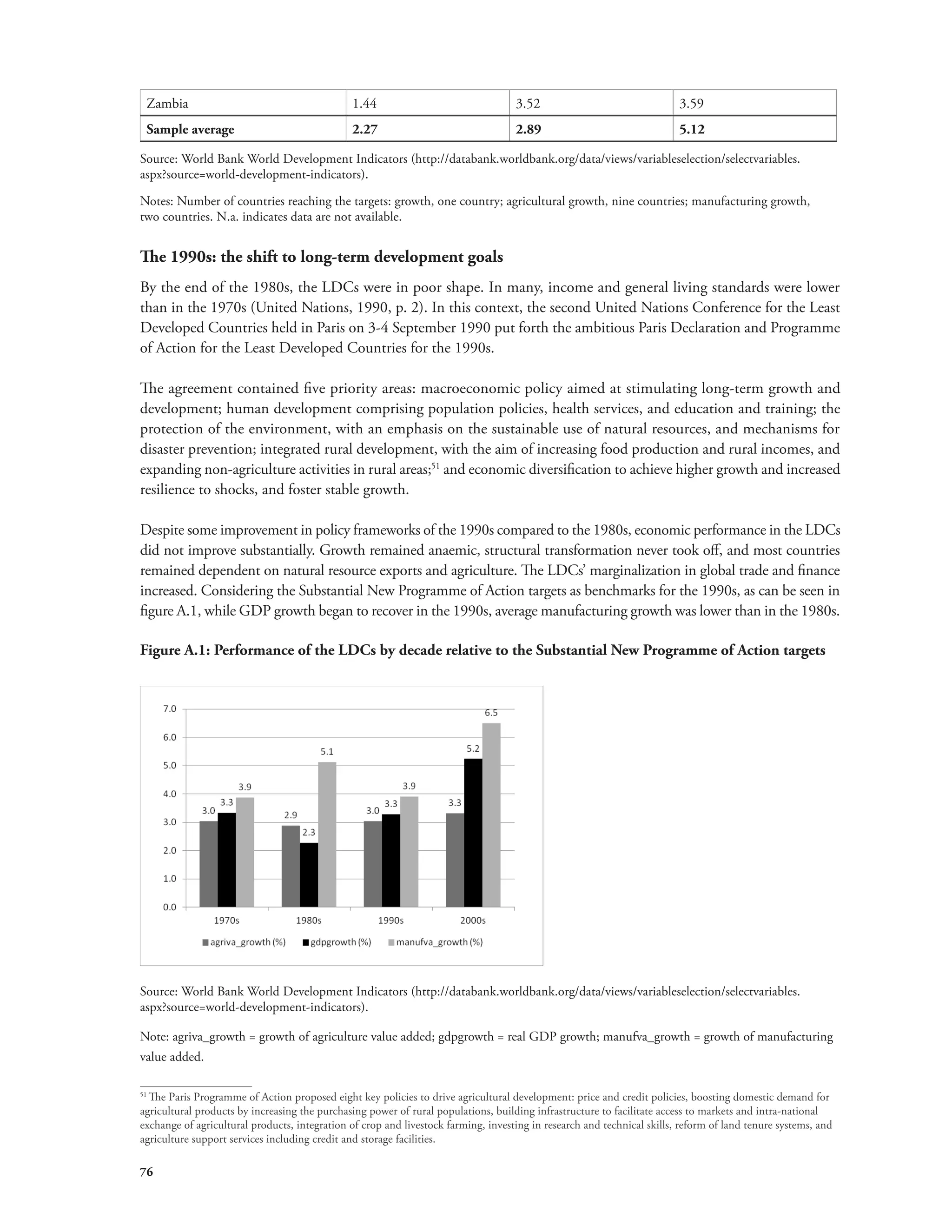
LEAST DEVELOPED COUNTRIES 
2013 
Follow up of the Implementation of 
the Istanbul Programme of Action for 
the Least Developed Countries 
SPECIAL THEME 
Productive Capacity Building in 
the Least Developed Countries and the 
Post-2015 Development Agenda
iii 
FOREWORD 
When United Nations Member States gathered in Istanbul in 2011 at the Fourth United Nations Conference on 
the Least Developed Countries (LDCs), it was with the view to express global solidarity and renew commitments to 
support strong and sustainable growth and development in this poorest and most vulnerable group of nations. The 
Istanbul Declaration and Istanbul Programme of Action for the Least Developed Countries for the Decade 2011-2020 
encapsulate such solidarity and commitments. 
The United Nations Office of the High Representative for the Least Developed Countries, Landlocked Developing 
Countries and Small Island Developing States is charged with assisting the United Nations Secretary-General to 
undertake global follow-up and monitoring of the Istanbul Programme of Action. In a report to the United Nations 
General Assembly,1 the Secretary-General stated that the Office will carry out analytical activities on the priority areas of 
the Istanbul Programme in order to substantively backstop its follow up. This report series is part of that commitment. 
Part 1 of the report, comprising chapters 1 and 2, assesses progress towards achieving the goals and targets of the 
Istanbul Programme of Action, particularly in eight priority areas; reviews efforts towards this end; identifies challenges 
ahead; and proposes some recommendations for further implementation, and the formulation of the post-2015 United 
Nations development agenda and the sustainable development goals. 
One distinctive feature of the Istanbul Programme of Action is its focus on productive capacity-building in the LDCs, 
which is identified as defining challenges and opportunities for sustainable development in these countries. The second, 
thematic part of the report, chapter 3, proposes a conceptual and operational framework for productive capacity-building 
in the context of the post-2015 agenda, particularly as it relates to LDC issues. 
The report also contains comprehensive statistical data on the implementation of the Istanbul Programme of Action. 
It is my sincere hope that you will find it useful for policy formulation for full and effective implementation as well as 
articulation of the post-2015 agenda. 
Gyan Chandra Acharya 
UN Under-Secretary-General and High Representative for LDCs, LLDCs and SIDS (UN-OHRLLS) 
1 The report of the Secretary-General entitled “Ensuring the effective implementation of the functions of the Office of the High Representative for the 
Least Developed Countries, Landlocked Developing Countries and Small Island Developing States and strengthening its capabilities and its effectiveness, 
as well as the effectiveness of the United Nations system support provided to least developed countries” (A/67/262).
iv 
ACRONYMS 
FAO Food and Agricultural Organization 
FDI Foreign direct investment 
GDP Gross domestic product 
GNI Gross national income 
HIPC Heavily Indebted Poor Countries Initiative 
HIV/AIDS Human immunodeficiency virus infection / acquired immunodeficiency syndrome 
IAEA International Atomic Energy Agency 
IFAD International Fund for Agrticultural Development 
IMF International Monetary Fund 
IPoA Istanbul Programme of Action 
ITC International Trade Center 
ITU International Telecommunication Union 
LDCs Least developed countries 
MDG Millenium Development Goals 
MDRI Multilateral Debt Relief Initiative 
NGO Non-government organisation 
ODA Official development assistance 
PPP Purchasing power parity 
REDD United Nations Collaborative Programme on Reducing Emissions from Deforestation and Degradation 
TRIPS Trade-related aspects of intellectual property rights 
UNAIDS Joint United Nations Programme on HIV/AIDS 
UNCDF United Nations Capital Development Fund 
UNCTAD United Nations Conference on Trade and Development 
UNDP United Nations Development Programme 
UNECA United Nations Economic Commission for Africa 
UNEP United Nations Environment Programme 
UNESCAP United Nations Economic and Social Commission for Asia and the Pacific 
UNESCO United Nations Educational, Scientific and Cultural Organization 
UNFCCC Secretariat of the United Nations Framework Convention on Climate Change 
UNFPA United Nations Population Fund 
UNICEF United Nations Children’s Fund 
UNIDO United Nations Industrial Development Organization 
UNODC United Nations Office on Drugs and Crime 
UNOPS United Nations Office for Project Services 
UN-Women United Nations Entity for Gender Equality and the Empowerment of Women 
WFP World Food Programme 
WIPO World Intellectual Property Organization 
WMO World Meteorological Organization 
WTO World Trade Organisation
v 
EXECUTIVE SUMMARY 
Progress in the implementation of IPoA is mixed 
Two years into the implementation of the Istanbul Programme of Action (IPoA), least developed countries (LDCs) 
have made some progress on many of the goals and targets agreed in Istanbul. Although the majority of LDCs grew at 
a pace slower than their last- decade averages, a few continued to expand at 7 per cent or more – the target set in the 
Programme of Action. These countries witnessed strong and rising investment rates, rapid urbanization, and robust 
expansion of sectors other than agriculture. This development indicates that structural change also seems to be taking 
hold in a few LDCs. 
Yet, most LDCs continue to face pervasive poverty, serious structural impediments to growth, low levels of social and 
human development and high exposure to shocks and disasters. Even those countries with improved performance started 
off from low bases and have a long way to go to catch up with the levels of development of other developing countries. 
Poverty continued to be stubbornly high, with almost half of LDC citizens living with less than 1.25 $ US a day. While 
most LDCs have made important strides towards achieving universal primary education, progress has been modest on 
secondary, vocational and technical, and tertiary education, where skills for productive and decent employment are 
acquired. Also very limited headway has been made towards meeting health, water, sanitation and employment-related 
goals and targets. Gender inequalities have remained high. 
Physical infrastructure, including roads, railways, maritime and air infrastructure continued to be largely below 
international standards. Further, generation, diffusion and application of knowledge are very limited partly because of 
a narrow base of science-literate citizens. 
The deteriorating global economic environment is transmitting to LDCs for example through declining ODA flows 
and increasing volatility of commodity prices, therefore putting at risk hard-won gains achieved so far, and the ability 
to expand these gains to all LDCs. The sum of the above is that most LDCs are expected to miss most of the MDGs. 
Against the above backdrop, both LDCs and development partners, including the UN system, have intensified efforts 
to mainstream the IPoA into their national development and development cooperation strategies, respectively. Likewise, 
other stakeholders of the IPoA including parliaments, the private sector and civil society have been involved in various 
activities related to the implementation of the IPoA. 
Looking forward, the international community should give due priority to LDCs in the efforts to accelerate MDGs 
and formulate the post-2015 UN Development Agenda. The LDCs have identified productive capacity building as a 
high priority. 
Building productive capacity is a defining challenge and opportunity for development in LDCs 
Building productive capacity is essential for achieving high and sustainable growth, structural transformation, and 
creation of employment and decent jobs. Progress towards structural transformation will not only reduce the exposure 
of these countries to shocks, but also enable them to sustain a GDP growth rate of at least 7 per cent per annum, and 
help them meet the criteria for graduation. 
A review of recent global development frameworks for LDCs reveals that inadequate attention has been paid to productive 
capacity building. Even when productive capacity was mentioned explicitly in some of these frameworks, there was 
no systematic discussion of the tools needed to build it, and it was not well integrated into the monitoring systems. 
The IPoA broke new ground by bringing out productive capacity building as a key priority for the current decade. 
This report puts forward a productive capacity-oriented development strategy for LDCs in the post-2015 era, one that 
would entail a number of critical innovations in the way we think about development policy both at macro and sectoral 
levels. This strategy also rests on a strong mutual accountability framework between LDCs and their development partners.
A productive capacity-oriented strategy for post-2015 era 
At the macro level, the proposed strategy sets employment creation as the policy objective of macroeconomic policies 
and as the means to achieve meaningful and sustainable improvements in living standards in LDCs. More specifically, 
LDCs need to not only seek to raise the rate of output growth but also to increase the labour intensity of growth. Such 
a strategy should transpire through a shift towards a macroeconomic policy framework that targets ‘real’ objectives 
(instead of preoccupation with inflation targeting), is realistic and flexible, and utilizes a larger policy tool kit to achieve 
these ‘real goals’. 
In particular, the strategy needs to fully exploit the potential of development-oriented monetary, financial and 
credit policies to direct resources toward the most growth and employment generating sectors in the economy and 
entrepreneurship development. It should also rest on an exchange rate management that is supportive to building 
international competitiveness of and productive capacity in LDCs along with a fiscal policy that helps meet the large 
and growing demands in productive and social infrastructure. 
Such a reoriented macroeconomic policy framework needs to be fully integrated with and supported by sectoral policies, 
which also need to be geared towards growth and employment creation. First and foremost, the new strategy must 
reverse the effects of decades of marginalization of agriculture in LDCs – which has also faced adverse impacts of climate 
change and other vulnerabilities. The development of agriculture must become a central element of national industrial 
policy. The goal is to build solid backward and forward linkages between agriculture and other sectors, and to raise 
productivity through scaled up investments in infrastructure and systematic integration of technology, innovation and 
agricultural extension. The strategy calls for improved financing for agriculture, not only in terms of absolute volumes 
of funding but also in terms of more adapted credit instruments in line with the peculiarities of agricultural activity. 
At the sectoral level, the proposed strategy aims at boosting dynamism in the private sector to transform it into a true 
engine of sustainable growth and development. LDCs will need to design a clear industrial policy in which private 
sector development is anchored around agricultural processing, manufacturing and service sectors as the drivers of 
productivity growth and employment creation. 
Therefore, macroeconomic and sectoral policies must be geared to alleviating the constraints to private enterprise growth, 
including small and medium enterprises. In particular, the proposed strategy calls for scaling up infrastructure in all 
its forms including access to sustainable energy, transportation, telecommunication and water, which are critical not 
only for reducing the costs of trade and production but also increasing the quality of life in general through affordable 
infrastructure services. The strategy also emphasizes the establishment and strengthening of regulatory frameworks – or 
soft infrastructure – to facilitate and support private sector development. 
Investment, human capacity and technology 
Achieving stable long-term growth and development in LDCs hinges on the ability of these countries to sustainably 
raise the level of domestic investment, including public and private investment. An important tool to achieve this is 
to increase public resource mobilization, adopt a fiscal policy that promotes public investment, which is sustainable 
through clear, formal rules of allocation of tax and non-tax revenue towards investment expenditure vs. recurrent 
expenditure, such as Sustainable Budget Index. 
Another important component of the proposed capacity building strategy is a human capital development policy that 
seeks to achieve a balance between the supply and demand sides of skills development. The goal is to establish systems 
that produce a new class of entrepreneurs rather than only aspiring bureaucrats as in traditional education systems, 
especially among the growing youth population. 
The proposed strategy puts emphasis on science, technology, and innovation as a cross-cutting and integrated element of 
the productive capacity building agenda. It is an important driver of productivity growth in agriculture, industrialization, 
and global competitiveness. The proposed strategy requires strengthening the linkages between knowledge and the 
production sector, especially industry and agriculture. It also requires making science and technology the cornerstone of 
human capital development. Hence, science, technology, engineering and mathematics should become the predominant 
vi
areas of training in formal education, technical and vocational training, and on-the-job training in the private sector. 
Moreover, human capital development must become a joint venture between the public sector and the private sector. 
Role of development partners 
While the responsibility for the implementation of the productive capacity building strategy rests primarily with the 
governments and people of LDCs, their development partners and the international community as a whole, including 
emerging developing countries, have a major supportive role to play for ensuring the effectiveness and impact of LDCs’ 
actions. In particular, development assistance commitments must be delivered and the allocation of aid should be aligned 
with the productive capacity building priorities in each recipient country. LDCs’ market access should be ensured by 
implementing duty and quota-free treatment of their exports, improving rules of origin, operationalizing services waiver 
and actions on cotton. Another key aspect of support by the development partners relates to helping LDCs to acquire 
modern technology tailored to productive capacity building. The proposed Technology Bank dedicated to LDCs can 
play a crucial role in this regard. Other areas where actions by the development partners can make a difference include 
improved policy design; further improvements in aid coordination; progress towards a transparent global financial 
system; and helping to build a stronger data and statistical capacity in LDCs. All these should contribute to enhance 
development effectiveness. 
vii
viii 
RÉSUMÉ 
Les progrès dans la mise en oeuvre du Programme d’Action d’Istanbul sont mitigés 
Après deux ans de mise en oeuvre du Programme d’action d’Istanbul (PAI), les pays les moins avancés ont fait des 
progrès sur plusieurs des cibles et objectifs convenus à Istanbul. Bien que la majorité des PMA a cru à un rythme plus 
lent que les moyennes enregistrées au cours de la décennie passée, quelques-uns ont continué à croître au rythme de 
7 pour cent ou plus – la cible retenue dans le Programme d’Action d’Istanbul. Ces pays ont connu des niveaux élevés 
et croissants de leurs taux d’investissement, une urbanisation rapide et une forte expansion dans les secteurs autres 
que l’agriculture. Cette évolution indique que le changement structurel semble être en marche dans quelques PMA. 
Cependant la plupart des PMA continuent d’être confrontés à une pauvreté généralisée, à des obstacles structurels 
entravant la croissance, à un faible niveau de développement social et humain et à une exposition élevée aux chocs 
et aux catastrophes. Même les pays ayant connus une amélioration de leurs performances sont partis de conditions 
initiales défavorables et ainsi ont un long chemin à parcourir pour arriver aux niveaux de développement des autres 
pays en développement. 
La pauvreté reste obstinément élevée, avec près de la moitié des citoyens des PMA vivant avec moins de 1,25 $ US par 
jour. Alors que la plupart des PMA ont fait des progrès importants vers la réalisation de l’éducation primaire universelle, 
les progrès ont été modestes au niveau de l’enseignement secondaire, professionnel et technique et tertiaire, où les 
compétences requises pour des emplois productifs et décents sont acquises. En outre, des progrès très limités ont été 
accomplis concernant les cibles et objectifs liés à la santé, à l’eau, à l’assainissement et à l’emploi. Les inégalités de genre 
restent également élevées. 
Les infrastructures physiques, y compris les routes, les voies ferrées, maritimes et aériennes, restent largement en deçà 
des normes internationales. En outre, la production, diffusion et application des connaissances restent très limitées en 
partie à cause d’un nombre limité de citoyens familiers à la science. 
La dégradation de l’environnement économique mondial a affecté les PMA, par exemple à travers la baisse des flux 
d’APD et l’augmentation de la volatilité des prix des matières premières, mettant ainsi en péril les gains durement acquis 
jusqu’ici. Elle affecte aussi la possibilité d’étendre ces gains à tous les PMA. En somme, la plupart des PMA pourraient 
ne pas atteindre la plupart des OMD. 
C’est dans ce contexte que les PMA et leurs partenaires au développement, y compris le système des Nations Unies, ont 
intensifié leurs efforts afin d’intégrer le Programme d’Action d’Istanbul dans leurs stratégies nationales de développement 
et leurs stratégies de coopération au développement, respectivement. De même, d’autres acteurs, y compris les parlements, 
le secteur privé et la société civile, ont été impliqués dans diverses activités liées à la mise en oeuvre du PAI. 
La communauté internationale devrait accorder une priorité aux PMA dans les efforts visant à accélérer les OMD et 
dans le cadre de la formulation de l’Ordre du Jour du Développement des Nations Unies post- 2015. Les PMA ont 
identifié le renforcement des capacités productives comme une grande priorité. 
Renforcement des capacités productives est un défi majeur et une opportunité pour le développement des PMA 
Le renforcement des capacités productives est essentiel pour parvenir à une croissance forte et durable, à une transformation 
structurelle et à une création d’emplois décents. Le progrès vers la transformation structurelle permettra non seulement 
de réduire l’exposition de ces pays aux chocs mais aussi de leur permettre de maintenir un taux de croissance du PIB 
d’au moins 7 pour cent par an, et ainsi les aider à remplir les critères de sortie de la catégorie des PMA. 
Un examen des récents cadres globaux de développement pour les PMA révèle qu’une attention insuffisante a été accordée 
au renforcement des capacités productives. Même lorsque la capacité de production a été explicitement mentionnée 
dans certains de ces cadres, il n’y a eu aucune discussion systématique des outils nécessaires pour y arriver, ou encore la
problématique de la capacité de production n’a pas été bien intégrée dans les systèmes de suivi. Le PAI a changé la donne 
en mettant en relief le renforcement des capacités productives comme une priorité essentielle pour la décennie en cours. 
Ce rapport propose une stratégie de développement axée sur le renforcement des capacités productives des PMA pour 
l’ère post -2015. Ceci implique un certain nombre d’innovations importantes dans la façon dont nous pensons ‘politiques 
de développement’ tant aux niveaux macroéconomiques que sectorielles. Cette stratégie repose également sur un cadre 
solide de responsabilités mutuelles entre les PMA et leurs partenaires au développement. 
Une stratégie axée sur la capacité productive pour l’ère post-2015 
Au niveau macroéconomique, la stratégie proposée place la création d’emplois au coeur de l’objectif des politiques 
macroéconomiques et comme moyen de réaliser des améliorations significatives et durables du niveau de vie dans les 
PMA. Plus précisément, les PMA doivent chercher non seulement à augmenter le taux de croissance de leur produit 
mais aussi à augmenter l’intensité du travail de la croissance. Une telle stratégie devrait transparaître à travers une 
évolution vers un cadre de politiques macroeconomiques qui vise des objectifs «réels» (à la place des préoccupations de 
ciblage de l’inflation) mais aussi un cadre qui est réaliste et flexible, et utilise une vaste panoplie d’outils de politiques 
permettant d’atteindre ces objectifs « réels». 
En particulier, la stratégie doit exploiter pleinement le potentiel des politiques monétaires, financières et de crédit axées 
sur le développement de sorte à canaliser les ressources vers les secteurs de l’économie à forte croissance et générateurs 
d’emplois et vers le développement de l’entreprenariat . Il devrait également reposer sur une gestion du taux de change 
qui soit favorable au renforcement de la compétitivité internationale et de la capacité de production dans les PMA, 
de pair avec une politique budgétaire permettant de répondre aux demandes importantes et croissantes en matière 
d’infrastructures productives et sociales. 
Un tel nouveau cadre de politique macroéconomique doit être pleinement intégré avec et soutenu par des politiques 
sectorielles – qui doivent également être tournées vers la croissance et la création d’emplois. Tout d’abord, la nouvelle 
stratégie doit inverser les effets de décennies de marginalisation de l’agriculture dans les PMA—qui a également subi les 
effets négatifs du changement climatique et été affectée par d’autres vulnérabilités. Le développement de l’agriculture 
doit devenir un élément central de la politique industrielle nationale. L’objectif est d’établir des liens en amont et en aval 
entre l’agriculture et d’autres secteurs et d’augmenter la productivité—et ce à travers l’augmentation des investissements 
dans les infrastructures et l’intégration systématique entre technologie, innovation et vulgarisation agricole. La stratégie 
appelle à l’amélioration du financement de l’agriculture, non seulement en termes de volumes absolus mais aussi en 
termes d’instruments de crédit plus adaptées aux particularités de l’activité agricole. 
Au niveau sectoriel, la stratégie proposée vise à renforcer le dynamisme du secteur privé afin de le transformer en un 
véritable moteur de croissance et de développement durable. Les PMA devront concevoir une politique industrielle claire 
dans laquelle le développement du secteur privé est ancré autour de l’agro-transformation, des secteurs manufacturiers 
et des services comme moteurs de la croissance de la productivité et de la création d’emplois. 
Ainsi, les politiques macroéconomiques et sectorielles doivent être tournées vers l’atténuation des obstacles à la 
croissance des entreprises privées, y compris les petites et moyennes entreprises. En particulier, la stratégie proposée 
appelle à l’amélioration des infrastructures dans toutes ses formes – y compris l’énergie durable, les transports, les 
télécommunications et l’eau – qui sont essentielles non seulement pour réduire les coûts de production et ceux liées 
au commerce mais aussi pour améliorer la qualité de vie en général, à travers des services d’infrastructures abordables. 
La stratégie insiste aussi sur la création et le renforcement des cadres réglementaires – ou l’infrastructure immatérielle 
– pour faciliter et soutenir le développement du secteur privé. 
Investissement, capacités humaines et technologie 
Atteindre une croissance et un développement soutenables à long terme dans les PMA dépend de la capacité de ces 
pays à accroître durablement le niveau de leur investissement intérieur, à la fois public et privé. Un moyen important 
permettant d’y arriver consiste à accroître la mobilisation des ressources publiques, à adopter une politique fiscale 
ix
favorisant l’investissement public – qui est durable que si il est sous-tendu par des règles claires et formelles de répartition 
des recettes fiscales et non fiscales entre les dépenses d’investissement et celles de fonctionnement, par exemple guidées 
par l’ Indice Durable sur le Budget. 
Un autre élément important de la stratégie proposée en matière de renforcement des capacités est une politique de 
développement du capital humain visant à atteindre un équilibre entre l’offre et la demande de développement des 
compétences. L’objectif est de mettre en place des systèmes qui produisent une nouvelle classe d’entrepreneurs – 
spécialement parmi la population croissante des jeunes – plutôt que les bureaucrates en herbe, comme c’est le cas dans 
les systèmes éducatifs traditionnels. 
La stratégie proposée met un accent sur la science, la technologie et l’innovation comme un élément transversal et 
intégrateur de l’agenda de renforcement des capacités productives. Cet élément est un moteur important de croissance 
de la productivité dans l’agriculture, de l’industrialisation et de la compétitivité mondiale. La stratégie proposée nécessite 
le renforcement des liens entre les connaissances et le secteur productif, en particulier dans l’industrie et l’agriculture. 
Elle exige également de faire de la science et de la technologie la pierre angulaire du développement du capital humain. 
Par conséquent, la science, la technologie, l’ingénierie et les mathématiques doivent devenir les domaines de formation 
prédominants dans l’éducation formelle, la formation technique et professionnelle, et la formation sur le tas dans le 
secteur privé. En outre, le développement du capital humain doit devenir une joint-venture entre le secteur public et 
le secteur privé. 
Rôle des partenaires au développement 
Si la responsabilité de la mise en oeuvre de la stratégie de renforcement des capacités productives incombe principalement 
aux gouvernements et aux peuples des PMA, leurs partenaires au développement et la communauté internationale dans 
son ensemble, y compris les pays en développement émergents, ont un rôle de soutien important à jouer afin d’assurer 
l’efficacité et l’impact des actions des PMA. En particulier, les engagements en matière d’aide au développement doivent 
être tenus et l’allocation de l’aide doit être alignée sur les priorités en matière de renforcement des capacités productives 
dans chaque pays bénéficiaire. 
L’accès aux marchés par les PMA devrait être réalisé à travers la mise en oeuvre d’un traitement en franchise de droits 
et sans contingent de leurs exportations, l’amélioration des règles d’origine, l’opérationnalisation de la dérogation sur 
les services et des actions concernant le coton. Un autre aspect essentiel du soutien par les partenaires au développement 
concerne l’aide permettant aux PMA d’acquérir une technologie moderne adaptée au renforcement des capacités 
productives. La Banque de technologie consacrée aux PMA peut jouer un rôle crucial à cet égard. Les autres domaines 
où les actions des partenaires au développement peuvent faire une différence comprennent : l’amélioration de la 
conception des politiques, une amélioration de la coordination de l’aide; des avancés vers un système financier mondial 
transparent, et l’aide au renforcement des capacités statistiques. Toutes ces recommandations devraient contribuer à 
améliorer l’efficacité du développement. 
x
xi 
ACKNOWLEDGEMENTS 
This report was prepared under the overall guidance of Gyan Chandra Acharya, United Nations Under-Secretary-General 
and High Representative for Least Developed Countries, Landlocked Developing Countries and Small Island Developing 
States, and the general supervision of Heidi Schroderus-Fox, Director of the Office of the High Representative. 
The report team was led by Khalil Rahman, Chief, Policy Coordination for the LDCs, Office of the High Representative. 
Team members comprised Susanna Wolf, Oumar Diallo, Abdul Alim, Margherita Musollino Berg, Tomas Gonzalez 
and Rita Ruohonen. The team is grateful to Professor Leonce Ndikumana for his contribution to the thematic part 
of the report. 
It also appreciates the support received from Ricardo Dunn, who handled processing of the report and its media outreach, 
and to Gretchen Luchsinger for editing. Mbayang Mbengue provided secretarial assistance.
1 
TABLE OF CONTENTS 
FOREWORD iii 
ACRONYMS iv 
EXECUTIVE SUMMARY v 
RÉSUMÉ viii 
ACKNOWLEDGEMENTS xi 
INTRODUCTION 3 
PART I Progress in the implementation of the Istanbul Programme of Action 5 
CHAPTER 1 Progress towards achieving the goals and targets of the Istanbul Programme of Action 6 
1.1 Recent performance and prospects 6 
1.1.1 Recent economic trends 6 
1.1.2 Estimates for 2012 and outlook for 2013 8 
1.2 Progress in implementing key priorities of the Istanbul Programme of Action 9 
1.2.1 Productive capacity 9 
1.2.2 Agriculture, food security and rural development 14 
1.2.3 Trade 15 
1.2.4 Commodities 16 
1.2.5 Human and social development 17 
1.2.6 Multiple crises and other emerging challenges 21 
1.2.7 Mobilizing financial resources for development and capacity-building 23 
1.2.8 Good governance at all levels 25 
1.3 Progress towards graduation 26 
1.4 Conclusions 27 
CHAPTER 2 Contribution of stakeholders in monitoring and implementing the Istanbul Programme 
of Action 
29 
2.1 Biennial Regional Reviews of the implementation of the Istanbul Programme of Action 29 
2.2 Efforts by United Nations Member States to mainstream the Istanbul Programme of Action 
30 
into Relevant Strategic Frameworks 
2.3 Support by the United Nations system, and regional and international organizations for 
LDC priorities 
31 
2.4 Engagement of other stakeholders in implementing the Istanbul Programme of Action 36 
2.5 Conclusions 36
2 
APPENDIX 2.1: Key aspects of deliberations at the annual workshop of the LDC National Focal 
Points, Geneva, 23 July 2013 
38 
APPENDIX 2.2: Communique of the high-level event on food security, sustainable agriculture 
and structural transformation in LDCs 
41 
PART II Productive capacity-building in the LDCs and the Post-2015 Development Agenda 43 
CHAPTER 3 Productive capacity building in the LDCs and the Post-2015 Development Agenda 44 
3.1 Introduction 44 
3.2 Key concepts: Productive capacity, policy goals, targets and indicators 46 
3.2.1 Productive capacity 46 
3.2.2 Goals, targets and indicators 46 
3.3 Productive capacity in current and past development frameworks 47 
3.4 Prevailing policy frameworks and productive capacity 48 
3.4.1 The “do-no-harm” approach 48 
3.4.2 Prevailing sectoral policy frameworks 51 
3.5 Proposed policy framework for productive capacity building in LDCs 51 
3.5.1 Elements of the new framework 51 
3.6 Setting targets and monitoring productive capacity building 68 
3.6.1 The challenge of setting targets and monitoring 68 
3.6.2 Specific targets 69 
3.7 Conclusion 72 
APPENDIX 3.1: Productive capacity in recent development frameworks for the LDCs 74 
APPENDIX 3.2: A Technology Bank for the LDCs 78 
STATISTICAL ANNEX 79 
REFERENCES 111
3 
INTRODUCTION 
At the Fourth United Nations Conference on the Least Developed Countries in Istanbul in May 2011, the global 
community agreed on a compact—the Istanbul Programme of Action for the Least Developed Countries for the Decade 
2011-2020—with the ambition of steering a course of sustainable growth and development in the least developed 
countries (LDCs), and enabling at least half of these countries to qualify for graduation from the LDC category by 
2020. To fulfil this aspiration, the LDCs and their development partners set a number of goals and targets in the eight 
priority areas of the Istanbul Programme of Action (IPoA). Each goal and target is underpinned by a set of commitments. 
Two years into implementation, a measure of the distance travelled is the rate of progress towards achieving the goals and 
targets. This is assessed in chapter 1 of this report. Chapter 2 reviews interventions by various stakeholders, particularly 
the LDCs and their development partners, to advance progress. 
The picture across priority areas and countries is mixed. The downsides of global deceleration have manifested in slowing 
official development assistance flows to the LDCs, which were among the key drivers of the economic revival sustained 
during much of the last decade. As a result, most LDCs have experienced a significant decline in the growth of gross 
domestic product (GDP) compared with the last decade’s averages. Nonetheless, a few have demonstrated impressive 
accomplishments. They have managed to sustain growth rates close to their decennial averages, rising gross capital 
formation and rapid urbanization. They have also undergone some changes in the structures of their economies, with 
the share of their non-agricultural sectors steadily increasing. 
Overall progress has been slow, however, particularly in view of the very low starting points in most LDCs, in such areas 
as the diversification of production and export structures away from primary commodities, agricultural development 
and food security, crisis mitigation, the building of resilience, and, above all, poverty eradication. Most of these 
countries continue to face the challenge of triggering and sustaining a dynamic process of development and productive 
transformation involving the adoption of more sophisticated technologies, diversification into non-traditional and higher 
value added goods and services, the development of domestic capabilities and the transformation of employment patterns. 
Responding to these challenges will require building productive capacities. The second part of this report defines the 
contours of a development strategy oriented accordingly and outlines how such an agenda can be taken forward.
PART I 
PROGRESS IN THE IMPLEMENTATION 
OF THE ISTANBUL PROGRAMME OF ACTION
CHAPTER 1 
PROGRESS TOWARDS ACHIEVING THE GOALS AND TARGETS OF 
THE ISTANBUL PROGRAMME OF ACTION 
1.1 RECENT PERFORMANCE AND PROSPECTS 
1.1.1 Recent economic trends 
The first year of implementing the Istanbul Programme of Action coincided with the deceleration in global output, which 
reverberated in LDC economies as global economic growth weakened and official development assistance waned after 
years of steady increases. This combined with some country-specific factors, such as lower oil and agricultural outputs, 
and in some cases political developments, to drag down growth in a number of countries. As a result, their combined 
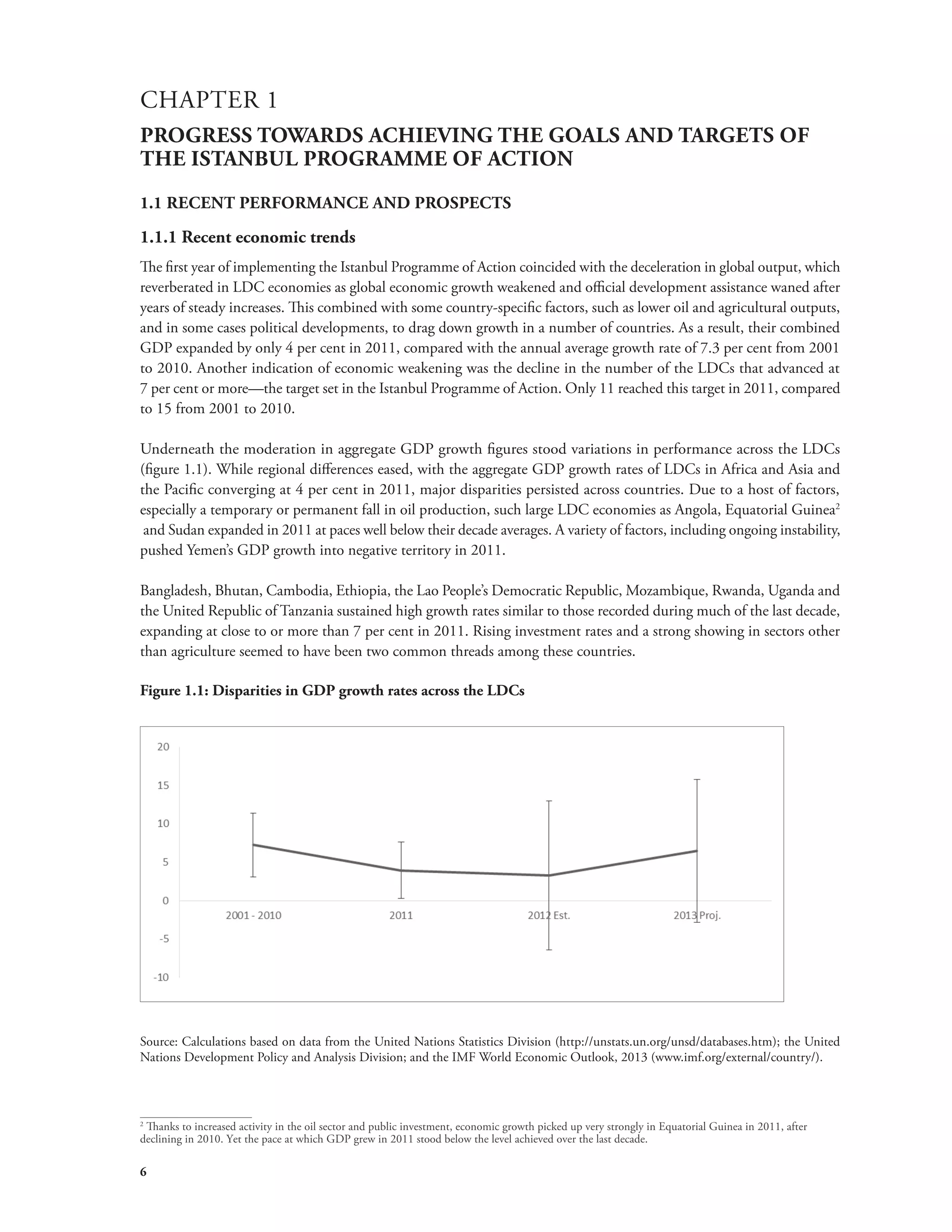
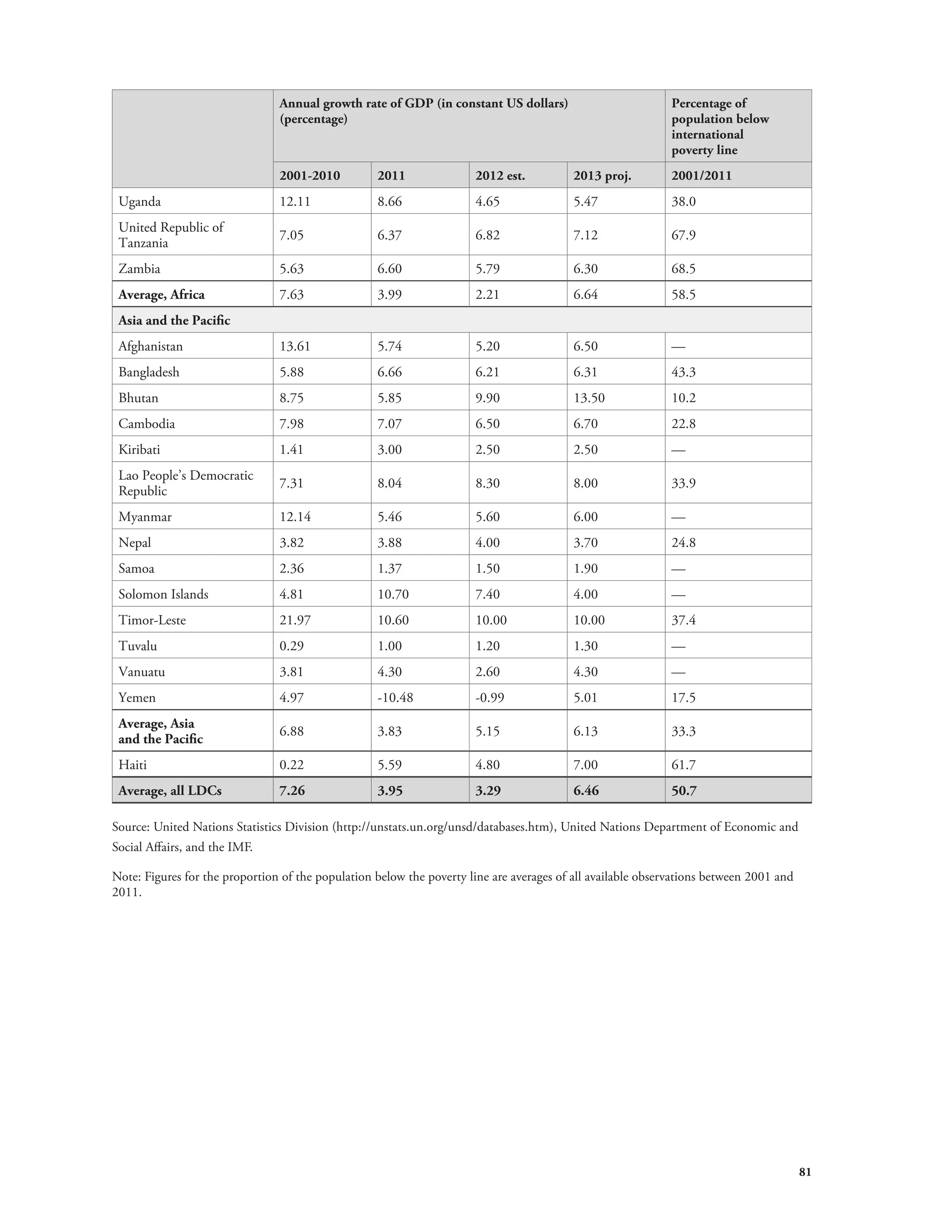
GDP expanded by only 4 per cent in 2011, compared with the annual average growth rate of 7.3 per cent from 2001 
to 2010. Another indication of economic weakening was the decline in the number of the LDCs that advanced at 
7 per cent or more—the target set in the Istanbul Programme of Action. Only 11 reached this target in 2011, compared 
to 15 from 2001 to 2010. 
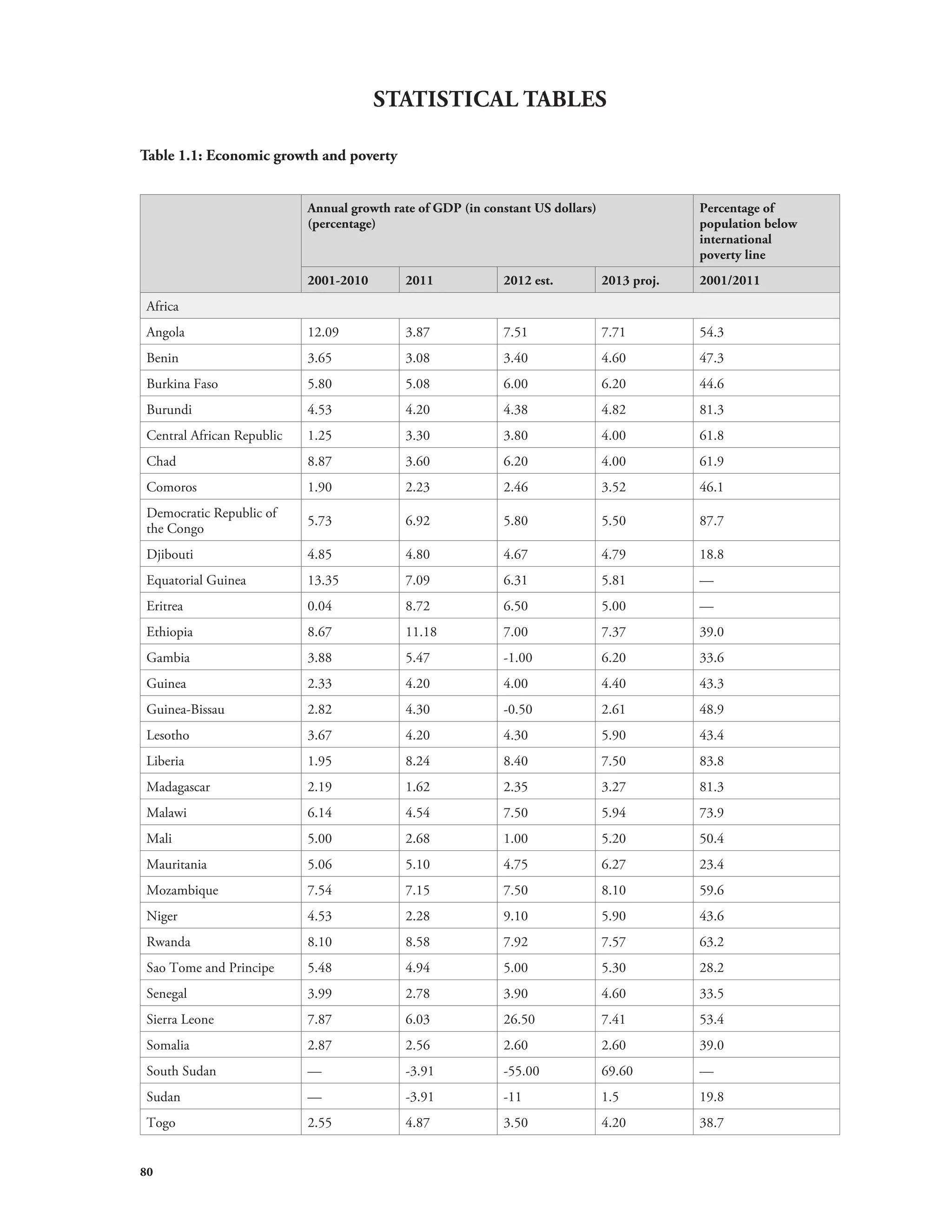
Underneath the moderation in aggregate GDP growth figures stood variations in performance across the LDCs 
(figure 1.1). While regional differences eased, with the aggregate GDP growth rates of LDCs in Africa and Asia and 
the Pacific converging at 4 per cent in 2011, major disparities persisted across countries. Due to a host of factors, 
especially a temporary or permanent fall in oil production, such large LDC economies as Angola, Equatorial Guinea2 
and Sudan expanded in 2011 at paces well below their decade averages. A variety of factors, including ongoing instability, 
pushed Yemen’s GDP growth into negative territory in 2011. 
Bangladesh, Bhutan, Cambodia, Ethiopia, the Lao People’s Democratic Republic, Mozambique, Rwanda, Uganda and 
the United Republic of Tanzania sustained high growth rates similar to those recorded during much of the last decade, 
expanding at close to or more than 7 per cent in 2011. Rising investment rates and a strong showing in sectors other 
than agriculture seemed to have been two common threads among these countries. 
Figure 1.1: Disparities in GDP growth rates across the LDCs 
Source: Calculations based on data from the United Nations Statistics Division (http://unstats.un.org/unsd/databases.htm); the United 
Nations Development Policy and Analysis Division; and the IMF World Economic Outlook, 2013 (www.imf.org/external/country/). 
2 Thanks to increased activity in the oil sector and public investment, economic growth picked up very strongly in Equatorial Guinea in 2011, after 
declining in 2010. Yet the pace at which GDP grew in 2011 stood below the level achieved over the last decade. 
6
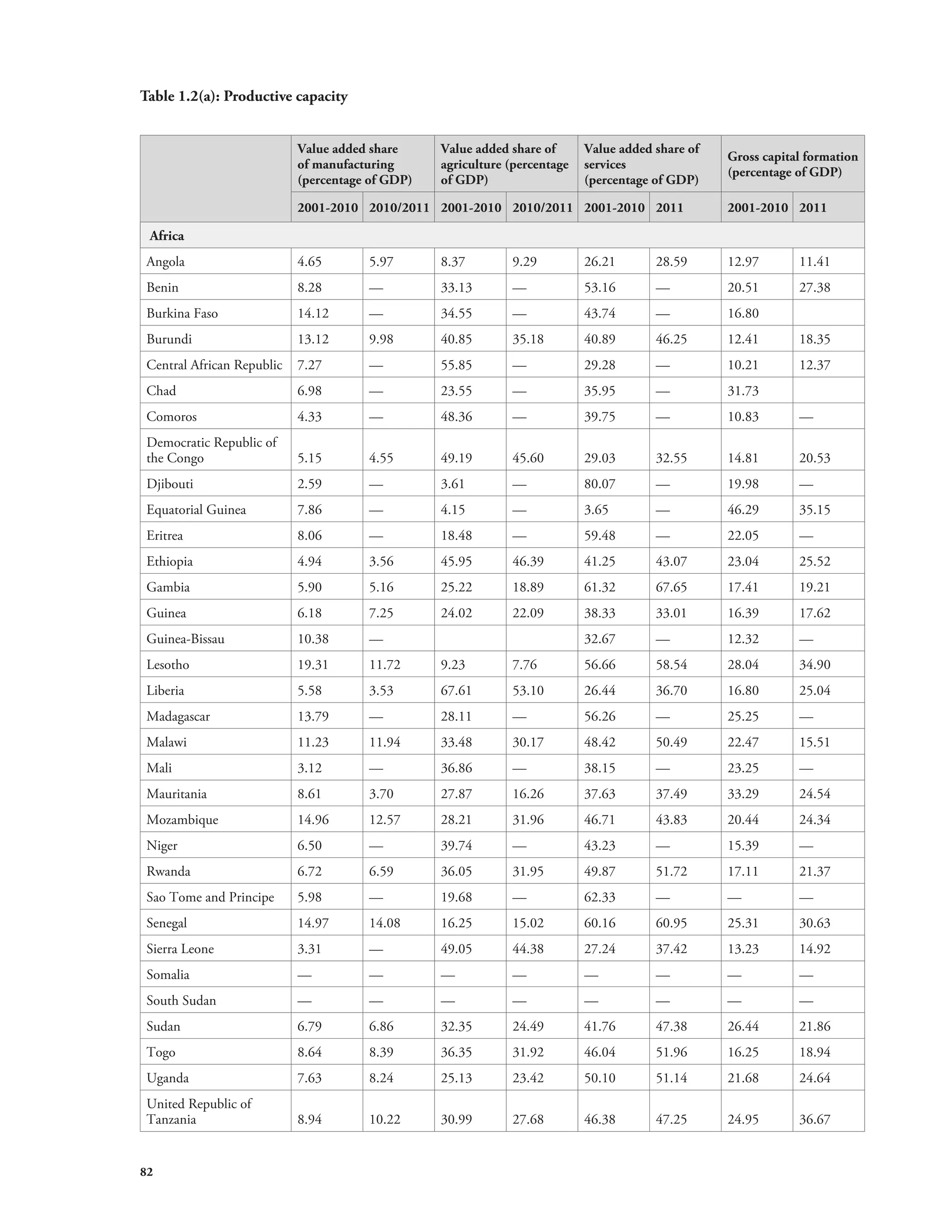
Investment rates for the African and Asia and the Pacific regional groupings appeared to have plateaued in 2011 
compared with their decade averages. Gross capital formation as a percentage of GDP was around 21 to 22 per cent 
in Africa, and 24 to 26 per cent in Asia and the Pacific. 
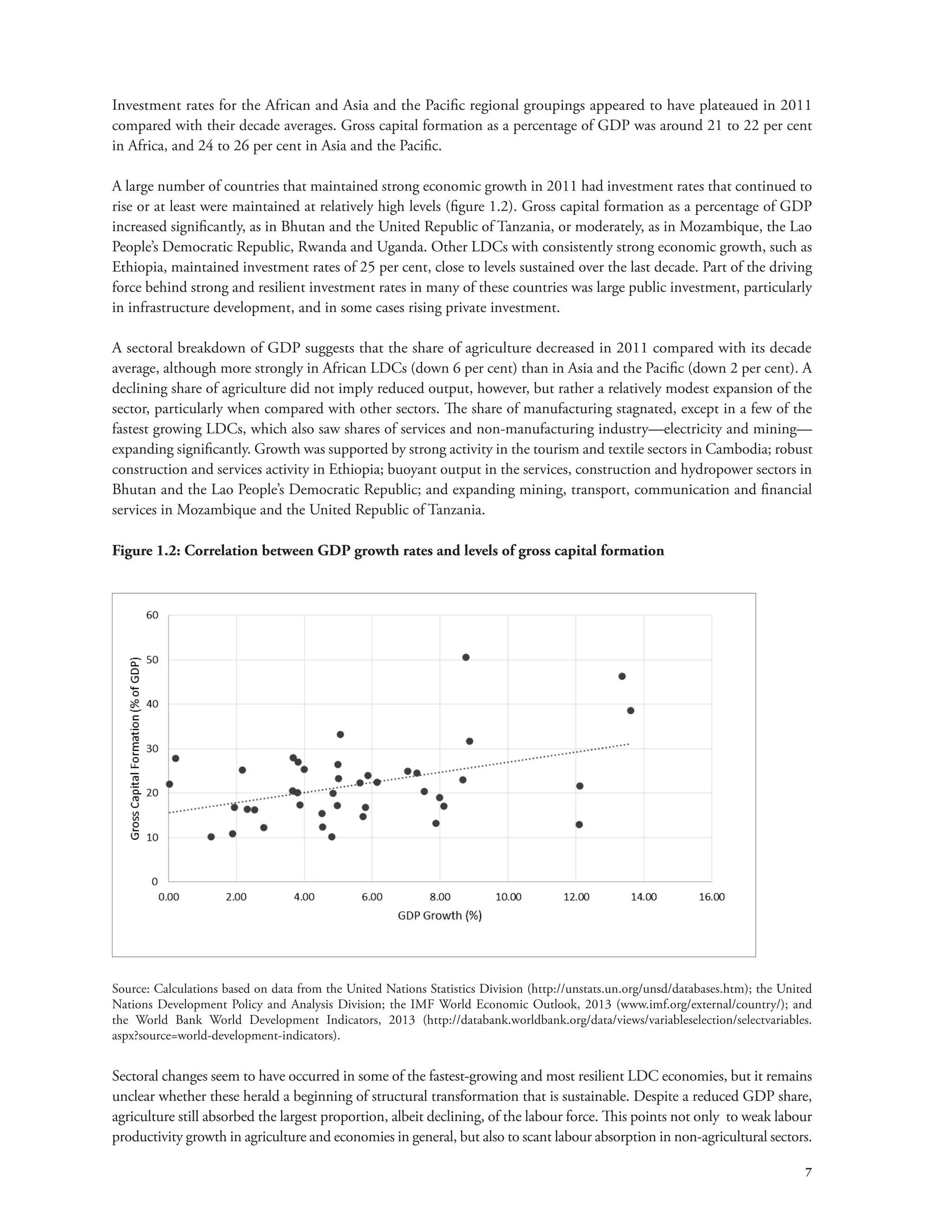
A large number of countries that maintained strong economic growth in 2011 had investment rates that continued to 
rise or at least were maintained at relatively high levels (figure 1.2). Gross capital formation as a percentage of GDP 
increased significantly, as in Bhutan and the United Republic of Tanzania, or moderately, as in Mozambique, the Lao 
People’s Democratic Republic, Rwanda and Uganda. Other LDCs with consistently strong economic growth, such as 
Ethiopia, maintained investment rates of 25 per cent, close to levels sustained over the last decade. Part of the driving 
force behind strong and resilient investment rates in many of these countries was large public investment, particularly 
in infrastructure development, and in some cases rising private investment. 
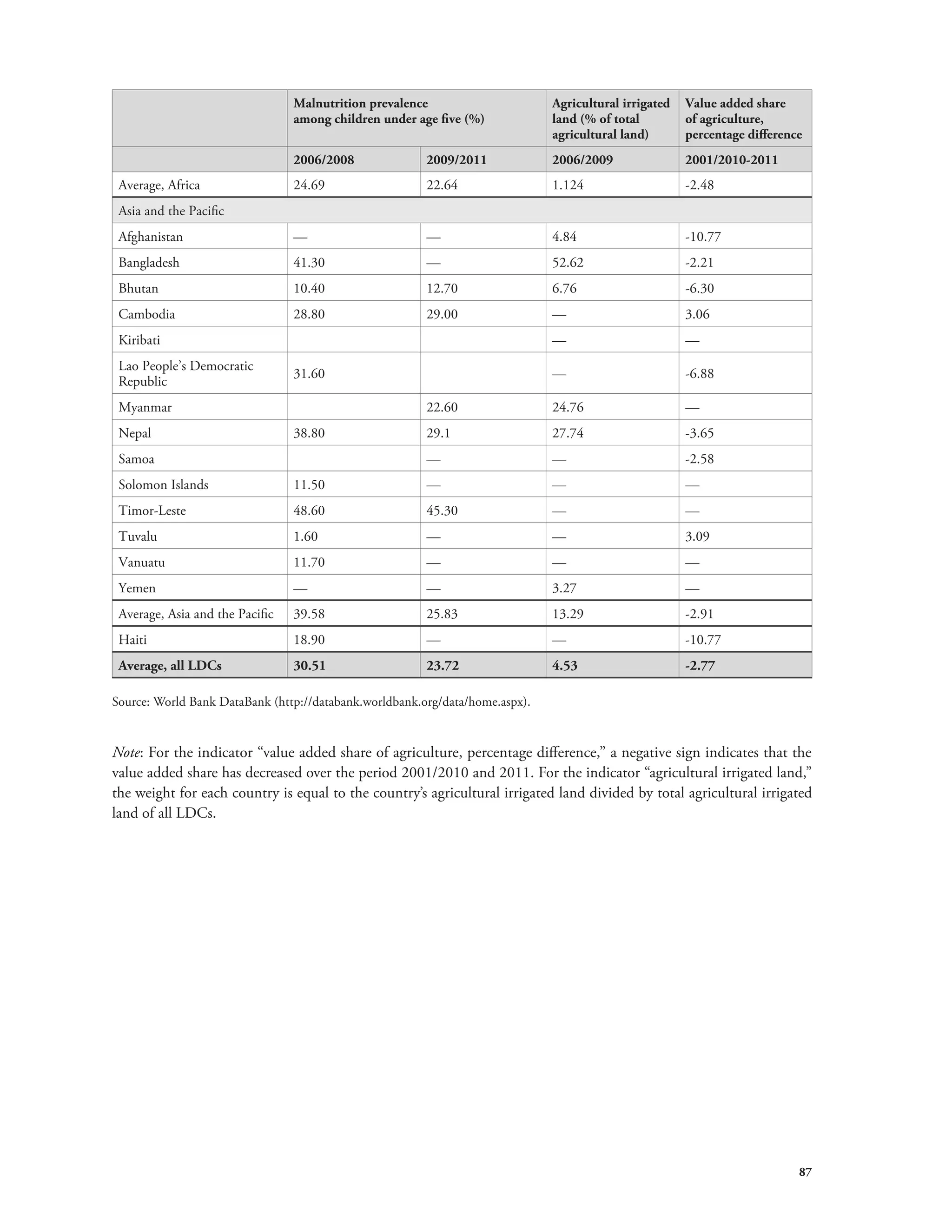
A sectoral breakdown of GDP suggests that the share of agriculture decreased in 2011 compared with its decade 
average, although more strongly in African LDCs (down 6 per cent) than in Asia and the Pacific (down 2 per cent). A 
declining share of agriculture did not imply reduced output, however, but rather a relatively modest expansion of the 
sector, particularly when compared with other sectors. The share of manufacturing stagnated, except in a few of the 
fastest growing LDCs, which also saw shares of services and non-manufacturing industry—electricity and mining— 
expanding significantly. Growth was supported by strong activity in the tourism and textile sectors in Cambodia; robust 
construction and services activity in Ethiopia; buoyant output in the services, construction and hydropower sectors in 
Bhutan and the Lao People’s Democratic Republic; and expanding mining, transport, communication and financial 
services in Mozambique and the United Republic of Tanzania. 
7 
Figure 1.2: Correlation between GDP growth rates and levels of gross capital formation 
Source: Calculations based on data from the United Nations Statistics Division (http://unstats.un.org/unsd/databases.htm); the United 
Nations Development Policy and Analysis Division; the IMF World Economic Outlook, 2013 (www.imf.org/external/country/); and 
the World Bank World Development Indicators, 2013 (http://databank.worldbank.org/data/views/variableselection/selectvariables. 
aspx?source=world-development-indicators). 
Sectoral changes seem to have occurred in some of the fastest-growing and most resilient LDC economies, but it remains 
unclear whether these herald a beginning of structural transformation that is sustainable. Despite a reduced GDP share, 
agriculture still absorbed the largest proportion, albeit declining, of the labour force. This points not only to weak labour 
productivity growth in agriculture and economies in general, but also to scant labour absorption in non-agricultural sectors.
The limited uptake by non-agricultural sectors of excess agricultural labour owed much to the nature of production 
processes and the types of goods and services produced by these sectors. Some sectors, especially mining, are capital 
intensive. Other thriving sectors, in particular construction and transportation, rely solely on small domestic markets. 
Their continued expansion and ability to employ surplus agricultural workers may be constrained as they cannot tap 
into vast and dynamic international markets. 
A major implication of these growth patterns is that economic expansion, even in the fastest growing LDCs, did not 
translate into meaningful poverty reduction. Poverty rates continued to be alarmingly high. Almost half of the 880 
million people in the LDCs still live on less than US$1.25 a day. This is much higher than the proportion in other 
developing countries. It poses a serious challenge to the realization of the Istanbul Programme of Action goals, as well 
as for defining the post-2015 development agenda. 
1.1.2 Estimates for 2012 and outlook for 2013 
Most of the factors that led to the weakening of global economic growth in 2011 persisted and sometimes deepened 
in 2012. Many developed countries remained trapped in a vicious cycle of financial fragility, high and unsustainable 
public debts, excessive fiscal consolidation, weak aggregate demand and growth, and high unemployment rates. The 
deterioration of macroeconomic conditions in these countries affected growth elsewhere, causing a global slowdown. 
A deteriorating external environment combined with domestic factors such as sluggish growth, structural challenges, 
widespread unemployment and poor weather conditions weakened economic activity in some of the LDCs. Aggregate 
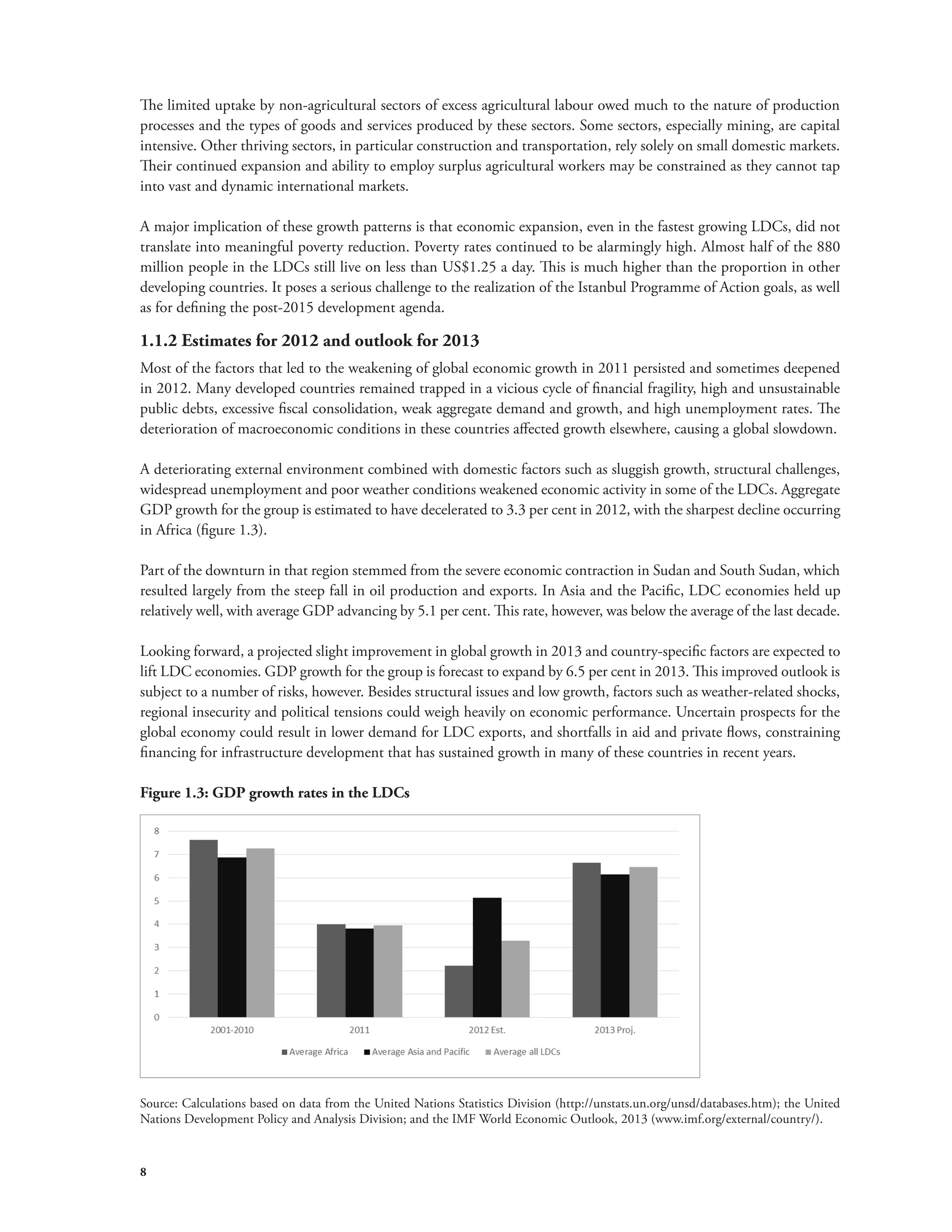
GDP growth for the group is estimated to have decelerated to 3.3 per cent in 2012, with the sharpest decline occurring 
in Africa (figure 1.3). 
Part of the downturn in that region stemmed from the severe economic contraction in Sudan and South Sudan, which 
resulted largely from the steep fall in oil production and exports. In Asia and the Pacific, LDC economies held up 
relatively well, with average GDP advancing by 5.1 per cent. This rate, however, was below the average of the last decade. 
Looking forward, a projected slight improvement in global growth in 2013 and country-specific factors are expected to 
lift LDC economies. GDP growth for the group is forecast to expand by 6.5 per cent in 2013. This improved outlook is 
subject to a number of risks, however. Besides structural issues and low growth, factors such as weather-related shocks, 
regional insecurity and political tensions could weigh heavily on economic performance. Uncertain prospects for the 
global economy could result in lower demand for LDC exports, and shortfalls in aid and private flows, constraining 
financing for infrastructure development that has sustained growth in many of these countries in recent years. 
Figure 1.3: GDP growth rates in the LDCs 
Source: Calculations based on data from the United Nations Statistics Division (http://unstats.un.org/unsd/databases.htm); the United 
Nations Development Policy and Analysis Division; and the IMF World Economic Outlook, 2013 (www.imf.org/external/country/). 
8
These risks underline the vulnerability of the LDCs, even the very few that have weathered the global slowdown 
relatively well. Progress in structural transformation could not only reduce the exposure of these countries to shocks, 
but also enable them to sustain growth rates of at least 7 per cent per annum and to meet the criteria for graduation 
from the LDC category by 2020. This would require bold actions by these countries and their development partners 
in the eight priority areas of the Istanbul Programme of Action. 
1.2 PROGRESS IN IMPLEMENTING KEY PRIORITIES OF THE ISTANBUL PROGRAMME 
OF ACTION 
An assessment of progress in implementing the Istanbul Programme of Action since its 2011 adoption presents a mixed 
picture. The LDCs have made some progress on many of the agreed goals and targets. Structural change seems to be 
taking hold in a few nations, particularly those that have sustained high GDP growth. There has also been progress, 
albeit moderate, on some social indicators. 
Yet most LDCs continue to struggle with the stark realities of pervasive poverty, rising inequality, a stagnant share of 
manufacturing in GDP, continued low economy-wide productivity, insufficient generation of productive employment 
and decent jobs, and ongoing vulnerability to shocks. More worrisome, the deteriorating global economic environment 
in 2012 resulted in tepid growth in trade and declining aid flows, therefore putting at risk hard-won gains and the ability 
to expand these to all LDCs. Some of the main developments in the eight priority areas of the Istanbul Programme of 
Action are summarized on the following pages. 
1.2.1 Productive capacity 
1.2.1.1 Infrastructure 
Information and Communication Technology 
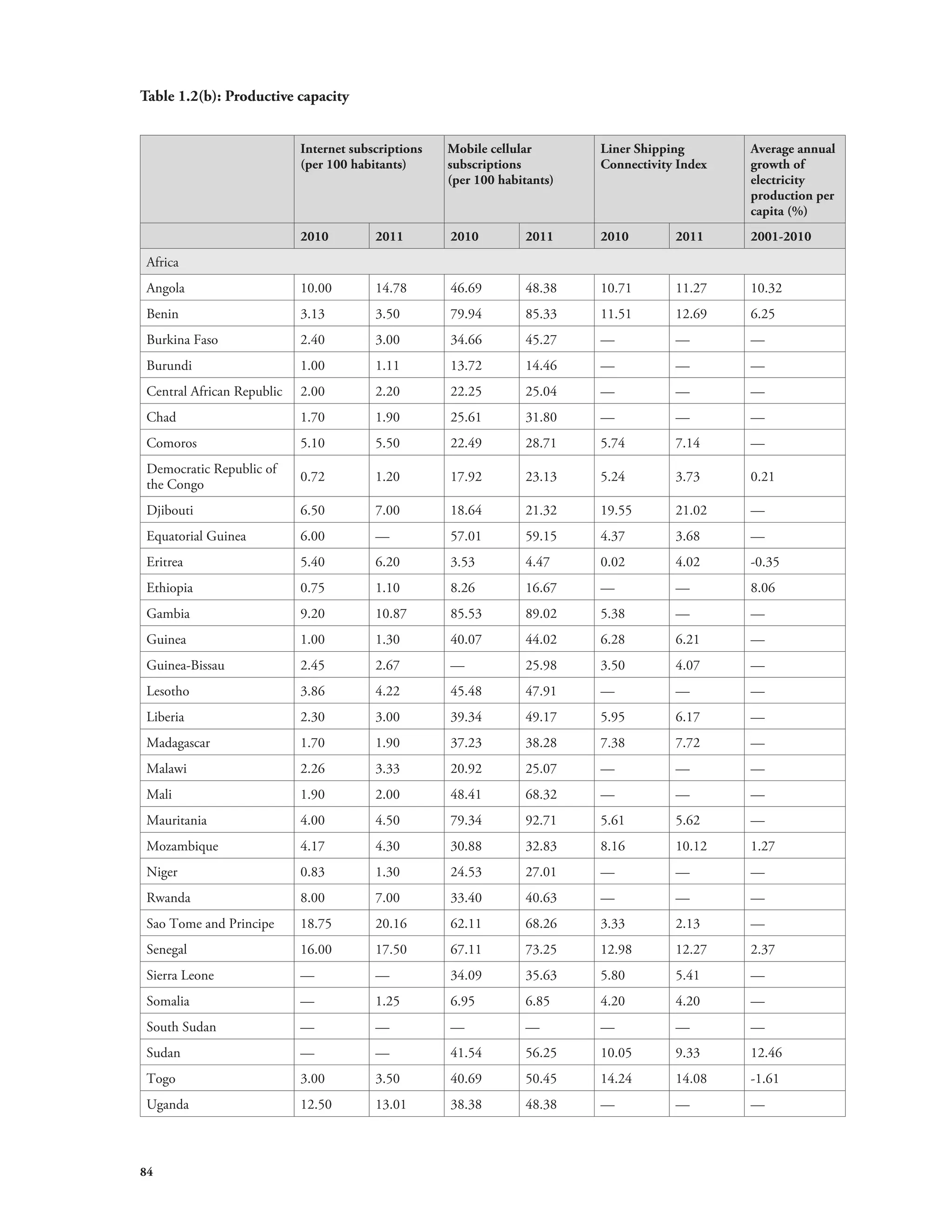
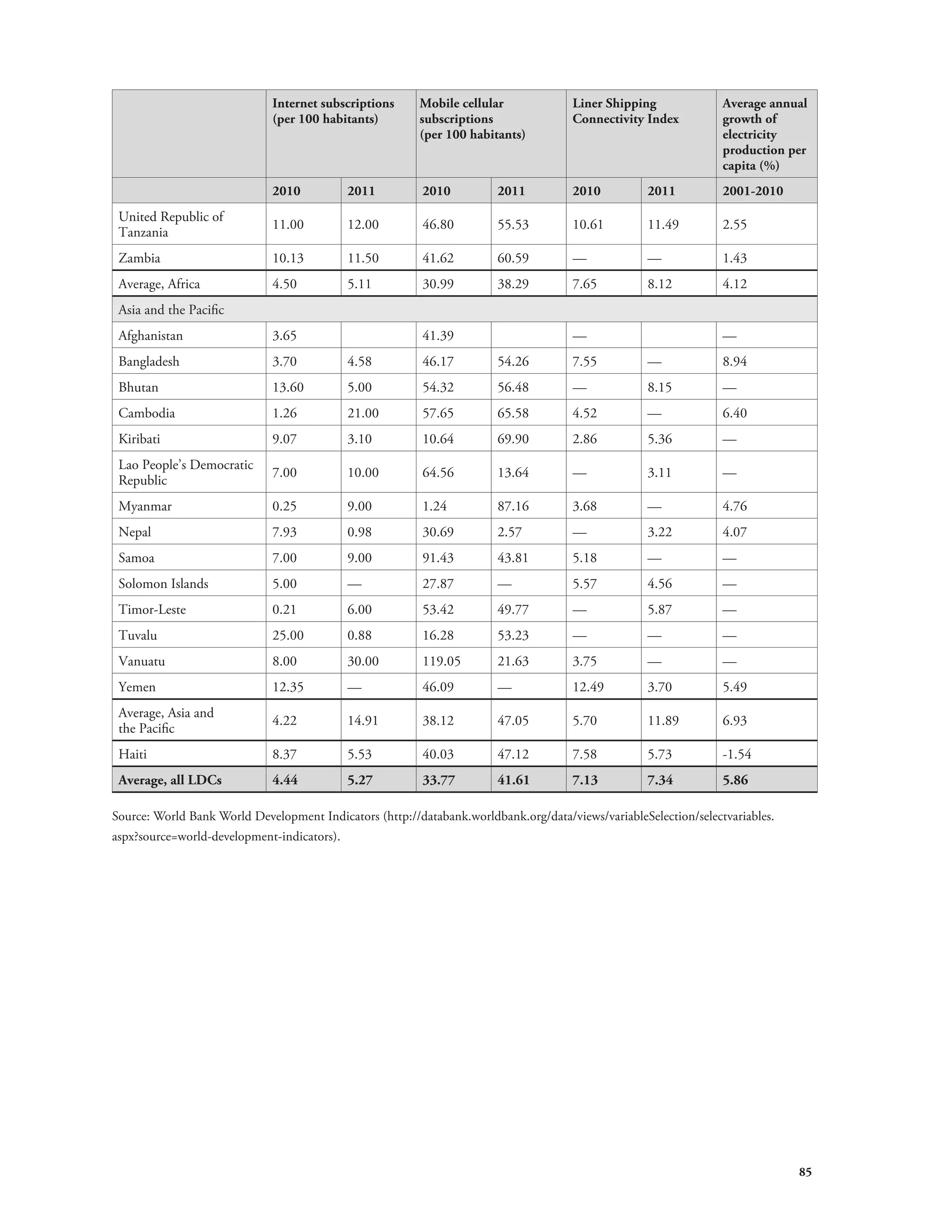
Access to information and communication technology continued to improve in 2011, with both mobile cellular and 
Internet subscriptions increasing, although at various speeds. The most impressive growth occurred in mobile telephony. 
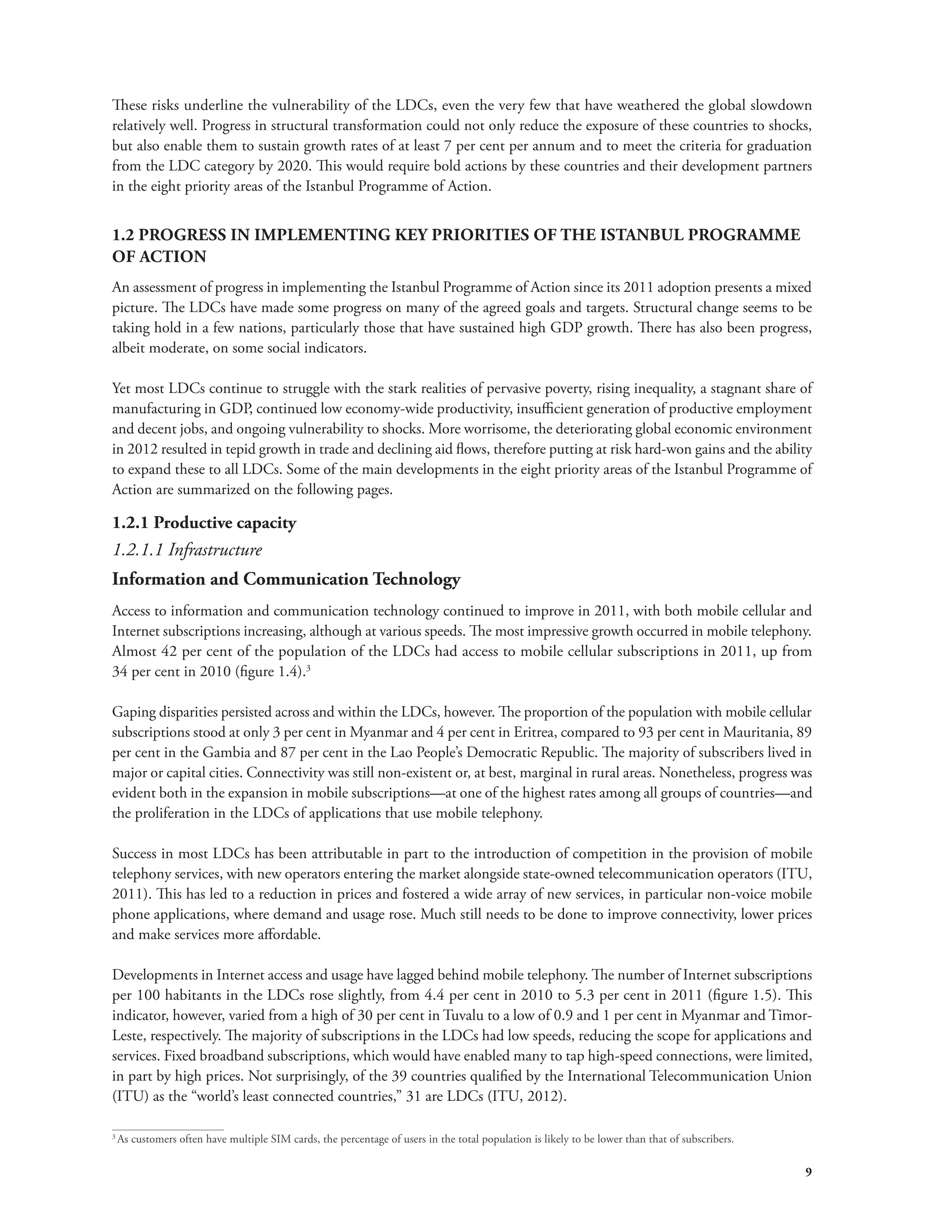
Almost 42 per cent of the population of the LDCs had access to mobile cellular subscriptions in 2011, up from 
34 per cent in 2010 (figure 1.4).3 
Gaping disparities persisted across and within the LDCs, however. The proportion of the population with mobile cellular 
subscriptions stood at only 3 per cent in Myanmar and 4 per cent in Eritrea, compared to 93 per cent in Mauritania, 89 
per cent in the Gambia and 87 per cent in the Lao People’s Democratic Republic. The majority of subscribers lived in 
major or capital cities. Connectivity was still non-existent or, at best, marginal in rural areas. Nonetheless, progress was 
evident both in the expansion in mobile subscriptions—at one of the highest rates among all groups of countries—and 
the proliferation in the LDCs of applications that use mobile telephony. 
Success in most LDCs has been attributable in part to the introduction of competition in the provision of mobile 
telephony services, with new operators entering the market alongside state-owned telecommunication operators (ITU, 
2011). This has led to a reduction in prices and fostered a wide array of new services, in particular non-voice mobile 
phone applications, where demand and usage rose. Much still needs to be done to improve connectivity, lower prices 
and make services more affordable. 
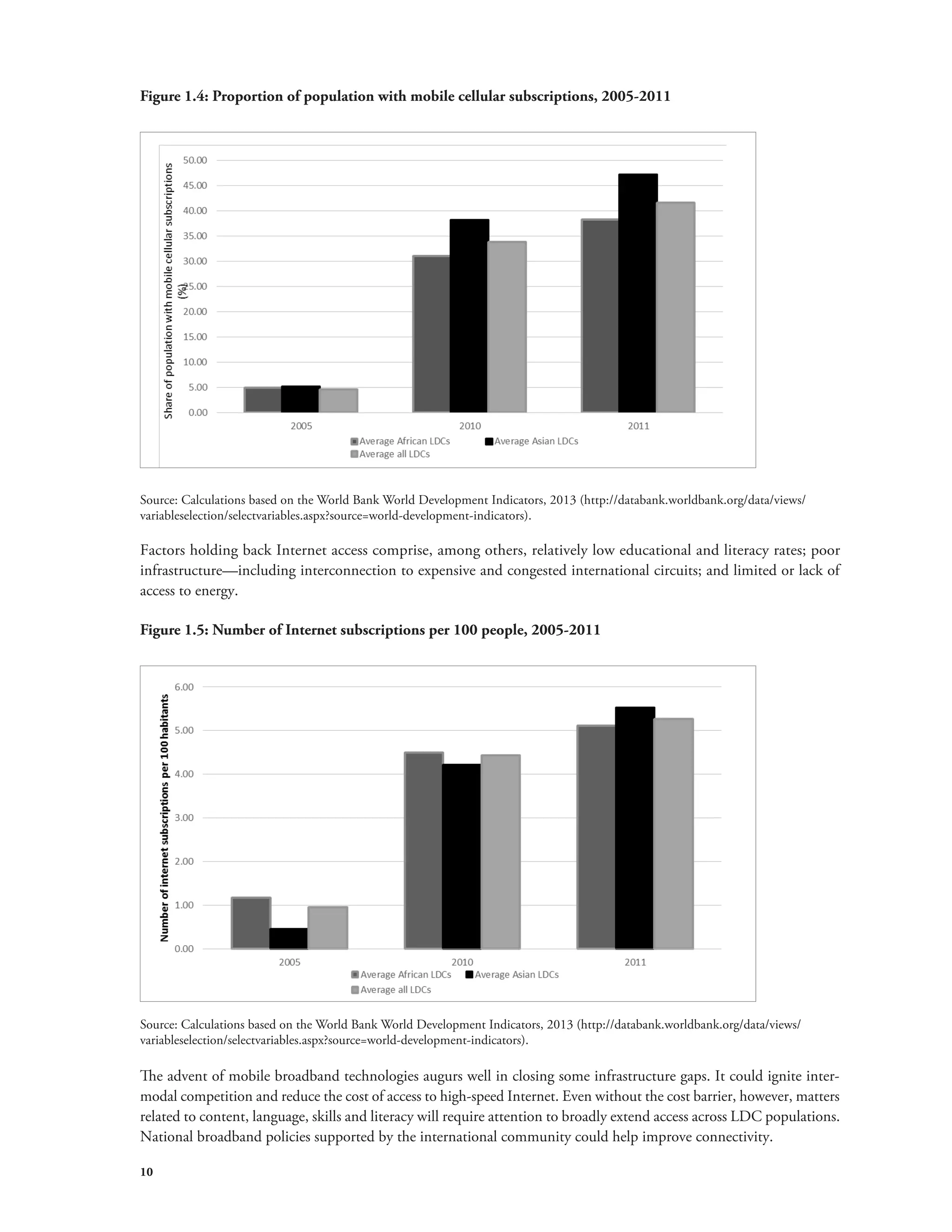
Developments in Internet access and usage have lagged behind mobile telephony. The number of Internet subscriptions 
per 100 habitants in the LDCs rose slightly, from 4.4 per cent in 2010 to 5.3 per cent in 2011 (figure 1.5). This 
indicator, however, varied from a high of 30 per cent in Tuvalu to a low of 0.9 and 1 per cent in Myanmar and Timor- 
Leste, respectively. The majority of subscriptions in the LDCs had low speeds, reducing the scope for applications and 
services. Fixed broadband subscriptions, which would have enabled many to tap high-speed connections, were limited, 
in part by high prices. Not surprisingly, of the 39 countries qualified by the International Telecommunication Union 
(ITU) as the “world’s least connected countries,” 31 are LDCs (ITU, 2012). 
9 
3 As customers often have multiple SIM cards, the percentage of users in the total population is likely to be lower than that of subscribers.
Figure 1.4: Proportion of population with mobile cellular subscriptions, 2005-2011 
Source: Calculations based on the World Bank World Development Indicators, 2013 (http://databank.worldbank.org/data/views/ 
variableselection/selectvariables.aspx?source=world-development-indicators). 
Factors holding back Internet access comprise, among others, relatively low educational and literacy rates; poor 
infrastructure—including interconnection to expensive and congested international circuits; and limited or lack of 
access to energy. 
Figure 1.5: Number of Internet subscriptions per 100 people, 2005-2011 
Source: Calculations based on the World Bank World Development Indicators, 2013 (http://databank.worldbank.org/data/views/ 
variableselection/selectvariables.aspx?source=world-development-indicators). 
The advent of mobile broadband technologies augurs well in closing some infrastructure gaps. It could ignite inter-modal 
10 
competition and reduce the cost of access to high-speed Internet. Even without the cost barrier, however, matters 
related to content, language, skills and literacy will require attention to broadly extend access across LDC populations. 
National broadband policies supported by the international community could help improve connectivity.
11 
Transportation 
Roads 
Given the positive contributions of transport to growth and development, the LDCs and their development partners 
committed in the Istanbul Programme of Action to substantively expanding combined rail and paved road mileage as 
well as sea and air networks by 2020. Increased public investment—mostly funded through multilateral and regional 
banks, and through South-South cooperation arrangements—has enabled many LDCs to extend their total road mileage. 
Combined with some institutional reforms, this has led to some improvements in road conditions. 
Road conditions are far from the standards that prevail in other developing countries, however. All categories of roads 
confront challenges. The deplorable state of rural roads continues to pose a serious handicap to transporting people 
and agricultural goods, therefore hampering the development of agriculture and its integration into rapidly growing 
agribusiness chains. The situation is not any better for intra-urban roads. Conditions and designs remain subpar in 
many instances, and are often responsible for heavy traffic congestion (Foster and Briceno-Garmendia, 2010). 
The status of trunk road networks, in particular trading corridors connecting inland to costal ports, is rather mixed. 
Many Asian LDCs have benefited from the Asia Highway Network, which now covers 32 countries and encompasses 
142,000 km of highways. There are no missing links in the network, and almost a third of it is in excellent condition, 
although some segments are not in good shape (UNESCAP, 2012). In contrast, the Trans-African Highway, a regional 
initiative to develop integrated transport corridors connecting all African countries and providing landlocked ones with 
access to seaports, has yet to be realized. There are many missing links and existing portions that are poorly maintained 
(UNECA, 2012). 
Challenges are not confined solely to hard infrastructure. Soft infrastructure, including the institutional and regulatory 
aspects of road transport, constitutes a serious impediment to transport and cross-border trade efficiency. Soft infrastructure 
issues are sometimes responsible for high road-transport tariffs in some West and Central African LDCs, particularly as 
physical infrastructure improves in some of these countries (World Bank, 2012a; United States Agency for International 
Development, 2011). Limited competition in road transport services and the existence of roadblocks have made road 
transport tariffs prohibitive and transit times uncertain. 
Railways 
Despite recent revitalization in a number of the LDCs, the conditions of railway systems do not compare favourably 
with those of road networks. In most cases, if they are even functional, railway networks operate with original structures 
and limited modernization. They also tend to be fragmented, running within a single country or confined to connecting 
a deep-sea port with its immediate hinterland. 
Passenger and freight traffic has shrunk, causing many LDCs, particularly in Africa, to grant concessions to private 
operators to run the railways. Although service has improved and tariffs have picked up, many systems are still not in 
a position to generate enough revenue for expanding and improving existing networks. 
The recent commodity boom has prompted a renewed interest in and commitment to railway rehabilitation and 
expansion. A number of foreign companies with some stakes in the mining sectors in Guinea, Liberia and Sierra 
Leone have planned heavy-haul rail projects, which include refurbishing existing and/or building new rail lines.4 
Under its Growth and Transformation Plan, Ethiopia has initiated a series of projects to build 2,600 km of railway lines 
by 2015. Construction has already commenced. Similar initiatives are well underway in the Lao People’s Democratic 
Republic and in Angola, where projects in the pipeline raise the prospects of operationalizing the transcontinental 
corridor between the Atlantic and Indian oceans.5 
4 See www.railjournal.com/index.php/freight/demand-for-resources-drives-african-rail-boom.html. 
5 See www.ft.com/intl/cms/s/0/cdb78d52-c6b9-11e1-95ea-00144feabdc0.html#axzz2LxMvGBWG.
Some Asian LDCs are ahead in filling missing links, although much remains to be done (UNESCAP, 2012). Bangladesh, 
the Lao People’s Democratic Republic, Myanmar and Nepal are signatories to the International Agreement on the 
Trans-Asian Railway Network, which is backed by the United Nations Economic and Social Commission for Asia 
and the Pacific (UNESCAP). 
These new projects and initiatives face a number of challenges, including the complexity of financial arrangements, the 
conditions of financing, and gaps in the institutional and regulatory frameworks guiding the functioning of railway 
networks. 
Maritime transport 
Weak land and air transport links and cost considerations make maritime transport the preferred mode for conducting 
international trade in many LDCs. Efficient maritime transport is therefore essential for the pursuit and success of 
trade promotion initiatives. 
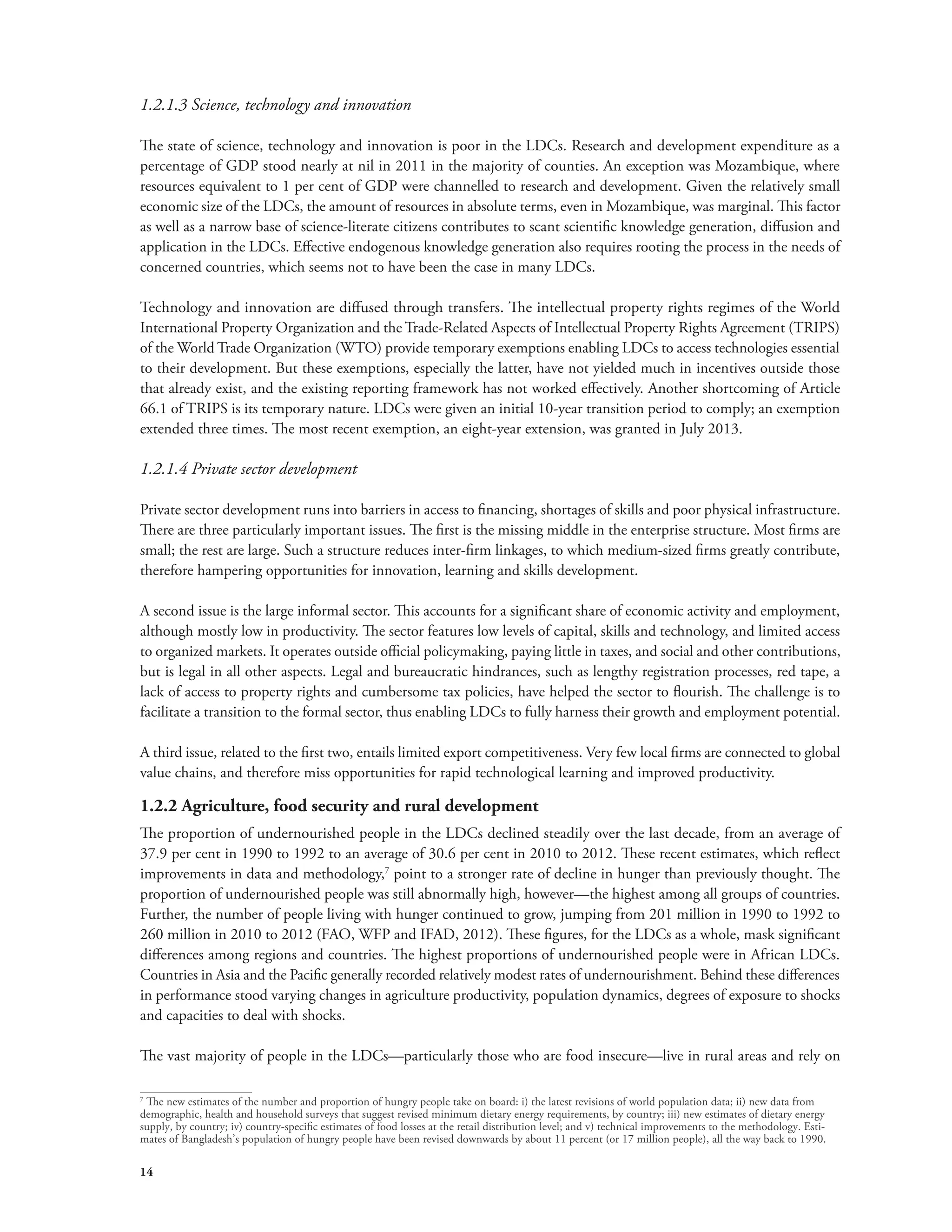
Recent trends in the Liner Shipping Connectivity Index, which helps gauge how well countries are linked to global 
shipping networks, suggests some progress, albeit marginal. The average for all LDCs on the index rose to 7.3 in 
2011, up from 7.1 in 2010—on a 0-to-100 scale where 100 is the value assigned to a country with the most efficient 
shipping landscape. Among the LDCs, the index ranges from as high as 21 in Djibouti to 3 in Kiribati (figure 1.6). 
Many Asian LDCs are connected to international routes through direct shipping services. Transit times for goods going 
to landlocked Asian LDCs such as Bhutan and Nepal have declined or at best remained the same (UNESCAP, 2012). 
Despite some progress, maritime infrastructure and services lag far behind international standards. Many ports in the 
LDCs do not have modern gantry cranes, for instance, limiting their ability to efficiently dock container ships. Nor can 
they accommodate large ships. Communication systems and customs practices are often out of date. Severe delays and 
congestion result, leading to long port dwelling and documentation times, relatively low traffic and high shipping tariffs. 
Figure 1.6: Countries with the highest and lowest values on the Liner Shipping Connectivity Index 
Source: Calculations based on the World Bank World Development Indicators, 2013 (http://databank.worldbank.org/data/views/ 
variableselection/selectvariables.aspx?source=world-development-indicators). 
Removing these obstacles will require, among other measures, refurbishing port infrastructure; better linking ports to 
other transport modes, including road, rail and air; simplifying procedures to cut handling costs and dwelling times; 
and improving port management. 
12
Air Transport 
The demise of many national and regional airlines during the last decade made air transport all the more inconvenient, 
particularly in many LDCs. With new airlines emerging and filling the vacuum left by defunct ones, the situation has 
improved moderately, but flight frequency and traffic remain relatively low. New airlines are often small, undercapitalized 
and face cost disadvantages compared to bigger foreign airlines. Many operate nationally and regionally, and lack the 
ability to run international routes effectively. 
Airport infrastructure challenges in many LDCs include runways in poor condition, outdated traffic control 
communication and limited facilities for transit passengers. 
1.2.1.2 Energy 
The lack of access to modern forms of energy is a major impediment to sustainable development, as it exacerbates the 
vulnerability of the chronically poor. As of 2007, based on the latest available data, 79 per cent of people in the LDCs lacked 
access to electricity, while 91 per cent had no access to modern fuels. The rural-urban divide in access to energy was even 
more pronounced. While 27 per cent of urban dwellers had access to modern fuels, only 3 per cent of rural dwellers did.6 
Making renewable energy available to the LDCs could have far-reaching impacts, including improvements in health, 
equity and empowerment for women, better opportunities for livelihoods and greater environmental sustainability. 
The lack of access to energy contrasts with the fact the majority of the LDCs have vast energy resources that have yet 
to be fully tapped. Only a few countries, including Bhutan, Ethiopia and the Lao People’s Democratic Republic, have 
made progress, mainly due to investments launched prior to the Istanbul Programme of Action. Hydropower generation 
expanded significantly in Bhutan, financed by India, its main investor and trading partner. The country has produced 
1,480 megawatts of power, 75 per cent of which has been exported to India. Efforts are underway to expand power 
generation capacity to 10,000 megawatts by 2020 through the building of 10 new hydropower plants.6 
A key component of Ethiopia’s growth strategy is to construct a number of hydropower plants to attend to growing 
domestic demand—driven in part by a vibrant manufacturing sector—and increasing demand by neighbouring countries. 
Power generation capacity is expected to reach 8,000 to 10,000 megawatts by 2015. Ethiopia is also capitalizing on its 
vast sources of other forms of renewable energy—thermal, wind and solar. Similar developments have taken hold in the 
Lao People’s Democratic Republic, where the Nam Theun 2 hydropower project is expected to increase the country’s 
power generation capacity, a significant share of which is slated for export to Thailand. 
Ambitious plans for large renewable power installations were announced in 2011 in several LDCs, including Guinea 
(solar), Lesotho (wind) and Rwanda (geothermal). Some countries have successfully stimulated rural electrification 
projects by mainstreaming renewables as a central technology option in national energy strategies. This approach is 
promising provided there is a focused national strategy and committed implementation programme. 
Having vast energy resources does not mean that power will be accessible, affordable and reliable. Improving access, 
affordability, quantity, quality and sustainability will require innovative financing schemes and close cooperation with 
the private sector. Other important measures entail the improved management of utility companies, effective regulatory 
frameworks to guide the production and transmission of power, increased cross-border power trade, and expanded 
access to energy for underserved groups or areas. 
13 
6 See http://gofar.sg/bhutan/2012/11/harnessing-hydropower/.
1.2.1.3 Science, technology and innovation 
The state of science, technology and innovation is poor in the LDCs. Research and development expenditure as a 
percentage of GDP stood nearly at nil in 2011 in the majority of counties. An exception was Mozambique, where 
resources equivalent to 1 per cent of GDP were channelled to research and development. Given the relatively small 
economic size of the LDCs, the amount of resources in absolute terms, even in Mozambique, was marginal. This factor 
as well as a narrow base of science-literate citizens contributes to scant scientific knowledge generation, diffusion and 
application in the LDCs. Effective endogenous knowledge generation also requires rooting the process in the needs of 
concerned countries, which seems not to have been the case in many LDCs. 
Technology and innovation are diffused through transfers. The intellectual property rights regimes of the World 
International Property Organization and the Trade-Related Aspects of Intellectual Property Rights Agreement (TRIPS) 
of the World Trade Organization (WTO) provide temporary exemptions enabling LDCs to access technologies essential 
to their development. But these exemptions, especially the latter, have not yielded much in incentives outside those 
that already exist, and the existing reporting framework has not worked effectively. Another shortcoming of Article 
66.1 of TRIPS is its temporary nature. LDCs were given an initial 10-year transition period to comply; an exemption 
extended three times. The most recent exemption, an eight-year extension, was granted in July 2013. 
1.2.1.4 Private sector development 
Private sector development runs into barriers in access to financing, shortages of skills and poor physical infrastructure. 
There are three particularly important issues. The first is the missing middle in the enterprise structure. Most firms are 
small; the rest are large. Such a structure reduces inter-firm linkages, to which medium-sized firms greatly contribute, 
therefore hampering opportunities for innovation, learning and skills development. 
A second issue is the large informal sector. This accounts for a significant share of economic activity and employment, 
although mostly low in productivity. The sector features low levels of capital, skills and technology, and limited access 
to organized markets. It operates outside official policymaking, paying little in taxes, and social and other contributions, 
but is legal in all other aspects. Legal and bureaucratic hindrances, such as lengthy registration processes, red tape, a 
lack of access to property rights and cumbersome tax policies, have helped the sector to flourish. The challenge is to 
facilitate a transition to the formal sector, thus enabling LDCs to fully harness their growth and employment potential. 
A third issue, related to the first two, entails limited export competitiveness. Very few local firms are connected to global 
value chains, and therefore miss opportunities for rapid technological learning and improved productivity. 
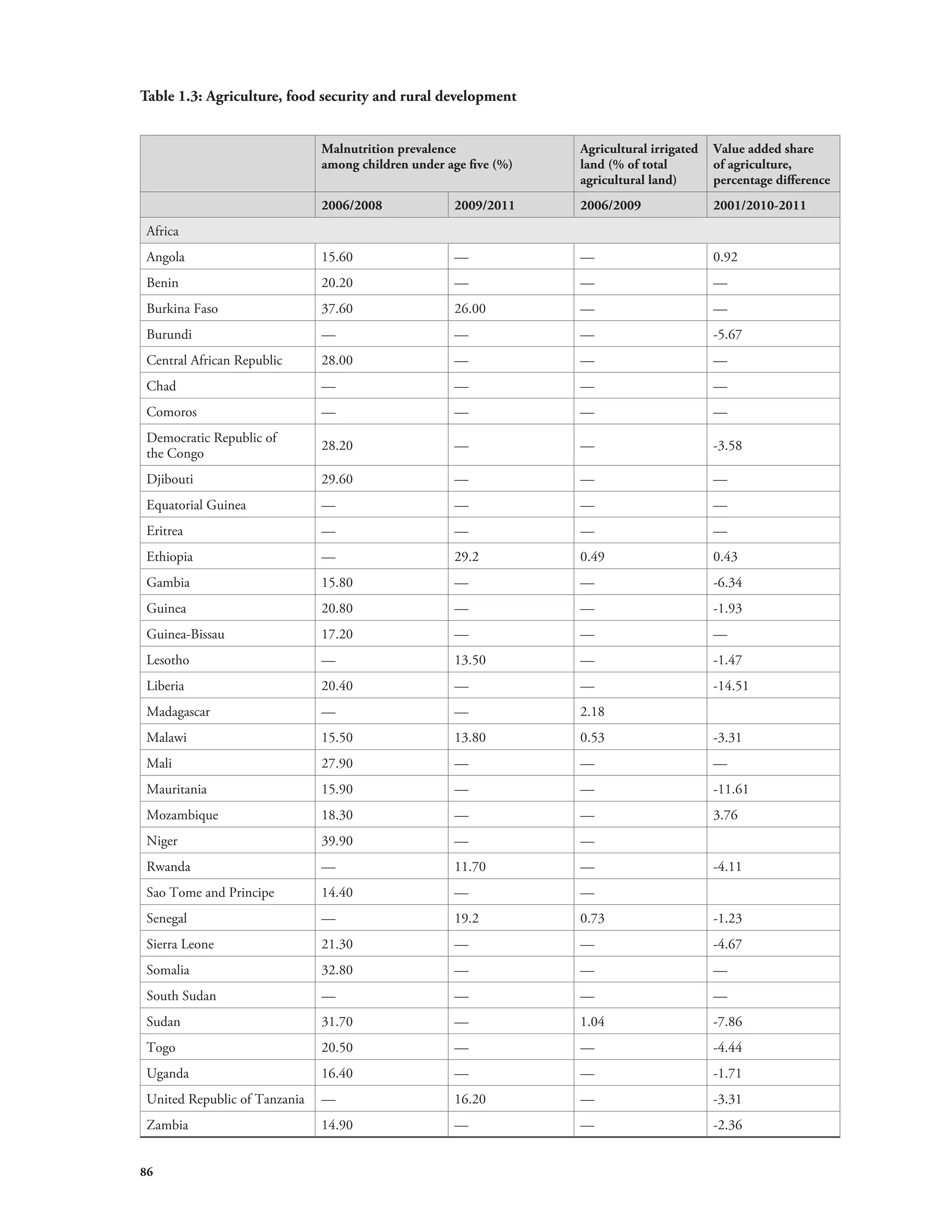
1.2.2 Agriculture, food security and rural development 
The proportion of undernourished people in the LDCs declined steadily over the last decade, from an average of 
37.9 per cent in 1990 to 1992 to an average of 30.6 per cent in 2010 to 2012. These recent estimates, which reflect 
improvements in data and methodology,7 point to a stronger rate of decline in hunger than previously thought. The 
proportion of undernourished people was still abnormally high, however—the highest among all groups of countries. 
Further, the number of people living with hunger continued to grow, jumping from 201 million in 1990 to 1992 to 
260 million in 2010 to 2012 (FAO, WFP and IFAD, 2012). These figures, for the LDCs as a whole, mask significant 
differences among regions and countries. The highest proportions of undernourished people were in African LDCs. 
Countries in Asia and the Pacific generally recorded relatively modest rates of undernourishment. Behind these differences 
in performance stood varying changes in agriculture productivity, population dynamics, degrees of exposure to shocks 
and capacities to deal with shocks. 
The vast majority of people in the LDCs—particularly those who are food insecure—live in rural areas and rely on 
7 The new estimates of the number and proportion of hungry people take on board: i) the latest revisions of world population data; ii) new data from 
demographic, health and household surveys that suggest revised minimum dietary energy requirements, by country; iii) new estimates of dietary energy 
supply, by country; iv) country-specific estimates of food losses at the retail distribution level; and v) technical improvements to the methodology. Esti-mates 
14 
of Bangladesh’s population of hungry people have been revised downwards by about 11 percent (or 17 million people), all the way back to 1990.
agriculture as their primary means of subsistence. The state of the rural economy, which is intrinsically linked to 
improvements in agricultural productivity, therefore determines the pace at which these countries reduce hunger. Growth 
in food production has resulted in increased food availability and a decline in food prices in local markets. It also has 
had spillover effects on the rural non-farm economy by spurring demand for non-agricultural goods and services. The 
relatively strong achievements of the Asian LDCs in reducing the prevalence of undernourishment have been attributed 
to productivity-led (yield-increasing) growth in agriculture. By contrast, the relatively modest performance of the African 
LDCs has come partly from low agricultural productivity, which mirrored to some extent the low capitalization of the 
sector. Even so, malnourishment, hunger and food insecurity remain critical challenges in all of the LDCs. 
Demographic dynamics also explain variations in progress towards reducing hunger. Rapid population growth has 
put additional pressure on the natural resource bases of these countries, including land and water, and undermined 
agricultural productivity, especially where technical progress was slow. 
In some countries, natural and human-induced crises, especially civil strife, and/or the spread of HIV/AIDS have 
hampered the reduction of undernourishment (FAO, WFP and IFAD, 2012). Hunger has worsened in Burundi, 
the Democratic Republic of the Congo and Yemen. Growing insecurity and the frequent displacement of people has 
depressed agricultural productivity and output, therefore affecting both food availability and affordability. 
1.2.3 Trade 
Trade flows continued to recover from the severe decline recorded in 2009. The value of total imports of goods and 
services has expanded, although at a relatively slower pace than exports. As a result of the expansion beginning in 
2010, the value of total exports of goods and services reached US$229.8 billion in 2011, a 23.9 per-cent increase 
over the 2010 level. The rate of expansion was far better than those sustained not only globally at 5 per cent, but 
also by other developing economies at 12.6 per cent (WTO, 2012a; WTO, 2012b). As a result, the share of LDC 
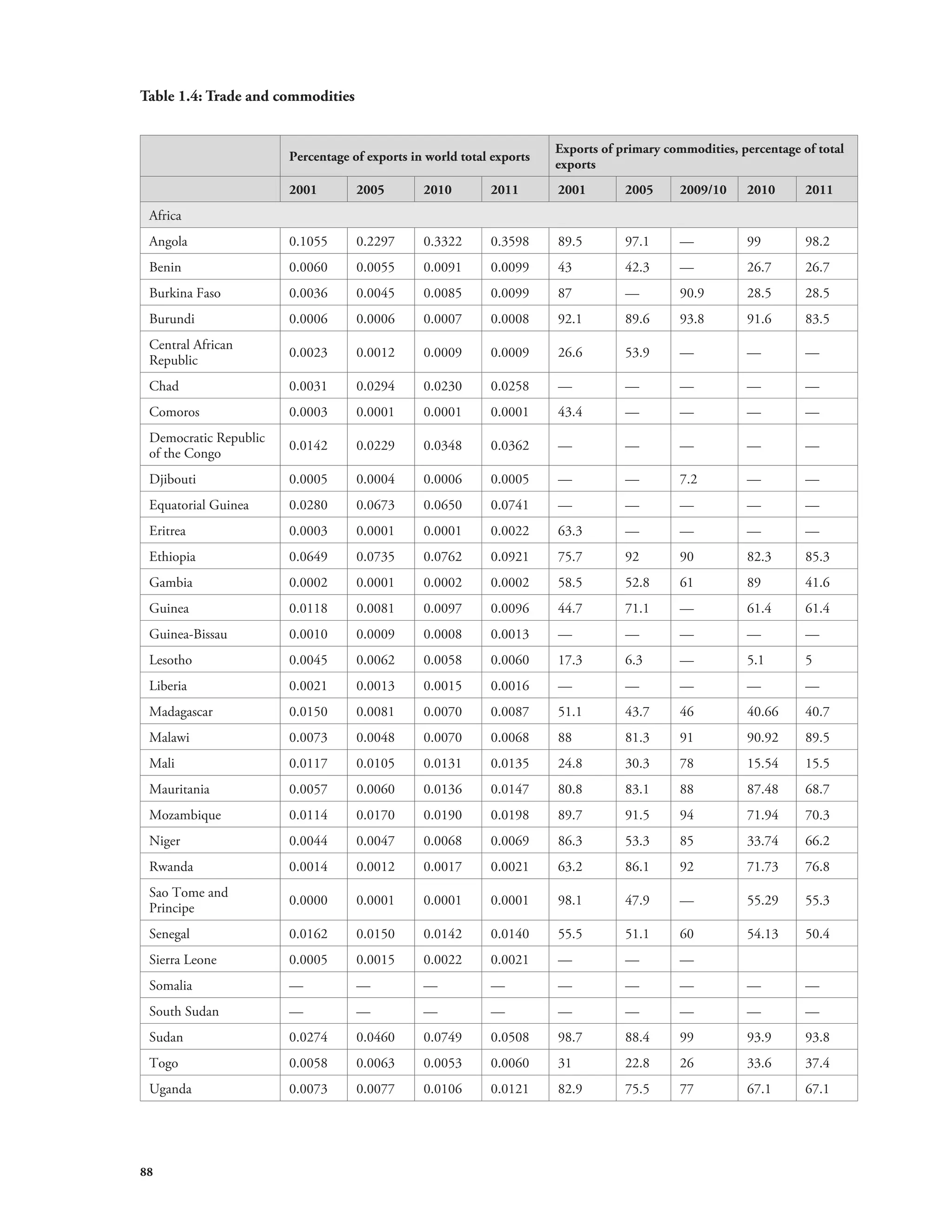
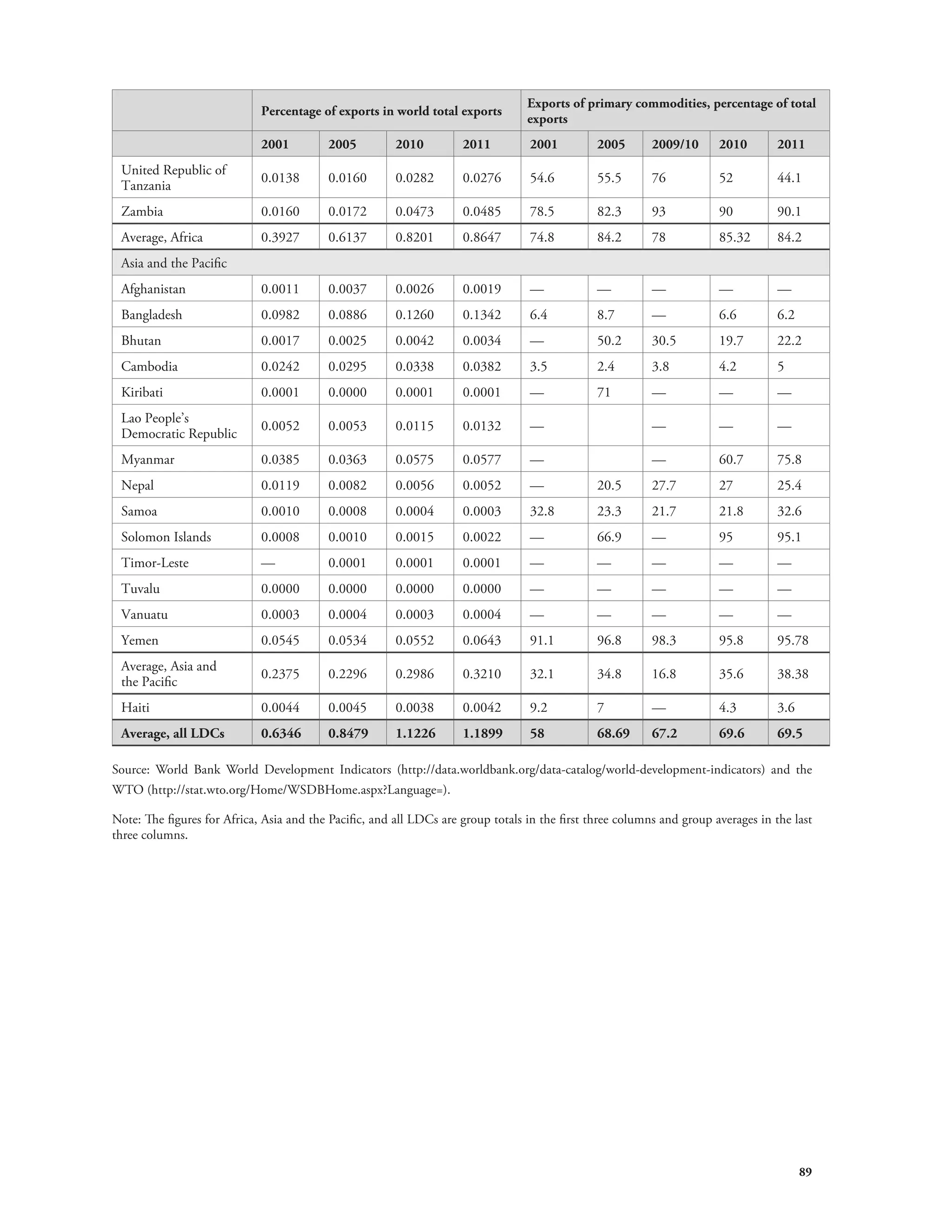
exports in the world total increased slightly to 1.19 per cent in 2011, up from 1.12 per cent in 2010. Recent WTO8 
estimates indicate that both LDC merchandise exports and imports of goods showed signs of weakening in 2012, as 
they grew at a much slower pace than in the last two years. 
The product structure of the LDCs’ total exports tilted overwhelmingly towards merchandise, which reached US$203.8 
billion in 2011—87 per cent of the total. Primary commodities continued to account for close to 70 per cent of total 
merchandise exports. An increased share of merchandise owed much to the export prices of primary commodities, 
which rebounded significantly in 2011, posting a 29.1 per cent increase and offsetting the 3 per cent decline in export 
volume. By contrast, the share of manufactured goods in total exports dropped to 20 per cent, largely driven by 
the relative decline of clothing. The same held true for services, whose share stood at 9 per cent of the total (WTO, 
2012a). In sum, LDCs’ dependence on primary commodities increased, making them more vulnerable to fluctuations 
in commodity markets. 
Total trade flows were not uniformly distributed across the LDCs. Angola, Equatorial Guinea, Myanmar and Sudan, 
which export hydrocarbons; Ethiopia, which exports agricultural and manufacturing products; Zambia, which exports 
minerals; and Bangladesh and Cambodia, which export manufacturing products, accounted for 87 per cent of total 
exports. This left only 13 per cent for the remaining 40 LDCs. 
Changes in trade destinations that started during the last decade were sustained. The largest market for LDC exports 
is no longer developed countries, but has become developing countries, whose share jumped from 40 per cent in 2000 
to 52 per cent in 2011. Much of the growing share of developing countries reflected stronger trade links with China, 
which absorbed 22 per cent of LDC merchandise exports. 
Growing trade ties with emerging countries occurred against the background of improved market access there. China; India; 
the Republic of Korea; and Taiwan, Province of China recently notified the WTO of LDC-dedicated preferential trade 
agreements (WTO, 2012a). Publicly disclosing this information contributes to greater transparency and clarity, thus greater 
15 
8 Appendix table 1.1 of WTO (2013).
accountability in the partnership between the LDCs and these emerging countries. Limited available information indicates 
that 64 per cent of LDC exports benefited from duty-free and quota-free market access in the above countries in 2010.9 
Preferential access might increase in the years to come, particularly in those countries where duty-free provisions will 
be phased in. 
Duty-free and quota-free market access for LDCs in developed countries covered 80 per cent of LDC exports (excluding 
arms and oil) in 2010. The figure has remained virtually unchanged since 2004, however (United Nations, 2012a). 
This contrasts with the situation of non-LDC developing countries, which have seen preferential access to developed 
country markets improve steadily in recent years, if still at a modest level compared to that for the LDCs. 
All in all, commitment to providing duty-free and quota-free market access to LDC exports has yet to be fully achieved. 
Even existing preferential schemes are not always fully utilized because of administrative hurdles and restrictive rules of 
origin. Supply constraints and trade-related infrastructure deficits also need to be addressed. 
Progress in improving market access hinges in part on the Doha Round of global trade negotiations, where not much 
progress has been made. Three LDC-related decisions were adopted during the eighth session of the WTO Ministerial 
Conference in December 2011, however. These decisions pertained to preferential market access for service exports 
and service suppliers from the LDCs, the extension of the TRIPS Article 66.2 transition period beyond 2013 and the 
streamlining of LDC accession to the WTO. Following these decisions, the General Council on 25 July 2012 formally 
adopted the decision to facilitate LDC membership. 
Progress in joining the WTO has been steady. Of the 49 LDCs, 34 are members and 10 are in discussions for accession. 
The most recently admitted LDCs are Samoa (10 May 2012), Vanuatu (24 August 2012) and the Lao People’s Democratic 
Republic (26 October 2012). 
1.2.4 Commodities 
There have been modest achievements in economic and trade diversification in the LDCs. In most, the share of extractive 
industries has risen, while that of manufacturing has either decreased in importance or stagnated. Only a few economies 
have not followed this script. The United Republic of Tanzania is one example. It has undergone important structural 
changes, with its share of agriculture decreasing to the benefit of manufacturing, construction, services and mining. 
Ethiopia has experienced similar developments. 
The product and geographic compositions of trade have evolved in opposite directions. The average share of primary 
commodities exports across the LDCs—which had increased significantly during the commodity boom—have continued 
to be high, around 70 per cent in 2011, with a much higher share in Africa at 84 per cent than in Asia and the Pacific 
at 38 per cent. As the LDCs have sustained a strong product concentration in their exports, the geographic destinations 
have changed. Trade relations with emerging countries, China in particular, have firmed up (WTO, 2012a). The 
expansion has been so robust that in 2011 developing countries outpaced developed countries as the most important 
markets for LDC exports. 
Shifts in the composition and destination of trade flows have conflicting effects on economic vulnerability. On the 
one hand, the concentration of production and exports in sectors with limited technology, productivity and quality 
spillovers limits the ability of countries to sustain high-level economic growth over a long period of time (Moore and 
Walkes, 2010). A narrow productive base also indicates limited dynamic shifts in resources, labour and capital—from 
low-productivity to high-productivity sectors and activities—hence the failure to raise economy-wide productivity 
and create decent jobs. Further, the failure to achieve adequate economic and trade diversification implies continued 
dependence on sectors with highly erratic and correlated prices. The consequence is continued exposure to adverse 
external shocks and greater economic instability. 
On the other hand, the growing prominence of emerging countries as major trading partners of the LDCs bodes well 
9 The most recent year for which this information is available. 
16
for efforts to reduce volatility. Greater geographic diversification of trade reduces the likelihood of shock from a single 
trading partner, helping countries become more resilient. This cushioning effect decreases, however, as countries become 
more diversified in what they produce and trade. 
1.2.5 Human and social development 
1.2.5.1 Education and training 
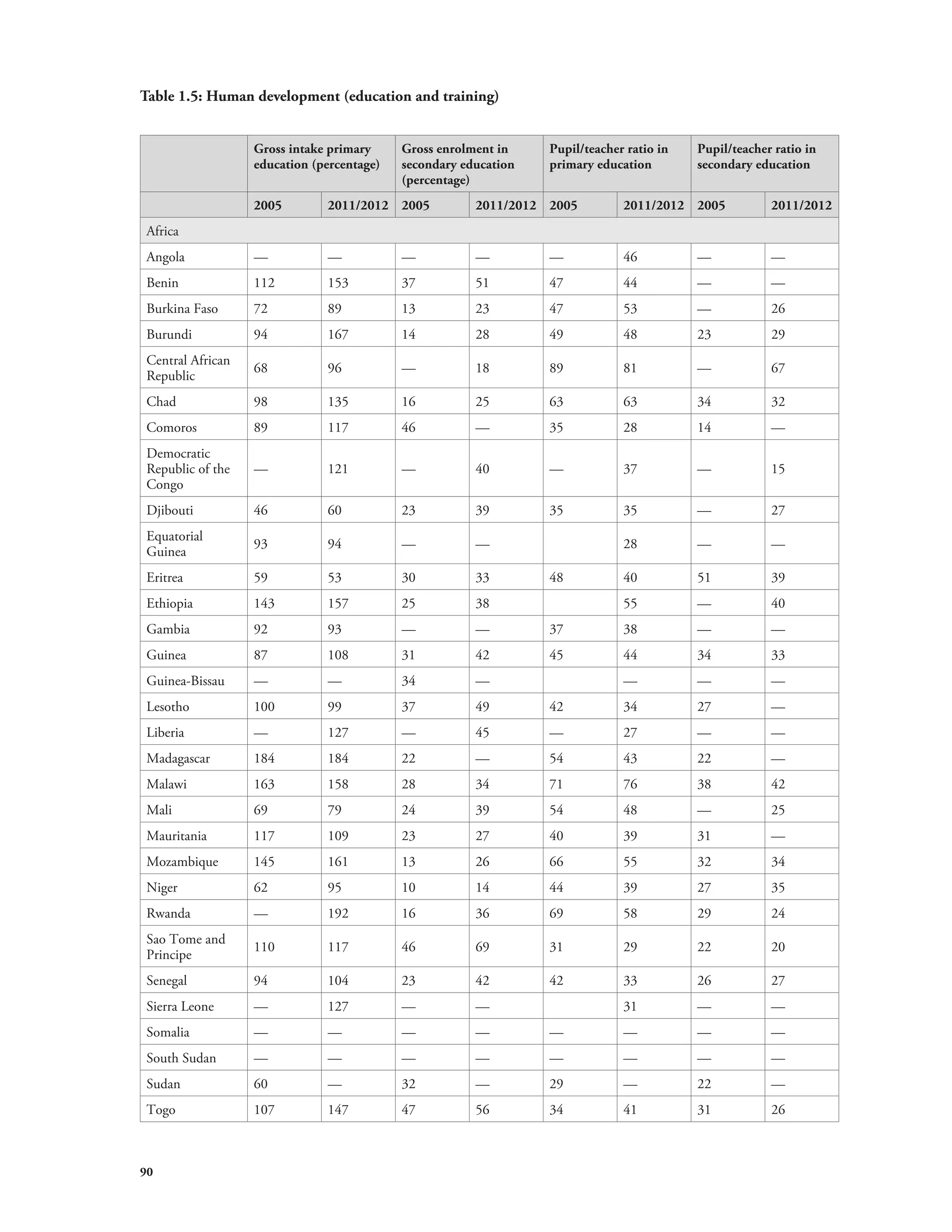
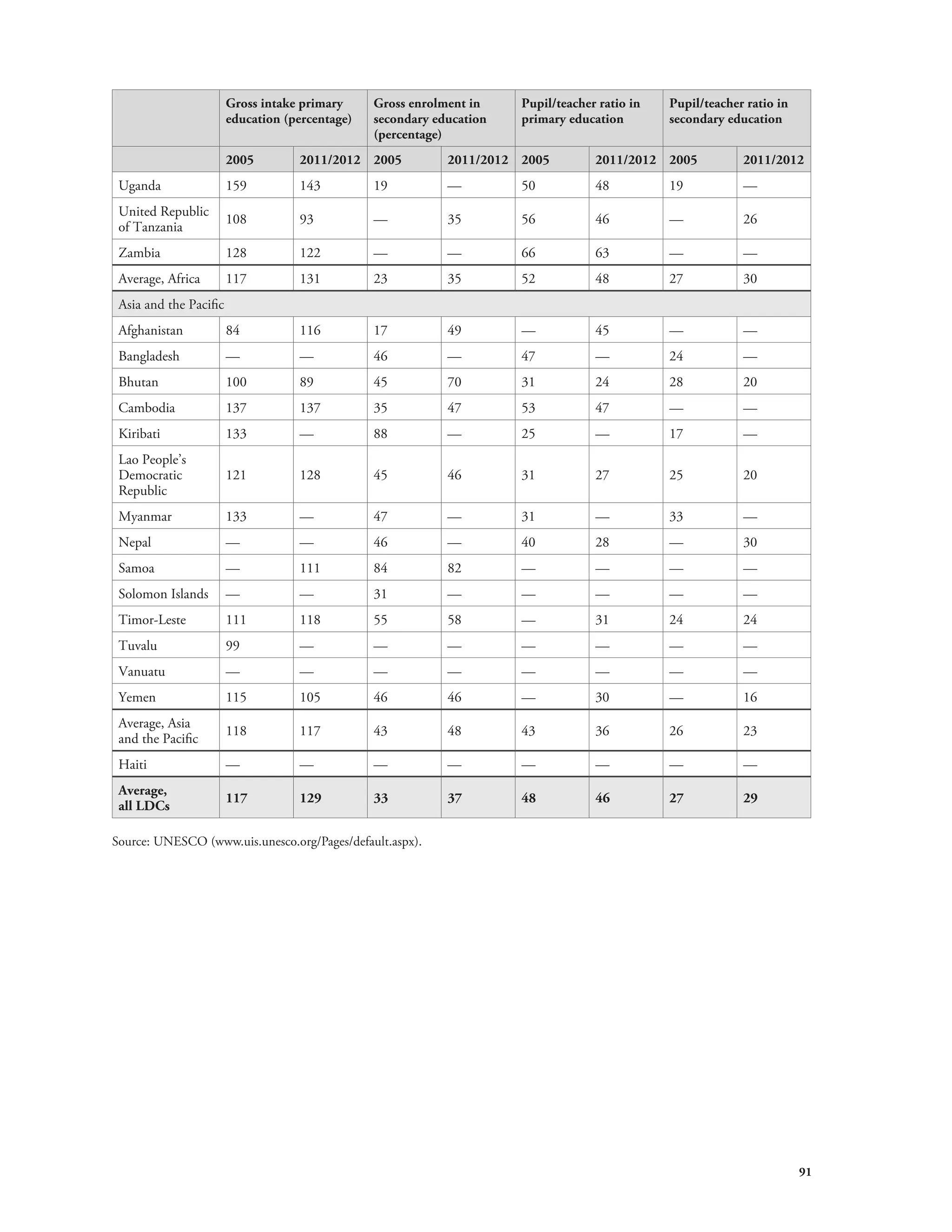
Following a decade of strong performance, gross intake in primary education continued to expand in many of the LDCs, 
albeit at a more modest pace. Even as the rate of progress had tapered off, a number of countries have witnessed some 
increases in primary enrolments. As a result, the number of new entrants in primary education in 2011 was three-and-half 
17 
times the 1999 level (UNESCO, 2012). 
Irrespective of their success in increasing entry into school, many countries have persistently displayed low survival and 
completion rates. The survival rate to the last grade of primary school in 2011 stood, for example, at 32 per cent and 
28 per cent in Angola and Chad, respectively. Poorly trained teachers and clogged classrooms have impaired learning 
outcomes. A major challenge for the majority of LDCs is enrolling prospective students at the right age and ensuring 
that they complete primary education. 
There has been modest progress in expanding enrolments in secondary, vocational and technical, and tertiary education, 
where skills for productive and decent employment are acquired. In most LDCs, low completion rates and poor learning 
outcomes in primary education are among the factors that thwart stellar enrolment and completion rates in secondary, 
and vocational and technical education. The mixed quality of education and limited access by marginalized groups 
persist as major issues. 
While tertiary enrolment rates have risen, quality has seemed to deteriorate, partly because new entrants are not always 
well equipped for higher education. Other hindrances comprise insufficient and inadequate laboratories and library 
facilities, and very limited use of information and communication technology. 
1.2.5.2 Population and primary health 
After years of steady decline, the average child mortality rate across the LDCs in 2011 was at two-thirds of its 2001 
level, but still alarmingly high by international standards. Eighty-nine of every 1,000 children in the LDCs died before 
turning five. Countries emerging from or in conflicts recorded the highest child mortality rates (figure 1.7). Angola, 
Central African Republic, Chad, the Democratic Republic of the Congo, Guinea-Bissau, Sierra Leone and Somalia had 
child mortality rates that were almost double the group average, or sometimes even more. Poor health services; diseases 
such as pneumonia, diarrhoea and malaria; and persistent child malnutrition and hunger constituted the main causes 
of deaths among children under five in most of these countries. 
Conversely, Pacific LDCs, in particular Samoa, the Solomon Islands and Tuvalu, continued to fare better, not only 
sustaining progress in reducing child mortality, but also posting the lowest rates even by the standards of other developing 
countries. Remarkable progress was made in a number of other LDCs as well. Bangladesh, Cambodia, the Lao People’s 
Democratic Republic and Senegal, for instance, cut their child mortality rates by almost half between 2001 and 2011. 
Over the same period, Rwanda’s performance was even more impressive, with a record of reducing the percentage of 
children dying before age five by more than two-thirds. Common contributing factors to success have included good or 
improved primary health care; improved education, particularly of mothers; increased child protection; better nutrition 
for children and mothers; and improved reproductive health. Strong global and domestic commitments created an 
environment conducive to these achievements.
Figure 1.7: Countries with the highest and lowest infant mortality rates 
Source: Calculations based on the World Bank World Development Indicators, 2013 (http://databank.worldbank.org/data/views/ 
variableselection/selectvariables.aspx?source=world-development-indicators). 
Maternal mortality rates also trended downwards, following patterns similar to those of child mortality. Some countries, 
such as Nepal and the United Republic of Tanzania, have drastically reduced maternal mortality over the last decade. 
In most instances, countries with the highest rates were roughly the ones with the lowest levels of child survival. LDC 
maternal mortality rates remained the highest in the world, however, with 398 deaths per 100,000 births in 2010, 
compared to 240 for developing countries on average. Progress was driven partially by better health care, improved 
access to health centres and more female education (United Nations, 2012b). One dimension of higher quality health 
care is increased access to reproductive health care, which nonetheless remained modest. 
On average, HIV prevalence rates seemed to have plateaued over recent years in the LDCs. Proportionally, the largest 
populations living with HIV/AIDS are in Lesotho, Malawi, Mozambique and Zambia. One positive development has 
been the reduction in the number of AIDS-related deaths, thanks in part to the introduction of antiretroviral therapy. 
The incidence of malaria and tuberculosis has decreased in most countries. The challenge now is to nurture and expand 
the achievements made so far, particularly as international funding—a key driver of the success in reducing the incidence 
of some of these diseases—is expected to recede. 
1.2.5.3 Youth development 
Models of youth participation in society and decision-making processes have grown in the LDCs. These range from 
youth forums, councils and parliaments to engagement in public events, including seminars and conferences. But there 
is still far to go to remove barriers to meaningful youth participation, and encourage young people as effective partners 
and leaders in development. Sociocultural norms, particularly age restrictions, and limited economic empowerment 
are among the obstacles. 
Progress in expanding education opportunities to youth has been noteworthy. The literacy rate for people aged 15 to 
25 grew to 76.45 per cent in 2009 to 2010, up from 69.45 per cent in 2000 to 2002. This major achievement came 
with some caveats. First, a good number of young literates had only a primary education, with the transition rate from 
primary to secondary education remaining low in many LDCs. The proportion of children who completed primary 
education but did not proceed to secondary school was as high as 40 per cent in Angola, Mauritania and the United 
18
Republic of Tanzania (UNESCO, 2012). Second, while enrolments of young people in secondary, vocational and 
technical, and tertiary education increased moderately, the quality and alignment of such education to labour market 
demand remained a source of concern. Another dimension of the employability of young people, even if they acquire 
the right education and training, is access to continued learning and the upgrade of skills. This is all the more required 
if LDCs are to undergo economic transformation and generate decent employment. 
1.2.5.4 Shelter 
Populations in most of the LDCs have continued to grow at a relatively fast pace. Much of this growth has occurred 
in urban areas, which have benefited from the combination of rural-urban migration and natural population growth. 
From 2005 to 2010, the populations of Kinshasa and Luanda, for instance, grew by 1.6 million and 1.2 million people, 
respectively. Dhaka recorded one of strongest population growth rates among Asian cities and is now considered the 
world’s ninth largest metropolis (United Nations Human Settlements Programme (UN-Habitat), 2012). 
Rapid urbanization has been accompanied by growing demand for affordable urban land and housing, but supply 
has not always followed due to factors such as land tenure issues; land prices; an inadequate amount of urban land 
regulated for housing development; limited access to housing finance, which is underdeveloped and inflexible; and the 
unavailability and high cost of imported building materials. 
The mismatch between supply and demand has resulted in the mushrooming of unplanned or informal settlements 
and slums, although the significance of these in overall urban growth has moderated somewhat. This has not been met 
by commensurate expansion in infrastructure and services. Rural areas have also faced challenges to decent shelter. 
Some regional initiatives and commitments have attempted to respond to the problem of shelter. Examples include 
the Africa Land Policy Initiative, spearheaded by the African Union, the African Development Bank and the United 
Nations Economic Commission for Africa (UNECA), and the Declaration of the 2010 African Ministerial Conference 
on Housing and Urban Development. Both measures have emphasized the central role of land in securing sustainable 
and equitable urban development. Many LDCs have promoted “bottom-up” microfinance and community savings 
schemes to pool resources and leverage housing finance. 
1.2.5.5 Water and sanitation 
Progress in expanding access to safe drinking water and adequate sanitation has slowed moderately over the last five 
years. A relatively large proportion of people in the LDCs still get by without these basic necessities. The proportion 
with improved drinking water hovered around 64 per cent in 2010;10 the proportion with improved sanitation was 
merely 34 per cent (figure 1.8). Low by international standards, these averages mask important variations among 
countries. The percentage of people with improved drinking water varied from as low as 29 per cent and 44 per cent 
in Somalia and Ethiopia, respectively, to 96 per cent and 98 per cent in Tuvalu and Bhutan, respectively. Access to 
improved sanitation ranged from 9 per cent of people in Niger to 98 per cent in Tuvalu. Significant disparities existed 
within countries, particularly between urban and rural areas, and among various socioeconomic groups (UNICEF and 
World Health Organization (WHO), 2012). 
19 
10 The latest information is from 2010.
Figure 1.8: Access to safe drinking water and adequate sanitation in the LDCs 
Source: Calculations based on the World Bank World Development Indicators, 2013 (http://databank.worldbank.org/data/views/ 
variableselection/selectvariables.aspx?source=world-development-indicators). 
Aggregate figures do not always reflect other important dimensions of access to water. In some cases, a greater proportion 
of people using an improved source of drinking water did not necessarily imply a reduction in the burden of time and 
effort to collect it. More than a quarter of the people in some East African LDCs devoted more than half an hour per 
round trip to fetch water, with the burden falling disproportionately on girls and women. 
1.2.5.6 Gender equality and empowerment 
Most LDCs have sustained progress in gender equality and women’s empowerment. The rate of change has varied across 
sectors, with representation in parliaments being an area with significant movement towards equal opportunity for men 
and women. Here, the LDCs compare favourably to other countries. On average, the percentage of parliamentary seats 
held by women almost doubled from 2001 to 2012. In eight LDCs, a third or more of parliamentarians were women. 
Of these eight countries, one—Rwanda—had more female than male parliamentarians. Part of the success in this area 
came from affirmative action measures, including reserved seats for women. 
On average, the LDCs have yet to achieve parity in primary education, although a growing number have reached this 
target, namely Burundi, Nepal, Uganda and the United Republic of Tanzania. Others such as the Gambia, Malawi, 
Mauritania, Rwanda and Senegal have exceeded it—recording a marginal gender disparity in favour of girls. Evidence 
suggests that once enrolled in primary education, girls stand a good chance—compared with boys—of not repeating 
grades or dropping out of school (UNESCO, 2012). 
These positive developments have resulted from national and global efforts to remove barriers to girls’ enrolment, school 
attendance and achievement. Targeted interventions in some LDCs have encompassed the removal of school fees in 
public primary and secondary schools, the establishment of community schools to shorten walking distances from 
home to school, the introduction of school feeding programmes, the provision of safe drinking water and improved 
sanitation, and the staging of awareness and sensitization campaigns. 
There has been some progress in secondary and tertiary education, although gender disparities there have tended to be larger 
than for primary education. The literacy rate of young women increased from 58 per cent in 2000 to 68 per cent in 2010, 
faster than the rate for young men. Besides general participation, a major issue pertaining to gender equality and economic 
empowerment in tertiary education relates to the fields of specialization pursued by girls. The majority of female students 
are often confined to those for which demand is modest, reducing their likelihood of securing equal job opportunities. 
Overall, improvements in employment have proved to be modest, particularly in relation to gaps in equality. As barriers 
20
to their employment in the formal economy are strong, women more than men turn to the informal sector, relying 
on low-productivity jobs. A very high proportion of women in non-agriculture sectors occupy informal jobs. This 
share has been around 80 per cent in Mali, Madagascar and Zambia, and almost 75 per cent in Liberia and Uganda 
(UNESCO, 2012). 
1.2.5.7 Social protection 
The need to mitigate shocks to the well-being of particular households has prompted a move towards adopting social 
protection schemes in the LDCs. These typically target vulnerable groups, such as people with physical or mental 
disabilities, orphans, widows and the elderly. All these new instruments complement existing contribution-based social 
protection mechanisms, including pension schemes, which cover only people holding jobs in the formal sector, as well 
as minimum standards and regulations that protect individuals and households. 
Most new schemes aim at specific outcomes in such areas as education, health, food security, employment and poverty 
reduction. A recent wave of measures to remove school fees in public primary schools in a good number of countries 
was geared towards boosting enrolment, particularly among disadvantaged groups. Such a drive has been extended 
to secondary education. Cambodia, the Lao People’s Democratic Republic, Rwanda and Uganda, for instance, have 
removed school fees or committed to doing so. A number of countries have opted for focusing on specific groups, such 
as the Janajati ethnic groups and poor households under Nepal’s Tenth Plan. Another social protection programme is 
the cash transfer scheme for teenage girls and young women in Malawi. 
Examples of health-related interventions have comprised free health care for children under five and pregnant women, 
and the introduction of health insurance. These innovations have contributed to higher health service use and improved 
health outcomes in countries or regions where they were introduced. 
Poverty, food security and employment generation are the focus of a number of new social protection initiatives. 
Subsidies for agricultural inputs, such as fertilizers, and agricultural goods are among the instruments to improve 
food availability and affordability. Rwanda’s Vision 2020 Umurenge Programme incorporates public work, credit and 
unconditional cash-transfer components. Other schemes have covered various dimensions of poverty and/or particular 
vulnerable groups. An old-age pension scheme for all citizens over age 70 in Lesotho helps provide security to elders 
with no pension benefits. Preliminary evidence suggests that social protection programmes have had positive effects on 
education, health and poverty reduction (UNICEF, 2010), although most are small-scale pilot projects. Little is known 
about the degree to which they could be adopted on a much larger scale. Linked to feasibility is affordability, as well as 
financial sustainability and the capacity to operate countrywide schemes. Further, as these interventions take the form of 
transfers and price changes, they alter the incentive structure in place as well as behaviours, which may incur some costs. 
1.2.6 Multiple crises and other emerging challenges 
1.2.6.1 Economic shocks 
Several LDCs withstood the recent food, fuel, economic and financial crises relatively well compared with previous 
episodes, due in part to domestic policy buffers built beforehand as well as global responses. Many commodity producers 
managed the recent commodity price boom effectively, setting aside a significant share of their windfalls, avoiding real 
exchange-rate appreciation and limiting domestic credit expansion. They therefore entered the crisis from a position of 
strength, which helped them take a countercyclical stance in their fiscal, monetary and exchange rate policies. 
Government spending increased as these countries attempted to boost domestic demand, and protect the poorest and 
most vulnerable segments of their populations. Some of their central banks eased credit conditions to sustain economic 
recovery. New emergency financing instruments developed by regional banks and multilateral institutions helped 
safeguard public spending programmes to encourage economic activity and cushion the social impacts of the crises. 
21
As recovery took hold, some LDCs began rebuilding domestic shock absorbers, albeit with varied degrees of success. This 
momentum was, however, brought to a halt and in some cases undone as the sovereign debt crisis escalated in Europe 
and global growth receded. These developments resulted in limited fiscal space and declining foreign reserves, therefore 
further exposing the LDCs to exogenous shocks. Also worrisome has been the prospect of external financing drying up, 
which could limit global responses. Some global financing instruments, in particular the International Monetary Fund’s 
(IMF) Poverty Reduction and Growth Trust, may face significant shortfalls in the near future if additional resources are 
not secured. This indicates the need to establish a sustainable concessional financing framework so as to attend to the 
contingent financing needs of the LDCs. It is also the case that even when they are adequately funded, current global 
financing instruments come with a number of shortcomings. Access to concessional resources is mostly still subject to 
inflexible conditions, despite recent reforms. 
1.2.6.2 Climate change and environmental sustainability 
Growing evidence suggests that climate change is affecting many LDCs because of their locations, as well as their limited 
economic, institutional, scientific and technical capacities to manage and adapt to shocks. 
Situated in the tropics, the LDCs could face increases in temperatures beyond levels that human and natural ecosystems 
have been able to withstand (World Bank, 2012c). Extreme temperatures and unpredictable variations are likely to harm 
agriculture, ecosystems and health, among other impacts, and undermine efforts to reduce poverty. Rising sea levels, 
coastal erosion, salinization and depletion of aquifers, ocean acidification, desertification, land degradation and melting 
of glaciers have disproportionately affected the LDCs because of their lack of adaptation capacity. The magnitude of the 
damages is much higher when indirect effects, such as those on valued added chains and supply networks, are factored in. 
Addressing climate change and environmental sustainability challenges provides opportunities for the LDCs to move 
away from static growth engines, and towards green growth and sustainable development. Investing in such sectors as 
sustainable agriculture, environmentally friendly tourism, the sustainable management of natural resources and renewable 
energy opens potentials to generate employment while responding to climate change. In the pursuit of environmental 
sustainability, 3.5 million jobs could be created in Bangladesh, for instance (UN-Habitat, 2012). 
Under the United Nations Framework Convention on Climate Change, the LDCs are expected to receive support for 
formulating national adaptation programmes of action. The Least Developed Countries Fund is the instrument for that 
purpose. The programmes are designed to help countries meet long-term and immediate requirements. Other funds, 
such as the Adaptation Fund and the Green Climate Fund, can also play important roles in supporting the LDCs. 
As marginal emitters of greenhouse gases, the LDCs are poised to benefit from emissions trading schemes and the 
Clean Development Mechanism, but experience suggests these mechanisms do not work effectively for them. Of the 
LDCs qualified for the Clean Development Mechanism, over half have not developed any projects. This is due in part 
to limited availability of early stage and seed funding as well as transaction costs.11 
1.2.6.3 Disaster risk reduction 
The LDCs are most exposed to disasters, but least equipped to cope with them. All six countries with the highest 
rankings on the United Nations International Strategy for Disaster Reduction index are LDCs (United Nations, 2011).12 
The frequency and scale of hydrological and meteorological hazards have risen in recent years, along with the magnitude 
of shocks and LDC exposure. Rapid urbanization—occurring amid loose environmental controls, weak enforcement 
of building standards and anarchical land use—and growing concentrations of assets have made countries all the more 
vulnerable. Climate change is expected to continue increasing LDC vulnerability. 
A number of regional, subregional and national initiatives have responded to these challenges. The African Union and 
11 See http://cdm.unfccc.int/about/dev_ben/CDM-Benefits-2012.pdf. 
12 These countries are Afghanistan, Chad, the Democratic Republic of the Congo, Eritrea, Haiti and Somalia. 
22
all regional economic communities in Africa have formulated strategies for disaster risk reduction. Among several bold 
national efforts, Bhutan, Ethiopia, the Lao People’s Democratic Republic and Lesotho have made important steps 
towards formulating disaster risk reduction policies and strategies, and establishing disaster management institutions. 
Care must to be taken in ensuring that the importance attached to disaster risk reduction leads to sustained investments 
and an actual reduction in long-term vulnerability. In particular, efforts should be geared towards closing funding and 
institutional gaps in existing disaster management institutions, improving information management and communication 
on disasters, and integrating disaster risk reduction into development planning. 
1.2.7 Mobilizing financial resources for development and capacity-building 
1.2.7.1 Domestic resource mobilization 
Average gross domestic savings in the LDCs has edged upward, moving from 18.3 per cent in 2010 to 19.7 per cent 
in 2011. Changes in aggregate domestic savings rates largely reflected the performance of resource-rich LDCs, such as 
Angola and Equatorial Guinea. When these countries are excluded, average figures for the group turn rather modest. 
Limited per capita income, demographics and peculiar features of financial systems are among the forces depressing 
private savings rates. Low income implies that much of it is devoted to consumption, leaving very little for savings. High 
proportions of people who are too young to work, as is the case in the LDCs, or too old to do so also have negative 
impacts. Institutional obstacles include inadequate banking and financial services. 
A large chunk of domestic savings, particularly in African LDCs, comes from the public sector. This depends, to some 
extent, on the ability to collect revenues. Government revenues trended upward from an average of 11.7 per cent from 
2001 to 2009 to 14.9 per cent in 2010. 
Behind this uptick was the good performance of resource-rich LDCs, where tax revenues generated from natural resource 
extraction rose through the commodity price boom. In some cases, revenues derived from other forms of taxation, 
including excise taxes, corporate income taxes on non-extractive industries, trade taxes and value added taxes, stagnated 
or increased marginally. A small number of taxes therefore accounted for a growing share of government revenues. 
In most LDCs, an unbalanced mix of tax sources and a small formal sector have narrowed the tax base. Other factors 
eroding the base have included the proliferation of tax preferences and transfer pricing practices by multinational 
enterprises. These potential revenue losses have materialized in part because of limited resources and tax administration 
capacities in the LDCs. 
1.2.7.2 Official development assistance 
Official development assistance to the LDCs in 2011 was almost identical to what it was in 2010. It totalled US$44.6 
billion, slightly up from the US$43.8 billion received in 2010. Increased aid budgets for such donors as Australia, 
France, Germany, Italy, Sweden, Switzerland, the United Kingdom of Great Britain and Northern Ireland, and the 
United States of America offset cuts in Belgium, Canada, Japan and the Netherlands. 
Official development assistance as a percentage of donors’ gross national income (GNI) fell to 0.10 per cent in 2011, 
down from the record 0.11 per cent posted in 2010. Of the 23 members of the Organisation for Economic Co-operation 
and Development (OECD)/Development Assistance Committee, only 10 met the low-bound target of 0.15 per cent 
reaffirmed in the Istanbul Programme of Action. Resources mobilized under the Aid for Trade initiative declined in 
2011. According to the OECD, commitments to the initiative reached US$41.5 billion in 2011, down from a record 
US$48 billion in 2010. The LDCs received only 32 per cent of the total, or US$13.4 billion. Afghanistan, Bangladesh 
and the Democratic Republic of the Congo were among the top recipients. 
Against the backdrop of the European sovereign debt crisis, 2012 preliminary estimates of official development assistance 
suggested a rather daunting picture. Bilateral net assistance to the LDCs was estimated to have dropped by 12.8 per 
23
cent over 2011.13 This decline was more severe than that of the total envelope of bilateral aid granted to all countries, 
which fell by 4 per cent, suggesting that the LDCs have been unevenly affected. 
Progress in improving the quality of aid was mixed. The grant element of the ODA to LDCs in 2009 and 2010 stood 
at 99.4 per cent, which is higher than for other developing countries.14 
The allocations of some multilateral organizations, in particular the World Bank, are increasingly shifting towards 
productive capacity-building. Infrastructure, water, sanitation, flood protection, information and communication 
technology, and agriculture accounted for almost half of total International Development Association commitments 
for 2012, compared with 22 per cent for education, health and other social service sectors (World Bank, 2012d). 
Important strides have been made towards improving recipients’ public financial management systems and ensuring 
that donors use these. In 2010, six of the seven countries where systems improved beyond initial targets were LDCs. 
While 83.6 per cent of bilateral assistance to the LDCs was untied, the remaining 16.4 per cent was still subject to 
requirements to acquire goods and services from suppliers in donor countries. Aid to the LDCs continued to be 
fragmented overall; predictability had not improved (United Nations, 2012a). 
1.2.7.3 External debt 
Debt indicators show that, on average, the debt situation of the LDCs improved in 2011. Both average ratios of debt 
stock to GNI and total debt service to exports of goods, services and income declined slightly over 2010. Debt relief 
provided under the Enhanced Heavily Indebted Poor Country Initiative (HIPC) and the Multilateral Debt Relief 
Initiative (MDRI) as well as strong export earnings fuelled this positive development. 
This better aggregate picture, however, conceals differences. Not all LDCs were eligible for the debt relief initiatives, 
including a few African LDCs and a good number of those in Asia and the Pacific. Even when eligible, not all countries 
reached the decision or completion points, where countries are granted full and irrevocable debt reduction. As of 
February 2013, there were four countries eligible for HIPC that had not received full debt relief. All four—Chad, 
Eritrea, Somalia and Sudan—were LDCs. 
HIPC debt cancellation does not always eliminate debt distress. Of the nine LDCs at high risk of debt distress, as of 
February 2013, six had already received debt relief through HIPC and the MDRI.15 Long-term debt sustainability was 
eroded by negative exogenous shocks, to which these countries were very much exposed. 
Looking forward, many LDCs are increasingly relying on non-concessional lending to finance infrastructure development. 
Much of this new lending is coming from bilateral official sources, mainly from emerging countries. New resources are 
also raised through the issuance of foreign-currency denominated debt on international markets. Rwanda and Zambia 
have sold their first foreign-currency bonds, and Bangladesh, Mozambique, Uganda and the United Republic of Tanzania 
are expected to follow suit in the near future. With these new developments and a sober outlook for overall bilateral 
aid, many LDCs in the near future may face rising effective interest rates on their external debt and may therefore be 
confronted with debt sustainability problems.16 
Addressing new challenges and the shortcoming of existing debt relief initiatives requires innovative mechanisms that 
raise the contingent aspect of debt claims and align debt service burdens with the repayment capacity of and economic 
cycles in the LDCs. 
13 See www.oecd.org/dac/stats/aidtopoorcountriesslipsfurtherasgovernmentstightenbudgets.htm. 
14 United Nations (2012a). 
15 See www.imf.org/external/pubs/ft/dsa/dsalist.pdf. These countries are: Afghanistan, Burundi, the Democratic Republic of the Congo, the Gambia, 
Haiti, and Sao Tome and Principe. 
16 Some investments in infrastructure bear fruit only in the medium and long run, hence there is a potential maturity mismatch. Countries might there-fore 
24 
face the reality of a debt service burden that exceeds the capacity to pay.
25 
1.2.7.4 Foreign direct investment 
Foreign direct investment inflows to the LDCs reached US$26 billion in 2012, a historic high and a 20 per cent 
increase over 2011 (UNCTAD, 2013). With this increase, the LDCs accounted for 1.9 per cent of global foreign direct 
investment (FDI) inflows, up from 1.3 per cent in 2011. Much of the momentum was attributable to strong showings 
in Cambodia, the Democratic Republic of the Congo, Liberia, Mauritania, Mozambique and Uganda. Foreign direct 
investment outflows continued to increase, reaching US$5 billion in 2012. 
A positive outlook is tempered by factors such as the retreat in greenfield investment projects, which provide new operational 
facilities and jobs, owing to significant reductions in planned projects in primary and related processing industries. 
Foreign direct investment has continued to concentrate in some locations and sectors. African LDCs constituting the 
bulk of LDC commodity-producing countries accounted for a significant share of flows. Although in decline, the share 
of investment in extractive sectors is still significant. Most sectors attracting FDI have limited forward and backward 
linkages to other economic sectors, hindering spillover effects in employment, technology and know-how. 
1.2.7.5 Remittances 
Remittance flows to the LDCs reached US$30 billion in 2011, an 11 per cent increase over 2010 (World Bank, 2012b). 
Such strong pick up was geographically broad. Bangladesh continued to be the largest recipient; migrants sent $US12 
billion in 2011. Other top recipients were Haiti, Nepal, Senegal, Sudan and Yemen. Remittance figures were also sizeable 
in relative terms. In 2011, Liberia received from its diaspora the equivalent of 31 per cent of its GDP. Contributions of 
similar magnitude were also found in Lesotho at 29 per cent, Nepal at 22 per cent and Samoa at 21 per cent, suggesting 
that remittances sustained livelihoods and economic activity in many LDCs. 
Transaction costs remain a challenge for migrants seeking to remit funds to households in origin countries. Sending 
money to the LDCs, particularly in Africa and the Pacific, is expensive, reaching as high as 12 per cent of the total 
amount transferred (World Bank, 2012b). Some innovations could reduce prohibitive costs and make transfers more 
convenient. Mobile banking operators, such as M-PESA in the United Republic of Tanzania and Digicel in Samoa, are 
providing international remittance services. Similarly, money transfer firms, such as Western Union and MoneyGram, 
have joined hands with mobile operators in offering these services in a number of the LDCs. Although promising, 
these innovations face a number of operational and regulatory hurdles. 
Leveraging the development potential of remittances is another challenge, with flows geared predominantly towards 
consumption instead of investment. There have been some efforts to scale up the contribution of remittance flows to 
capital formation, such as through diaspora bonds,17 but success so far has been limited. 
1.2.8 Good governance at all levels 
Commitment to good governance is strong across the LDCs. A growing number of countries have adhered to relevant 
international legal instruments. As of April 2013, 40 countries had accepted, signed or ratified the United Nations 
Convention Against Corruption. The majority of African LDCs adhere to the African Peer Review Mechanism, which 
encourages integrity and transparency in political and economic governance. 
In line with their commitments, many LDCs have embarked on reforming their institutional and policy frameworks. 
As a result, governance practices have improved moderately. Participation in the political process has increased, with 
one illustration being the growing number of women elected officials, as shown earlier in this report. 
Public spending effectiveness and budget transparency have improved to some extent, in some countries, through 
reforms in such areas as budget governance, revenue governance, internal control, public procurement, and external 
audit and oversight. These reforms are, however, far from being fully implemented in most LDCs. A host of factors, 
17 Ethiopia has issued diaspora bonds to fund energy projects.
including limited capacity and inadequate citizen participation, have curtailed reforms. Capacities have been weak at 
all stages of the reform process, especially in formulation, implementation, and review and monitoring. 
Given limited capacities in countries, the public financial management reform agenda has often been driven by donors, 
posing a sustainability problem. Implementation has been equally affected by capacity gaps. For example, the introduction 
of the Automated System for Customs Data has helped eliminate individual discretion in customs assessments, yet 
weak human resource capabilities along with exemptions and porous borders have prevented some countries from fully 
unlocking the system’s potential. 
The oversight capacity of parliaments often remains constrained by the lack of support staff with expertise on budget 
matters, resulting in weak scrutiny of the budget process. Limited participation of citizens and non-state actors in discussions 
pertaining to budget formulation, oversight and monitoring has constituted another inhibiting factor. This element stemmed 
in part from regulatory frameworks that do not always enable these actors to be directly engaged in policy discourse. 
On global governance, not much has been achieved to increase the voice and participation of the LDCs in relevant 
international forums. Ongoing efforts to rebalance voice and representation in the IMF, even if realized, would not 
dramatically change the weight of the LDCs in the governance structure there. Their quota would continue to be 
marginal and not proportionate with their demographic size or with the volume of IMF activities in them. 
1.3 PROGRESS TOWARDS GRADUATION 
Progress on the economic, social and political issues described above has led to an increased focus on graduation from 
the LDC category. Several countries are approaching or have met three graduation criteria, namely GNI per capita, a 
human assets index and an economic vulnerability index. 
The United Nations Committee for Development Policy’s 2012 Triennial Review of the List of LDCs indicated that 
six exceeded thresholds for two out of the three criteria, or met the income criteria at more than twice the threshold. 
Samoa will graduate in 2014. Equatorial Guinea again exceeded the income threshold, after having been recommended 
for graduation by the United Nations Economic and Social Council in 2009. Tuvalu and Vanuatu met the criteria for 
the third time, both exceeding the income and human assets index thresholds. Kiribati surpassed both as well, while 
Angola fulfilled the income criteria—both reached graduation thresholds for the first time. 
Samoa has made some progress in its preparations for a transition strategy, including collecting information on LDC-specific 
26 
support measures. The Government has held consultations with development partners about the continuation 
of support programmes, with the large majority of important donors, including multilateral agencies, likely to maintain 
assistance. A development policy matrix that guides engagement with development partners has been introduced, 
and Samoa was designated a “delivering as one” country in 2013, which should enhance collaboration among United 
Nations entities there. 
Cambodia has announced that it is committed to graduating from LDC status before 2020. In this respect, it is planning 
to set up a working group involving all key government ministries and institutions for the implementation of projects 
and programmes to accelerate graduation. 
The Lao People’s Democratic Republic has also announced that it is striving to reach graduation, as reflected in the 
2020 strategy set out in 2000. The strategy is being revised to enable its long-term vision to be reflected in the next 
national development plan. Sector working groups and round-table meetings will be important forums for discussion 
and action around the strategy. Formulating a graduation strategy implies that all key elements for achieving structural 
progress, especially developing sound productive capacities, are mainstreamed in the planning process. 
The governments of Angola, Myanmar and Nepal are developing graduation strategies supported by development partners. 
Some other LDCs have also indicated their intention to graduate, although the target year varies: 2021 for Bangladesh, 2025 
for Ethiopia and the United Republic of Tanzania, 2030 for Zambia, and 2035 for Guinea, Liberia, Niger and Sierra Leone.
In the short term, the number of LDCs has increased to 49 as the General Assembly decided in December 2012 to 
include South Sudan.18 
1.4 CONCLUSIONS 
Two years into the implementation of the Istanbul Programme of Action, the LDCs have made some progress on many 
of the agreed goals and targets. Structural change seems to be taking hold in a few countries, in particular those that 
have sustained high GDP growth, helped in large part by increasing investment and rapid urbanization. Yet as this 
report indicates, most LDCs continue to face pervasive poverty, serious structural impediments to growth, low levels 
of human development, and high exposure to shocks and disasters. More worrisome, the deteriorating global economic 
environment threatens LDCs through declining official development assistance flows, putting at risk hard-won gains 
and the ability to expand these to all LDCs. 
Addressing these new challenges and achieving the goals and targets of the Istanbul Programme will require stronger 
actions by the LDCs and their development partners in the eight priority areas. Both groups have intensified efforts 
to mainstream the Programme into national development and development cooperation strategies. It is crucial now to 
focus on implementation, especially with respect to agreed actions. 
Although the LDCs have made some progress in social and human development, many of the Millennium Development 
Goals and their targets have yet to be achieved. The international community should give due priority to the LDCs to 
accelerate progress by the 2015 endpoint of the goals. With only two years remaining, greater effort is needed especially 
in those countries that lag behind. 
Specific attention should be given to productive capacity-building, which is essential for growth, structural transformation, 
and the creation of employment and decent jobs. Structural transformation will not only reduce exposure to shocks, but 
also help countries move towards a growth rate of at least 7 per cent per year and meet LDC graduation criteria. More 
domestic investment as well as official development assistance and multilateral lending should therefore be channelled 
into productive capacity-building, including infrastructure and energy. This will also require cultivating the capacities 
of the private sector and policy reforms to promote a multi-stakeholder approach to development. 
Sustainable agricultural practices need to be adopted to boost productivity, address climate change and help achieve 
food security. Expanding the access of women and youth to factors of production, such as employable skills, finance 
and land, should be a key priority. The development of rural infrastructure and storage capacity; the modernization of 
agriculture; and the expansion of credit, finance and extension services should be emphasized. 
Trade diversification and the reduction of vulnerability to shocks require that duty-free and quota-free market access be 
expanded, including through more simplified and beneficial rules of origin and a reduction in non-tariff barriers, and 
the improvement of the allocation of Aid for Trade resources and other measures to overcome supply-side constraints. 
Mainstreaming trade policy into development strategies, improving supply-side capacity, trade facilitation and effective 
duty-free and quota-free market access for the LDCs need to be pursued in an integrated manner. 
Establishment of a special technology transfer and technological capacity-building mechanism for the LDCs is crucial 
to facilitating technological leapfrogging, which will contribute to rapid structural transformation. 
The recent decline in official development assistance to the LDCs should be reversed and important steps taken to 
live up to aid commitments in the Istanbul Programme of Action. More priority should be given to the LDCs in 
the allocation of assistance and other resources. Aid quality and effectiveness need to be further improved, especially 
with respect to using national systems and enhancing predictability. As the HIPC and MDRI come to an end, and 
debt sustainability concerns mount in a number of the LDCs, innovative responses need to be developed. Improving 
domestic resource mobilization should complement global efforts to expand total resources available to the LDCs. 
27 
18 Resolution 67/136.
Incentives such as schemes for potential investors in home countries could be designed to attract a greater volume of 
foreign direct investment, with significant spillover effects on the domestic economy. 
As the LDCs’ relationships with emerging economies deepen, with significant potential for further expansion, South-South 
and triangular cooperation could be strengthened in all areas of the Istanbul Programme of Action. Institutionalized 
collaboration could increase, and resources from innovative financing made available for LDC development. 
Moderate progress towards achieving the Istanbul Programme of Action goals and targets, and the growing challenges 
faced by the LDCs underline the need to give priority to these countries in the post-2015 development agenda. This 
is not only a moral imperative, but also a means to promote a stable and peaceful global order. 
Key areas of the Istanbul Programme should be reflected in the agenda, such as productive capacity-building, including 
through rapid development of infrastructure and energy; green growth policies to achieve sustained, equitable and 
inclusive economic growth; structural transformation; food security; poverty eradication; the building of resilience; 
and sufficient policy space to pursue structural transformation and productive employment. 
Since the LDCs are highly vulnerable and regularly exposed to various natural hazards and shocks, it is important to 
cultivate appropriate adaptation and resilience capacities to mitigate threats. The LDCs also need easy access to resources 
from different environment and climate change funds and programmes. 
It is encouraging that several LDCs have announced their intention to graduate by 2020. These countries should start 
preparations for graduation and transition strategies as early as possible, and receive specific support from development 
partners, including through South-South cooperation, and from the United Nations system in a more coherent manner. 
28
CHAPTER 2 
CONTRIBUTION OF STAKEHOLDERS IN MONITORING AND 
IMPLEMENTING THE ISTANBUL PROGRAMME OF ACTION 
It is encouraging that many LDCs have begun integrating the priorities and goals of the Istanbul Programme of Action 
in their national development strategies and programmes. A few have also announced their intent to graduate from the 
LDC group by or around the end of the decade. Many donors have also taken into account the Istanbul Programme 
priorities and concerns of the LDCs, including by attempting to streamline their development aid strategies, and provide 
more focused, less fragmented and more effective aid. 
Within the United Nations system, the Office of the High Representative for the Least Developed Countries, Landlocked 
Developing Countries and Small Island Developing States has continued to assist the Secretary-General in providing 
effective follow-up and monitoring of the implementation of the Istanbul Programme of Action, and mobilizing 
international support and resources accordingly. The number of United Nations system organizations that have decided 
to participate in implementation has increased over the past year, and other stakeholders, including parliaments, civil 
society and the private sector, are also contributing. 
2.1 BIENNIAL REGIONAL REVIEWS OF THE IMPLEMENTATION OF THE ISTANBUL 
PROGRAMME OF ACTION 
In close collaboration with the Office of the High Representative for the Least Developed Countries, Landlocked 
Developing Countries and Small Island Developing States, UNESCAP, and UNECA have organized biennial reviews 
of Istanbul Programme of Action implementation in their respective regions. 
The Asia-Pacific regional review took place in Siem Reap, Cambodia, in December 2012. The Siem Reap Outcome 
Document underscored the importance of productive capacity-building for achieving economic transformation, and 
for enabling Asia-Pacific LDCs to graduate. To benefit from the region’s dynamism, and produce new and more value 
added goods and services, representatives of the LDCs agreed to pursue strategic diversification policies, covering: 
the expansion of educational opportunities; adequate and appropriate infrastructure, including access to reliable 
electricity, efficient transport links and modern telecommunication services; value-chain development; simplification 
and harmonization of transit border procedures; and better access to finance. More comprehensive support from the 
international community was called for to sustain progress made so far. The 69th session of UNESCAP in Bangkok in 
April 2013 adopted the Siem Reap Outcome Document.19 
The Africa regional review took place during UNECA’s sixth joint annual meeting with the African Union in Abidjan 
in March 2013.20 A Committee of Experts noted that despite an impressive growth record and improvements in social 
indicators, the sustainability of such changes remained questionable given increased unemployment and the persistent 
vulnerability of the African LDCs. The global economic slowdown, coupled with climate change, posed grave downside 
risks for these countries. Their performance continued to be driven by a narrow range of primary commodities subject 
to high price volatility, with benefits accruing to small segments of society. The meeting called on development partners 
to support the African LDCs to develop a more diversified production and export base to increase resilience, and 
assist their efforts to promote inclusiveness and access to basic social services. Furthermore, the Committee called for 
institutionalizing a biennial regional review. 
29 
19 See www.unescap.org/pdd/calendar/CSN-AP-RegionalMeeting-the IPoA-SiemReap-Dec2012/. 
20 See www.uneca.org/cfm.
2.2 EFFORTS BY UNITED NATIONS MEMBER STATES TO MAINSTREAM THE ISTANBUL 
PROGRAMME OF ACTION INTO RELEVANT STRATEGIC FRAMEWORKS21 
One of the founding principles of the Istanbul Programme of Action is to mainstream its provisions into relevant plan-ning 
30 
documents of the LDCs, their development partners and international institutions. Many LDCs have already 
aligned their national planning documents accordingly. 
In Zambia, the Istanbul Programme was integrated into the Sixth National Development Plan (2011-2015). The 
Accelerated Growth and Sustainable Development Plan (2011-2015) of Burkina Faso aims to achieve the objectives in 
the eight priority areas. Similarly, the Agenda for Transformation, Liberia’s medium-term national development plan for 
2012-2017, was aligned with the Istanbul Programme. The Agenda feeds into Liberia Rising Vision 2030, which sets a 
broad aspiration for the country to graduate from LDC status, while the Agenda defines initial steps towards that vision. 
The Gambia featured some Istanbul Programme priorities in its Programme for Accelerated Growth and Employment 
(2012-2015), which seeks to further enhance the productive base to unlock the country’s growth potential. Cambodia 
and the Lao People’s Democratic Republic have included clear timelines for graduation in their national development 
plans. Nepal has integrated the Istanbul Programme in the United Nations development assistance framework and is 
working towards integrating it into its national development plan as well. 
Aligning national planning documents with the Istanbul Programme of Action is only a starting point, the main 
challenges being implementation, monitoring and follow-up. Towards these ends, Bhutan has appointed a focal 
point in each ministry. Malawi has developed an implementation plan outlining all activities. Countries that have 
mainstreamed the Istanbul Programme in national plans have faced some challenges in early implementation, including: 
limited increases in public expenditures due to macroeconomic stability concerns; misalignment between allocations 
in budget or medium-term expenditure frameworks on the one hand, and the priorities set in the programme and 
national development plans/strategies, on the other; and volatile and unpredictable support from development partners. 
Recent downward official development assistance trends are likely to make it harder for the LDCs to adequately address 
Istanbul Programme priorities. 
Development cooperation strategies and the policies of various development partners have also taken into account the 
Istanbul Programme and LDC concerns. The European Union Council conclusions of 15 October 2012 on financing 
for development stated that the European Union would continue to improve coherence and complementarity between 
its trade and development policies based on greater differentiation among developing countries, prioritizing the LDCs 
and those countries most in need. In addition, the European Union restated its commitment to continue working to 
deliver more focused, targeted and coordinated Aid for Trade in line with the European Union Agenda for Change. 
To streamline development aid strategies, many traditional donors have pursued more focused, less fragmented and 
more effective aid, designated for a smaller group of recipients. Countries such as Belgium, Canada, Denmark, Finland, 
France, the Netherlands, New Zealand and Sweden have made important steps in this direction in terms of the LDCs. 
The United States is the largest contributor of aid to the group, although its official development assistance was only 
0.07 per cent of GNI in 2011. 
From 2012 to 2013, three LDCs—the Lao People’s Democratic Republic, Samoa and Vanuatu—became full members 
of the WTO. It is moving towards revising the work programme of its subcommittee on the LDCs to integrate trade-related 
elements of the Istanbul Programme of Action. To that effect, the LDCs proposed specific references to the IPoA 
in the updated version of the work programme. On 25 July 2012, the WTO General Council adopted a decision to 
strengthen, streamline and operationalize the 2002 guidelines on LDC accession. This was done by providing specific 
flexibilities to help acceding countries integrate into the multilateral trading system at a pace and in a manner consistent 
with their development, trade and financial needs. 
Based on the report of the Ad Hoc Working Group to Further Study and Strengthen the Smooth Transition Process for 
21 The narrative is informed by the LDC national focal points workshop organized by the Office of the High Representative for the Least Developed 
Countries, Landlocked Developing Countries and Small Island Developing States in October 2012.
the Countries Graduating from the LDC Category,22 the General Assembly adopted resolution 67/221 on a smooth 
transition for countries graduating from the list of the LDCs. It emphasizes an orderly and gradual transition from LDC 
status based on a strong national strategy and supported by international measures. It recognizes that the graduation 
process of the LDCs should include the consideration of appropriate incentives and support measures. 
The resolution encourages the LDCs to interact with graduated countries in order to obtain information, and discuss 
experiences and share lessons learned, with support from the Office of the High Representative for the Least Developed 
Countries, Landlocked Developing Countries and Small Island Developing States. It further stresses that a smooth 
transition strategy should be designed by the graduating country in collaboration with development and trading 
partners, supported by the United Nations Resident Coordinator. It invites development partners to consider LDC 
indicators such as GNI per capita, the human assets index and the economic vulnerability index as part of their criteria 
for allocating official development assistance. 
31 
2.3 SUPPORT BY THE UNITED NATIONS SYSTEM, AND REGIONAL AND 
INTERNATIONAL ORGANIZATIONS FOR LDC PRIORITIES23 
The Office of the High Representative for the Least Developed Countries, Landlocked Developing Countries and 
Small Island Developing States assists the Secretary-General in several core functions. It aids with effective follow-up 
and monitoring of the implementation of the Istanbul Programme of Action, and the mobilization of international 
support and resources for its effective implementation. It is also tasked with the full mobilization and coordination of 
all parts of the United Nations system to facilitate coherent and coordinated implementation at the country, regional 
and global levels. 
Since the 2011 adoption of the Istanbul Programme of Action, the Office of the High Representative has organized 
a number of inter-agency consultative group meetings to build synergies among United Nations system and other 
international organizations, and enhance the scope and effectiveness of their support to the LDCs. 
A November 2012 meeting in New York agreed to take forward planned activities for four working groups. Spearheaded 
by relevant United Nations entities, these focus on the following major priority areas: (i) resource mobilization; (ii) crisis 
mitigation and resilience building; (iii) agriculture, food security, nutrition and rural development; and (iv) human and 
social development. The inter-agency consultative group met again in July 2013 in Geneva, and considered actions 
taken within each working group. 
United Nations coordination mechanisms, such as the High-level Committee on Programmes and the Chief Executives 
Board for Coordination, have taken up implementation of the Istanbul Programme of Action to ensure coordination 
and monitoring on a system-wide basis. The latter is in the process of implementing the mandate from resolution 
67/220 to include implementation as a standing item on its agenda. 
A number of United Nations entities have agreed to mainstream the Istanbul Programme of Action in their work 
programmes. These include the Food and Agricultural Organization (FAO); the International Atomic Energy Agency 
(IAEA); the International Fund for Agricultural Development (IFAD); the International Telecommunication Union 
(ITU); the United Nations Capital Development Fund (UNCDF); the United Nations Conference on Trade and 
Development (UNCTAD); the United Nations Development Programme (UNDP); UNESCAP; the United Nations 
Educational, Scientific and Cultural Organization (UNESCO); the United Nations Population Fund (UNFPA); the 
United Nations Children’s Fund (UNICEF); the United Nations Industrial Development Organization (UNIDO); the 
Secretariat of the United Nations Framework Convention on Climate Change; the United Nations Office for Project 
Services (UNOPS); the United Nations Entity for Gender Equality and the Empowerment of Women (UN-Women); the 
22 A/67/92. 
23 The narrative is based on inputs submitted by the United Nations system, and regional and international organizations, and as such does not constitute 
a comprehensive survey of all efforts to support implementation of the Istanbul Programme of Action.
World Food Programme (WFP); the World Intellectual Property Organization (WIPO) and the World Meteorological 
Organization (WMO). In several other organizations, the issue will be on the agenda of the next meeting of their 
governing bodies. Many entities allocate 50 per cent or more of their budgets to the LDCs. 
United Nations and other organizations support the LDCs through operational activities, capacity-building and technical 
assistance, as well as policy-oriented research and analysis on development issues covering the eight priority areas of the 
Istanbul Programme of Action. The following paragraphs summarize some efforts. 
The Office of the High Representative for the Least Developed Countries, Landlocked Developing Countries and 
Small Island Developing States has continued advocacy to raise international awareness about the special development 
challenges confronted by the LDCs and to place them high on the global development cooperation agenda. It has 
assisted these countries in participating in United Nations and other global forums, including through the LDCs’ 
Global Coordination Bureau in New York, and by supporting LDC representatives in major United Nations negotiating 
processes, such as those related to the sustainable development goals and the post-2015 development agenda. It has 
also aided organization of special high-level events of the LDCs and their development partners. In its advocacy, it has 
worked closely with development partners, including the Group of Friends of LDCs, as well as other stakeholders. 
The High Representative has especially focused his advocacy on reflecting the needs and priorities of the LDCs in the 
post-2015 development agenda and the sustainable development goals. Analytical work has been undertaken to produce 
a joint gap and capacity analysis aiming towards the establishment of a technology bank, and a mechanism to support 
science, technology and innovation that will be dedicated to the LDCs, building on existing international initiatives, 
in response to resolution 67/220. The Office of the High Representative convened a special event on the technology 
bank on the sidelines of the High-level Segment of the Economic and Social Council in July 2013. 
The Office of the High Representative also organized the annual workshop of the national focal points of the LDCs 
on implementation of the Istanbul Programme of Action on 23 July 2013 in Geneva. Key aspects of the deliberations 
are provided in appendix 2.1 at the end of this chapter. 
In October 2012, the High Representative was appointed as a commissioner on the Broadband Commission for Digital 
Development, an ITU and UNESCO initiative aimed at boosting the importance of broadband on the international 
policy agenda and accelerating the achievement of the Millennium Development Goals. In collaboration with ITU, 
the Office of the High Representative plans to establish a working group on the LDCs and broadband that would help 
identify tangible solutions to ongoing obstacles to the diffusion of information technology. 
The High Representative was recently invited to join the multi-stakeholder advisory board, co-chaired by the Secretary- 
General and the President of the World Bank, that provides strategic guidance to the Sustainable Energy for All initiative. 
It champions national targets, policies and regulations that extend energy access, and foster growth and development. 
A majority of LDCs have opted to be part of the initiative, benefiting from support in devising and implementing 
policies and programmes, and in advocacy and resource mobilization. 
OHRLLS and FAO, in collaboration with IFAD and WFP, organised on 18 June 2013, on the margins of the 38th FAO 
Conference, a side event during which it was underscored that improving agricultural productivity and rural incomes 
is key if the LDCs are to achieve structural transformation, strong growth, sustainable and inclusive development, and 
food and nutrition security (See Appendix 2.2). 
In the context of the Third Development Cooperation Forum of the Economic and Social Council held in July 
2012, the Office of the High Representative collaborated with the Government of Turkey on an event on monitoring 
implementation of the Istanbul Programme as a way to strengthen mutual accountability in the LDCs. A second side 
event was jointly organized by the Office with the governments of Finland and Zambia as a follow-up to the outcome of 
the 2012 United Nations Conference on Sustainable Development, or Rio+20. The event discussed how the international 
community could support the LDCs in building green economies. 
32
The United Nations Department of Economic and Social Affairs has launched a revamped LDC online portal dedicated 
to providing information on international support and smooth transition measures. 
UNCTAD has continued to assist the LDCs through its dedicated research and policy analysis, advisory services, 
technical cooperation and capacity-building. The latest UNCTAD LDC report focuses on the role of remittances in 
support of inclusive and sustainable development. UNCTAD has also conducted a project assessing how the volatility 
of commodity prices and the global economic, financial and food crises affect the abilities of the LDCs to meet 
internationally agreed development goals, including those in the Istanbul Programme. 
Activities undertaken by UNECA in support of the LDCs in its region include: mainstreaming the Africa Mining Vision 
into national development strategies; focusing on policy areas with the greatest impact on graduation; ensuring that 
preferential rules of origin applicable to imports from the LDCs are simple, transparent and predictable, and contribute 
to facilitating market access; and building the capacities of national statistical offices to monitor the Istanbul Programme. 
UNESCAP has carried out capacity development activities to support the implementation of the Istanbul Programme. 
These have included regional advocacy training workshops for the LDCs on achieving the Millennium Development 
Goals, held in Kathmandu from 18 to 20 April 2012, and in Siem Reap, Cambodia, from 25 to 28 October 2011. 
The workshops aimed to support LDC policymakers, civil society groups, media, academia and development partners 
in developing and implementing national development strategies based on the goals. 
In Haiti, the United Nations Economic Commission for Latin America and the Caribbean has supported the Experiences 
in Social Innovation project by transferring knowledge and taking concrete approaches to environmental protection, 
maternal health, violence in schools, domestic violence, productive development in rural areas and microfinancing. It 
is also providing assistance in the compilation and dissemination of social indicators on Haiti. 
Science, technology and innovation have received growing attention in the programmatic work of a number of United 
Nations agencies. WIPO has paid particular attention to the specific capacity-building needs of the LDCs. Its cooperation 
programme has continued to focus on capabilities to innovate and create. This has included support for the preparation 
of national intellectual property policy and innovation strategies, technical skills development, strategic use of intellectual 
property tools for economic competitiveness, and access to and use of global scientific knowledge databases. 
Under the Istanbul Programme of Action strategy for industrial upgrading, UNIDO has collaborated with the African 
Union Commission to establish a comprehensive business plan for the African pharmaceutical industry, aimed at 
promoting its development and the independent production of public health enhancing medicines in the region’s 
LDCs. UNIDO has also focused on empowering youth by providing them with skills to revitalize their communities 
and participate in the production of valuable and tradable goods. The Innovation, Development and Entrepreneurship 
for All project is centred on youth-led innovation enterprises, and the creation of clusters and networks in sectors with 
growth potential. 
The ITU has developed strategies to support the LDCs in maximizing the selection and use of appropriate new 
technologies, such as broadband, digital broadcasting and next-generation networks. It has also continued to implement 
actions to help these countries reduce their digital gaps, create and maintain a policy and regulatory environment to 
enable the spread of technology, and build required human and institutional capacities. 
A key feature of the contribution of UNOPS has been in the area of infrastructure, including transport, energy, water, 
shelter, education and health. Support has focused on the construction or rehabilitation of roads, bridges and airstrips, 
particularly in post-crisis situations, and has helped to restart local economies, provide livelihoods and develop skills 
among local labourers. 
IAEA’s assistance to the LDCs concentrates on developing national technical, managerial and institutional capacities 
in nuclear science and technology, with applications in the areas of food and agriculture, human health, water, the 
33
environment and sustainable energy planning. In some countries, support helps increase capacities for and enhance 
the safety and security standards of uranium mining, as a potential source of income. 
Interventions undertaken by the United Nations and other international organizations have covered practically all 
dimensions of human and social development. The LDCs have received focused attention as part of a global initiative 
galvanized by UNICEF together with the governments of Ethiopia, India and the United States. Known as Committing 
to Child Survival: A Promise Renewed, it includes goals to end preventable child deaths. 
With respect to population and health, UNFPA continues to support the LDCs in population situation analysis, 
assessment of the nexus between population dynamics and development challenges, the development and implementation 
of censuses, and the analysis of census data. It helped strengthen national capacities to incorporate population issues in 
relevant national public policies, plans and expenditure frameworks in 42 LDCs in 2011 and 2012. 
The Joint United Nations Programme on HIV/AIDS (UNAIDS) has applied a strategic investment approach, including 
a suite of tools to help the LDCs match their decision-making with available evidence on modes of transmission and 
cost-effectiveness. Interventions to eliminate new HIV infections among children and keep their mothers alive have 
resulted in commendable progress in some countries in curbing the epidemic. Such interventions have been an entry 
point to work more broadly on women’s rights, access to reproductive health services for young women and women’s 
empowerment. 
The WTO continues to support LDC Member States, in particular through its biennial technical assistance plans, the 
Standards and Trade Development Facility and the Enhanced Integrated Framework (box 2.1). 
The International Trade Centre (ITC) has provided technical cooperation to the LDCs to encourage small business 
export success. It offers trade-related information through web portals, therefore helping exporters make informed 
decisions. It also trains trade experts in its market analysis tools and methods to analyse export potentials in key markets 
abroad. Through its Women and Trade Programme, ITC promotes gender equality and the empowerment of women 
and girls by helping women derive greater economic benefits from participation in export-oriented value chains, and 
improving the export competitiveness of goods and services supplied by women entrepreneurs. 
FAO has engaged in a wide range of activities in the LDCs, covering all areas of agriculture, food and nutrition, fisheries, 
forestry and sustainable development. Key priority areas include sustainable intensification of crop and livestock 
34 
Box 2.1: An Aid for Trade Partnership 
The Enhanced Integrated Framework for Trade-Related Assistance for the Least Developed Countries, or EIF, 
is an Aid for Trade partnership that helps LDCs become more active players in the global trading system. It 
involves countries, donors and six core partner agencies. Operations are financed through a multi-donor trust 
fund, managed by UNOPS working closely with the EIF Executive Secretariat, which is housed in the WTO. At 
the end of 2012, total secured funding for the EIF amounted to US$240 million. The number of EIF projects 
increased remarkably during the year, from 29 to 43 for Tier 1 projects, and from 1 to 12 for Tier II projects. 
Tier 1 funding supports greater in-country capacity and ownership by providing financial resources for measures 
such as preparing or updating the Diagnostic Trade Integration Study and its action matrix, as well as facilitating 
and supporting trade mainstreaming actions. Tier 2 funding is aimed at assisting in the implementation of 
priority projects identified in the action matrix. In 2012, the EIF underwent an independent external midterm 
review that confirmed not only its high relevance to the current trade and economic priorities of the LDCs, but 
also its positive contribution to strengthening capacities for trade-related strategies and plans, mainstreaming 
trade in national development strategies and ensuring coordinated delivery of trade-related technical assistance 
following country priorities. The EIF was extended until the end of 2015, with an additional operational period 
for project implementation up to 2017.
production, and sustainable management and use of fisheries, aquaculture and natural resources. Such activities are 
designed to secure improved food security and better nutrition, along with increased and more effective public and 
private investment in agriculture and rural development. 
Reducing rural poverty is at the core of IFAD’s interventions in the LDCs, with an ongoing portfolio of 124 projects 
focusing on small-scale agriculture as a crucial source of income and nutrition for many poor rural households, and a 
driver of rural economic growth. 
In collaboration with IFAD, the World Bank has been implementing the Send Money Home to Asia project, which 
includes country profiles and innovative cases of remittance services in the region’s LDCs. The Bank has also created a 
database on remittance transfer costs under the Send Money to Africa project, which allows migrants to compare costs 
from 16 sending countries to 28 receiving countries, for a total of 54 country corridors, including within Africa. The 
initiative enhances market transparency by providing migrants with reliable data. 
Several organizations are supporting the LDCs to respond to crises and other emerging challenges. To help low-income 
countries, many of which are in the LDC group, to withstand the effects of economic shocks, the IMF continues to 
make available three concessional lending instruments under the umbrella of the Poverty Reduction and Growth Trust. 
These comprise the Extended Credit Facility, the Standby Credit Facility and the Rapid Credit Facility, which offer 
short-term and emergency financing as well as medium-term balance-of-payment support. In response to the increasing 
financial needs of low-income countries during the financial crisis, IMF concessional lending significantly increased. 
Annual new commitments have remained higher than before the crisis. 
The United Nations Environment Programme (UNEP) has concentrated its support on enhancing the capacity of the 
LDCs to incorporate climate change responses into national development processes. Its activities are aimed at assisting 
with adaptation to climate change, the mitigation of its effects, reductions in emissions from deforestation, and expanded 
knowledge and communication on climate change. 
The Strategic Initiative to Address Climate Change in the LDCs is a major instrument of UNDP. It covers capacity-building 
for international climate negotiations, access to climate finance and the mainstreaming of climate change 
into national development processes. UNDP also provides assistance in the formulation and implementation of green, 
low-emission, climate-resilient development strategies that allow the LDCs to respond more effectively to emerging 
climate finance opportunities. 
Under the United Nations collaborative initiative Reducing Emissions from Deforestation and Degradation (REDD+), 
UNDP works in partnership with FAO and UNEP to assist the LDCs and other countries in three major forested regions 
with readiness activities; implementation of REDD strategies; innovative pilot projects, including those promising 
multiple benefits, such as to protect biodiversity and increase options for livelihoods; and sustainable forest management. 
UNEP helps with the management of harmful substances and hazardous wastes, including through assistance to the LDCs 
to institute appropriate policy and control systems, and meet international obligations. UNEP has also been active in 
tackling vulnerability to conflicts and natural hazards, with support covering both prevention of and response to crisis. 
In the area of macroeconomic management, the IMF has provided many LDCs with technical assistance on fiscal policy 
implementation, the financial sector and central banking, statistics and training. Capacity-building has targeted public 
financial management and debt management. 
A cornerstone of UNDP’s assistance to the LDCs is in democratic governance, encompassing effective and fair electoral, 
judicial and security institutions, and processes that promote the rule of law, transparency, accountability and participation, 
especially for women, and marginalized and vulnerable groups. 
The United Nations Office on Drugs and Crime (UNODC) has helped advance implementation of the United Nations 
Convention against Corruption in the LDCs, including through assessments of national anti-corruption legislation 
35
and practices to identify shortcomings, and the reform and drafting of anti-corruption legislation. Bangladesh, Sao 
Tome and Principe, and Uganda have completed the country review stage as part of the Convention’s implementation 
review mechanism, while 17 more countries are still undergoing the process. 
2.4 ENGAGEMENT OF OTHER STAKEHOLDERS IN IMPLEMENTING THE ISTANBUL 
PROGRAMME OF ACTION 
The Istanbul Programme of Action recognizes that civil society complements the role of governments and the private 
sector in monitoring implementation. The Office of the High Representative for the Least Developed Countries, 
Landlocked Developing Countries and Small Island Developing States in close cooperation with LDC Watch organized 
a forum for NGOs on implementation in Kathmandu in May 2013. LDC Watch has been active in many relevant 
international forums to highlight LDC concerns, and the importance of international cooperation and partnerships 
for their development. 
Academia remains involved as well. LDC IV Monitor,24 a group of think tanks and academic institutions from the 
LDCs and partner countries, undertook policy-oriented research on the implementation of the priority areas of the 
Istanbul Programme of Action. It has organized events to help maintain and increase the interest of policymakers, 
practitioners and the public in implementation. 
Several private sector initiatives were initiated at the Istanbul conference. As a follow-up, a special high-level event on 
sustainable energy was held in New York in September 2013, with the participation of the private sector. This event, 
supported by the Office of the High Representative for the Least Developed Countries, Landlocked Developing Countries 
and Small Island Developing States, was jointly organized by Benin, on behalf of the LDCs, and Norway, on behalf 
of the Group of Friends on Sustainable Energy for All. ITC and WIPO have organized a number of LDC-focused 
private sector development events, during which further capacity-building and trade-related support was extended. 
The engagement of parliaments in implementation helps ensure effectiveness, transparency and accountability in 
monitoring and follow-up. The Office of the High Representative for the Least Developed Countries, Landlocked 
Developing Countries and Small Island Developing States in cooperation with the Inter-Parliamentary Union is 
organising a workshop during the Union’s Assembly in October 2013. The event aims at strengthening the capacity 
of parliamentarians to track implementation, providing opportunities to share experiences and good practices, and 
fostering cooperation among parliamentarians from the LDCs. 
2.5. CONCLUSIONS 
In line with the provisions of the Istanbul Programme of Action, regional reviews of its implementation were held 
in Africa and Asia and the Pacific, both focussing on the importance of building productive capacity, including the 
integration of the LDCs in global value chains and industrialization. These biannual regional reviews are essential for 
monitoring implementation and should be further strengthened. There has been progress in mainstreaming the Istanbul 
Programme of Action at all levels and by all actors. Both the LDCs and their development partners have intensified 
efforts to integrate it into their national development and development cooperation strategies, respectively. It is crucial 
now to focus on implementation, especially with respect to agreed actions. 
The number of United Nations organizations deciding to actively support implementation has increased over the 
past year. These organizations should maintain and expand their focus on the LDCs, and include them more in their 
analytical work, especially related to the post-2015 development agenda. 
Other stakeholders, including parliaments, civil society and the private sector are also contributing. It is very important 
to ensure that these stakeholders are involved in monitoring the intergovernmental process. 
24 See www.ldc4monitor.org. 
36
As a precondition for meaningful transition strategies that will prevent LDC graduates from sliding back into the category, 
all development partners should provide current information on LDC-specific support as well as smooth transition 
measures, as discussed in the ad hoc working group on LDC transition. Smooth transition measures by development 
and trading partners should be enhanced in line with resolution 67/221. United Nations organizations should also 
step up their assistance to graduating countries to support smooth transitions, in a coherent and coordinated manner. 
37
APPENDIX 2.1 
KEY ASPECTS OF DELIBERATIONS AT THE ANNUAL WORKSHOP OF 
THE LDC NATIONAL FOCAL POINTS, GENEVA, 23 JULY 2013 
The Office of the High Representative for the Least Developed Countries, Landlocked Developing Countries and 
Small Island Developing States organized an annual workshop for LDC national focal points in 2013. Representatives 
from Angola, Bangladesh, Benin, Burundi, Cambodia, Central African Republic, Chad, Comoros, the Democratic 
Republic of the Congo, Djibouti, Guinea, the Lao People’s Democratic Republic, Lesotho, Liberia, Madagascar, Mali, 
Myanmar, Nepal, Niger, Senegal, Sierra Leone, Solomon Islands, Tanzania, Tuvalu, Yemen and Zambia assessed the 
state of implementation of the Istanbul Programme of Action; shared their experiences in mainstreaming it into national 
development planning processes; underlined their graduation strategies, if any; spelled out obstacles encountered; and 
proposed a number of recommendations. The focal points highlighted that progress towards Istanbul Programme 
goals and targets has varied across priority areas, and performance has differed across countries. 
Some participants noted that commonalities between the Brussels Programme of Action for the Least Developed 
Countries for the Decade 2001-2010, the Istanbul Programme of Action as its successor, and the Millennium 
Development Goals, as well as greater national and global attention to the agenda of the goals, have triggered some 
actions that have served the LDCs well. National development plans and strategies have taken up priorities expressed in 
these global frameworks and resulted in the implementation, with the support of development partners, of some agreed 
measures. Achievements have occurred in some countries, although they have been modest given low starting points. 
In implementing plans and strategies, the LDCs have boosted investments in productive capacity-building, including 
in infrastructure as well as human and social development. In the overwhelmingly majority of countries, both domestic 
and external resources have financed these investments. Only a very few states, in particular some oil exporters, have 
relied on their own resources to carry forward their development agenda. 
Overall, growing attention has gone to infrastructure development as a means to improve competiveness in international 
markets, and to harness the potential gains of regional and global economic integration. Some LDCs have issued euro 
bonds and used the proceeds to upgrade infrastructure, particularly in transport and energy. These efforts have taken 
place against the backdrop of governance reforms covering public financial management systems, including budget 
execution and reporting; public procurement; the public sector; decentralization and deconcentration; and the fight 
against corruption. 
Experiences in mainstreaming the Istanbul Programme of Action into national development 
planning processes 
Mainstreaming the Istanbul Programme of Action into national development planning processes proceeds through three 
complementary steps. The first is the formulation of a national long-term vision, which provides the direction, consistency 
and focus required to sustain structural transformation. Although country-driven and informed by aspirations expressed 
by citizens, the long-term vision of many of the LDCs incorporates the notion of graduation from the category—the 
overarching goal of the Istanbul Programme. That is not surprising, as national, regional and global consultations guided 
its formulation. In most cases, the long-term vision aims for the kind of radical economic transformation required to 
attain, by a certain target date, middle-income country status, which loosely equates to exiting the LDC category. The 
target year varies across countries: 2021 for Bangladesh, 2022 for Nepal, 2025 for Ethiopia and the United Republic 
of Tanzania, 2030 for Zambia, and 2035 for Guinea, Liberia, Niger and Sierra Leone. 
The second step is operationalizing the national long-term vision through the formulation of medium-term national 
development and sectoral plans and strategies, the time span of which is three to five years. The priority areas of the 
Istanbul Programme of Action are reflected when the contours and content of these strategies and plans are spelled 
out. They guide interventions and support, and map the roles of governments, the private sector, civil society and 
development partners. 
38
The third step is to use the annual government budget as the key implementing vehicle of medium-term national 
development and sectoral plans and strategies that integrate the Istanbul Programme of Action. Both the total budget 
envelope and its allocation across sectors signal commitments to priorities defined in the plans and strategies. 
Graduation from the LDC category 
Some focal points reiterated their countries’ commitments to graduate from the LDC category. These countries have 
formulated or are formulating a road map towards graduation as well as an inclusive and transparent national graduation 
strategy. Ministerial committees or other institutional arrangements have been established or are expected to be set 
up to guide, oversee, monitor and evaluate implementation. Focal points from countries aspiring to graduate sought 
the support of the international community in achieving this endeavour. Participants underscored activities already 
undertaken, including visits to graduated countries, and welcomed missions conducted or planned by UNDP; the 
Office of the High Representative for the Least Developed Countries, Landlocked Developing Countries and Small 
Island Developing States; and UNCTAD. They called for the Office of the High Representative to coordinate the 
United Nations system’s support to graduation and smooth transition. 
While reiterating the importance of national leadership and ownership of the graduation process, and its integration 
into national development planning cycles, participants called support from development partners key in ensuring 
a smooth transition and avoiding an abrupt loss of LDC-dedicated support measures in the areas of development 
financing, trade, technology and capacity-building. 
Challenges in implementing the Istanbul Programme of ActionThe national focal points underlined that key obstacles 
to effective implementation of national development and sectoral plans and strategies linked to the Istanbul Programme 
of Action include inadequate financial, technical and technological capacities. In particular, the limited technical and 
technological capacities of the public and the private sectors are seen as critical challenges to effectively implementing 
investment projects. 
Many participants expressed concern over delays in the execution of investment budgets. These were attributed not 
only to limited financial resources, which sometimes stem from lags in the disbursement of external budget support, 
but also to the low absorptive capacities of governments and the private sector. The latter materialize through the weak 
ability of governments to select and execute projects, as well as of the private sector to supply, in a timely and efficient 
manner, needed goods and services. Other inhibiting factors include inadequate coordination between ministries, and 
the lack of alignment between budget allocations and defined priorities. 
Prevailing political and security situations in some of the LDCs hold back implementation. These factors have resulted 
in the weakening of production and export bases, the deterioration of physical infrastructure, declines in government 
revenues, the erosion of social and natural capital, the suspension of development aid and the drying up of foreign 
direct investment. 
Special development challenges faced by landlocked and small island LDCs were highlighted, beyond those common 
to all LDCs. They include geographical remoteness and other obstacles, and the high costs of providing services to 
sometimes widely dispersed populations. 
On external hindrances to implementing the Istanbul Programme of Action, participants mentioned sobering growth 
in the developed world and emerging economies, which has had some spillover effects on the LDCs in the form of 
slower expansion in trade and private financial flows, and declining development assistance. They underlined regional 
insecurity, which disrupts trade routes and depresses investment. 
39
Recommendations 
Looking forward, the national focal points indicated that national ownership of the aspirations contained in the Istanbul 
Programme of Action is key. Care must be taken to adapt goals and targets to specific national circumstances. This is 
one condition to ensure that these countries have the policy space required to fully achieve the Istanbul Programme. 
The focal points concurred that strong political commitment and transformative leadership are essential to integrate the 
Istanbul Programme into national development frameworks and ensure successful implementation through coordinated 
multi-stakeholder participation. There also needs to be continuous improvement in the business environment to support 
the expansion of the private sector, be it national or foreign. 
Effective implementation of the Istanbul Programme of Action will also require bold support and engagement by 
development partners. They should live up to their commitments in terms of development assistance, market access, 
technology and capacity-building. The growing importance of South-South cooperation as an engine for trade, finance, 
technology transfer and technical cooperation was recognized. Participants emphasized the need for increased sharing 
of experiences and peer learning between emerging countries and the LDCs. 
Source: www.ohrlls.org. 
40
41 
APPENDIX 2.2 
COMMUNIQUE OF THE HIGH-LEVEL EVENT ON FOOD SECURITY, 
SUSTAINABLE AGRICULTURE AND STRUCTURAL TRANSFORMATION 
IN LDCs 
(Rome, 18 June, 2013) 
We, high-level representatives from least developed countries (LDCs), their development partners and UN system 
organizations, assembled in this side event on food security, sustainable agriculture development and structural 
transformation in LDCs, hereby: 
Express appreciation to OHRLLS, FAO, IFAD, WFP and UNCTAD for organizing this event. 
Welcome the organization of this important event for sharing policy perspectives and experiences, and agreeing on 
collective actions to achieve food security in LDCs. 
Acknowledge that hunger and malnutrition continue to be a regular feature in the lives of a substantial number of 
people in LDCs. 
Express concern that the proportion of undernourished in total population of LDCs, although in decline, is still 
abnormally high, standing at 30 per cent, which equates to 260 million people living with hunger in LDCs, representing 
a serious gap in meeting the MDGs. 
Emphasize that hunger and malnutrition across LDCs is not only the product of sporadic events, including high and 
volatile food prices, natural hazards and conflicts, but also structural factors such as under-investment in agriculture, 
limited extension services, underdeveloped markets, high dependence on food imports, weak transport infrastructure and 
food distribution systems; and are deeply concerned that these challenges are likely to be compounded by climate change. 
Observe that despite progress made by some LDCs, food insecurity accompanies low agricultural productivity and slow 
economic growth in small family farms in many LDCs; and take note that, with such lackluster performance, agriculture 
could not generate decent incomes for small family farmers, increase savings and foster household diversification and 
resilience; act as a supplier of raw materials; serve as market for the goods and services produced by other sectors; and 
generate enough foreign exchange earnings to cover imports of intermediary and capital goods needed for industrialization. 
Recognize that improving agricultural productivity and rural incomes is essential in putting LDCs on the course of 
structural transformation, strong growth, sustainable and inclusive development, and food and nutrition security. 
Note with appreciation the recent commitments made by LDCs’ development partners in the areas of agriculture 
development, food security and nutrition within the context of the High-Level Task Force (HLTF) on the Global 
Food Security Crisis, various G20 initiatives, the World Food Summits, the UN Secretary General’s Zero Hunger 
Challenge and other recent initiatives. 
Express satisfaction over the establishment and the good work of the Rome-based agencies working group on agricultural-related 
indicators for the IPOA. This is important in order to ensure continued commitment. Data generation and use 
of data for decision making will make a big difference in delivering on the IPOA. 
Stress that the interests and concerns of the LDCs in regard to agriculture, food security and hunger should remain 
high on the international agenda and be fully reflected in the post-2015 UN Development Agenda and the Sustainable 
Development Goals;
Call on the development partners and the private sector to work closely with LDCs in creating a conducive environment 
for the provision of additional, predictable and adequate financing for activities strongly linked to agricultural productivity 
growth, food security and generation of income in rural areas. 
Recall the need to link smallholder producers to higher-value chains in order to modernize and enhance profitability 
of smallholder farms and stress the crucial role played by the in this regard. 
Encourage environmentally-sustainable climate-resilient agricultural practices as well as agricultural research in LDCs. 
Note the growing adoption of social protection schemes, including cash-based transfers, school feeding programmes 
and emergency food reserves, as ways to secure access to food by vulnerable groups and reaffirm the need to link these 
schemes to productive capacity building –including improved access to credit and technology and improved rural 
infrastructure. 
Note the growing importance of South-South cooperation as an engine for trade, finance, technology transfer and 
technical cooperation in all areas, including in agriculture, and call for increased experience-sharing and peer-learning 
between emerging countries and LDCs, including through triangular cooperation. 
42
PART II 
PRODUCTIVE CAPACITY-BUILDING IN THE LDCS 
AND THE POST-2015 DEVELOPMENT AGENDA
CHAPTER 3 
3.1 INTRODUCTION 
Over the past decade and a half, the development discourse has revolved around poverty reduction and other key 
development objectives enshrined in the Millennium Development Goals. While the goals have occupied centre stage 
for some years, more recent policy frameworks have included the outcome of the 2012 United Nations Conference on 
Sustainable Development, or Rio+20, which galvanized debate on environmental protection and sustainability. It also 
stressed the need to focus on the LDCs. Frameworks dedicated to particular groups of countries or regions include 
the Brussels Programme of Action for the Least Developed Countries for the Decade 2001-2010, and the Istanbul 
Programme of Action for the Least Developed Countries for the Decade 2011-2020. 
Various policy frameworks were inspired by the need to forge a strong partnership between the LDCs and the international 
community to drive the development agenda. They recognized that the responsibility for designing and implementing 
policies rests primarily with the LDCs, but underscored the critical importance of support from development partners. 
Some considered it an “ethical” responsibility for developed countries to assist the LDCs to achieve higher living 
standards and reduce their marginalization in the global economy. The Paris Programme of Action for the Least 
Developed Countries for the 1990s stated that “refusal to accept the marginalization of the least developed countries 
is an ethical imperative” (United Nations, 1990, p. 2). The Brussels Programme of Action was equally clear: “It is an 
ethical imperative for the international community to adopt international support measures to help LDCs to arrest 
and reverse their marginalization and to promote their expeditious integration into the world economy and fight social 
exclusion” (United Nations, 2001, p. 5). 
While these frameworks have certainly helped to focus the policy debate on the needs of developing countries and key 
global challenges such as the environment, their implementation has not always been satisfactory. As a result, benefits 
to targeted countries have often been limited. The Brussels Programme of Action noted the ineffectiveness of an earlier 
agreement: “Ten years after the adoption of the Paris Programme of Action by the Second United Nations Conference 
on LDCs in 1990, the objectives and goals set therein have not been achieved” (ibid., p. 3). 
The global community has realized that current and past development frameworks have not served developing countries 
particularly well for a number of reasons. First, these countries have vast diversity in their needs, capacities, endowments, 
physical environment, challenges and potentials. The LDCs, on the other hand, share some common features that keep 
them caught in a low-income trap. Structural constraints include deficient physical productive capital, high dependence 
on agriculture, limited technology and skills, inefficient utilization of natural resources and a heavy demographic burden. 
These countries require specific interventions to unlock structural barriers to growth. 
A second reason has been the lack of integration of the economic, social and environment pillars of sustainable 
development. While this was realized at Rio+20, the Millennium Development Goals primarily focused on human and 
social development. Emphasis on purely economic goals has traditionally been characteristic of programmes sponsored 
by the Bretton Woods institutions. The Istanbul Programme of Action made a conscious attempt to balance the three 
pillars. One of its most striking aspects is its strong attention to building productive capacity and achieving structural 
change, while responding to the imperatives of human development and the environment. 
A third reason has been the lack of consistent links between goals and tools to achieve them, as well as the absence of 
defined mechanisms or channels through which policy interventions are supposed to reach the goals. The path from policy 
tools to goals has remained a “black box.” Development frameworks have also systematically overlooked the prerequisite 
conditions for countries to reach set goals. Even when these conditions are listed, little is said about how to achieve them. 
The issue of productive capacity has been systematically overlooked in the design, implementation and monitoring 
of existing policy frameworks, even when it is explicitly listed as a priority. For instance, the Istanbul Programme of 
Action states: “We recognize that productive capacity-building is a development multiplier and that the renewed and 
strengthened partnership should give priority to this issue in the next decade in a coherent manner” (United Nations 
2011, p. 3). It recognizes the importance of infrastructure and institutional capacity in building productive capacity. 
44
Yet in current monitoring systems, the metrics do not incorporate infrastructure or any other dimensions of productive 
capacity. When institutional capacity is assessed, it is not linked to productive capacity. 
Th e current debate on the post-2015 development agenda off ers a unique opportunity to critically rethink the approach 
to development policy, drawing on past experience. It is a chance to formulate broad and bold strategies drawing 
on the lessons from the Millennium Development Goals, but going beyond them in terms of policy objectives (see 
United Nations 2013). Th e goals have helped to focus policy and improve the monitoring of progress, contributing 
to the substantial advancements made by developing countries since the turn of the century. But there is room for 
improvement. Th e post-2015 debate off ers options to explicitly formulate ambitious but realistic goals, and to defi ne 
the means to achieve them. Th e report of the High-Level Panel of Eminent Persons on the Post-2015 Development 
Agenda has already emphasized the importance of productive capacity (see Box 3.1). 
Moving forward, productive capacity-building for the LDCs will be central to driving economic structural transformation, 
social and human development, and environmental sustainability. Indeed, a major cause of the growing global divergence 
among and within countries relates to diff erences in productive capacity across countries and groups. To accelerate growth 
and development in the LDCs, and to attain a more balanced global economic system, it is critically important to design 
strategies for increasing productive capacity in these countries as well as frameworks for measuring and monitoring progress. 
Th is chapter proposes a conceptual and monitoring framework for productive capacity-building in the LDCs. It is geared 
towards providing a strong analytical basis for advocacy eff orts and supporting the LDCs in articulating positions for 
deliberations around the post-2015 development agenda. 
Th e next section, 3.2, defi nes productive capacity as well as the concepts of policy goals, targets, indicators and instruments 
used by the report. Sections 3.3 and 3.4 discuss how productive capacity features in the context of past and existing 
development policy frameworks, respectively. Section 3.5 spells out the elements of a proposed development framework 
centred on productive capacity-building, and discusses the role of development partners. Section 3.6 proposes a way 
to conceptualize and set targets related to productive capacity, and how to monitor progress towards them. Section 3.7 
off ers concluding remarks. 
45 
Box 3.1: Productive Capacity Building in the report of the High-Level Panel of Eminent 
Persons on the Post-2015 Development Agenda 
In 2012, the Secretary-General of the United Nations appointed a high-level panel to make recommendations on 
the development agenda beyond 2015. Th e panel was composed of the Presidents of Indonesia and Liberia and 
the Prime Minister of the United Kingdom of Great Britain and Northern Ireland. Th e panel’s report highlighted 
the importance of productive capacity building. In particular, it called for “a quantum leap forward in economic 
opportunities and a profound economic transformation to end extreme poverty and improve livelihoods.” 
To that end, it emphasized a rapid shift to sustainable patterns of consumption and production--harnessing 
innovation, technology, and the potential of private business to create more value and drive sustainable and 
inclusive growth. Th e report stressed that diversifi ed economies, with equal opportunities for all, can unleash 
the dynamism that creates jobs and livelihoods, especially for young people and women. “Th is is a challenge for 
every country on earth: to ensure good job possibilities while moving to the sustainable patterns of work and 
life that will be necessary in a world of limited natural resources”, the report said. It underlined the need to 
ensure that everyone has what they need to grow and prosper, including access to quality education and skills, 
healthcare, clean water, electricity, telecommunications and transport. “We should make it easier for people 
to invest, start-up a business and to trade. And we can do more to take advantage of rapid urbanisation: cities 
are the world’s engines for business and innovation. With good management they can provide jobs, hope and 
growth, while building sustainability.” 
Source: Th e Report of the High-Level Panel of Eminent Persons on the Post-2015 Development Agenda (New York, United 
Nations Publications (un.org/publications), 2013)
3.2 KEY CONCEPTS: PRODUCTIVE CAPACITY, POLICY GOALS, TARGETS 
AND INDICATORS 
3.2.1 Productive capacity 
The LDCs face structural challenges that require them to rethink their approach to development policy if they are to 
achieve sustainable development. First, they continue to confront high and stubborn levels of poverty despite impressive 
growth, especially over the past decade. Second, their growth has remained unstable and volatile, as a result of their 
excessive dependence on primary commodities, and their vulnerability to natural disasters and other exogenous shocks. 
Third, their production systems are characterized by very low technology intensity, explaining their limited competitiveness 
and lack of dynamism. Fourth, they struggle with balancing the need to accelerate growth and the requirement to 
sustain the environment; that is, to achieve green growth. Green growth is already a challenge for developed and other 
developing countries. It is more daunting for the LDCs, given their relatively limited capacity, and the urgency to reach 
high and continued growth. Yet with the right policies and incentives, the LDCs can chart a green economy growth, 
with less adjustment as these counties are in the early stage of development. 
In considering shifts in approach to development policy, the LDCs could find ways to better utilize their resources and 
endowments to produce higher quantities of goods and services, with higher value added and more efficiency in resource 
use; produce a wider range of goods and services; and better compete globally. These changes depend on increasing 
their capabilities, which build on stronger productive capacity. 
The concept of productive capacity has been referred to in a few reports and studies on developing countries in general 
and the LDCs in particular. For example, UNCTAD made reference to the concept in various reports on trade (2004, 
2006). UNESCAP considered the topic of capacity-building in the LDCs in its 2011 annual report. A number of 
United Nations system organizations have approached productive capacity-building from sectoral vantage points. The 
Istanbul Programme of Action put strong emphasis on the transformative role of productive capacity-building, but 
without explicitly defining the concept. As a working definition, productive capacity is the set of capabilities enabling 
a country to produce efficiently and competitively. They consist of a combination of physical, human, technological, 
institutional and environmental assets that determine both efficiency and competitiveness as well as a dynamic path. 
Productive capacity determines not only how well a country is doing today, but also how it is likely to perform in the 
future. The focus on developing productive capacity in the LDCs is motivated by three main arguments. First, these 
countries cannot afford a business as usual approach to economic development policy. Where some other countries 
can afford to walk, these countries need to run to meet the urgent needs of their populations. They should rethink 
policy design based on their specific needs and circumstances. Second, growth in the LDCs needs to be high and 
sustainable. The key means to achieving this goal are increasing economic diversification; better leveraging natural 
endowments; mainstreaming the use of technology; and better mobilizing domestic resources and external support, 
including development cooperation. Third, the LDCs need to strengthen their position within the global economy, 
which requires them to build competitiveness and build their domestic markets. 
This chapter elaborates on how to build productive capacity in the LDCs. It emphasizes several building blocks: 
revamping the macroeconomic policy framework; closer integration of macroeconomic and sectoral policies; harnessing 
technology and innovation to promote diversification, resilience and competitiveness; and designing better financing 
strategies for more effective domestic and external resource mobilization. The chapter discusses the specific goals, targets 
and indicators of a development framework focused on productive capacity. 
3.2.2 Goals, targets and indicators 
An important characteristic of a well-designed development strategy is to have clearly defined and delineated goals. A 
policy goal is an explicit description of country’s ambition in a specific domain. Setting clear goals allows the government 
to articulate where it stands to the people, the markets and the global community; to establish a sense of urgency and 
purpose; and to assess policy implementation, which helps to establish credibility. 
Clearly defined goals are a good instrument for resource mobilization at the global level, and a means to align national 
policy with the global development agenda. Operationalizing the goals requires identifying targets. These need to be 
46
ambitious, requiring every stakeholder to exert maximum effort to achieve the goal. But at the same time, they need 
to be reasonable and practical, and not be set too high, since that undermines effort. Goals and targets require clear 
indicators, which are statistical measures to assess a policy stance and track progress. Metrics and parameters need to 
be easily interpreted, and, ideally, not subject to substantial degrees of subjectivity. 
47 
3.3 PRODUCTIVE CAPACITY IN CURRENT AND PAST DEVELOPMENT FRAMEWORKS 
Since the 1980s, the United Nations has articulated decennial programmes of action to support development in the 
LDCs. A detailed account of these strategies and outcomes of implementation is provided in appendix 1 of this chapter. 
The first was the Substantial New Programme of Action for the 1980s for the Least Developed Countries. Its objective 
was to “transform the economies of these countries towards self-sustained development and enable them to provide 
at least minimum standards of nutrition, health, housing and education as well as job opportunities to their citizens, 
and particularly to the rural and urban poor.” Despite ambitious targets, it fell short on implementation. By the end 
of the 1980s, the LDCs were in poor shape. In many of them, income and general living standards were lower than in 
the 1970s (United Nations, 1990, p. 2). 
Several critical flaws of the Substantial New Programme of Action undermined implementation: the lack of clear 
provisions for the means for reaching the targets; inadequate funding of key pillars of the programme; its pursuit 
of a one-size-fits-all approach; and restrictive macroeconomic policy frameworks, where the short-term objective of 
macroeconomic stability trumped long-term growth and employment objectives. Unfortunately, the LDCs did not 
even achieve the short-term objective of stabilization. 
The second United Nations Conference for the Least Developed Countries held in 1990 put forth an ambitious 
development policy enshrined in the Paris Declaration and Programme of Action for the Least Developed Countries 
for the 1990s. The agreement articulated five priority areas: macroeconomic policy aimed at stimulating long-term 
growth and development; human development; the protection of the environment; integrated rural development and 
economic diversification. 
Despite the better design of this framework, LDC economic performance did not improve substantially. Growth remained 
anaemic, structural transformation never took off, and most countries remained dependent on natural resource exports 
and agriculture. Marginalization in global trade and finance increased. By the end of the 1990s, it was clear that the 
development strategies for the decade had not served the LDCs well and that a new approach was urgently needed. 
The United Nations produced the Brussels Programme of Action for the Least Developed Countries for the Decade 
2001-2010, aimed at enabling the LDCs to achieve sustained economic growth and development, integrate in the 
global economy and maximize the benefits from integration. It was inspired by the values, principles and objectives 
of the Millennium Declaration. The first key priority was to reduce by half the proportion of people living in extreme 
poverty by 2015, which is the first Millennium Development Goal. Other priorities were scaling up expenditures 
and interventions to promote human resource development; tackling supply-side constraints for higher growth and 
increased resilience to shocks; increasing employment creation; and protecting the environment. Further, the Brussels 
Programme aimed at expanding the LDC share of global trade and finance. 
The Brussels Programme represented a major improvement relative to previous development frameworks in many 
important respects, including by adopting a people-centred approach to development policy; underlining the issue of 
social equity and fairness; bringing to the forefront the notion of human and institutional capabilities as prerequisites for 
economic growth and development; and including for the first time, as a stand-alone commitment in an internationally 
agreed development policy framework, the notion of “productive capacities” for the LDCs. 
The document explicitly recognized that inadequate productive capacities constituted a crucial barrier to growth and 
development. It recognized that productive capacities were low because of a range of constraints, including inadequate
financial resources, insufficient and inefficient physical and social infrastructure, a lack of skilled human resources, 
environmental degradation, weak institutional capacity, low technological capacity and lack of entrepreneurship. 
Despite its major innovations, the Brussels Programme also had notable gaps, especially its lack of emphasis on 
macroeconomic policy frameworks as the foundation of any successful and sustainable development strategy, including 
in terms of building productive capacity. Specifically, fiscal policy is key to a country’s ability to develop infrastructure, 
contain production costs and mobilize resources for long-term investment and social service delivery. Monetary policy 
has implications for the cost and availability of finance, the returns to investment, export competitiveness and the 
capacity to protect the economy against shocks. It is critically dependent on the degree of flexibility and autonomy 
that the monetary authority has on interest rates, money supply and the exchange rate. These issues need to be taken 
into account in the design of an effective framework for productive capacity-building in the LDCs. 
3.4 PREVAILING POLICY FRAMEWORKS AND PRODUCTIVE CAPACITY 
Prevailing policy frameworks in the LDCs are an eclectic synthesis of those reviewed above. Despite some innovations, 
the main policy orientation remains essentially the same. This section highlights key tenets of current macroeconomic 
and sectoral frameworks to set the stage for discussing the design, structure and features of a productive capacity-oriented 
48 
policy framework. 
3.4.1 The “do-no-harm” approach 
Prevailing macroeconomic frameworks in the LDCs may be characterized as following a “do-no-harm” approach. 
They are primarily concerned with two very narrow objectives, which trump all other national development goals: 
maintaining price stability and specifically low inflation, and achieving public debt sustainability. The first objective 
is in the hands of the central bank under its monetary policy mandate, and it is achieved by containing domestic 
demand via interest rate management. The second objective is in the hands of the ministries of finance, and is achieved 
by containing government borrowing and public expenditure. These two are discussed in turn below. The discussion 
unveils inconsistencies within this policy orientation and its inadequacy, given the structural constraints faced by the 
LDCs in their attempts to reach their development objectives. 
3.4.1.1 Monetary policy 
In practice, monetary policy has been primarily focused on controlling inflation through domestic demand compression. 
All LDCs today in fact target inflation, although few have formally adopted this in their official monetary framework.25 
This restrictive orientation is inconsistent with the structural constraints faced by these countries, as high real interest 
rates have rendered much investment unviable. In particular, inflation targeting is problematic in these countries for 
at least three reasons. 
First, inflation in the LDCs is not primarily a monetary phenomenon. Empirical evidence shows that there is no systematic 
and robust relationship between the growth rate of the money supply, or the gap between money supply and demand on 
the one hand, and inflation on the other hand. To the extent that such a relationship exists, it seems to materialize only at 
very high levels of inflation (Kremer, Bick and Nautz, 2013; Pollin and Zhu, 2009). So hyperinflation may be a monetary 
phenomenon, but not the usual inflation rates observed in the average LDC. Even in countries that have experienced 
hyperinflation, money growth has often been only one of many contributing factors. Some recent cases among the LDCs 
include those of the Democratic Republic of the Congo (end-1980s to end-1990s) and Angola (1990 to beginning 2000s).26 
These periods also coincided with severe political instability and a general stunting of the productive sector—important 
supply-side constraints that were among the key causes of hyperinflation. 
25 See Heintz and Ndikumana (2011) for a discussion on African countries. 
26 Inflation hit a record high of 23,834 per cent in 1994 in the Democratic Republic of the Congo, and 4,145 per cent in 1996 in Angola (World Bank 
World Development Indicators, http://databank.worldbank.org/data/views/variableselection/selectvariables.aspx?source=world-development-indicators).
Second, as a result of their structural features, the LDCs experience higher average inflation rates than counterparts 
with comparable income levels. A simple econometric exercise clearly demonstrates this empirical regularity. Countries 
with comparable income levels should have comparable inflation rates measured at the purchasing power parity (PPP) 
level. Using a global sample of 182 countries, this prediction was tested by regressing the PPP conversion rate on per 
capita income and a dummy variable for the LDCs from 2000 to 2010. This was a period where the LDCs experienced 
substantial declines in inflation and improved macroeconomic stability. Therefore, policy-induced inflation, such as 
monetary inflation, was less prevalent than in past decades. The regression yields the following results: 
49 
Log(PPP conversion rate) = -2.406 + 0.223 log(GDP per capita) + 0.207 LDC dummy; R2 = 0.71, n=182. 
The result s imply that the LDCs have an inflation rate that is 20 percent above that of other countries with comparable 
levels of income.27 
This puts the LDCs at a disadvantage, making it difficult for them to achieve competitive wages in support of 
industrialization; wages low enough to be competitive would not be enough for decent living standards for workers. 
This calls for strengthening productive sectors to build competitive supply capacities. 
Third, inflation targeting in the context of economies prone to supply shocks makes monetary policy procyclical. While 
monetary policy may not be able to effectively contain inflation, it may make matters worse when economies are hit 
by supply-side shocks. 
Weak monetary policy transmission 
The effectiveness of monetary policy is hampered by the structural features of LDC economies (Heintz & Ndikumana, 
2011; Kasekende & Brownbridge, 2011). Banking systems in LDCs are characterized by, among other things, excessive 
liquidity, a concentration of credit on the short end of the term structure, and a credit rationing against key sectors 
of the economy that are responsible for employment creation and growth, especially small-holder agriculture, small 
and medium enterprises, and industry in general (Mkandawire, 1999; Nkurunziza, Ndikumana, & Nyamoya, 2012; 
Sacerdoti, 2005; Steele, Aryeetey, Hettige, & Nissanke, 1997). As a result, monetary policy tools, such as the discount 
rate and reserve requirements, have limited impact on credit conditions, thus on investment, including in productive 
sectors. Further, even if policy rates are transmitted into lending rates, the fact that the banking and financial sectors are 
shallow implies that the effects of credit conditions on the real sector are limited. Moreover, limited alternative sources of 
financing for government budget deficits raise the risk of crowding out of private spending by public sector borrowing. 
Financial liberalization has at best mixed results on monetary policy transmission in the LDCs. In principle, financial 
liberalization, especially the removal of interest repression, is expected to result in positive real interest rates, which 
would encourage savings and ultimately stimulate domestic investment and growth. The evidence from the LDCs shows 
very little savings response to increasing real interest rates and mitigated gains from liberalization in terms of financial 
deepening (Mkandawire, 1999; Nkurunziza et al., 2012; Reinhart and Ioannis, 2003). 
3.4.1.2 Exchange rate management 
The real exchange rate is an important determinant of economic performance in terms of growth and competitiveness 
(Frenkel and Rapetti, 2008; Ghura and Grennes, 1993). Promoting competitiveness and building productive capacity 
in the LDCs are often hampered by ineffective exchange rate management. There are two critical issues. The first is 
the risk of exchange rate overvaluation, and the second is a high pass-through between inflation and the nominal 
exchange rate. A major cause of exchange rate overvaluation in many LDCs is the so-called “Dutch disease” arising 
from natural resource endowment. Large foreign exchange inflows associated with commodity booms put pressure on 
the exchange rate, which forces the central bank to hoard excess reserves to defend the value of the currency. At the 
same time, the concentration of investments in the natural resource sector causes the non-resource sector to atrophy, 
which exacerbates these countries’ exposure to shocks from commodity markets. The exchange rate overvaluation has 
27 In sub-Saharan African countries, inflation is also about 20 per cent above that of other regions (Heintz, 2012).
also been associated with large inflows of external capital, but this is less of a problem for LDCs that are still below the 
radar screen of foreign investors. 
The high pass-through between the domestic price level and the nominal exchange rate causes a problem for monetary 
policy. It implies that the transmission from changes in the nominal exchange to the real exchange rate is very weak 
(Oladipo, 2007). The central bank therefore has little control on the real exchange rate; in other words, attempting to 
manage the nominal exchange rate is not an effective policy. At the same time, such a policy is costly as it requires the 
central bank to hold large amounts of idle foreign exchange reserves. 
Exchange rate management has evolved over time in the LDCs with an increasing trend towards free or managed floats. 
In practice, despite de jure pronouncements of the exchange rate regime, most LDCs have followed de facto “soft pegs” 
typically against a strong currency. For example, many sub-Saharan African countries have tied their currency to the 
dollar (Slavov, 2013). While this may make sense as they hold most of their reserves in dollars, it is not in keeping with 
their trade orientation, which is much more diversified in terms of currency denomination. As the LDCs endeavour to 
design effective strategies to build their productive capacity, the management of the exchange rate and foreign exchange 
reserves should be a key part of the policy agenda. 
3.4.1.3 Fiscal policy 
The fiscal policy orientation and practice in the LDCs has not been conducive to productive capacity-building, with 
issues on the expenditure and revenue sides. On the latter, the LDCs have chronically underperformed in revenue 
mobilization, which has limited their policy space, and their ability to stimulate domestic demand and growth. Most 
importantly, public investment has been below potential, and has not met large and growing demands for productive 
and social infrastructure. Low budgetary allocations to public investment are a key reason for the severe shortage and 
poor quality of public infrastructure in transport, power and communication. Expenditure management has been 
ineffective, resulting in wastage of resources and misallocation across activities. The chronic underprovisioning of 
maintenance budgets for infrastructure helps explain poor quality and unreliability. 
Over time, there have been shifts in priorities at the national and international levels, especially in terms of preferences 
between social and productive sectors. With the adoption of the Millennium Development Goals at the turn of the 
century, the priority was increasingly given to social sectors in the allocation of both domestic resources and foreign 
aid, compared with the productive sectors, especially agriculture. This has been somewhat more balanced since 2006. 
Underperformance in revenue mobilization is especially evident in countries rich in natural resources, where non-rent 
revenue is often lower than in countries at comparable income levels without natural resources (for the case of African 
countries, see African Development Bank, OECD and UNECA, 2010; Ndikumana and Abderrahim, 2010). Revenue 
mobilization is at times hampered by pervasive corruption in the public and corporate sectors. Tax evasion, excessive 
tax exemptions and leakages of public revenue all undermine the efficiency of the tax system (Ndikumana, 2013b). 
Due to weak revenue performance, the LDCs confront chronic budget deficit financing problems. Most rely 
heavily on short-term financing, which is costly. Moreover, attention has primarily been given to foreign 
financing through aid and external borrowing. Recently, some LDCs have shown interest in tapping private 
global markets through sovereign bond issues, especially targeting infrastructure. Rwanda successfully 
issued its very first sovereign 10-year bond worth US$400 million to finance its development needs.28 
A number of LDCs, such as Bangladesh, are waiting in line to follow suit. The low interest rates in developed countries 
are likely to continue pushing investors to search for higher yields abroad. This will raise investor appetite in favour of 
markets in the LDCs. This mode of financing carries some risks, however, especially due to high sovereign risk in most 
of these countries, implying high borrowing costs and possibly a growing debt burden. 
Domestic financing remains a major untapped source for most of the LDCs. While domestic bond markets are 
underdeveloped, their potential is quite high. In Asia, for example, while Bangladesh and Nepal, two LDCs, have the least 
28 Investors Snap Up Rwanda Bond as They Hunt for Higher Yields.” The Wall Street Journal, 25 April 2013. 
50
developed bond markets, their potential compares well with the more developed markets in the region (Sophastienphong, 
Mu and Saporito, 2008). Turning to domestic bond markets to mobilize domestic savings requires the creative design 
of bond instruments to increase their attractiveness in the eyes of domestic investors.29 
A word of caution is in order. Domestic debt is costly, and may even be more expensive than external debt (Beaugrand, 
Loko and Montfort, 2002). In the United Republic of Tanzania, for example, while domestic debt made up 27.2 per cent 
of the total stock of public debt in 2012, interest payments on domestic debt represented 70.9 per cent of total interest 
payments that year.30, 31 Each country needs to carefully examine its financing options to ensure debt sustainability. 
3.4.2 Prevailing sectoral policy frameworks 
While the LDCs have had sectoral policies as part of national development strategies, these have not been effective in 
building competitive economies and supporting sustained growth. The main constraints have included inadequate funding 
and insufficient capacity for execution. A key weakness has been the lack of integration between macroeconomic and 
sectoral policies. This is typically best accomplished in the context of a coherent industrial policy, but this instrument 
has been marginalized and at times explicitly disparaged as something passé and akin to central planning, especially as 
it naturally entails a key role by the state. The productive capacity-oriented framework proposed in this chapter seeks 
to integrate sectoral policies and macroeconomic policies in support of sustainable development, where the facilitation 
role of the state and the market would work in a synchronized manner. 
3.5 PROPOSED POLICY FRAMEWORK FOR PRODUCTIVE CAPACITY-BUILDING 
IN THE LDCS 
3.5.1 Elements of the new framework 
This section describes the key elements of a proposed policy framework for productive capacity-building in the LDCs. 
It has four main pillars: employment-oriented macroeconomic policies; productive capacity-focused sectoral policies; 
enabling cross-cutting policies; and a supportive global partnership. The following pages examine how these pillars relate 
to productive capacity and to the ultimate goals of sustainable growth and development, as illustrated in Figure 3.1. 
The framework rests on a mutual accountability compact between the LDCs and their development partners, whereby 
the LDCs have the ownership and leadership of their development, and the development partners provide strong and 
sustained support. Such support is essential for enhancing effectiveness of LDCs’ national actions and maximizing 
outcomes. This rule of engagement mirrors the principles of country ownership and leadership, and genuine partnership 
enshrined in the Istanbul Programme of Action. 
29 In this regard, although it is not an LDCs, Kenya offers a good illustration in the design of domestic infrastructure bonds. See Brixiova and Ndikumana 
(2013) for details. 
30 Data obtained directly from the Bank of Tanzania. 
31 There seems to be substantial variation across countries. Although they are not LDCs, the evidence on Kenya and South Africa offer a useful illustration 
for this discussion. In 2010 Kenya’s public debt was almost equally distributed between domestic debt (50.3%) and external debt (49.7%). But monthly 
interest payments on domestic debt were ten times larger than payments on external debt (8.6 billion shillings compared to 0.8 billion shillings) (Source: 
Ministry of Finance of Kenya, Monthly Debt Bulletin, August 2011). In South Africa, in September 2012 domestic debt represented 90 percent of total 
debt, and monthly interest payments on domestic debt accounted for 95 percent, which is in the same ball park (Source: South African Reserve Bank, 
Full Quarterly Bulletin - No 266 - December 2012; accessed online). 
51
Figure 3.1: Mutual accountability compact for productive capacity building in LDCs 
52 
Pillars Areas of intervention Outcomes 
2. Sectoral Policies 
National Ownership and Leadership by LDCs 
1.Macroeconic 
Policy Framework 
3. Cross-cutting 
Policies 
4. Supportive International 
Framework 
• Fiscal policy 
• Monetary policy 
• Exchange rate 
and capital 
account 
policy 
• Productivity 
• Diversification 
• Competitiveness 
• Resilience 
• Economic dyamism 
• Productive efficiency 
• Competitiveness 
• Resilience and 
adaptation 
• Improved 
Development 
Effectiveness 
• Policy Design and 
Donor Coodination 
• Financing for 
Development 
(Trade, ODA, FDI, 
Remittances and 
Innovative Financing) 
• Technology Transfer 
• Systemic Issues (Global 
Financing and Trading 
System) 
• Low production 
costs 
• Low cost of 
investment capital 
• Competitiveness 
• Growth 
• Employment 
• Private sector 
developement 
• Agriculture 
• Manufacturing and 
services 
• Financial system 
• Infrastructure, 
including energy 
• Human capital 
developement 
• Institutions and 
soft infrastructure 
• Science and 
technology 
• Natural resources 
management 
• Environment and 
climate change
53 
3.5.1.1 Developmental macroeconomic policy framework for productive capacity-building 
Moving away from the “do-no-harm” approach to macroeconomic policy, the proposed framework considers it a tool 
for industrial policy and productive capacity-building. This orientation has three key features: a broad mandate, real 
targeting and flexibility. 
Under the framework, macroeconomic policy goes beyond inflation control. As noted above, an important weakness 
of macroeconomic policy in the past has been that it has been confined to the short-term goal of macroeconomic 
stabilization. The mandate has to be broadened to include short-term as well as long-term goals, thus moving towards 
a genuine developmental macroeconomic policy. This is accomplished by expanding the set of targets to include real 
targets corresponding to the developmental needs of the LDCs. In addition to keeping prices stable, macroeconomic 
policy is expected to pursue employment creation and growth. In the past, employment has been absent in the design 
of macroeconomic policy; growth has taken a second rank relative to inflation. 
Achieving real targets or genuine development goals requires expanding the toolkit for macroeconomic policy. In 
particular, this includes exploiting the full potential of monetary, financial and credit policies to reduce the costs of 
investment capital through low long-term interest rates, and to steer investment capital into the most strategic sectors 
for creating employment, including industry, smallholder agriculture, and small and medium enterprises. 
Key targets are: moderate but not unduly low or high inflation; low long-term interest rates; the growth rate of the 
employment-output ratio; the short-term growth rate of employment in line with the growth of the labour force; and 
international competitiveness. 
3.5.1.2 Sectoral policies 
Agriculture, productive capacity and economic transformation 
Agriculture should be at the centre of productive capacity-building and any strategy for sustainable development in the 
majority of the LDCs, for several reasons. The first is a demographic imperative. Given high fertility rates combined 
with declining mortality rates, the capacity of these countries to meet domestic demand for food requires an increase 
in production (see section 1.2.2). A country can boost food production either by expanding cultivation or raising 
yields, or both. In most LDCs, room for increasing arable land is very limited, implying that the main option will be 
greater productivity. 
But over the past decades, productivity has been declining in many LDCs, especially in sub-Saharan Africa. The gap 
between the LDCs and middle-income countries has been widening since the 1980s, even during the 2000s when the 
LDCs registered some improvements (figure 3.2). Between the peak of 1984 and the most recent observation in 2010, 
the ratio of agricultural productivity for LDCs relative to the middle-income countries has declined nearly by half, 
from 0.33 to 0.17. This trend urgently needs to be reversed.
Figure 3.2: Agricultural productivity by income group 
Source: World Bank World Development Indicators (http://databank.worldbank.org/data/views/variableselection/selectvariables. 
aspx?source=world-development-indicators). 
Notes: The LDC/middle-income country productivity ratio equals the ratio of agricultural productivity for the LDCs relative to middle-income 
54 
countries; agriva_worker = agriculture value added per worker. 
The low productivity of agriculture is both a cause and a result of the relatively large size of the agriculture sector, which 
is a symptom of failed economic transformation. Compared to other countries, agriculture in the LDCs represents a 
significant portion of GDP, more than a third for most LDCs and over 40 percent for a number of them. The negative 
relationship between agricultural productivity and the size of the agriculture sector is illustrated in figure 3.3. 
Figure 3.3: Agricultural productivity and size, average 2000-2010 
Source: World Bank World Development Indicators (http://databank.worldbank.org/data/views/variableselection/selectvariables. 
aspx?source=world-development-indicators).
A high concentration of labour in agriculture combined with low productivity implies low and even declining living 
standards for rural populations. Under the proposed productive capacity-oriented policy framework, the LDCs would 
need to increase investments in enhancing the productivity of agriculture, which would help enable a transition of 
labour from agriculture to non-agricultural activities. Sustaining this transition could involve a substantial expansion 
of rural non-agricultural activities to avoid the traditional rural-urban population exodus that causes urban congestion, 
the expansion of slums and degradation of living standards. 
Increasing productive capacity and raising productivity and value addition in agriculture depends on a range of 
explicit measures, among them: extending technology penetration, including in production and agro-processing, 
storage and marketing; increasing financial resource flows into agriculture; and upping investment in infrastructure. 
The last encompasses both hard infrastructure such as irrigation, roads and other transportation infrastructure, and 
telecommunication infrastructure, as well as soft infrastructure, notably land law and regulations to facilitate investment 
and trade domestically and internationally. In addition to raising agricultural production, better agricultural infrastructure 
and connectivity to markets could increase the competitiveness of African agricultural products in global markets. In 
general, agriculture in the LDCs has been hampered by inadequate investments in the areas above (World Bank, 2011).32 
Agriculture can constitute a launching pad for industrialization and manufacturing sector growth in many LDCs. 
While a dominant part of the economy in most of these countries, the sector has lacked dynamism, mostly because it 
is not adequately linked to the rest of the economy. The LDCs could endorse development strategies that transform 
agriculture into an engine of growth, industrialization and economic transformation, as illustrated in figure 3.4. Scaled-up 
investment in technology, infrastructure, human capital and public financing for agriculture, as the main inputs to 
agriculture-based economic transformation, could enable a steady increase in agricultural productivity, expanded food 
production and higher rural incomes. Agriculture could become more attractive to private investors, thus enlarging 
resources in the sector. Greater productivity and higher incomes could release excess labour to other sectors, including 
upstream industries such as agro-processing, textiles and others. This eventually fosters an integrated industrialization 
process leading to higher growth, economic transformation and rising living standards. Too often, the LDCs have 
embarked on industrialization as a zero sum game where industry wins as agriculture loses. The proposed productive 
capacity-oriented framework is geared towards industry and agriculture feeding into each other. 
55 
32 There has been a steady decline in domestic and international funding for agricultural education and training, as a result of pressure to downsize the 
public sector through privatization, and a general decline in external aid to agriculture (World Bank, 2011). This has undermined capacity-building for 
agricultural development
Figure 3.4: Agriculture-based economic transformation in the LDCs 
56 
Integrated agriculture-industrialization strategy 
Technology 
penetration 
Private nancing 
Food price eects 
of manufacturing 
wages 
Input into 
agro-industry 
INPUTS Human capital 
Induced demand 
for manufactures 
Labour supply 
eects on 
manufacturing 
wages 
Supply of food 
and raw material 
Rual incomes Labour migration 
Public 
nancing 
Hard and soft 
infrastructure 
Agricultural productivity 
Immediate 
targets 
Intermediate 
targets 
Manufacturing 
sector take-o 
Private sector development, manufacturing and services 
It is increasingly acknowledged that the private sector is the engine of growth in developing countries.33 Yet, in most 
LDCs, it remains thin and lacks dynamism (see section 1.2.1.4). A key reason for this is lack of productive capacity. The 
various elements of the proposed productive capacity-building framework are essential for overcoming this obstacle and 
building an environment that fosters a flourishing private sector. In particular, flexible macroeconomic policy oriented 
around real development goals aids in establishing an environment with low investment uncertainty and low cost of 
capital. Infrastructure, the quality of human skills, the availability of credit and the quality of institutions are key to 
reducing the cost of production and trade, thus enhancing competitiveness in the private sector. Two sectors that are 
especially important in driving private sector development and growth in LDCs are the manufacturing and service 
sectors. These should be given a high degree of attention in building productive capacity. 
Manufacturing and service sectors 
Industrial policy in the LDCs could give prominent attention to the manufacturing and service sectors in line with each 
country’s endowments and dynamic comparative advantages. This could be key to transforming the private sector into 
a true engine of economic transformation, broad-based growth, employment creation and sustainable development. 
The manufacturing sector is central to sustainable development given the special benefits that it brings to the domestic 
economy, including backward and forward linkages with other sectors, technology transfer, dynamic economies of scale 
and balance of payment gains through export growth. One objective of the proposed productive capacity-building 
framework is to induce dynamism in manufacturing. 
Two key features characterize growth in the LDCs over the past decades. First, they have been unable to make any 
sustained progress in developing manufacturing, mainly due to the lack of innovation, competition from imports 
given high domestic production costs, and the lack of coherent industrial policies. Second, a number of the LDCs have 
witnessed the increasing predominance of the service sector, which in many countries has taken over agriculture in 
33 See African Development Bank, 2011.
terms of contribution to GDP. Expansion of the service sector has typically been driven by low-productivity activities, 
especially in the informal sector. This pattern raises two concerns. It has not been accompanied by productivity gains 
in the primary and secondary sectors. And the service sector has not generated a sufficient quantity of stable and well-remunerated 
jobs, even as scaling up and improving the quality of growth in the sector will be indispensable for the 
LDCs to meet labour demands from population growth and progress in education. The service sector will remain a 
critical source of growth especially for countries with limited resources, and/or that are landlocked or are small island 
developing countries. 
Financial systems: financing productive capacity-building in the LDCs 
Constraints to productive capacity in the LDCs are multifaceted and vary across countries. A lack of adequate access 
to finance is one important factor limiting abilities to address these hindrances (see section 1.2.7). Financial systems in 
these countries have not contributed to promoting productive capacity due to various structural inefficiencies. Credit 
tends to be expensive because of high interest rates and non-interest costs. Banking systems reap high profit margins 
due partly to wide interest spreads. Since credit is primarily short term, it does not match the long-term investment 
needs of the private sector. It tends to be rationed especially for productive sectors such as industry and agriculture, 
despite their importance to growth and employment creation. 
A study on Burundi found that agriculture received less than 1 per cent of total bank credit during 2000-2008, while 
industry accounted for a mere 2 per cent (Nkurunziza et al., 2012). In the same period, agriculture accounted for 
over 40 per cent of GDP and employed 84 per cent of the population. The LDCs in general face similar challenges 
in access to finance, especially for agriculture, small and medium enterprises, and the informal sector. In Bangladesh, 
for example, while the segment of the economy called the “missing middle”—comprising micro, small and medium 
enterprises, and marginal, small and medium farmers—is referred to as the “engine of rural growth,” it faces severe 
financing constraints. Even when enterprises and farms can access credit, costs are exorbitant. Effective borrowing costs 
for farmers are estimated at up to 25 per cent, although advertised interest rates have ranged from 8 per cent to 12 per 
cent (World Bank, 2008). This is a result of both supply-side factors (e.g., lack of competition in the banking sector) 
and demand-side factors (e.g., lack of collateral and a high correlated risk of activities in these sectors). 
To finance productive capacity-building under the framework proposed here, the LDCs could refocus their financial 
policies to develop financing institutions and instruments that meet the needs of the private sector, and especially 
cater to the rural sector. A financing strategy could have three main pillars: infrastructure-focused finance, specialized 
agricultural and rural finance, and finance accessible to small and medium enterprises and the informal sector. 
Financing for infrastructure 
For the LDCs to achieve higher and more sustained growth and development, they need to resolve their infrastructure 
shortages. A priority of financial policy could be to mobilize infrastructure financing—or power generation and 
transmission, transportation, water, telecommunications and agriculture. The last is in line with the central role that 
the proposed policy framework has assigned to agriculture, and the specialized nature of agricultural infrastructure. 
This goes beyond basic infrastructure to include irrigation, conservation and preservation infrastructure, which are all 
vital to increasing productivity and reducing post-harvest waste. 
Financing for agriculture 
Access to finance is an integral part of any strategy for rural development. The World Bank’s Agriculture Investment 
Sourcebook puts it as follows: “Constraints to agricultural development are many. Access to financial service is only 
one response to these constraints, but improvements in the provision of – and access to – financing for agriculture can 
meet a range of needs, and it can be critical to the success of agricultural development programs.”34 Designing financial 
policy to support productive capacity in agriculture requires addressing problems specific to the sector related to access to 
finance. These are: high and interrelated covariant risks due to fluctuations in production and prices, dispersed demand 
34 There has been a steady decline in funding (domestic and foreign) for agriculture education and training, as a result of pressure to downsize the public 
sector through privatization, and general decline in external aid to agriculture (World Bank, 2011). This has undermined capacity building for agricultural 
development.. 
57
for financial services in the cases of those LDCs with low population density, high information and transactions costs 
for financial service providers, the seasonality of agricultural production and the lack of usable collateral.35 Considering 
these specific problems and needs, targeted strategies are needed to promote access to financial services. These could 
include the following: 
58 
• Integrating financial and agricultural policy: Traditionally, financing programmes for agriculture are managed by 
the line ministry in isolation from the overall financial strategy, which is in the hands of the ministry of finance. 
Access to finance for agriculture needs to be considered in the context of the financial system in general. Actors 
in the agricultural sector need not only credit, but also other services provided by the financial sector, including 
savings facilities, payment systems, money transfer facilities, insurance schemes, etc. Providing adequate access 
to finance for agriculture cannot be divorced from the overall national financial sector development strategy. 
• Providing a special model of financing for smallholder farmers: Given the special characteristics of smallholder 
farming, the financing model needs to be adapted accordingly. In particular, it could adopt flexible repayment 
conditions to match production and income cycles as well as investment term structures in rural areas. Rather 
than using conventional monthly payment contracts, lenders could establish loan repayment terms in line 
with farmers’ income flows. Such a model has been used successfully in Bolivia by microfinance institutions.36 
Moreover, this model could treat the farming household as a financial unit by considering comprehensive 
repayment capacity beyond income expected from crops and livestock (e.g., non-farm income, remittances). 
The model could also include credit schemes dedicated to particular products such as export-oriented crops, 
new technologies or new products that are being introduced in an area. 
• Targeting both the sustainability and outreach of financial institutions specializing in lending to agriculture: 
To the maximum degree possible, financing for agriculture needs to follow principles that ensure viability of 
the institutions and financing programmes. 
• Protecting the poor: While the poor may be helped by increased access to credit, this can also plunge them 
into financial distress if it is not done properly. It is important to distinguish the “entrepreneurial poor” from 
really poor households. The former are those that have potential viable income-generating activities that they 
are only unable to pursue because of lack of finance. Such households will benefit from improved access to 
credit. The latter, in contrast, lack both current income and potential viable income-generating activities and 
assets. These households would be better served by grant programmes. A mix of credit schemes and grants, 
supported by risk-insurance schemes against agricultural production risks, may be necessary to fully serve the 
needs of the agricultural sector in the LDCs. 
Financing for small and medium enterprises and the informal sector 
Small and medium enterprises and operators in the informal sector generally face special constraints to accessing formal 
sources of financing. These are related to the relatively high and correlated risks of their activities, implying an unstable 
income flow, lack of collateral and weak entrepreneurial capacity. Meeting their needs therefore requires approaches 
that depart from market-based financial intermediation, such as flexible credit schemes, as described above for financing 
smallholder agriculture. In addition, programmes aimed at increasing access to credit could include efforts to build 
entrepreneurial capacity. A strategy focused on these issues should address supply-side problems from the lender’s 
perspective as well as demand-side problems on the borrower side. 
Initiatives aimed at promoting access to finance for the informal sector need to explicitly target youth and women, who 
make up a large share of employment and production there. These groups are typically the most constrained in terms 
of access to finance.37 Such measures could include credit subsidies for youth and female-headed small and medium 
35 Ibid. (module 8, p. 1). 
36 Ibid. (module 8, p. 14). 
37 Empirical evidence shows that credit constraints faced by women are more binding in some regions, especially sub-Saharan Africa, which hosts the 
majority of the LDCs. See Asiedu et al. (2013).
enterprises, institutional support to community savings and credit schemes that cater to youth and women, and special 
technical assistance programmes for targeted capacity-building. 
Infrastructure for productive capacity 
There is substantial evidence demonstrating the primacy of infrastructure for growth and development in the LDCs as 
well as in emerging and advanced economies. An increase in the level and quality of infrastructure is accompanied by 
proportional increases in growth (Ajakaiye and Ncube, 2010; Calderón and Servén, 2010; Munnell, 1992). 
At the moment, limited access to productive and social infrastructure may be the most debilitating constraint to growth 
and improvement in well-being in the LDCs. As can be seen in figure 3.5, they are clustered at the bottom of the scale 
in terms of access to electricity in relation to income. 
59 
Figure 3.5: Access to electricity—the LDCs vs. others, average 2000-2010 
Source: World Bank World Development Indicators (http://databank.worldbank.org/data/views/variableselection/selectvariables. 
aspx?source=world-development-indicators). 
Under the proposed policy framework, the LDCs would make infrastructure a priority, with specific targets in the 
short and medium term. Governments would need to gear their fiscal policy towards scaling up public infrastructure 
financing and incentivizing private investment in infrastructure, both directly and through public-private partnerships. 
Targets could include specific thresholds for the allocation of government budget resources to infrastructure, and 
thresholds for private sector participation in infrastructure financing. Types of infrastructure will vary by country and 
period based on existing deficits, but a sustainable energy mix will be one major consideration. Each country could 
set targets for power generation and access to electricity, transportation, water supply and telecommunication, based 
on national needs and goals. 
Human capital development 
Investment in people or human capital is a vital complement to physical capital investment in the growth and development 
process. Traditionally, discussions on the role of human capital have focused on formal schooling as a means of acquiring 
skills to contribute to production. In practice, however, human capital development encompasses multiple channels 
for acquiring and enhancing skills and productive capacity. These include pre-labour market training, on-the-job 
experience, health and nutrition, and “early life investments” in children. The proposed framework for productive 
capacity-building takes this general approach.38 
38 One of the limitations of empirical research linking growth to human capital has been the focus on schooling as a measure of human capital. It is
The emphasis on human capital is motivated by the substantial gains that it brings. First, human capital makes physical 
capital more productive. This explains why, contrary to theoretical predictions, the LDCs exhibit lower levels of capital 
productivity, even as they have relatively lower levels of productive physical capital. While the proposed framework 
calls for scaling up investment in physical capital, especially infrastructure, the LDCs will reap the full benefits of this 
in terms of higher growth if they undertake adequate investments in skills and knowledge to scale up human capital 
development. 
Second, human capital is critical for innovation, which is a key driver of economic dynamism and competitiveness. 
It enables the discovery of new technology (invention) as well as the transfer and adoption of externally generated 
technology. The ability of the LDCs to “catch up” with advanced economies hinges on sustained investment in human 
capital. Within the context of the proposed productive capacity-building framework, it is important to give equal 
attention to both the quantitative acquisition of skills and their quality. This will need to be kept in mind in setting 
targets for this pillar, as discussed in the next section. 
Third, human capital investment is a social equalizer. Access to skills enables individuals and groups starting from relatively 
disadvantaged status to achieve higher standards of living. An equitable system of access to education and other forms of 
skills acquisition is critical not only for building productive capacity, but also for social dynamism, equity and stability. 
For countries with substantial inflows of remittances from expatriate workers, improvements in skills hold the key to 
increasing such flows. As noted in chapter 1, remittances currently stand at US$30 billion, outpacing overall foreign 
direct investment flows to the LDCs. In the context of productive capacity-building, a key challenge is to divert an 
increasing share of remittances towards capital formation and human development. 
3.5.1.3 Cross-cutting policies 
Institutions and soft infrastructure for productive capacity-building 
The success of the proposed productive capacity-building framework hinges fundamentally on the ability of the LDCs to 
establish and nurture appropriate institutions, generally construed to include economic policies.39 Efficient institutions 
are indispensable for not only driving growth, but also for preventing and overcoming socially destabilizing distributional 
inefficiencies and poverty traps.40 The emphasis should be on: 
60 
-- The stability of institutions to ensure the stability and continuity of policies. One of the key challenges will be 
to minimize policy instability over political cycles by establishing mechanisms to promote a reasonable degree 
of independence for major economic policies. 
-- Distributional efficiency and inclusiveness, which are key to sustainable development as well as social and 
political stability.41 
-- Nurturing institutions that facilitate the consolidation of a developmental state. The LDCs need to promote 
institutions that give priority to a long-term national vision of broad-based development, while serving traditional 
roles in upholding the rule of law, and accountability and transparency in public sector management. 
Institutions are critical for productive capacity-building, including through enabling private sector enterprise and 
innovation. This is accomplished through “soft infrastructure,” such as efficient regulations that minimize investment 
risk, reduce the administrative costs of doing business, and protect property and creditor rights. Soft infrastructure is 
critical amid rising competitive pressure from globalization and the increasing technological intensity of production. 
Specific institutions need to be in place for investment and trade promotion, and trade negotiations. 
difficult to find comparable measures of schooling—one year of schooling does not carry the same skills content everywhere. Other channels of skills 
acquisition are even harder to measure and operationalize in empirical research. For a recent review of these issues and additional references on the topic, 
see Hanushek (2013). 
39 See Robinson (2012). 
40 See Bowles, Durlauf and Hoff (2006) 
41 When institutions are “extractive” rather than “inclusive,” the gains from growth are unequally distributed, and growth is less sustainable. See Acemoglu 
and Robinson (2012), and Ndikumana (2013a)
Institutions are also essential for mobilizing financing for productive capacity-building, both from the domestic financial 
system and external sources. While high rates of return to investment, such as in the natural resource and service sectors, 
may be sufficient to attract foreign capital in the short run, the quality of institutions is key to securing stable sources 
of capital over the long term, a fundamental consideration for building productive capacity. 
Science, technology and innovation for productive capacity-building 
One of the greatest factors for economic divergence across nations has been the capacity to generate, absorb, and use 
new technology and innovation. Science and technology are key drivers of productivity and economic dynamism, as 
well as essential conditions for successful integration in the global economy. Countries able to move up the value chain 
in international trade tend to grow faster, and there is a close correlation between GDP growth and manufacturing 
growth (figure 3.6). The LDCs have struggled to achieve high and sustained growth in major part because of inadequate 
investment in science and insufficient access to technology and innovation. 
61 
Figure 3.6: GDP growth and manufacturing growth 
Source: World Bank World Development Indicators (http://databank.worldbank.org/data/views/variableselection/selectvariables. 
aspx?source=world-development-indicators). 
It has been claimed that the LDCs could take advantage of their “latecomer” position and leapfrog to modern technology, 
thus speeding up the growth process. As they do not have to invest in the discovery, testing and application of new 
technology, they can apply existing forms to meet their needs. In reality, there are two important constraints to this 
scenario. First, technology acquisition is costly due to explicit and implicit protectionist practices revolving around 
intellectual property rights and patents. The advanced economies “kick away the ladder” as they advance technologically, 
making it harder for latecomers to follow in their footsteps (Chang, 2002). 
Technology acquisition requires skills and knowledge to understand and apply it to the country’s specific needs and 
circumstances. Japan was able to apply western technology during its growth acceleration phase thanks to high levels of 
education partly acquired in western education systems. For the LDCs to take advantage of modern technology, they 
need to scale up investments in human capital development focused on science and technology, and bridge the “science 
divide” that has held them back relative to advanced countries. This may also require an overhaul of the interactions 
between scientific education institutions, scientific research centres, extension services, and private enterprise, including 
in the agricultural sector. In particular, the LDCs need to find a way to break the glass wall between scientific training 
and research, and the production sector. This counterproductive separation is most apparent in the case of agriculture,
where countries have invested much in scientific research with little to show in increased agricultural productivity 
(Juma, 2011). 
Building productive capacity through science and technology requires a clear understanding of two key channels 
for transferring technology (Isaksson and Ng 2006), based on each country context. The first channel is through 
research and development, and domestic production of knowledge. Transfers are facilitated by close relationships 
among the actors involved in the entire chain from the production to the application of technology in the public and 
private sectors. The process calls for a clear and consistent national policy on research and knowledge generation that 
incentivizes private creativity and innovation, rewards excellence in science and technology, and protects scientific and 
technological rights, while preventing counterproductive monopolization of knowledge. The second channel involves 
international exchanges through trade and foreign direct investment. One limitation for the LDCs is the concentration 
of these in the natural resource sector, where little value added is created, and little knowledge is transmitted to the 
local economy, especially because of the high capital intensity of production. Another critical constraint is limited 
absorption capacity, which results from inadequate investment in science and technology, and in formal and informal 
education and training systems. 
Building productive capacity in the LDCs will likely require an overhaul of national policy frameworks to give a more 
prominent role to science, technology and innovation. The capacity-oriented framework proposed here includes the 
following objectives: increasing the share of science, technology, engineering and mathematics in the formal education 
system in terms of budgetary allocations, infrastructure and enrolment; increasing opportunities for continuing 
education in science and technology; creating science and technology networks involving researchers, trainers, farmers 
and industry; increasing the high-technology content of exports; increasing the share of foreign direct investment going 
to high-technology activities; and increasing the share of foreign direct investment going to activities with high local 
labour intensity. 
The development of science and technology in the LDCs will require governments and the international donor community 
to take strong roles. Given the public good nature of technology and innovation, private investment in science and 
technology may be inadequate. Public investment could take the lead and create an environment incentivizing private 
engagement down the road. The global community in turn needs to scale up its support as promised in various global 
conventions. As early as 1990, the Paris Declaration and Programme of Action urged the global community to “give 
LDCs the freest and fullest possible access to technologies whose transfer is not subject to private decisions, and facilitate 
access, to the extent practicable, to technologies whose transfer is subject to private decisions” (United Nations, 1990, 
p. 34). The Istanbul Programme of Action envisaged the establishment of a technology bank for the LDCs as a joint 
action by countries and their development partners, as explored later in this chapter and in appendix 2. 
Global support to the LDCs generally runs into the challenge of balancing encouragement for innovation with facilitating 
low-cost access to it (Boldrin and Levine, 2013; Hagiu and Yoffie, 2013; Moser, 2013). There is little evidence that rigid 
protection of innovation rights and protectionism in general encourage innovation—quite the contrary (Boldrin and 
Levine, 2013). The LDCs for their part will need to adopt intellectual property regimes carefully crafted to both bolster 
innovation, including by small and medium enterprises, while capitalizing on preferential provisions or exceptions in 
international intellectual property agreements (Reichman, 2009). 
Natural resources and productive capacity 
Many LDCs are endowed with vast natural resources, including oil, natural gas and minerals (see section 1.2.4). For 
example, the Democratic Republic of the Congo is the world’s top producer of cobalt (45,000 metric tons), followed 
by Zambia (11,000 metric tons). Major oil producers comprise Angola (16th in the world with 1.84 million barrels 
per day), Equatorial Guinea (33th with 346,000 barrels per day) and Chad (49th with 115,000 barrels per day). While 
many LDCs endowed with plentiful resources have achieved impressive growth rates during resource booms, they 
have not succeeded in establishing a foundation for sustained long-run growth and development. Growth rates have 
remained erratic and subject to shocks from commodity prices. Production and export bases are heavily dependent on 
natural resources. Moreover, the record of these countries in social development is not satisfactory; some have performed 
below resource-scarce counterparts. Generally, the evidence points to the systematic underperformance of resource-rich 
62
developing countries relative to their resource-poor counterparts over the past decades, a phenomenon referred to as 
the “resource curse” or the “paradox of the plenty” (Auty and Mikesell, 1998; Sachs and Warner, 1995, 1997).42 This 
implies that as part of the strategy for building productive capacity to accelerate progress towards sustained and shared 
development, the LDCs need to devise better strategies for optimizing gains from natural resources. 
The proposed framework for productive capacity-building suggests several pillars for strategies in this area: maximizing 
revenue, including tax and non-tax rents accruing to the LDCs; moving up the value chain in resource exploitation; 
and maximizing synergies with and spillover effects on non-resource sectors. The next paragraphs elaborate on these 
dimensions. 
Maximizing revenue from natural resources 
Optimizing the generation of financial resources from natural resources includes direct taxation of natural resource 
exploitation and trade, as well as maximizing the country’s share of resource rents. Currently, the LDCs generate 
an unsatisfactory level of government taxes from natural resources, partly because of structural inefficiencies in tax 
systems,43 and partly because of tax dodging by multinational corporations.44 LDC governments could engage in a 
two-pronged strategy to increase tax system efficiency and combat tax evasion (see Ndikumana (2013b) for some policy 
recommendations). The latter is particularly challenging given the substantial economic and political weight of major 
international corporations, and the difficulty in forging an international compact against corporate tax evasion. The 
recent Group of 8 initiative on this issue is a step in the right direction. 
Moving up the resource value chain 
Reforming the production process could increase domestic value addition on natural resources. At the moment, most 
LDCs specialize in exports of very low value added natural resources. Lack of access to export markets is an important 
constraint to productive capacity improvement, economic diversification and growth. But even when new market 
opportunities arise, the LDCs are not always able to take advantage of them to upgrade their productive capacity 
and expand their production base. The African Growth and Opportunity Act illustrates this issue. At is heart are 
substantial trade preferences that, along with those under the Generalized System of Preferences, allow virtually all 
marketable goods produced in eligible countries to enter the market in the United States duty-free.45 Yet three natural 
resources, namely oil, iron and steel, make up over 86 per cent of Africa’s total exports to the United States under the 
programme. The top four exporting countries account for 91.9 per cent of the continent’s total exports, and, except 
for South Africa, they are undiversified, resource-dependent economies (Angola, Nigeria and the Republic of Congo). 
Angola is the only LDC, indicating that most LDCs in the region are not able to take full advantage of preferential 
export market opportunities. 
The export concentration index for Africa has nearly doubled between 1995 and 2011, from 0.24 to 0.43 (UNECA, 
2013, table 3.2, p. 78). But the current production system limits the share of producing countries in natural resource 
rents at the end of the process. For example, it is estimated that African coffee-producing countries collect less than 
10 per cent of the final market value of consumed coffee globally, and that the retail price of a diamond is more than 
three times the producer’s selling price (ibid., pp. 88-89). 
Those LDCs that are rich in resources need to build capacities to increase domestic returns from their exports. In many 
cases, they could overhaul existing contractual engagements with international corporations to phase out the export of 
unprocessed and semi-processed resources. While no LDC has been successful in doing so thus far, they could draw 
lessons from the successful experiences of some emerging economies and other resource-rich developing countries. 
The Government of Botswana, for instance, is actively pursuing a strategy of increasing the share of diamonds cut and 
42 Evidence from empirical studies suggests that the relationship between long-run economic growth and natural resources depends on other factors, 
including institutions, management capacity and the learning process (Stijns, 2005). Moreover, the issue is resource dependence, not resource 
endowment. The former is bad for growth, whereas the latter is good for growth (Ding and Field, 2005). 
43 See African Development Bank et al. (2010), and Ndikumana and Abderrahim (2010) for an analysis of African countries. 
44 See Action Aid (2010) for an illustration of tax dodging by multinational companies, and Ndikumana (2013b) for a general discussion of the problem 
of corporate corruption and tax evasion, including in the natural resource sector. 
45 See www.ustr.gov/trade-topics/trade-development/preference-programs/african-growth-and-opportunity-act-agoa. 
63
processed locally, as well as the country’s share in rents from them. This brings benefits from moving up the value chain 
in commodity exports and generating employment. 
The LDCs could set specific targets related to investment in technical capacities to transform the management of 
natural resources, negotiate with multinational corporations and aim for increased value addition over time. These 
could be established in terms of the domestic value added content of exports, the percentage of national consumption of 
processed products that are manufactured domestically, and public investment in capacity-building in the management 
of natural resources. 
Resources as a basis of economic transformation 
There are two main drivers of the resource curse. The first is ill-advised procyclical fiscal policy characterized by public 
expenditure booms directed to the non-tradable sector, and skewed towards consumption rather than investment. This 
creates growth surges that fade away as commodity booms recede. Most importantly, it atrophies the non-resource sector 
through the relative price effect (exchange rate appreciation). The second driver is the decay of institutions leading to the 
waste of resources, and the stunting of the private sector and non-resource industries in general. The most significant 
impact of the resource curse by far is when countries fail to take advantage of natural resources to stimulate economic 
transformation. In their development strategies going forward, resource-rich LDCs could do more to focus linking 
resource exploitation to economic transformation. 
The following elements are key: reinvesting natural resource rents; contributing to domestic financial development; and 
promoting private sector development with an explicit focus on the small and medium enterprise sector. 
On the first issue, a common mistake and key cause of the resource curse is to increase recurrent expenditures during 
resource revenue booms. This is partly a result of the intense pressure that governments face due to large social services 
needs, but it is also often a result of rent-seeking behaviour and the pursuit of political interests (e.g., spending to 
consolidate political support). As natural resources are non-renewable, it is important to ensure that their depletion 
is accompanied by the creation of equally productive capital. The ultimate objective is to ensure that national wealth 
does not decline over time, following the Solow-Hartwick rule (Hartwick, 1977; Solow, 1974, 1986). It underscores 
managing resources to maximize the well-being of both current and future generations, so the current generations do 
not overconsume to the detriment of future generations (current saving). Few countries have been able to achieve this 
objective. But those that have made concerted efforts have reaped high rewards in both smoothing the impacts of shocks 
and achieving high long-term growth. By the turn of the century, for example, Botswana already had international 
financial assets from minerals in excess of US$6.3 billion or 130 per cent of GDP. It had joined the elite club of 
best performers in long-term growth—i.e., countries that had recorded long streaks of uninterrupted high growth 
(Commission on Growth and Development, 2008). 
The formal commitment of the government to an investment rule is necessary to achieve optimal investment from natural 
resources. Conceptually, the rule should ensure that all resource rents are invested in productive capital. Practically, the 
government commits to financing recurrent expenditures only by recurrent revenue. Botswana has institutionalized this 
budgeting rule by establishing a sustainable budget index, defined as the ratio of non-investment spending to recurrent 
revenue (Lange and Wright, 2004). Keeping the ratio at or less than one ensures that all the revenues from mineral 
resources are used to finance public investment or development expenditures. The latter term is more illustrative, as in 
practice, “public investment” includes human capital investment comprising expenditures on health and education. 
In addition to defining the share of resource rents to be allocated to creating new capital, countries need to make other 
choices. They need to select between physical and financial capital, and between domestic and international financial 
assets. Pursuing a healthy balance among various financial assets minimizes investment risks and ensures that returns 
are at least as high as those from the natural resource that generated the funds. 
A common option is to set up sovereign wealth funds managed for both long-term sustainability and smooth returns. 
These can collect a share of export revenues that would vary with commodity prices over time; rules for using the funds 
would be dictated by the national development agenda and business cycle circumstances. Countries that have established 
64
such funds have been able to draw on them during downturns to support domestic demand. During the recent Great 
Recession, both Botswana and Nigeria were able to implement stimulus packages to shore up private investment and 
selected parts of the private sector (Brixiova and Ndikumana, 2013). 
While it is important to preserve national wealth through replacing depleted natural assets by produced capital, in 
the case of developing countries especially, it is also necessary to use natural resources to increase living standards. A 
strict application of the Solow-Hartwick rule means that consumption is constant over time, which is not a rational 
objective in countries facing high levels of poverty. The rule can be augmented by the requirement to preserve a 
minimum “survivability” level of consumption (Pezzey and Toman, 2002; Pezzy, 1992). Practically, this objective is 
achieved by investing resource revenues in employment-intensive sectors, selective income-supporting programmes 
and social safety nets. 
A second key issue is maximizing the contribution of natural resources to domestic financial sector development, 
especially the mobilization of long-term investment capital. Currently, many resource-rich LDCs have underdeveloped 
financial systems, so very few resource revenues cycle through them. This curtails contributions to financial development. 
Further, many natural resources are exploited by international corporations with little involvement in domestic financial 
systems. One way to address these shortfalls is to provide incentives or even requirements for foreign investors in natural 
resources to keep a certain fraction of their profits in domestic financial systems as term deposits or other financial assets. 
This would contribute to expanding the pool of investment capital. Naturally, these additional resources would need 
to be intermediated efficiently. Banks should be ready to use them to increase the credit supply; specific interventions 
may be needed to encourage them in this direction. 
Finally, the third key issue entails maximizing the contribution of natural resources to promoting small and medium 
enterprises. Natural resources can contribute to employment creation and diversification of production by supporting 
financing for these enterprises. One option is a fund dedicated to them that is replenished by a fraction of the government’s 
resource rents as well as contributions by international and national corporations exploiting resources. Applications for 
funding could be assessed based on targets for employment generation, value addition and creation of new activities. 
Environment and climate change 
The LDCs are at the frontline of climate change. People there are more exposed to fallout from land degradation, 
drought, desertification, deforestation, and water and air pollution, sea-level rising and glacier melting. The implications 
for productive capacity can be seen in adverse effects on agriculture, leading to large numbers of people losing their 
livelihoods and the perpetuation of extreme poverty. 
Given that the LDC contribution to greenhouse gas emissions is minute, and that climate change will continue even 
with the most optimistic global reductions in emissions, the LDCs should focus first on adaptation. This is not only a 
sustainable development challenge, but also, in some cases, such as for small island developing states, a survival issue 
(United Nations Office of the High Representative for the Least Developed Countries, Landlocked Developing Countries 
and Small Island Developing States, 2009). Successful adaptation calls for a number of actions at both national and 
international levels; the proposed productive capacity-building framework prioritizes the following. 
First, better, more informed decisions about climate change impacts depend on improved understanding of multiple 
stresses at all levels—local, national and global. More research is needed to understand the specific impacts on LDCs 
and small island developing states, and options for adaptation in view of their structural weaknesses. 
Second, national adaptation programmes could be more comprehensive. Adaptation could be mainstreamed in national 
development plans and strategies, with a key consideration being to reconcile the imperatives of adaptation with 
those of productive capacity-building, within the overriding objectives of accelerating growth, poverty reduction and 
sustainable development. 
65
Third, the LDCs have neither the financial resources nor the technical capacities to meet their adaptation needs. The 
international community needs to provide stronger financial and technical support through special funds and other 
international frameworks. Adequate funding is critical. 
Climate change and environment degradation of land, air, soil and forest have direct impact on productive activities of 
a large part of LDCs’ population. Any productive capacity building efforts will have to take into account hydrological 
and climatological impacts on natural resource capital and infrastructure in LDCs. 
3.5.1.4 A supportive international framework 
The productive capacity-building framework described in this chapter is based on mutual accountability. The LDCs own 
and lead their development, backed by strong, sustained support from international development partners. Traditional 
development cooperation, complemented by South-South and triangular cooperation, will be a key determinant of 
success in developing productive capacities. The importance of mutual accountability has been repeatedly stressed in 
various intergovernmental agreements, including the outcome document of the 2010 United Nations Summit on the 
Millennium Development Goals and the Istanbul Programme of Action. Progress in mutual accountability will be 
critical to the way forward, particularly given the inherently unequal relationship between development partners and 
the LDCs. Steps need to be taken to ensure complementarity between international and country mechanisms, and 
between official and non-official ones. 
There is growing consensus that the post-2015 development agenda should be people-centred, with an emphasis on 
economic equity and social justice, and planet-sensitive, with the preservation of nature and the environment at the heart 
of development policy (United Nations, 2013). Productive capacity-building is a pillar of such an agenda, underlining 
the responsibility of the global community to support the LDCs and other vulnerable countries. Some key areas of 
intervention are highlighted here. 
i. Policy design: A key task for the international community is to depart from the do-no-harm and one-size-fits-all 
66 
approaches. Macroeconomic and sectoral policies need to recognize country specificities and needs. The global 
community could promote macroeconomic frameworks that are flexible and primarily designed to support the 
“real” goals of strong and sustainable growth, employment creation and poverty reduction. It could also assist with 
better coordination between macroeconomic and sectoral policies to help the LDCs strengthen their economic 
bases and achieve economic diversification. 
ii. Financing: Required investments in productive capacity-building cannot come from domestic sources alone. 
While the LDCs can do much to improve efficiency in mobilizing public and private domestic resources, external 
assistance from traditional donors in the North and from emerging countries of the South as well as triangular 
cooperation and public-private partnerships will be critical to fill gaps. As noted in chapter 1, the recent decline 
in official development assistance sets back efforts to achieve the target of 0.15-0.20 per cent of donors’ GNI, 
as reaffirmed in the Istanbul Programme of Action. The global community needs to fulfil its side of the bargain 
and deliver on commitments to increase assistance, along with giving due consideration to productive capacity-building 
in allocations. To support productive capacity-building, increased emphasis could be placed on financing 
infrastructure and the productive sectors. Moreover, development partners could assist the LDCs in addressing 
market failures, notably by supporting programmes aimed at increasing the availability of long-term financing 
and access to finance for small and medium enterprises and the informal sector in general. To leverage the impact 
of foreign investment flows to the LDCs, risk and guarantee arrangements and other incentives could encourage 
foreign firms to invest in productive capacity. Additional issues come from the daunting challenges of climate 
change, which threatens the livelihoods of millions, and requires strong and decisive support by development 
partners at all levels, including through additional financing for adaptation and mitigation. 
iii. Donor coordination: A key to success in global support for the LDCs is coordination of donors’ initiatives at the 
country level and globally. With dozens of donors operating in each country, administrative burdens are high for the 
recipients of assistance. There are risks of confusion in policy direction and wasted resources. The United Nations 
has a comparative advantage in coordinating global efforts to set an agenda for productive capacity-building and
to monitor progress in this area. Efforts towards coordination and harmonization within institutions need to be 
scaled up to maximize efficiency. With these issues on the table for decades, the international community now 
needs to deliver on its promises for the success of the proposed productive capacity-building framework and the 
post-2015 development agenda. 
iv. Technology: Development partners could help the LDCs in the acquisition and transfer of technology tailored 
to building productive capacity. An important step could be the establishment of a technology bank dedicated 
to the LDCs, as recommended by the report of the Secretary-General on this subject. It proposes structuring 
such a scheme around three main pillars: “(a) a Patent Bank to help LDCs access and utilize appropriate 
technologies; (b) a Science, Technology and Innovation Supporting Mechanism to help improve LDCs’ scientific 
research and innovation base; and (c) a Science and Technology Research Depository Facility to promote 
global networking of researchers and research institutions from LDCs”46 (see also appendix 2 of this chapter). 
Equally important, donors could refrain from protectionist practices that constrain access to new technologies for 
these countries; the recent extension of the exemption granted to the LDCs under the TRIPS agreement of the 
WTO constitutes a positive development. Full implementation of the agreement’s Article 66.2—which stipulates 
that developed countries in the WTO “shall provide incentives to enterprises and institutions in their territories for 
the purpose of promoting and encouraging technology transfer to least-developed country Members in order to 
enable them to create a sound and viable technological base”—would be essential to closing science and technology 
gaps. In addition, donors will need to scale up aid allocations to science and technology in education systems as 
well in the labour markets. 
v. The global financial system: To help the LDCs mobilize and retain financial resources, the global community 
needs to forge a compact against illicit financial flows that drain resources from developing countries (UNDP, 
2011). First, developed countries need to cooperate in the fight against banking secrecy practices that facilitate 
the smuggling and concealment of illicit capital from developing countries. They should also enforce their rules 
against illicit private sector practices, notably money laundering and tax evasion, and collectively seek strategies 
that minimize the damaging effects of transfer pricing by multinational corporations. In particular, developed 
countries need to rally behind new proposals aimed at increasing transparency in global financial and trading systems, 
including country by country reporting; automatic exchanges of information, including on beneficiary ownership; 
and responsible sovereign lending and borrowing, as championed by the United Nations (UNCTAD, 2012b). 
vi. Global trading system: The ability of the LDCs to take advantage of globalization to boost their productive 
capacity and accelerate growth hinges on the enforcement of the rules of fair trade by major developed and 
emerging economies, and the international community as a whole. In particular, developed countries should 
refrain from providing unfair advantages to their producers, as is frequently the case for agricultural products. 
Despite a continued stalemate in the Doha Round, an early harvest package dedicated to the LDCs, supported 
by strong Aid for Trade resources, could help boost market access opportunities and supply capacities in these 
countries. Such a package should cover areas such as the implementation of duty-free and quota-free treatment 
for LDC exports; simple and flexible preferential rules of origin; equitable treatment for LDC cotton producers; 
and operationalization of LDC service waivers. 
vii. Data and statistical capacity-building: Policies to promote productive capacity-building and the monitoring of 
progress require timely, consistent and reliable statistics at national and sectoral level. The LDCs are weak in 
this area, implying that the donor community needs to make the development of statistical capabilities central 
to development assistance. Priorities could encompass increased technical assistance and financial support in 
gathering, processing, disseminating and storing data. Coordination among donors with comparative advantages 
in this area will be critical for efficiency. 
46 Report of the Secretary-General on a technology bank and science, technology and innovation supporting mechanism for the least developed countries 
(A/68/217). 
67
3.6 SETTING TARGETS AND MONITORING PRODUCTIVE CAPACITY-BUILDING 
3.6.1 The challenge of setting targets and monitoring 
One key challenge in designing a development strategy oriented around productive capacity-building is to establish 
targets and a monitoring system to assess progress towards achieving goals. Quantifiable, operational indicators help 
establish a predictable link between policy tools and development objectives, as in figure 3.1. There are three important 
considerations. 
First, countries are pursuing multiple goals and face a myriad of priorities, while the standard policy toolkit is narrow. 
This could be expanded to provide more options to policymakers, including the following: 
i. Financial and credit policies to support growth, employment creation and sectoral strategies: The overall objective 
68 
is to develop and incentivize the financial sector to provide an optimal level of affordable credit to the productive 
sectors. This is achieved through a combination of effective and efficient public development banking institutions 
and an efficient private banking sector. There is extensive evidence of positive rewards from an activist credit policy. 
Amsden (2001, p. 127) underscores the role of development banks and effective government intervention in East 
Asia as follows: “From the viewpoint of long-term capital supply for public and private investment, development 
banks throughout ‘the rest’ were of overwhelming importance. The government’s role in long-term credit allocation 
was substantial even in parts of ‘the rest’ where development banks were of relatively minor importance.” Amsden 
also emphasizes the critical role of commercial banks in supporting development when the right conditions are 
established: “When necessary, the whole banking sector in these countries was mobilized to steer long-term credit 
to targeted industries, acting as a surrogate development bank.” The LDCs can draw lessons from the East Asian 
experience. Targeted strategies should not only recognize the role of finance in the growth process, but most 
importantly take due account of the critical role of government policy in incentivizing financial intermediaries to 
channel investment capital into industry and other productive sectors. 
ii. Selective and accountable subsidy programmes that support employment creation and private sector development: 
Key sectors of the economy—especially agriculture, small and medium enterprises and the informal sector in 
general—are typically credit constrained, which prevents them from reaching their full growth potential. Market-based 
credit allocation often excludes these sectors. A way out is to establish mechanisms for reducing credit costs 
for borrowers and credit risks for lenders to increase credit flows. Potential mechanisms include credit subsidies 
and loan guarantees. If they are carefully designed, such programmes are affordable to the government, and they 
generate substantial positive impacts on investment and private sector activities in general. The studies by Pollin, 
Wa Githinji and Heintz (2008) and Pollin, Epstein, Ndikumana and Heintz (2006) provide illustrations for the 
cases of Kenya and South Africa, respectively. The discussion in them applies to the LDCs as well. Since concerns 
are always raised about corruption risks and measurement of outcomes in subsidy and guarantee programmes, 
policies need to be crafted to include accountability mechanisms, so that only borrowers with credible projects 
likely to meet investment and employment objectives receive loans. Performance measures need to be part of the 
application and screening process for loan guarantees and credit subsidies. 
A second consideration entails determining whether targets should be universal or country specific. Should there be 
the same targets for all LDCs? Globally, any future development framework should take a universal approach, setting 
goals for relevant groups of countries. At the national and regional levels, however, targets need to be adjusted to reflect 
circumstances and capabilities. 
Third, there is the challenge of measuring progress. Should absolute or relative progress be measured? This question 
is especially pertinent since developing countries face different initial conditions. Progress may be underestimated for 
LDCs starting at low levels of development. One of the consequences of an assessment that ignores initial conditions 
is that it creates disincentives. If it appears that a country will never succeed, it naturally stops trying. Going forward, 
progress needs to be measured in relative terms. The point is not whether a country has achieved the target or not, but 
by how much it has moved from its own initial position towards the target. This approach measures relative convergence, 
not absolute convergence.
3.6.2 Specific targets 
The targets described below are key for the proposed framework for building productive capacities. The social development 
targets enshrined in the current Millennium Developmenst Goals are not listed here, as most constitute ultimate 
outcomes of economic development and remain valid in the post-2015 era. 
3.6.2.1 Employment growth 
Active populations are the most valuable resource of the LDCs. But at the moment, they are not fully mobilized 
because economies do not generate adequate employment. An orientation around jobs should be the starting point for 
strategies to build productive capacity. 
The main innovation in the proposed productive capacity-oriented framework is to gear macroeconomic policy towards 
achieving “real” development outcomes, a crucial move beyond the traditional concentration on nominal outcomes such 
as inflation. To the extent that the objective is sustainable development, it is only logical to target the main source of 
sustainable livelihoods—decent employment. Employment growth could be explicitly set as an intermediate objective 
of macroeconomic and sectoral policy. Accompanying measures will be needed to ensure that jobs being created are 
decent and can provide enough income for workers to sustainably overcome poverty. But for the majority of developing 
countries, the first priority is to boost the number of jobs. 
There are two main ways to raise employment growth: by increasing the output growth rate and by increasing the 
labour intensity of production. This follows from the following identity: 
where N is employment and Y is real output or real GDP. From this identity, the growth rate of employment is obtained as: 
where n is the growth rate of the labour intensity of production (N/Y) and g is the growth rate of real output. The 
original Millennium Development Goals did not include a goal or target on growth and employment. It was only with 
the 2005 United Nations World Summit that a target to “achieve full and productive employment and decent work 
for all, including women and young people” was added to the first of the goals. Even then, no explicit links between 
output growth and employment growth were established. 
The proposed productive capacity-focused framework suggests another innovation by applying an employment growth 
target, or more specifically, a target for labour intensity of output. As evidence has demonstrated, developing countries 
have experienced growth with less than proportional increases in employment, a major reason for limited gains from 
growth in terms of poverty reduction. This tendency needs to be reversed. 
Under the proposed framework, the LDCs could continue to pursue a benchmark growth rate of real output at 7 per 
cent, as has been the case in earlier frameworks. This target would be adapted to each country’s circumstances, however. 
Those endowed with natural resources might target a higher growth rate, for example. A higher rate may also be needed 
for countries with very high poverty levels, but this is not realistic as they also have less productive capacity. The focus in 
these countries would be on raising the employment intensity of production so that growth is accompanied by a faster 
increase in employment. This provides more flexibility to the development strategy than focusing only on GDP growth. 
A target for the labour intensity of growth could be the rate of growth of the labour force. But this would only ensure 
that unemployment does not rise, which is not a satisfactory outcome in countries already struggling with high levels of 
unemployment. The actual target for employment growth should be set at a higher rate to enable the LDCs to absorb 
new inflows in the labour market while also reducing the level of unemployment. 
69
3.6.2.2 Agricultural productivity 
A second critical target of the proposed framework is agricultural productivity growth. Given that the supply of arable 
land is limited, and fertility rates often remain high, it is imperative to raise agricultural productivity to meet the demand 
for food from a growing population. To transform agriculture into a launching pad for industrialization, productivity 
needs to increase to supply raw material to industries and to release excess labour. 
Tools to raise agricultural productivity include: 
70 
-- Channeling a larger share of domestic credit to agriculture, including from commercial and development banks, 
and through microcredit targeting smallholder farmers; 
-- Increasing the infusion of science, innovation and technology in agriculture; and 
-- Increasing infrastructure for irrigation, conservation, marketing and telecommunication for better transmission 
of market information to farmers. 
Key indicators to monitor are: the share of credit to agriculture as a percentage of total domestic credit, the rate of use of 
improved fertilizers, coverage of mobile telephony in rural areas, average rural road density and irrigation infrastructure 
in arid areas. Targets for the LDCs could be set at levels prevalent in middle-income countries. 
3.6.2.3 Productivity in manufacturing and services 
Not in all LDCs that agriculture can provide a lunching pad towards sustainable growth and development. Some LDCs 
might be better off promoting manufacturing and services--even sometimes concomitantly with efforts geared towards 
agriculture. Targets on manufacturing and services outputs and employment may also be relevant. 
3.6.2.4 Investment and infrastructure 
The proposed framework places a heavy emphasis on investment or capital accumulation as a driver of growth, private 
sector development and employment creation. The challenge here is for the LDCs to meet their investment requirements 
to drive this growth process. This typically involves filling the two financing gaps, namely an investment-savings gap 
and a foreign exchange gap.47 This can be formulated as follows: 
where Sp is private saving, Sg is government saving, Sf is foreign saving and I is investment.48 The identity suggests that 
efforts to raise the investment rate should be on several fronts, including the following: 
i. Raising private domestic savings through improvement of the reach and efficiency of the financial system: The 
potential for savings in the informal and rural sectors is often underexploited because of the lack of appropriate 
savings instruments. Tools include measures to increase access to banking services in both. 
ii. Raising public investment, but more specifically, ensuring adequate allocations to capital expenditure: In resource-rich 
LDCs, a way to do so could be to adopt a sustainable budget index as described earlier. The strategy also 
requires raising government revenue, which involves both expanding the tax base by bringing more activities into 
the tax pool, and increasing efficiency by minimizing leakages, exonerations and other losses. 
47 The so-called two-gap model is rooted in the seminal work of Harrod (1939, 1948), Domar (1946), and Chenery and Strout (1966). The third gap 
underlying the model, which is the government budget constraint, is viewed as an outcome of the two gaps in private investment savings, and foreign 
exchange or the current account deficit. The empirical and theoretical validity of the two-gap model has been severely critiqued (Easterly, 1999). But 
extended versions of the model remain the benchmark for development financing by donor agencies. The dominant model is the World Bank’s Revised 
Minimum Standard Model, which incorporates government debt and the budget deficit explicitly in the analysis. See Shimeles, Rebei and Ndikumana 
(2009) for a discussion of the relevance of the model for African countries. 
48 A complete formulation of the model is: 
, where the p and g subscripts stand for private 
and government, respectively; Y is income, C consumption, T government revenue, M merchandise imports, X merchandise exports and F net trade in 
services (net foreign transfers on the current account).
iii. Developing domestic input markets to reduce the import bill and ameliorate the current account deficit: This calls 
for fostering synergies as well as horizontal and vertical integration in the production sector, especially linkages 
between agriculture and industry as discussed earlier. 
iv. The size of Sf in the above equation depends on trade balance (exports minus imports) and other foreign flows such 
as official development assistance, foreign investment and private flows (e.g., remittances). Supportive actions on 
trade, development finance and foreign direct investment, and better mobilization of remittances will help close 
both investment-savings and foreign exchange gaps. 
The target for the LDCs could be to sustainably increase their domestic investment rate as a basis for long-term growth. 
Ideally, they would aim to reach an investment to GDP ratio of 30 percent in order to reach and sustain the 7 per-cent 
GDP growth target of the Istanbul Programme of Action. 
Infrastructure is indispensable for achieving all the targets identified above, and is a factor in the overall success of the 
proposed framework for productive capacity-building. It is an important determinant of efficiency of production and 
trade as well as living standards. While infrastructure takes multiple forms that are important to various degrees, the 
proposed strategy focuses on four types: power generation and transmission; transport; telecommunication; and water 
supply, including irrigation infrastructure. 
3.6.2.5 Human capital 
Another innovation in the proposed productive capacity-focused framework involves balancing the demand and supply 
sides of human capital development, incorporating specific targets for employment for youth and women. Under past 
and existing frameworks, developing countries have emphasized quantitative measures of human capital development. 
School enrolment and completion rates have been primary objectives, supplemented by a push for gender parity in 
education. Much less attention has been paid to the demand side of skills; that is, the needs of the productive sectors. The 
mismatch between supply and demand is the primary cause of growing youth unemployment in the developing world. 
The proposed framework redirects attention to minimizing skill mismatches by increasing the connection between 
training and the needs of the job market. The first objective could be to facilitate the transition between school and 
work. This requires restructuring the curriculum in general education programmes to include practical skills acquisition, 
and expanding technical and vocational education and training. A second objective could be to increase opportunities 
for on-the-job training through collaboration between government and the private sector. 
This approach implies going beyond the existing targets in education under the Millennium Development Goals. 
Countries will need to measure and monitor success with regard to the transition from formal education to employment; 
the integration of women in formal labour markets; employment for skilled and unskilled youth; the transition from 
technical and vocational education and training to employment; the share of technical and vocational education and 
training in the education system; and partnership between government and the private sector in skills development. 
3.6.2.6 Science, innovation and technology 
The proposed framework introduces a further innovation by putting science, innovation and technology at the core of 
development policy, using a three-pronged approach. A first goal could be to increase the acquisition of skills in science 
and technology. This could be achieved by increasing the intensity of teaching in science, technology, engineering and 
math in secondary schools and higher education. Countries could set targets in terms of enrolment in these areas as 
well as accompanying budgetary allocations to related programmes. 
Some countries have already moved in that direction. For example, in its Education Sector Development Program 
IV for 2011-2015, Ethiopia has set a 70:30 ratio for intakes in science and technology versus social sciences and the 
humanities in higher education for 2014 to 2015, up from 58:42 from 2008 to 2009. In addition, the country continues 
to strengthen human resources development “by training competent and innovative people with special attention to 
71
engineering, technology and natural sciences, through introducing high quality science and mathematics curricula at 
primary and secondary schools” (Government of Ethiopia, Ministry of Education, 2010, p.11). The challenge is to 
secure adequate financial resources to support expanded science, technology, engineering and math education, given 
that it requires more specialized infrastructure and supplies than social sciences and the humanities. It is important to 
preserve quality while increasing enrolments and throughput. 
A second goal could be to increase the connection between training and practice, and the diffusion of scientific knowledge 
into industry, agriculture and private sector activity in general. This requires, among other things, close collaboration 
between the government and the private sector, which is not part of the tradition in many LDCs. 
A third goal could be to strengthen international cooperation for technology transfer to the LDCs. Implementation 
of obligations under Article 66.2 of the WTO TRIPS Agreement and allocation of official development assistance to 
facilitate technology transfer are important measures of international support. 
3.7 CONCLUSION 
The review of current and past development strategies for the LDCs reveals inadequate attention to productive capacity-building, 
72 
even as it is critical for achieving development goals. Where productive capacity is explicitly mentioned, there has 
been no systematic discussion of tools to build it, and it has not been well integrated into monitoring systems. Without 
systematic and formal intentions to make improvements, it is not surprising that productive capacity has lagged behind 
in the LDCs. 
A consensus is emerging in the debates on the post-2015 development agenda that countries need to aim for development 
paths that are sustainable and inclusive. A key condition is to achieve economic growth that is strong, resilient and broad 
based. One way to get there is to build and strengthen productive capacity. 
This chapter has outlined key elements of a proposed productive capacity-oriented development framework for the LDCs 
in the post-2015 era. Based on a mutual accountability compact between the LDCs and their development partners, the 
strategy entails a number of critical innovations in development policy at the macro and sectoral levels. At the macro level, 
it calls for a focus on employment creation, accelerated economic growth, and sustainable development as the overarching 
goal of macroeconomic policy and central avenue for meaningfully and sustainably raising living standards in the LDCs. 
To achieve this objective, these countries need to not only raise the rate of output growth, but also increase the labour 
intensity of growth. A key innovation in the proposed framework is the shift towards macroeconomic policy that targets 
“real” development objectives, moving beyond nominal objectives such as inflation; that is flexible; and that deploys a 
larger policy toolkit to achieve development objectives. In particular, the framework stresses the need to fully exploit the 
potential of development-oriented financial and credit policies to direct resources towards sectors of the economy that 
can generate the most growth and employment. 
A reoriented macroeconomic approach needs to be fully integrated with and supported by sectoral policies, which also 
should be geared towards growth and employment creation. First and foremost, the proposed framework calls for reversing 
the effects of decades of the marginalization of agriculture in the LDCs, especially given a changing environment, the 
adverse impacts of climate change and other vulnerabilities. The development of agriculture could become a central 
element of national industrial policy, complemented by actions to expand manufacturing and services sectors. The goal 
could be to build solid backward and forward linkages between agriculture and other sectors, and to raise productivity 
though scaled-up investments in infrastructure, and systematic promotion of technology, innovation and agricultural 
extension services. The proposed framework highlights improved financing for agriculture in terms of absolute volumes 
of funding and more credit instruments adapted to the peculiarities of agricultural activity. 
The manufacturing and services sectors constitute important elements of the proposed productive capacity building 
strategy. In LDCs that have limited potential in agriculture, these two sectors will be the key drivers of growth and 
employment creation. Thus LDCs need to set specific growth and employment targets for these two sectors and design 
appropriate measures to raise productivity in the two sectors.
The framework also aims at boosting dynamism in the private sector to transform it into a true engine of sustainable 
growth and development. The LDCs may need to design clear industrial policies in which private sector development is 
anchored in the manufacturing and service sectors as the drivers of productivity growth and employment. Macroeconomic 
and sectoral policies could be geared to alleviating constraints to private enterprises, including small and medium ones. 
All forms of infrastructure should be scaled up, including in relation to access to sustainable energy, transportation, 
telecommunication and water. All of these elements are critical for not only reducing the costs of trade and production, 
but also increasing the quality of life. Establishing and strengthening regulatory frameworks—or soft infrastructure—can 
facilitate and support private sector development. 
Achieving stable long-term growth and development in the LDCs hinges on the ability of these countries to sustainably 
raise the level of domestic public and private investment. Important steps entail increasing public resource mobilization, 
and adopting fiscal policy that promotes sustainable public investment through clear formal rules on the allocation of 
tax and non-tax revenue to investment and recurrent expenditures. A sustainable budget index can be one valuable tool. 
Another key component of the proposed productive capacity-building framework is a human capital development 
policy that seeks to balance the supply and demand sides of skills development. The goal is to establish systems that 
produce, among other things, a new class of entrepreneurs. 
The proposed framework puts due emphasis on science, technology and innovation as cross-cutting and integrated 
elements of productive capacity-building. These help drive productivity growth in agriculture, industrialization and 
global competitiveness. Links between knowledge and the productive sectors, especially industry and agriculture, are 
key. The framework also underlines science and technology as cornerstones of human capital development. Science, 
technology, engineering and mathematics should become the predominant areas of training in formal education, 
technical and vocational training, and on-the-job training in the private sector. Moreover, human capital development 
could become a joint venture between the public and private sectors. 
While the responsibility for implementing the proposed framework rests primarily with the governments and people of 
the LDCs, their development partners and the international community as a whole have a major role to play in ensuring 
success. In particular, the international community should commit to effective and timely delivery of development 
assistance, and fully align aid with the productive capacity-building priorities in each recipient country. The international 
community can also assist countries to take advantage of modern technology and innovation. Individually and collectively, 
development partners can commit to promoting transparency in the global financial system to stem illicit financial flows 
from developing countries. At the same time, a fair trading system should enable the LDCs to access global markets for 
their exports and beneficially integrate into the globalized world economy. 
73
APPENDIX 3.1: 
PRODUCTIVE CAPACITY IN RECENT DEVELOPMENT FRAMEWORKS FOR 
THE LDCS 
The 1980s: the dominance of market fundamentalism 
Development policy frameworks in the 1980s were dominated by market fundamentalism with the view that policies 
needed to be guided by market signals. Primary objectives were macroeconomic stabilization and efficient allocation 
of resources across sectors. These notions informed strategies for developing countries in general and the LDCs. 
The approach within the United Nations was articulated in the Substantial New Programme of Action for the 1980s for 
the Least Developed Countries. Its objective was to “transform the economies of these countries towards self-sustained 
development and enable them to provide at least minimum standards of nutrition, health, housing and education as 
well as job opportunities to their citizens, and particularly to the rural and urban poor” (United Nations, 1990, p. 2). 
The Substantial New Programme of Action set a range of targets that LDCs were supposed to achieve before the end of 
the 1980s. At the macroeconomic level, the goal was an average annual GDP growth rate of 7.2 per cent. At the sectoral 
level, there was a heavy emphasis on agricultural development, with a target of a 4 per cent growth rate for the decade. 
The manufacturing sector was expected to grow at 9 per cent. There was an emphasis on infrastructure, particularly for 
rural areas and agriculture; human resources, covering health and education; and trade. 
While the targets of the Substantial New Programme of Action made sense given the circumstances and needs of the 
LDCs, the programme fell short on implementation. As a result, the record of the 1980s was dismal; the period would 
eventually be recorded in history books as the “lost decade.” As can be seen in Table A.1, the targets were not achieved 
in the majority of the LDCs. 
The question is what explains the unsatisfactory record of the LDCs at that juncture. The most critical flaw undermining 
the Substantial New Programme of Action was that despite clearly defined targets, it did not include clear provisions for 
reaching the targets. A second problem was inadequate funding of key pillars of the Programme. Infrastructure financing 
gaps undermined the ability of the LDCs to build a strong production base; link their production systems to markets; 
and provide essential services to their populations, such as water and sanitation. A third problem was the pursuit of 
restrictive macroeconomic policy frameworks, where short-term stability objectives trumped long-term growth and 
employment objectives. Unfortunately, the LDCs did not even achieve the short-term aim of stabilization. A fourth 
important problem was the Programme’s one-size-fits-all approach, preventing adaptation to national specificities. 
74
Table A.1: Performance of the LDCs in the 1980s relative to the Substantial New Programme of Action targets 
75 
Country name GDP growth 
(target = 7%) 
Agriculture growth 
(target = 4%) 
Manufacturing growth 
(target = 9%) 
Angola 4.18 0.63 -9.15 
Bangladesh 3.22 1.62 4.37 
Benin 3.13 4.58 6.42 
Bhutan 10.02 5.65 28.11 
Burkina Faso 3.74 3.87 2.42 
Burundi 4.29 3.04 n.a. 
Central African Republic 0.93 1.04 6.44 
Chad 5.38 4.04 
Comoros 2.72 3.87 4.44 
Democratic Republic of the Congo 1.81 2.56 2.06 
Equatorial Guinea 0.88 n.a. n.a. 
Ethiopia 2.35 1.39 4.01 
Gambia 3.94 0.83 7.54 
Guinea 4.54 4.49 3.06 
Guinea-Bissau 2.91 n.a. n.a. 
Kiribati -2.98 3.69 2.79 
Lao People’s Democratic Republic 4.14 4.17 11.18 
Lesotho 2.18 -2.28 10.38 
Liberia -4.49 n.a. n.a. 
Madagascar 0.37 2.20 2.17 
Malawi 1.72 0.82 3.07 
Mali 0.56 4.00 6.16 
Mauritania 2.21 3.93 -0.21 
Mozambique 0.44 6.38 n.a. 
Myanmar 1.94 2.25 1.78 
Nepal 4.09 3.59 7.65 
Niger 0.04 2.32 -3.37 
Rwanda 3.23 0.66 6.13 
Samoa 1.98 n.a. n.a. 
Senegal 2.39 1.85 2.54 
Sierra Leone 1.13 3.19 n.a. 
Somalia 1.65 3.93 -1.12 
Sudan 3.39 5.06 7.10 
Togo 2.62 6.27 3.49 
Uganda 3.01 2.28 4.51 
United Republic of Tanzania 3.76 n.a. n.a. 
Vanuatu 2.47 2.19 n.a.
Zambia 1.44 3.52 3.59 
Sample average 2.27 2.89 5.12 
Source: World Bank World Development Indicators (http://databank.worldbank.org/data/views/variableselection/selectvariables. 
aspx?source=world-development-indicators). 
Notes: Number of countries reaching the targets: growth, one country; agricultural growth, nine countries; manufacturing growth, 
two countries. N.a. indicates data are not available. 
The 1990s: the shift to long-term development goals 
By the end of the 1980s, the LDCs were in poor shape. In many, income and general living standards were lower 
than in the 1970s (United Nations, 1990, p. 2). In this context, the second United Nations Conference for the Least 
Developed Countries held in Paris on 3-4 September 1990 put forth the ambitious Paris Declaration and Programme 
of Action for the Least Developed Countries for the 1990s. 
The agreement contained five priority areas: macroeconomic policy aimed at stimulating long-term growth and 
development; human development comprising population policies, health services, and education and training; the 
protection of the environment, with an emphasis on the sustainable use of natural resources, and mechanisms for 
disaster prevention; integrated rural development, with the aim of increasing food production and rural incomes, and 
expanding non-agriculture activities in rural areas;51 and economic diversification to achieve higher growth and increased 
resilience to shocks, and foster stable growth. 
Despite some improvement in policy frameworks of the 1990s compared to the 1980s, economic performance in the LDCs 
did not improve substantially. Growth remained anaemic, structural transformation never took off, and most countries 
remained dependent on natural resource exports and agriculture. The LDCs’ marginalization in global trade and finance 
increased. Considering the Substantial New Programme of Action targets as benchmarks for the 1990s, as can be seen in 
figure A.1, while GDP growth began to recover in the 1990s, average manufacturing growth was lower than in the 1980s. 
Figure A.1: Performance of the LDCs by decade relative to the Substantial New Programme of Action targets 
Source: World Bank World Development Indicators (http://databank.worldbank.org/data/views/variableselection/selectvariables. 
aspx?source=world-development-indicators). 
Note: agriva_growth = growth of agriculture value added; gdpgrowth = real GDP growth; manufva_growth = growth of manufacturing 
value added. 
51 The Paris Programme of Action proposed eight key policies to drive agricultural development: price and credit policies, boosting domestic demand for 
agricultural products by increasing the purchasing power of rural populations, building infrastructure to facilitate access to markets and intra-national 
exchange of agricultural products, integration of crop and livestock farming, investing in research and technical skills, reform of land tenure systems, and 
agriculture support services including credit and storage facilities. 
76
The 2000s: centred on people and focused on institutions 
By the end of the 1990s, it was clear that the development strategies for the decade had not served the LDCs well. A 
new approach was urgently needed. The United Nations produced the Brussels Programme of Action for the Least 
Developed Countries for the Decade 2001-2010. Its main objectives were to provide a framework that would enable 
the LDCs to achieve sustained economic growth and development, integrate in the global economy and maximize 
the benefits from such integration. The Brussels Programme of Action considered it “imperative for the international 
community to adopt international support measures to help LDCs to arrest and reverse their marginalization and to 
promote their expeditious integration into the world economy and fight social exclusion” (United Nations 2001, p. 5). 
The Brussels Programme of Action was based on the values, principles and objectives of the Millennium Declaration. 
The first key priority was to reduce by half the proportion of people living in extreme poverty by 2015, which is the first 
Millennium Development Goal. The second priority was to promote human resource development through scaling up 
expenditures and interventions in the areas of education, health and reproductive health. The third priority was to tackle 
supply-side constraints to unlock the capacity and potential of LDC economies to achieve higher growth and increase 
resilience to shocks. The fourth priority was to increase employment creation as a means of raising living standards and 
fighting against poverty. The fifth priority was to protect the environment. Finally, the Brussels Programme of Action 
aimed at increasing the share of the LDCs in global trade and finance through specific interventions in those areas. 
Targets were set for these priorities. At the macroeconomic level, the LDCs were expected to achieve an annual GDP 
growth rate of 7 per cent during the decade. The target investment-to-GDP ratio was set at 25 per cent. 
The Brussels Programme of Action represented a major improvement over previous frameworks in many important 
respects. The first and most critical one was its people-centred approach to policy. Reducing poverty became the primary 
objective of national and international development. The Programme emphasized the provision of social services to the 
poor, and brought more to the fore issues of social equity and fairness in the distribution of the benefits from growth. 
It particularly stressed the importance of catering to the needs of women and youth, and integrating these and other 
marginalized groups into the mainstream economy through access to employment, finance, land and other means of 
production. In its third commitment, the Programme stressed human and institutional capabilities as prerequisite for 
economic growth and development. It emphasized health, education and reproductive health. 
For the first time, the notion of “productive capacities” for LDCs was included as a self-standing commitment in 
an internationally sanctioned development policy framework. The Programme explicitly recognized that inadequate 
productive capacities constituted a crucial binding constraint to growth and development in the LDCs. It recognized 
that productive capacities in these countries were low because of a range of constraints, including inadequate financial 
resources, insufficient and inefficient physical and social infrastructure, lack of skilled human resources, environmental 
degradation, weak institutional capacity, low technological capacity and lack of entrepreneurship. 
Despite its advances, however, the Brussels Programme of Action did not take up the issue of the macroeconomic 
framework, a critical omission given the impact on productive capacity. Specifically, fiscal policy is key to the ability to 
build infrastructure, contain production costs and mobilize resources for long-term investments and social service delivery. 
Monetary policy has implications for the cost and availability of finance, returns to investment, the competitiveness of 
exports, and the capacity to protect the economy against shocks from nature as well as the global economy. It is critically 
dependent on the degree of flexibility and autonomy that the monetary authority has on interest rates, the money supply 
and the exchange rate. These factors need to be taken into account in designing an effective framework for productive 
capacity-building in the LDCs. The Istanbul Programme of Action, by putting productive capacity-building at the 
front of the development agenda for the LDCs, has taken an important stride in this direction. 
77
APPENDIX 3.2: 
A TECHNOLOGY BANK FOR THE LDCS 
Following on commitments made in the Istanbul Declaration and Istanbul Programme of Action adopted at the 
Fourth United Nations Conference on the Least Developed Countries in 2011, and upon the request of the General 
Assembly,49 a report of the Secretary-General50 proposed a technology bank with the following components: 
(a) A patents bank to help the LDCs access and utilize appropriate technologies. It could involve: 
78 
• A licensing facility to help the LDCs secure relevant intellectual property at negotiated or concessionary rates; 
• Technical assistance to identify appropriate technologies; 
• An enforcement mechanism ensuring the use of such intellectual property only in the LDCs, as well as an 
arbitration mechanism; and 
• Help in protecting the intellectual property rights of LDC inventors. 
(b) A science, technology and innovation supporting mechanism to help improve the LDCs’ scientific research and 
innovation base. It could involve: 
• Support to build the LDCs’ endogenous human and institutional capacity for acquisition and adaptation 
technologies; 
• Assistance to the establishment of technology incubators in LDC universities, and support for information 
and communication technology connectivity, especially at the campus “last mile”; 
• Support to market the LDCs’ research results and to improve intellectual property rights management 
capability; and 
• Assistance in leveraging the LDCs’ diaspora knowledge networks. 
(c) A science and technology research depository facility to promote global networking of LDC researchers and research 
institutions. It could involve: 
• Support to the LDCs to access scientific literature by building on the Research4Life facility, a United Nations 
public-private partnership; 
• Help in brokering LDC research collaboration through partnerships with institutions in advanced and 
developing economies, as well as triangular cooperation; 
• Research support and networking services for LDC researchers; 
• Capacity-building support to expand publication of scientific work from the LDCs in peer-reviewed journals. 
The generous offer of the Government of Turkey to host an international science, technology and innovation centre augurs 
well for the technology bank initiative. Strong global support involving all development partners as well as countries 
from the South will be key to effectiveness. The report of the Secretary-General proposes further consultations, serviced 
by the United Nations Office of the High Representative for the Least Developed Countries, Landlocked Developing 
Countries and Small Island Developing States, to work out institutional details. 
Source: Report of the Secretary-General on a technology bank and science, technology and innovation supporting mechanism 
for the least developed countries (A/68/217). 
49 A/67/220 
50 A/68/217
79 
STATISTICAL ANNEX 
DATA 
The tables contained in the Statistical Annex were largely compiled from official, published international sources by 
the United Nations Office of the High Representative for the Least Developed Countries, Landlocked Developing 
Countries and Small Island Developing States. The published sources are cited with each table. Since national data 
sources have improved, international estimates were rarely used, except to adjust national data for comparability. Where 
sources made retrospective adjustments to data, the newer data were incorporated in the tables. As a result, some data 
may differ from those published in previous years. 
Where shown, totals and averages for the LDCs are weighted by absolute numbers of population or economic variable 
used in the denominator. 
Explanatory notes for tables 
1. Years separated by a hyphen (such as 2001-2010) indicate data based on averages in the period shown, unless 
otherwise indicated in the notes to the tables. Years separated by a slash (such as 2009/2010) indicate that data 
are shown for the latest year available in the period. 
2. Figures may not add to totals, owing to rounding.
80 
STATISTICAL TABLES 
Table 1.1: Economic growth and poverty 
Annual growth rate of GDP (in constant US dollars) 
(percentage) 
Percentage of 
population below 
international 
poverty line 
2001-2010 2011 2012 est. 2013 proj. 2001/2011 
Africa 
Angola 12.09 3.87 7.51 7.71 54.3 
Benin 3.65 3.08 3.40 4.60 47.3 
Burkina Faso 5.80 5.08 6.00 6.20 44.6 
Burundi 4.53 4.20 4.38 4.82 81.3 
Central African Republic 1.25 3.30 3.80 4.00 61.8 
Chad 8.87 3.60 6.20 4.00 61.9 
Comoros 1.90 2.23 2.46 3.52 46.1 
Democratic Republic of 
the Congo 5.73 6.92 5.80 5.50 87.7 
Djibouti 4.85 4.80 4.67 4.79 18.8 
Equatorial Guinea 13.35 7.09 6.31 5.81 — 
Eritrea 0.04 8.72 6.50 5.00 — 
Ethiopia 8.67 11.18 7.00 7.37 39.0 
Gambia 3.88 5.47 -1.00 6.20 33.6 
Guinea 2.33 4.20 4.00 4.40 43.3 
Guinea-Bissau 2.82 4.30 -0.50 2.61 48.9 
Lesotho 3.67 4.20 4.30 5.90 43.4 
Liberia 1.95 8.24 8.40 7.50 83.8 
Madagascar 2.19 1.62 2.35 3.27 81.3 
Malawi 6.14 4.54 7.50 5.94 73.9 
Mali 5.00 2.68 1.00 5.20 50.4 
Mauritania 5.06 5.10 4.75 6.27 23.4 
Mozambique 7.54 7.15 7.50 8.10 59.6 
Niger 4.53 2.28 9.10 5.90 43.6 
Rwanda 8.10 8.58 7.92 7.57 63.2 
Sao Tome and Principe 5.48 4.94 5.00 5.30 28.2 
Senegal 3.99 2.78 3.90 4.60 33.5 
Sierra Leone 7.87 6.03 26.50 7.41 53.4 
Somalia 2.87 2.56 2.60 2.60 39.0 
South Sudan — -3.91 -55.00 69.60 — 
Sudan — -3.91 -11 1.5 19.8 
Togo 2.55 4.87 3.50 4.20 38.7
81 
Annual growth rate of GDP (in constant US dollars) 
(percentage) 
Percentage of 
population below 
international 
poverty line 
2001-2010 2011 2012 est. 2013 proj. 2001/2011 
Uganda 12.11 8.66 4.65 5.47 38.0 
United Republic of 
Tanzania 7.05 6.37 6.82 7.12 67.9 
Zambia 5.63 6.60 5.79 6.30 68.5 
Average, Africa 7.63 3.99 2.21 6.64 58.5 
Asia and the Pacific 
Afghanistan 13.61 5.74 5.20 6.50 — 
Bangladesh 5.88 6.66 6.21 6.31 43.3 
Bhutan 8.75 5.85 9.90 13.50 10.2 
Cambodia 7.98 7.07 6.50 6.70 22.8 
Kiribati 1.41 3.00 2.50 2.50 — 
Lao People’s Democratic 
Republic 7.31 8.04 8.30 8.00 33.9 
Myanmar 12.14 5.46 5.60 6.00 — 
Nepal 3.82 3.88 4.00 3.70 24.8 
Samoa 2.36 1.37 1.50 1.90 — 
Solomon Islands 4.81 10.70 7.40 4.00 — 
Timor-Leste 21.97 10.60 10.00 10.00 37.4 
Tuvalu 0.29 1.00 1.20 1.30 — 
Vanuatu 3.81 4.30 2.60 4.30 — 
Yemen 4.97 -10.48 -0.99 5.01 17.5 
Average, Asia 
and the Pacific 6.88 3.83 5.15 6.13 33.3 
Haiti 0.22 5.59 4.80 7.00 61.7 
Average, all LDCs 7.26 3.95 3.29 6.46 50.7 
Source: United Nations Statistics Division (http://unstats.un.org/unsd/databases.htm), United Nations Department of Economic and 
Social Affairs, and the IMF. 
Note: Figures for the proportion of the population below the poverty line are averages of all available observations between 2001 and 
2011.
Table 1.2(a): Productive capacity 
82 
Value added share 
of manufacturing 
(percentage of GDP) 
Value added share of 
agriculture (percentage 
of GDP) 
Value added share of 
services 
(percentage of GDP) 
Gross capital formation 
(percentage of GDP) 
2001-2010 2010/2011 2001-2010 2010/2011 2001-2010 2011 2001-2010 2011 
Africa 
Angola 4.65 5.97 8.37 9.29 26.21 28.59 12.97 11.41 
Benin 8.28 — 33.13 — 53.16 — 20.51 27.38 
Burkina Faso 14.12 — 34.55 — 43.74 — 16.80 
Burundi 13.12 9.98 40.85 35.18 40.89 46.25 12.41 18.35 
Central African Republic 7.27 — 55.85 — 29.28 — 10.21 12.37 
Chad 6.98 — 23.55 — 35.95 — 31.73 
Comoros 4.33 — 48.36 — 39.75 — 10.83 — 
Democratic Republic of 
the Congo 5.15 4.55 49.19 45.60 29.03 32.55 14.81 20.53 
Djibouti 2.59 — 3.61 — 80.07 — 19.98 — 
Equatorial Guinea 7.86 — 4.15 — 3.65 — 46.29 35.15 
Eritrea 8.06 — 18.48 — 59.48 — 22.05 — 
Ethiopia 4.94 3.56 45.95 46.39 41.25 43.07 23.04 25.52 
Gambia 5.90 5.16 25.22 18.89 61.32 67.65 17.41 19.21 
Guinea 6.18 7.25 24.02 22.09 38.33 33.01 16.39 17.62 
Guinea-Bissau 10.38 — 32.67 — 12.32 — 
Lesotho 19.31 11.72 9.23 7.76 56.66 58.54 28.04 34.90 
Liberia 5.58 3.53 67.61 53.10 26.44 36.70 16.80 25.04 
Madagascar 13.79 — 28.11 — 56.26 — 25.25 — 
Malawi 11.23 11.94 33.48 30.17 48.42 50.49 22.47 15.51 
Mali 3.12 — 36.86 — 38.15 — 23.25 — 
Mauritania 8.61 3.70 27.87 16.26 37.63 37.49 33.29 24.54 
Mozambique 14.96 12.57 28.21 31.96 46.71 43.83 20.44 24.34 
Niger 6.50 — 39.74 — 43.23 — 15.39 — 
Rwanda 6.72 6.59 36.05 31.95 49.87 51.72 17.11 21.37 
Sao Tome and Principe 5.98 — 19.68 — 62.33 — — — 
Senegal 14.97 14.08 16.25 15.02 60.16 60.95 25.31 30.63 
Sierra Leone 3.31 — 49.05 44.38 27.24 37.42 13.23 14.92 
Somalia — — — — — — — — 
South Sudan — — — — — — — — 
Sudan 6.79 6.86 32.35 24.49 41.76 47.38 26.44 21.86 
Togo 8.64 8.39 36.35 31.92 46.04 51.96 16.25 18.94 
Uganda 7.63 8.24 25.13 23.42 50.10 51.14 21.68 24.64 
United Republic of 
Tanzania 8.94 10.22 30.99 27.68 46.38 47.25 24.95 36.67
83 
Value added share 
of manufacturing 
(percentage of GDP) 
Value added share of 
agriculture (percentage 
of GDP) 
Value added share of 
services 
(percentage of GDP) 
Gross capital formation 
(percentage of GDP) 
2001-2010 2010/2011 2001-2010 2010/2011 2001-2010 2011 2001-2010 2011 
Zambia 10.79 8.38 21.86 19.50 47.70 43.24 22.35 24.96 
Average, Africa 7.73 7.22 29.04 23.41 39.55 44.73 21.93 21.45 
Asia and the Pacific 
Afghanistan 16.58 13.13 31.60 20.83 43.13 56.64 
Bangladesh 16.86 17.63 20.49 18.29 52.07 53.51 38.67 25.42 
Bhutan 8.10 9.31 22.24 15.94 37.02 40.15 24.03 25.15 
Cambodia 17.96 16.11 33.63 36.68 41.04 39.81 50.63 59.39 
Kiribati 5.29 5.55 25.01 25.28 65.91 — 19.07 17.10 
Lao People’s Democratic 
Republic 8.46 7.56 37.69 30.80 37.84 34.53 — — 
Myanmar 9.59 — 52.64 — 33.84 24.51 27.44 
Nepal 7.97 6.38 35.40 31.75 47.29 52.92 — — 
Samoa 13.97 8.26 12.61 10.03 58.23 62.91 27.08 32.52 
Solomon Islands 5.61 — 36.35 55.03 — — — 
Timor-Leste — — — — — — 10.18 — 
Tuvalu 0.97 1.52 20.20 23.29 70.62 64.79 — — 
Vanuatu 3.92 — 21.80 7.70 69.66 — — — 
Yemen 7.06 6.06 10.97 — 48.16 — — 
Average, Asia and 
14.40 13.33 22.79 20.15 49.30 51.78 24.08 25.84 
the Pacific 
Haiti — — — — — — 27.79 28.00 
Average, all LDCs 9.96 9.70 25.24 22.16 42.94 45.97 22.75 22.86 
Source: World Bank DataBank (http://databank.worldbank.org/data/home.aspx).
Table 1.2(b): Productive capacity 
84 
Internet subscriptions 
(per 100 habitants) 
Mobile cellular 
subscriptions 
(per 100 habitants) 
Liner Shipping 
Connectivity Index 
Average annual 
growth of 
electricity 
production per 
capita (%) 
2010 2011 2010 2011 2010 2011 2001-2010 
Africa 
Angola 10.00 14.78 46.69 48.38 10.71 11.27 10.32 
Benin 3.13 3.50 79.94 85.33 11.51 12.69 6.25 
Burkina Faso 2.40 3.00 34.66 45.27 — — — 
Burundi 1.00 1.11 13.72 14.46 — — — 
Central African Republic 2.00 2.20 22.25 25.04 — — — 
Chad 1.70 1.90 25.61 31.80 — — — 
Comoros 5.10 5.50 22.49 28.71 5.74 7.14 — 
Democratic Republic of 
the Congo 0.72 1.20 17.92 23.13 5.24 3.73 0.21 
Djibouti 6.50 7.00 18.64 21.32 19.55 21.02 — 
Equatorial Guinea 6.00 — 57.01 59.15 4.37 3.68 — 
Eritrea 5.40 6.20 3.53 4.47 0.02 4.02 -0.35 
Ethiopia 0.75 1.10 8.26 16.67 — — 8.06 
Gambia 9.20 10.87 85.53 89.02 5.38 — — 
Guinea 1.00 1.30 40.07 44.02 6.28 6.21 — 
Guinea-Bissau 2.45 2.67 — 25.98 3.50 4.07 — 
Lesotho 3.86 4.22 45.48 47.91 — — — 
Liberia 2.30 3.00 39.34 49.17 5.95 6.17 — 
Madagascar 1.70 1.90 37.23 38.28 7.38 7.72 — 
Malawi 2.26 3.33 20.92 25.07 — — — 
Mali 1.90 2.00 48.41 68.32 — — — 
Mauritania 4.00 4.50 79.34 92.71 5.61 5.62 — 
Mozambique 4.17 4.30 30.88 32.83 8.16 10.12 1.27 
Niger 0.83 1.30 24.53 27.01 — — — 
Rwanda 8.00 7.00 33.40 40.63 — — — 
Sao Tome and Principe 18.75 20.16 62.11 68.26 3.33 2.13 — 
Senegal 16.00 17.50 67.11 73.25 12.98 12.27 2.37 
Sierra Leone — — 34.09 35.63 5.80 5.41 — 
Somalia — 1.25 6.95 6.85 4.20 4.20 — 
South Sudan — — — — — — — 
Sudan — — 41.54 56.25 10.05 9.33 12.46 
Togo 3.00 3.50 40.69 50.45 14.24 14.08 -1.61 
Uganda 12.50 13.01 38.38 48.38 — — —
85 
Internet subscriptions 
(per 100 habitants) 
Mobile cellular 
subscriptions 
(per 100 habitants) 
Liner Shipping 
Connectivity Index 
Average annual 
growth of 
electricity 
production per 
capita (%) 
2010 2011 2010 2011 2010 2011 2001-2010 
United Republic of 
Tanzania 11.00 12.00 46.80 55.53 10.61 11.49 2.55 
Zambia 10.13 11.50 41.62 60.59 — — 1.43 
Average, Africa 4.50 5.11 30.99 38.29 7.65 8.12 4.12 
Asia and the Pacific 
Afghanistan 3.65 41.39 — — 
Bangladesh 3.70 4.58 46.17 54.26 7.55 — 8.94 
Bhutan 13.60 5.00 54.32 56.48 — 8.15 — 
Cambodia 1.26 21.00 57.65 65.58 4.52 — 6.40 
Kiribati 9.07 3.10 10.64 69.90 2.86 5.36 — 
Lao People’s Democratic 
Republic 7.00 10.00 64.56 13.64 — 3.11 — 
Myanmar 0.25 9.00 1.24 87.16 3.68 — 4.76 
Nepal 7.93 0.98 30.69 2.57 — 3.22 4.07 
Samoa 7.00 9.00 91.43 43.81 5.18 — — 
Solomon Islands 5.00 — 27.87 — 5.57 4.56 — 
Timor-Leste 0.21 6.00 53.42 49.77 — 5.87 — 
Tuvalu 25.00 0.88 16.28 53.23 — — — 
Vanuatu 8.00 30.00 119.05 21.63 3.75 — — 
Yemen 12.35 — 46.09 — 12.49 3.70 5.49 
Average, Asia and 
the Pacific 4.22 14.91 38.12 47.05 5.70 11.89 6.93 
Haiti 8.37 5.53 40.03 47.12 7.58 5.73 -1.54 
Average, all LDCs 4.44 5.27 33.77 41.61 7.13 7.34 5.86 
Source: World Bank World Development Indicators (http://databank.worldbank.org/data/views/variableSelection/selectvariables. 
aspx?source=world-development-indicators).
Table 1.3: Agriculture, food security and rural development 
86 
Malnutrition prevalence 
among children under age five (%) 
Agricultural irrigated 
land (% of total 
agricultural land) 
Value added share 
of agriculture, 
percentage difference 
2006/2008 2009/2011 2006/2009 2001/2010-2011 
Africa 
Angola 15.60 — — 0.92 
Benin 20.20 — — — 
Burkina Faso 37.60 26.00 — — 
Burundi — — — -5.67 
Central African Republic 28.00 — — — 
Chad — — — — 
Comoros — — — — 
Democratic Republic of 
the Congo 28.20 — — -3.58 
Djibouti 29.60 — — — 
Equatorial Guinea — — — — 
Eritrea — — — — 
Ethiopia — 29.2 0.49 0.43 
Gambia 15.80 — — -6.34 
Guinea 20.80 — — -1.93 
Guinea-Bissau 17.20 — — — 
Lesotho — 13.50 — -1.47 
Liberia 20.40 — — -14.51 
Madagascar — — 2.18 
Malawi 15.50 13.80 0.53 -3.31 
Mali 27.90 — — — 
Mauritania 15.90 — — -11.61 
Mozambique 18.30 — — 3.76 
Niger 39.90 — — 
Rwanda — 11.70 — -4.11 
Sao Tome and Principe 14.40 — — 
Senegal — 19.2 0.73 -1.23 
Sierra Leone 21.30 — — -4.67 
Somalia 32.80 — — — 
South Sudan — — — — 
Sudan 31.70 — 1.04 -7.86 
Togo 20.50 — — -4.44 
Uganda 16.40 — — -1.71 
United Republic of Tanzania — 16.20 — -3.31 
Zambia 14.90 — — -2.36
87 
Malnutrition prevalence 
among children under age five (%) 
Agricultural irrigated 
land (% of total 
agricultural land) 
Value added share 
of agriculture, 
percentage difference 
2006/2008 2009/2011 2006/2009 2001/2010-2011 
Average, Africa 24.69 22.64 1.124 -2.48 
Asia and the Pacific 
Afghanistan — — 4.84 -10.77 
Bangladesh 41.30 — 52.62 -2.21 
Bhutan 10.40 12.70 6.76 -6.30 
Cambodia 28.80 29.00 — 3.06 
Kiribati — — 
Lao People’s Democratic 
Republic 31.60 — -6.88 
Myanmar 22.60 24.76 — 
Nepal 38.80 29.1 27.74 -3.65 
Samoa — — -2.58 
Solomon Islands 11.50 — — — 
Timor-Leste 48.60 45.30 — — 
Tuvalu 1.60 — — 3.09 
Vanuatu 11.70 — — — 
Yemen — — 3.27 — 
Average, Asia and the Pacific 39.58 25.83 13.29 -2.91 
Haiti 18.90 — — -10.77 
Average, all LDCs 30.51 23.72 4.53 -2.77 
Source: World Bank DataBank (http://databank.worldbank.org/data/home.aspx). 
Note: For the indicator “value added share of agriculture, percentage difference,” a negative sign indicates that the 
value added share has decreased over the period 2001/2010 and 2011. For the indicator “agricultural irrigated land,” 
the weight for each country is equal to the country’s agricultural irrigated land divided by total agricultural irrigated 
land of all LDCs.
Table 1.4: Trade and commodities 
88 
Percentage of exports in world total exports Exports of primary commodities, percentage of total 
exports 
2001 2005 2010 2011 2001 2005 2009/10 2010 2011 
Africa 
Angola 0.1055 0.2297 0.3322 0.3598 89.5 97.1 — 99 98.2 
Benin 0.0060 0.0055 0.0091 0.0099 43 42.3 — 26.7 26.7 
Burkina Faso 0.0036 0.0045 0.0085 0.0099 87 — 90.9 28.5 28.5 
Burundi 0.0006 0.0006 0.0007 0.0008 92.1 89.6 93.8 91.6 83.5 
Central African 
Republic 0.0023 0.0012 0.0009 0.0009 26.6 53.9 — — — 
Chad 0.0031 0.0294 0.0230 0.0258 — — — — — 
Comoros 0.0003 0.0001 0.0001 0.0001 43.4 — — — — 
Democratic Republic 
of the Congo 0.0142 0.0229 0.0348 0.0362 — — — — — 
Djibouti 0.0005 0.0004 0.0006 0.0005 — — 7.2 — — 
Equatorial Guinea 0.0280 0.0673 0.0650 0.0741 — — — — — 
Eritrea 0.0003 0.0001 0.0001 0.0022 63.3 — — — — 
Ethiopia 0.0649 0.0735 0.0762 0.0921 75.7 92 90 82.3 85.3 
Gambia 0.0002 0.0001 0.0002 0.0002 58.5 52.8 61 89 41.6 
Guinea 0.0118 0.0081 0.0097 0.0096 44.7 71.1 — 61.4 61.4 
Guinea-Bissau 0.0010 0.0009 0.0008 0.0013 — — — — — 
Lesotho 0.0045 0.0062 0.0058 0.0060 17.3 6.3 — 5.1 5 
Liberia 0.0021 0.0013 0.0015 0.0016 — — — — — 
Madagascar 0.0150 0.0081 0.0070 0.0087 51.1 43.7 46 40.66 40.7 
Malawi 0.0073 0.0048 0.0070 0.0068 88 81.3 91 90.92 89.5 
Mali 0.0117 0.0105 0.0131 0.0135 24.8 30.3 78 15.54 15.5 
Mauritania 0.0057 0.0060 0.0136 0.0147 80.8 83.1 88 87.48 68.7 
Mozambique 0.0114 0.0170 0.0190 0.0198 89.7 91.5 94 71.94 70.3 
Niger 0.0044 0.0047 0.0068 0.0069 86.3 53.3 85 33.74 66.2 
Rwanda 0.0014 0.0012 0.0017 0.0021 63.2 86.1 92 71.73 76.8 
Sao Tome and 
Principe 0.0000 0.0001 0.0001 0.0001 98.1 47.9 — 55.29 55.3 
Senegal 0.0162 0.0150 0.0142 0.0140 55.5 51.1 60 54.13 50.4 
Sierra Leone 0.0005 0.0015 0.0022 0.0021 — — — 
Somalia — — — — — — — — — 
South Sudan — — — — — — — — — 
Sudan 0.0274 0.0460 0.0749 0.0508 98.7 88.4 99 93.9 93.8 
Togo 0.0058 0.0063 0.0053 0.0060 31 22.8 26 33.6 37.4 
Uganda 0.0073 0.0077 0.0106 0.0121 82.9 75.5 77 67.1 67.1
Percentage of exports in world total exports Exports of primary commodities, percentage of total 
89 
exports 
2001 2005 2010 2011 2001 2005 2009/10 2010 2011 
United Republic of 
Tanzania 0.0138 0.0160 0.0282 0.0276 54.6 55.5 76 52 44.1 
Zambia 0.0160 0.0172 0.0473 0.0485 78.5 82.3 93 90 90.1 
Average, Africa 0.3927 0.6137 0.8201 0.8647 74.8 84.2 78 85.32 84.2 
Asia and the Pacific 
Afghanistan 0.0011 0.0037 0.0026 0.0019 — — — — — 
Bangladesh 0.0982 0.0886 0.1260 0.1342 6.4 8.7 — 6.6 6.2 
Bhutan 0.0017 0.0025 0.0042 0.0034 — 50.2 30.5 19.7 22.2 
Cambodia 0.0242 0.0295 0.0338 0.0382 3.5 2.4 3.8 4.2 5 
Kiribati 0.0001 0.0000 0.0001 0.0001 — 71 — — — 
Lao People’s 
Democratic Republic 0.0052 0.0053 0.0115 0.0132 — — — — 
Myanmar 0.0385 0.0363 0.0575 0.0577 — — 60.7 75.8 
Nepal 0.0119 0.0082 0.0056 0.0052 — 20.5 27.7 27 25.4 
Samoa 0.0010 0.0008 0.0004 0.0003 32.8 23.3 21.7 21.8 32.6 
Solomon Islands 0.0008 0.0010 0.0015 0.0022 — 66.9 — 95 95.1 
Timor-Leste — 0.0001 0.0001 0.0001 — — — — — 
Tuvalu 0.0000 0.0000 0.0000 0.0000 — — — — — 
Vanuatu 0.0003 0.0004 0.0003 0.0004 — — — — — 
Yemen 0.0545 0.0534 0.0552 0.0643 91.1 96.8 98.3 95.8 95.78 
Average, Asia and 
the Pacific 0.2375 0.2296 0.2986 0.3210 32.1 34.8 16.8 35.6 38.38 
Haiti 0.0044 0.0045 0.0038 0.0042 9.2 7 — 4.3 3.6 
Average, all LDCs 0.6346 0.8479 1.1226 1.1899 58 68.69 67.2 69.6 69.5 
Source: World Bank World Development Indicators (http://data.worldbank.org/data-catalog/world-development-indicators) and the 
WTO (http://stat.wto.org/Home/WSDBHome.aspx?Language=). 
Note: The figures for Africa, Asia and the Pacific, and all LDCs are group totals in the first three columns and group averages in the last 
three columns.
Table 1.5: Human development (education and training) 
90 
Gross intake primary 
education (percentage) 
Gross enrolment in 
secondary education 
(percentage) 
Pupil/teacher ratio in 
primary education 
Pupil/teacher ratio in 
secondary education 
2005 2011/2012 2005 2011/2012 2005 2011/2012 2005 2011/2012 
Africa 
Angola — — — — — 46 — — 
Benin 112 153 37 51 47 44 — — 
Burkina Faso 72 89 13 23 47 53 — 26 
Burundi 94 167 14 28 49 48 23 29 
Central African 
Republic 68 96 — 18 89 81 — 67 
Chad 98 135 16 25 63 63 34 32 
Comoros 89 117 46 — 35 28 14 — 
Democratic 
Republic of the 
— 121 — 40 — 37 — 15 
Congo 
Djibouti 46 60 23 39 35 35 — 27 
Equatorial 
Guinea 93 94 — — 28 — — 
Eritrea 59 53 30 33 48 40 51 39 
Ethiopia 143 157 25 38 55 — 40 
Gambia 92 93 — — 37 38 — — 
Guinea 87 108 31 42 45 44 34 33 
Guinea-Bissau — — 34 — — — — 
Lesotho 100 99 37 49 42 34 27 — 
Liberia — 127 — 45 — 27 — — 
Madagascar 184 184 22 — 54 43 22 — 
Malawi 163 158 28 34 71 76 38 42 
Mali 69 79 24 39 54 48 — 25 
Mauritania 117 109 23 27 40 39 31 — 
Mozambique 145 161 13 26 66 55 32 34 
Niger 62 95 10 14 44 39 27 35 
Rwanda — 192 16 36 69 58 29 24 
Sao Tome and 
Principe 110 117 46 69 31 29 22 20 
Senegal 94 104 23 42 42 33 26 27 
Sierra Leone — 127 — — 31 — — 
Somalia — — — — — — — — 
South Sudan — — — — — — — — 
Sudan 60 — 32 — 29 — 22 — 
Togo 107 147 47 56 34 41 31 26
91 
Gross intake primary 
education (percentage) 
Gross enrolment in 
secondary education 
(percentage) 
Pupil/teacher ratio in 
primary education 
Pupil/teacher ratio in 
secondary education 
2005 2011/2012 2005 2011/2012 2005 2011/2012 2005 2011/2012 
Uganda 159 143 19 — 50 48 19 — 
United Republic 
of Tanzania 108 93 — 35 56 46 — 26 
Zambia 128 122 — — 66 63 — — 
Average, Africa 117 131 23 35 52 48 27 30 
Asia and the Pacific 
Afghanistan 84 116 17 49 — 45 — — 
Bangladesh — — 46 — 47 — 24 — 
Bhutan 100 89 45 70 31 24 28 20 
Cambodia 137 137 35 47 53 47 — — 
Kiribati 133 — 88 — 25 — 17 — 
Lao People’s 
Democratic 
121 128 45 46 31 27 25 20 
Republic 
Myanmar 133 — 47 — 31 — 33 — 
Nepal — — 46 — 40 28 — 30 
Samoa — 111 84 82 — — — — 
Solomon Islands — — 31 — — — — — 
Timor-Leste 111 118 55 58 — 31 24 24 
Tuvalu 99 — — — — — — — 
Vanuatu — — — — — — — — 
Yemen 115 105 46 46 — 30 — 16 
Average, Asia 
and the Pacific 118 117 43 48 43 36 26 23 
Haiti — — — — — — — — 
Average, 
all LDCs 117 129 33 37 48 46 27 29 
Source: UNESCO (www.uis.unesco.org/Pages/default.aspx).
Table 1.6: Human development (education and training) 
92 
Percentage of female students 
in primary education 
Percentage of female students 
in secondary education 
Percentage of female students 
in tertiary education 
2005 2011/2012 2005 2011/2012 2005 2011/2012 
Africa 
Angola — — — — — — 
Benin 43.55 46.55 35.43 37.88 — — 
Burkina Faso 43.71 47.23 40.73 42.99 30.73 32.60 
Burundi 46.19 50.10 42.54 42.49 27.67 — 
Central African 
Republic 41.07 42.37 — 35.87 — — 
Chad 40.13 42.59 25.53 30.20 6.01 19.13 
Comoros 46.16 44.99 42.51 — — 45.41 
Democratic Republic 
of the Congo — 46.26 — 36.82 — — 
Djibouti 44.58 46.76 39.51 42.94 41.75 39.89 
Equatorial Guinea 48.70 49.30 — — — — 
Eritrea 44.36 44.78 37.20 43.66 — — 
Ethiopia 45.07 47.40 37.27 46.31 24.36 30.22 
Gambia 50.41 50.56 — — — — 
Guinea 44.08 45.60 32.90 38.23 18.64 25.83 
Guinea-Bissau — — — — — — 
Lesotho 49.63 48.86 55.82 57.99 56.87 — 
Liberia — 46.91 — 44.34 — — 
Madagascar 48.91 49.37 48.95 — 47.04 48.21 
Malawi 50.24 50.51 44.71 47.41 35.34 39.16 
Mali 43.41 45.84 37.48 40.57 — 30.96 
Mauritania 49.99 50.60 45.90 44.79 24.55 28.72 
Mozambique 45.71 47.43 40.85 46.44 33.13 38.65 
Niger 40.78 44.16 39.08 39.14 29.56 30.37 
Rwanda 50.90 50.87 47.21 51.53 — 43.16 
Sao Tome and Principe 48.62 48.78 51.13 52.61 — — 
Senegal 48.64 51.09 42.46 47.43 — — 
Sierra Leone — 48.80 — — — — 
Somalia — — — — — — 
Sudan — — — — — — 
South Sudan 45.64 — 47.54 — — — 
Togo 45.94 47.57 34.69 — — — 
Uganda 49.58 50.12 44.41 — — 21.16 
United Republic of 
Tanzania 48.87 50.45 — 46.48 32.55 35.36
93 
Percentage of female students 
in primary education 
Percentage of female students 
in secondary education 
Percentage of female students 
in tertiary education 
2005 2011/2012 2005 2011/2012 2005 2011/2012 
Zambia 48.67 49.64 — — — — 
Average, Africa 46.32 47.87 40.80 42.98 29.18 32.41 
Asia and the Pacific 
Afghanistan 35.69 39.87 23.37 33.82 — — 
Bangladesh 50.12 — 50.55 — 33.45 — 
Bhutan 48.72 49.70 47.15 50.71 34.82 39.76 
Cambodia 47.24 47.64 41.88 46.98 31.46 37.69 
Kiribati 49.38 — 51.82 — — — 
Lao People’s 
Democratic Republic 45.98 47.44 42.47 45.21 41.17 41.78 
Myanmar 49.86 — 49.13 — — 57.53 
Nepal 46.28 50.43 44.71 50.35 37.02 41.65 
Samoa — 48.58 50.66 50.92 — — 
Solomon Islands 46.76 — 43.50 — — — 
Timor-Leste 46.89 47.86 48.71 49.54 — — 
Tuvalu 48.34 — — — — — 
Vanuatu 47.69 — — — — — 
Yemen 41.60 43.94 32.07 37.91 26.08 — 
Average, Asia and 
the Pacific 47.45 45.31 45.17 41.97 33.28 48.74 
Haiti — — — — — — 
Average, all LDCs 46.82 47.37 42.95 42.75 31.16 36.37 
Source: UNESCO (www.uis.unesco.org/Pages/default.aspx).
Table 1.7: Human development (population and primary health) 
94 
Infant mortality rate 
(0-1 years) 
per 1,000 live births 
Maternal mortality 
rate per 100,000 
births 
Contraceptive 
prevalence 
(% of women 
aged 15-49) 
HIV prevalence 
(% of people aged 15-49) 
2005 2010 2005 2010 2001-2010 2005 2010 2011 
Africa 
Angola 108 98 650 450 6 2 2.1 2.1 
Benin 81 73 430 350 18 1.3 1.2 1.2 
Burkina Faso 95 93 370 300 16 1.6 1.2 1.1 
Burundi 94 88 910 800 17 2.3 1.4 1.3 
Central African 
Republic 111 106 1000 890 23 6.5 4.9 4.6 
Chad 102 99 1100 1100 5 — — — 
Comoros 69 63 310 280 26 0 0.1 0.1 
Democratic 
Republic of Congo 117 112 660 540 23 — — — 
Djibouti 78 73 220 200 16 2.1 1.5 1.4 
Equatorial Guinea 89 81 270 240 10 3.3 4.4 4.7 
Eritrea 50 42 300 240 8 0.9 0.7 0.6 
Ethiopia 77 68 510 350 11 2.6 1.6 1.4 
Gambia 61 57 430 360 14 1.3 1.4 1.5 
Guinea 93 81 800 610 8 1.5 1.4 1.4 
Guinea-Bissau 99 92 890 790 11 1.9 2.4 2.5 
Lesotho 83 65 720 620 39 22.8 23.2 23.3 
Liberia 92 74 1100 770 11 2 1.1 1 
Madagascar 53 43 310 240 29 0.3 0.3 0.3 
Malawi 77 58 630 460 35 13 10.4 10 
Mali 106 99 620 540 8 1.4 1.1 1.1 
Mauritania 76 75 560 510 9 0.7 1.1 1.1 
Mozambique 106 92 630 490 16 11.1 11.3 11.3 
Niger 84 73 720 590 14 0.9 0.8 0.8 
Rwanda 79 59 550 340 30 3.3 3 2.9 
Sao Tome and 
Principe 55 53 87 70 33 1.2 1 1 
Senegal 56 50 430 370 12 0.6 0.7 0.7 
Sierra Leone 128 114 1000 890 6 1.4 1.6 1.6 
Somalia 108 108 1000 1000 15 0.8 0.7 0.7 
South Sudan 
Sudan 69 66 800 730 8 0.4 0.4 0.4 
Togo 71 66 370 300 19 4.1 3.5 3.4 
Uganda 75 63 420 310 22 6.4 7 7.2
95 
Infant mortality rate 
(0-1 years) 
per 1,000 live births 
Maternal mortality 
rate per 100,000 
births 
Contraceptive 
prevalence 
(% of women 
aged 15-49) 
HIV prevalence 
(% of people aged 15-49) 
2005 2010 2005 2010 2001-2010 2005 2010 2011 
United Republic of 
Tanzania 65 50 610 460 30 6.1 5.8 5.8 
Zambia 84 69 500 440 38 13.9 12.7 12.5 
Average, Africa 85.85 76.67 606.77 487.11 18 3.55 3.50 3.5 
Asia and the Pacific 
Afghanistan 104 103 710 460 14 0 0 0 
Bangladesh 49 38 330 240 55 0 0 0 
Bhutan 53 44 270 180 44 0.1 0.3 0.3 
Cambodia 58 43 340 250 38 0.8 0.6 0.6 
Kiribati 44 39 29 — — — 
Lao People’s 
Democratic 
52 42 650 470 35 0.2 0.3 0.3 
Republic 
Myanmar 57 50 230 200 37 0.8 0.7 0.6 
Nepal 51 41 250 170 41 0.5 0.3 0.3 
Samoa 19 17 120 100 29 — — — 
Solomon Islands 26 23 110 93 21 — — — 
Timor-Leste 62 46 410 300 15 — — — 
Tuvalu 31 27 31 — — — 
Vanuatu 15 12 110 110 38 — — — 
Yemen 64 57 270 200 25 0.1 0.2 0.2 
Average, Asia and 
the Pacific 57.38 48.66 345.02 251.10 43 0.19 0.18 0.17 
Haiti 67 70 410 350 30 2.2 1.9 1.8 
Average, all LDCs 76.64 66.20 503.39 397.94 28 2.11 2.12 2.13 
Source: United Nations Statistical Division (http://unstats.un.org/unsd/databases.htm).
Table 1.8: Human development (youth development) 
96 
Youth literacy (percentage of population aged 15-24) 
2000/2002 2009/2010 
Africa 
Angola 72.19 73.07 
Benin 45.31 55.02 
Burkina Faso — — 
Burundi 73.33 77.57 
Central African Republic 60.81 65.17 
Chad 37.56 47.05 
Comoros 80.19 85.61 
Democratic Republic of Congo 70.42 65.02 
Djibouti — — 
Equatorial Guinea 97.13 98.00 
Eritrea 77.95 89.33 
Ethiopia — — 
Gambia 52.56 66.72 
Guinea — 63.41 
Guinea-Bissau 59.49 72.08 
Lesotho 90.93 91.92 
Liberia — 76.51 
Madagascar 70.24 64.94 
Malawi — 87.08 
Mali — 44.30 
Mauritania 61.34 68.30 
Mozambique — 71.79 
Niger 14.00 — 
Rwanda 77.62 77.47 
Sao Tome and Principe 95.42 95.32 
Senegal 49.12 65.01 
Sierra Leone — 59.41 
Somalia — — 
South Sudan — 
Sudan 78.16 86.65 
Togo 74.44 81.74 
Uganda 80.79 87.41 
United Republic of Tanzania 78.40 77.32 
Zambia 69.09 74.41 
Average, Africa 67.50 72.30
97 
Youth literacy (percentage of population aged 15-24) 
2000/2002 2009/2010 
Asia and the Pacific 
Afghanistan — 76.96 
Bangladesh 63.62 — 
Bhutan — 87.13 
Cambodia — — 
Kiribati — — 
Lao People’s Democratic Republic 78.46 95.82 
Myanmar 94.59 83.12 
Nepal 70.05 99.49 
Samoa — — 
Solomon Islands — 79.53 
Timor-Leste 74.44 — 
Tuvalu — 94.28 
Vanuatu — 85.22 
Yemen — 76.96 
Average, Asia and Pacific 71.55 82.38 
Haiti — — 
Average, all LDCs 69.45 76.45 
Source: UNESCO (http://www.uis.unesco.org/Pages/default.aspx).
Table 1.9: Human development (shelter, water and sanitation) 
98 
Percentage of population using an 
improved drinking water source 
Percentage of population using an 
improved sanitation facility 
2005 2010 2005 2010 
Africa 
Angola 48 51 51 58 
Benin 70 75 11 13 
Burkina Faso 70 79 14 17 
Burundi 72 72 46 46 
Central African Republic 65 67 29 34 
Chad 48 51 12 13 
Comoros 95 95 35 36 
Democratic Republic of the Congo 44 45 21 24 
Djibouti 86 88 54 50 
Equatorial Guinea 51 — 89 — 
Eritrea 60 — 13 — 
Ethiopia 37 44 14 21 
Gambia 87 89 66 68 
Guinea 69 74 16 18 
Guinea-Bissau 57 64 17 20 
Lesotho 78 78 26 26 
Liberia 67 73 15 18 
Madagascar 42 46 14 15 
Malawi 73 83 48 51 
Mali 55 64 20 22 
Mauritania 45 50 24 26 
Mozambique 45 47 16 18 
Niger 46 49 9 9 
Rwanda 66 65 51 55 
Sao Tome and Principe 85 89 24 26 
Senegal 68 72 49 52 
Sierra Leone 51 55 12 13 
Somalia 26 29 22 23 
South Sudan 
Sudan 60 58 26 26 
Togo 58 61 13 13 
Uganda 65 72 32 34 
United Republic of Tanzania 54 — 10 — 
Zambia 58 61 48 48 
Average, Africa 52.18 55.99 22.02 26.62
99 
Percentage of population using an 
improved drinking water source 
Percentage of population using an 
improved sanitation facility 
2005 2010 2005 2010 
Asia and the Pacific 
Afghanistan 42 50 35 50 
Bangladesh 81 81 51 81 
Bhutan 91 96 41 96 
Cambodia 54 64 24 64 
Kiribati 63 — 34 — 
Lao People’s Democratic Republic 57 67 45 67 
Myanmar 75 83 70 83 
Nepal 86 89 26 89 
Samoa 94 96 98 96 
Solomon Islands 70 — 32 — 
Timor-Leste 62 69 43 69 
Tuvalu 96 98 83 98 
Vanuatu 83 90 49 90 
Yemen 57 55 47 55 
Average, Asia and the Pacific 73.16 75.86 48.12 49.09 
Haiti 66 — 19 17 
Average, all LDCs 60.38 63.93 32.60 34.32 
Source: United Nations Statistics Division (http://unstats.un.org/unsd/databases.htm).
Table 1.10: Human development (gender equality and empowerment of women) 
100 
Percentage of parliamentary seats held by women 
2001 2005 2012 
Africa 
Angola 15.50 15.00 — 
Benin 6.00 7.20 8.40 
Burkina Faso 8.10 11.70 15.30 
Burundi 14.40 30.50 30.50 
Central African Republic 7.30 10.50 12.50 
Chad 2.40 6.50 12.80 
Comoros — 3.00 3.00 
Democratic Republic of the Congo — 12.00 8.90 
Djibouti 0.00 10.80 13.80 
Equatorial Guinea 5.00 18.00 10.00 
Eritrea 14.70 22.00 22.00 
Ethiopia 7.70 21.40 27.80 
Gambia 2.00 13.20 7.50 
Guinea 8.80 19.30 — 
Guinea-Bissau 7.80 14.00 10.00 
Lesotho 3.80 11.70 25.80 
Liberia 7.80 12.50 11.00 
Madagascar 8.00 6.90 17.50 
Malawi 9.30 13.60 22.30 
Mali 12.20 10.20 10.20 
Mauritania — — 22.10 
Mozambique 30.00 34.80 39.20 
Niger 1.20 12.40 13.30 
Rwanda 25.70 48.80 56.30 
Sao Tome and Principe 9.10 9.10 18.20 
Senegal 16.70 19.20 42.70 
Sierra Leone 8.80 14.50 12.90 
Somalia — 8.00 13.80 
South Sudan 26.50 
Sudan — — 24.60 
Togo 22.30 30.40 11.10 
Uganda 4.90 7.40 35.00 
United Republic of Tanzania 9.70 14.70 36.00 
Zambia 24.70 23.90 11.50 
Average, Africa 10.48 15.81 19.77
101 
Percentage of parliamentary seats held by women 
2001 2005 2012 
Asia and the Pacific 
Afghanistan — 27.3 27.7 
Bangladesh — 14.8 19.7 
Bhutan 9.3 9.3 8.5 
Cambodia 7.4 9.8 20.3 
Kiribati 4.8 4.8 8.7 
Lao People’s Democratic Republic 21.2 22.9 25.0 
Myanmar — — 6.0 
Nepal 5.9 5.9 33.2 
Samoa 6.1 6.1 4.1 
Solomon Islands — 0.0 0.0 
Timor-Leste — 25.3 38.5 
Tuvalu 0.0 0.0 6.7 
Vanuatu 0.0 3.8 1.9 
Yemen 0.7 0.3 0.3 
Average, Asia and the Pacific 6.16 10.0 14.3 
Haiti 3.6 3.6 4.2 
Average, all LDCs 9.3 13.9 17.8 
Source: UNESCO (www.uis.unesco.org/Pages/default.aspx), United Nations Statistical Division (http://unstats.un.org/unsd/databases. 
htm) and the Inter-Parliamentary Union.
Table 1.11: Multiple crises and emerging challenges 
102 
Total reserves 
(% of external debt) 
Total debt service 
(% of exports of goods, 
services and income) 
Total debt service 
(% of government 
expenditure) 
2001 2011 2001-2011 2010 2011 2010 2011 
Africa 
Angola 8.34 125.39 60.48 4.50 4.25 16.34 14.12 
Benin 39.45 62.38 82.12 2.51 — — — 
Burkina Faso 17.32 39.55 42.39 2.49 — — — 
Burundi 1.64 47.06 19.65 2.05 3.44 0.58 1.37 
Central African Republic 14.16 26.96 17.75 — — 1.57 0.38 
Chad 11.43 52.23 32.45 — — 6.50 — 
Comoros 26.10 56.15 39.09 — — — — 
Democratic Republic of 
the Congo 0.71 23.26 5.56 3.07 2.44 21.26 12.23 
Djibouti 23.55 31.83 23.47 8.07 — — — 
Equatorial Guinea — — — — — — — 
Eritrea 11.66 10.88 6.58 — — — — 
Ethiopia 8.52 — — 3.95 6.06 8.05 14.47 
Gambia 21.44 47.86 25.09 8.09 7.47 25.41 28.38 
Guinea 7.05 — — 4.84 11.16 10.53 31.72 
Guinea-Bissau 7.68 77.55 15.55 — — — — 
Lesotho 64.16 — — 1.94 — 4.25 5.04 
Liberia 0.02 — — 1.43 — 3.34 1.45 
Madagascar 9.54 46.19 27.10 3.65 2.14 7.46 4.27 
Malawi 7.93 18.05 14.40 1.74 1.34 2.17 1.93 
Mali 12.11 47.04 41.97 2.45 — — — 
Mauritania 1.73 18.54 7.80 4.74 3.58 23.06 22.11 
Mozambique 14.63 63.26 38.24 2.78 1.58 7.50 3.63 
Niger 6.66 47.79 34.88 — — — — 
Rwanda 16.32 95.17 58.33 2.41 — 2.82 3.40 
Sao Tome and Principe 5.02 22.29 18.39 6.36 5.40 — — 
Senegal 12.32 45.04 41.96 — — 27.06 28.44 
Sierra Leone 4.18 41.87 22.83 2.73 3.77 4.98 8.31 
Somalia — — — — — — — 
South Sudan — — — — — — — 
Sudan — — — — — — — 
Togo 17.78 37.10 36.72 3.04 1.97 5.37 3.85 
Uganda 8.88 120.40 32.68 — — 12.11 4.12 
United Republic of 
Tanzania 0.32 0.91 5.13 4.17 — 7.02 7.69
103 
Total reserves 
(% of external debt) 
Total debt service 
(% of exports of goods, 
services and income) 
Total debt service 
(% of government 
expenditure) 
2001 2011 2001-2011 2010 2011 2010 2011 
Zambia 26.10 67.84 71.96 1.83 1.70 3.23 3.61 
Average, Africa 8.47 52.67 26.56 3.83 3.85 10.70 10.50 
Asia and the Pacific 
Afghanistan — 241.84 192.54 — — 0.06 0.07 
Bangladesh 8.75 33.93 23.05 4.72 3.14 6.51 10.14 
Bhutan 118.57 76.27 90.75 13.47 — 0.53 0.57 
Cambodia 25.68 93.67 57.79 0.90 0.16 0.40 0.52 
Kiribati — — — — — — — 
Lao People’s Democratic 
Republic 6.02 19.13 13.21 13.24 — 1.94 1.91 
Myanmar 8.22 94.80 37.94 7.14 — — — 
Nepal 39.37 91.78 57.35 10.50 0.43 1.19 1.38 
Samoa 41.81 45.29 49.80 5.28 0.03 — — 
Solomon Islands 11.02 161.36 62.29 5.91 — — — 
Timor-Leste — — — — — — — 
Tuvalu — — — — — — — 
Vanuatu 40.92 86.12 69.16 1.64 0.01 — — 
Yemen 70.64 70.52 100.70 2.80 0.58 1.65 — 
Average, Asia and 
the Pacific 22.69 62.86 48.61 4.92 4.35 12.28 14.60 
Haiti 11.03 152.86 41.47 15.78 0.49 — — 
Average, all LDCs 12.11 57.02 35.85 4.25 3.98 11.13 11.42 
Source: World Bank World Development Indicators (http://data.worldbank.org/data-catalog/world-development-indicators).
Table 1.12: Mobilizing financial resources for development and capacity-building 
104 
Gross domestic savings (percentage of GDP) Government revenue, excluding grants 
(percentage of GDP) 
2010 2011 2009 2010 
Africa 
Angola 32.13 33.08 — — 
Benin 12.32 14.10 17.83 18.42 
Burkina Faso — — 13.68 15.59 
Burundi -12.38 -9.95 — — 
Central African Republic 0.28 0.96 — — 
Chad 10.66 — — — 
Comoros — — — — 
Democratic Republic of 
the Congo 13.95 10.80 23.20 23.47 
Djibouti — — — — 
Equatorial Guinea 70.96 59.13 — — 
Eritrea — — — — 
Ethiopia 5.31 10.55 9.42 12.11 
Gambia 2.80 0.91 — — 
Guinea 2.39 -0.27 — — 
Guinea-Bissau — — — — 
Lesotho -42.06 -31.32 — — 
Liberia -36.62 -40.80 — — 
Madagascar — — — — 
Malawi 10.42 5.60 — — 
Mali — — 17.13 17.28 
Mauritania 15.70 18.20 — — 
Mozambique 5.96 7.83 — — 
Niger — — — — 
Rwanda 0.43 2.30 — — 
Sao Tome and Principe — — — — 
Senegal 10.77 10.90 — — 
Sierra Leone 3.32 4.60 11.85 13.26 
Somalia — — — — 
South Sudan 45.97 48.08 — — 
Sudan 25.70 23.99 — — 
Togo 1.77 1.41 16.95 17.34 
Uganda 13.33 13.80 12.58 12.37 
United Republic of Tanzania 21.29 17.51 — — 
Zambia 34.45 33.97 15.63 17.42
105 
Average, Africa 23.22 23.97 14.28 15.79 
Asia and the Pacific 
Afghanistan -20.45 -19.84 10.52 — 
Bangladesh 17.80 16.44 11.06 11.04 
Bhutan — — 22.95 — 
Cambodia 11.93 11.68 11.11 — 
Kiribati — — — 12.24 
Lao People’s Democratic 
Republic 21.96 21.23 14.15 — 
Myanmar — — — 14.40 
Nepal 11.52 8.62 14.13 — 
Samoa — — — 14.89 
Solomon Islands — — — — 
Timor-Leste — — — — 
Tuvalu — — — — 
Vanuatu — — — — 
Yemen 7.60 — — — 
Average, Asia and 
the Pacific 11.99 11.39 11.56 13.02 
Haiti -24.60 -13.44 — — 
Average, all LDCs 18.32 19.66 12.71 14.88 
Source: World Bank World Development Indicators (http://data.worldbank.org/data-catalog/world-development-indicators).
Table 1.13: Aid from members of the OECD Development Assistance Committee to the LDCs (net donor 
disbursements, millions of US dollars) 
106 
2000-2001 2010 2011 
Amount 
% of 
total 
% of 
GNI Amount 
% of 
total 
% of 
GNI Amount 
% of 
total 
% of 
GNI 
Australia 259 28 0.07 1 150 30 0.10 1 370 27 0.09 
Austria 128 24 0.07 459 38 0.12 323 29 0.08 
Belgium 286 34 0.12 1 446 48 0.31 1 103 39 0.21 
Canada 333 20 0.05 2 296 44 0.15 1 892 35 0.11 
Denmark 568 34 0.36 1 117 39 0.35 1 078 37 0.31 
Finland 121 32 0.10 481 36 0.20 477 34 0.18 
France 1 262 30 0.09 3 674 28 0.14 3 823 29 0.14 
Germany 1 302 26 0.07 3 649 28 0.11 3 894 28 0.11 
Greece 30 14 0.03 106 21 0.04 89 21 0.03 
Ireland 137 53 0.16 497 56 0.29 485 53 0.27 
Italy 547 36 0.05 1 180 39 0.06 1 689 39 0.08 
Japan 2 385 20 0.05 4 443 40 0.08 4 243 39 0.07 
Luxembourg 41 31 0.23 153 38 0.40 155 38 0.37 
Netherlands 924 29 0.24 1 854 29 0.24 1 491 24 0.18 
New Zealand 32 29 0.07 101 29 0.08 122 29 0.08 
Norway 458 35 0.27 1 402 31 0.34 1 462 30 0.30 
Portugal 155 58 0.15 286 44 0.13 360 51 0.16 
Republic of Korea 56 23 0.01 447 38 0.04 475 36 0.04 
Spain 223 15 0.04 1 615 27 0.12 1 176 28 0.08 
Sweden 516 30 0.23 1 411 31 0.30 1 960 35 0.36 
Switzerland 277 31 0.11 620 27 0.11 801 26 0.12 
United Kingdom 
1 624 36 0.11 4 673 36 0.20 5 275 38 0.21 
of Great Britain and 
Northern Ireland 
United States of America 2 114 20 0.02 10 775 36 0.07 10 856 35 0.07 
Total, Development 
Assistance Committee 
members 13 778 26 0.06 43 834 34 0.11 44 598 33 0.10 
Of which: 
Development Assistance 
Committee-European 
Union countries 7 865 30 0.10 22 601 32 0.15 23 378 32 0.14 
Source: OECD (www.oecd.org/dac/stats/statisticsonresourceflowstodevelopingcountries.htm).
107 
Table 1.14: External debt and debt forgiveness 
External debt stock (% of GNI) External debt 
stock, percentage 
point difference 
Debt forgiveness 
or reduction, 
cumulative since 
2002 (% of GDP) 
2010 2011 2010-2011 2002-2011 
Africa 
Angola 25.58 23.45 -2.13 -1.55 
Benin 19.58 19.45 -0.13 -25.82 
Burkina Faso 24.71 23.75 -0.96 -22.62 
Burundi 31.63 26.91 -4.72 -69.66 
Central African Republic 29.25 26.50 -2.75 -34.86 
Chad 23.13 21.43 -1.70 -1.31 
Comoros 52.07 45.59 -6.48 -0.90 
Democratic Republic of the Congo 50.86 37.90 -12.96 -95.29 
Djibouti — — — -0.43 
Equatorial Guinea — — — 
Eritrea 49.67 40.83 -8.83 -0.21 
Ethiopia 24.84 27.21 2.37 -36.60 
Gambia 50.67 43.60 -7.07 -34.14 
Guinea 72.95 65.65 -7.30 -7.86 
Guinea-Bissau 135.36 29.15 -106.20 -149.52 
Lesotho 28.65 27.06 -1.59 -1.69 
Liberia 51.78 42.88 -8.90 -238.04 
Madagascar 31.29 28.37 -2.91 -61.15 
Malawi 21.07 22.28 1.21 -73.51 
Mali 27.37 29.07 1.70 -44.91 
Mauritania 72.10 70.79 -1.31 -56.75 
Mozambique 40.91 32.09 -8.82 -36.74 
Niger 23.58 23.65 0.07 -41.98 
Rwanda 16.36 17.46 1.10 -38.18 
Sao Tome and Principe 89.02 92.20 3.18 -166.32 
Senegal 30.75 30.58 -0.17 -30.60 
Sierra Leone 48.76 48.24 -0.52 -91.67 
Somalia — — — 
South Sudan — — — 
Sudan 36.81 — — -2.51 
Togo 39.43 18.06 -21.37 -57.15 
Uganda 19.33 23.50 4.16 -34.11 
United Republic of Tanzania 39.46 42.62 3.16 -36.87 
Zambia 30.85 24.71 -6.14 -54.18
108 
External debt stock (% of GNI) External debt 
stock, percentage 
point difference 
Debt forgiveness 
or reduction, 
cumulative since 
2002 (% of GDP) 
2010 2011 2010-2011 2002-2011 
Average, Africa 31.86 28.52 -3.33 -27.39 
Asia and the Pacific 
Afghanistan 15.98 — — -2.84 
Bangladesh 23.48 22.58 -0.90 -1.41 
Bhutan 63.92 64.95 1.04 0.00 
Cambodia 35.95 35.26 -0.68 -13.31 
Kiribati — — — — 
Lao People’s Democratic Republic 84.23 80.29 -3.94 -20.89 
Myanmar — — — — 
Nepal 23.53 20.83 -2.70 0.00 
Samoa 56.22 58.53 2.31 -2.61 
Solomon Islands 41.60 37.95 -3.65 -1.85 
Timor-Leste — — — — 
Tuvalu — — — — 
Vanuatu 25.93 25.37 -0.55 -0.78 
Yemen 22.94 20.48 -2.45 -1.72 
Average, Asia and the Pacific 26.10 25.65 -0.45 -2.84 
Haiti 14.63 10.60 -4.04 -43.80 
Average, all LDCs 29.55 27.18 -2.37 -19.12 
Source: World Bank World Development Indicators (http://databank.worldbank.org/data/home.aspx).
109 
Table 1.15: Good governance 
Status of adoption of the United Nations Convention against Corruption 
Signature Ratification Acceptance 
Africa 
Angola 10 December 2003 29 August 2006 
Benin 10 December 2003 14 October 2004 
Burkina Faso 10 December 2003 10 October 2006 
Burundi 10 March 2006 
Central African Republic 11 February 2004 6 October 2006 
Chad 
Comoros 10 December 2003 11 October 2012 
Democratic Republic of the Congo 23 September 2010 
Djibouti 17 June 2004 20 April 2005 
Equatorial Guinea 
Eritrea 
Ethiopia 10 December 2003 26 November 2007 
Gambia 
Guinea 15 July 2005 
Guinea-Bissau 10 September 2007 
Lesotho 16 September 2005 16 September 2005 
Liberia 16 September 2005 
Madagascar 10 December 2003 22 September 2004 
Malawi 21 September 2004 4 December 2007 
Mali 9 December 2003 18 April 2008 
Mauritania 25 October 2006 
Mozambique 25 May 2004 9 April 2008 
Niger 
Rwanda 30 November 2004 4 October 2006 
Sao Tome and Principe 8 December 2005 12 April 2006 
Senegal 9 December 2003 16 November 2005 
Sierra Leone 9 December 2003 30 September 2004 
Somalia 
South Sudan 
Sudan 14 January 2005 
Togo 10 December 2003 6 July 2005 
Uganda 9 December 2003 9 September 2004 
United Republic of Tanzania 9 December 2003 25 May 2005 
Zambia 11 December 2003 7 December 2007 
Asia and the Pacific 
Afghanistan 20 February 2004 25 August 2008
110 
Status of adoption of the United Nations Convention against Corruption 
Signature Ratification Acceptance 
Bangladesh 27 February 2007 
Bhutan 15 September 2005 
Cambodia 5 September 2007 
Kiribati 
Lao People’s Democratic Republic 10 December 2003 25 September 2009 
Myanmar 2 December 2005 
Nepal 10 December 2003 31 March 2011 
Samoa 
Solomon Islands 6 January 2012 
Timor-Leste 10 December 2003 27 March 2009 
Tuvalu 
Vanuatu 12 July 2011 
Yemen 11 December 2003 7 November 2005 
Haiti 10 December 2003 14 September 2009 
Source: UNODC (http://www.unodc.org/).
111 
REFERENCES 
Acemoglu, D., and J. A. Robinson (2012). Why Nations Fail: The Origins of Power, Prosperity and Poverty. New York: 
Crown Publishers. 
Action Aid (2010). Calling Time: Why SABMiller Should Stop Dodging Taxes in Africa. London: Action Aid. 
African Development Bank (2010). African Development Report 2010—orts, Trade and Logistics. Tunis. 
(2011). African Development Report 2011: Private Sector Development as an Engine of Economic Development. Tunis. 
African Development Bank, OECD and UNECA (2010). African Economic Outlook 2010: Public Resource 
Mobilization and Aid. Paris: OECD; Tunis: African Development Bank. 
Ajakaiye, O., and M. Ncube. (2010). Infrastructure and Economic Development in Africa: An Overview. Journal of 
African Economies, 19, supplement 1, pp. i3-i12. 
Amsden, A. (2001). The rise of “the rest”: challenges to the west from late-industrializing economies. Oxford: Oxford 
University Press. 
Asiedu, E., I. Kalonda-Kanyama, L. Ndikumana and K. Nti-Addae (2013). Access to Credit by Firms in Sub- 
Saharan Africa: How Relevant Is Gender? American Economic Review Papers and Proceedings, 13(3), pp. 293-297. 
Auty, R. M., and R. Mikesell (1998). Sustainable Development in Mineral Economies. Oxford: Clarendon Press. 
Beaugrand, P., B. Loko and M. Montfort. (2002). The choice between external and domestic debt in financing 
budget deficits: the case of Central and West African countries. IMF Working Paper. Washington, D.C.: IMF. 
Boldrin, M., and D. K. Levine (2013). The Case against Patents. Journal of Economic Perspectives, 27(1), pp. 3-22. 
Bowles, S., S. N. Durlauf, and K. R. Hoff (2006). Poverty Traps. New York: Russell Sage Foundation. 
Brixiova, Z., and L. Ndikumana (2013). The Global Financial Crisis and Africa: The Effects and Policy Responses. 
In The Oxford Handbook of the Political Economy of Financial Crises, G. Epstein and M. H. Wolfson, eds., pp. 711- 
735. Oxford: Oxford University Press. 
Calderón, C., and L. Servén. (2010). Infrastructure and Economic Development in Sub-Saharan Africa. Journal of 
African Economies, 19, supplement 1, pp. i13-i87. 
Chang, H. (2002). Kicking Away the Ladder: Development Strategy in Historical Perspective. London: Anthem. 
Chenery, H. B., and A. M. Strout. (1966). Foreign Assistance and Economic Development. American Economic 
Review, LVI, 4, part I. 
Commission on Growth and Development. (2008). The Growth Report: Strategies for Sustainable Growth and 
Inclusive Development. Washington, D.C.: World Bank. 
Committee for Development Policy. (2012). The United Nations Development Strategy Beyond 2015. New York: 
United Nations Department of Economic and Social Affairs. 
Ding, N., and B. C. Field (2005). Natural Resource Abundance and Economic Growth. Land Economics, 81(4), 
pp. 496-502. 
Domar, E. (1946). Capital Expansion, Rate of Growth, and Employment. Econometrica, 14, pp. 137-147. 
Easterly, W. (1999). The Ghost of Financing Gap. Testing the Growth Model Used in the International Financial 
Institutions. Journal of Development Economics, 60(2), pp. 423-438. 
FAO, WFP and IFAD (2012). The State of Food Insecurity in the World 2012: Economic growth is necessary but not 
sufficient to accelerate reduction of hunger and malnutrition. Rome. 
Frenkel, R., and M. Rapetti (2008). Five years of competitive and stable real exchange rate in Argentina, 2002-2007. 
International Review of Applied Economics, 22(2), pp. 215-226. 
Ghura, D., and T. Grennes (1993). The real exchange rate and macroeconomic performance in sub-Saharan Africa.
Journal of Development Economics, 1, pp. 155-174. 
Government of Ethiopia, Ministry of Education (2010). Education Sector Development Program IV (2010/2011- 
2014/2015). Addis Ababa. 
Government of Kenya, Ministry of Finance (2011). Monthly Debt Bulletin, August. 
Hagiu, A., and D. B. Yoffie (2013). The New Patent Intermediaries: Platforms, Defensive Aggregators, and Super- 
Aggregators. Journal of Economic Perspectives, 27(1), pp. 45-66. 
Hanushek, E. (2013). Economic growth in developing countries: the role of human capital. Stanford University. 
Harrod, R. F. (1939). An essay in dynamic theory. Economic Journal, XLIX, pp. 14-33. 
(1948). Towards a Dynamic Economics. London: Macmillan. 
Hartwick, J. M. (1977). Intergenerational equity and the investing of rents from exhaustible resources. American 
Economic Review, 67(5), pp. 972-974. 
Heintz, J. (2012). How Macroeconomic Policy Can Support Economic Development in Sub-Saharan African 
Countries. Paper presented at the International Economic Association Conference. 
Heintz, J., and L. Ndikumana (2011). Is there a case for formal inflation targeting in sub-Saharan Africa? Journal of 
African Economies, supplement 2 (May), pp. ii67-ii103. 
Isaksson, A., and H. T. Ng (2006). Determinants of Productivity: Cross-Country Analysis and Country Case 
Studies. UNIDO Research and Statistics Staff Working Paper, vol. 01/2006. Vienna: UNIDO. 
ITU (2011). The Role of ICT in Advancing Growth in Least Developed Countries: Trends, Challenges and Opportunities. 
Geneva. 
(2012). Measuring the Information Society 2012. Geneva. 
Juma, C. (2011). The New Harvest: Agricultural Innovation in Africa. Oxford: Oxford University Press. 
Kasekende, L., and M. Brownbridge (2011). Post-crisis Monetary Policy Frameworks in sub-Saharan Africa. African 
Development Review, 23(2), pp. 190-201. 
Kremer, S., A. Bick and D. Nautz (2013). Inflation and Growth: New Evidence from a Dynamic Panel Threshold 
Analysis. Empirical Economics, 44(2), pp. 861-878. 
Lange, G. M., and M. Wright (2004). Sustainable Development in Mineral Economies: The Example of Botswana. 
Environment and Development Economics, 9(4), pp. 485-505. 
Laurens, B. (2005). Monetary Policy Implementation at Different Stages of Market Development. IMF Occasional 
Paper, vol. 244. Washington, D.C.: IMF. 
Mkandawire, T. (1999). The political economy of financial reform in Africa. Journal of International Development, 
11, pp. 321-342. 
Moore, W., and C. Walkes (2010). Does Industrial Concentration Impact on the Relationship between Policies and 
Volatility? International Review of Applied Economics, 24, pp. 179-202. 
Moser, P. (2013). Patents and Innovation: Evidence from Economic History. Journal of Economic Perspectives, 27(1), 
pp. 23-44. 
Munnell, A. H. (1992). Policy Watch: Infrastructure Investment and Economic Growth. The Journal of Economic 
Perspectives, 6(4), pp. 189-198. 
Ndikumana, L. (2013a). Overcoming Low Political Equilibrium in Africa: Institutional Changes for Inclusive 
Development. PERI Working Paper, vol. 331. Amherst, Massachusetts: Political Economy Research Institute. 
Ndikumana, L. (2013b). The Private Sector as Culprit and Victim of Corruption in Africa. PERI Working Paper, 
vol. 330. Amherst, Massachusetts: Political Economy Research Institute. 
Ndikumana, L., and K. Abderrahim (2010). Revenue Mobilization in African Countries: Does Natural Resource 
Endowment Matter? African Development Review, 22(3), pp. 351-365. 
112
Nkurunziza, J., L. Ndikumana and P. Nyamoya (2012). The Financial Sector in Burundi. NBER Working Paper, 
vol. 18289. Cambridge, Massachusetts: National Bureau of Economic Research. 
Oladipo, O. (2007). Exchange rate pass through: a case study of a small open economy. Global Economy Journal, 
7(3), pp. 1-24. 
Pezzey, J., and M. Toman (2002). Progress and problems in the economics of sustainability. In International Yearbook 
of Environmental and Resource Economics 2002/2003, T. Tietenberg and H. Folmer, eds. Cheltenham, United 
Kingdom: Edward Elgar. 
Pezzy, J. (1992). Sustainable development concepts: an economic analysis. World Bank Environment Paper, vol. 2. 
Washington, D.C.: World Bank. 
Pollin, R., G. Epstein, L. Ndikumana and J. Heintz (2006). An Employment-Targeted Economic Program for South 
Africa. Cheltenham, United Kingdom: Edward Elgar. 
Pollin, R., M. Wa Githinji and J. Heintz (2008). An Employment-Targeted Economic Program for Kenya. Cheltenham, 
United Kingdom: Edward Elgar. 
Pollin, R., and A. Zhu (2009). Inflation and Economic Growth: A Cross-Country Non-linear Analysis. In Beyond 
Inflation Targeting: Assessing the Impacts and Policy Alternatives, G. A. Epstein and A. E. Eldan, eds., pp. 116-136. 
Cheltenham, United Kingdom and Northampton, Massachusetts: Edward Elgar. 
Reichman, J. H. (2009). Intellectual property in the 21st century: Will the developing countries lead or follow? 
Houston Law Review, 46(4), pp. 1,116-1,185. 
Reinhart, C. M., and T. Ioannis (2003). Financial liberalization: The African experience. Journal of African 
Economies, supplement 2 October (12), pp. ii53-88. 
Robinson, J. (2012). Elites and institutional persistence. In The Role of Elites in Economic Development, A. H. 
Amsden, A. DiCaprio and J. Robinson, eds., pp. 29-49. Oxford: Oxford University Press. 
Sacerdoti, E. (2005). Access to Bank Credit in Sub-Saharan Africa: Key Issues and Reform Strategies. Working 
paper, vol. 05/166. Washington, D.C.: IMF. 
Sachs, J. D., and A. M. Warner (1995). Natural Resource Abundance and Economic Growth. NBER Working 
Papers, vol. 5398. Cambridge, Massachusetts: National Bureau of Economic Research. 
(1997). Fundamental Sources of Long-Run Growth. American Economic Review, 87(2), pp. 184-188. 
Shimeles, A., N. Rebei and L. Ndikumana (2009). Computations of development financing gaps: some conceptual 
and empirical issues. Development Research Brief. African Development Bank. 
Slavov, S. T. (2013). De Jure versus De Facto Exchange Rate Regimes in Sub-Saharan Africa. Journal of African 
Economies, 22(3). 
Solow, R. (1974). Intergenerational equity and exhaustible resources. Review of Economic Studies, 41, pp. 29-45. 
(1986). On the intergenerational allocation of natural resources. Scandinavian Journal of Economics, 88, pp. 141-149. 
South African Reserve Bank (2012). Full Quarterly Bulletin, 266, December. 
Sophastienphong, K., Y. Mu and C. Saporito (2008). South Asian bond markets: developing long-term finance for 
growth. Washington, D.C.: World Bank. 
Steele, W., E. Aryeetey, H. Hettige and M. Nissanke (1997). Informal financial markets under liberalization in four 
African countries. World Development, 25(5), pp. 817-830. 
Stijns, J.P.C. (2005). Natural Resource Abundance and Economic Growth Revisited. Resources Policy, 30(2), 
pp. 107-130. 
UNCTAD (2004). The Least Developed Country Report 2004: Linking International Trade with Poverty Reduction. 
Geneva. 
(2006). The Least Developed Countries Report 2006: Developing Productive Capacities. Geneva. 
113
(2011). Bulding Prodictive Capacities: UNCTAD Support for LDCs. Geneva. 
(2012a). The Least Developed Countries Report 2012: Harnessing Remittances and Diaspora Knowledge to Build 
Productive Capacities. Geneva. 
(2012b). Principles on Promoting Responsible Sovereign Lending and Borrowing. Geneva. 
(2013). World Investment Report 2013: Global Value Chains: Investment and Trade for Development. Geneva. 
UNDP (2011). Illicit Financial Flows from the Least Developed Countries: 1990–2008. New York. 
UNDP and WHO (2009). The Energy Access Situation in Developing Countries: A Review Focusing on the Least 
Developed Countries and Sub-Saharan Africa. New York. 
UNECA (2012). Assessing Regional Integration in Africa V: Towards an African Continental Free Trade Area. Addis 
Ababa. 
(2013). Economic Report on Africa 2013: Making the Most of Africa’s Commodities: Industrializing for Growth, Jobs, 
and Economic Transformation. Addis Ababa. 
UNESCAP (2011) Economic and Social Survey of Asia and the Pacific2011. Bangkok. 
(2012). South and South-West Asia Development Report 2012-13: Regional Cooperation for Inclusive and Sustainable 
Development. New Delhi: South and South-West Asia Office. 
UNESCO (2012). EFA Global Monitoring Report, Youth and Skills: Putting education to work. Paris. 
UN-Habitat (2012). State of the World’s Cities 2012/2013: Prosperity of Cities. Nairobi. 
UNICEF (2010). Social Protection: Accelerating the MDGs with Equity. Social and Economic Policy Working Briefs. 
New York. 
(2012). Commitment To Child Survival: A Promised Renewed. 
UNICEF and WHO (2012). Progress on Driving Water and Sanitation: 2012 Update. New York. 
United Nations (1990). Paris Declaration and Programme of Action for the Least Developed Countries for the 
1990s. New York. 
(2001). Brussels Programme of Action for the Least Developed Countries for the Decade 2001-2010. New York. 
(2011). Global Assessment Report on Disaster Risk Reduction: Revealing Risk, Redefining Development. New York. 
(2012a). Millennium Development Goal 8 MDG Gap Task Force Report 2012, The Global Partnership for Development: 
Making Rhetoric a Reality. New York. 
(2012b). The Millennium Development Goals Report. New York. 
(2013). A New Global Partnership: Eradicate Poverty and Transform Economies through Sustainable Development. 
Report of the High-Level Panel of Eminent Persons on the Post-2015 Development Agenda. New York. 
United Nations Office of the High Representative for the Least Developed Countries, Landlocked Developing 
Countries and Small Island Developing States (2009) The Impact of Climate Change on the Development Prospects of 
the Least Developed Countries and Small Island Developing States. New York. 
United States Agency for International Development (2011). Regional Agricultural Transport and Trade Policy Study. 
West Africa Trade Hub Technical Report #41. Washington, D.C. 
The Wall Street Journal (2013). Investors Snap Up Rwanda Bond as They Hunt for Higher Yields. 25 April. 
World Bank (2008). Increasing Access to Rural Finance in Bangladesh: The Forgotten Missing Middle. Washington, 
D.C. 
(2011). Agricuture Investment Sourcebook. Washington, D.C. 
(2012a). Africa Can Help Feed Africa: Removing barriers to regional trade in food staples. Washington, D.C. 
(2012b). Migration and Development Brief. Washington, D.C.: Migration and Remittances Unit, Development 
Prospects Group. 
114
115 
(2012c). Turn Down the Heat: Why a 40 C World Must be Avoided. Washington, D.C. 
(2012d). World Bank Annual Report 2012. Washington, D.C. 
WTO (2012a). Market Access for Products and Services of Export Interest to Least-Developed Countries. Note by the 
Secretariat, Sub-Committee on Least-Developed Countries. Geneva. 
(2012b). World Trade Report 2012: Trade and public policies: A closer look at non-tariff measures in the 21st century. 
Geneva. 
(2013). World Trade Report 2013: Factors shaping the future of world trade. Geneva.
THE 49 LEAST 
DEVELOPED COUNTRIES 
UN-OHRLLS 
Floor 32 
New York, NY 10017, USA 
Tel: (917) 367-6006 
Fax: (917) 367-3415 
E-mail: OHRLLS-UNHQ@un.org 
WWW.UN.ORG/OHRLLS 
Copyright © United Nations 2013 
ASIA [ 14 ] 
Afghanistan 
Bangladesh 
Bhutan 
Cambodia 
Kiribati 
Lao People’s 
Democratic Republic 
Myanmar 
Nepal 
Samoa 
Solomon Islands 
Timor-Leste 
Tuvalu 
Vanuatu 
Yemen 
LATIN AMERICA AND 
THE CARIBBEAN [ 1 ] 
Haiti 
AFRICA [ 34 ] 
Angola 
Benin 
Burkina Faso 
Burundi 
Central African Republic 
Chad 
Comoros 
Democratic Republic 
of the Congo 
Djibouti 
Equatorial Guinea 
Eritrea 
Ethiopia 
Gambia 
Guinea 
Guinea-Bissau 
Lesotho 
Liberia 
Madagascar 
Malawi 
Mali 
Mauritania 
Mozambique 
Niger 
Rwanda 
São Tomé and Príncipe 
Senegal 
Sierra Leone 
Somalia 
South Sudan 
Sudan 
Togo 
Uganda 
United Republic 
of Tanzania 
Zambia

State of the least developed countries 2013

  • 1.
    STATE OF THE LEAST DEVELOPED COUNTRIES 2013 Follow up of the Implementation of the Istanbul Programme of Action for the Least Developed Countries SPECIAL THEME Productive Capacity Building in the Least Developed Countries and the Post-2015 Development Agenda
  • 4.
    iii FOREWORD WhenUnited Nations Member States gathered in Istanbul in 2011 at the Fourth United Nations Conference on the Least Developed Countries (LDCs), it was with the view to express global solidarity and renew commitments to support strong and sustainable growth and development in this poorest and most vulnerable group of nations. The Istanbul Declaration and Istanbul Programme of Action for the Least Developed Countries for the Decade 2011-2020 encapsulate such solidarity and commitments. The United Nations Office of the High Representative for the Least Developed Countries, Landlocked Developing Countries and Small Island Developing States is charged with assisting the United Nations Secretary-General to undertake global follow-up and monitoring of the Istanbul Programme of Action. In a report to the United Nations General Assembly,1 the Secretary-General stated that the Office will carry out analytical activities on the priority areas of the Istanbul Programme in order to substantively backstop its follow up. This report series is part of that commitment. Part 1 of the report, comprising chapters 1 and 2, assesses progress towards achieving the goals and targets of the Istanbul Programme of Action, particularly in eight priority areas; reviews efforts towards this end; identifies challenges ahead; and proposes some recommendations for further implementation, and the formulation of the post-2015 United Nations development agenda and the sustainable development goals. One distinctive feature of the Istanbul Programme of Action is its focus on productive capacity-building in the LDCs, which is identified as defining challenges and opportunities for sustainable development in these countries. The second, thematic part of the report, chapter 3, proposes a conceptual and operational framework for productive capacity-building in the context of the post-2015 agenda, particularly as it relates to LDC issues. The report also contains comprehensive statistical data on the implementation of the Istanbul Programme of Action. It is my sincere hope that you will find it useful for policy formulation for full and effective implementation as well as articulation of the post-2015 agenda. Gyan Chandra Acharya UN Under-Secretary-General and High Representative for LDCs, LLDCs and SIDS (UN-OHRLLS) 1 The report of the Secretary-General entitled “Ensuring the effective implementation of the functions of the Office of the High Representative for the Least Developed Countries, Landlocked Developing Countries and Small Island Developing States and strengthening its capabilities and its effectiveness, as well as the effectiveness of the United Nations system support provided to least developed countries” (A/67/262).
  • 5.
    iv ACRONYMS FAOFood and Agricultural Organization FDI Foreign direct investment GDP Gross domestic product GNI Gross national income HIPC Heavily Indebted Poor Countries Initiative HIV/AIDS Human immunodeficiency virus infection / acquired immunodeficiency syndrome IAEA International Atomic Energy Agency IFAD International Fund for Agrticultural Development IMF International Monetary Fund IPoA Istanbul Programme of Action ITC International Trade Center ITU International Telecommunication Union LDCs Least developed countries MDG Millenium Development Goals MDRI Multilateral Debt Relief Initiative NGO Non-government organisation ODA Official development assistance PPP Purchasing power parity REDD United Nations Collaborative Programme on Reducing Emissions from Deforestation and Degradation TRIPS Trade-related aspects of intellectual property rights UNAIDS Joint United Nations Programme on HIV/AIDS UNCDF United Nations Capital Development Fund UNCTAD United Nations Conference on Trade and Development UNDP United Nations Development Programme UNECA United Nations Economic Commission for Africa UNEP United Nations Environment Programme UNESCAP United Nations Economic and Social Commission for Asia and the Pacific UNESCO United Nations Educational, Scientific and Cultural Organization UNFCCC Secretariat of the United Nations Framework Convention on Climate Change UNFPA United Nations Population Fund UNICEF United Nations Children’s Fund UNIDO United Nations Industrial Development Organization UNODC United Nations Office on Drugs and Crime UNOPS United Nations Office for Project Services UN-Women United Nations Entity for Gender Equality and the Empowerment of Women WFP World Food Programme WIPO World Intellectual Property Organization WMO World Meteorological Organization WTO World Trade Organisation
  • 6.
    v EXECUTIVE SUMMARY Progress in the implementation of IPoA is mixed Two years into the implementation of the Istanbul Programme of Action (IPoA), least developed countries (LDCs) have made some progress on many of the goals and targets agreed in Istanbul. Although the majority of LDCs grew at a pace slower than their last- decade averages, a few continued to expand at 7 per cent or more – the target set in the Programme of Action. These countries witnessed strong and rising investment rates, rapid urbanization, and robust expansion of sectors other than agriculture. This development indicates that structural change also seems to be taking hold in a few LDCs. Yet, most LDCs continue to face pervasive poverty, serious structural impediments to growth, low levels of social and human development and high exposure to shocks and disasters. Even those countries with improved performance started off from low bases and have a long way to go to catch up with the levels of development of other developing countries. Poverty continued to be stubbornly high, with almost half of LDC citizens living with less than 1.25 $ US a day. While most LDCs have made important strides towards achieving universal primary education, progress has been modest on secondary, vocational and technical, and tertiary education, where skills for productive and decent employment are acquired. Also very limited headway has been made towards meeting health, water, sanitation and employment-related goals and targets. Gender inequalities have remained high. Physical infrastructure, including roads, railways, maritime and air infrastructure continued to be largely below international standards. Further, generation, diffusion and application of knowledge are very limited partly because of a narrow base of science-literate citizens. The deteriorating global economic environment is transmitting to LDCs for example through declining ODA flows and increasing volatility of commodity prices, therefore putting at risk hard-won gains achieved so far, and the ability to expand these gains to all LDCs. The sum of the above is that most LDCs are expected to miss most of the MDGs. Against the above backdrop, both LDCs and development partners, including the UN system, have intensified efforts to mainstream the IPoA into their national development and development cooperation strategies, respectively. Likewise, other stakeholders of the IPoA including parliaments, the private sector and civil society have been involved in various activities related to the implementation of the IPoA. Looking forward, the international community should give due priority to LDCs in the efforts to accelerate MDGs and formulate the post-2015 UN Development Agenda. The LDCs have identified productive capacity building as a high priority. Building productive capacity is a defining challenge and opportunity for development in LDCs Building productive capacity is essential for achieving high and sustainable growth, structural transformation, and creation of employment and decent jobs. Progress towards structural transformation will not only reduce the exposure of these countries to shocks, but also enable them to sustain a GDP growth rate of at least 7 per cent per annum, and help them meet the criteria for graduation. A review of recent global development frameworks for LDCs reveals that inadequate attention has been paid to productive capacity building. Even when productive capacity was mentioned explicitly in some of these frameworks, there was no systematic discussion of the tools needed to build it, and it was not well integrated into the monitoring systems. The IPoA broke new ground by bringing out productive capacity building as a key priority for the current decade. This report puts forward a productive capacity-oriented development strategy for LDCs in the post-2015 era, one that would entail a number of critical innovations in the way we think about development policy both at macro and sectoral levels. This strategy also rests on a strong mutual accountability framework between LDCs and their development partners.
  • 7.
    A productive capacity-orientedstrategy for post-2015 era At the macro level, the proposed strategy sets employment creation as the policy objective of macroeconomic policies and as the means to achieve meaningful and sustainable improvements in living standards in LDCs. More specifically, LDCs need to not only seek to raise the rate of output growth but also to increase the labour intensity of growth. Such a strategy should transpire through a shift towards a macroeconomic policy framework that targets ‘real’ objectives (instead of preoccupation with inflation targeting), is realistic and flexible, and utilizes a larger policy tool kit to achieve these ‘real goals’. In particular, the strategy needs to fully exploit the potential of development-oriented monetary, financial and credit policies to direct resources toward the most growth and employment generating sectors in the economy and entrepreneurship development. It should also rest on an exchange rate management that is supportive to building international competitiveness of and productive capacity in LDCs along with a fiscal policy that helps meet the large and growing demands in productive and social infrastructure. Such a reoriented macroeconomic policy framework needs to be fully integrated with and supported by sectoral policies, which also need to be geared towards growth and employment creation. First and foremost, the new strategy must reverse the effects of decades of marginalization of agriculture in LDCs – which has also faced adverse impacts of climate change and other vulnerabilities. The development of agriculture must become a central element of national industrial policy. The goal is to build solid backward and forward linkages between agriculture and other sectors, and to raise productivity through scaled up investments in infrastructure and systematic integration of technology, innovation and agricultural extension. The strategy calls for improved financing for agriculture, not only in terms of absolute volumes of funding but also in terms of more adapted credit instruments in line with the peculiarities of agricultural activity. At the sectoral level, the proposed strategy aims at boosting dynamism in the private sector to transform it into a true engine of sustainable growth and development. LDCs will need to design a clear industrial policy in which private sector development is anchored around agricultural processing, manufacturing and service sectors as the drivers of productivity growth and employment creation. Therefore, macroeconomic and sectoral policies must be geared to alleviating the constraints to private enterprise growth, including small and medium enterprises. In particular, the proposed strategy calls for scaling up infrastructure in all its forms including access to sustainable energy, transportation, telecommunication and water, which are critical not only for reducing the costs of trade and production but also increasing the quality of life in general through affordable infrastructure services. The strategy also emphasizes the establishment and strengthening of regulatory frameworks – or soft infrastructure – to facilitate and support private sector development. Investment, human capacity and technology Achieving stable long-term growth and development in LDCs hinges on the ability of these countries to sustainably raise the level of domestic investment, including public and private investment. An important tool to achieve this is to increase public resource mobilization, adopt a fiscal policy that promotes public investment, which is sustainable through clear, formal rules of allocation of tax and non-tax revenue towards investment expenditure vs. recurrent expenditure, such as Sustainable Budget Index. Another important component of the proposed capacity building strategy is a human capital development policy that seeks to achieve a balance between the supply and demand sides of skills development. The goal is to establish systems that produce a new class of entrepreneurs rather than only aspiring bureaucrats as in traditional education systems, especially among the growing youth population. The proposed strategy puts emphasis on science, technology, and innovation as a cross-cutting and integrated element of the productive capacity building agenda. It is an important driver of productivity growth in agriculture, industrialization, and global competitiveness. The proposed strategy requires strengthening the linkages between knowledge and the production sector, especially industry and agriculture. It also requires making science and technology the cornerstone of human capital development. Hence, science, technology, engineering and mathematics should become the predominant vi
  • 8.
    areas of trainingin formal education, technical and vocational training, and on-the-job training in the private sector. Moreover, human capital development must become a joint venture between the public sector and the private sector. Role of development partners While the responsibility for the implementation of the productive capacity building strategy rests primarily with the governments and people of LDCs, their development partners and the international community as a whole, including emerging developing countries, have a major supportive role to play for ensuring the effectiveness and impact of LDCs’ actions. In particular, development assistance commitments must be delivered and the allocation of aid should be aligned with the productive capacity building priorities in each recipient country. LDCs’ market access should be ensured by implementing duty and quota-free treatment of their exports, improving rules of origin, operationalizing services waiver and actions on cotton. Another key aspect of support by the development partners relates to helping LDCs to acquire modern technology tailored to productive capacity building. The proposed Technology Bank dedicated to LDCs can play a crucial role in this regard. Other areas where actions by the development partners can make a difference include improved policy design; further improvements in aid coordination; progress towards a transparent global financial system; and helping to build a stronger data and statistical capacity in LDCs. All these should contribute to enhance development effectiveness. vii
  • 9.
    viii RÉSUMÉ Lesprogrès dans la mise en oeuvre du Programme d’Action d’Istanbul sont mitigés Après deux ans de mise en oeuvre du Programme d’action d’Istanbul (PAI), les pays les moins avancés ont fait des progrès sur plusieurs des cibles et objectifs convenus à Istanbul. Bien que la majorité des PMA a cru à un rythme plus lent que les moyennes enregistrées au cours de la décennie passée, quelques-uns ont continué à croître au rythme de 7 pour cent ou plus – la cible retenue dans le Programme d’Action d’Istanbul. Ces pays ont connu des niveaux élevés et croissants de leurs taux d’investissement, une urbanisation rapide et une forte expansion dans les secteurs autres que l’agriculture. Cette évolution indique que le changement structurel semble être en marche dans quelques PMA. Cependant la plupart des PMA continuent d’être confrontés à une pauvreté généralisée, à des obstacles structurels entravant la croissance, à un faible niveau de développement social et humain et à une exposition élevée aux chocs et aux catastrophes. Même les pays ayant connus une amélioration de leurs performances sont partis de conditions initiales défavorables et ainsi ont un long chemin à parcourir pour arriver aux niveaux de développement des autres pays en développement. La pauvreté reste obstinément élevée, avec près de la moitié des citoyens des PMA vivant avec moins de 1,25 $ US par jour. Alors que la plupart des PMA ont fait des progrès importants vers la réalisation de l’éducation primaire universelle, les progrès ont été modestes au niveau de l’enseignement secondaire, professionnel et technique et tertiaire, où les compétences requises pour des emplois productifs et décents sont acquises. En outre, des progrès très limités ont été accomplis concernant les cibles et objectifs liés à la santé, à l’eau, à l’assainissement et à l’emploi. Les inégalités de genre restent également élevées. Les infrastructures physiques, y compris les routes, les voies ferrées, maritimes et aériennes, restent largement en deçà des normes internationales. En outre, la production, diffusion et application des connaissances restent très limitées en partie à cause d’un nombre limité de citoyens familiers à la science. La dégradation de l’environnement économique mondial a affecté les PMA, par exemple à travers la baisse des flux d’APD et l’augmentation de la volatilité des prix des matières premières, mettant ainsi en péril les gains durement acquis jusqu’ici. Elle affecte aussi la possibilité d’étendre ces gains à tous les PMA. En somme, la plupart des PMA pourraient ne pas atteindre la plupart des OMD. C’est dans ce contexte que les PMA et leurs partenaires au développement, y compris le système des Nations Unies, ont intensifié leurs efforts afin d’intégrer le Programme d’Action d’Istanbul dans leurs stratégies nationales de développement et leurs stratégies de coopération au développement, respectivement. De même, d’autres acteurs, y compris les parlements, le secteur privé et la société civile, ont été impliqués dans diverses activités liées à la mise en oeuvre du PAI. La communauté internationale devrait accorder une priorité aux PMA dans les efforts visant à accélérer les OMD et dans le cadre de la formulation de l’Ordre du Jour du Développement des Nations Unies post- 2015. Les PMA ont identifié le renforcement des capacités productives comme une grande priorité. Renforcement des capacités productives est un défi majeur et une opportunité pour le développement des PMA Le renforcement des capacités productives est essentiel pour parvenir à une croissance forte et durable, à une transformation structurelle et à une création d’emplois décents. Le progrès vers la transformation structurelle permettra non seulement de réduire l’exposition de ces pays aux chocs mais aussi de leur permettre de maintenir un taux de croissance du PIB d’au moins 7 pour cent par an, et ainsi les aider à remplir les critères de sortie de la catégorie des PMA. Un examen des récents cadres globaux de développement pour les PMA révèle qu’une attention insuffisante a été accordée au renforcement des capacités productives. Même lorsque la capacité de production a été explicitement mentionnée dans certains de ces cadres, il n’y a eu aucune discussion systématique des outils nécessaires pour y arriver, ou encore la
  • 10.
    problématique de lacapacité de production n’a pas été bien intégrée dans les systèmes de suivi. Le PAI a changé la donne en mettant en relief le renforcement des capacités productives comme une priorité essentielle pour la décennie en cours. Ce rapport propose une stratégie de développement axée sur le renforcement des capacités productives des PMA pour l’ère post -2015. Ceci implique un certain nombre d’innovations importantes dans la façon dont nous pensons ‘politiques de développement’ tant aux niveaux macroéconomiques que sectorielles. Cette stratégie repose également sur un cadre solide de responsabilités mutuelles entre les PMA et leurs partenaires au développement. Une stratégie axée sur la capacité productive pour l’ère post-2015 Au niveau macroéconomique, la stratégie proposée place la création d’emplois au coeur de l’objectif des politiques macroéconomiques et comme moyen de réaliser des améliorations significatives et durables du niveau de vie dans les PMA. Plus précisément, les PMA doivent chercher non seulement à augmenter le taux de croissance de leur produit mais aussi à augmenter l’intensité du travail de la croissance. Une telle stratégie devrait transparaître à travers une évolution vers un cadre de politiques macroeconomiques qui vise des objectifs «réels» (à la place des préoccupations de ciblage de l’inflation) mais aussi un cadre qui est réaliste et flexible, et utilise une vaste panoplie d’outils de politiques permettant d’atteindre ces objectifs « réels». En particulier, la stratégie doit exploiter pleinement le potentiel des politiques monétaires, financières et de crédit axées sur le développement de sorte à canaliser les ressources vers les secteurs de l’économie à forte croissance et générateurs d’emplois et vers le développement de l’entreprenariat . Il devrait également reposer sur une gestion du taux de change qui soit favorable au renforcement de la compétitivité internationale et de la capacité de production dans les PMA, de pair avec une politique budgétaire permettant de répondre aux demandes importantes et croissantes en matière d’infrastructures productives et sociales. Un tel nouveau cadre de politique macroéconomique doit être pleinement intégré avec et soutenu par des politiques sectorielles – qui doivent également être tournées vers la croissance et la création d’emplois. Tout d’abord, la nouvelle stratégie doit inverser les effets de décennies de marginalisation de l’agriculture dans les PMA—qui a également subi les effets négatifs du changement climatique et été affectée par d’autres vulnérabilités. Le développement de l’agriculture doit devenir un élément central de la politique industrielle nationale. L’objectif est d’établir des liens en amont et en aval entre l’agriculture et d’autres secteurs et d’augmenter la productivité—et ce à travers l’augmentation des investissements dans les infrastructures et l’intégration systématique entre technologie, innovation et vulgarisation agricole. La stratégie appelle à l’amélioration du financement de l’agriculture, non seulement en termes de volumes absolus mais aussi en termes d’instruments de crédit plus adaptées aux particularités de l’activité agricole. Au niveau sectoriel, la stratégie proposée vise à renforcer le dynamisme du secteur privé afin de le transformer en un véritable moteur de croissance et de développement durable. Les PMA devront concevoir une politique industrielle claire dans laquelle le développement du secteur privé est ancré autour de l’agro-transformation, des secteurs manufacturiers et des services comme moteurs de la croissance de la productivité et de la création d’emplois. Ainsi, les politiques macroéconomiques et sectorielles doivent être tournées vers l’atténuation des obstacles à la croissance des entreprises privées, y compris les petites et moyennes entreprises. En particulier, la stratégie proposée appelle à l’amélioration des infrastructures dans toutes ses formes – y compris l’énergie durable, les transports, les télécommunications et l’eau – qui sont essentielles non seulement pour réduire les coûts de production et ceux liées au commerce mais aussi pour améliorer la qualité de vie en général, à travers des services d’infrastructures abordables. La stratégie insiste aussi sur la création et le renforcement des cadres réglementaires – ou l’infrastructure immatérielle – pour faciliter et soutenir le développement du secteur privé. Investissement, capacités humaines et technologie Atteindre une croissance et un développement soutenables à long terme dans les PMA dépend de la capacité de ces pays à accroître durablement le niveau de leur investissement intérieur, à la fois public et privé. Un moyen important permettant d’y arriver consiste à accroître la mobilisation des ressources publiques, à adopter une politique fiscale ix
  • 11.
    favorisant l’investissement public– qui est durable que si il est sous-tendu par des règles claires et formelles de répartition des recettes fiscales et non fiscales entre les dépenses d’investissement et celles de fonctionnement, par exemple guidées par l’ Indice Durable sur le Budget. Un autre élément important de la stratégie proposée en matière de renforcement des capacités est une politique de développement du capital humain visant à atteindre un équilibre entre l’offre et la demande de développement des compétences. L’objectif est de mettre en place des systèmes qui produisent une nouvelle classe d’entrepreneurs – spécialement parmi la population croissante des jeunes – plutôt que les bureaucrates en herbe, comme c’est le cas dans les systèmes éducatifs traditionnels. La stratégie proposée met un accent sur la science, la technologie et l’innovation comme un élément transversal et intégrateur de l’agenda de renforcement des capacités productives. Cet élément est un moteur important de croissance de la productivité dans l’agriculture, de l’industrialisation et de la compétitivité mondiale. La stratégie proposée nécessite le renforcement des liens entre les connaissances et le secteur productif, en particulier dans l’industrie et l’agriculture. Elle exige également de faire de la science et de la technologie la pierre angulaire du développement du capital humain. Par conséquent, la science, la technologie, l’ingénierie et les mathématiques doivent devenir les domaines de formation prédominants dans l’éducation formelle, la formation technique et professionnelle, et la formation sur le tas dans le secteur privé. En outre, le développement du capital humain doit devenir une joint-venture entre le secteur public et le secteur privé. Rôle des partenaires au développement Si la responsabilité de la mise en oeuvre de la stratégie de renforcement des capacités productives incombe principalement aux gouvernements et aux peuples des PMA, leurs partenaires au développement et la communauté internationale dans son ensemble, y compris les pays en développement émergents, ont un rôle de soutien important à jouer afin d’assurer l’efficacité et l’impact des actions des PMA. En particulier, les engagements en matière d’aide au développement doivent être tenus et l’allocation de l’aide doit être alignée sur les priorités en matière de renforcement des capacités productives dans chaque pays bénéficiaire. L’accès aux marchés par les PMA devrait être réalisé à travers la mise en oeuvre d’un traitement en franchise de droits et sans contingent de leurs exportations, l’amélioration des règles d’origine, l’opérationnalisation de la dérogation sur les services et des actions concernant le coton. Un autre aspect essentiel du soutien par les partenaires au développement concerne l’aide permettant aux PMA d’acquérir une technologie moderne adaptée au renforcement des capacités productives. La Banque de technologie consacrée aux PMA peut jouer un rôle crucial à cet égard. Les autres domaines où les actions des partenaires au développement peuvent faire une différence comprennent : l’amélioration de la conception des politiques, une amélioration de la coordination de l’aide; des avancés vers un système financier mondial transparent, et l’aide au renforcement des capacités statistiques. Toutes ces recommandations devraient contribuer à améliorer l’efficacité du développement. x
  • 12.
    xi ACKNOWLEDGEMENTS Thisreport was prepared under the overall guidance of Gyan Chandra Acharya, United Nations Under-Secretary-General and High Representative for Least Developed Countries, Landlocked Developing Countries and Small Island Developing States, and the general supervision of Heidi Schroderus-Fox, Director of the Office of the High Representative. The report team was led by Khalil Rahman, Chief, Policy Coordination for the LDCs, Office of the High Representative. Team members comprised Susanna Wolf, Oumar Diallo, Abdul Alim, Margherita Musollino Berg, Tomas Gonzalez and Rita Ruohonen. The team is grateful to Professor Leonce Ndikumana for his contribution to the thematic part of the report. It also appreciates the support received from Ricardo Dunn, who handled processing of the report and its media outreach, and to Gretchen Luchsinger for editing. Mbayang Mbengue provided secretarial assistance.
  • 14.
    1 TABLE OFCONTENTS FOREWORD iii ACRONYMS iv EXECUTIVE SUMMARY v RÉSUMÉ viii ACKNOWLEDGEMENTS xi INTRODUCTION 3 PART I Progress in the implementation of the Istanbul Programme of Action 5 CHAPTER 1 Progress towards achieving the goals and targets of the Istanbul Programme of Action 6 1.1 Recent performance and prospects 6 1.1.1 Recent economic trends 6 1.1.2 Estimates for 2012 and outlook for 2013 8 1.2 Progress in implementing key priorities of the Istanbul Programme of Action 9 1.2.1 Productive capacity 9 1.2.2 Agriculture, food security and rural development 14 1.2.3 Trade 15 1.2.4 Commodities 16 1.2.5 Human and social development 17 1.2.6 Multiple crises and other emerging challenges 21 1.2.7 Mobilizing financial resources for development and capacity-building 23 1.2.8 Good governance at all levels 25 1.3 Progress towards graduation 26 1.4 Conclusions 27 CHAPTER 2 Contribution of stakeholders in monitoring and implementing the Istanbul Programme of Action 29 2.1 Biennial Regional Reviews of the implementation of the Istanbul Programme of Action 29 2.2 Efforts by United Nations Member States to mainstream the Istanbul Programme of Action 30 into Relevant Strategic Frameworks 2.3 Support by the United Nations system, and regional and international organizations for LDC priorities 31 2.4 Engagement of other stakeholders in implementing the Istanbul Programme of Action 36 2.5 Conclusions 36
  • 15.
    2 APPENDIX 2.1:Key aspects of deliberations at the annual workshop of the LDC National Focal Points, Geneva, 23 July 2013 38 APPENDIX 2.2: Communique of the high-level event on food security, sustainable agriculture and structural transformation in LDCs 41 PART II Productive capacity-building in the LDCs and the Post-2015 Development Agenda 43 CHAPTER 3 Productive capacity building in the LDCs and the Post-2015 Development Agenda 44 3.1 Introduction 44 3.2 Key concepts: Productive capacity, policy goals, targets and indicators 46 3.2.1 Productive capacity 46 3.2.2 Goals, targets and indicators 46 3.3 Productive capacity in current and past development frameworks 47 3.4 Prevailing policy frameworks and productive capacity 48 3.4.1 The “do-no-harm” approach 48 3.4.2 Prevailing sectoral policy frameworks 51 3.5 Proposed policy framework for productive capacity building in LDCs 51 3.5.1 Elements of the new framework 51 3.6 Setting targets and monitoring productive capacity building 68 3.6.1 The challenge of setting targets and monitoring 68 3.6.2 Specific targets 69 3.7 Conclusion 72 APPENDIX 3.1: Productive capacity in recent development frameworks for the LDCs 74 APPENDIX 3.2: A Technology Bank for the LDCs 78 STATISTICAL ANNEX 79 REFERENCES 111
  • 16.
    3 INTRODUCTION Atthe Fourth United Nations Conference on the Least Developed Countries in Istanbul in May 2011, the global community agreed on a compact—the Istanbul Programme of Action for the Least Developed Countries for the Decade 2011-2020—with the ambition of steering a course of sustainable growth and development in the least developed countries (LDCs), and enabling at least half of these countries to qualify for graduation from the LDC category by 2020. To fulfil this aspiration, the LDCs and their development partners set a number of goals and targets in the eight priority areas of the Istanbul Programme of Action (IPoA). Each goal and target is underpinned by a set of commitments. Two years into implementation, a measure of the distance travelled is the rate of progress towards achieving the goals and targets. This is assessed in chapter 1 of this report. Chapter 2 reviews interventions by various stakeholders, particularly the LDCs and their development partners, to advance progress. The picture across priority areas and countries is mixed. The downsides of global deceleration have manifested in slowing official development assistance flows to the LDCs, which were among the key drivers of the economic revival sustained during much of the last decade. As a result, most LDCs have experienced a significant decline in the growth of gross domestic product (GDP) compared with the last decade’s averages. Nonetheless, a few have demonstrated impressive accomplishments. They have managed to sustain growth rates close to their decennial averages, rising gross capital formation and rapid urbanization. They have also undergone some changes in the structures of their economies, with the share of their non-agricultural sectors steadily increasing. Overall progress has been slow, however, particularly in view of the very low starting points in most LDCs, in such areas as the diversification of production and export structures away from primary commodities, agricultural development and food security, crisis mitigation, the building of resilience, and, above all, poverty eradication. Most of these countries continue to face the challenge of triggering and sustaining a dynamic process of development and productive transformation involving the adoption of more sophisticated technologies, diversification into non-traditional and higher value added goods and services, the development of domestic capabilities and the transformation of employment patterns. Responding to these challenges will require building productive capacities. The second part of this report defines the contours of a development strategy oriented accordingly and outlines how such an agenda can be taken forward.
  • 18.
    PART I PROGRESSIN THE IMPLEMENTATION OF THE ISTANBUL PROGRAMME OF ACTION
  • 19.
    CHAPTER 1 PROGRESSTOWARDS ACHIEVING THE GOALS AND TARGETS OF THE ISTANBUL PROGRAMME OF ACTION 1.1 RECENT PERFORMANCE AND PROSPECTS 1.1.1 Recent economic trends The first year of implementing the Istanbul Programme of Action coincided with the deceleration in global output, which reverberated in LDC economies as global economic growth weakened and official development assistance waned after years of steady increases. This combined with some country-specific factors, such as lower oil and agricultural outputs, and in some cases political developments, to drag down growth in a number of countries. As a result, their combined GDP expanded by only 4 per cent in 2011, compared with the annual average growth rate of 7.3 per cent from 2001 to 2010. Another indication of economic weakening was the decline in the number of the LDCs that advanced at 7 per cent or more—the target set in the Istanbul Programme of Action. Only 11 reached this target in 2011, compared to 15 from 2001 to 2010. Underneath the moderation in aggregate GDP growth figures stood variations in performance across the LDCs (figure 1.1). While regional differences eased, with the aggregate GDP growth rates of LDCs in Africa and Asia and the Pacific converging at 4 per cent in 2011, major disparities persisted across countries. Due to a host of factors, especially a temporary or permanent fall in oil production, such large LDC economies as Angola, Equatorial Guinea2 and Sudan expanded in 2011 at paces well below their decade averages. A variety of factors, including ongoing instability, pushed Yemen’s GDP growth into negative territory in 2011. Bangladesh, Bhutan, Cambodia, Ethiopia, the Lao People’s Democratic Republic, Mozambique, Rwanda, Uganda and the United Republic of Tanzania sustained high growth rates similar to those recorded during much of the last decade, expanding at close to or more than 7 per cent in 2011. Rising investment rates and a strong showing in sectors other than agriculture seemed to have been two common threads among these countries. Figure 1.1: Disparities in GDP growth rates across the LDCs Source: Calculations based on data from the United Nations Statistics Division (http://unstats.un.org/unsd/databases.htm); the United Nations Development Policy and Analysis Division; and the IMF World Economic Outlook, 2013 (www.imf.org/external/country/). 2 Thanks to increased activity in the oil sector and public investment, economic growth picked up very strongly in Equatorial Guinea in 2011, after declining in 2010. Yet the pace at which GDP grew in 2011 stood below the level achieved over the last decade. 6
  • 20.
    Investment rates forthe African and Asia and the Pacific regional groupings appeared to have plateaued in 2011 compared with their decade averages. Gross capital formation as a percentage of GDP was around 21 to 22 per cent in Africa, and 24 to 26 per cent in Asia and the Pacific. A large number of countries that maintained strong economic growth in 2011 had investment rates that continued to rise or at least were maintained at relatively high levels (figure 1.2). Gross capital formation as a percentage of GDP increased significantly, as in Bhutan and the United Republic of Tanzania, or moderately, as in Mozambique, the Lao People’s Democratic Republic, Rwanda and Uganda. Other LDCs with consistently strong economic growth, such as Ethiopia, maintained investment rates of 25 per cent, close to levels sustained over the last decade. Part of the driving force behind strong and resilient investment rates in many of these countries was large public investment, particularly in infrastructure development, and in some cases rising private investment. A sectoral breakdown of GDP suggests that the share of agriculture decreased in 2011 compared with its decade average, although more strongly in African LDCs (down 6 per cent) than in Asia and the Pacific (down 2 per cent). A declining share of agriculture did not imply reduced output, however, but rather a relatively modest expansion of the sector, particularly when compared with other sectors. The share of manufacturing stagnated, except in a few of the fastest growing LDCs, which also saw shares of services and non-manufacturing industry—electricity and mining— expanding significantly. Growth was supported by strong activity in the tourism and textile sectors in Cambodia; robust construction and services activity in Ethiopia; buoyant output in the services, construction and hydropower sectors in Bhutan and the Lao People’s Democratic Republic; and expanding mining, transport, communication and financial services in Mozambique and the United Republic of Tanzania. 7 Figure 1.2: Correlation between GDP growth rates and levels of gross capital formation Source: Calculations based on data from the United Nations Statistics Division (http://unstats.un.org/unsd/databases.htm); the United Nations Development Policy and Analysis Division; the IMF World Economic Outlook, 2013 (www.imf.org/external/country/); and the World Bank World Development Indicators, 2013 (http://databank.worldbank.org/data/views/variableselection/selectvariables. aspx?source=world-development-indicators). Sectoral changes seem to have occurred in some of the fastest-growing and most resilient LDC economies, but it remains unclear whether these herald a beginning of structural transformation that is sustainable. Despite a reduced GDP share, agriculture still absorbed the largest proportion, albeit declining, of the labour force. This points not only to weak labour productivity growth in agriculture and economies in general, but also to scant labour absorption in non-agricultural sectors.
  • 21.
    The limited uptakeby non-agricultural sectors of excess agricultural labour owed much to the nature of production processes and the types of goods and services produced by these sectors. Some sectors, especially mining, are capital intensive. Other thriving sectors, in particular construction and transportation, rely solely on small domestic markets. Their continued expansion and ability to employ surplus agricultural workers may be constrained as they cannot tap into vast and dynamic international markets. A major implication of these growth patterns is that economic expansion, even in the fastest growing LDCs, did not translate into meaningful poverty reduction. Poverty rates continued to be alarmingly high. Almost half of the 880 million people in the LDCs still live on less than US$1.25 a day. This is much higher than the proportion in other developing countries. It poses a serious challenge to the realization of the Istanbul Programme of Action goals, as well as for defining the post-2015 development agenda. 1.1.2 Estimates for 2012 and outlook for 2013 Most of the factors that led to the weakening of global economic growth in 2011 persisted and sometimes deepened in 2012. Many developed countries remained trapped in a vicious cycle of financial fragility, high and unsustainable public debts, excessive fiscal consolidation, weak aggregate demand and growth, and high unemployment rates. The deterioration of macroeconomic conditions in these countries affected growth elsewhere, causing a global slowdown. A deteriorating external environment combined with domestic factors such as sluggish growth, structural challenges, widespread unemployment and poor weather conditions weakened economic activity in some of the LDCs. Aggregate GDP growth for the group is estimated to have decelerated to 3.3 per cent in 2012, with the sharpest decline occurring in Africa (figure 1.3). Part of the downturn in that region stemmed from the severe economic contraction in Sudan and South Sudan, which resulted largely from the steep fall in oil production and exports. In Asia and the Pacific, LDC economies held up relatively well, with average GDP advancing by 5.1 per cent. This rate, however, was below the average of the last decade. Looking forward, a projected slight improvement in global growth in 2013 and country-specific factors are expected to lift LDC economies. GDP growth for the group is forecast to expand by 6.5 per cent in 2013. This improved outlook is subject to a number of risks, however. Besides structural issues and low growth, factors such as weather-related shocks, regional insecurity and political tensions could weigh heavily on economic performance. Uncertain prospects for the global economy could result in lower demand for LDC exports, and shortfalls in aid and private flows, constraining financing for infrastructure development that has sustained growth in many of these countries in recent years. Figure 1.3: GDP growth rates in the LDCs Source: Calculations based on data from the United Nations Statistics Division (http://unstats.un.org/unsd/databases.htm); the United Nations Development Policy and Analysis Division; and the IMF World Economic Outlook, 2013 (www.imf.org/external/country/). 8
  • 22.
    These risks underlinethe vulnerability of the LDCs, even the very few that have weathered the global slowdown relatively well. Progress in structural transformation could not only reduce the exposure of these countries to shocks, but also enable them to sustain growth rates of at least 7 per cent per annum and to meet the criteria for graduation from the LDC category by 2020. This would require bold actions by these countries and their development partners in the eight priority areas of the Istanbul Programme of Action. 1.2 PROGRESS IN IMPLEMENTING KEY PRIORITIES OF THE ISTANBUL PROGRAMME OF ACTION An assessment of progress in implementing the Istanbul Programme of Action since its 2011 adoption presents a mixed picture. The LDCs have made some progress on many of the agreed goals and targets. Structural change seems to be taking hold in a few nations, particularly those that have sustained high GDP growth. There has also been progress, albeit moderate, on some social indicators. Yet most LDCs continue to struggle with the stark realities of pervasive poverty, rising inequality, a stagnant share of manufacturing in GDP, continued low economy-wide productivity, insufficient generation of productive employment and decent jobs, and ongoing vulnerability to shocks. More worrisome, the deteriorating global economic environment in 2012 resulted in tepid growth in trade and declining aid flows, therefore putting at risk hard-won gains and the ability to expand these to all LDCs. Some of the main developments in the eight priority areas of the Istanbul Programme of Action are summarized on the following pages. 1.2.1 Productive capacity 1.2.1.1 Infrastructure Information and Communication Technology Access to information and communication technology continued to improve in 2011, with both mobile cellular and Internet subscriptions increasing, although at various speeds. The most impressive growth occurred in mobile telephony. Almost 42 per cent of the population of the LDCs had access to mobile cellular subscriptions in 2011, up from 34 per cent in 2010 (figure 1.4).3 Gaping disparities persisted across and within the LDCs, however. The proportion of the population with mobile cellular subscriptions stood at only 3 per cent in Myanmar and 4 per cent in Eritrea, compared to 93 per cent in Mauritania, 89 per cent in the Gambia and 87 per cent in the Lao People’s Democratic Republic. The majority of subscribers lived in major or capital cities. Connectivity was still non-existent or, at best, marginal in rural areas. Nonetheless, progress was evident both in the expansion in mobile subscriptions—at one of the highest rates among all groups of countries—and the proliferation in the LDCs of applications that use mobile telephony. Success in most LDCs has been attributable in part to the introduction of competition in the provision of mobile telephony services, with new operators entering the market alongside state-owned telecommunication operators (ITU, 2011). This has led to a reduction in prices and fostered a wide array of new services, in particular non-voice mobile phone applications, where demand and usage rose. Much still needs to be done to improve connectivity, lower prices and make services more affordable. Developments in Internet access and usage have lagged behind mobile telephony. The number of Internet subscriptions per 100 habitants in the LDCs rose slightly, from 4.4 per cent in 2010 to 5.3 per cent in 2011 (figure 1.5). This indicator, however, varied from a high of 30 per cent in Tuvalu to a low of 0.9 and 1 per cent in Myanmar and Timor- Leste, respectively. The majority of subscriptions in the LDCs had low speeds, reducing the scope for applications and services. Fixed broadband subscriptions, which would have enabled many to tap high-speed connections, were limited, in part by high prices. Not surprisingly, of the 39 countries qualified by the International Telecommunication Union (ITU) as the “world’s least connected countries,” 31 are LDCs (ITU, 2012). 9 3 As customers often have multiple SIM cards, the percentage of users in the total population is likely to be lower than that of subscribers.
  • 23.
    Figure 1.4: Proportionof population with mobile cellular subscriptions, 2005-2011 Source: Calculations based on the World Bank World Development Indicators, 2013 (http://databank.worldbank.org/data/views/ variableselection/selectvariables.aspx?source=world-development-indicators). Factors holding back Internet access comprise, among others, relatively low educational and literacy rates; poor infrastructure—including interconnection to expensive and congested international circuits; and limited or lack of access to energy. Figure 1.5: Number of Internet subscriptions per 100 people, 2005-2011 Source: Calculations based on the World Bank World Development Indicators, 2013 (http://databank.worldbank.org/data/views/ variableselection/selectvariables.aspx?source=world-development-indicators). The advent of mobile broadband technologies augurs well in closing some infrastructure gaps. It could ignite inter-modal 10 competition and reduce the cost of access to high-speed Internet. Even without the cost barrier, however, matters related to content, language, skills and literacy will require attention to broadly extend access across LDC populations. National broadband policies supported by the international community could help improve connectivity.
  • 24.
    11 Transportation Roads Given the positive contributions of transport to growth and development, the LDCs and their development partners committed in the Istanbul Programme of Action to substantively expanding combined rail and paved road mileage as well as sea and air networks by 2020. Increased public investment—mostly funded through multilateral and regional banks, and through South-South cooperation arrangements—has enabled many LDCs to extend their total road mileage. Combined with some institutional reforms, this has led to some improvements in road conditions. Road conditions are far from the standards that prevail in other developing countries, however. All categories of roads confront challenges. The deplorable state of rural roads continues to pose a serious handicap to transporting people and agricultural goods, therefore hampering the development of agriculture and its integration into rapidly growing agribusiness chains. The situation is not any better for intra-urban roads. Conditions and designs remain subpar in many instances, and are often responsible for heavy traffic congestion (Foster and Briceno-Garmendia, 2010). The status of trunk road networks, in particular trading corridors connecting inland to costal ports, is rather mixed. Many Asian LDCs have benefited from the Asia Highway Network, which now covers 32 countries and encompasses 142,000 km of highways. There are no missing links in the network, and almost a third of it is in excellent condition, although some segments are not in good shape (UNESCAP, 2012). In contrast, the Trans-African Highway, a regional initiative to develop integrated transport corridors connecting all African countries and providing landlocked ones with access to seaports, has yet to be realized. There are many missing links and existing portions that are poorly maintained (UNECA, 2012). Challenges are not confined solely to hard infrastructure. Soft infrastructure, including the institutional and regulatory aspects of road transport, constitutes a serious impediment to transport and cross-border trade efficiency. Soft infrastructure issues are sometimes responsible for high road-transport tariffs in some West and Central African LDCs, particularly as physical infrastructure improves in some of these countries (World Bank, 2012a; United States Agency for International Development, 2011). Limited competition in road transport services and the existence of roadblocks have made road transport tariffs prohibitive and transit times uncertain. Railways Despite recent revitalization in a number of the LDCs, the conditions of railway systems do not compare favourably with those of road networks. In most cases, if they are even functional, railway networks operate with original structures and limited modernization. They also tend to be fragmented, running within a single country or confined to connecting a deep-sea port with its immediate hinterland. Passenger and freight traffic has shrunk, causing many LDCs, particularly in Africa, to grant concessions to private operators to run the railways. Although service has improved and tariffs have picked up, many systems are still not in a position to generate enough revenue for expanding and improving existing networks. The recent commodity boom has prompted a renewed interest in and commitment to railway rehabilitation and expansion. A number of foreign companies with some stakes in the mining sectors in Guinea, Liberia and Sierra Leone have planned heavy-haul rail projects, which include refurbishing existing and/or building new rail lines.4 Under its Growth and Transformation Plan, Ethiopia has initiated a series of projects to build 2,600 km of railway lines by 2015. Construction has already commenced. Similar initiatives are well underway in the Lao People’s Democratic Republic and in Angola, where projects in the pipeline raise the prospects of operationalizing the transcontinental corridor between the Atlantic and Indian oceans.5 4 See www.railjournal.com/index.php/freight/demand-for-resources-drives-african-rail-boom.html. 5 See www.ft.com/intl/cms/s/0/cdb78d52-c6b9-11e1-95ea-00144feabdc0.html#axzz2LxMvGBWG.
  • 25.
    Some Asian LDCsare ahead in filling missing links, although much remains to be done (UNESCAP, 2012). Bangladesh, the Lao People’s Democratic Republic, Myanmar and Nepal are signatories to the International Agreement on the Trans-Asian Railway Network, which is backed by the United Nations Economic and Social Commission for Asia and the Pacific (UNESCAP). These new projects and initiatives face a number of challenges, including the complexity of financial arrangements, the conditions of financing, and gaps in the institutional and regulatory frameworks guiding the functioning of railway networks. Maritime transport Weak land and air transport links and cost considerations make maritime transport the preferred mode for conducting international trade in many LDCs. Efficient maritime transport is therefore essential for the pursuit and success of trade promotion initiatives. Recent trends in the Liner Shipping Connectivity Index, which helps gauge how well countries are linked to global shipping networks, suggests some progress, albeit marginal. The average for all LDCs on the index rose to 7.3 in 2011, up from 7.1 in 2010—on a 0-to-100 scale where 100 is the value assigned to a country with the most efficient shipping landscape. Among the LDCs, the index ranges from as high as 21 in Djibouti to 3 in Kiribati (figure 1.6). Many Asian LDCs are connected to international routes through direct shipping services. Transit times for goods going to landlocked Asian LDCs such as Bhutan and Nepal have declined or at best remained the same (UNESCAP, 2012). Despite some progress, maritime infrastructure and services lag far behind international standards. Many ports in the LDCs do not have modern gantry cranes, for instance, limiting their ability to efficiently dock container ships. Nor can they accommodate large ships. Communication systems and customs practices are often out of date. Severe delays and congestion result, leading to long port dwelling and documentation times, relatively low traffic and high shipping tariffs. Figure 1.6: Countries with the highest and lowest values on the Liner Shipping Connectivity Index Source: Calculations based on the World Bank World Development Indicators, 2013 (http://databank.worldbank.org/data/views/ variableselection/selectvariables.aspx?source=world-development-indicators). Removing these obstacles will require, among other measures, refurbishing port infrastructure; better linking ports to other transport modes, including road, rail and air; simplifying procedures to cut handling costs and dwelling times; and improving port management. 12
  • 26.
    Air Transport Thedemise of many national and regional airlines during the last decade made air transport all the more inconvenient, particularly in many LDCs. With new airlines emerging and filling the vacuum left by defunct ones, the situation has improved moderately, but flight frequency and traffic remain relatively low. New airlines are often small, undercapitalized and face cost disadvantages compared to bigger foreign airlines. Many operate nationally and regionally, and lack the ability to run international routes effectively. Airport infrastructure challenges in many LDCs include runways in poor condition, outdated traffic control communication and limited facilities for transit passengers. 1.2.1.2 Energy The lack of access to modern forms of energy is a major impediment to sustainable development, as it exacerbates the vulnerability of the chronically poor. As of 2007, based on the latest available data, 79 per cent of people in the LDCs lacked access to electricity, while 91 per cent had no access to modern fuels. The rural-urban divide in access to energy was even more pronounced. While 27 per cent of urban dwellers had access to modern fuels, only 3 per cent of rural dwellers did.6 Making renewable energy available to the LDCs could have far-reaching impacts, including improvements in health, equity and empowerment for women, better opportunities for livelihoods and greater environmental sustainability. The lack of access to energy contrasts with the fact the majority of the LDCs have vast energy resources that have yet to be fully tapped. Only a few countries, including Bhutan, Ethiopia and the Lao People’s Democratic Republic, have made progress, mainly due to investments launched prior to the Istanbul Programme of Action. Hydropower generation expanded significantly in Bhutan, financed by India, its main investor and trading partner. The country has produced 1,480 megawatts of power, 75 per cent of which has been exported to India. Efforts are underway to expand power generation capacity to 10,000 megawatts by 2020 through the building of 10 new hydropower plants.6 A key component of Ethiopia’s growth strategy is to construct a number of hydropower plants to attend to growing domestic demand—driven in part by a vibrant manufacturing sector—and increasing demand by neighbouring countries. Power generation capacity is expected to reach 8,000 to 10,000 megawatts by 2015. Ethiopia is also capitalizing on its vast sources of other forms of renewable energy—thermal, wind and solar. Similar developments have taken hold in the Lao People’s Democratic Republic, where the Nam Theun 2 hydropower project is expected to increase the country’s power generation capacity, a significant share of which is slated for export to Thailand. Ambitious plans for large renewable power installations were announced in 2011 in several LDCs, including Guinea (solar), Lesotho (wind) and Rwanda (geothermal). Some countries have successfully stimulated rural electrification projects by mainstreaming renewables as a central technology option in national energy strategies. This approach is promising provided there is a focused national strategy and committed implementation programme. Having vast energy resources does not mean that power will be accessible, affordable and reliable. Improving access, affordability, quantity, quality and sustainability will require innovative financing schemes and close cooperation with the private sector. Other important measures entail the improved management of utility companies, effective regulatory frameworks to guide the production and transmission of power, increased cross-border power trade, and expanded access to energy for underserved groups or areas. 13 6 See http://gofar.sg/bhutan/2012/11/harnessing-hydropower/.
  • 27.
    1.2.1.3 Science, technologyand innovation The state of science, technology and innovation is poor in the LDCs. Research and development expenditure as a percentage of GDP stood nearly at nil in 2011 in the majority of counties. An exception was Mozambique, where resources equivalent to 1 per cent of GDP were channelled to research and development. Given the relatively small economic size of the LDCs, the amount of resources in absolute terms, even in Mozambique, was marginal. This factor as well as a narrow base of science-literate citizens contributes to scant scientific knowledge generation, diffusion and application in the LDCs. Effective endogenous knowledge generation also requires rooting the process in the needs of concerned countries, which seems not to have been the case in many LDCs. Technology and innovation are diffused through transfers. The intellectual property rights regimes of the World International Property Organization and the Trade-Related Aspects of Intellectual Property Rights Agreement (TRIPS) of the World Trade Organization (WTO) provide temporary exemptions enabling LDCs to access technologies essential to their development. But these exemptions, especially the latter, have not yielded much in incentives outside those that already exist, and the existing reporting framework has not worked effectively. Another shortcoming of Article 66.1 of TRIPS is its temporary nature. LDCs were given an initial 10-year transition period to comply; an exemption extended three times. The most recent exemption, an eight-year extension, was granted in July 2013. 1.2.1.4 Private sector development Private sector development runs into barriers in access to financing, shortages of skills and poor physical infrastructure. There are three particularly important issues. The first is the missing middle in the enterprise structure. Most firms are small; the rest are large. Such a structure reduces inter-firm linkages, to which medium-sized firms greatly contribute, therefore hampering opportunities for innovation, learning and skills development. A second issue is the large informal sector. This accounts for a significant share of economic activity and employment, although mostly low in productivity. The sector features low levels of capital, skills and technology, and limited access to organized markets. It operates outside official policymaking, paying little in taxes, and social and other contributions, but is legal in all other aspects. Legal and bureaucratic hindrances, such as lengthy registration processes, red tape, a lack of access to property rights and cumbersome tax policies, have helped the sector to flourish. The challenge is to facilitate a transition to the formal sector, thus enabling LDCs to fully harness their growth and employment potential. A third issue, related to the first two, entails limited export competitiveness. Very few local firms are connected to global value chains, and therefore miss opportunities for rapid technological learning and improved productivity. 1.2.2 Agriculture, food security and rural development The proportion of undernourished people in the LDCs declined steadily over the last decade, from an average of 37.9 per cent in 1990 to 1992 to an average of 30.6 per cent in 2010 to 2012. These recent estimates, which reflect improvements in data and methodology,7 point to a stronger rate of decline in hunger than previously thought. The proportion of undernourished people was still abnormally high, however—the highest among all groups of countries. Further, the number of people living with hunger continued to grow, jumping from 201 million in 1990 to 1992 to 260 million in 2010 to 2012 (FAO, WFP and IFAD, 2012). These figures, for the LDCs as a whole, mask significant differences among regions and countries. The highest proportions of undernourished people were in African LDCs. Countries in Asia and the Pacific generally recorded relatively modest rates of undernourishment. Behind these differences in performance stood varying changes in agriculture productivity, population dynamics, degrees of exposure to shocks and capacities to deal with shocks. The vast majority of people in the LDCs—particularly those who are food insecure—live in rural areas and rely on 7 The new estimates of the number and proportion of hungry people take on board: i) the latest revisions of world population data; ii) new data from demographic, health and household surveys that suggest revised minimum dietary energy requirements, by country; iii) new estimates of dietary energy supply, by country; iv) country-specific estimates of food losses at the retail distribution level; and v) technical improvements to the methodology. Esti-mates 14 of Bangladesh’s population of hungry people have been revised downwards by about 11 percent (or 17 million people), all the way back to 1990.
  • 28.
    agriculture as theirprimary means of subsistence. The state of the rural economy, which is intrinsically linked to improvements in agricultural productivity, therefore determines the pace at which these countries reduce hunger. Growth in food production has resulted in increased food availability and a decline in food prices in local markets. It also has had spillover effects on the rural non-farm economy by spurring demand for non-agricultural goods and services. The relatively strong achievements of the Asian LDCs in reducing the prevalence of undernourishment have been attributed to productivity-led (yield-increasing) growth in agriculture. By contrast, the relatively modest performance of the African LDCs has come partly from low agricultural productivity, which mirrored to some extent the low capitalization of the sector. Even so, malnourishment, hunger and food insecurity remain critical challenges in all of the LDCs. Demographic dynamics also explain variations in progress towards reducing hunger. Rapid population growth has put additional pressure on the natural resource bases of these countries, including land and water, and undermined agricultural productivity, especially where technical progress was slow. In some countries, natural and human-induced crises, especially civil strife, and/or the spread of HIV/AIDS have hampered the reduction of undernourishment (FAO, WFP and IFAD, 2012). Hunger has worsened in Burundi, the Democratic Republic of the Congo and Yemen. Growing insecurity and the frequent displacement of people has depressed agricultural productivity and output, therefore affecting both food availability and affordability. 1.2.3 Trade Trade flows continued to recover from the severe decline recorded in 2009. The value of total imports of goods and services has expanded, although at a relatively slower pace than exports. As a result of the expansion beginning in 2010, the value of total exports of goods and services reached US$229.8 billion in 2011, a 23.9 per-cent increase over the 2010 level. The rate of expansion was far better than those sustained not only globally at 5 per cent, but also by other developing economies at 12.6 per cent (WTO, 2012a; WTO, 2012b). As a result, the share of LDC exports in the world total increased slightly to 1.19 per cent in 2011, up from 1.12 per cent in 2010. Recent WTO8 estimates indicate that both LDC merchandise exports and imports of goods showed signs of weakening in 2012, as they grew at a much slower pace than in the last two years. The product structure of the LDCs’ total exports tilted overwhelmingly towards merchandise, which reached US$203.8 billion in 2011—87 per cent of the total. Primary commodities continued to account for close to 70 per cent of total merchandise exports. An increased share of merchandise owed much to the export prices of primary commodities, which rebounded significantly in 2011, posting a 29.1 per cent increase and offsetting the 3 per cent decline in export volume. By contrast, the share of manufactured goods in total exports dropped to 20 per cent, largely driven by the relative decline of clothing. The same held true for services, whose share stood at 9 per cent of the total (WTO, 2012a). In sum, LDCs’ dependence on primary commodities increased, making them more vulnerable to fluctuations in commodity markets. Total trade flows were not uniformly distributed across the LDCs. Angola, Equatorial Guinea, Myanmar and Sudan, which export hydrocarbons; Ethiopia, which exports agricultural and manufacturing products; Zambia, which exports minerals; and Bangladesh and Cambodia, which export manufacturing products, accounted for 87 per cent of total exports. This left only 13 per cent for the remaining 40 LDCs. Changes in trade destinations that started during the last decade were sustained. The largest market for LDC exports is no longer developed countries, but has become developing countries, whose share jumped from 40 per cent in 2000 to 52 per cent in 2011. Much of the growing share of developing countries reflected stronger trade links with China, which absorbed 22 per cent of LDC merchandise exports. Growing trade ties with emerging countries occurred against the background of improved market access there. China; India; the Republic of Korea; and Taiwan, Province of China recently notified the WTO of LDC-dedicated preferential trade agreements (WTO, 2012a). Publicly disclosing this information contributes to greater transparency and clarity, thus greater 15 8 Appendix table 1.1 of WTO (2013).
  • 29.
    accountability in thepartnership between the LDCs and these emerging countries. Limited available information indicates that 64 per cent of LDC exports benefited from duty-free and quota-free market access in the above countries in 2010.9 Preferential access might increase in the years to come, particularly in those countries where duty-free provisions will be phased in. Duty-free and quota-free market access for LDCs in developed countries covered 80 per cent of LDC exports (excluding arms and oil) in 2010. The figure has remained virtually unchanged since 2004, however (United Nations, 2012a). This contrasts with the situation of non-LDC developing countries, which have seen preferential access to developed country markets improve steadily in recent years, if still at a modest level compared to that for the LDCs. All in all, commitment to providing duty-free and quota-free market access to LDC exports has yet to be fully achieved. Even existing preferential schemes are not always fully utilized because of administrative hurdles and restrictive rules of origin. Supply constraints and trade-related infrastructure deficits also need to be addressed. Progress in improving market access hinges in part on the Doha Round of global trade negotiations, where not much progress has been made. Three LDC-related decisions were adopted during the eighth session of the WTO Ministerial Conference in December 2011, however. These decisions pertained to preferential market access for service exports and service suppliers from the LDCs, the extension of the TRIPS Article 66.2 transition period beyond 2013 and the streamlining of LDC accession to the WTO. Following these decisions, the General Council on 25 July 2012 formally adopted the decision to facilitate LDC membership. Progress in joining the WTO has been steady. Of the 49 LDCs, 34 are members and 10 are in discussions for accession. The most recently admitted LDCs are Samoa (10 May 2012), Vanuatu (24 August 2012) and the Lao People’s Democratic Republic (26 October 2012). 1.2.4 Commodities There have been modest achievements in economic and trade diversification in the LDCs. In most, the share of extractive industries has risen, while that of manufacturing has either decreased in importance or stagnated. Only a few economies have not followed this script. The United Republic of Tanzania is one example. It has undergone important structural changes, with its share of agriculture decreasing to the benefit of manufacturing, construction, services and mining. Ethiopia has experienced similar developments. The product and geographic compositions of trade have evolved in opposite directions. The average share of primary commodities exports across the LDCs—which had increased significantly during the commodity boom—have continued to be high, around 70 per cent in 2011, with a much higher share in Africa at 84 per cent than in Asia and the Pacific at 38 per cent. As the LDCs have sustained a strong product concentration in their exports, the geographic destinations have changed. Trade relations with emerging countries, China in particular, have firmed up (WTO, 2012a). The expansion has been so robust that in 2011 developing countries outpaced developed countries as the most important markets for LDC exports. Shifts in the composition and destination of trade flows have conflicting effects on economic vulnerability. On the one hand, the concentration of production and exports in sectors with limited technology, productivity and quality spillovers limits the ability of countries to sustain high-level economic growth over a long period of time (Moore and Walkes, 2010). A narrow productive base also indicates limited dynamic shifts in resources, labour and capital—from low-productivity to high-productivity sectors and activities—hence the failure to raise economy-wide productivity and create decent jobs. Further, the failure to achieve adequate economic and trade diversification implies continued dependence on sectors with highly erratic and correlated prices. The consequence is continued exposure to adverse external shocks and greater economic instability. On the other hand, the growing prominence of emerging countries as major trading partners of the LDCs bodes well 9 The most recent year for which this information is available. 16
  • 30.
    for efforts toreduce volatility. Greater geographic diversification of trade reduces the likelihood of shock from a single trading partner, helping countries become more resilient. This cushioning effect decreases, however, as countries become more diversified in what they produce and trade. 1.2.5 Human and social development 1.2.5.1 Education and training Following a decade of strong performance, gross intake in primary education continued to expand in many of the LDCs, albeit at a more modest pace. Even as the rate of progress had tapered off, a number of countries have witnessed some increases in primary enrolments. As a result, the number of new entrants in primary education in 2011 was three-and-half 17 times the 1999 level (UNESCO, 2012). Irrespective of their success in increasing entry into school, many countries have persistently displayed low survival and completion rates. The survival rate to the last grade of primary school in 2011 stood, for example, at 32 per cent and 28 per cent in Angola and Chad, respectively. Poorly trained teachers and clogged classrooms have impaired learning outcomes. A major challenge for the majority of LDCs is enrolling prospective students at the right age and ensuring that they complete primary education. There has been modest progress in expanding enrolments in secondary, vocational and technical, and tertiary education, where skills for productive and decent employment are acquired. In most LDCs, low completion rates and poor learning outcomes in primary education are among the factors that thwart stellar enrolment and completion rates in secondary, and vocational and technical education. The mixed quality of education and limited access by marginalized groups persist as major issues. While tertiary enrolment rates have risen, quality has seemed to deteriorate, partly because new entrants are not always well equipped for higher education. Other hindrances comprise insufficient and inadequate laboratories and library facilities, and very limited use of information and communication technology. 1.2.5.2 Population and primary health After years of steady decline, the average child mortality rate across the LDCs in 2011 was at two-thirds of its 2001 level, but still alarmingly high by international standards. Eighty-nine of every 1,000 children in the LDCs died before turning five. Countries emerging from or in conflicts recorded the highest child mortality rates (figure 1.7). Angola, Central African Republic, Chad, the Democratic Republic of the Congo, Guinea-Bissau, Sierra Leone and Somalia had child mortality rates that were almost double the group average, or sometimes even more. Poor health services; diseases such as pneumonia, diarrhoea and malaria; and persistent child malnutrition and hunger constituted the main causes of deaths among children under five in most of these countries. Conversely, Pacific LDCs, in particular Samoa, the Solomon Islands and Tuvalu, continued to fare better, not only sustaining progress in reducing child mortality, but also posting the lowest rates even by the standards of other developing countries. Remarkable progress was made in a number of other LDCs as well. Bangladesh, Cambodia, the Lao People’s Democratic Republic and Senegal, for instance, cut their child mortality rates by almost half between 2001 and 2011. Over the same period, Rwanda’s performance was even more impressive, with a record of reducing the percentage of children dying before age five by more than two-thirds. Common contributing factors to success have included good or improved primary health care; improved education, particularly of mothers; increased child protection; better nutrition for children and mothers; and improved reproductive health. Strong global and domestic commitments created an environment conducive to these achievements.
  • 31.
    Figure 1.7: Countrieswith the highest and lowest infant mortality rates Source: Calculations based on the World Bank World Development Indicators, 2013 (http://databank.worldbank.org/data/views/ variableselection/selectvariables.aspx?source=world-development-indicators). Maternal mortality rates also trended downwards, following patterns similar to those of child mortality. Some countries, such as Nepal and the United Republic of Tanzania, have drastically reduced maternal mortality over the last decade. In most instances, countries with the highest rates were roughly the ones with the lowest levels of child survival. LDC maternal mortality rates remained the highest in the world, however, with 398 deaths per 100,000 births in 2010, compared to 240 for developing countries on average. Progress was driven partially by better health care, improved access to health centres and more female education (United Nations, 2012b). One dimension of higher quality health care is increased access to reproductive health care, which nonetheless remained modest. On average, HIV prevalence rates seemed to have plateaued over recent years in the LDCs. Proportionally, the largest populations living with HIV/AIDS are in Lesotho, Malawi, Mozambique and Zambia. One positive development has been the reduction in the number of AIDS-related deaths, thanks in part to the introduction of antiretroviral therapy. The incidence of malaria and tuberculosis has decreased in most countries. The challenge now is to nurture and expand the achievements made so far, particularly as international funding—a key driver of the success in reducing the incidence of some of these diseases—is expected to recede. 1.2.5.3 Youth development Models of youth participation in society and decision-making processes have grown in the LDCs. These range from youth forums, councils and parliaments to engagement in public events, including seminars and conferences. But there is still far to go to remove barriers to meaningful youth participation, and encourage young people as effective partners and leaders in development. Sociocultural norms, particularly age restrictions, and limited economic empowerment are among the obstacles. Progress in expanding education opportunities to youth has been noteworthy. The literacy rate for people aged 15 to 25 grew to 76.45 per cent in 2009 to 2010, up from 69.45 per cent in 2000 to 2002. This major achievement came with some caveats. First, a good number of young literates had only a primary education, with the transition rate from primary to secondary education remaining low in many LDCs. The proportion of children who completed primary education but did not proceed to secondary school was as high as 40 per cent in Angola, Mauritania and the United 18
  • 32.
    Republic of Tanzania(UNESCO, 2012). Second, while enrolments of young people in secondary, vocational and technical, and tertiary education increased moderately, the quality and alignment of such education to labour market demand remained a source of concern. Another dimension of the employability of young people, even if they acquire the right education and training, is access to continued learning and the upgrade of skills. This is all the more required if LDCs are to undergo economic transformation and generate decent employment. 1.2.5.4 Shelter Populations in most of the LDCs have continued to grow at a relatively fast pace. Much of this growth has occurred in urban areas, which have benefited from the combination of rural-urban migration and natural population growth. From 2005 to 2010, the populations of Kinshasa and Luanda, for instance, grew by 1.6 million and 1.2 million people, respectively. Dhaka recorded one of strongest population growth rates among Asian cities and is now considered the world’s ninth largest metropolis (United Nations Human Settlements Programme (UN-Habitat), 2012). Rapid urbanization has been accompanied by growing demand for affordable urban land and housing, but supply has not always followed due to factors such as land tenure issues; land prices; an inadequate amount of urban land regulated for housing development; limited access to housing finance, which is underdeveloped and inflexible; and the unavailability and high cost of imported building materials. The mismatch between supply and demand has resulted in the mushrooming of unplanned or informal settlements and slums, although the significance of these in overall urban growth has moderated somewhat. This has not been met by commensurate expansion in infrastructure and services. Rural areas have also faced challenges to decent shelter. Some regional initiatives and commitments have attempted to respond to the problem of shelter. Examples include the Africa Land Policy Initiative, spearheaded by the African Union, the African Development Bank and the United Nations Economic Commission for Africa (UNECA), and the Declaration of the 2010 African Ministerial Conference on Housing and Urban Development. Both measures have emphasized the central role of land in securing sustainable and equitable urban development. Many LDCs have promoted “bottom-up” microfinance and community savings schemes to pool resources and leverage housing finance. 1.2.5.5 Water and sanitation Progress in expanding access to safe drinking water and adequate sanitation has slowed moderately over the last five years. A relatively large proportion of people in the LDCs still get by without these basic necessities. The proportion with improved drinking water hovered around 64 per cent in 2010;10 the proportion with improved sanitation was merely 34 per cent (figure 1.8). Low by international standards, these averages mask important variations among countries. The percentage of people with improved drinking water varied from as low as 29 per cent and 44 per cent in Somalia and Ethiopia, respectively, to 96 per cent and 98 per cent in Tuvalu and Bhutan, respectively. Access to improved sanitation ranged from 9 per cent of people in Niger to 98 per cent in Tuvalu. Significant disparities existed within countries, particularly between urban and rural areas, and among various socioeconomic groups (UNICEF and World Health Organization (WHO), 2012). 19 10 The latest information is from 2010.
  • 33.
    Figure 1.8: Accessto safe drinking water and adequate sanitation in the LDCs Source: Calculations based on the World Bank World Development Indicators, 2013 (http://databank.worldbank.org/data/views/ variableselection/selectvariables.aspx?source=world-development-indicators). Aggregate figures do not always reflect other important dimensions of access to water. In some cases, a greater proportion of people using an improved source of drinking water did not necessarily imply a reduction in the burden of time and effort to collect it. More than a quarter of the people in some East African LDCs devoted more than half an hour per round trip to fetch water, with the burden falling disproportionately on girls and women. 1.2.5.6 Gender equality and empowerment Most LDCs have sustained progress in gender equality and women’s empowerment. The rate of change has varied across sectors, with representation in parliaments being an area with significant movement towards equal opportunity for men and women. Here, the LDCs compare favourably to other countries. On average, the percentage of parliamentary seats held by women almost doubled from 2001 to 2012. In eight LDCs, a third or more of parliamentarians were women. Of these eight countries, one—Rwanda—had more female than male parliamentarians. Part of the success in this area came from affirmative action measures, including reserved seats for women. On average, the LDCs have yet to achieve parity in primary education, although a growing number have reached this target, namely Burundi, Nepal, Uganda and the United Republic of Tanzania. Others such as the Gambia, Malawi, Mauritania, Rwanda and Senegal have exceeded it—recording a marginal gender disparity in favour of girls. Evidence suggests that once enrolled in primary education, girls stand a good chance—compared with boys—of not repeating grades or dropping out of school (UNESCO, 2012). These positive developments have resulted from national and global efforts to remove barriers to girls’ enrolment, school attendance and achievement. Targeted interventions in some LDCs have encompassed the removal of school fees in public primary and secondary schools, the establishment of community schools to shorten walking distances from home to school, the introduction of school feeding programmes, the provision of safe drinking water and improved sanitation, and the staging of awareness and sensitization campaigns. There has been some progress in secondary and tertiary education, although gender disparities there have tended to be larger than for primary education. The literacy rate of young women increased from 58 per cent in 2000 to 68 per cent in 2010, faster than the rate for young men. Besides general participation, a major issue pertaining to gender equality and economic empowerment in tertiary education relates to the fields of specialization pursued by girls. The majority of female students are often confined to those for which demand is modest, reducing their likelihood of securing equal job opportunities. Overall, improvements in employment have proved to be modest, particularly in relation to gaps in equality. As barriers 20
  • 34.
    to their employmentin the formal economy are strong, women more than men turn to the informal sector, relying on low-productivity jobs. A very high proportion of women in non-agriculture sectors occupy informal jobs. This share has been around 80 per cent in Mali, Madagascar and Zambia, and almost 75 per cent in Liberia and Uganda (UNESCO, 2012). 1.2.5.7 Social protection The need to mitigate shocks to the well-being of particular households has prompted a move towards adopting social protection schemes in the LDCs. These typically target vulnerable groups, such as people with physical or mental disabilities, orphans, widows and the elderly. All these new instruments complement existing contribution-based social protection mechanisms, including pension schemes, which cover only people holding jobs in the formal sector, as well as minimum standards and regulations that protect individuals and households. Most new schemes aim at specific outcomes in such areas as education, health, food security, employment and poverty reduction. A recent wave of measures to remove school fees in public primary schools in a good number of countries was geared towards boosting enrolment, particularly among disadvantaged groups. Such a drive has been extended to secondary education. Cambodia, the Lao People’s Democratic Republic, Rwanda and Uganda, for instance, have removed school fees or committed to doing so. A number of countries have opted for focusing on specific groups, such as the Janajati ethnic groups and poor households under Nepal’s Tenth Plan. Another social protection programme is the cash transfer scheme for teenage girls and young women in Malawi. Examples of health-related interventions have comprised free health care for children under five and pregnant women, and the introduction of health insurance. These innovations have contributed to higher health service use and improved health outcomes in countries or regions where they were introduced. Poverty, food security and employment generation are the focus of a number of new social protection initiatives. Subsidies for agricultural inputs, such as fertilizers, and agricultural goods are among the instruments to improve food availability and affordability. Rwanda’s Vision 2020 Umurenge Programme incorporates public work, credit and unconditional cash-transfer components. Other schemes have covered various dimensions of poverty and/or particular vulnerable groups. An old-age pension scheme for all citizens over age 70 in Lesotho helps provide security to elders with no pension benefits. Preliminary evidence suggests that social protection programmes have had positive effects on education, health and poverty reduction (UNICEF, 2010), although most are small-scale pilot projects. Little is known about the degree to which they could be adopted on a much larger scale. Linked to feasibility is affordability, as well as financial sustainability and the capacity to operate countrywide schemes. Further, as these interventions take the form of transfers and price changes, they alter the incentive structure in place as well as behaviours, which may incur some costs. 1.2.6 Multiple crises and other emerging challenges 1.2.6.1 Economic shocks Several LDCs withstood the recent food, fuel, economic and financial crises relatively well compared with previous episodes, due in part to domestic policy buffers built beforehand as well as global responses. Many commodity producers managed the recent commodity price boom effectively, setting aside a significant share of their windfalls, avoiding real exchange-rate appreciation and limiting domestic credit expansion. They therefore entered the crisis from a position of strength, which helped them take a countercyclical stance in their fiscal, monetary and exchange rate policies. Government spending increased as these countries attempted to boost domestic demand, and protect the poorest and most vulnerable segments of their populations. Some of their central banks eased credit conditions to sustain economic recovery. New emergency financing instruments developed by regional banks and multilateral institutions helped safeguard public spending programmes to encourage economic activity and cushion the social impacts of the crises. 21
  • 35.
    As recovery tookhold, some LDCs began rebuilding domestic shock absorbers, albeit with varied degrees of success. This momentum was, however, brought to a halt and in some cases undone as the sovereign debt crisis escalated in Europe and global growth receded. These developments resulted in limited fiscal space and declining foreign reserves, therefore further exposing the LDCs to exogenous shocks. Also worrisome has been the prospect of external financing drying up, which could limit global responses. Some global financing instruments, in particular the International Monetary Fund’s (IMF) Poverty Reduction and Growth Trust, may face significant shortfalls in the near future if additional resources are not secured. This indicates the need to establish a sustainable concessional financing framework so as to attend to the contingent financing needs of the LDCs. It is also the case that even when they are adequately funded, current global financing instruments come with a number of shortcomings. Access to concessional resources is mostly still subject to inflexible conditions, despite recent reforms. 1.2.6.2 Climate change and environmental sustainability Growing evidence suggests that climate change is affecting many LDCs because of their locations, as well as their limited economic, institutional, scientific and technical capacities to manage and adapt to shocks. Situated in the tropics, the LDCs could face increases in temperatures beyond levels that human and natural ecosystems have been able to withstand (World Bank, 2012c). Extreme temperatures and unpredictable variations are likely to harm agriculture, ecosystems and health, among other impacts, and undermine efforts to reduce poverty. Rising sea levels, coastal erosion, salinization and depletion of aquifers, ocean acidification, desertification, land degradation and melting of glaciers have disproportionately affected the LDCs because of their lack of adaptation capacity. The magnitude of the damages is much higher when indirect effects, such as those on valued added chains and supply networks, are factored in. Addressing climate change and environmental sustainability challenges provides opportunities for the LDCs to move away from static growth engines, and towards green growth and sustainable development. Investing in such sectors as sustainable agriculture, environmentally friendly tourism, the sustainable management of natural resources and renewable energy opens potentials to generate employment while responding to climate change. In the pursuit of environmental sustainability, 3.5 million jobs could be created in Bangladesh, for instance (UN-Habitat, 2012). Under the United Nations Framework Convention on Climate Change, the LDCs are expected to receive support for formulating national adaptation programmes of action. The Least Developed Countries Fund is the instrument for that purpose. The programmes are designed to help countries meet long-term and immediate requirements. Other funds, such as the Adaptation Fund and the Green Climate Fund, can also play important roles in supporting the LDCs. As marginal emitters of greenhouse gases, the LDCs are poised to benefit from emissions trading schemes and the Clean Development Mechanism, but experience suggests these mechanisms do not work effectively for them. Of the LDCs qualified for the Clean Development Mechanism, over half have not developed any projects. This is due in part to limited availability of early stage and seed funding as well as transaction costs.11 1.2.6.3 Disaster risk reduction The LDCs are most exposed to disasters, but least equipped to cope with them. All six countries with the highest rankings on the United Nations International Strategy for Disaster Reduction index are LDCs (United Nations, 2011).12 The frequency and scale of hydrological and meteorological hazards have risen in recent years, along with the magnitude of shocks and LDC exposure. Rapid urbanization—occurring amid loose environmental controls, weak enforcement of building standards and anarchical land use—and growing concentrations of assets have made countries all the more vulnerable. Climate change is expected to continue increasing LDC vulnerability. A number of regional, subregional and national initiatives have responded to these challenges. The African Union and 11 See http://cdm.unfccc.int/about/dev_ben/CDM-Benefits-2012.pdf. 12 These countries are Afghanistan, Chad, the Democratic Republic of the Congo, Eritrea, Haiti and Somalia. 22
  • 36.
    all regional economiccommunities in Africa have formulated strategies for disaster risk reduction. Among several bold national efforts, Bhutan, Ethiopia, the Lao People’s Democratic Republic and Lesotho have made important steps towards formulating disaster risk reduction policies and strategies, and establishing disaster management institutions. Care must to be taken in ensuring that the importance attached to disaster risk reduction leads to sustained investments and an actual reduction in long-term vulnerability. In particular, efforts should be geared towards closing funding and institutional gaps in existing disaster management institutions, improving information management and communication on disasters, and integrating disaster risk reduction into development planning. 1.2.7 Mobilizing financial resources for development and capacity-building 1.2.7.1 Domestic resource mobilization Average gross domestic savings in the LDCs has edged upward, moving from 18.3 per cent in 2010 to 19.7 per cent in 2011. Changes in aggregate domestic savings rates largely reflected the performance of resource-rich LDCs, such as Angola and Equatorial Guinea. When these countries are excluded, average figures for the group turn rather modest. Limited per capita income, demographics and peculiar features of financial systems are among the forces depressing private savings rates. Low income implies that much of it is devoted to consumption, leaving very little for savings. High proportions of people who are too young to work, as is the case in the LDCs, or too old to do so also have negative impacts. Institutional obstacles include inadequate banking and financial services. A large chunk of domestic savings, particularly in African LDCs, comes from the public sector. This depends, to some extent, on the ability to collect revenues. Government revenues trended upward from an average of 11.7 per cent from 2001 to 2009 to 14.9 per cent in 2010. Behind this uptick was the good performance of resource-rich LDCs, where tax revenues generated from natural resource extraction rose through the commodity price boom. In some cases, revenues derived from other forms of taxation, including excise taxes, corporate income taxes on non-extractive industries, trade taxes and value added taxes, stagnated or increased marginally. A small number of taxes therefore accounted for a growing share of government revenues. In most LDCs, an unbalanced mix of tax sources and a small formal sector have narrowed the tax base. Other factors eroding the base have included the proliferation of tax preferences and transfer pricing practices by multinational enterprises. These potential revenue losses have materialized in part because of limited resources and tax administration capacities in the LDCs. 1.2.7.2 Official development assistance Official development assistance to the LDCs in 2011 was almost identical to what it was in 2010. It totalled US$44.6 billion, slightly up from the US$43.8 billion received in 2010. Increased aid budgets for such donors as Australia, France, Germany, Italy, Sweden, Switzerland, the United Kingdom of Great Britain and Northern Ireland, and the United States of America offset cuts in Belgium, Canada, Japan and the Netherlands. Official development assistance as a percentage of donors’ gross national income (GNI) fell to 0.10 per cent in 2011, down from the record 0.11 per cent posted in 2010. Of the 23 members of the Organisation for Economic Co-operation and Development (OECD)/Development Assistance Committee, only 10 met the low-bound target of 0.15 per cent reaffirmed in the Istanbul Programme of Action. Resources mobilized under the Aid for Trade initiative declined in 2011. According to the OECD, commitments to the initiative reached US$41.5 billion in 2011, down from a record US$48 billion in 2010. The LDCs received only 32 per cent of the total, or US$13.4 billion. Afghanistan, Bangladesh and the Democratic Republic of the Congo were among the top recipients. Against the backdrop of the European sovereign debt crisis, 2012 preliminary estimates of official development assistance suggested a rather daunting picture. Bilateral net assistance to the LDCs was estimated to have dropped by 12.8 per 23
  • 37.
    cent over 2011.13This decline was more severe than that of the total envelope of bilateral aid granted to all countries, which fell by 4 per cent, suggesting that the LDCs have been unevenly affected. Progress in improving the quality of aid was mixed. The grant element of the ODA to LDCs in 2009 and 2010 stood at 99.4 per cent, which is higher than for other developing countries.14 The allocations of some multilateral organizations, in particular the World Bank, are increasingly shifting towards productive capacity-building. Infrastructure, water, sanitation, flood protection, information and communication technology, and agriculture accounted for almost half of total International Development Association commitments for 2012, compared with 22 per cent for education, health and other social service sectors (World Bank, 2012d). Important strides have been made towards improving recipients’ public financial management systems and ensuring that donors use these. In 2010, six of the seven countries where systems improved beyond initial targets were LDCs. While 83.6 per cent of bilateral assistance to the LDCs was untied, the remaining 16.4 per cent was still subject to requirements to acquire goods and services from suppliers in donor countries. Aid to the LDCs continued to be fragmented overall; predictability had not improved (United Nations, 2012a). 1.2.7.3 External debt Debt indicators show that, on average, the debt situation of the LDCs improved in 2011. Both average ratios of debt stock to GNI and total debt service to exports of goods, services and income declined slightly over 2010. Debt relief provided under the Enhanced Heavily Indebted Poor Country Initiative (HIPC) and the Multilateral Debt Relief Initiative (MDRI) as well as strong export earnings fuelled this positive development. This better aggregate picture, however, conceals differences. Not all LDCs were eligible for the debt relief initiatives, including a few African LDCs and a good number of those in Asia and the Pacific. Even when eligible, not all countries reached the decision or completion points, where countries are granted full and irrevocable debt reduction. As of February 2013, there were four countries eligible for HIPC that had not received full debt relief. All four—Chad, Eritrea, Somalia and Sudan—were LDCs. HIPC debt cancellation does not always eliminate debt distress. Of the nine LDCs at high risk of debt distress, as of February 2013, six had already received debt relief through HIPC and the MDRI.15 Long-term debt sustainability was eroded by negative exogenous shocks, to which these countries were very much exposed. Looking forward, many LDCs are increasingly relying on non-concessional lending to finance infrastructure development. Much of this new lending is coming from bilateral official sources, mainly from emerging countries. New resources are also raised through the issuance of foreign-currency denominated debt on international markets. Rwanda and Zambia have sold their first foreign-currency bonds, and Bangladesh, Mozambique, Uganda and the United Republic of Tanzania are expected to follow suit in the near future. With these new developments and a sober outlook for overall bilateral aid, many LDCs in the near future may face rising effective interest rates on their external debt and may therefore be confronted with debt sustainability problems.16 Addressing new challenges and the shortcoming of existing debt relief initiatives requires innovative mechanisms that raise the contingent aspect of debt claims and align debt service burdens with the repayment capacity of and economic cycles in the LDCs. 13 See www.oecd.org/dac/stats/aidtopoorcountriesslipsfurtherasgovernmentstightenbudgets.htm. 14 United Nations (2012a). 15 See www.imf.org/external/pubs/ft/dsa/dsalist.pdf. These countries are: Afghanistan, Burundi, the Democratic Republic of the Congo, the Gambia, Haiti, and Sao Tome and Principe. 16 Some investments in infrastructure bear fruit only in the medium and long run, hence there is a potential maturity mismatch. Countries might there-fore 24 face the reality of a debt service burden that exceeds the capacity to pay.
  • 38.
    25 1.2.7.4 Foreigndirect investment Foreign direct investment inflows to the LDCs reached US$26 billion in 2012, a historic high and a 20 per cent increase over 2011 (UNCTAD, 2013). With this increase, the LDCs accounted for 1.9 per cent of global foreign direct investment (FDI) inflows, up from 1.3 per cent in 2011. Much of the momentum was attributable to strong showings in Cambodia, the Democratic Republic of the Congo, Liberia, Mauritania, Mozambique and Uganda. Foreign direct investment outflows continued to increase, reaching US$5 billion in 2012. A positive outlook is tempered by factors such as the retreat in greenfield investment projects, which provide new operational facilities and jobs, owing to significant reductions in planned projects in primary and related processing industries. Foreign direct investment has continued to concentrate in some locations and sectors. African LDCs constituting the bulk of LDC commodity-producing countries accounted for a significant share of flows. Although in decline, the share of investment in extractive sectors is still significant. Most sectors attracting FDI have limited forward and backward linkages to other economic sectors, hindering spillover effects in employment, technology and know-how. 1.2.7.5 Remittances Remittance flows to the LDCs reached US$30 billion in 2011, an 11 per cent increase over 2010 (World Bank, 2012b). Such strong pick up was geographically broad. Bangladesh continued to be the largest recipient; migrants sent $US12 billion in 2011. Other top recipients were Haiti, Nepal, Senegal, Sudan and Yemen. Remittance figures were also sizeable in relative terms. In 2011, Liberia received from its diaspora the equivalent of 31 per cent of its GDP. Contributions of similar magnitude were also found in Lesotho at 29 per cent, Nepal at 22 per cent and Samoa at 21 per cent, suggesting that remittances sustained livelihoods and economic activity in many LDCs. Transaction costs remain a challenge for migrants seeking to remit funds to households in origin countries. Sending money to the LDCs, particularly in Africa and the Pacific, is expensive, reaching as high as 12 per cent of the total amount transferred (World Bank, 2012b). Some innovations could reduce prohibitive costs and make transfers more convenient. Mobile banking operators, such as M-PESA in the United Republic of Tanzania and Digicel in Samoa, are providing international remittance services. Similarly, money transfer firms, such as Western Union and MoneyGram, have joined hands with mobile operators in offering these services in a number of the LDCs. Although promising, these innovations face a number of operational and regulatory hurdles. Leveraging the development potential of remittances is another challenge, with flows geared predominantly towards consumption instead of investment. There have been some efforts to scale up the contribution of remittance flows to capital formation, such as through diaspora bonds,17 but success so far has been limited. 1.2.8 Good governance at all levels Commitment to good governance is strong across the LDCs. A growing number of countries have adhered to relevant international legal instruments. As of April 2013, 40 countries had accepted, signed or ratified the United Nations Convention Against Corruption. The majority of African LDCs adhere to the African Peer Review Mechanism, which encourages integrity and transparency in political and economic governance. In line with their commitments, many LDCs have embarked on reforming their institutional and policy frameworks. As a result, governance practices have improved moderately. Participation in the political process has increased, with one illustration being the growing number of women elected officials, as shown earlier in this report. Public spending effectiveness and budget transparency have improved to some extent, in some countries, through reforms in such areas as budget governance, revenue governance, internal control, public procurement, and external audit and oversight. These reforms are, however, far from being fully implemented in most LDCs. A host of factors, 17 Ethiopia has issued diaspora bonds to fund energy projects.
  • 39.
    including limited capacityand inadequate citizen participation, have curtailed reforms. Capacities have been weak at all stages of the reform process, especially in formulation, implementation, and review and monitoring. Given limited capacities in countries, the public financial management reform agenda has often been driven by donors, posing a sustainability problem. Implementation has been equally affected by capacity gaps. For example, the introduction of the Automated System for Customs Data has helped eliminate individual discretion in customs assessments, yet weak human resource capabilities along with exemptions and porous borders have prevented some countries from fully unlocking the system’s potential. The oversight capacity of parliaments often remains constrained by the lack of support staff with expertise on budget matters, resulting in weak scrutiny of the budget process. Limited participation of citizens and non-state actors in discussions pertaining to budget formulation, oversight and monitoring has constituted another inhibiting factor. This element stemmed in part from regulatory frameworks that do not always enable these actors to be directly engaged in policy discourse. On global governance, not much has been achieved to increase the voice and participation of the LDCs in relevant international forums. Ongoing efforts to rebalance voice and representation in the IMF, even if realized, would not dramatically change the weight of the LDCs in the governance structure there. Their quota would continue to be marginal and not proportionate with their demographic size or with the volume of IMF activities in them. 1.3 PROGRESS TOWARDS GRADUATION Progress on the economic, social and political issues described above has led to an increased focus on graduation from the LDC category. Several countries are approaching or have met three graduation criteria, namely GNI per capita, a human assets index and an economic vulnerability index. The United Nations Committee for Development Policy’s 2012 Triennial Review of the List of LDCs indicated that six exceeded thresholds for two out of the three criteria, or met the income criteria at more than twice the threshold. Samoa will graduate in 2014. Equatorial Guinea again exceeded the income threshold, after having been recommended for graduation by the United Nations Economic and Social Council in 2009. Tuvalu and Vanuatu met the criteria for the third time, both exceeding the income and human assets index thresholds. Kiribati surpassed both as well, while Angola fulfilled the income criteria—both reached graduation thresholds for the first time. Samoa has made some progress in its preparations for a transition strategy, including collecting information on LDC-specific 26 support measures. The Government has held consultations with development partners about the continuation of support programmes, with the large majority of important donors, including multilateral agencies, likely to maintain assistance. A development policy matrix that guides engagement with development partners has been introduced, and Samoa was designated a “delivering as one” country in 2013, which should enhance collaboration among United Nations entities there. Cambodia has announced that it is committed to graduating from LDC status before 2020. In this respect, it is planning to set up a working group involving all key government ministries and institutions for the implementation of projects and programmes to accelerate graduation. The Lao People’s Democratic Republic has also announced that it is striving to reach graduation, as reflected in the 2020 strategy set out in 2000. The strategy is being revised to enable its long-term vision to be reflected in the next national development plan. Sector working groups and round-table meetings will be important forums for discussion and action around the strategy. Formulating a graduation strategy implies that all key elements for achieving structural progress, especially developing sound productive capacities, are mainstreamed in the planning process. The governments of Angola, Myanmar and Nepal are developing graduation strategies supported by development partners. Some other LDCs have also indicated their intention to graduate, although the target year varies: 2021 for Bangladesh, 2025 for Ethiopia and the United Republic of Tanzania, 2030 for Zambia, and 2035 for Guinea, Liberia, Niger and Sierra Leone.
  • 40.
    In the shortterm, the number of LDCs has increased to 49 as the General Assembly decided in December 2012 to include South Sudan.18 1.4 CONCLUSIONS Two years into the implementation of the Istanbul Programme of Action, the LDCs have made some progress on many of the agreed goals and targets. Structural change seems to be taking hold in a few countries, in particular those that have sustained high GDP growth, helped in large part by increasing investment and rapid urbanization. Yet as this report indicates, most LDCs continue to face pervasive poverty, serious structural impediments to growth, low levels of human development, and high exposure to shocks and disasters. More worrisome, the deteriorating global economic environment threatens LDCs through declining official development assistance flows, putting at risk hard-won gains and the ability to expand these to all LDCs. Addressing these new challenges and achieving the goals and targets of the Istanbul Programme will require stronger actions by the LDCs and their development partners in the eight priority areas. Both groups have intensified efforts to mainstream the Programme into national development and development cooperation strategies. It is crucial now to focus on implementation, especially with respect to agreed actions. Although the LDCs have made some progress in social and human development, many of the Millennium Development Goals and their targets have yet to be achieved. The international community should give due priority to the LDCs to accelerate progress by the 2015 endpoint of the goals. With only two years remaining, greater effort is needed especially in those countries that lag behind. Specific attention should be given to productive capacity-building, which is essential for growth, structural transformation, and the creation of employment and decent jobs. Structural transformation will not only reduce exposure to shocks, but also help countries move towards a growth rate of at least 7 per cent per year and meet LDC graduation criteria. More domestic investment as well as official development assistance and multilateral lending should therefore be channelled into productive capacity-building, including infrastructure and energy. This will also require cultivating the capacities of the private sector and policy reforms to promote a multi-stakeholder approach to development. Sustainable agricultural practices need to be adopted to boost productivity, address climate change and help achieve food security. Expanding the access of women and youth to factors of production, such as employable skills, finance and land, should be a key priority. The development of rural infrastructure and storage capacity; the modernization of agriculture; and the expansion of credit, finance and extension services should be emphasized. Trade diversification and the reduction of vulnerability to shocks require that duty-free and quota-free market access be expanded, including through more simplified and beneficial rules of origin and a reduction in non-tariff barriers, and the improvement of the allocation of Aid for Trade resources and other measures to overcome supply-side constraints. Mainstreaming trade policy into development strategies, improving supply-side capacity, trade facilitation and effective duty-free and quota-free market access for the LDCs need to be pursued in an integrated manner. Establishment of a special technology transfer and technological capacity-building mechanism for the LDCs is crucial to facilitating technological leapfrogging, which will contribute to rapid structural transformation. The recent decline in official development assistance to the LDCs should be reversed and important steps taken to live up to aid commitments in the Istanbul Programme of Action. More priority should be given to the LDCs in the allocation of assistance and other resources. Aid quality and effectiveness need to be further improved, especially with respect to using national systems and enhancing predictability. As the HIPC and MDRI come to an end, and debt sustainability concerns mount in a number of the LDCs, innovative responses need to be developed. Improving domestic resource mobilization should complement global efforts to expand total resources available to the LDCs. 27 18 Resolution 67/136.
  • 41.
    Incentives such asschemes for potential investors in home countries could be designed to attract a greater volume of foreign direct investment, with significant spillover effects on the domestic economy. As the LDCs’ relationships with emerging economies deepen, with significant potential for further expansion, South-South and triangular cooperation could be strengthened in all areas of the Istanbul Programme of Action. Institutionalized collaboration could increase, and resources from innovative financing made available for LDC development. Moderate progress towards achieving the Istanbul Programme of Action goals and targets, and the growing challenges faced by the LDCs underline the need to give priority to these countries in the post-2015 development agenda. This is not only a moral imperative, but also a means to promote a stable and peaceful global order. Key areas of the Istanbul Programme should be reflected in the agenda, such as productive capacity-building, including through rapid development of infrastructure and energy; green growth policies to achieve sustained, equitable and inclusive economic growth; structural transformation; food security; poverty eradication; the building of resilience; and sufficient policy space to pursue structural transformation and productive employment. Since the LDCs are highly vulnerable and regularly exposed to various natural hazards and shocks, it is important to cultivate appropriate adaptation and resilience capacities to mitigate threats. The LDCs also need easy access to resources from different environment and climate change funds and programmes. It is encouraging that several LDCs have announced their intention to graduate by 2020. These countries should start preparations for graduation and transition strategies as early as possible, and receive specific support from development partners, including through South-South cooperation, and from the United Nations system in a more coherent manner. 28
  • 42.
    CHAPTER 2 CONTRIBUTIONOF STAKEHOLDERS IN MONITORING AND IMPLEMENTING THE ISTANBUL PROGRAMME OF ACTION It is encouraging that many LDCs have begun integrating the priorities and goals of the Istanbul Programme of Action in their national development strategies and programmes. A few have also announced their intent to graduate from the LDC group by or around the end of the decade. Many donors have also taken into account the Istanbul Programme priorities and concerns of the LDCs, including by attempting to streamline their development aid strategies, and provide more focused, less fragmented and more effective aid. Within the United Nations system, the Office of the High Representative for the Least Developed Countries, Landlocked Developing Countries and Small Island Developing States has continued to assist the Secretary-General in providing effective follow-up and monitoring of the implementation of the Istanbul Programme of Action, and mobilizing international support and resources accordingly. The number of United Nations system organizations that have decided to participate in implementation has increased over the past year, and other stakeholders, including parliaments, civil society and the private sector, are also contributing. 2.1 BIENNIAL REGIONAL REVIEWS OF THE IMPLEMENTATION OF THE ISTANBUL PROGRAMME OF ACTION In close collaboration with the Office of the High Representative for the Least Developed Countries, Landlocked Developing Countries and Small Island Developing States, UNESCAP, and UNECA have organized biennial reviews of Istanbul Programme of Action implementation in their respective regions. The Asia-Pacific regional review took place in Siem Reap, Cambodia, in December 2012. The Siem Reap Outcome Document underscored the importance of productive capacity-building for achieving economic transformation, and for enabling Asia-Pacific LDCs to graduate. To benefit from the region’s dynamism, and produce new and more value added goods and services, representatives of the LDCs agreed to pursue strategic diversification policies, covering: the expansion of educational opportunities; adequate and appropriate infrastructure, including access to reliable electricity, efficient transport links and modern telecommunication services; value-chain development; simplification and harmonization of transit border procedures; and better access to finance. More comprehensive support from the international community was called for to sustain progress made so far. The 69th session of UNESCAP in Bangkok in April 2013 adopted the Siem Reap Outcome Document.19 The Africa regional review took place during UNECA’s sixth joint annual meeting with the African Union in Abidjan in March 2013.20 A Committee of Experts noted that despite an impressive growth record and improvements in social indicators, the sustainability of such changes remained questionable given increased unemployment and the persistent vulnerability of the African LDCs. The global economic slowdown, coupled with climate change, posed grave downside risks for these countries. Their performance continued to be driven by a narrow range of primary commodities subject to high price volatility, with benefits accruing to small segments of society. The meeting called on development partners to support the African LDCs to develop a more diversified production and export base to increase resilience, and assist their efforts to promote inclusiveness and access to basic social services. Furthermore, the Committee called for institutionalizing a biennial regional review. 29 19 See www.unescap.org/pdd/calendar/CSN-AP-RegionalMeeting-the IPoA-SiemReap-Dec2012/. 20 See www.uneca.org/cfm.
  • 43.
    2.2 EFFORTS BYUNITED NATIONS MEMBER STATES TO MAINSTREAM THE ISTANBUL PROGRAMME OF ACTION INTO RELEVANT STRATEGIC FRAMEWORKS21 One of the founding principles of the Istanbul Programme of Action is to mainstream its provisions into relevant plan-ning 30 documents of the LDCs, their development partners and international institutions. Many LDCs have already aligned their national planning documents accordingly. In Zambia, the Istanbul Programme was integrated into the Sixth National Development Plan (2011-2015). The Accelerated Growth and Sustainable Development Plan (2011-2015) of Burkina Faso aims to achieve the objectives in the eight priority areas. Similarly, the Agenda for Transformation, Liberia’s medium-term national development plan for 2012-2017, was aligned with the Istanbul Programme. The Agenda feeds into Liberia Rising Vision 2030, which sets a broad aspiration for the country to graduate from LDC status, while the Agenda defines initial steps towards that vision. The Gambia featured some Istanbul Programme priorities in its Programme for Accelerated Growth and Employment (2012-2015), which seeks to further enhance the productive base to unlock the country’s growth potential. Cambodia and the Lao People’s Democratic Republic have included clear timelines for graduation in their national development plans. Nepal has integrated the Istanbul Programme in the United Nations development assistance framework and is working towards integrating it into its national development plan as well. Aligning national planning documents with the Istanbul Programme of Action is only a starting point, the main challenges being implementation, monitoring and follow-up. Towards these ends, Bhutan has appointed a focal point in each ministry. Malawi has developed an implementation plan outlining all activities. Countries that have mainstreamed the Istanbul Programme in national plans have faced some challenges in early implementation, including: limited increases in public expenditures due to macroeconomic stability concerns; misalignment between allocations in budget or medium-term expenditure frameworks on the one hand, and the priorities set in the programme and national development plans/strategies, on the other; and volatile and unpredictable support from development partners. Recent downward official development assistance trends are likely to make it harder for the LDCs to adequately address Istanbul Programme priorities. Development cooperation strategies and the policies of various development partners have also taken into account the Istanbul Programme and LDC concerns. The European Union Council conclusions of 15 October 2012 on financing for development stated that the European Union would continue to improve coherence and complementarity between its trade and development policies based on greater differentiation among developing countries, prioritizing the LDCs and those countries most in need. In addition, the European Union restated its commitment to continue working to deliver more focused, targeted and coordinated Aid for Trade in line with the European Union Agenda for Change. To streamline development aid strategies, many traditional donors have pursued more focused, less fragmented and more effective aid, designated for a smaller group of recipients. Countries such as Belgium, Canada, Denmark, Finland, France, the Netherlands, New Zealand and Sweden have made important steps in this direction in terms of the LDCs. The United States is the largest contributor of aid to the group, although its official development assistance was only 0.07 per cent of GNI in 2011. From 2012 to 2013, three LDCs—the Lao People’s Democratic Republic, Samoa and Vanuatu—became full members of the WTO. It is moving towards revising the work programme of its subcommittee on the LDCs to integrate trade-related elements of the Istanbul Programme of Action. To that effect, the LDCs proposed specific references to the IPoA in the updated version of the work programme. On 25 July 2012, the WTO General Council adopted a decision to strengthen, streamline and operationalize the 2002 guidelines on LDC accession. This was done by providing specific flexibilities to help acceding countries integrate into the multilateral trading system at a pace and in a manner consistent with their development, trade and financial needs. Based on the report of the Ad Hoc Working Group to Further Study and Strengthen the Smooth Transition Process for 21 The narrative is informed by the LDC national focal points workshop organized by the Office of the High Representative for the Least Developed Countries, Landlocked Developing Countries and Small Island Developing States in October 2012.
  • 44.
    the Countries Graduatingfrom the LDC Category,22 the General Assembly adopted resolution 67/221 on a smooth transition for countries graduating from the list of the LDCs. It emphasizes an orderly and gradual transition from LDC status based on a strong national strategy and supported by international measures. It recognizes that the graduation process of the LDCs should include the consideration of appropriate incentives and support measures. The resolution encourages the LDCs to interact with graduated countries in order to obtain information, and discuss experiences and share lessons learned, with support from the Office of the High Representative for the Least Developed Countries, Landlocked Developing Countries and Small Island Developing States. It further stresses that a smooth transition strategy should be designed by the graduating country in collaboration with development and trading partners, supported by the United Nations Resident Coordinator. It invites development partners to consider LDC indicators such as GNI per capita, the human assets index and the economic vulnerability index as part of their criteria for allocating official development assistance. 31 2.3 SUPPORT BY THE UNITED NATIONS SYSTEM, AND REGIONAL AND INTERNATIONAL ORGANIZATIONS FOR LDC PRIORITIES23 The Office of the High Representative for the Least Developed Countries, Landlocked Developing Countries and Small Island Developing States assists the Secretary-General in several core functions. It aids with effective follow-up and monitoring of the implementation of the Istanbul Programme of Action, and the mobilization of international support and resources for its effective implementation. It is also tasked with the full mobilization and coordination of all parts of the United Nations system to facilitate coherent and coordinated implementation at the country, regional and global levels. Since the 2011 adoption of the Istanbul Programme of Action, the Office of the High Representative has organized a number of inter-agency consultative group meetings to build synergies among United Nations system and other international organizations, and enhance the scope and effectiveness of their support to the LDCs. A November 2012 meeting in New York agreed to take forward planned activities for four working groups. Spearheaded by relevant United Nations entities, these focus on the following major priority areas: (i) resource mobilization; (ii) crisis mitigation and resilience building; (iii) agriculture, food security, nutrition and rural development; and (iv) human and social development. The inter-agency consultative group met again in July 2013 in Geneva, and considered actions taken within each working group. United Nations coordination mechanisms, such as the High-level Committee on Programmes and the Chief Executives Board for Coordination, have taken up implementation of the Istanbul Programme of Action to ensure coordination and monitoring on a system-wide basis. The latter is in the process of implementing the mandate from resolution 67/220 to include implementation as a standing item on its agenda. A number of United Nations entities have agreed to mainstream the Istanbul Programme of Action in their work programmes. These include the Food and Agricultural Organization (FAO); the International Atomic Energy Agency (IAEA); the International Fund for Agricultural Development (IFAD); the International Telecommunication Union (ITU); the United Nations Capital Development Fund (UNCDF); the United Nations Conference on Trade and Development (UNCTAD); the United Nations Development Programme (UNDP); UNESCAP; the United Nations Educational, Scientific and Cultural Organization (UNESCO); the United Nations Population Fund (UNFPA); the United Nations Children’s Fund (UNICEF); the United Nations Industrial Development Organization (UNIDO); the Secretariat of the United Nations Framework Convention on Climate Change; the United Nations Office for Project Services (UNOPS); the United Nations Entity for Gender Equality and the Empowerment of Women (UN-Women); the 22 A/67/92. 23 The narrative is based on inputs submitted by the United Nations system, and regional and international organizations, and as such does not constitute a comprehensive survey of all efforts to support implementation of the Istanbul Programme of Action.
  • 45.
    World Food Programme(WFP); the World Intellectual Property Organization (WIPO) and the World Meteorological Organization (WMO). In several other organizations, the issue will be on the agenda of the next meeting of their governing bodies. Many entities allocate 50 per cent or more of their budgets to the LDCs. United Nations and other organizations support the LDCs through operational activities, capacity-building and technical assistance, as well as policy-oriented research and analysis on development issues covering the eight priority areas of the Istanbul Programme of Action. The following paragraphs summarize some efforts. The Office of the High Representative for the Least Developed Countries, Landlocked Developing Countries and Small Island Developing States has continued advocacy to raise international awareness about the special development challenges confronted by the LDCs and to place them high on the global development cooperation agenda. It has assisted these countries in participating in United Nations and other global forums, including through the LDCs’ Global Coordination Bureau in New York, and by supporting LDC representatives in major United Nations negotiating processes, such as those related to the sustainable development goals and the post-2015 development agenda. It has also aided organization of special high-level events of the LDCs and their development partners. In its advocacy, it has worked closely with development partners, including the Group of Friends of LDCs, as well as other stakeholders. The High Representative has especially focused his advocacy on reflecting the needs and priorities of the LDCs in the post-2015 development agenda and the sustainable development goals. Analytical work has been undertaken to produce a joint gap and capacity analysis aiming towards the establishment of a technology bank, and a mechanism to support science, technology and innovation that will be dedicated to the LDCs, building on existing international initiatives, in response to resolution 67/220. The Office of the High Representative convened a special event on the technology bank on the sidelines of the High-level Segment of the Economic and Social Council in July 2013. The Office of the High Representative also organized the annual workshop of the national focal points of the LDCs on implementation of the Istanbul Programme of Action on 23 July 2013 in Geneva. Key aspects of the deliberations are provided in appendix 2.1 at the end of this chapter. In October 2012, the High Representative was appointed as a commissioner on the Broadband Commission for Digital Development, an ITU and UNESCO initiative aimed at boosting the importance of broadband on the international policy agenda and accelerating the achievement of the Millennium Development Goals. In collaboration with ITU, the Office of the High Representative plans to establish a working group on the LDCs and broadband that would help identify tangible solutions to ongoing obstacles to the diffusion of information technology. The High Representative was recently invited to join the multi-stakeholder advisory board, co-chaired by the Secretary- General and the President of the World Bank, that provides strategic guidance to the Sustainable Energy for All initiative. It champions national targets, policies and regulations that extend energy access, and foster growth and development. A majority of LDCs have opted to be part of the initiative, benefiting from support in devising and implementing policies and programmes, and in advocacy and resource mobilization. OHRLLS and FAO, in collaboration with IFAD and WFP, organised on 18 June 2013, on the margins of the 38th FAO Conference, a side event during which it was underscored that improving agricultural productivity and rural incomes is key if the LDCs are to achieve structural transformation, strong growth, sustainable and inclusive development, and food and nutrition security (See Appendix 2.2). In the context of the Third Development Cooperation Forum of the Economic and Social Council held in July 2012, the Office of the High Representative collaborated with the Government of Turkey on an event on monitoring implementation of the Istanbul Programme as a way to strengthen mutual accountability in the LDCs. A second side event was jointly organized by the Office with the governments of Finland and Zambia as a follow-up to the outcome of the 2012 United Nations Conference on Sustainable Development, or Rio+20. The event discussed how the international community could support the LDCs in building green economies. 32
  • 46.
    The United NationsDepartment of Economic and Social Affairs has launched a revamped LDC online portal dedicated to providing information on international support and smooth transition measures. UNCTAD has continued to assist the LDCs through its dedicated research and policy analysis, advisory services, technical cooperation and capacity-building. The latest UNCTAD LDC report focuses on the role of remittances in support of inclusive and sustainable development. UNCTAD has also conducted a project assessing how the volatility of commodity prices and the global economic, financial and food crises affect the abilities of the LDCs to meet internationally agreed development goals, including those in the Istanbul Programme. Activities undertaken by UNECA in support of the LDCs in its region include: mainstreaming the Africa Mining Vision into national development strategies; focusing on policy areas with the greatest impact on graduation; ensuring that preferential rules of origin applicable to imports from the LDCs are simple, transparent and predictable, and contribute to facilitating market access; and building the capacities of national statistical offices to monitor the Istanbul Programme. UNESCAP has carried out capacity development activities to support the implementation of the Istanbul Programme. These have included regional advocacy training workshops for the LDCs on achieving the Millennium Development Goals, held in Kathmandu from 18 to 20 April 2012, and in Siem Reap, Cambodia, from 25 to 28 October 2011. The workshops aimed to support LDC policymakers, civil society groups, media, academia and development partners in developing and implementing national development strategies based on the goals. In Haiti, the United Nations Economic Commission for Latin America and the Caribbean has supported the Experiences in Social Innovation project by transferring knowledge and taking concrete approaches to environmental protection, maternal health, violence in schools, domestic violence, productive development in rural areas and microfinancing. It is also providing assistance in the compilation and dissemination of social indicators on Haiti. Science, technology and innovation have received growing attention in the programmatic work of a number of United Nations agencies. WIPO has paid particular attention to the specific capacity-building needs of the LDCs. Its cooperation programme has continued to focus on capabilities to innovate and create. This has included support for the preparation of national intellectual property policy and innovation strategies, technical skills development, strategic use of intellectual property tools for economic competitiveness, and access to and use of global scientific knowledge databases. Under the Istanbul Programme of Action strategy for industrial upgrading, UNIDO has collaborated with the African Union Commission to establish a comprehensive business plan for the African pharmaceutical industry, aimed at promoting its development and the independent production of public health enhancing medicines in the region’s LDCs. UNIDO has also focused on empowering youth by providing them with skills to revitalize their communities and participate in the production of valuable and tradable goods. The Innovation, Development and Entrepreneurship for All project is centred on youth-led innovation enterprises, and the creation of clusters and networks in sectors with growth potential. The ITU has developed strategies to support the LDCs in maximizing the selection and use of appropriate new technologies, such as broadband, digital broadcasting and next-generation networks. It has also continued to implement actions to help these countries reduce their digital gaps, create and maintain a policy and regulatory environment to enable the spread of technology, and build required human and institutional capacities. A key feature of the contribution of UNOPS has been in the area of infrastructure, including transport, energy, water, shelter, education and health. Support has focused on the construction or rehabilitation of roads, bridges and airstrips, particularly in post-crisis situations, and has helped to restart local economies, provide livelihoods and develop skills among local labourers. IAEA’s assistance to the LDCs concentrates on developing national technical, managerial and institutional capacities in nuclear science and technology, with applications in the areas of food and agriculture, human health, water, the 33
  • 47.
    environment and sustainableenergy planning. In some countries, support helps increase capacities for and enhance the safety and security standards of uranium mining, as a potential source of income. Interventions undertaken by the United Nations and other international organizations have covered practically all dimensions of human and social development. The LDCs have received focused attention as part of a global initiative galvanized by UNICEF together with the governments of Ethiopia, India and the United States. Known as Committing to Child Survival: A Promise Renewed, it includes goals to end preventable child deaths. With respect to population and health, UNFPA continues to support the LDCs in population situation analysis, assessment of the nexus between population dynamics and development challenges, the development and implementation of censuses, and the analysis of census data. It helped strengthen national capacities to incorporate population issues in relevant national public policies, plans and expenditure frameworks in 42 LDCs in 2011 and 2012. The Joint United Nations Programme on HIV/AIDS (UNAIDS) has applied a strategic investment approach, including a suite of tools to help the LDCs match their decision-making with available evidence on modes of transmission and cost-effectiveness. Interventions to eliminate new HIV infections among children and keep their mothers alive have resulted in commendable progress in some countries in curbing the epidemic. Such interventions have been an entry point to work more broadly on women’s rights, access to reproductive health services for young women and women’s empowerment. The WTO continues to support LDC Member States, in particular through its biennial technical assistance plans, the Standards and Trade Development Facility and the Enhanced Integrated Framework (box 2.1). The International Trade Centre (ITC) has provided technical cooperation to the LDCs to encourage small business export success. It offers trade-related information through web portals, therefore helping exporters make informed decisions. It also trains trade experts in its market analysis tools and methods to analyse export potentials in key markets abroad. Through its Women and Trade Programme, ITC promotes gender equality and the empowerment of women and girls by helping women derive greater economic benefits from participation in export-oriented value chains, and improving the export competitiveness of goods and services supplied by women entrepreneurs. FAO has engaged in a wide range of activities in the LDCs, covering all areas of agriculture, food and nutrition, fisheries, forestry and sustainable development. Key priority areas include sustainable intensification of crop and livestock 34 Box 2.1: An Aid for Trade Partnership The Enhanced Integrated Framework for Trade-Related Assistance for the Least Developed Countries, or EIF, is an Aid for Trade partnership that helps LDCs become more active players in the global trading system. It involves countries, donors and six core partner agencies. Operations are financed through a multi-donor trust fund, managed by UNOPS working closely with the EIF Executive Secretariat, which is housed in the WTO. At the end of 2012, total secured funding for the EIF amounted to US$240 million. The number of EIF projects increased remarkably during the year, from 29 to 43 for Tier 1 projects, and from 1 to 12 for Tier II projects. Tier 1 funding supports greater in-country capacity and ownership by providing financial resources for measures such as preparing or updating the Diagnostic Trade Integration Study and its action matrix, as well as facilitating and supporting trade mainstreaming actions. Tier 2 funding is aimed at assisting in the implementation of priority projects identified in the action matrix. In 2012, the EIF underwent an independent external midterm review that confirmed not only its high relevance to the current trade and economic priorities of the LDCs, but also its positive contribution to strengthening capacities for trade-related strategies and plans, mainstreaming trade in national development strategies and ensuring coordinated delivery of trade-related technical assistance following country priorities. The EIF was extended until the end of 2015, with an additional operational period for project implementation up to 2017.
  • 48.
    production, and sustainablemanagement and use of fisheries, aquaculture and natural resources. Such activities are designed to secure improved food security and better nutrition, along with increased and more effective public and private investment in agriculture and rural development. Reducing rural poverty is at the core of IFAD’s interventions in the LDCs, with an ongoing portfolio of 124 projects focusing on small-scale agriculture as a crucial source of income and nutrition for many poor rural households, and a driver of rural economic growth. In collaboration with IFAD, the World Bank has been implementing the Send Money Home to Asia project, which includes country profiles and innovative cases of remittance services in the region’s LDCs. The Bank has also created a database on remittance transfer costs under the Send Money to Africa project, which allows migrants to compare costs from 16 sending countries to 28 receiving countries, for a total of 54 country corridors, including within Africa. The initiative enhances market transparency by providing migrants with reliable data. Several organizations are supporting the LDCs to respond to crises and other emerging challenges. To help low-income countries, many of which are in the LDC group, to withstand the effects of economic shocks, the IMF continues to make available three concessional lending instruments under the umbrella of the Poverty Reduction and Growth Trust. These comprise the Extended Credit Facility, the Standby Credit Facility and the Rapid Credit Facility, which offer short-term and emergency financing as well as medium-term balance-of-payment support. In response to the increasing financial needs of low-income countries during the financial crisis, IMF concessional lending significantly increased. Annual new commitments have remained higher than before the crisis. The United Nations Environment Programme (UNEP) has concentrated its support on enhancing the capacity of the LDCs to incorporate climate change responses into national development processes. Its activities are aimed at assisting with adaptation to climate change, the mitigation of its effects, reductions in emissions from deforestation, and expanded knowledge and communication on climate change. The Strategic Initiative to Address Climate Change in the LDCs is a major instrument of UNDP. It covers capacity-building for international climate negotiations, access to climate finance and the mainstreaming of climate change into national development processes. UNDP also provides assistance in the formulation and implementation of green, low-emission, climate-resilient development strategies that allow the LDCs to respond more effectively to emerging climate finance opportunities. Under the United Nations collaborative initiative Reducing Emissions from Deforestation and Degradation (REDD+), UNDP works in partnership with FAO and UNEP to assist the LDCs and other countries in three major forested regions with readiness activities; implementation of REDD strategies; innovative pilot projects, including those promising multiple benefits, such as to protect biodiversity and increase options for livelihoods; and sustainable forest management. UNEP helps with the management of harmful substances and hazardous wastes, including through assistance to the LDCs to institute appropriate policy and control systems, and meet international obligations. UNEP has also been active in tackling vulnerability to conflicts and natural hazards, with support covering both prevention of and response to crisis. In the area of macroeconomic management, the IMF has provided many LDCs with technical assistance on fiscal policy implementation, the financial sector and central banking, statistics and training. Capacity-building has targeted public financial management and debt management. A cornerstone of UNDP’s assistance to the LDCs is in democratic governance, encompassing effective and fair electoral, judicial and security institutions, and processes that promote the rule of law, transparency, accountability and participation, especially for women, and marginalized and vulnerable groups. The United Nations Office on Drugs and Crime (UNODC) has helped advance implementation of the United Nations Convention against Corruption in the LDCs, including through assessments of national anti-corruption legislation 35
  • 49.
    and practices toidentify shortcomings, and the reform and drafting of anti-corruption legislation. Bangladesh, Sao Tome and Principe, and Uganda have completed the country review stage as part of the Convention’s implementation review mechanism, while 17 more countries are still undergoing the process. 2.4 ENGAGEMENT OF OTHER STAKEHOLDERS IN IMPLEMENTING THE ISTANBUL PROGRAMME OF ACTION The Istanbul Programme of Action recognizes that civil society complements the role of governments and the private sector in monitoring implementation. The Office of the High Representative for the Least Developed Countries, Landlocked Developing Countries and Small Island Developing States in close cooperation with LDC Watch organized a forum for NGOs on implementation in Kathmandu in May 2013. LDC Watch has been active in many relevant international forums to highlight LDC concerns, and the importance of international cooperation and partnerships for their development. Academia remains involved as well. LDC IV Monitor,24 a group of think tanks and academic institutions from the LDCs and partner countries, undertook policy-oriented research on the implementation of the priority areas of the Istanbul Programme of Action. It has organized events to help maintain and increase the interest of policymakers, practitioners and the public in implementation. Several private sector initiatives were initiated at the Istanbul conference. As a follow-up, a special high-level event on sustainable energy was held in New York in September 2013, with the participation of the private sector. This event, supported by the Office of the High Representative for the Least Developed Countries, Landlocked Developing Countries and Small Island Developing States, was jointly organized by Benin, on behalf of the LDCs, and Norway, on behalf of the Group of Friends on Sustainable Energy for All. ITC and WIPO have organized a number of LDC-focused private sector development events, during which further capacity-building and trade-related support was extended. The engagement of parliaments in implementation helps ensure effectiveness, transparency and accountability in monitoring and follow-up. The Office of the High Representative for the Least Developed Countries, Landlocked Developing Countries and Small Island Developing States in cooperation with the Inter-Parliamentary Union is organising a workshop during the Union’s Assembly in October 2013. The event aims at strengthening the capacity of parliamentarians to track implementation, providing opportunities to share experiences and good practices, and fostering cooperation among parliamentarians from the LDCs. 2.5. CONCLUSIONS In line with the provisions of the Istanbul Programme of Action, regional reviews of its implementation were held in Africa and Asia and the Pacific, both focussing on the importance of building productive capacity, including the integration of the LDCs in global value chains and industrialization. These biannual regional reviews are essential for monitoring implementation and should be further strengthened. There has been progress in mainstreaming the Istanbul Programme of Action at all levels and by all actors. Both the LDCs and their development partners have intensified efforts to integrate it into their national development and development cooperation strategies, respectively. It is crucial now to focus on implementation, especially with respect to agreed actions. The number of United Nations organizations deciding to actively support implementation has increased over the past year. These organizations should maintain and expand their focus on the LDCs, and include them more in their analytical work, especially related to the post-2015 development agenda. Other stakeholders, including parliaments, civil society and the private sector are also contributing. It is very important to ensure that these stakeholders are involved in monitoring the intergovernmental process. 24 See www.ldc4monitor.org. 36
  • 50.
    As a preconditionfor meaningful transition strategies that will prevent LDC graduates from sliding back into the category, all development partners should provide current information on LDC-specific support as well as smooth transition measures, as discussed in the ad hoc working group on LDC transition. Smooth transition measures by development and trading partners should be enhanced in line with resolution 67/221. United Nations organizations should also step up their assistance to graduating countries to support smooth transitions, in a coherent and coordinated manner. 37
  • 51.
    APPENDIX 2.1 KEYASPECTS OF DELIBERATIONS AT THE ANNUAL WORKSHOP OF THE LDC NATIONAL FOCAL POINTS, GENEVA, 23 JULY 2013 The Office of the High Representative for the Least Developed Countries, Landlocked Developing Countries and Small Island Developing States organized an annual workshop for LDC national focal points in 2013. Representatives from Angola, Bangladesh, Benin, Burundi, Cambodia, Central African Republic, Chad, Comoros, the Democratic Republic of the Congo, Djibouti, Guinea, the Lao People’s Democratic Republic, Lesotho, Liberia, Madagascar, Mali, Myanmar, Nepal, Niger, Senegal, Sierra Leone, Solomon Islands, Tanzania, Tuvalu, Yemen and Zambia assessed the state of implementation of the Istanbul Programme of Action; shared their experiences in mainstreaming it into national development planning processes; underlined their graduation strategies, if any; spelled out obstacles encountered; and proposed a number of recommendations. The focal points highlighted that progress towards Istanbul Programme goals and targets has varied across priority areas, and performance has differed across countries. Some participants noted that commonalities between the Brussels Programme of Action for the Least Developed Countries for the Decade 2001-2010, the Istanbul Programme of Action as its successor, and the Millennium Development Goals, as well as greater national and global attention to the agenda of the goals, have triggered some actions that have served the LDCs well. National development plans and strategies have taken up priorities expressed in these global frameworks and resulted in the implementation, with the support of development partners, of some agreed measures. Achievements have occurred in some countries, although they have been modest given low starting points. In implementing plans and strategies, the LDCs have boosted investments in productive capacity-building, including in infrastructure as well as human and social development. In the overwhelmingly majority of countries, both domestic and external resources have financed these investments. Only a very few states, in particular some oil exporters, have relied on their own resources to carry forward their development agenda. Overall, growing attention has gone to infrastructure development as a means to improve competiveness in international markets, and to harness the potential gains of regional and global economic integration. Some LDCs have issued euro bonds and used the proceeds to upgrade infrastructure, particularly in transport and energy. These efforts have taken place against the backdrop of governance reforms covering public financial management systems, including budget execution and reporting; public procurement; the public sector; decentralization and deconcentration; and the fight against corruption. Experiences in mainstreaming the Istanbul Programme of Action into national development planning processes Mainstreaming the Istanbul Programme of Action into national development planning processes proceeds through three complementary steps. The first is the formulation of a national long-term vision, which provides the direction, consistency and focus required to sustain structural transformation. Although country-driven and informed by aspirations expressed by citizens, the long-term vision of many of the LDCs incorporates the notion of graduation from the category—the overarching goal of the Istanbul Programme. That is not surprising, as national, regional and global consultations guided its formulation. In most cases, the long-term vision aims for the kind of radical economic transformation required to attain, by a certain target date, middle-income country status, which loosely equates to exiting the LDC category. The target year varies across countries: 2021 for Bangladesh, 2022 for Nepal, 2025 for Ethiopia and the United Republic of Tanzania, 2030 for Zambia, and 2035 for Guinea, Liberia, Niger and Sierra Leone. The second step is operationalizing the national long-term vision through the formulation of medium-term national development and sectoral plans and strategies, the time span of which is three to five years. The priority areas of the Istanbul Programme of Action are reflected when the contours and content of these strategies and plans are spelled out. They guide interventions and support, and map the roles of governments, the private sector, civil society and development partners. 38
  • 52.
    The third stepis to use the annual government budget as the key implementing vehicle of medium-term national development and sectoral plans and strategies that integrate the Istanbul Programme of Action. Both the total budget envelope and its allocation across sectors signal commitments to priorities defined in the plans and strategies. Graduation from the LDC category Some focal points reiterated their countries’ commitments to graduate from the LDC category. These countries have formulated or are formulating a road map towards graduation as well as an inclusive and transparent national graduation strategy. Ministerial committees or other institutional arrangements have been established or are expected to be set up to guide, oversee, monitor and evaluate implementation. Focal points from countries aspiring to graduate sought the support of the international community in achieving this endeavour. Participants underscored activities already undertaken, including visits to graduated countries, and welcomed missions conducted or planned by UNDP; the Office of the High Representative for the Least Developed Countries, Landlocked Developing Countries and Small Island Developing States; and UNCTAD. They called for the Office of the High Representative to coordinate the United Nations system’s support to graduation and smooth transition. While reiterating the importance of national leadership and ownership of the graduation process, and its integration into national development planning cycles, participants called support from development partners key in ensuring a smooth transition and avoiding an abrupt loss of LDC-dedicated support measures in the areas of development financing, trade, technology and capacity-building. Challenges in implementing the Istanbul Programme of ActionThe national focal points underlined that key obstacles to effective implementation of national development and sectoral plans and strategies linked to the Istanbul Programme of Action include inadequate financial, technical and technological capacities. In particular, the limited technical and technological capacities of the public and the private sectors are seen as critical challenges to effectively implementing investment projects. Many participants expressed concern over delays in the execution of investment budgets. These were attributed not only to limited financial resources, which sometimes stem from lags in the disbursement of external budget support, but also to the low absorptive capacities of governments and the private sector. The latter materialize through the weak ability of governments to select and execute projects, as well as of the private sector to supply, in a timely and efficient manner, needed goods and services. Other inhibiting factors include inadequate coordination between ministries, and the lack of alignment between budget allocations and defined priorities. Prevailing political and security situations in some of the LDCs hold back implementation. These factors have resulted in the weakening of production and export bases, the deterioration of physical infrastructure, declines in government revenues, the erosion of social and natural capital, the suspension of development aid and the drying up of foreign direct investment. Special development challenges faced by landlocked and small island LDCs were highlighted, beyond those common to all LDCs. They include geographical remoteness and other obstacles, and the high costs of providing services to sometimes widely dispersed populations. On external hindrances to implementing the Istanbul Programme of Action, participants mentioned sobering growth in the developed world and emerging economies, which has had some spillover effects on the LDCs in the form of slower expansion in trade and private financial flows, and declining development assistance. They underlined regional insecurity, which disrupts trade routes and depresses investment. 39
  • 53.
    Recommendations Looking forward,the national focal points indicated that national ownership of the aspirations contained in the Istanbul Programme of Action is key. Care must be taken to adapt goals and targets to specific national circumstances. This is one condition to ensure that these countries have the policy space required to fully achieve the Istanbul Programme. The focal points concurred that strong political commitment and transformative leadership are essential to integrate the Istanbul Programme into national development frameworks and ensure successful implementation through coordinated multi-stakeholder participation. There also needs to be continuous improvement in the business environment to support the expansion of the private sector, be it national or foreign. Effective implementation of the Istanbul Programme of Action will also require bold support and engagement by development partners. They should live up to their commitments in terms of development assistance, market access, technology and capacity-building. The growing importance of South-South cooperation as an engine for trade, finance, technology transfer and technical cooperation was recognized. Participants emphasized the need for increased sharing of experiences and peer learning between emerging countries and the LDCs. Source: www.ohrlls.org. 40
  • 54.
    41 APPENDIX 2.2 COMMUNIQUE OF THE HIGH-LEVEL EVENT ON FOOD SECURITY, SUSTAINABLE AGRICULTURE AND STRUCTURAL TRANSFORMATION IN LDCs (Rome, 18 June, 2013) We, high-level representatives from least developed countries (LDCs), their development partners and UN system organizations, assembled in this side event on food security, sustainable agriculture development and structural transformation in LDCs, hereby: Express appreciation to OHRLLS, FAO, IFAD, WFP and UNCTAD for organizing this event. Welcome the organization of this important event for sharing policy perspectives and experiences, and agreeing on collective actions to achieve food security in LDCs. Acknowledge that hunger and malnutrition continue to be a regular feature in the lives of a substantial number of people in LDCs. Express concern that the proportion of undernourished in total population of LDCs, although in decline, is still abnormally high, standing at 30 per cent, which equates to 260 million people living with hunger in LDCs, representing a serious gap in meeting the MDGs. Emphasize that hunger and malnutrition across LDCs is not only the product of sporadic events, including high and volatile food prices, natural hazards and conflicts, but also structural factors such as under-investment in agriculture, limited extension services, underdeveloped markets, high dependence on food imports, weak transport infrastructure and food distribution systems; and are deeply concerned that these challenges are likely to be compounded by climate change. Observe that despite progress made by some LDCs, food insecurity accompanies low agricultural productivity and slow economic growth in small family farms in many LDCs; and take note that, with such lackluster performance, agriculture could not generate decent incomes for small family farmers, increase savings and foster household diversification and resilience; act as a supplier of raw materials; serve as market for the goods and services produced by other sectors; and generate enough foreign exchange earnings to cover imports of intermediary and capital goods needed for industrialization. Recognize that improving agricultural productivity and rural incomes is essential in putting LDCs on the course of structural transformation, strong growth, sustainable and inclusive development, and food and nutrition security. Note with appreciation the recent commitments made by LDCs’ development partners in the areas of agriculture development, food security and nutrition within the context of the High-Level Task Force (HLTF) on the Global Food Security Crisis, various G20 initiatives, the World Food Summits, the UN Secretary General’s Zero Hunger Challenge and other recent initiatives. Express satisfaction over the establishment and the good work of the Rome-based agencies working group on agricultural-related indicators for the IPOA. This is important in order to ensure continued commitment. Data generation and use of data for decision making will make a big difference in delivering on the IPOA. Stress that the interests and concerns of the LDCs in regard to agriculture, food security and hunger should remain high on the international agenda and be fully reflected in the post-2015 UN Development Agenda and the Sustainable Development Goals;
  • 55.
    Call on thedevelopment partners and the private sector to work closely with LDCs in creating a conducive environment for the provision of additional, predictable and adequate financing for activities strongly linked to agricultural productivity growth, food security and generation of income in rural areas. Recall the need to link smallholder producers to higher-value chains in order to modernize and enhance profitability of smallholder farms and stress the crucial role played by the in this regard. Encourage environmentally-sustainable climate-resilient agricultural practices as well as agricultural research in LDCs. Note the growing adoption of social protection schemes, including cash-based transfers, school feeding programmes and emergency food reserves, as ways to secure access to food by vulnerable groups and reaffirm the need to link these schemes to productive capacity building –including improved access to credit and technology and improved rural infrastructure. Note the growing importance of South-South cooperation as an engine for trade, finance, technology transfer and technical cooperation in all areas, including in agriculture, and call for increased experience-sharing and peer-learning between emerging countries and LDCs, including through triangular cooperation. 42
  • 56.
    PART II PRODUCTIVECAPACITY-BUILDING IN THE LDCS AND THE POST-2015 DEVELOPMENT AGENDA
  • 57.
    CHAPTER 3 3.1INTRODUCTION Over the past decade and a half, the development discourse has revolved around poverty reduction and other key development objectives enshrined in the Millennium Development Goals. While the goals have occupied centre stage for some years, more recent policy frameworks have included the outcome of the 2012 United Nations Conference on Sustainable Development, or Rio+20, which galvanized debate on environmental protection and sustainability. It also stressed the need to focus on the LDCs. Frameworks dedicated to particular groups of countries or regions include the Brussels Programme of Action for the Least Developed Countries for the Decade 2001-2010, and the Istanbul Programme of Action for the Least Developed Countries for the Decade 2011-2020. Various policy frameworks were inspired by the need to forge a strong partnership between the LDCs and the international community to drive the development agenda. They recognized that the responsibility for designing and implementing policies rests primarily with the LDCs, but underscored the critical importance of support from development partners. Some considered it an “ethical” responsibility for developed countries to assist the LDCs to achieve higher living standards and reduce their marginalization in the global economy. The Paris Programme of Action for the Least Developed Countries for the 1990s stated that “refusal to accept the marginalization of the least developed countries is an ethical imperative” (United Nations, 1990, p. 2). The Brussels Programme of Action was equally clear: “It is an ethical imperative for the international community to adopt international support measures to help LDCs to arrest and reverse their marginalization and to promote their expeditious integration into the world economy and fight social exclusion” (United Nations, 2001, p. 5). While these frameworks have certainly helped to focus the policy debate on the needs of developing countries and key global challenges such as the environment, their implementation has not always been satisfactory. As a result, benefits to targeted countries have often been limited. The Brussels Programme of Action noted the ineffectiveness of an earlier agreement: “Ten years after the adoption of the Paris Programme of Action by the Second United Nations Conference on LDCs in 1990, the objectives and goals set therein have not been achieved” (ibid., p. 3). The global community has realized that current and past development frameworks have not served developing countries particularly well for a number of reasons. First, these countries have vast diversity in their needs, capacities, endowments, physical environment, challenges and potentials. The LDCs, on the other hand, share some common features that keep them caught in a low-income trap. Structural constraints include deficient physical productive capital, high dependence on agriculture, limited technology and skills, inefficient utilization of natural resources and a heavy demographic burden. These countries require specific interventions to unlock structural barriers to growth. A second reason has been the lack of integration of the economic, social and environment pillars of sustainable development. While this was realized at Rio+20, the Millennium Development Goals primarily focused on human and social development. Emphasis on purely economic goals has traditionally been characteristic of programmes sponsored by the Bretton Woods institutions. The Istanbul Programme of Action made a conscious attempt to balance the three pillars. One of its most striking aspects is its strong attention to building productive capacity and achieving structural change, while responding to the imperatives of human development and the environment. A third reason has been the lack of consistent links between goals and tools to achieve them, as well as the absence of defined mechanisms or channels through which policy interventions are supposed to reach the goals. The path from policy tools to goals has remained a “black box.” Development frameworks have also systematically overlooked the prerequisite conditions for countries to reach set goals. Even when these conditions are listed, little is said about how to achieve them. The issue of productive capacity has been systematically overlooked in the design, implementation and monitoring of existing policy frameworks, even when it is explicitly listed as a priority. For instance, the Istanbul Programme of Action states: “We recognize that productive capacity-building is a development multiplier and that the renewed and strengthened partnership should give priority to this issue in the next decade in a coherent manner” (United Nations 2011, p. 3). It recognizes the importance of infrastructure and institutional capacity in building productive capacity. 44
  • 58.
    Yet in currentmonitoring systems, the metrics do not incorporate infrastructure or any other dimensions of productive capacity. When institutional capacity is assessed, it is not linked to productive capacity. Th e current debate on the post-2015 development agenda off ers a unique opportunity to critically rethink the approach to development policy, drawing on past experience. It is a chance to formulate broad and bold strategies drawing on the lessons from the Millennium Development Goals, but going beyond them in terms of policy objectives (see United Nations 2013). Th e goals have helped to focus policy and improve the monitoring of progress, contributing to the substantial advancements made by developing countries since the turn of the century. But there is room for improvement. Th e post-2015 debate off ers options to explicitly formulate ambitious but realistic goals, and to defi ne the means to achieve them. Th e report of the High-Level Panel of Eminent Persons on the Post-2015 Development Agenda has already emphasized the importance of productive capacity (see Box 3.1). Moving forward, productive capacity-building for the LDCs will be central to driving economic structural transformation, social and human development, and environmental sustainability. Indeed, a major cause of the growing global divergence among and within countries relates to diff erences in productive capacity across countries and groups. To accelerate growth and development in the LDCs, and to attain a more balanced global economic system, it is critically important to design strategies for increasing productive capacity in these countries as well as frameworks for measuring and monitoring progress. Th is chapter proposes a conceptual and monitoring framework for productive capacity-building in the LDCs. It is geared towards providing a strong analytical basis for advocacy eff orts and supporting the LDCs in articulating positions for deliberations around the post-2015 development agenda. Th e next section, 3.2, defi nes productive capacity as well as the concepts of policy goals, targets, indicators and instruments used by the report. Sections 3.3 and 3.4 discuss how productive capacity features in the context of past and existing development policy frameworks, respectively. Section 3.5 spells out the elements of a proposed development framework centred on productive capacity-building, and discusses the role of development partners. Section 3.6 proposes a way to conceptualize and set targets related to productive capacity, and how to monitor progress towards them. Section 3.7 off ers concluding remarks. 45 Box 3.1: Productive Capacity Building in the report of the High-Level Panel of Eminent Persons on the Post-2015 Development Agenda In 2012, the Secretary-General of the United Nations appointed a high-level panel to make recommendations on the development agenda beyond 2015. Th e panel was composed of the Presidents of Indonesia and Liberia and the Prime Minister of the United Kingdom of Great Britain and Northern Ireland. Th e panel’s report highlighted the importance of productive capacity building. In particular, it called for “a quantum leap forward in economic opportunities and a profound economic transformation to end extreme poverty and improve livelihoods.” To that end, it emphasized a rapid shift to sustainable patterns of consumption and production--harnessing innovation, technology, and the potential of private business to create more value and drive sustainable and inclusive growth. Th e report stressed that diversifi ed economies, with equal opportunities for all, can unleash the dynamism that creates jobs and livelihoods, especially for young people and women. “Th is is a challenge for every country on earth: to ensure good job possibilities while moving to the sustainable patterns of work and life that will be necessary in a world of limited natural resources”, the report said. It underlined the need to ensure that everyone has what they need to grow and prosper, including access to quality education and skills, healthcare, clean water, electricity, telecommunications and transport. “We should make it easier for people to invest, start-up a business and to trade. And we can do more to take advantage of rapid urbanisation: cities are the world’s engines for business and innovation. With good management they can provide jobs, hope and growth, while building sustainability.” Source: Th e Report of the High-Level Panel of Eminent Persons on the Post-2015 Development Agenda (New York, United Nations Publications (un.org/publications), 2013)
  • 59.
    3.2 KEY CONCEPTS:PRODUCTIVE CAPACITY, POLICY GOALS, TARGETS AND INDICATORS 3.2.1 Productive capacity The LDCs face structural challenges that require them to rethink their approach to development policy if they are to achieve sustainable development. First, they continue to confront high and stubborn levels of poverty despite impressive growth, especially over the past decade. Second, their growth has remained unstable and volatile, as a result of their excessive dependence on primary commodities, and their vulnerability to natural disasters and other exogenous shocks. Third, their production systems are characterized by very low technology intensity, explaining their limited competitiveness and lack of dynamism. Fourth, they struggle with balancing the need to accelerate growth and the requirement to sustain the environment; that is, to achieve green growth. Green growth is already a challenge for developed and other developing countries. It is more daunting for the LDCs, given their relatively limited capacity, and the urgency to reach high and continued growth. Yet with the right policies and incentives, the LDCs can chart a green economy growth, with less adjustment as these counties are in the early stage of development. In considering shifts in approach to development policy, the LDCs could find ways to better utilize their resources and endowments to produce higher quantities of goods and services, with higher value added and more efficiency in resource use; produce a wider range of goods and services; and better compete globally. These changes depend on increasing their capabilities, which build on stronger productive capacity. The concept of productive capacity has been referred to in a few reports and studies on developing countries in general and the LDCs in particular. For example, UNCTAD made reference to the concept in various reports on trade (2004, 2006). UNESCAP considered the topic of capacity-building in the LDCs in its 2011 annual report. A number of United Nations system organizations have approached productive capacity-building from sectoral vantage points. The Istanbul Programme of Action put strong emphasis on the transformative role of productive capacity-building, but without explicitly defining the concept. As a working definition, productive capacity is the set of capabilities enabling a country to produce efficiently and competitively. They consist of a combination of physical, human, technological, institutional and environmental assets that determine both efficiency and competitiveness as well as a dynamic path. Productive capacity determines not only how well a country is doing today, but also how it is likely to perform in the future. The focus on developing productive capacity in the LDCs is motivated by three main arguments. First, these countries cannot afford a business as usual approach to economic development policy. Where some other countries can afford to walk, these countries need to run to meet the urgent needs of their populations. They should rethink policy design based on their specific needs and circumstances. Second, growth in the LDCs needs to be high and sustainable. The key means to achieving this goal are increasing economic diversification; better leveraging natural endowments; mainstreaming the use of technology; and better mobilizing domestic resources and external support, including development cooperation. Third, the LDCs need to strengthen their position within the global economy, which requires them to build competitiveness and build their domestic markets. This chapter elaborates on how to build productive capacity in the LDCs. It emphasizes several building blocks: revamping the macroeconomic policy framework; closer integration of macroeconomic and sectoral policies; harnessing technology and innovation to promote diversification, resilience and competitiveness; and designing better financing strategies for more effective domestic and external resource mobilization. The chapter discusses the specific goals, targets and indicators of a development framework focused on productive capacity. 3.2.2 Goals, targets and indicators An important characteristic of a well-designed development strategy is to have clearly defined and delineated goals. A policy goal is an explicit description of country’s ambition in a specific domain. Setting clear goals allows the government to articulate where it stands to the people, the markets and the global community; to establish a sense of urgency and purpose; and to assess policy implementation, which helps to establish credibility. Clearly defined goals are a good instrument for resource mobilization at the global level, and a means to align national policy with the global development agenda. Operationalizing the goals requires identifying targets. These need to be 46
  • 60.
    ambitious, requiring everystakeholder to exert maximum effort to achieve the goal. But at the same time, they need to be reasonable and practical, and not be set too high, since that undermines effort. Goals and targets require clear indicators, which are statistical measures to assess a policy stance and track progress. Metrics and parameters need to be easily interpreted, and, ideally, not subject to substantial degrees of subjectivity. 47 3.3 PRODUCTIVE CAPACITY IN CURRENT AND PAST DEVELOPMENT FRAMEWORKS Since the 1980s, the United Nations has articulated decennial programmes of action to support development in the LDCs. A detailed account of these strategies and outcomes of implementation is provided in appendix 1 of this chapter. The first was the Substantial New Programme of Action for the 1980s for the Least Developed Countries. Its objective was to “transform the economies of these countries towards self-sustained development and enable them to provide at least minimum standards of nutrition, health, housing and education as well as job opportunities to their citizens, and particularly to the rural and urban poor.” Despite ambitious targets, it fell short on implementation. By the end of the 1980s, the LDCs were in poor shape. In many of them, income and general living standards were lower than in the 1970s (United Nations, 1990, p. 2). Several critical flaws of the Substantial New Programme of Action undermined implementation: the lack of clear provisions for the means for reaching the targets; inadequate funding of key pillars of the programme; its pursuit of a one-size-fits-all approach; and restrictive macroeconomic policy frameworks, where the short-term objective of macroeconomic stability trumped long-term growth and employment objectives. Unfortunately, the LDCs did not even achieve the short-term objective of stabilization. The second United Nations Conference for the Least Developed Countries held in 1990 put forth an ambitious development policy enshrined in the Paris Declaration and Programme of Action for the Least Developed Countries for the 1990s. The agreement articulated five priority areas: macroeconomic policy aimed at stimulating long-term growth and development; human development; the protection of the environment; integrated rural development and economic diversification. Despite the better design of this framework, LDC economic performance did not improve substantially. Growth remained anaemic, structural transformation never took off, and most countries remained dependent on natural resource exports and agriculture. Marginalization in global trade and finance increased. By the end of the 1990s, it was clear that the development strategies for the decade had not served the LDCs well and that a new approach was urgently needed. The United Nations produced the Brussels Programme of Action for the Least Developed Countries for the Decade 2001-2010, aimed at enabling the LDCs to achieve sustained economic growth and development, integrate in the global economy and maximize the benefits from integration. It was inspired by the values, principles and objectives of the Millennium Declaration. The first key priority was to reduce by half the proportion of people living in extreme poverty by 2015, which is the first Millennium Development Goal. Other priorities were scaling up expenditures and interventions to promote human resource development; tackling supply-side constraints for higher growth and increased resilience to shocks; increasing employment creation; and protecting the environment. Further, the Brussels Programme aimed at expanding the LDC share of global trade and finance. The Brussels Programme represented a major improvement relative to previous development frameworks in many important respects, including by adopting a people-centred approach to development policy; underlining the issue of social equity and fairness; bringing to the forefront the notion of human and institutional capabilities as prerequisites for economic growth and development; and including for the first time, as a stand-alone commitment in an internationally agreed development policy framework, the notion of “productive capacities” for the LDCs. The document explicitly recognized that inadequate productive capacities constituted a crucial barrier to growth and development. It recognized that productive capacities were low because of a range of constraints, including inadequate
  • 61.
    financial resources, insufficientand inefficient physical and social infrastructure, a lack of skilled human resources, environmental degradation, weak institutional capacity, low technological capacity and lack of entrepreneurship. Despite its major innovations, the Brussels Programme also had notable gaps, especially its lack of emphasis on macroeconomic policy frameworks as the foundation of any successful and sustainable development strategy, including in terms of building productive capacity. Specifically, fiscal policy is key to a country’s ability to develop infrastructure, contain production costs and mobilize resources for long-term investment and social service delivery. Monetary policy has implications for the cost and availability of finance, the returns to investment, export competitiveness and the capacity to protect the economy against shocks. It is critically dependent on the degree of flexibility and autonomy that the monetary authority has on interest rates, money supply and the exchange rate. These issues need to be taken into account in the design of an effective framework for productive capacity-building in the LDCs. 3.4 PREVAILING POLICY FRAMEWORKS AND PRODUCTIVE CAPACITY Prevailing policy frameworks in the LDCs are an eclectic synthesis of those reviewed above. Despite some innovations, the main policy orientation remains essentially the same. This section highlights key tenets of current macroeconomic and sectoral frameworks to set the stage for discussing the design, structure and features of a productive capacity-oriented 48 policy framework. 3.4.1 The “do-no-harm” approach Prevailing macroeconomic frameworks in the LDCs may be characterized as following a “do-no-harm” approach. They are primarily concerned with two very narrow objectives, which trump all other national development goals: maintaining price stability and specifically low inflation, and achieving public debt sustainability. The first objective is in the hands of the central bank under its monetary policy mandate, and it is achieved by containing domestic demand via interest rate management. The second objective is in the hands of the ministries of finance, and is achieved by containing government borrowing and public expenditure. These two are discussed in turn below. The discussion unveils inconsistencies within this policy orientation and its inadequacy, given the structural constraints faced by the LDCs in their attempts to reach their development objectives. 3.4.1.1 Monetary policy In practice, monetary policy has been primarily focused on controlling inflation through domestic demand compression. All LDCs today in fact target inflation, although few have formally adopted this in their official monetary framework.25 This restrictive orientation is inconsistent with the structural constraints faced by these countries, as high real interest rates have rendered much investment unviable. In particular, inflation targeting is problematic in these countries for at least three reasons. First, inflation in the LDCs is not primarily a monetary phenomenon. Empirical evidence shows that there is no systematic and robust relationship between the growth rate of the money supply, or the gap between money supply and demand on the one hand, and inflation on the other hand. To the extent that such a relationship exists, it seems to materialize only at very high levels of inflation (Kremer, Bick and Nautz, 2013; Pollin and Zhu, 2009). So hyperinflation may be a monetary phenomenon, but not the usual inflation rates observed in the average LDC. Even in countries that have experienced hyperinflation, money growth has often been only one of many contributing factors. Some recent cases among the LDCs include those of the Democratic Republic of the Congo (end-1980s to end-1990s) and Angola (1990 to beginning 2000s).26 These periods also coincided with severe political instability and a general stunting of the productive sector—important supply-side constraints that were among the key causes of hyperinflation. 25 See Heintz and Ndikumana (2011) for a discussion on African countries. 26 Inflation hit a record high of 23,834 per cent in 1994 in the Democratic Republic of the Congo, and 4,145 per cent in 1996 in Angola (World Bank World Development Indicators, http://databank.worldbank.org/data/views/variableselection/selectvariables.aspx?source=world-development-indicators).
  • 62.
    Second, as aresult of their structural features, the LDCs experience higher average inflation rates than counterparts with comparable income levels. A simple econometric exercise clearly demonstrates this empirical regularity. Countries with comparable income levels should have comparable inflation rates measured at the purchasing power parity (PPP) level. Using a global sample of 182 countries, this prediction was tested by regressing the PPP conversion rate on per capita income and a dummy variable for the LDCs from 2000 to 2010. This was a period where the LDCs experienced substantial declines in inflation and improved macroeconomic stability. Therefore, policy-induced inflation, such as monetary inflation, was less prevalent than in past decades. The regression yields the following results: 49 Log(PPP conversion rate) = -2.406 + 0.223 log(GDP per capita) + 0.207 LDC dummy; R2 = 0.71, n=182. The result s imply that the LDCs have an inflation rate that is 20 percent above that of other countries with comparable levels of income.27 This puts the LDCs at a disadvantage, making it difficult for them to achieve competitive wages in support of industrialization; wages low enough to be competitive would not be enough for decent living standards for workers. This calls for strengthening productive sectors to build competitive supply capacities. Third, inflation targeting in the context of economies prone to supply shocks makes monetary policy procyclical. While monetary policy may not be able to effectively contain inflation, it may make matters worse when economies are hit by supply-side shocks. Weak monetary policy transmission The effectiveness of monetary policy is hampered by the structural features of LDC economies (Heintz & Ndikumana, 2011; Kasekende & Brownbridge, 2011). Banking systems in LDCs are characterized by, among other things, excessive liquidity, a concentration of credit on the short end of the term structure, and a credit rationing against key sectors of the economy that are responsible for employment creation and growth, especially small-holder agriculture, small and medium enterprises, and industry in general (Mkandawire, 1999; Nkurunziza, Ndikumana, & Nyamoya, 2012; Sacerdoti, 2005; Steele, Aryeetey, Hettige, & Nissanke, 1997). As a result, monetary policy tools, such as the discount rate and reserve requirements, have limited impact on credit conditions, thus on investment, including in productive sectors. Further, even if policy rates are transmitted into lending rates, the fact that the banking and financial sectors are shallow implies that the effects of credit conditions on the real sector are limited. Moreover, limited alternative sources of financing for government budget deficits raise the risk of crowding out of private spending by public sector borrowing. Financial liberalization has at best mixed results on monetary policy transmission in the LDCs. In principle, financial liberalization, especially the removal of interest repression, is expected to result in positive real interest rates, which would encourage savings and ultimately stimulate domestic investment and growth. The evidence from the LDCs shows very little savings response to increasing real interest rates and mitigated gains from liberalization in terms of financial deepening (Mkandawire, 1999; Nkurunziza et al., 2012; Reinhart and Ioannis, 2003). 3.4.1.2 Exchange rate management The real exchange rate is an important determinant of economic performance in terms of growth and competitiveness (Frenkel and Rapetti, 2008; Ghura and Grennes, 1993). Promoting competitiveness and building productive capacity in the LDCs are often hampered by ineffective exchange rate management. There are two critical issues. The first is the risk of exchange rate overvaluation, and the second is a high pass-through between inflation and the nominal exchange rate. A major cause of exchange rate overvaluation in many LDCs is the so-called “Dutch disease” arising from natural resource endowment. Large foreign exchange inflows associated with commodity booms put pressure on the exchange rate, which forces the central bank to hoard excess reserves to defend the value of the currency. At the same time, the concentration of investments in the natural resource sector causes the non-resource sector to atrophy, which exacerbates these countries’ exposure to shocks from commodity markets. The exchange rate overvaluation has 27 In sub-Saharan African countries, inflation is also about 20 per cent above that of other regions (Heintz, 2012).
  • 63.
    also been associatedwith large inflows of external capital, but this is less of a problem for LDCs that are still below the radar screen of foreign investors. The high pass-through between the domestic price level and the nominal exchange rate causes a problem for monetary policy. It implies that the transmission from changes in the nominal exchange to the real exchange rate is very weak (Oladipo, 2007). The central bank therefore has little control on the real exchange rate; in other words, attempting to manage the nominal exchange rate is not an effective policy. At the same time, such a policy is costly as it requires the central bank to hold large amounts of idle foreign exchange reserves. Exchange rate management has evolved over time in the LDCs with an increasing trend towards free or managed floats. In practice, despite de jure pronouncements of the exchange rate regime, most LDCs have followed de facto “soft pegs” typically against a strong currency. For example, many sub-Saharan African countries have tied their currency to the dollar (Slavov, 2013). While this may make sense as they hold most of their reserves in dollars, it is not in keeping with their trade orientation, which is much more diversified in terms of currency denomination. As the LDCs endeavour to design effective strategies to build their productive capacity, the management of the exchange rate and foreign exchange reserves should be a key part of the policy agenda. 3.4.1.3 Fiscal policy The fiscal policy orientation and practice in the LDCs has not been conducive to productive capacity-building, with issues on the expenditure and revenue sides. On the latter, the LDCs have chronically underperformed in revenue mobilization, which has limited their policy space, and their ability to stimulate domestic demand and growth. Most importantly, public investment has been below potential, and has not met large and growing demands for productive and social infrastructure. Low budgetary allocations to public investment are a key reason for the severe shortage and poor quality of public infrastructure in transport, power and communication. Expenditure management has been ineffective, resulting in wastage of resources and misallocation across activities. The chronic underprovisioning of maintenance budgets for infrastructure helps explain poor quality and unreliability. Over time, there have been shifts in priorities at the national and international levels, especially in terms of preferences between social and productive sectors. With the adoption of the Millennium Development Goals at the turn of the century, the priority was increasingly given to social sectors in the allocation of both domestic resources and foreign aid, compared with the productive sectors, especially agriculture. This has been somewhat more balanced since 2006. Underperformance in revenue mobilization is especially evident in countries rich in natural resources, where non-rent revenue is often lower than in countries at comparable income levels without natural resources (for the case of African countries, see African Development Bank, OECD and UNECA, 2010; Ndikumana and Abderrahim, 2010). Revenue mobilization is at times hampered by pervasive corruption in the public and corporate sectors. Tax evasion, excessive tax exemptions and leakages of public revenue all undermine the efficiency of the tax system (Ndikumana, 2013b). Due to weak revenue performance, the LDCs confront chronic budget deficit financing problems. Most rely heavily on short-term financing, which is costly. Moreover, attention has primarily been given to foreign financing through aid and external borrowing. Recently, some LDCs have shown interest in tapping private global markets through sovereign bond issues, especially targeting infrastructure. Rwanda successfully issued its very first sovereign 10-year bond worth US$400 million to finance its development needs.28 A number of LDCs, such as Bangladesh, are waiting in line to follow suit. The low interest rates in developed countries are likely to continue pushing investors to search for higher yields abroad. This will raise investor appetite in favour of markets in the LDCs. This mode of financing carries some risks, however, especially due to high sovereign risk in most of these countries, implying high borrowing costs and possibly a growing debt burden. Domestic financing remains a major untapped source for most of the LDCs. While domestic bond markets are underdeveloped, their potential is quite high. In Asia, for example, while Bangladesh and Nepal, two LDCs, have the least 28 Investors Snap Up Rwanda Bond as They Hunt for Higher Yields.” The Wall Street Journal, 25 April 2013. 50
  • 64.
    developed bond markets,their potential compares well with the more developed markets in the region (Sophastienphong, Mu and Saporito, 2008). Turning to domestic bond markets to mobilize domestic savings requires the creative design of bond instruments to increase their attractiveness in the eyes of domestic investors.29 A word of caution is in order. Domestic debt is costly, and may even be more expensive than external debt (Beaugrand, Loko and Montfort, 2002). In the United Republic of Tanzania, for example, while domestic debt made up 27.2 per cent of the total stock of public debt in 2012, interest payments on domestic debt represented 70.9 per cent of total interest payments that year.30, 31 Each country needs to carefully examine its financing options to ensure debt sustainability. 3.4.2 Prevailing sectoral policy frameworks While the LDCs have had sectoral policies as part of national development strategies, these have not been effective in building competitive economies and supporting sustained growth. The main constraints have included inadequate funding and insufficient capacity for execution. A key weakness has been the lack of integration between macroeconomic and sectoral policies. This is typically best accomplished in the context of a coherent industrial policy, but this instrument has been marginalized and at times explicitly disparaged as something passé and akin to central planning, especially as it naturally entails a key role by the state. The productive capacity-oriented framework proposed in this chapter seeks to integrate sectoral policies and macroeconomic policies in support of sustainable development, where the facilitation role of the state and the market would work in a synchronized manner. 3.5 PROPOSED POLICY FRAMEWORK FOR PRODUCTIVE CAPACITY-BUILDING IN THE LDCS 3.5.1 Elements of the new framework This section describes the key elements of a proposed policy framework for productive capacity-building in the LDCs. It has four main pillars: employment-oriented macroeconomic policies; productive capacity-focused sectoral policies; enabling cross-cutting policies; and a supportive global partnership. The following pages examine how these pillars relate to productive capacity and to the ultimate goals of sustainable growth and development, as illustrated in Figure 3.1. The framework rests on a mutual accountability compact between the LDCs and their development partners, whereby the LDCs have the ownership and leadership of their development, and the development partners provide strong and sustained support. Such support is essential for enhancing effectiveness of LDCs’ national actions and maximizing outcomes. This rule of engagement mirrors the principles of country ownership and leadership, and genuine partnership enshrined in the Istanbul Programme of Action. 29 In this regard, although it is not an LDCs, Kenya offers a good illustration in the design of domestic infrastructure bonds. See Brixiova and Ndikumana (2013) for details. 30 Data obtained directly from the Bank of Tanzania. 31 There seems to be substantial variation across countries. Although they are not LDCs, the evidence on Kenya and South Africa offer a useful illustration for this discussion. In 2010 Kenya’s public debt was almost equally distributed between domestic debt (50.3%) and external debt (49.7%). But monthly interest payments on domestic debt were ten times larger than payments on external debt (8.6 billion shillings compared to 0.8 billion shillings) (Source: Ministry of Finance of Kenya, Monthly Debt Bulletin, August 2011). In South Africa, in September 2012 domestic debt represented 90 percent of total debt, and monthly interest payments on domestic debt accounted for 95 percent, which is in the same ball park (Source: South African Reserve Bank, Full Quarterly Bulletin - No 266 - December 2012; accessed online). 51
  • 65.
    Figure 3.1: Mutualaccountability compact for productive capacity building in LDCs 52 Pillars Areas of intervention Outcomes 2. Sectoral Policies National Ownership and Leadership by LDCs 1.Macroeconic Policy Framework 3. Cross-cutting Policies 4. Supportive International Framework • Fiscal policy • Monetary policy • Exchange rate and capital account policy • Productivity • Diversification • Competitiveness • Resilience • Economic dyamism • Productive efficiency • Competitiveness • Resilience and adaptation • Improved Development Effectiveness • Policy Design and Donor Coodination • Financing for Development (Trade, ODA, FDI, Remittances and Innovative Financing) • Technology Transfer • Systemic Issues (Global Financing and Trading System) • Low production costs • Low cost of investment capital • Competitiveness • Growth • Employment • Private sector developement • Agriculture • Manufacturing and services • Financial system • Infrastructure, including energy • Human capital developement • Institutions and soft infrastructure • Science and technology • Natural resources management • Environment and climate change
  • 66.
    53 3.5.1.1 Developmentalmacroeconomic policy framework for productive capacity-building Moving away from the “do-no-harm” approach to macroeconomic policy, the proposed framework considers it a tool for industrial policy and productive capacity-building. This orientation has three key features: a broad mandate, real targeting and flexibility. Under the framework, macroeconomic policy goes beyond inflation control. As noted above, an important weakness of macroeconomic policy in the past has been that it has been confined to the short-term goal of macroeconomic stabilization. The mandate has to be broadened to include short-term as well as long-term goals, thus moving towards a genuine developmental macroeconomic policy. This is accomplished by expanding the set of targets to include real targets corresponding to the developmental needs of the LDCs. In addition to keeping prices stable, macroeconomic policy is expected to pursue employment creation and growth. In the past, employment has been absent in the design of macroeconomic policy; growth has taken a second rank relative to inflation. Achieving real targets or genuine development goals requires expanding the toolkit for macroeconomic policy. In particular, this includes exploiting the full potential of monetary, financial and credit policies to reduce the costs of investment capital through low long-term interest rates, and to steer investment capital into the most strategic sectors for creating employment, including industry, smallholder agriculture, and small and medium enterprises. Key targets are: moderate but not unduly low or high inflation; low long-term interest rates; the growth rate of the employment-output ratio; the short-term growth rate of employment in line with the growth of the labour force; and international competitiveness. 3.5.1.2 Sectoral policies Agriculture, productive capacity and economic transformation Agriculture should be at the centre of productive capacity-building and any strategy for sustainable development in the majority of the LDCs, for several reasons. The first is a demographic imperative. Given high fertility rates combined with declining mortality rates, the capacity of these countries to meet domestic demand for food requires an increase in production (see section 1.2.2). A country can boost food production either by expanding cultivation or raising yields, or both. In most LDCs, room for increasing arable land is very limited, implying that the main option will be greater productivity. But over the past decades, productivity has been declining in many LDCs, especially in sub-Saharan Africa. The gap between the LDCs and middle-income countries has been widening since the 1980s, even during the 2000s when the LDCs registered some improvements (figure 3.2). Between the peak of 1984 and the most recent observation in 2010, the ratio of agricultural productivity for LDCs relative to the middle-income countries has declined nearly by half, from 0.33 to 0.17. This trend urgently needs to be reversed.
  • 67.
    Figure 3.2: Agriculturalproductivity by income group Source: World Bank World Development Indicators (http://databank.worldbank.org/data/views/variableselection/selectvariables. aspx?source=world-development-indicators). Notes: The LDC/middle-income country productivity ratio equals the ratio of agricultural productivity for the LDCs relative to middle-income 54 countries; agriva_worker = agriculture value added per worker. The low productivity of agriculture is both a cause and a result of the relatively large size of the agriculture sector, which is a symptom of failed economic transformation. Compared to other countries, agriculture in the LDCs represents a significant portion of GDP, more than a third for most LDCs and over 40 percent for a number of them. The negative relationship between agricultural productivity and the size of the agriculture sector is illustrated in figure 3.3. Figure 3.3: Agricultural productivity and size, average 2000-2010 Source: World Bank World Development Indicators (http://databank.worldbank.org/data/views/variableselection/selectvariables. aspx?source=world-development-indicators).
  • 68.
    A high concentrationof labour in agriculture combined with low productivity implies low and even declining living standards for rural populations. Under the proposed productive capacity-oriented policy framework, the LDCs would need to increase investments in enhancing the productivity of agriculture, which would help enable a transition of labour from agriculture to non-agricultural activities. Sustaining this transition could involve a substantial expansion of rural non-agricultural activities to avoid the traditional rural-urban population exodus that causes urban congestion, the expansion of slums and degradation of living standards. Increasing productive capacity and raising productivity and value addition in agriculture depends on a range of explicit measures, among them: extending technology penetration, including in production and agro-processing, storage and marketing; increasing financial resource flows into agriculture; and upping investment in infrastructure. The last encompasses both hard infrastructure such as irrigation, roads and other transportation infrastructure, and telecommunication infrastructure, as well as soft infrastructure, notably land law and regulations to facilitate investment and trade domestically and internationally. In addition to raising agricultural production, better agricultural infrastructure and connectivity to markets could increase the competitiveness of African agricultural products in global markets. In general, agriculture in the LDCs has been hampered by inadequate investments in the areas above (World Bank, 2011).32 Agriculture can constitute a launching pad for industrialization and manufacturing sector growth in many LDCs. While a dominant part of the economy in most of these countries, the sector has lacked dynamism, mostly because it is not adequately linked to the rest of the economy. The LDCs could endorse development strategies that transform agriculture into an engine of growth, industrialization and economic transformation, as illustrated in figure 3.4. Scaled-up investment in technology, infrastructure, human capital and public financing for agriculture, as the main inputs to agriculture-based economic transformation, could enable a steady increase in agricultural productivity, expanded food production and higher rural incomes. Agriculture could become more attractive to private investors, thus enlarging resources in the sector. Greater productivity and higher incomes could release excess labour to other sectors, including upstream industries such as agro-processing, textiles and others. This eventually fosters an integrated industrialization process leading to higher growth, economic transformation and rising living standards. Too often, the LDCs have embarked on industrialization as a zero sum game where industry wins as agriculture loses. The proposed productive capacity-oriented framework is geared towards industry and agriculture feeding into each other. 55 32 There has been a steady decline in domestic and international funding for agricultural education and training, as a result of pressure to downsize the public sector through privatization, and a general decline in external aid to agriculture (World Bank, 2011). This has undermined capacity-building for agricultural development
  • 69.
    Figure 3.4: Agriculture-basedeconomic transformation in the LDCs 56 Integrated agriculture-industrialization strategy Technology penetration Private nancing Food price eects of manufacturing wages Input into agro-industry INPUTS Human capital Induced demand for manufactures Labour supply eects on manufacturing wages Supply of food and raw material Rual incomes Labour migration Public nancing Hard and soft infrastructure Agricultural productivity Immediate targets Intermediate targets Manufacturing sector take-o Private sector development, manufacturing and services It is increasingly acknowledged that the private sector is the engine of growth in developing countries.33 Yet, in most LDCs, it remains thin and lacks dynamism (see section 1.2.1.4). A key reason for this is lack of productive capacity. The various elements of the proposed productive capacity-building framework are essential for overcoming this obstacle and building an environment that fosters a flourishing private sector. In particular, flexible macroeconomic policy oriented around real development goals aids in establishing an environment with low investment uncertainty and low cost of capital. Infrastructure, the quality of human skills, the availability of credit and the quality of institutions are key to reducing the cost of production and trade, thus enhancing competitiveness in the private sector. Two sectors that are especially important in driving private sector development and growth in LDCs are the manufacturing and service sectors. These should be given a high degree of attention in building productive capacity. Manufacturing and service sectors Industrial policy in the LDCs could give prominent attention to the manufacturing and service sectors in line with each country’s endowments and dynamic comparative advantages. This could be key to transforming the private sector into a true engine of economic transformation, broad-based growth, employment creation and sustainable development. The manufacturing sector is central to sustainable development given the special benefits that it brings to the domestic economy, including backward and forward linkages with other sectors, technology transfer, dynamic economies of scale and balance of payment gains through export growth. One objective of the proposed productive capacity-building framework is to induce dynamism in manufacturing. Two key features characterize growth in the LDCs over the past decades. First, they have been unable to make any sustained progress in developing manufacturing, mainly due to the lack of innovation, competition from imports given high domestic production costs, and the lack of coherent industrial policies. Second, a number of the LDCs have witnessed the increasing predominance of the service sector, which in many countries has taken over agriculture in 33 See African Development Bank, 2011.
  • 70.
    terms of contributionto GDP. Expansion of the service sector has typically been driven by low-productivity activities, especially in the informal sector. This pattern raises two concerns. It has not been accompanied by productivity gains in the primary and secondary sectors. And the service sector has not generated a sufficient quantity of stable and well-remunerated jobs, even as scaling up and improving the quality of growth in the sector will be indispensable for the LDCs to meet labour demands from population growth and progress in education. The service sector will remain a critical source of growth especially for countries with limited resources, and/or that are landlocked or are small island developing countries. Financial systems: financing productive capacity-building in the LDCs Constraints to productive capacity in the LDCs are multifaceted and vary across countries. A lack of adequate access to finance is one important factor limiting abilities to address these hindrances (see section 1.2.7). Financial systems in these countries have not contributed to promoting productive capacity due to various structural inefficiencies. Credit tends to be expensive because of high interest rates and non-interest costs. Banking systems reap high profit margins due partly to wide interest spreads. Since credit is primarily short term, it does not match the long-term investment needs of the private sector. It tends to be rationed especially for productive sectors such as industry and agriculture, despite their importance to growth and employment creation. A study on Burundi found that agriculture received less than 1 per cent of total bank credit during 2000-2008, while industry accounted for a mere 2 per cent (Nkurunziza et al., 2012). In the same period, agriculture accounted for over 40 per cent of GDP and employed 84 per cent of the population. The LDCs in general face similar challenges in access to finance, especially for agriculture, small and medium enterprises, and the informal sector. In Bangladesh, for example, while the segment of the economy called the “missing middle”—comprising micro, small and medium enterprises, and marginal, small and medium farmers—is referred to as the “engine of rural growth,” it faces severe financing constraints. Even when enterprises and farms can access credit, costs are exorbitant. Effective borrowing costs for farmers are estimated at up to 25 per cent, although advertised interest rates have ranged from 8 per cent to 12 per cent (World Bank, 2008). This is a result of both supply-side factors (e.g., lack of competition in the banking sector) and demand-side factors (e.g., lack of collateral and a high correlated risk of activities in these sectors). To finance productive capacity-building under the framework proposed here, the LDCs could refocus their financial policies to develop financing institutions and instruments that meet the needs of the private sector, and especially cater to the rural sector. A financing strategy could have three main pillars: infrastructure-focused finance, specialized agricultural and rural finance, and finance accessible to small and medium enterprises and the informal sector. Financing for infrastructure For the LDCs to achieve higher and more sustained growth and development, they need to resolve their infrastructure shortages. A priority of financial policy could be to mobilize infrastructure financing—or power generation and transmission, transportation, water, telecommunications and agriculture. The last is in line with the central role that the proposed policy framework has assigned to agriculture, and the specialized nature of agricultural infrastructure. This goes beyond basic infrastructure to include irrigation, conservation and preservation infrastructure, which are all vital to increasing productivity and reducing post-harvest waste. Financing for agriculture Access to finance is an integral part of any strategy for rural development. The World Bank’s Agriculture Investment Sourcebook puts it as follows: “Constraints to agricultural development are many. Access to financial service is only one response to these constraints, but improvements in the provision of – and access to – financing for agriculture can meet a range of needs, and it can be critical to the success of agricultural development programs.”34 Designing financial policy to support productive capacity in agriculture requires addressing problems specific to the sector related to access to finance. These are: high and interrelated covariant risks due to fluctuations in production and prices, dispersed demand 34 There has been a steady decline in funding (domestic and foreign) for agriculture education and training, as a result of pressure to downsize the public sector through privatization, and general decline in external aid to agriculture (World Bank, 2011). This has undermined capacity building for agricultural development.. 57
  • 71.
    for financial servicesin the cases of those LDCs with low population density, high information and transactions costs for financial service providers, the seasonality of agricultural production and the lack of usable collateral.35 Considering these specific problems and needs, targeted strategies are needed to promote access to financial services. These could include the following: 58 • Integrating financial and agricultural policy: Traditionally, financing programmes for agriculture are managed by the line ministry in isolation from the overall financial strategy, which is in the hands of the ministry of finance. Access to finance for agriculture needs to be considered in the context of the financial system in general. Actors in the agricultural sector need not only credit, but also other services provided by the financial sector, including savings facilities, payment systems, money transfer facilities, insurance schemes, etc. Providing adequate access to finance for agriculture cannot be divorced from the overall national financial sector development strategy. • Providing a special model of financing for smallholder farmers: Given the special characteristics of smallholder farming, the financing model needs to be adapted accordingly. In particular, it could adopt flexible repayment conditions to match production and income cycles as well as investment term structures in rural areas. Rather than using conventional monthly payment contracts, lenders could establish loan repayment terms in line with farmers’ income flows. Such a model has been used successfully in Bolivia by microfinance institutions.36 Moreover, this model could treat the farming household as a financial unit by considering comprehensive repayment capacity beyond income expected from crops and livestock (e.g., non-farm income, remittances). The model could also include credit schemes dedicated to particular products such as export-oriented crops, new technologies or new products that are being introduced in an area. • Targeting both the sustainability and outreach of financial institutions specializing in lending to agriculture: To the maximum degree possible, financing for agriculture needs to follow principles that ensure viability of the institutions and financing programmes. • Protecting the poor: While the poor may be helped by increased access to credit, this can also plunge them into financial distress if it is not done properly. It is important to distinguish the “entrepreneurial poor” from really poor households. The former are those that have potential viable income-generating activities that they are only unable to pursue because of lack of finance. Such households will benefit from improved access to credit. The latter, in contrast, lack both current income and potential viable income-generating activities and assets. These households would be better served by grant programmes. A mix of credit schemes and grants, supported by risk-insurance schemes against agricultural production risks, may be necessary to fully serve the needs of the agricultural sector in the LDCs. Financing for small and medium enterprises and the informal sector Small and medium enterprises and operators in the informal sector generally face special constraints to accessing formal sources of financing. These are related to the relatively high and correlated risks of their activities, implying an unstable income flow, lack of collateral and weak entrepreneurial capacity. Meeting their needs therefore requires approaches that depart from market-based financial intermediation, such as flexible credit schemes, as described above for financing smallholder agriculture. In addition, programmes aimed at increasing access to credit could include efforts to build entrepreneurial capacity. A strategy focused on these issues should address supply-side problems from the lender’s perspective as well as demand-side problems on the borrower side. Initiatives aimed at promoting access to finance for the informal sector need to explicitly target youth and women, who make up a large share of employment and production there. These groups are typically the most constrained in terms of access to finance.37 Such measures could include credit subsidies for youth and female-headed small and medium 35 Ibid. (module 8, p. 1). 36 Ibid. (module 8, p. 14). 37 Empirical evidence shows that credit constraints faced by women are more binding in some regions, especially sub-Saharan Africa, which hosts the majority of the LDCs. See Asiedu et al. (2013).
  • 72.
    enterprises, institutional supportto community savings and credit schemes that cater to youth and women, and special technical assistance programmes for targeted capacity-building. Infrastructure for productive capacity There is substantial evidence demonstrating the primacy of infrastructure for growth and development in the LDCs as well as in emerging and advanced economies. An increase in the level and quality of infrastructure is accompanied by proportional increases in growth (Ajakaiye and Ncube, 2010; Calderón and Servén, 2010; Munnell, 1992). At the moment, limited access to productive and social infrastructure may be the most debilitating constraint to growth and improvement in well-being in the LDCs. As can be seen in figure 3.5, they are clustered at the bottom of the scale in terms of access to electricity in relation to income. 59 Figure 3.5: Access to electricity—the LDCs vs. others, average 2000-2010 Source: World Bank World Development Indicators (http://databank.worldbank.org/data/views/variableselection/selectvariables. aspx?source=world-development-indicators). Under the proposed policy framework, the LDCs would make infrastructure a priority, with specific targets in the short and medium term. Governments would need to gear their fiscal policy towards scaling up public infrastructure financing and incentivizing private investment in infrastructure, both directly and through public-private partnerships. Targets could include specific thresholds for the allocation of government budget resources to infrastructure, and thresholds for private sector participation in infrastructure financing. Types of infrastructure will vary by country and period based on existing deficits, but a sustainable energy mix will be one major consideration. Each country could set targets for power generation and access to electricity, transportation, water supply and telecommunication, based on national needs and goals. Human capital development Investment in people or human capital is a vital complement to physical capital investment in the growth and development process. Traditionally, discussions on the role of human capital have focused on formal schooling as a means of acquiring skills to contribute to production. In practice, however, human capital development encompasses multiple channels for acquiring and enhancing skills and productive capacity. These include pre-labour market training, on-the-job experience, health and nutrition, and “early life investments” in children. The proposed framework for productive capacity-building takes this general approach.38 38 One of the limitations of empirical research linking growth to human capital has been the focus on schooling as a measure of human capital. It is
  • 73.
    The emphasis onhuman capital is motivated by the substantial gains that it brings. First, human capital makes physical capital more productive. This explains why, contrary to theoretical predictions, the LDCs exhibit lower levels of capital productivity, even as they have relatively lower levels of productive physical capital. While the proposed framework calls for scaling up investment in physical capital, especially infrastructure, the LDCs will reap the full benefits of this in terms of higher growth if they undertake adequate investments in skills and knowledge to scale up human capital development. Second, human capital is critical for innovation, which is a key driver of economic dynamism and competitiveness. It enables the discovery of new technology (invention) as well as the transfer and adoption of externally generated technology. The ability of the LDCs to “catch up” with advanced economies hinges on sustained investment in human capital. Within the context of the proposed productive capacity-building framework, it is important to give equal attention to both the quantitative acquisition of skills and their quality. This will need to be kept in mind in setting targets for this pillar, as discussed in the next section. Third, human capital investment is a social equalizer. Access to skills enables individuals and groups starting from relatively disadvantaged status to achieve higher standards of living. An equitable system of access to education and other forms of skills acquisition is critical not only for building productive capacity, but also for social dynamism, equity and stability. For countries with substantial inflows of remittances from expatriate workers, improvements in skills hold the key to increasing such flows. As noted in chapter 1, remittances currently stand at US$30 billion, outpacing overall foreign direct investment flows to the LDCs. In the context of productive capacity-building, a key challenge is to divert an increasing share of remittances towards capital formation and human development. 3.5.1.3 Cross-cutting policies Institutions and soft infrastructure for productive capacity-building The success of the proposed productive capacity-building framework hinges fundamentally on the ability of the LDCs to establish and nurture appropriate institutions, generally construed to include economic policies.39 Efficient institutions are indispensable for not only driving growth, but also for preventing and overcoming socially destabilizing distributional inefficiencies and poverty traps.40 The emphasis should be on: 60 -- The stability of institutions to ensure the stability and continuity of policies. One of the key challenges will be to minimize policy instability over political cycles by establishing mechanisms to promote a reasonable degree of independence for major economic policies. -- Distributional efficiency and inclusiveness, which are key to sustainable development as well as social and political stability.41 -- Nurturing institutions that facilitate the consolidation of a developmental state. The LDCs need to promote institutions that give priority to a long-term national vision of broad-based development, while serving traditional roles in upholding the rule of law, and accountability and transparency in public sector management. Institutions are critical for productive capacity-building, including through enabling private sector enterprise and innovation. This is accomplished through “soft infrastructure,” such as efficient regulations that minimize investment risk, reduce the administrative costs of doing business, and protect property and creditor rights. Soft infrastructure is critical amid rising competitive pressure from globalization and the increasing technological intensity of production. Specific institutions need to be in place for investment and trade promotion, and trade negotiations. difficult to find comparable measures of schooling—one year of schooling does not carry the same skills content everywhere. Other channels of skills acquisition are even harder to measure and operationalize in empirical research. For a recent review of these issues and additional references on the topic, see Hanushek (2013). 39 See Robinson (2012). 40 See Bowles, Durlauf and Hoff (2006) 41 When institutions are “extractive” rather than “inclusive,” the gains from growth are unequally distributed, and growth is less sustainable. See Acemoglu and Robinson (2012), and Ndikumana (2013a)
  • 74.
    Institutions are alsoessential for mobilizing financing for productive capacity-building, both from the domestic financial system and external sources. While high rates of return to investment, such as in the natural resource and service sectors, may be sufficient to attract foreign capital in the short run, the quality of institutions is key to securing stable sources of capital over the long term, a fundamental consideration for building productive capacity. Science, technology and innovation for productive capacity-building One of the greatest factors for economic divergence across nations has been the capacity to generate, absorb, and use new technology and innovation. Science and technology are key drivers of productivity and economic dynamism, as well as essential conditions for successful integration in the global economy. Countries able to move up the value chain in international trade tend to grow faster, and there is a close correlation between GDP growth and manufacturing growth (figure 3.6). The LDCs have struggled to achieve high and sustained growth in major part because of inadequate investment in science and insufficient access to technology and innovation. 61 Figure 3.6: GDP growth and manufacturing growth Source: World Bank World Development Indicators (http://databank.worldbank.org/data/views/variableselection/selectvariables. aspx?source=world-development-indicators). It has been claimed that the LDCs could take advantage of their “latecomer” position and leapfrog to modern technology, thus speeding up the growth process. As they do not have to invest in the discovery, testing and application of new technology, they can apply existing forms to meet their needs. In reality, there are two important constraints to this scenario. First, technology acquisition is costly due to explicit and implicit protectionist practices revolving around intellectual property rights and patents. The advanced economies “kick away the ladder” as they advance technologically, making it harder for latecomers to follow in their footsteps (Chang, 2002). Technology acquisition requires skills and knowledge to understand and apply it to the country’s specific needs and circumstances. Japan was able to apply western technology during its growth acceleration phase thanks to high levels of education partly acquired in western education systems. For the LDCs to take advantage of modern technology, they need to scale up investments in human capital development focused on science and technology, and bridge the “science divide” that has held them back relative to advanced countries. This may also require an overhaul of the interactions between scientific education institutions, scientific research centres, extension services, and private enterprise, including in the agricultural sector. In particular, the LDCs need to find a way to break the glass wall between scientific training and research, and the production sector. This counterproductive separation is most apparent in the case of agriculture,
  • 75.
    where countries haveinvested much in scientific research with little to show in increased agricultural productivity (Juma, 2011). Building productive capacity through science and technology requires a clear understanding of two key channels for transferring technology (Isaksson and Ng 2006), based on each country context. The first channel is through research and development, and domestic production of knowledge. Transfers are facilitated by close relationships among the actors involved in the entire chain from the production to the application of technology in the public and private sectors. The process calls for a clear and consistent national policy on research and knowledge generation that incentivizes private creativity and innovation, rewards excellence in science and technology, and protects scientific and technological rights, while preventing counterproductive monopolization of knowledge. The second channel involves international exchanges through trade and foreign direct investment. One limitation for the LDCs is the concentration of these in the natural resource sector, where little value added is created, and little knowledge is transmitted to the local economy, especially because of the high capital intensity of production. Another critical constraint is limited absorption capacity, which results from inadequate investment in science and technology, and in formal and informal education and training systems. Building productive capacity in the LDCs will likely require an overhaul of national policy frameworks to give a more prominent role to science, technology and innovation. The capacity-oriented framework proposed here includes the following objectives: increasing the share of science, technology, engineering and mathematics in the formal education system in terms of budgetary allocations, infrastructure and enrolment; increasing opportunities for continuing education in science and technology; creating science and technology networks involving researchers, trainers, farmers and industry; increasing the high-technology content of exports; increasing the share of foreign direct investment going to high-technology activities; and increasing the share of foreign direct investment going to activities with high local labour intensity. The development of science and technology in the LDCs will require governments and the international donor community to take strong roles. Given the public good nature of technology and innovation, private investment in science and technology may be inadequate. Public investment could take the lead and create an environment incentivizing private engagement down the road. The global community in turn needs to scale up its support as promised in various global conventions. As early as 1990, the Paris Declaration and Programme of Action urged the global community to “give LDCs the freest and fullest possible access to technologies whose transfer is not subject to private decisions, and facilitate access, to the extent practicable, to technologies whose transfer is subject to private decisions” (United Nations, 1990, p. 34). The Istanbul Programme of Action envisaged the establishment of a technology bank for the LDCs as a joint action by countries and their development partners, as explored later in this chapter and in appendix 2. Global support to the LDCs generally runs into the challenge of balancing encouragement for innovation with facilitating low-cost access to it (Boldrin and Levine, 2013; Hagiu and Yoffie, 2013; Moser, 2013). There is little evidence that rigid protection of innovation rights and protectionism in general encourage innovation—quite the contrary (Boldrin and Levine, 2013). The LDCs for their part will need to adopt intellectual property regimes carefully crafted to both bolster innovation, including by small and medium enterprises, while capitalizing on preferential provisions or exceptions in international intellectual property agreements (Reichman, 2009). Natural resources and productive capacity Many LDCs are endowed with vast natural resources, including oil, natural gas and minerals (see section 1.2.4). For example, the Democratic Republic of the Congo is the world’s top producer of cobalt (45,000 metric tons), followed by Zambia (11,000 metric tons). Major oil producers comprise Angola (16th in the world with 1.84 million barrels per day), Equatorial Guinea (33th with 346,000 barrels per day) and Chad (49th with 115,000 barrels per day). While many LDCs endowed with plentiful resources have achieved impressive growth rates during resource booms, they have not succeeded in establishing a foundation for sustained long-run growth and development. Growth rates have remained erratic and subject to shocks from commodity prices. Production and export bases are heavily dependent on natural resources. Moreover, the record of these countries in social development is not satisfactory; some have performed below resource-scarce counterparts. Generally, the evidence points to the systematic underperformance of resource-rich 62
  • 76.
    developing countries relativeto their resource-poor counterparts over the past decades, a phenomenon referred to as the “resource curse” or the “paradox of the plenty” (Auty and Mikesell, 1998; Sachs and Warner, 1995, 1997).42 This implies that as part of the strategy for building productive capacity to accelerate progress towards sustained and shared development, the LDCs need to devise better strategies for optimizing gains from natural resources. The proposed framework for productive capacity-building suggests several pillars for strategies in this area: maximizing revenue, including tax and non-tax rents accruing to the LDCs; moving up the value chain in resource exploitation; and maximizing synergies with and spillover effects on non-resource sectors. The next paragraphs elaborate on these dimensions. Maximizing revenue from natural resources Optimizing the generation of financial resources from natural resources includes direct taxation of natural resource exploitation and trade, as well as maximizing the country’s share of resource rents. Currently, the LDCs generate an unsatisfactory level of government taxes from natural resources, partly because of structural inefficiencies in tax systems,43 and partly because of tax dodging by multinational corporations.44 LDC governments could engage in a two-pronged strategy to increase tax system efficiency and combat tax evasion (see Ndikumana (2013b) for some policy recommendations). The latter is particularly challenging given the substantial economic and political weight of major international corporations, and the difficulty in forging an international compact against corporate tax evasion. The recent Group of 8 initiative on this issue is a step in the right direction. Moving up the resource value chain Reforming the production process could increase domestic value addition on natural resources. At the moment, most LDCs specialize in exports of very low value added natural resources. Lack of access to export markets is an important constraint to productive capacity improvement, economic diversification and growth. But even when new market opportunities arise, the LDCs are not always able to take advantage of them to upgrade their productive capacity and expand their production base. The African Growth and Opportunity Act illustrates this issue. At is heart are substantial trade preferences that, along with those under the Generalized System of Preferences, allow virtually all marketable goods produced in eligible countries to enter the market in the United States duty-free.45 Yet three natural resources, namely oil, iron and steel, make up over 86 per cent of Africa’s total exports to the United States under the programme. The top four exporting countries account for 91.9 per cent of the continent’s total exports, and, except for South Africa, they are undiversified, resource-dependent economies (Angola, Nigeria and the Republic of Congo). Angola is the only LDC, indicating that most LDCs in the region are not able to take full advantage of preferential export market opportunities. The export concentration index for Africa has nearly doubled between 1995 and 2011, from 0.24 to 0.43 (UNECA, 2013, table 3.2, p. 78). But the current production system limits the share of producing countries in natural resource rents at the end of the process. For example, it is estimated that African coffee-producing countries collect less than 10 per cent of the final market value of consumed coffee globally, and that the retail price of a diamond is more than three times the producer’s selling price (ibid., pp. 88-89). Those LDCs that are rich in resources need to build capacities to increase domestic returns from their exports. In many cases, they could overhaul existing contractual engagements with international corporations to phase out the export of unprocessed and semi-processed resources. While no LDC has been successful in doing so thus far, they could draw lessons from the successful experiences of some emerging economies and other resource-rich developing countries. The Government of Botswana, for instance, is actively pursuing a strategy of increasing the share of diamonds cut and 42 Evidence from empirical studies suggests that the relationship between long-run economic growth and natural resources depends on other factors, including institutions, management capacity and the learning process (Stijns, 2005). Moreover, the issue is resource dependence, not resource endowment. The former is bad for growth, whereas the latter is good for growth (Ding and Field, 2005). 43 See African Development Bank et al. (2010), and Ndikumana and Abderrahim (2010) for an analysis of African countries. 44 See Action Aid (2010) for an illustration of tax dodging by multinational companies, and Ndikumana (2013b) for a general discussion of the problem of corporate corruption and tax evasion, including in the natural resource sector. 45 See www.ustr.gov/trade-topics/trade-development/preference-programs/african-growth-and-opportunity-act-agoa. 63
  • 77.
    processed locally, aswell as the country’s share in rents from them. This brings benefits from moving up the value chain in commodity exports and generating employment. The LDCs could set specific targets related to investment in technical capacities to transform the management of natural resources, negotiate with multinational corporations and aim for increased value addition over time. These could be established in terms of the domestic value added content of exports, the percentage of national consumption of processed products that are manufactured domestically, and public investment in capacity-building in the management of natural resources. Resources as a basis of economic transformation There are two main drivers of the resource curse. The first is ill-advised procyclical fiscal policy characterized by public expenditure booms directed to the non-tradable sector, and skewed towards consumption rather than investment. This creates growth surges that fade away as commodity booms recede. Most importantly, it atrophies the non-resource sector through the relative price effect (exchange rate appreciation). The second driver is the decay of institutions leading to the waste of resources, and the stunting of the private sector and non-resource industries in general. The most significant impact of the resource curse by far is when countries fail to take advantage of natural resources to stimulate economic transformation. In their development strategies going forward, resource-rich LDCs could do more to focus linking resource exploitation to economic transformation. The following elements are key: reinvesting natural resource rents; contributing to domestic financial development; and promoting private sector development with an explicit focus on the small and medium enterprise sector. On the first issue, a common mistake and key cause of the resource curse is to increase recurrent expenditures during resource revenue booms. This is partly a result of the intense pressure that governments face due to large social services needs, but it is also often a result of rent-seeking behaviour and the pursuit of political interests (e.g., spending to consolidate political support). As natural resources are non-renewable, it is important to ensure that their depletion is accompanied by the creation of equally productive capital. The ultimate objective is to ensure that national wealth does not decline over time, following the Solow-Hartwick rule (Hartwick, 1977; Solow, 1974, 1986). It underscores managing resources to maximize the well-being of both current and future generations, so the current generations do not overconsume to the detriment of future generations (current saving). Few countries have been able to achieve this objective. But those that have made concerted efforts have reaped high rewards in both smoothing the impacts of shocks and achieving high long-term growth. By the turn of the century, for example, Botswana already had international financial assets from minerals in excess of US$6.3 billion or 130 per cent of GDP. It had joined the elite club of best performers in long-term growth—i.e., countries that had recorded long streaks of uninterrupted high growth (Commission on Growth and Development, 2008). The formal commitment of the government to an investment rule is necessary to achieve optimal investment from natural resources. Conceptually, the rule should ensure that all resource rents are invested in productive capital. Practically, the government commits to financing recurrent expenditures only by recurrent revenue. Botswana has institutionalized this budgeting rule by establishing a sustainable budget index, defined as the ratio of non-investment spending to recurrent revenue (Lange and Wright, 2004). Keeping the ratio at or less than one ensures that all the revenues from mineral resources are used to finance public investment or development expenditures. The latter term is more illustrative, as in practice, “public investment” includes human capital investment comprising expenditures on health and education. In addition to defining the share of resource rents to be allocated to creating new capital, countries need to make other choices. They need to select between physical and financial capital, and between domestic and international financial assets. Pursuing a healthy balance among various financial assets minimizes investment risks and ensures that returns are at least as high as those from the natural resource that generated the funds. A common option is to set up sovereign wealth funds managed for both long-term sustainability and smooth returns. These can collect a share of export revenues that would vary with commodity prices over time; rules for using the funds would be dictated by the national development agenda and business cycle circumstances. Countries that have established 64
  • 78.
    such funds havebeen able to draw on them during downturns to support domestic demand. During the recent Great Recession, both Botswana and Nigeria were able to implement stimulus packages to shore up private investment and selected parts of the private sector (Brixiova and Ndikumana, 2013). While it is important to preserve national wealth through replacing depleted natural assets by produced capital, in the case of developing countries especially, it is also necessary to use natural resources to increase living standards. A strict application of the Solow-Hartwick rule means that consumption is constant over time, which is not a rational objective in countries facing high levels of poverty. The rule can be augmented by the requirement to preserve a minimum “survivability” level of consumption (Pezzey and Toman, 2002; Pezzy, 1992). Practically, this objective is achieved by investing resource revenues in employment-intensive sectors, selective income-supporting programmes and social safety nets. A second key issue is maximizing the contribution of natural resources to domestic financial sector development, especially the mobilization of long-term investment capital. Currently, many resource-rich LDCs have underdeveloped financial systems, so very few resource revenues cycle through them. This curtails contributions to financial development. Further, many natural resources are exploited by international corporations with little involvement in domestic financial systems. One way to address these shortfalls is to provide incentives or even requirements for foreign investors in natural resources to keep a certain fraction of their profits in domestic financial systems as term deposits or other financial assets. This would contribute to expanding the pool of investment capital. Naturally, these additional resources would need to be intermediated efficiently. Banks should be ready to use them to increase the credit supply; specific interventions may be needed to encourage them in this direction. Finally, the third key issue entails maximizing the contribution of natural resources to promoting small and medium enterprises. Natural resources can contribute to employment creation and diversification of production by supporting financing for these enterprises. One option is a fund dedicated to them that is replenished by a fraction of the government’s resource rents as well as contributions by international and national corporations exploiting resources. Applications for funding could be assessed based on targets for employment generation, value addition and creation of new activities. Environment and climate change The LDCs are at the frontline of climate change. People there are more exposed to fallout from land degradation, drought, desertification, deforestation, and water and air pollution, sea-level rising and glacier melting. The implications for productive capacity can be seen in adverse effects on agriculture, leading to large numbers of people losing their livelihoods and the perpetuation of extreme poverty. Given that the LDC contribution to greenhouse gas emissions is minute, and that climate change will continue even with the most optimistic global reductions in emissions, the LDCs should focus first on adaptation. This is not only a sustainable development challenge, but also, in some cases, such as for small island developing states, a survival issue (United Nations Office of the High Representative for the Least Developed Countries, Landlocked Developing Countries and Small Island Developing States, 2009). Successful adaptation calls for a number of actions at both national and international levels; the proposed productive capacity-building framework prioritizes the following. First, better, more informed decisions about climate change impacts depend on improved understanding of multiple stresses at all levels—local, national and global. More research is needed to understand the specific impacts on LDCs and small island developing states, and options for adaptation in view of their structural weaknesses. Second, national adaptation programmes could be more comprehensive. Adaptation could be mainstreamed in national development plans and strategies, with a key consideration being to reconcile the imperatives of adaptation with those of productive capacity-building, within the overriding objectives of accelerating growth, poverty reduction and sustainable development. 65
  • 79.
    Third, the LDCshave neither the financial resources nor the technical capacities to meet their adaptation needs. The international community needs to provide stronger financial and technical support through special funds and other international frameworks. Adequate funding is critical. Climate change and environment degradation of land, air, soil and forest have direct impact on productive activities of a large part of LDCs’ population. Any productive capacity building efforts will have to take into account hydrological and climatological impacts on natural resource capital and infrastructure in LDCs. 3.5.1.4 A supportive international framework The productive capacity-building framework described in this chapter is based on mutual accountability. The LDCs own and lead their development, backed by strong, sustained support from international development partners. Traditional development cooperation, complemented by South-South and triangular cooperation, will be a key determinant of success in developing productive capacities. The importance of mutual accountability has been repeatedly stressed in various intergovernmental agreements, including the outcome document of the 2010 United Nations Summit on the Millennium Development Goals and the Istanbul Programme of Action. Progress in mutual accountability will be critical to the way forward, particularly given the inherently unequal relationship between development partners and the LDCs. Steps need to be taken to ensure complementarity between international and country mechanisms, and between official and non-official ones. There is growing consensus that the post-2015 development agenda should be people-centred, with an emphasis on economic equity and social justice, and planet-sensitive, with the preservation of nature and the environment at the heart of development policy (United Nations, 2013). Productive capacity-building is a pillar of such an agenda, underlining the responsibility of the global community to support the LDCs and other vulnerable countries. Some key areas of intervention are highlighted here. i. Policy design: A key task for the international community is to depart from the do-no-harm and one-size-fits-all 66 approaches. Macroeconomic and sectoral policies need to recognize country specificities and needs. The global community could promote macroeconomic frameworks that are flexible and primarily designed to support the “real” goals of strong and sustainable growth, employment creation and poverty reduction. It could also assist with better coordination between macroeconomic and sectoral policies to help the LDCs strengthen their economic bases and achieve economic diversification. ii. Financing: Required investments in productive capacity-building cannot come from domestic sources alone. While the LDCs can do much to improve efficiency in mobilizing public and private domestic resources, external assistance from traditional donors in the North and from emerging countries of the South as well as triangular cooperation and public-private partnerships will be critical to fill gaps. As noted in chapter 1, the recent decline in official development assistance sets back efforts to achieve the target of 0.15-0.20 per cent of donors’ GNI, as reaffirmed in the Istanbul Programme of Action. The global community needs to fulfil its side of the bargain and deliver on commitments to increase assistance, along with giving due consideration to productive capacity-building in allocations. To support productive capacity-building, increased emphasis could be placed on financing infrastructure and the productive sectors. Moreover, development partners could assist the LDCs in addressing market failures, notably by supporting programmes aimed at increasing the availability of long-term financing and access to finance for small and medium enterprises and the informal sector in general. To leverage the impact of foreign investment flows to the LDCs, risk and guarantee arrangements and other incentives could encourage foreign firms to invest in productive capacity. Additional issues come from the daunting challenges of climate change, which threatens the livelihoods of millions, and requires strong and decisive support by development partners at all levels, including through additional financing for adaptation and mitigation. iii. Donor coordination: A key to success in global support for the LDCs is coordination of donors’ initiatives at the country level and globally. With dozens of donors operating in each country, administrative burdens are high for the recipients of assistance. There are risks of confusion in policy direction and wasted resources. The United Nations has a comparative advantage in coordinating global efforts to set an agenda for productive capacity-building and
  • 80.
    to monitor progressin this area. Efforts towards coordination and harmonization within institutions need to be scaled up to maximize efficiency. With these issues on the table for decades, the international community now needs to deliver on its promises for the success of the proposed productive capacity-building framework and the post-2015 development agenda. iv. Technology: Development partners could help the LDCs in the acquisition and transfer of technology tailored to building productive capacity. An important step could be the establishment of a technology bank dedicated to the LDCs, as recommended by the report of the Secretary-General on this subject. It proposes structuring such a scheme around three main pillars: “(a) a Patent Bank to help LDCs access and utilize appropriate technologies; (b) a Science, Technology and Innovation Supporting Mechanism to help improve LDCs’ scientific research and innovation base; and (c) a Science and Technology Research Depository Facility to promote global networking of researchers and research institutions from LDCs”46 (see also appendix 2 of this chapter). Equally important, donors could refrain from protectionist practices that constrain access to new technologies for these countries; the recent extension of the exemption granted to the LDCs under the TRIPS agreement of the WTO constitutes a positive development. Full implementation of the agreement’s Article 66.2—which stipulates that developed countries in the WTO “shall provide incentives to enterprises and institutions in their territories for the purpose of promoting and encouraging technology transfer to least-developed country Members in order to enable them to create a sound and viable technological base”—would be essential to closing science and technology gaps. In addition, donors will need to scale up aid allocations to science and technology in education systems as well in the labour markets. v. The global financial system: To help the LDCs mobilize and retain financial resources, the global community needs to forge a compact against illicit financial flows that drain resources from developing countries (UNDP, 2011). First, developed countries need to cooperate in the fight against banking secrecy practices that facilitate the smuggling and concealment of illicit capital from developing countries. They should also enforce their rules against illicit private sector practices, notably money laundering and tax evasion, and collectively seek strategies that minimize the damaging effects of transfer pricing by multinational corporations. In particular, developed countries need to rally behind new proposals aimed at increasing transparency in global financial and trading systems, including country by country reporting; automatic exchanges of information, including on beneficiary ownership; and responsible sovereign lending and borrowing, as championed by the United Nations (UNCTAD, 2012b). vi. Global trading system: The ability of the LDCs to take advantage of globalization to boost their productive capacity and accelerate growth hinges on the enforcement of the rules of fair trade by major developed and emerging economies, and the international community as a whole. In particular, developed countries should refrain from providing unfair advantages to their producers, as is frequently the case for agricultural products. Despite a continued stalemate in the Doha Round, an early harvest package dedicated to the LDCs, supported by strong Aid for Trade resources, could help boost market access opportunities and supply capacities in these countries. Such a package should cover areas such as the implementation of duty-free and quota-free treatment for LDC exports; simple and flexible preferential rules of origin; equitable treatment for LDC cotton producers; and operationalization of LDC service waivers. vii. Data and statistical capacity-building: Policies to promote productive capacity-building and the monitoring of progress require timely, consistent and reliable statistics at national and sectoral level. The LDCs are weak in this area, implying that the donor community needs to make the development of statistical capabilities central to development assistance. Priorities could encompass increased technical assistance and financial support in gathering, processing, disseminating and storing data. Coordination among donors with comparative advantages in this area will be critical for efficiency. 46 Report of the Secretary-General on a technology bank and science, technology and innovation supporting mechanism for the least developed countries (A/68/217). 67
  • 81.
    3.6 SETTING TARGETSAND MONITORING PRODUCTIVE CAPACITY-BUILDING 3.6.1 The challenge of setting targets and monitoring One key challenge in designing a development strategy oriented around productive capacity-building is to establish targets and a monitoring system to assess progress towards achieving goals. Quantifiable, operational indicators help establish a predictable link between policy tools and development objectives, as in figure 3.1. There are three important considerations. First, countries are pursuing multiple goals and face a myriad of priorities, while the standard policy toolkit is narrow. This could be expanded to provide more options to policymakers, including the following: i. Financial and credit policies to support growth, employment creation and sectoral strategies: The overall objective 68 is to develop and incentivize the financial sector to provide an optimal level of affordable credit to the productive sectors. This is achieved through a combination of effective and efficient public development banking institutions and an efficient private banking sector. There is extensive evidence of positive rewards from an activist credit policy. Amsden (2001, p. 127) underscores the role of development banks and effective government intervention in East Asia as follows: “From the viewpoint of long-term capital supply for public and private investment, development banks throughout ‘the rest’ were of overwhelming importance. The government’s role in long-term credit allocation was substantial even in parts of ‘the rest’ where development banks were of relatively minor importance.” Amsden also emphasizes the critical role of commercial banks in supporting development when the right conditions are established: “When necessary, the whole banking sector in these countries was mobilized to steer long-term credit to targeted industries, acting as a surrogate development bank.” The LDCs can draw lessons from the East Asian experience. Targeted strategies should not only recognize the role of finance in the growth process, but most importantly take due account of the critical role of government policy in incentivizing financial intermediaries to channel investment capital into industry and other productive sectors. ii. Selective and accountable subsidy programmes that support employment creation and private sector development: Key sectors of the economy—especially agriculture, small and medium enterprises and the informal sector in general—are typically credit constrained, which prevents them from reaching their full growth potential. Market-based credit allocation often excludes these sectors. A way out is to establish mechanisms for reducing credit costs for borrowers and credit risks for lenders to increase credit flows. Potential mechanisms include credit subsidies and loan guarantees. If they are carefully designed, such programmes are affordable to the government, and they generate substantial positive impacts on investment and private sector activities in general. The studies by Pollin, Wa Githinji and Heintz (2008) and Pollin, Epstein, Ndikumana and Heintz (2006) provide illustrations for the cases of Kenya and South Africa, respectively. The discussion in them applies to the LDCs as well. Since concerns are always raised about corruption risks and measurement of outcomes in subsidy and guarantee programmes, policies need to be crafted to include accountability mechanisms, so that only borrowers with credible projects likely to meet investment and employment objectives receive loans. Performance measures need to be part of the application and screening process for loan guarantees and credit subsidies. A second consideration entails determining whether targets should be universal or country specific. Should there be the same targets for all LDCs? Globally, any future development framework should take a universal approach, setting goals for relevant groups of countries. At the national and regional levels, however, targets need to be adjusted to reflect circumstances and capabilities. Third, there is the challenge of measuring progress. Should absolute or relative progress be measured? This question is especially pertinent since developing countries face different initial conditions. Progress may be underestimated for LDCs starting at low levels of development. One of the consequences of an assessment that ignores initial conditions is that it creates disincentives. If it appears that a country will never succeed, it naturally stops trying. Going forward, progress needs to be measured in relative terms. The point is not whether a country has achieved the target or not, but by how much it has moved from its own initial position towards the target. This approach measures relative convergence, not absolute convergence.
  • 82.
    3.6.2 Specific targets The targets described below are key for the proposed framework for building productive capacities. The social development targets enshrined in the current Millennium Developmenst Goals are not listed here, as most constitute ultimate outcomes of economic development and remain valid in the post-2015 era. 3.6.2.1 Employment growth Active populations are the most valuable resource of the LDCs. But at the moment, they are not fully mobilized because economies do not generate adequate employment. An orientation around jobs should be the starting point for strategies to build productive capacity. The main innovation in the proposed productive capacity-oriented framework is to gear macroeconomic policy towards achieving “real” development outcomes, a crucial move beyond the traditional concentration on nominal outcomes such as inflation. To the extent that the objective is sustainable development, it is only logical to target the main source of sustainable livelihoods—decent employment. Employment growth could be explicitly set as an intermediate objective of macroeconomic and sectoral policy. Accompanying measures will be needed to ensure that jobs being created are decent and can provide enough income for workers to sustainably overcome poverty. But for the majority of developing countries, the first priority is to boost the number of jobs. There are two main ways to raise employment growth: by increasing the output growth rate and by increasing the labour intensity of production. This follows from the following identity: where N is employment and Y is real output or real GDP. From this identity, the growth rate of employment is obtained as: where n is the growth rate of the labour intensity of production (N/Y) and g is the growth rate of real output. The original Millennium Development Goals did not include a goal or target on growth and employment. It was only with the 2005 United Nations World Summit that a target to “achieve full and productive employment and decent work for all, including women and young people” was added to the first of the goals. Even then, no explicit links between output growth and employment growth were established. The proposed productive capacity-focused framework suggests another innovation by applying an employment growth target, or more specifically, a target for labour intensity of output. As evidence has demonstrated, developing countries have experienced growth with less than proportional increases in employment, a major reason for limited gains from growth in terms of poverty reduction. This tendency needs to be reversed. Under the proposed framework, the LDCs could continue to pursue a benchmark growth rate of real output at 7 per cent, as has been the case in earlier frameworks. This target would be adapted to each country’s circumstances, however. Those endowed with natural resources might target a higher growth rate, for example. A higher rate may also be needed for countries with very high poverty levels, but this is not realistic as they also have less productive capacity. The focus in these countries would be on raising the employment intensity of production so that growth is accompanied by a faster increase in employment. This provides more flexibility to the development strategy than focusing only on GDP growth. A target for the labour intensity of growth could be the rate of growth of the labour force. But this would only ensure that unemployment does not rise, which is not a satisfactory outcome in countries already struggling with high levels of unemployment. The actual target for employment growth should be set at a higher rate to enable the LDCs to absorb new inflows in the labour market while also reducing the level of unemployment. 69
  • 83.
    3.6.2.2 Agricultural productivity A second critical target of the proposed framework is agricultural productivity growth. Given that the supply of arable land is limited, and fertility rates often remain high, it is imperative to raise agricultural productivity to meet the demand for food from a growing population. To transform agriculture into a launching pad for industrialization, productivity needs to increase to supply raw material to industries and to release excess labour. Tools to raise agricultural productivity include: 70 -- Channeling a larger share of domestic credit to agriculture, including from commercial and development banks, and through microcredit targeting smallholder farmers; -- Increasing the infusion of science, innovation and technology in agriculture; and -- Increasing infrastructure for irrigation, conservation, marketing and telecommunication for better transmission of market information to farmers. Key indicators to monitor are: the share of credit to agriculture as a percentage of total domestic credit, the rate of use of improved fertilizers, coverage of mobile telephony in rural areas, average rural road density and irrigation infrastructure in arid areas. Targets for the LDCs could be set at levels prevalent in middle-income countries. 3.6.2.3 Productivity in manufacturing and services Not in all LDCs that agriculture can provide a lunching pad towards sustainable growth and development. Some LDCs might be better off promoting manufacturing and services--even sometimes concomitantly with efforts geared towards agriculture. Targets on manufacturing and services outputs and employment may also be relevant. 3.6.2.4 Investment and infrastructure The proposed framework places a heavy emphasis on investment or capital accumulation as a driver of growth, private sector development and employment creation. The challenge here is for the LDCs to meet their investment requirements to drive this growth process. This typically involves filling the two financing gaps, namely an investment-savings gap and a foreign exchange gap.47 This can be formulated as follows: where Sp is private saving, Sg is government saving, Sf is foreign saving and I is investment.48 The identity suggests that efforts to raise the investment rate should be on several fronts, including the following: i. Raising private domestic savings through improvement of the reach and efficiency of the financial system: The potential for savings in the informal and rural sectors is often underexploited because of the lack of appropriate savings instruments. Tools include measures to increase access to banking services in both. ii. Raising public investment, but more specifically, ensuring adequate allocations to capital expenditure: In resource-rich LDCs, a way to do so could be to adopt a sustainable budget index as described earlier. The strategy also requires raising government revenue, which involves both expanding the tax base by bringing more activities into the tax pool, and increasing efficiency by minimizing leakages, exonerations and other losses. 47 The so-called two-gap model is rooted in the seminal work of Harrod (1939, 1948), Domar (1946), and Chenery and Strout (1966). The third gap underlying the model, which is the government budget constraint, is viewed as an outcome of the two gaps in private investment savings, and foreign exchange or the current account deficit. The empirical and theoretical validity of the two-gap model has been severely critiqued (Easterly, 1999). But extended versions of the model remain the benchmark for development financing by donor agencies. The dominant model is the World Bank’s Revised Minimum Standard Model, which incorporates government debt and the budget deficit explicitly in the analysis. See Shimeles, Rebei and Ndikumana (2009) for a discussion of the relevance of the model for African countries. 48 A complete formulation of the model is: , where the p and g subscripts stand for private and government, respectively; Y is income, C consumption, T government revenue, M merchandise imports, X merchandise exports and F net trade in services (net foreign transfers on the current account).
  • 84.
    iii. Developing domesticinput markets to reduce the import bill and ameliorate the current account deficit: This calls for fostering synergies as well as horizontal and vertical integration in the production sector, especially linkages between agriculture and industry as discussed earlier. iv. The size of Sf in the above equation depends on trade balance (exports minus imports) and other foreign flows such as official development assistance, foreign investment and private flows (e.g., remittances). Supportive actions on trade, development finance and foreign direct investment, and better mobilization of remittances will help close both investment-savings and foreign exchange gaps. The target for the LDCs could be to sustainably increase their domestic investment rate as a basis for long-term growth. Ideally, they would aim to reach an investment to GDP ratio of 30 percent in order to reach and sustain the 7 per-cent GDP growth target of the Istanbul Programme of Action. Infrastructure is indispensable for achieving all the targets identified above, and is a factor in the overall success of the proposed framework for productive capacity-building. It is an important determinant of efficiency of production and trade as well as living standards. While infrastructure takes multiple forms that are important to various degrees, the proposed strategy focuses on four types: power generation and transmission; transport; telecommunication; and water supply, including irrigation infrastructure. 3.6.2.5 Human capital Another innovation in the proposed productive capacity-focused framework involves balancing the demand and supply sides of human capital development, incorporating specific targets for employment for youth and women. Under past and existing frameworks, developing countries have emphasized quantitative measures of human capital development. School enrolment and completion rates have been primary objectives, supplemented by a push for gender parity in education. Much less attention has been paid to the demand side of skills; that is, the needs of the productive sectors. The mismatch between supply and demand is the primary cause of growing youth unemployment in the developing world. The proposed framework redirects attention to minimizing skill mismatches by increasing the connection between training and the needs of the job market. The first objective could be to facilitate the transition between school and work. This requires restructuring the curriculum in general education programmes to include practical skills acquisition, and expanding technical and vocational education and training. A second objective could be to increase opportunities for on-the-job training through collaboration between government and the private sector. This approach implies going beyond the existing targets in education under the Millennium Development Goals. Countries will need to measure and monitor success with regard to the transition from formal education to employment; the integration of women in formal labour markets; employment for skilled and unskilled youth; the transition from technical and vocational education and training to employment; the share of technical and vocational education and training in the education system; and partnership between government and the private sector in skills development. 3.6.2.6 Science, innovation and technology The proposed framework introduces a further innovation by putting science, innovation and technology at the core of development policy, using a three-pronged approach. A first goal could be to increase the acquisition of skills in science and technology. This could be achieved by increasing the intensity of teaching in science, technology, engineering and math in secondary schools and higher education. Countries could set targets in terms of enrolment in these areas as well as accompanying budgetary allocations to related programmes. Some countries have already moved in that direction. For example, in its Education Sector Development Program IV for 2011-2015, Ethiopia has set a 70:30 ratio for intakes in science and technology versus social sciences and the humanities in higher education for 2014 to 2015, up from 58:42 from 2008 to 2009. In addition, the country continues to strengthen human resources development “by training competent and innovative people with special attention to 71
  • 85.
    engineering, technology andnatural sciences, through introducing high quality science and mathematics curricula at primary and secondary schools” (Government of Ethiopia, Ministry of Education, 2010, p.11). The challenge is to secure adequate financial resources to support expanded science, technology, engineering and math education, given that it requires more specialized infrastructure and supplies than social sciences and the humanities. It is important to preserve quality while increasing enrolments and throughput. A second goal could be to increase the connection between training and practice, and the diffusion of scientific knowledge into industry, agriculture and private sector activity in general. This requires, among other things, close collaboration between the government and the private sector, which is not part of the tradition in many LDCs. A third goal could be to strengthen international cooperation for technology transfer to the LDCs. Implementation of obligations under Article 66.2 of the WTO TRIPS Agreement and allocation of official development assistance to facilitate technology transfer are important measures of international support. 3.7 CONCLUSION The review of current and past development strategies for the LDCs reveals inadequate attention to productive capacity-building, 72 even as it is critical for achieving development goals. Where productive capacity is explicitly mentioned, there has been no systematic discussion of tools to build it, and it has not been well integrated into monitoring systems. Without systematic and formal intentions to make improvements, it is not surprising that productive capacity has lagged behind in the LDCs. A consensus is emerging in the debates on the post-2015 development agenda that countries need to aim for development paths that are sustainable and inclusive. A key condition is to achieve economic growth that is strong, resilient and broad based. One way to get there is to build and strengthen productive capacity. This chapter has outlined key elements of a proposed productive capacity-oriented development framework for the LDCs in the post-2015 era. Based on a mutual accountability compact between the LDCs and their development partners, the strategy entails a number of critical innovations in development policy at the macro and sectoral levels. At the macro level, it calls for a focus on employment creation, accelerated economic growth, and sustainable development as the overarching goal of macroeconomic policy and central avenue for meaningfully and sustainably raising living standards in the LDCs. To achieve this objective, these countries need to not only raise the rate of output growth, but also increase the labour intensity of growth. A key innovation in the proposed framework is the shift towards macroeconomic policy that targets “real” development objectives, moving beyond nominal objectives such as inflation; that is flexible; and that deploys a larger policy toolkit to achieve development objectives. In particular, the framework stresses the need to fully exploit the potential of development-oriented financial and credit policies to direct resources towards sectors of the economy that can generate the most growth and employment. A reoriented macroeconomic approach needs to be fully integrated with and supported by sectoral policies, which also should be geared towards growth and employment creation. First and foremost, the proposed framework calls for reversing the effects of decades of the marginalization of agriculture in the LDCs, especially given a changing environment, the adverse impacts of climate change and other vulnerabilities. The development of agriculture could become a central element of national industrial policy, complemented by actions to expand manufacturing and services sectors. The goal could be to build solid backward and forward linkages between agriculture and other sectors, and to raise productivity though scaled-up investments in infrastructure, and systematic promotion of technology, innovation and agricultural extension services. The proposed framework highlights improved financing for agriculture in terms of absolute volumes of funding and more credit instruments adapted to the peculiarities of agricultural activity. The manufacturing and services sectors constitute important elements of the proposed productive capacity building strategy. In LDCs that have limited potential in agriculture, these two sectors will be the key drivers of growth and employment creation. Thus LDCs need to set specific growth and employment targets for these two sectors and design appropriate measures to raise productivity in the two sectors.
  • 86.
    The framework alsoaims at boosting dynamism in the private sector to transform it into a true engine of sustainable growth and development. The LDCs may need to design clear industrial policies in which private sector development is anchored in the manufacturing and service sectors as the drivers of productivity growth and employment. Macroeconomic and sectoral policies could be geared to alleviating constraints to private enterprises, including small and medium ones. All forms of infrastructure should be scaled up, including in relation to access to sustainable energy, transportation, telecommunication and water. All of these elements are critical for not only reducing the costs of trade and production, but also increasing the quality of life. Establishing and strengthening regulatory frameworks—or soft infrastructure—can facilitate and support private sector development. Achieving stable long-term growth and development in the LDCs hinges on the ability of these countries to sustainably raise the level of domestic public and private investment. Important steps entail increasing public resource mobilization, and adopting fiscal policy that promotes sustainable public investment through clear formal rules on the allocation of tax and non-tax revenue to investment and recurrent expenditures. A sustainable budget index can be one valuable tool. Another key component of the proposed productive capacity-building framework is a human capital development policy that seeks to balance the supply and demand sides of skills development. The goal is to establish systems that produce, among other things, a new class of entrepreneurs. The proposed framework puts due emphasis on science, technology and innovation as cross-cutting and integrated elements of productive capacity-building. These help drive productivity growth in agriculture, industrialization and global competitiveness. Links between knowledge and the productive sectors, especially industry and agriculture, are key. The framework also underlines science and technology as cornerstones of human capital development. Science, technology, engineering and mathematics should become the predominant areas of training in formal education, technical and vocational training, and on-the-job training in the private sector. Moreover, human capital development could become a joint venture between the public and private sectors. While the responsibility for implementing the proposed framework rests primarily with the governments and people of the LDCs, their development partners and the international community as a whole have a major role to play in ensuring success. In particular, the international community should commit to effective and timely delivery of development assistance, and fully align aid with the productive capacity-building priorities in each recipient country. The international community can also assist countries to take advantage of modern technology and innovation. Individually and collectively, development partners can commit to promoting transparency in the global financial system to stem illicit financial flows from developing countries. At the same time, a fair trading system should enable the LDCs to access global markets for their exports and beneficially integrate into the globalized world economy. 73
  • 87.
    APPENDIX 3.1: PRODUCTIVECAPACITY IN RECENT DEVELOPMENT FRAMEWORKS FOR THE LDCS The 1980s: the dominance of market fundamentalism Development policy frameworks in the 1980s were dominated by market fundamentalism with the view that policies needed to be guided by market signals. Primary objectives were macroeconomic stabilization and efficient allocation of resources across sectors. These notions informed strategies for developing countries in general and the LDCs. The approach within the United Nations was articulated in the Substantial New Programme of Action for the 1980s for the Least Developed Countries. Its objective was to “transform the economies of these countries towards self-sustained development and enable them to provide at least minimum standards of nutrition, health, housing and education as well as job opportunities to their citizens, and particularly to the rural and urban poor” (United Nations, 1990, p. 2). The Substantial New Programme of Action set a range of targets that LDCs were supposed to achieve before the end of the 1980s. At the macroeconomic level, the goal was an average annual GDP growth rate of 7.2 per cent. At the sectoral level, there was a heavy emphasis on agricultural development, with a target of a 4 per cent growth rate for the decade. The manufacturing sector was expected to grow at 9 per cent. There was an emphasis on infrastructure, particularly for rural areas and agriculture; human resources, covering health and education; and trade. While the targets of the Substantial New Programme of Action made sense given the circumstances and needs of the LDCs, the programme fell short on implementation. As a result, the record of the 1980s was dismal; the period would eventually be recorded in history books as the “lost decade.” As can be seen in Table A.1, the targets were not achieved in the majority of the LDCs. The question is what explains the unsatisfactory record of the LDCs at that juncture. The most critical flaw undermining the Substantial New Programme of Action was that despite clearly defined targets, it did not include clear provisions for reaching the targets. A second problem was inadequate funding of key pillars of the Programme. Infrastructure financing gaps undermined the ability of the LDCs to build a strong production base; link their production systems to markets; and provide essential services to their populations, such as water and sanitation. A third problem was the pursuit of restrictive macroeconomic policy frameworks, where short-term stability objectives trumped long-term growth and employment objectives. Unfortunately, the LDCs did not even achieve the short-term aim of stabilization. A fourth important problem was the Programme’s one-size-fits-all approach, preventing adaptation to national specificities. 74
  • 88.
    Table A.1: Performanceof the LDCs in the 1980s relative to the Substantial New Programme of Action targets 75 Country name GDP growth (target = 7%) Agriculture growth (target = 4%) Manufacturing growth (target = 9%) Angola 4.18 0.63 -9.15 Bangladesh 3.22 1.62 4.37 Benin 3.13 4.58 6.42 Bhutan 10.02 5.65 28.11 Burkina Faso 3.74 3.87 2.42 Burundi 4.29 3.04 n.a. Central African Republic 0.93 1.04 6.44 Chad 5.38 4.04 Comoros 2.72 3.87 4.44 Democratic Republic of the Congo 1.81 2.56 2.06 Equatorial Guinea 0.88 n.a. n.a. Ethiopia 2.35 1.39 4.01 Gambia 3.94 0.83 7.54 Guinea 4.54 4.49 3.06 Guinea-Bissau 2.91 n.a. n.a. Kiribati -2.98 3.69 2.79 Lao People’s Democratic Republic 4.14 4.17 11.18 Lesotho 2.18 -2.28 10.38 Liberia -4.49 n.a. n.a. Madagascar 0.37 2.20 2.17 Malawi 1.72 0.82 3.07 Mali 0.56 4.00 6.16 Mauritania 2.21 3.93 -0.21 Mozambique 0.44 6.38 n.a. Myanmar 1.94 2.25 1.78 Nepal 4.09 3.59 7.65 Niger 0.04 2.32 -3.37 Rwanda 3.23 0.66 6.13 Samoa 1.98 n.a. n.a. Senegal 2.39 1.85 2.54 Sierra Leone 1.13 3.19 n.a. Somalia 1.65 3.93 -1.12 Sudan 3.39 5.06 7.10 Togo 2.62 6.27 3.49 Uganda 3.01 2.28 4.51 United Republic of Tanzania 3.76 n.a. n.a. Vanuatu 2.47 2.19 n.a.
  • 89.
    Zambia 1.44 3.523.59 Sample average 2.27 2.89 5.12 Source: World Bank World Development Indicators (http://databank.worldbank.org/data/views/variableselection/selectvariables. aspx?source=world-development-indicators). Notes: Number of countries reaching the targets: growth, one country; agricultural growth, nine countries; manufacturing growth, two countries. N.a. indicates data are not available. The 1990s: the shift to long-term development goals By the end of the 1980s, the LDCs were in poor shape. In many, income and general living standards were lower than in the 1970s (United Nations, 1990, p. 2). In this context, the second United Nations Conference for the Least Developed Countries held in Paris on 3-4 September 1990 put forth the ambitious Paris Declaration and Programme of Action for the Least Developed Countries for the 1990s. The agreement contained five priority areas: macroeconomic policy aimed at stimulating long-term growth and development; human development comprising population policies, health services, and education and training; the protection of the environment, with an emphasis on the sustainable use of natural resources, and mechanisms for disaster prevention; integrated rural development, with the aim of increasing food production and rural incomes, and expanding non-agriculture activities in rural areas;51 and economic diversification to achieve higher growth and increased resilience to shocks, and foster stable growth. Despite some improvement in policy frameworks of the 1990s compared to the 1980s, economic performance in the LDCs did not improve substantially. Growth remained anaemic, structural transformation never took off, and most countries remained dependent on natural resource exports and agriculture. The LDCs’ marginalization in global trade and finance increased. Considering the Substantial New Programme of Action targets as benchmarks for the 1990s, as can be seen in figure A.1, while GDP growth began to recover in the 1990s, average manufacturing growth was lower than in the 1980s. Figure A.1: Performance of the LDCs by decade relative to the Substantial New Programme of Action targets Source: World Bank World Development Indicators (http://databank.worldbank.org/data/views/variableselection/selectvariables. aspx?source=world-development-indicators). Note: agriva_growth = growth of agriculture value added; gdpgrowth = real GDP growth; manufva_growth = growth of manufacturing value added. 51 The Paris Programme of Action proposed eight key policies to drive agricultural development: price and credit policies, boosting domestic demand for agricultural products by increasing the purchasing power of rural populations, building infrastructure to facilitate access to markets and intra-national exchange of agricultural products, integration of crop and livestock farming, investing in research and technical skills, reform of land tenure systems, and agriculture support services including credit and storage facilities. 76
  • 90.
    The 2000s: centredon people and focused on institutions By the end of the 1990s, it was clear that the development strategies for the decade had not served the LDCs well. A new approach was urgently needed. The United Nations produced the Brussels Programme of Action for the Least Developed Countries for the Decade 2001-2010. Its main objectives were to provide a framework that would enable the LDCs to achieve sustained economic growth and development, integrate in the global economy and maximize the benefits from such integration. The Brussels Programme of Action considered it “imperative for the international community to adopt international support measures to help LDCs to arrest and reverse their marginalization and to promote their expeditious integration into the world economy and fight social exclusion” (United Nations 2001, p. 5). The Brussels Programme of Action was based on the values, principles and objectives of the Millennium Declaration. The first key priority was to reduce by half the proportion of people living in extreme poverty by 2015, which is the first Millennium Development Goal. The second priority was to promote human resource development through scaling up expenditures and interventions in the areas of education, health and reproductive health. The third priority was to tackle supply-side constraints to unlock the capacity and potential of LDC economies to achieve higher growth and increase resilience to shocks. The fourth priority was to increase employment creation as a means of raising living standards and fighting against poverty. The fifth priority was to protect the environment. Finally, the Brussels Programme of Action aimed at increasing the share of the LDCs in global trade and finance through specific interventions in those areas. Targets were set for these priorities. At the macroeconomic level, the LDCs were expected to achieve an annual GDP growth rate of 7 per cent during the decade. The target investment-to-GDP ratio was set at 25 per cent. The Brussels Programme of Action represented a major improvement over previous frameworks in many important respects. The first and most critical one was its people-centred approach to policy. Reducing poverty became the primary objective of national and international development. The Programme emphasized the provision of social services to the poor, and brought more to the fore issues of social equity and fairness in the distribution of the benefits from growth. It particularly stressed the importance of catering to the needs of women and youth, and integrating these and other marginalized groups into the mainstream economy through access to employment, finance, land and other means of production. In its third commitment, the Programme stressed human and institutional capabilities as prerequisite for economic growth and development. It emphasized health, education and reproductive health. For the first time, the notion of “productive capacities” for LDCs was included as a self-standing commitment in an internationally sanctioned development policy framework. The Programme explicitly recognized that inadequate productive capacities constituted a crucial binding constraint to growth and development in the LDCs. It recognized that productive capacities in these countries were low because of a range of constraints, including inadequate financial resources, insufficient and inefficient physical and social infrastructure, lack of skilled human resources, environmental degradation, weak institutional capacity, low technological capacity and lack of entrepreneurship. Despite its advances, however, the Brussels Programme of Action did not take up the issue of the macroeconomic framework, a critical omission given the impact on productive capacity. Specifically, fiscal policy is key to the ability to build infrastructure, contain production costs and mobilize resources for long-term investments and social service delivery. Monetary policy has implications for the cost and availability of finance, returns to investment, the competitiveness of exports, and the capacity to protect the economy against shocks from nature as well as the global economy. It is critically dependent on the degree of flexibility and autonomy that the monetary authority has on interest rates, the money supply and the exchange rate. These factors need to be taken into account in designing an effective framework for productive capacity-building in the LDCs. The Istanbul Programme of Action, by putting productive capacity-building at the front of the development agenda for the LDCs, has taken an important stride in this direction. 77
  • 91.
    APPENDIX 3.2: ATECHNOLOGY BANK FOR THE LDCS Following on commitments made in the Istanbul Declaration and Istanbul Programme of Action adopted at the Fourth United Nations Conference on the Least Developed Countries in 2011, and upon the request of the General Assembly,49 a report of the Secretary-General50 proposed a technology bank with the following components: (a) A patents bank to help the LDCs access and utilize appropriate technologies. It could involve: 78 • A licensing facility to help the LDCs secure relevant intellectual property at negotiated or concessionary rates; • Technical assistance to identify appropriate technologies; • An enforcement mechanism ensuring the use of such intellectual property only in the LDCs, as well as an arbitration mechanism; and • Help in protecting the intellectual property rights of LDC inventors. (b) A science, technology and innovation supporting mechanism to help improve the LDCs’ scientific research and innovation base. It could involve: • Support to build the LDCs’ endogenous human and institutional capacity for acquisition and adaptation technologies; • Assistance to the establishment of technology incubators in LDC universities, and support for information and communication technology connectivity, especially at the campus “last mile”; • Support to market the LDCs’ research results and to improve intellectual property rights management capability; and • Assistance in leveraging the LDCs’ diaspora knowledge networks. (c) A science and technology research depository facility to promote global networking of LDC researchers and research institutions. It could involve: • Support to the LDCs to access scientific literature by building on the Research4Life facility, a United Nations public-private partnership; • Help in brokering LDC research collaboration through partnerships with institutions in advanced and developing economies, as well as triangular cooperation; • Research support and networking services for LDC researchers; • Capacity-building support to expand publication of scientific work from the LDCs in peer-reviewed journals. The generous offer of the Government of Turkey to host an international science, technology and innovation centre augurs well for the technology bank initiative. Strong global support involving all development partners as well as countries from the South will be key to effectiveness. The report of the Secretary-General proposes further consultations, serviced by the United Nations Office of the High Representative for the Least Developed Countries, Landlocked Developing Countries and Small Island Developing States, to work out institutional details. Source: Report of the Secretary-General on a technology bank and science, technology and innovation supporting mechanism for the least developed countries (A/68/217). 49 A/67/220 50 A/68/217
  • 92.
    79 STATISTICAL ANNEX DATA The tables contained in the Statistical Annex were largely compiled from official, published international sources by the United Nations Office of the High Representative for the Least Developed Countries, Landlocked Developing Countries and Small Island Developing States. The published sources are cited with each table. Since national data sources have improved, international estimates were rarely used, except to adjust national data for comparability. Where sources made retrospective adjustments to data, the newer data were incorporated in the tables. As a result, some data may differ from those published in previous years. Where shown, totals and averages for the LDCs are weighted by absolute numbers of population or economic variable used in the denominator. Explanatory notes for tables 1. Years separated by a hyphen (such as 2001-2010) indicate data based on averages in the period shown, unless otherwise indicated in the notes to the tables. Years separated by a slash (such as 2009/2010) indicate that data are shown for the latest year available in the period. 2. Figures may not add to totals, owing to rounding.
  • 93.
    80 STATISTICAL TABLES Table 1.1: Economic growth and poverty Annual growth rate of GDP (in constant US dollars) (percentage) Percentage of population below international poverty line 2001-2010 2011 2012 est. 2013 proj. 2001/2011 Africa Angola 12.09 3.87 7.51 7.71 54.3 Benin 3.65 3.08 3.40 4.60 47.3 Burkina Faso 5.80 5.08 6.00 6.20 44.6 Burundi 4.53 4.20 4.38 4.82 81.3 Central African Republic 1.25 3.30 3.80 4.00 61.8 Chad 8.87 3.60 6.20 4.00 61.9 Comoros 1.90 2.23 2.46 3.52 46.1 Democratic Republic of the Congo 5.73 6.92 5.80 5.50 87.7 Djibouti 4.85 4.80 4.67 4.79 18.8 Equatorial Guinea 13.35 7.09 6.31 5.81 — Eritrea 0.04 8.72 6.50 5.00 — Ethiopia 8.67 11.18 7.00 7.37 39.0 Gambia 3.88 5.47 -1.00 6.20 33.6 Guinea 2.33 4.20 4.00 4.40 43.3 Guinea-Bissau 2.82 4.30 -0.50 2.61 48.9 Lesotho 3.67 4.20 4.30 5.90 43.4 Liberia 1.95 8.24 8.40 7.50 83.8 Madagascar 2.19 1.62 2.35 3.27 81.3 Malawi 6.14 4.54 7.50 5.94 73.9 Mali 5.00 2.68 1.00 5.20 50.4 Mauritania 5.06 5.10 4.75 6.27 23.4 Mozambique 7.54 7.15 7.50 8.10 59.6 Niger 4.53 2.28 9.10 5.90 43.6 Rwanda 8.10 8.58 7.92 7.57 63.2 Sao Tome and Principe 5.48 4.94 5.00 5.30 28.2 Senegal 3.99 2.78 3.90 4.60 33.5 Sierra Leone 7.87 6.03 26.50 7.41 53.4 Somalia 2.87 2.56 2.60 2.60 39.0 South Sudan — -3.91 -55.00 69.60 — Sudan — -3.91 -11 1.5 19.8 Togo 2.55 4.87 3.50 4.20 38.7
  • 94.
    81 Annual growthrate of GDP (in constant US dollars) (percentage) Percentage of population below international poverty line 2001-2010 2011 2012 est. 2013 proj. 2001/2011 Uganda 12.11 8.66 4.65 5.47 38.0 United Republic of Tanzania 7.05 6.37 6.82 7.12 67.9 Zambia 5.63 6.60 5.79 6.30 68.5 Average, Africa 7.63 3.99 2.21 6.64 58.5 Asia and the Pacific Afghanistan 13.61 5.74 5.20 6.50 — Bangladesh 5.88 6.66 6.21 6.31 43.3 Bhutan 8.75 5.85 9.90 13.50 10.2 Cambodia 7.98 7.07 6.50 6.70 22.8 Kiribati 1.41 3.00 2.50 2.50 — Lao People’s Democratic Republic 7.31 8.04 8.30 8.00 33.9 Myanmar 12.14 5.46 5.60 6.00 — Nepal 3.82 3.88 4.00 3.70 24.8 Samoa 2.36 1.37 1.50 1.90 — Solomon Islands 4.81 10.70 7.40 4.00 — Timor-Leste 21.97 10.60 10.00 10.00 37.4 Tuvalu 0.29 1.00 1.20 1.30 — Vanuatu 3.81 4.30 2.60 4.30 — Yemen 4.97 -10.48 -0.99 5.01 17.5 Average, Asia and the Pacific 6.88 3.83 5.15 6.13 33.3 Haiti 0.22 5.59 4.80 7.00 61.7 Average, all LDCs 7.26 3.95 3.29 6.46 50.7 Source: United Nations Statistics Division (http://unstats.un.org/unsd/databases.htm), United Nations Department of Economic and Social Affairs, and the IMF. Note: Figures for the proportion of the population below the poverty line are averages of all available observations between 2001 and 2011.
  • 95.
    Table 1.2(a): Productivecapacity 82 Value added share of manufacturing (percentage of GDP) Value added share of agriculture (percentage of GDP) Value added share of services (percentage of GDP) Gross capital formation (percentage of GDP) 2001-2010 2010/2011 2001-2010 2010/2011 2001-2010 2011 2001-2010 2011 Africa Angola 4.65 5.97 8.37 9.29 26.21 28.59 12.97 11.41 Benin 8.28 — 33.13 — 53.16 — 20.51 27.38 Burkina Faso 14.12 — 34.55 — 43.74 — 16.80 Burundi 13.12 9.98 40.85 35.18 40.89 46.25 12.41 18.35 Central African Republic 7.27 — 55.85 — 29.28 — 10.21 12.37 Chad 6.98 — 23.55 — 35.95 — 31.73 Comoros 4.33 — 48.36 — 39.75 — 10.83 — Democratic Republic of the Congo 5.15 4.55 49.19 45.60 29.03 32.55 14.81 20.53 Djibouti 2.59 — 3.61 — 80.07 — 19.98 — Equatorial Guinea 7.86 — 4.15 — 3.65 — 46.29 35.15 Eritrea 8.06 — 18.48 — 59.48 — 22.05 — Ethiopia 4.94 3.56 45.95 46.39 41.25 43.07 23.04 25.52 Gambia 5.90 5.16 25.22 18.89 61.32 67.65 17.41 19.21 Guinea 6.18 7.25 24.02 22.09 38.33 33.01 16.39 17.62 Guinea-Bissau 10.38 — 32.67 — 12.32 — Lesotho 19.31 11.72 9.23 7.76 56.66 58.54 28.04 34.90 Liberia 5.58 3.53 67.61 53.10 26.44 36.70 16.80 25.04 Madagascar 13.79 — 28.11 — 56.26 — 25.25 — Malawi 11.23 11.94 33.48 30.17 48.42 50.49 22.47 15.51 Mali 3.12 — 36.86 — 38.15 — 23.25 — Mauritania 8.61 3.70 27.87 16.26 37.63 37.49 33.29 24.54 Mozambique 14.96 12.57 28.21 31.96 46.71 43.83 20.44 24.34 Niger 6.50 — 39.74 — 43.23 — 15.39 — Rwanda 6.72 6.59 36.05 31.95 49.87 51.72 17.11 21.37 Sao Tome and Principe 5.98 — 19.68 — 62.33 — — — Senegal 14.97 14.08 16.25 15.02 60.16 60.95 25.31 30.63 Sierra Leone 3.31 — 49.05 44.38 27.24 37.42 13.23 14.92 Somalia — — — — — — — — South Sudan — — — — — — — — Sudan 6.79 6.86 32.35 24.49 41.76 47.38 26.44 21.86 Togo 8.64 8.39 36.35 31.92 46.04 51.96 16.25 18.94 Uganda 7.63 8.24 25.13 23.42 50.10 51.14 21.68 24.64 United Republic of Tanzania 8.94 10.22 30.99 27.68 46.38 47.25 24.95 36.67
  • 96.
    83 Value addedshare of manufacturing (percentage of GDP) Value added share of agriculture (percentage of GDP) Value added share of services (percentage of GDP) Gross capital formation (percentage of GDP) 2001-2010 2010/2011 2001-2010 2010/2011 2001-2010 2011 2001-2010 2011 Zambia 10.79 8.38 21.86 19.50 47.70 43.24 22.35 24.96 Average, Africa 7.73 7.22 29.04 23.41 39.55 44.73 21.93 21.45 Asia and the Pacific Afghanistan 16.58 13.13 31.60 20.83 43.13 56.64 Bangladesh 16.86 17.63 20.49 18.29 52.07 53.51 38.67 25.42 Bhutan 8.10 9.31 22.24 15.94 37.02 40.15 24.03 25.15 Cambodia 17.96 16.11 33.63 36.68 41.04 39.81 50.63 59.39 Kiribati 5.29 5.55 25.01 25.28 65.91 — 19.07 17.10 Lao People’s Democratic Republic 8.46 7.56 37.69 30.80 37.84 34.53 — — Myanmar 9.59 — 52.64 — 33.84 24.51 27.44 Nepal 7.97 6.38 35.40 31.75 47.29 52.92 — — Samoa 13.97 8.26 12.61 10.03 58.23 62.91 27.08 32.52 Solomon Islands 5.61 — 36.35 55.03 — — — Timor-Leste — — — — — — 10.18 — Tuvalu 0.97 1.52 20.20 23.29 70.62 64.79 — — Vanuatu 3.92 — 21.80 7.70 69.66 — — — Yemen 7.06 6.06 10.97 — 48.16 — — Average, Asia and 14.40 13.33 22.79 20.15 49.30 51.78 24.08 25.84 the Pacific Haiti — — — — — — 27.79 28.00 Average, all LDCs 9.96 9.70 25.24 22.16 42.94 45.97 22.75 22.86 Source: World Bank DataBank (http://databank.worldbank.org/data/home.aspx).
  • 97.
    Table 1.2(b): Productivecapacity 84 Internet subscriptions (per 100 habitants) Mobile cellular subscriptions (per 100 habitants) Liner Shipping Connectivity Index Average annual growth of electricity production per capita (%) 2010 2011 2010 2011 2010 2011 2001-2010 Africa Angola 10.00 14.78 46.69 48.38 10.71 11.27 10.32 Benin 3.13 3.50 79.94 85.33 11.51 12.69 6.25 Burkina Faso 2.40 3.00 34.66 45.27 — — — Burundi 1.00 1.11 13.72 14.46 — — — Central African Republic 2.00 2.20 22.25 25.04 — — — Chad 1.70 1.90 25.61 31.80 — — — Comoros 5.10 5.50 22.49 28.71 5.74 7.14 — Democratic Republic of the Congo 0.72 1.20 17.92 23.13 5.24 3.73 0.21 Djibouti 6.50 7.00 18.64 21.32 19.55 21.02 — Equatorial Guinea 6.00 — 57.01 59.15 4.37 3.68 — Eritrea 5.40 6.20 3.53 4.47 0.02 4.02 -0.35 Ethiopia 0.75 1.10 8.26 16.67 — — 8.06 Gambia 9.20 10.87 85.53 89.02 5.38 — — Guinea 1.00 1.30 40.07 44.02 6.28 6.21 — Guinea-Bissau 2.45 2.67 — 25.98 3.50 4.07 — Lesotho 3.86 4.22 45.48 47.91 — — — Liberia 2.30 3.00 39.34 49.17 5.95 6.17 — Madagascar 1.70 1.90 37.23 38.28 7.38 7.72 — Malawi 2.26 3.33 20.92 25.07 — — — Mali 1.90 2.00 48.41 68.32 — — — Mauritania 4.00 4.50 79.34 92.71 5.61 5.62 — Mozambique 4.17 4.30 30.88 32.83 8.16 10.12 1.27 Niger 0.83 1.30 24.53 27.01 — — — Rwanda 8.00 7.00 33.40 40.63 — — — Sao Tome and Principe 18.75 20.16 62.11 68.26 3.33 2.13 — Senegal 16.00 17.50 67.11 73.25 12.98 12.27 2.37 Sierra Leone — — 34.09 35.63 5.80 5.41 — Somalia — 1.25 6.95 6.85 4.20 4.20 — South Sudan — — — — — — — Sudan — — 41.54 56.25 10.05 9.33 12.46 Togo 3.00 3.50 40.69 50.45 14.24 14.08 -1.61 Uganda 12.50 13.01 38.38 48.38 — — —
  • 98.
    85 Internet subscriptions (per 100 habitants) Mobile cellular subscriptions (per 100 habitants) Liner Shipping Connectivity Index Average annual growth of electricity production per capita (%) 2010 2011 2010 2011 2010 2011 2001-2010 United Republic of Tanzania 11.00 12.00 46.80 55.53 10.61 11.49 2.55 Zambia 10.13 11.50 41.62 60.59 — — 1.43 Average, Africa 4.50 5.11 30.99 38.29 7.65 8.12 4.12 Asia and the Pacific Afghanistan 3.65 41.39 — — Bangladesh 3.70 4.58 46.17 54.26 7.55 — 8.94 Bhutan 13.60 5.00 54.32 56.48 — 8.15 — Cambodia 1.26 21.00 57.65 65.58 4.52 — 6.40 Kiribati 9.07 3.10 10.64 69.90 2.86 5.36 — Lao People’s Democratic Republic 7.00 10.00 64.56 13.64 — 3.11 — Myanmar 0.25 9.00 1.24 87.16 3.68 — 4.76 Nepal 7.93 0.98 30.69 2.57 — 3.22 4.07 Samoa 7.00 9.00 91.43 43.81 5.18 — — Solomon Islands 5.00 — 27.87 — 5.57 4.56 — Timor-Leste 0.21 6.00 53.42 49.77 — 5.87 — Tuvalu 25.00 0.88 16.28 53.23 — — — Vanuatu 8.00 30.00 119.05 21.63 3.75 — — Yemen 12.35 — 46.09 — 12.49 3.70 5.49 Average, Asia and the Pacific 4.22 14.91 38.12 47.05 5.70 11.89 6.93 Haiti 8.37 5.53 40.03 47.12 7.58 5.73 -1.54 Average, all LDCs 4.44 5.27 33.77 41.61 7.13 7.34 5.86 Source: World Bank World Development Indicators (http://databank.worldbank.org/data/views/variableSelection/selectvariables. aspx?source=world-development-indicators).
  • 99.
    Table 1.3: Agriculture,food security and rural development 86 Malnutrition prevalence among children under age five (%) Agricultural irrigated land (% of total agricultural land) Value added share of agriculture, percentage difference 2006/2008 2009/2011 2006/2009 2001/2010-2011 Africa Angola 15.60 — — 0.92 Benin 20.20 — — — Burkina Faso 37.60 26.00 — — Burundi — — — -5.67 Central African Republic 28.00 — — — Chad — — — — Comoros — — — — Democratic Republic of the Congo 28.20 — — -3.58 Djibouti 29.60 — — — Equatorial Guinea — — — — Eritrea — — — — Ethiopia — 29.2 0.49 0.43 Gambia 15.80 — — -6.34 Guinea 20.80 — — -1.93 Guinea-Bissau 17.20 — — — Lesotho — 13.50 — -1.47 Liberia 20.40 — — -14.51 Madagascar — — 2.18 Malawi 15.50 13.80 0.53 -3.31 Mali 27.90 — — — Mauritania 15.90 — — -11.61 Mozambique 18.30 — — 3.76 Niger 39.90 — — Rwanda — 11.70 — -4.11 Sao Tome and Principe 14.40 — — Senegal — 19.2 0.73 -1.23 Sierra Leone 21.30 — — -4.67 Somalia 32.80 — — — South Sudan — — — — Sudan 31.70 — 1.04 -7.86 Togo 20.50 — — -4.44 Uganda 16.40 — — -1.71 United Republic of Tanzania — 16.20 — -3.31 Zambia 14.90 — — -2.36
  • 100.
    87 Malnutrition prevalence among children under age five (%) Agricultural irrigated land (% of total agricultural land) Value added share of agriculture, percentage difference 2006/2008 2009/2011 2006/2009 2001/2010-2011 Average, Africa 24.69 22.64 1.124 -2.48 Asia and the Pacific Afghanistan — — 4.84 -10.77 Bangladesh 41.30 — 52.62 -2.21 Bhutan 10.40 12.70 6.76 -6.30 Cambodia 28.80 29.00 — 3.06 Kiribati — — Lao People’s Democratic Republic 31.60 — -6.88 Myanmar 22.60 24.76 — Nepal 38.80 29.1 27.74 -3.65 Samoa — — -2.58 Solomon Islands 11.50 — — — Timor-Leste 48.60 45.30 — — Tuvalu 1.60 — — 3.09 Vanuatu 11.70 — — — Yemen — — 3.27 — Average, Asia and the Pacific 39.58 25.83 13.29 -2.91 Haiti 18.90 — — -10.77 Average, all LDCs 30.51 23.72 4.53 -2.77 Source: World Bank DataBank (http://databank.worldbank.org/data/home.aspx). Note: For the indicator “value added share of agriculture, percentage difference,” a negative sign indicates that the value added share has decreased over the period 2001/2010 and 2011. For the indicator “agricultural irrigated land,” the weight for each country is equal to the country’s agricultural irrigated land divided by total agricultural irrigated land of all LDCs.
  • 101.
    Table 1.4: Tradeand commodities 88 Percentage of exports in world total exports Exports of primary commodities, percentage of total exports 2001 2005 2010 2011 2001 2005 2009/10 2010 2011 Africa Angola 0.1055 0.2297 0.3322 0.3598 89.5 97.1 — 99 98.2 Benin 0.0060 0.0055 0.0091 0.0099 43 42.3 — 26.7 26.7 Burkina Faso 0.0036 0.0045 0.0085 0.0099 87 — 90.9 28.5 28.5 Burundi 0.0006 0.0006 0.0007 0.0008 92.1 89.6 93.8 91.6 83.5 Central African Republic 0.0023 0.0012 0.0009 0.0009 26.6 53.9 — — — Chad 0.0031 0.0294 0.0230 0.0258 — — — — — Comoros 0.0003 0.0001 0.0001 0.0001 43.4 — — — — Democratic Republic of the Congo 0.0142 0.0229 0.0348 0.0362 — — — — — Djibouti 0.0005 0.0004 0.0006 0.0005 — — 7.2 — — Equatorial Guinea 0.0280 0.0673 0.0650 0.0741 — — — — — Eritrea 0.0003 0.0001 0.0001 0.0022 63.3 — — — — Ethiopia 0.0649 0.0735 0.0762 0.0921 75.7 92 90 82.3 85.3 Gambia 0.0002 0.0001 0.0002 0.0002 58.5 52.8 61 89 41.6 Guinea 0.0118 0.0081 0.0097 0.0096 44.7 71.1 — 61.4 61.4 Guinea-Bissau 0.0010 0.0009 0.0008 0.0013 — — — — — Lesotho 0.0045 0.0062 0.0058 0.0060 17.3 6.3 — 5.1 5 Liberia 0.0021 0.0013 0.0015 0.0016 — — — — — Madagascar 0.0150 0.0081 0.0070 0.0087 51.1 43.7 46 40.66 40.7 Malawi 0.0073 0.0048 0.0070 0.0068 88 81.3 91 90.92 89.5 Mali 0.0117 0.0105 0.0131 0.0135 24.8 30.3 78 15.54 15.5 Mauritania 0.0057 0.0060 0.0136 0.0147 80.8 83.1 88 87.48 68.7 Mozambique 0.0114 0.0170 0.0190 0.0198 89.7 91.5 94 71.94 70.3 Niger 0.0044 0.0047 0.0068 0.0069 86.3 53.3 85 33.74 66.2 Rwanda 0.0014 0.0012 0.0017 0.0021 63.2 86.1 92 71.73 76.8 Sao Tome and Principe 0.0000 0.0001 0.0001 0.0001 98.1 47.9 — 55.29 55.3 Senegal 0.0162 0.0150 0.0142 0.0140 55.5 51.1 60 54.13 50.4 Sierra Leone 0.0005 0.0015 0.0022 0.0021 — — — Somalia — — — — — — — — — South Sudan — — — — — — — — — Sudan 0.0274 0.0460 0.0749 0.0508 98.7 88.4 99 93.9 93.8 Togo 0.0058 0.0063 0.0053 0.0060 31 22.8 26 33.6 37.4 Uganda 0.0073 0.0077 0.0106 0.0121 82.9 75.5 77 67.1 67.1
  • 102.
    Percentage of exportsin world total exports Exports of primary commodities, percentage of total 89 exports 2001 2005 2010 2011 2001 2005 2009/10 2010 2011 United Republic of Tanzania 0.0138 0.0160 0.0282 0.0276 54.6 55.5 76 52 44.1 Zambia 0.0160 0.0172 0.0473 0.0485 78.5 82.3 93 90 90.1 Average, Africa 0.3927 0.6137 0.8201 0.8647 74.8 84.2 78 85.32 84.2 Asia and the Pacific Afghanistan 0.0011 0.0037 0.0026 0.0019 — — — — — Bangladesh 0.0982 0.0886 0.1260 0.1342 6.4 8.7 — 6.6 6.2 Bhutan 0.0017 0.0025 0.0042 0.0034 — 50.2 30.5 19.7 22.2 Cambodia 0.0242 0.0295 0.0338 0.0382 3.5 2.4 3.8 4.2 5 Kiribati 0.0001 0.0000 0.0001 0.0001 — 71 — — — Lao People’s Democratic Republic 0.0052 0.0053 0.0115 0.0132 — — — — Myanmar 0.0385 0.0363 0.0575 0.0577 — — 60.7 75.8 Nepal 0.0119 0.0082 0.0056 0.0052 — 20.5 27.7 27 25.4 Samoa 0.0010 0.0008 0.0004 0.0003 32.8 23.3 21.7 21.8 32.6 Solomon Islands 0.0008 0.0010 0.0015 0.0022 — 66.9 — 95 95.1 Timor-Leste — 0.0001 0.0001 0.0001 — — — — — Tuvalu 0.0000 0.0000 0.0000 0.0000 — — — — — Vanuatu 0.0003 0.0004 0.0003 0.0004 — — — — — Yemen 0.0545 0.0534 0.0552 0.0643 91.1 96.8 98.3 95.8 95.78 Average, Asia and the Pacific 0.2375 0.2296 0.2986 0.3210 32.1 34.8 16.8 35.6 38.38 Haiti 0.0044 0.0045 0.0038 0.0042 9.2 7 — 4.3 3.6 Average, all LDCs 0.6346 0.8479 1.1226 1.1899 58 68.69 67.2 69.6 69.5 Source: World Bank World Development Indicators (http://data.worldbank.org/data-catalog/world-development-indicators) and the WTO (http://stat.wto.org/Home/WSDBHome.aspx?Language=). Note: The figures for Africa, Asia and the Pacific, and all LDCs are group totals in the first three columns and group averages in the last three columns.
  • 103.
    Table 1.5: Humandevelopment (education and training) 90 Gross intake primary education (percentage) Gross enrolment in secondary education (percentage) Pupil/teacher ratio in primary education Pupil/teacher ratio in secondary education 2005 2011/2012 2005 2011/2012 2005 2011/2012 2005 2011/2012 Africa Angola — — — — — 46 — — Benin 112 153 37 51 47 44 — — Burkina Faso 72 89 13 23 47 53 — 26 Burundi 94 167 14 28 49 48 23 29 Central African Republic 68 96 — 18 89 81 — 67 Chad 98 135 16 25 63 63 34 32 Comoros 89 117 46 — 35 28 14 — Democratic Republic of the — 121 — 40 — 37 — 15 Congo Djibouti 46 60 23 39 35 35 — 27 Equatorial Guinea 93 94 — — 28 — — Eritrea 59 53 30 33 48 40 51 39 Ethiopia 143 157 25 38 55 — 40 Gambia 92 93 — — 37 38 — — Guinea 87 108 31 42 45 44 34 33 Guinea-Bissau — — 34 — — — — Lesotho 100 99 37 49 42 34 27 — Liberia — 127 — 45 — 27 — — Madagascar 184 184 22 — 54 43 22 — Malawi 163 158 28 34 71 76 38 42 Mali 69 79 24 39 54 48 — 25 Mauritania 117 109 23 27 40 39 31 — Mozambique 145 161 13 26 66 55 32 34 Niger 62 95 10 14 44 39 27 35 Rwanda — 192 16 36 69 58 29 24 Sao Tome and Principe 110 117 46 69 31 29 22 20 Senegal 94 104 23 42 42 33 26 27 Sierra Leone — 127 — — 31 — — Somalia — — — — — — — — South Sudan — — — — — — — — Sudan 60 — 32 — 29 — 22 — Togo 107 147 47 56 34 41 31 26
  • 104.
    91 Gross intakeprimary education (percentage) Gross enrolment in secondary education (percentage) Pupil/teacher ratio in primary education Pupil/teacher ratio in secondary education 2005 2011/2012 2005 2011/2012 2005 2011/2012 2005 2011/2012 Uganda 159 143 19 — 50 48 19 — United Republic of Tanzania 108 93 — 35 56 46 — 26 Zambia 128 122 — — 66 63 — — Average, Africa 117 131 23 35 52 48 27 30 Asia and the Pacific Afghanistan 84 116 17 49 — 45 — — Bangladesh — — 46 — 47 — 24 — Bhutan 100 89 45 70 31 24 28 20 Cambodia 137 137 35 47 53 47 — — Kiribati 133 — 88 — 25 — 17 — Lao People’s Democratic 121 128 45 46 31 27 25 20 Republic Myanmar 133 — 47 — 31 — 33 — Nepal — — 46 — 40 28 — 30 Samoa — 111 84 82 — — — — Solomon Islands — — 31 — — — — — Timor-Leste 111 118 55 58 — 31 24 24 Tuvalu 99 — — — — — — — Vanuatu — — — — — — — — Yemen 115 105 46 46 — 30 — 16 Average, Asia and the Pacific 118 117 43 48 43 36 26 23 Haiti — — — — — — — — Average, all LDCs 117 129 33 37 48 46 27 29 Source: UNESCO (www.uis.unesco.org/Pages/default.aspx).
  • 105.
    Table 1.6: Humandevelopment (education and training) 92 Percentage of female students in primary education Percentage of female students in secondary education Percentage of female students in tertiary education 2005 2011/2012 2005 2011/2012 2005 2011/2012 Africa Angola — — — — — — Benin 43.55 46.55 35.43 37.88 — — Burkina Faso 43.71 47.23 40.73 42.99 30.73 32.60 Burundi 46.19 50.10 42.54 42.49 27.67 — Central African Republic 41.07 42.37 — 35.87 — — Chad 40.13 42.59 25.53 30.20 6.01 19.13 Comoros 46.16 44.99 42.51 — — 45.41 Democratic Republic of the Congo — 46.26 — 36.82 — — Djibouti 44.58 46.76 39.51 42.94 41.75 39.89 Equatorial Guinea 48.70 49.30 — — — — Eritrea 44.36 44.78 37.20 43.66 — — Ethiopia 45.07 47.40 37.27 46.31 24.36 30.22 Gambia 50.41 50.56 — — — — Guinea 44.08 45.60 32.90 38.23 18.64 25.83 Guinea-Bissau — — — — — — Lesotho 49.63 48.86 55.82 57.99 56.87 — Liberia — 46.91 — 44.34 — — Madagascar 48.91 49.37 48.95 — 47.04 48.21 Malawi 50.24 50.51 44.71 47.41 35.34 39.16 Mali 43.41 45.84 37.48 40.57 — 30.96 Mauritania 49.99 50.60 45.90 44.79 24.55 28.72 Mozambique 45.71 47.43 40.85 46.44 33.13 38.65 Niger 40.78 44.16 39.08 39.14 29.56 30.37 Rwanda 50.90 50.87 47.21 51.53 — 43.16 Sao Tome and Principe 48.62 48.78 51.13 52.61 — — Senegal 48.64 51.09 42.46 47.43 — — Sierra Leone — 48.80 — — — — Somalia — — — — — — Sudan — — — — — — South Sudan 45.64 — 47.54 — — — Togo 45.94 47.57 34.69 — — — Uganda 49.58 50.12 44.41 — — 21.16 United Republic of Tanzania 48.87 50.45 — 46.48 32.55 35.36
  • 106.
    93 Percentage offemale students in primary education Percentage of female students in secondary education Percentage of female students in tertiary education 2005 2011/2012 2005 2011/2012 2005 2011/2012 Zambia 48.67 49.64 — — — — Average, Africa 46.32 47.87 40.80 42.98 29.18 32.41 Asia and the Pacific Afghanistan 35.69 39.87 23.37 33.82 — — Bangladesh 50.12 — 50.55 — 33.45 — Bhutan 48.72 49.70 47.15 50.71 34.82 39.76 Cambodia 47.24 47.64 41.88 46.98 31.46 37.69 Kiribati 49.38 — 51.82 — — — Lao People’s Democratic Republic 45.98 47.44 42.47 45.21 41.17 41.78 Myanmar 49.86 — 49.13 — — 57.53 Nepal 46.28 50.43 44.71 50.35 37.02 41.65 Samoa — 48.58 50.66 50.92 — — Solomon Islands 46.76 — 43.50 — — — Timor-Leste 46.89 47.86 48.71 49.54 — — Tuvalu 48.34 — — — — — Vanuatu 47.69 — — — — — Yemen 41.60 43.94 32.07 37.91 26.08 — Average, Asia and the Pacific 47.45 45.31 45.17 41.97 33.28 48.74 Haiti — — — — — — Average, all LDCs 46.82 47.37 42.95 42.75 31.16 36.37 Source: UNESCO (www.uis.unesco.org/Pages/default.aspx).
  • 107.
    Table 1.7: Humandevelopment (population and primary health) 94 Infant mortality rate (0-1 years) per 1,000 live births Maternal mortality rate per 100,000 births Contraceptive prevalence (% of women aged 15-49) HIV prevalence (% of people aged 15-49) 2005 2010 2005 2010 2001-2010 2005 2010 2011 Africa Angola 108 98 650 450 6 2 2.1 2.1 Benin 81 73 430 350 18 1.3 1.2 1.2 Burkina Faso 95 93 370 300 16 1.6 1.2 1.1 Burundi 94 88 910 800 17 2.3 1.4 1.3 Central African Republic 111 106 1000 890 23 6.5 4.9 4.6 Chad 102 99 1100 1100 5 — — — Comoros 69 63 310 280 26 0 0.1 0.1 Democratic Republic of Congo 117 112 660 540 23 — — — Djibouti 78 73 220 200 16 2.1 1.5 1.4 Equatorial Guinea 89 81 270 240 10 3.3 4.4 4.7 Eritrea 50 42 300 240 8 0.9 0.7 0.6 Ethiopia 77 68 510 350 11 2.6 1.6 1.4 Gambia 61 57 430 360 14 1.3 1.4 1.5 Guinea 93 81 800 610 8 1.5 1.4 1.4 Guinea-Bissau 99 92 890 790 11 1.9 2.4 2.5 Lesotho 83 65 720 620 39 22.8 23.2 23.3 Liberia 92 74 1100 770 11 2 1.1 1 Madagascar 53 43 310 240 29 0.3 0.3 0.3 Malawi 77 58 630 460 35 13 10.4 10 Mali 106 99 620 540 8 1.4 1.1 1.1 Mauritania 76 75 560 510 9 0.7 1.1 1.1 Mozambique 106 92 630 490 16 11.1 11.3 11.3 Niger 84 73 720 590 14 0.9 0.8 0.8 Rwanda 79 59 550 340 30 3.3 3 2.9 Sao Tome and Principe 55 53 87 70 33 1.2 1 1 Senegal 56 50 430 370 12 0.6 0.7 0.7 Sierra Leone 128 114 1000 890 6 1.4 1.6 1.6 Somalia 108 108 1000 1000 15 0.8 0.7 0.7 South Sudan Sudan 69 66 800 730 8 0.4 0.4 0.4 Togo 71 66 370 300 19 4.1 3.5 3.4 Uganda 75 63 420 310 22 6.4 7 7.2
  • 108.
    95 Infant mortalityrate (0-1 years) per 1,000 live births Maternal mortality rate per 100,000 births Contraceptive prevalence (% of women aged 15-49) HIV prevalence (% of people aged 15-49) 2005 2010 2005 2010 2001-2010 2005 2010 2011 United Republic of Tanzania 65 50 610 460 30 6.1 5.8 5.8 Zambia 84 69 500 440 38 13.9 12.7 12.5 Average, Africa 85.85 76.67 606.77 487.11 18 3.55 3.50 3.5 Asia and the Pacific Afghanistan 104 103 710 460 14 0 0 0 Bangladesh 49 38 330 240 55 0 0 0 Bhutan 53 44 270 180 44 0.1 0.3 0.3 Cambodia 58 43 340 250 38 0.8 0.6 0.6 Kiribati 44 39 29 — — — Lao People’s Democratic 52 42 650 470 35 0.2 0.3 0.3 Republic Myanmar 57 50 230 200 37 0.8 0.7 0.6 Nepal 51 41 250 170 41 0.5 0.3 0.3 Samoa 19 17 120 100 29 — — — Solomon Islands 26 23 110 93 21 — — — Timor-Leste 62 46 410 300 15 — — — Tuvalu 31 27 31 — — — Vanuatu 15 12 110 110 38 — — — Yemen 64 57 270 200 25 0.1 0.2 0.2 Average, Asia and the Pacific 57.38 48.66 345.02 251.10 43 0.19 0.18 0.17 Haiti 67 70 410 350 30 2.2 1.9 1.8 Average, all LDCs 76.64 66.20 503.39 397.94 28 2.11 2.12 2.13 Source: United Nations Statistical Division (http://unstats.un.org/unsd/databases.htm).
  • 109.
    Table 1.8: Humandevelopment (youth development) 96 Youth literacy (percentage of population aged 15-24) 2000/2002 2009/2010 Africa Angola 72.19 73.07 Benin 45.31 55.02 Burkina Faso — — Burundi 73.33 77.57 Central African Republic 60.81 65.17 Chad 37.56 47.05 Comoros 80.19 85.61 Democratic Republic of Congo 70.42 65.02 Djibouti — — Equatorial Guinea 97.13 98.00 Eritrea 77.95 89.33 Ethiopia — — Gambia 52.56 66.72 Guinea — 63.41 Guinea-Bissau 59.49 72.08 Lesotho 90.93 91.92 Liberia — 76.51 Madagascar 70.24 64.94 Malawi — 87.08 Mali — 44.30 Mauritania 61.34 68.30 Mozambique — 71.79 Niger 14.00 — Rwanda 77.62 77.47 Sao Tome and Principe 95.42 95.32 Senegal 49.12 65.01 Sierra Leone — 59.41 Somalia — — South Sudan — Sudan 78.16 86.65 Togo 74.44 81.74 Uganda 80.79 87.41 United Republic of Tanzania 78.40 77.32 Zambia 69.09 74.41 Average, Africa 67.50 72.30
  • 110.
    97 Youth literacy(percentage of population aged 15-24) 2000/2002 2009/2010 Asia and the Pacific Afghanistan — 76.96 Bangladesh 63.62 — Bhutan — 87.13 Cambodia — — Kiribati — — Lao People’s Democratic Republic 78.46 95.82 Myanmar 94.59 83.12 Nepal 70.05 99.49 Samoa — — Solomon Islands — 79.53 Timor-Leste 74.44 — Tuvalu — 94.28 Vanuatu — 85.22 Yemen — 76.96 Average, Asia and Pacific 71.55 82.38 Haiti — — Average, all LDCs 69.45 76.45 Source: UNESCO (http://www.uis.unesco.org/Pages/default.aspx).
  • 111.
    Table 1.9: Humandevelopment (shelter, water and sanitation) 98 Percentage of population using an improved drinking water source Percentage of population using an improved sanitation facility 2005 2010 2005 2010 Africa Angola 48 51 51 58 Benin 70 75 11 13 Burkina Faso 70 79 14 17 Burundi 72 72 46 46 Central African Republic 65 67 29 34 Chad 48 51 12 13 Comoros 95 95 35 36 Democratic Republic of the Congo 44 45 21 24 Djibouti 86 88 54 50 Equatorial Guinea 51 — 89 — Eritrea 60 — 13 — Ethiopia 37 44 14 21 Gambia 87 89 66 68 Guinea 69 74 16 18 Guinea-Bissau 57 64 17 20 Lesotho 78 78 26 26 Liberia 67 73 15 18 Madagascar 42 46 14 15 Malawi 73 83 48 51 Mali 55 64 20 22 Mauritania 45 50 24 26 Mozambique 45 47 16 18 Niger 46 49 9 9 Rwanda 66 65 51 55 Sao Tome and Principe 85 89 24 26 Senegal 68 72 49 52 Sierra Leone 51 55 12 13 Somalia 26 29 22 23 South Sudan Sudan 60 58 26 26 Togo 58 61 13 13 Uganda 65 72 32 34 United Republic of Tanzania 54 — 10 — Zambia 58 61 48 48 Average, Africa 52.18 55.99 22.02 26.62
  • 112.
    99 Percentage ofpopulation using an improved drinking water source Percentage of population using an improved sanitation facility 2005 2010 2005 2010 Asia and the Pacific Afghanistan 42 50 35 50 Bangladesh 81 81 51 81 Bhutan 91 96 41 96 Cambodia 54 64 24 64 Kiribati 63 — 34 — Lao People’s Democratic Republic 57 67 45 67 Myanmar 75 83 70 83 Nepal 86 89 26 89 Samoa 94 96 98 96 Solomon Islands 70 — 32 — Timor-Leste 62 69 43 69 Tuvalu 96 98 83 98 Vanuatu 83 90 49 90 Yemen 57 55 47 55 Average, Asia and the Pacific 73.16 75.86 48.12 49.09 Haiti 66 — 19 17 Average, all LDCs 60.38 63.93 32.60 34.32 Source: United Nations Statistics Division (http://unstats.un.org/unsd/databases.htm).
  • 113.
    Table 1.10: Humandevelopment (gender equality and empowerment of women) 100 Percentage of parliamentary seats held by women 2001 2005 2012 Africa Angola 15.50 15.00 — Benin 6.00 7.20 8.40 Burkina Faso 8.10 11.70 15.30 Burundi 14.40 30.50 30.50 Central African Republic 7.30 10.50 12.50 Chad 2.40 6.50 12.80 Comoros — 3.00 3.00 Democratic Republic of the Congo — 12.00 8.90 Djibouti 0.00 10.80 13.80 Equatorial Guinea 5.00 18.00 10.00 Eritrea 14.70 22.00 22.00 Ethiopia 7.70 21.40 27.80 Gambia 2.00 13.20 7.50 Guinea 8.80 19.30 — Guinea-Bissau 7.80 14.00 10.00 Lesotho 3.80 11.70 25.80 Liberia 7.80 12.50 11.00 Madagascar 8.00 6.90 17.50 Malawi 9.30 13.60 22.30 Mali 12.20 10.20 10.20 Mauritania — — 22.10 Mozambique 30.00 34.80 39.20 Niger 1.20 12.40 13.30 Rwanda 25.70 48.80 56.30 Sao Tome and Principe 9.10 9.10 18.20 Senegal 16.70 19.20 42.70 Sierra Leone 8.80 14.50 12.90 Somalia — 8.00 13.80 South Sudan 26.50 Sudan — — 24.60 Togo 22.30 30.40 11.10 Uganda 4.90 7.40 35.00 United Republic of Tanzania 9.70 14.70 36.00 Zambia 24.70 23.90 11.50 Average, Africa 10.48 15.81 19.77
  • 114.
    101 Percentage ofparliamentary seats held by women 2001 2005 2012 Asia and the Pacific Afghanistan — 27.3 27.7 Bangladesh — 14.8 19.7 Bhutan 9.3 9.3 8.5 Cambodia 7.4 9.8 20.3 Kiribati 4.8 4.8 8.7 Lao People’s Democratic Republic 21.2 22.9 25.0 Myanmar — — 6.0 Nepal 5.9 5.9 33.2 Samoa 6.1 6.1 4.1 Solomon Islands — 0.0 0.0 Timor-Leste — 25.3 38.5 Tuvalu 0.0 0.0 6.7 Vanuatu 0.0 3.8 1.9 Yemen 0.7 0.3 0.3 Average, Asia and the Pacific 6.16 10.0 14.3 Haiti 3.6 3.6 4.2 Average, all LDCs 9.3 13.9 17.8 Source: UNESCO (www.uis.unesco.org/Pages/default.aspx), United Nations Statistical Division (http://unstats.un.org/unsd/databases. htm) and the Inter-Parliamentary Union.
  • 115.
    Table 1.11: Multiplecrises and emerging challenges 102 Total reserves (% of external debt) Total debt service (% of exports of goods, services and income) Total debt service (% of government expenditure) 2001 2011 2001-2011 2010 2011 2010 2011 Africa Angola 8.34 125.39 60.48 4.50 4.25 16.34 14.12 Benin 39.45 62.38 82.12 2.51 — — — Burkina Faso 17.32 39.55 42.39 2.49 — — — Burundi 1.64 47.06 19.65 2.05 3.44 0.58 1.37 Central African Republic 14.16 26.96 17.75 — — 1.57 0.38 Chad 11.43 52.23 32.45 — — 6.50 — Comoros 26.10 56.15 39.09 — — — — Democratic Republic of the Congo 0.71 23.26 5.56 3.07 2.44 21.26 12.23 Djibouti 23.55 31.83 23.47 8.07 — — — Equatorial Guinea — — — — — — — Eritrea 11.66 10.88 6.58 — — — — Ethiopia 8.52 — — 3.95 6.06 8.05 14.47 Gambia 21.44 47.86 25.09 8.09 7.47 25.41 28.38 Guinea 7.05 — — 4.84 11.16 10.53 31.72 Guinea-Bissau 7.68 77.55 15.55 — — — — Lesotho 64.16 — — 1.94 — 4.25 5.04 Liberia 0.02 — — 1.43 — 3.34 1.45 Madagascar 9.54 46.19 27.10 3.65 2.14 7.46 4.27 Malawi 7.93 18.05 14.40 1.74 1.34 2.17 1.93 Mali 12.11 47.04 41.97 2.45 — — — Mauritania 1.73 18.54 7.80 4.74 3.58 23.06 22.11 Mozambique 14.63 63.26 38.24 2.78 1.58 7.50 3.63 Niger 6.66 47.79 34.88 — — — — Rwanda 16.32 95.17 58.33 2.41 — 2.82 3.40 Sao Tome and Principe 5.02 22.29 18.39 6.36 5.40 — — Senegal 12.32 45.04 41.96 — — 27.06 28.44 Sierra Leone 4.18 41.87 22.83 2.73 3.77 4.98 8.31 Somalia — — — — — — — South Sudan — — — — — — — Sudan — — — — — — — Togo 17.78 37.10 36.72 3.04 1.97 5.37 3.85 Uganda 8.88 120.40 32.68 — — 12.11 4.12 United Republic of Tanzania 0.32 0.91 5.13 4.17 — 7.02 7.69
  • 116.
    103 Total reserves (% of external debt) Total debt service (% of exports of goods, services and income) Total debt service (% of government expenditure) 2001 2011 2001-2011 2010 2011 2010 2011 Zambia 26.10 67.84 71.96 1.83 1.70 3.23 3.61 Average, Africa 8.47 52.67 26.56 3.83 3.85 10.70 10.50 Asia and the Pacific Afghanistan — 241.84 192.54 — — 0.06 0.07 Bangladesh 8.75 33.93 23.05 4.72 3.14 6.51 10.14 Bhutan 118.57 76.27 90.75 13.47 — 0.53 0.57 Cambodia 25.68 93.67 57.79 0.90 0.16 0.40 0.52 Kiribati — — — — — — — Lao People’s Democratic Republic 6.02 19.13 13.21 13.24 — 1.94 1.91 Myanmar 8.22 94.80 37.94 7.14 — — — Nepal 39.37 91.78 57.35 10.50 0.43 1.19 1.38 Samoa 41.81 45.29 49.80 5.28 0.03 — — Solomon Islands 11.02 161.36 62.29 5.91 — — — Timor-Leste — — — — — — — Tuvalu — — — — — — — Vanuatu 40.92 86.12 69.16 1.64 0.01 — — Yemen 70.64 70.52 100.70 2.80 0.58 1.65 — Average, Asia and the Pacific 22.69 62.86 48.61 4.92 4.35 12.28 14.60 Haiti 11.03 152.86 41.47 15.78 0.49 — — Average, all LDCs 12.11 57.02 35.85 4.25 3.98 11.13 11.42 Source: World Bank World Development Indicators (http://data.worldbank.org/data-catalog/world-development-indicators).
  • 117.
    Table 1.12: Mobilizingfinancial resources for development and capacity-building 104 Gross domestic savings (percentage of GDP) Government revenue, excluding grants (percentage of GDP) 2010 2011 2009 2010 Africa Angola 32.13 33.08 — — Benin 12.32 14.10 17.83 18.42 Burkina Faso — — 13.68 15.59 Burundi -12.38 -9.95 — — Central African Republic 0.28 0.96 — — Chad 10.66 — — — Comoros — — — — Democratic Republic of the Congo 13.95 10.80 23.20 23.47 Djibouti — — — — Equatorial Guinea 70.96 59.13 — — Eritrea — — — — Ethiopia 5.31 10.55 9.42 12.11 Gambia 2.80 0.91 — — Guinea 2.39 -0.27 — — Guinea-Bissau — — — — Lesotho -42.06 -31.32 — — Liberia -36.62 -40.80 — — Madagascar — — — — Malawi 10.42 5.60 — — Mali — — 17.13 17.28 Mauritania 15.70 18.20 — — Mozambique 5.96 7.83 — — Niger — — — — Rwanda 0.43 2.30 — — Sao Tome and Principe — — — — Senegal 10.77 10.90 — — Sierra Leone 3.32 4.60 11.85 13.26 Somalia — — — — South Sudan 45.97 48.08 — — Sudan 25.70 23.99 — — Togo 1.77 1.41 16.95 17.34 Uganda 13.33 13.80 12.58 12.37 United Republic of Tanzania 21.29 17.51 — — Zambia 34.45 33.97 15.63 17.42
  • 118.
    105 Average, Africa23.22 23.97 14.28 15.79 Asia and the Pacific Afghanistan -20.45 -19.84 10.52 — Bangladesh 17.80 16.44 11.06 11.04 Bhutan — — 22.95 — Cambodia 11.93 11.68 11.11 — Kiribati — — — 12.24 Lao People’s Democratic Republic 21.96 21.23 14.15 — Myanmar — — — 14.40 Nepal 11.52 8.62 14.13 — Samoa — — — 14.89 Solomon Islands — — — — Timor-Leste — — — — Tuvalu — — — — Vanuatu — — — — Yemen 7.60 — — — Average, Asia and the Pacific 11.99 11.39 11.56 13.02 Haiti -24.60 -13.44 — — Average, all LDCs 18.32 19.66 12.71 14.88 Source: World Bank World Development Indicators (http://data.worldbank.org/data-catalog/world-development-indicators).
  • 119.
    Table 1.13: Aidfrom members of the OECD Development Assistance Committee to the LDCs (net donor disbursements, millions of US dollars) 106 2000-2001 2010 2011 Amount % of total % of GNI Amount % of total % of GNI Amount % of total % of GNI Australia 259 28 0.07 1 150 30 0.10 1 370 27 0.09 Austria 128 24 0.07 459 38 0.12 323 29 0.08 Belgium 286 34 0.12 1 446 48 0.31 1 103 39 0.21 Canada 333 20 0.05 2 296 44 0.15 1 892 35 0.11 Denmark 568 34 0.36 1 117 39 0.35 1 078 37 0.31 Finland 121 32 0.10 481 36 0.20 477 34 0.18 France 1 262 30 0.09 3 674 28 0.14 3 823 29 0.14 Germany 1 302 26 0.07 3 649 28 0.11 3 894 28 0.11 Greece 30 14 0.03 106 21 0.04 89 21 0.03 Ireland 137 53 0.16 497 56 0.29 485 53 0.27 Italy 547 36 0.05 1 180 39 0.06 1 689 39 0.08 Japan 2 385 20 0.05 4 443 40 0.08 4 243 39 0.07 Luxembourg 41 31 0.23 153 38 0.40 155 38 0.37 Netherlands 924 29 0.24 1 854 29 0.24 1 491 24 0.18 New Zealand 32 29 0.07 101 29 0.08 122 29 0.08 Norway 458 35 0.27 1 402 31 0.34 1 462 30 0.30 Portugal 155 58 0.15 286 44 0.13 360 51 0.16 Republic of Korea 56 23 0.01 447 38 0.04 475 36 0.04 Spain 223 15 0.04 1 615 27 0.12 1 176 28 0.08 Sweden 516 30 0.23 1 411 31 0.30 1 960 35 0.36 Switzerland 277 31 0.11 620 27 0.11 801 26 0.12 United Kingdom 1 624 36 0.11 4 673 36 0.20 5 275 38 0.21 of Great Britain and Northern Ireland United States of America 2 114 20 0.02 10 775 36 0.07 10 856 35 0.07 Total, Development Assistance Committee members 13 778 26 0.06 43 834 34 0.11 44 598 33 0.10 Of which: Development Assistance Committee-European Union countries 7 865 30 0.10 22 601 32 0.15 23 378 32 0.14 Source: OECD (www.oecd.org/dac/stats/statisticsonresourceflowstodevelopingcountries.htm).
  • 120.
    107 Table 1.14:External debt and debt forgiveness External debt stock (% of GNI) External debt stock, percentage point difference Debt forgiveness or reduction, cumulative since 2002 (% of GDP) 2010 2011 2010-2011 2002-2011 Africa Angola 25.58 23.45 -2.13 -1.55 Benin 19.58 19.45 -0.13 -25.82 Burkina Faso 24.71 23.75 -0.96 -22.62 Burundi 31.63 26.91 -4.72 -69.66 Central African Republic 29.25 26.50 -2.75 -34.86 Chad 23.13 21.43 -1.70 -1.31 Comoros 52.07 45.59 -6.48 -0.90 Democratic Republic of the Congo 50.86 37.90 -12.96 -95.29 Djibouti — — — -0.43 Equatorial Guinea — — — Eritrea 49.67 40.83 -8.83 -0.21 Ethiopia 24.84 27.21 2.37 -36.60 Gambia 50.67 43.60 -7.07 -34.14 Guinea 72.95 65.65 -7.30 -7.86 Guinea-Bissau 135.36 29.15 -106.20 -149.52 Lesotho 28.65 27.06 -1.59 -1.69 Liberia 51.78 42.88 -8.90 -238.04 Madagascar 31.29 28.37 -2.91 -61.15 Malawi 21.07 22.28 1.21 -73.51 Mali 27.37 29.07 1.70 -44.91 Mauritania 72.10 70.79 -1.31 -56.75 Mozambique 40.91 32.09 -8.82 -36.74 Niger 23.58 23.65 0.07 -41.98 Rwanda 16.36 17.46 1.10 -38.18 Sao Tome and Principe 89.02 92.20 3.18 -166.32 Senegal 30.75 30.58 -0.17 -30.60 Sierra Leone 48.76 48.24 -0.52 -91.67 Somalia — — — South Sudan — — — Sudan 36.81 — — -2.51 Togo 39.43 18.06 -21.37 -57.15 Uganda 19.33 23.50 4.16 -34.11 United Republic of Tanzania 39.46 42.62 3.16 -36.87 Zambia 30.85 24.71 -6.14 -54.18
  • 121.
    108 External debtstock (% of GNI) External debt stock, percentage point difference Debt forgiveness or reduction, cumulative since 2002 (% of GDP) 2010 2011 2010-2011 2002-2011 Average, Africa 31.86 28.52 -3.33 -27.39 Asia and the Pacific Afghanistan 15.98 — — -2.84 Bangladesh 23.48 22.58 -0.90 -1.41 Bhutan 63.92 64.95 1.04 0.00 Cambodia 35.95 35.26 -0.68 -13.31 Kiribati — — — — Lao People’s Democratic Republic 84.23 80.29 -3.94 -20.89 Myanmar — — — — Nepal 23.53 20.83 -2.70 0.00 Samoa 56.22 58.53 2.31 -2.61 Solomon Islands 41.60 37.95 -3.65 -1.85 Timor-Leste — — — — Tuvalu — — — — Vanuatu 25.93 25.37 -0.55 -0.78 Yemen 22.94 20.48 -2.45 -1.72 Average, Asia and the Pacific 26.10 25.65 -0.45 -2.84 Haiti 14.63 10.60 -4.04 -43.80 Average, all LDCs 29.55 27.18 -2.37 -19.12 Source: World Bank World Development Indicators (http://databank.worldbank.org/data/home.aspx).
  • 122.
    109 Table 1.15:Good governance Status of adoption of the United Nations Convention against Corruption Signature Ratification Acceptance Africa Angola 10 December 2003 29 August 2006 Benin 10 December 2003 14 October 2004 Burkina Faso 10 December 2003 10 October 2006 Burundi 10 March 2006 Central African Republic 11 February 2004 6 October 2006 Chad Comoros 10 December 2003 11 October 2012 Democratic Republic of the Congo 23 September 2010 Djibouti 17 June 2004 20 April 2005 Equatorial Guinea Eritrea Ethiopia 10 December 2003 26 November 2007 Gambia Guinea 15 July 2005 Guinea-Bissau 10 September 2007 Lesotho 16 September 2005 16 September 2005 Liberia 16 September 2005 Madagascar 10 December 2003 22 September 2004 Malawi 21 September 2004 4 December 2007 Mali 9 December 2003 18 April 2008 Mauritania 25 October 2006 Mozambique 25 May 2004 9 April 2008 Niger Rwanda 30 November 2004 4 October 2006 Sao Tome and Principe 8 December 2005 12 April 2006 Senegal 9 December 2003 16 November 2005 Sierra Leone 9 December 2003 30 September 2004 Somalia South Sudan Sudan 14 January 2005 Togo 10 December 2003 6 July 2005 Uganda 9 December 2003 9 September 2004 United Republic of Tanzania 9 December 2003 25 May 2005 Zambia 11 December 2003 7 December 2007 Asia and the Pacific Afghanistan 20 February 2004 25 August 2008
  • 123.
    110 Status ofadoption of the United Nations Convention against Corruption Signature Ratification Acceptance Bangladesh 27 February 2007 Bhutan 15 September 2005 Cambodia 5 September 2007 Kiribati Lao People’s Democratic Republic 10 December 2003 25 September 2009 Myanmar 2 December 2005 Nepal 10 December 2003 31 March 2011 Samoa Solomon Islands 6 January 2012 Timor-Leste 10 December 2003 27 March 2009 Tuvalu Vanuatu 12 July 2011 Yemen 11 December 2003 7 November 2005 Haiti 10 December 2003 14 September 2009 Source: UNODC (http://www.unodc.org/).
  • 124.
    111 REFERENCES Acemoglu,D., and J. A. Robinson (2012). Why Nations Fail: The Origins of Power, Prosperity and Poverty. New York: Crown Publishers. Action Aid (2010). Calling Time: Why SABMiller Should Stop Dodging Taxes in Africa. London: Action Aid. African Development Bank (2010). African Development Report 2010—orts, Trade and Logistics. Tunis. (2011). African Development Report 2011: Private Sector Development as an Engine of Economic Development. Tunis. African Development Bank, OECD and UNECA (2010). African Economic Outlook 2010: Public Resource Mobilization and Aid. Paris: OECD; Tunis: African Development Bank. Ajakaiye, O., and M. Ncube. (2010). Infrastructure and Economic Development in Africa: An Overview. Journal of African Economies, 19, supplement 1, pp. i3-i12. Amsden, A. (2001). The rise of “the rest”: challenges to the west from late-industrializing economies. Oxford: Oxford University Press. Asiedu, E., I. Kalonda-Kanyama, L. Ndikumana and K. Nti-Addae (2013). Access to Credit by Firms in Sub- Saharan Africa: How Relevant Is Gender? American Economic Review Papers and Proceedings, 13(3), pp. 293-297. Auty, R. M., and R. Mikesell (1998). Sustainable Development in Mineral Economies. Oxford: Clarendon Press. Beaugrand, P., B. Loko and M. Montfort. (2002). The choice between external and domestic debt in financing budget deficits: the case of Central and West African countries. IMF Working Paper. Washington, D.C.: IMF. Boldrin, M., and D. K. Levine (2013). The Case against Patents. Journal of Economic Perspectives, 27(1), pp. 3-22. Bowles, S., S. N. Durlauf, and K. R. Hoff (2006). Poverty Traps. New York: Russell Sage Foundation. Brixiova, Z., and L. Ndikumana (2013). The Global Financial Crisis and Africa: The Effects and Policy Responses. In The Oxford Handbook of the Political Economy of Financial Crises, G. Epstein and M. H. Wolfson, eds., pp. 711- 735. Oxford: Oxford University Press. Calderón, C., and L. Servén. (2010). Infrastructure and Economic Development in Sub-Saharan Africa. Journal of African Economies, 19, supplement 1, pp. i13-i87. Chang, H. (2002). Kicking Away the Ladder: Development Strategy in Historical Perspective. London: Anthem. Chenery, H. B., and A. M. Strout. (1966). Foreign Assistance and Economic Development. American Economic Review, LVI, 4, part I. Commission on Growth and Development. (2008). The Growth Report: Strategies for Sustainable Growth and Inclusive Development. Washington, D.C.: World Bank. Committee for Development Policy. (2012). The United Nations Development Strategy Beyond 2015. New York: United Nations Department of Economic and Social Affairs. Ding, N., and B. C. Field (2005). Natural Resource Abundance and Economic Growth. Land Economics, 81(4), pp. 496-502. Domar, E. (1946). Capital Expansion, Rate of Growth, and Employment. Econometrica, 14, pp. 137-147. Easterly, W. (1999). The Ghost of Financing Gap. Testing the Growth Model Used in the International Financial Institutions. Journal of Development Economics, 60(2), pp. 423-438. FAO, WFP and IFAD (2012). The State of Food Insecurity in the World 2012: Economic growth is necessary but not sufficient to accelerate reduction of hunger and malnutrition. Rome. Frenkel, R., and M. Rapetti (2008). Five years of competitive and stable real exchange rate in Argentina, 2002-2007. International Review of Applied Economics, 22(2), pp. 215-226. Ghura, D., and T. Grennes (1993). The real exchange rate and macroeconomic performance in sub-Saharan Africa.
  • 125.
    Journal of DevelopmentEconomics, 1, pp. 155-174. Government of Ethiopia, Ministry of Education (2010). Education Sector Development Program IV (2010/2011- 2014/2015). Addis Ababa. Government of Kenya, Ministry of Finance (2011). Monthly Debt Bulletin, August. Hagiu, A., and D. B. Yoffie (2013). The New Patent Intermediaries: Platforms, Defensive Aggregators, and Super- Aggregators. Journal of Economic Perspectives, 27(1), pp. 45-66. Hanushek, E. (2013). Economic growth in developing countries: the role of human capital. Stanford University. Harrod, R. F. (1939). An essay in dynamic theory. Economic Journal, XLIX, pp. 14-33. (1948). Towards a Dynamic Economics. London: Macmillan. Hartwick, J. M. (1977). Intergenerational equity and the investing of rents from exhaustible resources. American Economic Review, 67(5), pp. 972-974. Heintz, J. (2012). How Macroeconomic Policy Can Support Economic Development in Sub-Saharan African Countries. Paper presented at the International Economic Association Conference. Heintz, J., and L. Ndikumana (2011). Is there a case for formal inflation targeting in sub-Saharan Africa? Journal of African Economies, supplement 2 (May), pp. ii67-ii103. Isaksson, A., and H. T. Ng (2006). Determinants of Productivity: Cross-Country Analysis and Country Case Studies. UNIDO Research and Statistics Staff Working Paper, vol. 01/2006. Vienna: UNIDO. ITU (2011). The Role of ICT in Advancing Growth in Least Developed Countries: Trends, Challenges and Opportunities. Geneva. (2012). Measuring the Information Society 2012. Geneva. Juma, C. (2011). The New Harvest: Agricultural Innovation in Africa. Oxford: Oxford University Press. Kasekende, L., and M. Brownbridge (2011). Post-crisis Monetary Policy Frameworks in sub-Saharan Africa. African Development Review, 23(2), pp. 190-201. Kremer, S., A. Bick and D. Nautz (2013). Inflation and Growth: New Evidence from a Dynamic Panel Threshold Analysis. Empirical Economics, 44(2), pp. 861-878. Lange, G. M., and M. Wright (2004). Sustainable Development in Mineral Economies: The Example of Botswana. Environment and Development Economics, 9(4), pp. 485-505. Laurens, B. (2005). Monetary Policy Implementation at Different Stages of Market Development. IMF Occasional Paper, vol. 244. Washington, D.C.: IMF. Mkandawire, T. (1999). The political economy of financial reform in Africa. Journal of International Development, 11, pp. 321-342. Moore, W., and C. Walkes (2010). Does Industrial Concentration Impact on the Relationship between Policies and Volatility? International Review of Applied Economics, 24, pp. 179-202. Moser, P. (2013). Patents and Innovation: Evidence from Economic History. Journal of Economic Perspectives, 27(1), pp. 23-44. Munnell, A. H. (1992). Policy Watch: Infrastructure Investment and Economic Growth. The Journal of Economic Perspectives, 6(4), pp. 189-198. Ndikumana, L. (2013a). Overcoming Low Political Equilibrium in Africa: Institutional Changes for Inclusive Development. PERI Working Paper, vol. 331. Amherst, Massachusetts: Political Economy Research Institute. Ndikumana, L. (2013b). The Private Sector as Culprit and Victim of Corruption in Africa. PERI Working Paper, vol. 330. Amherst, Massachusetts: Political Economy Research Institute. Ndikumana, L., and K. Abderrahim (2010). Revenue Mobilization in African Countries: Does Natural Resource Endowment Matter? African Development Review, 22(3), pp. 351-365. 112
  • 126.
    Nkurunziza, J., L.Ndikumana and P. Nyamoya (2012). The Financial Sector in Burundi. NBER Working Paper, vol. 18289. Cambridge, Massachusetts: National Bureau of Economic Research. Oladipo, O. (2007). Exchange rate pass through: a case study of a small open economy. Global Economy Journal, 7(3), pp. 1-24. Pezzey, J., and M. Toman (2002). Progress and problems in the economics of sustainability. In International Yearbook of Environmental and Resource Economics 2002/2003, T. Tietenberg and H. Folmer, eds. Cheltenham, United Kingdom: Edward Elgar. Pezzy, J. (1992). Sustainable development concepts: an economic analysis. World Bank Environment Paper, vol. 2. Washington, D.C.: World Bank. Pollin, R., G. Epstein, L. Ndikumana and J. Heintz (2006). An Employment-Targeted Economic Program for South Africa. Cheltenham, United Kingdom: Edward Elgar. Pollin, R., M. Wa Githinji and J. Heintz (2008). An Employment-Targeted Economic Program for Kenya. Cheltenham, United Kingdom: Edward Elgar. Pollin, R., and A. Zhu (2009). Inflation and Economic Growth: A Cross-Country Non-linear Analysis. In Beyond Inflation Targeting: Assessing the Impacts and Policy Alternatives, G. A. Epstein and A. E. Eldan, eds., pp. 116-136. Cheltenham, United Kingdom and Northampton, Massachusetts: Edward Elgar. Reichman, J. H. (2009). Intellectual property in the 21st century: Will the developing countries lead or follow? Houston Law Review, 46(4), pp. 1,116-1,185. Reinhart, C. M., and T. Ioannis (2003). Financial liberalization: The African experience. Journal of African Economies, supplement 2 October (12), pp. ii53-88. Robinson, J. (2012). Elites and institutional persistence. In The Role of Elites in Economic Development, A. H. Amsden, A. DiCaprio and J. Robinson, eds., pp. 29-49. Oxford: Oxford University Press. Sacerdoti, E. (2005). Access to Bank Credit in Sub-Saharan Africa: Key Issues and Reform Strategies. Working paper, vol. 05/166. Washington, D.C.: IMF. Sachs, J. D., and A. M. Warner (1995). Natural Resource Abundance and Economic Growth. NBER Working Papers, vol. 5398. Cambridge, Massachusetts: National Bureau of Economic Research. (1997). Fundamental Sources of Long-Run Growth. American Economic Review, 87(2), pp. 184-188. Shimeles, A., N. Rebei and L. Ndikumana (2009). Computations of development financing gaps: some conceptual and empirical issues. Development Research Brief. African Development Bank. Slavov, S. T. (2013). De Jure versus De Facto Exchange Rate Regimes in Sub-Saharan Africa. Journal of African Economies, 22(3). Solow, R. (1974). Intergenerational equity and exhaustible resources. Review of Economic Studies, 41, pp. 29-45. (1986). On the intergenerational allocation of natural resources. Scandinavian Journal of Economics, 88, pp. 141-149. South African Reserve Bank (2012). Full Quarterly Bulletin, 266, December. Sophastienphong, K., Y. Mu and C. Saporito (2008). South Asian bond markets: developing long-term finance for growth. Washington, D.C.: World Bank. Steele, W., E. Aryeetey, H. Hettige and M. Nissanke (1997). Informal financial markets under liberalization in four African countries. World Development, 25(5), pp. 817-830. Stijns, J.P.C. (2005). Natural Resource Abundance and Economic Growth Revisited. Resources Policy, 30(2), pp. 107-130. UNCTAD (2004). The Least Developed Country Report 2004: Linking International Trade with Poverty Reduction. Geneva. (2006). The Least Developed Countries Report 2006: Developing Productive Capacities. Geneva. 113
  • 127.
    (2011). Bulding ProdictiveCapacities: UNCTAD Support for LDCs. Geneva. (2012a). The Least Developed Countries Report 2012: Harnessing Remittances and Diaspora Knowledge to Build Productive Capacities. Geneva. (2012b). Principles on Promoting Responsible Sovereign Lending and Borrowing. Geneva. (2013). World Investment Report 2013: Global Value Chains: Investment and Trade for Development. Geneva. UNDP (2011). Illicit Financial Flows from the Least Developed Countries: 1990–2008. New York. UNDP and WHO (2009). The Energy Access Situation in Developing Countries: A Review Focusing on the Least Developed Countries and Sub-Saharan Africa. New York. UNECA (2012). Assessing Regional Integration in Africa V: Towards an African Continental Free Trade Area. Addis Ababa. (2013). Economic Report on Africa 2013: Making the Most of Africa’s Commodities: Industrializing for Growth, Jobs, and Economic Transformation. Addis Ababa. UNESCAP (2011) Economic and Social Survey of Asia and the Pacific2011. Bangkok. (2012). South and South-West Asia Development Report 2012-13: Regional Cooperation for Inclusive and Sustainable Development. New Delhi: South and South-West Asia Office. UNESCO (2012). EFA Global Monitoring Report, Youth and Skills: Putting education to work. Paris. UN-Habitat (2012). State of the World’s Cities 2012/2013: Prosperity of Cities. Nairobi. UNICEF (2010). Social Protection: Accelerating the MDGs with Equity. Social and Economic Policy Working Briefs. New York. (2012). Commitment To Child Survival: A Promised Renewed. UNICEF and WHO (2012). Progress on Driving Water and Sanitation: 2012 Update. New York. United Nations (1990). Paris Declaration and Programme of Action for the Least Developed Countries for the 1990s. New York. (2001). Brussels Programme of Action for the Least Developed Countries for the Decade 2001-2010. New York. (2011). Global Assessment Report on Disaster Risk Reduction: Revealing Risk, Redefining Development. New York. (2012a). Millennium Development Goal 8 MDG Gap Task Force Report 2012, The Global Partnership for Development: Making Rhetoric a Reality. New York. (2012b). The Millennium Development Goals Report. New York. (2013). A New Global Partnership: Eradicate Poverty and Transform Economies through Sustainable Development. Report of the High-Level Panel of Eminent Persons on the Post-2015 Development Agenda. New York. United Nations Office of the High Representative for the Least Developed Countries, Landlocked Developing Countries and Small Island Developing States (2009) The Impact of Climate Change on the Development Prospects of the Least Developed Countries and Small Island Developing States. New York. United States Agency for International Development (2011). Regional Agricultural Transport and Trade Policy Study. West Africa Trade Hub Technical Report #41. Washington, D.C. The Wall Street Journal (2013). Investors Snap Up Rwanda Bond as They Hunt for Higher Yields. 25 April. World Bank (2008). Increasing Access to Rural Finance in Bangladesh: The Forgotten Missing Middle. Washington, D.C. (2011). Agricuture Investment Sourcebook. Washington, D.C. (2012a). Africa Can Help Feed Africa: Removing barriers to regional trade in food staples. Washington, D.C. (2012b). Migration and Development Brief. Washington, D.C.: Migration and Remittances Unit, Development Prospects Group. 114
  • 128.
    115 (2012c). TurnDown the Heat: Why a 40 C World Must be Avoided. Washington, D.C. (2012d). World Bank Annual Report 2012. Washington, D.C. WTO (2012a). Market Access for Products and Services of Export Interest to Least-Developed Countries. Note by the Secretariat, Sub-Committee on Least-Developed Countries. Geneva. (2012b). World Trade Report 2012: Trade and public policies: A closer look at non-tariff measures in the 21st century. Geneva. (2013). World Trade Report 2013: Factors shaping the future of world trade. Geneva.
  • 129.
    THE 49 LEAST DEVELOPED COUNTRIES UN-OHRLLS Floor 32 New York, NY 10017, USA Tel: (917) 367-6006 Fax: (917) 367-3415 E-mail: OHRLLS-UNHQ@un.org WWW.UN.ORG/OHRLLS Copyright © United Nations 2013 ASIA [ 14 ] Afghanistan Bangladesh Bhutan Cambodia Kiribati Lao People’s Democratic Republic Myanmar Nepal Samoa Solomon Islands Timor-Leste Tuvalu Vanuatu Yemen LATIN AMERICA AND THE CARIBBEAN [ 1 ] Haiti AFRICA [ 34 ] Angola Benin Burkina Faso Burundi Central African Republic Chad Comoros Democratic Republic of the Congo Djibouti Equatorial Guinea Eritrea Ethiopia Gambia Guinea Guinea-Bissau Lesotho Liberia Madagascar Malawi Mali Mauritania Mozambique Niger Rwanda São Tomé and Príncipe Senegal Sierra Leone Somalia South Sudan Sudan Togo Uganda United Republic of Tanzania Zambia