Munagunuri Suneel Babu Int. Journal of Engineering Research and Applications www.ijera.com 
ISSN : 2248-9622, Vol. 4, Issue 11(Version - 4), November 2014, pp.88-90 
www.ijera.com 88 | P a g e 
Analysis of a Compessor Rotor using Finite Element Analysis Munagunuri Suneel Babu*, N.Amaranageswararao** 
*PG student, Department of mechanical engineering, Nimra institute of science & technology, Ibrahimpattanam. 
**Guide(Assoc.Prof), Department of mechanical engineering, Nimra institute of science & technology, Ibrahimpattanam 
Abstract— The compressor compresses its working fluid by first accelerating the fluid and then diffusing it to obtain a pressure increase. In an axial flow compressor, air passes from one stage to the next, each stage raising the pressure slightly. The energy level of air or gas flowing through it is increased by the action of the rotor blades which exert a torque on the fluid which is supplied by an electric motor or a steam or a gas turbine. In this present work we are taken the existing model of transonic compressor test rotors which contains 18 blades. The model was modeled in Pro-E Creo 5.0 with existing dimensions and analyzed using Ansys14.5. For the analysis we are taken two different materials and compared the values. For the further extension we changed the existing mode by decreasing the number of blades and analyzed with different materials. The developed stress values of the existing model are compares with the modified models. Our objective is to increase the performance of the rotor blade by changing the materials and the model. From the observation we will suggest which model is suitable for the compressor rotor. Keywords— Ansys14.5, compressor , chromium steel , Pro-E Creo 5.0, Rotor & Titanium (g-5) 
I. INTRODUCTION An compressor is a machine that can continuously pressurise gases. It is a rotating, airfoil- based compressor in which the gas or working fluid principally flows parallel to the axis of rotation. This differs from other rotating compressors such as centrifugal compressors, axi-centrifugal compressors and mixed-flow compressors where the fluid flow will include a "radial component" through the compressor. The energy level of the fluid increases as it flows through the compressor due to the action of the rotor blades which exert a torque on the fluid. The stationary blades slow the fluid, converting the circumferential component of flow into pressure. Compressors are typically driven by anelectric motor or a steam or a gas turbine. Axial flow compressors produce a continuous flow of compressed gas, and have the benefits of high efficiency and large mass flow rate, particularly in relation to their size and cross-section. They do, however, require several rows of airfoils to achieve a large pressure rise, making them complex and expensive relative to other designs (e.g. centrifugal compressors). Axial compressors are integral to the design of large gas turbines such as jet engines, high speed ship engines, and small scale power stations. They are also used in industrial applications such as large volume air separation plants,blast furnace air, fluid catalytic cracking air, and propane dehydrogenation. Due to high performance, high reliability and flexible operation during the flight envelope, they are also used in aerospace engines. 
II. MODELING BY USING PRO-E 
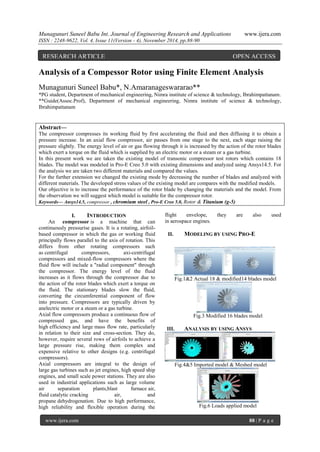
Fig.1&2 Actual 18 & modified14 blades model Fig.3 Modified 16 blades model 
III. ANALYSIS BY USING ANSYS Fig.4&5 Imported model & Meshed model Fig.6 Loads applied model 
RESEARCH ARTICLE OPEN ACCESS
Munagunuri Suneel Babu Int. Journal of Engineering Research and Applications www.ijera.com 
ISSN : 2248-9622, Vol. 4, Issue 11(Version - 4), November 2014, pp.88-90 
www.ijera.com 89 | P a g e 
IV. RESULTS & DISCUSSION 
Actual 18 blade model: 
 For chromium steel Fig.7&8Stress intensity & Deformed shape Fig.9 Vonmises stress 
 For Titanium (g-5) Fig.10&11 Stress intensity& Deformed shape Fig.12 Vonmises stress Modified 16 blade model: 
 For chromium steel Fig.13 & 14 Stress intensity & Deformed shape Fig.15 Vonmises stress 
 For Titanium (g-5) Fig.16 & 17 Stress intensity & Deformed shape Fig.18 Vonmises stress 
Modified 14 blade model: 
 For chromium steel Fig.19 & 20 Stress intensity & Deformed shape Fig.21 Vonmises stress 
 For Titanium (g-5) Fig.22& 23 Stress intensity & Deformed shape Fig.24 Vonmises stress 
V. RESULTS TABLE 
Stress intensity 
Model/material used 
18 blades 
16 blades 
14 blades 
Chromium steel 
5102 
4954 
4795 
Titanium (G-5) alloy 
4924 
4865 
4926 
Table.1 Stress intensity 
Deformed shape 
Model/material used 
18 blades 
16 blades 
14 blades 
Chromium steel 
.985e4 
.983e4 
.969e4 
Titanium (G-5) alloy 
.176e3 
.175e3 
.174e3 
Table.1 Deformed shape 
Vonmisses stress 
Model/material used 
18 blades 
16 blades 
14 blades 
Chromium steel 
5032 
4653 
4523 
Titanium (G-5) alloy 
4862 
4558 
4632 
Table.1 Vonmisses stress 
VI. CONCLUSION 
The model was created in Pro-E creo-5 and saved in the format of IGES later the saved files was imported into Ansys for the analysis. In the analysis part structural analysis is performed on the two models by changing the material properties. The obtained results were compared and by the observation we concluding that
Munagunuri Suneel Babu Int. Journal of Engineering Research and Applications www.ijera.com 
ISSN : 2248-9622, Vol. 4, Issue 11(Version - 4), November 2014, pp.88-90 
www.ijera.com 90 | P a g e 
Results comparison by material: 
1. For the original 18 blade model the stress values of chromium steel (actual material) are more than the titanium alloy (G-5) so titanium alloy material is best for the original 18 blade model. 
2. For the modified 16 blade model the stress values of chromium steel (actual material) are more than the titanium alloy (G-5) so titanium alloy material is best for the original 16 blade model. 
3. For the modified 14 blade model the stress values of chromium steel (actual material) are more than the titanium alloy (G-5) so titanium alloy material is best for the original 14 blade model. 
So we conclude that titanium alloy is best for rotor than chromium steel. Results comparison by the model: If we compare the model stress values the number of stress values are increased with number of blades increased so here our observation is that by reducing the blades the stress values are reduced for the efficiency of the rotor we have to use composite materials with this by the reduction of blades also efficiency increased. Future scope: 
1. By changing the blade dimensions the efficiency may increased. 
2. By using composite materials the efficiency may obtained. 
3. By varying the thickness of the rotor the efficiency may increased. 
REFERENCES: 
[1.] S. Veeramachanemi, K. Krishna, L. Avinash, S.R. Puppola,M.B. Srinivas, "Novel architectures for high-speed and low-power 3-2, 4-2 and 5-2compressors," IEEE Proc. Oj VLSlD '07, pp. 324-329,2007. 
[2.] C. H. Chang, J. Gu, M. Zhang, “Ultra low- voltage low power CMOS 4-2 and 5-2 compressors for fast arithmetic circuits” IEEE Transactions on Circuits and Systems I:Regular Papers, Volume 51, Issue 10, Oct. 2004 Page(s):1985 – 1997. 
[3.] S. F. Hsiao, M. R. Jiang, and J. S. Yeh, “Design of high speed low-power 3-2 counter and 4-2 compressor for fast multipliers,” Electron. Lett, vol. 34, no. 4,pp. 341– 343,1998. 
[4.] Numerical Simulation of an Axial Compressor with Non Axisymmetric Casing Treatment by N.Gourdain, M.Montagnac, J.F.Boussuge CERFACS, Computational Fluid Dynamics Team 31057 Toulouse, France [5.] Stall Inception in Axial Flow Compressors by I. J. Day [6.] Modeling of the double leakage and leakage spillage flows in axial flow compressors by Hui Du, Xianjun Yu, Baojie Liu 
[7.] Design Methodology of a Two Stage Axial Compressor by Gaddam Srikanth Ȧ, S.Srinivas Prasad Ȧ, V.Mahesh Kumar Ȧ and B.Mounica Reddy 
[8.] Numerical Investigation of Flow In An Axial Flow Compressor Cascade by T. Suthakar, Akash, National Institute of Technology, Tiruchirappalli 
[9.] Effect of Variations in Aspect Ratio on Single Stage Axial Flow Compressor Using Numerical Analysis by Kumbhar Anil H., Aashish Agarwal, PG Student, Asso. Professor, Technocrats Institute of Technology, Bhopal, M.P, India. [10.] Frank Sieverding, Beat Ribi, Michael Casey, Michael Meyer (2004) Design of Industrial Axial Compressor Blade Sections for Optimal Range and Performance J. [11.] S M Yahya (2003) Fundamentals of Compressible flow, 81-224-1468-0, Tata Mc- Graw Hill. [12.] Philip G. Hill, Carl R. Peterson (2010), Mechanics and Thermodynamics of Propulsion, 0201146592, Addison-Wesley [13.] Jack D. Mattingly (1996), Elements of Gas turbine Propulsion, 0-07-912196-9, Tata Mc- Graw Hill.

Analysis of a Compessor Rotor using Finite Element Analysis

  • 1.
    Munagunuri Suneel BabuInt. Journal of Engineering Research and Applications www.ijera.com ISSN : 2248-9622, Vol. 4, Issue 11(Version - 4), November 2014, pp.88-90 www.ijera.com 88 | P a g e Analysis of a Compessor Rotor using Finite Element Analysis Munagunuri Suneel Babu*, N.Amaranageswararao** *PG student, Department of mechanical engineering, Nimra institute of science & technology, Ibrahimpattanam. **Guide(Assoc.Prof), Department of mechanical engineering, Nimra institute of science & technology, Ibrahimpattanam Abstract— The compressor compresses its working fluid by first accelerating the fluid and then diffusing it to obtain a pressure increase. In an axial flow compressor, air passes from one stage to the next, each stage raising the pressure slightly. The energy level of air or gas flowing through it is increased by the action of the rotor blades which exert a torque on the fluid which is supplied by an electric motor or a steam or a gas turbine. In this present work we are taken the existing model of transonic compressor test rotors which contains 18 blades. The model was modeled in Pro-E Creo 5.0 with existing dimensions and analyzed using Ansys14.5. For the analysis we are taken two different materials and compared the values. For the further extension we changed the existing mode by decreasing the number of blades and analyzed with different materials. The developed stress values of the existing model are compares with the modified models. Our objective is to increase the performance of the rotor blade by changing the materials and the model. From the observation we will suggest which model is suitable for the compressor rotor. Keywords— Ansys14.5, compressor , chromium steel , Pro-E Creo 5.0, Rotor & Titanium (g-5) I. INTRODUCTION An compressor is a machine that can continuously pressurise gases. It is a rotating, airfoil- based compressor in which the gas or working fluid principally flows parallel to the axis of rotation. This differs from other rotating compressors such as centrifugal compressors, axi-centrifugal compressors and mixed-flow compressors where the fluid flow will include a "radial component" through the compressor. The energy level of the fluid increases as it flows through the compressor due to the action of the rotor blades which exert a torque on the fluid. The stationary blades slow the fluid, converting the circumferential component of flow into pressure. Compressors are typically driven by anelectric motor or a steam or a gas turbine. Axial flow compressors produce a continuous flow of compressed gas, and have the benefits of high efficiency and large mass flow rate, particularly in relation to their size and cross-section. They do, however, require several rows of airfoils to achieve a large pressure rise, making them complex and expensive relative to other designs (e.g. centrifugal compressors). Axial compressors are integral to the design of large gas turbines such as jet engines, high speed ship engines, and small scale power stations. They are also used in industrial applications such as large volume air separation plants,blast furnace air, fluid catalytic cracking air, and propane dehydrogenation. Due to high performance, high reliability and flexible operation during the flight envelope, they are also used in aerospace engines. II. MODELING BY USING PRO-E Fig.1&2 Actual 18 & modified14 blades model Fig.3 Modified 16 blades model III. ANALYSIS BY USING ANSYS Fig.4&5 Imported model & Meshed model Fig.6 Loads applied model RESEARCH ARTICLE OPEN ACCESS
  • 2.
    Munagunuri Suneel BabuInt. Journal of Engineering Research and Applications www.ijera.com ISSN : 2248-9622, Vol. 4, Issue 11(Version - 4), November 2014, pp.88-90 www.ijera.com 89 | P a g e IV. RESULTS & DISCUSSION Actual 18 blade model:  For chromium steel Fig.7&8Stress intensity & Deformed shape Fig.9 Vonmises stress  For Titanium (g-5) Fig.10&11 Stress intensity& Deformed shape Fig.12 Vonmises stress Modified 16 blade model:  For chromium steel Fig.13 & 14 Stress intensity & Deformed shape Fig.15 Vonmises stress  For Titanium (g-5) Fig.16 & 17 Stress intensity & Deformed shape Fig.18 Vonmises stress Modified 14 blade model:  For chromium steel Fig.19 & 20 Stress intensity & Deformed shape Fig.21 Vonmises stress  For Titanium (g-5) Fig.22& 23 Stress intensity & Deformed shape Fig.24 Vonmises stress V. RESULTS TABLE Stress intensity Model/material used 18 blades 16 blades 14 blades Chromium steel 5102 4954 4795 Titanium (G-5) alloy 4924 4865 4926 Table.1 Stress intensity Deformed shape Model/material used 18 blades 16 blades 14 blades Chromium steel .985e4 .983e4 .969e4 Titanium (G-5) alloy .176e3 .175e3 .174e3 Table.1 Deformed shape Vonmisses stress Model/material used 18 blades 16 blades 14 blades Chromium steel 5032 4653 4523 Titanium (G-5) alloy 4862 4558 4632 Table.1 Vonmisses stress VI. CONCLUSION The model was created in Pro-E creo-5 and saved in the format of IGES later the saved files was imported into Ansys for the analysis. In the analysis part structural analysis is performed on the two models by changing the material properties. The obtained results were compared and by the observation we concluding that
  • 3.
    Munagunuri Suneel BabuInt. Journal of Engineering Research and Applications www.ijera.com ISSN : 2248-9622, Vol. 4, Issue 11(Version - 4), November 2014, pp.88-90 www.ijera.com 90 | P a g e Results comparison by material: 1. For the original 18 blade model the stress values of chromium steel (actual material) are more than the titanium alloy (G-5) so titanium alloy material is best for the original 18 blade model. 2. For the modified 16 blade model the stress values of chromium steel (actual material) are more than the titanium alloy (G-5) so titanium alloy material is best for the original 16 blade model. 3. For the modified 14 blade model the stress values of chromium steel (actual material) are more than the titanium alloy (G-5) so titanium alloy material is best for the original 14 blade model. So we conclude that titanium alloy is best for rotor than chromium steel. Results comparison by the model: If we compare the model stress values the number of stress values are increased with number of blades increased so here our observation is that by reducing the blades the stress values are reduced for the efficiency of the rotor we have to use composite materials with this by the reduction of blades also efficiency increased. Future scope: 1. By changing the blade dimensions the efficiency may increased. 2. By using composite materials the efficiency may obtained. 3. By varying the thickness of the rotor the efficiency may increased. REFERENCES: [1.] S. Veeramachanemi, K. Krishna, L. Avinash, S.R. Puppola,M.B. Srinivas, "Novel architectures for high-speed and low-power 3-2, 4-2 and 5-2compressors," IEEE Proc. Oj VLSlD '07, pp. 324-329,2007. [2.] C. H. Chang, J. Gu, M. Zhang, “Ultra low- voltage low power CMOS 4-2 and 5-2 compressors for fast arithmetic circuits” IEEE Transactions on Circuits and Systems I:Regular Papers, Volume 51, Issue 10, Oct. 2004 Page(s):1985 – 1997. [3.] S. F. Hsiao, M. R. Jiang, and J. S. Yeh, “Design of high speed low-power 3-2 counter and 4-2 compressor for fast multipliers,” Electron. Lett, vol. 34, no. 4,pp. 341– 343,1998. [4.] Numerical Simulation of an Axial Compressor with Non Axisymmetric Casing Treatment by N.Gourdain, M.Montagnac, J.F.Boussuge CERFACS, Computational Fluid Dynamics Team 31057 Toulouse, France [5.] Stall Inception in Axial Flow Compressors by I. J. Day [6.] Modeling of the double leakage and leakage spillage flows in axial flow compressors by Hui Du, Xianjun Yu, Baojie Liu [7.] Design Methodology of a Two Stage Axial Compressor by Gaddam Srikanth Ȧ, S.Srinivas Prasad Ȧ, V.Mahesh Kumar Ȧ and B.Mounica Reddy [8.] Numerical Investigation of Flow In An Axial Flow Compressor Cascade by T. Suthakar, Akash, National Institute of Technology, Tiruchirappalli [9.] Effect of Variations in Aspect Ratio on Single Stage Axial Flow Compressor Using Numerical Analysis by Kumbhar Anil H., Aashish Agarwal, PG Student, Asso. Professor, Technocrats Institute of Technology, Bhopal, M.P, India. [10.] Frank Sieverding, Beat Ribi, Michael Casey, Michael Meyer (2004) Design of Industrial Axial Compressor Blade Sections for Optimal Range and Performance J. [11.] S M Yahya (2003) Fundamentals of Compressible flow, 81-224-1468-0, Tata Mc- Graw Hill. [12.] Philip G. Hill, Carl R. Peterson (2010), Mechanics and Thermodynamics of Propulsion, 0201146592, Addison-Wesley [13.] Jack D. Mattingly (1996), Elements of Gas turbine Propulsion, 0-07-912196-9, Tata Mc- Graw Hill.