Risk assessment for the entire CCS chain
and its application to CO2Quest:
the specific case of impurities
and real-scale experiments
R. Farret, Y. Flauw, J. Hebrard (INERIS)
N. MacDowell, N. Shah (ICL)
An integrated method for risk analysis of the CCS chain
Application in the CO2Quest project
Impacts of impurities: real-scale experiments
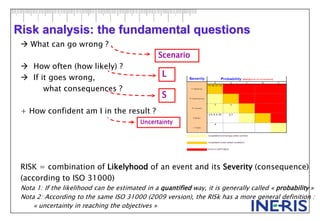
 What can go wrong ?
 How often (how likely) ?
 If it goes wrong,
what consequences ?
+ How confident am I in the result ?
RISK = combination of Likelyhood of an event and its Severity (consequence)
(according to ISO 31000)
Nota 1: If the likelihood can be estimated in a quantified way, it is generally called « probability »
Nota 2: According to the same ISO 31000 (2009 version), the RISk has a more general definition :
« uncertainty in reaching the objectives »
L
Uncertainty
Risk analysis: the fundamental questions
S
Scenario
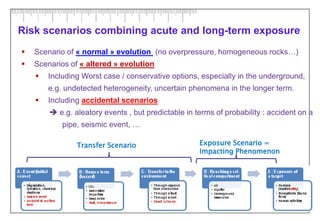
 Scenario of « normal » evolution (no overpressure, homogeneous rocks…)
 Scenarios of « altered » evolution
 Including Worst case / conservative options, especially in the underground,
e.g. undetected heterogeneity, uncertain phenomena in the longer term.
 Including accidental scenarios
 e.g. aleatory events , but predictable in terms of probability : accident on a
pipe, seismic event, …
Risk scenarios combining acute and long-term exposure
Transfer Scenario Exposure Scenario =
Impacting Phenomenon
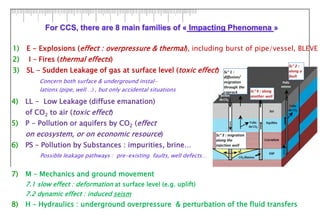
For CCS, there are 8 main families of « Impacting Phenomena »
Possible leakage pathways : pre-existing faults, well defects…
Concern both surface & underground instal-
lations (pipe, well…) , but only accidental situations
1) E - Explosions (effect : overpressure & thermal), including burst of pipe/vessel, BLEVE
2) I – Fires (thermal effects)
3) SL - Sudden Leakage of gas at surface level (toxic effect)
4) LL - Low Leakage (diffuse emanation)
of CO2 to air (toxic effect)
5) P - Pollution or aquifers by CO2 (effect
on ecosystem, or on economic resource)
6) PS – Pollution by Substances : impurities, brine…
7) M – Mechanics and ground movement
7.1 slow effect : deformation at surface level (e.g. uplift)
7.2 dynamic effect : induced seism
8) H – Hydraulics : underground overpressure & perturbation of the fluid transfers
 It is an organisational issues : how to seek for constant improvement
 Risk management involves such a PDCA constant improvement (see ISO 31000)
and interaction with authorities/stakeholders
 To be encouraged for pilots & projects on such a new technology, with public funding
Promote Knowledge sharing tools & Learning from experience
 Promote an database for Accidents and incidents, including leakages
 To know what already happened & what works or not (e.g. Safety devices)
(see the state of the art in industrial safety)
 Examples for underground storage : Evans 2008 (HSE), Farret 2013 (INERIS)
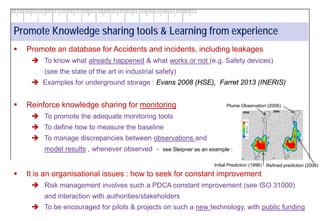
 Reinforce knowledge sharing for monitoring
 To promote the adequate monitoring tools
 To define how to measure the baseline
 To manage discrepancies between observations and
model results , whenever observed - see Sleipner as an example :
Initial Prediction (1996)
Plume Observation (2006)
Refined prediction (2006)
An integrated method for risk analysis of the CCS chain
Application in the CO2Quest project
Impacts of impurities: real-scale experiments
Objectives
Explore and define the incremental risks (additional safety
and environmental impacts) associated with the presence
of impurities in the CO2 stream on the CCS system
performance (transportation and storage) :
 identify CO2 mixtures that have the most pronounced
impact on pipe and the most important effect of
impurities on the performance of CO2 geological storage
 cover both safety and impact on the environment
Impact profiles of impurities
In order to address the 8 « impacting phenomena » presented
before, we identified 4 categories of mechanisms that are likely to
be influenced by impurities:
• physical impacts;
• chemical impacts;
• toxic impacts (cloud dispersion, pollution of drinking water);
• impacts on ecosystems (pollutants).
For each impurity identified in the CO2Quest project,
these 4 categories were reviewed throughout the CCS chain.
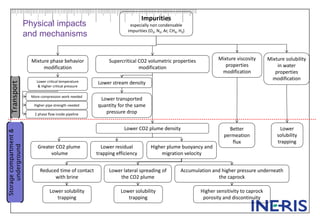
Impurities
especially non condensable
impurities (O2, N2, Ar, CH4, H2)
Mixture phase behavior
modification
Supercritical CO2 volumetric properties
modification
Mixture viscosity
properties
modification
Mixture solubility
in water
properties
modificationLower critical temperature
& Higher critical pressure
More compression work needed
Higher pipe strength needed
2 phase flow inside pipeline
Lower stream density
Lower transported
quantity for the same
pressure drop
Transport
Storagecompartment&
underground
Better
permeation
flux
Lower
solubility
trapping
Lower CO2 plume density
Greater CO2 plume
volume
Higher plume buoyancy and
migration velocity
Lower residual
trapping efficiency
Reduced time of contact
with brine
Accumulation and higher pressure underneath
the caprock
Lower lateral spreading of
the CO2 plume
Lower solubility
trapping
Higher sensitivity to caprock
porosity and discontinuity
Lower solubility
trapping
Physical impacts
and mechanisms
CO2 + Impurities
Acidification of the milieu
Minerals
dissolution
Ligands
production
Dissolution of metallic
elements : [Fe2+]aq
Successive effects:
• lower rock mechanical
resistance
• Higher rock porosity
• Pore plugging by
precipitation
Aqueous metallic
species (scavenging)
Dissolved complexes
(metal + ligand)
migrating with brine (water)
Organic element
dissolution by
supercritical CO2
Higher Dissolved
Organic Carbon (DOC)
Chemical impacts
and mechanisms
Alteration of
well cement
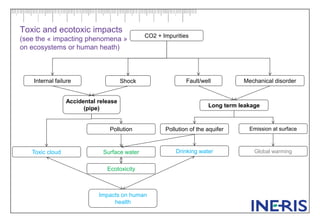
Toxic and ecotoxic impacts
(see the « impacting phenomena »
on ecosystems or human heath)
CO2 + Impurities
Internal failure Fault/wellShock Mechanical disorder
Long term leakage
Emission at surfacePollution of the aquifer
Global warmingDrinking water
Accidental release
(pipe)
Pollution
Toxic cloud Surface water
Impacts on human
health
Ecotoxicity
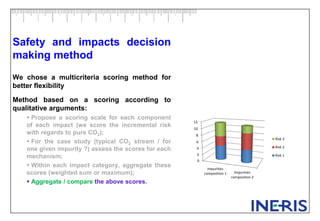
Safety and impacts decision
making method
We chose a multicriteria scoring method for
better flexibility
Method based on a scoring according to
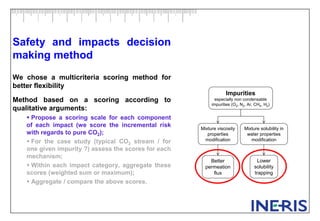
qualitative arguments:
 Propose a scoring scale for each component
of each impact (we score the incremental risk
with regards to pure CO2);
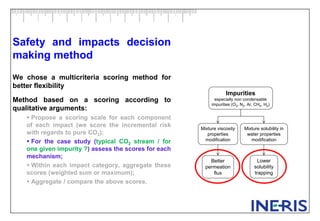
 For the case study (typical CO2 stream / for
one given impurity ?) assess the scores for each
mechanism;
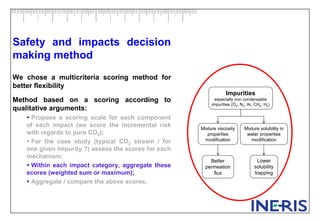
 Within each impact category, aggregate these
scores (weighted sum or maximum);
 Aggregate / compare the above scores.
Impurities
especially non condensable
impurities (O2, N2, Ar, CH4, H2)
Mixture viscosity
properties
modification
Mixture solubility in
water properties
modification
Better
permeation
flux
Lower
solubility
trapping
Safety and impacts decision
making method
We chose a multicriteria scoring method for
better flexibility
Method based on a scoring according to
qualitative arguments:
 Propose a scoring scale for each component
of each impact (we score the incremental risk
with regards to pure CO2);
 For the case study (typical CO2 stream / for
one given impurity ?) assess the scores for each
mechanism;
 Within each impact category, aggregate these
scores (weighted sum or maximum);
 Aggregate / compare the above scores.
Impurities
especially non condensable
impurities (O2, N2, Ar, CH4, H2)
Mixture viscosity
properties
modification
Mixture solubility in
water properties
modification
Better
permeation
flux
Lower
solubility
trapping
Safety and impacts decision
making method
We chose a multicriteria scoring method for
better flexibility
Method based on a scoring according to
qualitative arguments:
 Propose a scoring scale for each component
of each impact (we score the incremental risk
with regards to pure CO2);
 For the case study (typical CO2 stream / for
one given impurity ?) assess the scores for each
mechanism;
 Within each impact category, aggregate these
scores (weighted sum or maximum);
 Aggregate / compare the above scores.
Impurities
especially non condensable
impurities (O2, N2, Ar, CH4, H2)
Mixture viscosity
properties
modification
Mixture solubility in
water properties
modification
Better
permeation
flux
Lower
solubility
trapping
Safety and impacts decision
making method
We chose a multicriteria scoring method for
better flexibility
Method based on a scoring according to
qualitative arguments:
 Propose a scoring scale for each component
of each impact (we score the incremental risk
with regards to pure CO2);
 For the case study (typical CO2 stream / for
one given impurity ?) assess the scores for each
mechanism;
 Within each impact category, aggregate these
scores (weighted sum or maximum);
 Aggregate / compare the above scores.
0
2
4
6
8
10
12
Impurities
composition 1 Impurities
composition 2
Risk 3
Risk 2
Risk 1
An integrated method for risk analysis of the CCS chain
Application in the CO2Quest project
Impacts of impurities: real-scale experiments
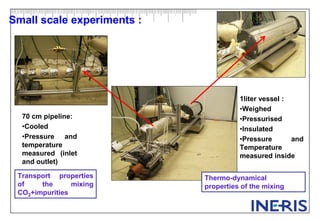
Small scale experiments :
1liter vessel :
•Weighed
•Pressurised
•Insulated
•Pressure and
Temperature
measured inside
Thermo-dynamical
properties of the mixing
70 cm pipeline:
•Cooled
•Pressure and
temperature
measured (inlet
and outlet)
Transport properties
of the mixing
CO2+impurities
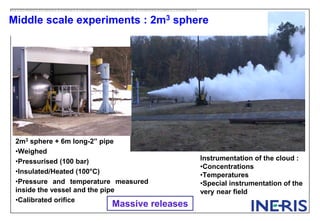
Middle scale experiments : 2m3 sphere
2m3 sphere + 6m long-2” pipe
•Weighed
•Pressurised (100 bar)
•Insulated/Heated (100°C)
•Pressure and temperature measured
inside the vessel and the pipe
•Calibrated orifice
Instrumentation of the cloud :
•Concentrations
•Temperatures
•Special instrumentation of the
very near field
Massive releases
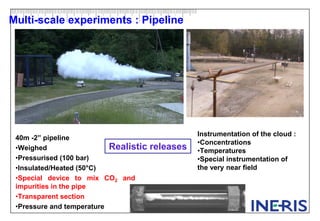
Multi-scale experiments : Pipeline
40m -2” pipeline
•Weighed
•Pressurised (100 bar)
•Insulated/Heated (50°C)
•Special device to mix CO2 and
impurities in the pipe
•Transparent section
•Pressure and temperature
Instrumentation of the cloud :
•Concentrations
•Temperatures
•Special instrumentation of
the very near field
Realistic releases

Risk assessment for the entire CCS chain and its application to CO2Quest: the specific case of impurities and real-scale experiments - Niall Mac Dowell at EC FP7 Projects: Leading the way in CCS implementation, London, 14-15 April 2014

  • 1.
    Risk assessment forthe entire CCS chain and its application to CO2Quest: the specific case of impurities and real-scale experiments R. Farret, Y. Flauw, J. Hebrard (INERIS) N. MacDowell, N. Shah (ICL)
  • 2.
    An integrated methodfor risk analysis of the CCS chain Application in the CO2Quest project Impacts of impurities: real-scale experiments
  • 3.
     What cango wrong ?  How often (how likely) ?  If it goes wrong, what consequences ? + How confident am I in the result ? RISK = combination of Likelyhood of an event and its Severity (consequence) (according to ISO 31000) Nota 1: If the likelihood can be estimated in a quantified way, it is generally called « probability » Nota 2: According to the same ISO 31000 (2009 version), the RISk has a more general definition : « uncertainty in reaching the objectives » L Uncertainty Risk analysis: the fundamental questions S Scenario
  • 4.
     Scenario of« normal » evolution (no overpressure, homogeneous rocks…)  Scenarios of « altered » evolution  Including Worst case / conservative options, especially in the underground, e.g. undetected heterogeneity, uncertain phenomena in the longer term.  Including accidental scenarios  e.g. aleatory events , but predictable in terms of probability : accident on a pipe, seismic event, … Risk scenarios combining acute and long-term exposure Transfer Scenario Exposure Scenario = Impacting Phenomenon
  • 5.
    For CCS, thereare 8 main families of « Impacting Phenomena » Possible leakage pathways : pre-existing faults, well defects… Concern both surface & underground instal- lations (pipe, well…) , but only accidental situations 1) E - Explosions (effect : overpressure & thermal), including burst of pipe/vessel, BLEVE 2) I – Fires (thermal effects) 3) SL - Sudden Leakage of gas at surface level (toxic effect) 4) LL - Low Leakage (diffuse emanation) of CO2 to air (toxic effect) 5) P - Pollution or aquifers by CO2 (effect on ecosystem, or on economic resource) 6) PS – Pollution by Substances : impurities, brine… 7) M – Mechanics and ground movement 7.1 slow effect : deformation at surface level (e.g. uplift) 7.2 dynamic effect : induced seism 8) H – Hydraulics : underground overpressure & perturbation of the fluid transfers
  • 6.
     It isan organisational issues : how to seek for constant improvement  Risk management involves such a PDCA constant improvement (see ISO 31000) and interaction with authorities/stakeholders  To be encouraged for pilots & projects on such a new technology, with public funding Promote Knowledge sharing tools & Learning from experience  Promote an database for Accidents and incidents, including leakages  To know what already happened & what works or not (e.g. Safety devices) (see the state of the art in industrial safety)  Examples for underground storage : Evans 2008 (HSE), Farret 2013 (INERIS)  Reinforce knowledge sharing for monitoring  To promote the adequate monitoring tools  To define how to measure the baseline  To manage discrepancies between observations and model results , whenever observed - see Sleipner as an example : Initial Prediction (1996) Plume Observation (2006) Refined prediction (2006)
  • 7.
    An integrated methodfor risk analysis of the CCS chain Application in the CO2Quest project Impacts of impurities: real-scale experiments
  • 8.
    Objectives Explore and definethe incremental risks (additional safety and environmental impacts) associated with the presence of impurities in the CO2 stream on the CCS system performance (transportation and storage) :  identify CO2 mixtures that have the most pronounced impact on pipe and the most important effect of impurities on the performance of CO2 geological storage  cover both safety and impact on the environment
  • 9.
    Impact profiles ofimpurities In order to address the 8 « impacting phenomena » presented before, we identified 4 categories of mechanisms that are likely to be influenced by impurities: • physical impacts; • chemical impacts; • toxic impacts (cloud dispersion, pollution of drinking water); • impacts on ecosystems (pollutants). For each impurity identified in the CO2Quest project, these 4 categories were reviewed throughout the CCS chain.
  • 10.
    Impurities especially non condensable impurities(O2, N2, Ar, CH4, H2) Mixture phase behavior modification Supercritical CO2 volumetric properties modification Mixture viscosity properties modification Mixture solubility in water properties modificationLower critical temperature & Higher critical pressure More compression work needed Higher pipe strength needed 2 phase flow inside pipeline Lower stream density Lower transported quantity for the same pressure drop Transport Storagecompartment& underground Better permeation flux Lower solubility trapping Lower CO2 plume density Greater CO2 plume volume Higher plume buoyancy and migration velocity Lower residual trapping efficiency Reduced time of contact with brine Accumulation and higher pressure underneath the caprock Lower lateral spreading of the CO2 plume Lower solubility trapping Higher sensitivity to caprock porosity and discontinuity Lower solubility trapping Physical impacts and mechanisms
  • 11.
    CO2 + Impurities Acidificationof the milieu Minerals dissolution Ligands production Dissolution of metallic elements : [Fe2+]aq Successive effects: • lower rock mechanical resistance • Higher rock porosity • Pore plugging by precipitation Aqueous metallic species (scavenging) Dissolved complexes (metal + ligand) migrating with brine (water) Organic element dissolution by supercritical CO2 Higher Dissolved Organic Carbon (DOC) Chemical impacts and mechanisms Alteration of well cement
  • 12.
    Toxic and ecotoxicimpacts (see the « impacting phenomena » on ecosystems or human heath) CO2 + Impurities Internal failure Fault/wellShock Mechanical disorder Long term leakage Emission at surfacePollution of the aquifer Global warmingDrinking water Accidental release (pipe) Pollution Toxic cloud Surface water Impacts on human health Ecotoxicity
  • 13.
    Safety and impactsdecision making method We chose a multicriteria scoring method for better flexibility Method based on a scoring according to qualitative arguments:  Propose a scoring scale for each component of each impact (we score the incremental risk with regards to pure CO2);  For the case study (typical CO2 stream / for one given impurity ?) assess the scores for each mechanism;  Within each impact category, aggregate these scores (weighted sum or maximum);  Aggregate / compare the above scores. Impurities especially non condensable impurities (O2, N2, Ar, CH4, H2) Mixture viscosity properties modification Mixture solubility in water properties modification Better permeation flux Lower solubility trapping
  • 14.
    Safety and impactsdecision making method We chose a multicriteria scoring method for better flexibility Method based on a scoring according to qualitative arguments:  Propose a scoring scale for each component of each impact (we score the incremental risk with regards to pure CO2);  For the case study (typical CO2 stream / for one given impurity ?) assess the scores for each mechanism;  Within each impact category, aggregate these scores (weighted sum or maximum);  Aggregate / compare the above scores. Impurities especially non condensable impurities (O2, N2, Ar, CH4, H2) Mixture viscosity properties modification Mixture solubility in water properties modification Better permeation flux Lower solubility trapping
  • 15.
    Safety and impactsdecision making method We chose a multicriteria scoring method for better flexibility Method based on a scoring according to qualitative arguments:  Propose a scoring scale for each component of each impact (we score the incremental risk with regards to pure CO2);  For the case study (typical CO2 stream / for one given impurity ?) assess the scores for each mechanism;  Within each impact category, aggregate these scores (weighted sum or maximum);  Aggregate / compare the above scores. Impurities especially non condensable impurities (O2, N2, Ar, CH4, H2) Mixture viscosity properties modification Mixture solubility in water properties modification Better permeation flux Lower solubility trapping
  • 16.
    Safety and impactsdecision making method We chose a multicriteria scoring method for better flexibility Method based on a scoring according to qualitative arguments:  Propose a scoring scale for each component of each impact (we score the incremental risk with regards to pure CO2);  For the case study (typical CO2 stream / for one given impurity ?) assess the scores for each mechanism;  Within each impact category, aggregate these scores (weighted sum or maximum);  Aggregate / compare the above scores. 0 2 4 6 8 10 12 Impurities composition 1 Impurities composition 2 Risk 3 Risk 2 Risk 1
  • 17.
    An integrated methodfor risk analysis of the CCS chain Application in the CO2Quest project Impacts of impurities: real-scale experiments
  • 18.
    Small scale experiments: 1liter vessel : •Weighed •Pressurised •Insulated •Pressure and Temperature measured inside Thermo-dynamical properties of the mixing 70 cm pipeline: •Cooled •Pressure and temperature measured (inlet and outlet) Transport properties of the mixing CO2+impurities
  • 19.
    Middle scale experiments: 2m3 sphere 2m3 sphere + 6m long-2” pipe •Weighed •Pressurised (100 bar) •Insulated/Heated (100°C) •Pressure and temperature measured inside the vessel and the pipe •Calibrated orifice Instrumentation of the cloud : •Concentrations •Temperatures •Special instrumentation of the very near field Massive releases
  • 20.
    Multi-scale experiments :Pipeline 40m -2” pipeline •Weighed •Pressurised (100 bar) •Insulated/Heated (50°C) •Special device to mix CO2 and impurities in the pipe •Transparent section •Pressure and temperature Instrumentation of the cloud : •Concentrations •Temperatures •Special instrumentation of the very near field Realistic releases