THE CREATION CYCLE
AND COSMIC MYTHS
WORLD MYTHOLOGY
HUM/105
Prof. Francisco Pesante
THE CREATION CYCLE AND COSMIC MYTHS
Objectives:
1. Explain the role of the creator in various world
myths.
2. Discuss the cultural importance of cosmic
myths.
3. Identify the shared characteristics of common
cosmic myths.
4
THE CREATION CYCLE AND COSMIC MYTHS
I. THE BIRTH OF ORDER
Cosmogony: (deriving from the Greek: the birth
of order) Principles of the physical universe and
the basic sociopolitical, cultural, and spiritual
facts of existence that affect human beings.
Mythic narrative about the origin of the
universe.
5
THE CREATION CYCLE AND COSMIC MYTHS
I. THE BIRTH OF ORDER
What role does the creation myth plays in other
cultures?
• Before the Western’s God creation of time and
space, most of the world’s creation myths
begin with an eternal being sleeping within or
hovering in contemplation above the infinite
abyss of a primeval sea.
6
THE CREATION CYCLE AND COSMIC MYTHS
I. THE BIRTH OF ORDER
What role does the creation myth plays in our
Western culture?
• Mainly Christian
• The Genesis account of creation.
7
THE CREATION CYCLE AND COSMIC MYTHS
II. CLASSIFYING COSMOGNIC MYTHS
(Eliade, 1974)
1. Ex nihilo creation: a divinity creates the cosmos
by thought, word, dream, or from bodily effluents;
8
THE CREATION CYCLE AND COSMIC MYTHS
II. CLASSIFYING COSMOGNIC MYTHS
2. Earth-diver creation: in which a divinity sends
waterfowl or amphibious animals or itself dives to
the bottom of a primordial ocean to bring up mud
or sand from which the world grows.
9
THE CREATION CYCLE AND COSMIC MYTHS
II. CLASSIFYING COSMOGNIC MYTHS
3. Creation by dividing: a primordial unity like
earth and sky, form from Chaos, or the cracking
open of a “Cosmic Egg”.
10
THE CREATION CYCLE AND COSMIC MYTHS
II. CLASSIFYING COSMOGNIC MYTHS
4. Creation by dismemberment of a primordial
Being, like the sea monsters (Ex. Corn mothers of
the Americas).
11
THE CREATION CYCLE AND COSMIC MYTHS
II. CLASSIFYING COSMOGNIC MYTHS
5. Emergence myths: a people travels through a
series of chambers or worlds until it emerges into
this one.
12
THE CREATION CYCLE AND COSMIC MYTHS
Some advice before entering the world of the
myths …
• Beware of ethnocentric and anthropocentric
bias.
13
THE CREATION CYCLE AND COSMIC MYTHS
Some advice before entering the world of the
myths …
• If, however, we are self-conscious about our
culture’s assumptions about what is “normal,”
we see that at least as many cosmogonic
myths have presented creation as part of a
natural—even accidental—process as have
conceived it as an exercise of divine and
creative will (Weigle, 1989).
14
THE CREATION CYCLE AND COSMIC MYTHS
CREATION MYTH TYPOLOGIES (Weigle, 1989)
1. Accretion or conjunction;
2. Secretion;
3. Sacrifice;
4. Division or conjugation;
5. Earth-diver;
6. Emergence;
7. Two creators;
8. Deus faber;
9. Ex nihilo; and
10.Modern perceptions.
15
THE CREATION CYCLE AND COSMIC MYTHS
CREATION MYTH TYPOLOGIES
1. Accretion or conjunction stories;
• The birth of order as resulting from the
mingling or layering of the primal elements
(e.g., earth, wind, fire, and water).
16
THE CREATION CYCLE AND COSMIC MYTHS
CREATION MYTH TYPOLOGIES
1. Accretion or conjunction stories;
• Close to the pre-Socratic philosophers stance?
• Pané, R. (1498). Relación de Fray Ramón
acerca de las antigüedades de los indios
(Fragmentos)
17
THE CREATION CYCLE AND COSMIC MYTHS
CREATION MYTH TYPOLOGY
2. Secretion stories;
• They depict the cosmos as resulting from such
divine emissions as “vomit, sweat, urination,
defecation, masturbation, web-spinning, [and]
parthenogenesis”
18
THE CREATION CYCLE AND COSMIC MYTHS
CREATION MYTH TYPOLOGY
2. Secretion stories;
• It is interesting to note that secretion myths
usually account for the creation of human or
divine beings rather than for the propagation
of the material cosmos.
• Example: Cronus.
19
THE CREATION CYCLE AND COSMIC MYTHS
CREATION MYTH TYPOLOGY
3. Sacrifice stories;
• In some cosmogonies, the creator god
sacrifices himself or herself or someone else
to complete the work of creation.
• Example: Mitrahism
20
THE CREATION CYCLE AND COSMIC MYTHS
CREATION MYTH TYPOLOGY
4. Division or consummation stories;
• Usually associated with discriminating primal
matter or a cosmogonic egg or with the
consummated marriage of earth and sky.
• Hesiod (8th Century B.C.). The Theogony (excerpt)
21
THE CREATION CYCLE AND COSMIC MYTHS
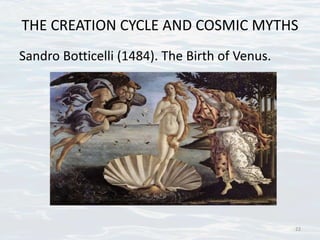
Sandro Botticelli (1484). The Birth of Venus.
22
THE CREATION CYCLE AND COSMIC MYTHS
CREATION MYTH TYPOLOGY
5. Earth-diver stories;
• Most cosmogonies begin with a vast primeval
sea from which creative agents emerge to
organize this watery chaos.
23
THE CREATION CYCLE AND COSMIC MYTHS
CREATION MYTH TYPOLOGY
5. Earth-diver stories;
• In this type of myth, a god or his agent dives
to the bottom of this primordial deep and
returns with a few grains of sand or a bit of
mud from which the earth and the rest of the
cosmos eventually arise.
24
THE CREATION CYCLE AND COSMIC MYTHS
CREATION MYTH TYPOLOGY
5. Earth-diver stories;
• Some academics state that earth-diver myth
signify a return to primal Nature.
25
THE CREATION CYCLE AND COSMIC MYTHS
CREATION MYTH TYPOLOGY
5. Earth-diver stories;
• The fact that the earth-diver manages to bring
back only a few grains of sand or a tiny dab of
mud from the bottom of the primeval deep
suggests an analogy to human birth and
growth.
26
THE CREATION CYCLE AND COSMIC MYTHS
CREATION MYTH TYPOLOGY
5. Earth-diver stories;
• Nothing natural in our experience begins fully
formed; things begin small and grow to full
stature over time, and this fact seems decisive
in earth-diver myths.
27
THE CREATION CYCLE AND COSMIC MYTHS
CREATION MYTH TYPOLOGY
6. Emergence stories;
• Typically depict the first people or first person as
journeying from an original, cramped world or
womb into this world.
• Emergence myths emphasize evolutionary
progress from the cramped darkness of early
society to the airy brightness of civilization.
28
THE CREATION CYCLE AND COSMIC MYTHS
CREATION MYTH TYPOLOGY
6. Emergence;
• The people learn important truths before they finally
arrive in our world—and even then, the world they
find is not quite complete without their efforts. Tests
must be successfully met, religious ritual must be
learned and performed, and the people must create
that which the world does not already provide.
• Ex. Plato: Allegory of the Cave
29
THE CREATION CYCLE AND COSMIC MYTHS
CREATION MYTH TYPOLOGY
7. Two creators stories;
• This myths two gods create the world through
cooperation or competition,
• Frequently cosmogonies employing the dual-
creator motif depict one god as more active or
more human than the other.
30
THE CREATION CYCLE AND COSMIC MYTHS
CREATION MYTH TYPOLOGY
8. Deus faber stories;
• It presents the creator as the Maker God—the
quintessential architect, artisan, or
craftsperson
• Celebrate the astonishing intricacy and
cleverness of creation.
31
THE CREATION CYCLE AND COSMIC MYTHS
CREATION MYTH TYPOLOGY
An example of integration of more than one of
the creation myth typologies:
Two Creators
+ Deus faber
The Matrix, Reloaded
Which other typology could we include?
32
THE CREATION CYCLE AND COSMIC MYTHS
CREATION MYTH TYPOLOGY
9. Ex nihilo stories;
• The “out of nothing” myth par excellence is
the account in Genesis of God speaking into
existence light and darkness, sun and moon,
stars and earth, plants and animals.
33
THE CREATION CYCLE AND COSMIC MYTHS
CREATION MYTH TYPOLOGY
9. Ex nihilo;
• Describe cosmogonies in which the creator
brings the world into being through speech,
breath, dream, thought, or laughter.
34
THE CREATION CYCLE AND COSMIC MYTHS
CREATION MYTH TYPOLOGY
9. Ex nihilo;
• An example?
• When the God of Genesis uses breath to
speak the universe into existence or to make
Adam “a living soul,” he creates “out of
nothing.”
35
THE CREATION CYCLE AND COSMIC MYTHS
CREATION MYTH TYPOLOGY
10. Modern perceptions
• Similarities between the Judeo-Christian
creation story and the many other stories
from other cultures, bring us back to the
caution with which we began this section:
36
THE CREATION CYCLE AND COSMIC MYTHS
CREATION MYTH TYPOLOGY
10. Modern perceptions
• We should not let our culturally derived sense
of what is normal and right distort our view of
other cultures and their ways of describing
what it was like “in the beginning.”
37
THE CREATION CYCLE AND COSMIC MYTHS
CREATION MYTH TYPOLOGY
10. Contemporary myths
• Either taken completely literally or not,
creation myths—whatever their specific
features— answer some of humanity’s most
fundamental questions.
38
THE CREATION CYCLE AND COSMIC MYTHS
CREATION MYTH TYPOLOGY
10. Contemporary myths
• Where did the physical universe come from?
• What is God like?
• What explains such natural phenomena as
earthquakes and comets?
• Why does the only world we’ve ever known
feel imperfect to us?
• What’s the meaning of our existence?
39
THE CREATION CYCLE AND COSMIC MYTHS
CREATION MYTH TYPOLOGY
10. Contemporary myths
• How and why did sickness, death, and other evils
enter the world?
• When and why did human beings become
alienated from the Divine and/or from nature?
• What explains the existence of the different
nations?
• When and where did the world’s various cultures
come by their characteristic practices, beliefs, and
life-giving substances?
40
References:
• Eliade, M. (1974). Gods, Goddesses, and
Myths of Creation: A Thematic Source Book of
the History of Religions. Part I of From
Primitives to Zen. New York: Harper & Row.
• Leonard, S., & McClure, M. (2004). Myth &
knowing: An introduction to world mythology.
New York, NY: McGraw-Hill.
• Weigle, M. (1989). Creation and Procreation:
Feminist Reflections on Mythologies of
Cosmogony and Parturition. Philadelphia:
University of Pennsylvania Press.
41

HUM-105 Creation Cycle & Cosmic Myths

  • 1.
    THE CREATION CYCLE ANDCOSMIC MYTHS WORLD MYTHOLOGY HUM/105 Prof. Francisco Pesante
  • 2.
    THE CREATION CYCLEAND COSMIC MYTHS Objectives: 1. Explain the role of the creator in various world myths. 2. Discuss the cultural importance of cosmic myths. 3. Identify the shared characteristics of common cosmic myths. 4
  • 3.
    THE CREATION CYCLEAND COSMIC MYTHS I. THE BIRTH OF ORDER Cosmogony: (deriving from the Greek: the birth of order) Principles of the physical universe and the basic sociopolitical, cultural, and spiritual facts of existence that affect human beings. Mythic narrative about the origin of the universe. 5
  • 4.
    THE CREATION CYCLEAND COSMIC MYTHS I. THE BIRTH OF ORDER What role does the creation myth plays in other cultures? • Before the Western’s God creation of time and space, most of the world’s creation myths begin with an eternal being sleeping within or hovering in contemplation above the infinite abyss of a primeval sea. 6
  • 5.
    THE CREATION CYCLEAND COSMIC MYTHS I. THE BIRTH OF ORDER What role does the creation myth plays in our Western culture? • Mainly Christian • The Genesis account of creation. 7
  • 6.
    THE CREATION CYCLEAND COSMIC MYTHS II. CLASSIFYING COSMOGNIC MYTHS (Eliade, 1974) 1. Ex nihilo creation: a divinity creates the cosmos by thought, word, dream, or from bodily effluents; 8
  • 7.
    THE CREATION CYCLEAND COSMIC MYTHS II. CLASSIFYING COSMOGNIC MYTHS 2. Earth-diver creation: in which a divinity sends waterfowl or amphibious animals or itself dives to the bottom of a primordial ocean to bring up mud or sand from which the world grows. 9
  • 8.
    THE CREATION CYCLEAND COSMIC MYTHS II. CLASSIFYING COSMOGNIC MYTHS 3. Creation by dividing: a primordial unity like earth and sky, form from Chaos, or the cracking open of a “Cosmic Egg”. 10
  • 9.
    THE CREATION CYCLEAND COSMIC MYTHS II. CLASSIFYING COSMOGNIC MYTHS 4. Creation by dismemberment of a primordial Being, like the sea monsters (Ex. Corn mothers of the Americas). 11
  • 10.
    THE CREATION CYCLEAND COSMIC MYTHS II. CLASSIFYING COSMOGNIC MYTHS 5. Emergence myths: a people travels through a series of chambers or worlds until it emerges into this one. 12
  • 11.
    THE CREATION CYCLEAND COSMIC MYTHS Some advice before entering the world of the myths … • Beware of ethnocentric and anthropocentric bias. 13
  • 12.
    THE CREATION CYCLEAND COSMIC MYTHS Some advice before entering the world of the myths … • If, however, we are self-conscious about our culture’s assumptions about what is “normal,” we see that at least as many cosmogonic myths have presented creation as part of a natural—even accidental—process as have conceived it as an exercise of divine and creative will (Weigle, 1989). 14
  • 13.
    THE CREATION CYCLEAND COSMIC MYTHS CREATION MYTH TYPOLOGIES (Weigle, 1989) 1. Accretion or conjunction; 2. Secretion; 3. Sacrifice; 4. Division or conjugation; 5. Earth-diver; 6. Emergence; 7. Two creators; 8. Deus faber; 9. Ex nihilo; and 10.Modern perceptions. 15
  • 14.
    THE CREATION CYCLEAND COSMIC MYTHS CREATION MYTH TYPOLOGIES 1. Accretion or conjunction stories; • The birth of order as resulting from the mingling or layering of the primal elements (e.g., earth, wind, fire, and water). 16
  • 15.
    THE CREATION CYCLEAND COSMIC MYTHS CREATION MYTH TYPOLOGIES 1. Accretion or conjunction stories; • Close to the pre-Socratic philosophers stance? • Pané, R. (1498). Relación de Fray Ramón acerca de las antigüedades de los indios (Fragmentos) 17
  • 16.
    THE CREATION CYCLEAND COSMIC MYTHS CREATION MYTH TYPOLOGY 2. Secretion stories; • They depict the cosmos as resulting from such divine emissions as “vomit, sweat, urination, defecation, masturbation, web-spinning, [and] parthenogenesis” 18
  • 17.
    THE CREATION CYCLEAND COSMIC MYTHS CREATION MYTH TYPOLOGY 2. Secretion stories; • It is interesting to note that secretion myths usually account for the creation of human or divine beings rather than for the propagation of the material cosmos. • Example: Cronus. 19
  • 18.
    THE CREATION CYCLEAND COSMIC MYTHS CREATION MYTH TYPOLOGY 3. Sacrifice stories; • In some cosmogonies, the creator god sacrifices himself or herself or someone else to complete the work of creation. • Example: Mitrahism 20
  • 19.
    THE CREATION CYCLEAND COSMIC MYTHS CREATION MYTH TYPOLOGY 4. Division or consummation stories; • Usually associated with discriminating primal matter or a cosmogonic egg or with the consummated marriage of earth and sky. • Hesiod (8th Century B.C.). The Theogony (excerpt) 21
  • 20.
    THE CREATION CYCLEAND COSMIC MYTHS Sandro Botticelli (1484). The Birth of Venus. 22
  • 21.
    THE CREATION CYCLEAND COSMIC MYTHS CREATION MYTH TYPOLOGY 5. Earth-diver stories; • Most cosmogonies begin with a vast primeval sea from which creative agents emerge to organize this watery chaos. 23
  • 22.
    THE CREATION CYCLEAND COSMIC MYTHS CREATION MYTH TYPOLOGY 5. Earth-diver stories; • In this type of myth, a god or his agent dives to the bottom of this primordial deep and returns with a few grains of sand or a bit of mud from which the earth and the rest of the cosmos eventually arise. 24
  • 23.
    THE CREATION CYCLEAND COSMIC MYTHS CREATION MYTH TYPOLOGY 5. Earth-diver stories; • Some academics state that earth-diver myth signify a return to primal Nature. 25
  • 24.
    THE CREATION CYCLEAND COSMIC MYTHS CREATION MYTH TYPOLOGY 5. Earth-diver stories; • The fact that the earth-diver manages to bring back only a few grains of sand or a tiny dab of mud from the bottom of the primeval deep suggests an analogy to human birth and growth. 26
  • 25.
    THE CREATION CYCLEAND COSMIC MYTHS CREATION MYTH TYPOLOGY 5. Earth-diver stories; • Nothing natural in our experience begins fully formed; things begin small and grow to full stature over time, and this fact seems decisive in earth-diver myths. 27
  • 26.
    THE CREATION CYCLEAND COSMIC MYTHS CREATION MYTH TYPOLOGY 6. Emergence stories; • Typically depict the first people or first person as journeying from an original, cramped world or womb into this world. • Emergence myths emphasize evolutionary progress from the cramped darkness of early society to the airy brightness of civilization. 28
  • 27.
    THE CREATION CYCLEAND COSMIC MYTHS CREATION MYTH TYPOLOGY 6. Emergence; • The people learn important truths before they finally arrive in our world—and even then, the world they find is not quite complete without their efforts. Tests must be successfully met, religious ritual must be learned and performed, and the people must create that which the world does not already provide. • Ex. Plato: Allegory of the Cave 29
  • 28.
    THE CREATION CYCLEAND COSMIC MYTHS CREATION MYTH TYPOLOGY 7. Two creators stories; • This myths two gods create the world through cooperation or competition, • Frequently cosmogonies employing the dual- creator motif depict one god as more active or more human than the other. 30
  • 29.
    THE CREATION CYCLEAND COSMIC MYTHS CREATION MYTH TYPOLOGY 8. Deus faber stories; • It presents the creator as the Maker God—the quintessential architect, artisan, or craftsperson • Celebrate the astonishing intricacy and cleverness of creation. 31
  • 30.
    THE CREATION CYCLEAND COSMIC MYTHS CREATION MYTH TYPOLOGY An example of integration of more than one of the creation myth typologies: Two Creators + Deus faber The Matrix, Reloaded Which other typology could we include? 32
  • 31.
    THE CREATION CYCLEAND COSMIC MYTHS CREATION MYTH TYPOLOGY 9. Ex nihilo stories; • The “out of nothing” myth par excellence is the account in Genesis of God speaking into existence light and darkness, sun and moon, stars and earth, plants and animals. 33
  • 32.
    THE CREATION CYCLEAND COSMIC MYTHS CREATION MYTH TYPOLOGY 9. Ex nihilo; • Describe cosmogonies in which the creator brings the world into being through speech, breath, dream, thought, or laughter. 34
  • 33.
    THE CREATION CYCLEAND COSMIC MYTHS CREATION MYTH TYPOLOGY 9. Ex nihilo; • An example? • When the God of Genesis uses breath to speak the universe into existence or to make Adam “a living soul,” he creates “out of nothing.” 35
  • 34.
    THE CREATION CYCLEAND COSMIC MYTHS CREATION MYTH TYPOLOGY 10. Modern perceptions • Similarities between the Judeo-Christian creation story and the many other stories from other cultures, bring us back to the caution with which we began this section: 36
  • 35.
    THE CREATION CYCLEAND COSMIC MYTHS CREATION MYTH TYPOLOGY 10. Modern perceptions • We should not let our culturally derived sense of what is normal and right distort our view of other cultures and their ways of describing what it was like “in the beginning.” 37
  • 36.
    THE CREATION CYCLEAND COSMIC MYTHS CREATION MYTH TYPOLOGY 10. Contemporary myths • Either taken completely literally or not, creation myths—whatever their specific features— answer some of humanity’s most fundamental questions. 38
  • 37.
    THE CREATION CYCLEAND COSMIC MYTHS CREATION MYTH TYPOLOGY 10. Contemporary myths • Where did the physical universe come from? • What is God like? • What explains such natural phenomena as earthquakes and comets? • Why does the only world we’ve ever known feel imperfect to us? • What’s the meaning of our existence? 39
  • 38.
    THE CREATION CYCLEAND COSMIC MYTHS CREATION MYTH TYPOLOGY 10. Contemporary myths • How and why did sickness, death, and other evils enter the world? • When and why did human beings become alienated from the Divine and/or from nature? • What explains the existence of the different nations? • When and where did the world’s various cultures come by their characteristic practices, beliefs, and life-giving substances? 40
  • 39.
    References: • Eliade, M.(1974). Gods, Goddesses, and Myths of Creation: A Thematic Source Book of the History of Religions. Part I of From Primitives to Zen. New York: Harper & Row. • Leonard, S., & McClure, M. (2004). Myth & knowing: An introduction to world mythology. New York, NY: McGraw-Hill. • Weigle, M. (1989). Creation and Procreation: Feminist Reflections on Mythologies of Cosmogony and Parturition. Philadelphia: University of Pennsylvania Press. 41