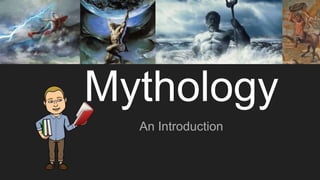
Mythology
An Introduction
Standard(s):
6.2.5 Describe the characteristics of Roman civilization; its cultural, political, and
technological achievements; and its influence on other later cultures.
Agenda:
❏ Guiding questions and “FIRST” thoughts
❏ Recap “heroes”
❏ Read and analyze “The Seasons” (with partner)
❏ Answer comprehension questions when finished
❏ Discuss & Apply to Guiding Questions
❏ Read and analyze “Arachne’s Web” (individually)
What meanings did
myths about gods,
goddesses, and
heroes have for the
ancient Greeks?
What meanings
do the Greek
myths have for
us today?
Guiding Questions
Why are myths important? How are they different
from “regular” fiction?
Your answer here...
RECAP - Heroes
Heroes were an important part of Greek mythology, but the characteristics Greeks admired in a hero are not
necessarily identical to those we admire today. Greek heroes are not always what modern readers might think
of as "good role models." Their actions may strike us as morally dubious. For example, in his encounter with
the Cyclops, Odysseus helps himself to the giant's food without permission, attacks while the Cyclops is in a
wine-induced stupor, and brags about blinding the one-eyed creature. This does not mean the Greeks
admired thievery and bragging, however. What they admired about Odysseus, in this instance, was his
capacity for quick thinking. Odysseus defied that which others would not (as is also shown by his desire to
hear the Sirens' song) and pulled off great feats with panache and self-confidence.
Not all Greek heroes were admired for the same reasons. Some, such as Odysseus, were admired for their
resourcefulness and intelligence, whereas others, such as Herakles, were known for their strength and
courage. Some were not particularly resourceful but depended on help to accomplish their tasks.
Whether or not a given action or quality was admired depended upon its ultimate results. Being headstrong
might succeed in one instance but lead to failure in another. The Greeks held their characters accountable for
their actions, and a hero might be punished as well as rewarded.
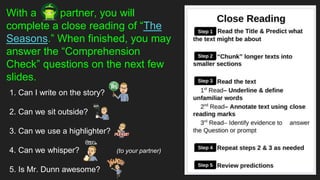
With a partner, you will
complete a close reading of “The
Seasons.” When finished, you may
answer the “Comprehension
Check” questions on the next few
slides.
1. Can I write on the story?
2. Can we sit outside?
3. Can we use a highlighter?
4. Can we whisper? (to your partner)
5. Is Mr. Dunn awesome?
Comprehension
Check
When finished reading “Proserpina,” answer
the questions on the next 4 slides about the
story. Be ready to discuss when time is called.
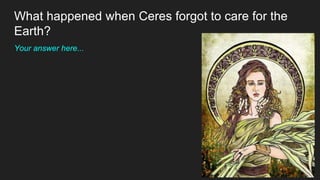
What happened when Ceres forgot to care for the
Earth?
Your answer here...
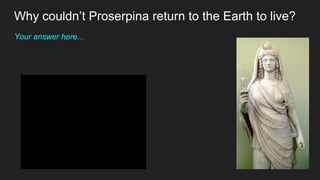
Why couldn’t Proserpina return to the Earth to live?
Your answer here...
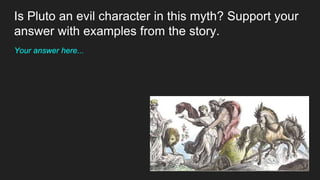
Is Pluto an evil character in this myth? Support your
answer with examples from the story.
Your answer here...
Your answer here...
Do you think Jupiter’s judgment about where
Proserpina would stay was fair? Why or why not?
Think about the Guiding
Questions. We know that
sometimes myths tell about
heroes and their heroic
deeds. Is that what’s
happening in “The
Seasons?” What’s
ANOTHER reason the
Greeks and Romans might
have created myths?
Why did the Greeks (and all ancient peoples) create
myths?
Your answer here...
Impress me
with your
brilliance!

Mythology an introduction

  • 1.
  • 2.
    Standard(s): 6.2.5 Describe thecharacteristics of Roman civilization; its cultural, political, and technological achievements; and its influence on other later cultures. Agenda: ❏ Guiding questions and “FIRST” thoughts ❏ Recap “heroes” ❏ Read and analyze “The Seasons” (with partner) ❏ Answer comprehension questions when finished ❏ Discuss & Apply to Guiding Questions ❏ Read and analyze “Arachne’s Web” (individually)
  • 3.
    What meanings did mythsabout gods, goddesses, and heroes have for the ancient Greeks? What meanings do the Greek myths have for us today? Guiding Questions
  • 4.
    Why are mythsimportant? How are they different from “regular” fiction? Your answer here...
  • 5.
    RECAP - Heroes Heroeswere an important part of Greek mythology, but the characteristics Greeks admired in a hero are not necessarily identical to those we admire today. Greek heroes are not always what modern readers might think of as "good role models." Their actions may strike us as morally dubious. For example, in his encounter with the Cyclops, Odysseus helps himself to the giant's food without permission, attacks while the Cyclops is in a wine-induced stupor, and brags about blinding the one-eyed creature. This does not mean the Greeks admired thievery and bragging, however. What they admired about Odysseus, in this instance, was his capacity for quick thinking. Odysseus defied that which others would not (as is also shown by his desire to hear the Sirens' song) and pulled off great feats with panache and self-confidence. Not all Greek heroes were admired for the same reasons. Some, such as Odysseus, were admired for their resourcefulness and intelligence, whereas others, such as Herakles, were known for their strength and courage. Some were not particularly resourceful but depended on help to accomplish their tasks. Whether or not a given action or quality was admired depended upon its ultimate results. Being headstrong might succeed in one instance but lead to failure in another. The Greeks held their characters accountable for their actions, and a hero might be punished as well as rewarded.
  • 6.
    With a partner,you will complete a close reading of “The Seasons.” When finished, you may answer the “Comprehension Check” questions on the next few slides. 1. Can I write on the story? 2. Can we sit outside? 3. Can we use a highlighter? 4. Can we whisper? (to your partner) 5. Is Mr. Dunn awesome?
  • 7.
    Comprehension Check When finished reading“Proserpina,” answer the questions on the next 4 slides about the story. Be ready to discuss when time is called.
  • 8.
    What happened whenCeres forgot to care for the Earth? Your answer here...
  • 9.
    Why couldn’t Proserpinareturn to the Earth to live? Your answer here...
  • 10.
    Is Pluto anevil character in this myth? Support your answer with examples from the story. Your answer here...
  • 11.
    Your answer here... Doyou think Jupiter’s judgment about where Proserpina would stay was fair? Why or why not?
  • 12.
    Think about theGuiding Questions. We know that sometimes myths tell about heroes and their heroic deeds. Is that what’s happening in “The Seasons?” What’s ANOTHER reason the Greeks and Romans might have created myths?
  • 13.
    Why did theGreeks (and all ancient peoples) create myths? Your answer here... Impress me with your brilliance!