The Poetry in Pitching
It is difficult
to get the news from poems
yet men die miserably every day
for lack
of what is found there.
-William Carlos William from “Asphodel, That Greeny Flower”


        Clarity
                           Relevan
                           ce      Beaut
                                   y
                Jackson Spalding University Elective on media relations by Ivy Le
                                                            December 16, 2011
4 Audiences for every pitch
        People, not
        targets.
1.Journalist
2.Journalist’s boss
3.The outlet’s audience
4.Your client
News Values
• Change, Conflict, Counter-intuition = 3 C’s
  shortcut
• From Grady College of Journalism at UGA:
                           •   Timeliness
                           •   Proximity
                           •   Controversy
                           •   Impact aka consequence
                           •   Unusual Nature
                           •   Helpfulness
                           •   Celebrities
                           •   Human Interest
                           •   Community issues
                           •   Trends
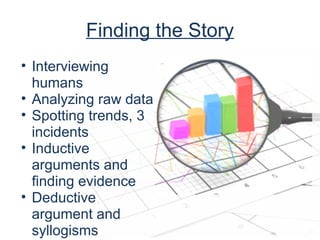
Finding the Story
• Interviewing
  humans
• Analyzing raw data
• Spotting trends, 3
  incidents
• Inductive
  arguments and
  finding evidence
• Deductive
  argument and
  syllogisms
Normal Distribution Graph
                      If something’s
                    not “normal” and
                     you know why,
                         you’ve got a
                               story.
Do you have a story?
• Is it narrative or
  descriptive? Common
  plots:
  o   Coming of age
  o   Odyssey
  o   Underdog
• Does it have a beginning, •
                              Are you moved?
  middle, and an end?       • Is something at
                              stake?
Telling the Story
 Pitch Package
• Pitch Email
• Voicemail Script
  (write your own)
• FAQs and Talking
  Points (or key
  messages)
• Vetted media list
• Bios
                              Preparation
                              • Study like you’ll be tested
                              • Anticipate objections
                              • Rehearse OUT LOUD until
                                you don’t sound scripted.
                              • Google all mentioned. No
                                surprises!
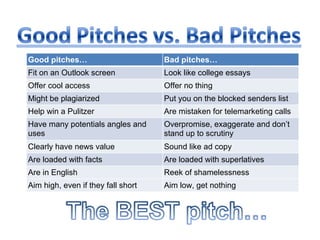
GOOD VS. BAD PITCHES
Good pitches…                       Bad pitches…
Fit on an Outlook screen            Look like college essays
Offer cool access                   Offer no thing
Might be plagiarized                Put you on the blocked senders list
Help win a Pulitzer                 Are mistaken for telemarketing calls
Have many potentials angles and     Overpromise, exaggerate and don’t
uses                                stand up to scrutiny
Clearly have news value             Sound like ad copy
Are loaded with facts               Are loaded with superlatives
Are in English                      Reek of shamelessness
Aim high, even if they fall short   Aim low, get nothing


                 The BEST pitch…
Show language some love.
idioglossia (ɪdɪəʊ ɡlɒsɪə) — n
• 1. a private language, as invented by a child or
  between two children, esp twins
• 2. a pathological condition in which a person's
  speech is so severely distorted that it is
  unintelligible
• from Greek idios private                   PR Ninja
  separate + glossa tongue                       vs.
World English Dictionary                      Journalist


                                “What did English ever do to you?”
Selling the Story
•   Conversations Shoe Salesmen should have
•   Switching Gears.
•   Style and Voice: Avoid the stereotype
•   Rejection and voicemails
•   Sales Closes for publicists:
    o   New Decision Close
    o   Ask for Action
    o   3 step close
    o   Alternate of Choice close
    o   Character close
    o   Extra Close
• Call anxiety
Pitch Troubleshooting
• Do you know the headline for your desired
  story?
• Is your subject line coy?
• Are the words precise? Could this be
  about anybody else but your client?
• Is there any body in this pitch? Is it person-
  less?
• Does the pitch contain any logic fallacies?*
• Is the hook/angle a buzz word or sentence
  fragment?
• Was the media list researched according
  to the news values in the pitch?
“Trying to add style is like adding a
     toupee. …The problem is not that he
      doesn’t look well- groomed; he does,
and we can only admire the wigmaker’s
skill. The point is that he doesn’t look like
  himself. …Readers want a person who
       is talking to them to sound genuine.
       Therefore, a fundamental rule is: be
                                 yourself.”
                – William Zinsser’s On Writing Well

Poetry in Pitching

  • 1.
    The Poetry inPitching It is difficult to get the news from poems yet men die miserably every day for lack of what is found there. -William Carlos William from “Asphodel, That Greeny Flower” Clarity Relevan ce Beaut y Jackson Spalding University Elective on media relations by Ivy Le December 16, 2011
  • 2.
    4 Audiences forevery pitch People, not targets. 1.Journalist 2.Journalist’s boss 3.The outlet’s audience 4.Your client
  • 3.
    News Values • Change,Conflict, Counter-intuition = 3 C’s shortcut • From Grady College of Journalism at UGA: • Timeliness • Proximity • Controversy • Impact aka consequence • Unusual Nature • Helpfulness • Celebrities • Human Interest • Community issues • Trends
  • 4.
    Finding the Story •Interviewing humans • Analyzing raw data • Spotting trends, 3 incidents • Inductive arguments and finding evidence • Deductive argument and syllogisms
  • 5.
    Normal Distribution Graph If something’s not “normal” and you know why, you’ve got a story.
  • 6.
    Do you havea story? • Is it narrative or descriptive? Common plots: o Coming of age o Odyssey o Underdog • Does it have a beginning, • Are you moved? middle, and an end? • Is something at stake?
  • 7.
    Telling the Story Pitch Package • Pitch Email • Voicemail Script (write your own) • FAQs and Talking Points (or key messages) • Vetted media list • Bios Preparation • Study like you’ll be tested • Anticipate objections • Rehearse OUT LOUD until you don’t sound scripted. • Google all mentioned. No surprises!
  • 8.
    GOOD VS. BADPITCHES Good pitches… Bad pitches… Fit on an Outlook screen Look like college essays Offer cool access Offer no thing Might be plagiarized Put you on the blocked senders list Help win a Pulitzer Are mistaken for telemarketing calls Have many potentials angles and Overpromise, exaggerate and don’t uses stand up to scrutiny Clearly have news value Sound like ad copy Are loaded with facts Are loaded with superlatives Are in English Reek of shamelessness Aim high, even if they fall short Aim low, get nothing The BEST pitch…
  • 9.
    Show language somelove. idioglossia (ɪdɪəʊ ɡlɒsɪə) — n • 1. a private language, as invented by a child or between two children, esp twins • 2. a pathological condition in which a person's speech is so severely distorted that it is unintelligible • from Greek idios private PR Ninja separate + glossa tongue vs. World English Dictionary Journalist “What did English ever do to you?”
  • 10.
    Selling the Story • Conversations Shoe Salesmen should have • Switching Gears. • Style and Voice: Avoid the stereotype • Rejection and voicemails • Sales Closes for publicists: o New Decision Close o Ask for Action o 3 step close o Alternate of Choice close o Character close o Extra Close • Call anxiety
  • 11.
    Pitch Troubleshooting • Doyou know the headline for your desired story? • Is your subject line coy? • Are the words precise? Could this be about anybody else but your client? • Is there any body in this pitch? Is it person- less? • Does the pitch contain any logic fallacies?* • Is the hook/angle a buzz word or sentence fragment? • Was the media list researched according to the news values in the pitch?
  • 12.
    “Trying to addstyle is like adding a toupee. …The problem is not that he doesn’t look well- groomed; he does, and we can only admire the wigmaker’s skill. The point is that he doesn’t look like himself. …Readers want a person who is talking to them to sound genuine. Therefore, a fundamental rule is: be yourself.” – William Zinsser’s On Writing Well

Editor's Notes

  • #2 The closer to these standards the pitch is, the more control you’ll see come through the eventual media hit.
  • #3 If beauty is in the eye of the beholders, we should start with the beholders.
  • #4 The danger: news value has to be a sentence, a complete thought.
  • #5 In PR, we usually think of research as the first step for measurement or messaging purposes. It’s also the first step in developing a pitch. Syllogism, a three-step deductive argument, is a pretty solid 3-idea structure for a pitch. You start with a major and a minor premise to a conclusion. A traditional example is "All men are mortal. Socrates is a man. Therefore, Socrates is mortal.“ Inductive reasoning is when you start with many, say 3, specific instances to come up with a conclusion. This is usually the structure for a classic trend pitch. The trap with inductive reasoning is that even though the premises are true and the argument is valid, it is possible for the conclusion to be false (determined to be false with a counterexample or other means).   Some mathematic systems don’t even allow inductive proofs. Ex. If a child puts his or her hand into a bag of candy and withdraws three pieces, all of which are red, he or she may conclude that all the candy is red. Inductive reasoning, or induction, is the process by which a general conclusion is reached from evaluating specific observations or situations.
  • #6 If you add percentages, you will see that approximately : •  68% of the distribution lies within one standard deviation of the mean. •  95% of the distribution lies within two standard deviations of the mean. •  99.7% of the distribution lies within three standard deviations of the mean. These percentages are known in statistics as the "empirical rule". statistically significant means it’s unlikely to have happened by chance vs. normal random error or variation. Why?
  • #7 Is there movement between the lede and close of the would-be news story? Learn broadly. Ideas and concepts are everywhere. Do not separate what you learn in business from what your kids tell you about what they learned in school or what you saw on NatGeo. Work and life are not separate. Everything is life, and you only get one. Celebrate life in your pitches, and make Beauty the standard. If you do, the telling of the story will just follow.
  • #9 … is the one you have on hand when an editor is ready to say yes. Reverse engineer stories.
  • #10 Guess what I’m saying with this. Inside jargon is not nice.
  • #11 Ppl don’t change their mind.  they make decisions based on the new information, that u can give them.  The New Decision Close When a person says no and you just keep pushing, you’re irritating. If you give them new info which allows them to make a new decision, a reason to make a new decision.  Ask for action, ask closing questions. Three question close 1. can u see where this can save u money/time/take care of ur health/etc? 2. are you interested in saving money? 3. when do you think u’d like to start saving money? (immediacy to get them into action) Qs lead to decision rather than force him at decision table ex. 1. do u invest in the stock market?  2. do u consider money for ur daughter’s educ an investment or an expenditure? (ppl make emotional decisions but tie it to logic incr chances at sale.)  3. and how much are your daughters worth as an investment? Alternate of choice close Did you want something for this issue or the next one? The Character Close  -  trust/integrity and sale is PPl buy from the good guys!! The Extra Close Don’t leave anything on the table.  selling them more of what they’re using anyhow.  ex.  I was wondering if you have another pair of shoes in that overnight bag, cuz it’d be a shame if had the best shine in the world tonight and looked like a schmoe tmrw.  BUT sometimes call anxiety is just because you know your pitch won’t work…
  • #12 Questions before we close? *Ad populum actually works Definition : The Latin name of this fallacy means "to the people." There are several versions of the ad populum fallacy, but what they all have in common is that in them, the arguer takes advantage of the desire most people have to be liked and to fit in with others and uses that desire to try to get the audience to accept his or her argument. One of the most common versions is the bandwagon fallacy, in which the arguer tries to convince the audience to do or believe something because everyone else (supposedly) does. Example : "Gay marriages are just immoral. 70% of Americans think so!" While the opinion of most Americans might be relevant in determining what laws we should have, it certainly doesn't determine what is moral or immoral: There was a time where a substantial number of Americans were in favor of segregation, but their opinion was not evidence that segregation was moral. The arguer is trying to get us to agree with the conclusion by appealing to our desire to fit in with other Americans. Tip : Make sure that you aren't recommending that your audience believe your conclusion because everyone else believes it, all the cool people believe it, people will like you better if you believe it, and so forth. Keep in mind that the popular opinion is not always the right one!