Mystery
The Adventures of Sherlock Holmes
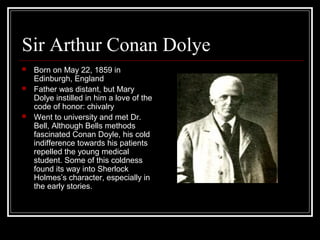
Sir Arthur Conan Dolye
 Born on May 22, 1859 in
Edinburgh, England
 Father was distant, but Mary
Dolye instilled in him a love of the
code of honor: chivalry
 Went to university and met Dr.
Bell, Although Bells methods
fascinated Conan Doyle, his cold
indifference towards his patients
repelled the young medical
student. Some of this coldness
found its way into Sherlock
Holmes’s character, especially in
the early stories.
Interview with Sir Arthur Conan
Doyle about Dr. John Bell
 BIO - Sherlock Holmes: The Original
Holmes [play Video 1:29]
 --------------------------------------------------------
 To check out the entire archive of video and
audio, visit
http://www.biography.com/broadband
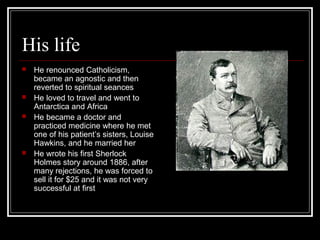
His life
 He renounced Catholicism,
became an agnostic and then
reverted to spiritual seances
 He loved to travel and went to
Antarctica and Africa
 He became a doctor and
practiced medicine where he met
one of his patient’s sisters, Louise
Hawkins, and he married her
 He wrote his first Sherlock
Holmes story around 1886, after
many rejections, he was forced to
sell it for $25 and it was not very
successful at first
His most famous work, Sherlock
Holmes
 He wrote and was very proud of Micah Clark, Sir Nigel, and The White
Company. Although these novels were widely admired, none of them
created the stir caused by the first series of short stories featuring Sherlock
Holmes and John Watson that appeared in The Strand Magazine, starting
in 1891.
 Conan Doyle was sick to death of the popular detective and decided to kill
him off in the 1893 story, "The Final Problem." Conan Doyle considered the
Holmes stories light fiction, good for earning money, but destined to be
quickly forgotten, the literary equivalent of junk food.
 The vehement public reaction to Holmes's death must have shocked Conan Doyle.
People wore black armbands and wrote him pleading/ threatening letters. Still, it
was nine years before he capitulated to public opinion and brought Holmes back.
 Conan Doyle did not make up his mind to resurrect Holmes until 1903, when he
wrote "The Empty House." He continued, reluctantly, to produce Holmes stories until
1927, three years before his own death.
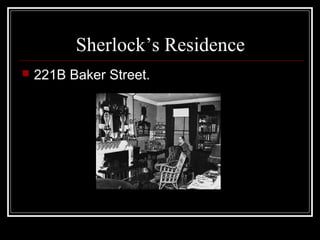
Sherlock’s Residence
 221B Baker Street.
Genre of Mystery
 A subgenre of narrative fiction; often
thought of as a detective story.
 Usually involves a mysterious death or
a crime to be solved.
 The central character must be a detective
who eventually solves the mystery by
logical deduction from facts fairly presented
to the reader.
Literary Terms to remember
 Main character who is a detective who sets out to solve a mystery.
 Suspects and their motives; these must be weighed and evaluated.
 Overt Clues about the crime are presented.
 Hidden Evidence is presented, i.e., essential details are offered in such
away that they seem unimportant.
 Inference Gaps—mysteries, by their very nature, do not tell the whole story.
It is up to readers to notice the gaps in the story and try to fill these gaps by
using and connecting the information that is presented.
 Suspense—having to hold various possible conclusions at bay as you wait
to see what happens; reader is expected to enjoy the suspense, and to
read to find out what will happen.
 Foreshadowing—clues left by the author as to possible outcomes.
 Red herring—a kind of foreshadowing clue that leads the reader to false
conclusions.
Who is Sherlock Holmes?

Mystery 2

  • 1.
  • 2.
    Sir Arthur ConanDolye  Born on May 22, 1859 in Edinburgh, England  Father was distant, but Mary Dolye instilled in him a love of the code of honor: chivalry  Went to university and met Dr. Bell, Although Bells methods fascinated Conan Doyle, his cold indifference towards his patients repelled the young medical student. Some of this coldness found its way into Sherlock Holmes’s character, especially in the early stories.
  • 3.
    Interview with SirArthur Conan Doyle about Dr. John Bell  BIO - Sherlock Holmes: The Original Holmes [play Video 1:29]  --------------------------------------------------------  To check out the entire archive of video and audio, visit http://www.biography.com/broadband
  • 4.
    His life  Herenounced Catholicism, became an agnostic and then reverted to spiritual seances  He loved to travel and went to Antarctica and Africa  He became a doctor and practiced medicine where he met one of his patient’s sisters, Louise Hawkins, and he married her  He wrote his first Sherlock Holmes story around 1886, after many rejections, he was forced to sell it for $25 and it was not very successful at first
  • 5.
    His most famouswork, Sherlock Holmes  He wrote and was very proud of Micah Clark, Sir Nigel, and The White Company. Although these novels were widely admired, none of them created the stir caused by the first series of short stories featuring Sherlock Holmes and John Watson that appeared in The Strand Magazine, starting in 1891.  Conan Doyle was sick to death of the popular detective and decided to kill him off in the 1893 story, "The Final Problem." Conan Doyle considered the Holmes stories light fiction, good for earning money, but destined to be quickly forgotten, the literary equivalent of junk food.  The vehement public reaction to Holmes's death must have shocked Conan Doyle. People wore black armbands and wrote him pleading/ threatening letters. Still, it was nine years before he capitulated to public opinion and brought Holmes back.  Conan Doyle did not make up his mind to resurrect Holmes until 1903, when he wrote "The Empty House." He continued, reluctantly, to produce Holmes stories until 1927, three years before his own death.
  • 6.
  • 7.
    Genre of Mystery A subgenre of narrative fiction; often thought of as a detective story.  Usually involves a mysterious death or a crime to be solved.  The central character must be a detective who eventually solves the mystery by logical deduction from facts fairly presented to the reader.
  • 8.
    Literary Terms toremember  Main character who is a detective who sets out to solve a mystery.  Suspects and their motives; these must be weighed and evaluated.  Overt Clues about the crime are presented.  Hidden Evidence is presented, i.e., essential details are offered in such away that they seem unimportant.  Inference Gaps—mysteries, by their very nature, do not tell the whole story. It is up to readers to notice the gaps in the story and try to fill these gaps by using and connecting the information that is presented.  Suspense—having to hold various possible conclusions at bay as you wait to see what happens; reader is expected to enjoy the suspense, and to read to find out what will happen.  Foreshadowing—clues left by the author as to possible outcomes.  Red herring—a kind of foreshadowing clue that leads the reader to false conclusions.
  • 9.
  • 10.