SHERLOCK HOMLES
SHERLOCK HOLMES DAIRY
 A fictional character created by the English writer
Sir Arthur Conan Doyle, Sherlock Holmes became
the prototype for the modern mastermind
detective. Doyle introduced Holmes in 1887 in the
short story “A Study in Scarlet” and went on to
write at least 50 more stories featuring the
detective, as well as The Hound of the Baskervilles
(1902) and several other novels .Doyle modeled his
detective on the methods and mannerisms of his
former teacher in medical school, Dr. Joseph Bell
of Edinburgh. A slim, nervously intense, hawk-
nosed man, Holmes uses purely scientific reasoning
to solve crimes and can make the most startling
deductions from trivial details and bits of physical
evidence overlooked by others. He lives at 221B
Arthur Conan Doyle
 (1859–1930). A British physician who turned to writing, Arthur Conan Doyle thought he
would be remembered for his historical novels. His fame, however, rests on his creation of
the master detective of fiction, the incomparable Sherlock Holmes.
 Arthur Conan Doyle was born in Edinburgh, Scotland, on May 22, 1859. He was the oldest
son of Charles Doyle, a civil servant. His parents were Irish Roman Catholics, and he
received his early education in a Jesuit school, Stonyhurst. Later he got a medical degree at
Edinburgh University. He started practice as a family physician in Southsea, England. His
income was small so he began writing stories to make ends meet. In 1891 he decided to give
up medicine to concentrate on his writing.
 A Study in Scarlet, published in 1887, introduced Holmes and his friend Dr. John Watson.
The second Holmes story was The Sign of Four (1890). In 1891 Doyle began a series for
Strand magazine called "The Adventures of Sherlock Holmes."
 Sherlock Holmes became known to movie and television audiences as a tall and lean, pipe-
smoking, violin-playing detective. He lived at 221B Baker Street in London, where he was
often visited by Watson, an associate in the many adventures. And according to Doyle, it was
Watson who recorded the Holmes stories for posterity.
 Whodunit? The dogged quest for the perpetrator of a vile crime
has become the definition of the detective story. The question of
whodunit keeps challenging all kinds of detectives in novels,
short stories, films, radio and television series, and stage plays.
 Contemporary crime writers generally specialize in hard-
boiled thrillers, with tough language and rough action, or
cozies, in which the characters are more refined and the
violence is less explicit. Both styles make use of red-herring, or
misleading, clues and phony suspects to confuse everyone
except the clever detective, who can always unravel the case.
 The professionals in contemporary detective fiction are most likely
to be private eyes (PIs, or private investigators), who have been
hired specifically to prove someone's innocence or guilt—for
example, Mickey Spillane's Mike Hammer or his postfeminist
counterpart, Sara Paretsky's V.I. Warshawski. The first real PI was
François-Eugene Vidocq, a reformed thief who started the first
official private detective bureau in Paris in 1817. His memoirs
(1828–29) inspired the American short-story writer Edgar Allan
Poe to write "The Murders in the Rue Morgue" (1841). In what Poe
called a ratiocinative (purely deductive) tale, a brutal double
murder baffles the French police but is solved by C. Auguste
Dupin—the model for thousands of other literary detectives who
operate with cool logic and without official status. The last of Poe's
three "Tales" about Dupin was printed in 1845. Although they
were later credited as the first detective stories, the word detective
never appeared in any of them.
 Called the “Edgar Allan Poe of France,” Émile Gaboriau wrote the first long detective
story and was far more successful than Poe with detective fiction. In 1866 he began
publishing installments of The Widow Lerouge, the first of 21 serial novels. Gaboriau
used the two basic detective types—Père Tabaret, an amateur, and Monsieur Lecoq,
the professional.
 Detective fiction was introduced into England by Wilkie Collins with The Moonstone
and its memorable detective, Sergeant Cuff, in 1868—still one of the best mystery
stories ever written. (Collins' other masterpiece, The Woman in White, had appeared
in 1860, but it was a pure mystery, not a story of detection.) Novelist Charles Dickens
had also been intrigued by this type of fiction, but he died in 1870 before finishing
The Mystery of Edwin Drood—still a challenge to literary detectives.
Picture gallery
 The first detective novel written in the United States was by a woman,
Anna Katharine Green, whose The Leavenworth Case appeared in
1878; her hero was a New York police detective. The first best seller of
literary crime was an 1886 Australian thriller: The Mystery of a
Hansom Cab by Fergus Hume. The next year marked the debut of
Sherlock Holmes, the first scientific detective. Sir Arthur Conan Doyle,
a British physician, wrote four novels and 56 short stories about the
immortal Holmes Arthur). After two dozen stories, Doyle killed off his
hero, but he was forced by public demand to publish a reminiscence in
1902 and then pull off an ingenious resurrection in 1905. One of the
best of the Holmes imitations that followed was Dr. John Evelyn
Thorndyke, the creation of R. Austin Freeman (also a physician), who
appeared in The Red Thumb Mark in 1907. Between 1911 and 1935
G.K. Chesterton published five collections of Father Brown stories. John
Dickson Carr, whose specialty was the locked-room puzzle in medieval
England, modeled one of his detectives (Dr. Gideon Fell) after
Chesterton.
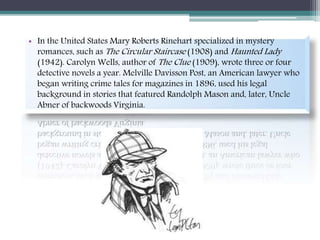
• In the United States Mary Roberts Rinehart specialized in mystery
romances, such as The Circular Staircase (1908) and Haunted Lady
(1942). Carolyn Wells, author of The Clue (1909), wrote three or four
detective novels a year. Melville Davisson Post, an American lawyer who
began writing crime tales for magazines in 1896, used his legal
background in stories that featured Randolph Mason and, later, Uncle
Abner of backwoods Virginia.
 Three popular American sleuths made their debut in the 1920s. Charlie
Chan was introduced by Earl Derr Biggers in The House Without a Key
(1925). The bicultural Chan, who endlessly quotes Confucian sayings,
was based on a real Honolulu police detective. Next was the urbane Philo
Vance, developed by S.S. Van Dine (the pen name of art critic Willard
Huntington Wright). The Benson Murder Case (1926) was the first of a
planned even dozen novels—each (except for The Gracie Allen Murder
Case) designed with a six-letter name in the title. Van Dine influenced
the creation of Ellery Queen, who appeared in The Roman Hat Mystery
(1929). The mystery writer Queen was both hero and author (the pen
name of Manfred B. Lee and Frederic Dannay). As Barnaby Ross, they
wrote four books about Drury Lane, an actor-detective (collected as The
XYZ Murders).
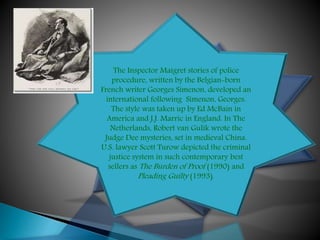
The Inspector Maigret stories of police
procedure, written by the Belgian-born
French writer Georges Simenon, developed an
international following Simenon, Georges.
The style was taken up by Ed McBain in
America and J.J. Marric in England. In The
Netherlands, Robert van Gulik wrote the
Judge Dee mysteries, set in medieval China.
U.S. lawyer Scott Turow depicted the criminal
justice system in such contemporary best
sellers as The Burden of Proof (1990) and
Pleading Guilty (1993).
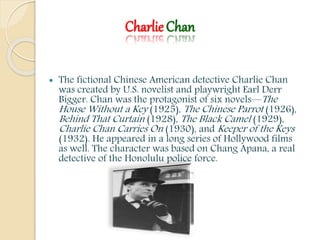
Charlie Chan
 The fictional Chinese American detective Charlie Chan
was created by U.S. novelist and playwright Earl Derr
Bigger. Chan was the protagonist of six novels—The
House Without a Key (1925), The Chinese Parrot (1926),
Behind That Curtain (1928), The Black Camel (1929),
Charlie Chan Carries On (1930), and Keeper of the Keys
(1932). He appeared in a long series of Hollywood films
as well. The character was based on Chang Apana, a real
detective of the Honolulu police force.
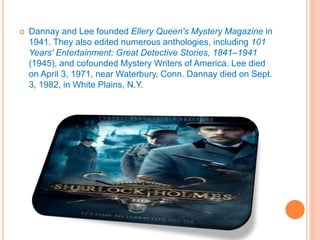
 Dannay and Lee founded Ellery Queen's Mystery Magazine in
1941. They also edited numerous anthologies, including 101
Years' Entertainment: Great Detective Stories, 1841–1941
(1945), and cofounded Mystery Writers of America. Lee died
on April 3, 1971, near Waterbury, Conn. Dannay died on Sept.
3, 1982, in White Plains, N.Y.
ELLERY QUEEN
 The cousins Manfred B. Lee (1905–71) and Frederic Dannay (1905–
82) cowrote a series of more than 35 detective novels featuring a
character named Ellery Queen. They took the name of their most
popular detective as a pseudonym.
 Lee was born Manford Lepofsky in Brooklyn, N.Y., on Jan. 11, 1905.
Dannay was born Daniel Nathan in Brooklyn on Oct. 20, 1905. They
first collaborated on an impulsive entry for a detective-story contest;
the success of the result, The Roman Hat Mystery (1929), started Ellery
Queen on his career. After the publication of two more mysteries, the
cousins were able to become full-time writers. They took turns
creating plots and writing stories about the sleuth Queen, whose
adventures have been adapted for radio, television, and film. The pair
also used the pseudonym Barnaby Ross when writing about their
second detective creation, Drury Lane. They would hold debates posing
as Queen and Ross, who were believed by all to be two distinct authors.
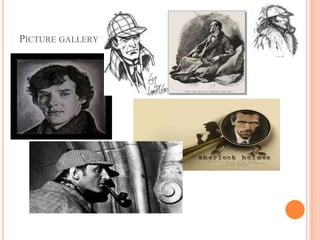
PICTURE GALLERY
Sherlock holmes

Sherlock holmes

  • 1.
  • 2.
    SHERLOCK HOLMES DAIRY A fictional character created by the English writer Sir Arthur Conan Doyle, Sherlock Holmes became the prototype for the modern mastermind detective. Doyle introduced Holmes in 1887 in the short story “A Study in Scarlet” and went on to write at least 50 more stories featuring the detective, as well as The Hound of the Baskervilles (1902) and several other novels .Doyle modeled his detective on the methods and mannerisms of his former teacher in medical school, Dr. Joseph Bell of Edinburgh. A slim, nervously intense, hawk- nosed man, Holmes uses purely scientific reasoning to solve crimes and can make the most startling deductions from trivial details and bits of physical evidence overlooked by others. He lives at 221B
  • 3.
    Arthur Conan Doyle (1859–1930). A British physician who turned to writing, Arthur Conan Doyle thought he would be remembered for his historical novels. His fame, however, rests on his creation of the master detective of fiction, the incomparable Sherlock Holmes.  Arthur Conan Doyle was born in Edinburgh, Scotland, on May 22, 1859. He was the oldest son of Charles Doyle, a civil servant. His parents were Irish Roman Catholics, and he received his early education in a Jesuit school, Stonyhurst. Later he got a medical degree at Edinburgh University. He started practice as a family physician in Southsea, England. His income was small so he began writing stories to make ends meet. In 1891 he decided to give up medicine to concentrate on his writing.  A Study in Scarlet, published in 1887, introduced Holmes and his friend Dr. John Watson. The second Holmes story was The Sign of Four (1890). In 1891 Doyle began a series for Strand magazine called "The Adventures of Sherlock Holmes."  Sherlock Holmes became known to movie and television audiences as a tall and lean, pipe- smoking, violin-playing detective. He lived at 221B Baker Street in London, where he was often visited by Watson, an associate in the many adventures. And according to Doyle, it was Watson who recorded the Holmes stories for posterity.
  • 5.
     Whodunit? Thedogged quest for the perpetrator of a vile crime has become the definition of the detective story. The question of whodunit keeps challenging all kinds of detectives in novels, short stories, films, radio and television series, and stage plays.  Contemporary crime writers generally specialize in hard- boiled thrillers, with tough language and rough action, or cozies, in which the characters are more refined and the violence is less explicit. Both styles make use of red-herring, or misleading, clues and phony suspects to confuse everyone except the clever detective, who can always unravel the case.
  • 7.
     The professionalsin contemporary detective fiction are most likely to be private eyes (PIs, or private investigators), who have been hired specifically to prove someone's innocence or guilt—for example, Mickey Spillane's Mike Hammer or his postfeminist counterpart, Sara Paretsky's V.I. Warshawski. The first real PI was François-Eugene Vidocq, a reformed thief who started the first official private detective bureau in Paris in 1817. His memoirs (1828–29) inspired the American short-story writer Edgar Allan Poe to write "The Murders in the Rue Morgue" (1841). In what Poe called a ratiocinative (purely deductive) tale, a brutal double murder baffles the French police but is solved by C. Auguste Dupin—the model for thousands of other literary detectives who operate with cool logic and without official status. The last of Poe's three "Tales" about Dupin was printed in 1845. Although they were later credited as the first detective stories, the word detective never appeared in any of them.
  • 8.
     Called the“Edgar Allan Poe of France,” Émile Gaboriau wrote the first long detective story and was far more successful than Poe with detective fiction. In 1866 he began publishing installments of The Widow Lerouge, the first of 21 serial novels. Gaboriau used the two basic detective types—Père Tabaret, an amateur, and Monsieur Lecoq, the professional.  Detective fiction was introduced into England by Wilkie Collins with The Moonstone and its memorable detective, Sergeant Cuff, in 1868—still one of the best mystery stories ever written. (Collins' other masterpiece, The Woman in White, had appeared in 1860, but it was a pure mystery, not a story of detection.) Novelist Charles Dickens had also been intrigued by this type of fiction, but he died in 1870 before finishing The Mystery of Edwin Drood—still a challenge to literary detectives.
  • 9.
  • 10.
     The firstdetective novel written in the United States was by a woman, Anna Katharine Green, whose The Leavenworth Case appeared in 1878; her hero was a New York police detective. The first best seller of literary crime was an 1886 Australian thriller: The Mystery of a Hansom Cab by Fergus Hume. The next year marked the debut of Sherlock Holmes, the first scientific detective. Sir Arthur Conan Doyle, a British physician, wrote four novels and 56 short stories about the immortal Holmes Arthur). After two dozen stories, Doyle killed off his hero, but he was forced by public demand to publish a reminiscence in 1902 and then pull off an ingenious resurrection in 1905. One of the best of the Holmes imitations that followed was Dr. John Evelyn Thorndyke, the creation of R. Austin Freeman (also a physician), who appeared in The Red Thumb Mark in 1907. Between 1911 and 1935 G.K. Chesterton published five collections of Father Brown stories. John Dickson Carr, whose specialty was the locked-room puzzle in medieval England, modeled one of his detectives (Dr. Gideon Fell) after Chesterton.
  • 12.
    • In theUnited States Mary Roberts Rinehart specialized in mystery romances, such as The Circular Staircase (1908) and Haunted Lady (1942). Carolyn Wells, author of The Clue (1909), wrote three or four detective novels a year. Melville Davisson Post, an American lawyer who began writing crime tales for magazines in 1896, used his legal background in stories that featured Randolph Mason and, later, Uncle Abner of backwoods Virginia.
  • 13.
     Three popularAmerican sleuths made their debut in the 1920s. Charlie Chan was introduced by Earl Derr Biggers in The House Without a Key (1925). The bicultural Chan, who endlessly quotes Confucian sayings, was based on a real Honolulu police detective. Next was the urbane Philo Vance, developed by S.S. Van Dine (the pen name of art critic Willard Huntington Wright). The Benson Murder Case (1926) was the first of a planned even dozen novels—each (except for The Gracie Allen Murder Case) designed with a six-letter name in the title. Van Dine influenced the creation of Ellery Queen, who appeared in The Roman Hat Mystery (1929). The mystery writer Queen was both hero and author (the pen name of Manfred B. Lee and Frederic Dannay). As Barnaby Ross, they wrote four books about Drury Lane, an actor-detective (collected as The XYZ Murders).
  • 15.
    The Inspector Maigretstories of police procedure, written by the Belgian-born French writer Georges Simenon, developed an international following Simenon, Georges. The style was taken up by Ed McBain in America and J.J. Marric in England. In The Netherlands, Robert van Gulik wrote the Judge Dee mysteries, set in medieval China. U.S. lawyer Scott Turow depicted the criminal justice system in such contemporary best sellers as The Burden of Proof (1990) and Pleading Guilty (1993).
  • 16.
    Charlie Chan  Thefictional Chinese American detective Charlie Chan was created by U.S. novelist and playwright Earl Derr Bigger. Chan was the protagonist of six novels—The House Without a Key (1925), The Chinese Parrot (1926), Behind That Curtain (1928), The Black Camel (1929), Charlie Chan Carries On (1930), and Keeper of the Keys (1932). He appeared in a long series of Hollywood films as well. The character was based on Chang Apana, a real detective of the Honolulu police force.
  • 17.
     Dannay andLee founded Ellery Queen's Mystery Magazine in 1941. They also edited numerous anthologies, including 101 Years' Entertainment: Great Detective Stories, 1841–1941 (1945), and cofounded Mystery Writers of America. Lee died on April 3, 1971, near Waterbury, Conn. Dannay died on Sept. 3, 1982, in White Plains, N.Y.
  • 18.
    ELLERY QUEEN  Thecousins Manfred B. Lee (1905–71) and Frederic Dannay (1905– 82) cowrote a series of more than 35 detective novels featuring a character named Ellery Queen. They took the name of their most popular detective as a pseudonym.  Lee was born Manford Lepofsky in Brooklyn, N.Y., on Jan. 11, 1905. Dannay was born Daniel Nathan in Brooklyn on Oct. 20, 1905. They first collaborated on an impulsive entry for a detective-story contest; the success of the result, The Roman Hat Mystery (1929), started Ellery Queen on his career. After the publication of two more mysteries, the cousins were able to become full-time writers. They took turns creating plots and writing stories about the sleuth Queen, whose adventures have been adapted for radio, television, and film. The pair also used the pseudonym Barnaby Ross when writing about their second detective creation, Drury Lane. They would hold debates posing as Queen and Ross, who were believed by all to be two distinct authors.
  • 19.