
SEO for the 2015 / 2016 Period
Algorithm Updates
Slide 1by
Algorithm Updates
Google Algorithm Tweaks & Changes
• Panda is still prominent as ever. ‘Value-add’ is overtaking content (which is a medium to deliver
value-add) in terms of focus for SEO, though obviously content will continue to deliver value-add.
We’ll get to this later!
• Penguin has been through many iterations and is now incrementally updated across query-spaces
rather than having large, devastating refreshes
• Penguin has made link-building very difficult for small and medium businesses since blogger-
outreach was severely damaged in terms of SEO effectiveness
• Large businesses with huge budgets can spend that money on SEO-creative instead. They can
produce microsites and interesting campaigns which gain links naturally around the web. This
avenue is not usually open to small / medium businesses
• Pigeon expanded to further English speaking nations in December 2014 (Canada, Australia, UK).
Pigeon has gradually been increasing the importance of local SEO factors and will continue to make
Local SEO more and more important
• Hummingbird continues to contextually interpret the web for Google. Keywords serve larger search
entities, which have always existed (as ‘keyword buckets’) but now have renewed prominence
Slide 2by
Algorithm Updates
Google Algorithm Tweaks & Changes
• In some months Google will be resuming their relationship with Twitter. This was huge news! The return
of real-time search heralds the first true connection point between SEO and social
• Just as YouTube video titles can be edited so that they trigger in “how to” or temporally relevant
video SERPs – will we be optimising individual tweets with the same goal in mind? It’s likely
• In late April Google will be increasing the importance of mobile friendliness as a ranking factor.
Google are advocating ‘responsive’ design over pre-set parallel mobile sites (‘m.’ etc.)
• This will only impact Google’s mobile SERPs, but some clients draw huge amounts of traffic through
mobile devices
• As technology and the web become more ubiquitous, we can expect to see sites with really solid
responsive design to fly
• There are still some advantages of parallel mobile sites, such as the fact that not all of the content
and resources have to be loaded. As mobile networks and devices become more powerful – this
benefit will become obsolete. Responsive design is the way forward except in very specific
circumstances
Slide 3by
SEO for the 2015 / 2016 Period
Link Building
Slide 4by
Link Building
Making Link Building Viable Again for Small / Medium Businesses
Slide 5by
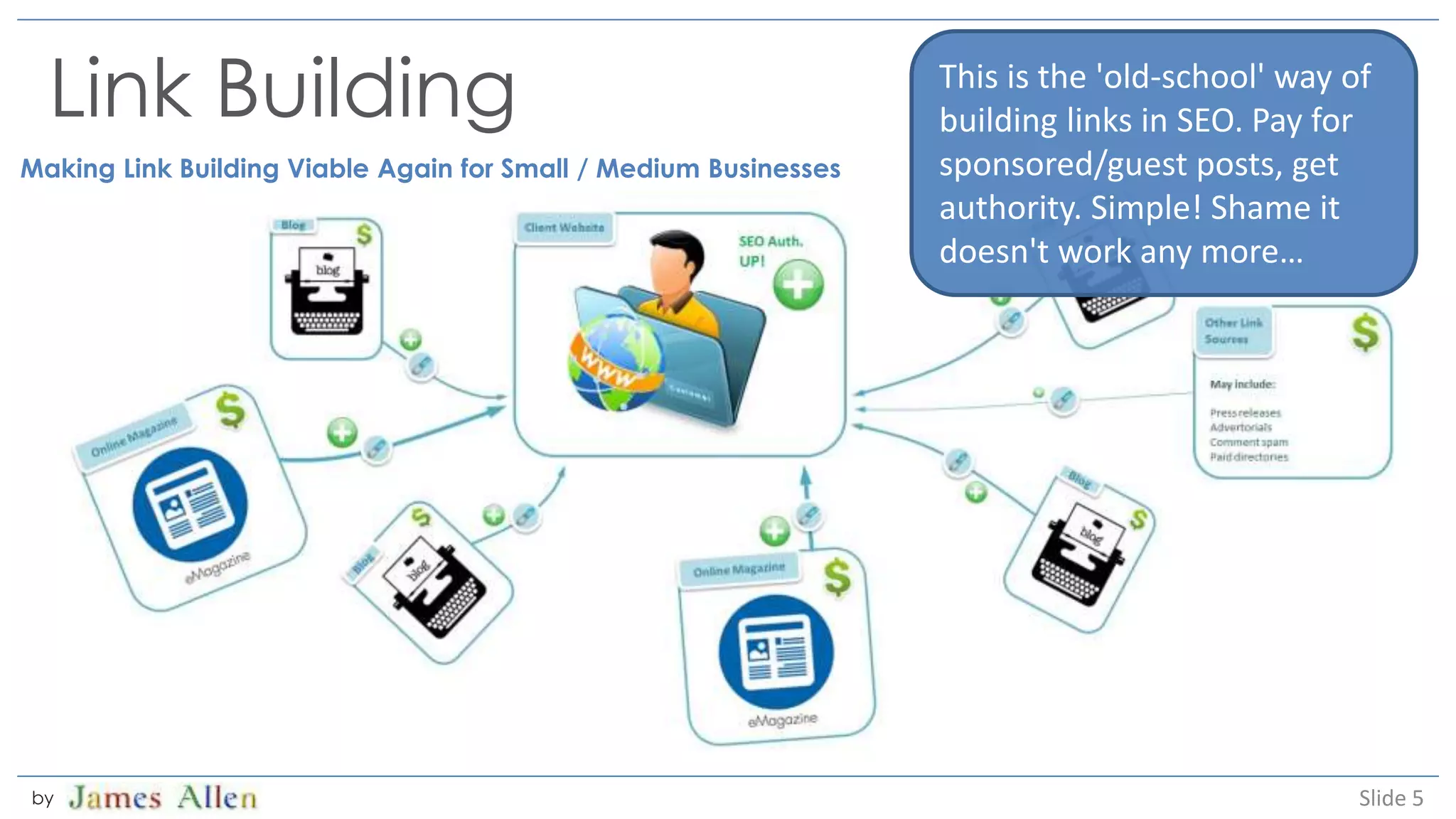
This is the 'old-school' way of
building links in SEO. Pay for
sponsored/guest posts, get
authority. Simple! Shame it
doesn't work any more…
Slide 6by
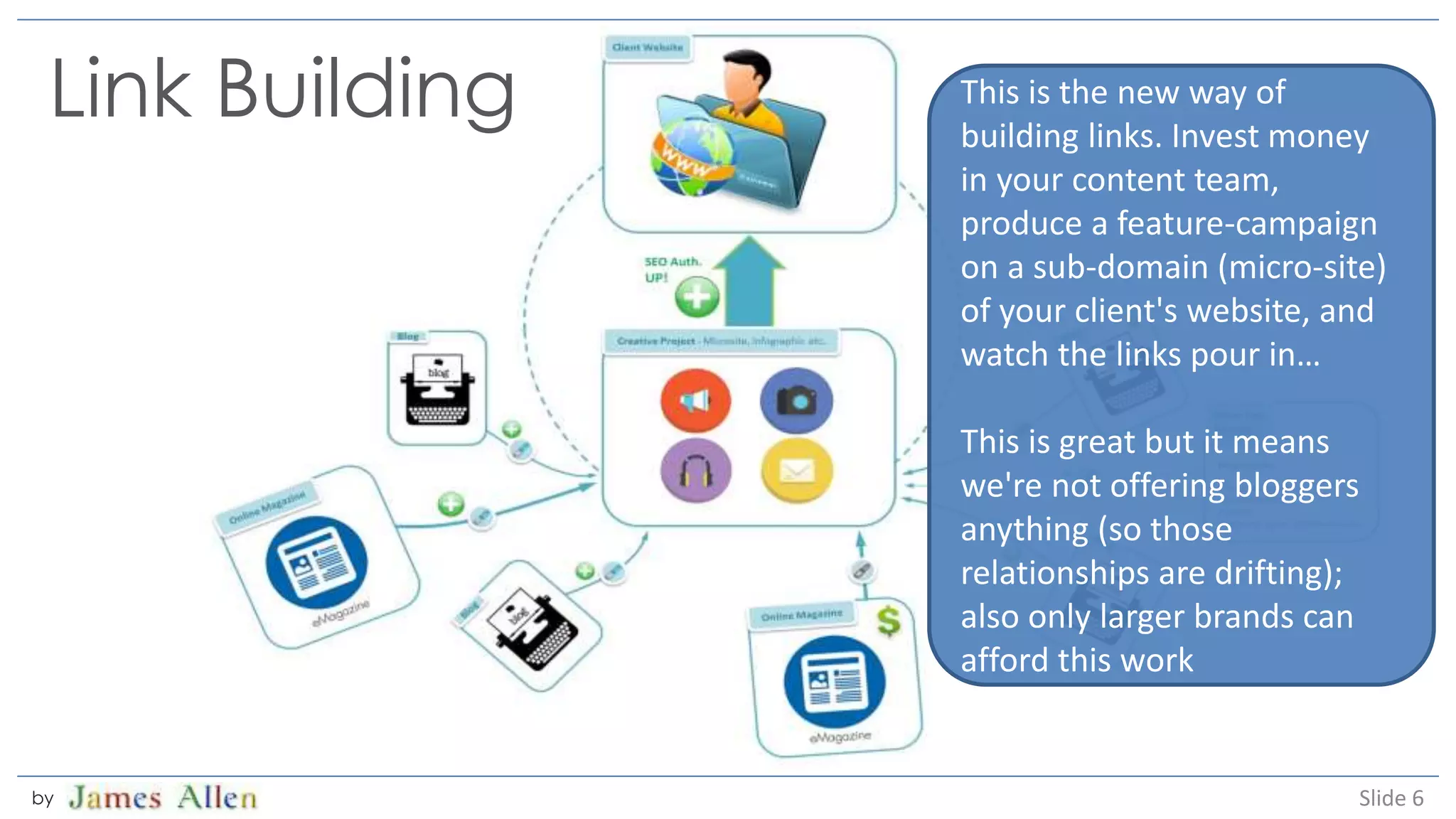
Link Building This is the new way of
building links. Invest money
in your content team,
produce a feature-campaign
on a sub-domain (micro-site)
of your client's website, and
watch the links pour in…
This is great but it means
we're not offering bloggers
anything (so those
relationships are drifting);
also only larger brands can
afford this work
Slide 7by
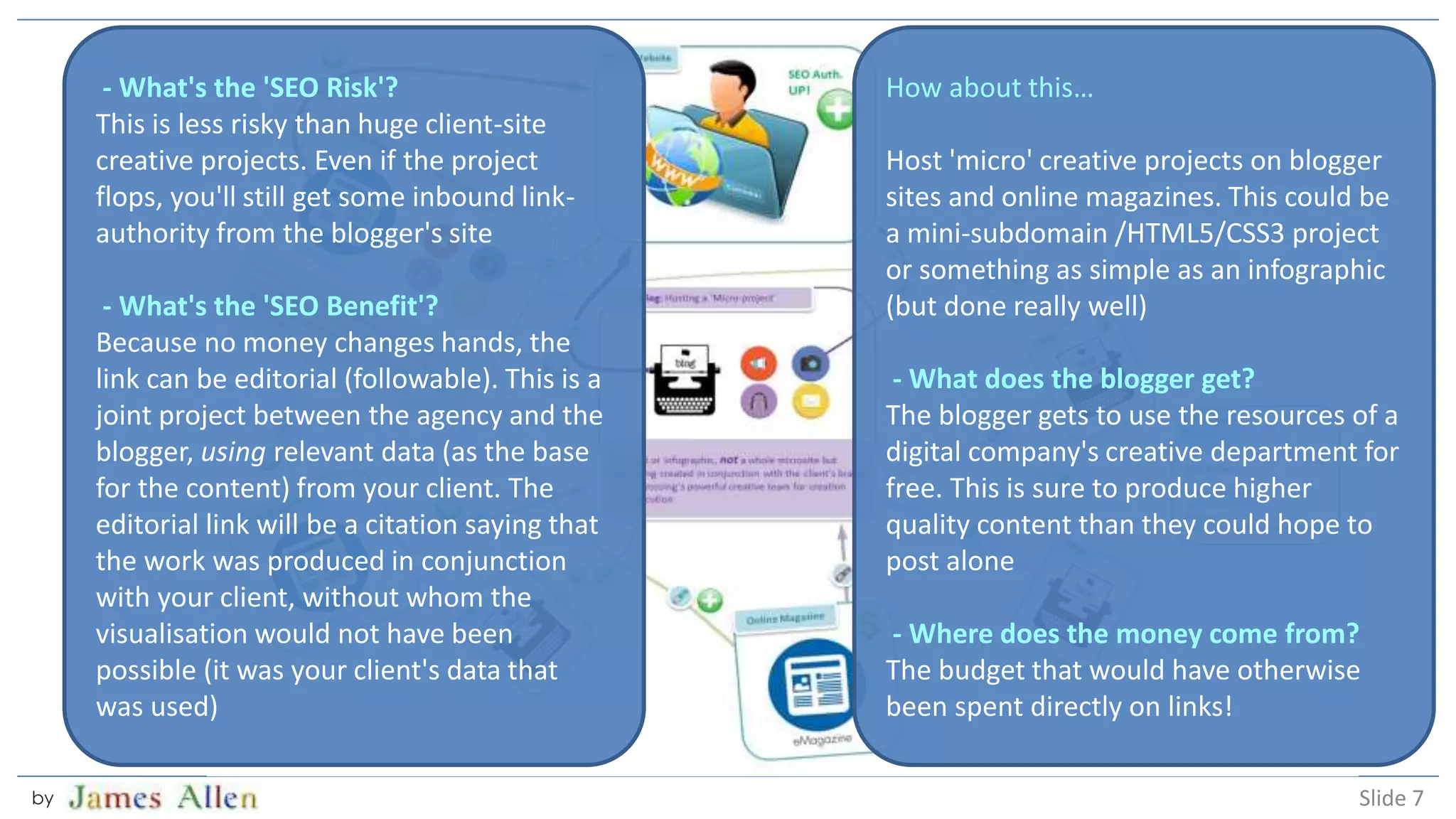
How about this…
Host 'micro' creative projects on blogger
sites and online magazines. This could be
a mini-subdomain /HTML5/CSS3 project
or something as simple as an infographic
(but done really well)
- What does the blogger get?
The blogger gets to use the resources of a
digital company's creative department for
free. This is sure to produce higher
quality content than they could hope to
post alone
- Where does the money come from?
The budget that would have otherwise
been spent directly on links!
- What's the 'SEO Risk'?
This is less risky than huge client-site
creative projects. Even if the project
flops, you'll still get some inbound link-
authority from the blogger's site
- What's the 'SEO Benefit'?
Because no money changes hands, the
link can be editorial (followable). This is a
joint project between the agency and the
blogger, using relevant data (as the base
for the content) from your client. The
editorial link will be a citation saying that
the work was produced in conjunction
with your client, without whom the
visualisation would not have been
possible (it was your client's data that
was used)
SEO for the 2015 / 2016 Period
Content & Value Add
Slide 8by
Content & Value-Add
‘Value Add’ is King – The New Era of SEO
• The phrase commonly touted by many who work in the SEO industry, “content is king”
– somewhat misses the mark
• Content is simply one medium through which value-add may be delivered to an
audience
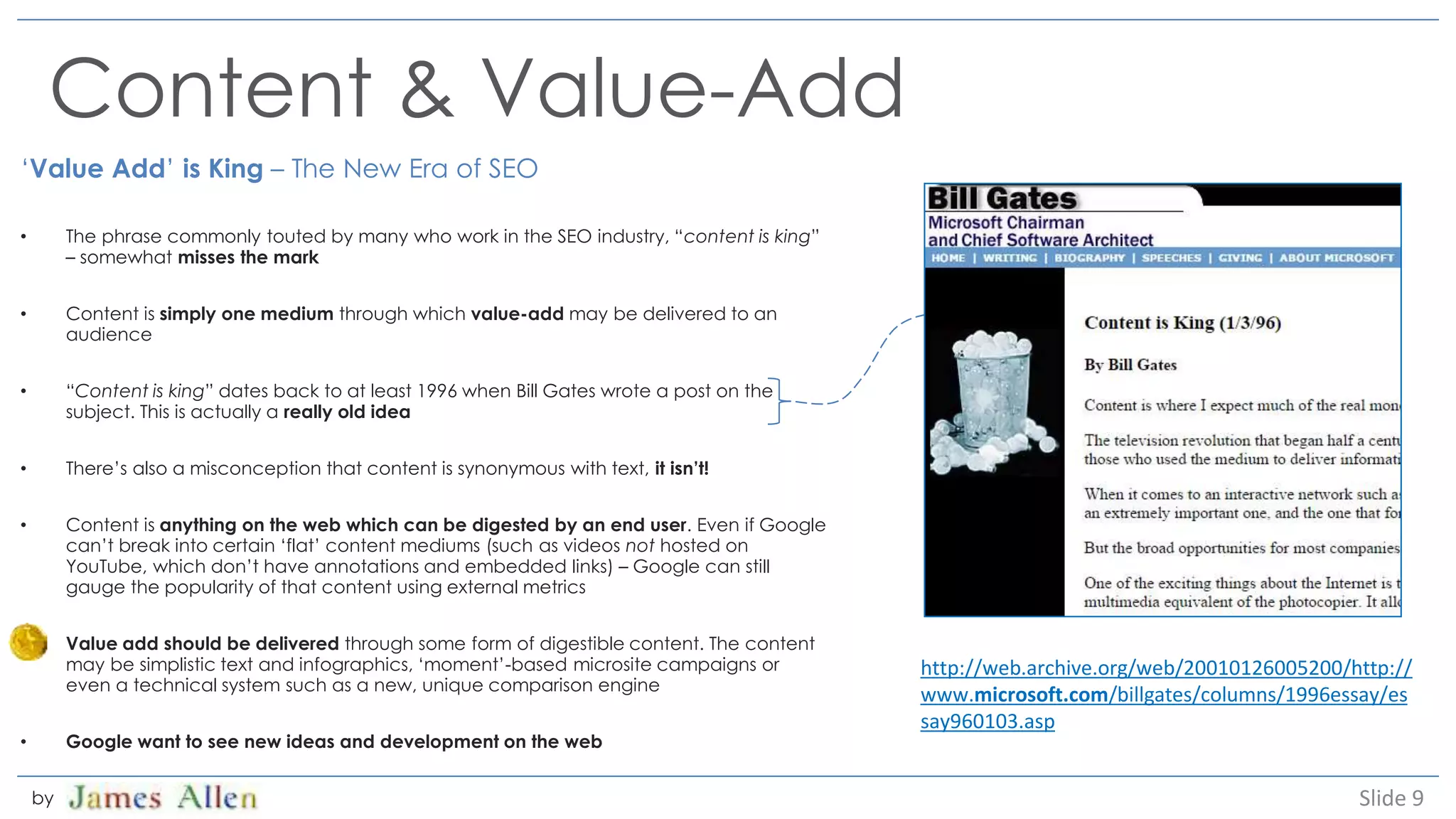
• “Content is king” dates back to at least 1996 when Bill Gates wrote a post on the
subject. This is actually a really old idea
• There’s also a misconception that content is synonymous with text, it isn’t!
• Content is anything on the web which can be digested by an end user. Even if Google
can’t break into certain ‘flat’ content mediums (such as videos not hosted on
YouTube, which don’t have annotations and embedded links) – Google can still
gauge the popularity of that content using external metrics
• Value add should be delivered through some form of digestible content. The content
may be simplistic text and infographics, ‘moment’-based microsite campaigns or
even a technical system such as a new, unique comparison engine
• Google want to see new ideas and development on the web
Slide 9by
http://web.archive.org/web/20010126005200/http://
www.microsoft.com/billgates/columns/1996essay/es
say960103.asp
Content & Value-Add
What do We do in the ‘Value-Add Era’ of SEO?
• Have an idea. This may be a new technical development to aggregate existing data
on the web such as a comparison engine like Money Supermarket or Compare the
Market. Don’t forget to leverage the client’s data for a new, web audience!
• Has it been done before? If so – don’t bother. Think of ways to aggregate previously
unexploited data (often from the client) which could be delivered to your target
audience in a new way. Make it informative, educational or entertaining
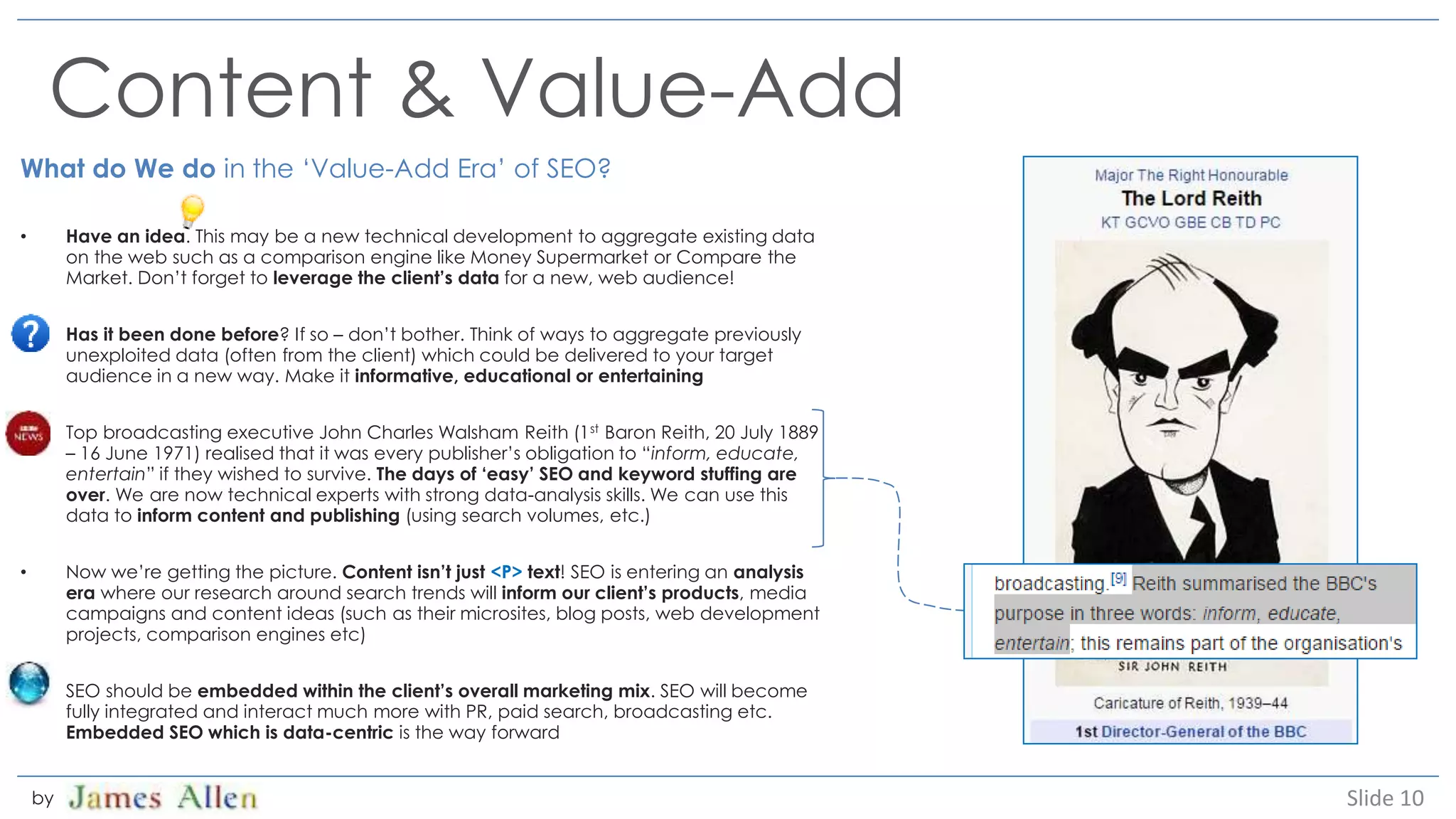
• Top broadcasting executive John Charles Walsham Reith (1st Baron Reith, 20 July 1889
– 16 June 1971) realised that it was every publisher’s obligation to “inform, educate,
entertain” if they wished to survive. The days of ‘easy’ SEO and keyword stuffing are
over. We are now technical experts with strong data-analysis skills. We can use this
data to inform content and publishing (using search volumes, etc.)
• Now we’re getting the picture. Content isn’t just <P> text! SEO is entering an analysis
era where our research around search trends will inform our client’s products, media
campaigns and content ideas (such as their microsites, blog posts, web development
projects, comparison engines etc)
• SEO should be embedded within the client’s overall marketing mix. SEO will become
fully integrated and interact much more with PR, paid search, broadcasting etc.
Embedded SEO which is data-centric is the way forward
Slide 10by
Content & Value Add
Key Takeaway
Slide 11by
• SEO has changed, content for the sake of content was
never what Google wanted
• Don’t think about content without value-add
• Content is anything which a search engine can determine
as popular, digestible material through on or off-page
metrics. Content can be technical development!
Content & Value Add
Key Takeaway
Slide 12by
• Have an idea, build something cool!
• Combining our search data and insights with unexploited
(on the web) client data will provide great SEO results
• SEO is no longer a ‘bolt-on’ service. We need to
integrate with other key marketing channels such as PR,
Social, etc.
SEO for the 2015 / 2016 Period
Structured Data
Slide 13by
Structured Data
New HTML5 Semantic Tags, WAI ARIA, etc.
• We all know that Google have been using ‘semantic’ tags (such as <H1>, <li>,
<strong>, <em>, <p> etc.) for a long time in SEO. With HTML5 comes a plethora of new
semantic tags for Google to get their teeth into
• There are also pre-existing attempts to get more semantic information into code by
using classes and attributes (rather than tags) such as WAI ARIA. We know a lot of this
was done for the sake of blind web-users, but it’s all contextual information Google
could be using
• Even if Google’s contextual use of conventions such as WAI ARIA is less likely, it’s very
likely that Google will adopt some contextual interpretation of the new HTML5
semantic tags
• We know this because Google have adopted almost all previously introduced
semantic tags such as the famous <H1> and <H2> tags
• Don’t forget that; technically speaking - <title> is also a semantic tag rather than
‘actual’ Meta data (like the Meta description) which is content contained within a
<Meta> tag (rather than having a dedicated HTML tag of its own)
Slide 14by
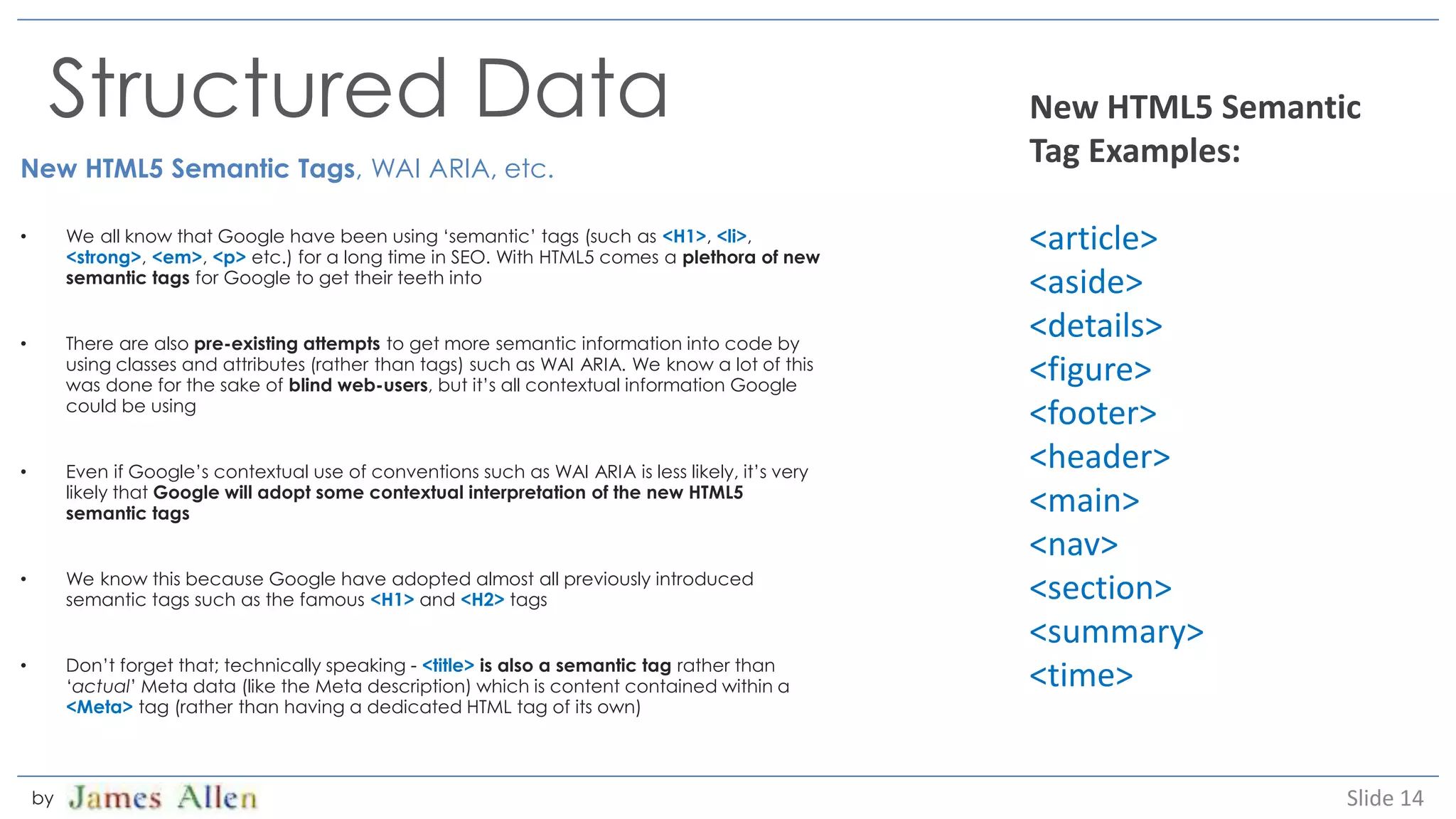
New HTML5 Semantic
Tag Examples:
<article>
<aside>
<details>
<figure>
<footer>
<header>
<main>
<nav>
<section>
<summary>
<time>
Structured Data
New HTML5 Semantic Tags, WAI ARIA, etc.
It’s likely that other forms of structured data:
• Stuff found on schema.org
• Microformats
• Microdata
• WAI ARIA
… will continue to evolve and play a role in rich-snippets (structured data surfacing in
Google’s SERPs) and Google’s search algorithm at large (particularly content-focused
algorithms like Panda)
All SEO experts should keep a keen eye on the development of not just schema.org but
structured data on a grander scale
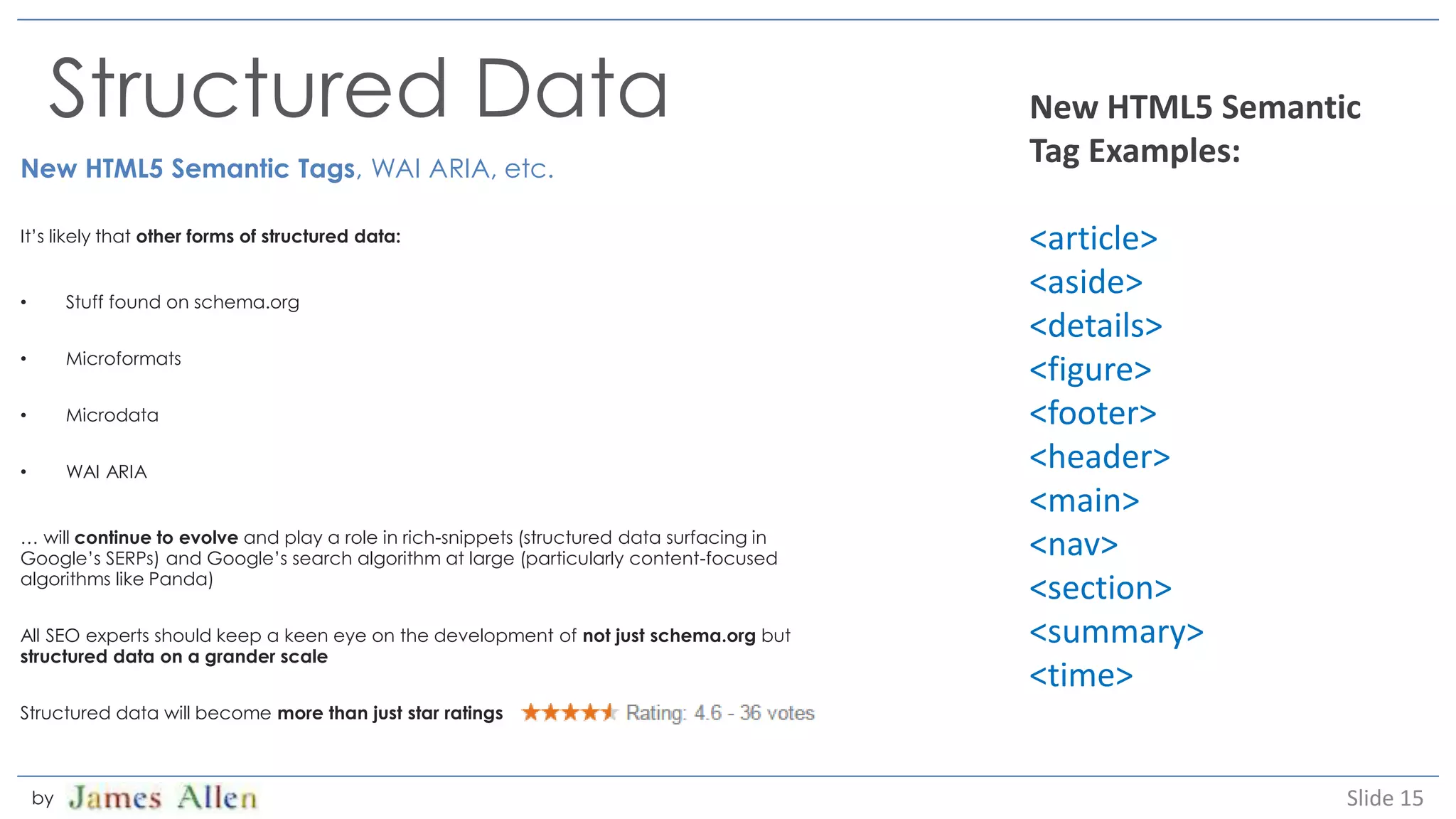
Structured data will become more than just star ratings
Slide 15by
New HTML5 Semantic
Tag Examples:
<article>
<aside>
<details>
<figure>
<footer>
<header>
<main>
<nav>
<section>
<summary>
<time>
Structured Data
Key Takeaway
Slide 16by
• Keep an eye on HTML5 introduced semantic tags
• Follow the evolution of Microdata, Microformats &
schema.org very closely
• Watch as Google’s rich snippets and Knowledge-graph
grow in size, scope, granularity and power
SEO for the 2015 / 2016 Period
Ubiquity
Slide 17by
Ubiquity
Device Ubiquity: It’s NOT all about ‘Mobile’
People are getting really lazy. They want to be using the same device wherever they are,
which is why the ‘tablet’ (iPad, etc) has become such a knock-out winner.
• An increasing amount of traffic comes from ‘mobile’ devices
• Although this is true, most of that traffic still comes from the home
• This means that it isn’t the ‘mobile’ nature of the devices which is causing them to be
so successful. Most mobile web-traffic doesn’t flow during transit
• The reason these smaller devices are so successful is that they are ubiquitous. You
can use the same device in your lounge as in your bedroom. Great! No multi-logging
required
Following the development of ‘Mobile’ is important, but the actual entity that is evolving
here is device-ubiquity and not the mobile market (which ubiquity is carrying, thusfar)
Because of device ubiquity, “responsive design” will outgrow and overtake parallel mobile
site design (‘m.’ sites, etc). Sites will have to be flexible across numerous devices including
mobile phones, tablets and whichever additional devices soon surface
Slide 18by
Ubiquity
Key Takeaway
Slide 19by
• Mobile is really important, especially with Google’s
upcoming Mobile Friendly update. But don’t lose focus on
the real digital evolution here, that of ubiquitous
experiences and devices
• Google may even match this with a fully responsive,
‘ubiquitous’ search platform. It’s possible that ‘mobile’
SERPs for mobile devices are just a stop-gap
Ubiquity
Key Takeaway
Slide 20by
• This will become even more true as mobile networks and
devices gain coverage, bandwidth and power
• Google will have to match a spectrum of devices. At the
moment “tablets” (especially the smaller ones) come under
‘mobile’ – but they usually use Wi-Fi (not 3g / 4g) so should
their search results factor page-load speed so significantly
as actual mobile phones? Tablet connections are closer to
desktop speeds
Ubiquity
Key Takeaway
Slide 21by
• Google are pushing responsive design over pre-set device-
specific parallel sites because they are down with ubiquity
• Responsive design (or responsive parallel sites) will be
able to best cope with the wide spectrum of devices and
screen sizes offered by device manufacturers
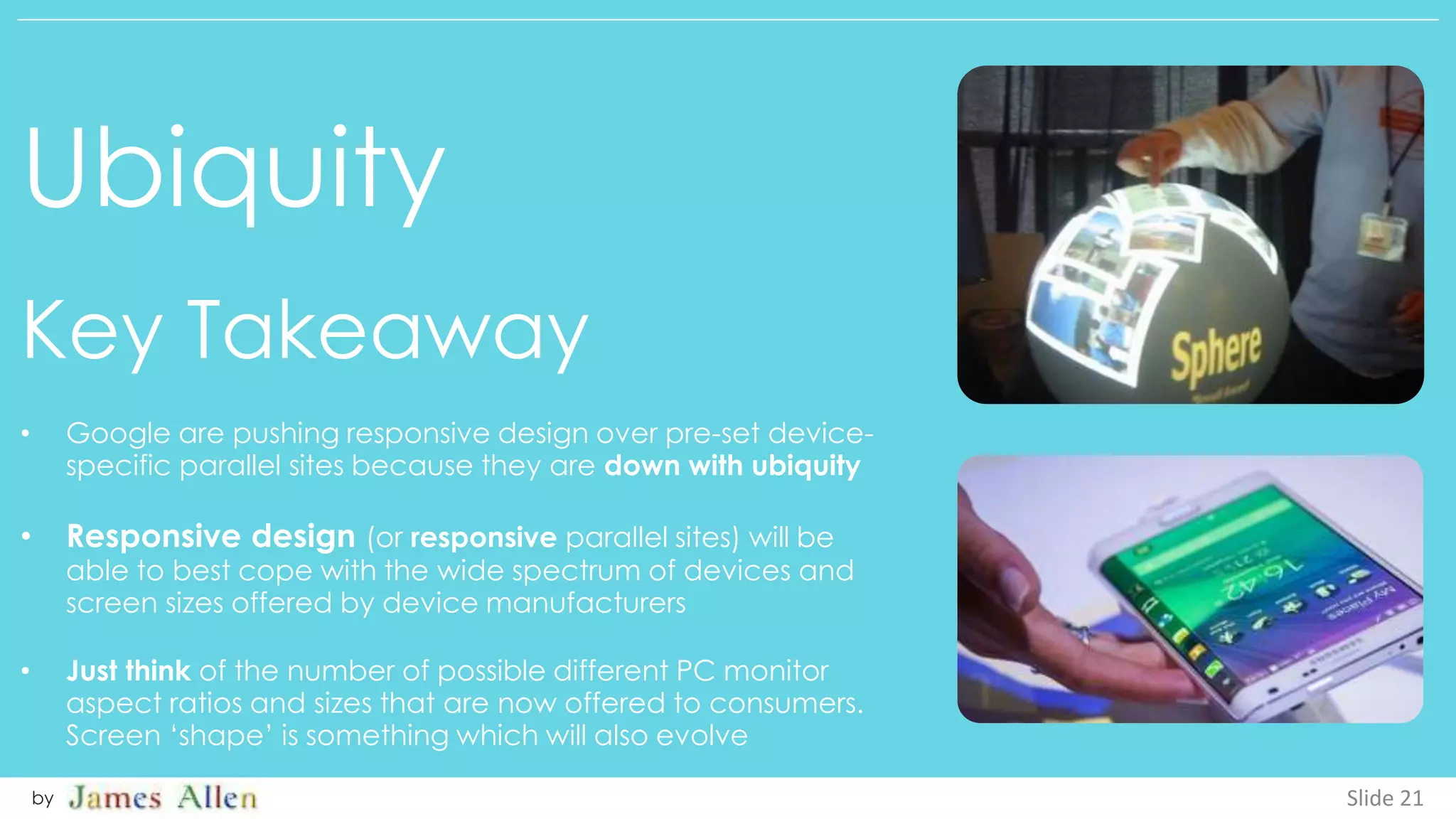
• Just think of the number of possible different PC monitor
aspect ratios and sizes that are now offered to consumers.
Screen ‘shape’ is something which will also evolve
Now that I’ve Taken
Everything a bit Bladerunner:
Are there any questions…?
Tweet me: @studiumcirclus
Slide 22by

SEO 2015 / Early 2016 Perspective & Strategy

  • 1.
    SEO for the2015 / 2016 Period Algorithm Updates Slide 1by
  • 2.
    Algorithm Updates Google AlgorithmTweaks & Changes • Panda is still prominent as ever. ‘Value-add’ is overtaking content (which is a medium to deliver value-add) in terms of focus for SEO, though obviously content will continue to deliver value-add. We’ll get to this later! • Penguin has been through many iterations and is now incrementally updated across query-spaces rather than having large, devastating refreshes • Penguin has made link-building very difficult for small and medium businesses since blogger- outreach was severely damaged in terms of SEO effectiveness • Large businesses with huge budgets can spend that money on SEO-creative instead. They can produce microsites and interesting campaigns which gain links naturally around the web. This avenue is not usually open to small / medium businesses • Pigeon expanded to further English speaking nations in December 2014 (Canada, Australia, UK). Pigeon has gradually been increasing the importance of local SEO factors and will continue to make Local SEO more and more important • Hummingbird continues to contextually interpret the web for Google. Keywords serve larger search entities, which have always existed (as ‘keyword buckets’) but now have renewed prominence Slide 2by
  • 3.
    Algorithm Updates Google AlgorithmTweaks & Changes • In some months Google will be resuming their relationship with Twitter. This was huge news! The return of real-time search heralds the first true connection point between SEO and social • Just as YouTube video titles can be edited so that they trigger in “how to” or temporally relevant video SERPs – will we be optimising individual tweets with the same goal in mind? It’s likely • In late April Google will be increasing the importance of mobile friendliness as a ranking factor. Google are advocating ‘responsive’ design over pre-set parallel mobile sites (‘m.’ etc.) • This will only impact Google’s mobile SERPs, but some clients draw huge amounts of traffic through mobile devices • As technology and the web become more ubiquitous, we can expect to see sites with really solid responsive design to fly • There are still some advantages of parallel mobile sites, such as the fact that not all of the content and resources have to be loaded. As mobile networks and devices become more powerful – this benefit will become obsolete. Responsive design is the way forward except in very specific circumstances Slide 3by
  • 4.
    SEO for the2015 / 2016 Period Link Building Slide 4by
  • 5.
    Link Building Making LinkBuilding Viable Again for Small / Medium Businesses Slide 5by This is the 'old-school' way of building links in SEO. Pay for sponsored/guest posts, get authority. Simple! Shame it doesn't work any more…
  • 6.
    Slide 6by Link BuildingThis is the new way of building links. Invest money in your content team, produce a feature-campaign on a sub-domain (micro-site) of your client's website, and watch the links pour in… This is great but it means we're not offering bloggers anything (so those relationships are drifting); also only larger brands can afford this work
  • 7.
    Slide 7by How aboutthis… Host 'micro' creative projects on blogger sites and online magazines. This could be a mini-subdomain /HTML5/CSS3 project or something as simple as an infographic (but done really well) - What does the blogger get? The blogger gets to use the resources of a digital company's creative department for free. This is sure to produce higher quality content than they could hope to post alone - Where does the money come from? The budget that would have otherwise been spent directly on links! - What's the 'SEO Risk'? This is less risky than huge client-site creative projects. Even if the project flops, you'll still get some inbound link- authority from the blogger's site - What's the 'SEO Benefit'? Because no money changes hands, the link can be editorial (followable). This is a joint project between the agency and the blogger, using relevant data (as the base for the content) from your client. The editorial link will be a citation saying that the work was produced in conjunction with your client, without whom the visualisation would not have been possible (it was your client's data that was used)
  • 8.
    SEO for the2015 / 2016 Period Content & Value Add Slide 8by
  • 9.
    Content & Value-Add ‘ValueAdd’ is King – The New Era of SEO • The phrase commonly touted by many who work in the SEO industry, “content is king” – somewhat misses the mark • Content is simply one medium through which value-add may be delivered to an audience • “Content is king” dates back to at least 1996 when Bill Gates wrote a post on the subject. This is actually a really old idea • There’s also a misconception that content is synonymous with text, it isn’t! • Content is anything on the web which can be digested by an end user. Even if Google can’t break into certain ‘flat’ content mediums (such as videos not hosted on YouTube, which don’t have annotations and embedded links) – Google can still gauge the popularity of that content using external metrics • Value add should be delivered through some form of digestible content. The content may be simplistic text and infographics, ‘moment’-based microsite campaigns or even a technical system such as a new, unique comparison engine • Google want to see new ideas and development on the web Slide 9by http://web.archive.org/web/20010126005200/http:// www.microsoft.com/billgates/columns/1996essay/es say960103.asp
  • 10.
    Content & Value-Add Whatdo We do in the ‘Value-Add Era’ of SEO? • Have an idea. This may be a new technical development to aggregate existing data on the web such as a comparison engine like Money Supermarket or Compare the Market. Don’t forget to leverage the client’s data for a new, web audience! • Has it been done before? If so – don’t bother. Think of ways to aggregate previously unexploited data (often from the client) which could be delivered to your target audience in a new way. Make it informative, educational or entertaining • Top broadcasting executive John Charles Walsham Reith (1st Baron Reith, 20 July 1889 – 16 June 1971) realised that it was every publisher’s obligation to “inform, educate, entertain” if they wished to survive. The days of ‘easy’ SEO and keyword stuffing are over. We are now technical experts with strong data-analysis skills. We can use this data to inform content and publishing (using search volumes, etc.) • Now we’re getting the picture. Content isn’t just <P> text! SEO is entering an analysis era where our research around search trends will inform our client’s products, media campaigns and content ideas (such as their microsites, blog posts, web development projects, comparison engines etc) • SEO should be embedded within the client’s overall marketing mix. SEO will become fully integrated and interact much more with PR, paid search, broadcasting etc. Embedded SEO which is data-centric is the way forward Slide 10by
  • 11.
    Content & ValueAdd Key Takeaway Slide 11by • SEO has changed, content for the sake of content was never what Google wanted • Don’t think about content without value-add • Content is anything which a search engine can determine as popular, digestible material through on or off-page metrics. Content can be technical development!
  • 12.
    Content & ValueAdd Key Takeaway Slide 12by • Have an idea, build something cool! • Combining our search data and insights with unexploited (on the web) client data will provide great SEO results • SEO is no longer a ‘bolt-on’ service. We need to integrate with other key marketing channels such as PR, Social, etc.
  • 13.
    SEO for the2015 / 2016 Period Structured Data Slide 13by
  • 14.
    Structured Data New HTML5Semantic Tags, WAI ARIA, etc. • We all know that Google have been using ‘semantic’ tags (such as <H1>, <li>, <strong>, <em>, <p> etc.) for a long time in SEO. With HTML5 comes a plethora of new semantic tags for Google to get their teeth into • There are also pre-existing attempts to get more semantic information into code by using classes and attributes (rather than tags) such as WAI ARIA. We know a lot of this was done for the sake of blind web-users, but it’s all contextual information Google could be using • Even if Google’s contextual use of conventions such as WAI ARIA is less likely, it’s very likely that Google will adopt some contextual interpretation of the new HTML5 semantic tags • We know this because Google have adopted almost all previously introduced semantic tags such as the famous <H1> and <H2> tags • Don’t forget that; technically speaking - <title> is also a semantic tag rather than ‘actual’ Meta data (like the Meta description) which is content contained within a <Meta> tag (rather than having a dedicated HTML tag of its own) Slide 14by New HTML5 Semantic Tag Examples: <article> <aside> <details> <figure> <footer> <header> <main> <nav> <section> <summary> <time>
  • 15.
    Structured Data New HTML5Semantic Tags, WAI ARIA, etc. It’s likely that other forms of structured data: • Stuff found on schema.org • Microformats • Microdata • WAI ARIA … will continue to evolve and play a role in rich-snippets (structured data surfacing in Google’s SERPs) and Google’s search algorithm at large (particularly content-focused algorithms like Panda) All SEO experts should keep a keen eye on the development of not just schema.org but structured data on a grander scale Structured data will become more than just star ratings Slide 15by New HTML5 Semantic Tag Examples: <article> <aside> <details> <figure> <footer> <header> <main> <nav> <section> <summary> <time>
  • 16.
    Structured Data Key Takeaway Slide16by • Keep an eye on HTML5 introduced semantic tags • Follow the evolution of Microdata, Microformats & schema.org very closely • Watch as Google’s rich snippets and Knowledge-graph grow in size, scope, granularity and power
  • 17.
    SEO for the2015 / 2016 Period Ubiquity Slide 17by
  • 18.
    Ubiquity Device Ubiquity: It’sNOT all about ‘Mobile’ People are getting really lazy. They want to be using the same device wherever they are, which is why the ‘tablet’ (iPad, etc) has become such a knock-out winner. • An increasing amount of traffic comes from ‘mobile’ devices • Although this is true, most of that traffic still comes from the home • This means that it isn’t the ‘mobile’ nature of the devices which is causing them to be so successful. Most mobile web-traffic doesn’t flow during transit • The reason these smaller devices are so successful is that they are ubiquitous. You can use the same device in your lounge as in your bedroom. Great! No multi-logging required Following the development of ‘Mobile’ is important, but the actual entity that is evolving here is device-ubiquity and not the mobile market (which ubiquity is carrying, thusfar) Because of device ubiquity, “responsive design” will outgrow and overtake parallel mobile site design (‘m.’ sites, etc). Sites will have to be flexible across numerous devices including mobile phones, tablets and whichever additional devices soon surface Slide 18by
  • 19.
    Ubiquity Key Takeaway Slide 19by •Mobile is really important, especially with Google’s upcoming Mobile Friendly update. But don’t lose focus on the real digital evolution here, that of ubiquitous experiences and devices • Google may even match this with a fully responsive, ‘ubiquitous’ search platform. It’s possible that ‘mobile’ SERPs for mobile devices are just a stop-gap
  • 20.
    Ubiquity Key Takeaway Slide 20by •This will become even more true as mobile networks and devices gain coverage, bandwidth and power • Google will have to match a spectrum of devices. At the moment “tablets” (especially the smaller ones) come under ‘mobile’ – but they usually use Wi-Fi (not 3g / 4g) so should their search results factor page-load speed so significantly as actual mobile phones? Tablet connections are closer to desktop speeds
  • 21.
    Ubiquity Key Takeaway Slide 21by •Google are pushing responsive design over pre-set device- specific parallel sites because they are down with ubiquity • Responsive design (or responsive parallel sites) will be able to best cope with the wide spectrum of devices and screen sizes offered by device manufacturers • Just think of the number of possible different PC monitor aspect ratios and sizes that are now offered to consumers. Screen ‘shape’ is something which will also evolve
  • 22.
    Now that I’veTaken Everything a bit Bladerunner: Are there any questions…? Tweet me: @studiumcirclus Slide 22by