03/25/2009 23:59


                   Multivalued Dependencies

                       Fourth Normal Form
                   Reasoning About FD’s + MVD’s


                                                                 1


03/25/2009 23:59


                       Definition of MVD
         !   A multivalued dependency (MVD) on R,
             X!!Y , says that if two tuples of R agree on
             all the attributes of X, then their components in
             Y may be swapped, and the result will be two
             tuples that are also in the relation.
         !   i.e., for each value of X, the values of Y are
             independent of the values of R-X-Y.


                                                                 2
03/25/2009 23:59


                                  Example: MVD
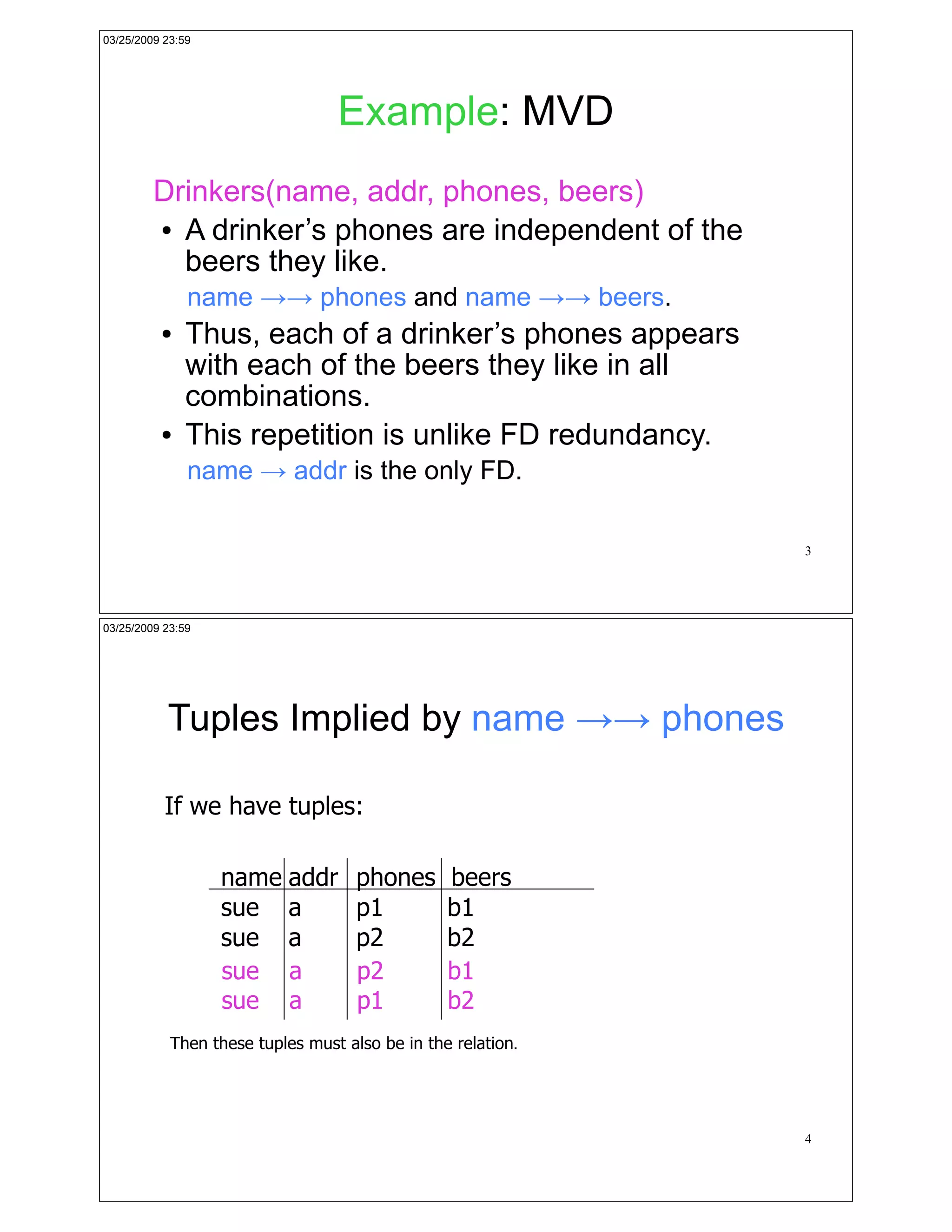
         Drinkers(name, addr, phones, beers)
         ! A drinker’s phones are independent of the

           beers they like.
               name !! phones and name !! beers.
          !   Thus, each of a drinker’s phones appears
              with each of the beers they like in all
              combinations.
          !   This repetition is unlike FD redundancy.
               name ! addr is the only FD.

                                                              3


03/25/2009 23:59


           Tuples Implied by name !! phones

           If we have tuples:

                   name addr         phones      beers
                   sue a             p1          b1
                   sue a             p2          b2
                   sue a             p2          b1
                   sue a             p1          b2
            Then these tuples must also be in the relation.


                                                              4
03/25/2009 23:59


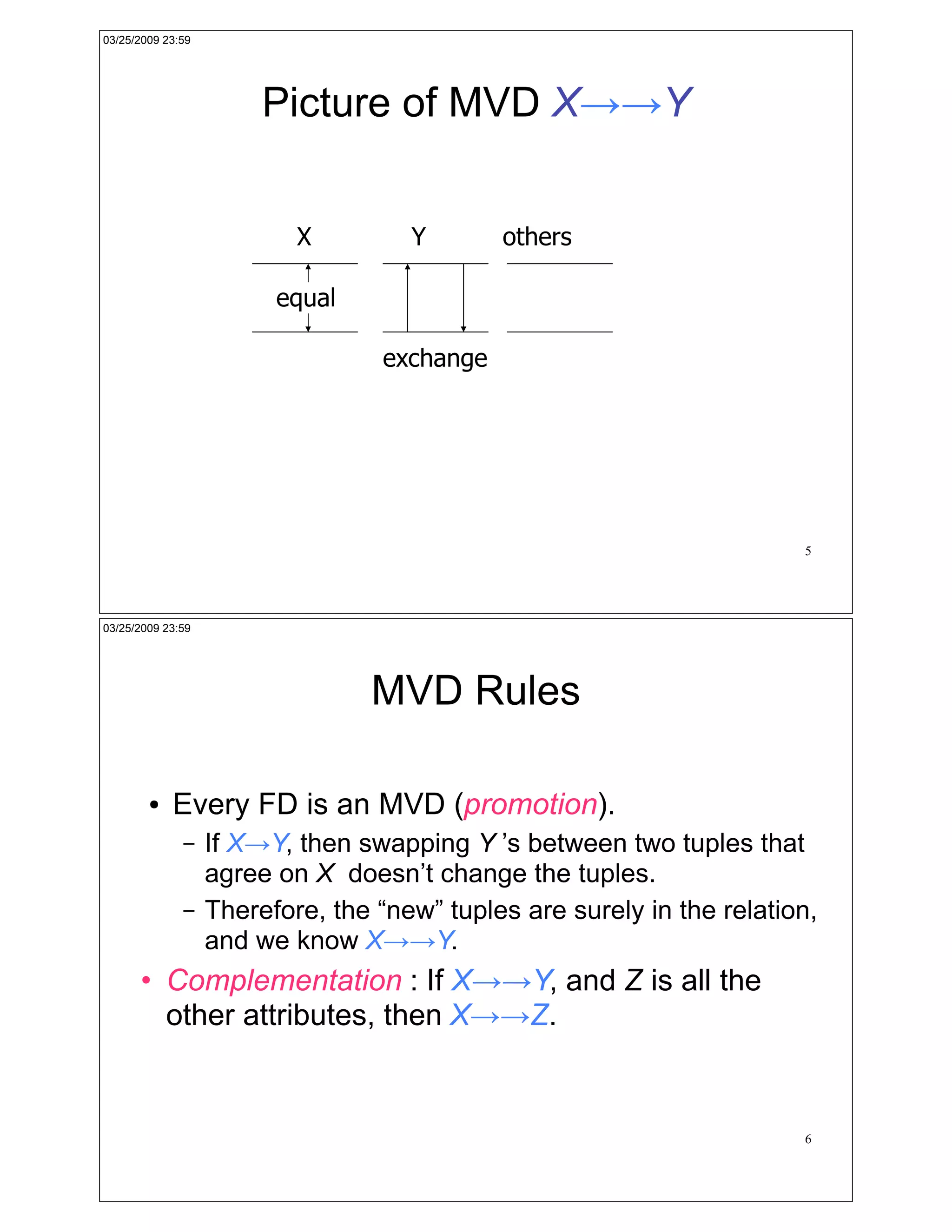
                        Picture of MVD X!!Y


                           X         Y       others

                         equal

                                  exchange


                                                                        5


03/25/2009 23:59


                                 MVD Rules

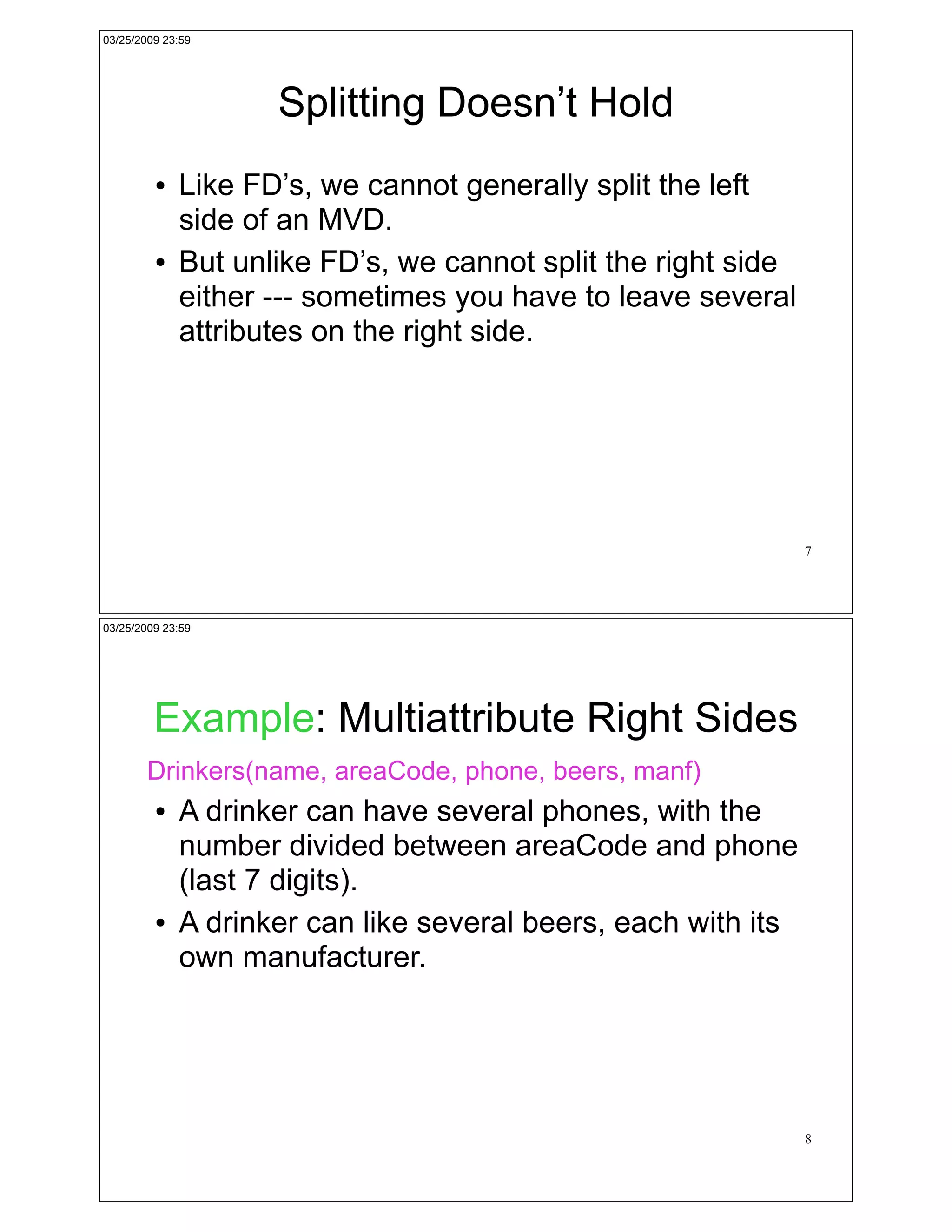
        !   Every FD is an MVD (promotion).
              –    If X!Y, then swapping Y ’s between two tuples that
                   agree on X doesn’t change the tuples.
              –    Therefore, the “new” tuples are surely in the relation,
                   and we know X!!Y.
      • Complementation : If X!!Y, and Z is all the
        other attributes, then X!!Z.


                                                                        6
03/25/2009 23:59


                    Splitting Doesn’t Hold
         !   Like FD’s, we cannot generally split the left
             side of an MVD.
         !   But unlike FD’s, we cannot split the right side
             either --- sometimes you have to leave several
             attributes on the right side.


                                                               7


03/25/2009 23:59


         Example: Multiattribute Right Sides
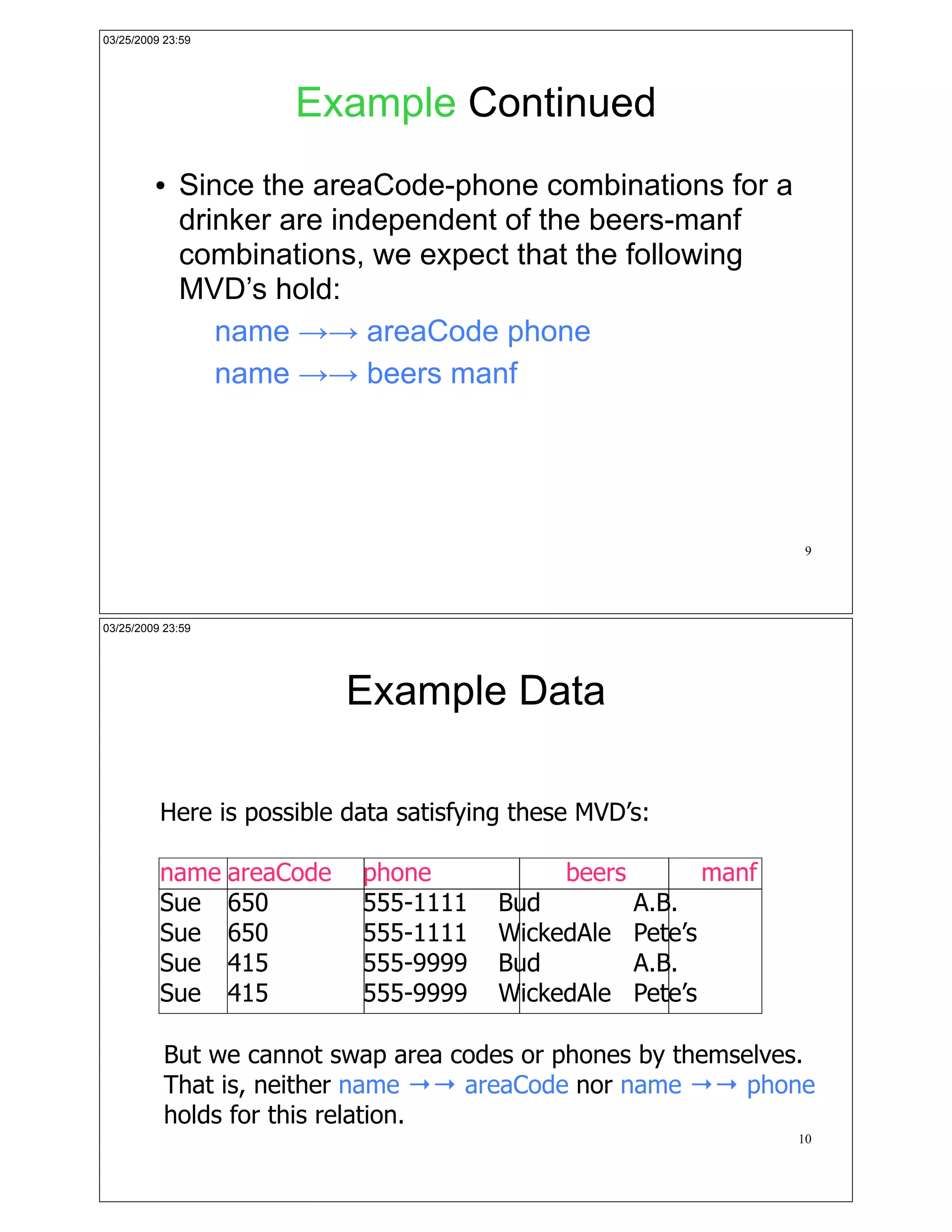
        Drinkers(name, areaCode, phone, beers, manf)
         !   A drinker can have several phones, with the
             number divided between areaCode and phone
             (last 7 digits).
         !   A drinker can like several beers, each with its
             own manufacturer.


                                                               8
03/25/2009 23:59


                      Example Continued
         !   Since the areaCode-phone combinations for a
             drinker are independent of the beers-manf
             combinations, we expect that the following
             MVD’s hold:
                name !! areaCode phone
                name !! beers manf


                                                                        9


03/25/2009 23:59


                           Example Data

          Here is possible data satisfying these MVD’s:

          name areaCode     phone              beers            manf
          Sue 650           555-1111     Bud           A.B.
          Sue 650           555-1111     WickedAle     Pete’s
          Sue 415           555-9999     Bud           A.B.
          Sue 415           555-9999     WickedAle     Pete’s

           But we cannot swap area codes or phones by themselves.
           That is, neither name !! areaCode nor name !! phone
           holds for this relation.
                                                                       10
03/25/2009 23:59


                            Fourth Normal Form
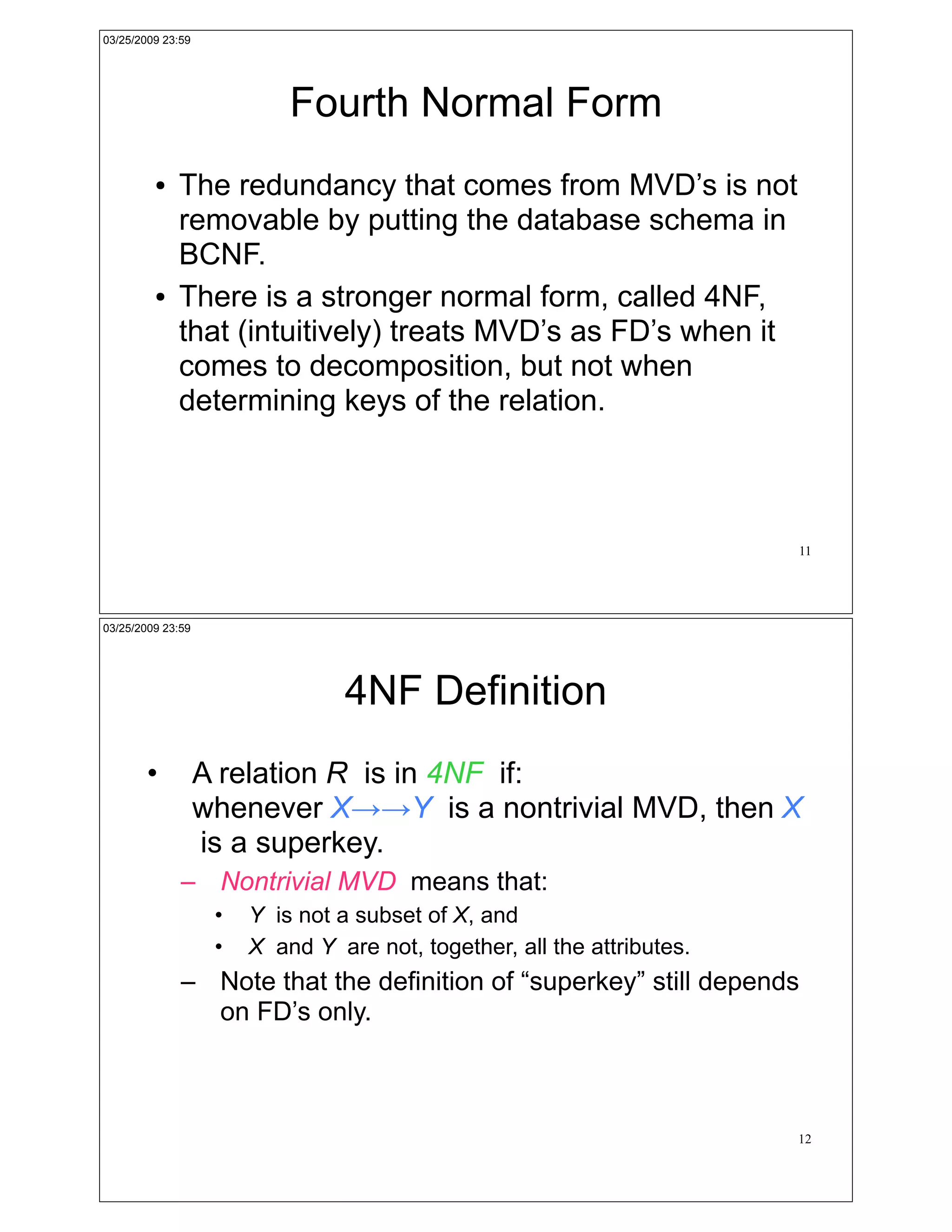
         !   The redundancy that comes from MVD’s is not
             removable by putting the database schema in
             BCNF.
         !   There is a stronger normal form, called 4NF,
             that (intuitively) treats MVD’s as FD’s when it
             comes to decomposition, but not when
             determining keys of the relation.


                                                                         11


03/25/2009 23:59


                                  4NF Definition
        •          A relation R is in 4NF if:
                   whenever X!!Y is a nontrivial MVD, then X
                   is a superkey.
              – Nontrivial MVD means that:
                    •   Y is not a subset of X, and
                    •   X and Y are not, together, all the attributes.
              – Note that the definition of “superkey” still depends
                on FD’s only.


                                                                         12
03/25/2009 23:59


                              BCNF Versus 4NF

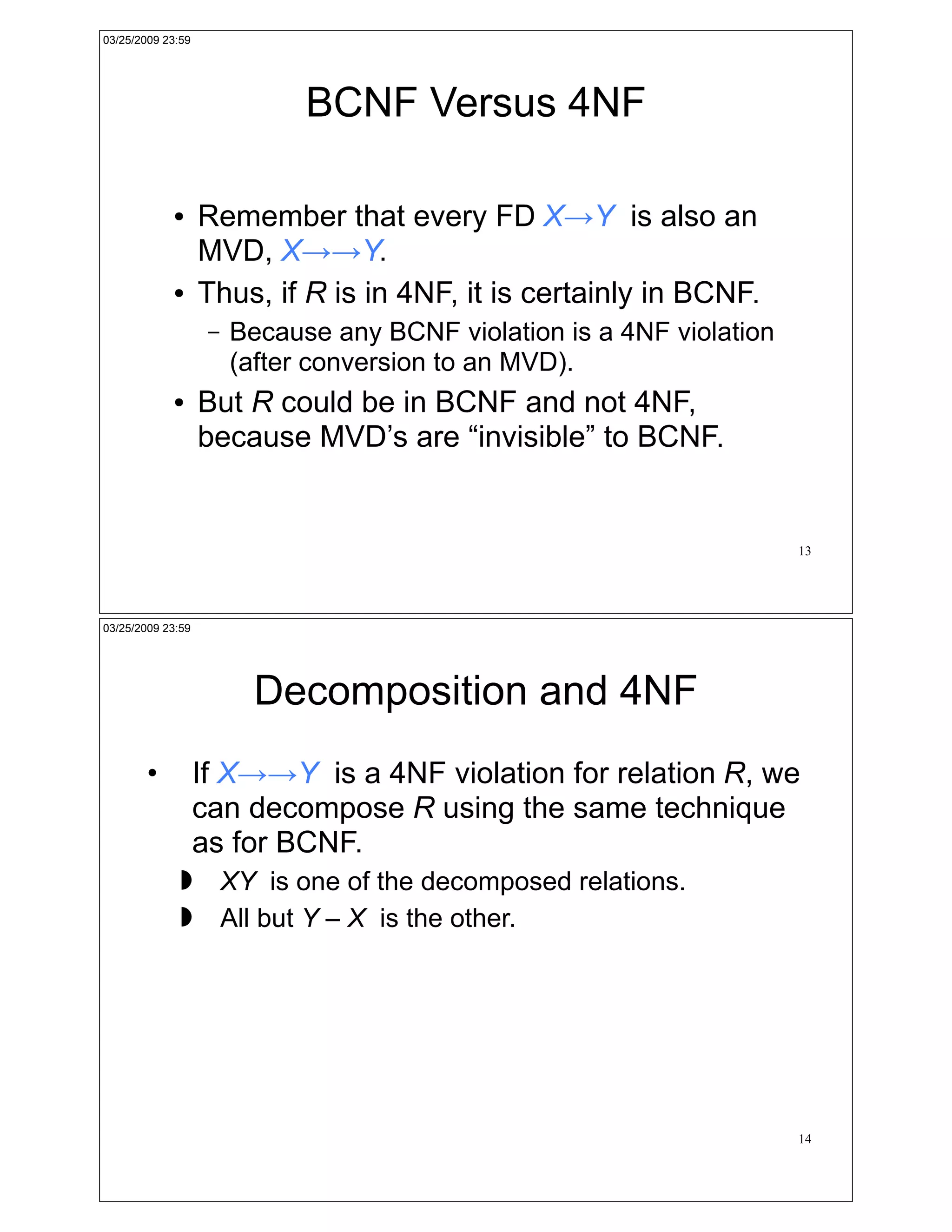
            !      Remember that every FD X!Y is also an
                   MVD, X!!Y.
            !      Thus, if R is in 4NF, it is certainly in BCNF.
                    –   Because any BCNF violation is a 4NF violation
                        (after conversion to an MVD).
            !      But R could be in BCNF and not 4NF,
                   because MVD’s are “invisible” to BCNF.


                                                                        13


03/25/2009 23:59


                          Decomposition and 4NF
        •          If X!!Y is a 4NF violation for relation R, we
                   can decompose R using the same technique
                   as for BCNF.
              !         XY is one of the decomposed relations.
              !         All but Y – X is the other.


                                                                        14
03/25/2009 23:59


                   Example: 4NF Decomposition
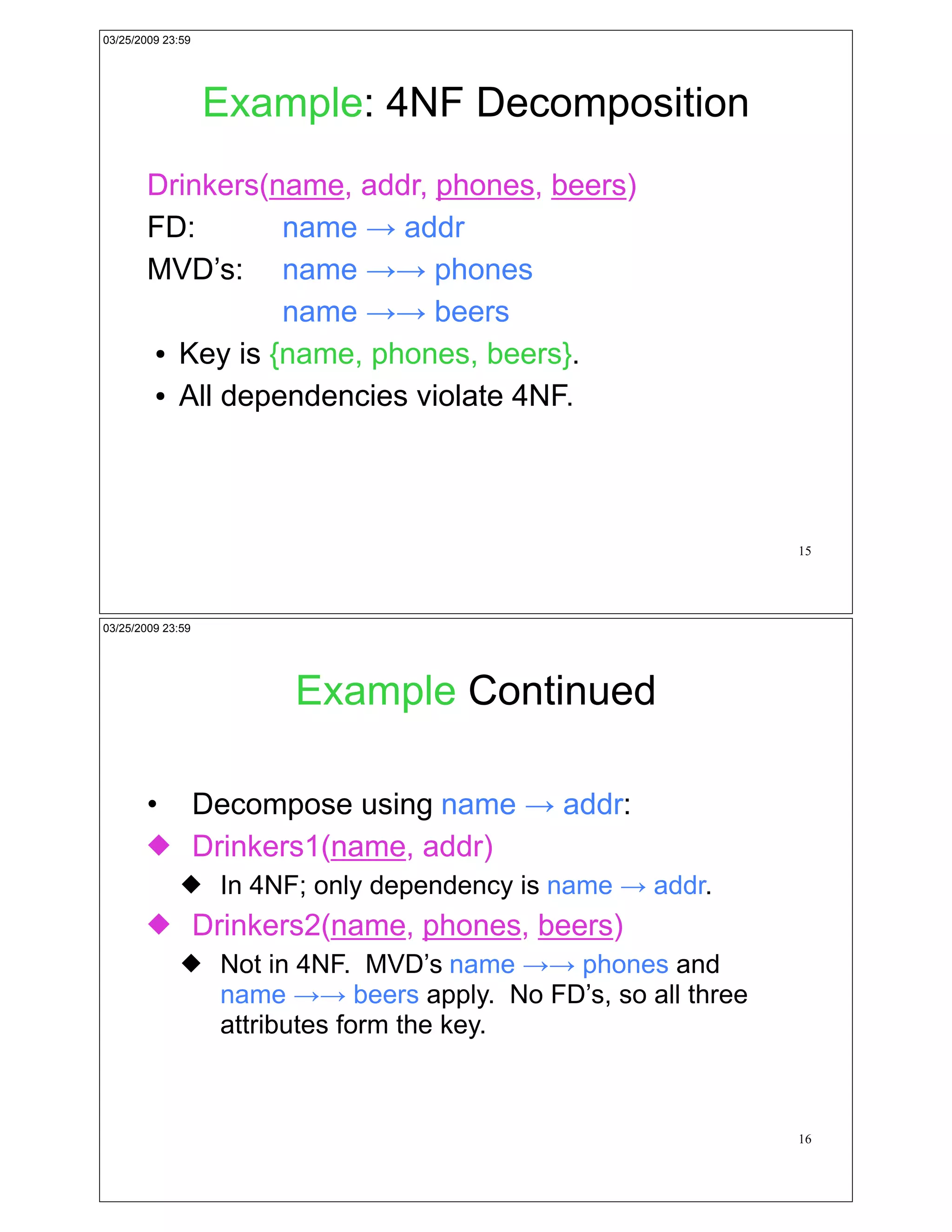
        Drinkers(name, addr, phones, beers)
        FD:       name ! addr
        MVD’s: name !! phones
                  name !! beers
        ! Key is {name, phones, beers}.


        ! All dependencies violate 4NF.


                                                             15


03/25/2009 23:59


                       Example Continued

        • Decompose using name ! addr:
        " Drinkers1(name, addr)
              " In 4NF; only dependency is name ! addr.
        " Drinkers2(name, phones, beers)
              " Not in 4NF. MVD’s name !! phones and
                name !! beers apply. No FD’s, so all three
                attributes form the key.


                                                             16
03/25/2009 23:59


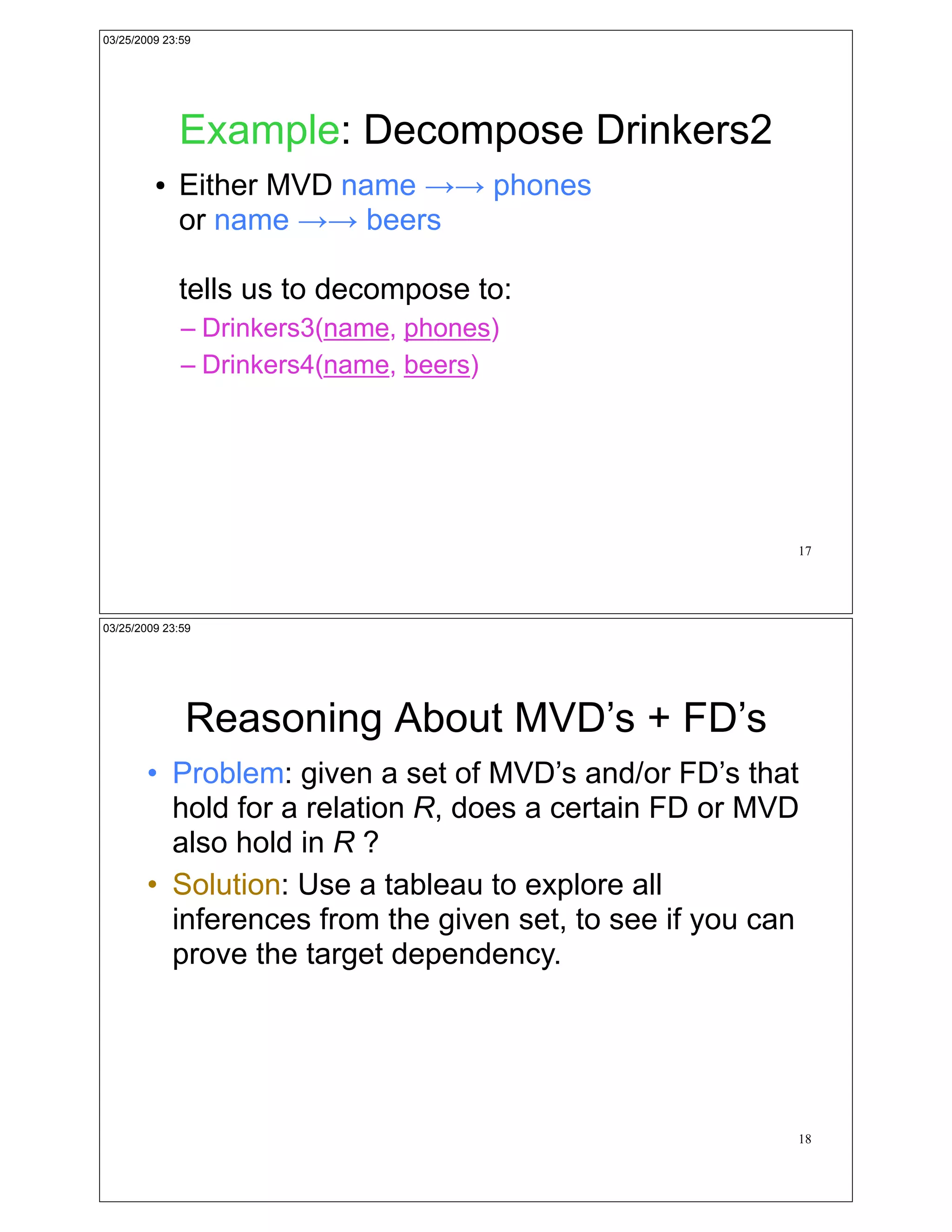
             Example: Decompose Drinkers2
         !   Either MVD name !! phones
             or name !! beers

             tells us to decompose to:
              – Drinkers3(name, phones)
              – Drinkers4(name, beers)


                                                         17


03/25/2009 23:59


              Reasoning About MVD’s + FD’s
        • Problem: given a set of MVD’s and/or FD’s that
          hold for a relation R, does a certain FD or MVD
          also hold in R ?
        • Solution: Use a tableau to explore all
          inferences from the given set, to see if you can
          prove the target dependency.


                                                         18
03/25/2009 23:59


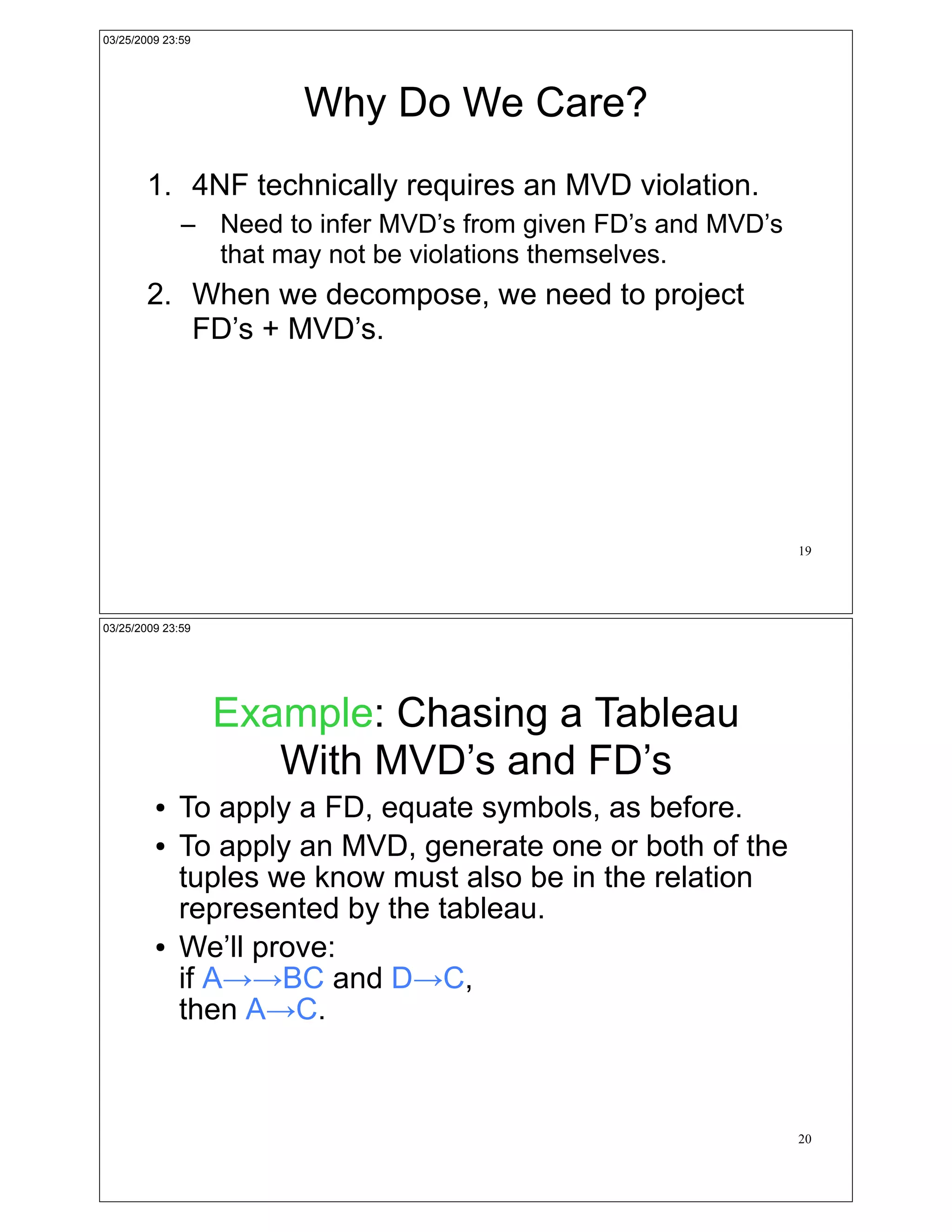
                       Why Do We Care?
        1. 4NF technically requires an MVD violation.
              – Need to infer MVD’s from given FD’s and MVD’s
                that may not be violations themselves.
        2. When we decompose, we need to project
           FD’s + MVD’s.


                                                                19


03/25/2009 23:59


                   Example: Chasing a Tableau
                      With MVD’s and FD’s
         !   To apply a FD, equate symbols, as before.
         !   To apply an MVD, generate one or both of the
             tuples we know must also be in the relation
             represented by the tableau.
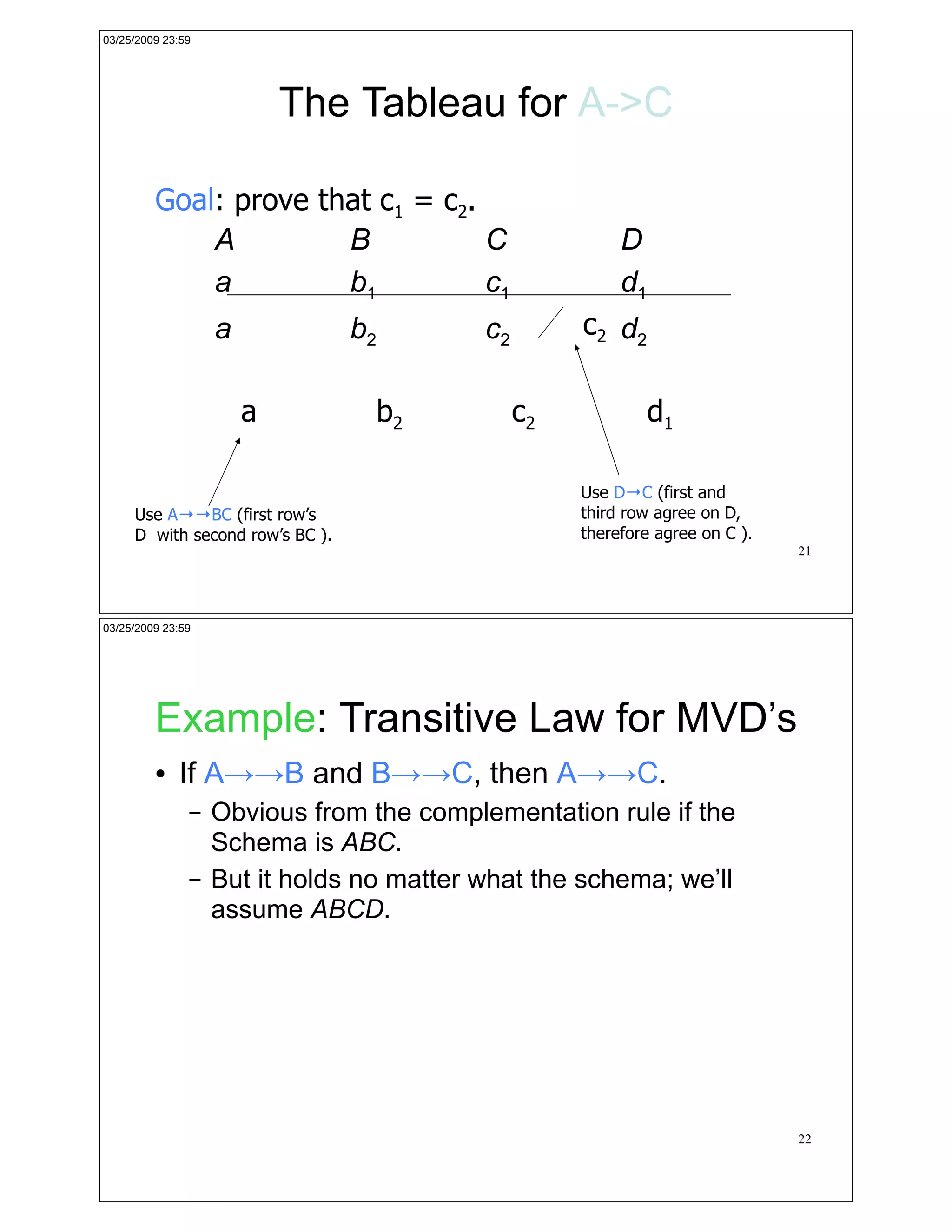
         !   We’ll prove:
             if A!!BC and D!C,
             then A!C.


                                                                20
03/25/2009 23:59


                           The Tableau for A->C

         Goal: prove that c1 = c2.
             A         B           C                      D
             a         b1          c1                     d1
                   a             b2        c2        c2 d2

                       a              b2        c2             d1

                                                     Use D!C (first and
     Use A!!BC (first row’s                          third row agree on D,
     D with second row’s BC ).                       therefore agree on C ).
                                                                               21


03/25/2009 23:59


         Example: Transitive Law for MVD’s
         !   If A!!B and B!!C, then A!!C.
               –   Obvious from the complementation rule if the
                   Schema is ABC.
               –   But it holds no matter what the schema; we’ll
                   assume ABCD.


                                                                               22
03/25/2009 23:59


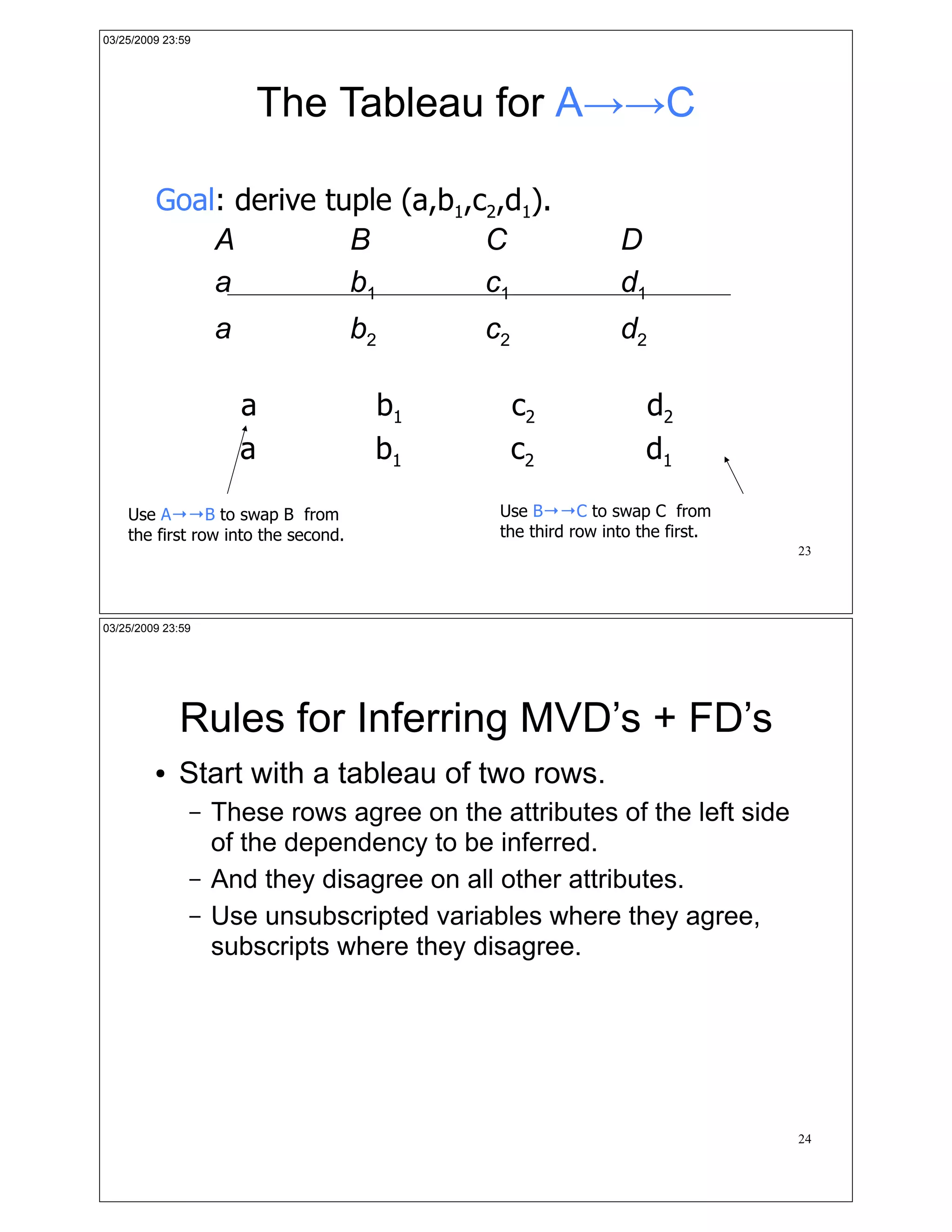
                       The Tableau for A!!C

         Goal: derive tuple (a,b1,c2,d1).
             A          B          C                        D
             a          b1         c1                       d1
                   a                 b2    c2               d2

                       a              b1        c2              d2
                       a              b1        c2              d1

    Use A!!B to swap B from                 Use B!!C to swap C from
    the first row into the second.          the third row into the first.
                                                                            23


03/25/2009 23:59


             Rules for Inferring MVD’s + FD’s
         !   Start with a tableau of two rows.
               –   These rows agree on the attributes of the left side
                   of the dependency to be inferred.
               –   And they disagree on all other attributes.
               –   Use unsubscripted variables where they agree,
                   subscripts where they disagree.


                                                                            24
03/25/2009 23:59


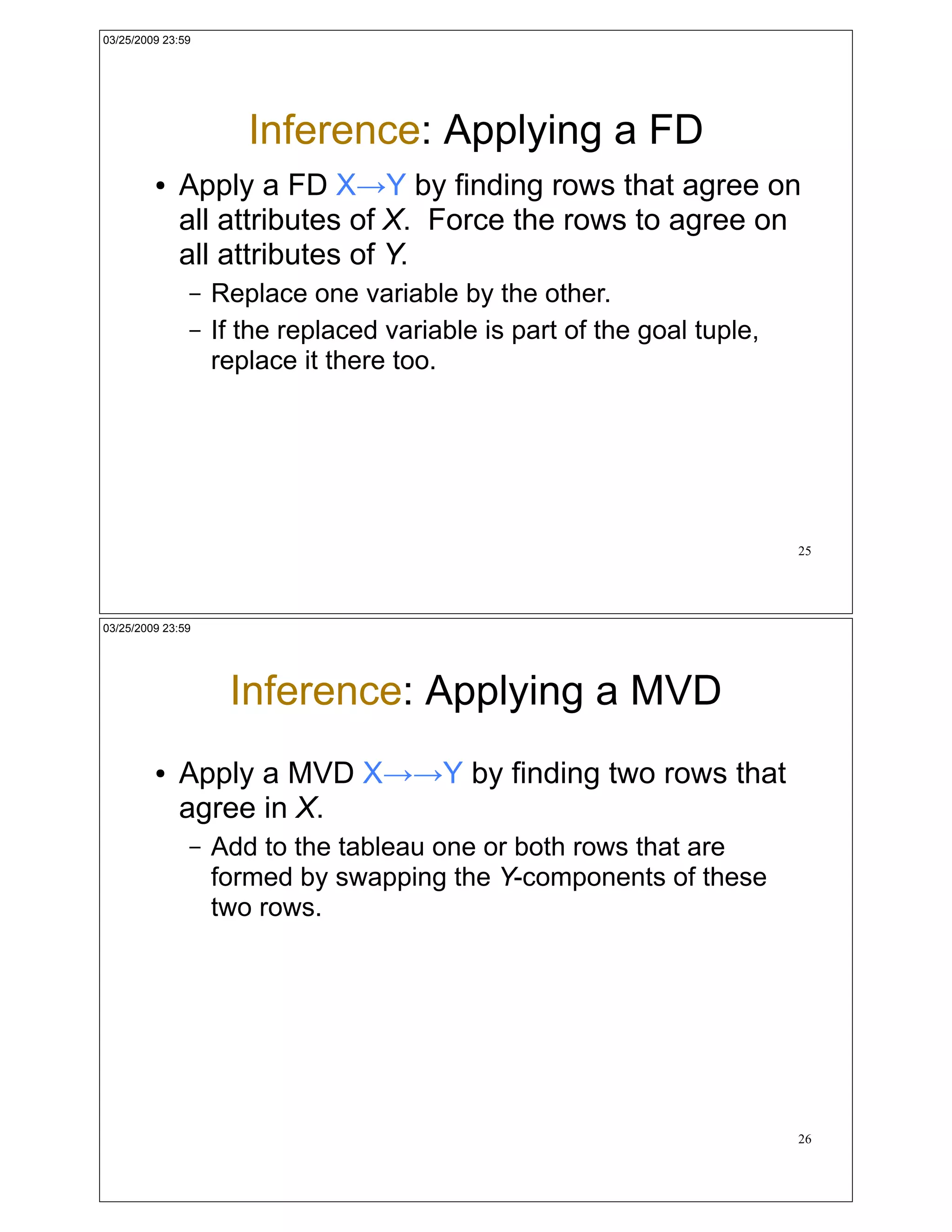
                      Inference: Applying a FD
         !   Apply a FD X!Y by finding rows that agree on
             all attributes of X. Force the rows to agree on
             all attributes of Y.
               –   Replace one variable by the other.
               –   If the replaced variable is part of the goal tuple,
                   replace it there too.


                                                                         25


03/25/2009 23:59


                    Inference: Applying a MVD
         !   Apply a MVD X!!Y by finding two rows that
             agree in X.
               –   Add to the tableau one or both rows that are
                   formed by swapping the Y-components of these
                   two rows.


                                                                         26
03/25/2009 23:59


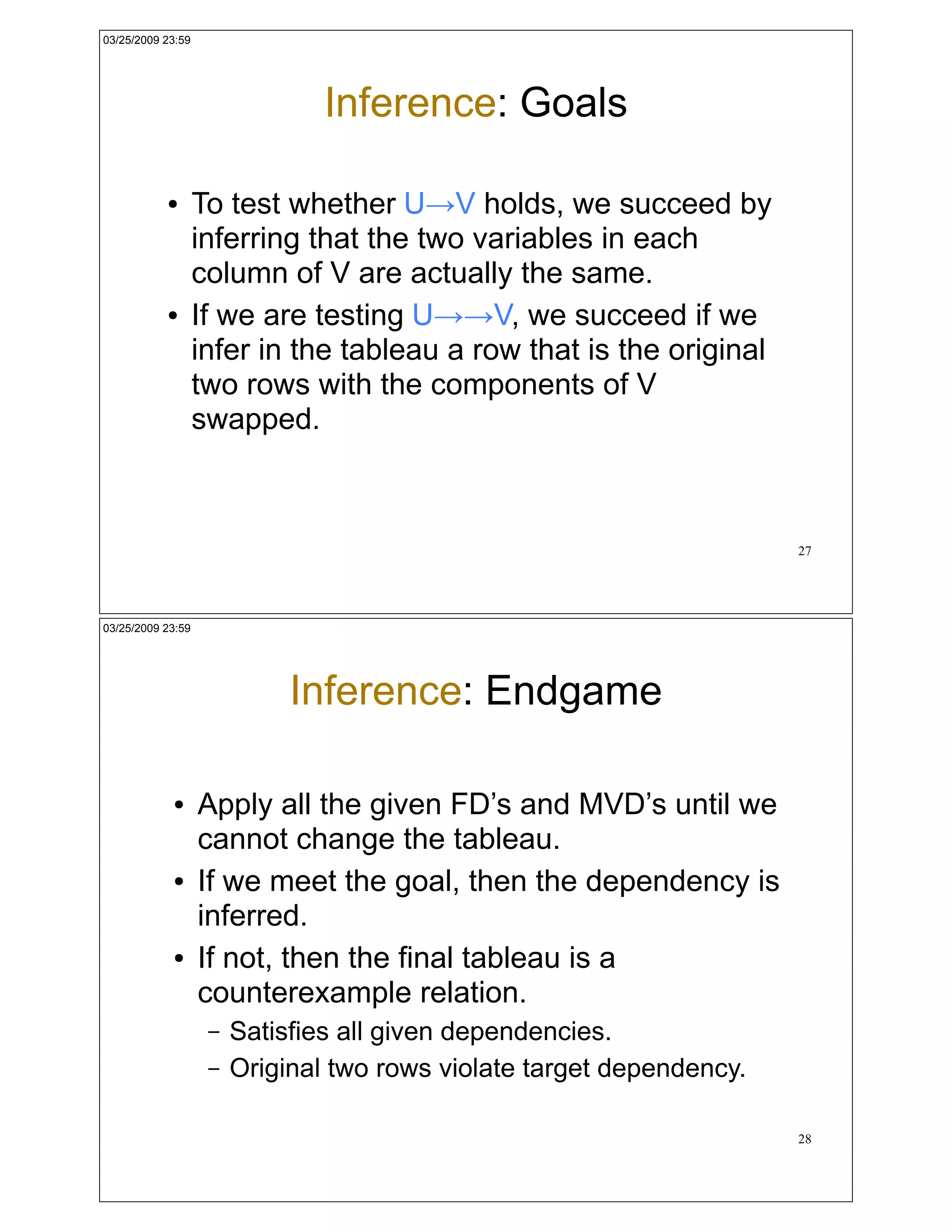
                                Inference: Goals

           !       To test whether U!V holds, we succeed by
                   inferring that the two variables in each
                   column of V are actually the same.
           !       If we are testing U!!V, we succeed if we
                   infer in the tableau a row that is the original
                   two rows with the components of V
                   swapped.


                                                                       27


03/25/2009 23:59


                             Inference: Endgame

            !      Apply all the given FD’s and MVD’s until we
                   cannot change the tableau.
            !      If we meet the goal, then the dependency is
                   inferred.
            !      If not, then the final tableau is a
                   counterexample relation.
                    –   Satisfies all given dependencies.
                    –   Original two rows violate target dependency.

                                                                       28

Multi Valued Dependency

  • 1.
    03/25/2009 23:59 Multivalued Dependencies Fourth Normal Form Reasoning About FD’s + MVD’s 1 03/25/2009 23:59 Definition of MVD ! A multivalued dependency (MVD) on R, X!!Y , says that if two tuples of R agree on all the attributes of X, then their components in Y may be swapped, and the result will be two tuples that are also in the relation. ! i.e., for each value of X, the values of Y are independent of the values of R-X-Y. 2
  • 2.
    03/25/2009 23:59 Example: MVD Drinkers(name, addr, phones, beers) ! A drinker’s phones are independent of the beers they like. name !! phones and name !! beers. ! Thus, each of a drinker’s phones appears with each of the beers they like in all combinations. ! This repetition is unlike FD redundancy. name ! addr is the only FD. 3 03/25/2009 23:59 Tuples Implied by name !! phones If we have tuples: name addr phones beers sue a p1 b1 sue a p2 b2 sue a p2 b1 sue a p1 b2 Then these tuples must also be in the relation. 4
  • 3.
    03/25/2009 23:59 Picture of MVD X!!Y X Y others equal exchange 5 03/25/2009 23:59 MVD Rules ! Every FD is an MVD (promotion). – If X!Y, then swapping Y ’s between two tuples that agree on X doesn’t change the tuples. – Therefore, the “new” tuples are surely in the relation, and we know X!!Y. • Complementation : If X!!Y, and Z is all the other attributes, then X!!Z. 6
  • 4.
    03/25/2009 23:59 Splitting Doesn’t Hold ! Like FD’s, we cannot generally split the left side of an MVD. ! But unlike FD’s, we cannot split the right side either --- sometimes you have to leave several attributes on the right side. 7 03/25/2009 23:59 Example: Multiattribute Right Sides Drinkers(name, areaCode, phone, beers, manf) ! A drinker can have several phones, with the number divided between areaCode and phone (last 7 digits). ! A drinker can like several beers, each with its own manufacturer. 8
  • 5.
    03/25/2009 23:59 Example Continued ! Since the areaCode-phone combinations for a drinker are independent of the beers-manf combinations, we expect that the following MVD’s hold: name !! areaCode phone name !! beers manf 9 03/25/2009 23:59 Example Data Here is possible data satisfying these MVD’s: name areaCode phone beers manf Sue 650 555-1111 Bud A.B. Sue 650 555-1111 WickedAle Pete’s Sue 415 555-9999 Bud A.B. Sue 415 555-9999 WickedAle Pete’s But we cannot swap area codes or phones by themselves. That is, neither name !! areaCode nor name !! phone holds for this relation. 10
  • 6.
    03/25/2009 23:59 Fourth Normal Form ! The redundancy that comes from MVD’s is not removable by putting the database schema in BCNF. ! There is a stronger normal form, called 4NF, that (intuitively) treats MVD’s as FD’s when it comes to decomposition, but not when determining keys of the relation. 11 03/25/2009 23:59 4NF Definition • A relation R is in 4NF if: whenever X!!Y is a nontrivial MVD, then X is a superkey. – Nontrivial MVD means that: • Y is not a subset of X, and • X and Y are not, together, all the attributes. – Note that the definition of “superkey” still depends on FD’s only. 12
  • 7.
    03/25/2009 23:59 BCNF Versus 4NF ! Remember that every FD X!Y is also an MVD, X!!Y. ! Thus, if R is in 4NF, it is certainly in BCNF. – Because any BCNF violation is a 4NF violation (after conversion to an MVD). ! But R could be in BCNF and not 4NF, because MVD’s are “invisible” to BCNF. 13 03/25/2009 23:59 Decomposition and 4NF • If X!!Y is a 4NF violation for relation R, we can decompose R using the same technique as for BCNF. ! XY is one of the decomposed relations. ! All but Y – X is the other. 14
  • 8.
    03/25/2009 23:59 Example: 4NF Decomposition Drinkers(name, addr, phones, beers) FD: name ! addr MVD’s: name !! phones name !! beers ! Key is {name, phones, beers}. ! All dependencies violate 4NF. 15 03/25/2009 23:59 Example Continued • Decompose using name ! addr: " Drinkers1(name, addr) " In 4NF; only dependency is name ! addr. " Drinkers2(name, phones, beers) " Not in 4NF. MVD’s name !! phones and name !! beers apply. No FD’s, so all three attributes form the key. 16
  • 9.
    03/25/2009 23:59 Example: Decompose Drinkers2 ! Either MVD name !! phones or name !! beers tells us to decompose to: – Drinkers3(name, phones) – Drinkers4(name, beers) 17 03/25/2009 23:59 Reasoning About MVD’s + FD’s • Problem: given a set of MVD’s and/or FD’s that hold for a relation R, does a certain FD or MVD also hold in R ? • Solution: Use a tableau to explore all inferences from the given set, to see if you can prove the target dependency. 18
  • 10.
    03/25/2009 23:59 Why Do We Care? 1. 4NF technically requires an MVD violation. – Need to infer MVD’s from given FD’s and MVD’s that may not be violations themselves. 2. When we decompose, we need to project FD’s + MVD’s. 19 03/25/2009 23:59 Example: Chasing a Tableau With MVD’s and FD’s ! To apply a FD, equate symbols, as before. ! To apply an MVD, generate one or both of the tuples we know must also be in the relation represented by the tableau. ! We’ll prove: if A!!BC and D!C, then A!C. 20
  • 11.
    03/25/2009 23:59 The Tableau for A->C Goal: prove that c1 = c2. A B C D a b1 c1 d1 a b2 c2 c2 d2 a b2 c2 d1 Use D!C (first and Use A!!BC (first row’s third row agree on D, D with second row’s BC ). therefore agree on C ). 21 03/25/2009 23:59 Example: Transitive Law for MVD’s ! If A!!B and B!!C, then A!!C. – Obvious from the complementation rule if the Schema is ABC. – But it holds no matter what the schema; we’ll assume ABCD. 22
  • 12.
    03/25/2009 23:59 The Tableau for A!!C Goal: derive tuple (a,b1,c2,d1). A B C D a b1 c1 d1 a b2 c2 d2 a b1 c2 d2 a b1 c2 d1 Use A!!B to swap B from Use B!!C to swap C from the first row into the second. the third row into the first. 23 03/25/2009 23:59 Rules for Inferring MVD’s + FD’s ! Start with a tableau of two rows. – These rows agree on the attributes of the left side of the dependency to be inferred. – And they disagree on all other attributes. – Use unsubscripted variables where they agree, subscripts where they disagree. 24
  • 13.
    03/25/2009 23:59 Inference: Applying a FD ! Apply a FD X!Y by finding rows that agree on all attributes of X. Force the rows to agree on all attributes of Y. – Replace one variable by the other. – If the replaced variable is part of the goal tuple, replace it there too. 25 03/25/2009 23:59 Inference: Applying a MVD ! Apply a MVD X!!Y by finding two rows that agree in X. – Add to the tableau one or both rows that are formed by swapping the Y-components of these two rows. 26
  • 14.
    03/25/2009 23:59 Inference: Goals ! To test whether U!V holds, we succeed by inferring that the two variables in each column of V are actually the same. ! If we are testing U!!V, we succeed if we infer in the tableau a row that is the original two rows with the components of V swapped. 27 03/25/2009 23:59 Inference: Endgame ! Apply all the given FD’s and MVD’s until we cannot change the tableau. ! If we meet the goal, then the dependency is inferred. ! If not, then the final tableau is a counterexample relation. – Satisfies all given dependencies. – Original two rows violate target dependency. 28