




Jesse Yates
 Salesforce.com


                  Secondary Indexing

                   the discussion so far….


9/11/12                                      HBase Pow-wow
What is it?
Problem
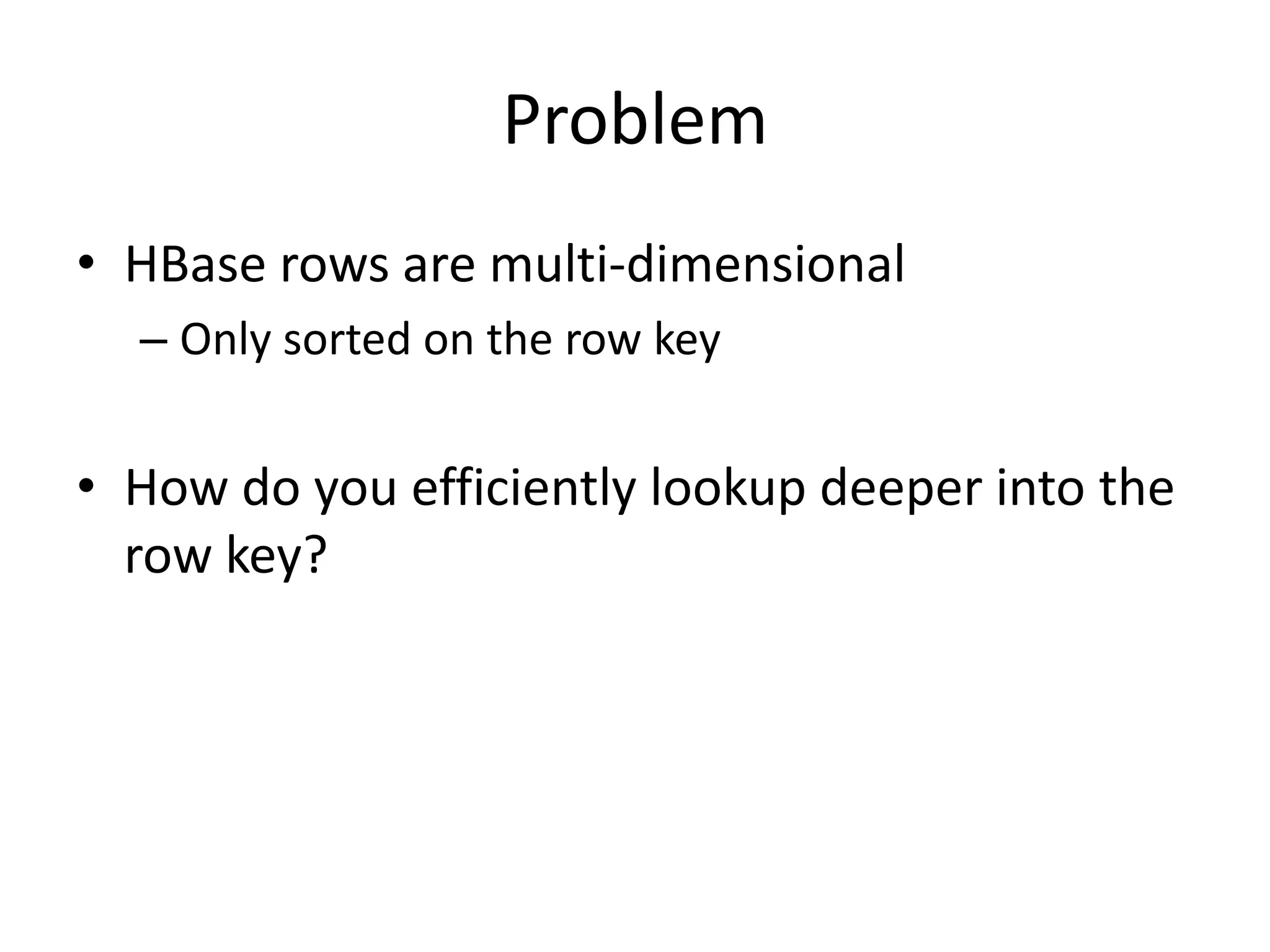
• HBase rows are multi-dimensional
  – Only sorted on the row key


• How do you efficiently lookup deeper into the
  row key?
Example
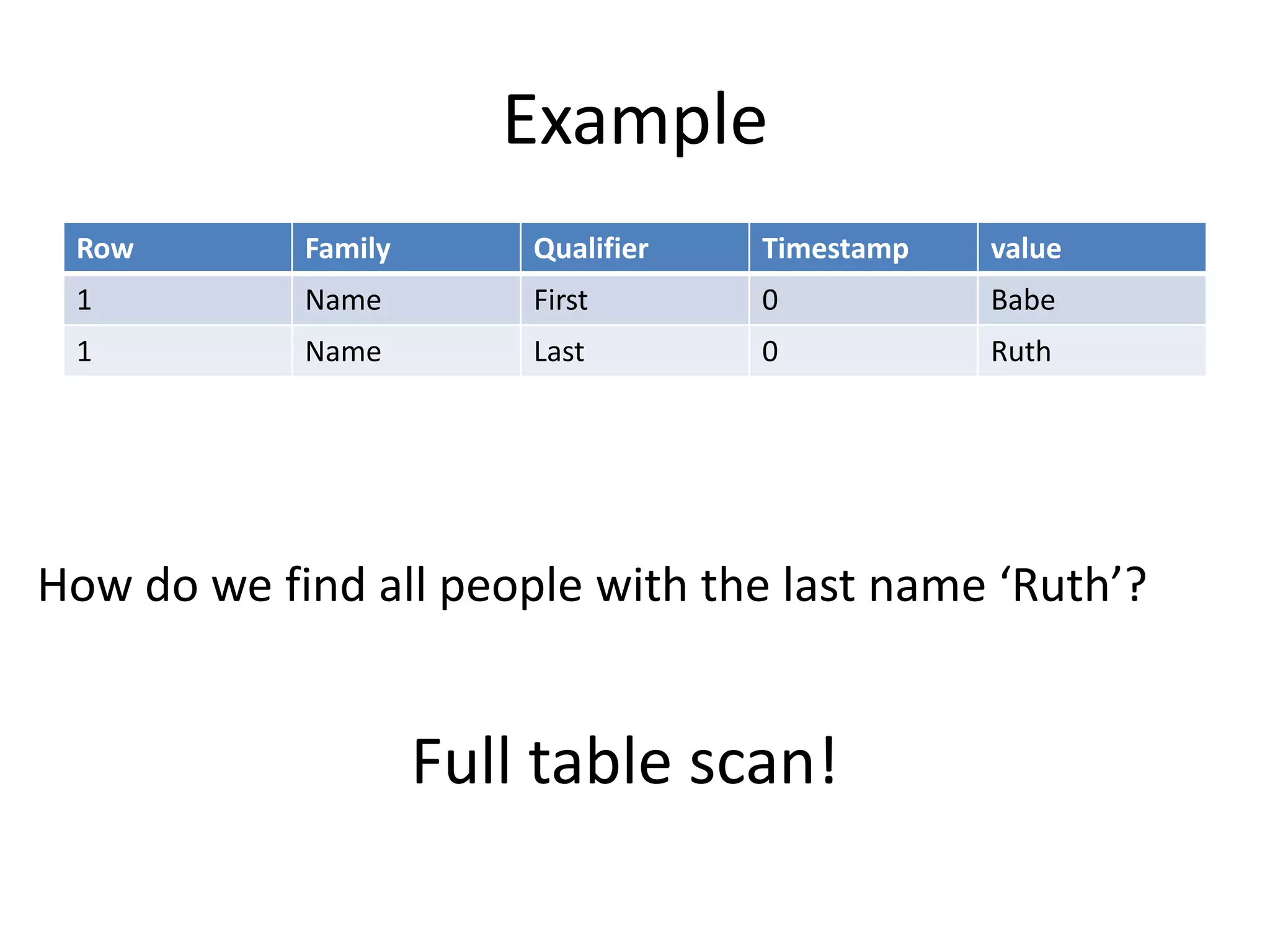
 Row        Family       Qualifier   Timestamp   value
 1          Name         First       0           Babe
 1          Name         Last        0           Ruth


How do we find all people with the last name ‘Ruth’?


                     Full table scan!
Indexing!
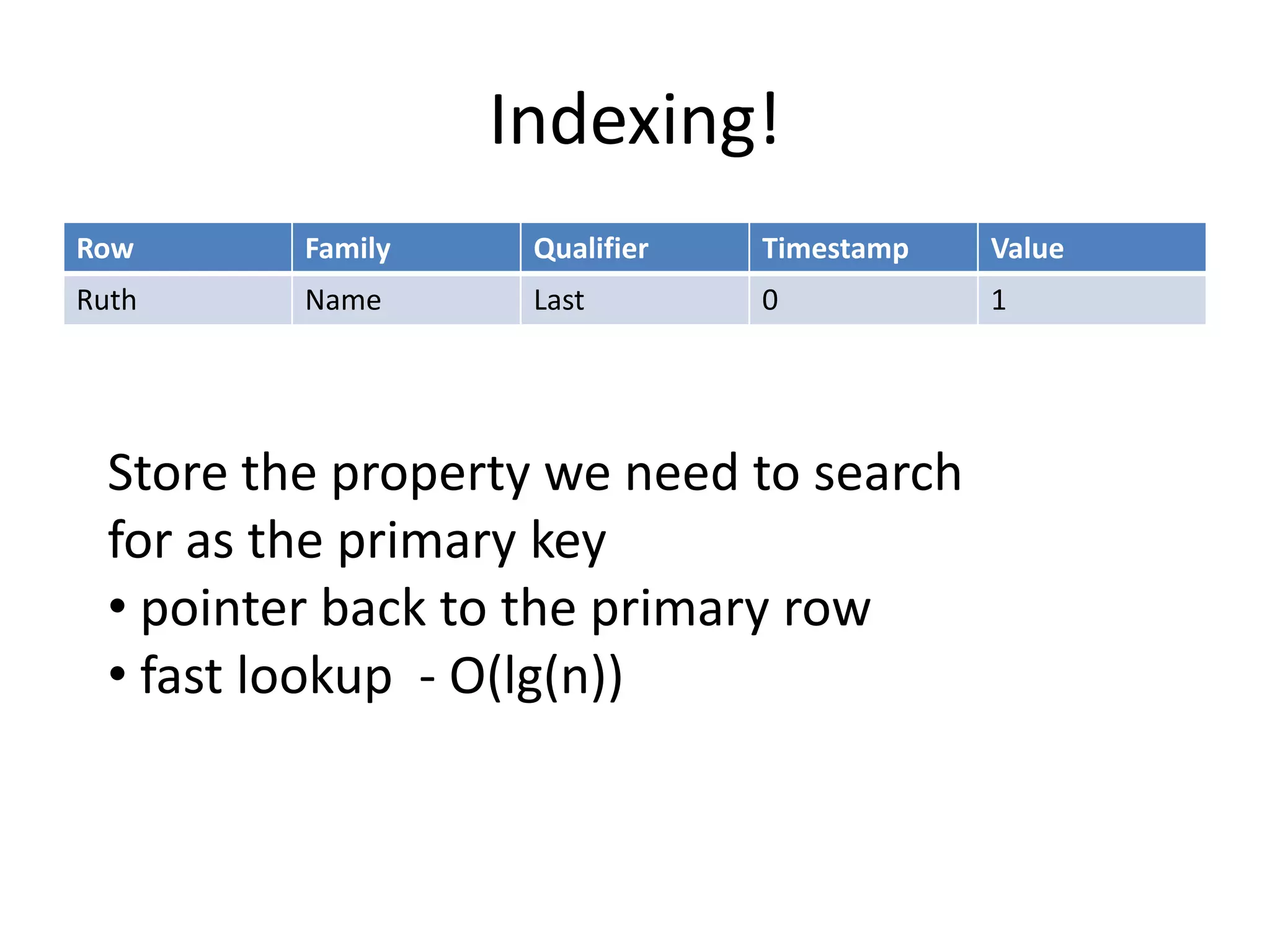
Row       Family    Qualifier   Timestamp   Value
Ruth      Name      Last        0           1


  Store the property we need to search
  for as the primary key
  • pointer back to the primary row
  • fast lookup - O(lg(n))
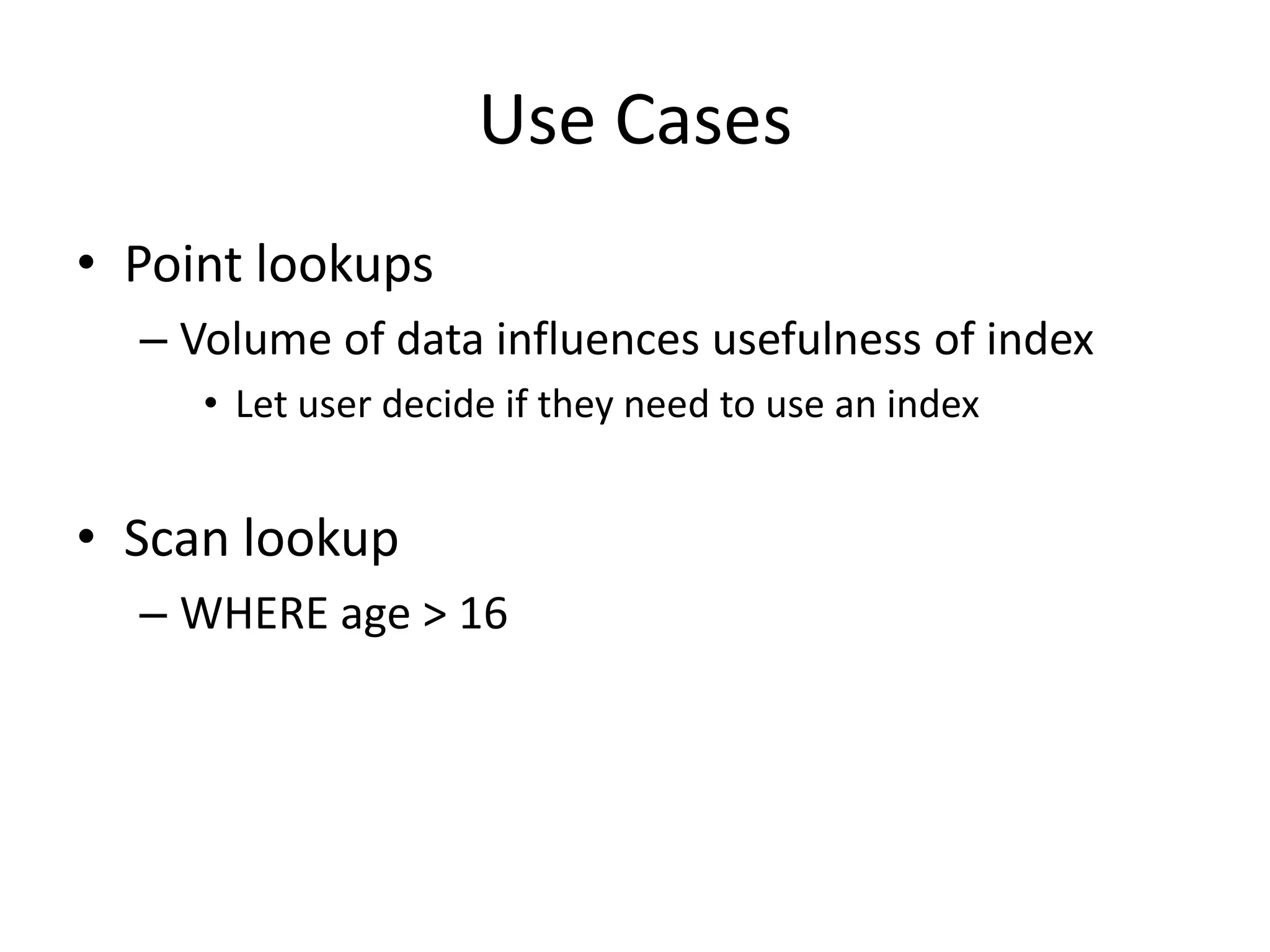
Use Cases
• Point lookups
  – Volume of data influences usefulness of index
     • Let user decide if they need to use an index


• Scan lookup
  – WHERE age > 16
Implementations
Omid

Full transactional support
    Centralized oracle
Lily

WAL implementation on top of HBase
        100-500 writes/sec
Percolator

       Full transactions
Distributed, optimistic locking
  ~10 sec latencies possible
Culvert

         Async
Dead project, incomplete
http://jyates.github.com/2012/07/0
  9/consistent-enough-secondary-
            indexes.html
       Client-side coordinated index
       Use timestamps to coordinate
           Not yet implemented
Trend Micro Implementation

          Still just POC
                 ???
Solr/Lucene

Standard Lucene library bolted on HBase
           Not commonly used
 Lots of formats/codecs already written
Considerations for HBase

    What do we need to do?
Built-in vs.
     external library vs.
semi-supported (e.g. security)
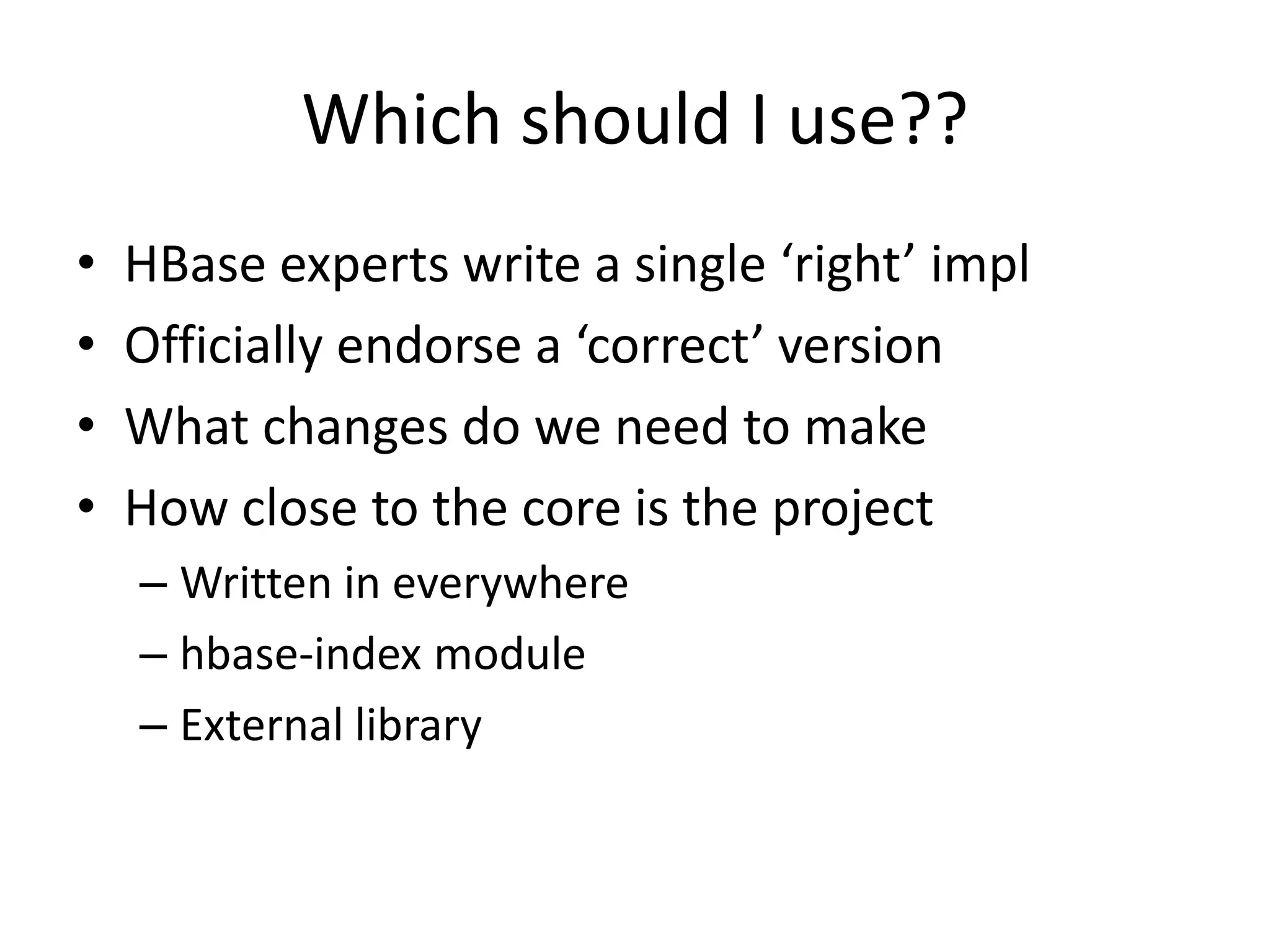
Which should I use??
•   HBase experts write a single ‘right’ impl
•   Officially endorse a ‘correct’ version
•   What changes do we need to make
•   How close to the core is the project
    – Written in everywhere
    – hbase-index module
    – External library
Async vs.
Synchronous vs.
 Transactional
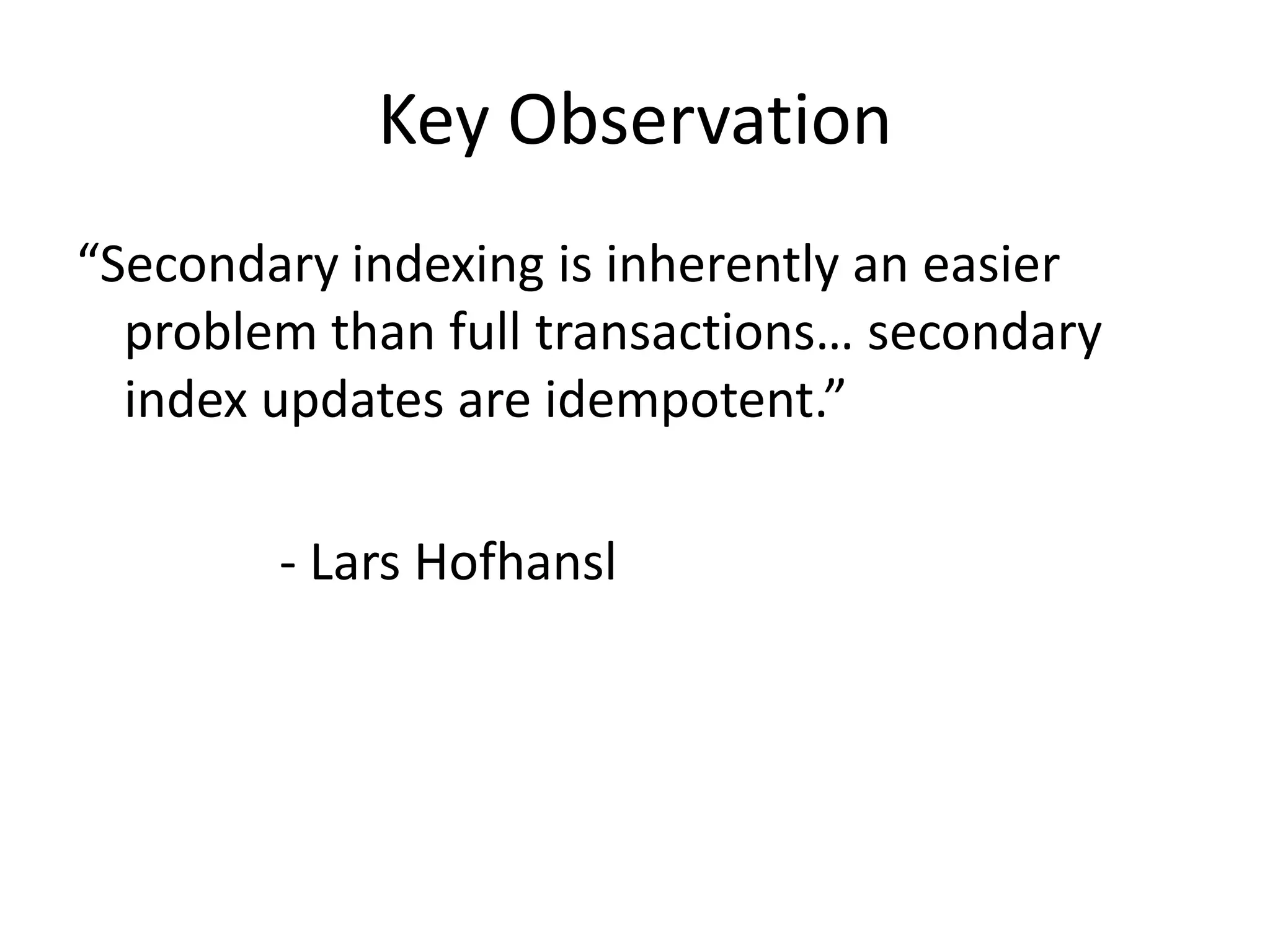
Key Observation
“Secondary indexing is inherently an easier
  problem than full transactions… secondary
  index updates are idempotent.”

        - Lars Hofhansl
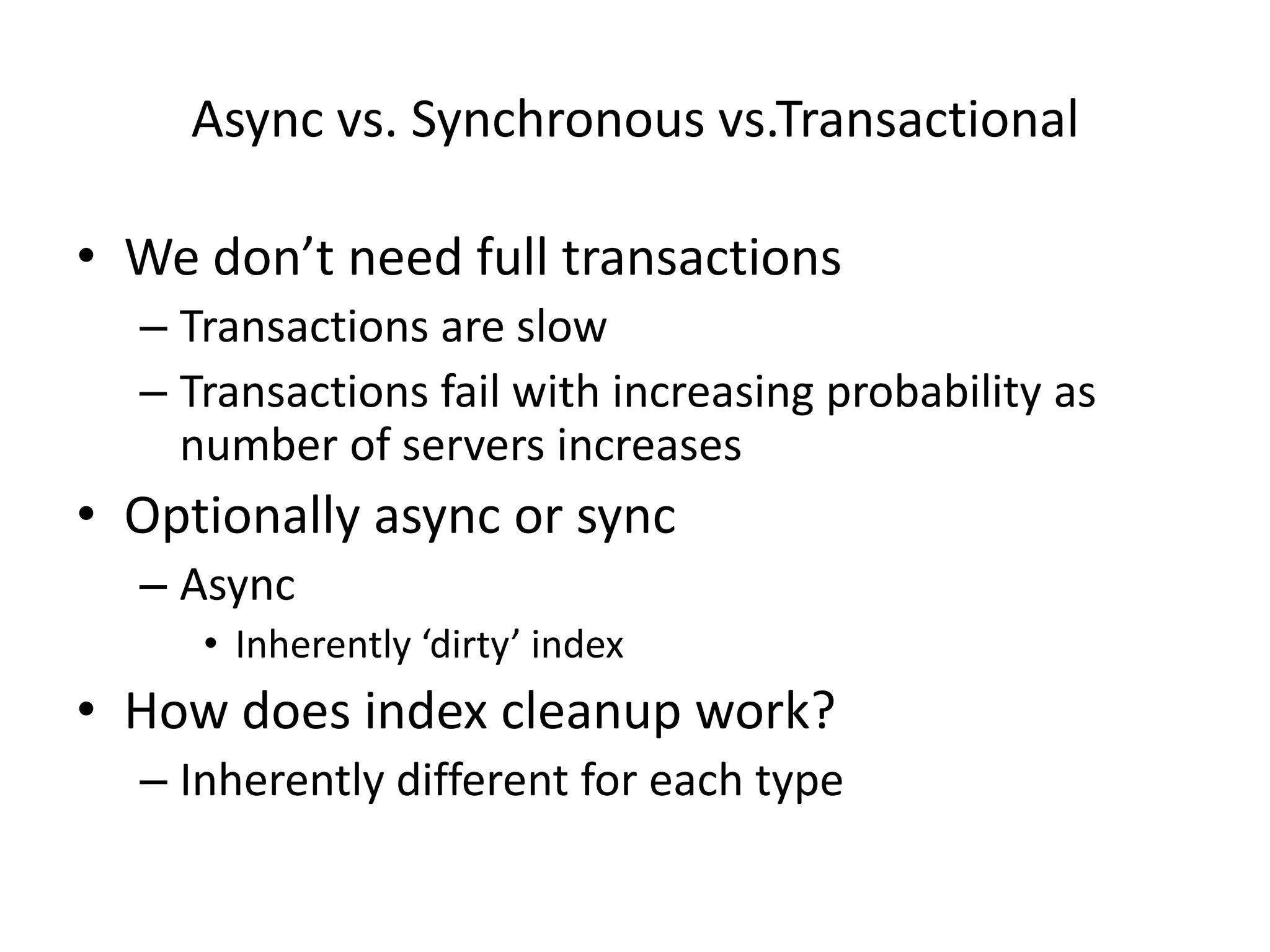
Async vs. Synchronous vs.Transactional

• We don’t need full transactions
  – Transactions are slow
  – Transactions fail with increasing probability as
    number of servers increases
• Optionally async or sync
  – Async
     • Inherently ‘dirty’ index
• How does index cleanup work?
  – Inherently different for each type
Locality
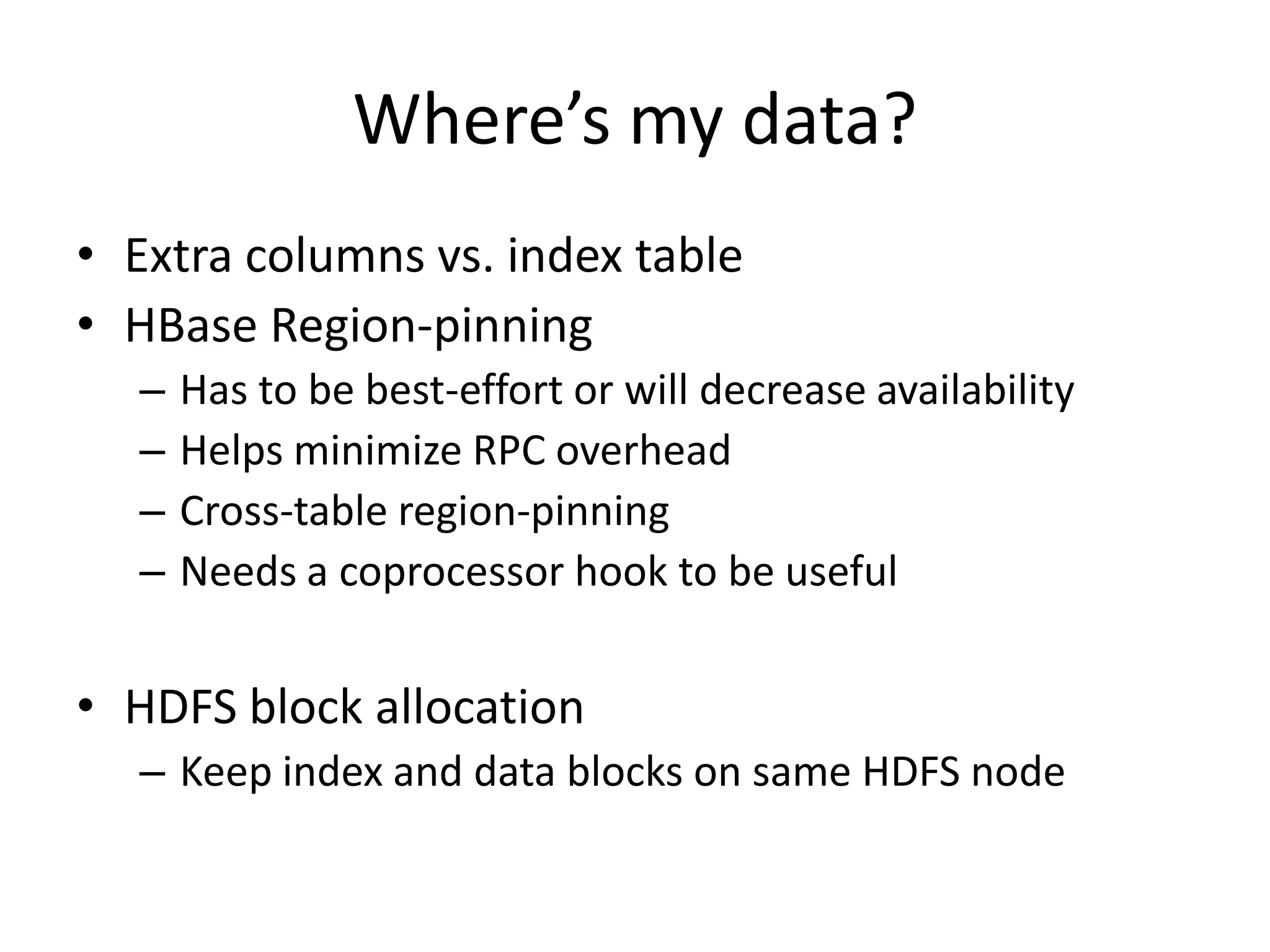
Where’s my data?
• Extra columns vs. index table
• HBase Region-pinning
  –   Has to be best-effort or will decrease availability
  –   Helps minimize RPC overhead
  –   Cross-table region-pinning
  –   Needs a coprocessor hook to be useful


• HDFS block allocation
  – Keep index and data blocks on same HDFS node
Index Cardinality
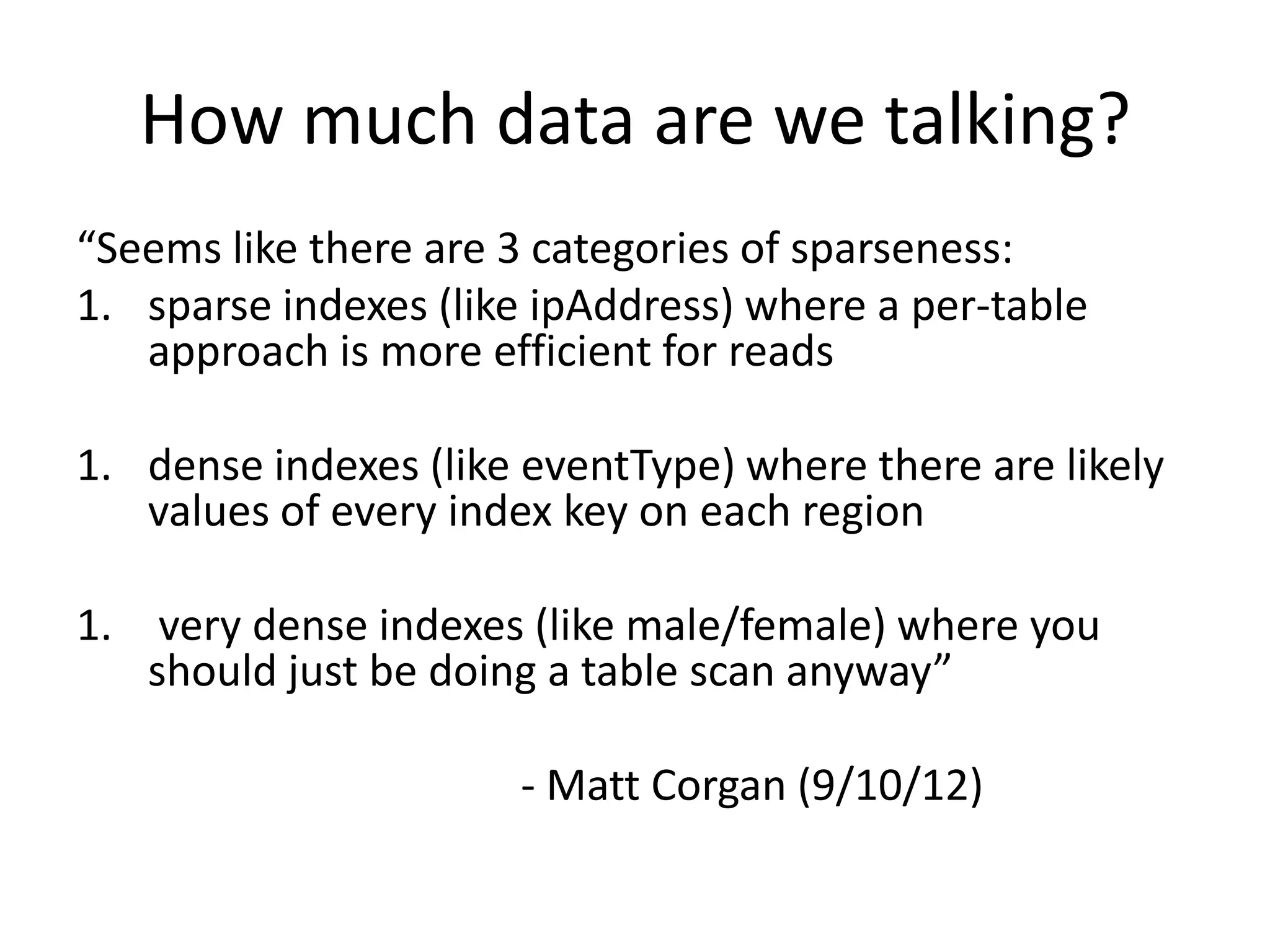
How much data are we talking?
“Seems like there are 3 categories of sparseness:
1. sparse indexes (like ipAddress) where a per-table
   approach is more efficient for reads

1. dense indexes (like eventType) where there are likely
   values of every index key on each region

1. very dense indexes (like male/female) where you
   should just be doing a table scan anyway”

                      - Matt Corgan (9/10/12)
Impact on implementation
• Need a lot of knowledge of data to pick the
  right kind of index
  – User knows their data, let them do the hard work
    of picking indexes
Pluggability
Everyone’s got an impl already
• We need to make HBase flexible enough to
  support (most) current indexing formats with
  minimal overhead for switching
  – Lucene style Codec/CodecProvider?
Client-interface
What should it look like?
• Minimal changes to the top-level interfaces
  – Add a single new flag?
  – Configuration based?
• Enough that the user gets to be smart about
  what should be used
  – We can’t get all cases right – just provide building
    blocks
• Automatically use an index?
• Scanner/Filter style use?
Properties for the client
• Should the user even see the index lookups?

• ACID?
• Ordering of results?
  – Support the current sorted order?
  – Batch lookup?

• Implications on current features
  – Replication
  – splitting
Schema(less)
• Schema enforced?
  – Rigid usage of index matching an expected schema?
  – Schema table? Reserved schema columns?.META.?
• Schema-less
  – Let the user apply whatever they think and use only
    what actually works
• Best-effort
  – Use client-hinted schema and try to apply all the
    known indexes
My random thoughts….
• Client-side managed indexes are efficient
  – Minimal RPC overhead
     • Cleanup is async to client and rarely misses
  – Solves the cross-region/server problem
     • Region-pinning is a nice-to-have optimization
  – Scales without concern for locality
  – Flexible enough to support custom codecs
  – Can be built to provide server-side optimizations
     • Locality aware indexes to minimize RPCs
Discussion!

Musings on Secondary Indexing in HBase

  • 1.
    Jesse Yates Salesforce.com Secondary Indexing the discussion so far…. 9/11/12 HBase Pow-wow
  • 2.
  • 3.
    Problem • HBase rowsare multi-dimensional – Only sorted on the row key • How do you efficiently lookup deeper into the row key?
  • 4.
    Example Row Family Qualifier Timestamp value 1 Name First 0 Babe 1 Name Last 0 Ruth How do we find all people with the last name ‘Ruth’? Full table scan!
  • 5.
    Indexing! Row Family Qualifier Timestamp Value Ruth Name Last 0 1 Store the property we need to search for as the primary key • pointer back to the primary row • fast lookup - O(lg(n))
  • 6.
    Use Cases • Pointlookups – Volume of data influences usefulness of index • Let user decide if they need to use an index • Scan lookup – WHERE age > 16
  • 7.
  • 8.
  • 9.
    Lily WAL implementation ontop of HBase 100-500 writes/sec
  • 10.
    Percolator Full transactions Distributed, optimistic locking ~10 sec latencies possible
  • 11.
    Culvert Async Dead project, incomplete
  • 12.
    http://jyates.github.com/2012/07/0 9/consistent-enough-secondary- indexes.html Client-side coordinated index Use timestamps to coordinate Not yet implemented
  • 13.
    Trend Micro Implementation Still just POC ???
  • 14.
    Solr/Lucene Standard Lucene librarybolted on HBase Not commonly used Lots of formats/codecs already written
  • 15.
    Considerations for HBase What do we need to do?
  • 16.
    Built-in vs. external library vs. semi-supported (e.g. security)
  • 17.
    Which should Iuse?? • HBase experts write a single ‘right’ impl • Officially endorse a ‘correct’ version • What changes do we need to make • How close to the core is the project – Written in everywhere – hbase-index module – External library
  • 18.
  • 19.
    Key Observation “Secondary indexingis inherently an easier problem than full transactions… secondary index updates are idempotent.” - Lars Hofhansl
  • 20.
    Async vs. Synchronousvs.Transactional • We don’t need full transactions – Transactions are slow – Transactions fail with increasing probability as number of servers increases • Optionally async or sync – Async • Inherently ‘dirty’ index • How does index cleanup work? – Inherently different for each type
  • 21.
  • 22.
    Where’s my data? •Extra columns vs. index table • HBase Region-pinning – Has to be best-effort or will decrease availability – Helps minimize RPC overhead – Cross-table region-pinning – Needs a coprocessor hook to be useful • HDFS block allocation – Keep index and data blocks on same HDFS node
  • 23.
  • 24.
    How much dataare we talking? “Seems like there are 3 categories of sparseness: 1. sparse indexes (like ipAddress) where a per-table approach is more efficient for reads 1. dense indexes (like eventType) where there are likely values of every index key on each region 1. very dense indexes (like male/female) where you should just be doing a table scan anyway” - Matt Corgan (9/10/12)
  • 25.
    Impact on implementation •Need a lot of knowledge of data to pick the right kind of index – User knows their data, let them do the hard work of picking indexes
  • 26.
  • 27.
    Everyone’s got animpl already • We need to make HBase flexible enough to support (most) current indexing formats with minimal overhead for switching – Lucene style Codec/CodecProvider?
  • 28.
  • 29.
    What should itlook like? • Minimal changes to the top-level interfaces – Add a single new flag? – Configuration based? • Enough that the user gets to be smart about what should be used – We can’t get all cases right – just provide building blocks • Automatically use an index? • Scanner/Filter style use?
  • 30.
    Properties for theclient • Should the user even see the index lookups? • ACID? • Ordering of results? – Support the current sorted order? – Batch lookup? • Implications on current features – Replication – splitting
  • 31.
    Schema(less) • Schema enforced? – Rigid usage of index matching an expected schema? – Schema table? Reserved schema columns?.META.? • Schema-less – Let the user apply whatever they think and use only what actually works • Best-effort – Use client-hinted schema and try to apply all the known indexes
  • 32.
    My random thoughts…. •Client-side managed indexes are efficient – Minimal RPC overhead • Cleanup is async to client and rarely misses – Solves the cross-region/server problem • Region-pinning is a nice-to-have optimization – Scales without concern for locality – Flexible enough to support custom codecs – Can be built to provide server-side optimizations • Locality aware indexes to minimize RPCs
  • 33.