Music Industry
          Copyright Pt 2


www.musicstudentinfo.com
              Chris Baker


                            1
Copyright Basics

A copyright is defined as: a limited duration monopoly.
A copyright protects “original works of authorship” that
are fixed in a tangible form of expression.


01/21/13                 Copyrights                    2
Length of a Copyright

You own a copyright for life plus 70 years.


01/21/13                  Copyrights          3
Copyrightable Works

•   Literary works
•   Musical works, including any accompanying words
•   Dramatic works, including any accompanying music
•   Pantomimes and choreographic works
•   Pictorial, graphic, and sculptural works


01/21/13                 Copyrights                    4
Copyrightable Works Cont.

• Motion pictures and other audiovisual works.
• Sound recordings.
• Architectural works.


01/21/13                Copyrights               5
Copyrightable Works Cont.

• Computer programs can be registered as literary
  works.
• Maps and architectural plans may be registered as
  pictorial, graphic, and sculptural works.


01/21/13                Copyrights                    6
Copyright Form of Notice

For literary works:

      The symbol: ©
      The year of first publication
      The name of copyright owner
      Ex: © 2005 Ed Street


01/21/13                       Copyrights   7
Form of Notice Cont.

For Phonorecords of sound recordings:

      1.   The symbol: ℗
      2.   The year of first publication
      3.   The name of copyright owner
      4.   Ex: ℗ 2005 MDC Records


01/21/13                     Copyrights    8
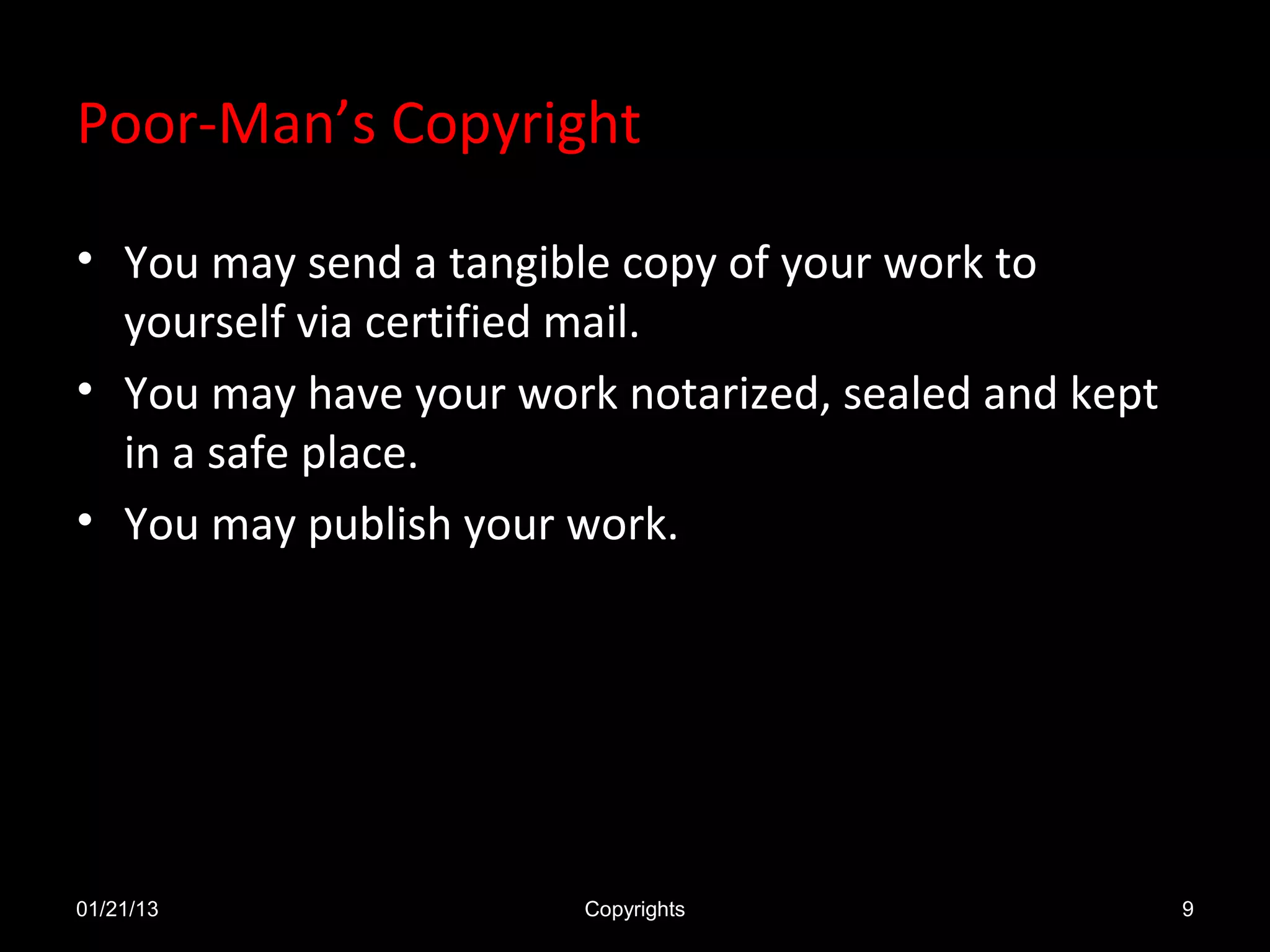
Poor-Man’s Copyright

• You may send a tangible copy of your work to
  yourself via certified mail.
• You may have your work notarized, sealed and kept
  in a safe place.
• You may publish your work.


01/21/13               Copyrights                     9
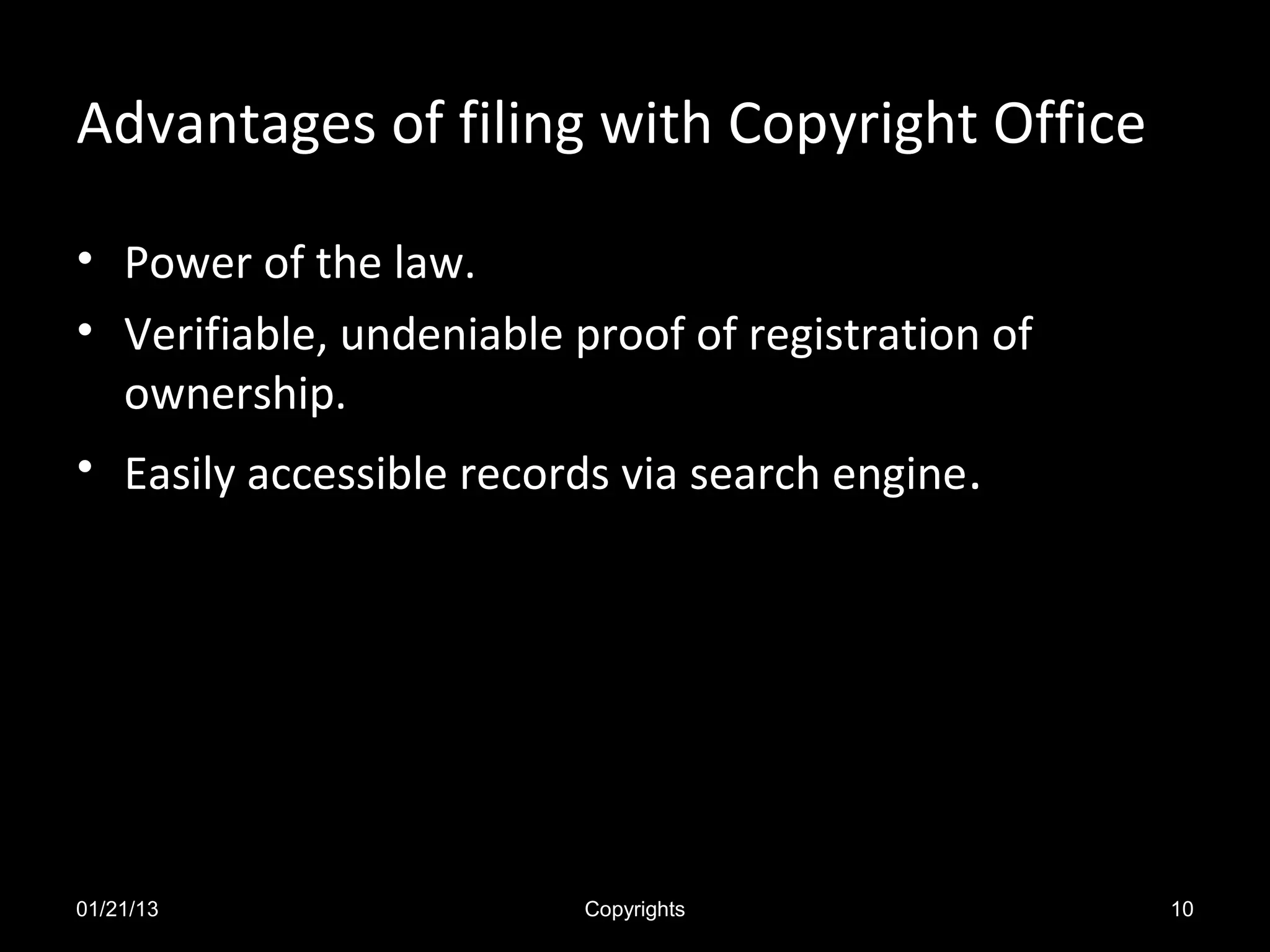
Advantages of filing with Copyright Office

• Power of the law.
• Verifiable, undeniable proof of registration of
  ownership.
• Easily accessible records via search engine.


01/21/13                  Copyrights                10
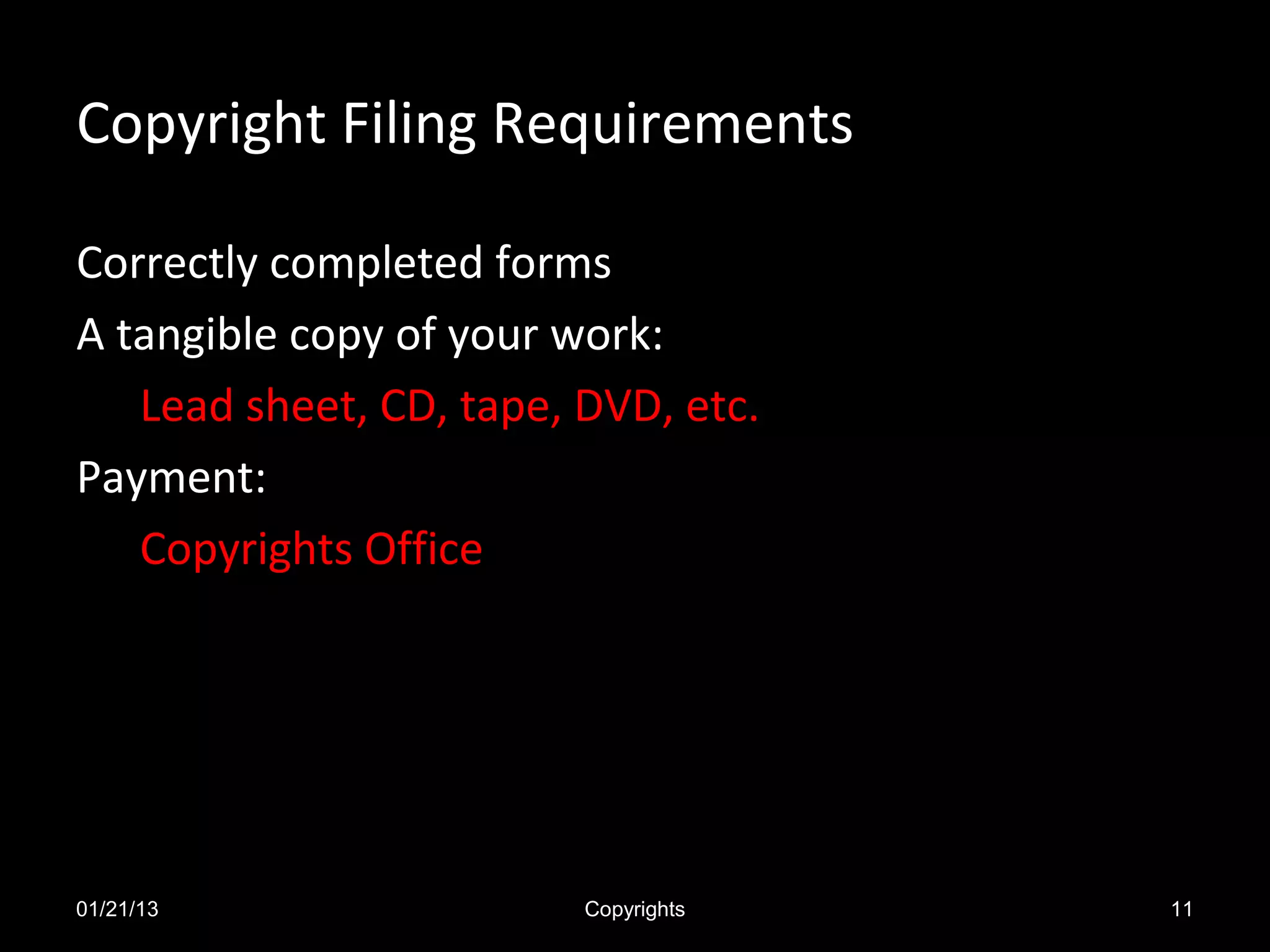
Copyright Filing Requirements

Correctly completed forms
A tangible copy of your work:
   Lead sheet, CD, tape, DVD, etc.
Payment:
   Copyrights Office


01/21/13                 Copyrights   11
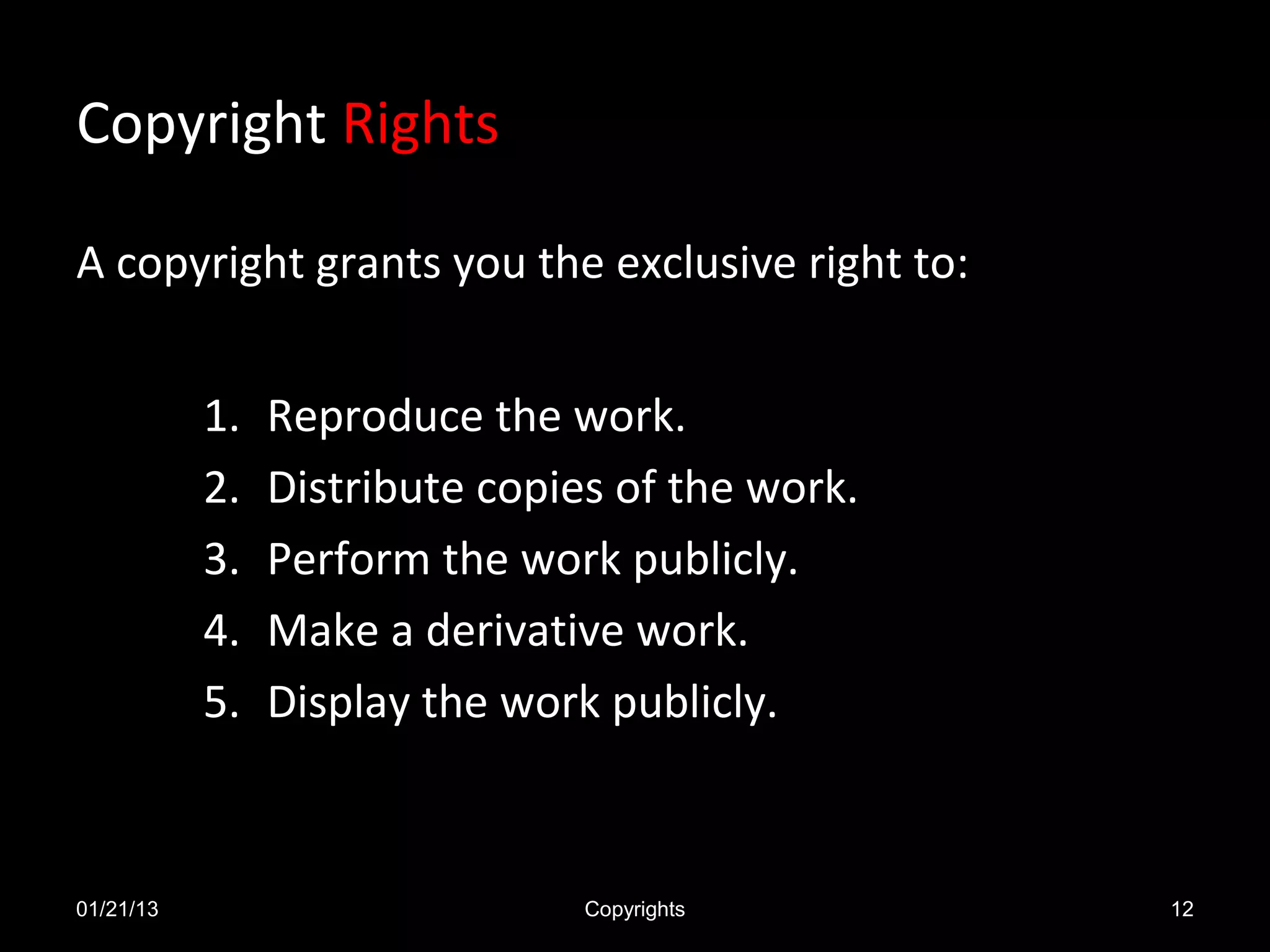
Copyright Rights

A copyright grants you the exclusive right to:


           1.   Reproduce the work.
           2.   Distribute copies of the work.
           3.   Perform the work publicly.
           4.   Make a derivative work.
           5.   Display the work publicly.


01/21/13                        Copyrights       12
Copyright Compulsory Licenses

Compulsory means you must issue these licenses to
someone who wants to use your work whether you like
it or not.

      Cable television rebroadcasts.
      BBC
      Jukeboxes


01/21/13                    Copyrights            13
Copyright Compulsory Licenses

      1. Digital performance records digital radio and
         webcasts.
      2. Digital distribution of records internet, phone
         and satellite downloads.
      3. Phonorecords of non-dramatic musical
         compositions.


01/21/13                    Copyrights                     14
Copyright Mechanicals

The Copyright Act provides that you must issue a
compulsory license to anyone else who wants to record
it on a phonograph record if it has already been
recorded and:

      The song is a non-dramatic work.
      The recording has been distributed publicly in
      phonorecords.
      The new recording will be in phonorecords only.


01/21/13                   Copyrights                   15
Regaining a Copyright

Regardless of anything in your songwriter agreement
  with the publisher, a work not made for hire that was
  assigned by you on or after January 1, 1978 can be
  reclaimed by you (or your copyright-entitled heirs) 35
  years after the work is published or 40 years after the
  assignment, whichever is earlier.


01/21/13                 Copyrights                    16
Copyright Public Domain

A work becomes “public domain” after your copyright
expires.

That means anyone can perform or record it without
paying a fee.


01/21/13                Copyrights                    17

Music Copyright Part 2

  • 1.
    Music Industry Copyright Pt 2 www.musicstudentinfo.com Chris Baker 1
  • 2.
    Copyright Basics A copyrightis defined as: a limited duration monopoly. A copyright protects “original works of authorship” that are fixed in a tangible form of expression. 01/21/13 Copyrights 2
  • 3.
    Length of aCopyright You own a copyright for life plus 70 years. 01/21/13 Copyrights 3
  • 4.
    Copyrightable Works • Literary works • Musical works, including any accompanying words • Dramatic works, including any accompanying music • Pantomimes and choreographic works • Pictorial, graphic, and sculptural works 01/21/13 Copyrights 4
  • 5.
    Copyrightable Works Cont. •Motion pictures and other audiovisual works. • Sound recordings. • Architectural works. 01/21/13 Copyrights 5
  • 6.
    Copyrightable Works Cont. •Computer programs can be registered as literary works. • Maps and architectural plans may be registered as pictorial, graphic, and sculptural works. 01/21/13 Copyrights 6
  • 7.
    Copyright Form ofNotice For literary works: The symbol: © The year of first publication The name of copyright owner Ex: © 2005 Ed Street 01/21/13 Copyrights 7
  • 8.
    Form of NoticeCont. For Phonorecords of sound recordings: 1. The symbol: ℗ 2. The year of first publication 3. The name of copyright owner 4. Ex: ℗ 2005 MDC Records 01/21/13 Copyrights 8
  • 9.
    Poor-Man’s Copyright • Youmay send a tangible copy of your work to yourself via certified mail. • You may have your work notarized, sealed and kept in a safe place. • You may publish your work. 01/21/13 Copyrights 9
  • 10.
    Advantages of filingwith Copyright Office • Power of the law. • Verifiable, undeniable proof of registration of ownership. • Easily accessible records via search engine. 01/21/13 Copyrights 10
  • 11.
    Copyright Filing Requirements Correctlycompleted forms A tangible copy of your work: Lead sheet, CD, tape, DVD, etc. Payment: Copyrights Office 01/21/13 Copyrights 11
  • 12.
    Copyright Rights A copyrightgrants you the exclusive right to: 1. Reproduce the work. 2. Distribute copies of the work. 3. Perform the work publicly. 4. Make a derivative work. 5. Display the work publicly. 01/21/13 Copyrights 12
  • 13.
    Copyright Compulsory Licenses Compulsorymeans you must issue these licenses to someone who wants to use your work whether you like it or not. Cable television rebroadcasts. BBC Jukeboxes 01/21/13 Copyrights 13
  • 14.
    Copyright Compulsory Licenses 1. Digital performance records digital radio and webcasts. 2. Digital distribution of records internet, phone and satellite downloads. 3. Phonorecords of non-dramatic musical compositions. 01/21/13 Copyrights 14
  • 15.
    Copyright Mechanicals The CopyrightAct provides that you must issue a compulsory license to anyone else who wants to record it on a phonograph record if it has already been recorded and: The song is a non-dramatic work. The recording has been distributed publicly in phonorecords. The new recording will be in phonorecords only. 01/21/13 Copyrights 15
  • 16.
    Regaining a Copyright Regardlessof anything in your songwriter agreement with the publisher, a work not made for hire that was assigned by you on or after January 1, 1978 can be reclaimed by you (or your copyright-entitled heirs) 35 years after the work is published or 40 years after the assignment, whichever is earlier. 01/21/13 Copyrights 16
  • 17.
    Copyright Public Domain Awork becomes “public domain” after your copyright expires. That means anyone can perform or record it without paying a fee. 01/21/13 Copyrights 17