
MUSIC OF MEDIEVAL,
RENAISSANCE AND BAROQUE
PERIOD
Lesson
Objectives
musical
ected
mental
val,
nd
5
dieval,
aroque
al and
ground
on.
What are the first
three periods of
western music
history ?
1. ME
2.
PE
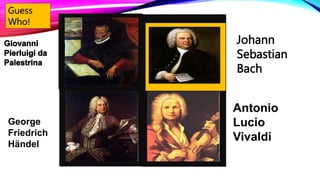
Johann
Sebastian
Bach
Antonio
Lucio
Vivaldi
George
Friedrich
Händel
Guess
Who!
Describe the life of the
people during medieval
period based on the
short clips.
TEAM WORK!
: Finish task on time
: Everyone is on task
Achieve: Aim for Excellence
: Maintaining decorum
at all time
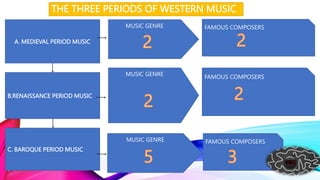
THE THREE PERIODS OF WESTERN MUSIC
C. BAROQUE PERIOD MUSIC
B.RENAISSANCE PERIOD MUSIC
A. MEDIEVAL PERIOD MUSIC
MUSIC GENRE FAMOUS COMPOSERS
MUSIC GENRE
MUSIC GENRE FAMOUS COMPOSERS
FAMOUS COMPOSERS
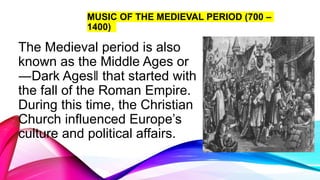
MUSIC OF THE MEDIEVAL PERIOD (700 –
1400)
The Medieval period is also
known as the Middle Ages or
―Dark Ages‖ that started with
the fall of the Roman Empire.
During this time, the Christian
Church influenced Europe’s
culture and political affairs.
MUSIC OF THE RENAISSANCE
PERIOD (1400 – 1600)
The term ―Renaissance‖ comes from the word ―renaitre‖ which
means “rebirth‖, ―revival‖, and ―rediscovery‖. The Renaissance
Period is a period of of ―looking back‖ to the Golden Age of
Greece and Rome.
The invention of printing in the 1400’s paved the way for a wide
distribution of renaissance compositions.
Lute was the prominent instrument of the renaissance
This era was also known as the ―golden age‖ of a capella choral
music.
Other historical facts:
• the actual position of earth in the solar system by Copernicus,
• the invention of compass creating a wider navigation not only of
the lands but also of the oceans
• Martin Luther’s Protestant reformation.
MUSIC OF THE BAROQUE
PERIOD (1685 – 1750)
The word Baroque is derived from the Portuguese word ―barroco”
which means ―pearl of irregular shape‖. Some of the great
composers of this time were George Friedrich Handel, Johann
Sebastian Bach, Claudio Monteverdi, and Antonio Vivaldi.
During this time, the arts highlighted grandiose and elaborate
ornamentation. These were clearly seen in the musical compositions
created by Baroque composers.
New instrumental techniques and changes in musical notation were
developed. Major and minor tonality was also created in this period. A
lot of the musical terms and concepts that evolved in this era are still
used today.
• was named after pope Gregory I, who made this the
approved music of the catholic church.
• transmitted orally. scholars agreed to put it in notation to
assist dissemination of chants across Europe.
Characteristics of the Gregorian chants:
Monophonic plainchant
monophonic
free meter
Modal
usually based on latin liturgy
use of neume notation
secular music
Emerged During the latter part of the Medieval Period, which was not
bound by Catholic. Most of these songs were performed across Europe
by groups of musicians called Troubadours.
Troubadour Music:
• Usually monophonic
• Sometimes with improvised accompaniment
• Tells of chivalry and courtly love
• Originated in France
• Written in the French language
Vocal Music of the Renaissance Period
1. Mass – is a form of sacred musical composition that
sets texts of the Eucharistic liturgy into music.
2. Madrigal
- A secular vocal polyphonic music composition which
originated from Italy. It is written and expressed in a
poetic text and sung during courtly social gatherings. It is
the most important secular form during the Renaissance
period.
1. Concerto – A form of
orchestral music that employs a
solo instrument accompanied by
an orchestra.
2. Concerto Grosso - A form of
orchestral music during the
Baroque Period wherein the
music is between a small group of
solo instruments called concertino
and the whole orchestra called
tutti. Music Genres of Baroque Music
3. Fugue
A contrapuntal piece,
developed mainly by imitative
counterpoint
 It is usually written in 3 or 4
parts, with a main theme called
―subject
 The entire piece grows
mainly from a single brief tune of
strong musical character
4. Oratorio – a large scale
musical composition for orchestra
and voices that incorporates
narratives on religious themes.
Unlike usual theatrical works, this
is usually performed without the
use of costumes, scenery, or
action. It is usually written in the
native language for the intended
audience.
Music Genres of Baroque Music
5. Chorale – musical
compositions that resemble a
harmonized version of hymnal
tunes of the Protestant Church
during the Baroque era.
Famous Composers of the Baroque Period
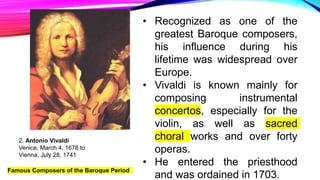
2. Antonio Vivaldi
Venice, March 4, 1678 to
Vienna, July 28, 1741
• Recognized as one of the
greatest Baroque composers,
his influence during his
lifetime was widespread over
Europe.
• Vivaldi is known mainly for
composing instrumental
concertos, especially for the
violin, as well as sacred
choral works and over forty
operas.
• He entered the priesthood
and was ordained in 1703.
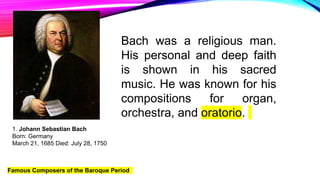
Bach was a religious man.
His personal and deep faith
is shown in his sacred
music. He was known for his
compositions for organ,
orchestra, and oratorio.
1. Johann Sebastian Bach
Born: Germany
March 21, 1685 Died: July 28, 1750
Famous Composers of the Baroque Period
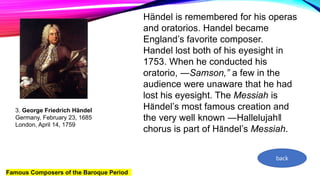
3. George Friedrich Händel
Germany, February 23, 1685
London, April 14, 1759
Händel is remembered for his operas
and oratorios. Handel became
England’s favorite composer.
Handel lost both of his eyesight in
1753. When he conducted his
oratorio, ―Samson,” a few in the
audience were unaware that he had
lost his eyesight. The Messiah is
Hӓndel’s most famous creation and
the very well known ―Hallelujah‖
chorus is part of Hӓndel’s Messiah.
back
Famous Composers of the Renaissance
Period
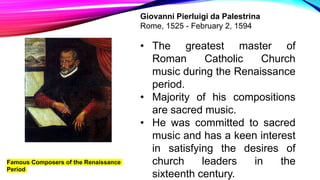
Giovanni Pierluigi da Palestrina
Rome, 1525 - February 2, 1594
• The greatest master of
Roman Catholic Church
music during the Renaissance
period.
• Majority of his compositions
are sacred music.
• He was committed to sacred
music and has a keen interest
in satisfying the desires of
church leaders in the
sixteenth century.
Famous Composers of the Renaissance
Period
Thomas Morley
1557 – 1602
Thomas Morley was the most famous composer of
secular music in his time. He was a singer in the
local cathedral during his childhood and was
believed to have studied music with William Byrd, an
Elizabethan composer of sacred music.
back
Famous Composers of the Medieval Period
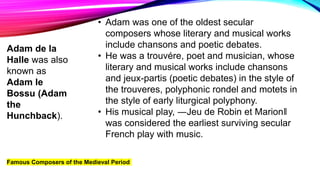
• Adam was one of the oldest secular
composers whose literary and musical works
include chansons and poetic debates.
• He was a trouvére, poet and musician, whose
literary and musical works include chansons
and jeux-partis (poetic debates) in the style of
the trouveres, polyphonic rondel and motets in
the style of early liturgical polyphony.
• His musical play, ―Jeu de Robin et Marion‖
was considered the earliest surviving secular
French play with music.
Adam de la
Halle was also
known as
Adam le
Bossu (Adam
the
Hunchback).
Famous Composers of the Medieval Period
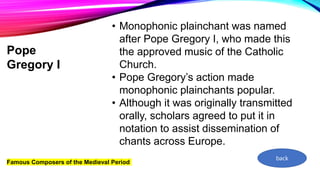
Pope
Gregory I
• Monophonic plainchant was named
after Pope Gregory I, who made this
the approved music of the Catholic
Church.
• Pope Gregory’s action made
monophonic plainchants popular.
• Although it was originally transmitted
orally, scholars agreed to put it in
notation to assist dissemination of
chants across Europe.
back
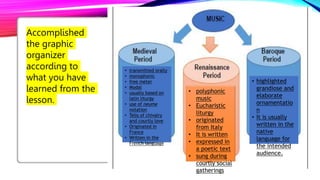
Accomplished
the graphic
organizer
according to
what you have
learned from the
lesson.
• transmitted orally
• monophonic
• free meter
• Modal
• usually based on
latin liturgy
• use of neume
notation
• Tells of chivalry
and courtly love
• Originated in
France
• Written in the
French language
• polyphonic
music
• Eucharistic
liturgy
• originated
from Italy
• It is written
• expressed in
a poetic text
• sung during
courtly social
gatherings
• highlighted
grandiose and
elaborate
ornamentatio
n
• It is usually
written in the
native
language for
the intended
audience.
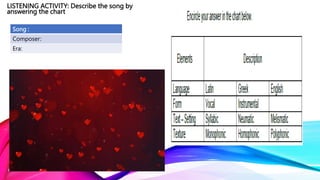
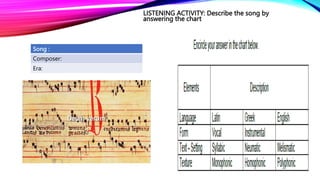
LISTENING ACTIVITY: Describe the song by
answering the chart
Song :
Composer:
Era:
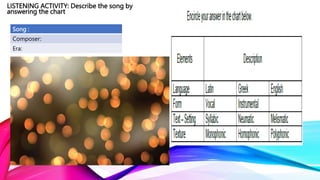
LISTENING ACTIVITY: Describe the song by
answering the chart
Song :
Composer:
Era:
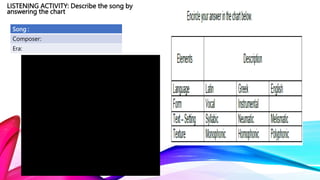
LISTENING ACTIVITY: Describe the song by
answering the chart
Song :
Composer:
Era:
LISTENING ACTIVITY: Describe the song by
answering the chart
Song :
Composer:
Era:
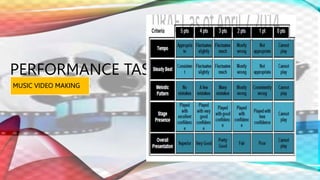
PERFORMANCE TASK
MUSIC VIDEO MAKING
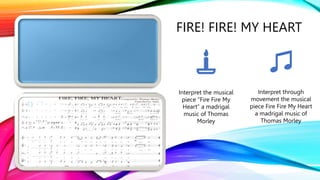
FIRE! FIRE! MY HEART
Interpret the musical
piece “Fire Fire My
Heart” a madrigal
music of Thomas
Morley
Interpret through
movement the musical
piece Fire Fire My Heart
a madrigal music of
Thomas Morley
LONG QUIZ 30
MINUTES!

music 9 week 1.pptx

  • 1.
  • 2.
  • 3.
    What are thefirst three periods of western music history ? 1. ME 2. PE
  • 4.
  • 5.
    Describe the lifeof the people during medieval period based on the short clips.
  • 6.
    TEAM WORK! : Finishtask on time : Everyone is on task Achieve: Aim for Excellence : Maintaining decorum at all time
  • 7.
    THE THREE PERIODSOF WESTERN MUSIC C. BAROQUE PERIOD MUSIC B.RENAISSANCE PERIOD MUSIC A. MEDIEVAL PERIOD MUSIC MUSIC GENRE FAMOUS COMPOSERS MUSIC GENRE MUSIC GENRE FAMOUS COMPOSERS FAMOUS COMPOSERS
  • 8.
    MUSIC OF THEMEDIEVAL PERIOD (700 – 1400) The Medieval period is also known as the Middle Ages or ―Dark Ages‖ that started with the fall of the Roman Empire. During this time, the Christian Church influenced Europe’s culture and political affairs.
  • 9.
    MUSIC OF THERENAISSANCE PERIOD (1400 – 1600) The term ―Renaissance‖ comes from the word ―renaitre‖ which means “rebirth‖, ―revival‖, and ―rediscovery‖. The Renaissance Period is a period of of ―looking back‖ to the Golden Age of Greece and Rome. The invention of printing in the 1400’s paved the way for a wide distribution of renaissance compositions. Lute was the prominent instrument of the renaissance This era was also known as the ―golden age‖ of a capella choral music. Other historical facts: • the actual position of earth in the solar system by Copernicus, • the invention of compass creating a wider navigation not only of the lands but also of the oceans • Martin Luther’s Protestant reformation.
  • 10.
    MUSIC OF THEBAROQUE PERIOD (1685 – 1750) The word Baroque is derived from the Portuguese word ―barroco” which means ―pearl of irregular shape‖. Some of the great composers of this time were George Friedrich Handel, Johann Sebastian Bach, Claudio Monteverdi, and Antonio Vivaldi. During this time, the arts highlighted grandiose and elaborate ornamentation. These were clearly seen in the musical compositions created by Baroque composers. New instrumental techniques and changes in musical notation were developed. Major and minor tonality was also created in this period. A lot of the musical terms and concepts that evolved in this era are still used today.
  • 11.
    • was namedafter pope Gregory I, who made this the approved music of the catholic church. • transmitted orally. scholars agreed to put it in notation to assist dissemination of chants across Europe. Characteristics of the Gregorian chants: Monophonic plainchant monophonic free meter Modal usually based on latin liturgy use of neume notation
  • 12.
    secular music Emerged Duringthe latter part of the Medieval Period, which was not bound by Catholic. Most of these songs were performed across Europe by groups of musicians called Troubadours. Troubadour Music: • Usually monophonic • Sometimes with improvised accompaniment • Tells of chivalry and courtly love • Originated in France • Written in the French language
  • 13.
    Vocal Music ofthe Renaissance Period 1. Mass – is a form of sacred musical composition that sets texts of the Eucharistic liturgy into music. 2. Madrigal - A secular vocal polyphonic music composition which originated from Italy. It is written and expressed in a poetic text and sung during courtly social gatherings. It is the most important secular form during the Renaissance period.
  • 14.
    1. Concerto –A form of orchestral music that employs a solo instrument accompanied by an orchestra. 2. Concerto Grosso - A form of orchestral music during the Baroque Period wherein the music is between a small group of solo instruments called concertino and the whole orchestra called tutti. Music Genres of Baroque Music 3. Fugue A contrapuntal piece, developed mainly by imitative counterpoint  It is usually written in 3 or 4 parts, with a main theme called ―subject  The entire piece grows mainly from a single brief tune of strong musical character
  • 15.
    4. Oratorio –a large scale musical composition for orchestra and voices that incorporates narratives on religious themes. Unlike usual theatrical works, this is usually performed without the use of costumes, scenery, or action. It is usually written in the native language for the intended audience. Music Genres of Baroque Music 5. Chorale – musical compositions that resemble a harmonized version of hymnal tunes of the Protestant Church during the Baroque era.
  • 16.
    Famous Composers ofthe Baroque Period 2. Antonio Vivaldi Venice, March 4, 1678 to Vienna, July 28, 1741 • Recognized as one of the greatest Baroque composers, his influence during his lifetime was widespread over Europe. • Vivaldi is known mainly for composing instrumental concertos, especially for the violin, as well as sacred choral works and over forty operas. • He entered the priesthood and was ordained in 1703.
  • 17.
    Bach was areligious man. His personal and deep faith is shown in his sacred music. He was known for his compositions for organ, orchestra, and oratorio. 1. Johann Sebastian Bach Born: Germany March 21, 1685 Died: July 28, 1750 Famous Composers of the Baroque Period
  • 18.
    Famous Composers ofthe Baroque Period 3. George Friedrich Händel Germany, February 23, 1685 London, April 14, 1759 Händel is remembered for his operas and oratorios. Handel became England’s favorite composer. Handel lost both of his eyesight in 1753. When he conducted his oratorio, ―Samson,” a few in the audience were unaware that he had lost his eyesight. The Messiah is Hӓndel’s most famous creation and the very well known ―Hallelujah‖ chorus is part of Hӓndel’s Messiah. back
  • 19.
    Famous Composers ofthe Renaissance Period Giovanni Pierluigi da Palestrina Rome, 1525 - February 2, 1594 • The greatest master of Roman Catholic Church music during the Renaissance period. • Majority of his compositions are sacred music. • He was committed to sacred music and has a keen interest in satisfying the desires of church leaders in the sixteenth century.
  • 20.
    Famous Composers ofthe Renaissance Period Thomas Morley 1557 – 1602 Thomas Morley was the most famous composer of secular music in his time. He was a singer in the local cathedral during his childhood and was believed to have studied music with William Byrd, an Elizabethan composer of sacred music. back
  • 21.
    Famous Composers ofthe Medieval Period • Adam was one of the oldest secular composers whose literary and musical works include chansons and poetic debates. • He was a trouvére, poet and musician, whose literary and musical works include chansons and jeux-partis (poetic debates) in the style of the trouveres, polyphonic rondel and motets in the style of early liturgical polyphony. • His musical play, ―Jeu de Robin et Marion‖ was considered the earliest surviving secular French play with music. Adam de la Halle was also known as Adam le Bossu (Adam the Hunchback).
  • 22.
    Famous Composers ofthe Medieval Period Pope Gregory I • Monophonic plainchant was named after Pope Gregory I, who made this the approved music of the Catholic Church. • Pope Gregory’s action made monophonic plainchants popular. • Although it was originally transmitted orally, scholars agreed to put it in notation to assist dissemination of chants across Europe. back
  • 23.
    Accomplished the graphic organizer according to whatyou have learned from the lesson. • transmitted orally • monophonic • free meter • Modal • usually based on latin liturgy • use of neume notation • Tells of chivalry and courtly love • Originated in France • Written in the French language • polyphonic music • Eucharistic liturgy • originated from Italy • It is written • expressed in a poetic text • sung during courtly social gatherings • highlighted grandiose and elaborate ornamentatio n • It is usually written in the native language for the intended audience.
  • 24.
    LISTENING ACTIVITY: Describethe song by answering the chart Song : Composer: Era:
  • 25.
    LISTENING ACTIVITY: Describethe song by answering the chart Song : Composer: Era:
  • 26.
    LISTENING ACTIVITY: Describethe song by answering the chart Song : Composer: Era:
  • 27.
    LISTENING ACTIVITY: Describethe song by answering the chart Song : Composer: Era:
  • 28.
  • 29.
    FIRE! FIRE! MYHEART Interpret the musical piece “Fire Fire My Heart” a madrigal music of Thomas Morley Interpret through movement the musical piece Fire Fire My Heart a madrigal music of Thomas Morley
  • 30.