MUSIC 6
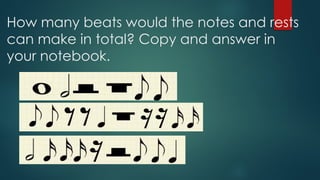
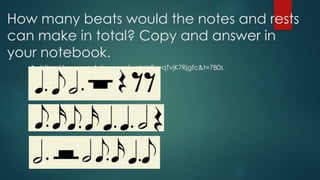
How many beats would the notes and rests
can make in total? Copy and answer in
your notebook.
DOTTED NOTES
AND RESTS
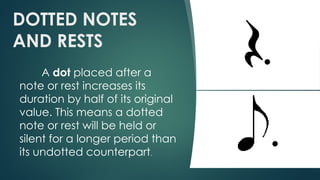
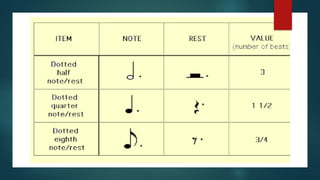
A dot placed after a
note or rest increases its
duration by half of its original
value. This means a dotted
note or rest will be held or
silent for a longer period than
its undotted counterpart.
Dotted Notes: A dot added to a
note increases its length by half of
its original value.
Dotted Rests: Similarly, a dot
added to a rest increases its
duration by half.
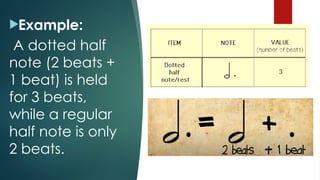
Example:
A dotted half
note (2 beats +
1 beat) is held
for 3 beats,
while a regular
half note is only
2 beats.
How many beats would the notes and rests
can make in total? Copy and answer in
your notebook.
 https://www.youtube.com/watch?v=qTvjK7Rjgfc&t=780s
WHAT I KNOW!!
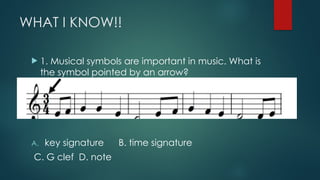
 1. Musical symbols are important in music. What is
the symbol pointed by an arrow?
A. key signature B. time signature
C. G clef D. note
2. A time signature consists the upper and the lower
number. What does the upper number tell?
A. It tells the number of beats in a measure. B. It tells
what note will receive one beat.
C. It tells the kinds of notes to be grouped in a
measure.
D. It tells how many beats should there be in a
measure.
3. In a time signature, the lower
number tells what note will
receive one beat. What note
will receive one beat in a time
signature?
A. half note B. eighth note
B. C. whole note D. quarter
note
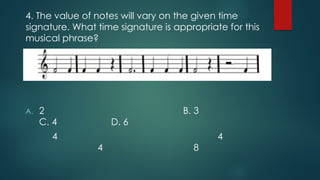
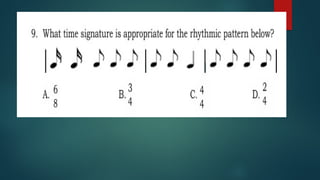
4. The value of notes will vary on the given time
signature. What time signature is appropriate for this
musical phrase?
A. 2 B. 3
C. 4 D. 6
4 4
4 8
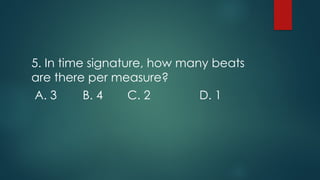
5. In time signature, how many beats
are there per measure?
A. 3 B. 4 C. 2 D. 1
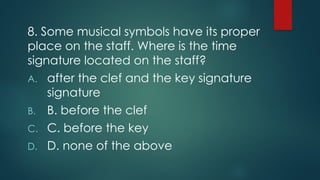
8. Some musical symbols have its proper
place on the staff. Where is the time
signature located on the staff?
A. after the clef and the key signature
signature
B. B. before the clef
C. C. before the key
D. D. none of the above
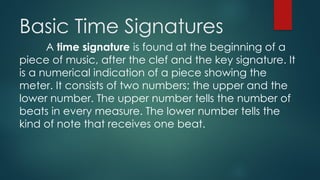
Basic Time Signatures
A time signature is found at the beginning of a
piece of music, after the clef and the key signature. It
is a numerical indication of a piece showing the
meter. It consists of two numbers; the upper and the
lower number. The upper number tells the number of
beats in every measure. The lower number tells the
kind of note that receives one beat.
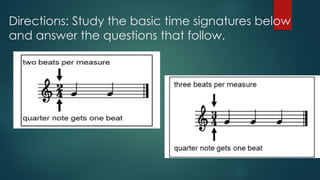
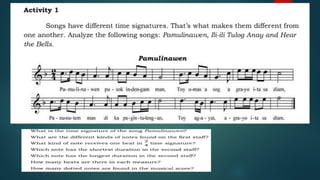
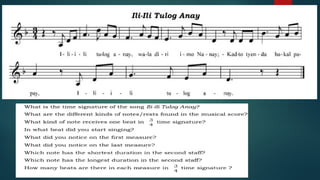
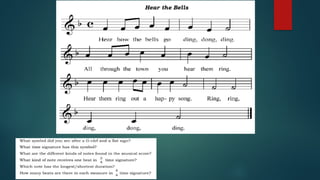
Directions: Study the basic time signatures below
and answer the questions that follow.
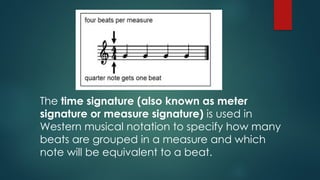
The time signature (also known as meter
signature or measure signature) is used in
Western musical notation to specify how many
beats are grouped in a measure and which
note will be equivalent to a beat.
MUSIC 6 Quarter 1 Module 1. Notes and Rests

MUSIC 6 Quarter 1 Module 1. Notes and Rests

  • 1.
  • 2.
    How many beatswould the notes and rests can make in total? Copy and answer in your notebook.
  • 3.
    DOTTED NOTES AND RESTS Adot placed after a note or rest increases its duration by half of its original value. This means a dotted note or rest will be held or silent for a longer period than its undotted counterpart.
  • 4.
    Dotted Notes: Adot added to a note increases its length by half of its original value. Dotted Rests: Similarly, a dot added to a rest increases its duration by half.
  • 5.
    Example: A dotted half note(2 beats + 1 beat) is held for 3 beats, while a regular half note is only 2 beats.
  • 7.
    How many beatswould the notes and rests can make in total? Copy and answer in your notebook.  https://www.youtube.com/watch?v=qTvjK7Rjgfc&t=780s
  • 10.
    WHAT I KNOW!! 1. Musical symbols are important in music. What is the symbol pointed by an arrow? A. key signature B. time signature C. G clef D. note
  • 11.
    2. A timesignature consists the upper and the lower number. What does the upper number tell? A. It tells the number of beats in a measure. B. It tells what note will receive one beat. C. It tells the kinds of notes to be grouped in a measure. D. It tells how many beats should there be in a measure.
  • 12.
    3. In atime signature, the lower number tells what note will receive one beat. What note will receive one beat in a time signature? A. half note B. eighth note B. C. whole note D. quarter note
  • 13.
    4. The valueof notes will vary on the given time signature. What time signature is appropriate for this musical phrase? A. 2 B. 3 C. 4 D. 6 4 4 4 8
  • 14.
    5. In timesignature, how many beats are there per measure? A. 3 B. 4 C. 2 D. 1
  • 17.
    8. Some musicalsymbols have its proper place on the staff. Where is the time signature located on the staff? A. after the clef and the key signature signature B. B. before the clef C. C. before the key D. D. none of the above
  • 20.
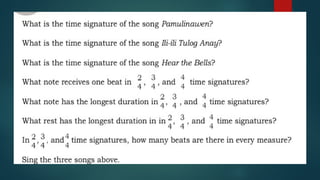
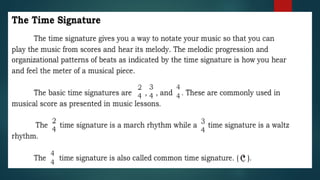
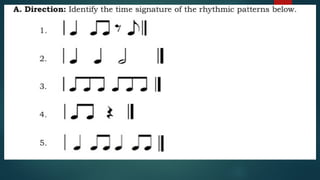
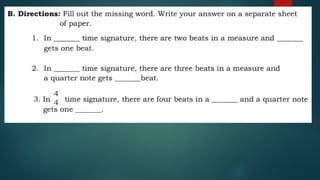
    Basic Time Signatures Atime signature is found at the beginning of a piece of music, after the clef and the key signature. It is a numerical indication of a piece showing the meter. It consists of two numbers; the upper and the lower number. The upper number tells the number of beats in every measure. The lower number tells the kind of note that receives one beat.
  • 21.
    Directions: Study thebasic time signatures below and answer the questions that follow.
  • 22.
    The time signature(also known as meter signature or measure signature) is used in Western musical notation to specify how many beats are grouped in a measure and which note will be equivalent to a beat.

Editor's Notes

  • #2 1. 13 beats 2. 8 beats 3. 7 beats
  • #7 10 beats 2. 8 beats 3. 10 beats
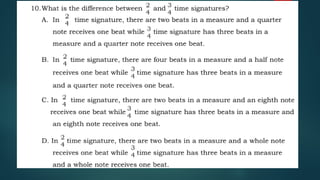
  • #21 What kind of note receives one beat in 2 /4 ¾ 4/4 , , and time signatures? In 2/4time signature, how many beats are there in every measure? How many beats are there in 3/4 every measure in time signature? In 4/4 time signature, how many quarter notes are there in a measure?
  • #23 Video 9:39 sec
  • #24 12:49
  • #25 15.23