Muon g-2 Beam Storage Magnet B Field
Shaping
George Ressinger (St. Charles North High School)
Dr. Brendan Kiburg (Fermi National Accelerator Laboratory)
Abstract
The Muon g-2 Experiment at the Fermi National Accelerator Laboratory is an upgraded
measurement of the anomalous magnetic moment of the muon. It seeks to test the finer
predictions of the Standard Model (SM) by measuring the contributions of Quantum
Electrodynamics (QED), as well as hadronic and weak interactions, to the anomaly. Current
efforts center on shaping and mapping the magnetic field. This will decrease the deviation in
measured positron energy, increasing the accuracy of the calculated anomaly well past that of
the Brookhaven National Lab (BNL) experiment (.7 ppm), to 140 ppb (.14 ppm). This accuracy
will allow for detailed calculations of effects on the muon not predicted by the SM, providing
insight into hitherto unknown physics.
Introduction
Background
The muon is an elementary, point-like, spin ½ particle identical to the electron (and tau), but with
207 times the electron mass. It has a rest frame lifetime of 2.2 ​µs. ​Discovered unexpectedly, it
was thought to be an excited state of the electron for some time, until confirmed to be a unique
particle. Like the electron, the muon is predicted to have a gyromagnetic factor (or “g”) equal to
2. This is a coefficient in the Dirac equation ​W​ p​ = g​ (​e/​ 2​mc​ )​ B​ , which predicts how fast a particle
precesses in a magnetic (B) field. Experiments to find the muon g anomaly were prompted by
Schwinger’s experiments on the hyperfine structure of hydrogen, which found an electron g
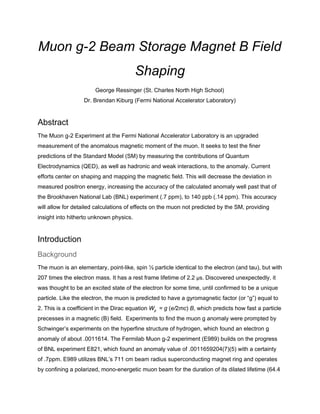
anomaly of about .0011614. The Fermilab Muon g-2 experiment (E989) builds on the progress
of BNL experiment E821, which found an anomaly value of .0011659204(7)(5) with a certainty
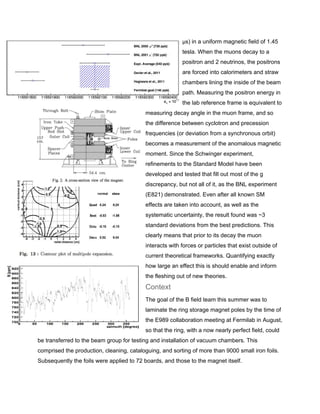
of .7ppm. E989 utilizes BNL’s 711 cm beam radius superconducting magnet ring and operates
by confining a polarized, mono-energetic muon beam for the duration of its dilated lifetime (64.4
µs​) in a uniform magnetic field of 1.45
tesla. When the muons decay to a
positron and 2 neutrinos, the positrons
are forced into calorimeters and straw
chambers lining the inside of the beam
path. Measuring the positron energy in
the lab reference frame is equivalent to
measuring decay angle in the muon frame, and so
the difference between cyclotron and precession
frequencies (or deviation from a synchronous orbit)
becomes a measurement of the anomalous magnetic
moment. Since the Schwinger experiment,
refinements to the Standard Model have been
developed and tested that fill out most of the g
discrepancy, but not all of it, as the BNL experiment
(E821) demonstrated. Even after all known SM
effects are taken into account, as well as the
systematic uncertainty, the result found was ~3
standard deviations from the best predictions. This
clearly means that prior to its decay the muon
interacts with forces or particles that exist outside of
current theoretical frameworks. Quantifying exactly
how large an effect this is should enable and inform
the fleshing out of new theories.
Context
The goal of the B field team this summer was to
laminate the ring storage magnet poles by the time of
the E989 collaboration meeting at Fermilab in August,
so that the ring, with a now nearly perfect field, could
be transferred to the beam group for testing and installation of vacuum chambers. This
comprised the production, cleaning, cataloguing, and sorting of more than 9000 small iron foils.
Subsequently the foils were applied to 72 boards, and those to the magnet itself.
Simultaneously required was consistent testing and calibration in the field, as well as constant
analysis of the perturbations caused by the boards.
Methods
Background
Tuning of the magnetic field
occurs in several distinct
ways. First is the adjustment
of wedge shims, which raise
and lower the pole pieces
thousandths of an inch. This
occurred prior to my arrival,
though I confirmed by
micrometer that all
adjustments were as
expected at 400 points around the ring. Second is the addition of small (sub-milligram) strips of
soft iron to G-10 plastic sheets placed inside the pole gap. This extremely low carbon iron has a
high permeability (ability to support the internal formation of a magnetic field consistent with an
applied field), and a low coercivity (a quality relating to a ferrous metal’s tendency to become
residually magnetic). This allows it to quickly adopt the applied field and amplify it in
proportionally to its mass. By placing 8856 strips (plus gratings) over 72 poles (36 top and
bottom) in 3 rows of 41 per pole, reduction of the field variation to less than 25 ppm azimuthally,
and .5 ppm azimuthally averaged radially and vertically, is expected. The field is measured
periodically using a non-magnetic cart containing 25 NMR probes, reading on average every .3
degrees. This data is analysed and used to inform corrections to the mass formulas, as well as
methods/orientations of placement and application of foils.
Data
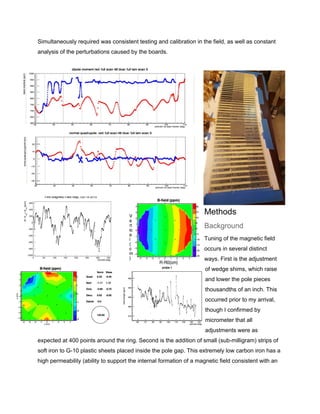
The field consistency has, as a result of our laminations, improved considerably thus far, and
should continue improving to well within our tolerances. The BNL E821 experiment ended with a
systematic uncertainty of 540 ppb, a variation of ~200 ppm azimuthally peak to trough, and less
than 1 ppm azimuthally averaged. The goal of “shimming” is to reduce those variations to 25
ppm azimuthally, .5 ppm azimuthally averaged, and to help limit systematic uncertainty to 140
ppb. Currently the field is at 40 ppm for the worst laminations, and well within 25 ppm for the
majority. Azimuthally averaged, especially for higher order perturbations, the field is still outside
of .5 ppm for the worse foils. Seen here without gratings are some of the before and after
variations in multipole effects, as well as early and more recent field graphs.
Analysis
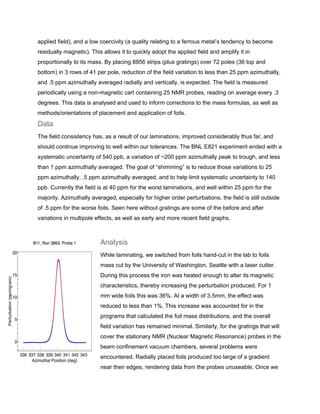
While laminating, we switched from foils hand-cut in the lab to foils
mass cut by the University of Washington, Seattle with a laser cutter.
During this process the iron was heated enough to alter its magnetic
characteristics, thereby increasing the perturbation produced. For 1
mm wide foils this was 36%. At a width of 3.5mm, the effect was
reduced to less than 1%. This increase was accounted for in the
programs that calculated the foil mass distributions, and the overall
field variation has remained minimal. Similarly, for the gratings that will
cover the stationary NMR (Nuclear Magnetic Resonance) probes in the
beam confinement vacuum chambers, several problems were
encountered. Radially placed foils produced too large of a gradient
near their edges, rendering data from the probes unuseable. Once we
switched to azimuthally placed foils, this effect was neutralized, but the total perturbation
produced by our calculated gratings was 12% too large. We again reduced the mass
accordingly, and the gratings are currently performing as expected.
Acknowledgements
Thanks go to Dr. Chris Stoughton at Fermilab for facilitating this project and experience, and to
Laura Thorpe and George Dzuricsko for the same. Dr. Brendan Kiburg, Dr. David Flay, and the
many other g-2 staff members were also immensely helpful and instrumental to the success of
my summer. Fermilab is operated by Fermi Research Alliance, LLC under Contract No.
DE-AC02-07CH11359 with the United States Department of Energy. QuarkNet is an
educational program sponsored by the National Science Foundation and the Department of
Energy whose aim is to support science education in schools by establishing a nationwide
network of science teachers. This work was supported by CRADA FRA-2014-0022-02
agreement between Fermi Research Alliance LLC and the University of Notre Dame for the
2015-16 QuarkNet summer program.
References
1. Ozben, C. S. and others. (2002). PRECISION MEASUREMENT OF THE ANOMALOUS
MAGNETIC MOMENT OF THE MUON. Retrieved July 29, 2016, from ​http://arxiv.org/
2. Gray, F. (2015, May). Muon g-2 Experiment at Fermilab. Retrieved July, 2016, from
http://arxiv.org/pdf/1510.00346.pdf
3. G. (2014, December). Muon g – 2 Technical Design Report. Retrieved July, 2016, from
https://arxiv.org/ftp/arxiv/papers/1501/1501.06858.pdf
4. Danby. ​The Brookhaven Muon Storage Ring Magnet. Department of Energy. Nuclear
Instruments and Methods in Physics Research, June 2000. Web. July 2016.
5. Hertzog, David W. "Next Generation Muon G − 2 Experiments." ​ArXiv. N.p., 3 Dec.
2015. Web. July 2016.

Muong-2BeamStorageMagnetBFieldShaping

  • 1.
    Muon g-2 BeamStorage Magnet B Field Shaping George Ressinger (St. Charles North High School) Dr. Brendan Kiburg (Fermi National Accelerator Laboratory) Abstract The Muon g-2 Experiment at the Fermi National Accelerator Laboratory is an upgraded measurement of the anomalous magnetic moment of the muon. It seeks to test the finer predictions of the Standard Model (SM) by measuring the contributions of Quantum Electrodynamics (QED), as well as hadronic and weak interactions, to the anomaly. Current efforts center on shaping and mapping the magnetic field. This will decrease the deviation in measured positron energy, increasing the accuracy of the calculated anomaly well past that of the Brookhaven National Lab (BNL) experiment (.7 ppm), to 140 ppb (.14 ppm). This accuracy will allow for detailed calculations of effects on the muon not predicted by the SM, providing insight into hitherto unknown physics. Introduction Background The muon is an elementary, point-like, spin ½ particle identical to the electron (and tau), but with 207 times the electron mass. It has a rest frame lifetime of 2.2 ​µs. ​Discovered unexpectedly, it was thought to be an excited state of the electron for some time, until confirmed to be a unique particle. Like the electron, the muon is predicted to have a gyromagnetic factor (or “g”) equal to 2. This is a coefficient in the Dirac equation ​W​ p​ = g​ (​e/​ 2​mc​ )​ B​ , which predicts how fast a particle precesses in a magnetic (B) field. Experiments to find the muon g anomaly were prompted by Schwinger’s experiments on the hyperfine structure of hydrogen, which found an electron g anomaly of about .0011614. The Fermilab Muon g-2 experiment (E989) builds on the progress of BNL experiment E821, which found an anomaly value of .0011659204(7)(5) with a certainty of .7ppm. E989 utilizes BNL’s 711 cm beam radius superconducting magnet ring and operates by confining a polarized, mono-energetic muon beam for the duration of its dilated lifetime (64.4
  • 2.
    µs​) in auniform magnetic field of 1.45 tesla. When the muons decay to a positron and 2 neutrinos, the positrons are forced into calorimeters and straw chambers lining the inside of the beam path. Measuring the positron energy in the lab reference frame is equivalent to measuring decay angle in the muon frame, and so the difference between cyclotron and precession frequencies (or deviation from a synchronous orbit) becomes a measurement of the anomalous magnetic moment. Since the Schwinger experiment, refinements to the Standard Model have been developed and tested that fill out most of the g discrepancy, but not all of it, as the BNL experiment (E821) demonstrated. Even after all known SM effects are taken into account, as well as the systematic uncertainty, the result found was ~3 standard deviations from the best predictions. This clearly means that prior to its decay the muon interacts with forces or particles that exist outside of current theoretical frameworks. Quantifying exactly how large an effect this is should enable and inform the fleshing out of new theories. Context The goal of the B field team this summer was to laminate the ring storage magnet poles by the time of the E989 collaboration meeting at Fermilab in August, so that the ring, with a now nearly perfect field, could be transferred to the beam group for testing and installation of vacuum chambers. This comprised the production, cleaning, cataloguing, and sorting of more than 9000 small iron foils. Subsequently the foils were applied to 72 boards, and those to the magnet itself.
  • 3.
    Simultaneously required wasconsistent testing and calibration in the field, as well as constant analysis of the perturbations caused by the boards. Methods Background Tuning of the magnetic field occurs in several distinct ways. First is the adjustment of wedge shims, which raise and lower the pole pieces thousandths of an inch. This occurred prior to my arrival, though I confirmed by micrometer that all adjustments were as expected at 400 points around the ring. Second is the addition of small (sub-milligram) strips of soft iron to G-10 plastic sheets placed inside the pole gap. This extremely low carbon iron has a high permeability (ability to support the internal formation of a magnetic field consistent with an
  • 4.
    applied field), anda low coercivity (a quality relating to a ferrous metal’s tendency to become residually magnetic). This allows it to quickly adopt the applied field and amplify it in proportionally to its mass. By placing 8856 strips (plus gratings) over 72 poles (36 top and bottom) in 3 rows of 41 per pole, reduction of the field variation to less than 25 ppm azimuthally, and .5 ppm azimuthally averaged radially and vertically, is expected. The field is measured periodically using a non-magnetic cart containing 25 NMR probes, reading on average every .3 degrees. This data is analysed and used to inform corrections to the mass formulas, as well as methods/orientations of placement and application of foils. Data The field consistency has, as a result of our laminations, improved considerably thus far, and should continue improving to well within our tolerances. The BNL E821 experiment ended with a systematic uncertainty of 540 ppb, a variation of ~200 ppm azimuthally peak to trough, and less than 1 ppm azimuthally averaged. The goal of “shimming” is to reduce those variations to 25 ppm azimuthally, .5 ppm azimuthally averaged, and to help limit systematic uncertainty to 140 ppb. Currently the field is at 40 ppm for the worst laminations, and well within 25 ppm for the majority. Azimuthally averaged, especially for higher order perturbations, the field is still outside of .5 ppm for the worse foils. Seen here without gratings are some of the before and after variations in multipole effects, as well as early and more recent field graphs. Analysis While laminating, we switched from foils hand-cut in the lab to foils mass cut by the University of Washington, Seattle with a laser cutter. During this process the iron was heated enough to alter its magnetic characteristics, thereby increasing the perturbation produced. For 1 mm wide foils this was 36%. At a width of 3.5mm, the effect was reduced to less than 1%. This increase was accounted for in the programs that calculated the foil mass distributions, and the overall field variation has remained minimal. Similarly, for the gratings that will cover the stationary NMR (Nuclear Magnetic Resonance) probes in the beam confinement vacuum chambers, several problems were encountered. Radially placed foils produced too large of a gradient near their edges, rendering data from the probes unuseable. Once we
  • 5.
    switched to azimuthallyplaced foils, this effect was neutralized, but the total perturbation produced by our calculated gratings was 12% too large. We again reduced the mass accordingly, and the gratings are currently performing as expected. Acknowledgements Thanks go to Dr. Chris Stoughton at Fermilab for facilitating this project and experience, and to Laura Thorpe and George Dzuricsko for the same. Dr. Brendan Kiburg, Dr. David Flay, and the many other g-2 staff members were also immensely helpful and instrumental to the success of my summer. Fermilab is operated by Fermi Research Alliance, LLC under Contract No. DE-AC02-07CH11359 with the United States Department of Energy. QuarkNet is an educational program sponsored by the National Science Foundation and the Department of Energy whose aim is to support science education in schools by establishing a nationwide network of science teachers. This work was supported by CRADA FRA-2014-0022-02 agreement between Fermi Research Alliance LLC and the University of Notre Dame for the 2015-16 QuarkNet summer program. References 1. Ozben, C. S. and others. (2002). PRECISION MEASUREMENT OF THE ANOMALOUS MAGNETIC MOMENT OF THE MUON. Retrieved July 29, 2016, from ​http://arxiv.org/ 2. Gray, F. (2015, May). Muon g-2 Experiment at Fermilab. Retrieved July, 2016, from http://arxiv.org/pdf/1510.00346.pdf 3. G. (2014, December). Muon g – 2 Technical Design Report. Retrieved July, 2016, from https://arxiv.org/ftp/arxiv/papers/1501/1501.06858.pdf 4. Danby. ​The Brookhaven Muon Storage Ring Magnet. Department of Energy. Nuclear Instruments and Methods in Physics Research, June 2000. Web. July 2016. 5. Hertzog, David W. "Next Generation Muon G − 2 Experiments." ​ArXiv. N.p., 3 Dec. 2015. Web. July 2016.