S P EC I F I C A T I O N A N D C O N T R A C T S
Case Study -PPP Project
Rakshita Singh
A/3734/2022
3rd Year section-C
2.
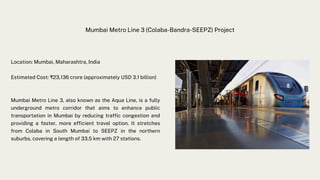
Mumbai Metro Line3 (Colaba-Bandra-SEEPZ) Project
Location: Mumbai, Maharashtra, India
Estimated Cost: ₹23,136 crore (approximately USD 3.1 billion)
Mumbai Metro Line 3, also known as the Aqua Line, is a fully
underground metro corridor that aims to enhance public
transportation in Mumbai by reducing traffic congestion and
providing a faster, more efficient travel option. It stretches
from Colaba in South Mumbai to SEEPZ in the northern
suburbs, covering a length of 33.5 km with 27 stations.
3.
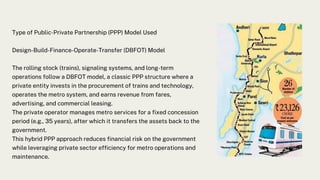
Type of Public-PrivatePartnership (PPP) Model Used
Design-Build-Finance-Operate-Transfer (DBFOT) Model
The rolling stock (trains), signaling systems, and long-term
operations follow a DBFOT model, a classic PPP structure where a
private entity invests in the procurement of trains and technology,
operates the metro system, and earns revenue from fares,
advertising, and commercial leasing.
The private operator manages metro services for a fixed concession
period (e.g., 35 years), after which it transfers the assets back to the
government.
This hybrid PPP approach reduces financial risk on the government
while leveraging private sector efficiency for metro operations and
maintenance.
4.
Contract Type
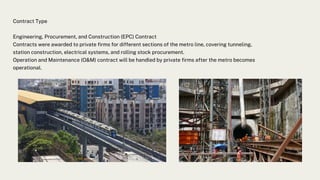
Engineering, Procurement,and Construction (EPC) Contract
Contracts were awarded to private firms for different sections of the metro line, covering tunneling,
station construction, electrical systems, and rolling stock procurement.
Operation and Maintenance (O&M) contract will be handled by private firms after the metro becomes
operational.
5.
Role of Governmentand Private Sector
Role of Government:
Funding & Policy Support: The Government of Maharashtra and the
Government of India provide funding and regulatory support.
Land Acquisition & Approvals: The government facilitates land
acquisition, clearances, and coordination with different agencies.
Project Oversight: The Mumbai Metro Rail Corporation Limited (MMRCL),
a government-owned body, is responsible for project execution.
Role of the Private Sector:
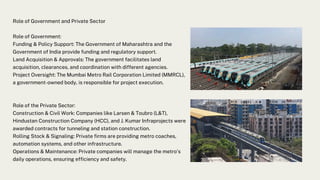
Construction & Civil Work: Companies like Larsen & Toubro (L&T),
Hindustan Construction Company (HCC), and J. Kumar Infraprojects were
awarded contracts for tunneling and station construction.
Rolling Stock & Signaling: Private firms are providing metro coaches,
automation systems, and other infrastructure.
Operations & Maintenance: Private companies will manage the metro's
daily operations, ensuring efficiency and safety.
6.
Challenges Faced
A. LandAcquisition Issues
The project required acquiring land for metro stations and entry-exit points in densely populated areas.
Residents and shopkeepers protested against land acquisition due to loss of property and livelihood.
B. Environmental Concerns
The project faced major opposition due to tree-cutting in Aarey Colony, a green zone in Mumbai. Activists and
environmentalists protested against the deforestation of nearly 2,000 trees.
After public and legal intervention, the government shifted some metro car shed activities to an alternative location.
C. Technical & Engineering Challenges
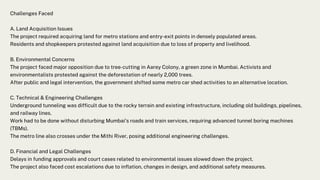
Underground tunneling was difficult due to the rocky terrain and existing infrastructure, including old buildings, pipelines,
and railway lines.
Work had to be done without disturbing Mumbai’s roads and train services, requiring advanced tunnel boring machines
(TBMs).
The metro line also crosses under the Mithi River, posing additional engineering challenges.
D. Financial and Legal Challenges
Delays in funding approvals and court cases related to environmental issues slowed down the project.
The project also faced cost escalations due to inflation, changes in design, and additional safety measures.
7.
Current Status
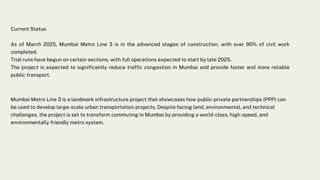
As ofMarch 2025, Mumbai Metro Line 3 is in the advanced stages of construction, with over 90% of civil work
completed.
Trial runs have begun on certain sections, with full operations expected to start by late 2025.
The project is expected to significantly reduce traffic congestion in Mumbai and provide faster and more reliable
public transport.
Mumbai Metro Line 3 is a landmark infrastructure project that showcases how public-private partnerships (PPP) can
be used to develop large-scale urban transportation projects. Despite facing land, environmental, and technical
challenges, the project is set to transform commuting in Mumbai by providing a world-class, high-speed, and
environmentally friendly metro system.



![제 23회 보아즈(BOAZ) 빅데이터 컨퍼런스 - [MBOAX] : ABSA를 활용한 소비자 반응 분석 기반 운영 효율화 대시보드 설계](https://cdn.slidesharecdn.com/ss_thumbnails/3-1boaz23rdconferencemboax-260203102709-9d519923-thumbnail.jpg?width=640&height=640&fit=bounds)


