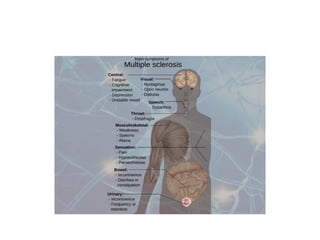
Multiple sclerosis
Prof. Dr Abid Naeem
➢ Most common chronic neurological disorder affecting young people
➢ In most typical form is characterized by lesions separated in time and
space in central nervous system
➢ More common in temperate than tropical climate
➢ More common in males (M:F 1.5:1)
➢ Usual age of presentation is between ages of 20 – 40
➢ Prevalence in UK of 1 in 1000
Path physiology
➢ Affects white matter of brain and spinal cord
➢ Inflammatory cells present and myelin damaged
➢ Foci of inflammation and demyelization known as plaques
➢ Initially inflammation and edema, followed by loss of myelin and
then gliosis (scar tissue)
➢ Leads to reduction in conduction velocity
➢ Thought that environmental agent (e.g. virus) triggers condition in
genetically susceptible individual
Presentation
➢ Visual disturbance
➢ Optic neuritis caused by inflammatory demyelization of one optic
nerve
➢ Pain around one eye especially on eye movement
➢ Blurred vision which may progress to monocular blindness over days
or weeks
➢ Loss of colour vision
➢ Limb weakness and sensory disturbance
➢ Lesion in spinal cord or cerebral hemispheres
➢ May have tingling sensation down back +/or limbs on neck flexion
➢ Symptoms may be worse after hot bath
➢ Course
1-Relapsing-remitting
➢ After episode may be resolution of symptoms (80% patients)
➢ After further episodes may be some residual disability
2-Secondary progressive
➢ Steady progression without resolution complete or near-completion
3- Primary progressive
➢ 10% patients have this form of disease with no clear relapses and
remissions
Multiple sclerosis
Differential Diagnosis
➢ SLE and related collagen vascular disease and vasculitis.
➢ Cerebral stroke
➢ Neoplasm (lymphoma, glioma and meningioma).
➢ Behçet’s disease.
➢ HIV.
Management
➢ If relapse severe enough to limit function – Treat with steroids
➢ Symptom control
➢ Spasticity, fatigue, bladder disturbance, depression, pain
➢ Disease modifying therapy
➢ Interferon beta and glatiramer acetate
Thanks

Multiple sclerosis.pdf

  • 1.
  • 4.
    ➢ Most commonchronic neurological disorder affecting young people ➢ In most typical form is characterized by lesions separated in time and space in central nervous system ➢ More common in temperate than tropical climate ➢ More common in males (M:F 1.5:1) ➢ Usual age of presentation is between ages of 20 – 40 ➢ Prevalence in UK of 1 in 1000
  • 5.
    Path physiology ➢ Affectswhite matter of brain and spinal cord ➢ Inflammatory cells present and myelin damaged ➢ Foci of inflammation and demyelization known as plaques ➢ Initially inflammation and edema, followed by loss of myelin and then gliosis (scar tissue) ➢ Leads to reduction in conduction velocity ➢ Thought that environmental agent (e.g. virus) triggers condition in genetically susceptible individual
  • 6.
    Presentation ➢ Visual disturbance ➢Optic neuritis caused by inflammatory demyelization of one optic nerve ➢ Pain around one eye especially on eye movement ➢ Blurred vision which may progress to monocular blindness over days or weeks ➢ Loss of colour vision ➢ Limb weakness and sensory disturbance ➢ Lesion in spinal cord or cerebral hemispheres ➢ May have tingling sensation down back +/or limbs on neck flexion ➢ Symptoms may be worse after hot bath
  • 7.
    ➢ Course 1-Relapsing-remitting ➢ Afterepisode may be resolution of symptoms (80% patients) ➢ After further episodes may be some residual disability 2-Secondary progressive ➢ Steady progression without resolution complete or near-completion 3- Primary progressive ➢ 10% patients have this form of disease with no clear relapses and remissions
  • 8.
  • 10.
    Differential Diagnosis ➢ SLEand related collagen vascular disease and vasculitis. ➢ Cerebral stroke ➢ Neoplasm (lymphoma, glioma and meningioma). ➢ Behçet’s disease. ➢ HIV.
  • 11.
    Management ➢ If relapsesevere enough to limit function – Treat with steroids ➢ Symptom control ➢ Spasticity, fatigue, bladder disturbance, depression, pain ➢ Disease modifying therapy ➢ Interferon beta and glatiramer acetate
  • 13.