Multidisciplinary
Trauma Team meeting
1/2022
Dr. Lim Teck Seng
Emergency physician HTJS
8 June 2022
Agenda
❖Data and attendance of critical trauma patients
❖Finalize trauma team committee
❖Trauma pathway:
➢Trauma services in Malaysian hospitals
➢Discussion on pathway and activation criteria
❖Resources and limitations
❖Timeline and future plan
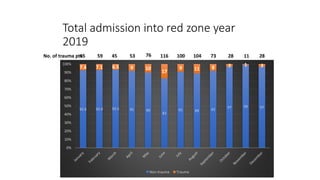
Total admission into red zone year
2019
92.6 92.9 93.5 92 90
83
91 89 92
97 99 97
7.4 7.1 6.5 8 10
17
9 11 8 3 1 3
0%
10%
20%
30%
40%
50%
60%
70%
80%
90%
100%
Non-trauma Trauma
No. of trauma pts:
65 59 45 53 76 116 100 104 73 28 11 28
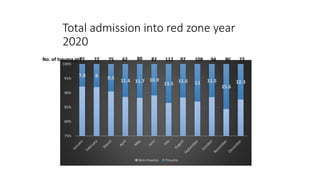
Total admission into red zone year
2020
7.8 8 9.5
11.4 11.7 10.9
13.5
11.6 13 11.5
15.6
12.3
75%
80%
85%
90%
95%
100%
Non-trauma Trauma
No. of trauma pts:
77 72 75 62 80 82 112 97 108 94 90 73
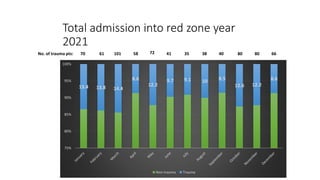
Total admission into red zone year
2021
13.4 13.8 14.4
8.6
12.2
9.7 9.1 10 8.5
12.6 12.2
8.6
75%
80%
85%
90%
95%
100%
Non-trauma Trauma
No. of trauma pts: 70 61 101 58 72 41 35 38 40 80 80 66
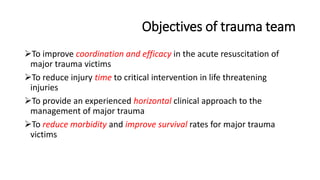
Objectives of trauma team
➢To improve coordination and efficacy in the acute resuscitation of
major trauma victims
➢To reduce injury time to critical intervention in life threatening
injuries
➢To provide an experienced horizontal clinical approach to the
management of major trauma
➢To reduce morbidity and improve survival rates for major trauma
victims
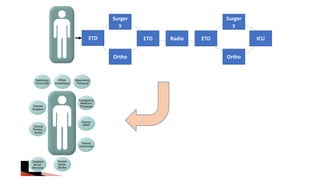
ETD
Ortho
ETD
Ortho
ICU
Surger
y
ETD Radio
Surger
y
Agenda
❖Introduction and summary of meeting 1.0
❖Finalize trauma team committee
❖Trauma pathway:
➢Trauma services in Malaysian hospitals
➢Discussion on pathway and activation criteria
❖Resources and limitations
❖Timeline and future plan
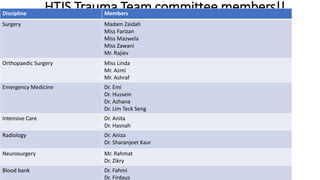
HTJS Trauma Team committee members!!
(?Name)
Discipline Members
Surgery Madam Zaidah
Miss Farizan
Miss Mazwela
Miss Zawani
Mr. Rajiev
Orthopaedic Surgery Miss Linda
Mr. Azmi
Mr. Ashraf
Emergency Medicine Dr. Emi
Dr. Hussein
Dr. Azhana
Dr. Lim Teck Seng
Intensive Care Dr. Anita
Dr. Hasnah
Radiology Dr. Aniza
Dr. Sharanjeet Kaur
Neurosurgery Mr. Rahmat
Dr. Zikry
Blood bank Dr. Fahmi
Dr. Firdaus
Agenda
❖Introduction and summary of meeting 1.0
❖Finalize trauma team committee
❖Trauma pathway:
➢Trauma services in Malaysian hospitals
➢Discussion on pathway and activation criteria
❖Resources and limitations
❖Timeline and future plan
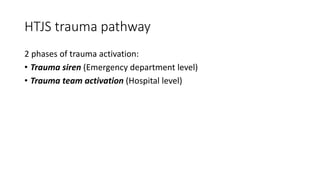
HTJS trauma pathway
2 phases of trauma activation:
• Trauma siren (Emergency department level)
• Trauma team activation (Hospital level)
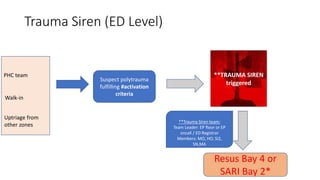
PHC team
Walk-in
Resus Bay 4 or
SARI Bay 2*
**Trauma Siren team:
Team Leader: EP floor or EP
oncall / ED Registrar
Members: MO, HO, SI2,
SN,MA
Suspect polytrauma
fulfilling #activation
criteria
Uptriage from
other zones
Trauma Siren (ED Level)
**TRAUMA SIREN
triggered
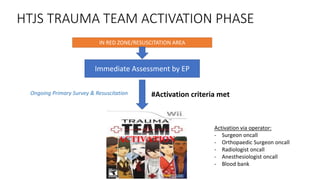
Immediate Assessment by EP
#Activation criteria met
HTJS TRAUMA TEAM ACTIVATION PHASE
IN RED ZONE/RESUSCITATION AREA
Ongoing Primary Survey & Resuscitation
Activation via operator:
- Surgeon oncall
- Orthopaedic Surgeon oncall
- Radiologist oncall
- Anesthesiologist oncall
- Blood bank
ACTIVATION
Suggestion of Activation
Criteria:
#Activation criteria example 1
Physiological Criteria
I. Spo2 < 90%
II. GCS<13
III. Systolic BP < 100 mmHg
IV. Respiratory Rate <10/min or
>30/min
V. Pulse Rate > 120/min
VI. Age > 65 Years Old
VII.Anticoagulant Therapy
Anatomical Criteria
I. Visible Injury to > 1 Body Region
(Head/Neck/Thorax/Abdomen/Pel
vis)
II. Suspected Unstable Pelvic Fracture
III. Flail or Open Chest Wound
IV. Hard Signs of Spinal Cord Injury
V. Positive FAST
Mechanism of injury Criteria
I. Fatality in The Same Vehicle
II. Ejection Out of the Car
III. Vehicle Roll Over
IV. Pedestrian, Cyclist, Motorcyclist
Versus Car
V. Suspected Fall > 3 Meters
VI. Prolonged Extrication > 15
Minutes
VII.High Speed Collision > 50 km/h
at Impact
VIII.Explosion
**Activation of Trauma Team would require a minimum total of 2 criteria’s.
Each of the 2 criteria’s need to be derived from at least 2 different categories
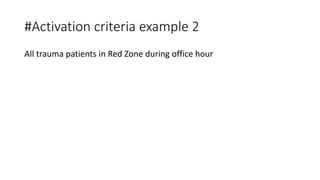
#Activation criteria example 2
All trauma patients in Red Zone during office hour
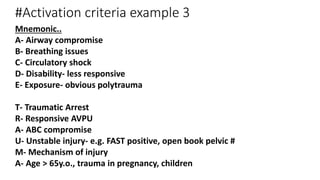
#Activation criteria example 3
Mnemonic..
A- Airway compromise
B- Breathing issues
C- Circulatory shock
D- Disability- less responsive
E- Exposure- obvious polytrauma
T- Traumatic Arrest
R- Responsive AVPU
A- ABC compromise
U- Unstable injury- e.g. FAST positive, open book pelvic #
M- Mechanism of injury
A- Age > 65y.o., trauma in pregnancy, children
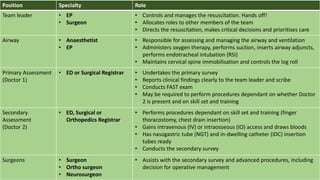
Trauma Team Dynamics
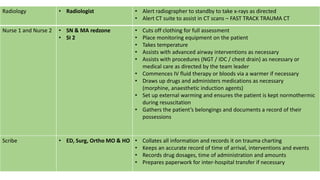
Position Specialty Role
Team leader • EP
• Surgeon
• Controls and manages the resuscitation. Hands off!
• Allocates roles to other members of the team
• Directs the resuscitation, makes critical decisions and prioritises care
Airway • Anaesthetist
• EP
• Responsible for assessing and managing the airway and ventilation
• Administers oxygen therapy, performs suction, inserts airway adjuncts,
performs endotracheal intubation (RSI)
• Maintains cervical spine immobilisation and controls the log roll
Primary Assessment
(Doctor 1)
• ED or Surgical Registrar • Undertakes the primary survey
• Reports clinical findings clearly to the team leader and scribe
• Conducts FAST exam
• May be required to perform procedures dependant on whether Doctor
2 is present and on skill set and training
Secondary
Assessment
(Doctor 2)
• ED, Surgical or
Orthopedics Registrar
• Performs procedures dependant on skill set and training (finger
thoracostomy, chest drain insertion)
• Gains intravenous (IV) or intraosseous (IO) access and draws bloods
• Has nasogastric tube (NGT) and in-dwelling catheter (IDC) insertion
tubes ready
• Conducts the secondary survey
Surgeons • Surgeon
• Ortho surgeon
• Neurosurgeon
• Assists with the secondary survey and advanced procedures, including
decision for operative management
Radiology • Radiologist • Alert radiographer to standby to take x-rays as directed
• Alert CT suite to assist in CT scans – FAST TRACK TRAUMA CT
Nurse 1 and Nurse 2 • SN & MA redzone
• SI 2
• Cuts off clothing for full assessment
• Place monitoring equipment on the patient
• Takes temperature
• Assists with advanced airway interventions as necessary
• Assists with procedures (NGT / IDC / chest drain) as necessary or
medical care as directed by the team leader
• Commences IV fluid therapy or bloods via a warmer if necessary
• Draws up drugs and administers medications as necessary
(morphine, anaesthetic induction agents)
• Set up external warming and ensures the patient is kept normothermic
during resuscitation
• Gathers the patient’s belongings and documents a record of their
possessions
Scribe • ED, Surg, Ortho MO & HO • Collates all information and records it on trauma charting
• Keeps an accurate record of time of arrival, interventions and events
• Records drug dosages, time of administration and amounts
• Prepares paperwork for inter-hospital transfer if necessary
Agenda
❖Introduction and summary of meeting 1.0
❖Finalize trauma team committee
❖Trauma pathway:
➢Trauma services in Malaysian hospitals
➢Discussion on pathway and activation criteria
❖Resources and limitations
❖Timeline and future plan
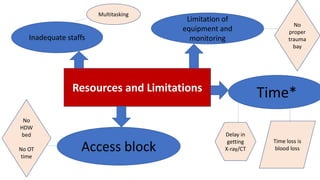
Resources and Limitations
Inadequate staffs
Limitation of
equipment and
monitoring
No
proper
trauma
bay
Access block
No
HDW
bed
No OT
time
Time*
Time loss is
blood loss
Delay in
getting
X-ray/CT
Multitasking
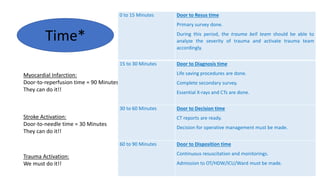
Time*
Myocardial Infarction:
Door-to-reperfusion time = 90 Minutes
They can do it!!
Stroke Activation:
Door-to-needle time = 30 Minutes
They can do it!!
Trauma Activation:
We must do it!!
0 to 15 Minutes Door to Resus time
Primary survey done.
During this period, the trauma bell team should be able to
analyze the severity of trauma and activate trauma team
accordingly.
15 to 30 Minutes Door to Diagnosis time
Life saving procedures are done.
Complete secondary survey.
Essential X-rays and CTs are done.
30 to 60 Minutes Door to Decision time
CT reports are ready.
Decision for operative management must be made.
60 to 90 Minutes Door to Disposition time
Continuous resuscitation and monitorings.
Admission to OT/HDW/ICU/Ward must be made.
Agenda
❖Introduction and summary of meeting 1.0
❖Finalize trauma team committee
❖Trauma pathway:
➢Trauma services in Malaysian hospitals
➢Discussion on pathway and activation criteria
❖Resources and limitations
❖Timeline and future plan
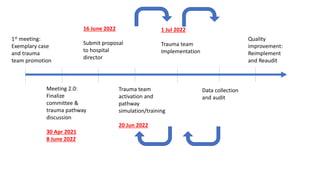
1st meeting:
Exemplary case
and trauma
team promotion
Meeting 2.0:
Finalize
committee &
trauma pathway
discussion
30 Apr 2021
8 June 2022
16 June 2022
Submit proposal
to hospital
director
Trauma team
activation and
pathway
simulation/training
20 Jun 2022
1 Jul 2022
Trauma team
Implementation
Data collection
and audit
Quality
improvement:
Reimplement
and Reaudit
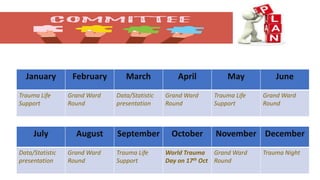
January February March April May June
Trauma Life
Support
Grand Ward
Round
Data/Statistic
presentation
Grand Ward
Round
Trauma Life
Support
Grand Ward
Round
July August September October November December
Data/Statistic
presentation
Grand Ward
Round
Trauma Life
Support
World Trauma
Day on 17th Oct
Grand Ward
Round
Trauma Night
MULTIDISCIPLINARY Trauma Team meeting@!!

MULTIDISCIPLINARY Trauma Team meeting@!!

  • 1.
    Multidisciplinary Trauma Team meeting 1/2022 Dr.Lim Teck Seng Emergency physician HTJS 8 June 2022
  • 2.
    Agenda ❖Data and attendanceof critical trauma patients ❖Finalize trauma team committee ❖Trauma pathway: ➢Trauma services in Malaysian hospitals ➢Discussion on pathway and activation criteria ❖Resources and limitations ❖Timeline and future plan
  • 3.
    Total admission intored zone year 2019 92.6 92.9 93.5 92 90 83 91 89 92 97 99 97 7.4 7.1 6.5 8 10 17 9 11 8 3 1 3 0% 10% 20% 30% 40% 50% 60% 70% 80% 90% 100% Non-trauma Trauma No. of trauma pts: 65 59 45 53 76 116 100 104 73 28 11 28
  • 4.
    Total admission intored zone year 2020 7.8 8 9.5 11.4 11.7 10.9 13.5 11.6 13 11.5 15.6 12.3 75% 80% 85% 90% 95% 100% Non-trauma Trauma No. of trauma pts: 77 72 75 62 80 82 112 97 108 94 90 73
  • 5.
    Total admission intored zone year 2021 13.4 13.8 14.4 8.6 12.2 9.7 9.1 10 8.5 12.6 12.2 8.6 75% 80% 85% 90% 95% 100% Non-trauma Trauma No. of trauma pts: 70 61 101 58 72 41 35 38 40 80 80 66
  • 6.
    Objectives of traumateam ➢To improve coordination and efficacy in the acute resuscitation of major trauma victims ➢To reduce injury time to critical intervention in life threatening injuries ➢To provide an experienced horizontal clinical approach to the management of major trauma ➢To reduce morbidity and improve survival rates for major trauma victims
  • 7.
  • 8.
    Agenda ❖Introduction and summaryof meeting 1.0 ❖Finalize trauma team committee ❖Trauma pathway: ➢Trauma services in Malaysian hospitals ➢Discussion on pathway and activation criteria ❖Resources and limitations ❖Timeline and future plan
  • 9.
    HTJS Trauma Teamcommittee members!! (?Name) Discipline Members Surgery Madam Zaidah Miss Farizan Miss Mazwela Miss Zawani Mr. Rajiev Orthopaedic Surgery Miss Linda Mr. Azmi Mr. Ashraf Emergency Medicine Dr. Emi Dr. Hussein Dr. Azhana Dr. Lim Teck Seng Intensive Care Dr. Anita Dr. Hasnah Radiology Dr. Aniza Dr. Sharanjeet Kaur Neurosurgery Mr. Rahmat Dr. Zikry Blood bank Dr. Fahmi Dr. Firdaus
  • 10.
    Agenda ❖Introduction and summaryof meeting 1.0 ❖Finalize trauma team committee ❖Trauma pathway: ➢Trauma services in Malaysian hospitals ➢Discussion on pathway and activation criteria ❖Resources and limitations ❖Timeline and future plan
  • 11.
    HTJS trauma pathway 2phases of trauma activation: • Trauma siren (Emergency department level) • Trauma team activation (Hospital level)
  • 12.
    PHC team Walk-in Resus Bay4 or SARI Bay 2* **Trauma Siren team: Team Leader: EP floor or EP oncall / ED Registrar Members: MO, HO, SI2, SN,MA Suspect polytrauma fulfilling #activation criteria Uptriage from other zones Trauma Siren (ED Level) **TRAUMA SIREN triggered
  • 13.
    Immediate Assessment byEP #Activation criteria met HTJS TRAUMA TEAM ACTIVATION PHASE IN RED ZONE/RESUSCITATION AREA Ongoing Primary Survey & Resuscitation Activation via operator: - Surgeon oncall - Orthopaedic Surgeon oncall - Radiologist oncall - Anesthesiologist oncall - Blood bank ACTIVATION
  • 14.
  • 15.
    #Activation criteria example1 Physiological Criteria I. Spo2 < 90% II. GCS<13 III. Systolic BP < 100 mmHg IV. Respiratory Rate <10/min or >30/min V. Pulse Rate > 120/min VI. Age > 65 Years Old VII.Anticoagulant Therapy Anatomical Criteria I. Visible Injury to > 1 Body Region (Head/Neck/Thorax/Abdomen/Pel vis) II. Suspected Unstable Pelvic Fracture III. Flail or Open Chest Wound IV. Hard Signs of Spinal Cord Injury V. Positive FAST Mechanism of injury Criteria I. Fatality in The Same Vehicle II. Ejection Out of the Car III. Vehicle Roll Over IV. Pedestrian, Cyclist, Motorcyclist Versus Car V. Suspected Fall > 3 Meters VI. Prolonged Extrication > 15 Minutes VII.High Speed Collision > 50 km/h at Impact VIII.Explosion **Activation of Trauma Team would require a minimum total of 2 criteria’s. Each of the 2 criteria’s need to be derived from at least 2 different categories
  • 16.
    #Activation criteria example2 All trauma patients in Red Zone during office hour
  • 17.
    #Activation criteria example3 Mnemonic.. A- Airway compromise B- Breathing issues C- Circulatory shock D- Disability- less responsive E- Exposure- obvious polytrauma T- Traumatic Arrest R- Responsive AVPU A- ABC compromise U- Unstable injury- e.g. FAST positive, open book pelvic # M- Mechanism of injury A- Age > 65y.o., trauma in pregnancy, children
  • 18.
  • 19.
    Position Specialty Role Teamleader • EP • Surgeon • Controls and manages the resuscitation. Hands off! • Allocates roles to other members of the team • Directs the resuscitation, makes critical decisions and prioritises care Airway • Anaesthetist • EP • Responsible for assessing and managing the airway and ventilation • Administers oxygen therapy, performs suction, inserts airway adjuncts, performs endotracheal intubation (RSI) • Maintains cervical spine immobilisation and controls the log roll Primary Assessment (Doctor 1) • ED or Surgical Registrar • Undertakes the primary survey • Reports clinical findings clearly to the team leader and scribe • Conducts FAST exam • May be required to perform procedures dependant on whether Doctor 2 is present and on skill set and training Secondary Assessment (Doctor 2) • ED, Surgical or Orthopedics Registrar • Performs procedures dependant on skill set and training (finger thoracostomy, chest drain insertion) • Gains intravenous (IV) or intraosseous (IO) access and draws bloods • Has nasogastric tube (NGT) and in-dwelling catheter (IDC) insertion tubes ready • Conducts the secondary survey Surgeons • Surgeon • Ortho surgeon • Neurosurgeon • Assists with the secondary survey and advanced procedures, including decision for operative management
  • 20.
    Radiology • Radiologist• Alert radiographer to standby to take x-rays as directed • Alert CT suite to assist in CT scans – FAST TRACK TRAUMA CT Nurse 1 and Nurse 2 • SN & MA redzone • SI 2 • Cuts off clothing for full assessment • Place monitoring equipment on the patient • Takes temperature • Assists with advanced airway interventions as necessary • Assists with procedures (NGT / IDC / chest drain) as necessary or medical care as directed by the team leader • Commences IV fluid therapy or bloods via a warmer if necessary • Draws up drugs and administers medications as necessary (morphine, anaesthetic induction agents) • Set up external warming and ensures the patient is kept normothermic during resuscitation • Gathers the patient’s belongings and documents a record of their possessions Scribe • ED, Surg, Ortho MO & HO • Collates all information and records it on trauma charting • Keeps an accurate record of time of arrival, interventions and events • Records drug dosages, time of administration and amounts • Prepares paperwork for inter-hospital transfer if necessary
  • 21.
    Agenda ❖Introduction and summaryof meeting 1.0 ❖Finalize trauma team committee ❖Trauma pathway: ➢Trauma services in Malaysian hospitals ➢Discussion on pathway and activation criteria ❖Resources and limitations ❖Timeline and future plan
  • 22.
    Resources and Limitations Inadequatestaffs Limitation of equipment and monitoring No proper trauma bay Access block No HDW bed No OT time Time* Time loss is blood loss Delay in getting X-ray/CT Multitasking
  • 23.
    Time* Myocardial Infarction: Door-to-reperfusion time= 90 Minutes They can do it!! Stroke Activation: Door-to-needle time = 30 Minutes They can do it!! Trauma Activation: We must do it!! 0 to 15 Minutes Door to Resus time Primary survey done. During this period, the trauma bell team should be able to analyze the severity of trauma and activate trauma team accordingly. 15 to 30 Minutes Door to Diagnosis time Life saving procedures are done. Complete secondary survey. Essential X-rays and CTs are done. 30 to 60 Minutes Door to Decision time CT reports are ready. Decision for operative management must be made. 60 to 90 Minutes Door to Disposition time Continuous resuscitation and monitorings. Admission to OT/HDW/ICU/Ward must be made.
  • 24.
    Agenda ❖Introduction and summaryof meeting 1.0 ❖Finalize trauma team committee ❖Trauma pathway: ➢Trauma services in Malaysian hospitals ➢Discussion on pathway and activation criteria ❖Resources and limitations ❖Timeline and future plan
  • 25.
    1st meeting: Exemplary case andtrauma team promotion Meeting 2.0: Finalize committee & trauma pathway discussion 30 Apr 2021 8 June 2022 16 June 2022 Submit proposal to hospital director Trauma team activation and pathway simulation/training 20 Jun 2022 1 Jul 2022 Trauma team Implementation Data collection and audit Quality improvement: Reimplement and Reaudit
  • 26.
    January February MarchApril May June Trauma Life Support Grand Ward Round Data/Statistic presentation Grand Ward Round Trauma Life Support Grand Ward Round July August September October November December Data/Statistic presentation Grand Ward Round Trauma Life Support World Trauma Day on 17th Oct Grand Ward Round Trauma Night