
Udaiappa Ramachandran (Udai)
CTO/CSO @ Akumina Inc., | Microsoft MVP (AI)
Web: https://udai.io
LinkedIn: https://linkedin.com/in/udair
Meetup: https://meetup.com/nashuaug
Scalable Multi-Agent AI with
AutoGen
Agenda
 What Are AI Agents?
 Understanding the core concept and characteristics
 Building Blocks of Modern AI Systems
 How LLMs, tools, memory, and chat work together
 Agent Frameworks & AutoGen
 Overview of frameworks with a deep dive into AutoGen
 Model Context Protocol (MCP)
 How agents interact with tools, APIs, and environments
 Live Demo & Use Cases
 Real-world agent conversations and applications
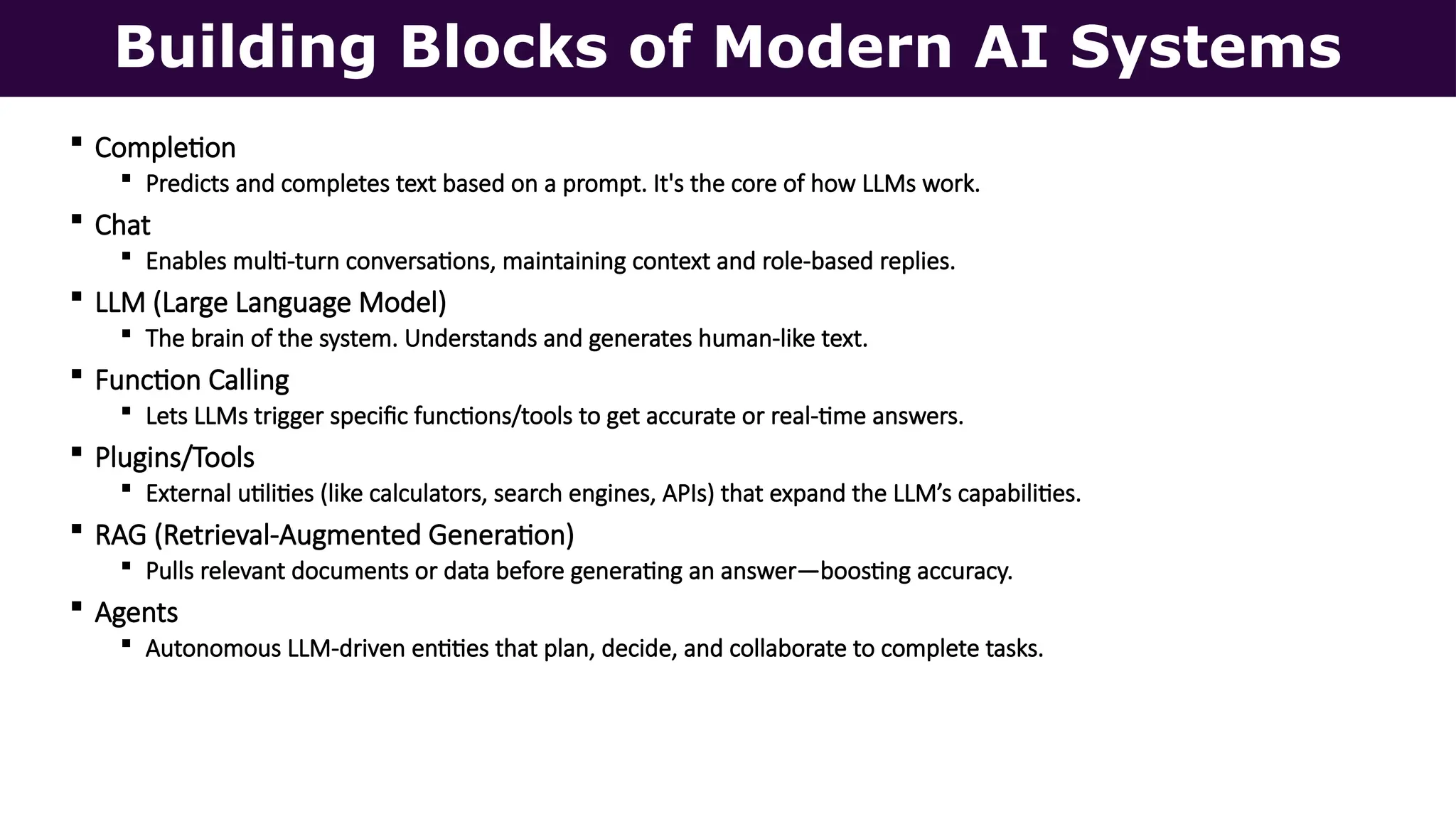
Building Blocks of Modern AI Systems
 Completion
 Predicts and completes text based on a prompt. It's the core of how LLMs work.
 Chat
 Enables multi-turn conversations, maintaining context and role-based replies.
 LLM (Large Language Model)
 The brain of the system. Understands and generates human-like text.
 Function Calling
 Lets LLMs trigger specific functions/tools to get accurate or real-time answers.
 Plugins/Tools
 External utilities (like calculators, search engines, APIs) that expand the LLM’s capabilities.
 RAG (Retrieval-Augmented Generation)
 Pulls relevant documents or data before generating an answer—boosting accuracy.
 Agents
 Autonomous LLM-driven entities that plan, decide, and collaborate to complete tasks.
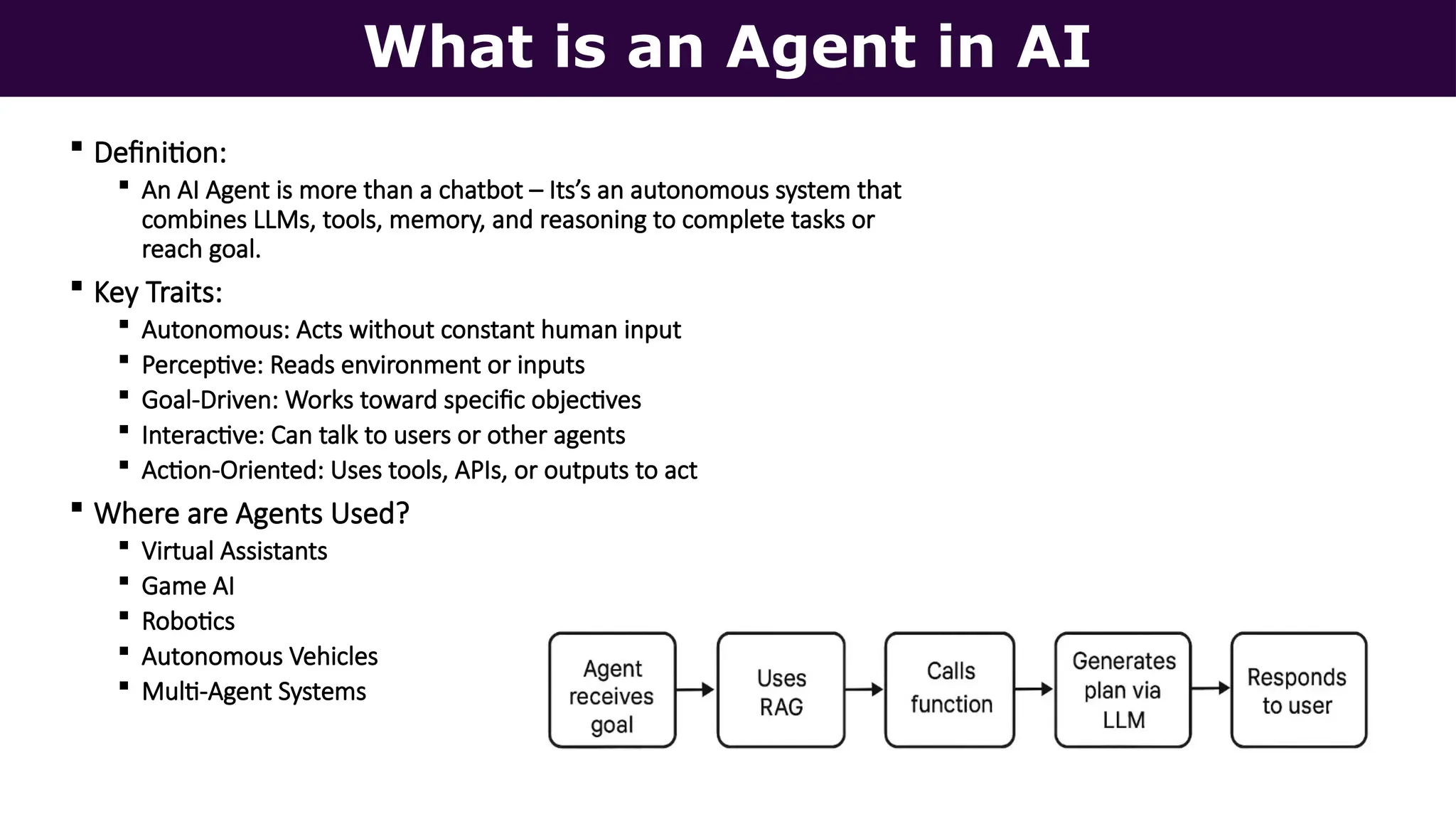
What is an Agent in AI
 Definition:
 An AI Agent is more than a chatbot – Its’s an autonomous system that
combines LLMs, tools, memory, and reasoning to complete tasks or
reach goal.
 Key Traits:
 Autonomous: Acts without constant human input
 Perceptive: Reads environment or inputs
 Goal-Driven: Works toward specific objectives
 Interactive: Can talk to users or other agents
 Action-Oriented: Uses tools, APIs, or outputs to act
 Where are Agents Used?
 Virtual Assistants
 Game AI
 Robotics
 Autonomous Vehicles
 Multi-Agent Systems
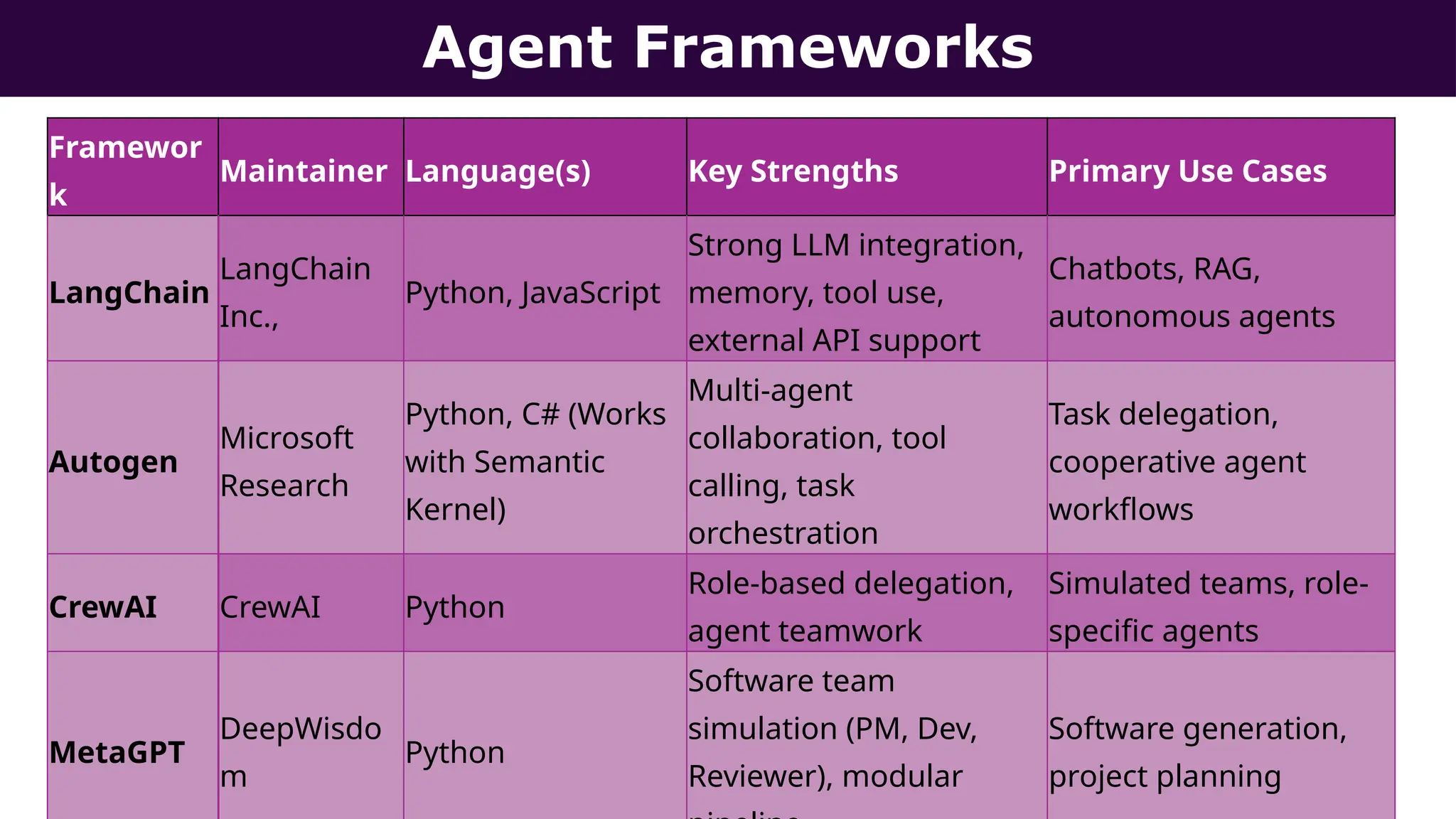
Agent Frameworks
Framewor
k
Maintainer Language(s) Key Strengths Primary Use Cases
LangChain
LangChain
Inc.,
Python, JavaScript
Strong LLM integration,
memory, tool use,
external API support
Chatbots, RAG,
autonomous agents
Autogen
Microsoft
Research
Python, C# (Works
with Semantic
Kernel)
Multi-agent
collaboration, tool
calling, task
orchestration
Task delegation,
cooperative agent
workflows
CrewAI CrewAI Python
Role-based delegation,
agent teamwork
Simulated teams, role-
specific agents
MetaGPT
DeepWisdo
m
Python
Software team
simulation (PM, Dev,
Reviewer), modular
Software generation,
project planning
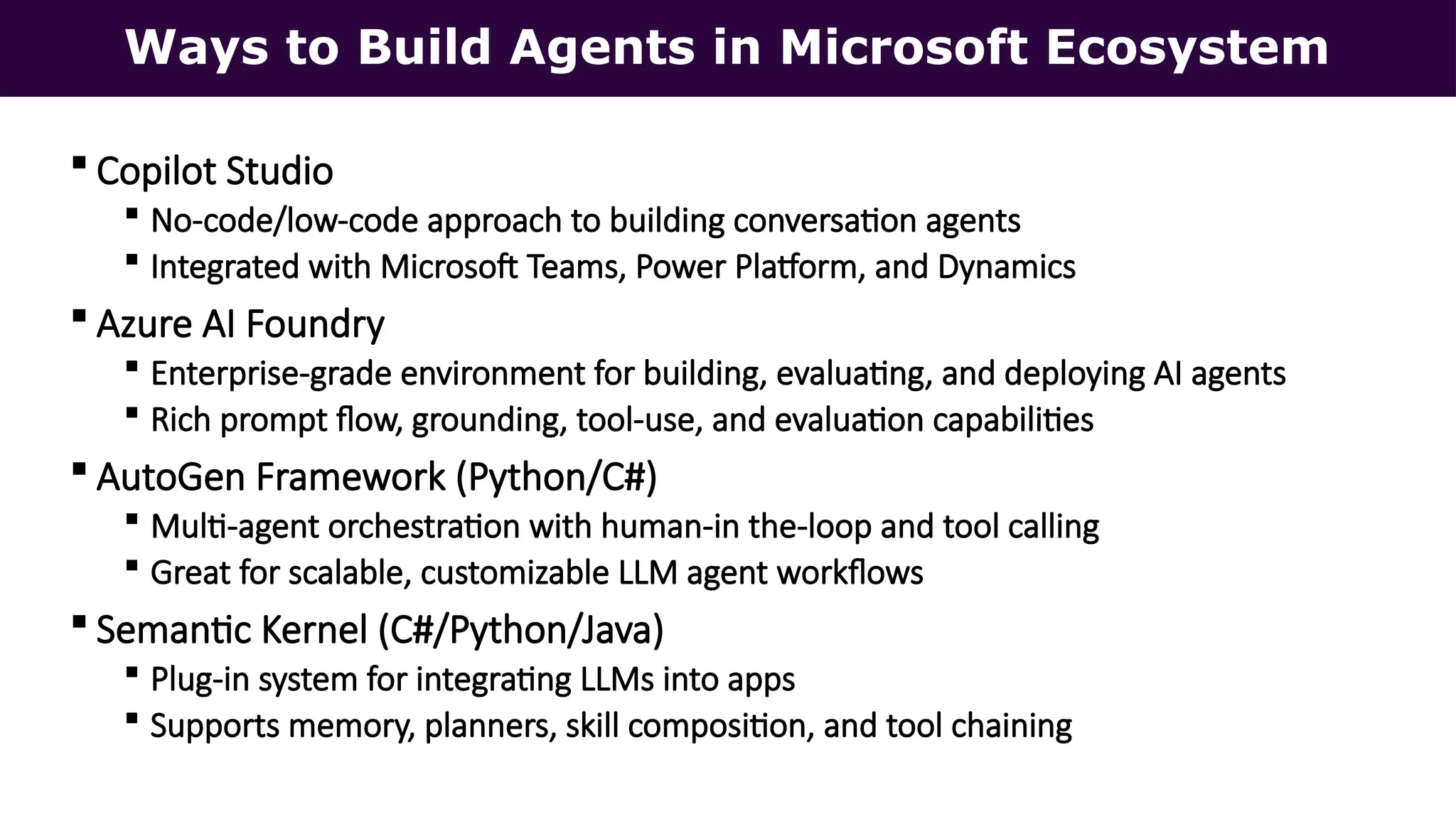
Ways to Build Agents in Microsoft Ecosystem
 Copilot Studio
 No-code/low-code approach to building conversation agents
 Integrated with Microsoft Teams, Power Platform, and Dynamics
 Azure AI Foundry
 Enterprise-grade environment for building, evaluating, and deploying AI agents
 Rich prompt flow, grounding, tool-use, and evaluation capabilities
 AutoGen Framework (Python/C#)
 Multi-agent orchestration with human-in the-loop and tool calling
 Great for scalable, customizable LLM agent workflows
 Semantic Kernel (C#/Python/Java)
 Plug-in system for integrating LLMs into apps
 Supports memory, planners, skill composition, and tool chaining
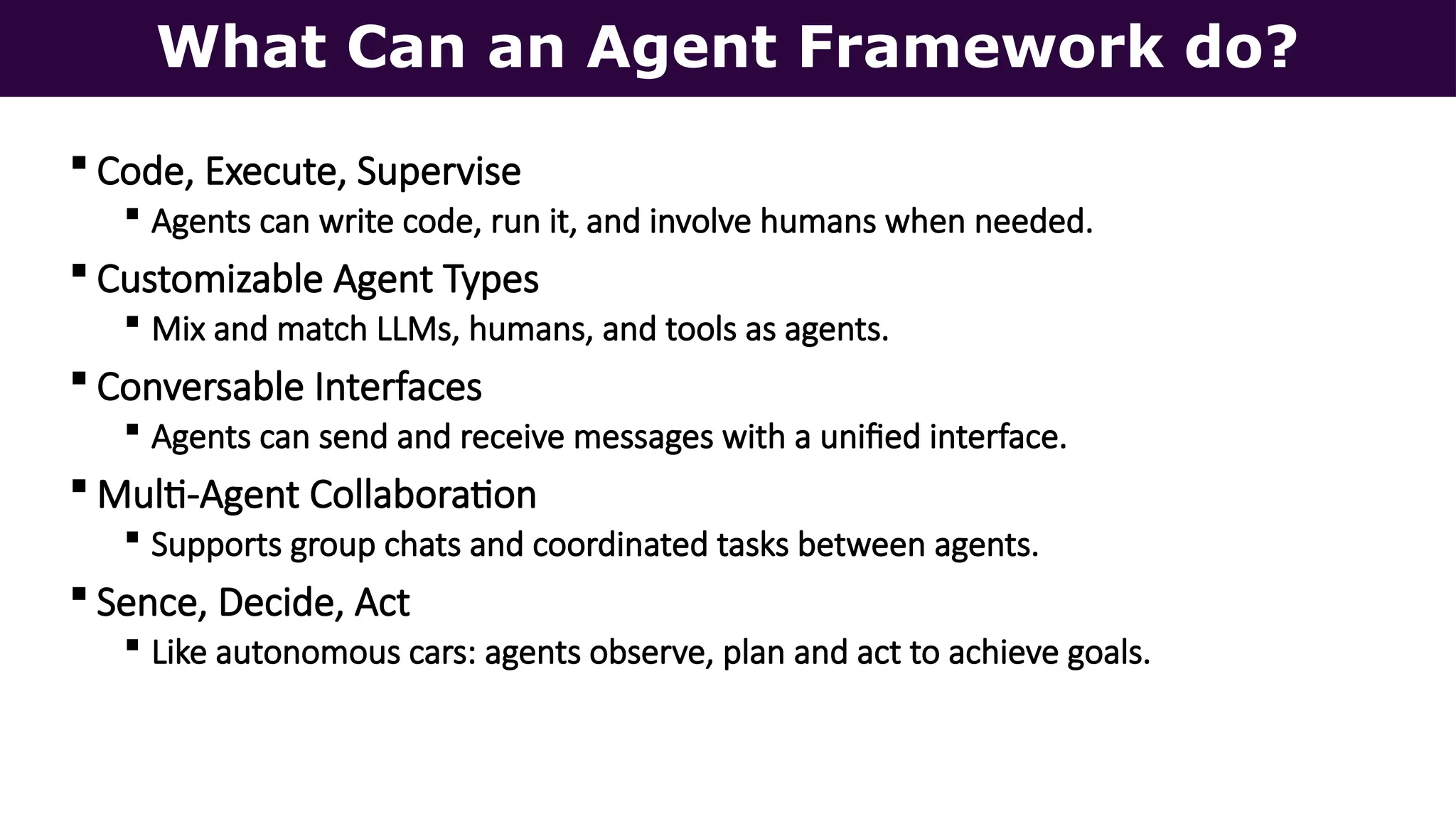
What Can an Agent Framework do?
 Code, Execute, Supervise
 Agents can write code, run it, and involve humans when needed.
 Customizable Agent Types
 Mix and match LLMs, humans, and tools as agents.
 Conversable Interfaces
 Agents can send and receive messages with a unified interface.
 Multi-Agent Collaboration
 Supports group chats and coordinated tasks between agents.
 Sence, Decide, Act
 Like autonomous cars: agents observe, plan and act to achieve goals.
Multi-Agent Collaboration
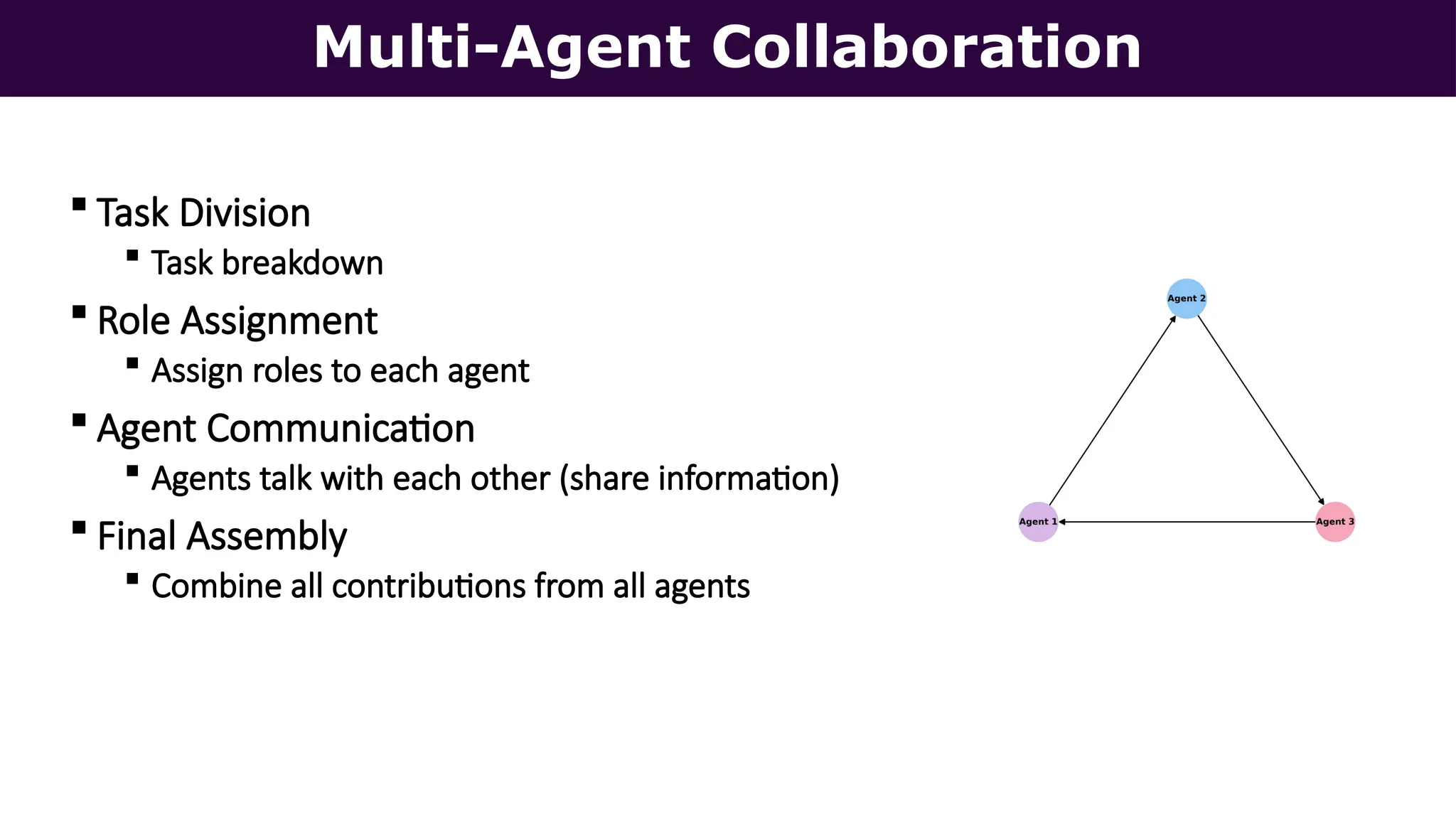
 Task Division
 Task breakdown
 Role Assignment
 Assign roles to each agent
 Agent Communication
 Agents talk with each other (share information)
 Final Assembly
 Combine all contributions from all agents
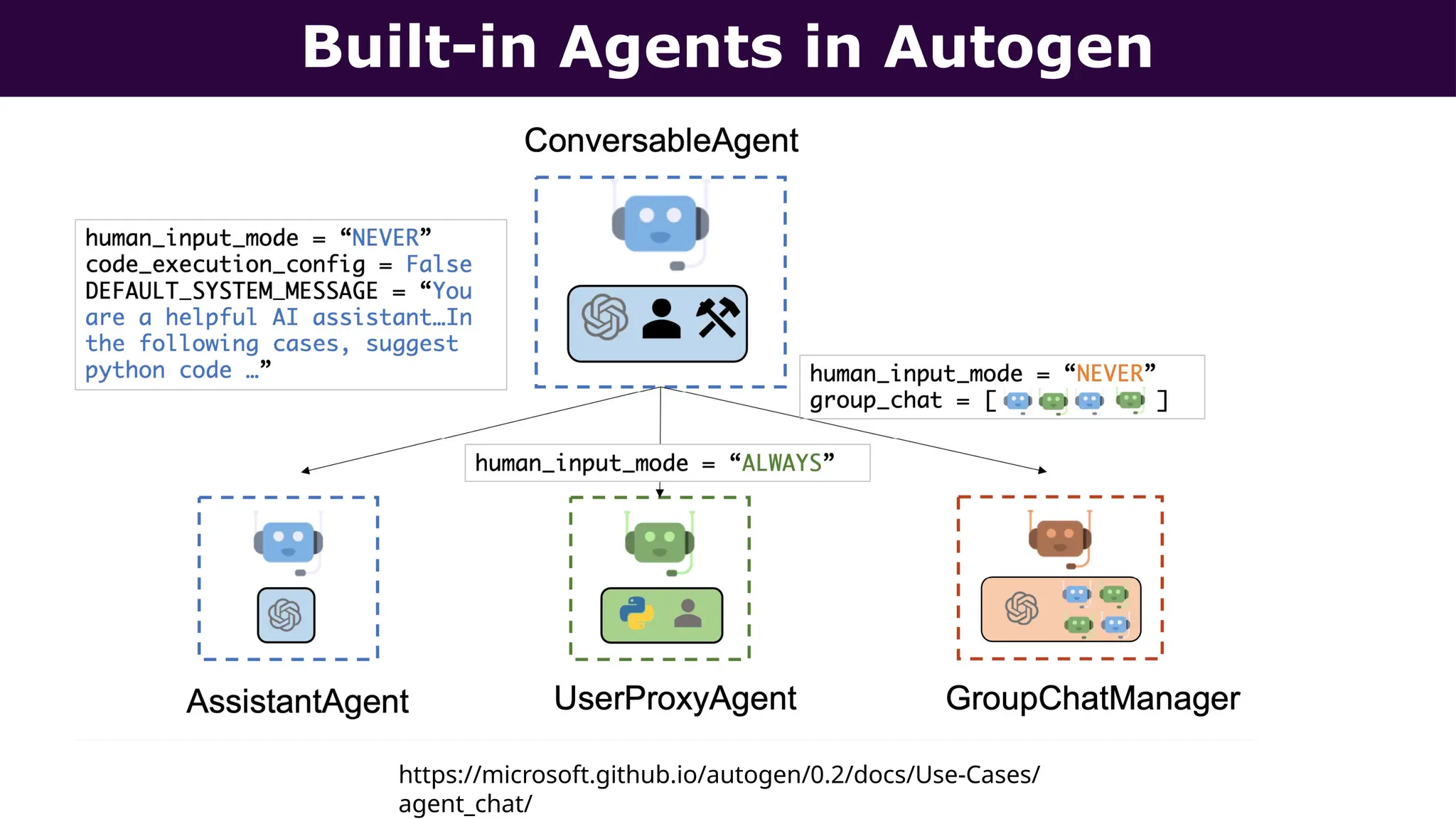
Built-in Agents in Autogen
https://microsoft.github.io/autogen/0.2/docs/Use-Cases/
agent_chat/
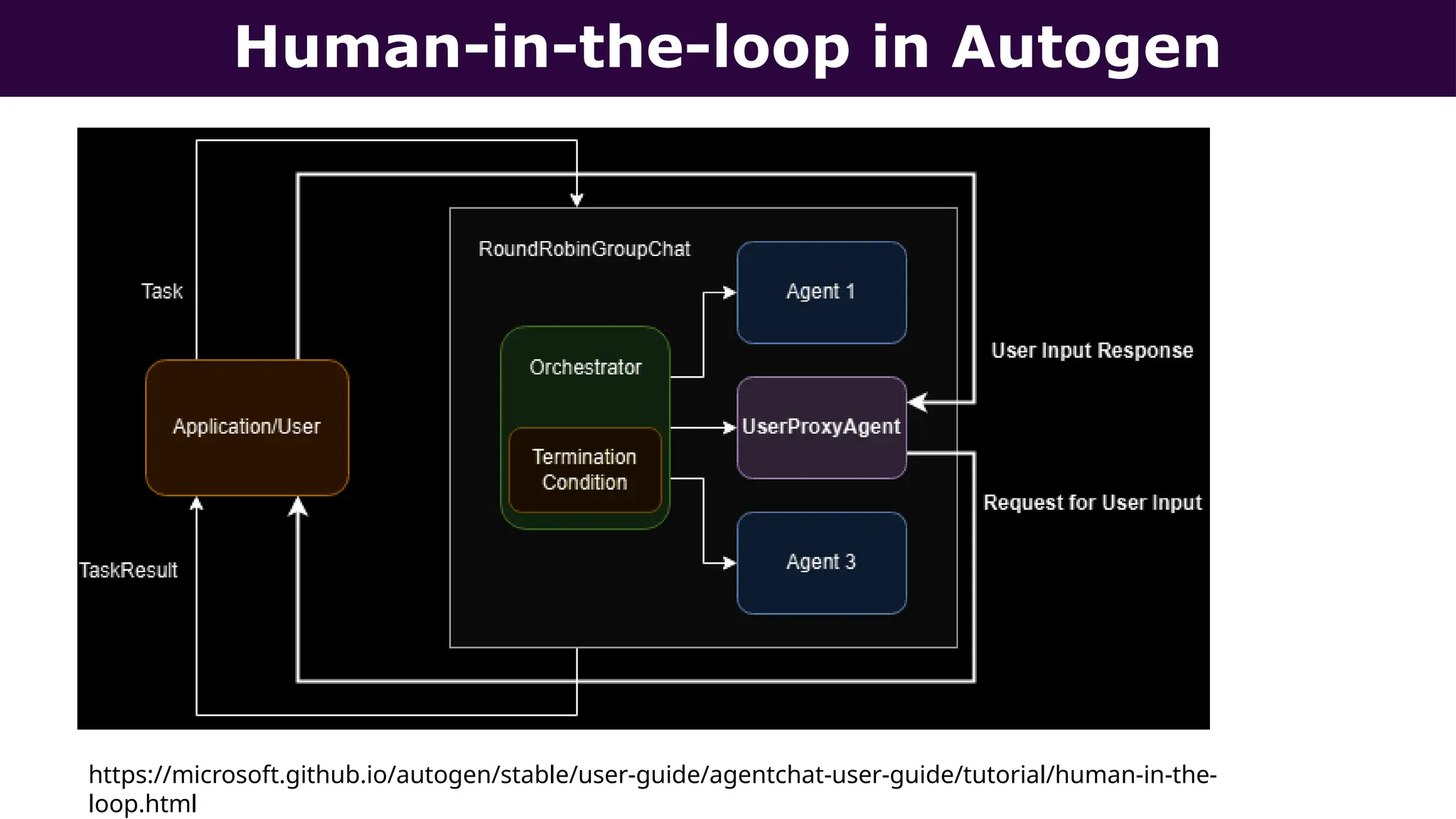
Human-in-the-loop in Autogen
https://microsoft.github.io/autogen/stable/user-guide/agentchat-user-guide/tutorial/human-in-the-
loop.html
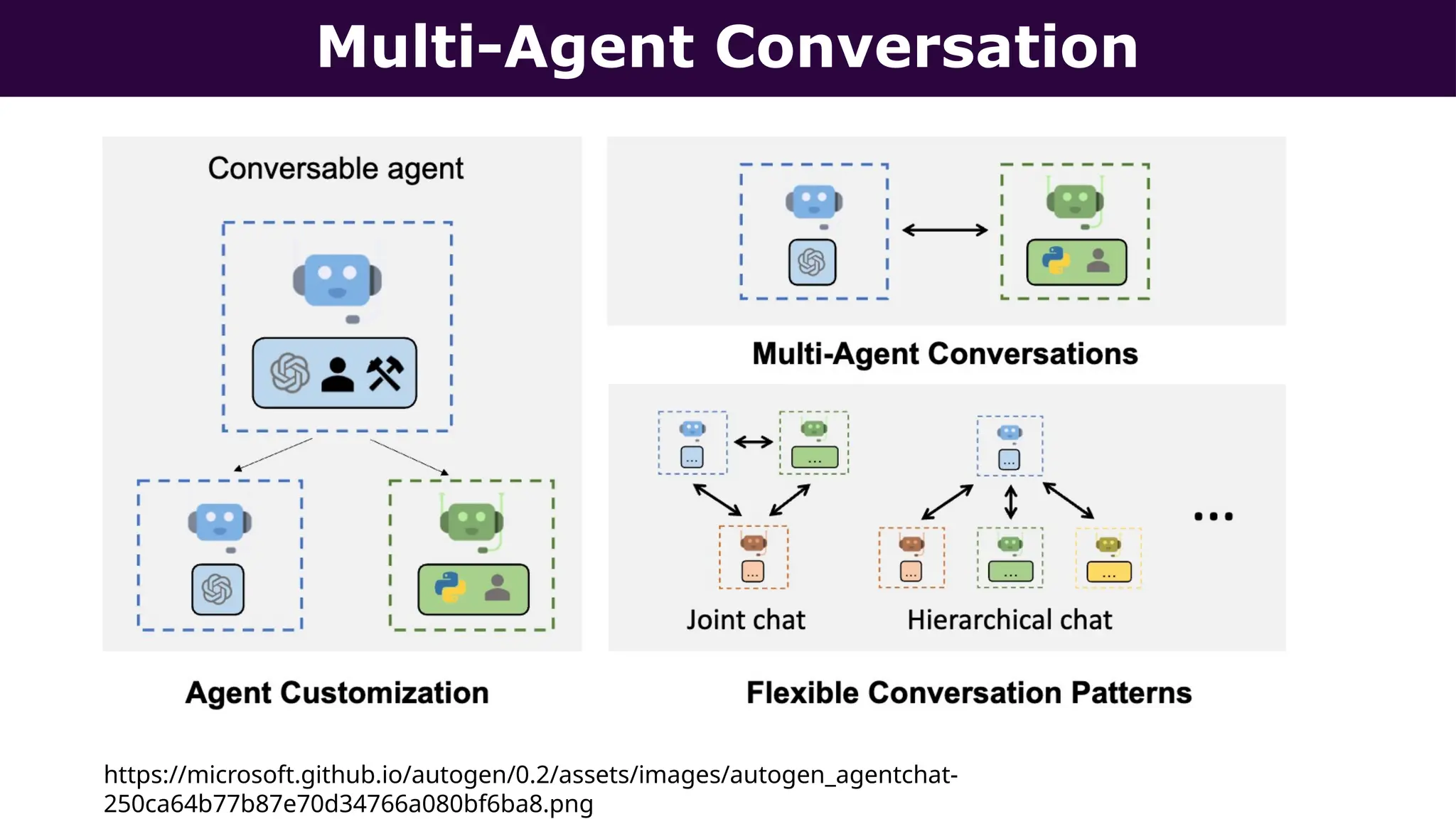
Multi-Agent Conversation
https://microsoft.github.io/autogen/0.2/assets/images/autogen_agentchat-
250ca64b77b87e70d34766a080bf6ba8.png
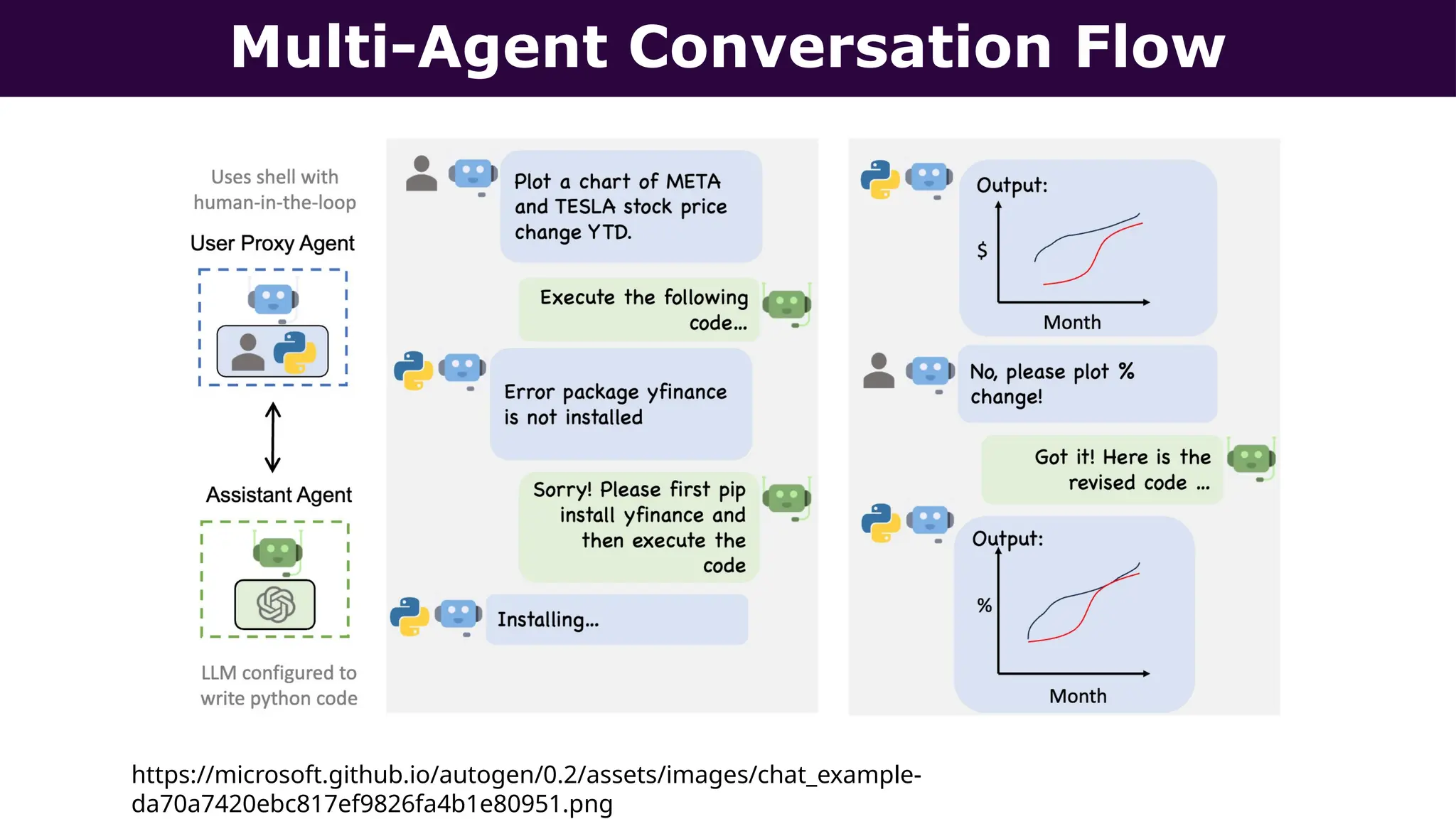
Multi-Agent Conversation Flow
https://microsoft.github.io/autogen/0.2/assets/images/chat_example-
da70a7420ebc817ef9826fa4b1e80951.png
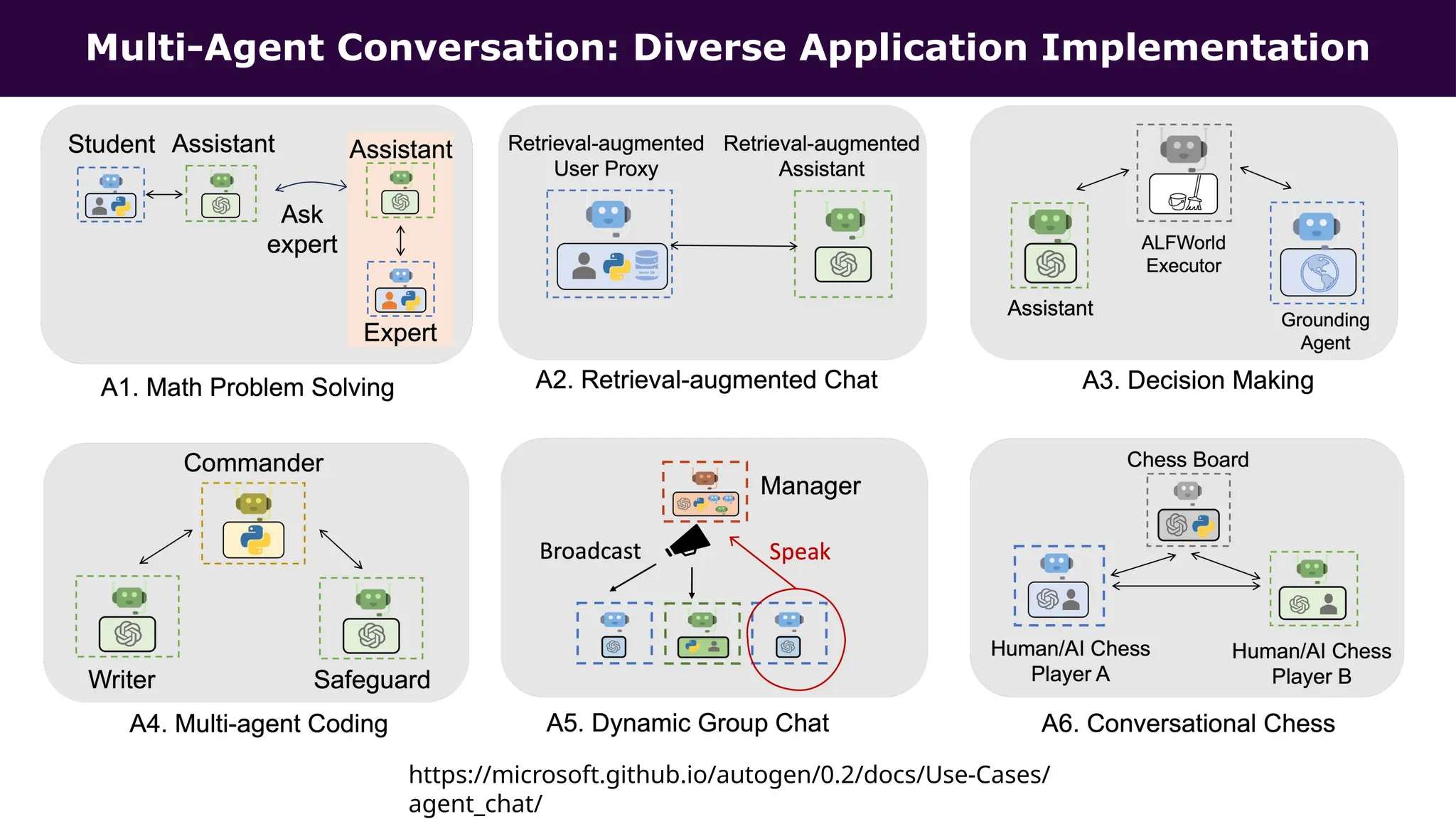
Multi-Agent Conversation: Diverse Application Implementation
https://microsoft.github.io/autogen/0.2/docs/Use-Cases/
agent_chat/
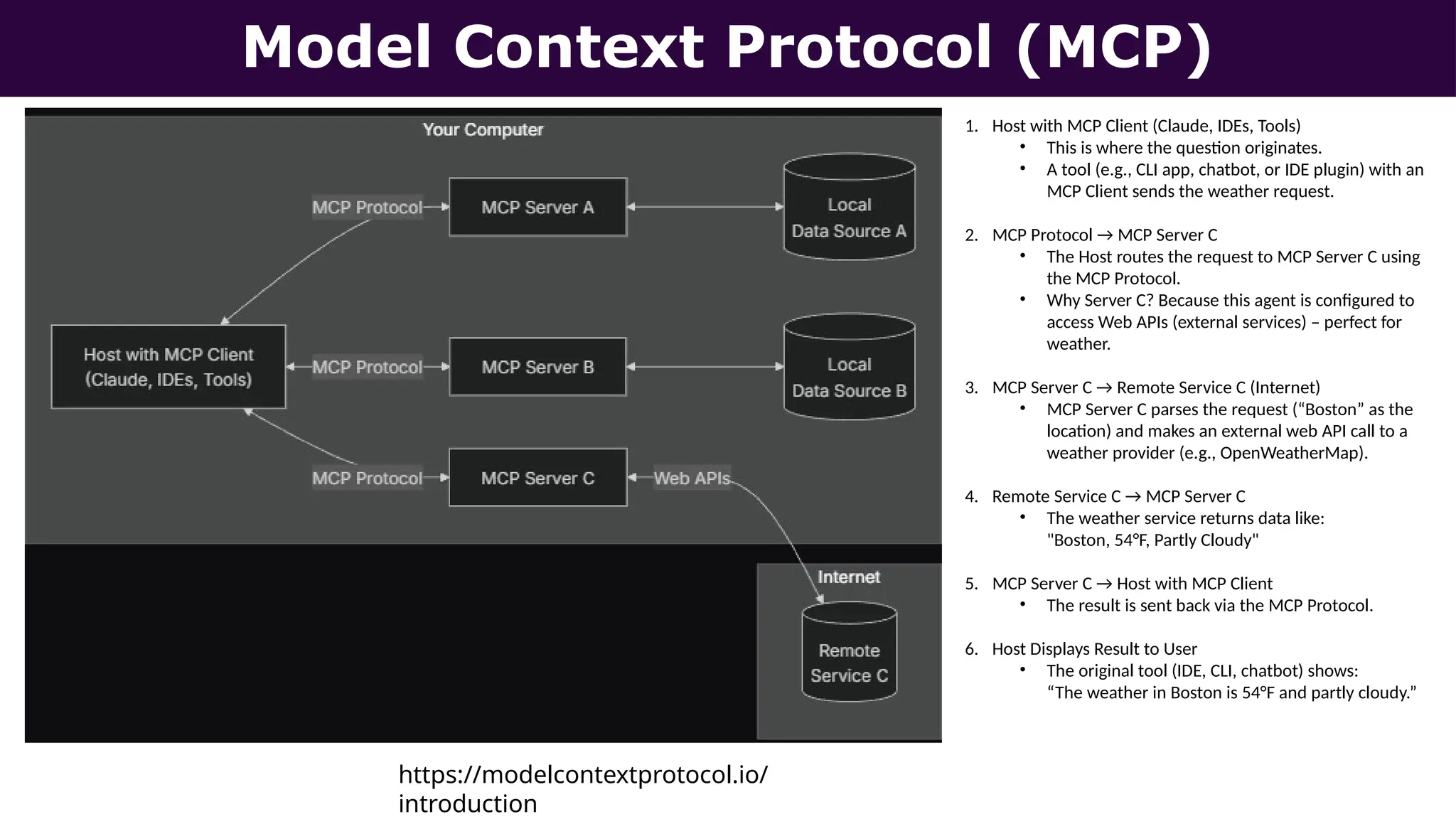
Model Context Protocol (MCP)
https://modelcontextprotocol.io/
introduction
1. Host with MCP Client (Claude, IDEs, Tools)
• This is where the question originates.
• A tool (e.g., CLI app, chatbot, or IDE plugin) with an
MCP Client sends the weather request.
2. MCP Protocol → MCP Server C
• The Host routes the request to MCP Server C using
the MCP Protocol.
• Why Server C? Because this agent is configured to
access Web APIs (external services) – perfect for
weather.
3. MCP Server C → Remote Service C (Internet)
• MCP Server C parses the request (“Boston” as the
location) and makes an external web API call to a
weather provider (e.g., OpenWeatherMap).
4. Remote Service C → MCP Server C
• The weather service returns data like:
"Boston, 54°F, Partly Cloudy"
5. MCP Server C → Host with MCP Client
• The result is sent back via the MCP Protocol.
6. Host Displays Result to User
• The original tool (IDE, CLI, chatbot) shows:
“The weather in Boston is 54°F and partly cloudy.”
Demo
References
 https://microsoft.github.io/autogen/stable/
 https://microsoft.github.io/autogen/0.2/docs/autogen-studio/getting-starte
d/
 https://github.com/microsoft/autogen
 https://github.com/microsoft/ai-agents-for-beginners
 https://microsoft.github.io/autogen/dotnet/dev/core/index.html
• Copilot Agents:
https://github.com/microsoft/agents-for-enhanced-customer-care-solution-a
ccelerator
• Agentic Framework:
https://github.com/microsoft/Multi-Agent-Custom-Automation-Engine-Solu
tion-Accelerator
• Knowledge Mining:
Thank you for your time and trust!
Boston Code Camp 38 – March 2025

Scalable Multi-Agent AI with AutoGen by Udai

  • 1.
    Udaiappa Ramachandran (Udai) CTO/CSO@ Akumina Inc., | Microsoft MVP (AI) Web: https://udai.io LinkedIn: https://linkedin.com/in/udair Meetup: https://meetup.com/nashuaug Scalable Multi-Agent AI with AutoGen
  • 3.
    Agenda  What AreAI Agents?  Understanding the core concept and characteristics  Building Blocks of Modern AI Systems  How LLMs, tools, memory, and chat work together  Agent Frameworks & AutoGen  Overview of frameworks with a deep dive into AutoGen  Model Context Protocol (MCP)  How agents interact with tools, APIs, and environments  Live Demo & Use Cases  Real-world agent conversations and applications
  • 4.
    Building Blocks ofModern AI Systems  Completion  Predicts and completes text based on a prompt. It's the core of how LLMs work.  Chat  Enables multi-turn conversations, maintaining context and role-based replies.  LLM (Large Language Model)  The brain of the system. Understands and generates human-like text.  Function Calling  Lets LLMs trigger specific functions/tools to get accurate or real-time answers.  Plugins/Tools  External utilities (like calculators, search engines, APIs) that expand the LLM’s capabilities.  RAG (Retrieval-Augmented Generation)  Pulls relevant documents or data before generating an answer—boosting accuracy.  Agents  Autonomous LLM-driven entities that plan, decide, and collaborate to complete tasks.
  • 5.
    What is anAgent in AI  Definition:  An AI Agent is more than a chatbot – Its’s an autonomous system that combines LLMs, tools, memory, and reasoning to complete tasks or reach goal.  Key Traits:  Autonomous: Acts without constant human input  Perceptive: Reads environment or inputs  Goal-Driven: Works toward specific objectives  Interactive: Can talk to users or other agents  Action-Oriented: Uses tools, APIs, or outputs to act  Where are Agents Used?  Virtual Assistants  Game AI  Robotics  Autonomous Vehicles  Multi-Agent Systems
  • 6.
    Agent Frameworks Framewor k Maintainer Language(s)Key Strengths Primary Use Cases LangChain LangChain Inc., Python, JavaScript Strong LLM integration, memory, tool use, external API support Chatbots, RAG, autonomous agents Autogen Microsoft Research Python, C# (Works with Semantic Kernel) Multi-agent collaboration, tool calling, task orchestration Task delegation, cooperative agent workflows CrewAI CrewAI Python Role-based delegation, agent teamwork Simulated teams, role- specific agents MetaGPT DeepWisdo m Python Software team simulation (PM, Dev, Reviewer), modular Software generation, project planning
  • 7.
    Ways to BuildAgents in Microsoft Ecosystem  Copilot Studio  No-code/low-code approach to building conversation agents  Integrated with Microsoft Teams, Power Platform, and Dynamics  Azure AI Foundry  Enterprise-grade environment for building, evaluating, and deploying AI agents  Rich prompt flow, grounding, tool-use, and evaluation capabilities  AutoGen Framework (Python/C#)  Multi-agent orchestration with human-in the-loop and tool calling  Great for scalable, customizable LLM agent workflows  Semantic Kernel (C#/Python/Java)  Plug-in system for integrating LLMs into apps  Supports memory, planners, skill composition, and tool chaining
  • 8.
    What Can anAgent Framework do?  Code, Execute, Supervise  Agents can write code, run it, and involve humans when needed.  Customizable Agent Types  Mix and match LLMs, humans, and tools as agents.  Conversable Interfaces  Agents can send and receive messages with a unified interface.  Multi-Agent Collaboration  Supports group chats and coordinated tasks between agents.  Sence, Decide, Act  Like autonomous cars: agents observe, plan and act to achieve goals.
  • 9.
    Multi-Agent Collaboration  TaskDivision  Task breakdown  Role Assignment  Assign roles to each agent  Agent Communication  Agents talk with each other (share information)  Final Assembly  Combine all contributions from all agents
  • 10.
    Built-in Agents inAutogen https://microsoft.github.io/autogen/0.2/docs/Use-Cases/ agent_chat/
  • 11.
  • 12.
  • 13.
  • 14.
    Multi-Agent Conversation: DiverseApplication Implementation https://microsoft.github.io/autogen/0.2/docs/Use-Cases/ agent_chat/
  • 15.
    Model Context Protocol(MCP) https://modelcontextprotocol.io/ introduction 1. Host with MCP Client (Claude, IDEs, Tools) • This is where the question originates. • A tool (e.g., CLI app, chatbot, or IDE plugin) with an MCP Client sends the weather request. 2. MCP Protocol → MCP Server C • The Host routes the request to MCP Server C using the MCP Protocol. • Why Server C? Because this agent is configured to access Web APIs (external services) – perfect for weather. 3. MCP Server C → Remote Service C (Internet) • MCP Server C parses the request (“Boston” as the location) and makes an external web API call to a weather provider (e.g., OpenWeatherMap). 4. Remote Service C → MCP Server C • The weather service returns data like: "Boston, 54°F, Partly Cloudy" 5. MCP Server C → Host with MCP Client • The result is sent back via the MCP Protocol. 6. Host Displays Result to User • The original tool (IDE, CLI, chatbot) shows: “The weather in Boston is 54°F and partly cloudy.”
  • 16.
  • 17.
    References  https://microsoft.github.io/autogen/stable/  https://microsoft.github.io/autogen/0.2/docs/autogen-studio/getting-starte d/ https://github.com/microsoft/autogen  https://github.com/microsoft/ai-agents-for-beginners  https://microsoft.github.io/autogen/dotnet/dev/core/index.html • Copilot Agents: https://github.com/microsoft/agents-for-enhanced-customer-care-solution-a ccelerator • Agentic Framework: https://github.com/microsoft/Multi-Agent-Custom-Automation-Engine-Solu tion-Accelerator • Knowledge Mining:
  • 18.
    Thank you foryour time and trust! Boston Code Camp 38 – March 2025

Editor's Notes

  • #2 https://microsoft.github.io/autogen/0.2/docs/Getting-Started/
  • #4 Agents are not just chatbots — they are orchestrators that combine LLMs, tools, memory, RAG, and decision-making into a coherent, task-driven system. Agent receives goal → Uses RAG → Calls function → Generates plan via LLM → Responds to user via chat.
  • #5 Example: A self-driving car is an agent that perceives its environment (through sensors), makes decisions (to drive safely), and takes actions (like steering or braking) to reach its destination. Agents have two features Conversable - agents can send and receive messages Customizable - agents can integrate with AI models, tools, humans or a combination of all.
  • #10 https://microsoft.github.io/autogen/0.2/docs/Getting-Started/
  • #11 https://microsoft.github.io/autogen/0.2/docs/Getting-Started/
  • #12 https://microsoft.github.io/autogen/0.2/docs/Getting-Started/
  • #13 https://microsoft.github.io/autogen/0.2/docs/Getting-Started/
  • #14 https://microsoft.github.io/autogen/0.2/docs/Getting-Started/
  • #15 MCP Client – UserProxyAgent MCP Host – Group Chat MCP Server – Agent Specialization using AutoGen SSE- Server Send Events
  • #16 python –m venv .venv .venv/bin/activate .venv/bin/deactivate pip install "autogen-agentchat” “autogen-ext[openai,azure]“ “ollama”
  • #17 https://github.com/pdichone/autogen-course/tree/main https://pypi.org/project/autogen-agentchat/ https://microsoft.github.io/autogen/stable/user-guide/agentchat-user-guide/installation.html