MULE-Flow processing strategies
-RajeshKumar
1
About Mule applications
 Java based apps that must be deployed to a Mule runtime
– Either on-premise or on CloudHub
 Packaged as zip file, referred to as deployable archive
– Universal format, for both on-premise and cloud
deployments
 Consist of one or more flows, stored in one or more XML files
 Can be developed, built and packaged using Anypoint Studio or
a third party build solution (Maven, Gradle)
 Built around the standard software pattern of Input-Processing-
Output
2
Recap: Flow types
Mule has three types of flows
 Regular flows
– Inbound endpoint, or more MPs, can have its own exception
strategy and processing strategy
– Can be synchronous or asynchronous
 Sub flows
– No inbound endpoint, inherits processing strategy from parent,
no exception strategy (exceptions bubble up into the parent
flow)
 Private flow
– Similar to regular flow, but no inbound endpoint
– Can only be called from within application via flow reference
3
Flow processing strategies
 A flow’s processing strategy determines how Mule implements
message processing for a given flow
 Mule automatically determines best processing strategy
– Implicitly set to either synchronous or queued-asynchronous
(leveraging SEDA)
 A flow is synchronous when
– The flow’s exchange pattern is request-response
– The flow partakes in a transaction
– The flow is really a sub-flow
 A flow is asynchronous in all other cases
– Unless overridden by manually setting a processing strategy
4
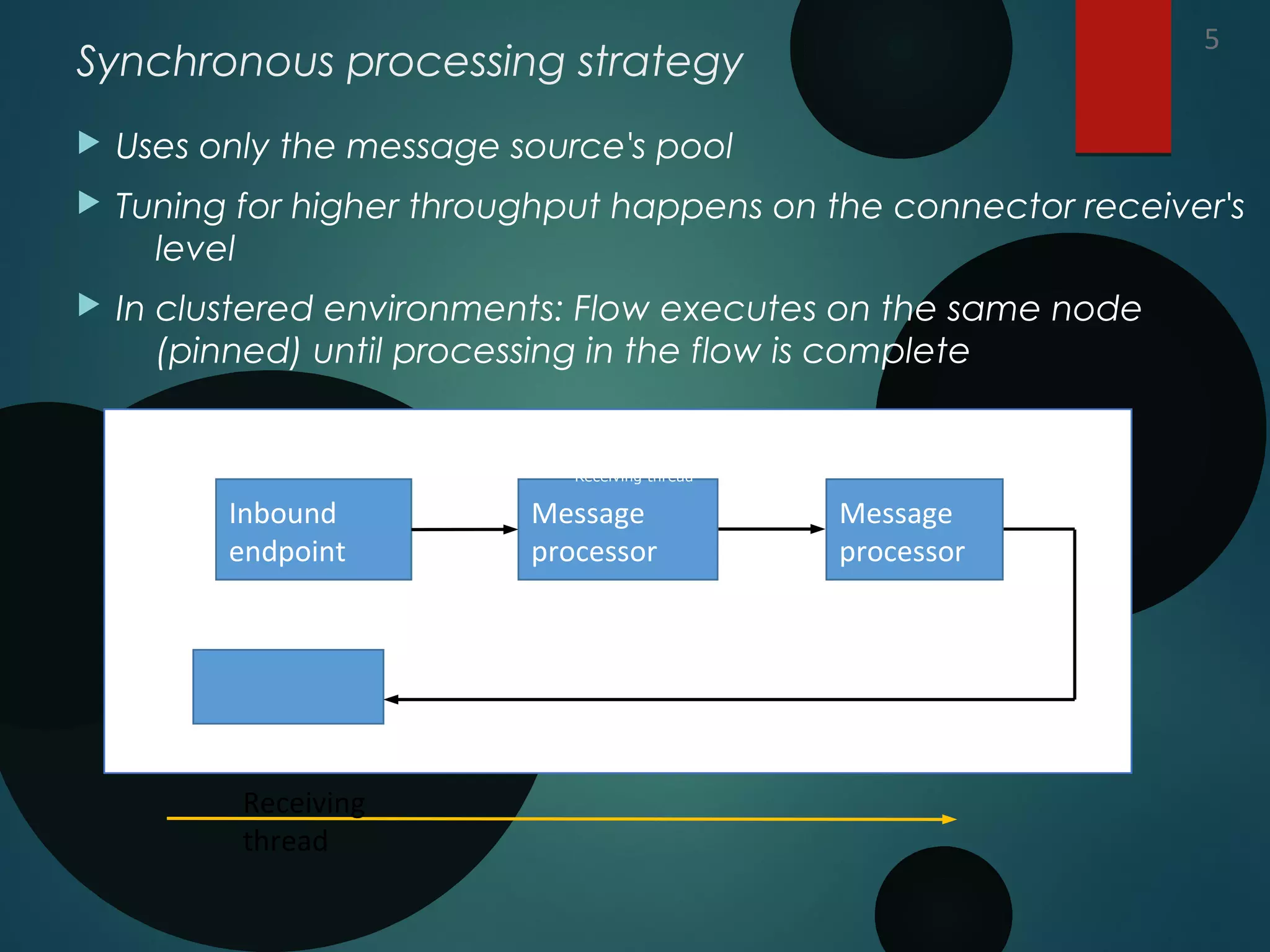
Synchronous processing strategy
 Uses only the message source's pool
 Tuning for higher throughput happens on the connector receiver's
level
 In clustered environments: Flow executes on the same node
(pinned) until processing in the flow is complete
5
Inbound
endpoint
Message
processor
Message
processor
Receiving thread
Receiving
thread
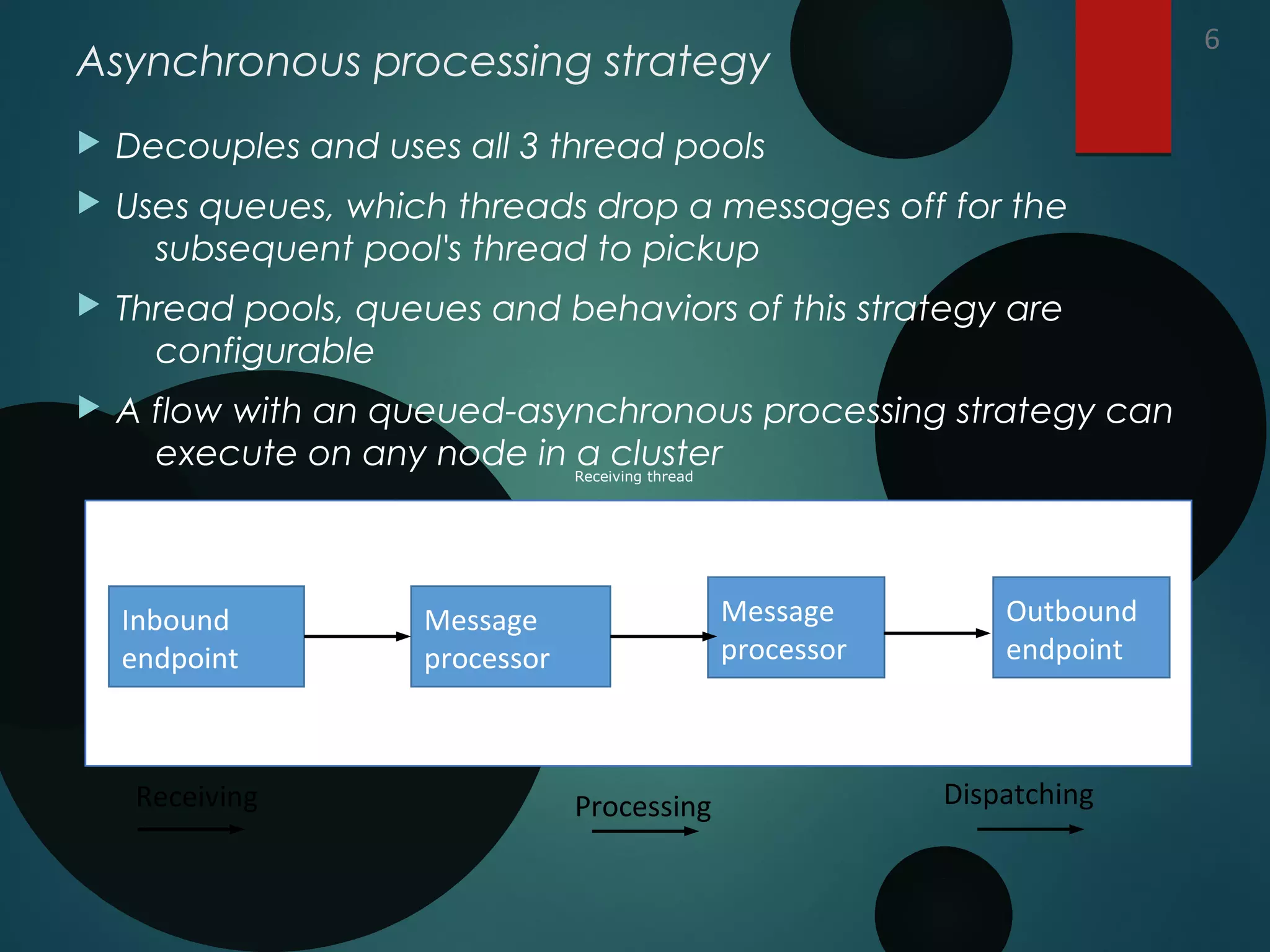
Asynchronous processing strategy
 Decouples and uses all 3 thread pools
 Uses queues, which threads drop a messages off for the
subsequent pool's thread to pickup
 Thread pools, queues and behaviors of this strategy are
configurable
 A flow with an queued-asynchronous processing strategy can
execute on any node in a cluster
6
Inbound
endpoint
Message
processor
Message
processor
Receiving thread
Receiving
Outbound
endpoint
Processing Dispatching
Synchronous vs asynchronous
Synchronous
– Same thread is used across the flow
– If outbound endpoint is one way (JMS), then the thread will be used to
continue
the message processing
– If outbound endpoint is request-response, then the thread will wait for the
response from the endpoint and continue the message processing after
receiving the response
Asynchronous
– Receiver thread receives the message and places it in Staged Event-Driven
Architecture (SEDA) Queue
– Receiver thread will be released for receiving message after placing in queue
– Message will be placed in a dispatcher queue for sending out
7
Receiving thread
THANKS
8

Mule flow processing strategies

  • 1.
  • 2.
    About Mule applications Java based apps that must be deployed to a Mule runtime – Either on-premise or on CloudHub  Packaged as zip file, referred to as deployable archive – Universal format, for both on-premise and cloud deployments  Consist of one or more flows, stored in one or more XML files  Can be developed, built and packaged using Anypoint Studio or a third party build solution (Maven, Gradle)  Built around the standard software pattern of Input-Processing- Output 2
  • 3.
    Recap: Flow types Mulehas three types of flows  Regular flows – Inbound endpoint, or more MPs, can have its own exception strategy and processing strategy – Can be synchronous or asynchronous  Sub flows – No inbound endpoint, inherits processing strategy from parent, no exception strategy (exceptions bubble up into the parent flow)  Private flow – Similar to regular flow, but no inbound endpoint – Can only be called from within application via flow reference 3
  • 4.
    Flow processing strategies A flow’s processing strategy determines how Mule implements message processing for a given flow  Mule automatically determines best processing strategy – Implicitly set to either synchronous or queued-asynchronous (leveraging SEDA)  A flow is synchronous when – The flow’s exchange pattern is request-response – The flow partakes in a transaction – The flow is really a sub-flow  A flow is asynchronous in all other cases – Unless overridden by manually setting a processing strategy 4
  • 5.
    Synchronous processing strategy Uses only the message source's pool  Tuning for higher throughput happens on the connector receiver's level  In clustered environments: Flow executes on the same node (pinned) until processing in the flow is complete 5 Inbound endpoint Message processor Message processor Receiving thread Receiving thread
  • 6.
    Asynchronous processing strategy Decouples and uses all 3 thread pools  Uses queues, which threads drop a messages off for the subsequent pool's thread to pickup  Thread pools, queues and behaviors of this strategy are configurable  A flow with an queued-asynchronous processing strategy can execute on any node in a cluster 6 Inbound endpoint Message processor Message processor Receiving thread Receiving Outbound endpoint Processing Dispatching
  • 7.
    Synchronous vs asynchronous Synchronous –Same thread is used across the flow – If outbound endpoint is one way (JMS), then the thread will be used to continue the message processing – If outbound endpoint is request-response, then the thread will wait for the response from the endpoint and continue the message processing after receiving the response Asynchronous – Receiver thread receives the message and places it in Staged Event-Driven Architecture (SEDA) Queue – Receiver thread will be released for receiving message after placing in queue – Message will be placed in a dispatcher queue for sending out 7 Receiving thread
  • 8.