This section describes how to debug your
Mule application using:
 Studio Visual Debugger
 Troubleshooting
 Studio’s Visual Debugger allows you to run
your application in Debug mode, stopping
execution to check the contents of a message at
previously-specified building blocks.
 To do this, you set a breakpoint at any building
block in your flow that you wish to check or test
(see image below). When you run your
application in Debug mode, the application
stops immediately after executing the building
block with the breakpoint. Using the Mule
Debugger View, you can browse through the
contents of the message as it exists at that point
in the flow, and evaluate Mule
Expressions against the message.
 Complete the following macro-steps to use
the Visual Debugger in Studio.
1. Setting Breakpoints
2. Running in Debug mode
3. Viewing message data at a Breakpoint
4. Resume application execution.
5. Repeat step 3 with the next building block
with a breakpoint, if any.
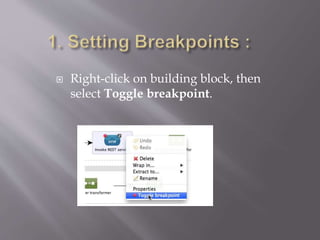
 Right-click on building block, then
select Toggle breakpoint.
 In the Package Explorer pane, right-click on
your application, then select Debug As> Mule
Application. Studio begins running the
application in Debug mode, and displays
the Confirm Perspective Switch window.
 When you begin running your
application in Debug mode, Mule opens
the Mule Debug perspective. Until a
message arrives at the first breakpoint,
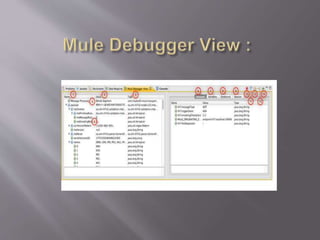
the Mule Debugger View in the console
displays a message that reads,
"Connected with mule ESB. Waiting for
a mule message to arrive!“
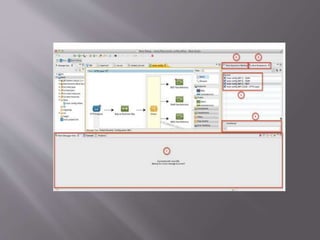
 The image below illustrates the Mule
Debug perspective.
 This section introduces a number of
techniques useful in troubleshooting
Mule problems and in gathering
information for technical support.
 Configuring Mule Stacktraces
 Debugging Outside Studio
 Logging
 By default Mule will filter out some internal
class references from stack traces to produce a
more readable output. This behavior can be
controlled one of three ways:
 Command-line arguments
 Setting properties in Mule Studio
 Using JMX
 In Anypoint Studio, you can use
the Studio Visual Debugger to help you
troubleshoot your app. If you’re creating
your Mule app outside Studio, you can
resort to the following options:
 When Running From Eclipse : Select the
"Debug As > Mule Server" start-up mode
from your configuration file. Any
breakpoint you will have set in your
custom code or Mule’s source code will
suspend the execution and will take you
to Eclipse’s Debug perspective.
 When Running Mule Standalone : You
need to start Mule with the -debug to
activate remote debugging, which gives (on
Linux):
$MULE_HOME/bin/mule –debug
 With this option, Mule will start normally
but the only difference being the following
message logged in the console:
Listening for transport dt_socket at
address: 5005
 The less high-tech and most popular of all
debugging techniques is the usage of log
statements in order to follow the evolution of an
application’s state. In Mule, the state you’re
interested in resides in the messages that are
flowing through your configuration and,
possibly, custom code.
 If you’re running your Mule configuration from
Eclipse, the log outputs are visible right in Eclipse
console window. If you’re running Mule from the
command line, the logs then are visible in your
OS console.
Mule debugging-sample

Mule debugging-sample

  • 2.
    This section describeshow to debug your Mule application using:  Studio Visual Debugger  Troubleshooting
  • 3.
     Studio’s VisualDebugger allows you to run your application in Debug mode, stopping execution to check the contents of a message at previously-specified building blocks.  To do this, you set a breakpoint at any building block in your flow that you wish to check or test (see image below). When you run your application in Debug mode, the application stops immediately after executing the building block with the breakpoint. Using the Mule Debugger View, you can browse through the contents of the message as it exists at that point in the flow, and evaluate Mule Expressions against the message.
  • 4.
     Complete thefollowing macro-steps to use the Visual Debugger in Studio. 1. Setting Breakpoints 2. Running in Debug mode 3. Viewing message data at a Breakpoint 4. Resume application execution. 5. Repeat step 3 with the next building block with a breakpoint, if any.
  • 5.
     Right-click onbuilding block, then select Toggle breakpoint.
  • 6.
     In thePackage Explorer pane, right-click on your application, then select Debug As> Mule Application. Studio begins running the application in Debug mode, and displays the Confirm Perspective Switch window.
  • 7.
     When youbegin running your application in Debug mode, Mule opens the Mule Debug perspective. Until a message arrives at the first breakpoint, the Mule Debugger View in the console displays a message that reads, "Connected with mule ESB. Waiting for a mule message to arrive!“  The image below illustrates the Mule Debug perspective.
  • 10.
     This sectionintroduces a number of techniques useful in troubleshooting Mule problems and in gathering information for technical support.  Configuring Mule Stacktraces  Debugging Outside Studio  Logging
  • 11.
     By defaultMule will filter out some internal class references from stack traces to produce a more readable output. This behavior can be controlled one of three ways:  Command-line arguments  Setting properties in Mule Studio  Using JMX
  • 12.
     In AnypointStudio, you can use the Studio Visual Debugger to help you troubleshoot your app. If you’re creating your Mule app outside Studio, you can resort to the following options:  When Running From Eclipse : Select the "Debug As > Mule Server" start-up mode from your configuration file. Any breakpoint you will have set in your custom code or Mule’s source code will suspend the execution and will take you to Eclipse’s Debug perspective.
  • 13.
     When RunningMule Standalone : You need to start Mule with the -debug to activate remote debugging, which gives (on Linux): $MULE_HOME/bin/mule –debug  With this option, Mule will start normally but the only difference being the following message logged in the console: Listening for transport dt_socket at address: 5005
  • 14.
     The lesshigh-tech and most popular of all debugging techniques is the usage of log statements in order to follow the evolution of an application’s state. In Mule, the state you’re interested in resides in the messages that are flowing through your configuration and, possibly, custom code.  If you’re running your Mule configuration from Eclipse, the log outputs are visible right in Eclipse console window. If you’re running Mule from the command line, the logs then are visible in your OS console.