MUGHAL PAINTING
RAHUL INTERNATIONAL SCHOOL
7th STANDARD SEC-A
SUBMITTED BY-
ROLL NO.-38 VARISHA MIRZA
Thursday, July 20, 2017 1
Thursday, July 20, 2017 2
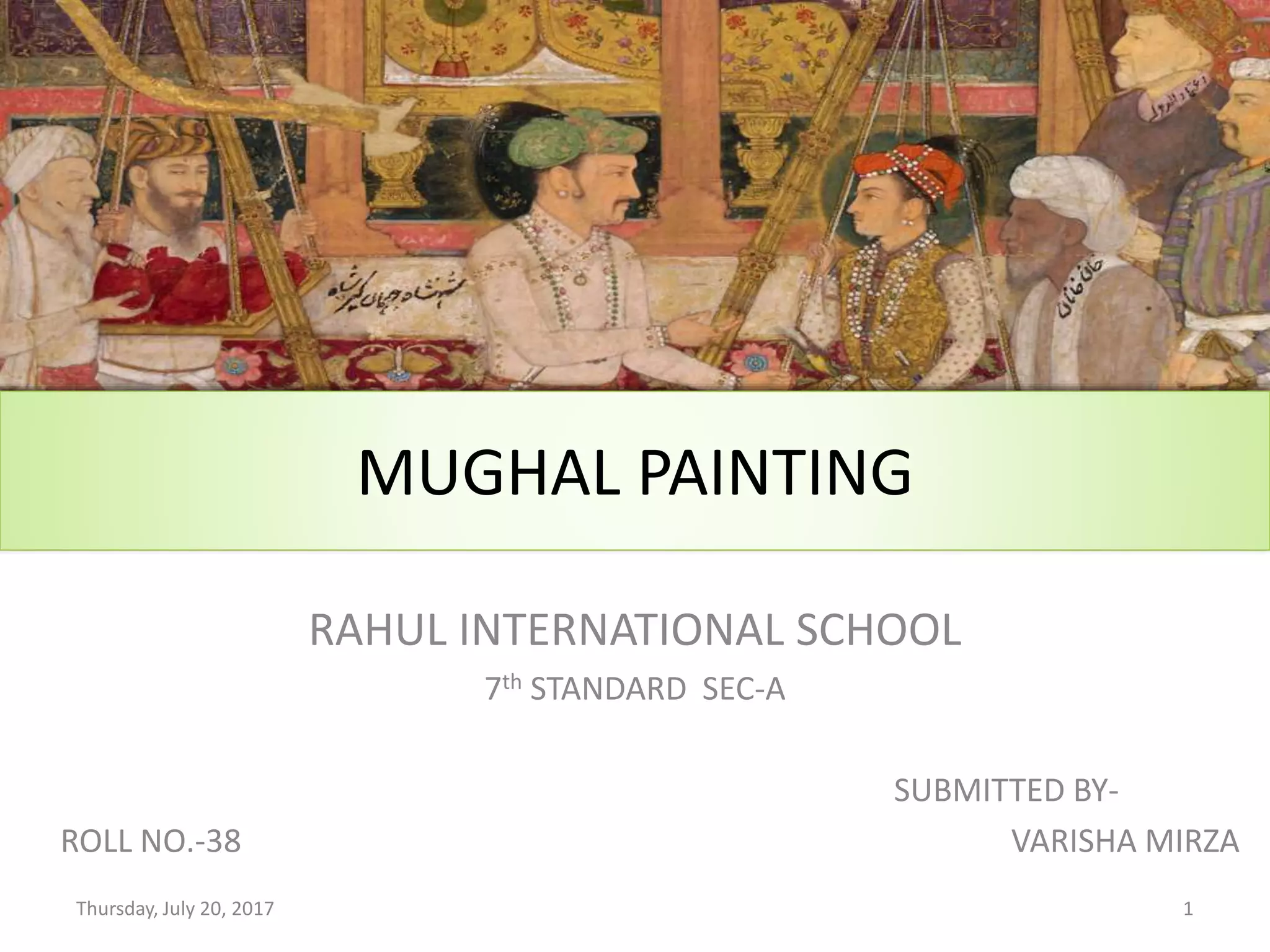
MUGHAL PAINTING
Mughal painting is a particular style of South
Asian painting, generally confined to miniatures
either as book illustrations or as single works to
be kept in albums, which emerged from Persian
miniature painting (itself largely of Chinese
origin), with Indian Hindu, Jain, and Buddhist
influences, and developed largely in the court of
the Mughal Empire of the 16th to 18th
centuries.
Thursday, July 20, 2017 3
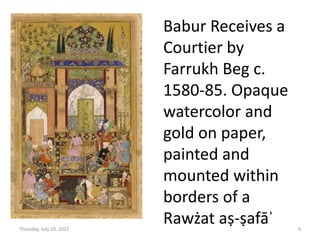
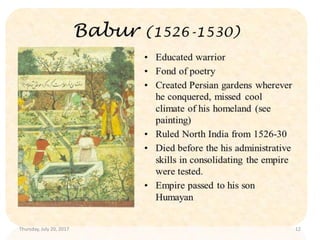
Babur Receives a
Courtier by
Farrukh Beg c.
1580-85. Opaque
watercolor and
gold on paper,
painted and
mounted within
borders of a
Rawżat aṣ-ṣafāʾThursday, July 20, 2017 4
Thursday, July 20, 2017 5
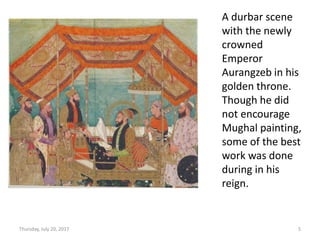
A durbar scene
with the newly
crowned
Emperor
Aurangzeb in his
golden throne.
Though he did
not encourage
Mughal painting,
some of the best
work was done
during in his
reign.
Thursday, July 20, 2017 6
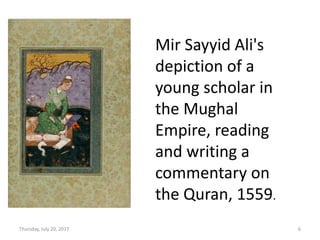
Mir Sayyid Ali's
depiction of a
young scholar in
the Mughal
Empire, reading
and writing a
commentary on
the Quran, 1559.
Thursday, July 20, 2017 7
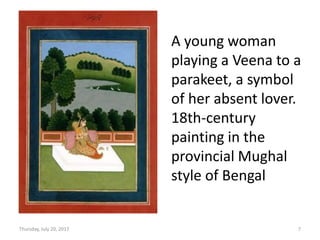
A young woman
playing a Veena to a
parakeet, a symbol
of her absent lover.
18th-century
painting in the
provincial Mughal
style of Bengal
Thursday, July 20, 2017 8
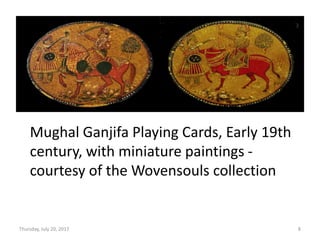
Mughal Ganjifa Playing Cards, Early 19th
century, with miniature paintings -
courtesy of the Wovensouls collection
Thursday, July 20, 2017 9
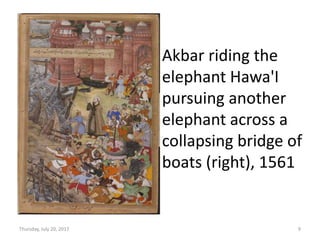
Akbar riding the
elephant Hawa'I
pursuing another
elephant across a
collapsing bridge of
boats (right), 1561
Thursday, July 20, 2017 10
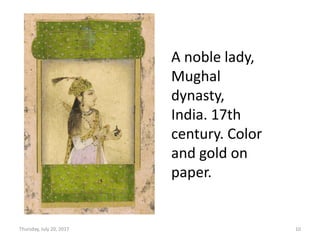
A noble lady,
Mughal
dynasty,
India. 17th
century. Color
and gold on
paper.
Thursday, July 20, 2017 11
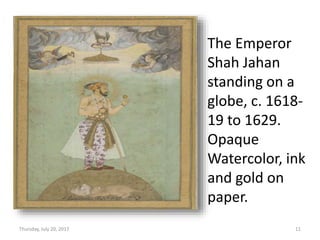
The Emperor
Shah Jahan
standing on a
globe, c. 1618-
19 to 1629.
Opaque
Watercolor, ink
and gold on
paper.
Thursday, July 20, 2017 12
ARTISTS
• The Persian master artists Abd al-Samad and Mir Sayyid Ali, who had accompanied
Humayun to India in the 16th century, were in charge of the imperial atelier during the
formative stages of Mughal painting. Many artists worked on large commissions, the
majority of them apparently Hindu, to judge by the names recorded. Mughal painting
flourished during the late 16th and early 17th centuries with spectacular works of art by
master artists such as Basawan, Lal, Daswanth,[13] and Miskin. Another influence on
the evolution of style during Akbar's reign was Kesu Das, who understood and
developed "European techniques of rendering space and volume".[14]
• Govardhan was a noted painter during the reigns of Akbar, Jahangir and Shah Jahan.
• The sub-imperial school of Mughal painting included artists such as Mushfiq, Kamal,
and Fazl.
• During the first half of the 18th century, many Mughal-trained artists left the imperial
workshop to work at Rajput courts. These include artists such as Bhawanidas and his
son Dalchand.
• Mughal painting generally involved a group of artists, one to decide the composition,
the second to actually paint, and the third to focus on portraiture, executing individual
faces
Thursday, July 20, 2017 13
MUGHAL STYLE TODAY
• Mughal-style miniature paintings are still being created
today by a small number of artists in Lahore
concentrated mainly in the National College of Arts.
Although many of these miniatures are skillful copies of
the originals, some artists have produced contemporary
works using classic methods with, at times, remarkable
artistic effect.
• The skills needed to produce these modern versions of
Mughal miniatures are still passed on from generation to
generation, although many artisans also employ dozens
of workers, often painting under trying working
conditions, to produce works sold under the signature of
their modern masters.
Thursday, July 20, 2017 14
Thursday, July 20, 2017 15

mughal paintings

  • 1.
    MUGHAL PAINTING RAHUL INTERNATIONALSCHOOL 7th STANDARD SEC-A SUBMITTED BY- ROLL NO.-38 VARISHA MIRZA Thursday, July 20, 2017 1
  • 2.
  • 3.
    MUGHAL PAINTING Mughal paintingis a particular style of South Asian painting, generally confined to miniatures either as book illustrations or as single works to be kept in albums, which emerged from Persian miniature painting (itself largely of Chinese origin), with Indian Hindu, Jain, and Buddhist influences, and developed largely in the court of the Mughal Empire of the 16th to 18th centuries. Thursday, July 20, 2017 3
  • 4.
    Babur Receives a Courtierby Farrukh Beg c. 1580-85. Opaque watercolor and gold on paper, painted and mounted within borders of a Rawżat aṣ-ṣafāʾThursday, July 20, 2017 4
  • 5.
    Thursday, July 20,2017 5 A durbar scene with the newly crowned Emperor Aurangzeb in his golden throne. Though he did not encourage Mughal painting, some of the best work was done during in his reign.
  • 6.
    Thursday, July 20,2017 6 Mir Sayyid Ali's depiction of a young scholar in the Mughal Empire, reading and writing a commentary on the Quran, 1559.
  • 7.
    Thursday, July 20,2017 7 A young woman playing a Veena to a parakeet, a symbol of her absent lover. 18th-century painting in the provincial Mughal style of Bengal
  • 8.
    Thursday, July 20,2017 8 Mughal Ganjifa Playing Cards, Early 19th century, with miniature paintings - courtesy of the Wovensouls collection
  • 9.
    Thursday, July 20,2017 9 Akbar riding the elephant Hawa'I pursuing another elephant across a collapsing bridge of boats (right), 1561
  • 10.
    Thursday, July 20,2017 10 A noble lady, Mughal dynasty, India. 17th century. Color and gold on paper.
  • 11.
    Thursday, July 20,2017 11 The Emperor Shah Jahan standing on a globe, c. 1618- 19 to 1629. Opaque Watercolor, ink and gold on paper.
  • 12.
  • 13.
    ARTISTS • The Persianmaster artists Abd al-Samad and Mir Sayyid Ali, who had accompanied Humayun to India in the 16th century, were in charge of the imperial atelier during the formative stages of Mughal painting. Many artists worked on large commissions, the majority of them apparently Hindu, to judge by the names recorded. Mughal painting flourished during the late 16th and early 17th centuries with spectacular works of art by master artists such as Basawan, Lal, Daswanth,[13] and Miskin. Another influence on the evolution of style during Akbar's reign was Kesu Das, who understood and developed "European techniques of rendering space and volume".[14] • Govardhan was a noted painter during the reigns of Akbar, Jahangir and Shah Jahan. • The sub-imperial school of Mughal painting included artists such as Mushfiq, Kamal, and Fazl. • During the first half of the 18th century, many Mughal-trained artists left the imperial workshop to work at Rajput courts. These include artists such as Bhawanidas and his son Dalchand. • Mughal painting generally involved a group of artists, one to decide the composition, the second to actually paint, and the third to focus on portraiture, executing individual faces Thursday, July 20, 2017 13
  • 14.
    MUGHAL STYLE TODAY •Mughal-style miniature paintings are still being created today by a small number of artists in Lahore concentrated mainly in the National College of Arts. Although many of these miniatures are skillful copies of the originals, some artists have produced contemporary works using classic methods with, at times, remarkable artistic effect. • The skills needed to produce these modern versions of Mughal miniatures are still passed on from generation to generation, although many artisans also employ dozens of workers, often painting under trying working conditions, to produce works sold under the signature of their modern masters. Thursday, July 20, 2017 14
  • 15.