Stage
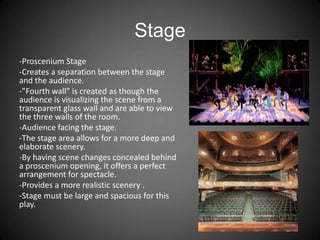
-Proscenium Stage
-Creates a separation between the stage
and the audience.
-”Fourth wall” is created as though the
audience is visualizing the scene from a
transparent glass wall and are able to view
the three walls of the room.
-Audience facing the stage.
-The stage area allows for a more deep and
elaborate scenery.
-By having scene changes concealed behind
a proscenium opening, it offers a perfect
arrangement for spectacle.
-Provides a more realistic scenery .
-Stage must be large and spacious for this
play.
Mood and Style
*-The setting of
play can establish
the mood, style,
and meaning of a
play.
*-The use of lights
can help distinguish
the mood using
colors, tint, etc.
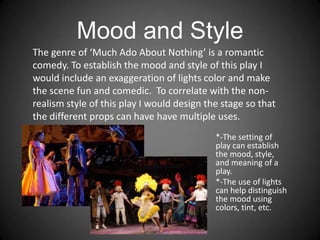
The genre of ‘Much Ado About Nothing’ is a romantic
comedy. To establish the mood and style of this play I
would include an exaggeration of lights color and make
the scene fun and comedic. To correlate with the non-
realism style of this play I would design the stage so that
the different props can have have multiple uses.
Realistic and Nonrealistic
Scenery
*The stage designer’s
role is of special
importance in
distinguishing
between realism and
non-realism.
To implement our non-realism
style of the play I would create a
stage to have an artificial feel
and appear illusionary. The
Shakespeare’s play has a much
more entertainment like feel in
this production.
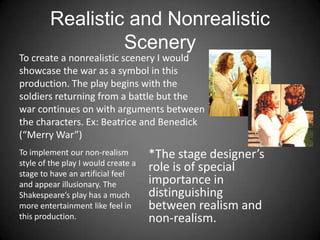
To create a nonrealistic scenery I would
showcase the war as a symbol in this
production. The play begins with the
soldiers returning from a battle but the
war continues on with arguments between
the characters. Ex: Beatrice and Benedick
(“Merry War”)
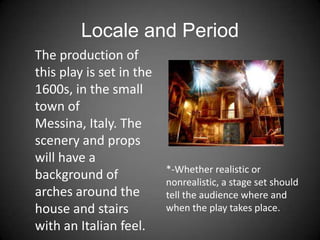
Locale and Period
*-Whether realistic or
nonrealistic, a stage set should
tell the audience where and
when the play takes place.
The production of
this play is set in the
1600s, in the small
town of
Messina, Italy. The
scenery and props
will have a
background of
arches around the
house and stairs
with an Italian feel.
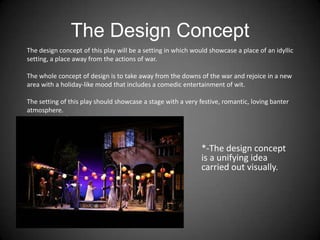
The Design Concept
*-The design concept
is a unifying idea
carried out visually.
The design concept of this play will be a setting in which would showcase a place of an idyllic
setting, a place away from the actions of war.
The whole concept of design is to take away from the downs of the war and rejoice in a new
area with a holiday-like mood that includes a comedic entertainment of wit.
The setting of this play should showcase a stage with a very festive, romantic, loving banter
atmosphere.
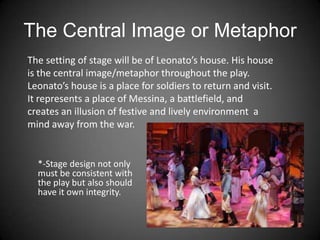
The Central Image or Metaphor
*-Stage design not only
must be consistent with
the play but also should
have it own integrity.
The setting of stage will be of Leonato’s house. His house
is the central image/metaphor throughout the play.
Leonato’s house is a place for soldiers to return and visit.
It represents a place of Messina, a battlefield, and
creates an illusion of festive and lively environment a
mind away from the war.
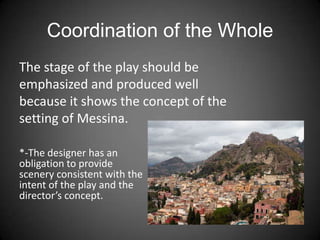
Coordination of the Whole
*-The designer has an
obligation to provide
scenery consistent with the
intent of the play and the
director’s concept.
The stage of the play should be
emphasized and produced well
because it shows the concept of the
setting of Messina.
Solving Practical Design
Problems
*-Each script presents unique practical problems which must be
solved by a designer; often these practical problems will help
determine the concept and other design decisions for a play.
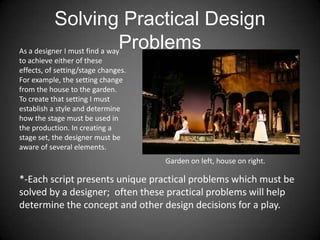
As a designer I must find a way
to achieve either of these
effects, of setting/stage changes.
For example, the setting change
from the house to the garden.
To create that setting I must
establish a style and determine
how the stage must be used in
the production. In creating a
stage set, the designer must be
aware of several elements.
Garden on left, house on right.

Much Ado About Nothing Collaboration Project

  • 2.
    Stage -Proscenium Stage -Creates aseparation between the stage and the audience. -”Fourth wall” is created as though the audience is visualizing the scene from a transparent glass wall and are able to view the three walls of the room. -Audience facing the stage. -The stage area allows for a more deep and elaborate scenery. -By having scene changes concealed behind a proscenium opening, it offers a perfect arrangement for spectacle. -Provides a more realistic scenery . -Stage must be large and spacious for this play.
  • 3.
    Mood and Style *-Thesetting of play can establish the mood, style, and meaning of a play. *-The use of lights can help distinguish the mood using colors, tint, etc. The genre of ‘Much Ado About Nothing’ is a romantic comedy. To establish the mood and style of this play I would include an exaggeration of lights color and make the scene fun and comedic. To correlate with the non- realism style of this play I would design the stage so that the different props can have have multiple uses.
  • 4.
    Realistic and Nonrealistic Scenery *Thestage designer’s role is of special importance in distinguishing between realism and non-realism. To implement our non-realism style of the play I would create a stage to have an artificial feel and appear illusionary. The Shakespeare’s play has a much more entertainment like feel in this production. To create a nonrealistic scenery I would showcase the war as a symbol in this production. The play begins with the soldiers returning from a battle but the war continues on with arguments between the characters. Ex: Beatrice and Benedick (“Merry War”)
  • 5.
    Locale and Period *-Whetherrealistic or nonrealistic, a stage set should tell the audience where and when the play takes place. The production of this play is set in the 1600s, in the small town of Messina, Italy. The scenery and props will have a background of arches around the house and stairs with an Italian feel.
  • 6.
    The Design Concept *-Thedesign concept is a unifying idea carried out visually. The design concept of this play will be a setting in which would showcase a place of an idyllic setting, a place away from the actions of war. The whole concept of design is to take away from the downs of the war and rejoice in a new area with a holiday-like mood that includes a comedic entertainment of wit. The setting of this play should showcase a stage with a very festive, romantic, loving banter atmosphere.
  • 7.
    The Central Imageor Metaphor *-Stage design not only must be consistent with the play but also should have it own integrity. The setting of stage will be of Leonato’s house. His house is the central image/metaphor throughout the play. Leonato’s house is a place for soldiers to return and visit. It represents a place of Messina, a battlefield, and creates an illusion of festive and lively environment a mind away from the war.
  • 8.
    Coordination of theWhole *-The designer has an obligation to provide scenery consistent with the intent of the play and the director’s concept. The stage of the play should be emphasized and produced well because it shows the concept of the setting of Messina.
  • 9.
    Solving Practical Design Problems *-Eachscript presents unique practical problems which must be solved by a designer; often these practical problems will help determine the concept and other design decisions for a play. As a designer I must find a way to achieve either of these effects, of setting/stage changes. For example, the setting change from the house to the garden. To create that setting I must establish a style and determine how the stage must be used in the production. In creating a stage set, the designer must be aware of several elements. Garden on left, house on right.