Name: Marta Epomba
Group#: 16

Your Element/Role: Set Designer

Link to your project:

THEA 1331 Collaboration Design Project worksheet
Play script: Bus Stop (title)
By: William Inge

Read play, analyze its design needs (For sets, lights, costumes or direction) (includes inside/outside,
doors, windows, drawbridge, etc.)

Answer the following in complete sentences.

1. Write a paragraph summarizing what happens in your play:
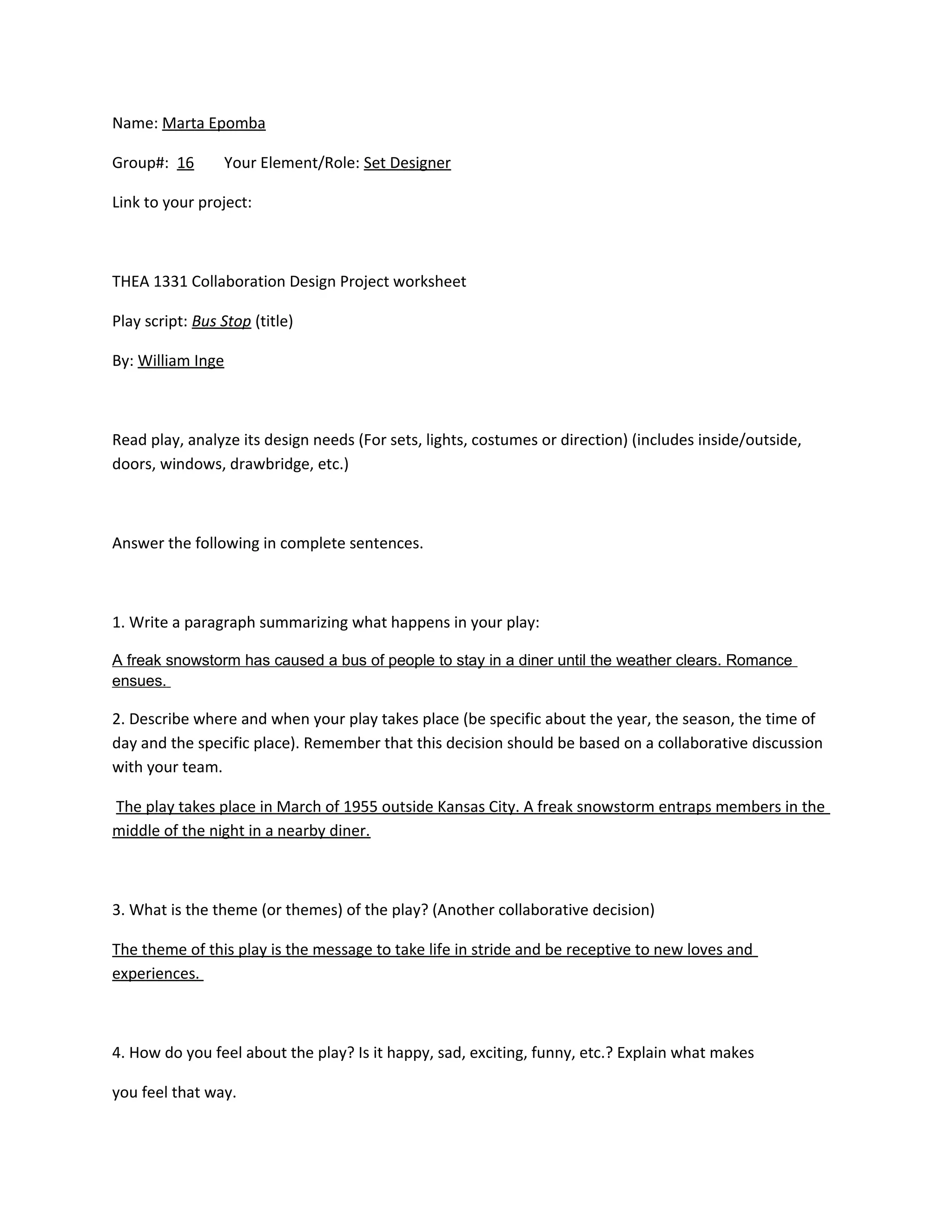
A freak snowstorm has caused a bus of people to stay in a diner until the weather clears. Romance
ensues.

2. Describe where and when your play takes place (be specific about the year, the season, the time of
day and the specific place). Remember that this decision should be based on a collaborative discussion
with your team.
The play takes place in March of 1955 outside Kansas City. A freak snowstorm entraps members in the
middle of the night in a nearby diner.

3. What is the theme (or themes) of the play? (Another collaborative decision)
The theme of this play is the message to take life in stride and be receptive to new loves and
experiences.

4. How do you feel about the play? Is it happy, sad, exciting, funny, etc.? Explain what makes
you feel that way.
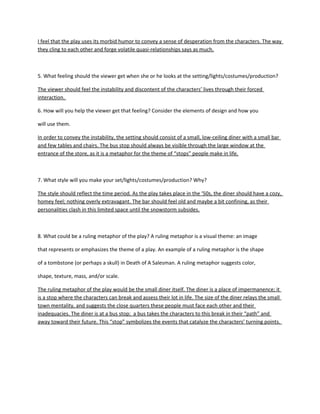
I feel that the play uses its morbid humor to convey a sense of desperation from the characters. The way
they cling to each other and forge volatile quasi-relationships says as much.

5. What feeling should the viewer get when she or he looks at the setting/lights/costumes/production?
The viewer should feel the instability and discontent of the characters’ lives through their forced
interaction.
6. How will you help the viewer get that feeling? Consider the elements of design and how you
will use them.
In order to convey the instability, the setting should consist of a small, low-ceiling diner. It should feel
small, almost confining, so as to really play off the angst of the characters. The bus stop should always
be visible through the large window at the entrance of the store, as it is a metaphor for the theme of
“stops” people make in life.

7. What style will you make your set/lights/costumes/production? Why?
The style should reflect the time period. As the play takes place in the ‘50s, the diner should have a
warm, muted tone; nothing overly extravagant or modern. The diner should feel old and maybe look a
bit worn, as a diner in a small town would. It should have a lot of wood finishing and accents in dull red.
There should be a rustic sort of minimalism to the setting; few tables and chairs, the bar and
accompanying stools being the major set pieces. A staircase going up to Grace’s overhead apartment
should .

8. What could be a ruling metaphor of the play? A ruling metaphor is a visual theme: an image that
represents or emphasizes the theme of a play. An example of a ruling metaphor is the shape of a
tombstone (or perhaps a skull) in Death of A Salesman. A ruling metaphor suggests color, shape, texture,
mass, and/or scale.
The ruling metaphor of the play would be the small diner itself. The diner is a place of impermanence; it
is a stop where the characters can break and assess their lot in life. The size of the diner relays the small
town mentality, and suggests the close quarters these people must face each other and their
inadequacies. The diner is at a bus stop; a bus takes the characters to this break in their “path” and
away toward their future. This “stop” symbolizes the events that catalyze the characters’ turning points.

Collaboration project set design written part

  • 1.
    Name: Marta Epomba Group#:16 Your Element/Role: Set Designer Link to your project: THEA 1331 Collaboration Design Project worksheet Play script: Bus Stop (title) By: William Inge Read play, analyze its design needs (For sets, lights, costumes or direction) (includes inside/outside, doors, windows, drawbridge, etc.) Answer the following in complete sentences. 1. Write a paragraph summarizing what happens in your play: A freak snowstorm has caused a bus of people to stay in a diner until the weather clears. Romance ensues. 2. Describe where and when your play takes place (be specific about the year, the season, the time of day and the specific place). Remember that this decision should be based on a collaborative discussion with your team. The play takes place in March of 1955 outside Kansas City. A freak snowstorm entraps members in the middle of the night in a nearby diner. 3. What is the theme (or themes) of the play? (Another collaborative decision) The theme of this play is the message to take life in stride and be receptive to new loves and experiences. 4. How do you feel about the play? Is it happy, sad, exciting, funny, etc.? Explain what makes you feel that way.
  • 2.
    I feel thatthe play uses its morbid humor to convey a sense of desperation from the characters. The way they cling to each other and forge volatile quasi-relationships says as much. 5. What feeling should the viewer get when she or he looks at the setting/lights/costumes/production? The viewer should feel the instability and discontent of the characters’ lives through their forced interaction. 6. How will you help the viewer get that feeling? Consider the elements of design and how you will use them. In order to convey the instability, the setting should consist of a small, low-ceiling diner. It should feel small, almost confining, so as to really play off the angst of the characters. The bus stop should always be visible through the large window at the entrance of the store, as it is a metaphor for the theme of “stops” people make in life. 7. What style will you make your set/lights/costumes/production? Why? The style should reflect the time period. As the play takes place in the ‘50s, the diner should have a warm, muted tone; nothing overly extravagant or modern. The diner should feel old and maybe look a bit worn, as a diner in a small town would. It should have a lot of wood finishing and accents in dull red. There should be a rustic sort of minimalism to the setting; few tables and chairs, the bar and accompanying stools being the major set pieces. A staircase going up to Grace’s overhead apartment should . 8. What could be a ruling metaphor of the play? A ruling metaphor is a visual theme: an image that represents or emphasizes the theme of a play. An example of a ruling metaphor is the shape of a tombstone (or perhaps a skull) in Death of A Salesman. A ruling metaphor suggests color, shape, texture, mass, and/or scale. The ruling metaphor of the play would be the small diner itself. The diner is a place of impermanence; it is a stop where the characters can break and assess their lot in life. The size of the diner relays the small town mentality, and suggests the close quarters these people must face each other and their inadequacies. The diner is at a bus stop; a bus takes the characters to this break in their “path” and away toward their future. This “stop” symbolizes the events that catalyze the characters’ turning points.