Positioning Singapore for
the future and seizing
opportunities to achieve
sustainable economic
growth and create good
jobs for Singaporeans
HIGHLIGHTS FROM
MTI COMMITTEE OF
SUPPLY DEBATE 2016
SEIZE OPPORTUNITIES CREATE VALUE
Leverage disruptive
technologies to ensure
Singapore remains competitive
and a key global player
• Digital technologies
• Industrial Internet of Things (IIoT)
which integrates info-comm
technology (ICT) into manufacturing
value chains
• Additive manufacturing
• Robotics
Tap on economic opportunities
presented by urbanisation and
rising consumerism in Asia
Drive deeper regional and
global economic integration
through trade agreements
Integrate restructuring efforts
through a $4.5 billion Industry
Transformation Programme
• Industry Transformation Maps (ITM)
• “Cluster Champions”
• $450 million National Robotics
Programme (NRP) over the next 3
years
Deepen innovation capabilities
• $3.25 billion from the Research,
Innovation and Enterprise (RIE)
2020 for research in Advanced
Manufacturing and Engineering (AME)
capabilities
BOOST PRODUCTIVITY
Provide near-term relief to
companies via financing support
• New SME Working Capital Loan
• Grant budget of over $2.3 billion under
the Enterprise Development Fund (EDF 5)
to support existing SPRING and IE
Singapore schemes1
Adopt a medium to long-term
approach to help companies
restructure via innovation and
transformation
• $400 million Automation Support
Package over the next 3 years
• Enhanced Infocomm for Productivity
and Growth (IPG)
Foster a vibrant and
innovation-enabling environment
for companies
• Jurong Innovation District
• JTC Launchpad @ JID by 2017
Information correct as of April 2016
1
Including the Capability Development Grant (CDG), Innovation and Capability Vouchers (ICV), Partnership for Capability Transformation (PACT), Market Readiness Assistance (MRA), Global Company Partnership (GCP), and Micro-Loan Programme (MLP)
Our companies need to push ahead with productivity and
transformation. We will support companies to restructure and
internationalise through an integrated and targeted approach,
and work with the industry and employers to up-skill our
workers to prepare for jobs of the future.
We will move into deeper
value creation anchored on
entrepreneurship and
innovation to harness future
opportunities and compete
globally.
Singapore must capitalise on
global economic trends that
present exciting new
opportunities, so that we can
continue to thrive even in a
slower growth environment.
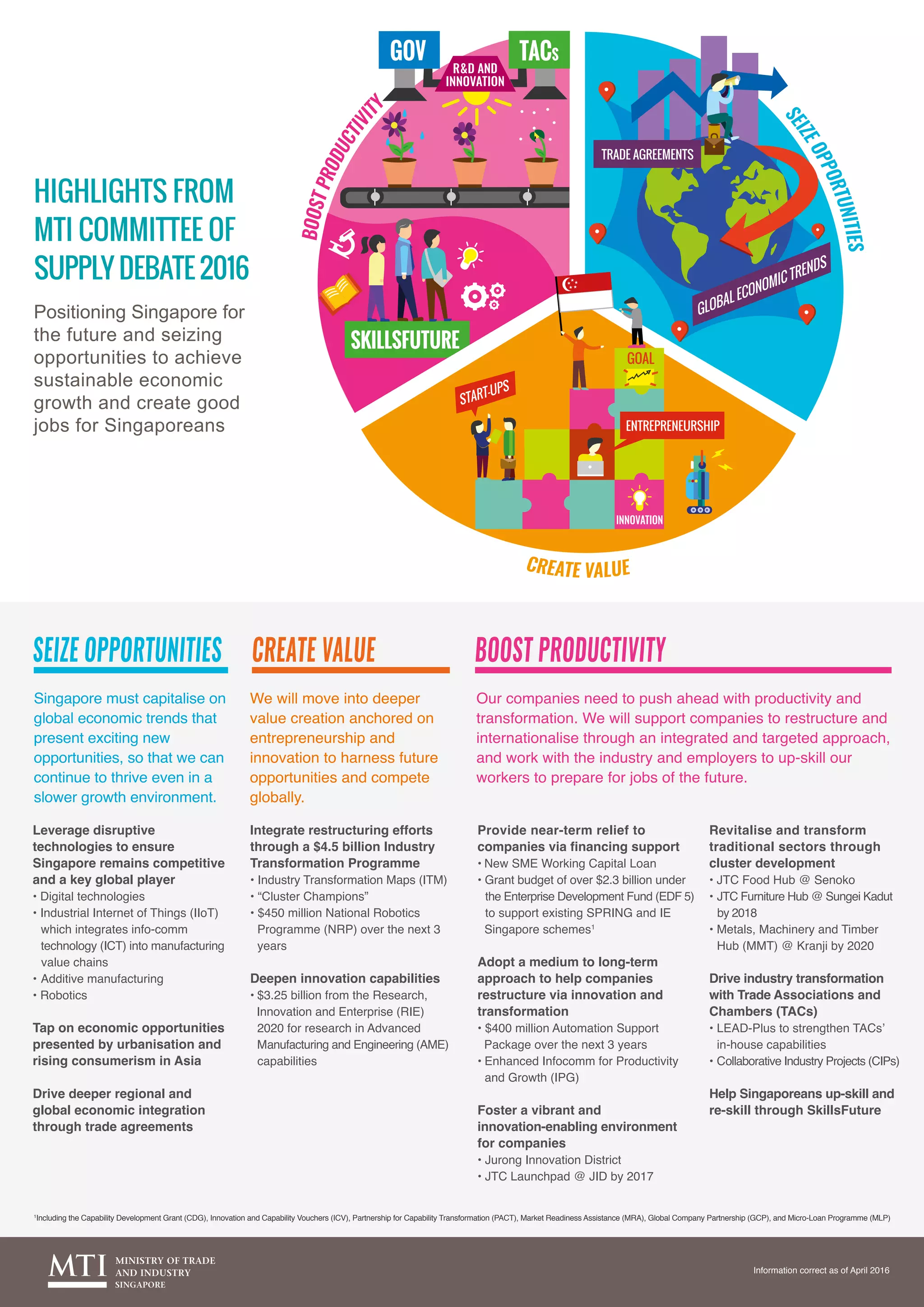
R&D AND
INNOVATION
GOV TACS
SKILLSFUTURE
START-UPS
ENTREPRENEURSHIP
INNOVATION
GOALGOAL
CREATE VALUE
BOOSTPRODUCTIVITY
SEIZEOPPORTUNITIES
Revitalise and transform
traditional sectors through
cluster development
• JTC Food Hub @ Senoko
• JTC Furniture Hub @ Sungei Kadut
by 2018
• Metals, Machinery and Timber
Hub (MMT) @ Kranji by 2020
Drive industry transformation
with Trade Associations and
Chambers (TACs)
• LEAD-Plus to strengthen TACs’
in-house capabilities
• Collaborative Industry Projects (CIPs)
Help Singaporeans up-skill and
re-skill through SkillsFuture
TRADE AGREEMENTS
GLOBAL ECONOMIC TRENDS
0.0
0.2
0.4
0.6
0.8
1.0

MTI COS 2016 infographic

  • 1.
    Positioning Singapore for thefuture and seizing opportunities to achieve sustainable economic growth and create good jobs for Singaporeans HIGHLIGHTS FROM MTI COMMITTEE OF SUPPLY DEBATE 2016 SEIZE OPPORTUNITIES CREATE VALUE Leverage disruptive technologies to ensure Singapore remains competitive and a key global player • Digital technologies • Industrial Internet of Things (IIoT) which integrates info-comm technology (ICT) into manufacturing value chains • Additive manufacturing • Robotics Tap on economic opportunities presented by urbanisation and rising consumerism in Asia Drive deeper regional and global economic integration through trade agreements Integrate restructuring efforts through a $4.5 billion Industry Transformation Programme • Industry Transformation Maps (ITM) • “Cluster Champions” • $450 million National Robotics Programme (NRP) over the next 3 years Deepen innovation capabilities • $3.25 billion from the Research, Innovation and Enterprise (RIE) 2020 for research in Advanced Manufacturing and Engineering (AME) capabilities BOOST PRODUCTIVITY Provide near-term relief to companies via financing support • New SME Working Capital Loan • Grant budget of over $2.3 billion under the Enterprise Development Fund (EDF 5) to support existing SPRING and IE Singapore schemes1 Adopt a medium to long-term approach to help companies restructure via innovation and transformation • $400 million Automation Support Package over the next 3 years • Enhanced Infocomm for Productivity and Growth (IPG) Foster a vibrant and innovation-enabling environment for companies • Jurong Innovation District • JTC Launchpad @ JID by 2017 Information correct as of April 2016 1 Including the Capability Development Grant (CDG), Innovation and Capability Vouchers (ICV), Partnership for Capability Transformation (PACT), Market Readiness Assistance (MRA), Global Company Partnership (GCP), and Micro-Loan Programme (MLP) Our companies need to push ahead with productivity and transformation. We will support companies to restructure and internationalise through an integrated and targeted approach, and work with the industry and employers to up-skill our workers to prepare for jobs of the future. We will move into deeper value creation anchored on entrepreneurship and innovation to harness future opportunities and compete globally. Singapore must capitalise on global economic trends that present exciting new opportunities, so that we can continue to thrive even in a slower growth environment. R&D AND INNOVATION GOV TACS SKILLSFUTURE START-UPS ENTREPRENEURSHIP INNOVATION GOALGOAL CREATE VALUE BOOSTPRODUCTIVITY SEIZEOPPORTUNITIES Revitalise and transform traditional sectors through cluster development • JTC Food Hub @ Senoko • JTC Furniture Hub @ Sungei Kadut by 2018 • Metals, Machinery and Timber Hub (MMT) @ Kranji by 2020 Drive industry transformation with Trade Associations and Chambers (TACs) • LEAD-Plus to strengthen TACs’ in-house capabilities • Collaborative Industry Projects (CIPs) Help Singaporeans up-skill and re-skill through SkillsFuture TRADE AGREEMENTS GLOBAL ECONOMIC TRENDS 0.0 0.2 0.4 0.6 0.8 1.0