And I do Mean “Guys”: the Women will
Come Later
Good vs. Bad


 At times, the line between
the good guys and the bad
guys was/is blurred.
 Heroes very often have tragic
flaws, and one common flaw
is hubris: when “affected” by
hubris, even heroes will do
dastardly deeds.
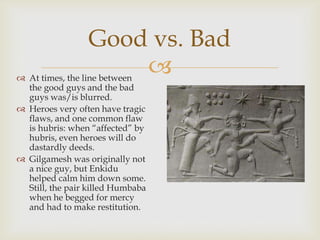
 Gilgamesh was originally not
a nice guy, but Enkidu
helped calm him down some.
Still, the pair killed Humbaba
when he begged for mercy
and had to make restitution.
 As I have pointed out previously, Gil’s epic is th
oldest extant piece of “literature” that tells a
complete story, but myth is also literature.
 In myth, the Egyptian god Set ranks among the
oldest recorded evildoers. This tale also
incorporates another common theme in myth:
sibling rivalry. There are stories of brothers/twins
who are close and you cooperate, but there are also
tales of warring brothers. One is usually seen as
“good” and the other as “bad.”
Osiris and Set


 In the Egyptian myth, Osiris is the
good brother—he has it all: the
kingdom of Egypt, a beautiful and
devoted wife (Isis), intelligence,
and the respect of his constituents.
 He also has a jealous brother, Set,
who builds a coffin, entices Osiris
to lie in it, then seals it and sets it
afloat in the Nile.
 Definitely not a show of brotherly
love!
 Osiris is, of course, resurrected, but
he must live in Tuat. His son,
Horus, takes up the fight against
Set; variant myths have Horus
either winning or the fight still
continuing.
Brothers and Best
Friends


 Bierlein covers the parallel tales of the Egyptian brothers
and Joseph and Potiphar (not brothers, but close friends),
but there are other tales of sibling rivalry from the
Hebrew Scriptures. Cain and Abel are one such story;
Jacob and Esau are another.
 Cain commits the first murder in the Hebrew Scriptures
when he slays his brother, Abel. For his transgression,
Cain is banished and marked—it is not clear what form
the “mark” takes.
 Banishment was one of the worst punishments given; in
early societies, someone cut off from the tribe not only
missed companionship, but would have found it difficult
to survive without the help of the clan to provide food.
 Jacob and Esau were twins—the first one to exit the womb
would inherit his father’s (Isaac) wealth. This rule of
primogeniture often caused problems for male siblings.
 Esau was born first, but as he emerged, Jacob was pulling
at his heel, which was construed as him trying to pull Esau
back into the uterus so that he could be born first (Genesis
25:26).
 On Isaac’s deathbed, Jacob and his mother transpired to
fool Isaac into blessing Jacob instead of Esau, giving him
the inheritance.
 Another conflict between brothers in the HS is that of Isaac
and Ishmael. This sibling rivalry got out of hand and was
never settled; in the modern mid-east, Muslims claim
Ishmael as their forefather, and the Jews claim Isaac as
theirs.
But not all Brothers
Fought


 There was competition between godly siblings, but when Zeus,
Poseidon and Hades cast lots for the sky, the sea, and the
underworld (in Sumerian myth, Enlil, Enki, and Anu also cast
lots for the sky, water, and earth), they abided by the cast—after
all, it was fated. Contrary to modern retellings of myth in
movies, Hades did not try to take Olympus from Zeus (I have
not seen said movie, only heard about it). There were rebellions
against Zeus, including one headed by Apollo and one by Hera,
but the brothers coexisted.
 Greek and other mythoi are rife with the twin/brother/best
friend motif: Castor and Pollux, Damon and Pythias, Romulus
and Remus (Roman), and the Divine Twins of Mayan myth are
but a few.
 However, in Zoroastrianism, Ahura Mazda and his brother,
Ahriman, represent good and evil—much like Osiris/Set and
Yahweh/Satan. Ahriman consistently plagues his brother.
The Villains


 While “bad” guys (such as Gilgamesh) can become “good guys” (a
theme we often see with the anti-hero), most often, they remained
bad. Some, like Oedipus and Arthur, unwittingly comment
dastardly deeds, but these heroes do not necessarily keep sliding
into perdition, but must find a way to redeem themselves.
 Other villains revel in their villainy. The trickster god is a seen
throughout various mythoi, but the intent of their trickery varies.
 In Greek myth, Hermes is a trickster, but his trickery (though
frustrating) is not of an “evil” bend; on the day he is born, he
steals Apollo’s cattle, covering up the theft by having the cows
walk backwards.
 In Norse myth, the trickster is Loki. Interestingly enough,
tricksters in Native American myth are also named “Loki”—
whether this is a cosmic coincidence or when the Norse tried to
colonize North America one cultures was influenced by the other
is not known.
Loki


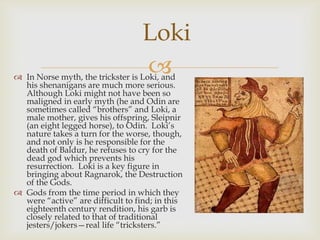
 In Norse myth, the trickster is Loki, and
his shenanigans are much more serious.
Although Loki might not have been so
maligned in early myth (he and Odin are
sometimes called “brothers” and Loki, a
male mother, gives his offspring, Sleipnir
(an eight legged horse), to Odin. Loki’s
nature takes a turn for the worse, though,
and not only is he responsible for the
death of Baldur, he refuses to cry for the
dead god which prevents his
resurrection. Loki is a key figure in
bringing about Ragnarok, the Destruction
of the Gods.
 Gods from the time period in which they
were “active” are difficult to find; in this
eighteenth century rendition, his garb is
closely related to that of traditional
jesters/jokers—real life “tricksters.”
 The fool from Camelot
and Lear’s fool
notwithstanding, Loki is
“well-dressed” in jester’s
garb; the joker/clown is
a trickster who is
nominally harmless, but
not to be trusted.
 The Joker in Batman is no
laughing matter—the
most recent is much
scarier than the 1960’s
TV series character
played by Cesar
Romero.
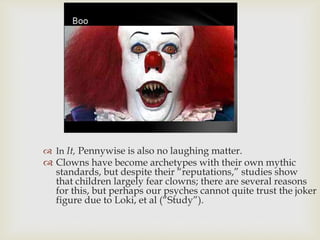
 In It, Pennywise is also no laughing matter.

 Clowns have become archetypes with their own mythic
standards, but despite their “reputations,” studies show
that children largely fear clowns; there are several reasons
for this, but perhaps our psyches cannot quite trust the joker
figure due to Loki, et al (“Study”).
Loki comes horrifyingly full
circle in modern times.

John W

John Wayne Gacy as
Pogo, the Clown.
e Clown.
Deities

 Although in Egypt the good and evil deities are fairly
delineated, in Sumeria, delineations are not so clear. There are
Sumerian demons, but they are not equated with gods—
likewise, in Christianity, demons are also not gods.
 “Evil” is also subjective. In Egypt, Ra decided to punish
humans for their disrespect, but he is upset with Sekhmet goes
overboard. In Sumerian, Enlil and the other gods seem peevish
when they decide to send a flood to rid the earth of humans;
many of the deities are horrified at the extent of the damage. In
Judeo/Christian versions of the flood, however, Yahweh is
presented as righteous in his efforts to rid the earth of humans,
but he does promise to never do so again, sending the rainbow
as a covenant.
 In Greek myth, deities have both “good” and “evil”
attributes, but some have more bad than good. Ares,
the god of war, and his sister, Eris (goddess of
discord) are usually disliked and feared; these two
represent chaos—war is fine, chaos is not logical (and
the Greeks prized logic).
 The taciturn, morose Hades is also feared, but his dark
nature might come from getting the underworld as his
domain in the casting of lots. And SOMEBODY has to
be god of the dead—death is necessary, as seen in the
myth of Sisyphus.
 Pantheons represent human emotions and traits, and
humans are both good and evil; therefore, gods are
both good and evil.
 With the advent of monotheistic gods, the attributes of
deity changed. Ahura Mazda is all good, and so is
Yahweh, yet evil persists.
 As in all major religions, there are
different sects and variant myths
in Hinduism, but , evil is
personified in the Asura, demons,
and there are all “good” gods such
as Vishnu, the epitome of
goodness and virtue. Vishnu has
been reincarnated nine times,
including incarnations as Krishna
and Buddha—he has a tenth
incarnation yet to come.
 However, if all gods are
manifestations of Brahma (as we
read in the creation myths), then
evil is an attribute of Brahma and
duality is introduced.
 Duality is also seen in Shiva, the
destroyer. Loki, in bring
destruction, is a bad guy; in
Hinduism, it is recognized that
without destruction, there is no
creation—the two are inseparable.
Vishnu
 In monotheistic religions where deity is all good, the concept of
evil is incorporated into entities that are second in strength only
to god, but they cannot be a god because (yes, obviously) there
is only one deity in monotheism.
 Zoroastrianism is one of the oldest extant monotheistic
religions, but like Hinduism, it has aspects of duality. Since this
is not a class in religion, I am refraining from discussing this
(though I really want to) and will pursue the point that all good
goods need all bad adversaries.
 Ahura Mazda battle Ahriman, but the best known battle
between good and evil is between Yahweh and Satan.
 In the Hebrew Scriptures, Shaitan is “the adversary,” but he is
not necessarily the personification of evil that he becomes in the
Christian Scriptures. In the former, Satan, aka “Lucifer,” comes
into his own as pure evil. A side note: “Lucifer” refers to the
morning star, which is not a star but the planet Venus.
Et Al.

 Like the Norse deities, everything has an end, but in
myth, counting all of the bad/evil guys would be a
daunting task.
 In literature, the good and bad guys evolved into the
protagonist and the antagonist, but as time
progressed, the lines again became blurred; the
protagonist can be his/her own enemy.
 I am not going to inflict my concept of the
subjectivity of good and evil, but I will call upon you
to reflect on this idea—see you in the discussion!
Works Cited

“Study Reveals Kids’ Fear of Clowns.” Finding Dulcinea.
Finding Dulcinea. 20 Jan. 2002. Web. 15 Nov. 2012
<http://www.findingdulcinea.com/news/
entertainment/Study-Reveals-Kids--Fear-ofClowns.html>.
Works Consulted
“What is Coulrophobia?” WiseGeek. WiseGeek. N.d.
Web. 15 Nov. 2012 <http://www.wisegeek.com/
what-is-coulrophobia.htm>.

MsWLZ--Mythic Bad Guys

  • 1.
    And I doMean “Guys”: the Women will Come Later
  • 2.
    Good vs. Bad  At times, the line between the good guys and the bad guys was/is blurred.  Heroes very often have tragic flaws, and one common flaw is hubris: when “affected” by hubris, even heroes will do dastardly deeds.  Gilgamesh was originally not a nice guy, but Enkidu helped calm him down some. Still, the pair killed Humbaba when he begged for mercy and had to make restitution.
  • 3.
     As Ihave pointed out previously, Gil’s epic is th oldest extant piece of “literature” that tells a complete story, but myth is also literature.  In myth, the Egyptian god Set ranks among the oldest recorded evildoers. This tale also incorporates another common theme in myth: sibling rivalry. There are stories of brothers/twins who are close and you cooperate, but there are also tales of warring brothers. One is usually seen as “good” and the other as “bad.”
  • 4.
    Osiris and Set  In the Egyptian myth, Osiris is the good brother—he has it all: the kingdom of Egypt, a beautiful and devoted wife (Isis), intelligence, and the respect of his constituents.  He also has a jealous brother, Set, who builds a coffin, entices Osiris to lie in it, then seals it and sets it afloat in the Nile.  Definitely not a show of brotherly love!  Osiris is, of course, resurrected, but he must live in Tuat. His son, Horus, takes up the fight against Set; variant myths have Horus either winning or the fight still continuing.
  • 5.
    Brothers and Best Friends  Bierlein covers the parallel tales of the Egyptian brothers and Joseph and Potiphar (not brothers, but close friends), but there are other tales of sibling rivalry from the Hebrew Scriptures. Cain and Abel are one such story; Jacob and Esau are another.  Cain commits the first murder in the Hebrew Scriptures when he slays his brother, Abel. For his transgression, Cain is banished and marked—it is not clear what form the “mark” takes.  Banishment was one of the worst punishments given; in early societies, someone cut off from the tribe not only missed companionship, but would have found it difficult to survive without the help of the clan to provide food.
  • 6.
     Jacob andEsau were twins—the first one to exit the womb would inherit his father’s (Isaac) wealth. This rule of primogeniture often caused problems for male siblings.  Esau was born first, but as he emerged, Jacob was pulling at his heel, which was construed as him trying to pull Esau back into the uterus so that he could be born first (Genesis 25:26).  On Isaac’s deathbed, Jacob and his mother transpired to fool Isaac into blessing Jacob instead of Esau, giving him the inheritance.  Another conflict between brothers in the HS is that of Isaac and Ishmael. This sibling rivalry got out of hand and was never settled; in the modern mid-east, Muslims claim Ishmael as their forefather, and the Jews claim Isaac as theirs.
  • 7.
    But not allBrothers Fought   There was competition between godly siblings, but when Zeus, Poseidon and Hades cast lots for the sky, the sea, and the underworld (in Sumerian myth, Enlil, Enki, and Anu also cast lots for the sky, water, and earth), they abided by the cast—after all, it was fated. Contrary to modern retellings of myth in movies, Hades did not try to take Olympus from Zeus (I have not seen said movie, only heard about it). There were rebellions against Zeus, including one headed by Apollo and one by Hera, but the brothers coexisted.  Greek and other mythoi are rife with the twin/brother/best friend motif: Castor and Pollux, Damon and Pythias, Romulus and Remus (Roman), and the Divine Twins of Mayan myth are but a few.  However, in Zoroastrianism, Ahura Mazda and his brother, Ahriman, represent good and evil—much like Osiris/Set and Yahweh/Satan. Ahriman consistently plagues his brother.
  • 8.
    The Villains   While“bad” guys (such as Gilgamesh) can become “good guys” (a theme we often see with the anti-hero), most often, they remained bad. Some, like Oedipus and Arthur, unwittingly comment dastardly deeds, but these heroes do not necessarily keep sliding into perdition, but must find a way to redeem themselves.  Other villains revel in their villainy. The trickster god is a seen throughout various mythoi, but the intent of their trickery varies.  In Greek myth, Hermes is a trickster, but his trickery (though frustrating) is not of an “evil” bend; on the day he is born, he steals Apollo’s cattle, covering up the theft by having the cows walk backwards.  In Norse myth, the trickster is Loki. Interestingly enough, tricksters in Native American myth are also named “Loki”— whether this is a cosmic coincidence or when the Norse tried to colonize North America one cultures was influenced by the other is not known.
  • 9.
    Loki   In Norsemyth, the trickster is Loki, and his shenanigans are much more serious. Although Loki might not have been so maligned in early myth (he and Odin are sometimes called “brothers” and Loki, a male mother, gives his offspring, Sleipnir (an eight legged horse), to Odin. Loki’s nature takes a turn for the worse, though, and not only is he responsible for the death of Baldur, he refuses to cry for the dead god which prevents his resurrection. Loki is a key figure in bringing about Ragnarok, the Destruction of the Gods.  Gods from the time period in which they were “active” are difficult to find; in this eighteenth century rendition, his garb is closely related to that of traditional jesters/jokers—real life “tricksters.”
  • 10.
     The foolfrom Camelot and Lear’s fool notwithstanding, Loki is “well-dressed” in jester’s garb; the joker/clown is a trickster who is nominally harmless, but not to be trusted.  The Joker in Batman is no laughing matter—the most recent is much scarier than the 1960’s TV series character played by Cesar Romero.
  • 11.
     In It,Pennywise is also no laughing matter.  Clowns have become archetypes with their own mythic standards, but despite their “reputations,” studies show that children largely fear clowns; there are several reasons for this, but perhaps our psyches cannot quite trust the joker figure due to Loki, et al (“Study”).
  • 12.
    Loki comes horrifyinglyfull circle in modern times. John W John Wayne Gacy as Pogo, the Clown. e Clown.
  • 13.
    Deities   Although inEgypt the good and evil deities are fairly delineated, in Sumeria, delineations are not so clear. There are Sumerian demons, but they are not equated with gods— likewise, in Christianity, demons are also not gods.  “Evil” is also subjective. In Egypt, Ra decided to punish humans for their disrespect, but he is upset with Sekhmet goes overboard. In Sumerian, Enlil and the other gods seem peevish when they decide to send a flood to rid the earth of humans; many of the deities are horrified at the extent of the damage. In Judeo/Christian versions of the flood, however, Yahweh is presented as righteous in his efforts to rid the earth of humans, but he does promise to never do so again, sending the rainbow as a covenant.
  • 14.
     In Greekmyth, deities have both “good” and “evil” attributes, but some have more bad than good. Ares, the god of war, and his sister, Eris (goddess of discord) are usually disliked and feared; these two represent chaos—war is fine, chaos is not logical (and the Greeks prized logic).  The taciturn, morose Hades is also feared, but his dark nature might come from getting the underworld as his domain in the casting of lots. And SOMEBODY has to be god of the dead—death is necessary, as seen in the myth of Sisyphus.  Pantheons represent human emotions and traits, and humans are both good and evil; therefore, gods are both good and evil.  With the advent of monotheistic gods, the attributes of deity changed. Ahura Mazda is all good, and so is Yahweh, yet evil persists.
  • 15.
     As inall major religions, there are different sects and variant myths in Hinduism, but , evil is personified in the Asura, demons, and there are all “good” gods such as Vishnu, the epitome of goodness and virtue. Vishnu has been reincarnated nine times, including incarnations as Krishna and Buddha—he has a tenth incarnation yet to come.  However, if all gods are manifestations of Brahma (as we read in the creation myths), then evil is an attribute of Brahma and duality is introduced.  Duality is also seen in Shiva, the destroyer. Loki, in bring destruction, is a bad guy; in Hinduism, it is recognized that without destruction, there is no creation—the two are inseparable. Vishnu
  • 16.
     In monotheisticreligions where deity is all good, the concept of evil is incorporated into entities that are second in strength only to god, but they cannot be a god because (yes, obviously) there is only one deity in monotheism.  Zoroastrianism is one of the oldest extant monotheistic religions, but like Hinduism, it has aspects of duality. Since this is not a class in religion, I am refraining from discussing this (though I really want to) and will pursue the point that all good goods need all bad adversaries.  Ahura Mazda battle Ahriman, but the best known battle between good and evil is between Yahweh and Satan.  In the Hebrew Scriptures, Shaitan is “the adversary,” but he is not necessarily the personification of evil that he becomes in the Christian Scriptures. In the former, Satan, aka “Lucifer,” comes into his own as pure evil. A side note: “Lucifer” refers to the morning star, which is not a star but the planet Venus.
  • 17.
    Et Al.   Likethe Norse deities, everything has an end, but in myth, counting all of the bad/evil guys would be a daunting task.  In literature, the good and bad guys evolved into the protagonist and the antagonist, but as time progressed, the lines again became blurred; the protagonist can be his/her own enemy.  I am not going to inflict my concept of the subjectivity of good and evil, but I will call upon you to reflect on this idea—see you in the discussion!
  • 18.
    Works Cited  “Study RevealsKids’ Fear of Clowns.” Finding Dulcinea. Finding Dulcinea. 20 Jan. 2002. Web. 15 Nov. 2012 <http://www.findingdulcinea.com/news/ entertainment/Study-Reveals-Kids--Fear-ofClowns.html>. Works Consulted “What is Coulrophobia?” WiseGeek. WiseGeek. N.d. Web. 15 Nov. 2012 <http://www.wisegeek.com/ what-is-coulrophobia.htm>.