Creating More
Complex Formulas
Excel is a spreadsheet application that can help you
calculate and analyze numerical information for
household budgets, company finances, inventory, and
more. To do this, you need to understand complex
formulas.
Simple formulas have one mathematical operation, such
as 5+5. Complex formulas have more than one
mathematical operation, such as 5+5-2. When there is
more than one operation in a formula, the order of
operations tells us which operation to calculate first. To
use Excel to calculate complex formulas, you'll need to
understand the order of operations.
 In some cases, the order in which a calculation is performed can
affect the return value of the formula, so it's important to
understand how the order is determined and how you can change
the order to obtain the results you want.
Calculation order
 Formulas calculate values in a specific order. A formula in Excel
always begins with an equal sign (=). Excel interprets the
characters that follow the equal sign as a formula. Following the
equal sign are the elements to be calculated (the operands), such
as constants or cell references. These are separated by calculation
operators..
The order of operations
Excel calculates formulas based on the
following order of operations:
1.Operations enclosed in parentheses
2.Exponential calculations (to the power of)
3.Multiplication and division, whichever
comes first
4.Addition and subtraction, whichever
comes first
A mnemonic that can help you remember the
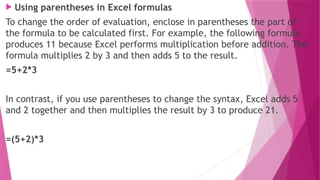
 Using parentheses in Excel formulas
To change the order of evaluation, enclose in parentheses the part of
the formula to be calculated first. For example, the following formula
produces 11 because Excel performs multiplication before addition. The
formula multiplies 2 by 3 and then adds 5 to the result.
=5+2*3
In contrast, if you use parentheses to change the syntax, Excel adds 5
and 2 together and then multiplies the result by 3 to produce 21.
=(5+2)*3
Example 1
The following example demonstrates how to use the order of
operations to calculate a formula:
SOLVE THE FOLLOWING:
1.2+9/3
2.(5+6)*4-10
3.120-6*4^2/2
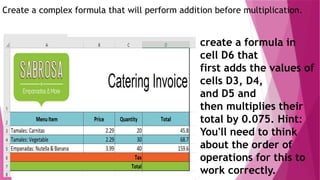
Create a complex formula that will perform addition before multiplication.
create a formula in
cell D6 that
first adds the values of
cells D3, D4,
and D5 and
then multiplies their
total by 0.075. Hint:
You'll need to think
about the order of
operations for this to
work correctly.
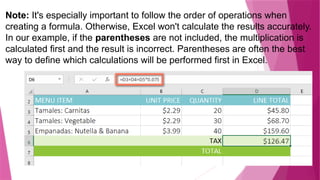
Creating complex formulas
In the example below, we'll demonstrate how Excel uses the order of operations to
solve a more complex formula. Here, we want to calculate the cost of sales tax for a
catering invoice. To do this, we'll write our formula as =(D3+D4+D5)*0.075 in cell D6.
This formula will add the prices of our items, then multiply that value by the 7.5% tax
rate (which is written as 0.075) to calculate the answer.
Excel follows the order of operations and first adds the values inside the
parentheses: (45.80+68.70+159.60) = 274.10. It then multiplies that value
by the tax rate: 274.10*0.075. The result will show that the sales tax is
$20.56.
Note: It's especially important to follow the order of operations when
creating a formula. Otherwise, Excel won't calculate the results accurately.
In our example, if the parentheses are not included, the multiplication is
calculated first and the result is incorrect. Parentheses are often the best
way to define which calculations will be performed first in Excel.
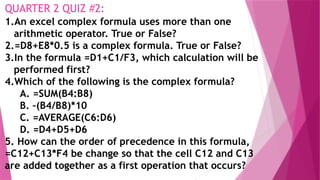
QUARTER 2 QUIZ #2:
1.An excel complex formula uses more than one
arithmetic operator. True or False?
2.=D8+E8*0.5 is a complex formula. True or False?
3.In the formula =D1+C1/F3, which calculation will be
performed first?
4.Which of the following is the complex formula?
A. =SUM(B4:B8)
B. –(B4/B8)*10
C. =AVERAGE(C6:D6)
D. =D4+D5+D6
5. How can the order of precedence in this formula,
=C12+C13*F4 be change so that the cell C12 and C13
are added together as a first operation that occurs?
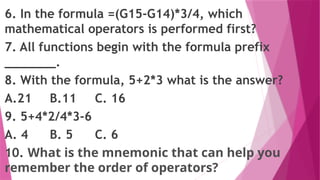
6. In the formula =(G15-G14)*3/4, which
mathematical operators is performed first?
7. All functions begin with the formula prefix
_______.
8. With the formula, 5+2*3 what is the answer?
A.21 B.11 C. 16
9. 5+4*2/4*3-6
A. 4 B. 5 C. 6
10. What is the mnemonic that can help you
remember the order of operators?
 ANSWER:
1. TRUE
2. TRUE
3. /F3
4. B
5. ADD PARENTHESIS
6. PARENTHESIS
7. =
8. B Explanation: Multiplation comes first. So 2*3=6 and
6+5=11
9. B Explanation: Multiplication and division first so 4*2=8.
divide by 4 and get 2. Multiply by 3 and get six so equation
reads 5+6-6=5
10.Please Excuse My Dear Aunt Sally.

MS Excel Basic Formula and and its Functions

  • 1.
  • 2.
    Excel is aspreadsheet application that can help you calculate and analyze numerical information for household budgets, company finances, inventory, and more. To do this, you need to understand complex formulas. Simple formulas have one mathematical operation, such as 5+5. Complex formulas have more than one mathematical operation, such as 5+5-2. When there is more than one operation in a formula, the order of operations tells us which operation to calculate first. To use Excel to calculate complex formulas, you'll need to understand the order of operations.
  • 3.
     In somecases, the order in which a calculation is performed can affect the return value of the formula, so it's important to understand how the order is determined and how you can change the order to obtain the results you want. Calculation order  Formulas calculate values in a specific order. A formula in Excel always begins with an equal sign (=). Excel interprets the characters that follow the equal sign as a formula. Following the equal sign are the elements to be calculated (the operands), such as constants or cell references. These are separated by calculation operators..
  • 4.
    The order ofoperations Excel calculates formulas based on the following order of operations: 1.Operations enclosed in parentheses 2.Exponential calculations (to the power of) 3.Multiplication and division, whichever comes first 4.Addition and subtraction, whichever comes first A mnemonic that can help you remember the
  • 5.
     Using parenthesesin Excel formulas To change the order of evaluation, enclose in parentheses the part of the formula to be calculated first. For example, the following formula produces 11 because Excel performs multiplication before addition. The formula multiplies 2 by 3 and then adds 5 to the result. =5+2*3 In contrast, if you use parentheses to change the syntax, Excel adds 5 and 2 together and then multiplies the result by 3 to produce 21. =(5+2)*3
  • 6.
    Example 1 The followingexample demonstrates how to use the order of operations to calculate a formula:
  • 7.
  • 8.
    Create a complexformula that will perform addition before multiplication. create a formula in cell D6 that first adds the values of cells D3, D4, and D5 and then multiplies their total by 0.075. Hint: You'll need to think about the order of operations for this to work correctly.
  • 9.
    Creating complex formulas Inthe example below, we'll demonstrate how Excel uses the order of operations to solve a more complex formula. Here, we want to calculate the cost of sales tax for a catering invoice. To do this, we'll write our formula as =(D3+D4+D5)*0.075 in cell D6. This formula will add the prices of our items, then multiply that value by the 7.5% tax rate (which is written as 0.075) to calculate the answer.
  • 10.
    Excel follows theorder of operations and first adds the values inside the parentheses: (45.80+68.70+159.60) = 274.10. It then multiplies that value by the tax rate: 274.10*0.075. The result will show that the sales tax is $20.56.
  • 11.
    Note: It's especiallyimportant to follow the order of operations when creating a formula. Otherwise, Excel won't calculate the results accurately. In our example, if the parentheses are not included, the multiplication is calculated first and the result is incorrect. Parentheses are often the best way to define which calculations will be performed first in Excel.
  • 12.
    QUARTER 2 QUIZ#2: 1.An excel complex formula uses more than one arithmetic operator. True or False? 2.=D8+E8*0.5 is a complex formula. True or False? 3.In the formula =D1+C1/F3, which calculation will be performed first? 4.Which of the following is the complex formula? A. =SUM(B4:B8) B. –(B4/B8)*10 C. =AVERAGE(C6:D6) D. =D4+D5+D6 5. How can the order of precedence in this formula, =C12+C13*F4 be change so that the cell C12 and C13 are added together as a first operation that occurs?
  • 13.
    6. In theformula =(G15-G14)*3/4, which mathematical operators is performed first? 7. All functions begin with the formula prefix _______. 8. With the formula, 5+2*3 what is the answer? A.21 B.11 C. 16 9. 5+4*2/4*3-6 A. 4 B. 5 C. 6 10. What is the mnemonic that can help you remember the order of operators?
  • 14.
     ANSWER: 1. TRUE 2.TRUE 3. /F3 4. B 5. ADD PARENTHESIS 6. PARENTHESIS 7. = 8. B Explanation: Multiplation comes first. So 2*3=6 and 6+5=11 9. B Explanation: Multiplication and division first so 4*2=8. divide by 4 and get 2. Multiply by 3 and get six so equation reads 5+6-6=5 10.Please Excuse My Dear Aunt Sally.