Building a Future-Oriented Green Intelligent City								An e-City Concept
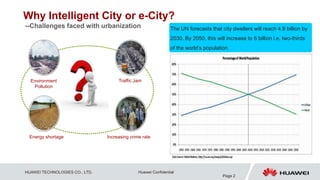
The UN forecasts that city dwellers will reach 4.9 billion by 2030. By 2050, this will increase to 6 billion i.e. two-thirds of the world’s populationTraffic JamEnvironmentPollutionEnergy shortageIncreasing crime rateWhy Intelligent City or e-City? --Challenges faced with urbanizationMeanwhile, it also means igher resource requirements and more complicated city management complex policy making  and social relations. Page 2
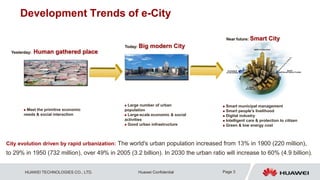
Page 3Development Trends of e-CityNear future:Smart CityToday:Big modern CityYesterday:Human gathered place Large number of urban population
 Large-scale economic &social activities
 Good urban infrastructure
 Smart municipal management
 Smart people's livelihood
 Digital industry
 Intelligent care & protection to citizen
Green & low energy cost
 Meet the primitiveeconomic needs & social interaction City evolution driven by rapid urbanization:The world's urban population increased from 13% in 1900 (220 million), to 29% in 1950 (732 million), over 49% in 2005 (3.2 billion). In 2030 the urban ratio will increase to 60% (4.9 billion).

Mr. Khalid Attia's presentation at QITCOM 2011

  • 1.
    Building a Future-OrientedGreen Intelligent City An e-City Concept
  • 2.
    The UN forecaststhat city dwellers will reach 4.9 billion by 2030. By 2050, this will increase to 6 billion i.e. two-thirds of the world’s populationTraffic JamEnvironmentPollutionEnergy shortageIncreasing crime rateWhy Intelligent City or e-City? --Challenges faced with urbanizationMeanwhile, it also means igher resource requirements and more complicated city management complex policy making and social relations. Page 2
  • 3.
    Page 3Development Trendsof e-CityNear future:Smart CityToday:Big modern CityYesterday:Human gathered place Large number of urban population
  • 4.
    Large-scale economic&social activities
  • 5.
    Good urbaninfrastructure
  • 6.
  • 7.
    Smart people'slivelihood
  • 8.
  • 9.
    Intelligent care& protection to citizen
  • 10.
    Green & lowenergy cost
  • 11.
    Meet theprimitiveeconomic needs & social interaction City evolution driven by rapid urbanization:The world's urban population increased from 13% in 1900 (220 million), to 29% in 1950 (732 million), over 49% in 2005 (3.2 billion). In 2030 the urban ratio will increase to 60% (4.9 billion).