B Y
P RO F . R A J E E V P A N D E Y
D E P A R T M E N T O F S T A T I S T I C S
U N I V E R S I T Y O F L U C K N O W
L U C K N O W
LECTURE
on
Parametric and Non-Parametric Tests
Chi-Square test, ANOVA, Mann-Whitney,
Kruskal Wallis and Kolmogrov-Smirnov
2.
Nonparametrics and
goodness offit
In tests we have done so far, the null hypothesis
has always been a stochastic model with a few
parameters.
T tests
Tests for regression coefficients
Test for autocorrelation
…
In nonparametric tests, the null hypothesis is not a
parametric distribution, rather a much larger class
of possible distributions
3.
Nonparametric statistics
Thenull hypothesis is for example that the
median of the distribution is zero
A test statistic can be formulated, so that
it has a known distribution under this
hypothesis
it has more extreme values under
alternative hypotheses
4.
Nonparametric tests: features
Nonparametric statistical tests can be used when the data
being analysed is not a normal distribution
Many nonparametric methods do not use the raw data and
instead use the rank order of data for analysis
Nonparametric methods can be used with small samples
5.
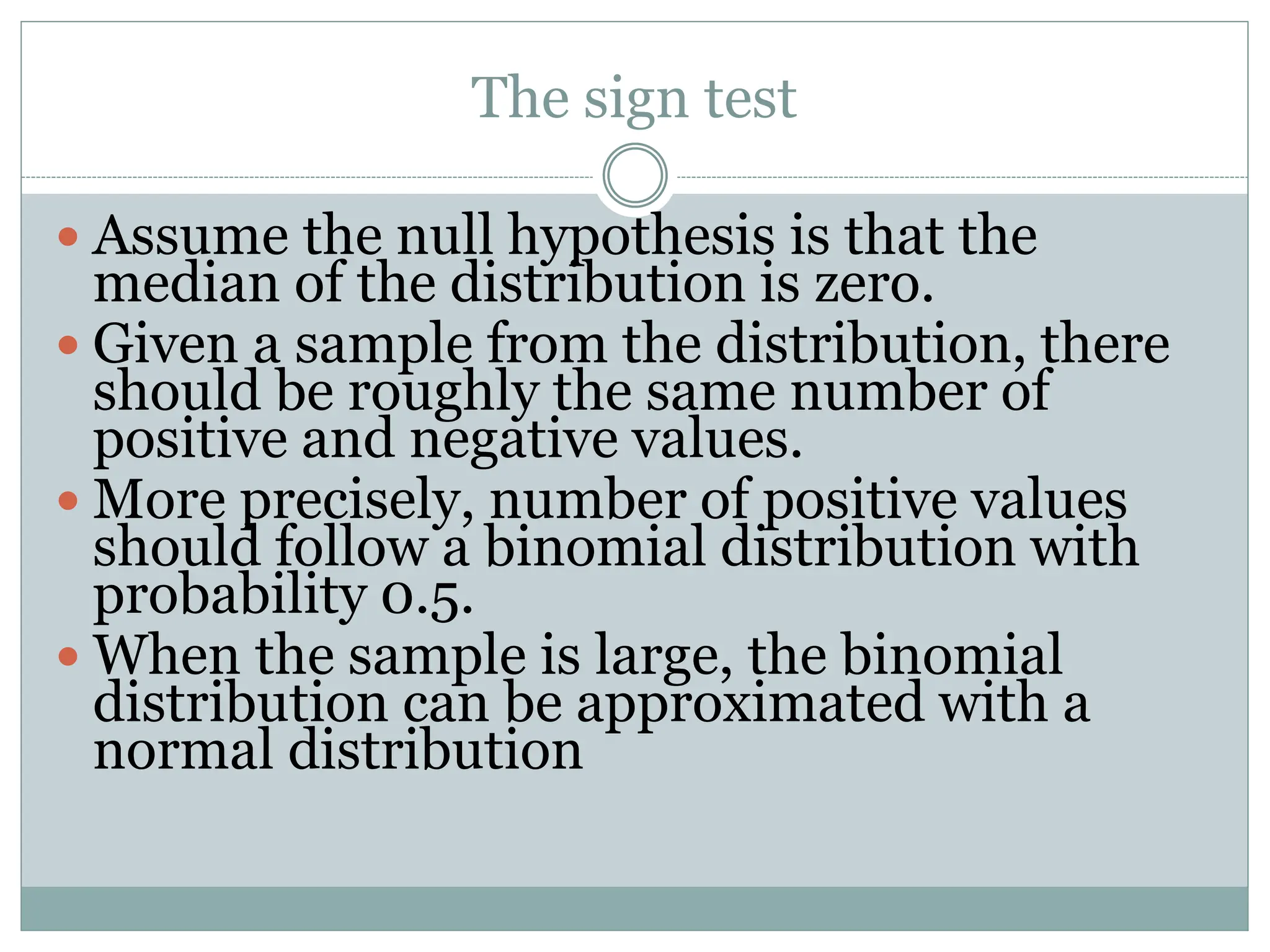
The sign test
Assume the null hypothesis is that the
median of the distribution is zero.
Given a sample from the distribution, there
should be roughly the same number of
positive and negative values.
More precisely, number of positive values
should follow a binomial distribution with
probability 0.5.
When the sample is large, the binomial
distribution can be approximated with a
normal distribution
6.
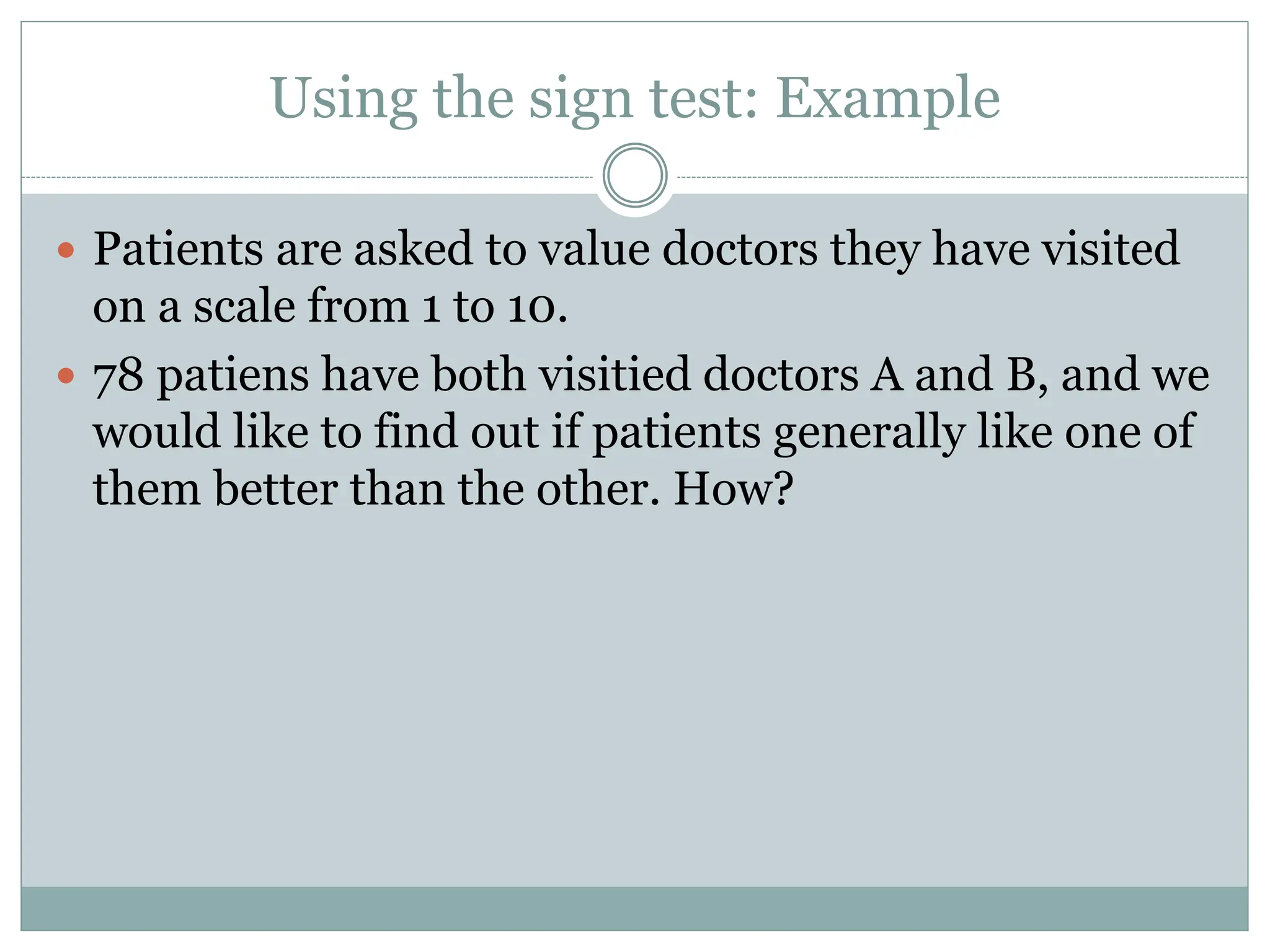
Using the signtest: Example
Patients are asked to value doctors they have visited
on a scale from 1 to 10.
78 patiens have both visitied doctors A and B, and we
would like to find out if patients generally like one of
them better than the other. How?
7.
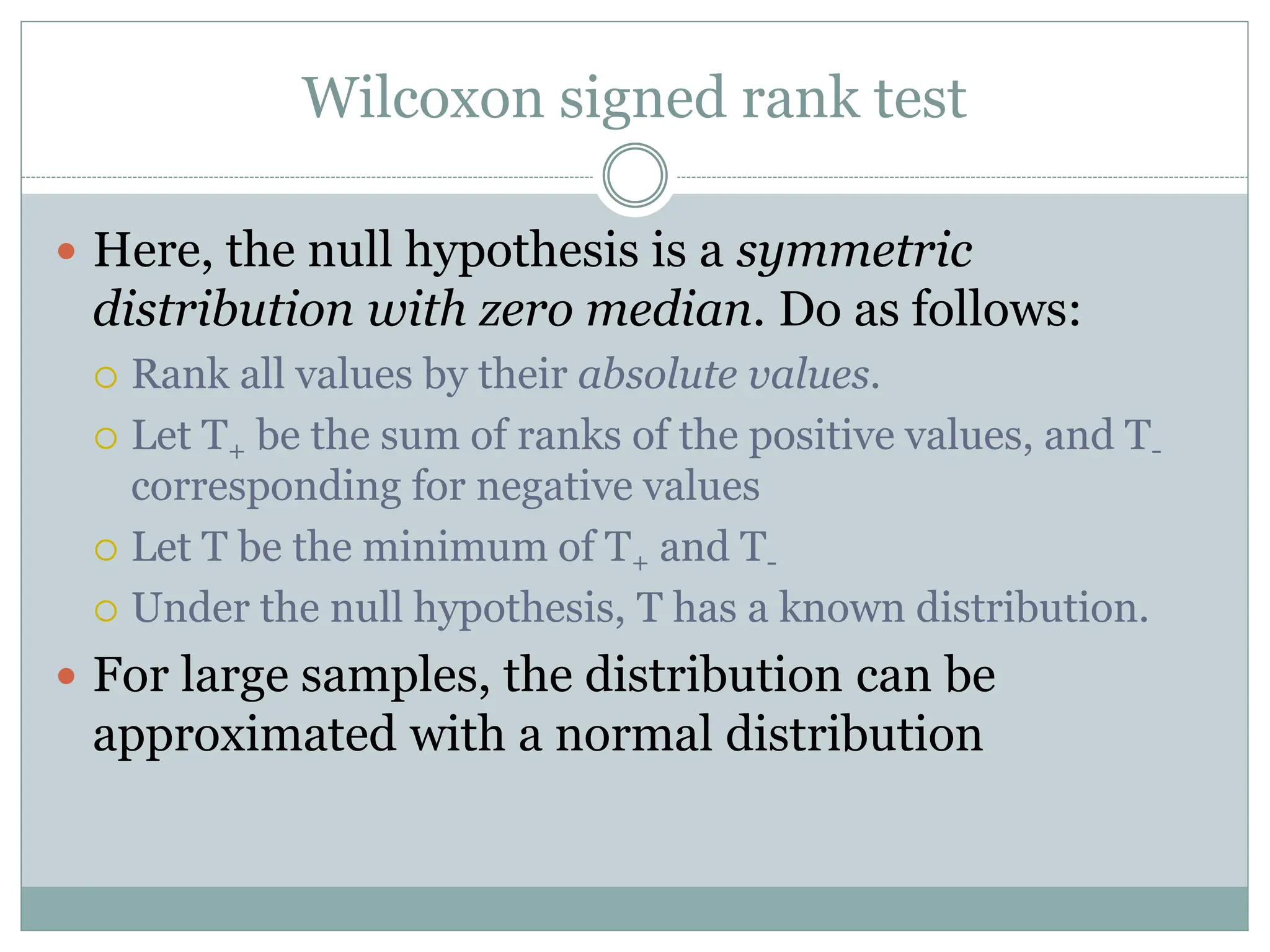
Wilcoxon signed ranktest
Here, the null hypothesis is a symmetric
distribution with zero median. Do as follows:
Rank all values by their absolute values.
Let T+ be the sum of ranks of the positive values, and T-
corresponding for negative values
Let T be the minimum of T+ and T-
Under the null hypothesis, T has a known distribution.
For large samples, the distribution can be
approximated with a normal distribution
8.
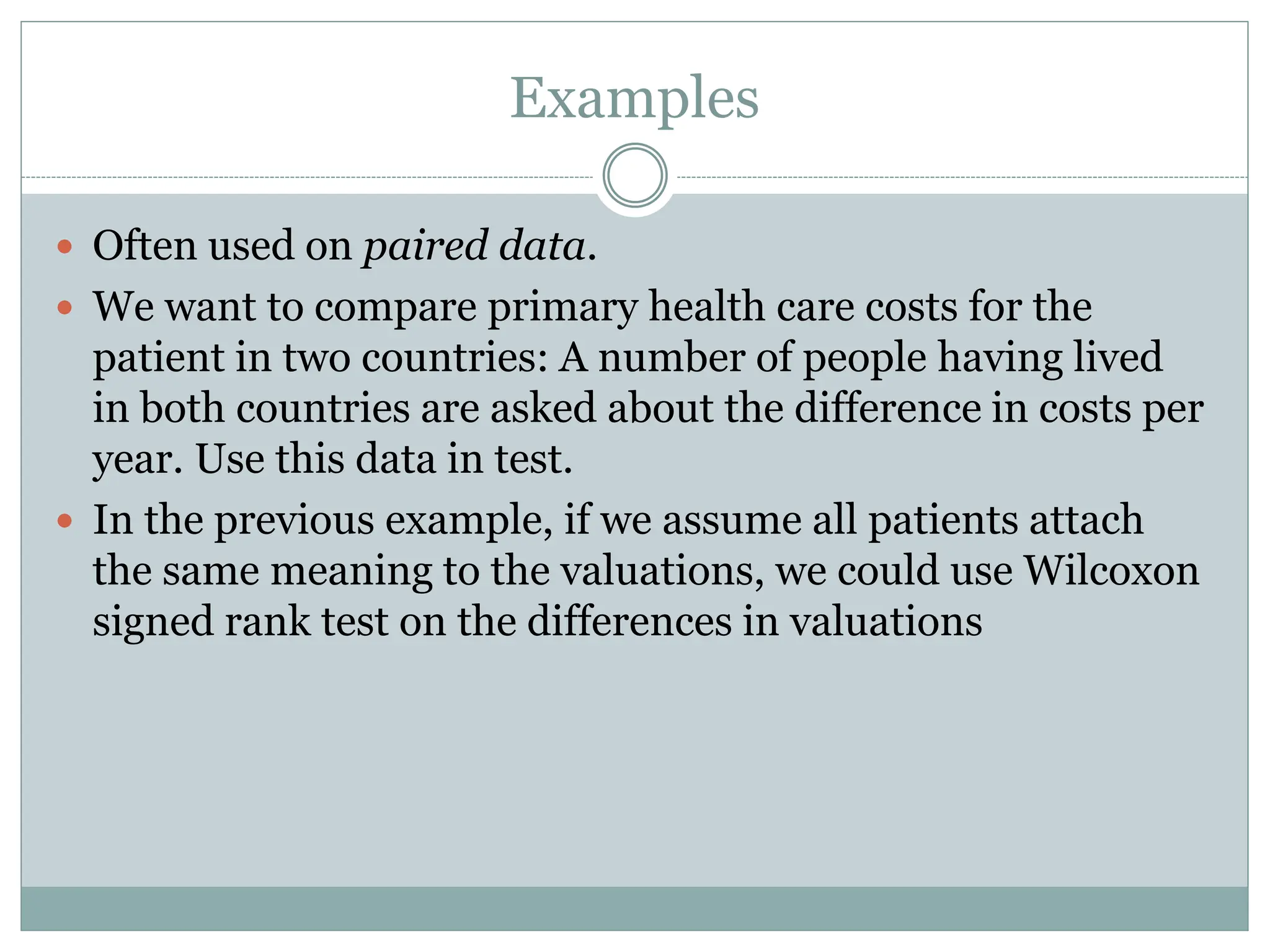
Examples
Often usedon paired data.
We want to compare primary health care costs for the
patient in two countries: A number of people having lived
in both countries are asked about the difference in costs per
year. Use this data in test.
In the previous example, if we assume all patients attach
the same meaning to the valuations, we could use Wilcoxon
signed rank test on the differences in valuations
9.
Wilcoxon rank sumtest
(or the Mann-Whitney U test)
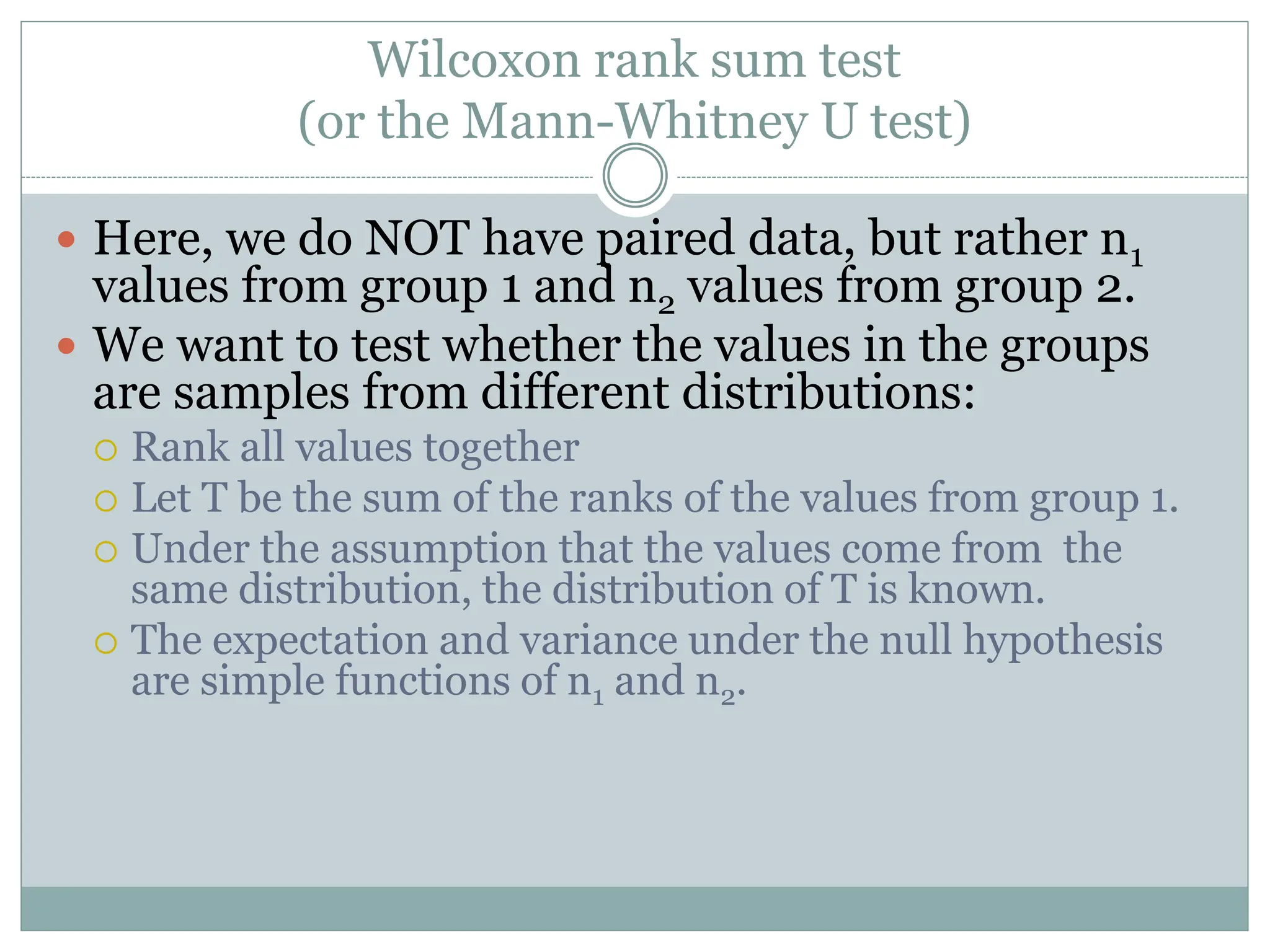
Here, we do NOT have paired data, but rather n1
values from group 1 and n2 values from group 2.
We want to test whether the values in the groups
are samples from different distributions:
Rank all values together
Let T be the sum of the ranks of the values from group 1.
Under the assumption that the values come from the
same distribution, the distribution of T is known.
The expectation and variance under the null hypothesis
are simple functions of n1 and n2.
10.
Wilcoxon rank sumtest
(or the Mann-Whitney U test)
For large samples, we can use a normal
approximation for the distribution of T.
The Mann-Whitney U test gives exactly the same
results, but uses slightly different test statistic.
11.
Example
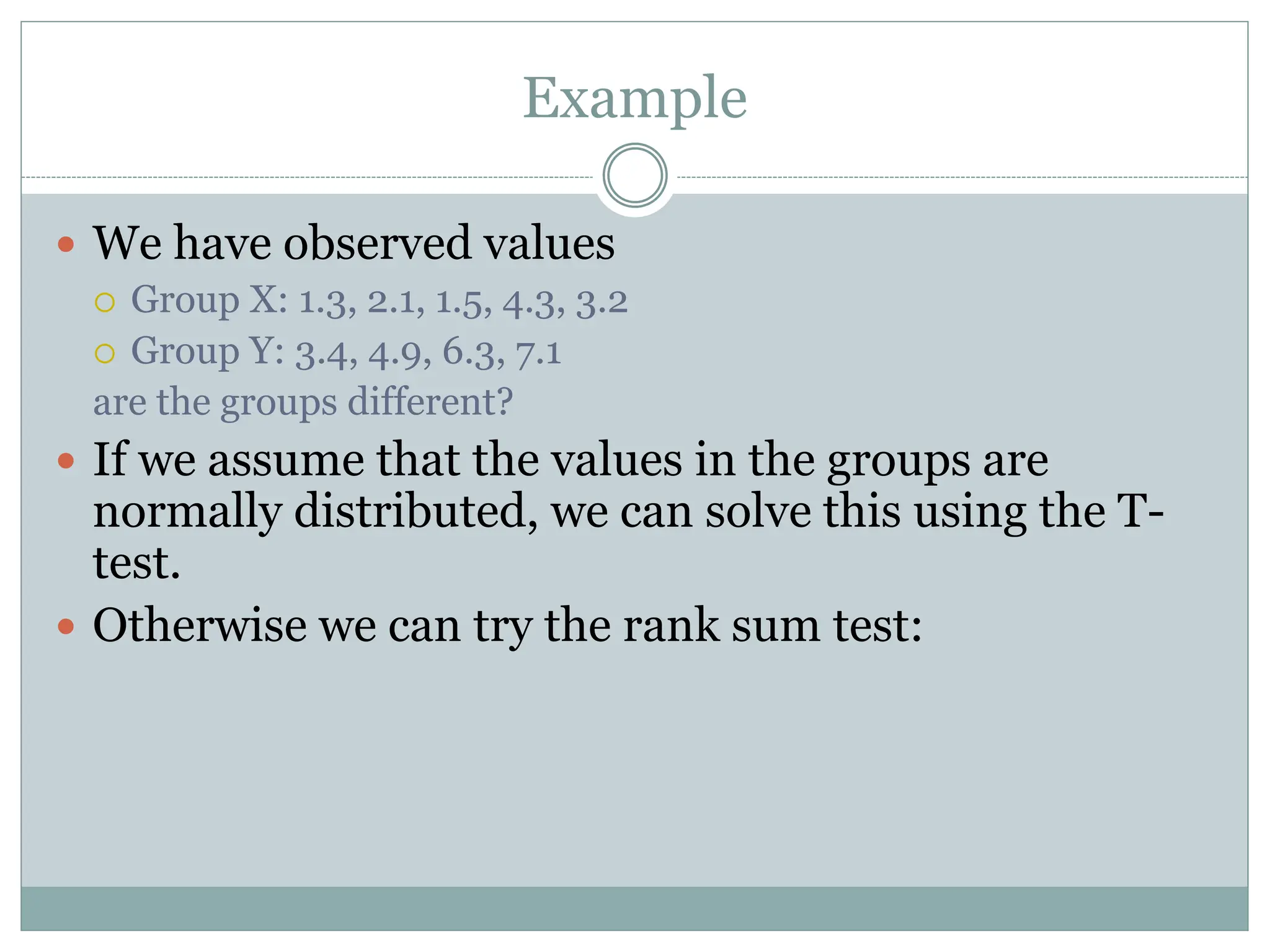
We haveobserved values
Group X: 1.3, 2.1, 1.5, 4.3, 3.2
Group Y: 3.4, 4.9, 6.3, 7.1
are the groups different?
If we assume that the values in the groups are
normally distributed, we can solve this using the T-
test.
Otherwise we can try the rank sum test:
12.
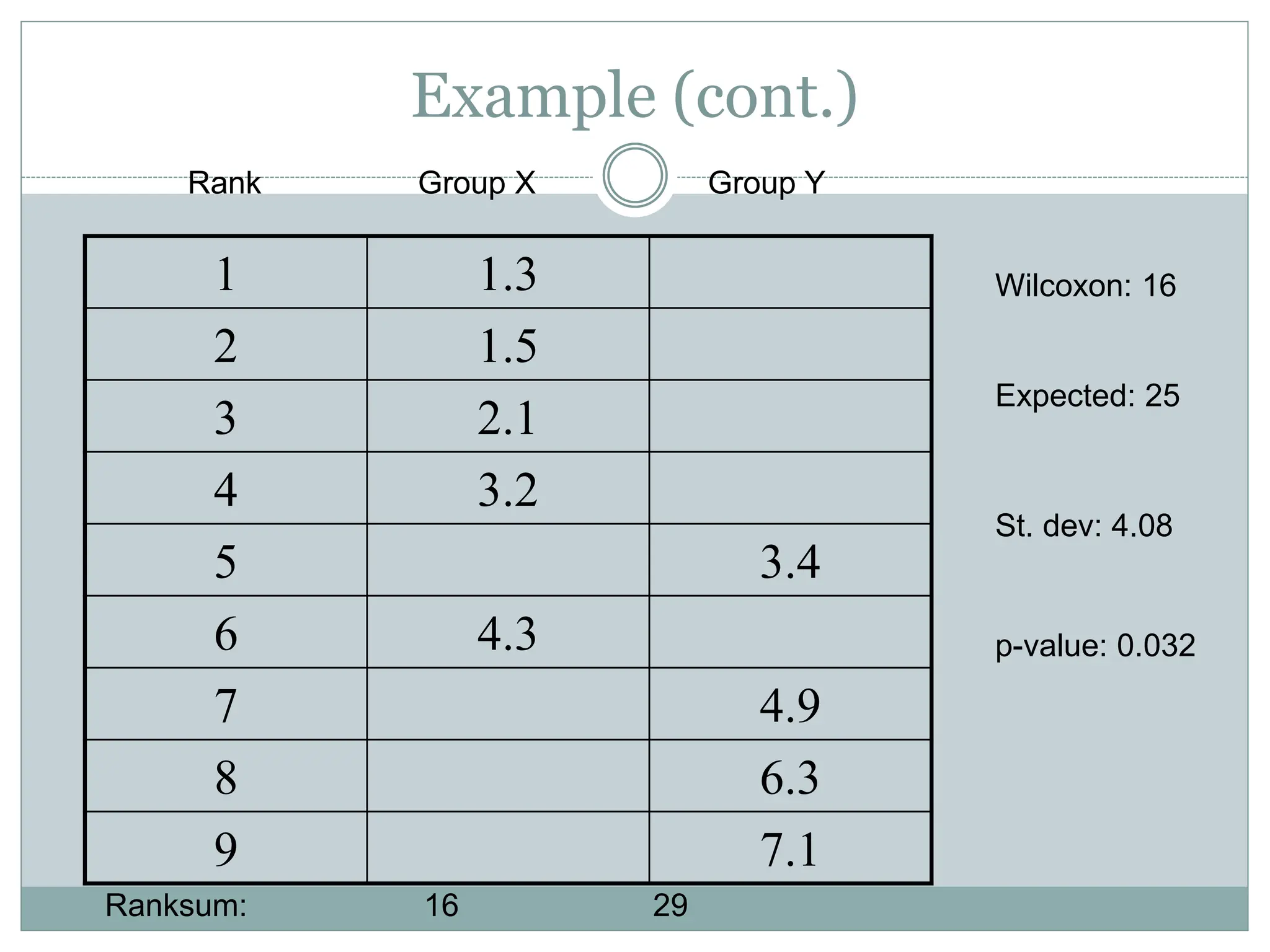
Example (cont.)
1 1.3
21.5
3 2.1
4 3.2
5 3.4
6 4.3
7 4.9
8 6.3
9 7.1
Rank Group X Group Y
Ranksum: 16 29
Wilcoxon: 16
Expected: 25
St. dev: 4.08
p-value: 0.032
13.
Spearman rank correlation
This can be applied when you have two observations
per item, and you want to test whether the
observations are related.
Computing the sample correlation gives an
indication.
We can test whether the population correlation could
be zero but test needs assumption of normality.
14.
Spearman rank correlation
The Spearman rank correlation tests for
association without any assumption on the
association:
Rank the X-values, and rank the Y-values.
Compute ordinary sample correlation of the ranks: This
is called the Spearman rank correlation.
Under the null hypothesis that X values and Y values are
independent, it has a fixed, tabulated distribution
(depending on number of observations)
The ordinary sample correlation is sometimes
called Pearson correlation to separate it from
Spearman correlation.
15.
Contingency tables
Thefollowing data type is frequent: Each object
(person, case,…) can be in one of two or more
categories. The data is the count of number of objects
in each category.
Often, you measure several categories for each
object. The resulting counts can then be put in a
contingency table.
16.
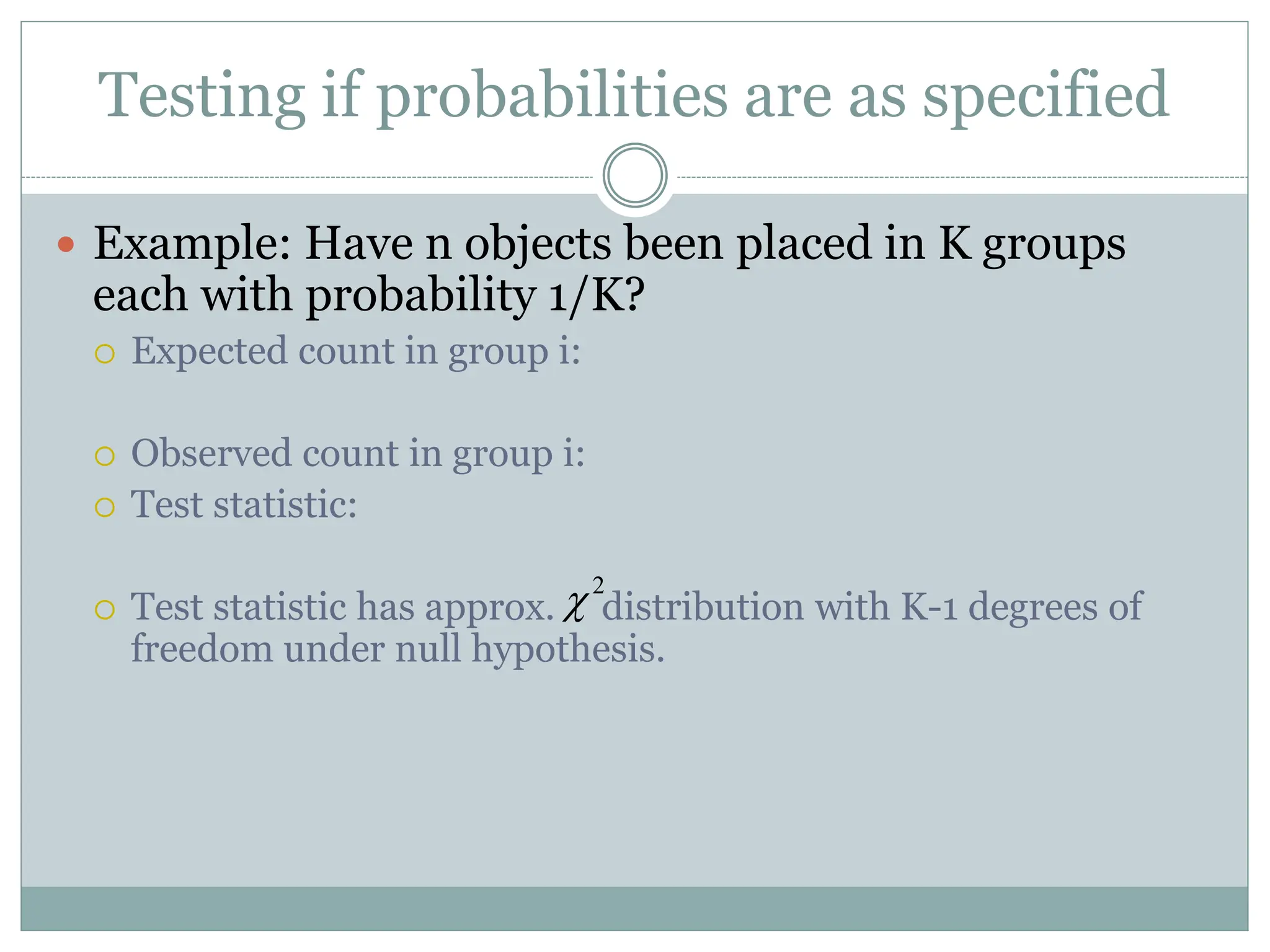
Testing if probabilitiesare as specified
Example: Have n objects been placed in K groups
each with probability 1/K?
Expected count in group i:
Observed count in group i:
Test statistic:
Test statistic has approx. distribution with K-1 degrees of
freedom under null hypothesis.
2
17.
Testing association ina
contingency table
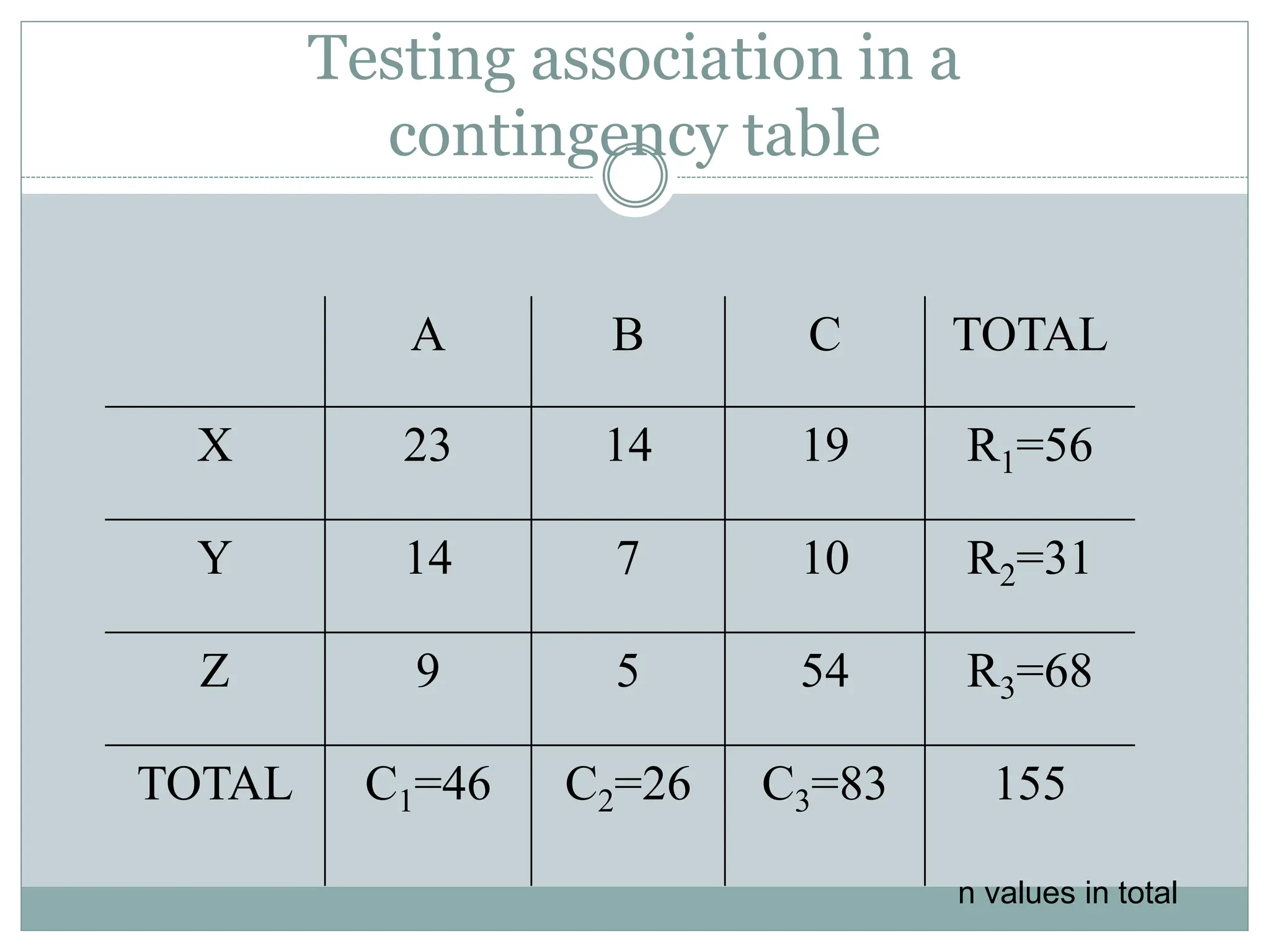
A B C TOTAL
X 23 14 19 R1=56
Y 14 7 10 R2=31
Z 9 5 54 R3=68
TOTAL C1=46 C2=26 C3=83 155
n values in total
18.
Testing association ina
contingency table
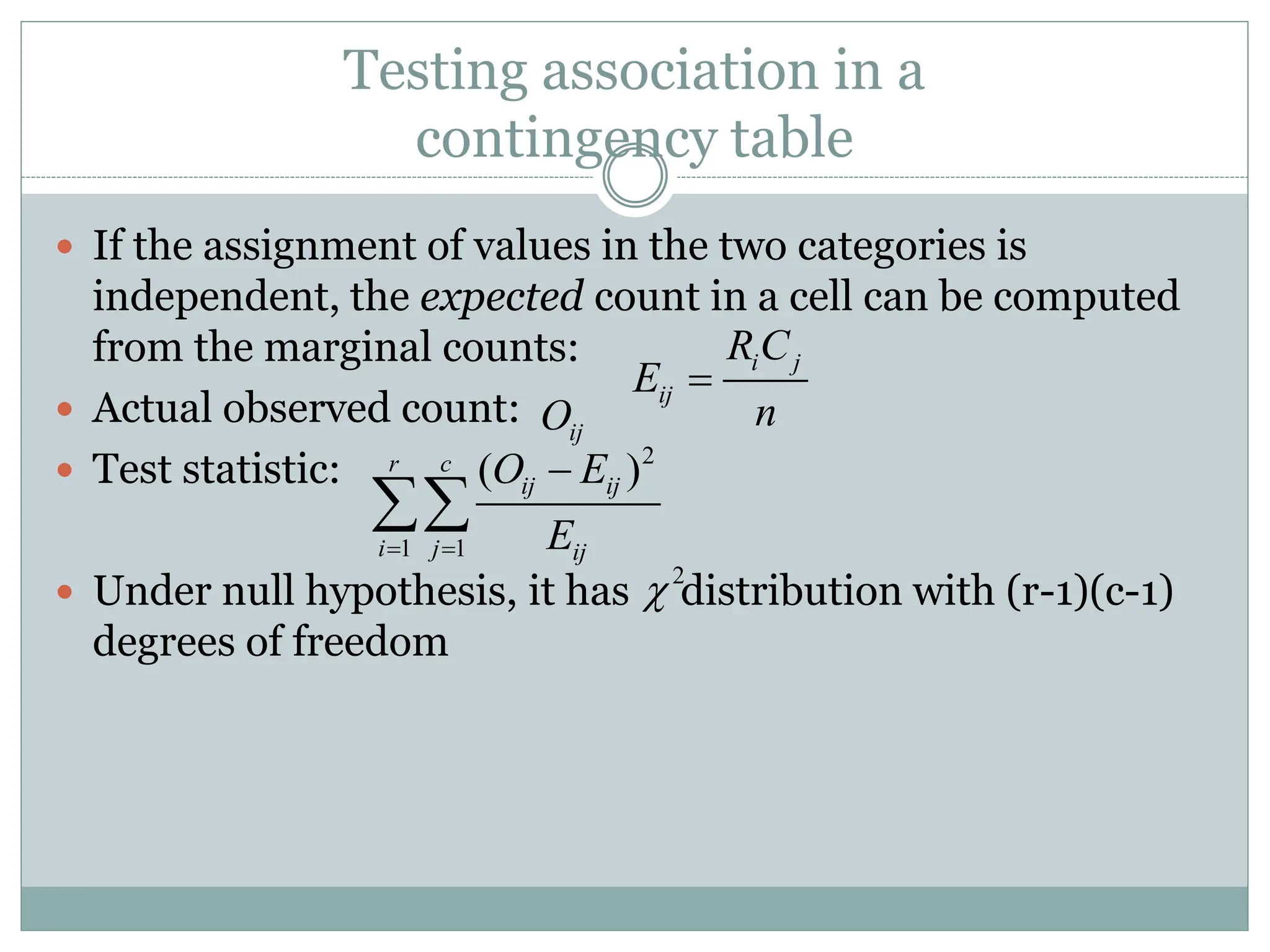
If the assignment of values in the two categories is
independent, the expected count in a cell can be computed
from the marginal counts:
Actual observed count:
Test statistic:
Under null hypothesis, it has distribution with (r-1)(c-1)
degrees of freedom
i j
ij
RC
E
n
ij
O
2
1 1
( )
r c
ij ij
i j ij
O E
E
2
19.
Goodness-of-fit tests
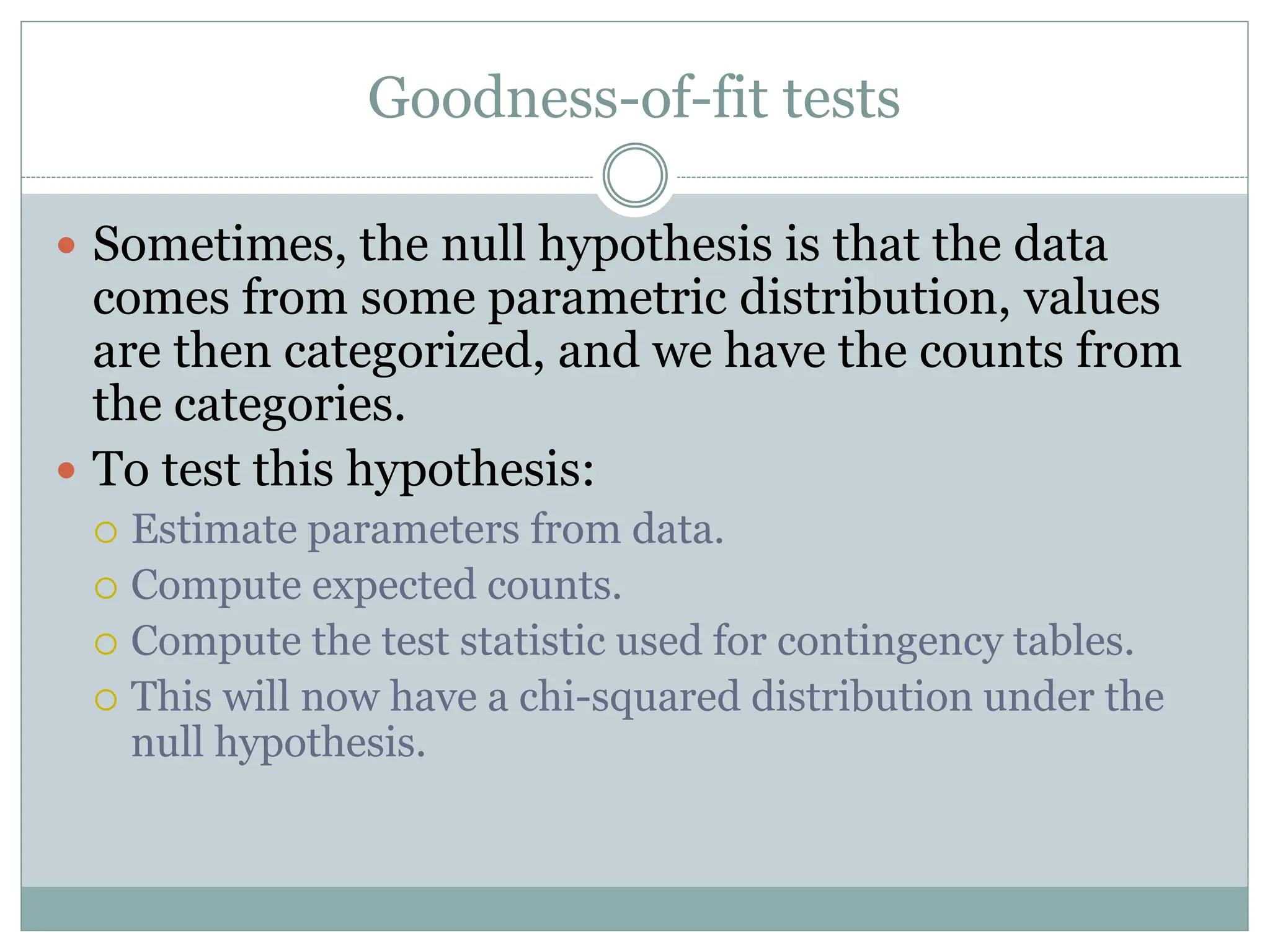
Sometimes,the null hypothesis is that the data
comes from some parametric distribution, values
are then categorized, and we have the counts from
the categories.
To test this hypothesis:
Estimate parameters from data.
Compute expected counts.
Compute the test statistic used for contingency tables.
This will now have a chi-squared distribution under the
null hypothesis.
20.
Tests for normality
Visual methods, like histograms and normality plots,
are very useful.
In addition, several statistical tests for normality
exist:
Kolmogorov-Smirnov test (can test against other distributions
too)
Bowman-Shelton test (tests skewness and kurtosis)
21.
Remarks on
nonparametric statistics
Tests with much more general null hypotheses, and
so fewer assumptions
Often a good choice when normality of the data
cannot be assumed
If you reject the null hypothesis with a
nonparametric test, it is a robust conclusion
However, with small amounts of data, you can often
not get significant conclusions
22.
Mann-Whitney U test
This is the nonparametric equivalent of the unpaired
t-test
It is applied when there are two independent samples
randomly drawn from the population e.g. diabetic patients
versus non-diabetics .
THe data has to be ordinal i.e. data that can be ranked (put
into order from highest to lowest )
It is recommended that the data should be >5 and <20 (for
larger samples, use formula or statistical packages)
The sample size in both population should be equal
23.
Uses of Mann-WhitneyU test
Mainly used to analyse the difference between the
medians of two data sets.
You want to know whether two sets of
measurements genuinely differ.
24.
Calculation of Mann-WhitneyU test
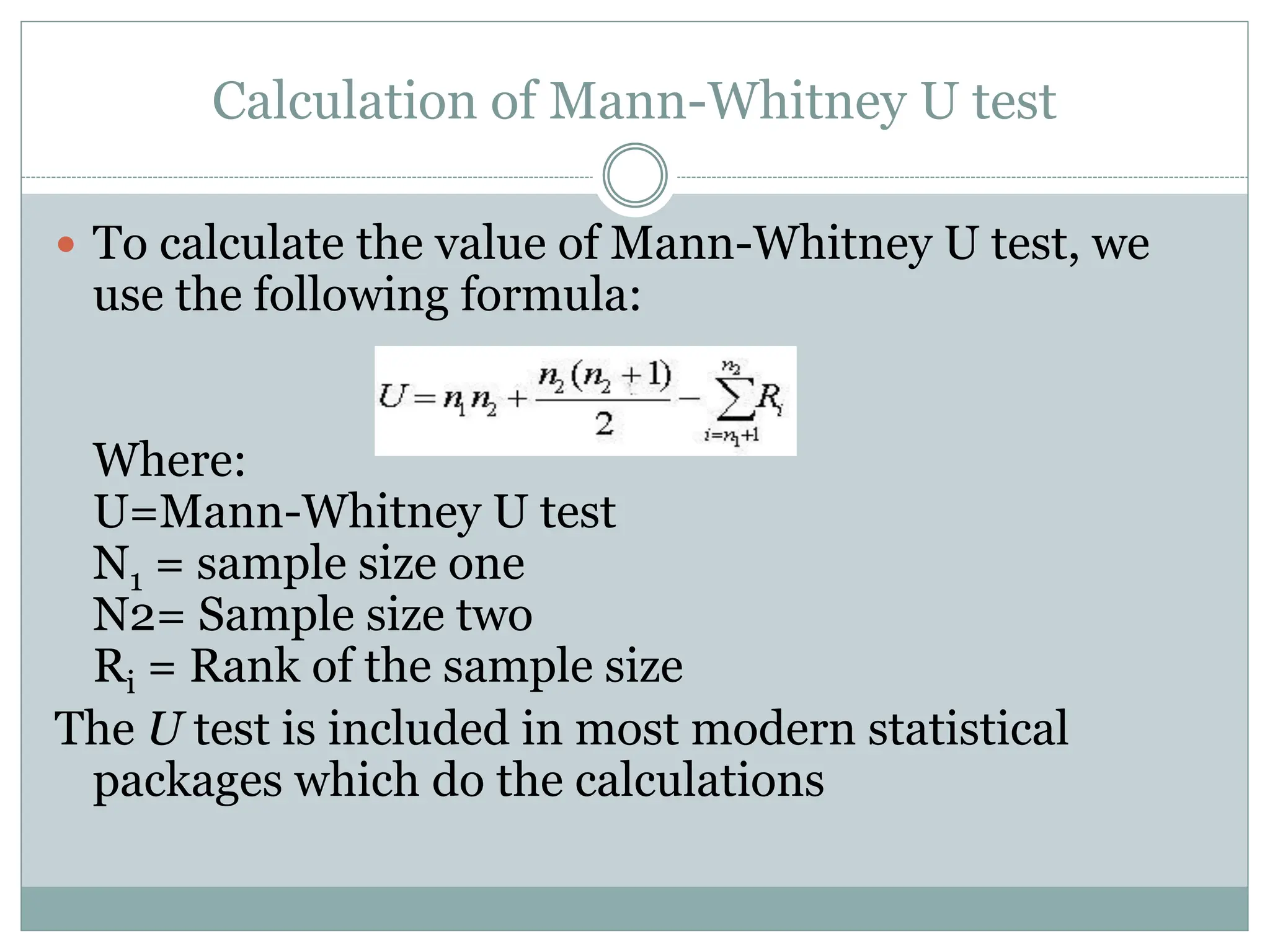
To calculate the value of Mann-Whitney U test, we
use the following formula:
Where:
U=Mann-Whitney U test
N1 = sample size one
N2= Sample size two
Ri = Rank of the sample size
The U test is included in most modern statistical
packages which do the calculations
25.
Mann-Whitney U test
MannWhitney U-test can be used to compare any two data
sets that are not normally distributed .
As long as the data is capable of being ranked, then the test
can be applied.
26.
Analysis of variance
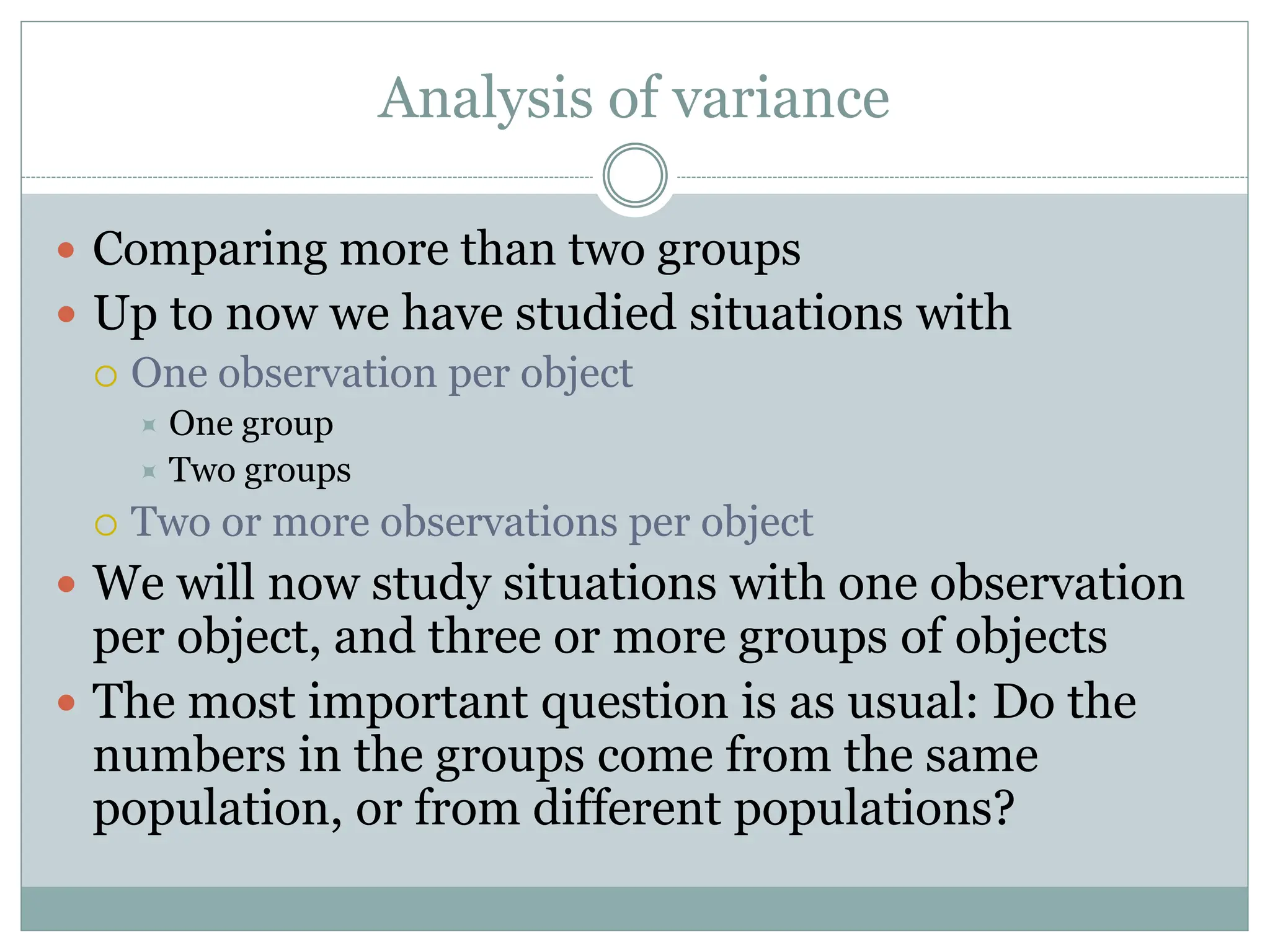
Comparing more than two groups
Up to now we have studied situations with
One observation per object
One group
Two groups
Two or more observations per object
We will now study situations with one observation
per object, and three or more groups of objects
The most important question is as usual: Do the
numbers in the groups come from the same
population, or from different populations?
27.
ANOVA
If youhave three groups, could plausibly do pairwise
comparisons. But if you have 10 groups? Too many
pairwise comparisons: You would get too many false
positives!
You would really like to compare a null hypothesis of
all equal, against some difference
ANOVA: ANalysis Of VAriance
28.
One-way ANOVA: Example
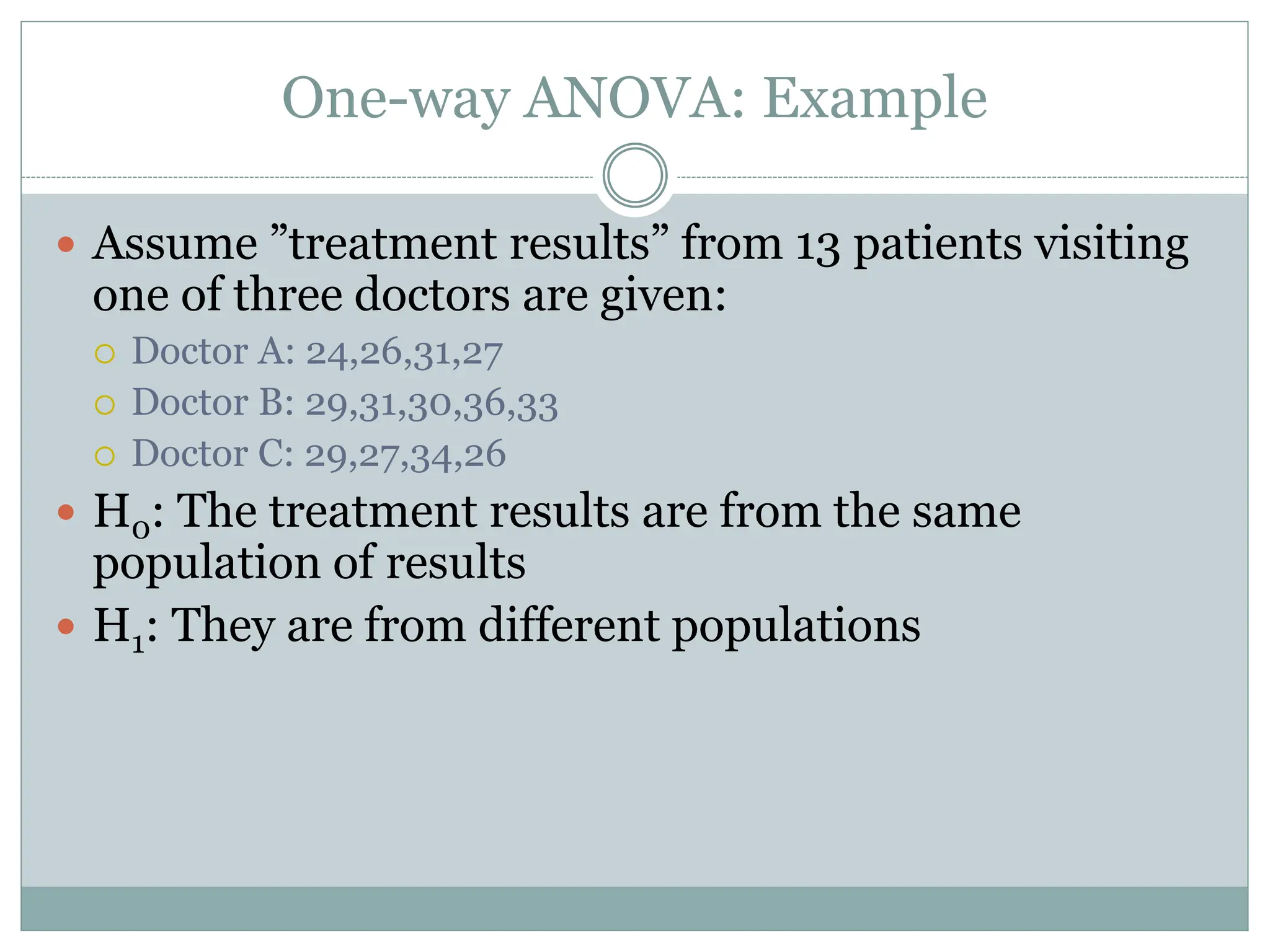
Assume ”treatment results” from 13 patients visiting
one of three doctors are given:
Doctor A: 24,26,31,27
Doctor B: 29,31,30,36,33
Doctor C: 29,27,34,26
H0: The treatment results are from the same
population of results
H1: They are from different populations
29.
Comparing the groups
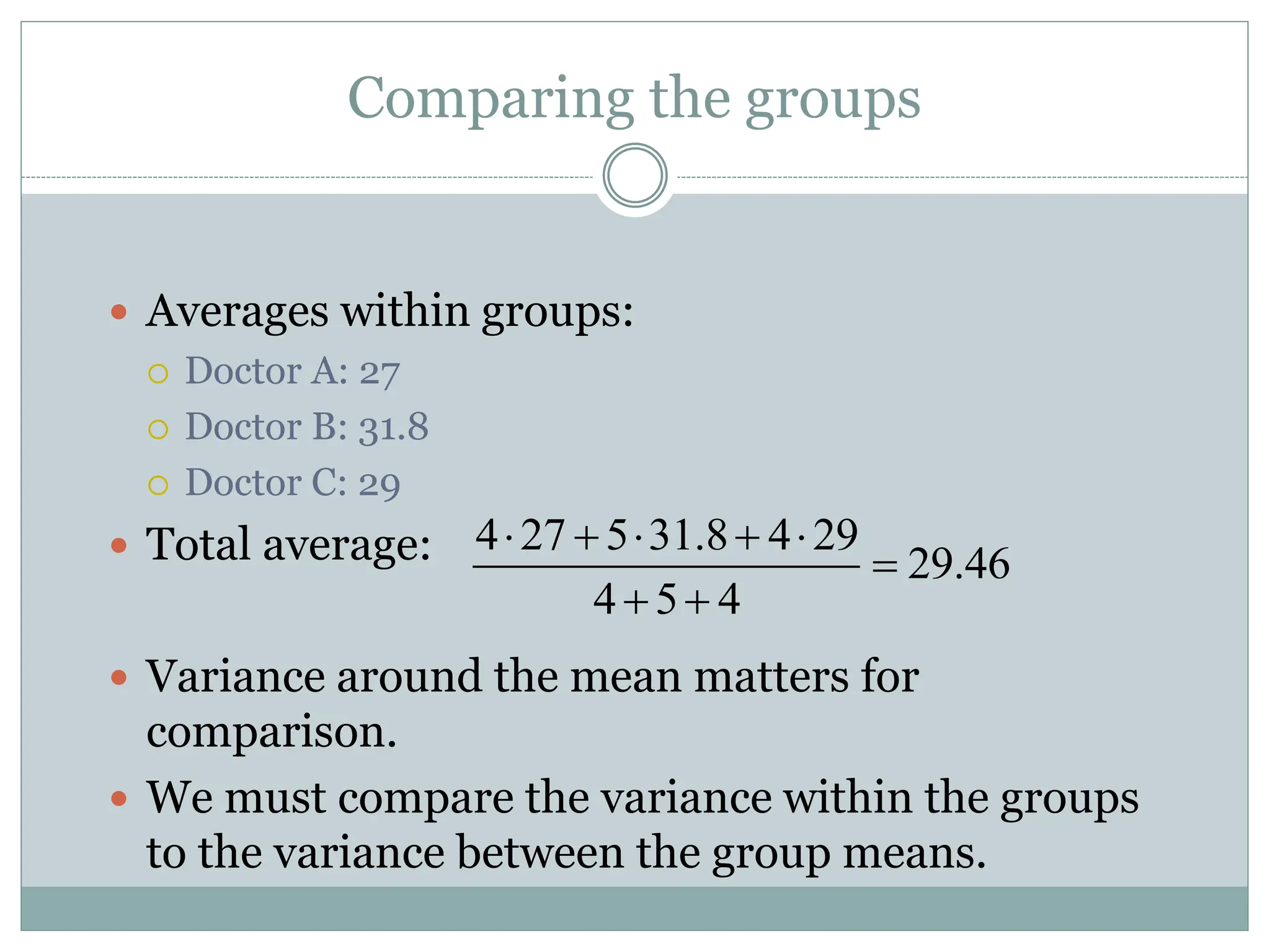
Averages within groups:
Doctor A: 27
Doctor B: 31.8
Doctor C: 29
Total average:
Variance around the mean matters for
comparison.
We must compare the variance within the groups
to the variance between the group means.
4 27 5 31.8 4 29
29.46
4 5 4
30.
Variance within andbetween groups
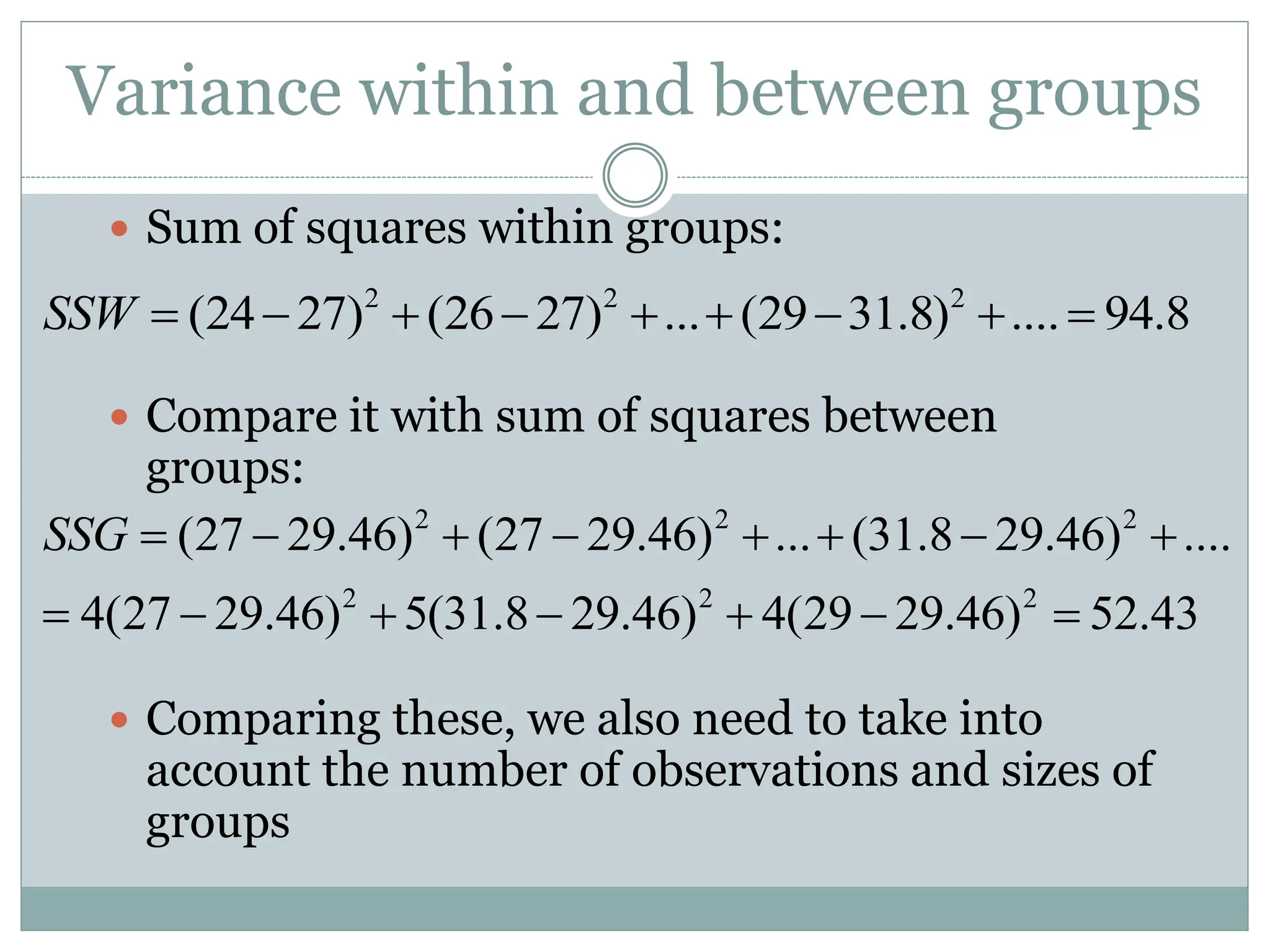
Sum of squares within groups:
Compare it with sum of squares between
groups:
Comparing these, we also need to take into
account the number of observations and sizes of
groups
2 2 2
(24 27) (26 27) ... (29 31.8) .... 94.8
SSW
2 2 2
2 2 2
(27 29.46) (27 29.46) ... (31.8 29.46) ....
4(27 29.46) 5(31.8 29.46) 4(29 29.46) 52.43
SSG
31.
Adjusting for groupsizes
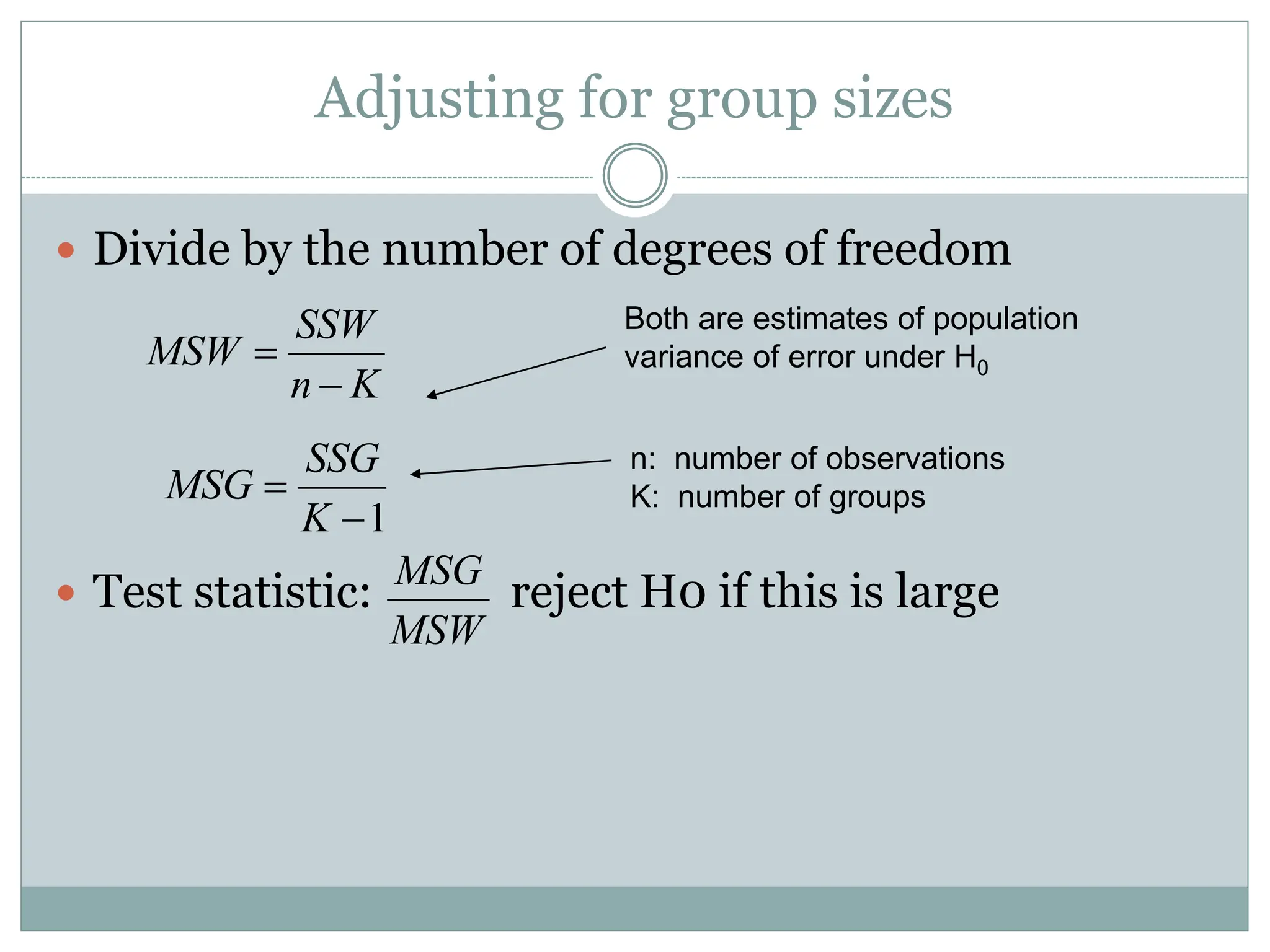
Divide by the number of degrees of freedom
Test statistic: reject H0 if this is large
SSW
MSW
n K
1
SSG
MSG
K
MSG
MSW
Both are estimates of population
variance of error under H0
n: number of observations
K: number of groups
32.
Test statistic thresholds
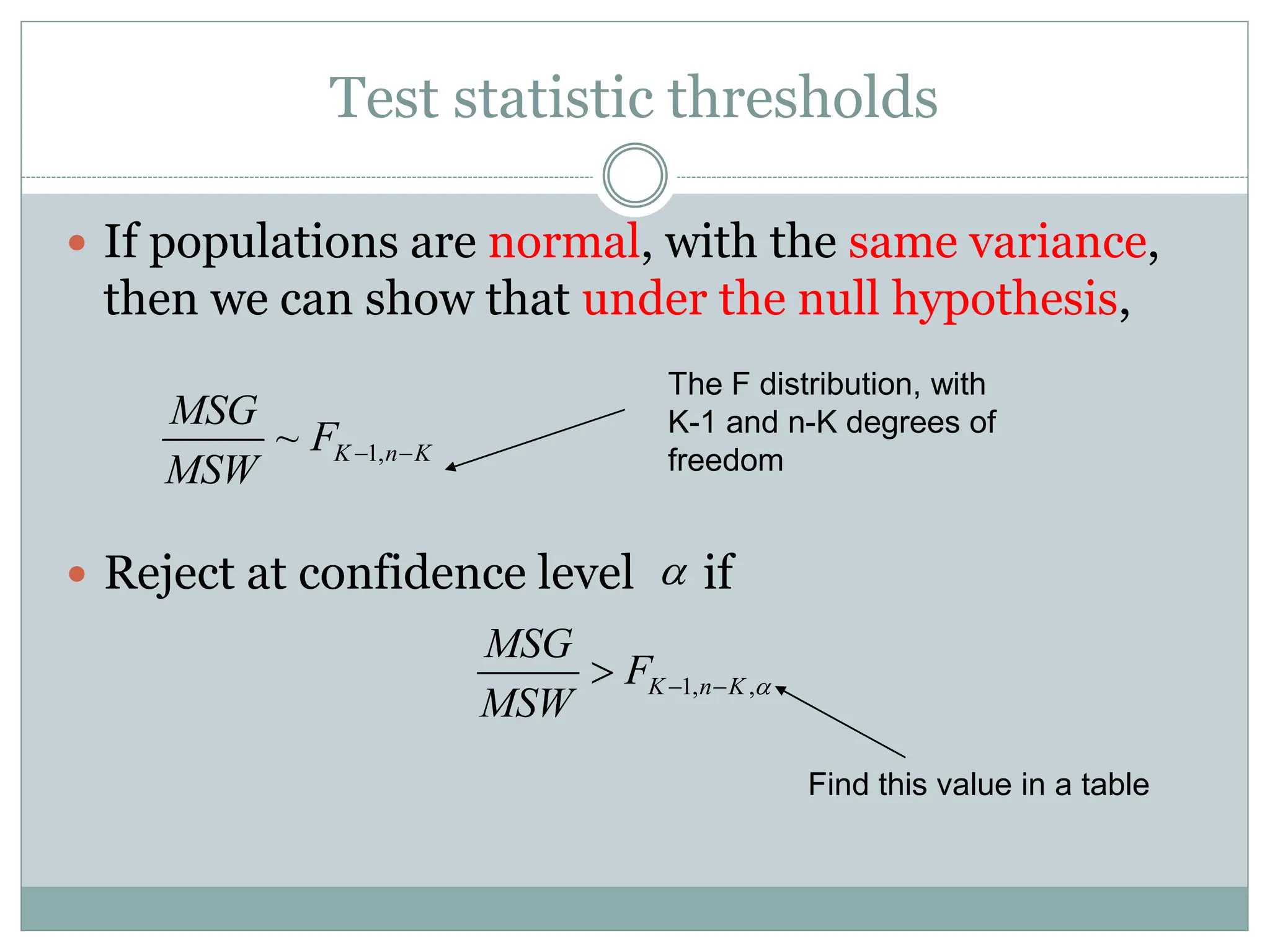
If populations are normal, with the same variance,
then we can show that under the null hypothesis,
Reject at confidence level if
1,
~ K n K
MSG
F
MSW
1, ,
K n K
MSG
F
MSW
The F distribution, with
K-1 and n-K degrees of
freedom
Find this value in a table
33.
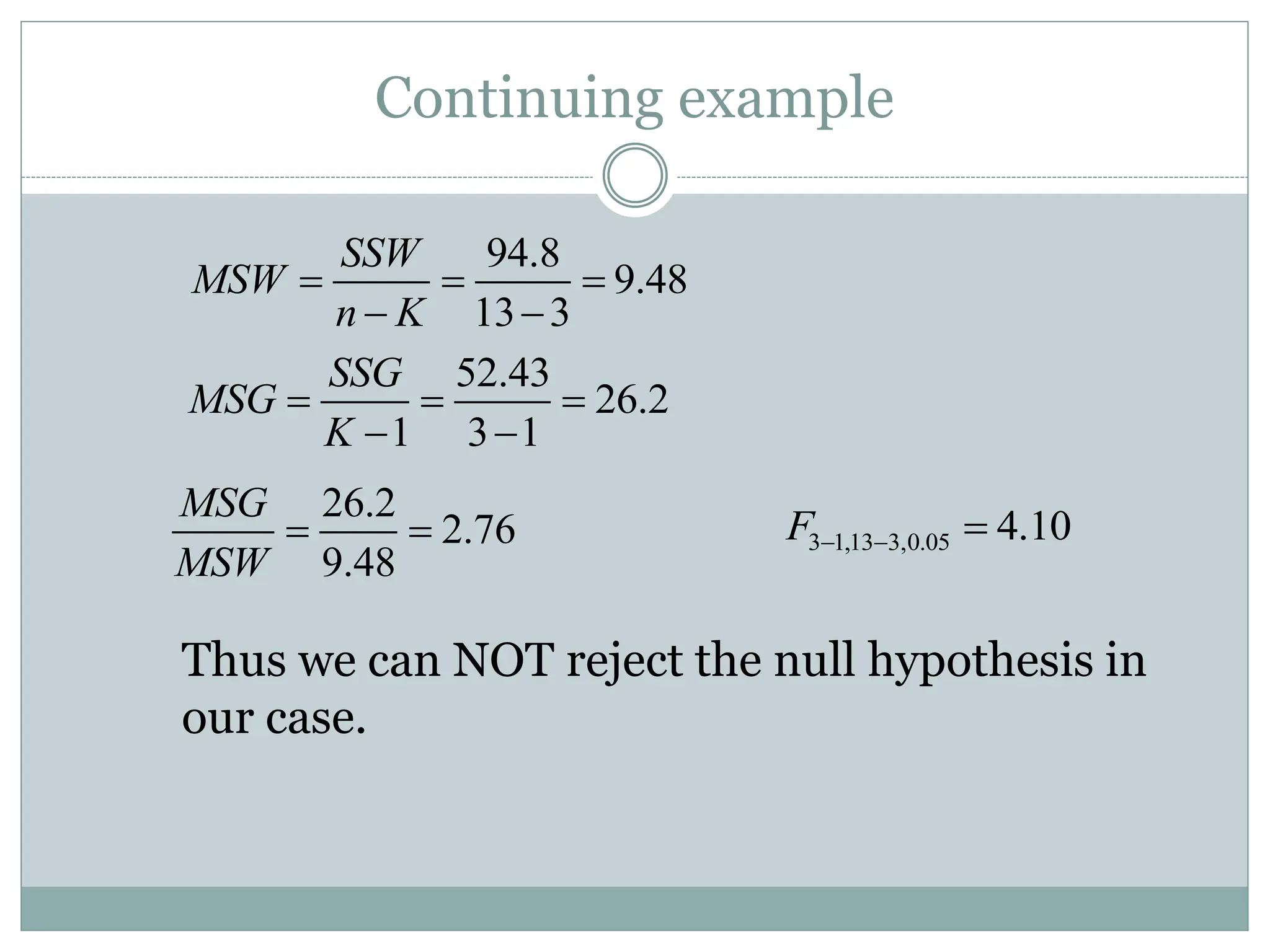
Continuing example
Thus wecan NOT reject the null hypothesis in
our case.
94.8
9.48
13 3
SSW
MSW
n K
52.43
26.2
1 3 1
SSG
MSG
K
26.2
2.76
9.48
MSG
MSW
3 1,13 3,0.05 4.10
F
34.
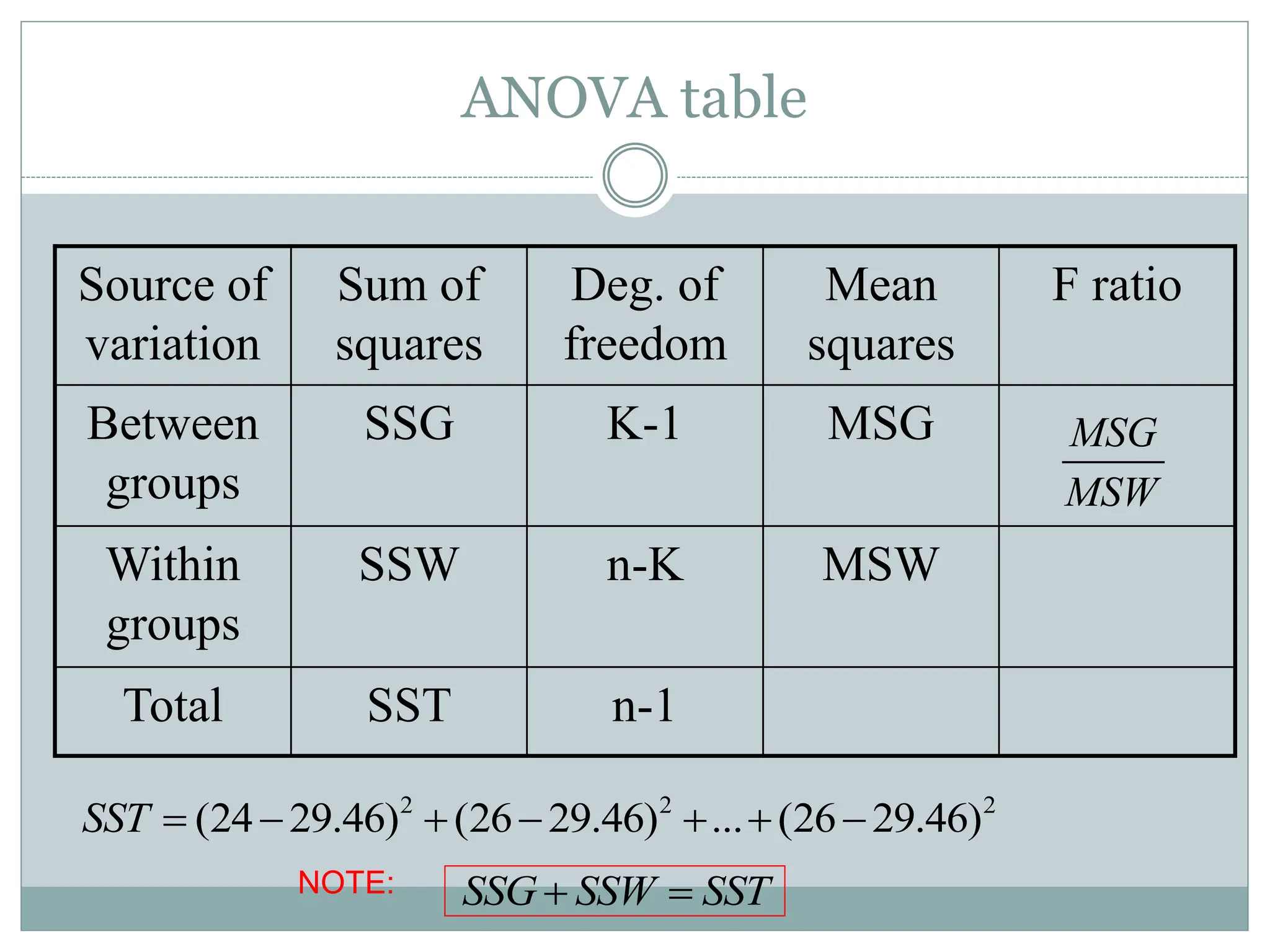
ANOVA table
Source of
variation
Sumof
squares
Deg. of
freedom
Mean
squares
F ratio
Between
groups
SSG K-1 MSG
Within
groups
SSW n-K MSW
Total SST n-1
MSG
MSW
2 2 2
(24 29.46) (26 29.46) ... (26 29.46)
SST
SSG SSW SST
NOTE:
35.
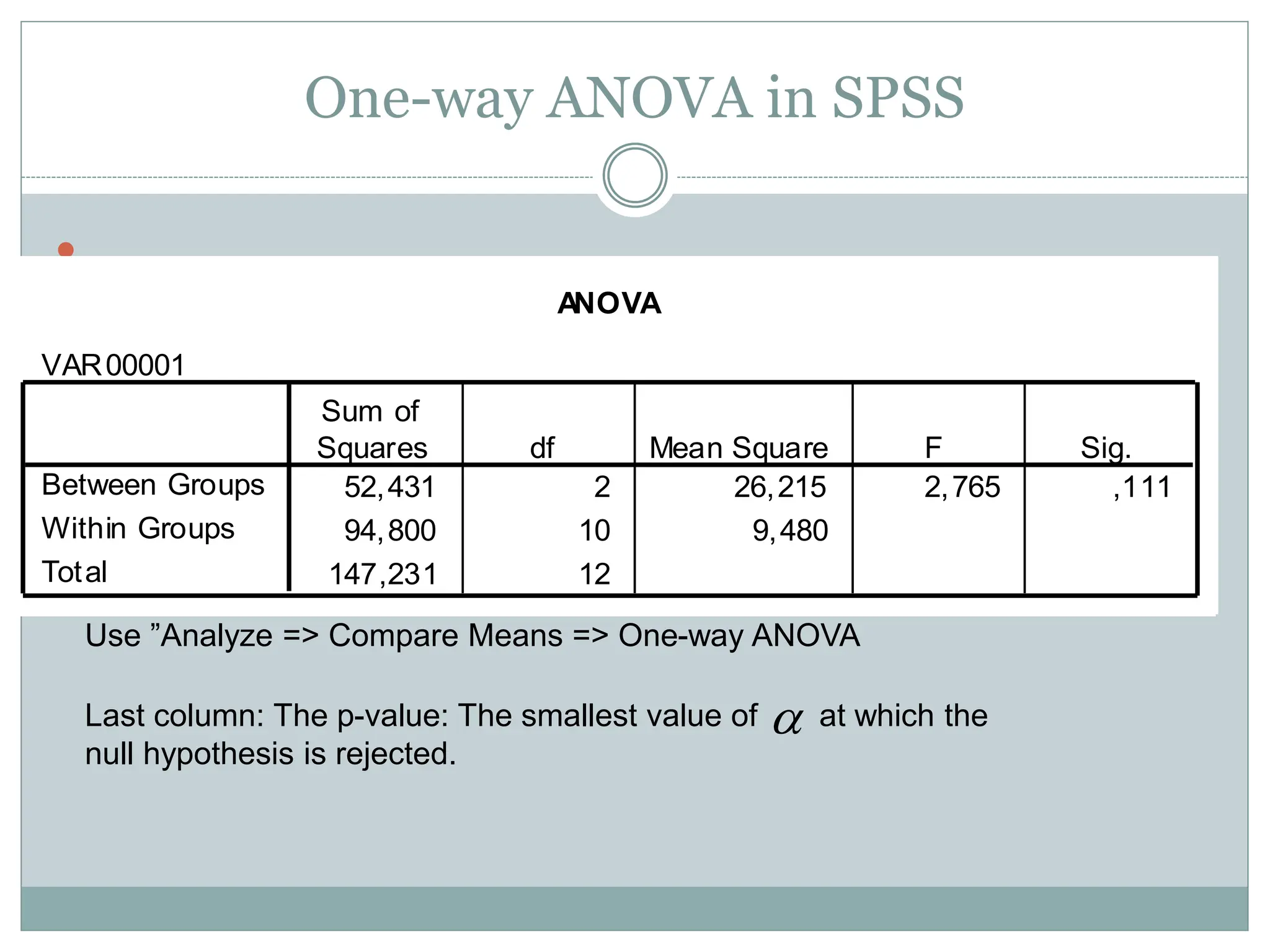
One-way ANOVA inSPSS
ANOVA
VAR00001
52,431 2 26,215 2,765 ,111
94,800 10 9,480
147,231 12
Between Groups
Within Groups
Total
Sum of
Squares df Mean Square F Sig.
Use ”Analyze => Compare Means => One-way ANOVA
Last column: The p-value: The smallest value of at which the
null hypothesis is rejected.
36.
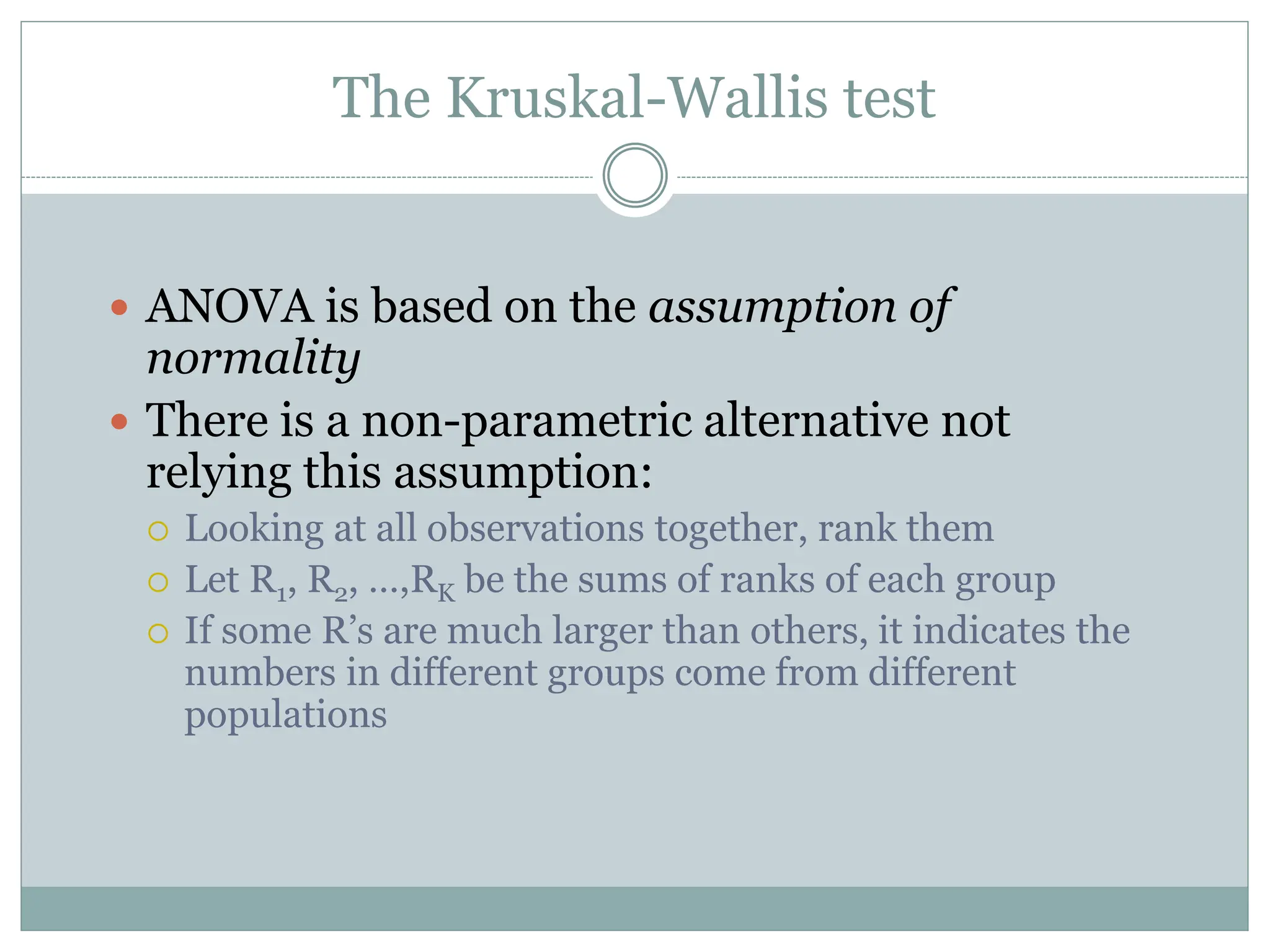
The Kruskal-Wallis test
ANOVA is based on the assumption of
normality
There is a non-parametric alternative not
relying this assumption:
Looking at all observations together, rank them
Let R1, R2, …,RK be the sums of ranks of each group
If some R’s are much larger than others, it indicates the
numbers in different groups come from different
populations
37.
The Kruskal-Wallis test
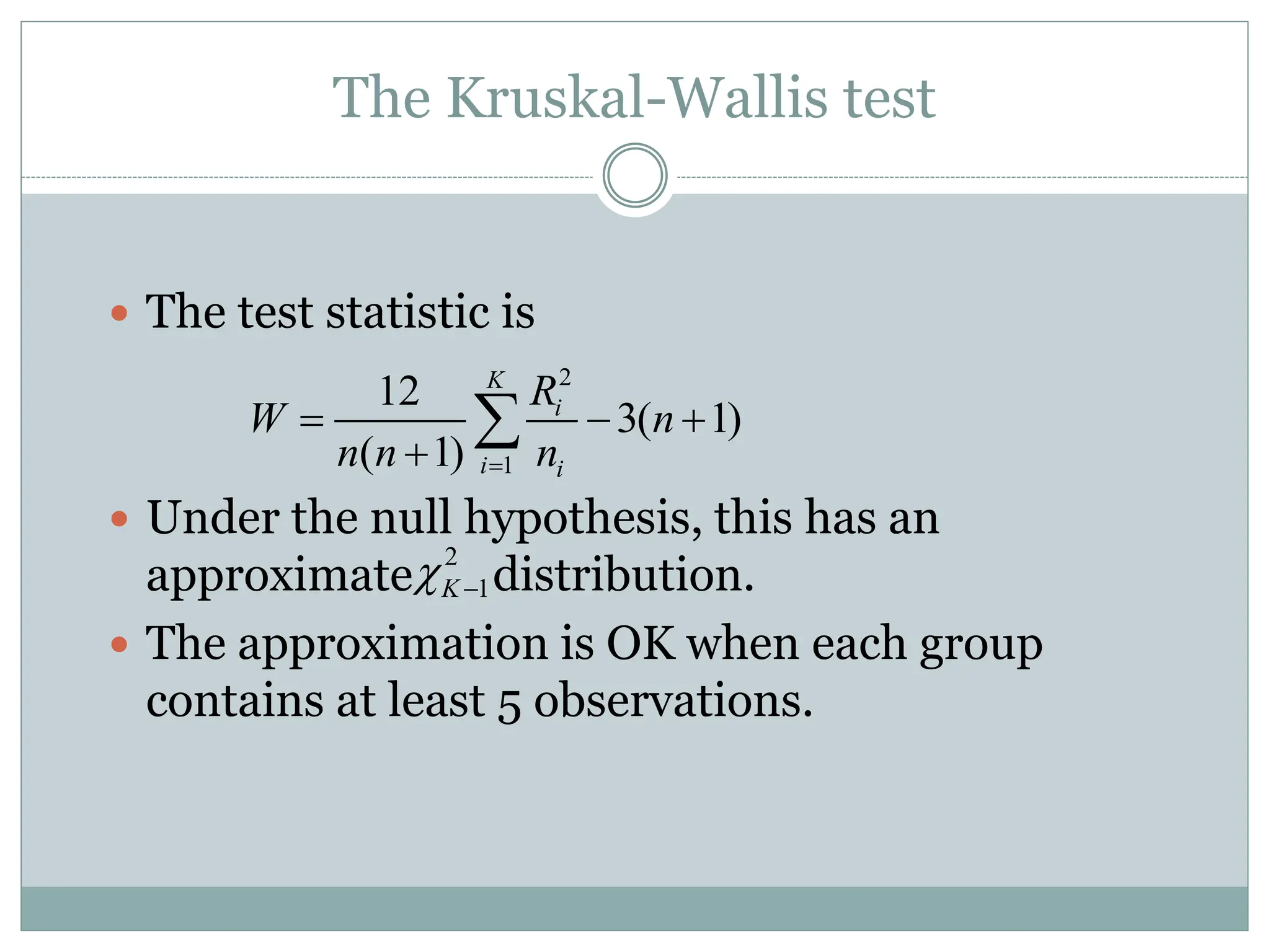
The test statistic is
Under the null hypothesis, this has an
approximate distribution.
The approximation is OK when each group
contains at least 5 observations.
2
1
K
2
1
12
3( 1)
( 1)
K
i
i i
R
W n
n n n
38.
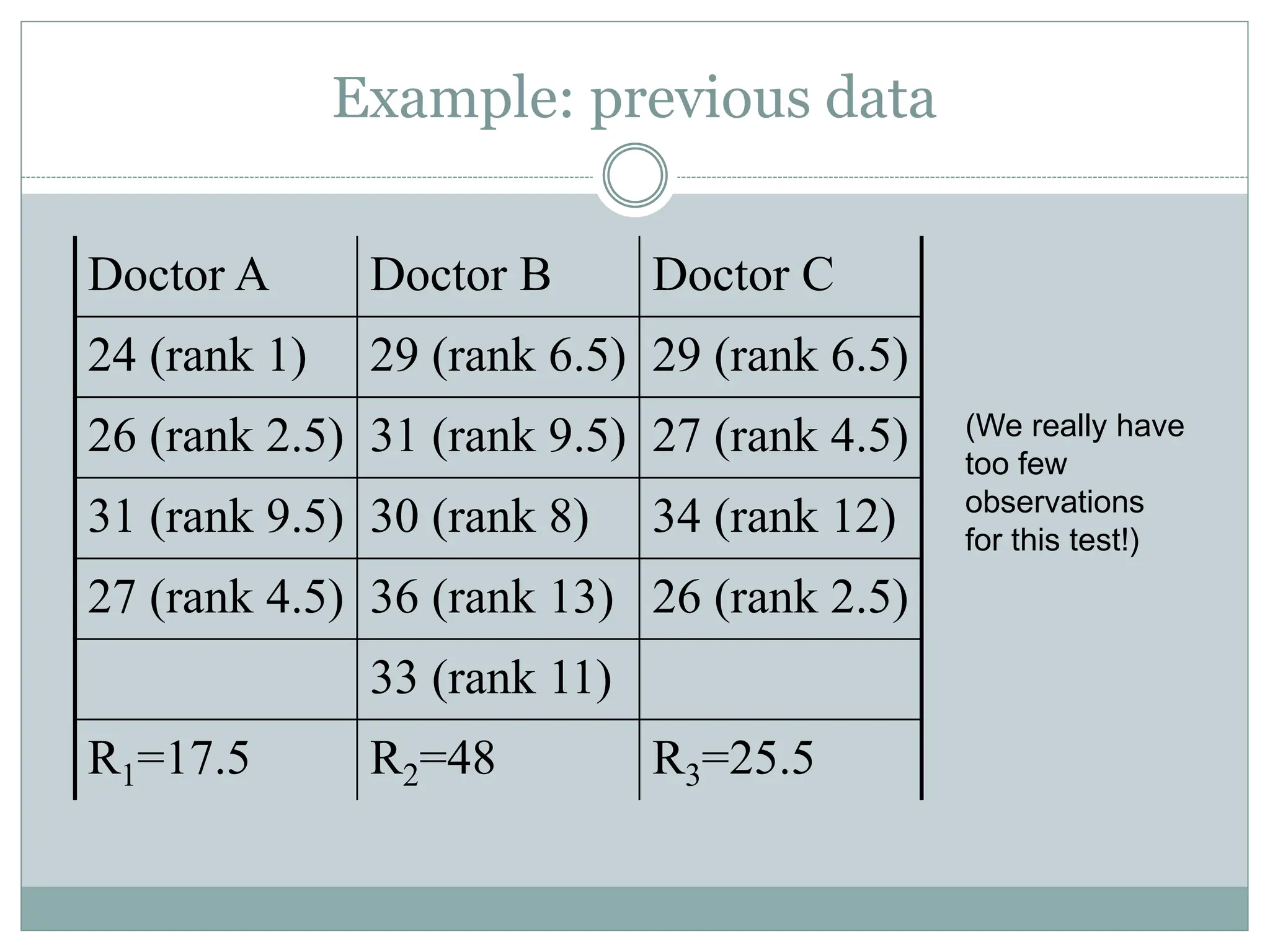
Example: previous data
DoctorA Doctor B Doctor C
24 (rank 1) 29 (rank 6.5) 29 (rank 6.5)
26 (rank 2.5) 31 (rank 9.5) 27 (rank 4.5)
31 (rank 9.5) 30 (rank 8) 34 (rank 12)
27 (rank 4.5) 36 (rank 13) 26 (rank 2.5)
33 (rank 11)
R1=17.5 R2=48 R3=25.5
(We really have
too few
observations
for this test!)
39.
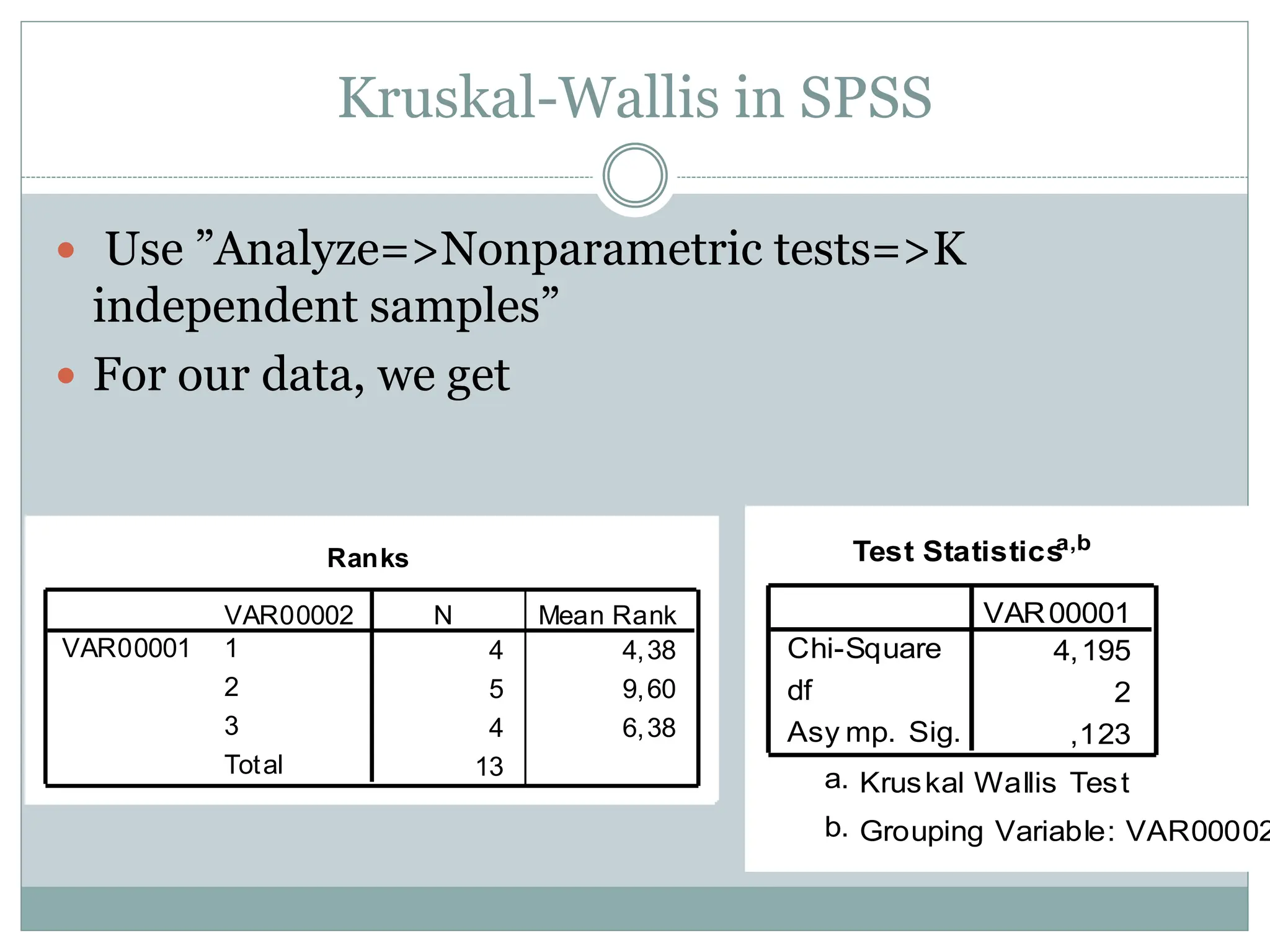
Kruskal-Wallis in SPSS
Use ”Analyze=>Nonparametric tests=>K
independent samples”
For our data, we get
Ranks
4 4,38
5 9,60
4 6,38
13
VAR00002
1
2
3
Total
VAR00001
N Mean Rank
Test Statistics
a,b
4,195
2
,123
Chi-Square
df
Asy mp. Sig.
VAR00001
Kruskal Wallis Test
a.
Grouping Variable: VAR00002
b.
40.
When to usewhat method
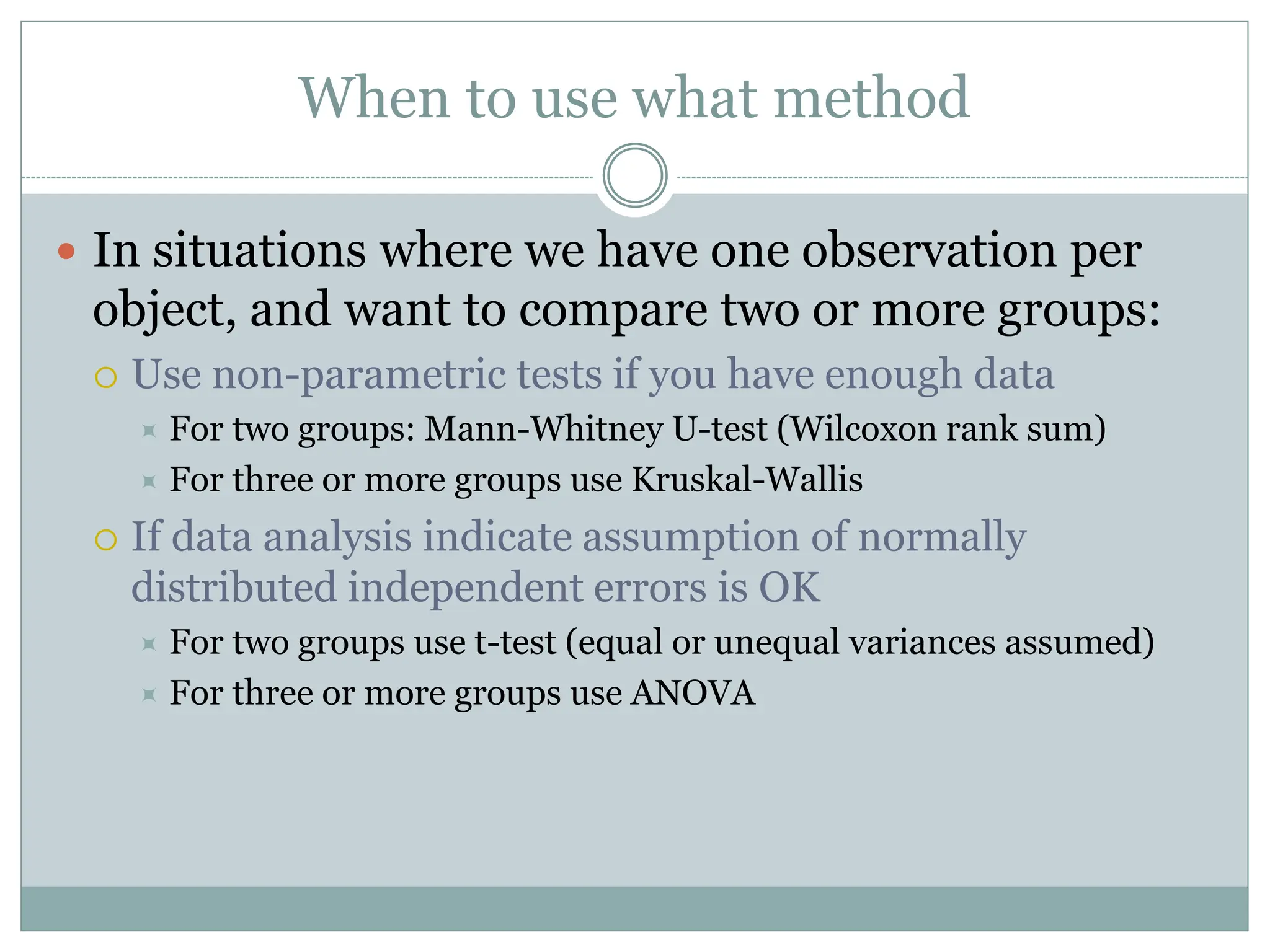
In situations where we have one observation per
object, and want to compare two or more groups:
Use non-parametric tests if you have enough data
For two groups: Mann-Whitney U-test (Wilcoxon rank sum)
For three or more groups use Kruskal-Wallis
If data analysis indicate assumption of normally
distributed independent errors is OK
For two groups use t-test (equal or unequal variances assumed)
For three or more groups use ANOVA
41.
When to usewhat method
When you in addition to the main observation have
some observations that can be used to pair or block
objects, and want to compare groups, and
assumption of normally distributed independent
errors is OK:
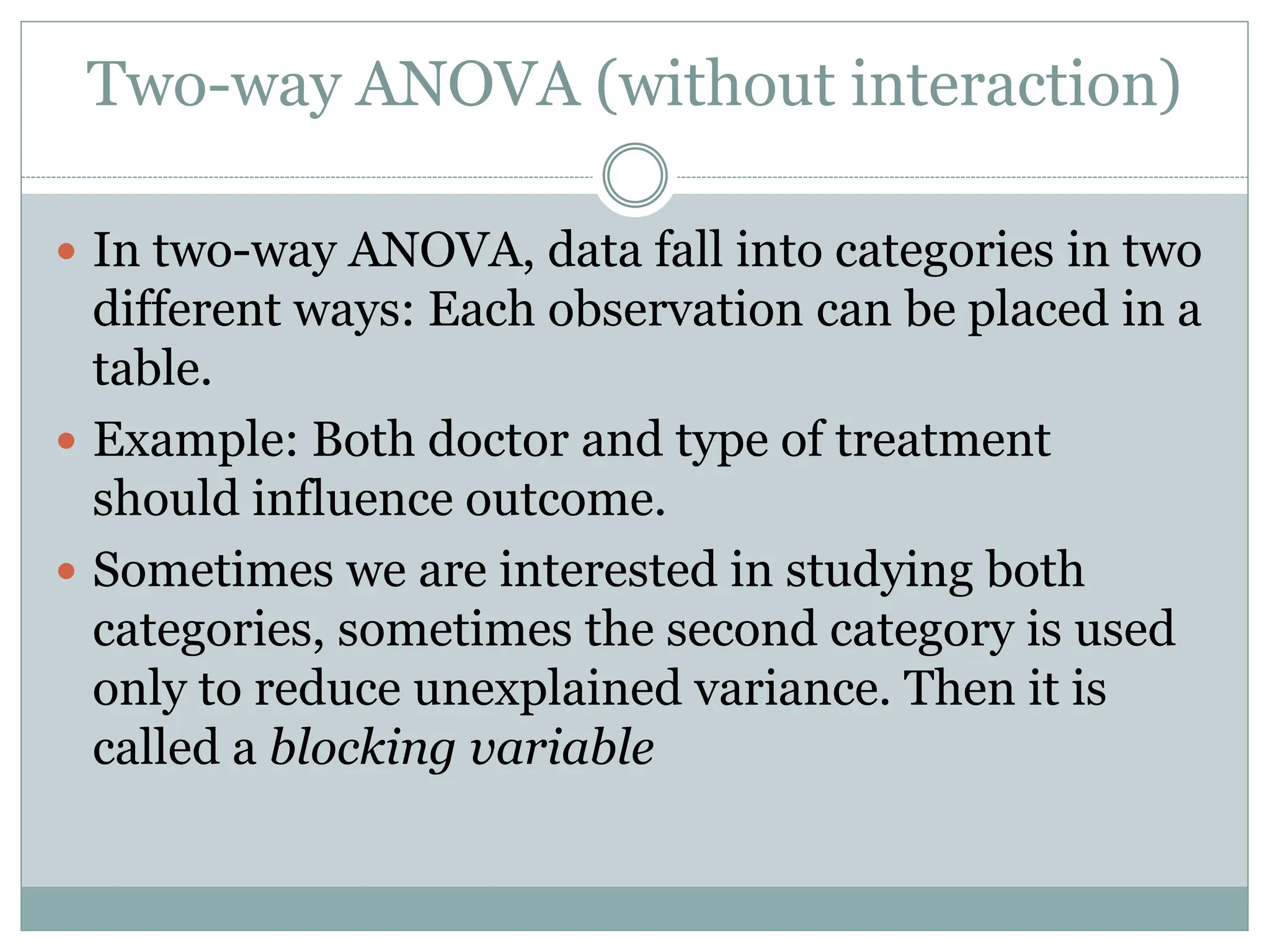
For two groups, use paired-data t-test
For three or more groups, we can use two-way ANOVA
42.
Two-way ANOVA (withoutinteraction)
In two-way ANOVA, data fall into categories in two
different ways: Each observation can be placed in a
table.
Example: Both doctor and type of treatment
should influence outcome.
Sometimes we are interested in studying both
categories, sometimes the second category is used
only to reduce unexplained variance. Then it is
called a blocking variable
43.
Sums of squaresfor two-way ANOVA
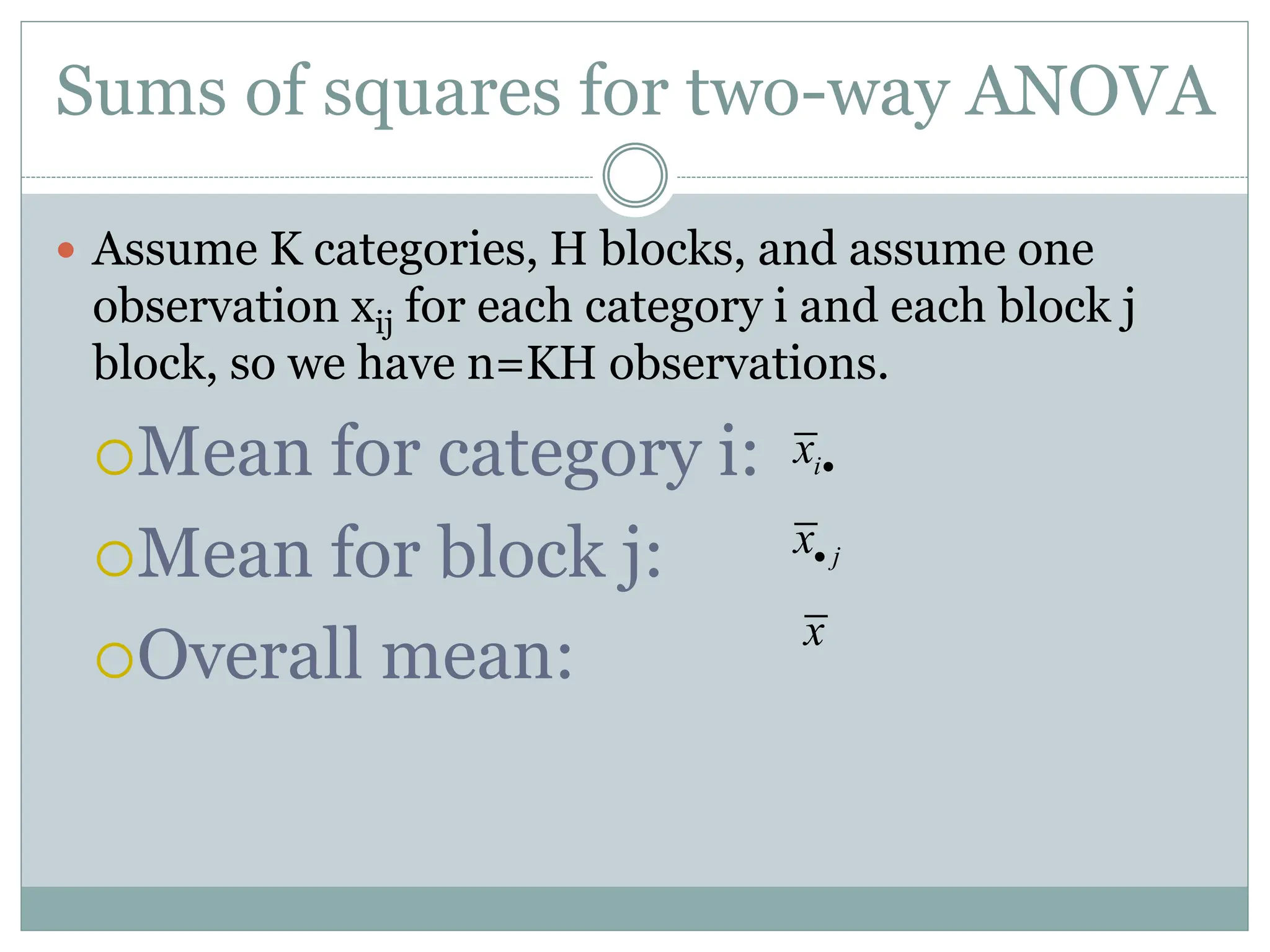
Assume K categories, H blocks, and assume one
observation xij for each category i and each block j
block, so we have n=KH observations.
Mean for category i:
Mean for block j:
Overall mean:
i
x
j
x
x
44.
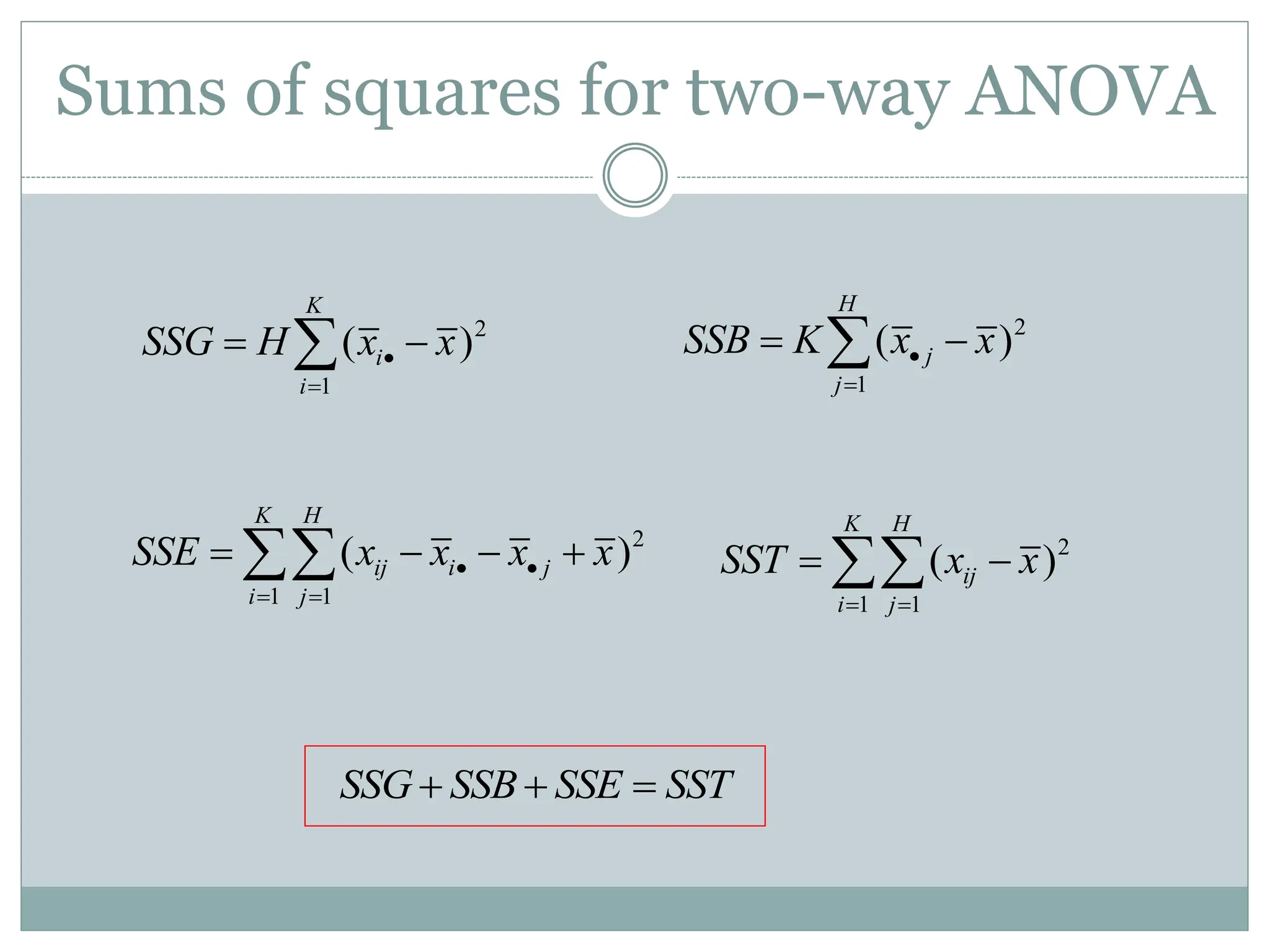
Sums of squaresfor two-way ANOVA
2
1
( )
K
i
i
SSG H x x
2
1
( )
H
j
j
SSB K x x
2
1 1
( )
K H
ij i j
i j
SSE x x x x
2
1 1
( )
K H
ij
i j
SST x x
SSG SSB SSE SST
45.
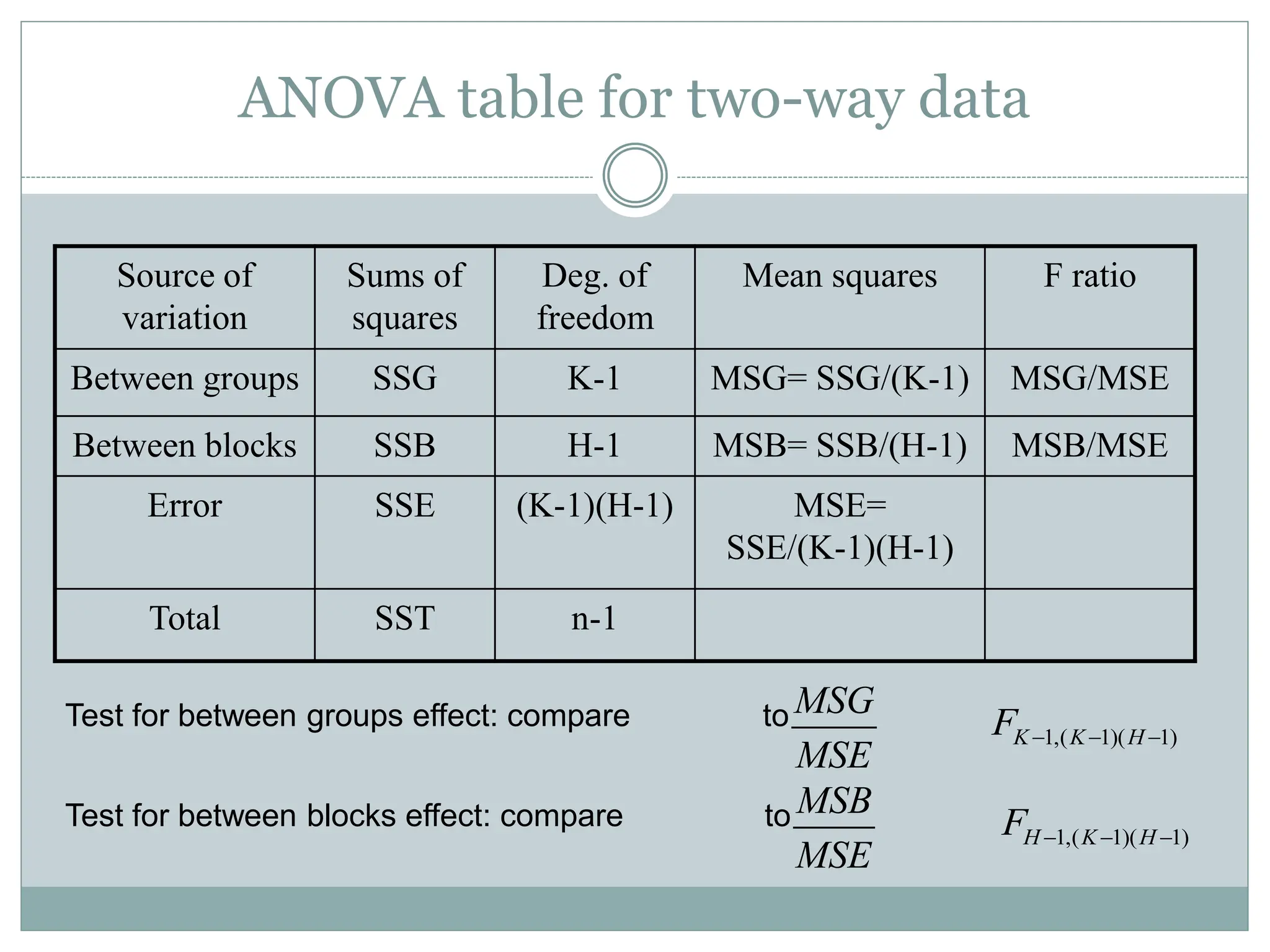
ANOVA table fortwo-way data
Source of
variation
Sums of
squares
Deg. of
freedom
Mean squares F ratio
Between groups SSG K-1 MSG= SSG/(K-1) MSG/MSE
Between blocks SSB H-1 MSB= SSB/(H-1) MSB/MSE
Error SSE (K-1)(H-1) MSE=
SSE/(K-1)(H-1)
Total SST n-1
Test for between groups effect: compare to
Test for between blocks effect: compare to
MSG
MSE
MSB
MSE
1,( 1)( 1)
K K H
F
1,( 1)( 1)
H K H
F
46.
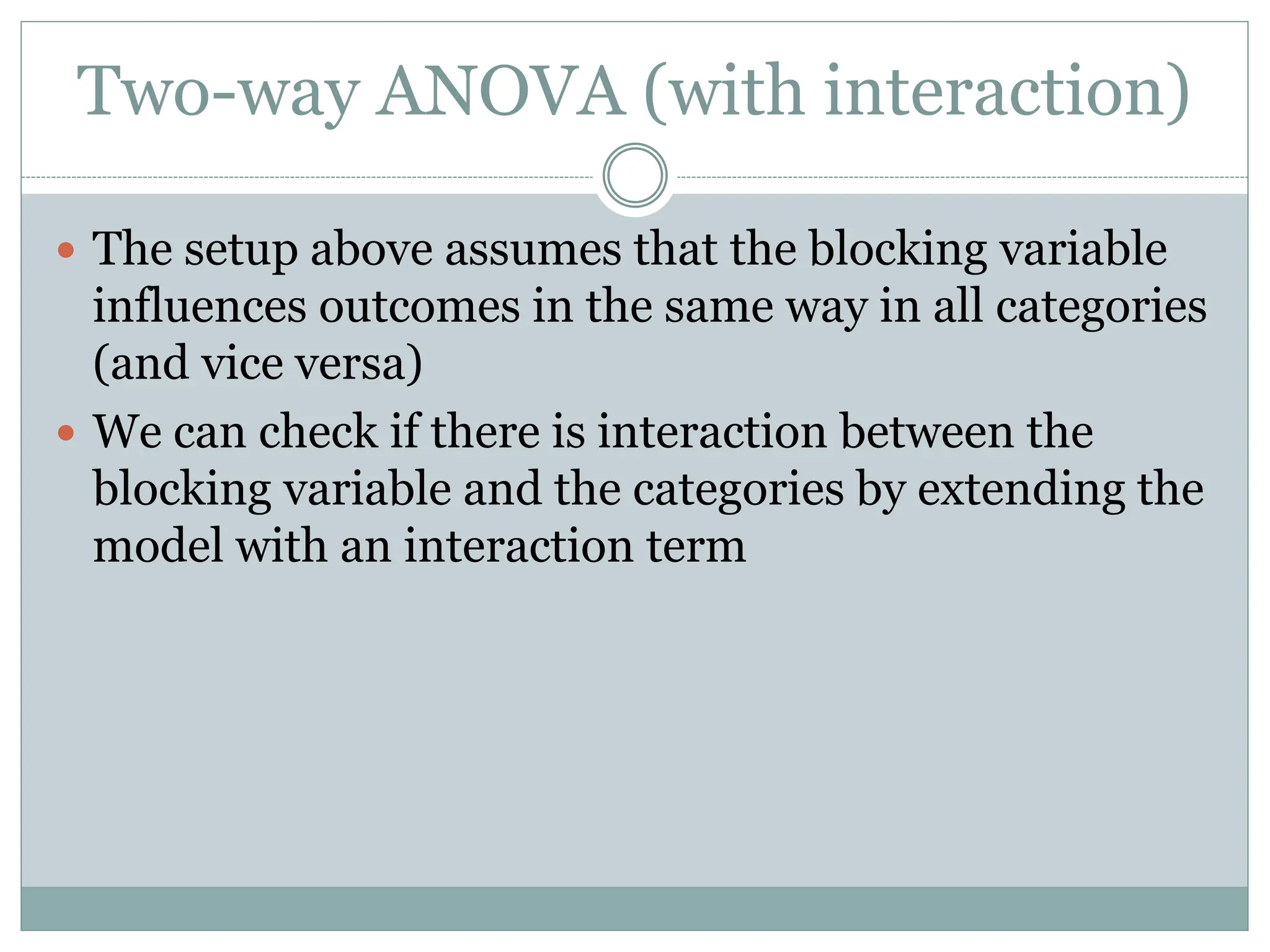
Two-way ANOVA (withinteraction)
The setup above assumes that the blocking variable
influences outcomes in the same way in all categories
(and vice versa)
We can check if there is interaction between the
blocking variable and the categories by extending the
model with an interaction term
47.
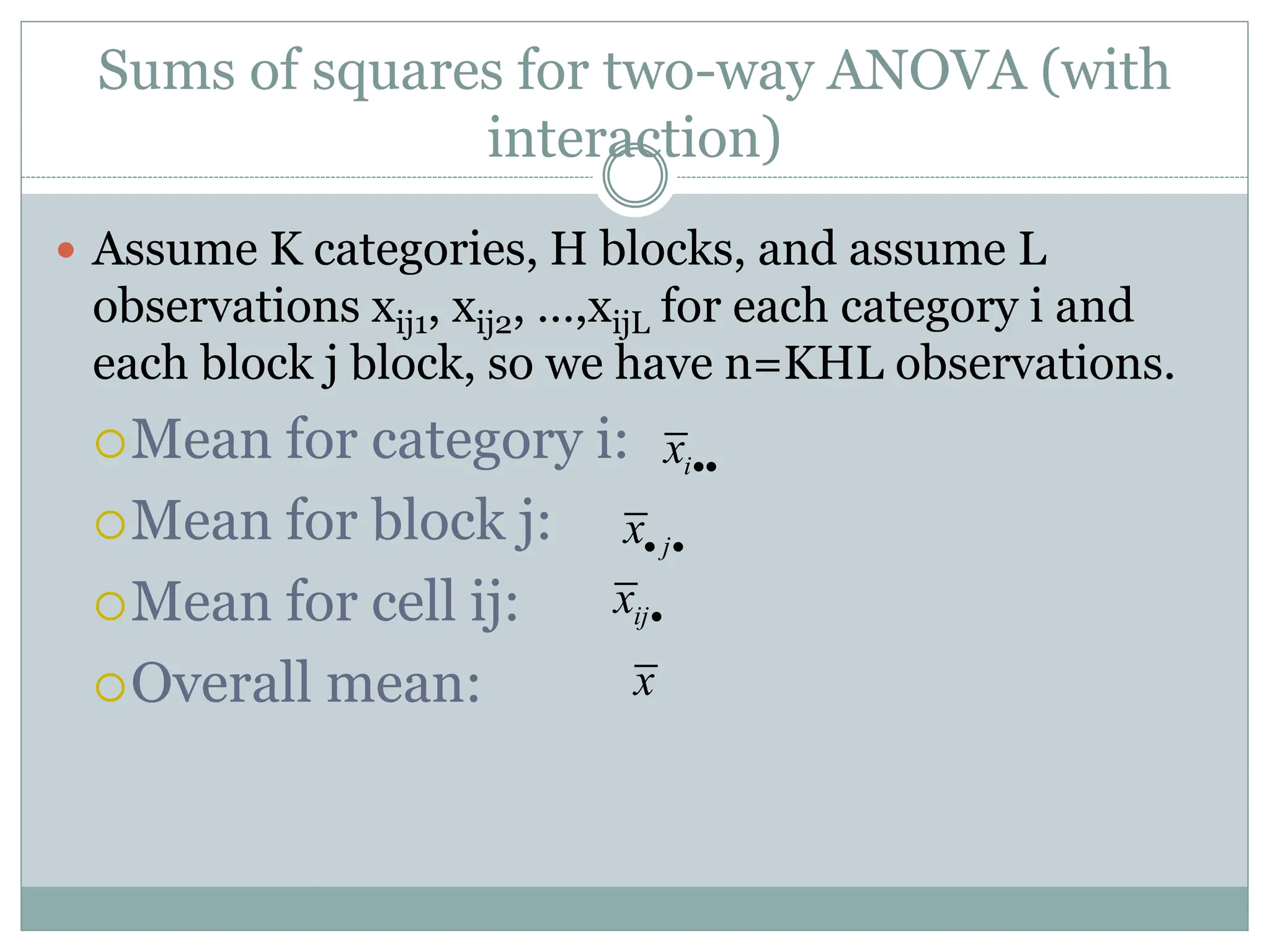
Sums of squaresfor two-way ANOVA (with
interaction)
Assume K categories, H blocks, and assume L
observations xij1, xij2, …,xijL for each category i and
each block j block, so we have n=KHL observations.
Mean for category i:
Mean for block j:
Mean for cell ij:
Overall mean:
i
x
j
x
x
ij
x
48.
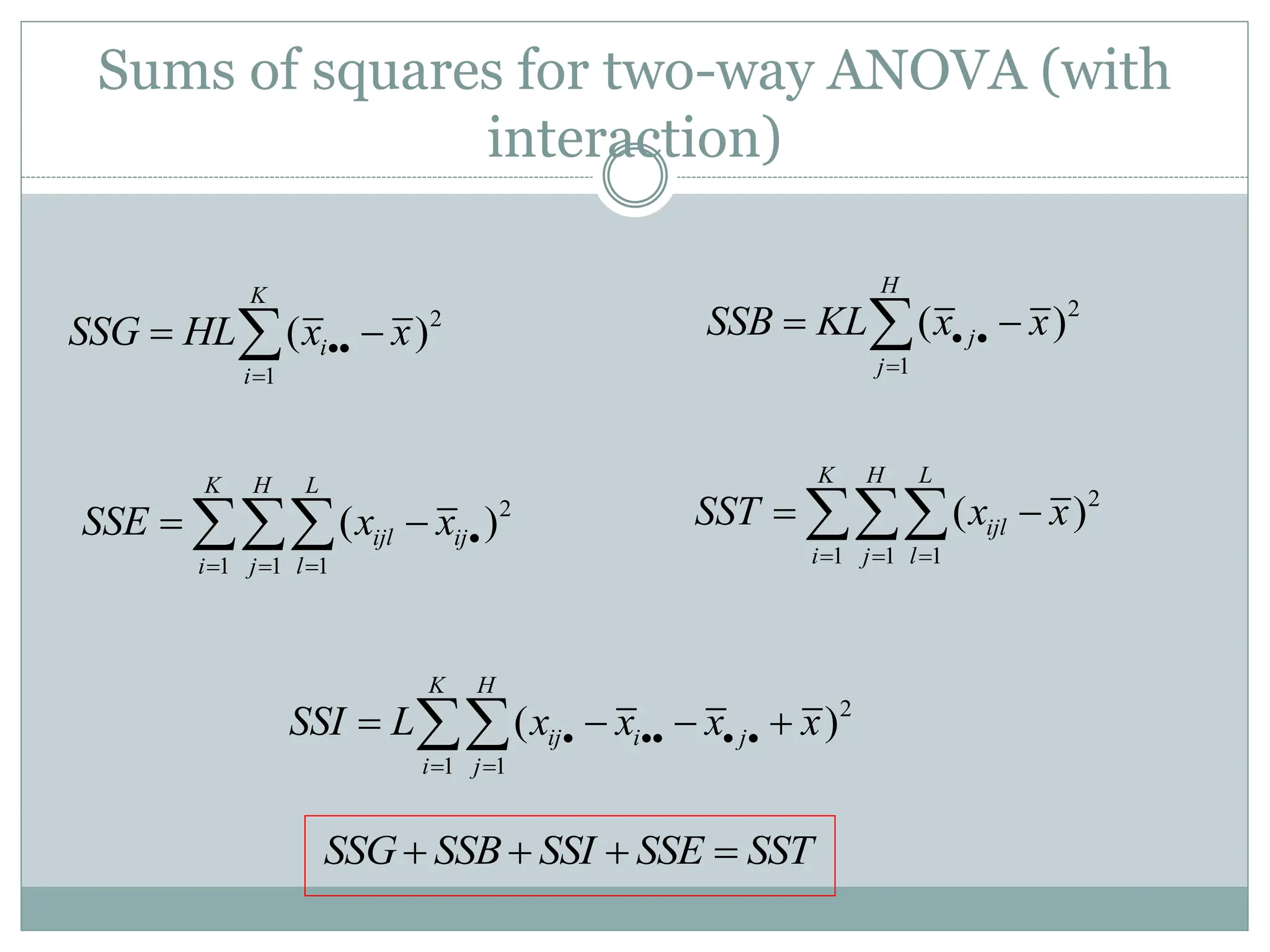
Sums of squaresfor two-way ANOVA (with
interaction)
2
1
( )
K
i
i
SSG HL x x
2
1
( )
H
j
j
SSB KL x x
2
1 1
( )
K H
ij i j
i j
SSI L x x x x
2
1 1 1
( )
K H L
ijl
i j l
SST x x
SSG SSB SSI SSE SST
2
1 1 1
( )
K H L
ijl ij
i j l
SSE x x
49.
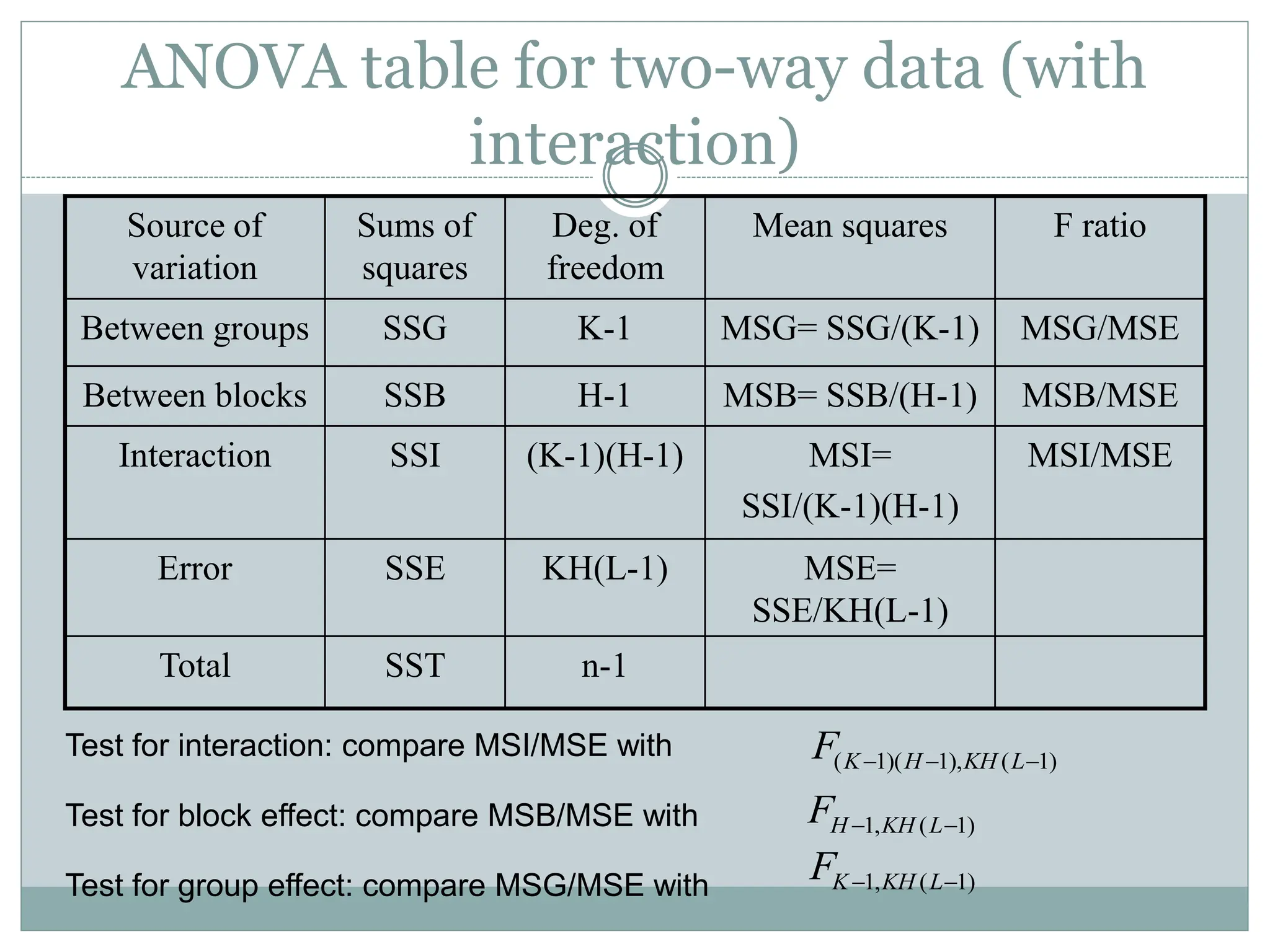
ANOVA table fortwo-way data (with
interaction)
Source of
variation
Sums of
squares
Deg. of
freedom
Mean squares F ratio
Between groups SSG K-1 MSG= SSG/(K-1) MSG/MSE
Between blocks SSB H-1 MSB= SSB/(H-1) MSB/MSE
Interaction SSI (K-1)(H-1) MSI=
SSI/(K-1)(H-1)
MSI/MSE
Error SSE KH(L-1) MSE=
SSE/KH(L-1)
Total SST n-1
Test for interaction: compare MSI/MSE with
Test for block effect: compare MSB/MSE with
Test for group effect: compare MSG/MSE with 1, ( 1)
K KH L
F
1, ( 1)
H KH L
F
( 1)( 1), ( 1)
K H KH L
F
50.
Notes on ANOVA
All analysis of variance (ANOVA) methods are based
on the assumptions of normally distributed and
independent errors
The same problems can be described using the
regression framework. We get exactly the same tests
and results!
There are many extensions beyond those mentioned
51.
The Kolmogorov-Smirnov Test
Introduction: The Kolmogorov-Smirnov test is a statistical test for
equality of continuous probability distributions. It can either compare a
sample with a reference probability distribution or it can directly
compare two sample datasets. The first is referred to as the one-sample
K-S test and serves as a goodness of fit test and the second as the two-
sample K-S test.1 The basis of the test is that it relates the distance
between the cumulative fraction functions of the two samples as a
number, D, which is then compared to the critical-D value for that data
distribution.4 If D is greater than critical-D, then it can be concluded
that the distributions are indeed different, otherwise there is not
enough evidence to prove difference between the two datasets.5 A P-
value can also be calculated from the D-value and the sample size of the
two data sets; this value answers the question of what is the probability
that the D-value would be that large or larger if two samples were
randomly sampled from identical populations as was observed?4
KS comparison
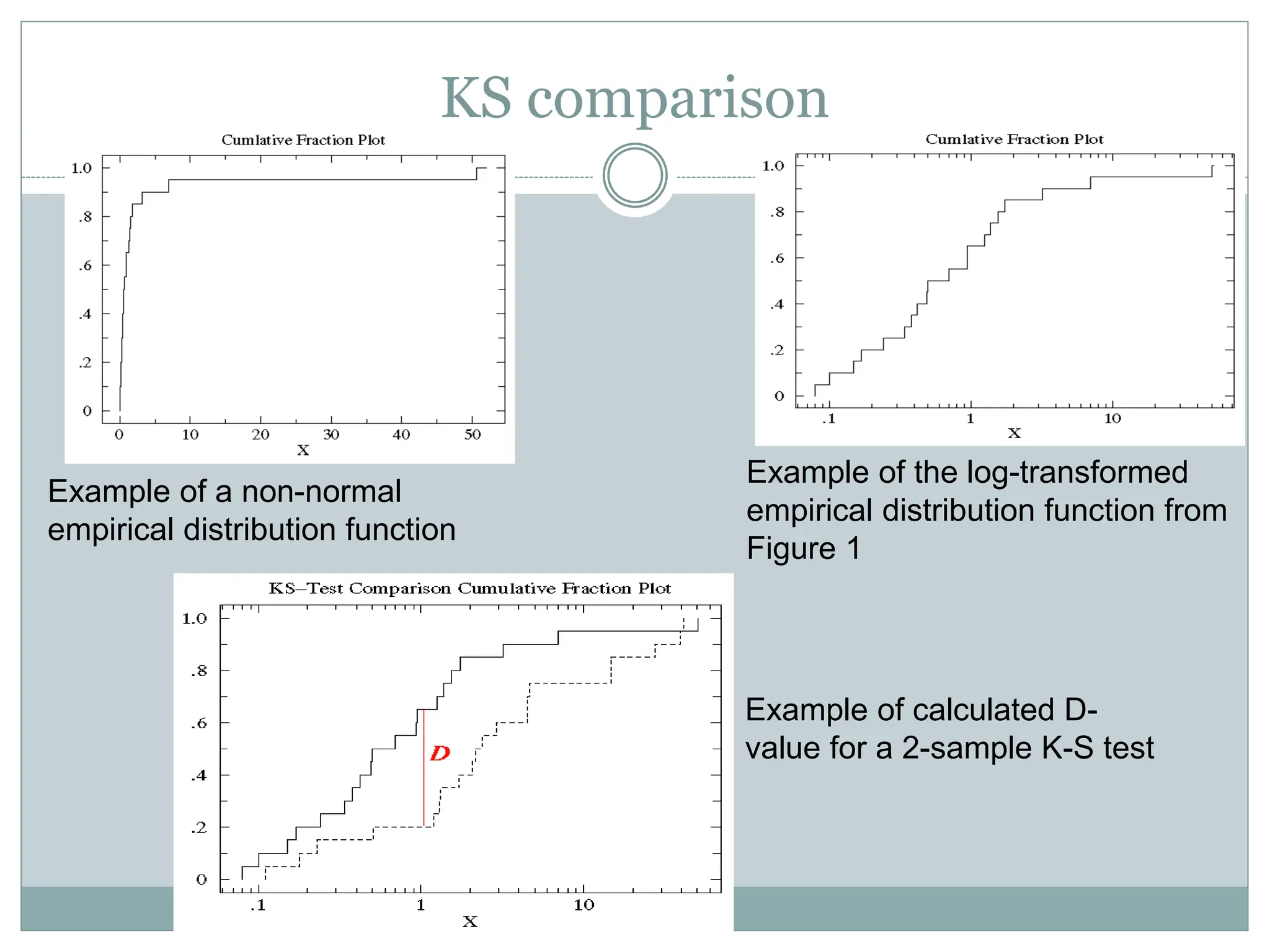
Example ofa non-normal
empirical distribution function
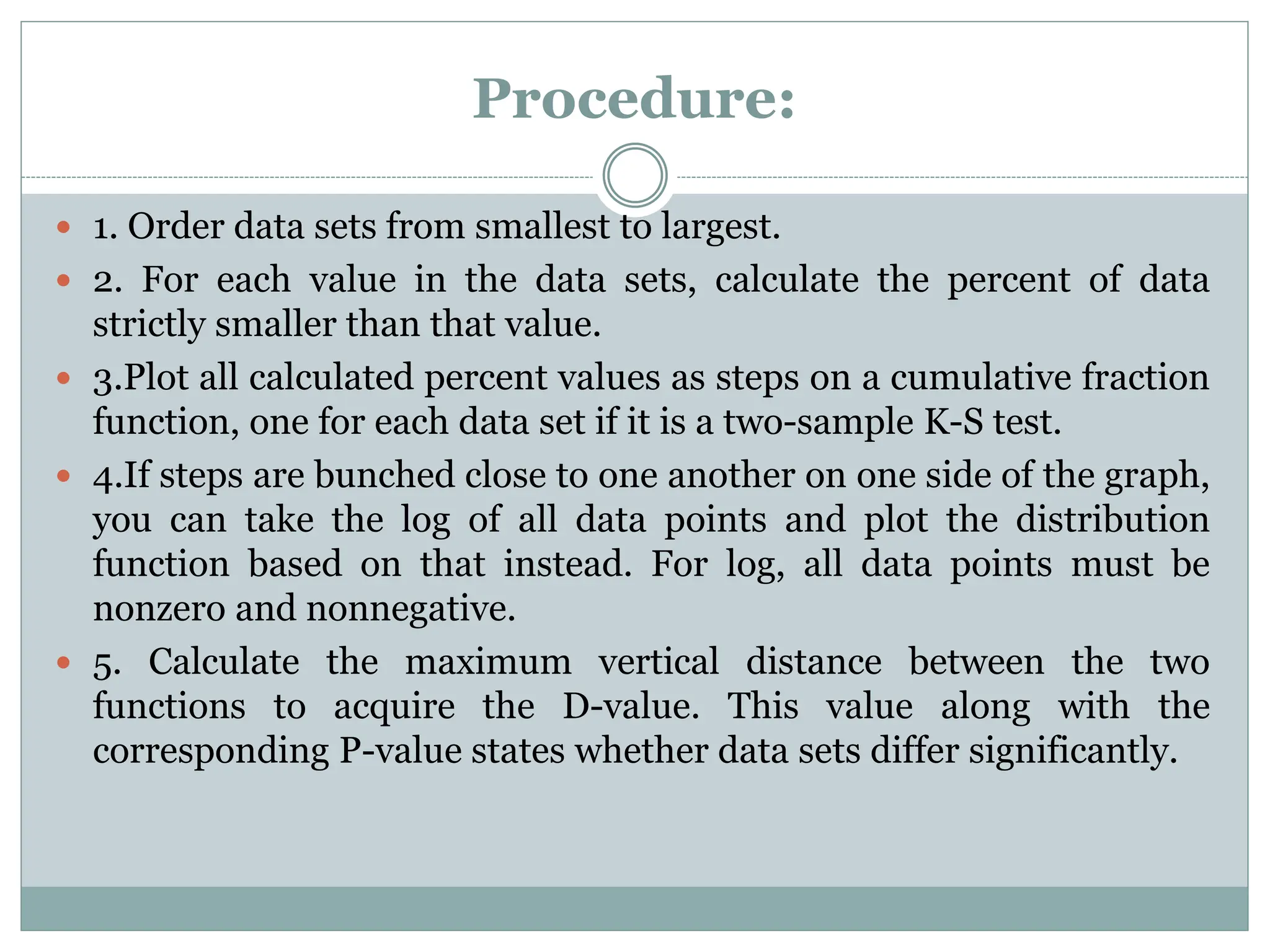
Example of the log-transformed
empirical distribution function from
Figure 1
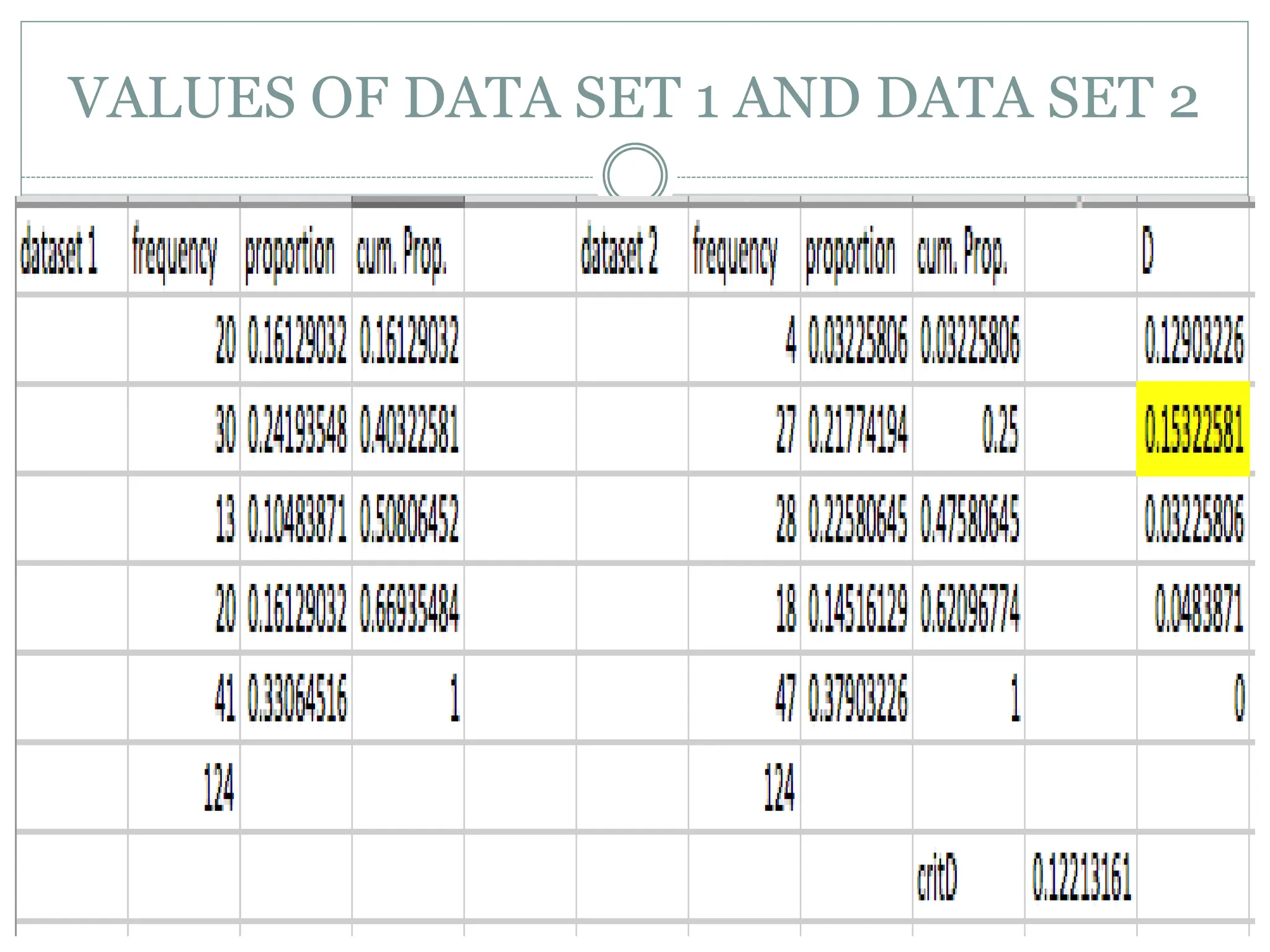
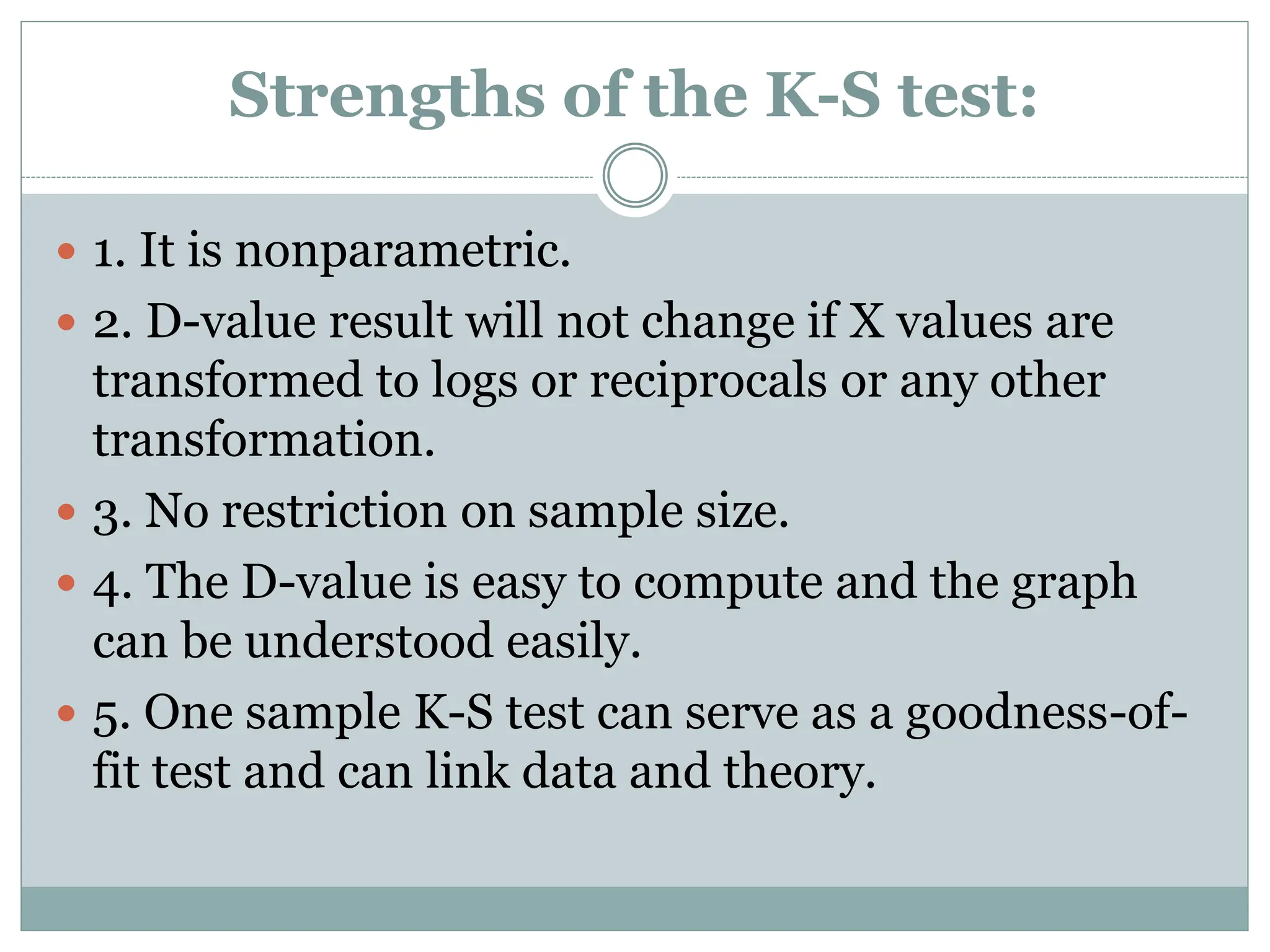
Example of calculated D-
value for a 2-sample K-S test
54.
Procedure:
1. Orderdata sets from smallest to largest.
2. For each value in the data sets, calculate the percent of data
strictly smaller than that value.
3.Plot all calculated percent values as steps on a cumulative fraction
function, one for each data set if it is a two-sample K-S test.
4.If steps are bunched close to one another on one side of the graph,
you can take the log of all data points and plot the distribution
function based on that instead. For log, all data points must be
nonzero and nonnegative.
5. Calculate the maximum vertical distance between the two
functions to acquire the D-value. This value along with the
corresponding P-value states whether data sets differ significantly.
55.
Strengths of theK-S test:
1. It is nonparametric.
2. D-value result will not change if X values are
transformed to logs or reciprocals or any other
transformation.
3. No restriction on sample size.
4. The D-value is easy to compute and the graph
can be understood easily.
5. One sample K-S test can serve as a goodness-of-
fit test and can link data and theory.
56.
Drawbacks:
1. The K-Stest is less sensitive when the
differences between curves is greatest at the
beginning or the end of the distributions. It
works best when EDFs deviate the most near
the center of the distribution.
2. The K-S test cannot be applied in two or more
dimensions because it is a EDF based test.