Connected Teaching,
Learning & Leadership
Joe Mazza, Ed.D.
NPSD, University of Pennsylvania
Moving Away From Organizational Silos
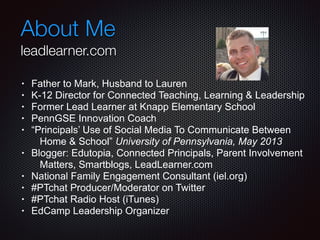
About Me
leadlearner.com
• Father to Mark, Husband to Lauren
• K-12 Director for Connected Teaching, Learning & Leadership
• Former Lead Learner at Knapp Elementary School
• PennGSE Innovation Coach
• “Principals’ Use of Social Media To Communicate Between
Home & School” University of Pennsylvania, May 2013
• Blogger: Edutopia, Connected Principals, Parent Involvement
Matters, Smartblogs, LeadLearner.com
• National Family Engagement Consultant (iel.org)
• #PTchat Producer/Moderator on Twitter
• #PTchat Radio Host (iTunes)
• EdCamp Leadership Organizer
What does it mean to “be
connected?”
You have taken control of your own learning.
You have made the decision to be a public learner, swimming through
social media waters using tools like Twitter, Google + Linked In, blogs etc.
You understand and embrace the fact you are role-modeling for kids with
every post, tweet, blog and digital footprint you make.
You try to contribute as much as you take from your PLN (Personal
Learning Network).
You are committed to paying it forward with your connectivity, being a
resource for others & building capacity with your own learning
community.
Former Lead Learner
Knapp Elementary School
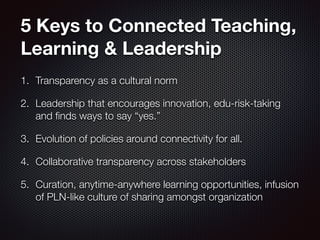
5 Keys to Connected Teaching,
Learning & Leadership
1. Transparency as a cultural norm
2. Leadership that encourages innovation, edu-risk-taking
and finds ways to say “yes.”
3. Evolution of policies around connectivity for all.
4. Collaborative transparency across stakeholders
5. Curation, anytime-anywhere learning opportunities, infusion
of PLN-like culture of sharing amongst organization
TRANSPARENCY
!
Offline AND Online
GLASS WALLS > Brick &
mortar. Share your story.
Tweeting minutes, notes, In-
Service learning events with
follow-up posts
“The smartest person in the
room IS THE ROOM.”
Leadership
!
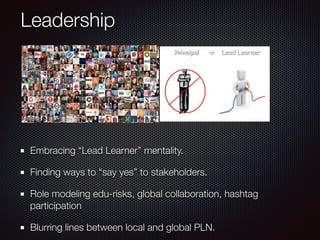
Embracing “Lead Learner” mentality.
Finding ways to “say yes” to stakeholders.
Role modeling edu-risks, global collaboration, hashtag
participation
Blurring lines between local and global PLN.
POLICY
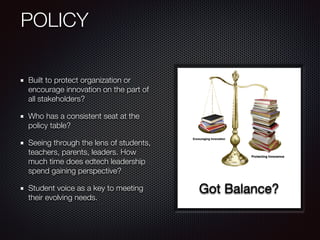
Built to protect organization or
encourage innovation on the part of
all stakeholders?
Who has a consistent seat at the
policy table?
Seeing through the lens of students,
teachers, parents, leaders. How
much time does edtech leadership
spend gaining perspective?
Student voice as a key to meeting
their evolving needs.
Got Balance?
COLLABORATIVE TRANSPARENCY
Some 2-way
communications tools:
TodaysMeet, Google
Apps, Evernote, Google+,
Facebook,
PollEverywhere,
Livestreaming, Blogs,
Twitter Youtube, Instagram
Newest collaboration tool
for me - Voxer.
Let’s Go LIVE To The Field
School leaders discuss use of Voxer to collaborate,
build relationships and go beyond 140 characters.
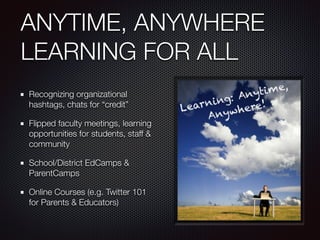
ANYTIME, ANYWHERE
LEARNING FOR ALL
!
Recognizing organizational
hashtags, chats for “credit”
Flipped faculty meetings, learning
opportunities for students, staff &
community
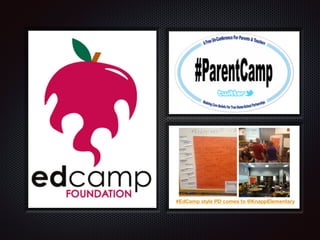
School/District EdCamps &
ParentCamps
Online Courses (e.g. Twitter 101
for Parents & Educators)
You’re connected.
Now What?
Podcasts
Ideas: PD in the car, to
start PLC/Leadership
Mtgs, PTA/PTO/HSA Mtgs
#PTchat Radio,
#EdTechChat Radio,
#EdChat Radio, #Satchat
Radio, #BrandEd Radio,
Student Voice Radio on
the BAM Radio Network.
Project Manager for Connected
Teaching, Learning & Leadership
Full job descriptions at
leadlearner.com
Dot connector
Capacity-builder
Hand-holder
Innovation coach
K-12 Lead Learner Role
Tweet, RT, Favorite, #FF
Blog, Podcast, Video
Community Forums
Offer staff development, webinars,
eCourses, un-conferences
Curation of teaching, learning &
leadership resources
Inform, Communicate, Solicit
feedback, Celebrate successes
Light “innovation fires”
Every Educator An Innovator
Connected Teaching,
Learning & Leadership
Joe Mazza, Ed.D.
NPSD, University of Pennsylvania
!
Website: leadlearner.com
Twitter: @Joe_Mazza
Voxer: joemazza
Skype: leadlearner
Email: pennedtech@gmail.com
Moving Away From Organizational Silos

Moving Away From Silos - K-12 Connected Teaching, Learning & Leadership

  • 1.
    Connected Teaching, Learning &Leadership Joe Mazza, Ed.D. NPSD, University of Pennsylvania Moving Away From Organizational Silos
  • 3.
    About Me leadlearner.com • Fatherto Mark, Husband to Lauren • K-12 Director for Connected Teaching, Learning & Leadership • Former Lead Learner at Knapp Elementary School • PennGSE Innovation Coach • “Principals’ Use of Social Media To Communicate Between Home & School” University of Pennsylvania, May 2013 • Blogger: Edutopia, Connected Principals, Parent Involvement Matters, Smartblogs, LeadLearner.com • National Family Engagement Consultant (iel.org) • #PTchat Producer/Moderator on Twitter • #PTchat Radio Host (iTunes) • EdCamp Leadership Organizer
  • 4.
    What does itmean to “be connected?” You have taken control of your own learning. You have made the decision to be a public learner, swimming through social media waters using tools like Twitter, Google + Linked In, blogs etc. You understand and embrace the fact you are role-modeling for kids with every post, tweet, blog and digital footprint you make. You try to contribute as much as you take from your PLN (Personal Learning Network). You are committed to paying it forward with your connectivity, being a resource for others & building capacity with your own learning community.
  • 5.
    Former Lead Learner KnappElementary School
  • 6.
    5 Keys toConnected Teaching, Learning & Leadership 1. Transparency as a cultural norm 2. Leadership that encourages innovation, edu-risk-taking and finds ways to say “yes.” 3. Evolution of policies around connectivity for all. 4. Collaborative transparency across stakeholders 5. Curation, anytime-anywhere learning opportunities, infusion of PLN-like culture of sharing amongst organization
  • 7.
    TRANSPARENCY ! Offline AND Online GLASSWALLS > Brick & mortar. Share your story. Tweeting minutes, notes, In- Service learning events with follow-up posts “The smartest person in the room IS THE ROOM.”
  • 8.
    Leadership ! Embracing “Lead Learner”mentality. Finding ways to “say yes” to stakeholders. Role modeling edu-risks, global collaboration, hashtag participation Blurring lines between local and global PLN.
  • 9.
    POLICY Built to protectorganization or encourage innovation on the part of all stakeholders? Who has a consistent seat at the policy table? Seeing through the lens of students, teachers, parents, leaders. How much time does edtech leadership spend gaining perspective? Student voice as a key to meeting their evolving needs. Got Balance?
  • 10.
    COLLABORATIVE TRANSPARENCY Some 2-way communicationstools: TodaysMeet, Google Apps, Evernote, Google+, Facebook, PollEverywhere, Livestreaming, Blogs, Twitter Youtube, Instagram Newest collaboration tool for me - Voxer.
  • 12.
    Let’s Go LIVETo The Field School leaders discuss use of Voxer to collaborate, build relationships and go beyond 140 characters.
  • 14.
    ANYTIME, ANYWHERE LEARNING FORALL ! Recognizing organizational hashtags, chats for “credit” Flipped faculty meetings, learning opportunities for students, staff & community School/District EdCamps & ParentCamps Online Courses (e.g. Twitter 101 for Parents & Educators)
  • 15.
  • 17.
    Podcasts Ideas: PD inthe car, to start PLC/Leadership Mtgs, PTA/PTO/HSA Mtgs #PTchat Radio, #EdTechChat Radio, #EdChat Radio, #Satchat Radio, #BrandEd Radio, Student Voice Radio on the BAM Radio Network.
  • 19.
    Project Manager forConnected Teaching, Learning & Leadership Full job descriptions at leadlearner.com Dot connector Capacity-builder Hand-holder Innovation coach
  • 20.
    K-12 Lead LearnerRole Tweet, RT, Favorite, #FF Blog, Podcast, Video Community Forums Offer staff development, webinars, eCourses, un-conferences Curation of teaching, learning & leadership resources Inform, Communicate, Solicit feedback, Celebrate successes Light “innovation fires”
  • 21.
  • 22.
    Connected Teaching, Learning &Leadership Joe Mazza, Ed.D. NPSD, University of Pennsylvania ! Website: leadlearner.com Twitter: @Joe_Mazza Voxer: joemazza Skype: leadlearner Email: pennedtech@gmail.com Moving Away From Organizational Silos