Advanced
Motorsport
Engineering
MSc course
Full and part-time
”
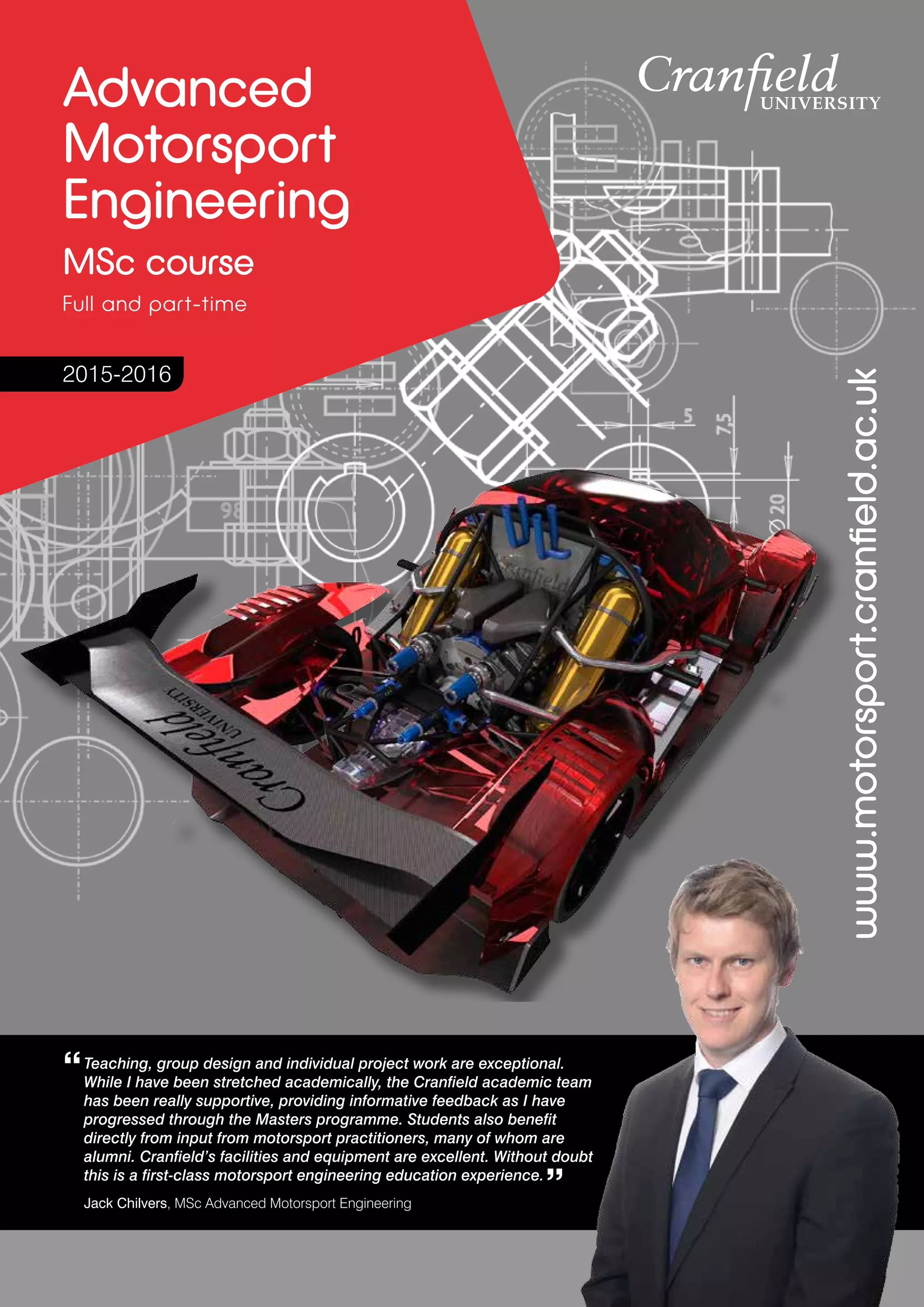
“Teaching, group design and individual project work are exceptional.
While I have been stretched academically, the Cranfield academic team
has been really supportive, providing informative feedback as I have
progressed through the Masters programme. Students also benefit
directly from input from motorsport practitioners, many of whom are
alumni. Cranfield’s facilities and equipment are excellent. Without doubt
this is a first-class motorsport engineering education experience.
Jack Chilvers, MSc Advanced Motorsport Engineering
www.motorsport.cranfield.ac.uk
2015-2016
Motorsport engineering
Motorsport is a demanding world that requires total commitment from its
engineers. Without their skills and expertise, teams don’t even get to race.
Cranfield’s Advanced Motorsport Engineering MSc will hone your skills and
expertise in relation to motorsport and high performance engineering through
a rigorous combination of high level teaching and motorsport related project
work. Our influential network of alumni is testament to the quality of the course.
Your career prospects
Motorsport is a highly competitive sector. While we cannot
guarantee you a job in motorsport, studying at Cranfield will
immerse you in a highly focused motorsport engineering
programme, providing you with access to motorsport companies
and practitioners. You will find Cranfield alumni working throughout
the international motorsport sector.
Industry-supported project work
Our students regularly engage with motorsport practitioners
through group design and individual project work supported by
industry. Our extensive network of contacts provides students
the opportunity to undertake exciting projects addressing real-life
challenges in motorsport, while gaining important additional skills.
Track record
Cranfield University has undertaken research, consultancy and
testing for the motorsport sector since the 1970s. The University
is home to the FIA approved Cranfield Impact Centre and
Cranfield Motorsport Simulation which work with F1 and leading
motorsport companies. We have an international reputation for our
expertise in aerodynamics, CFD, materials technology, including
composites, safety of motorsport vehicle structures, power-train
development, vehicle dynamics, simulation, data acquisition and
electronics, tyre characterisation and modelling. This track record
ensures the course is highly respected by the motorsport industry.
Motorsport engagement
Motorsport practitioners, many of whom are alumni of Cranfield
University contribute valuable sessions on the course.
The programme is supported by a dedicated industrial advisory
panel, which is comprised of senior motorsport professionals.
The panel is closely involved in development of course content
and provides support for group design and individual projects.
This ensures the knowledge you gain is of direct relevance to the
motorsport industry and provides you with an invaluable network
of industry contacts. Full-time students tour an F1 facility, receive
Silverstone passes, visit the circuit where they drive single seat
race cars (subject to availability), experience a professional race
driving simulator, and have access to a number of software
packages relevant to motorsport.
Prizes
Full-time students compete for prizes and trophies which are
awarded by Racecar Engineering, the MSA, Sir Jackie Stewart
OBE, Visiting Professor Adrian Reynard, Silverstone, Altair and
the BRDC.
Accreditation
This programme is accredited by the following institutions as
fulfilling further learning requirements for CEng.
• Institute of Engineering and Technology (IET)
• Institution of Mechanical Engineers (IMechE)
• The Royal Aeronautical Society (RAeS)
Examples of group projects:
• Hydrogen-powered sports-racing car with Radical Sportscars
• Active aerodynamics for the Reynard Inverter
• Energy Recovery Systems (ERS) for Ford Motorsport
• Sustainable off-road competition vehicles and events
• KERS systems for LMP racing
“
”
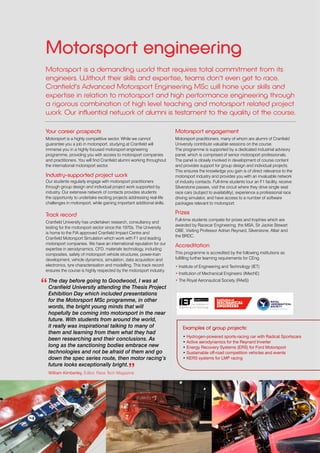
The day before going to Goodwood, I was at
Cranfield University attending the Thesis Project
Exhibition Day which included presentations
for the Motorsport MSc programme, in other
words, the bright young minds that will
hopefully be coming into motorsport in the near
future. With students from around the world,
it really was inspirational talking to many of
them and learning from them what they had
been researching and their conclusions. As
long as the sanctioning bodies embrace new
technologies and not be afraid of them and go
down the spec series route, then motor racing’s
future looks exceptionally bright.
William Kimberley, Editor, Race Tech Magazine
www.motorsport.cranfield.ac.uk
“
MSc course modules
Introduction to Advanced
Motorsport Engineering
This module provides an introduction to the programme and
includes two days dedicated to a number of software packages
used on the course.
Motorsport Structural Analysis
This is an introduction to selection, processing, design and
analysis of competition vehicles. You will learn about a range of
materials used in motorsport, structural analysis, modelling and
simulations, identification of failure modes and appropriate test
methods.
Composite Structures for
Motorsport
Provides a detailed understanding and practical experience of
using composite materials in racing car structures from materials
selection and component design to manufacturing technology,
processing and performance.
Motorsport Powertrain
Design
This module will equip you with the understanding of engineering
principles on which competition powertrain design and
development depend. It includes using AVL Boost for simulations.
Motorsport Vehicle Dynamics
This module is all about competition vehicle dynamics. It focuses
on limit behaviour with explanations and findings from vehicle
tests where you will use a computer based dynamics simulation
package.
Motorsport Electronics and
Data Acquisition
This provides an understanding of electronic and data acquisition
systems that are integral to modern motorsport vehicles. You will
employ methodologies used for the analysis and interpretation of
the data acquired and how these may be used to optimise vehicle
performance.
Computational Fluid
Dynamics for Motorsport
This module focuses on the application of Computational Fluid
Dynamics (CFD). CFD is an integral element in the design and
analysis of both external and internal vehicle aerodynamics,
their design and application.
Motorsport Aerodynamics
Aerodynamics are a critical aspect of competition vehicle design.
Through this module you will understand the principles and
applications of aerodynamics in relation to motorsport. The module
includes testing in the specialist Cranfield wind tunnel facility.
The Business of Motorsport
This module will develop your understanding of the business side
of motorsport and how the sector operates. It covers marketing,
project management, financial management, business planning
and strategy.
”
This course has the best reputation in the industry.This was
confirmed several times when I personally asked people in F1.
If anyone’s goal is to work in F1 or in motorsport in general,
this is by far the best course.
Ralph Koyess, Vehicle Performance Engineer at Lotus F1 Team
and former Motorsport MSc student
“
”
The all-round motorsport knowledge and
experiences I gained while at Cranfield
have proven invaluable to date, allowing
me to work closely with departments
outside my own area of expertise
and understand their objectives and
requirements.
I believe that this is the strongest feature
of the Cranfield Motorsport MSc as only
by appreciating the sometimes conflicting
requirements of race car design can you
produce a car that excels in all areas
without any weaknesses, which has to
be the ultimate aim of any motorsport
engineer.
Matthew Sorrell, Computational Fluid Dynamics
Team Leader for Red Bull Technology Limited
London
Cranfield
Milton
Keynes
Birmingham
Course information
MSc structure
The Advanced Motorsport Engineering
MSc course comprises a series of taught
modules, a group design project and an
individual thesis project.
Taught modules 40%
You will undertake nine taught modules,
eight of which are formally assessed.
These run from October to February,
providing you with the essential
knowledge to develop your understanding
of motorsport engineering and the
business of motorsport.
Group design project 20%
This runs from February to May. Student
teams work to a brief, delivering a
motorsport design engineering related
project. Students submit a detailed report
and present their project work to an invited
industry audience in May. Individual
contribution is also evaluated.
Thesis project 40%
The final individual thesis project runs until
early September. Thesis projects enable
students to specialise, demonstrating their
ability to think and work in an original way.
They are often supported by motorsport
companies. A thesis poster exhibition
concludes the programme.
Entry requirements
Candidates must possess a 1st or
Upper 2nd class UK honours degree
or international equivalent in a relevant
STEM discipline such as engineering,
aerodynamics, physics or applied
mathematics. You must have A-Level
mathematics and physics, or their
international equivalent. English language
IELTS 7.0 or equivalent preferred.
Consideration is given to exceptional
candidates with minimum IELTS 6.5
or equivalent.
Duration
MSc: Full-time 1 year, Part-time 2-3 years.
How to find us
www.motorsport.cranfield.ac.uk
Supporting organisations
include
Image courtesy of MERCEDES AMG PETRONAS
2014 version 3
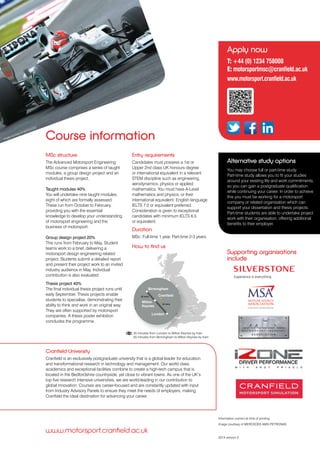
35 minutes from London to Milton Keynes by train
55 minutes from Birmingham to Milton Keynes by train
London
Cranfield
Milton
Keynes
Birmingham
35 mins
Information correct at time of printing
55 mins
Apply now
T: +44 (0) 1234 758008
E: motorsportmsc@cranfield.ac.uk
www.motorsport.cranfield.ac.uk
Alternative study options
You may choose full or part-time study.
Part-time study allows you to fit your studies
around your existing life and work commitments,
so you can gain a postgraduate qualification
while continuing your career. In order to achieve
this you must be working for a motorsport
company or related organisation which can
support your dissertation and thesis projects.
Part-time students are able to undertake project
work with their organisation, offering additional
benefits to their employer.
Image courtesy of MERCEDES
Cranfield University
Cranfield is an exclusively postgraduate university that is a global leader for education
and transformational research in technology and management. Our world class
academics and exceptional facilities combine to create a high-tech campus that is
located in the Bedfordshire countryside, yet close to vibrant towns. As one of the UK’s
top five research intensive universities, we are world-leading in our contribution to
global innovation. Courses are career-focused and are constantly updated with input
from Industry Advisory Panels to ensure they meet the needs of employers, making
Cranfield the ideal destination for advancing your career. 

Motorsport Brochure_low res VM

  • 1.
    Advanced Motorsport Engineering MSc course Full andpart-time ” “Teaching, group design and individual project work are exceptional. While I have been stretched academically, the Cranfield academic team has been really supportive, providing informative feedback as I have progressed through the Masters programme. Students also benefit directly from input from motorsport practitioners, many of whom are alumni. Cranfield’s facilities and equipment are excellent. Without doubt this is a first-class motorsport engineering education experience. Jack Chilvers, MSc Advanced Motorsport Engineering www.motorsport.cranfield.ac.uk 2015-2016
  • 2.
    Motorsport engineering Motorsport isa demanding world that requires total commitment from its engineers. Without their skills and expertise, teams don’t even get to race. Cranfield’s Advanced Motorsport Engineering MSc will hone your skills and expertise in relation to motorsport and high performance engineering through a rigorous combination of high level teaching and motorsport related project work. Our influential network of alumni is testament to the quality of the course. Your career prospects Motorsport is a highly competitive sector. While we cannot guarantee you a job in motorsport, studying at Cranfield will immerse you in a highly focused motorsport engineering programme, providing you with access to motorsport companies and practitioners. You will find Cranfield alumni working throughout the international motorsport sector. Industry-supported project work Our students regularly engage with motorsport practitioners through group design and individual project work supported by industry. Our extensive network of contacts provides students the opportunity to undertake exciting projects addressing real-life challenges in motorsport, while gaining important additional skills. Track record Cranfield University has undertaken research, consultancy and testing for the motorsport sector since the 1970s. The University is home to the FIA approved Cranfield Impact Centre and Cranfield Motorsport Simulation which work with F1 and leading motorsport companies. We have an international reputation for our expertise in aerodynamics, CFD, materials technology, including composites, safety of motorsport vehicle structures, power-train development, vehicle dynamics, simulation, data acquisition and electronics, tyre characterisation and modelling. This track record ensures the course is highly respected by the motorsport industry. Motorsport engagement Motorsport practitioners, many of whom are alumni of Cranfield University contribute valuable sessions on the course. The programme is supported by a dedicated industrial advisory panel, which is comprised of senior motorsport professionals. The panel is closely involved in development of course content and provides support for group design and individual projects. This ensures the knowledge you gain is of direct relevance to the motorsport industry and provides you with an invaluable network of industry contacts. Full-time students tour an F1 facility, receive Silverstone passes, visit the circuit where they drive single seat race cars (subject to availability), experience a professional race driving simulator, and have access to a number of software packages relevant to motorsport. Prizes Full-time students compete for prizes and trophies which are awarded by Racecar Engineering, the MSA, Sir Jackie Stewart OBE, Visiting Professor Adrian Reynard, Silverstone, Altair and the BRDC. Accreditation This programme is accredited by the following institutions as fulfilling further learning requirements for CEng. • Institute of Engineering and Technology (IET) • Institution of Mechanical Engineers (IMechE) • The Royal Aeronautical Society (RAeS) Examples of group projects: • Hydrogen-powered sports-racing car with Radical Sportscars • Active aerodynamics for the Reynard Inverter • Energy Recovery Systems (ERS) for Ford Motorsport • Sustainable off-road competition vehicles and events • KERS systems for LMP racing “ ” The day before going to Goodwood, I was at Cranfield University attending the Thesis Project Exhibition Day which included presentations for the Motorsport MSc programme, in other words, the bright young minds that will hopefully be coming into motorsport in the near future. With students from around the world, it really was inspirational talking to many of them and learning from them what they had been researching and their conclusions. As long as the sanctioning bodies embrace new technologies and not be afraid of them and go down the spec series route, then motor racing’s future looks exceptionally bright. William Kimberley, Editor, Race Tech Magazine
  • 3.
    www.motorsport.cranfield.ac.uk “ MSc course modules Introductionto Advanced Motorsport Engineering This module provides an introduction to the programme and includes two days dedicated to a number of software packages used on the course. Motorsport Structural Analysis This is an introduction to selection, processing, design and analysis of competition vehicles. You will learn about a range of materials used in motorsport, structural analysis, modelling and simulations, identification of failure modes and appropriate test methods. Composite Structures for Motorsport Provides a detailed understanding and practical experience of using composite materials in racing car structures from materials selection and component design to manufacturing technology, processing and performance. Motorsport Powertrain Design This module will equip you with the understanding of engineering principles on which competition powertrain design and development depend. It includes using AVL Boost for simulations. Motorsport Vehicle Dynamics This module is all about competition vehicle dynamics. It focuses on limit behaviour with explanations and findings from vehicle tests where you will use a computer based dynamics simulation package. Motorsport Electronics and Data Acquisition This provides an understanding of electronic and data acquisition systems that are integral to modern motorsport vehicles. You will employ methodologies used for the analysis and interpretation of the data acquired and how these may be used to optimise vehicle performance. Computational Fluid Dynamics for Motorsport This module focuses on the application of Computational Fluid Dynamics (CFD). CFD is an integral element in the design and analysis of both external and internal vehicle aerodynamics, their design and application. Motorsport Aerodynamics Aerodynamics are a critical aspect of competition vehicle design. Through this module you will understand the principles and applications of aerodynamics in relation to motorsport. The module includes testing in the specialist Cranfield wind tunnel facility. The Business of Motorsport This module will develop your understanding of the business side of motorsport and how the sector operates. It covers marketing, project management, financial management, business planning and strategy. ” This course has the best reputation in the industry.This was confirmed several times when I personally asked people in F1. If anyone’s goal is to work in F1 or in motorsport in general, this is by far the best course. Ralph Koyess, Vehicle Performance Engineer at Lotus F1 Team and former Motorsport MSc student “ ” The all-round motorsport knowledge and experiences I gained while at Cranfield have proven invaluable to date, allowing me to work closely with departments outside my own area of expertise and understand their objectives and requirements. I believe that this is the strongest feature of the Cranfield Motorsport MSc as only by appreciating the sometimes conflicting requirements of race car design can you produce a car that excels in all areas without any weaknesses, which has to be the ultimate aim of any motorsport engineer. Matthew Sorrell, Computational Fluid Dynamics Team Leader for Red Bull Technology Limited
  • 4.
    London Cranfield Milton Keynes Birmingham Course information MSc structure TheAdvanced Motorsport Engineering MSc course comprises a series of taught modules, a group design project and an individual thesis project. Taught modules 40% You will undertake nine taught modules, eight of which are formally assessed. These run from October to February, providing you with the essential knowledge to develop your understanding of motorsport engineering and the business of motorsport. Group design project 20% This runs from February to May. Student teams work to a brief, delivering a motorsport design engineering related project. Students submit a detailed report and present their project work to an invited industry audience in May. Individual contribution is also evaluated. Thesis project 40% The final individual thesis project runs until early September. Thesis projects enable students to specialise, demonstrating their ability to think and work in an original way. They are often supported by motorsport companies. A thesis poster exhibition concludes the programme. Entry requirements Candidates must possess a 1st or Upper 2nd class UK honours degree or international equivalent in a relevant STEM discipline such as engineering, aerodynamics, physics or applied mathematics. You must have A-Level mathematics and physics, or their international equivalent. English language IELTS 7.0 or equivalent preferred. Consideration is given to exceptional candidates with minimum IELTS 6.5 or equivalent. Duration MSc: Full-time 1 year, Part-time 2-3 years. How to find us www.motorsport.cranfield.ac.uk Supporting organisations include Image courtesy of MERCEDES AMG PETRONAS 2014 version 3 35 minutes from London to Milton Keynes by train 55 minutes from Birmingham to Milton Keynes by train London Cranfield Milton Keynes Birmingham 35 mins Information correct at time of printing 55 mins Apply now T: +44 (0) 1234 758008 E: motorsportmsc@cranfield.ac.uk www.motorsport.cranfield.ac.uk Alternative study options You may choose full or part-time study. Part-time study allows you to fit your studies around your existing life and work commitments, so you can gain a postgraduate qualification while continuing your career. In order to achieve this you must be working for a motorsport company or related organisation which can support your dissertation and thesis projects. Part-time students are able to undertake project work with their organisation, offering additional benefits to their employer. Image courtesy of MERCEDES Cranfield University Cranfield is an exclusively postgraduate university that is a global leader for education and transformational research in technology and management. Our world class academics and exceptional facilities combine to create a high-tech campus that is located in the Bedfordshire countryside, yet close to vibrant towns. As one of the UK’s top five research intensive universities, we are world-leading in our contribution to global innovation. Courses are career-focused and are constantly updated with input from Industry Advisory Panels to ensure they meet the needs of employers, making Cranfield the ideal destination for advancing your career.