322
323
324
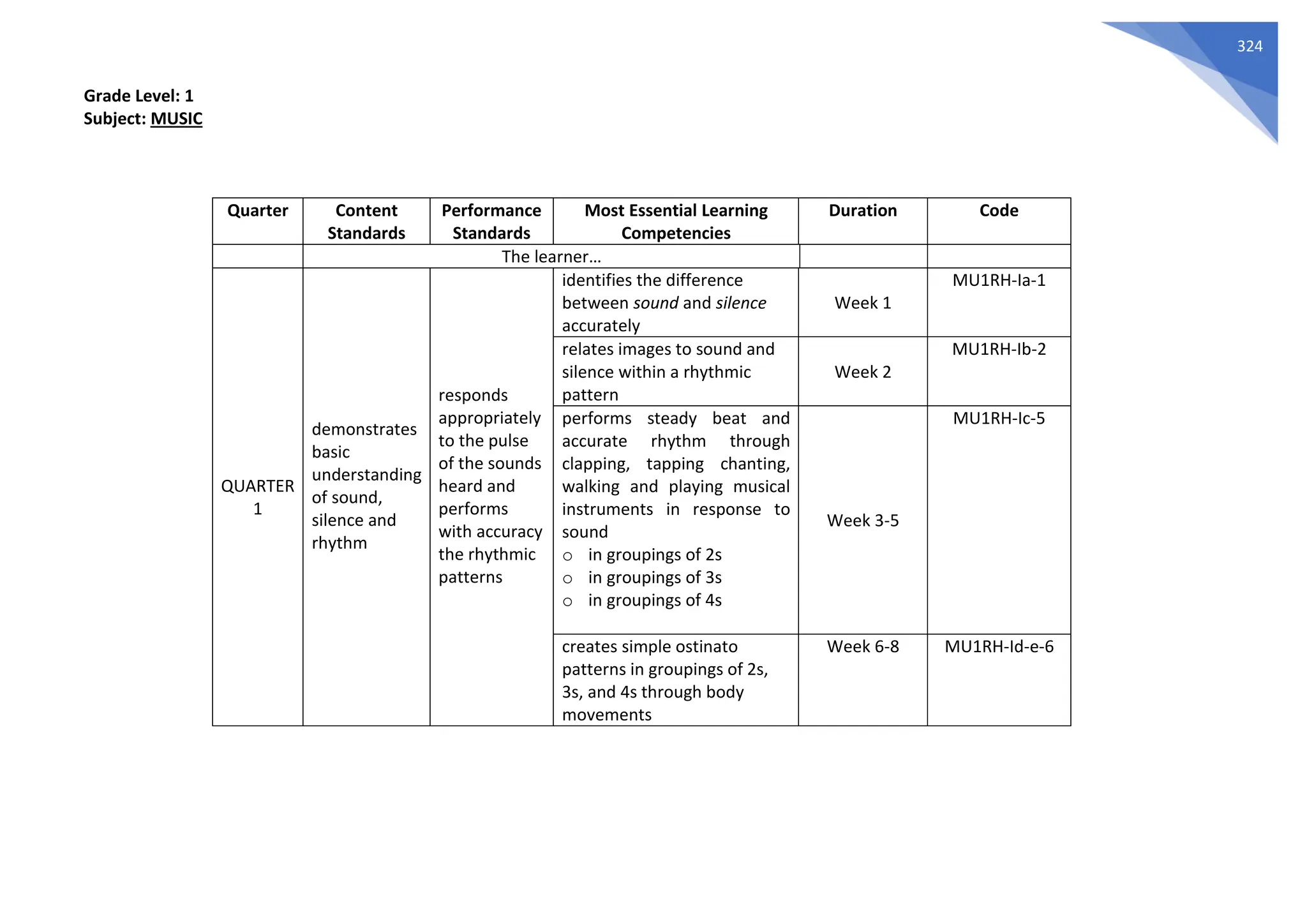
Grade Level: 1
Subject: MUSIC
Quarter Content
Standards
Performance
Standards
Most Essential Learning
Competencies
Duration Code
The learner…
QUARTER
1
demonstrates
basic
understanding
of sound,
silence and
rhythm
responds
appropriately
to the pulse
of the sounds
heard and
performs
with accuracy
the rhythmic
patterns
identifies the difference
between sound and silence
accurately
Week 1
MU1RH-Ia-1
relates images to sound and
silence within a rhythmic
pattern
Week 2
MU1RH-Ib-2
performs steady beat and
accurate rhythm through
clapping, tapping chanting,
walking and playing musical
instruments in response to
sound
o in groupings of 2s
o in groupings of 3s
o in groupings of 4s
Week 3-5
MU1RH-Ic-5
creates simple ostinato
patterns in groupings of 2s,
3s, and 4s through body
movements
Week 6-8 MU1RH-Id-e-6
325
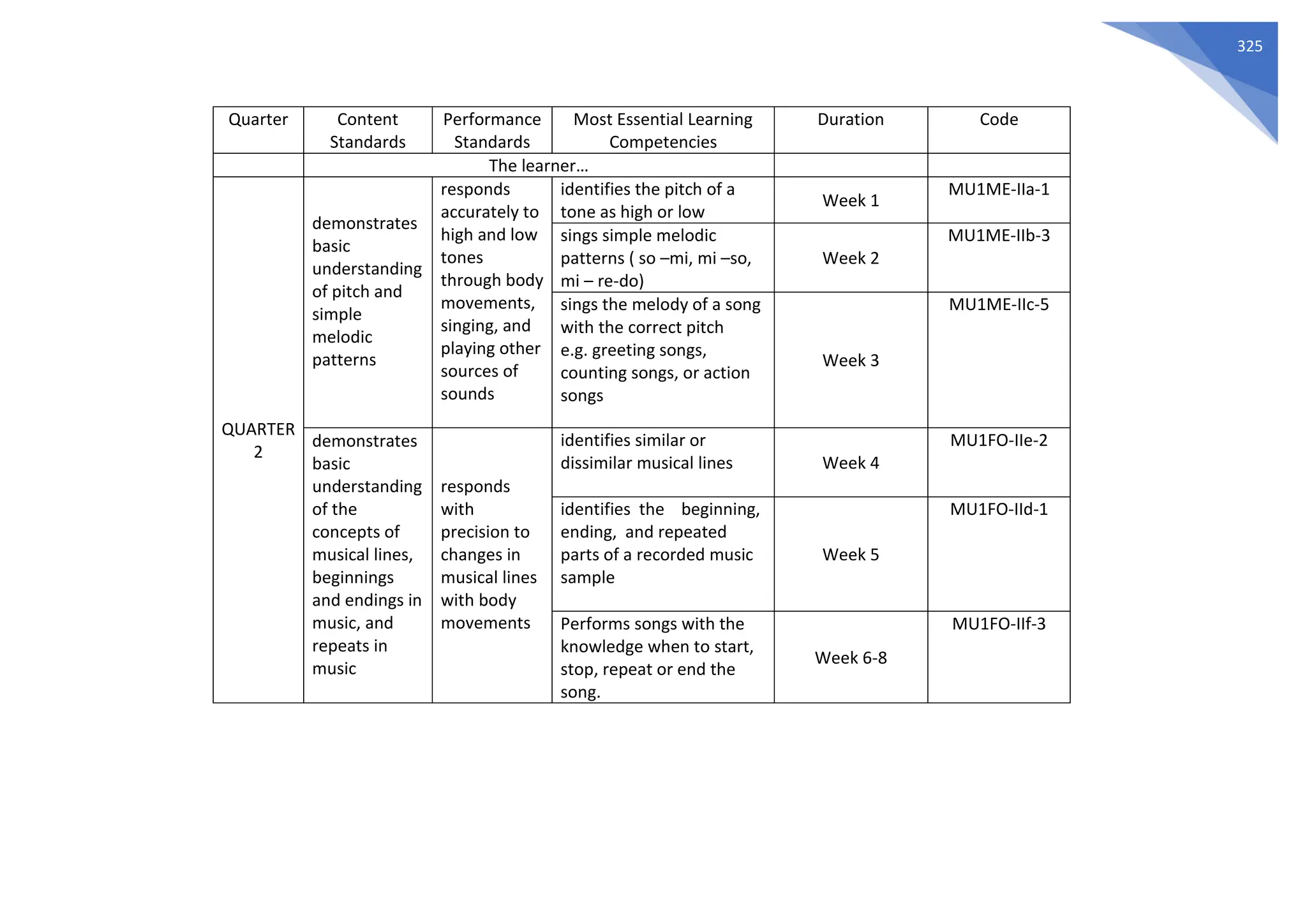
Quarter Content
Standards
Performance
Standards
Most Essential Learning
Competencies
Duration Code
The learner…
QUARTER
2
demonstrates
basic
understanding
of pitch and
simple
melodic
patterns
responds
accurately to
high and low
tones
through body
movements,
singing, and
playing other
sources of
sounds
identifies the pitch of a
tone as high or low
Week 1
MU1ME-IIa-1
sings simple melodic
patterns ( so –mi, mi –so,
mi – re-do)
Week 2
MU1ME-IIb-3
sings the melody of a song
with the correct pitch
e.g. greeting songs,
counting songs, or action
songs
Week 3
MU1ME-IIc-5
demonstrates
basic
understanding
of the
concepts of
musical lines,
beginnings
and endings in
music, and
repeats in
music
responds
with
precision to
changes in
musical lines
with body
movements
identifies similar or
dissimilar musical lines Week 4
MU1FO-IIe-2
identifies the beginning,
ending, and repeated
parts of a recorded music
sample
Week 5
MU1FO-IId-1
Performs songs with the
knowledge when to start,
stop, repeat or end the
song.
Week 6-8
MU1FO-IIf-3
326
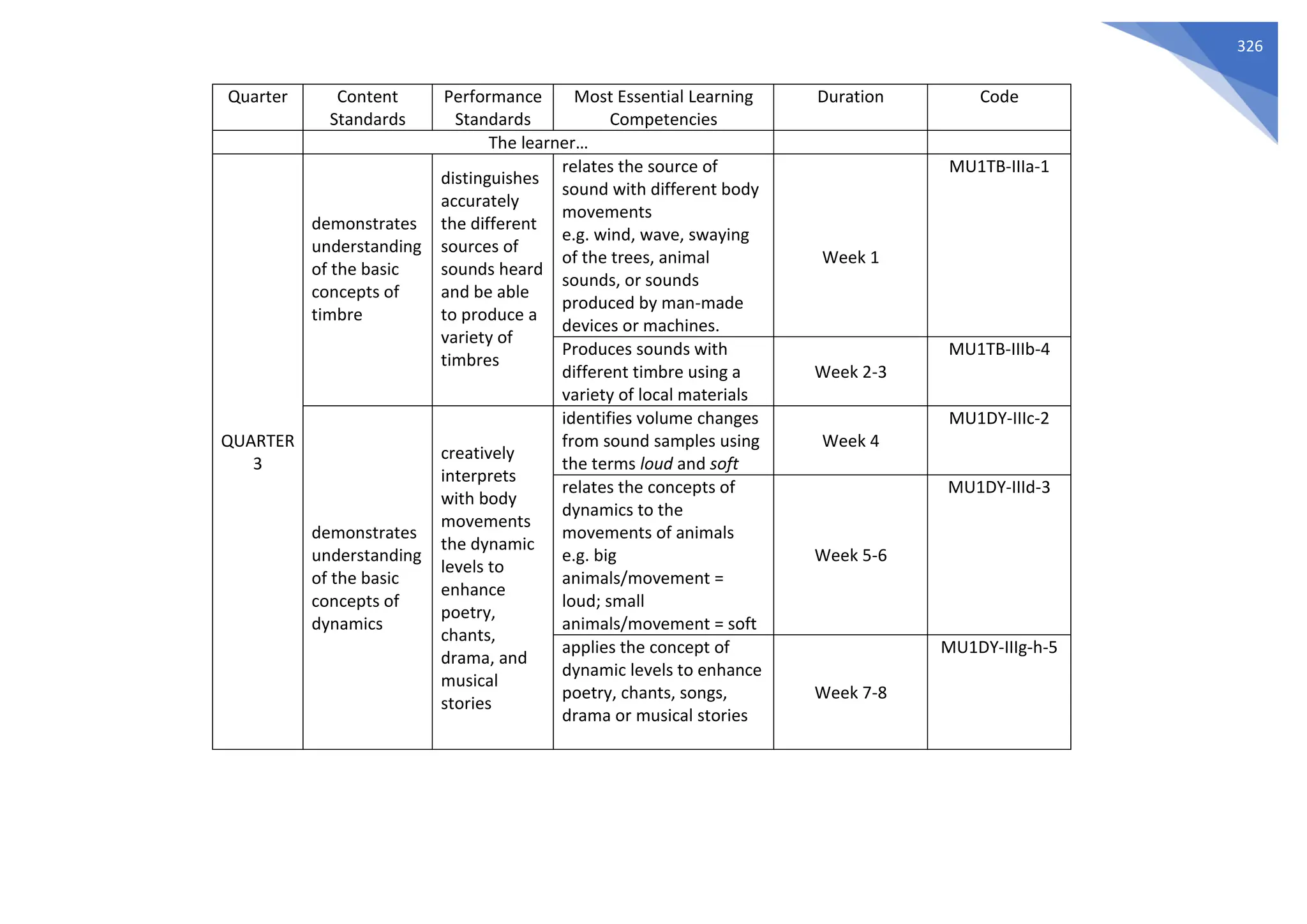
Quarter Content
Standards
Performance
Standards
Most Essential Learning
Competencies
Duration Code
The learner…
QUARTER
3
demonstrates
understanding
of the basic
concepts of
timbre
distinguishes
accurately
the different
sources of
sounds heard
and be able
to produce a
variety of
timbres
relates the source of
sound with different body
movements
e.g. wind, wave, swaying
of the trees, animal
sounds, or sounds
produced by man-made
devices or machines.
Week 1
MU1TB-IIIa-1
Produces sounds with
different timbre using a
variety of local materials
Week 2-3
MU1TB-IIIb-4
demonstrates
understanding
of the basic
concepts of
dynamics
creatively
interprets
with body
movements
the dynamic
levels to
enhance
poetry,
chants,
drama, and
musical
stories
identifies volume changes
from sound samples using
the terms loud and soft
Week 4
MU1DY-IIIc-2
relates the concepts of
dynamics to the
movements of animals
e.g. big
animals/movement =
loud; small
animals/movement = soft
Week 5-6
MU1DY-IIId-3
applies the concept of
dynamic levels to enhance
poetry, chants, songs,
drama or musical stories
Week 7-8
MU1DY-IIIg-h-5
327
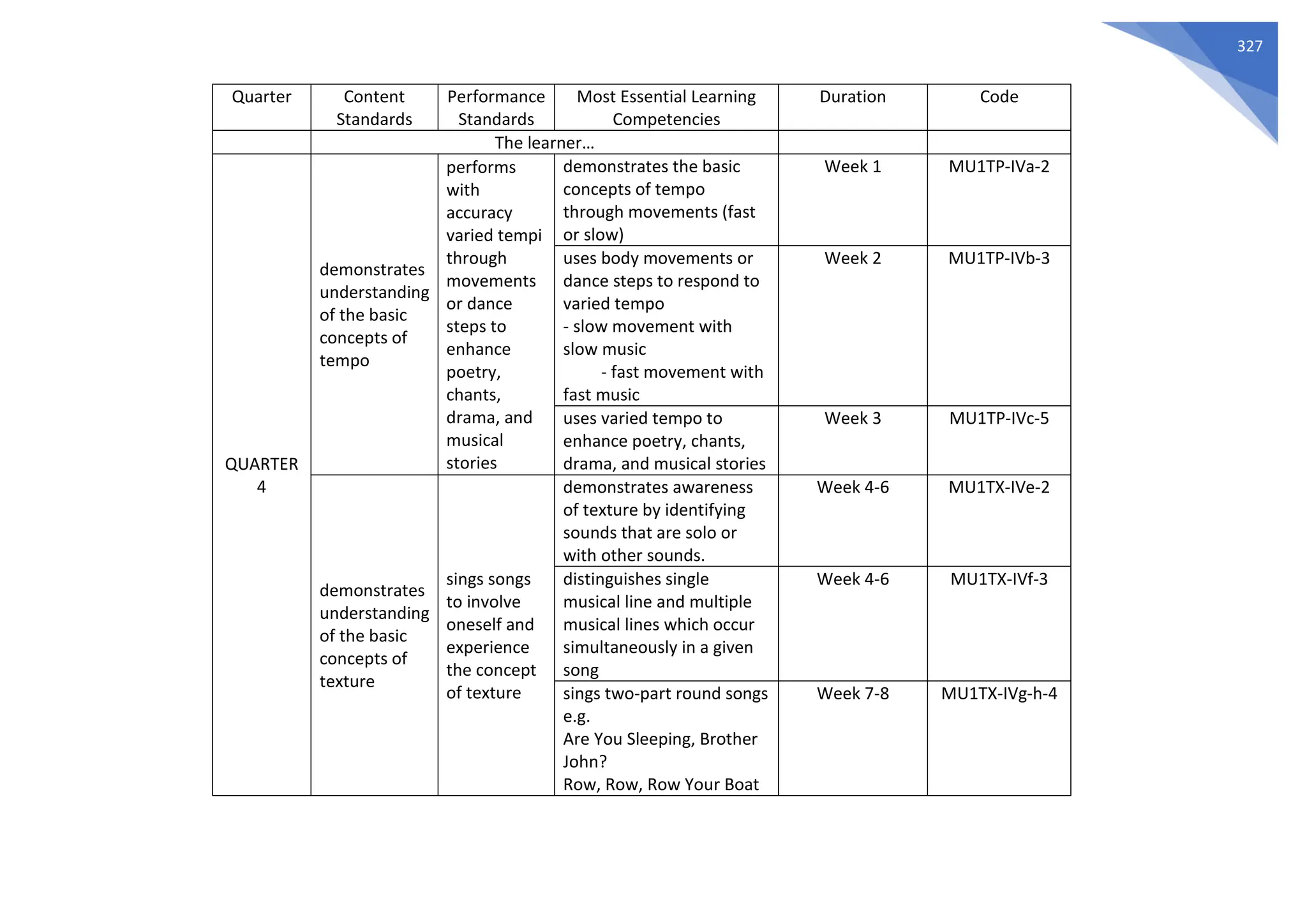
Quarter Content
Standards
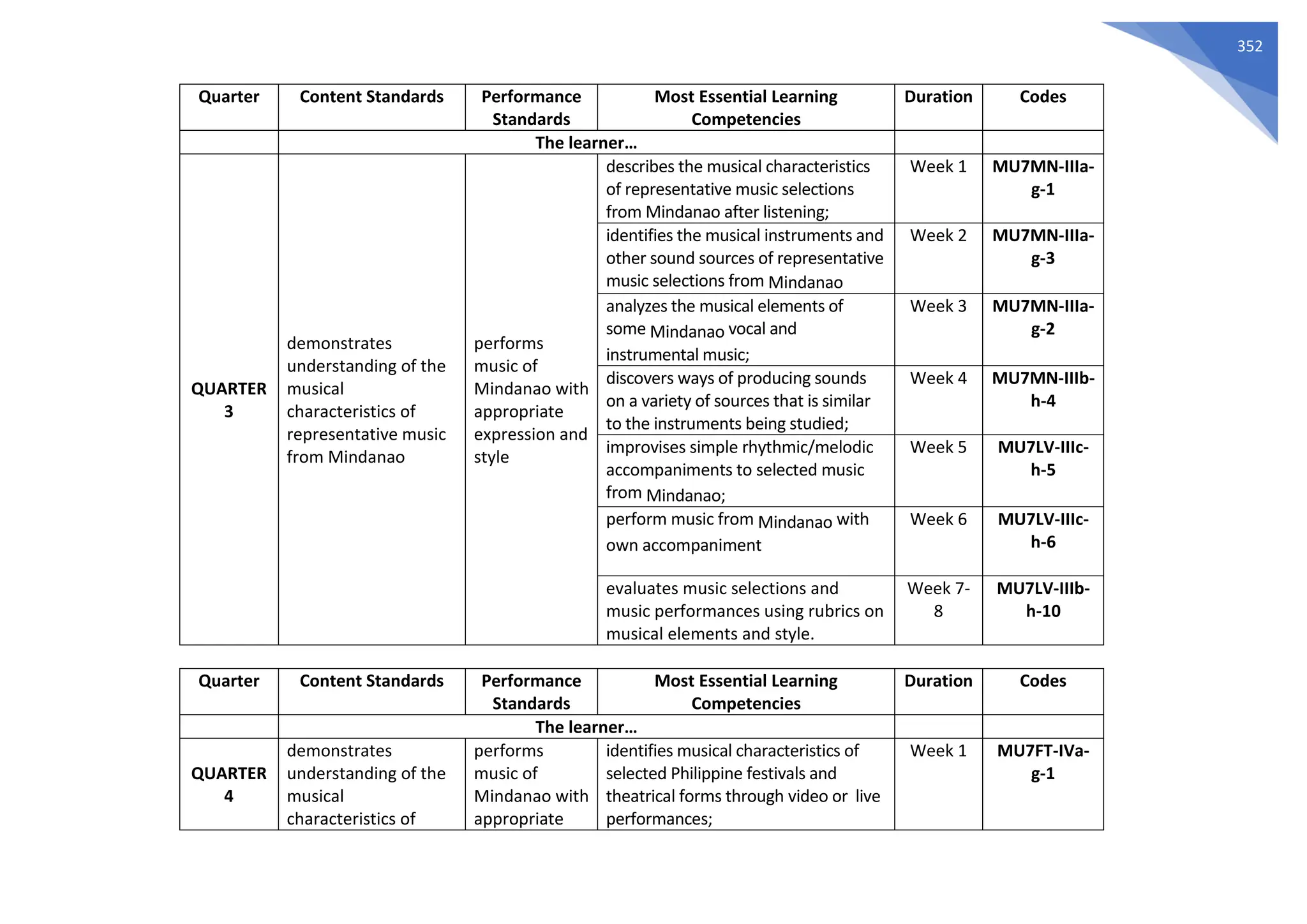
Performance
Standards
Most Essential Learning
Competencies
Duration Code
The learner…
QUARTER
4
demonstrates
understanding
of the basic
concepts of
tempo
performs
with
accuracy
varied tempi
through
movements
or dance
steps to
enhance
poetry,
chants,
drama, and
musical
stories
demonstrates the basic
concepts of tempo
through movements (fast
or slow)
Week 1 MU1TP-IVa-2
uses body movements or
dance steps to respond to
varied tempo
- slow movement with
slow music
- fast movement with
fast music
Week 2 MU1TP-IVb-3
uses varied tempo to
enhance poetry, chants,
drama, and musical stories
Week 3 MU1TP-IVc-5
demonstrates
understanding
of the basic
concepts of
texture
sings songs
to involve
oneself and
experience
the concept
of texture
demonstrates awareness
of texture by identifying
sounds that are solo or
with other sounds.
Week 4-6 MU1TX-IVe-2
distinguishes single
musical line and multiple
musical lines which occur
simultaneously in a given
song
Week 4-6 MU1TX-IVf-3
sings two-part round songs
e.g.
Are You Sleeping, Brother
John?
Row, Row, Row Your Boat
Week 7-8 MU1TX-IVg-h-4
328
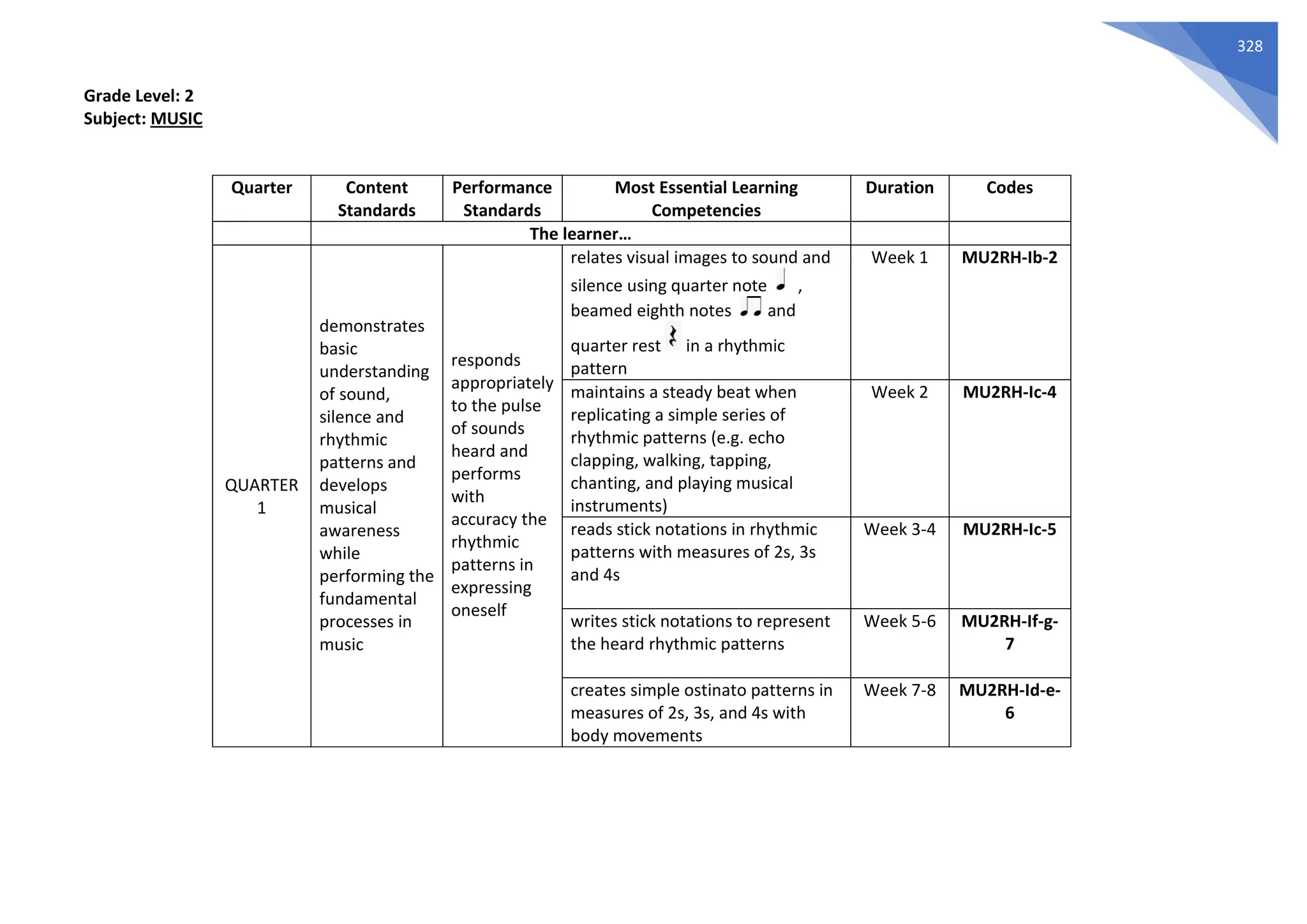
Grade Level: 2
Subject: MUSIC
Quarter Content
Standards
Performance
Standards
Most Essential Learning
Competencies
Duration Codes
The learner…
QUARTER
1
demonstrates
basic
understanding
of sound,
silence and
rhythmic
patterns and
develops
musical
awareness
while
performing the
fundamental
processes in
music
responds
appropriately
to the pulse
of sounds
heard and
performs
with
accuracy the
rhythmic
patterns in
expressing
oneself
relates visual images to sound and
silence using quarter note ,
beamed eighth notes and
quarter rest in a rhythmic
pattern
Week 1 MU2RH-Ib-2
maintains a steady beat when
replicating a simple series of
rhythmic patterns (e.g. echo
clapping, walking, tapping,
chanting, and playing musical
instruments)
Week 2 MU2RH-Ic-4
reads stick notations in rhythmic
patterns with measures of 2s, 3s
and 4s
Week 3-4 MU2RH-Ic-5
writes stick notations to represent
the heard rhythmic patterns
Week 5-6 MU2RH-If-g-
7
creates simple ostinato patterns in
measures of 2s, 3s, and 4s with
body movements
Week 7-8 MU2RH-Id-e-
6
329
Quarter Content
Standards
Performance
Standards
Most Essential Learning
Competencies
Duration Codes
The learner…
QUARTER
2
demonstrates
basic
understanding
of pitch and
simple melodic
patterns
performs
with
accuracy of
pitch, the
simple
melodic
patterns
through body
movements,
singing or
playing
musical
instruments
identifies the pitch of tones as: high
(so), low (mi); higher (la); lower
(re)
Week 1-2 MU2ME-IIa-1
responds to ranges of pitch through
body movements, singing, or
playing instruments
Week 1-2 MU2ME-IIa-2
sings children's songs with accurate
pitch
Week 3-4 MU2ME-IIb-4
* demonstrates melodic contour
through:
a. movement
b. music writing (on paper or on
air)
c. visual imagery
Week 3-4 MU2ME-IIc-6
MU2ME-IIc-7
demonstrates
understanding
of the basic
concepts of
musical form
performs a
song, chosen
from among
the
previously
learned
songs that
shows the
basic
concepts of
musical lines,
beginnings,
endings and
repeats
demonstrates the beginning,
ending and repeats of a song with
- movements
- vocal sounds
- instrumental sounds
Week 5-6 MU2FO-IId-2
identifies musical lines as
- similar
- dissimilar
Week 5-6 MU2FO-IIe-3
* creates melodic or rhythmic
introduction and ending of songs
Week 7-8 MU2FO-IIg-
h-6
MU2FO-IIg-
h-7
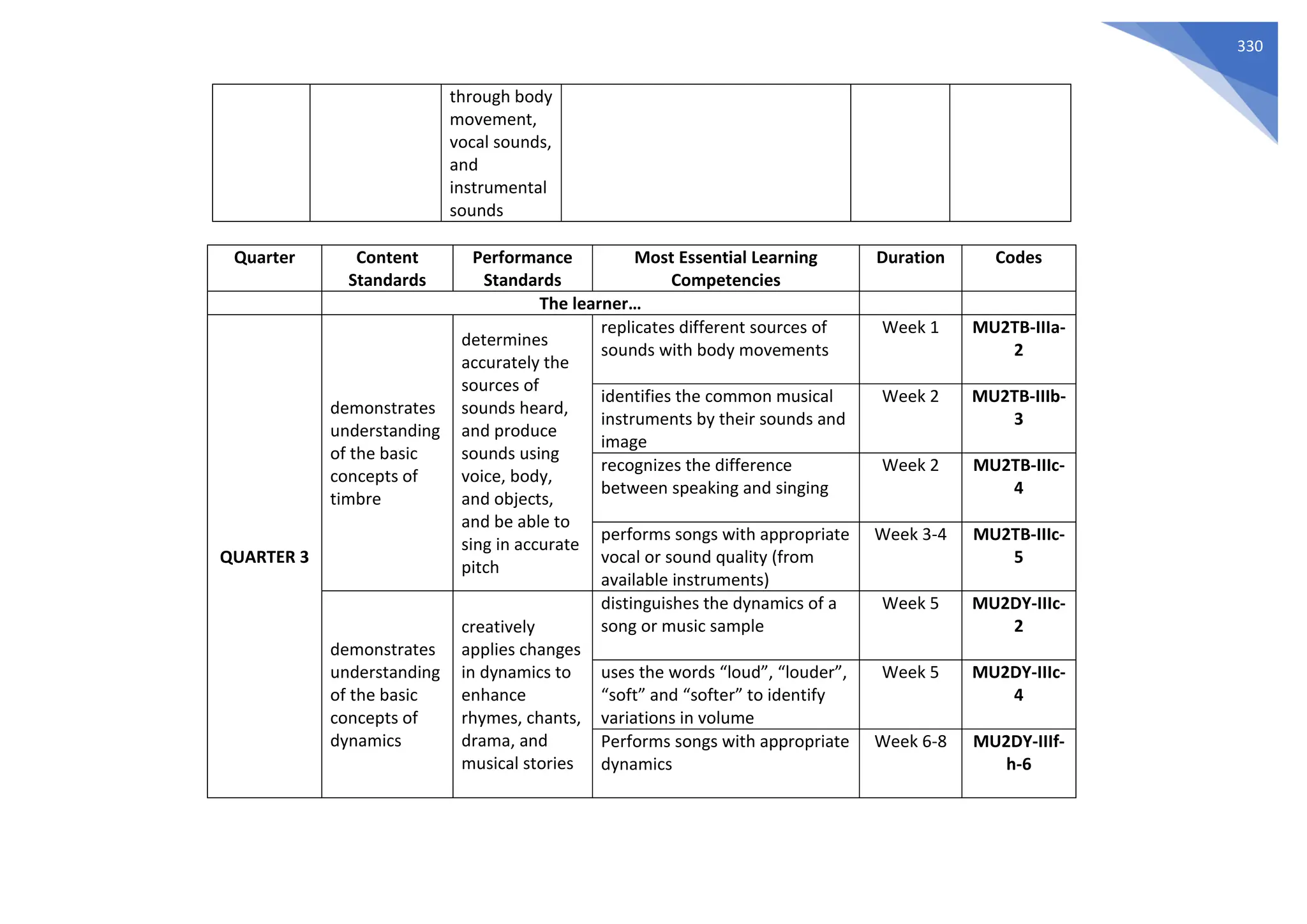
330
through body
movement,
vocal sounds,
and
instrumental
sounds
Quarter Content
Standards
Performance
Standards
Most Essential Learning
Competencies
Duration Codes
The learner…
QUARTER 3
demonstrates
understanding
of the basic
concepts of
timbre
determines
accurately the
sources of
sounds heard,
and produce
sounds using
voice, body,
and objects,
and be able to
sing in accurate
pitch
replicates different sources of
sounds with body movements
Week 1 MU2TB-IIIa-
2
identifies the common musical
instruments by their sounds and
image
Week 2 MU2TB-IIIb-
3
recognizes the difference
between speaking and singing
Week 2 MU2TB-IIIc-
4
performs songs with appropriate
vocal or sound quality (from
available instruments)
Week 3-4 MU2TB-IIIc-
5
demonstrates
understanding
of the basic
concepts of
dynamics
creatively
applies changes
in dynamics to
enhance
rhymes, chants,
drama, and
musical stories
distinguishes the dynamics of a
song or music sample
Week 5 MU2DY-IIIc-
2
uses the words “loud”, “louder”,
“soft” and “softer” to identify
variations in volume
Week 5 MU2DY-IIIc-
4
Performs songs with appropriate
dynamics
Week 6-8 MU2DY-IIIf-
h-6
331
Quarter Content
Standards
Performance
Standards
Most Essential Learning
Competencies
Duration Codes
The learner…
QUARTER 4
demonstrates
understanding
of the basic
concepts of
tempo
uses varied
tempo to
enhance
rhymes, chants,
drama, and
musical stories
follows the correct tempo of a
song including tempo changes
Week 1-2 MU2TP-IVb-
4
distinguishes “slow,” “slower,”
“fast,” and “faster” in recorded
music
Week 1-2 MU2TP-IVb-
5
demonstrates
understanding
of the basic
concepts of
texture
distinguishes
accurately
between single
musical line and
multiple
musical lines
which occur
simultaneously
in a given song
identifies musical texture with
recorded music
- melody with solo
instrument or voice
- single melody with
accompaniment
- two or more melodies sung
or played together at the same
time
Week 3-4 MU2TX-IVd-
f-1
distinguishes between single
musical line and multiple
musical lines which occur
simultaneously
Week 5-6 MU2TX-IVd-
f-3
distinguishes between thinness
and thickness of musical sound
in recorded or performed music
Week 7-8 MU2TX-IVg-
h-4
332
Grade Level: 3
Subject: MUSIC
Quarter Content
Standards
Performance
Standards
Most Essential Learning
Competencies
Duration Codes
The learner…
QUARTER
1
demonstrates
understanding
of the basic
concepts of
rhythm
performs simple
ostinato
patterns/simple
rhythmic
accompaniments
on classroom
instruments and
other sound
sources to a
given song
relates images with sound and
silence using quarter note ,
beamed eighth note , half
note , quarter rest and
half rest within a rhythmic
pattern
Week 1 MU3RH-Ia-1
maintains a steady beat when
replicating a simple series of
rhythmic patterns in measures
of 2s, 3s, and 4s (e.g. echo
clapping, walking, marching,
tapping, chanting, dancing the
waltz, or playing musical
instruments)
Week 2 MU3RH-Ib-h-
2
plays simple ostinato patterns
(continually repeated musical
phrase or rhythm) with
classroom instruments and
other sound sources
Week 5-6 MU3RH-Id-h-
5
creates continually repeated
musical phrase or rhythm in
measures of 2s, 3s, and 4s
Week 7-8 MU3RH-Ie-6
Quarter Content
Standards
Performance
Standards
Most Essential Learning
Competencies
Duration Codes
333
The learner…
QUARTER
2
demonstrates
understanding
of the basic
concepts of
melody
sings the
melody of a
song with
accurate pitch
identifies the pitch of a tone as:
- high – higher
- moderately high – higher
- moderately low – lower
- low – lower
Week 1 MU3ME-IIa-1
matches the correct pitch of
tones
- with the voice
- with an instrument
Week 2 MU3ME-IIa-2
recreates simple patterns and
contour of a melody
Week 3 MU3ME-IIb-5
demonstrates
understanding
of the basic
concepts of
musical form
sings, plays, and
performs
(through body
movements) a
chosen song
showing the
basic concepts
of musical lines,
beginnings,
endings and
repeats
identifies the beginning, middle,
ending and repetitions within a
song or music sample
Week 4 MU3FO-IId-1
identifies musical lines as
- similar
- same
- different
Week 5 MU3FO-IId-2
performs songs with accurate
pitch from beginning to end
including repetitions
Week 6-8 MU3FO-IIg-
h-6
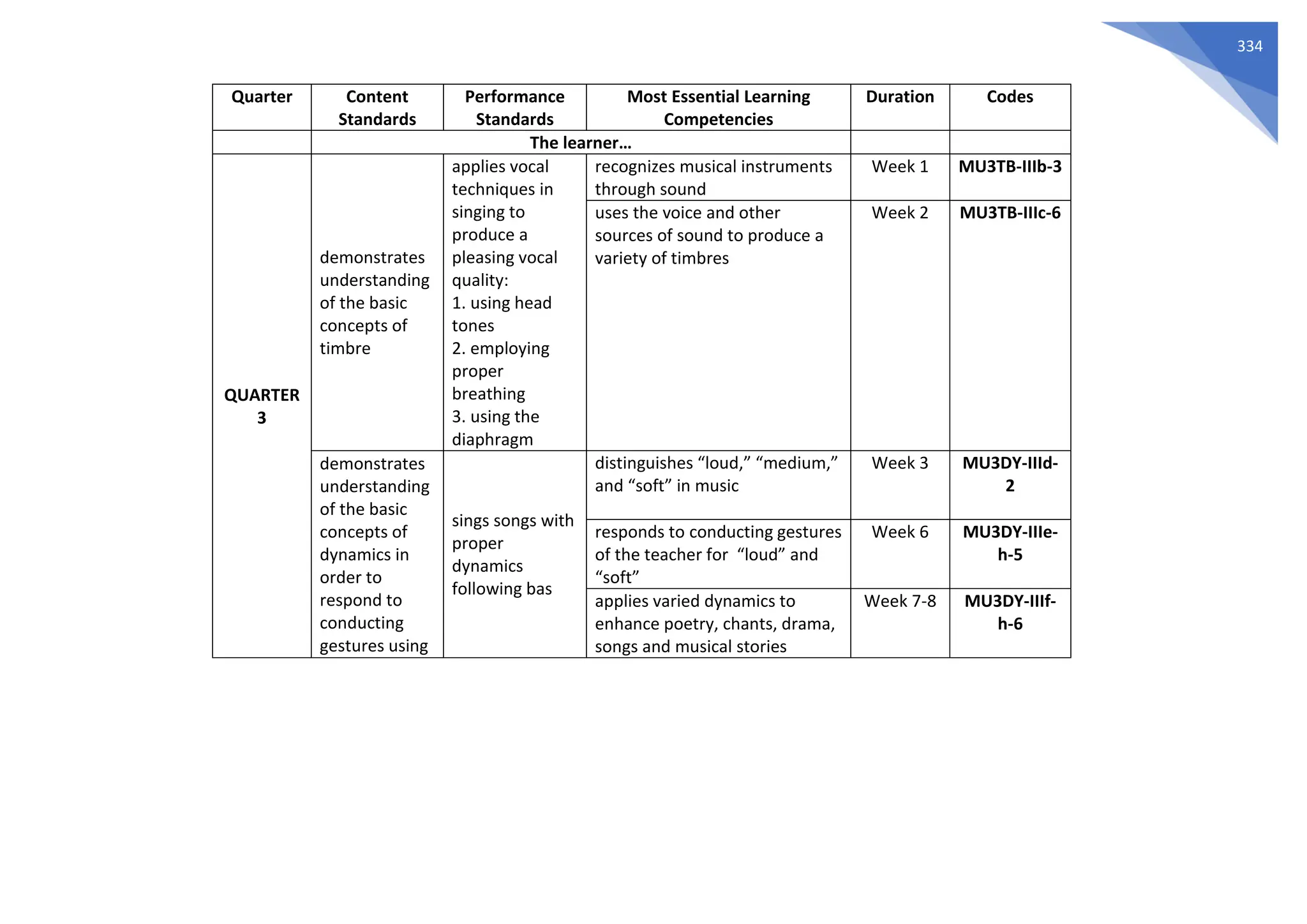
334
Quarter Content
Standards
Performance
Standards
Most Essential Learning
Competencies
Duration Codes
The learner…
QUARTER
3
demonstrates
understanding
of the basic
concepts of
timbre
applies vocal
techniques in
singing to
produce a
pleasing vocal
quality:
1. using head
tones
2. employing
proper
breathing
3. using the
diaphragm
recognizes musical instruments
through sound
Week 1 MU3TB-IIIb-3
uses the voice and other
sources of sound to produce a
variety of timbres
Week 2 MU3TB-IIIc-6
demonstrates
understanding
of the basic
concepts of
dynamics in
order to
respond to
conducting
gestures using
sings songs with
proper
dynamics
following bas
distinguishes “loud,” “medium,”
and “soft” in music
Week 3 MU3DY-IIId-
2
responds to conducting gestures
of the teacher for “loud” and
“soft”
Week 6 MU3DY-IIIe-
h-5
applies varied dynamics to
enhance poetry, chants, drama,
songs and musical stories
Week 7-8 MU3DY-IIIf-
h-6
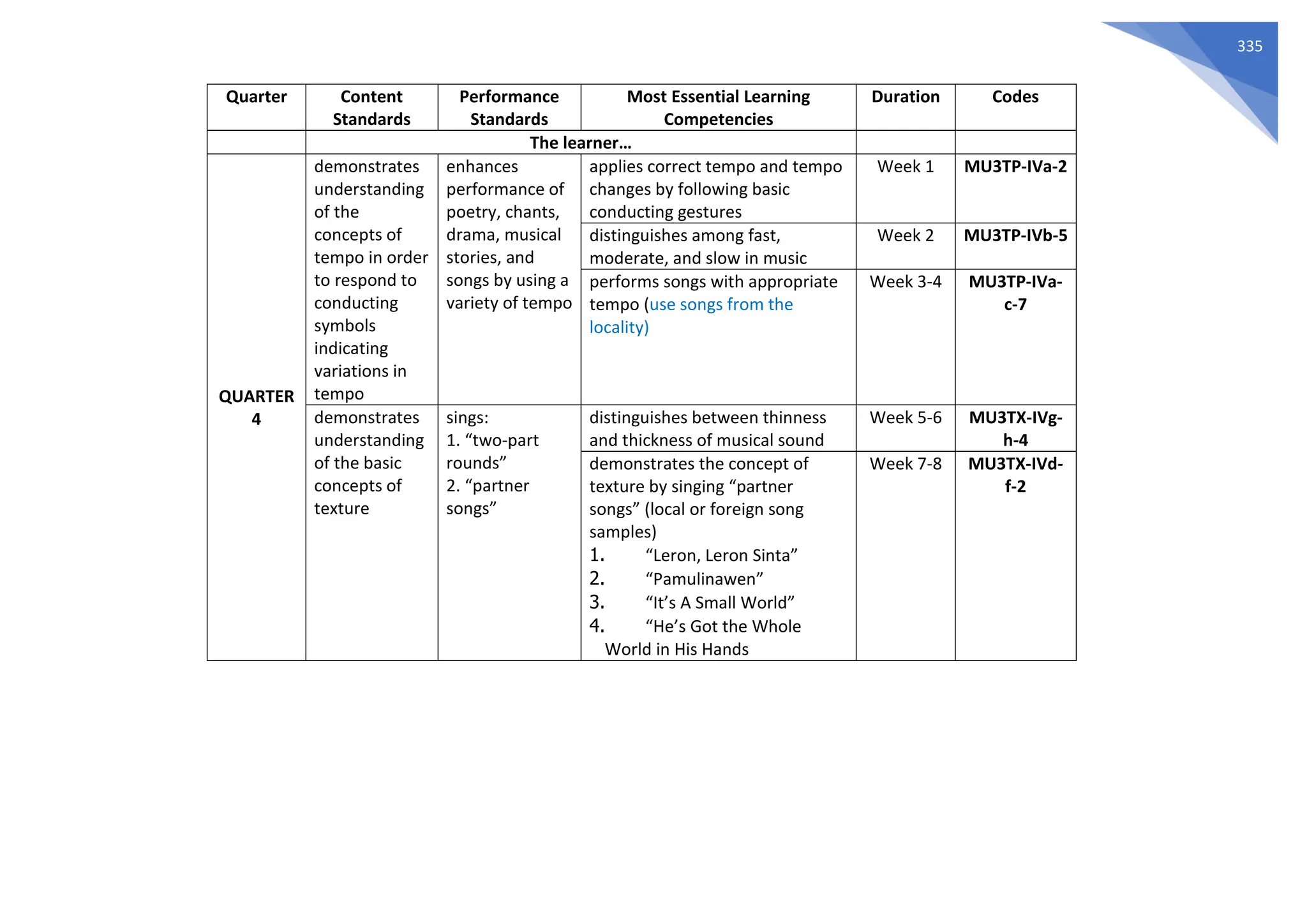
335
Quarter Content
Standards
Performance
Standards
Most Essential Learning
Competencies
Duration Codes
The learner…
QUARTER
4
demonstrates
understanding
of the
concepts of
tempo in order
to respond to
conducting
symbols
indicating
variations in
tempo
enhances
performance of
poetry, chants,
drama, musical
stories, and
songs by using a
variety of tempo
applies correct tempo and tempo
changes by following basic
conducting gestures
Week 1 MU3TP-IVa-2
distinguishes among fast,
moderate, and slow in music
Week 2 MU3TP-IVb-5
performs songs with appropriate
tempo (use songs from the
locality)
Week 3-4 MU3TP-IVa-
c-7
demonstrates
understanding
of the basic
concepts of
texture
sings:
1. “two-part
rounds”
2. “partner
songs”
distinguishes between thinness
and thickness of musical sound
Week 5-6 MU3TX-IVg-
h-4
demonstrates the concept of
texture by singing “partner
songs” (local or foreign song
samples)
1. “Leron, Leron Sinta”
2. “Pamulinawen”
3. “It’s A Small World”
4. “He’s Got the Whole
World in His Hands
Week 7-8 MU3TX-IVd-
f-2
336
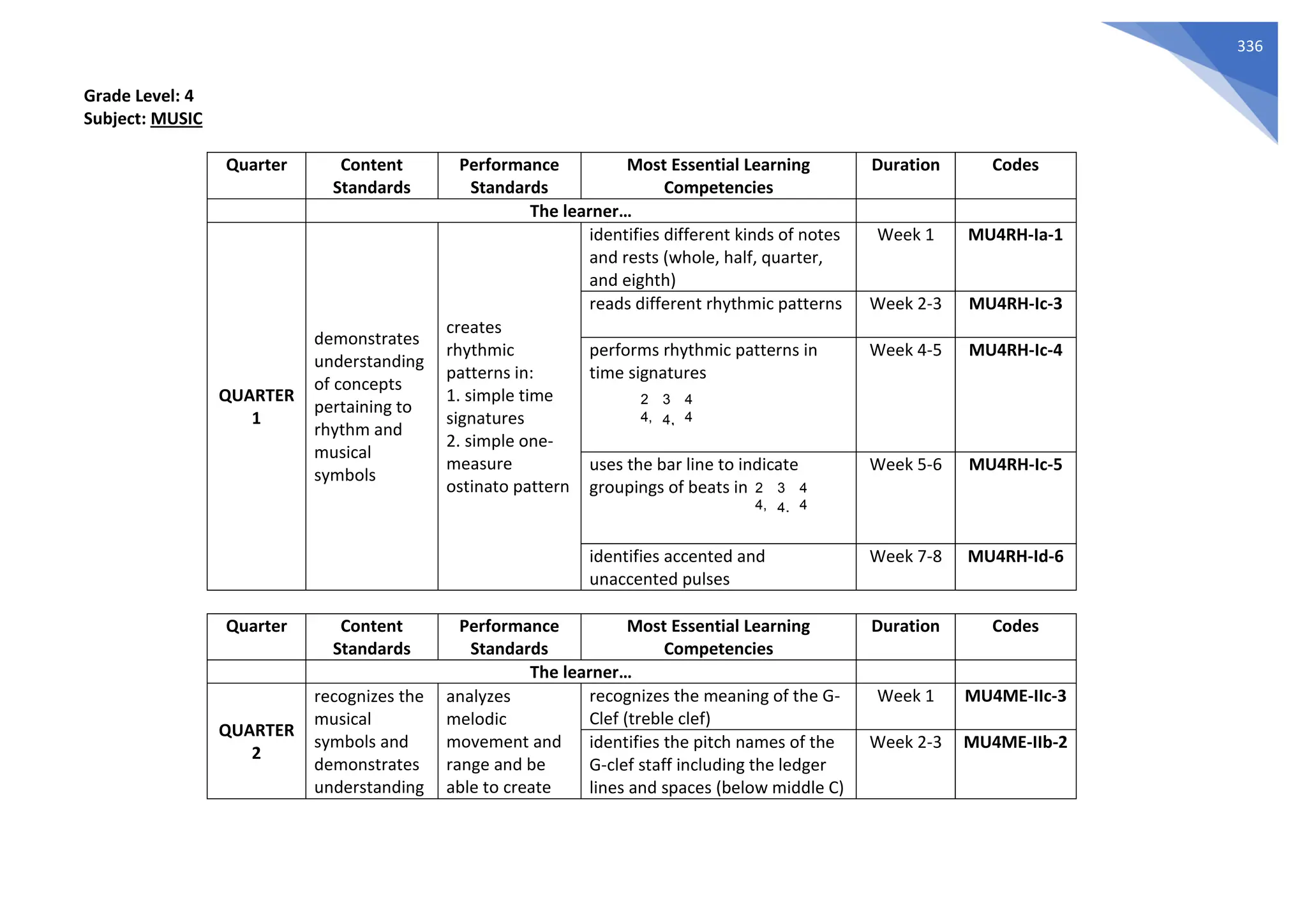
Grade Level: 4
Subject: MUSIC
Quarter Content
Standards
Performance
Standards
Most Essential Learning
Competencies
Duration Codes
The learner…
QUARTER
1
demonstrates
understanding
of concepts
pertaining to
rhythm and
musical
symbols
creates
rhythmic
patterns in:
1. simple time
signatures
2. simple one-
measure
ostinato pattern
identifies different kinds of notes
and rests (whole, half, quarter,
and eighth)
Week 1 MU4RH-Ia-1
reads different rhythmic patterns Week 2-3 MU4RH-Ic-3
performs rhythmic patterns in
time signatures
Week 4-5 MU4RH-Ic-4
uses the bar line to indicate
groupings of beats in
Week 5-6 MU4RH-Ic-5
identifies accented and
unaccented pulses
Week 7-8 MU4RH-Id-6
Quarter Content
Standards
Performance
Standards
Most Essential Learning
Competencies
Duration Codes
The learner…
QUARTER
2
recognizes the
musical
symbols and
demonstrates
understanding
analyzes
melodic
movement and
range and be
able to create
recognizes the meaning of the G-
Clef (treble clef)
Week 1 MU4ME-IIc-3
identifies the pitch names of the
G-clef staff including the ledger
lines and spaces (below middle C)
Week 2-3 MU4ME-IIb-2
3
4,
2
4,
4
4
3
4,
2
4,
4
4
337
of concepts
pertaining to
melody
and perform
simple melodies
identifies the movement of the
melody as:
- no movement
- ascending stepwise
- descending stepwise
- ascending skipwise
- descending skipwise
Week 4 MU4ME-IId-4
identifies the highest and lowest
pitch in a given notation of a
musical piece to determine its
range
Week 5 MU4ME-IIe-5
sings with accurate pitch the
simple intervals of a melody
Week 6 MU4ME-IIf-6
creates simple melodic lines Week 7-8 MU4ME-IIg-
h-7
Quarter Content
Standards
Performance
Standards
Most Essential Learning
Competencies
Duration Codes
The learner…
QUARTER
3
demonstrates
understanding
of musical
phrases, and
the uses and
meaning of
musical terms
in form
performs similar
and contrasting
musical phrases
identifies aurally and visually the
introduction and coda (ending) of
a musical piece
Week 1 MU4FO-IIIa-1
identifies aurally and visually the
antecedent and consequent in a
musical piece
Week 2 MU4FO-IIIa-2
recognizes similar and contrasting
phrases in vocal and instrumental
music
1. melodic
2. rhythmic
Week 3 MU4FO-IIIa-
b-3
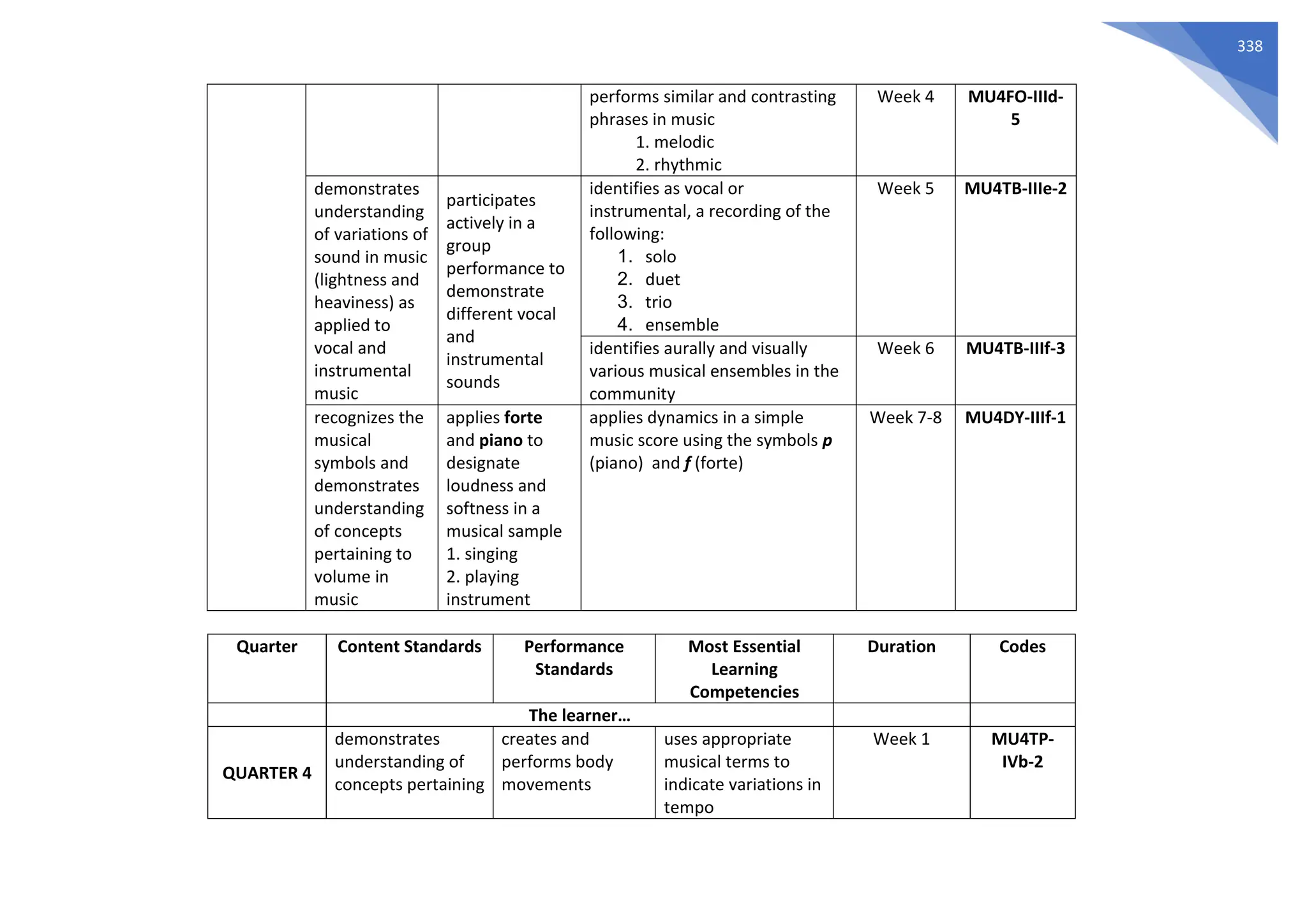
338
performs similar and contrasting
phrases in music
1. melodic
2. rhythmic
Week 4 MU4FO-IIId-
5
demonstrates
understanding
of variations of
sound in music
(lightness and
heaviness) as
applied to
vocal and
instrumental
music
participates
actively in a
group
performance to
demonstrate
different vocal
and
instrumental
sounds
identifies as vocal or
instrumental, a recording of the
following:
1. solo
2. duet
3. trio
4. ensemble
Week 5 MU4TB-IIIe-2
identifies aurally and visually
various musical ensembles in the
community
Week 6 MU4TB-IIIf-3
recognizes the
musical
symbols and
demonstrates
understanding
of concepts
pertaining to
volume in
music
applies forte
and piano to
designate
loudness and
softness in a
musical sample
1. singing
2. playing
instrument
applies dynamics in a simple
music score using the symbols p
(piano) and f (forte)
Week 7-8 MU4DY-IIIf-1
Quarter Content Standards Performance
Standards
Most Essential
Learning
Competencies
Duration Codes
The learner…
QUARTER 4
demonstrates
understanding of
concepts pertaining
creates and
performs body
movements
uses appropriate
musical terms to
indicate variations in
tempo
Week 1 MU4TP-
IVb-2
339
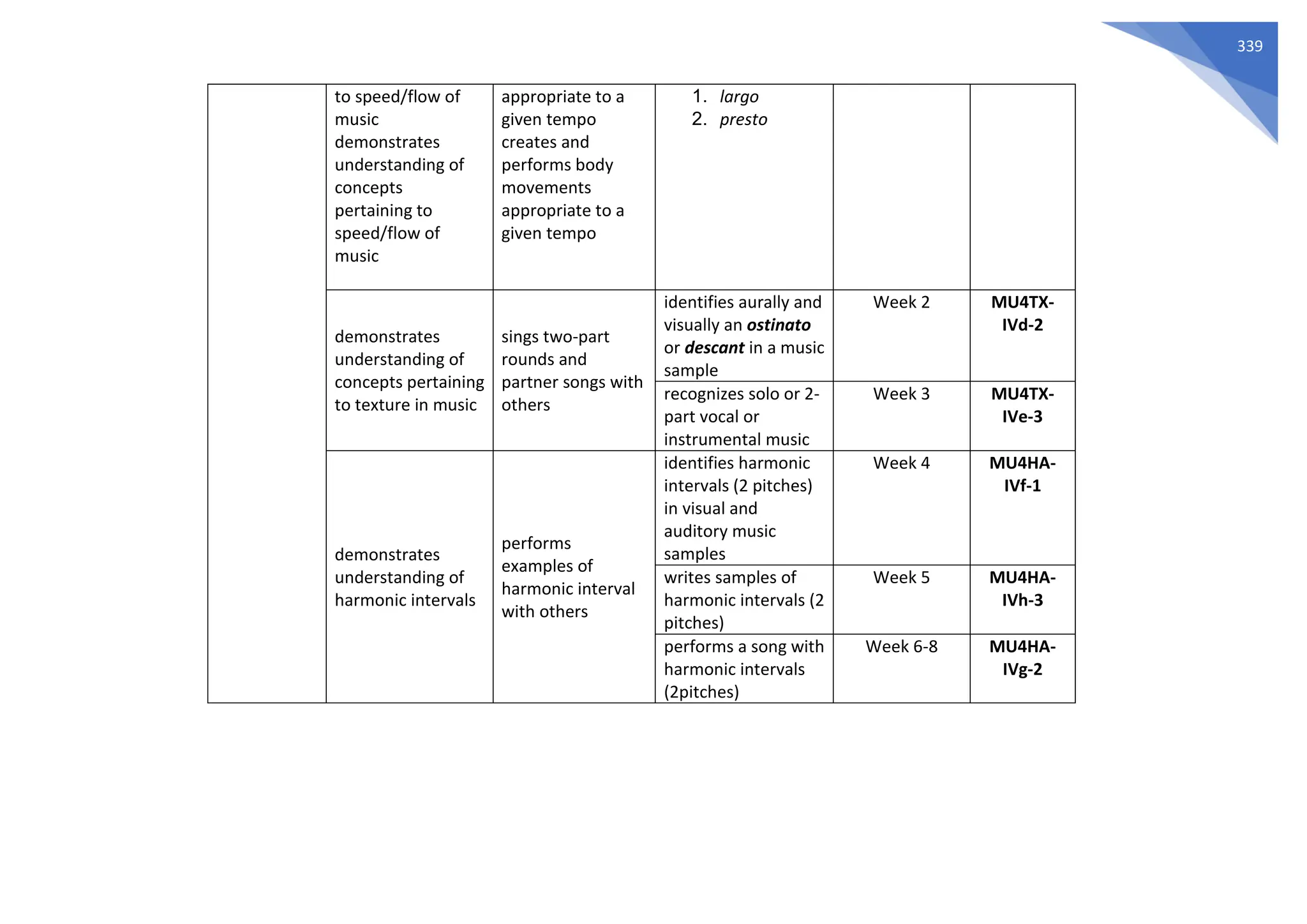
to speed/flow of
music
demonstrates
understanding of
concepts
pertaining to
speed/flow of
music
appropriate to a
given tempo
creates and
performs body
movements
appropriate to a
given tempo
1. largo
2. presto
demonstrates
understanding of
concepts pertaining
to texture in music
sings two-part
rounds and
partner songs with
others
identifies aurally and
visually an ostinato
or descant in a music
sample
Week 2 MU4TX-
IVd-2
recognizes solo or 2-
part vocal or
instrumental music
Week 3 MU4TX-
IVe-3
demonstrates
understanding of
harmonic intervals
performs
examples of
harmonic interval
with others
identifies harmonic
intervals (2 pitches)
in visual and
auditory music
samples
Week 4 MU4HA-
IVf-1
writes samples of
harmonic intervals (2
pitches)
Week 5 MU4HA-
IVh-3
performs a song with
harmonic intervals
(2pitches)
Week 6-8 MU4HA-
IVg-2
340
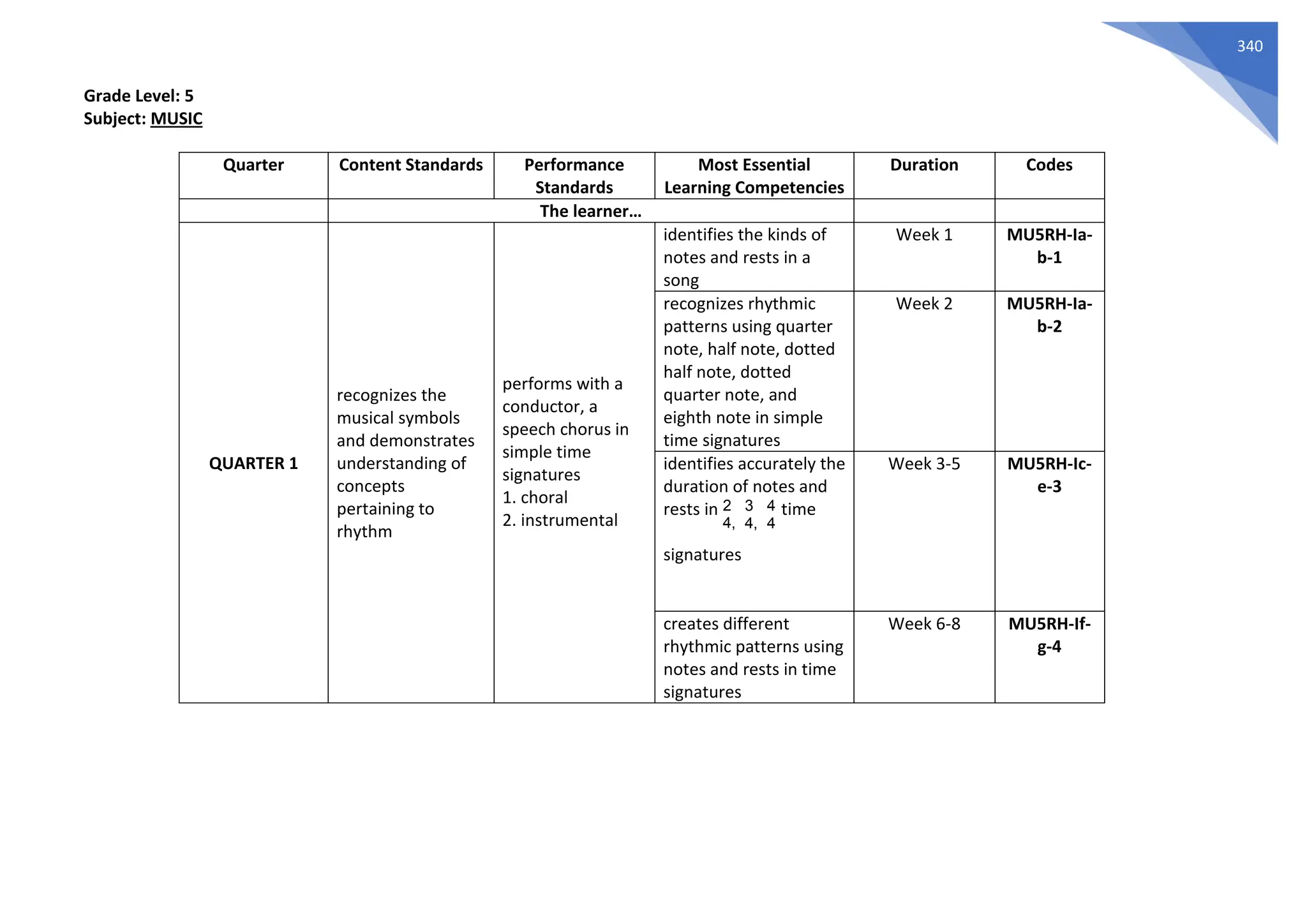
Grade Level: 5
Subject: MUSIC
Quarter Content Standards Performance
Standards
Most Essential
Learning Competencies
Duration Codes
The learner…
QUARTER 1
recognizes the
musical symbols
and demonstrates
understanding of
concepts
pertaining to
rhythm
performs with a
conductor, a
speech chorus in
simple time
signatures
1. choral
2. instrumental
identifies the kinds of
notes and rests in a
song
Week 1 MU5RH-Ia-
b-1
recognizes rhythmic
patterns using quarter
note, half note, dotted
half note, dotted
quarter note, and
eighth note in simple
time signatures
Week 2 MU5RH-Ia-
b-2
identifies accurately the
duration of notes and
rests in time
signatures
Week 3-5 MU5RH-Ic-
e-3
creates different
rhythmic patterns using
notes and rests in time
signatures
Week 6-8 MU5RH-If-
g-4
3
4,
2
4,
4
4
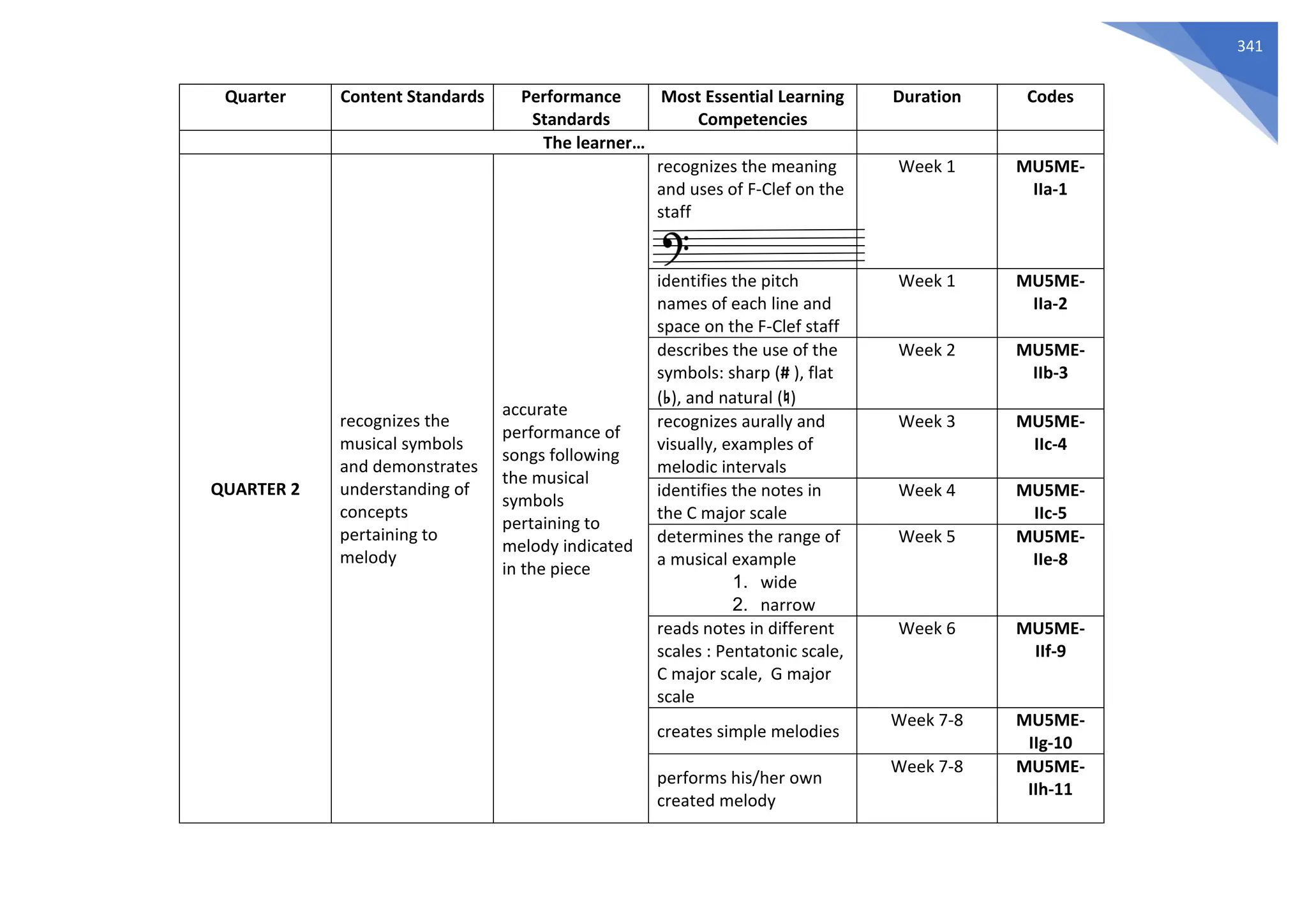
341
Quarter Content Standards Performance
Standards
Most Essential Learning
Competencies
Duration Codes
The learner…
QUARTER 2
recognizes the
musical symbols
and demonstrates
understanding of
concepts
pertaining to
melody
accurate
performance of
songs following
the musical
symbols
pertaining to
melody indicated
in the piece
recognizes the meaning
and uses of F-Clef on the
staff
Week 1 MU5ME-
IIa-1
identifies the pitch
names of each line and
space on the F-Clef staff
Week 1 MU5ME-
IIa-2
describes the use of the
symbols: sharp (# ), flat
(♭), and natural (♮)
Week 2 MU5ME-
IIb-3
recognizes aurally and
visually, examples of
melodic intervals
Week 3 MU5ME-
IIc-4
identifies the notes in
the C major scale
Week 4 MU5ME-
IIc-5
determines the range of
a musical example
1. wide
2. narrow
Week 5 MU5ME-
IIe-8
reads notes in different
scales : Pentatonic scale,
C major scale, G major
scale
Week 6 MU5ME-
IIf-9
creates simple melodies
Week 7-8 MU5ME-
IIg-10
performs his/her own
created melody
Week 7-8 MU5ME-
IIh-11
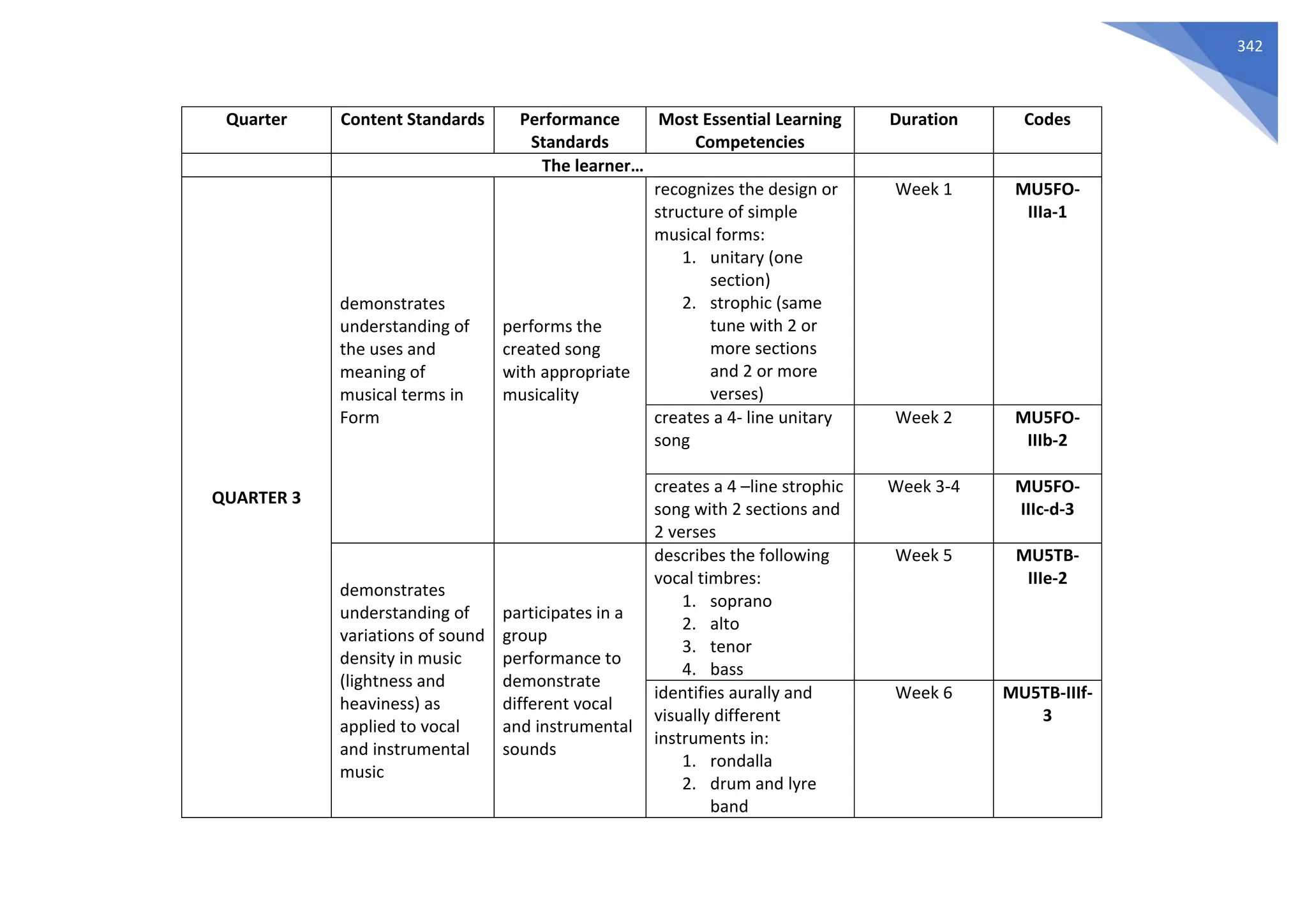
342
Quarter Content Standards Performance
Standards
Most Essential Learning
Competencies
Duration Codes
The learner…
QUARTER 3
demonstrates
understanding of
the uses and
meaning of
musical terms in
Form
performs the
created song
with appropriate
musicality
recognizes the design or
structure of simple
musical forms:
1. unitary (one
section)
2. strophic (same
tune with 2 or
more sections
and 2 or more
verses)
Week 1 MU5FO-
IIIa-1
creates a 4- line unitary
song
Week 2 MU5FO-
IIIb-2
creates a 4 –line strophic
song with 2 sections and
2 verses
Week 3-4 MU5FO-
IIIc-d-3
demonstrates
understanding of
variations of sound
density in music
(lightness and
heaviness) as
applied to vocal
and instrumental
music
participates in a
group
performance to
demonstrate
different vocal
and instrumental
sounds
describes the following
vocal timbres:
1. soprano
2. alto
3. tenor
4. bass
Week 5 MU5TB-
IIIe-2
identifies aurally and
visually different
instruments in:
1. rondalla
2. drum and lyre
band
Week 6 MU5TB-IIIf-
3
343
3. bamboo
group/ensemble
(Pangkat
Kawayan)
4. other local
indigenous
ensembles
creates music using
available sound sources
Week 7-8 MU5TB-
IIIg-h-5
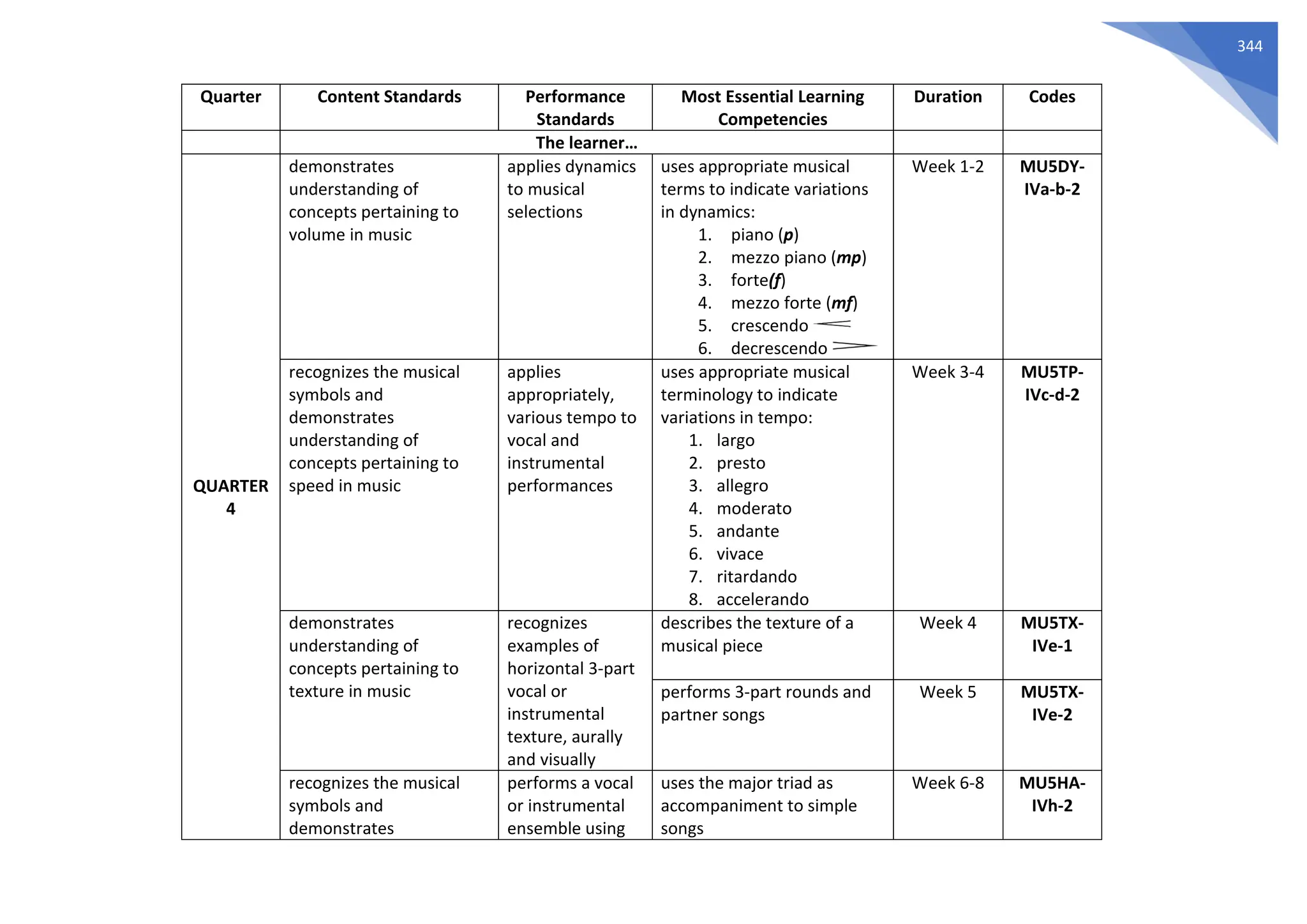
344
Quarter Content Standards Performance
Standards
Most Essential Learning
Competencies
Duration Codes
The learner…
QUARTER
4
demonstrates
understanding of
concepts pertaining to
volume in music
applies dynamics
to musical
selections
uses appropriate musical
terms to indicate variations
in dynamics:
1. piano (p)
2. mezzo piano (mp)
3. forte(f)
4. mezzo forte (mf)
5. crescendo
6. decrescendo
Week 1-2 MU5DY-
IVa-b-2
recognizes the musical
symbols and
demonstrates
understanding of
concepts pertaining to
speed in music
applies
appropriately,
various tempo to
vocal and
instrumental
performances
uses appropriate musical
terminology to indicate
variations in tempo:
1. largo
2. presto
3. allegro
4. moderato
5. andante
6. vivace
7. ritardando
8. accelerando
Week 3-4 MU5TP-
IVc-d-2
demonstrates
understanding of
concepts pertaining to
texture in music
recognizes
examples of
horizontal 3-part
vocal or
instrumental
texture, aurally
and visually
describes the texture of a
musical piece
Week 4 MU5TX-
IVe-1
performs 3-part rounds and
partner songs
Week 5 MU5TX-
IVe-2
recognizes the musical
symbols and
demonstrates
performs a vocal
or instrumental
ensemble using
uses the major triad as
accompaniment to simple
songs
Week 6-8 MU5HA-
IVh-2
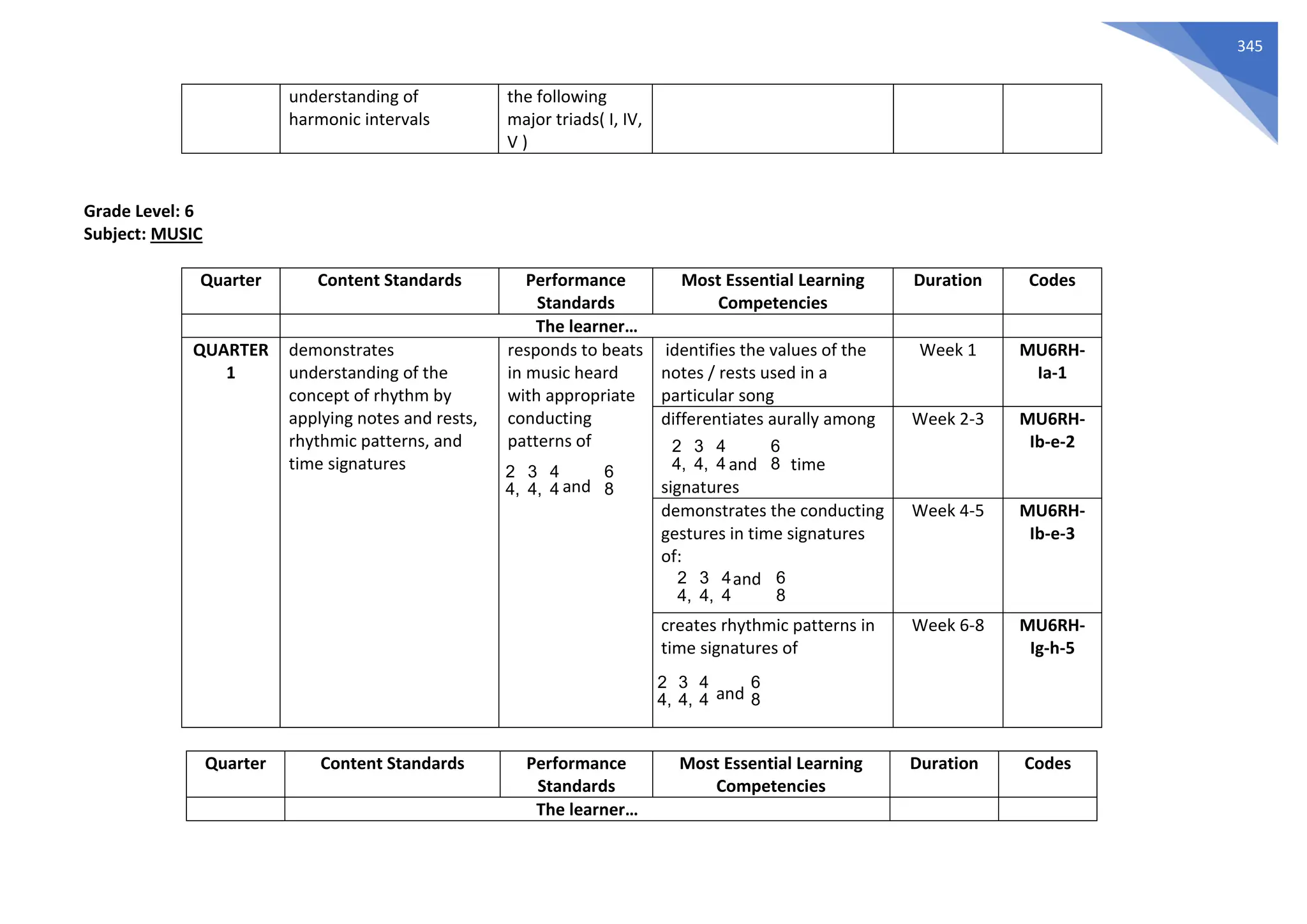
345
understanding of
harmonic intervals
the following
major triads( I, IV,
V )
Grade Level: 6
Subject: MUSIC
Quarter Content Standards Performance
Standards
Most Essential Learning
Competencies
Duration Codes
The learner…
QUARTER
1
demonstrates
understanding of the
concept of rhythm by
applying notes and rests,
rhythmic patterns, and
time signatures
responds to beats
in music heard
with appropriate
conducting
patterns of
and
identifies the values of the
notes / rests used in a
particular song
Week 1 MU6RH-
Ia-1
differentiates aurally among
and time
signatures
Week 2-3 MU6RH-
Ib-e-2
demonstrates the conducting
gestures in time signatures
of:
and
Week 4-5 MU6RH-
Ib-e-3
creates rhythmic patterns in
time signatures of
and
Week 6-8 MU6RH-
Ig-h-5
Quarter Content Standards Performance
Standards
Most Essential Learning
Competencies
Duration Codes
The learner…
3
4,
2
4,
4
4
6
8
3
4,
2
4,
4
4
6
8
3
4,
2
4,
4
4
6
8
3
4,
2
4,
4
4
6
8
346
QUARTER
2
demonstrates the
concept of melody by
using intervals in major
scales and in the minor
scales
applies learned
concepts of
melody and other
elements to
composition and
performance
reads simple musical
notations in the Key of C
Major, F Major and G Major
Week 1-2 MU6ME-
IIa-1
sings or plays instruments in
solo or with group,
melodies/songs in C Major,
G Major, and F Major
Week 3-4 MU6ME-
IIa-3
creates simple melodies Week 5-6 MU6ME-
IIa-4
sings self-composed
melodies
Week 7-8 MU6ME-
IIa-5
Quarter Content Standards Performance
Standards
Most Essential Learning
Competencies
Duration Codes
The learner…
QUARTER
3
demonstrates
understanding of the
concept of musical forms
and musical symbols
(repeat marks) indicated
performs
accurately the
design or
structure of a
given musical
piece
identifies simple musical
forms of songs from the
community:
1. binary (AB) -has 2
contrasting
sections (AB)
2. ternary (ABA)-has
3 sections, the
third section
similar to the first;
(ABC) – has 3
sections
3. rondo (ABACA) -
has contrasting
sections in
between
Week 1-2 MU6FO-
IIIa-b-1
347
repetitions of the
A section (ABACA)
uses the different repeat
marks that are related to
form:
1. Da Capo (D.C.)
2. Dal Segno (D.S.)
3. Al Fine (up to the
end)
4. D.C. al Fine (repeat
from the beginning
until the word
Fine)
5. ║: :║
6. ┌───┐┌───┐
1 2
(ending 1, ending 2)
Week 3 MU6FO-
IIIc-3
demonstrates
understanding of the
concept of timbre
through recognizing
musical instruments
aurally and visually
aurally
determines the
sound of a single
instrument in any
section of the
orchestra
describes the instrumental
sections of the Western
orchestra
Week 4 MU6TB-
IIId-1
distinguishes various musical
ensembles seen and heard in
the community
Week 5 MU6TB-
IIId-e-2
demonstrates
understanding of the
concept of dynamics
through a wide variety of
dynamic levels
applies the
appropriate
dynamic levels in
vocal and
instrumental
music
uses varied dynamics in a
song performance
1. piano (p)
2. mezzo piano (mp)
3. pianissimo (pp)
4. forte (f)
5. mezzo forte (mf)
6. fortissimo (ff)
7. crescendo
Week 6-8 MU6DY-
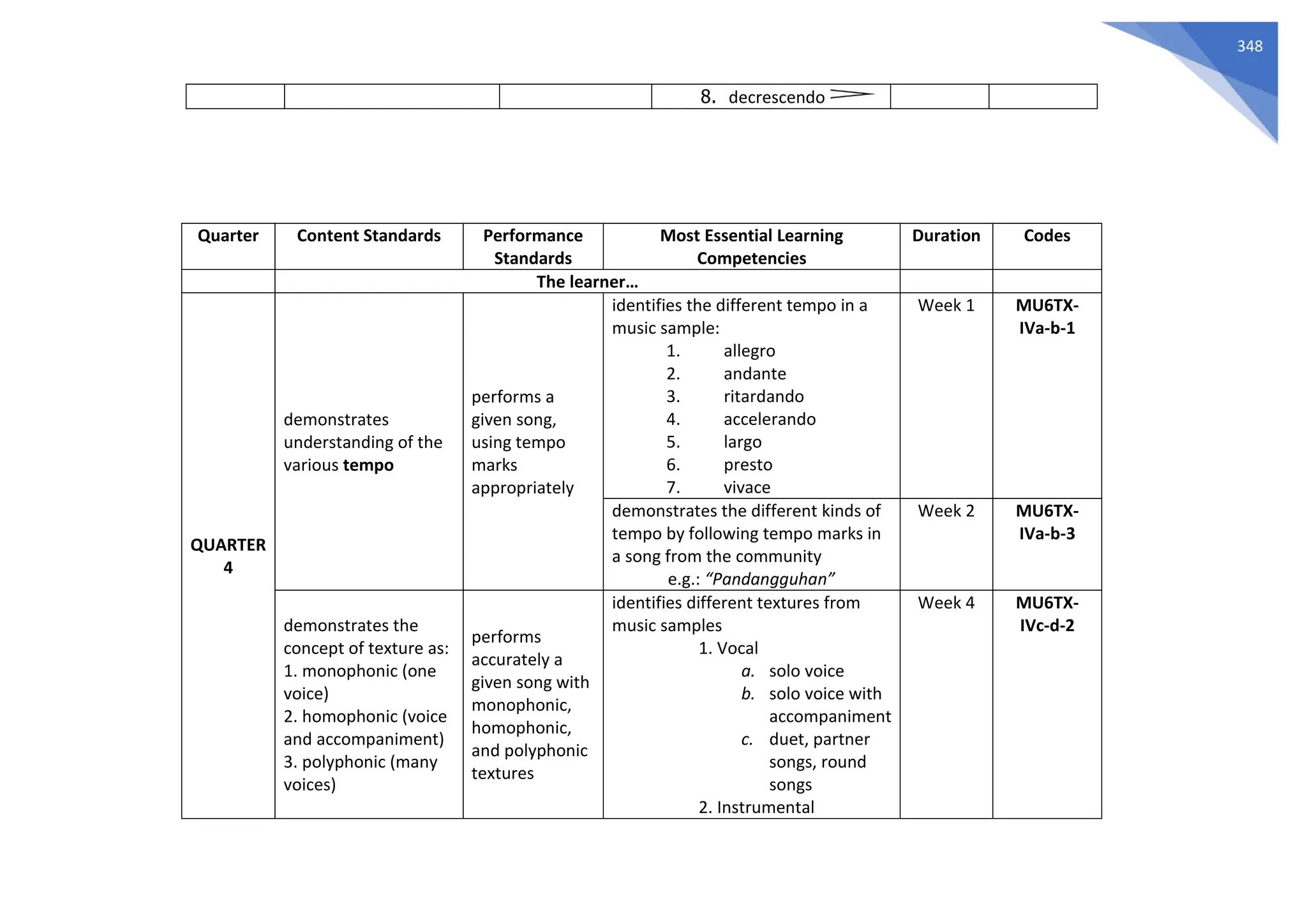
IIIh-2
348
8. decrescendo
Quarter Content Standards Performance
Standards
Most Essential Learning
Competencies
Duration Codes
The learner…
QUARTER
4
demonstrates
understanding of the
various tempo
performs a
given song,
using tempo
marks
appropriately
identifies the different tempo in a
music sample:
1. allegro
2. andante
3. ritardando
4. accelerando
5. largo
6. presto
7. vivace
Week 1 MU6TX-
IVa-b-1
demonstrates the different kinds of
tempo by following tempo marks in
a song from the community
e.g.: “Pandangguhan”
Week 2 MU6TX-
IVa-b-3
demonstrates the
concept of texture as:
1. monophonic (one
voice)
2. homophonic (voice
and accompaniment)
3. polyphonic (many
voices)
performs
accurately a
given song with
monophonic,
homophonic,
and polyphonic
textures
identifies different textures from
music samples
1. Vocal
a. solo voice
b. solo voice with
accompaniment
c. duet, partner
songs, round
songs
2. Instrumental
Week 4 MU6TX-
IVc-d-2
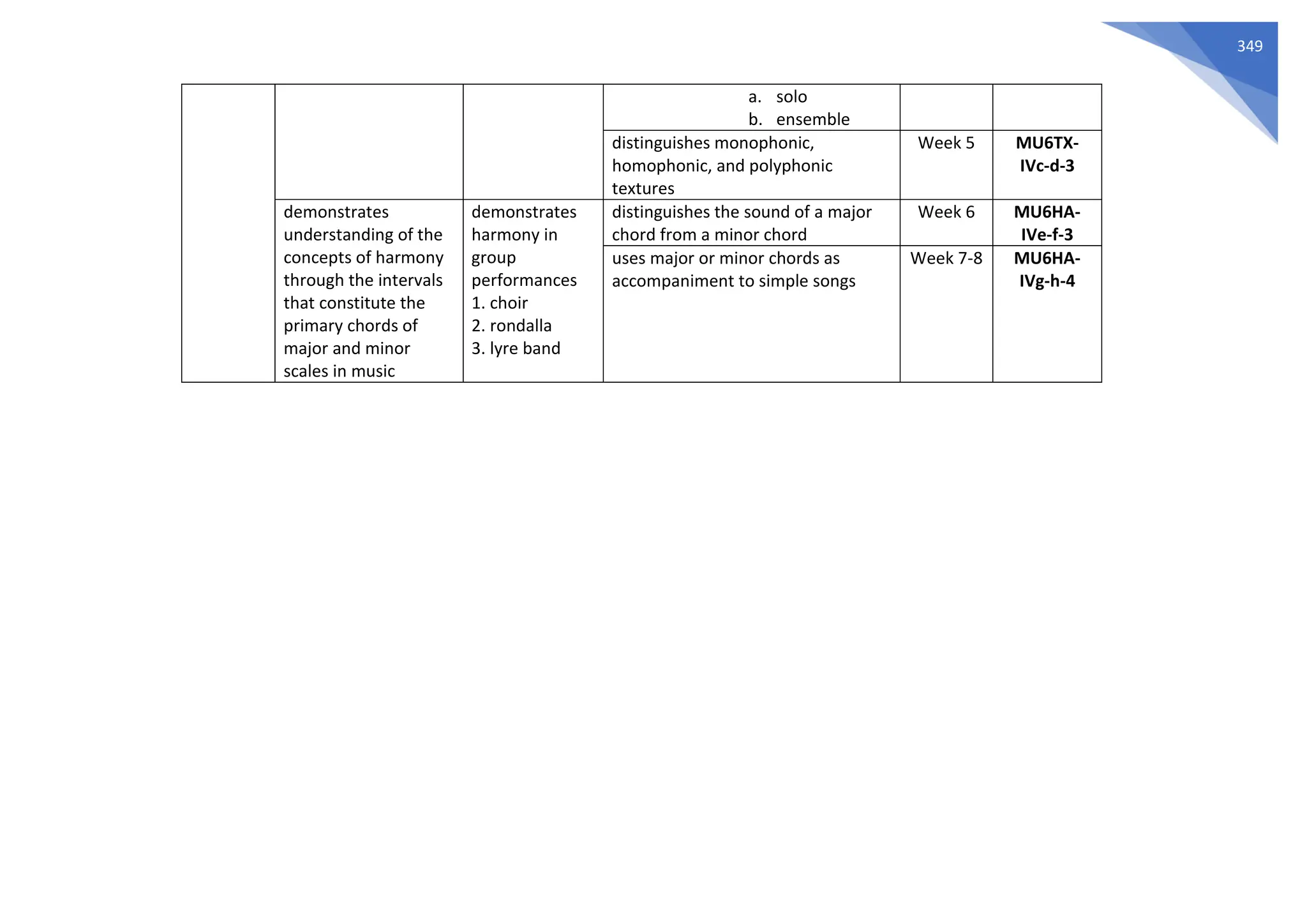
349
a. solo
b. ensemble
distinguishes monophonic,
homophonic, and polyphonic
textures
Week 5 MU6TX-
IVc-d-3
demonstrates
understanding of the
concepts of harmony
through the intervals
that constitute the
primary chords of
major and minor
scales in music
demonstrates
harmony in
group
performances
1. choir
2. rondalla
3. lyre band
distinguishes the sound of a major
chord from a minor chord
Week 6 MU6HA-
IVe-f-3
uses major or minor chords as
accompaniment to simple songs
Week 7-8 MU6HA-
IVg-h-4
350
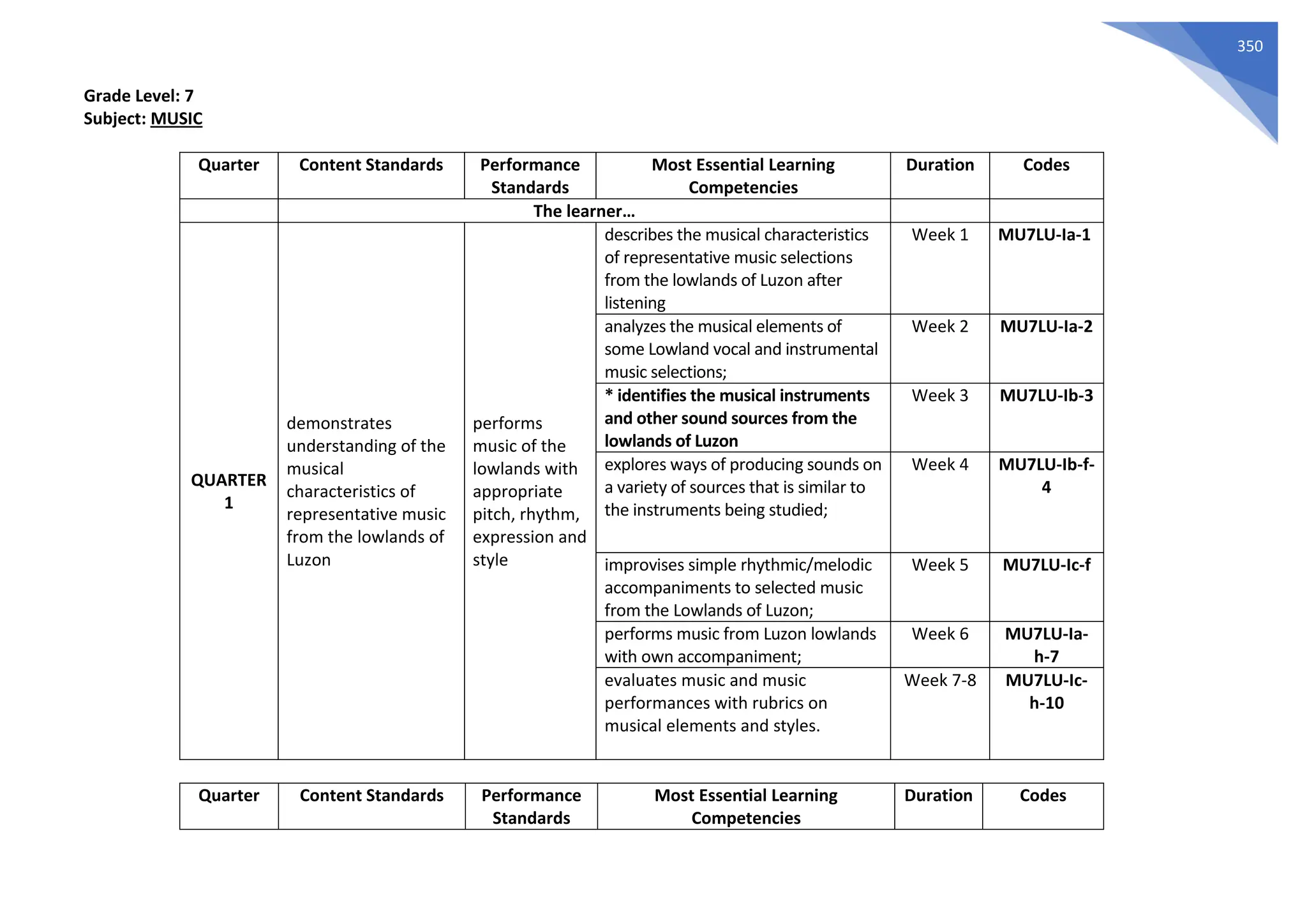
Grade Level: 7
Subject: MUSIC
Quarter Content Standards Performance
Standards
Most Essential Learning
Competencies
Duration Codes
The learner…
QUARTER
1
demonstrates
understanding of the
musical
characteristics of
representative music
from the lowlands of
Luzon
performs
music of the
lowlands with
appropriate
pitch, rhythm,
expression and
style
describes the musical characteristics
of representative music selections
from the lowlands of Luzon after
listening
Week 1 MU7LU-Ia-1
analyzes the musical elements of
some Lowland vocal and instrumental
music selections;
Week 2 MU7LU-Ia-2
* identifies the musical instruments
and other sound sources from the
lowlands of Luzon
Week 3 MU7LU-Ib-3
explores ways of producing sounds on
a variety of sources that is similar to
the instruments being studied;
Week 4 MU7LU-Ib-f-
4
improvises simple rhythmic/melodic
accompaniments to selected music
from the Lowlands of Luzon;
Week 5 MU7LU-Ic-f
performs music from Luzon lowlands
with own accompaniment;
Week 6 MU7LU-Ia-
h-7
evaluates music and music
performances with rubrics on
musical elements and styles.
Week 7-8 MU7LU-Ic-
h-10
Quarter Content Standards Performance
Standards
Most Essential Learning
Competencies
Duration Codes
351
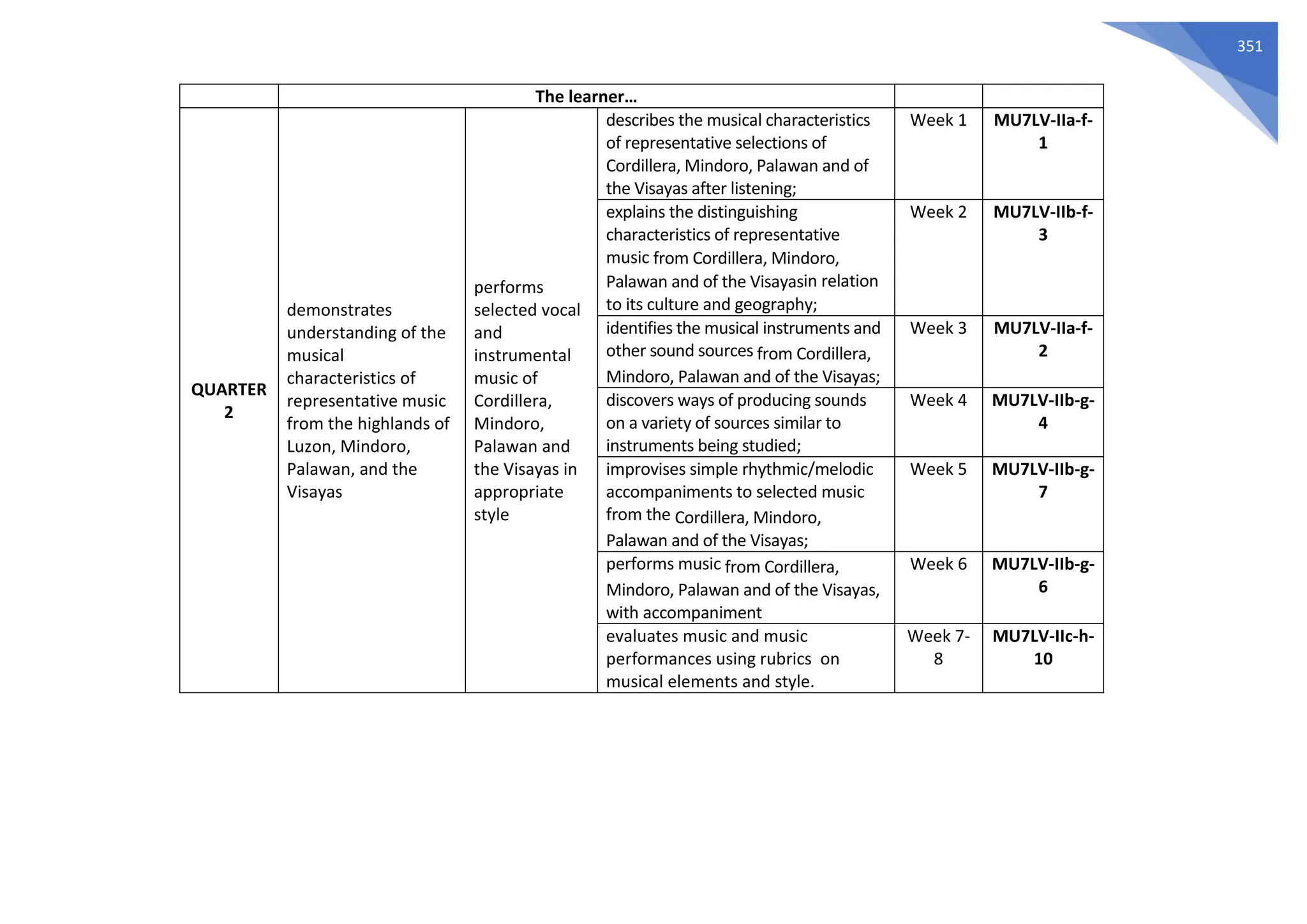
The learner…
QUARTER
2
demonstrates
understanding of the
musical
characteristics of
representative music
from the highlands of
Luzon, Mindoro,
Palawan, and the
Visayas
performs
selected vocal
and
instrumental
music of
Cordillera,
Mindoro,
Palawan and
the Visayas in
appropriate
style
describes the musical characteristics
of representative selections of
Cordillera, Mindoro, Palawan and of
the Visayas after listening;
Week 1 MU7LV-IIa-f-
1
explains the distinguishing
characteristics of representative
music from Cordillera, Mindoro,
Palawan and of the Visayasin relation
to its culture and geography;
Week 2 MU7LV-IIb-f-
3
identifies the musical instruments and
other sound sources from Cordillera,
Mindoro, Palawan and of the Visayas;
Week 3 MU7LV-IIa-f-
2
discovers ways of producing sounds
on a variety of sources similar to
instruments being studied;
Week 4 MU7LV-IIb-g-
4
improvises simple rhythmic/melodic
accompaniments to selected music
from the Cordillera, Mindoro,
Palawan and of the Visayas;
Week 5 MU7LV-IIb-g-
7
performs music from Cordillera,
Mindoro, Palawan and of the Visayas,
with accompaniment
Week 6 MU7LV-IIb-g-
6
evaluates music and music
performances using rubrics on
musical elements and style.
Week 7-
8
MU7LV-IIc-h-
10
352
Quarter Content Standards Performance
Standards
Most Essential Learning
Competencies
Duration Codes
The learner…
QUARTER
3
demonstrates
understanding of the
musical
characteristics of
representative music
from Mindanao
performs
music of
Mindanao with
appropriate
expression and
style
describes the musical characteristics
of representative music selections
from Mindanao after listening;
Week 1 MU7MN-IIIa-
g-1
identifies the musical instruments and
other sound sources of representative
music selections from Mindanao
Week 2 MU7MN-IIIa-
g-3
analyzes the musical elements of
some Mindanao vocal and
instrumental music;
Week 3 MU7MN-IIIa-
g-2
discovers ways of producing sounds
on a variety of sources that is similar
to the instruments being studied;
Week 4 MU7MN-IIIb-
h-4
improvises simple rhythmic/melodic
accompaniments to selected music
from Mindanao;
Week 5 MU7LV-IIIc-
h-5
perform music from Mindanao with
own accompaniment
Week 6 MU7LV-IIIc-
h-6
evaluates music selections and
music performances using rubrics on
musical elements and style.
Week 7-
8
MU7LV-IIIb-
h-10
Quarter Content Standards Performance
Standards
Most Essential Learning
Competencies
Duration Codes
The learner…
QUARTER
4
demonstrates
understanding of the
musical
characteristics of
performs
music of
Mindanao with
appropriate
identifies musical characteristics of
selected Philippine festivals and
theatrical forms through video or live
performances;
Week 1 MU7FT-IVa-
g-1
353
representative music
from Mindanao
expression and
style
describes the origins and cultural
background of selected Philippine
festival/s;
Week 2 MU7FT-IVa-
d-2
describes how the music contributes
to the performance of the musical
production;
Week 3 MU7FT-IVe-
h-4
describes how a specific idea or story
is communicated through music in a
particular Philippine musical theater
Week 4 MU7FT-IVe-
h-6
improvises music accompaniment in
relation to a particular Philippine
festival;
Week 5-
6
MU7FT-IVe-
h-4
performs selection/s from chosen
Philippine musical theater;
Week 7-
8
MU7FT-IVe-
h-7
354
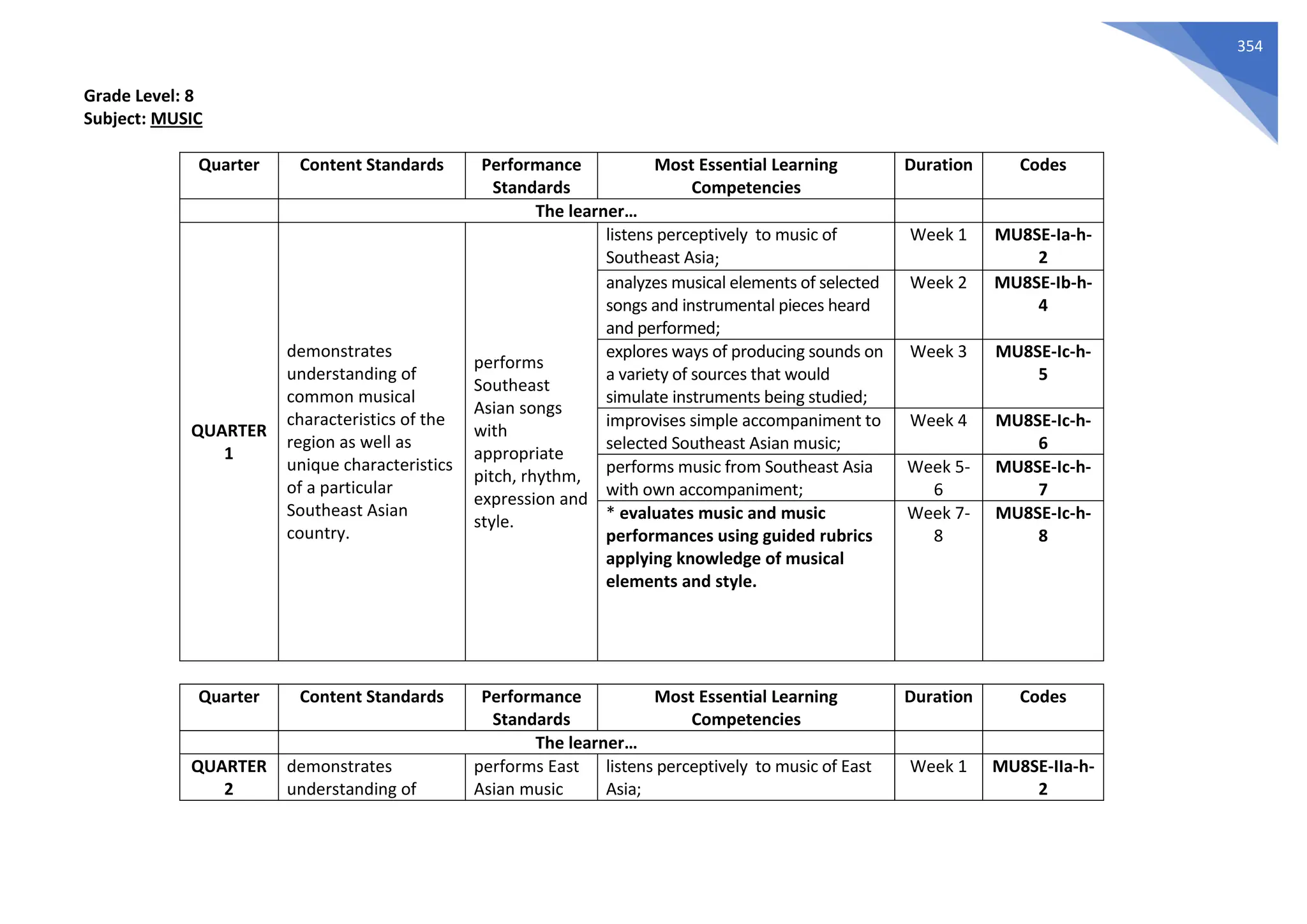
Grade Level: 8
Subject: MUSIC
Quarter Content Standards Performance
Standards
Most Essential Learning
Competencies
Duration Codes
The learner…
QUARTER
1
demonstrates
understanding of
common musical
characteristics of the
region as well as
unique characteristics
of a particular
Southeast Asian
country.
performs
Southeast
Asian songs
with
appropriate
pitch, rhythm,
expression and
style.
listens perceptively to music of
Southeast Asia;
Week 1 MU8SE-Ia-h-
2
analyzes musical elements of selected
songs and instrumental pieces heard
and performed;
Week 2 MU8SE-Ib-h-
4
explores ways of producing sounds on
a variety of sources that would
simulate instruments being studied;
Week 3 MU8SE-Ic-h-
5
improvises simple accompaniment to
selected Southeast Asian music;
Week 4 MU8SE-Ic-h-
6
performs music from Southeast Asia
with own accompaniment;
Week 5-
6
MU8SE-Ic-h-
7
* evaluates music and music
performances using guided rubrics
applying knowledge of musical
elements and style.
Week 7-
8
MU8SE-Ic-h-
8
Quarter Content Standards Performance
Standards
Most Essential Learning
Competencies
Duration Codes
The learner…
QUARTER
2
demonstrates
understanding of
performs East
Asian music
listens perceptively to music of East
Asia;
Week 1 MU8SE-IIa-h-
2
355
common and distinct
musical
characteristics of East
Asian countries
with
appropriate
pitch, rhythm,
expression and
style
analyzes musical elements of selected
songs and instrumental pieces heard
and performed;
Week 2 MU8SE-IIc-h-
4
explores ways of producing sounds on
a variety of sources that would
simulate instruments being studied;
Week 3 MU8SE-IIb-h-
5
improvises simple accompaniment to
selected East Asian music;
Week 4 MU8SE-IIc-h-
6
* performs music from East Asia with
own accompaniment;
Week 5-
6
MU8SE-IIb-h-
7
evaluates music and music
performances using guided rubrics
applying knowledge of musical
elements and style.
Week 7-
8
MU8SE-IIb-h-
8
Quarter Content Standards Performance
Standards
Most Essential Learning
Competencies
Duration Codes
The learner…
QUARTER
3
demonstrates an
understanding of
common and distinct
musical
characteristics of
South Asia and the
Middle East.
performs
South Asia and
the Middle
East music
with
appropriate
pitch, rhythm,
expression and
style.
listens perceptively to music of South
Asia and the Middle East;
Week 1 MU8WS-
IIIa-h-2
analyzes musical elements of selected
songs and instrumental pieces heard
and performed;
Week 2 MU8WS-
IIIc-h-4
explores ways of producing sounds on a
variety of sources that would simulate
instruments being studied;
Week 3 MU8WS-
IIIc-h-5
improvises simple accompaniment to
selected South Asia and the Middle
East music;
Week 4 MU8WS-
IIIb-h-6
356
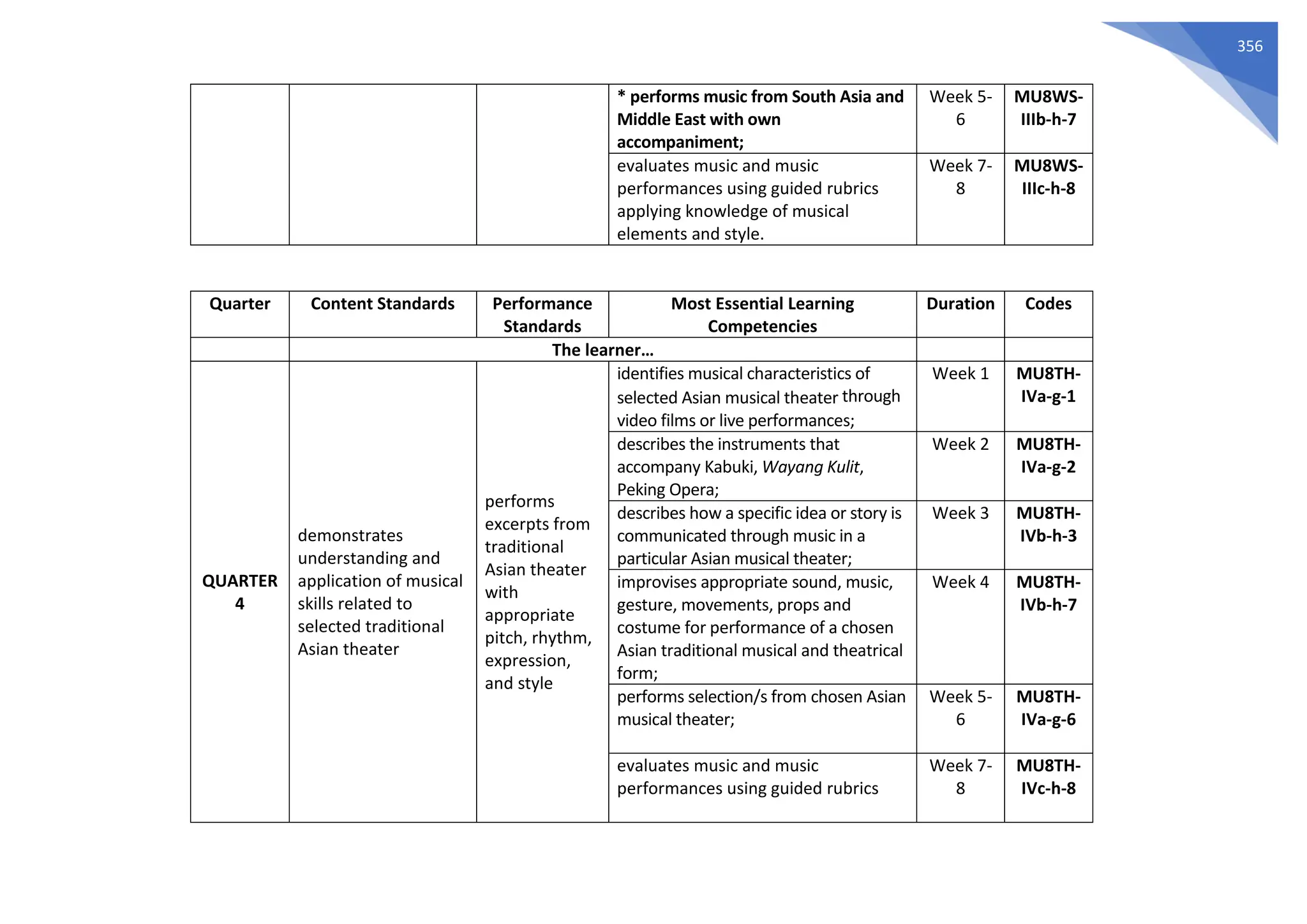
* performs music from South Asia and
Middle East with own
accompaniment;
Week 5-
6
MU8WS-
IIIb-h-7
evaluates music and music
performances using guided rubrics
applying knowledge of musical
elements and style.
Week 7-
8
MU8WS-
IIIc-h-8
Quarter Content Standards Performance
Standards
Most Essential Learning
Competencies
Duration Codes
The learner…
QUARTER
4
demonstrates
understanding and
application of musical
skills related to
selected traditional
Asian theater
performs
excerpts from
traditional
Asian theater
with
appropriate
pitch, rhythm,
expression,
and style
identifies musical characteristics of
selected Asian musical theater through
video films or live performances;
Week 1 MU8TH-
IVa-g-1
describes the instruments that
accompany Kabuki, Wayang Kulit,
Peking Opera;
Week 2 MU8TH-
IVa-g-2
describes how a specific idea or story is
communicated through music in a
particular Asian musical theater;
Week 3 MU8TH-
IVb-h-3
improvises appropriate sound, music,
gesture, movements, props and
costume for performance of a chosen
Asian traditional musical and theatrical
form;
Week 4 MU8TH-
IVb-h-7
performs selection/s from chosen Asian
musical theater;
Week 5-
6
MU8TH-
IVa-g-6
evaluates music and music
performances using guided rubrics
Week 7-
8
MU8TH-
IVc-h-8
357
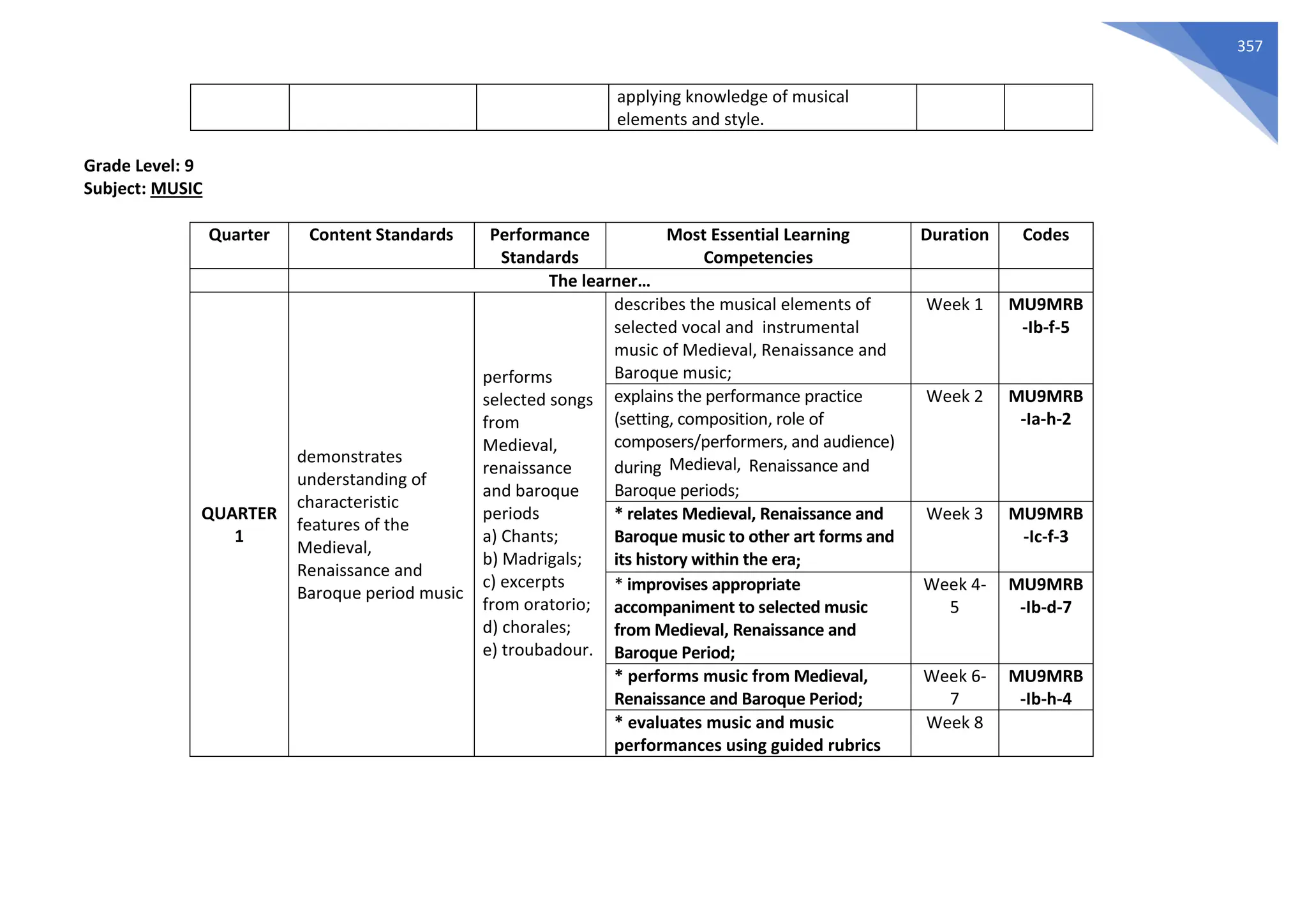
applying knowledge of musical
elements and style.
Grade Level: 9
Subject: MUSIC
Quarter Content Standards Performance
Standards
Most Essential Learning
Competencies
Duration Codes
The learner…
QUARTER
1
demonstrates
understanding of
characteristic
features of the
Medieval,
Renaissance and
Baroque period music
performs
selected songs
from
Medieval,
renaissance
and baroque
periods
a) Chants;
b) Madrigals;
c) excerpts
from oratorio;
d) chorales;
e) troubadour.
describes the musical elements of
selected vocal and instrumental
music of Medieval, Renaissance and
Baroque music;
Week 1 MU9MRB
-Ib-f-5
explains the performance practice
(setting, composition, role of
composers/performers, and audience)
during Medieval, Renaissance and
Baroque periods;
Week 2 MU9MRB
-Ia-h-2
* relates Medieval, Renaissance and
Baroque music to other art forms and
its history within the era;
Week 3 MU9MRB
-Ic-f-3
* improvises appropriate
accompaniment to selected music
from Medieval, Renaissance and
Baroque Period;
Week 4-
5
MU9MRB
-Ib-d-7
* performs music from Medieval,
Renaissance and Baroque Period;
Week 6-
7
MU9MRB
-Ib-h-4
* evaluates music and music
performances using guided rubrics
Week 8
358
Quarter Content Standards Performance
Standards
Most Essential Learning
Competencies
Duration Codes
The learner…
QUARTER
2
demonstrates
understanding of
characteristic features
of Classical period
music
demonstrates
understanding of
characteristic features
of Classical period
music
sings and
performs
themes of
symphonies
and other
instrumental
forms sings
and performs
themes of
symphonies
and other
instrumental
forms
describes musical elements of given
Classical period pieces;
Week 1 MU9CL-
IIa-f-1
explains the performance practice
(setting, composition, role of
composers/performers, and audience)
during Classical Period
Week 2 MU9CL-
IIa-f-3
relates Classical music to other art
forms and its history within the era;
Week 3 MU9CL-
IIa-f-2
improvises appropriate accompaniment
to selected music from Classical Period
Week 4-
5
MU9CL-
IIe-9
performs selected music from the
Classical period;
Week 6-
7
MU9CL-
IIb-h-7
evaluates music and music
performances using guided rubrics.
Week 8
Quarter Content Standards Performance
Standards
Most Essential Learning
Competencies
Duration Codes
The learner…
QUARTER
3
demonstrates
understanding of
characteristic features
of instrumental
Romantic music
sings and
performs
themes of
selected
instrumental
pieces
describes musical elements of given
Romantic period pieces;
Week 1 MU9RO-
IIIa-2
explains the performance practice
(setting, composition, role of
composers/performers, and audience)
during Romantic Period
Week 2 MU9RO-
IIIb-h-3
relates Romantic music to other art
forms and its history within the era;
Week 3 MU9RO-
IIIc-h-7
359
improvises appropriate accompaniment
to selected music from Romantic Period
Week 4-
5
MU9RO-
IIIc-h-8
performs selected music from the
Romantic period;
Week 6-
7
MU9RO-
IIIe-h-6
evaluates music and music
performances using guided rubrics.
Week 8
Quarter Content Standards Performance
Standards
Most Essential Learning
Competencies
Duration Codes
The learner…
QUARTER
4
demonstrates
understanding of
characteristic features
of vocal music of the
Romantic period
sings and
performs
themes of
selected songs
explains the plot, musical and
theatrical elements of an opera after
watching video samples;
Week 1-
2
MU9OP-
IVa-g-1
performs themes or melodic fragments
of given selected songs;
Week 3-
4
MU9OP-
IVb-h-3
improvises appropriate sounds, music,
gestures, movements, and costumes
for a chosen opera.
Week 5-
6
MU9OP-
IVb-h-5
evaluates music performances using
guided rubrics
Week 7-
8
360
Grade Level: 10
Subject: MUSIC
Quarter Content Standards Performance
Standards
Most Essential Learning
Competencies
Duration Codes
The learner…
QUARTER
1
demonstrates
understanding of 20th
century music styles
and characteristic
features.
creates
musical pieces
using
particular
style/s of the
20th Century.
describes distinctive musical elements
of given pieces in 20th century styles;
Week 1 MU10TC-
Ia-h-2
explains the performance practice
(setting, composition, role of
composers/performers, and audience)
of 20th century music;
Week 2-
3
MU10TC-
Ib-g-4
relates 20th Century music to other art
forms and media during the same time
period;
Week 4-
5
MU10TC-
Ia-g-3
performs music sample from the 20th
century
Week 5-
6
MU10TC-
Ib-5
evaluates music and music
performances using guided rubrics
Week 7-
8
Quarter Content Standards Performance
Standards
Most Essential Learning
Competencies
Duration Codes
The learner…
QUARTER
2
demonstrates
understanding of
characteristic features
of Afro-Latin
American music and
Popular music
performs vocal
and dance
forms of Afro-
Latin American
music and
describes the historical and cultural
background of Afro-Latin American
and popular music;
Week 1 MU10AP-
IIa-g-2
analyzes musical characteristics of Afro-
Latin American and popular music
through listening activities;
Week 2-
3
MU10AP-
IIa-h-5
361
selections of
Popular music
explores ways of creating sounds on a
variety of sources suitable to chosen
vocal and instrumental selections;
Week 4-
5
MU10AP-
IIa-7
performs selections of Afro-Latin
American and popular music in
appropriate pitch, rhythm, style, and
expression;
Week 6-
7
MU10AP-
IIa-h-6
evaluates music and music
performances using guided rubrics
Week 8 MU10AP-
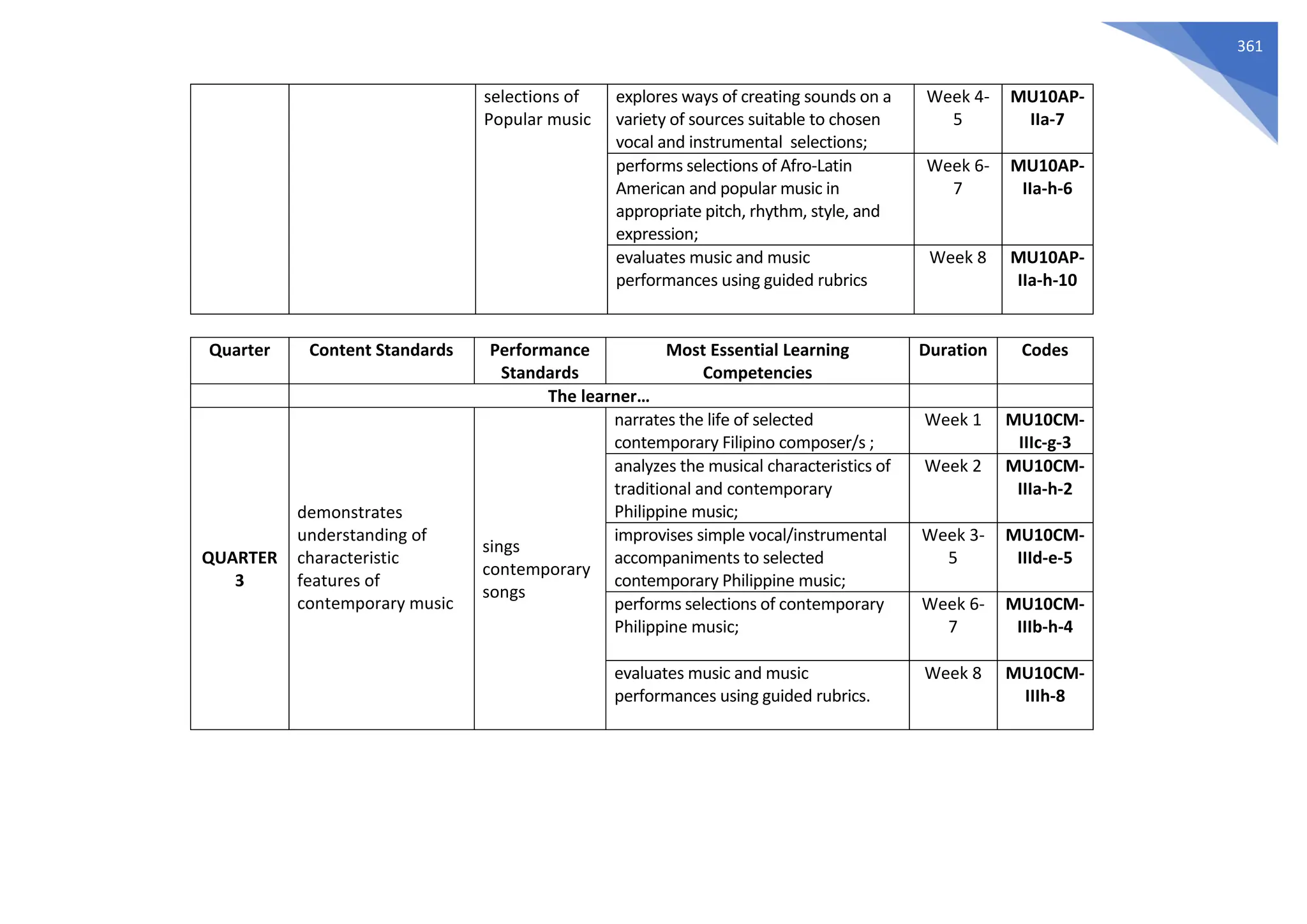
IIa-h-10
Quarter Content Standards Performance
Standards
Most Essential Learning
Competencies
Duration Codes
The learner…
QUARTER
3
demonstrates
understanding of
characteristic
features of
contemporary music
sings
contemporary
songs
narrates the life of selected
contemporary Filipino composer/s ;
Week 1 MU10CM-
IIIc-g-3
analyzes the musical characteristics of
traditional and contemporary
Philippine music;
Week 2 MU10CM-
IIIa-h-2
improvises simple vocal/instrumental
accompaniments to selected
contemporary Philippine music;
Week 3-
5
MU10CM-
IIId-e-5
performs selections of contemporary
Philippine music;
Week 6-
7
MU10CM-
IIIb-h-4
evaluates music and music
performances using guided rubrics.
Week 8 MU10CM-
IIIh-8
362
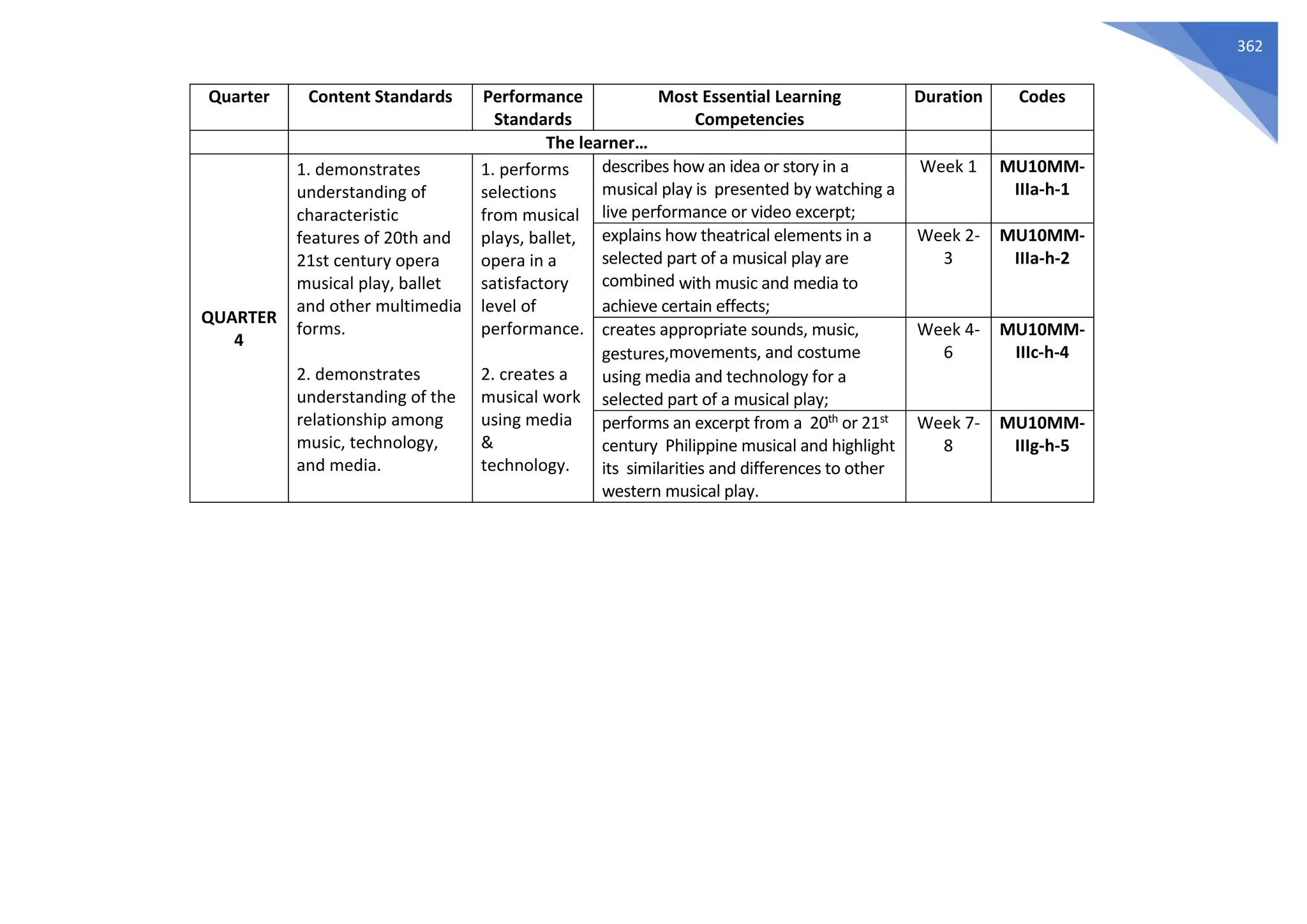
Quarter Content Standards Performance
Standards
Most Essential Learning
Competencies
Duration Codes
The learner…
QUARTER
4
1. demonstrates
understanding of
characteristic
features of 20th and
21st century opera
musical play, ballet
and other multimedia
forms.
2. demonstrates
understanding of the
relationship among
music, technology,
and media.
1. performs
selections
from musical
plays, ballet,
opera in a
satisfactory
level of
performance.
2. creates a
musical work
using media
&
technology.
describes how an idea or story in a
musical play is presented by watching a
live performance or video excerpt;
Week 1 MU10MM-
IIIa-h-1
explains how theatrical elements in a
selected part of a musical play are
combined with music and media to
achieve certain effects;
Week 2-
3
MU10MM-
IIIa-h-2
creates appropriate sounds, music,
gestures,movements, and costume
using media and technology for a
selected part of a musical play;
Week 4-
6
MU10MM-
IIIc-h-4
performs an excerpt from a 20th or 21st
century Philippine musical and highlight
its similarities and differences to other
western musical play.
Week 7-
8
MU10MM-
IIIg-h-5
363
364
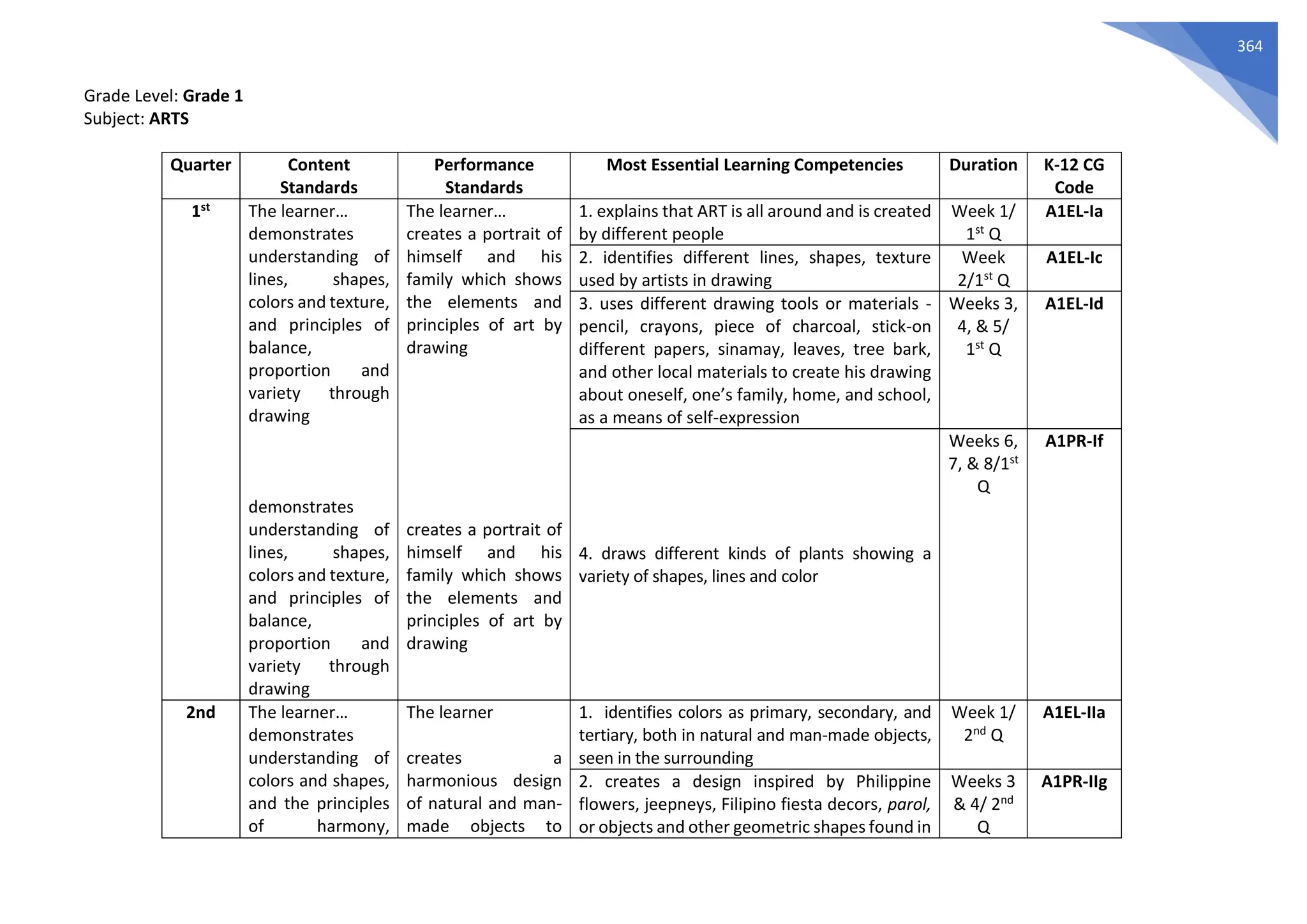
Grade Level: Grade 1
Subject: ARTS
Quarter Content
Standards
Performance
Standards
Most Essential Learning Competencies Duration K-12 CG
Code
1st The learner…
demonstrates
understanding of
lines, shapes,
colors and texture,
and principles of
balance,
proportion and
variety through
drawing
demonstrates
understanding of
lines, shapes,
colors and texture,
and principles of
balance,
proportion and
variety through
drawing
The learner…
creates a portrait of
himself and his
family which shows
the elements and
principles of art by
drawing
creates a portrait of
himself and his
family which shows
the elements and
principles of art by
drawing
1. explains that ART is all around and is created
by different people
Week 1/
1st Q
A1EL-Ia
2. identifies different lines, shapes, texture
used by artists in drawing
Week
2/1st Q
A1EL-Ic
3. uses different drawing tools or materials -
pencil, crayons, piece of charcoal, stick-on
different papers, sinamay, leaves, tree bark,
and other local materials to create his drawing
about oneself, one’s family, home, and school,
as a means of self-expression
Weeks 3,
4, & 5/
1st Q
A1EL-Id
4. draws different kinds of plants showing a
variety of shapes, lines and color
Weeks 6,
7, & 8/1st
Q
A1PR-If
2nd The learner…
demonstrates
understanding of
colors and shapes,
and the principles
of harmony,
The learner
creates a
harmonious design
of natural and man-
made objects to
1. identifies colors as primary, secondary, and
tertiary, both in natural and man-made objects,
seen in the surrounding
Week 1/
2nd Q
A1EL-IIa
2. creates a design inspired by Philippine
flowers, jeepneys, Filipino fiesta decors, parol,
or objects and other geometric shapes found in
Weeks 3
& 4/ 2nd
Q
A1PR-IIg
365
rhythm and
balance through
painting
demonstrates
understanding of
colors and shapes,
and the principles
of harmony,
rhythm and
balance through
painting
express ideas using
colors and shapes,
and harmony
creates a
harmonious design
of natural and man-
made objects to
express ideas using
colors and shapes,
and harmony
nature and in school using primary and
secondary colors
3. paints a home/school landscape or design
choosing specific colors to create a certain
feeling or mood
Weeks 5
& 6/ 2nd
Q
A1PR-Ie-1
4. talks about the landscape he painted and the
landscapes of others
Weeks 7
& 8/ 2nd
Q
A1PR-Ie-2
3rd demonstrates
understanding of
shapes and
texture and prints
that can be
repeated,
alternated and
emphasized
through
printmaking
demonstrates
understanding of
shapes and
texture and prints
that can be
repeated,
alternated and
emphasized
creates prints that
show repetition,
alternation and
emphasis using
objects from nature
and found objects at
home and in school
creates prints that
show repetition,
alternation and
emphasis using
objects from nature
1. differentiates between a print and a drawing
or painting
Week 1 /
3rd Q
A1EL-IIIa
2. describes the shape and texture of prints
made from objects found in nature and man-
made objects and from the artistically
designed prints in his artworks and in the
artworks of others.
Weeks 2
& 3 / 3rd
Q
A1EL-IIIb
3. creates a print by applying dyes on his finger
or palm or any part of the body and pressing it
to the paper, cloth, wall, etc. to create
impression
Week 4 /
3rd Q
A1EL-IIId
4. creates a print by rubbing pencil or crayon
on paper placed on top of a textured objects
from nature and found objects
Week 5 /
3rd Q
A1PL-IIIe
5. stencil a design (in recycled paper, plastic,
cardboard, leaves, and other materials) and
prints on paper, cloth, sinamay, bark, or a wall
Week 6 /
3rd Q
A1PR-IIIf
6. narrates experiences in experimenting
different art materials
Week 7 /
3rd Q
A1PR-IIIg
366
through
printmaking
and found objects at
home and in school
7. participates in school/district exhibit and
culminating activity in celebration of the
National Arts Month (February)
Week 8 /
3rd Q
A1PR-IIIh
Quarter Content
Standards
Performance
Standards
Most Essential Learning Competencies Duration K-12 CG
Code
4th The learner…
demonstrates
understanding of
texture and 3-D
shapes, and
principle of
proportion and
emphasis through
3-D works and
sculpture
demonstrates
understanding of
texture and 3-D
shapes, and
principle of
proportion and
emphasis through
3-D works and
sculpture
The learner
creates a useful 3-
Dimensional
object/sculpture
using found objects
and recycled
materials
creates a useful 3-
Dimensional
object/sculpture
using found objects
and recycled
materials
1. differentiates between 2-dimensional and 3-
dimensional artwork and states the difference
Week 1 /
4th Q
A1EL-IVa
2. identifies the different materials that can be
used in creating a 3-dimensional object:
2.1 clay or wood (human or animal figure)
2.2 bamboo (furniture, bahay kubo)
2.3 softwood (trumpo)
2.4 paper, cardboard, (masks)
2.5 found material (parol, sarangola)
Week 2
/4th Q
A1EL-IVb
Week 3 /
4th Q
A1EL-IVb
Week 4 /
4th Q
A1EL-IVb
3. creates 3D objects that are well
proportioned, balanced and show emphasis in
design, like any of the following: a pencil
holder, bowl, container, using recycled
materials like plastic bottles, etc.
Week 5-
6 / 4th Q
A1PR-IVe
4. creates masks, human figures out of
recyclable materials such as cardboards,
papers, baskets, leaves, strings, clay,
cardboard, glue, found materials, bilao, paper
plate, strings, seeds, flour-salt mixture, or
paper-mache, and other found materials
Week
7,8, & 9 /
4th Q
A1PR-IVf-
1
A1PR-IVg
A1PR-IVh
367
Grade Level: Grade 2
Subject: ARTS
Quarter Content
Standards
Performance
Standards
Most Essential Learning Competencies Duration K-12 CG
Code
1st The learner…
demonstrates
understanding on
lines, shapes, and
colors as
elements of art,
and variety,
proportion and
contrast as
principles of art
through drawing
The learner…
creates a
composition/design
by translating one’s
imagination or ideas
that others can see
and appreciates
1. describes the different styles of Filipino artists
when they create portraits and still life (different
lines and colors)
Week 1 /
1st Q
A2EL-Ia
2. differentiates the contrast between shapes
and colors of different fruits or plants and
flowers in one’s work and in the work of others
Week 2 /
1st Q
A2EL-Ib
3. draws the different fruits or plants to show
overlapping of shapes and the contrast of colors
and shapes in his colored drawing
Week 3
& 4 / 1st
Q
A2EL-Ic
4. draws from an actual still life arrangement
Week 5
& 6 / 1st
Q
A2EL-Id
5. draws a portrait of two or more persons - his
friends, his family, showing the differences in
the shape of their facial features (shape of
eyes, nose, lips, head, and texture of the hair
Week 7
& 8 / 1st
Q
A2EL-If
6. narrates stories related to the output
Week 8 /
1st Q A2EL-Ih-
3
2nd The learner…
demonstrates
understanding of
using two or more
kinds of lines,
colors and shapes
The learner…
creates a
composition or
design of a tricycle or
jeepney that shows
unity and variety of
1. describes the lines, shapes, colors, textures,
and designs seen in the skin coverings of
different animals and sea creatures using visual
arts words and actions.
Weeks 1
& 2 / 2nd
Q A2EL-IIa
2. designs with the use of drawing and painting
materials the sea or forest animals in their
habitats showing their unique shapes and
Weeks 3
& 4 / 2nd
Q
A2EL-IIb
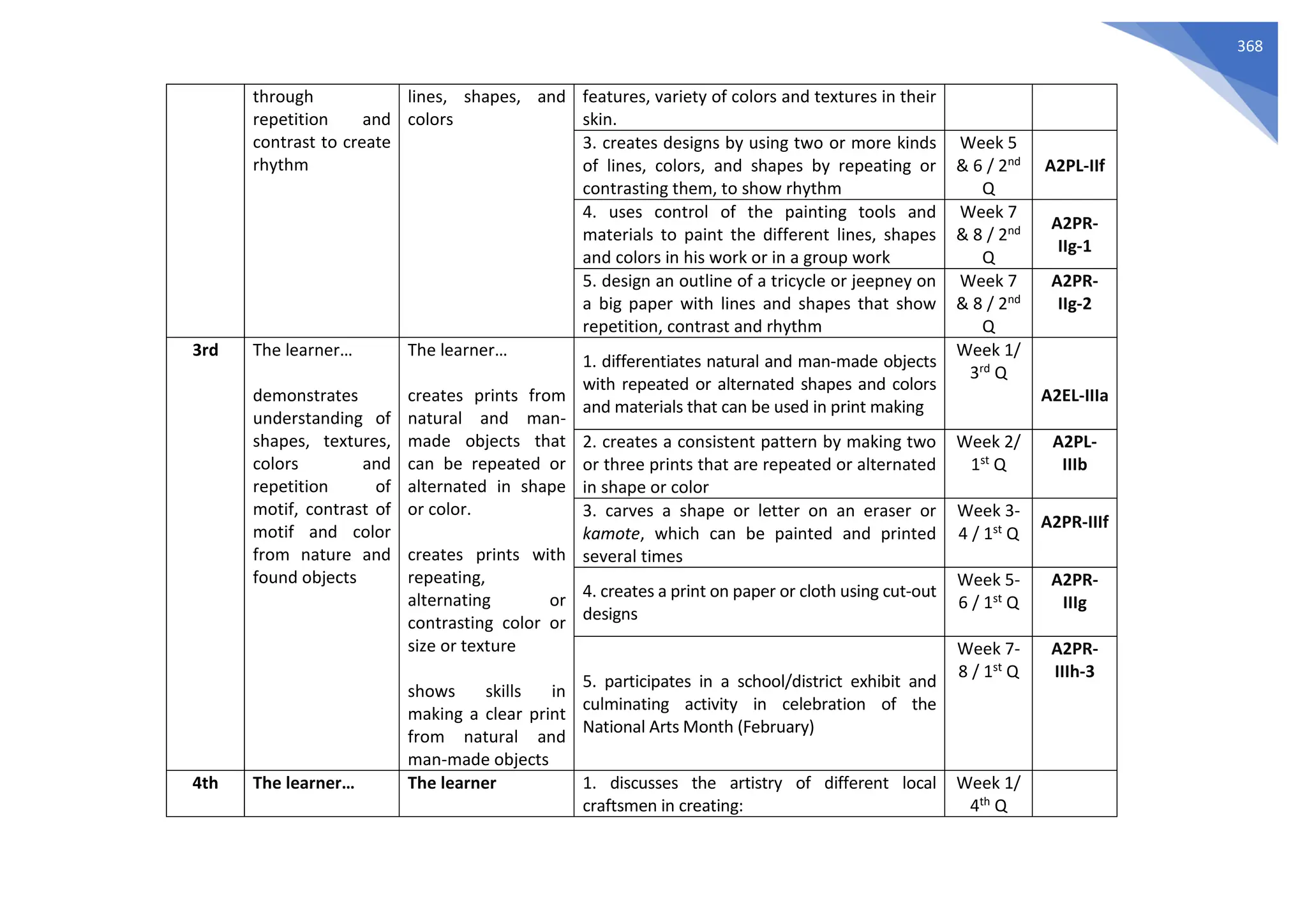
368
through
repetition and
contrast to create
rhythm
lines, shapes, and
colors
features, variety of colors and textures in their
skin.
3. creates designs by using two or more kinds
of lines, colors, and shapes by repeating or
contrasting them, to show rhythm
Week 5
& 6 / 2nd
Q
A2PL-IIf
4. uses control of the painting tools and
materials to paint the different lines, shapes
and colors in his work or in a group work
Week 7
& 8 / 2nd
Q
A2PR-
IIg-1
5. design an outline of a tricycle or jeepney on
a big paper with lines and shapes that show
repetition, contrast and rhythm
Week 7
& 8 / 2nd
Q
A2PR-
IIg-2
3rd The learner…
demonstrates
understanding of
shapes, textures,
colors and
repetition of
motif, contrast of
motif and color
from nature and
found objects
The learner…
creates prints from
natural and man-
made objects that
can be repeated or
alternated in shape
or color.
creates prints with
repeating,
alternating or
contrasting color or
size or texture
shows skills in
making a clear print
from natural and
man-made objects
1. differentiates natural and man-made objects
with repeated or alternated shapes and colors
and materials that can be used in print making
Week 1/
3rd Q
A2EL-IIIa
2. creates a consistent pattern by making two
or three prints that are repeated or alternated
in shape or color
Week 2/
1st Q
A2PL-
IIIb
3. carves a shape or letter on an eraser or
kamote, which can be painted and printed
several times
Week 3-
4 / 1st Q
A2PR-IIIf
4. creates a print on paper or cloth using cut-out
designs
Week 5-
6 / 1st Q
A2PR-
IIIg
5. participates in a school/district exhibit and
culminating activity in celebration of the
National Arts Month (February)
Week 7-
8 / 1st Q
A2PR-
IIIh-3
4th The learner… The learner 1. discusses the artistry of different local
craftsmen in creating:
Week 1/
4th Q
369
demonstrates
understanding of
shapes, texture,
proportion and
balance through
sculpture and 3-
dimensional
crafts
demonstrates
understanding of
shapes, texture,
proportion and
balance through
sculpture and 3-
dimensional
crafts
creates a 3-
dimensional free-
standing, balanced
figure using
different materials
(found materials,
recycled, local or
manufactured)
creates a 3-
dimensional free-
standing, balanced
figure using
different materials
(found materials,
recycled, local or
manufactured)
creates a 3-
dimensional free-
standing, balanced
figure using
different materials
(found materials,
recycled, local or
manufactured)
1.1 taka of different animals and figures in
Paete, Laguna
1.2 sarangola or kites
1.3 banca, native boats from Cavite, and
coastal towns
A2EL-
IVa-1
2. Answers a brief diagnostic assessment on
giving value and importance to the craftmanship
of local artists.
Week 2/
1st Q
A2EL-
IVa-2
3. identifies 3-dimensional crafts found in the
locality giving emphasis on their shapes,
textures, proportion and balance
3-4/ 1st
Q
A2EL-
IVb
4. executes the steps in making a paper maché
with focus on proportion and balance
Week 5-
6/ 1st Q
A2PR-
IVd
5. creates a clay human figure that is balanced
and can stand on its own
Week 7-
8/ 1st Q
A2PR-
IVh
370
Grade Level: Grade 3
Subject: ARTS
Quarter Content
Standards
Performance
Standards
Most Essential Learning Competencies Duration K-12 CG
Code
1st The learner...
demonstrates
understanding of
lines, texture,
shapes and depth,
contrast (size,
texture) through
drawing
The learner…
creates an artwork
of people in the
province/region.
On-the-spot
sketching of plants
trees, or buildings
and geometric line
designs
shows a work of art
based on close
observation of
natural objects in
his/her surrounding
noting its size, shape
and texture
1. distinguishes the size of persons in the
drawing, to indicate its distance from the
viewer
Week 1/
1st Q A3EL-Ia
2. shows the illusion of space in drawing the
objects and persons in different sizes
Week
2/1st Q
A3EL-Ib
3. explains that artist create visual textures by
using a variety of lines and colors
Week
3/1st Q
A3PL-Ic
4. discusses what foreground, middle ground,
and background, are all about in the context of a
landscape
Week
4/1st Q A3PL –Id
5. describes the way of life of people in the
cultural community
Week
5/1st Q A3PL-Ie
6. Creates a geometric design by contrasting two
kinds of lines in terms of type or size.
Week
6/1st Q A3PR-If
7. sketches on-the-spot outside or near the
school to draw a plant, flowers or a tree showing
the different textures and shape of each part,
using only a pencil or black crayon or ballpen
Week
7/1st Q A3PR-Ig
8. designs a view of the province/region with
houses and buildings indicating the foreground
middle ground and background by the size of the
objects
Week
8/1st Q
A3PR-Ii
371
Quarter Content
Standards
Performance
Standards
Most Essential Learning Competencies Duration K-12 CG
Code
2nd The learner...
demonstrates
understanding of
lines, textures,
shapes and
balance of size,
contrast of texture
through drawing
The learner...
creates an artwork
of people in the
province/region on-
the-spot sketching
of plants, trees and
building and
geometric line
designs
applies knowledge
of planes in a
landscape
(foreground, middle
ground and
background) in
painting a landscape
creates an artwork
of people in the
province/region on-
the-spot sketching
of plants, trees and
building and
geometric line
designs
1. Discusses the concept that there isharmony in
nature as seen in the color of landscapes at
different times of the day
Ex:
1.1 landscapes of Felix Hidalgo, Fernando
Amorsolo, Jonahmar Salvosa
1.2 Still’s life of Araceli Dans, Jorge Pineda,
Agustin Goy
Week 1/
2nd Q A3EL-IIa
2. Discusses the concept that nature is so rich
for no two animals have the same shape, skin
covering, and color
Week 2/
2nd Q
A3EL-IIb
3. demonstrates how harmony is created in an
artwork because of complementary colors and
shapes
Weeks 3
& 4/ 2nd
Q
A3PL-IIc
4. paints a still life by observing the different
shapes, color, and texture of fruits, drawing
them overlapping and choosing the right colors
for each fruit
Weeks 5
& 6/ 2nd
Q
A3PR-IId
5. creates new tints and shades of colors by
mixing two or more colors
Weeks 7
& 8/ 2nd
Q
A3PR-IIe
6. paints a landscape at a particular time of the
day and selects colors that complement each
other to create a mood
Weeks 7
& 8/ 2nd
Q
A3PR-IIf
7. discusses the characteristics of a wild animal
by making several pencil sketches and painting it
later, adding texture of its skin covering
Weeks 9
& 10/ 2nd
Q
A3PR-IIg
372
applies knowledge
of planes in a
landscape
(foreground, middle
ground and
background) in
painting a landscape
8. explains the truism that Filipino artists painted
landscapes in their own aparticular style and can
identify what makes each artist unique in his use
of colors to create harmony
Weeks 9
& 10/ 2nd
Q
A3PR-IIh
Quarter Content
Standards
Performance
Standards
Most Essential Learning Competencies Duration K-12 CG
Code
3rd The learner...
demonstrates
understanding of
shapes, colors and
principle
repetition and
emphasis through
printmaking
(stencils)
The learner...
exhibits basic skills
in making a design
for a print and
producing several
clean copies of the
prints
manipulates a
stencil with an
adequate skill to
produce a clean
print for a message,
slogan or logo for a
T-shirt, poster bag
produces at least 3
good copies of print
using
complementary
colors and
contrasting shapes
1. Discusses the concept that a print made from
objects found in nature can be realistic or
abstract
Week 1 /
3rd Q A3EL-IIIa
2. explains the importance and variety of
materials used for printing
Week 2 /
3rd Q
A3PL-
IIIb
3. Demonstrates the concept that a print design
may use repetition of shapes or lines and
emphasis on contrast of shapes and lines
Week 3 /
3rd Q A3PL-IIIc
4. Executes the concept that a print design can
beduplicated manytimesbyhand or bymachine
and can be shared with others
Week 4 /
3rd Q
A3PL-
IIId
5. explains the meaning of the design created
Week 5 /
3rd Q
A3PR-
IIIe
6. stencils a paper or plastic sheets to be used for
multiple prints on cloth or hard paper
Week 6 /
3rd Q
A3PR-
IIIg
7. writes a slogan about the environment that
correlates messages to be printed on T-shirts,
posters, banners or bags
Week 7 /
3rd Q
A3PR-
IIIg
8. participates in a school/district exhibit and
culminating activity in celebration of the
National Arts Month (February)
Week 1 /
4th Q A3PR-
IIIh
373
4th The learner...
demonstrates
understanding of
shapes, colors,
textures, and
emphasis by
variation of
shapes and
texture and
contrast of colors
through sculpture
and crafts
demonstrates
understanding of
shapes, colors,
textures, and
emphasis by
variation of
shapes and
texture and
contrast of colors
through sculpture
and crafts
The learner...
creates a single
puppet based on
character in
legends, myths or
stories using
recycled and hard
material
creates a mask or
headdress that is
imaginary in design
using found and
recycled materials
demonstrates basic
skills in constructing
a puppet made
from a hard and
stick, which can be
manipulated
1. identifies different styles of puppets made
in the Philippines (form Teatro Mulat and
Anino Theater Group)
Week 1
/4th Q A3EL-
IVa
2. discusses the variations of puppets in terms
of material, structure, shapes, colors and
intricacy of textural details
Weeks 2-
4 / 4th Q
A3PL-
IVb
3. creates a puppet designs that would give a
specific and unique character, with designs of
varied shapes and colors on puppets to show
the unique character of the puppet/s
Week 4 /
4th Q A3PR-
IVc
4. constructs a simple puppet based on a
character in a legend, myth or story using
recyclable materials and bamboo sticks or
twigs
Week 5
& 7 / 4th
Q
A3PR-
IVe
5. manipulates a puppet to act out a character
in a story together with the puppets
Week 5 /
4th Q
A3PR-
IVf
6. utilizes masks in simple role play or skit Week 6 /
3rd Q
A3PR-
IVf
7. performs as puppeteer together with others,
in a puppet show, to tell a story using the
puppet he/she created
Week 7 /
3rd Q
A3PR-
IVg
374
Grade Level: Grade 4
Subject: ARTS
Quarter Content
Standards
Performance
Standards
Most Essential Learning Competencies Duration K-12 CG
Code
1st The learner…
demonstrates
understanding of
lines, texture, and
shapes; and
balance of size and
repetition of
motifs/patterns
through drawing
The learner…
practices variety of
culture in the
community by way
of attire, body
accessories,
religious practices
and lifestyle.
creates a unique
design of houses,
and other
household objects
used by the cultural
groups.
writes a
comparative
description of
houses and utensils
used by selected
1. discusses the rich variety of cultural
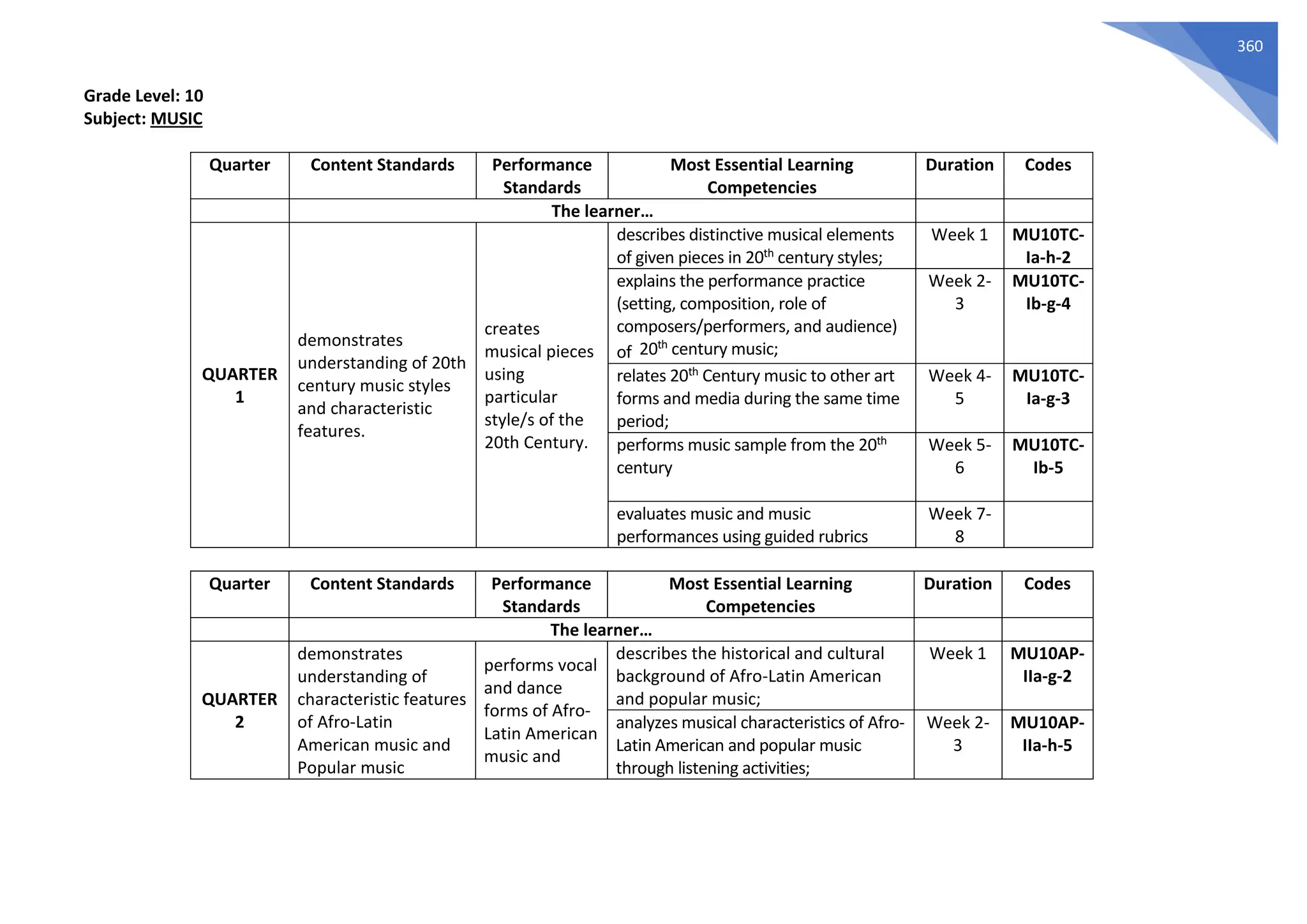
communities in the Philippines and their
uniqueness
(1.1 LUZON- Ivatan, Ifugao, Kalkminga,
Bontok, Gaddang, Agta
1.2 VISAYAS – Ati
1.3 MINDANAO-Badjao, Mangyan,Samal,
Yakan, Ubanon, Manobo, Higaonon, Talaandig,
Matigsalog, Bilaan, T’boli, Tiruray, Mansaka,
Tausug) and the distinctive characteristics of
these cultural communities in terms of attire,
body accessories, religious practices, and
lifestyles.
Week 1 /
1st Q
A4EL-Ia
2. Draws specific clothing, objects, and designs
of at least one the cultural communities by
applying an indigenous cultural motiff into a
contemporary design through crayon etching
technique.
Weeks 2-
4/1st Q
A4EL-Ib
A4EL-Ic
A4EL-Id
3. role plays ideas about the practices of the
different cultural communities.
Weeks
4/1st Q
A4PR-Ie
4. creates a drawing after close study and
observation of one of the cultural
communities’ way of dressing and accessories.
Week 5-
6/1st Q
A4PR-Ig
375
cultural groups from
different provinces.
5. produces a crayon resist on any of the topics:
the unique design of the houses, household
objects, practices, or rituals of one of the
cultural groups
Week
7/1st Q A4PR-Ih
6. uses crayon resist technique in showing
different ethnic designs or patterns.
Week
8/1st Q A4PR-Ii
Quarter Content
Standards
Performance
Standards
Most Essential Learning Competencies Duration K-12 CG
Code
2nd The learner…
demonstrates
understanding of
lines, color,
shapes, space, and
proportion
through drawing.
The learner…
sketches and paints
a landscape or
mural using shapes
and colors
appropriate to the
way of life of the
cultural community.
realizes that the
choice of colors to
use in a landscape
gives the mood or
feeling of a painting.
1. discusses pictures of localities where
different cultural communities live where each
group has distinct houses and practices.
Week 1/
2nd Q
A4EL-IIa
2. explains the attire and accessories of
selected cultural communities in the country in
terms of colors and shapes.
Week 2/
2nd Q
A4EL-IIb
3. depicts in a role play the importance of
communities and their culture.
Week 3/
2nd Q
A4EL-IIc
4. compares the geographical location,
practices, and festivals of the different cultural
groups in the country.
Week 4/
2nd Q
A4EL-IId
5. paints the sketched landscape using colors
appropriate to the cultural community’s ways
of life.
Week 5/
2nd Q
A4EL-IIe
A4EL-IIf
6. tells a story or relates experiences about
cultural communities seen in the landscape.
Week6/
2nd Q
A4EL-IIh
Quarter Content
Standards
Performance
Standards
Most Essential Learning Competencies Duration K-12 CG
Code
3rd The learner...
demonstrates
understanding of
The learner...
exhibits basic skills
in making a design
1. discusses the texture and characteristics of
each material.
Week 1 /
3rd Q
A4EL-IIIa
376
shapes, colors and
principle
repetition and
emphasis through
printmaking
(stencils)
for a print and
producing several
clean copies of the
prints
manipulates a
stencil with an
adequate skill to
produce a clean
print for a message,
slogan or logo for a
T-shirt, poster bag
produces at least 3
good copies of print
using
complementary
colors and
contrasting shapes
2. analyzes how existing ethnic motif designs
are repeated and alternated.
Week 1 /
3rd Q
A4PL-
IIIb
3. demonstrates the process of creating relief
prints and how these relief prints make the
work more interesting and harmonious in
terms of the elements involved.
Week 2 /
3rd Q
A4PL-IIIc
4. designs ethnic motifs by repeating,
alternating, or by radial arrangement.
Week 2 /
3rd Q
A4PR-
IIId
5. creates a relief master or mold using
additive and subtractive processes.
Week 3 /
3rd Q
A4PR-
IIIe
6. creates simple, interesting, and
harmoniously arranged relief prints from a clay
design.
Week 4 /
3rd Q
A4PR-IIIf
7. prints reliefs with adequate skill to produce
clean prints with a particular design motif
(repeated or alternated).
Week 5 /
3rd Q
A4PR-
IIIg
8. creates the relief mold using found material:
hard foam; cardboard shapes glued on wood;
strings and buttons, old screws, and metal
parts glued on wood or cardboard.
Weeks 6-
7 / 3rd Q A4PR-IIIi
9. participates in a school/district exhibit and
culminating activity in celebration of the
National Arts Month (February).
Weeks
8/ 3rd Q A4PR-
IIIj-2
4th The learner...
demonstrates
understanding of
shapes, colors,
The learner...
creates a single
puppet based on
character in
1. differentiates textile traditions in other
Asian Countries like China, India, Japan,
Indonesia, and in the Philippines in the olden
times and presently.
Week 1 /
4th Q
A4EL-Iva
377
textures, and
emphasis by
variation of
shapes and
texture and
contrast of colors
through sculpture
and crafts
demonstrates
understanding of
shapes, colors,
textures, and
emphasis by
variation of
shapes and
texture and
contrast of colors
through sculpture
and crafts
legends, myths or
stories using
recycled and hard
material
creates a mask or
headdress that is
imaginary in design
using found and
recycled materials
demonstrates basic
skills in constructing
a puppet made
from a hard and
stick, which can be
manipulated
2. discusses pictures or actual samples of
different kinds of mat weaving traditions in the
Philippines.
Week 1
/4th Q A4EL-Ivb
3. discusses the intricate designs of mats
woven in the Philippines:
3.1 Basey, Samar buri mats
3.2 Iloilo bamban mats
3.3 Badjao&Samal mats
3.4 Tawi-tawilaminusa mats
3.5 Romblon buri mats
Week 2 /
4th Q
A4EL-IVc
4. explains the steps to produce good tie-dye
designs.
Week 3 /
4th Q
A4PL-Ivd
5. explains the meaning of designs, colors, and
patterns used in the artworks.
Week 4 /
4th Q
A4PL-Ive
6. creates a small mat using colored buri strips
or any material that can be woven, showing
different designs: squares, checks zigzags, and
stripes.
7. weaves own design similar to the style made
by a local ethnic group.
Week 5
& 6 / 4th
Q
Week 7 /
4th Q
A4PR-IVf
A4PR-
IVg
8. creates original tie-dyed textile design by
following the traditional steps in tie-dyeing
using one or two colors.
Week 8 /
4th Q
A4PR-
IVh
378
Grade Level: Grade 5
Subject: ARTS
Quarter Content Standards Performance
Standards
Most Essential Learning Competencies Duration K-12 CG
Code
1st The learner…
demonstrates
understanding of
lines, shapes, and
space; and the
principles of
rhythm and
balance through
drawing of
archeological
artifacts, houses,
buildings, and
churches from
historical periods
using
crosshatching
technique to
simulate 3-
dimensional and
geometric effects
of an artwork.
The learner…
creates different
artifacts and
architectural
buildings in the
Philippines and in
the locality using
crosshatching
technique,
geometric shapes,
and space, with
rhythm and balance
as principles of
design.
puts up an exhibit
on Philippine
artifacts and houses
from different
historical periods
(miniature or
replica).
1. discusses events, practices, and culture
influenced by colonizers who have come to
our country by way of trading.
Week 1/
1st Q
A5EL-Ia
2. designs an illusion of depth/distance to
simulate a3-dimensional effect by using
crosshatching and shading techniques in
drawings (old pottery, boats, jars, musical
instruments).
Week
1/1st Q
A5EL-Ib
3. presents via powerpoint the significant
parts of the different architectural designs and
artifacts found in the locality. e.g. bahay kubo,
torogan, bahay na bato, simbahan, carcel, etc.
Week2/1st
Q A5EL-Ic
4. explains the importance of artifacts, houses,
clothes, language, lifestyle - utensils, food,
pottery, furniture - influenced by colonizers
who have come to our country (Manunggul
jar, balanghai, bahay na bato, kundiman,
Gabaldon schools, vaudeville, Spanish-
inspired churches).
Week 2
/1st Q
A5PL-Ie
5. creates illusion of space in 3-dimensional
drawings of important archeological artifacts
seen in books, museums (National Museum
and its branches in the Philippines, and in old
buildings or churches in the community.
Weeks 3-
4 /1st Q
A5PR-If
6. creates mural and drawings of the old
houses, churches, and/or buildings of his/her
community.
Weeks 5-
6/1st Q A5PR-Ig
379
7. participates in putting up a mini-exhibit with
labels of Philippine artifacts and houses after
the whole class completes drawings.
Weeks 7-
8/1st Q A5PR-Ih
8. tells something about his/her community as
reflected on his/her artwork.
Week
8/1st Q
A5PR-Ij
Quarter Content Standards Performance
Standards
Most Essential Learning Competencies Duration K-12 CG
Code
2nd The learner…
demonstrates
understanding of
lines, colors, space,
and harmony
through painting
and
explains/illustrates
landscapes of
important
historical places in
the community
(natural or man-
made)using one-
point perspective
in landscape
drawing,
complementary
colors, and the
right proportions
of parts.
The learner…
sketches natural or
man-made places in
the community
with the use of
complementary
colors.
draws/paints
significant or
important historical
places.
1. explains the importance of natural and
historical places in the community that have
been designated as World Heritage Site (e.g.,
rice terraces in Banawe, Batad; Paoay Church;
Miag-ao Church; landscape of Batanes, Callao
Caves in Cagayan; old houses inVigan, Ilocos
Norte; and the torogan in Marawi)
Week 1/
2nd Q
A5EL-IIa
2. explains that artists have different art styles
in painting landscapes or significant places in
their respective provinces (e.g., Fabian dela
Rosa, Fernando Amorsolo, Carlos Francisco,
Vicente Manansala, Jose Blanco,
VictorioEdades, Juan Arellano,
PrudencioLamarroza, and Manuel Baldemor)
Weeks 2
& 3/ 2nd Q
A5EL-IIc
3. presents via powerpoint the artistry of
famous Filipino artists in painting different
landscapes and is able to describe what makes
each artist’s masterpiece unique from others.
Week 3/
2nd Q
A5PL-IId
4. sketches using complementary colors in
painting a landscape.
Weeks 4-
5/ 2nd Q
A5PL-IIe
5. demonstrates skills and knowledge about
foreground, middle ground, and background
to emphasize depth in painting a landscape.
Weeks 6-
7/ 2nd Q A5PR-IIf
380
6. discusses details of the landscape significant
to the history of the country.
Week
8/2nd Q
A5PR-
IIg
Quarter Content Standards Performance
Standards
Most Essential Learning Competencies Duration K-12 CG
Code
3rd The learner…
demonstrates
understanding of
new printmaking
techniques with
the use of lines,
texture through
stories and myths.
The learner…
creates a variety of
prints using lines
(thick, thin, jagged,
ribbed, fluted,
woven) to produce
visual texture.
1. discusses new printmaking technique using
a sheet of thin rubber (used for soles of shoes),
linoleum, or any soft wood that can be carved
or gouged to create different lines and
textures.
Week 1 /
3rd Q
A5EL-
IIIa
2. discusses possible uses of the printed
artwork
Week 2 /
3rd Q
A5EL-
IIIc
3. shows skills in creating a linoleum, rubber
or wood cut print with the proper use of
carving tools.
Week 2 /
3rd Q
A5PL-
IIId
4. creates variations of the same print by using
different colors of ink in printing the master
plate.
Week 3 /
3rd Q A5PR-
IIIe
5. follows the step-by-step process of
creating a print:
5.1 sketching the areas to be carved out
and areas that will remain
5.2 carving the image on the rubber or
wood using sharp cutting tools
5.3 preliminary rubbing
5.4 final inking of the plate with printing
ink
5.5 placing paper over the plate, rubbing
the back of the paper
Weeks 4-
5 / 3rd Q
A5PR-
IIIf
381
demonstrates
understanding of
new printmaking
techniques with
the use of lines,
texture through
stories and myths.
creates a variety of
prints using lines
(thick, thin, jagged,
ribbed, fluted,
woven) to produce
visual texture.
5.6 impressing the print
5.7 repeating the process to get several
editions of the print
6. works with the class to produce a
compilation of their prints and create a book
or calendar which they can give as gifts, sell, or
display on the walls of their school.
Week 6 /
3rd Q
A5PR-
IIIg
7. demonstrates contrast in a carved or
textured area in an artwork.
Week 6 /
3rd Q
A5PR-
IIIh-1
8. produces several editions of the same print
that are well-inked and evenly printed.
Weeks 7/
3rd Q A5PR-
IIIh-2
9. participates in a school/district exhibit and
culminating activity in celebration of the
National Arts Month (February)
Week
8/3rd A5PR-
IIIh-3
4th The learner…
demonstrates
understanding of
colors, shapes,
space, repetition,
and balance
through sculpture
and 3-dimensional
crafts.
The learner…
demonstrates
fundamental
construction skills
in making a 3-
dimensional craft
that expresses
balance, artistic
design, and
repeated variation
of decorations and
colors
1. papier-
mâché jars
with
patterns
1. identifies the materials used in making3-
dimensional crafts which express balance and
repeated variation of shapes and colors
1.1 mobile
1.2 papier-mâché jar
1.3 paper beads
Week 1 /
4th Q
A5EL-
IVa
2. identifies the different techniques in
making 3-dimensional crafts
2.1 mobile
2.2 papier-mâché jar
2.3 paper beads
Week 1
/4th Q
A5EL-
IVb
3. discusses possibilities on the use of created
3-D crafts.
Week 2 /
4th Q
A5EL-
IVc
4. applies knowledge of colors, shapes, and
balance in creating mobiles, papier-mâché
jars, and paper beads.
Week 3 /
4th Q
A5PL-
IVd
382
2. paper beads
constructs 3-D craft
using primary and
secondary colors,
geometric shapes,
space, and
repetition of colors
to show balance of
the structure and
shape
mobile
5. demonstrates artistry in making mobiles
with varied colors and shapes.
Week 4 /
4th Q
A5PL-
IVe
6. creates designs for making 3-dimensional
crafts
6.1 mobile
6.2 papier-mâché jar
6.3 paper beads
Week 5 &
6 / 4th Q A5PR-
IVf
7. shows skills in making a papier-mâché jar Week 7 /
4th Q
A5PR-
IVg
8. creates paper beads with artistic designs
and varied colors out of old magazines and
colored papers for necklace, bracelet, ID
lanyard.
Week 8 /
4th Q
A5PR-
IVh
383
Grade Level: Grade 6
Subject: ARTS
Quarter Content
Standards
Performance
Standards
Most Essential Learning Competencies Duration K-12 CG
Code
1st The learner…
demonstrates
understanding of
the use of lines,
shapes, colors,
texture, and the
principles of
emphasis and
contrast in
drawing a logo
and own cartoon
character using
new technologies
in drawing.
The learner…
creates concepts
through art
processes,
elements, and
principles using new
technologies
(hardware and
software) to create
personal or class
logo.
designs cartoon
character on-the
spot using new
technologies.
creates concepts
through art
processes,
elements, and
principles using new
technologies
(hardware and
software) to create
1. discusses the concept that art processes,
elements and principles still apply even with the
use of new technologies.
Week 1/
1st Q A6EL-Ia
2. explains the elements and principles applied
in commercial art.
Week
1/1st Q
A6PL-Ia
3. applies concepts on the use of the software
(commands, menu, etc.).
Week 2 /
1st Q
A6PR-Ib
4. utilizes art skills in using new technologies
(hardware and software).
Week 2 /
1st Q A6PR-Ic
5. creates personal or class logo as visual
representation that can be used as a product,
brand, or trademark
Week 3 /
1st Q A6PR-Id
6. explains ideas about the logo Weeks 4
/ 1st Q A6PR-Id
7. explains the elements and principles applied
in comic art.
Week 5 /
1st Q A6PL-Ie
8. applies concepts on the steps/procedures in
cartoon character making.
Week 6 /
1st Q A6PR-If
9. utilizes art skills in using new technologies
(hardware and software) in cartoon character
making.
Week 6 /
1st Q A6PR-Ig
384
personal or class
logo.
designs cartoon
character on-the
spot using new
technologies.
10. creates own cartoon character to entertain,
express opinions, ideas, etc.
Week 7 /
1st Q A6PR-Ih
11. explains ideas about the cartoon character Week 8 /
1st Q A6PR-Ih
Quarter Content
Standards
Performance
Standards
Most Essential Learning Competencies Duration K-12 CG
Code
2nd The learner…
demonstrates
understanding of
shapes, space,
colors, and the
principles of
emphasis,
harmony and
contrast in digital
painting and
poster design
using new
technologies.
The learner…
applies concepts on
the use of software
in creating digital
paintings and
graphic designs.
1. Reviews the concept that art processes,
elements and principles still apply even with the
use of technologies.
Week 1/
2nd Q A6EL-IIa
2. explains the elements and principles applied
in digital art.
Week 1/
2nd Q A6PL-IIa
3. applies concepts on the use of the software
(commands, menu, etc.)
Week 2/
2nd Q
A6PR-IIb
4. utilizes art skills using new technologies
(hardware and software) in digital painting.
Week 2/
2nd Q
A6PR-IId
5. creates a digital painting similar with the
Masters’ (e.g., Van Gogh, Amorsolo, etc.) in
terms of style, theme, etc.
Weeks 3
-4 / 2nd Q
A6PR-IIc
6. discusses the elements and principles applied
in layouting.
Weeks 5-
6 /2nd Q
A6PL-IIf
7. applies skills in layouting and photo editing
using new technologies (hardware and
software) in making a poster.
Weeks 5-
6 /2nd Q A6PR-IIg
8. creates an advertisement/commercial or
announcement poster.
Weeks 7-
8 /2nd Q
A6PR-IIh
385
Quarter Content
Standards
Performance
Standards
Most Essential Learning Competencies Duration K-12 CG
Code
3rd The learner…
demonstrates
understanding of
shapes, colors,
values, and the
principles of
emphasis,
contrast, and
harmony in
printmaking and
photography
using new
technologies.
The learner…
creates simple
printmaking
(silkscreen) designs
on t-shirts and
posters.
describes the basic
concepts and
principles of basic
photography.
1. Explains the truism that design principles still
apply for any new design (contrast of colors,
shapes, and lines produces harmony) whether
done by hand or machine (computer).
Week 1 /
3rd Q
A6EL-
IIIa
2. Demonstrates understanding that digital
technology has speeded up the printing of
original designs and made it accessible to many,
as emphasized in t-shirts and poster designs.
Week 1 /
3rd Q A6PL-
IIIb
3. applies concepts on the steps/procedure in
silkscreen printing.
Week 2 /
3rd Q
A6PR-
IIIc
4. produces own prints from original design to
silkscreen printing to convey a message or
statement.
Week 2 /
3rd Q
A6PR-
IIId
5. Discusses the concepts and principles of
photography.
Week 3 /
3rd Q
A6PL-IIIf
6. discusses the parts and functions of the
camera (point and shoot or phone camera).
Week 4 /
3rd Q
A6PR-
IIIg
7. applies composition skills to produce a
printed photograph for a simple photo essay.
Week 5-
6 / 3rd Q
A6PR-
IIIh
8. participates in school/district exhibit and
culminating activity in celebration of the
National Arts Month (February)
Weeks 7-
8 / 3rd Q
4th The learner…
demonstrates
understanding of
shapes, colors,
The learner…
creates an actual 3-
D digitally-
enhanced paper bag
1. Discusses the concept that design principles
and elements relates to everyday objects.
Week 1 /
4th Q A6EL-
IVa
2. explains the elements and principles applied
in product design.
Week 1
/4th Q
A6PL-
IVa
386
and the principles
of contrast and
harmony through
the use of new
media in creating
audio-video art
and product or
package design.
for a product or
brand.
applies concepts on
the use of new
technologies
(hardware and
software) in
creating an audio-
video
art/animation.
3. manifests understanding of concepts on the
use of software (commands, menu, etc.)
Week 2 /
4th Q
A6PR-
IVb
4. utilizes art skills in using new technologies
(hardware and software) in package design.
Week 2 /
4th Q
A6PR-
IVc
5. creates an actual 3-D digitally-enhanced
product design for a paper bag.
Week 4 /
4th Q
A6PR-
IVd
6. reviews the truism that art processes,
elements and principles still apply even with the
use of technologies.
7. discusses the elements and principles
applied in audio-video art.
Week 3 /
4th Q A6EL-
IVe
7. shows skills in making a papier-mâché jar Week 7 /
4th Q
A6PL-
IVe
8. applies concepts on the use of the software
(commands, menu, etc.)
Weeks 4-
5 / 4th Q
A6PR-
IVf
9. utilizes art skills in using new technologies
(hardware and software)
Weeks 5-
6 / 4th Q
A6PR-
IVg
10. creates an audio-video art /animation
promoting a product.
Weeks 7-
8 / 4th Q
A6PR-
IVh
387
Grade Level: Grade 7
Subject: ARTS
Quarter Content Standards Performance
Standards
Most Essential Learning Competencies Duration K-12 CG
Code
1st The learner...
1. art elements
and processes
by synthesizing
and applying
prior knowledge
and skills
2. the salient
features of the
arts of Luzon
(highlands and
lowlands) by
showing the
relationship of
the elements of
art and
processes
among culturally
diverse
communities in
the country
3. the Philippines
as having a rich
The learner…
1. create artworks
showing the
characteristic
elements of the
arts of Luzon
(highlands and
lowlands)
2. exhibit completed
artworks for
appreciation and
critiquing
1. analyzes elements and principles of art in
the production of one’s arts and crafts inspired
by the arts of Luzon (highlands and lowlands)
Week 1/
1st Q
A7EL-Ib-
1
2. identifies characteristics of arts and crafts in
specific areas in Luzon (e.g., papier mâché
[taka] from Paete, Ifugao wood sculptures
[bul’ul], Cordillera jewelry and pottery, tattoo,
and Ilocos weaving and pottery [burnay], etc.)
Week
1/1st Q
A7EL-Ia-
2
3. reflects on or derive the mood, idea, or
message emanating from selected artifacts
and art objects Weeks 2
-4/ 1st Q
A7PL-Ih-
1
4. appreciates the artifacts and art objects in
terms of their uses and their distinct use of art
elements and principles
Week 2 /
1st Q A7PL-Ih-
2
5. incorporates the design, form, and spirit of
the highland/lowland artifact and object in
one’s creation
Week 3 /
1st Q A7PL-Ih-
3
6. traces the external (foreign) and internal
(indigenous) influences reflected in the design
of an artwork and in the making of a craft or
artifact
Weeks 4
/ 1st Q A7PL-Ih-
4
7. creates crafts that can be locally assembled
with local materials, guided by local traditional
techniques (e.g., habi, lilip, etc).
Weeks 5-
8 / 1st Q A7PR-Ic-
e-1
388
artistic and
cultural
tradition from
precolonial to
present times
8. Discusses the elements from
traditions/history of a community for one’s
artwork
Week 6 /
1st Q A7PR-If-
2
9. shows the relationship of the development
of crafts in specific areas of the country,
according to functionality, traditional
specialized expertise, and availability of
resources (e.g. pottery, weaving, jewelry,
baskets)
Week 6 /
1st Q
A7PR-If-
3
10. shows the relationship of Luzon (highlands
and lowlands) arts and crafts to Philippine
culture, traditions, and history (Islamic
influences, Spanish heritage, and American
legacies in education, business,
modernization, and entertainment, as well as
in indigenous practices, fiestas, and religious
and social practices)
Week 7 /
1st Q
A7PR-Ih-
4
Quarter Content Standards Performance
Standards
Most Essential Learning Competencies Duration K-12 CG
Code
2nd The learner…
1. art elements and
processes by
synthesizing and
applying prior
knowledge and
skills
2. the salient
features of the
arts of
MIMAROPA and
The learner…
create artwork
showing the
characteristic
elements of the arts
of MIMAROPA and
the Visayas
1. analyzes the elements and principles of art
in the production one’s arts and crafts inspired
by the arts of MIMAROPA and the Visayas Weeks 1
– 2 / 2nd
Q
A7EL-IIb-
1
2. identifies the characteristics of arts and
crafts in specific areas in MIMAROPA and the
Visayas, Marinduque (Moriones masks),
Palawan (Manunggul Jar), Mindoro (Hanunuo-
Mangyan writing, basketry, and weaving),
Bohol (churches), Cebu (furniture), Iloilo
(culinary arts and old houses), Samar (Basey
mats), etc.
Week 1/
2nd Q
A7EL-IIa-
2
389
the Visayan
Islands by
showing the
relationship of
the elements of
art and
processes
among culturally
diverse
communities in
the country
the Philippines as
having a rich
artistic and cultural
tradition from
precolonial to
present times
3. reflects on and derive the mood, idea or
message emanating from selected artifacts
and art objects
Weeks 3-
5/ 2nd Q
A7PL-
IIh-1
4. appreciates the artifacts and art objects in
terms of its utilization and its distinct use of art
elements and principles
Week 2/
2nd Q
A7PL-
IIh-2
5. incorporates the design, form and spirit of
artifacts and art objects from MIMAROPA and
the Visayas
Weeks 3
-4 / 2nd Q
A7PL-
IIh-3
6. explains the external (foreign) and internal
(indigenous) influences that are reflected in
the design of an artwork or in the making of a
craft or artifact
Weeks 5
/ 2nd Q
A7PL-
IIh-4
7. creates crafts that can be locally assembled
with local materials, guided by local traditional
techniques (e.g., habi, lilip, etc).
Weeks
6/ 2nd Q
A7PR-
IIc-e-1
8. discusses elements from traditions/history
of a community for one’s artwork
Weeks 7
/2nd Q
A7PR-IIf-
2
9. explains the correlation of the development
of crafts in specific areas of the country,
according to functionality, traditional
specialized expertise, and availability of
resources (e.g., architecture, weaving, pottery,
accessories, masks, and culinary arts)
Week 8
A7PR-IIf-
3
10. shows the relationship of MIMAROPA and
Visayas arts and crafts to Philippine culture,
A7PR-
IIh-4
390
traditions, and history (Islamic influences,
Spanish heritage, and American legacies in
education, business, modernization, and
entertainment, as well as in indigenous
practices, fiestas, and religious and social
practices)
Quarter Content Standards Performance
Standards
Most Essential Learning Competencies Duration K-12 CG
Code
3rd The learner…
1. art elements and
processes by
synthesizing and
applying prior
knowledge and
skills
2. the salient
features of the
arts of
Mindanao by
showing the
relationship of
the elements of
art and
processes
among culturally
diverse
communities in
the country
The learner…
1. create artworks
showing the
characteristic
elements of the
arts of Mindanao
2. exhibit completed
artworks for
appreciation and
critiquing
1. analyzes elements and principles of art in
the production one’s arts and crafts inspired by
the arts of Mindanao
Weeks 1-
2/3rd Q
A7EL-
IIIb-1
2. identifies characteristics of arts and crafts in
specific areas in Mindanao (e.g., maritime
vessel [balanghay] from Butuan, vinta from
Zamboanga; Maranao’s malong, brasswares,
okir, panolong, torogan, and sarimanok;
Yakan’s fabric and face makeup and body
ornamentation; T’boli’s tinalak and
accessories; Tawi-tawi’s Pangalaydance, etc.
Week 1 /
3rd Q
A7EL-
IIIa-2
3. reflects on and derive the mood, idea, or
message emanating from selected artifacts
and art objects
Weeks 3-
5/3rd Q
A7PL-
IIIh-1
4. appreciates the artifacts and art objects in
terms of its utilization and their distinct use of
art elements and principles
Week 2 /
3rd Q
A7PL-
IIIh-2
5. incorporates the design, form, and spirit of
artifacts and objects from Mindanao to one’s
creation
Week 3 /
3rd Q
A7PL-
IIIh-3
391
3. the Philippines
as having a rich
artistic and cultural
tradition from
precolonial to
present times
6. traces the external (foreign) and internal
(indigenous) influences that are reflected in
the design of an artwork and in the making of
a craft or artifact
Week 4 /
3rd Q
A7PL-
IIIh-4
7. creates crafts that can be locally assembled
with local materials, guided by local traditional
techniques (e.g., habi, lilip, etc).
Weeks 6-
8/3rd Q
A7PR-
IIIc-e-1
8. derives elements from traditions/history of
a community for one’s artwork
Weeks 6
/ 3rd Q
A7PR-
IIIf-2
9. shows the relationship of the development
of crafts in specific areas of the country,
according to functionality, traditional
specialized expertise, and availability of
resources (e.g., pottery, weaving, jewelry, and
basketry)
A7PR-
IIIf-3
10. shows the relationship of Mindanao’s arts
and crafts to Philippine culture, traditions, and
history, particularly with Islamic influences and
indigenous (Lumad) practices
Week 7
A7PR-
IIIh-4
11. participates in exhibit using completed
Mindanao-inspired arts and crafts in an
organized manner
Week 8 A7PR-
IIIg-5
4th The learner…
1. how theatrical
elements
(sound, music,
gesture,
movement ,and
costume) affect
the creation and
The learner…
1. create appropriate
festival attire with
accessories based
on authentic
festival costumes
1. identifies the festivals and theatrical forms
celebrated all over the country throughout the
year
Weeks 1-
2 / 4th Q
A7EL-
IVa-1
2. researches on the history of the festival and
theatrical composition and its evolution, and
describe how the townspeople participate and
contribute to the event
A7EL-
IVb-2
3. discusses the elements and principles of arts
as seen in Philippine Festivals
392
communication
of meaning in
Philippine
Festivals and
Theatrical Forms
as influenced by
history and
culture
2. theater and
performance as a
synthesis of arts
and a significant
expression of the
celebration of life
in various
Philippine
communities
2. create/improvise
appropriate
sound, music,
gesture,
movements, and
costume for a
chosen theatrical
composition
3. take part in a
chosen festival or in
a performance in a
theatrical play
A7EL-
IVc-3
4. explains what makes each of the Philippine
festivals unique through a visual presentation
Weeks 3-
4 / 4th Q
A7PL-
IVh-1
5. designs the visual elements and
components of the selected festival or
theatrical form through costumes, props, etc.
Weeks 5-
8 / 4th Q
A7PR-
IVd-1
6. analyzes the uniqueness of each group’s
performance of their selected festival or
theatrical form
7. choreographs the movements and gestures
reflecting the mood of the selected Philippine
festival/theatrical form
A7PR-
IVh-2
7. shows skills in making a papier-mâché jar A7PR-
IVe-f-3
8. improvises accompanying sound and
rhythm of the Philippine festival/theatrical
form
A7PR-
IVe-f-4
9. performs in a group showcase of the
selected Philippine festival/theatrical form
A7PR-
IVg-5
393
Grade Level: Grade 8
Subject: ARTS
Quarter Content Standards Performance
Standards
Most Essential Learning Competencies Duration K-12 CG
Code
1st The learner…
1. art elements
and processes
by synthesizing
and applying
prior
knowledge and
skills
2. the salient
features of the
arts of
Southeast Asia
by showing the
relationship of
the elements of
art and
processes
among
culturally
diverse
communities in
the region
3. Southeast Asian
countries as
The learners…
1. create artworks
showing the
characteristic
elements of the
arts of Southeast
Asia
2. exhibit completed
artworks for
appreciation and
critiquing
1. analyzes elements and principles of art in
the production of arts and crafts inspired by
the cultures of Southeast Asia
Weeks 1-
2/ 1st Q
A8EL-Ib-
1
2. identifies characteristics of arts and crafts in
specific countries in Southeast Asia: Indonesia
(batik, Wayang puppetry); Malaysia (modern
batik, wau, and objects made from pewter);
Thailand (silk fabrics and Loi Kratong Lantern
Festival); Cambodia (AngkorWat and ancient
temples); Singapore (Merlion), etc.
A8EL-Ia-
2
3. reflects on and derive the mood, idea, or
message from selected artifacts and art
objects Weeks 3
-5/ 1st Q
A8PL-Ih-
1
4. appreciates the artifacts and art objects in
terms of their utilization and their distinct use
of art elements and principles
A8PL-Ih-
2
5. incorporates the design, form, and spirit of
Southeast Asian artifacts and objects in one’s
creation
A8PL-Ih-
3
6. traces the external (foreign) and internal
(indigenous) influences that are reflected in
the design of an artwork and in the making of
a craft or artifact
A8PL-Ih-
4
7. creates crafts that can be locally assembled
with local materials, guided by local traditional
techniques (e.g.,batik, silk weaving, etc.)
Weeks 6-
8 / 1st Q
A8PR-Ic-
e-1
394
having a rich
artistic and
cultural
tradition from
prehistoric to
present times
8. derives elements from traditions/history of
a community for one’s artwork A8PR-If-
2
9. shows the relationship of the development
of crafts in specific countries in Southeast Asia,
according to functionality, traditional
specialized expertise and availability of
resources (e.g., pottery, weaving, jewelry, and
basketry)
A8PR-If-
3
10. shows the commonalities and differences
of the culture of the Southeast Asian countries
in relation to Philippine culture
A8PR-Ih-
4
Quarter Content Standards Performance
Standards
Most Essential Learning Competencies Duration K-12 CG
Code
2nd The learner…
1. art elements
and processes
by synthesizing
and applying
prior
knowledge and
skills
2. the salient
features of the
arts of East Asia
by showing the
relationship of
the elements of
art and
processes
The learner…
1. create artworks
showing the
characteristic
elements of the
arts of East Asia
2. exhibit completed
artworks for
appreciation and
critiquing
1. analyzes elements and principles of art in
the production of arts and crafts inspired by
the cultures of East Asia
Weeks 1-
2/3rd Q A8EL-IIb-
1
2. identifies characteristics of arts and crafts in
specific countries in East Asia: China (Chinese
painting and calligraphy); Japan (origami,
woodblock printing, theater masks, face
painting, and anime and manga); and Korea
(theater masks, drums, and K-pop)
A8EL-IIa-
2
3. reflects on and derive the mood, idea or
message from selected artifacts and art
objects
Weeks 3-
5/3rd Q
A8PL-
IIh-1
4. appreciates the artifacts and art objects in
terms of their utilization and their distinct use
of art elements and principles
A8PL-
IIh-2
5. incorporates the design, form, and spirit of
East Asian artifacts and objects to one’s
creation
A8PL-
IIh-3
395
among
culturally
diverse
communities in
the region
3. East Asian
countries as
having a rich
artistic and
cultural
tradition from
prehistoric to
present times
6. traces the external (foreign) and internal
(indigenous) influences that are reflected in
the design of an artwork and in the making of
a craft
A8PL-
IIh-4
7. creates crafts that can be locally assembled
with local materials, guided by local traditional
techniques (e.g., Gong-bi, Ikat, etc.)
Weeks 6-
8/3rd Q
A8PR-
IIc-e-1
8. derives elements from traditions/history of
a community for one’s artwork
A8PR-IIf-
2
9. shows the relationship of the development
of crafts in specific countries in East Asia
according to functionality, traditional
specialized expertise, and availability of
resources (e.g., pottery, weaving, jewelry, and
basketry)
A8PR-IIf-
3
10. shows the commonalities and differences
of the cultures of the East Asian countries in
relation to Philippine culture
A8PR-
IIh-4
Quarter Content Standards Performance
Standards
Most Essential Learning Competencies Duration K-12 CG
Code
3rd The learner…
1. art elements
and processes
by synthesizing
and applying
prior
knowledge and
skills
The learner…
1. create artworks
showing the
characteristic
elements of the
arts of South,
West, and Central
Asia
1. analyzes elements and principles of art in
the production of arts and crafts inspired by
the cultures of South Asia, West Asia, and
Central Asia
Weeks 1-
2/3rd Q
A8EL-
IIIb-1
2. identifies characteristics of arts and crafts in
specific countries in South, West, and Central
Asia: India (rangoli, katak, mendhi, diwali);
Saudi Arabia (carpet design); Pakistan (truck
art); and Tibet (mandala), etc.
A8EL-
IIIa-2
396
2. the salient
features of the
arts of South,
West, and
Central Asia by
showing the
relationship of
the elements of
art and
processes
among
culturally
diverse
communities in
the region
3. that the South,
West, and Central
Asian countries
have a rich, artistic
and cultural
tradition from
prehistoric to
present times
2. exhibits
completed
artworks for
appreciation and
critiquing
3. reflects on and derive the mood, idea or
message from selected artifacts and art
objects
Weeks 3-
5/3rd Q
A8PL-
IIIh-1
4. appreciates the artifacts and art objects in
terms of their utilization and their distinct use
of art elements and principles
A8PL-
IIIh-2
5. incorporates the design, form, and spirit of
South, West, and Central Asian artifacts and
objects to one’s creation
A8PL-
IIIh-3
6. traces the external (foreign) and internal
(indigenous) influences that are reflected in
the design of an artwork and in the making of
a craft
A8PL-
IIIh-4
7. creates arts and crafts that can be locally
assembled with local materials, guided by local
traditional techniques (e.g., Ghonghdis,
Marbling Technique, etc.)
Weeks 6-
8/3rd Q A8PR-
IIIc-e-1
8. derives elements from traditions/history of
a community for one’s artwork
A8PR-
IIIf-2
9. shows the relationship of the development
of crafts in specific countries in South Asia,
West Asia, and Central Asia, according to
functionality, traditional specialized expertise,
and availability of resources
A8PR-
IIIf-3
10. shows the commonalities and differences
of the cultures of the South Asian, West Asian,
and Central Asian countries in relation to
Philippine culture
A8PR-
IIIh-4
397
11. participates in an exhibit using completed
South-West-Central Asian-inspired crafts in
an organized manner
A8PR-
IIIg-5
4th The learner…
1. how theatrical
elements
(sound, music,
gesture,
movement, and
costume) affect
the creation
and
communication
of meaning in
Asian Festivals
and Theatrical
Forms as
influenced by
history and
culture
2. theater and
performance as a
synthesis of arts
and a significant
expression of the
celebration of life
in various Asian
communities
The learner…
1. create
appropriate
festival attire
with accessories
based on
authentic festival
costumes
2. create/improvise
appropriate
sound, music,
gesture,
movements, and
costume for a
chosen theatrical
composition
3. take part in a
chosen festival or in
a performance in a
theatrical play
1. identifies selected festivals and theatrical
forms celebrated all over the Asian region
Weeks 1-
2 / 4th Q
2. researches on the history of the festival and
theatrical forms and its evolution, and
describe how the community participates and
contributes to the event
3. discusses the elements and principles of arts
as seen in Philippine Festivals
Week 4
Weeks 3-
4 / 4th Q
4. identifies the elements and principles of arts
as manifested in Asian festivals and theatrical
forms
5. through a visual presentation, explains
what make each of the Asian Festivals and
Theatrical forms unique
Weeks 5-
8 / 4th Q
6. designs the visual elements and
components of the selected festival or
theatrical form through costumes, props, etc.
7. analyzes the uniqueness of each group’s
performance of their selected festival or
theatrical form
8. shows the relationship of the selected
Asian festival and the festival in the
Philippines in terms of form and reason for
holding the celebration
9. choreographs the movements and gestures
reflecting the mood of the selected
festival/theatrical form of Asia
398
10. improvises accompanying sound and
rhythm of the selected festival/ theatrical form
of Asia
Grade Level: Grade 9
Subject: ARTS
Quarter Content Standards Performance
Standards
Most Essential Learning Competencies Duration K-12 CG
Code
1st The learner…
1. art elements
and processes
by synthesizing
and applying
prior
knowledge and
skills
2. the arts as
integral to the
development of
organizations,
spiritual belief,
historical
events,
scientific
discoveries,
natural
disasters/
occurrences,
The learner..
1. perform /
participate
competently in a
presentation of a
creative impression
(verbal/nonverbal)
of a particular
artistic period
2. recognize the
difference and
uniqueness of the
art styles of the
different periods
(techniques,
process, elements,
and principles of
art)
1. analyzes art elements and principles in the
production of work following the style of a
western and classical art
Weeks 1-
2/ 1st Q A9EL-Ib-
1
2. identifies distinct characteristics of arts
during the different art periods
A9EL-Ia-
2
3. identifies representative artists from
various art periods
A9EL-Ia-
3
4. reflects on and derives the mood, idea, or
message from selected artworks
Weeks 3
-5/ 1st Q
A9PL-Ih-
1
5. discusses the use or function of artworks
by evaluating their utilization and
combination of art elements and principles
A9PL-Ih-
2
6. uses artworks to derive the
traditions/history of an art period A9PL-Ih-
3
7. compares the characteristics of artworks
produced in the different art periods A9PL-Ih-
4
399
and other
external
phenomena
8. creates artworks guided by techniques
and styles of Western Classical art traditions
Weeks 6-
8 / 1st Q
A9PR-Ic-
e-1
9. describes the influence of iconic artists
belonging to Western Classical art on the
evolution of art forms
A9PR-Ic-
e-2
10. applies different media techniques and
processes to communicate ideas,
experiences, and stories showing the
characteristics of Western Classical art
traditions
A9PR-Ic-
e-3
11. evaluates works of art in terms of artistic
concepts and ideas using criteria from the
Western Classical art traditions
A9PR-If-
4
12. shows the influences of the Western
Classical art traditions to Philippine art form A9PR-1f-
5
Quarter Content Standards Performance
Standards
Most Essential Learning Competencies Duration
A9EL-
IIb-1
2nd The learner…
1. art elements
and processes
by synthesizing
and applying
prior
knowledge and
skills
The learner…
1. performs/
participate
competently in a
presentation of a
creative impression
(verbal/nonverbal)
of a particular
artistic period
1. analyzes art elements and principles in the
production of work following a specific art
style
Weeks 3-
5/ 2nd Q A9EL-IIa-
2
2. identifies distinct characteristics of arts
during the Renaissance and Baroque periods
A9EL-IIa-
3
3. identifies representative artists from
Renaissance and Baroque periods
A9PL-
IIh-1
4. reflects on and derive the mood, idea or
message from selected artworks
Weeks 6-
8 / 2nd Q
A9PL-
IIh-2
400
2. the arts as
integral to the
development of
organizations,
spiritual belief,
historical
events,
scientific
discoveries,
natural
disasters/
occurrences,
and other
external
phenomena
2. recognizes the
difference and
uniqueness of the
art styles of the
different periods
(techniques,
process, elements,
and principles of
art)
5. discusses the use or function of artworks
by evaluating their utilization and
combination of art elements and principles
A9PL-
IIh-3
6. uses artworks to derive the
traditions/history of an art period
A9PL-
IIh-4
7. compares the characteristics of artworks
produced in the different art periods
A9PR-
IIc-e-1
8. creates artworks guided by techniques
and styles of the Renaissance and the
Baroque periods
Weeks 3-
5/ 2nd Q
A9PR-
IIc-e-2
9. explains the influence of iconic artists
belonging to the Renaissance and the
Baroque periods
A9PR-
IIc-e-3
10. applies different media techniques and
processes to communicate ideas,
experiences, and stories showing the
characteristics of the Renaissance and the
Baroque periods (e.g.,Fresco, Sfumato, etc.)
A9PR-IIf-
4
11. evaluates works of art in terms of artistic
concepts and ideas using criteria from the
Renaissance and the Baroque periods
A9PR-IIf-
5
12. shows the influences of the Renaissance
and Baroque periods on the Philippine art
form A9EL-
IIb-1
Quarter Content Standards Performance
Standards
Most Essential Learning Competencies Duration K=12 CG
Code
3rd The learner…
1. art elements
and processes
The learner…
1. perform/participate
competently in a
1. analyzes art elements and principles in the
production of work following a specific art
style from the Neoclassic and Romantic
periods
Weeks 1-
2/3rd Q
A9EL-
IIIb-1
401
by
synthesizing
and applying
prior
knowledge
and skills
2. the arts as
integral to the
development of
organizations,
spiritual belief,
historical events,
scientific
discoveries,
natural disasters/
occurrences, and
other external
phenomena
presentation of a
creative impression
(verbal/nonverbal)
from the Neoclassic
and Romantic
periods
2. recognize the
difference and
uniqueness of the
art styles of the
different periods
(techniques,
process, elements,
and principles of
art)
2. identifies distinct characteristics of arts
during the Neoclassic and Romantic periods
A9EL-
IIIa-2
3. identifies representative artists from the
Neoclassic and Romantic periods
A9EL-
IIIa-3
4. reflects on and derive the mood, idea, or
message from selected artworks
Week 3 /
3rd Q
A9PL-
IIIh-1
5. explains the use or function of artworks by
evaluating their utilization and combination
of art elements and principles
A9PL-
IIIh-2
6. uses artworks to derive the
traditions/history of the Neoclassic and
Romantic periods
A9PL-
IIIh-3
7. compares the characteristics of artworks
produced in the Neoclassic and Romantic
periods
A9PL-
IIIh-4
8. creates artworks guided by techniques
and styles of the Neoclassic and Romantic
periods (e.g., linear style and painterly
style)
Weeks 4-
7 / 3rd Q A9PR-
IIIc-e-1
9. describe the influence of iconic artists
belonging to the Neoclassic and Romantic
periods
A9PR-
IIIc-e-2
10. applies different media techniques and
processes to communicate ideas,
experiences, and stories showing the
characteristics of the Neoclassic and
Romantic periods
A9PR-
IIIc-e-3
402
11. evaluates works of art in terms of artistic
concepts and ideas using criteria from the
Neoclassic and Romantic periods
A9PR-
IIIf-4
12. shows the influences of Neoclassic and
Romantic periods on Philippine art forms
A9PR-
IIIf-4
13. participates in an exhibit using
completed artworks with Neoclassic and
Romantic periods characteristics
Week 8 /
3rd Q A9PR-III-
g -7
4th The learner…
1. how theatrical
elements (sound,
music, gesture,
movement, and
costume) affect
the creation and
communication of
meaning in a
theater
play/performance
incorporated with
media
2. theater and
performance as a
synthesis of arts
The learner…
1. create appropriate
costumes, props, set
accessories, costumes
improvised lighting
and other décor for
Philippine plays
2. create/improvise
appropriate sound,
music, gesture, and
movements for a
chosen theatrical
composition
3. participate in an
original performance
inspired by local
Philippine stories,
myths, and events
1. explains how an idea or theme is
communicated in a selected performance
through the integration of musical sounds,
songs, dialogue and dance
Weeks 1
/ 4th Q
A10EL-
IVb-4
2. analyzes examples of plays based on
theatrical forms, and elements of art as
applied to performance
A10EL-
IVa-2
3. illustrates how the different elements are
used to communicate the meaning Week 2 /
4th Q
A10EL-
IVc-3
4. Explains the uniqueness of each original
performance
A10PL-
IVh-1
5. designs with a group the visual
components of a school play (stage design,
costume, props, etc.)
A10PR-
IVe-1
6. assumes the role of a character as an
actor/performance, or production staff
(director, choreography, light designer, stage
manager)
Week 3 /
4th Q
Week 4 /
4th Q
A10PR-
IVh-2
7. analyzes the uniqueness of the group that
was given recognition for its performance
and explain what component contributed to
its selection
A10PR-
IVh-3
403
relevant to current
issues
8. contributes to the conceptualization of an
original performance
A10PR-
IVd-4
9. choreographs the movements and
gestures needed in the effective delivery of
an original performance with the use of
media
Week 5 /
4th Q A10PR-
IVf-g-5
10. improvises accompanying sound and
rhythm needed in the effective delivery of an
original performance with the use of
different media
Weeks 6-
8 / 4th Q
A10PR-
IVf-g-6
404
405
Grade Level: Grade 1
Subject: Physical Education
Quarter Content
Standards
Performance
Standards
Most Essential
Learning
Competencies
Duration K to 12
CG Code
1
The learner
demonstrates
understanding
awareness of
body parts in
preparation for
participation in
physical
activities.
The learner
performs with
coordination
enjoyable
movements on
body awareness.
1. Creates shapes
by using
different body
parts
Weeks 1&3 PE1BM-Ic-
d-2
2. Shows balance
on one, two,
three, four and
five body parts
Weeks 4&6
PE1BM-Ie-
f-3
3. Exhibits
transfer of
weight
Weeks 7&8
PE1BM-Ig-
h-4
4. Engages in fun
and enjoyable
physical
activities with
coordination
Suggested learning
activities
⮚ action songs
⮚ singing games
⮚ simple games
This
competency is
already
embedded in
other LCs.
PE1PF-Ia-
h-2
406
⮚ chasing and
fleeing games
⮚ mimetics
2
The learner
demonstrates
understanding
ofspace
awareness in
preparation for
participation in
physical activities
The learner
performs
movement skills
in a given space
with coordination
1. Moves within a
group without
bumping or
falling using
locomotors
skills
Weeks 1&4
PE1BM-
IIc-e-6
2. Executes
locomotor
skills while
moving in
different
directions at
different
spatial levels
Weeks 5&8
PE1BM-
IIf-h-7
3. Engages in fun
and enjoyable
physical
activities with
coordination
This
competency is
already
embedded in
other LCs.
PE1PF-IIa-
h-2
3
The learner
demonstrates
understanding of
qualities of effort
in preparation for
participation in
physical
activities.
The learner
performs
movements of
varying qualities
of effort with
coordination.
1. Demonstrates
the difference
between slow
and fast, heavy
and light, free
and bound
movements
Weeks 1&2
PE1BM-
IIIa-b-8
407
2. Demonstrates
contrast
between slow
and fast
speeds while
using
locomotor
skills
Weeks 3&8
PE1BM-
IIIc-d-9
3. Engages in fun
and enjoyable
physical
activities
This
competency is
already
embedded in
other LCs.
PE1PF-
IIIa-h-6
4. Demonstrates
the
characteristics
of sharing and
cooperating in
physical
activities
This
competency is
already
embedded in
other LCs.
PE1PF-
IIIa-h-9
4
The learner
demonstrates
understanding of
relationships of
movement skills
in preparation for
participation in
physical activities
The learner
performs
movements in
relation to a
stationary or
moving
object/person
with
coordination.
1. Demonstrates
relationship of
movement
Weeks 1&4
PE1BM-
IVc-e-13
408
2. Performs
jumping over a
stationary
object several
times in
succession,
using forward-
and- back and
side-to-side
movement
patterns
Weeks 5&8
PE1BM-
IVf-h-14
3. Engages in fun
and enjoyable
physical
activities
This
competency is
already
embedded in
other LCs.
PE1PF-
IVa-h-2
4. Follows simple
instructions
and rules
This
competency is
already
embedded in
other LCs.
PE1PF-
IVa-h-10
Grade Level: Grade 2
409
Subject: Physical Education
Quarter Content
Standards
Performance
Standards
Most Essential Learning
Competencies
Duration K to 12
CG Code
1
The learner
demonstrates
understanding of
body shapes and
body actions in
preparation for
various
movement
activities
The learner
performs body
shapes and
actions
properly.
1. Creates body shapes
and actions
Weeks 1&4
PE2BM-
Ie-f-2
2. Demonstrates
momentary stillness in
symmetrical and
asymmetrical shapes
using body parts other
than both feet as a
base of support
Weeks 5&8
PE2BM-
Ig-h-16
3. Demonstrates
movement skills in
response to sound and
music
This
competency is
already
embedded in
other LCs.
PE2MS-
Ia-h-1
4. Engages in fun and
enjoyable physical
activities
This
competency is
already
embedded in
other LCs.
PE2PF-Ia-
h-2
2 ThThe learner
demonstrates
ThThe learner
performs
1. Describes movements
in a location, direction,
Weeks 1&2 PE2BM-
IIa-b-17
410
understanding of
locations,
directions, levels,
pathways and
planes
movements
accurately
involving
locations,
directions,
levels, pathways
and planes.
level, pathway and
plane
2. Moves in:
⮚ personal and
general space
⮚ forward,
backward, and
sideward
directions
⮚ high, middle,
and low levels
⮚ straight, curve,
and zigzag
pathways
diagonal and horizontal
planes
Weeks 3&8 PE2BM-
IIc-h-18
3. Demonstrates
movement skills in
response to sounds
and music
This
competency is
already
embedded in
other LCs.
PE2MS-
IIa-h-1
4. Engages in fun and
enjoyable physical
activities
This
competency is
already
embedded in
other LCs.
PE2PF-
IIa-h-2
411
5. Maintains correct
posture and body
mechanics while
performing
movement
This
competency is
already
embedded in
other LCs.
PE2PF-
IIa-h-14
3
The learner
demonstrates
understanding of
movement in
relation to time,
force and flow
The learner
performs
movements
accurately
involving time,
force, and flow.
1. Moves: at slow,
slower, slowest/fast,
faster, fastest pace
using light, lighter,
lightest/strong, stronger,
strongest force with
smoothness
Weeks 1&8
PE2BM-
IIIc-h-19
2. Demonstrates
movement skills in
response to sound
and music
This
competency is
already
embedded in
other LCs.
PE2MS-
IIIa-h-1
3. Engages in fun and
enjoyable physical
activities
This
competency is
already
embedded in
other LCs.
PE2PF-
IIIa-h-2
4
The learner
demonstrates
understanding of
movement
activities relating
to person,
objects, music
and environment
The learner
performs
movement
activities
involving
person, objects,
music and
environment
correctly
1. Moves: individually,
with partner, and with
group with ribbon,
hoop, balls, and any
available
indigenous/improvised
materials, with sound,
in indoor and outdoor
settings
Weeks 1&8
PE2BM-
IV-c-h-21
412
2. Demonstrates
movement skills in
response to sound
This
competency is
already
embedded in
other LCs.
PE2MS-
IV-a-h-1
3. Engages in fun and
enjoyable physical
activities
This
competency is
already
embedded in
other LCs.
PE2PF-
IV-a-h-2
4. Maintains correct
body posture and
body mechanics
while performing
movement activities
This
competency is
already
embedded in
other LCs.
PE2PF-
IV-a-h-14
Grade Level: Grade 3
Subject: Physical Education
Quarter Content
Standards
Performance
Standards
Most Essential Learning
Competencies
Duration K to 12
CG
Code
1
The learner
demonstrates
understanding of
body shapes and
body actions in
preparation for
various
movement
activities
The learner
performs body
shapes and
actions
properly.
1. Describes body shapes and
actions
Weeks 1&2
PE3BM-
Ia-b-1
413
2. Performs body shapes and
actions
Weeks 3&8 PE3BM-
Ic-d-15
3. Demonstrates movement
skills in response to sounds
and music
This
competency is
already
embedded in
other LCs.
PE3MS-
Ia-h-1
4. Engages in fun and enjoyable
physical activities
This
competency is
already
embedded in
other LCs.
PE3PF-
Ia-h-2
2
The learner
demonstrates
understanding of
locations,
directions,
levels, pathways
and planes
The learner
performs
movements
accurately
involving
locations,
directions,
levels,
pathways and
planes.
1. Describes movements in a
location, direction, level,
pathway and plane
Weeks 1&2 PE3BM-
IIa-b-17
2. Moves in:
⮚ personal and general
space
⮚ forward, backward,
and sideward
directions
⮚ high, middle, and low
levels
Weeks 3&8 PE3BM-
IIc-h-18
414
⮚ straight, curve, and
zigzag pathways
diagonal and horizontal planes
3. Engages in fun and enjoyable
physical activities
This
competency is
already
embedded in
other LCs.
PE3PF-
IIa-h-2
3
The learner
demonstrates
understanding of
movement in
relation to time,
force and flow
The learner
performs
movements
accurately
involving time,
force, and flow.
1. Describes movements in a
location, direction, level,
pathway and plane
Weeks 1&2
PE3BM-
IIIa-b-17
2. Moves:
⮚ at slow, slower,
slowest/fast, faster,
fastest pace
using light, lighter, lightest/strong,
stronger, strongest force with
smoothness
Weeks 3&8 PE3BM-
IIIc-h-19
3. Demonstrates movement
skills in response to sound
This
competency is
already
embedded in
other LCs.
PE3MS-
IIIa-h-1
4. Engages in fun and enjoyable
physical activities
This
competency is
already
embedded in
other LCs.
PE3PF-
IIIa-h-2
415
4
The learner
demonstrates
understanding of
movement
activities relating
to person,
objects, music
and
environment
The learner
performs
movement
activities
involving
person, objects,
music and
environment
correctly
1. Participates in various
movement activities
involving person, objects,
music and environment
Weeks 1&2
PE3BM-
IV-a-b-
20
2. Moves:
⮚ individually, with
partner, and with
group
⮚ with ribbon, hoop,
balls, and any
available
indigenous/improvised
materials
⮚ with sound
in indoor and outdoor settings
Weeks 3&8 PE3BM-
IV-c-h-
21
3. Demonstrates movement
skills in response to sounds
and music
This
competency is
already
embedded in
other LCs.
PE3MS-
IV-a-h-1
4. Engages in fun and enjoyable
physical activities
This
competency is
already
embedded in
other LCs.
PE3PF-
IV-a-h-2
416
Grade Level: Grade 4
Subject: Physical Education
Quarter Content
Standards
Performance
Standards
Most Essential Learning
Competencies
Duration K to 12 CG
Code
1
The learner
demonstrates
understanding of
participation and
assessment of
physical activities
and physical
fitness
The learner
participates and
assesses
performance in
physical
activities.
assesses physical
fitness
1. Describes the
physical activity
pyramid
Week 1 PE4PF-Ia-
16
2. Assesses regularly
participation in
physical activities
based on physical
activity pyramid
This competency
is already
embedded in
other LCs.
PE4PF-Ib-
h-18
3. Observes safety
precautions
This competency
is already
embedded in
other LCs.
PE4GS-Ib-
h-3
4. Executes the
different skills
involved in the
game
Weeks 2&8 PE4GS-Ic-
h-4
5. Displays joy of
effort, respect for
others and fair play
during participation
in physical activities
This competency
is already
embedded in
other LCs.
PE4PF-Ib-
h-20
417
2
The learner
demonstrates
understanding of
participation in
and assessment
of physical
activities and
physical fitness
The learner
participates and
assesses
performance in
physical
activities.
assesses physical
fitness
1. Assesses regularly
participation in
physical activities
based on physical
activity pyramid
This competency
is already
embedded in
other LCs.
PE4PF-IIb-
h-18
2. Executes the
different skills
involved in the
game
Weeks 1 to 8 PE4GS-IIc-
h-4
3. Recognizes the
value of
participation in
physical activities
This competency
is already
embedded in
other LCs.
PE4PF-IIb-
h-19
3
The learner
demonstrates
understanding of
participation and
assessment of
physical activity
and physical
fitness
The learner
participates and
assesses
performance in
physical
activities.
assesses physical
fitness
1. Assesses regularly
participation in
physical activities
based on physical
activity pyramid
This competency
is already
embedded in
other LCs.
PE4PF-IIIb-
h-18
418
2. Executes the
different skills
involved in the
dance
Weeks 1 to 8 PE4GS-IIIc-
h-4
3. Recognizes the
value of
participation in
physical activities
This competency
is already
embedded in
other LCs.
PE4PF-IIIb-
h-19
4
The learner
demonstrates
understanding of
participation and
assessment of
physical activity
and physical
fitness
The learner
participates and
assesses
performance in
physical
activities.
assesses physical
fitness
1. Assesses regularly
participation in
physical activities
based on
Philippines physical
activity pyramid
This competency
is already
embedded in
other LCs.
PE4PF-IVb-
h-18
2. Observes safety
precautions
This competency
is already
embedded in
other LCs.
PE4RD-
IVb-h-3
3. Executes the
different skills
involved in the
dance
Weeks 1 to 7/4th PE4RD-
IVc-h-4
419
4. Recognizes the
value of
participation in
physical activities
This competency
is already
embedded in
other LCs.
PE4PF-IVb-
h-19
Grade Level: Grade 5
Subject: Physical Education
Quarter Content
Standards
Performance
Standards
Most Essential Learning
Competencies
Duration K to 12 CG
Code
1
The learner
demonstrates
understanding of
participation and
assessment of
physical activity
and physical
fitness
The learner
participates and
assesses
performance in
physical
activities.
assesses physical
fitness
1. Assesses regularly
participation in
physical activities
based on the
Philippines physical
activity pyramid
This competency
is already
embedded in
other LCs.
PE5PF-Ib-
h-18
2. Observes safety
precautions
This competency
is already
embedded in
other LCs.
PE5GS-Ib-
h-3
3. Executes the
different skills
involved in the
game
Weeks 1 to 8 PE5GS-Ic-
h-4
4. Displays joy of
effort, respect for
others and fair play
during participation
in physical activities
This competency
is already
embedded in
other LCs.
PE5PF-Ib-
h-20
420
2
The learner
demonstrates
understanding of
participation in
and assessment
of physical activity
and physical
fitness
The learner
participates and
assesses
performance in
physical
activities.
assesses physical
fitness
1. Assesses regularly
participation in
physical activities
based on the
Philippines physical
activity pyramid
This competency
is already
embedded in
other LCs.
PE5PF-IIb-
h-18
2. Observes safety
precautions
This competency
is already
embedded in
other LCs.
PE5GS-IIb-
h-3
3. Executes the
different skills
involved in the
game
Weeks 1 to 8 PE5GS-IIc-
h-4
4. Displays joy of
effort, respect for
others and fair play
during participation
in physical activities
This competency
is already
embedded in
other LCs.
PE5PF-IIb-
h-20
3
The learner
demonstrates
understanding of
participation and
The learner
participates and
assesses
performance in
1. Assesses regularly
participation in
physical activities
based on the
This competency
is already
embedded in
other LCs.
PE5PF-IIIb-
h-18
421
assessment of
physical activity
and physical
fitness
physical
activities.
assesses physical
fitness
Philippines physical
activity pyramid
2. Observes safety
precautions
This competency
is already
embedded in
other LCs.
PE5RD-
IIIb-h-3
3. Executes the
different skills
involved in the
dance
Weeks 1 to 8 PE5RD-
IIIc-h-4
4. Recognizes the
value of
participation in
physical activities
This competency
is already
embedded in
other LCs.
PE5PF-IIIb-
h-19
4
The learner
demonstrates
understanding of
participation and
The learner
participates and
assesses
performance in
1. Assesses regularly
participation in
physical activities
based on the
This competency
is already
embedded in
other LCs.
PE5PF-IVb-
h-18
422
assessment of
physical activity
and physical
fitness
physical
activities.
assesses physical
fitness
Philippines physical
activity pyramid
2. Executes the
different skills
involved in the
dance
Weeks 1 to 8 PE5RD-
IVc-h-4
3. Recognizes the
value of
participation in
physical activities
This competency
is already
embedded in
other LCs.
PE5PF-IVb-
h-19
Grade Level: Grade 6
Subject: Physical Education
Quarter Content
Standards
Performance
Standards
Most Essential Learning
Competencies
Duration K to 12 CG
Code
1
The learner
demonstrates
understanding of
participation and
assessment of
The learner
participates and
assesses
performance in
1. Assesses regularly
participation in
physical activities
based on the
This competency
is already
embedded in
other LCs.
PE6PF-Ib-
h-18
423
physical activity
and physical
fitness
physical
activities.
assesses physical
fitness
Philippines physical
activity pyramid
2. Observes safety
precautions
This competency
is already
embedded in
other LCs.
PE6GS-Ib-
h-3
3. Executes the
different skills
involved in the
game
Weeks 1 to 8
PE6GS-Ic-
h-4
4. Displays joy of
effort, respect for
others and fair play
during participation
in physical activities
This competency
is already
embedded in
other LCs.
PE6PF-Ib-
h-20
2
The learner
demonstrates
understanding of
participation in
and assessment
of physical
activities and
physical fitness
The learner
participates and
assesses
performance in
physical
activities.
assesses physical
fitness
1. Assesses regularly
participation in
physical activities
based on the
Philippines physical
activity pyramid
This competency
is already
embedded in
other LCs.
PE6PF-IIb-
h-18
2. Observes safety
precautions
This competency
is already
embedded in
other LCs.
PE6GS-IIb-
h-3
424
3. Executes the
different skills
involved in the
game
Weeks 1 to 8 PE6GS-IIc-
h-4
4. Displays joy of
effort, respect for
others and fair play
during participation
in physical activities
This competency
is already
embedded in
other LCs.
PE6PF-IIb-
h-20
3
The learner
demonstrates
understanding of
participation and
assessment of
physical activity
and physical
fitness
The learner
participates and
assesses
performance in
physical
activities.
assesses physical
fitness
1. Assesses regularly
participation in
physical activities
based on the
Philippines physical
activity pyramid
This competency
is already
embedded in
other LCs.
PE6PF-IIIb-
h-18
2. Observes safety
precautions
This competency
is already
embedded in
other LCs.
PE6RD-
IIIb-h-3
3. Executes the
different skills
involved in the
dance
Weeks 1 to 8 PE6RD-
IIIc-h-4
4. Displays joy of
effort, respect for
others during
participation in
physical activities
This competency
is already
embedded in
other LCs.
PE6PF-IIIb-
h-20
425
4
The learner . . .
demonstrates
understanding of
participation and
assessment of
physical activity
and physical
fitness
The learner . . .
participates and
assesses
performance in
physical
activities.
assesses physical
fitness
1. Assesses regularly
participation in
physical activities
based on the
Philippines physical
activity pyramid
This competency
is already
embedded in
other LCs.
PE6PF-IVb-
h-18
2. Executes the
different skills
involved in the
dance
Weeks 1 to 8 PE6RD-
IVc-h-4
3. Displays joy of
effort, respect for
others during
participation in
physical activities
This competency
is already
embedded in
other LCs.
PE6PF-IVb-
h-20
Grade Level: Grade 7
Subject: Physical Education
Quarter Content
Standards
Performance
Standards
Most Essential
Learning
Competencies
Duration K to 12
CG
Code
1
The learner
demonstrates
understanding
The learner
designs an
individualized
1. Undertakes
physical
activity and
This
competency
is already
PE7PF-
Ia-h-23
426
of guidelines
and principles
in exercise
program
design to
achieve
personal
fitness
exercise
program to
achieve
personal
fitness
physical
fitness
assessments
embedded
in other LCs.
2. Sets goals
based on
assessment
results
Week 1
PE7PF-
Ia-24
3. Prepares an
exercise
program
Week 2 PE7PF-
Ic-27
4. Describes
the nature
and
background
of the sport
Week 3
PE7GS-
Id-5
5. Executes
the skills
involved in
the sport
Weeks 4 to
8
PE7GS-
Id-h-4
6. Monitors
periodically
one’s
progress
towards the
fitness goals
This
competency
is already
embedded
in other LCs.
PE7PF-
Id-h-28
427
2
The learner
demonstrates
understanding
of guidelines
and principles
in exercise
program
design to
achieve
personal
fitness
The learner
modifies the
individualized
exercise
program to
achieve
personal
fitness
1. Undertakes
physical
activity and
physical
fitness
assessments
Week 1
PE7PF-
IIa-h-23
Reviews goals
based on
assessment results
PE7PF-
IIa-24
2. Describes
the nature
and
background
of the sport
Week 2
PE7GS-
IId-5
3. Executes the
skills
involved in
the sport
Weeks 3 to
8 PE7GS-
IId-h-4
3
The learner
demonstrates
understanding
of guidelines
and principles
in exercise
program
The learner
demonstrates
understanding
of guidelines
and principles
in exercise
program
1. Undertakes
physical
activity and
physical
fitness
assessments
Week 1
PE7PF-
IIIa-h-
23
428
design to
achieve
personal
fitness
design to
achieve
personal
fitness
2. Reviews
goals based
on
assessment
results
PE7PF-
IIIa-34
3. Describes
the nature
and
background
of the dance
Week 2
PE7RD-
IIId-1
4. Executes the
skills
involved in
the dance
Weeks 3 to
8 PE7RD-
IIId-h-4
4
The learner
demonstrates
understanding
of guidelines
and principles
in exercise
program
design to
achieve
personal
fitness
The learner
modifies the
individualized
exercise
program to
achieve
personal
fitness
1. Undertakes
physical
activity and
physical
fitness
assessments
Week 1
PE7PF-
IVa-h-
23
2. Reviews
goals based
PE7PF-
IVa-34
429
on
assessment
results
3. Describes
the nature
and
background
of the dance
Week 2
PE7RD-
IVc-1
4. Executes the
skills
involved in
the dance
Weeks 3 to
8 PE7RD-
IVd-h-4
Grade Level: Grade 8
Subject: Physical Education
Quarter Content
Standards
Performance
Standards
Most Essential Learning
Competencies
Duration K to 12
CG Code
1
The learner
demonstrates
understanding of
The learner
designs a
physical activity
1. Undertakes
physical activity
and physical
Week 1
PE8PF-Ia-
h-23
430
guidelines and
principles in
exercise program
design to achieve
fitness
program for the
family/school
peers to achieve
fitness
fitness
assessments
Sets goals based on
assessment results
PE8PF-Ia-
24
2. Conducts physical
activity and
physical fitness
assessments of
family/school
peers
Week 2
PE8PF-Ib -
36
3. Prepares a
physical activity
program
Week 3
PE8PF-Ic-
27
4. Describes the
nature and
background of the
sport
Week 4
PE8GS-Id-
1
5. Executes the skills
involved in the
sport
Weeks 5 to 8
PE8GS-Id-
h-4
6. Monitors
periodically
progress towards
the fitness goals
This
competency is
already
embedded in
other LCs.
PE8PF-Id-
h-28
7. Displays tolerance
and acceptance of
individuals with
This
competency is
already
PE8PF-Id-
h-37
431
varying skills and
abilities
embedded in
other LCs.
2
The learner
demonstrates
understanding of
guidelines and
principles in
exercise program
design to achieve
fitness
The learner
modifies
physical activity
program for the
family/school
peers to achieve
fitness
1. Undertakes
physical activity
and physical
fitness
assessments
This
competency is
already
embedded in
other LCs. PE8PF-Iia-
h-23
2. Conducts physical
activity and
physical fitness
assessments of
family/school
peers
Week 1
PE8PF-Iia-
36
3. Prepares a
physical activity
program
Week 2
PE8PF-Iic-
27
4. Executes the skills
involved in the
sport
Weeks 3 to 8
PE8GS-
IId-h-4
5. Displays tolerance
and acceptance of
individuals with
varying skills and
abilities
This
competency is
already
embedded in
other LCs.
PE8PF-IId-
h-37
3
The learner
demonstrates
understanding of
The learner
modifies a
physical activity
1. Undertakes
physical activity
and physical
This
competency is
already
PE8PF-
IIIa-h-23
432
guidelines and
principles in
exercise program
design to achieve
fitness
program for the
family/school
peers to achieve
fitness
fitness
assessments
embedded in
other LCs.
2. Reviews goals
based on
assessment results
Week 1
PE8PF-
IIIa-34
3. Executes the skills
involved in the
sport
Weeks 3 to 8
PE8GS-
IIId-h-4
4. Displays tolerance
and acceptance of
individuals with
varying skills and
abilities
This
competency is
already
embedded in
other LCs.
PE8PF-
IIId-h-37
4
The learner
demonstrates
understanding of
guidelines and
principles in
exercise program
design to achieve
fitness
The learner
modifies a
physical activity
program for the
family/school
peers to achieve
fitness
1. Undertakes
physical activity
and physical
fitness
assessments
This
competency is
already
embedded in
other LCs.
PE8PF-
IVa-h-23
2. Reviews goals
based on
assessment results
Week 1
PE8PF-
IVa-34
3. Describes the
nature and
Week 2 PE8RD-
IVc-1
433
background of the
dance
4. Executes the skills
involved in the
dance
Weeks 3 to 8
PE8RD-
IVd-h-4
5. Exerts best effort
to achieve positive
feeling about self
and others
This
competency is
already
embedded in
other LCs.
PE8PF-
IVd-h-38
Grade Level: Grade 9
Subject: Physical Education
Quarter Content
Standards
Performance
Standards
Most Essential Learning
Competencies
Duration K to 12
CG Code
434
1
The learner
demonstrates
understanding
of lifestyle and
weight
management
to promote
community
fitness
The learner
maintains an
active lifestyle
to influence
the physical
activity
participation of
the community
practices
healthy eating
habits that
support an
active lifestyle
1. Undertakes
physical activity
and physical
fitness
assessments
This
competency
is already
embedded in
other LCs.
PE9PF-
Ia-h-23
2. Performs
appropriate first
aid for injuries
and emergency
situations in
physical activity
and sports
settings (e.g.
cramps, sprain,
heat exhaustion)
Weeks 1 & 2
PE9PF-
Ib-30
3. Involves oneself
in community
service through
sports officiating
and physical
activity programs
This
competency
is already
embedded in
other LCs.
PE9PF-
Ie-h-41
4. Officiates
practice and
Weeks 3 & 8 PE9GS-
Ib-h-5
435
competitive
games
2
The learner
demonstrates
understanding
of lifestyle and
weight
management
to promote
community
fitness
The learner
maintains an
active lifestyle
to influence
the physical
activity
participation of
the community
practices
healthy eating
habits that
support an
active lifestyle
1. Undertakes
physical activity
and physical
fitness
assessments
This
competency
is already
embedded in
other LCs.
PE9PF-
IIa-h-23
2. Executes the
skills involved in
the dance
Weeks 1 to 8
PE9RD-
IIb-h-4
3. Monitors
periodically
one’s progress
towards the
fitness goals
This
competency
is already
embedded in
other LCs.
PE9PF-
IIb-h-28
4. Performs
appropriate first
aid for injuries
and emergency
situations in
physical activity
and dance
settings
This
competency
is already
embedded in
other LCs.
PE9PF-
IIb-h-30
436
(cramps,sprain,
heat exhaustion)
5. Involves oneself
in community
service through
dance activities
in the
community
This
competency
is already
embedded in
other LCs.
PE9PF-
IIg-h-41
3
The learner
demonstrates
understanding
of lifestyle and
weight
management
to promote
community
fitness
The learner
maintains an
active lifestyle
to influence
the physical
activity
participation of
the community
practices
healthy eating
habits that
support an
active lifestyle
1. undertakes
physical activity
and physical
fitness
assessments
This
competency
is already
embedded in
other LCs.
PE9PF-
IIIa-h-23
2. executes the
skills involved in
the dance
Weeks 1 to 8
PE9RD-
IIIb-h-4
3. performs
appropriate first
aid for injuries
and emergency
situations in
physical activity
and dance
settings (cramps,
This
competency
is already
embedded in
other LCs.
PE9PF-
IIIb-h-30
437
sprain, heat
exhaustion)
4. involves oneself
in community
service through
dance activities
in the
community
This
competency
is already
embedded in
other LCs.
PE9PF-
IIIg-h-41
4
The learner
demonstrates
understanding
of lifestyle and
weight
management
to promote
community
fitness
The learner
maintains an
active lifestyle
to influence
the physical
activity
participation of
the community
practices
healthy eating
habits that
support an
active lifestyle
1. Discusses the
nature and
background of
indoor and
outdoor
recreational
activities
Week 1
PE9GS-
IVa-6
2. Participates in
active recreation
Weeks 2 to 8 PE9GS-
IVb-h-7
3. Advocates
community
efforts to
increase
participation in
physical activities
and improve
This
competency
is already
embedded in
other LCs.
PE9PF-
IVb-h-43
438
nutrition
practices
4. Practices
environmental
ethics (e.g Leave
No Trace) during
participation in
recreational
activities of the
community
This
competency
is already
embedded in
other LCs.
PE9PF-
IVb-h-44
Grade Level: Grade 10
Subject: Physical Education
Quarter Content Standards Performance
Standards
Most Essential Learning
Competencies
Duration K to 12
CG Code
439
1
The learner
demonstrates
understanding of
lifestyle and weight
management to
promote societal
fitness
The learner
maintains an active
lifestyle to
influence the
physical activity
participation of the
community and
society
practices healthy
eating habits that
support an active
lifestyle
1. Assesses
physical
activity,
exercise and
eating habits
This
competency is
already
embedded in
other LCs.
PE10PF-
Ia-h-39
2. Engages in
moderate to
vigorous physical
activities for at
least 60 minutes
a day in and out
of school
Weeks 1 to 8
PE10PF-
Ib-h-45
3. Expresses a
sense of purpose
and
belongingness
by participating
in physical
activity-related
community
services and
programs
This
competency is
already
embedded in
other LCs. PE10PF-
Ib-h-48
2
The learner
demonstrates
The learner
maintains an
1. Assesses
physical
This
competency is
PE10PF-
IIa-h-39
440
understanding
of lifestyle and
weight
management
to promote
societal
fitness
active
lifestyle to
influence
the physical
activity
participation
of the
community
and society
practices healthy
eating habits that
support an active
lifestyle
activities,
exercises and
eating habits
already
embedded in
other LCs.
2. Engages in
moderate to
vigorous physical
activities for at
least 60 minutes
a day in and out
of school
Weeks 1 to 8
PE10PF-
IIc-h-45
3
The learner
demonstrates
understanding
of lifestyle and
weight
management
to promote
societal
fitness
The learner
maintains an
active
lifestyle to
influence
the physical
activity
participation
of the
community
and society
1. Assesses
physical
activities,
exercises and
eating habits
This
competency is
already
embedded in
other LCs.
PE10PF-
IIIa-h-39
441
practices healthy
eating habits that
support an active
lifestyle
2. Engages in
moderate to
vigorous physical
activities for at
least 60 minutes
a day in and out
of school
Weeks 1 to 7
PE10PF-
IIIc-h-45
3. Expresses a
sense of purpose
and
belongingness
by participating
in physical
activity-related
community
services and
programs
This
competency is
already
embedded in
other LCs. PE10PF-
IIIc-h-48
4
The learner ...
demonstrates
understanding of
lifestyle and weight
management to
promote societal
fitness
The learner ...
maintains an active
lifestyle to
influence the
physical activity
participation of the
community and
society
1. Assesses
physical
activities,
exercises and
eating habits
This
competency is
already
embedded in
other LCs. PE10PF-
IVa-h-39
442
practices healthy
eating habits that
support an active
lifestyle
2. Engages in
moderate to
vigorous physical
activities for at
least 60 minutes
a day in and out
of school
Weeks 1 to 8
PE10PF-
IVc-h-45
443
444
Grade Level: Grade 1
Subject: Health
Quarter
Content
Standards
Performance
Standards
Most Essential Learning
Competencies
Duration
K to 12 CG
Code
1st
Quarter
The learner…
understands
the
importance of
good eating
habits and
behavior
The learner…
practices
healthful eating
habits daily
distinguishes healthful
from less healthful foods
Week 1 to
Week 2
H1N-Ia-b-1
tells the consequences of
eating less healthful foods
Week 3 to
Week 4
H1N-Ic-d-2
*practices good decision
making exhibited in eating
habits that can help one
become healthy
Week 5 to
Week 6
H1N-Ie-f-3
H1N-Ig-j-4
2nd
Quarter
demonstrates
understanding
of the proper
ways of taking
care of one’s
health
practices good
health habits and
hygiene daily
identifies proper behavior
during mealtime
Week 1 to
Week 2
H1PH-IIa-b-
1
demonstrates proper hand
washing
Week 3 to
Week 4
H1PH-IIc-d-
2
realizes the importance of
washing hands
Week 5 H1PH-IIe-3
practices habits of keeping
the body clean & healthy
Week 6 to
Week 7
H1PH-IIf-i-4
realizes the importance of
practicing good health
habits
Week 8 H1PH-IIj-5
3rd
Quarter
understands
the
importance of
keeping the
consistently
demonstrates
describes the
characteristics of a
healthful home
environment
Week 1
H1FH-IIIa-1
445
home
environment
healthful.
healthful
practices for
a
healthful home
environment.
discusses the effect of
clean water on one’s
health
Week 2
H1FH-IIIb-2
discusses how to keep
water at home clean
Week 3
H1FH-IIIc-3
practices water
conservation
Week 4
H1FH-IIIde-
4
explains the effect of
indoor air on one’s health
Week 5 to
Week 6
H1FH-IIIfg-5
identifies sources of indoor
air pollution
H1FH-IIIfg-6
practices ways to keep
indoor air clean
H1FH-IIIfg-7
explains the effect of a
home environment to the
health of the people living
in it
Week 7
H1FH-IIIhi-8
demonstrates how to keep
the home environment
healthful
Week 8 H1FH-IIIj-10
4th
Quarter
demonstrates
understanding
of safe and
responsible
behavior to
lessen risk and
prevent
injuries in day-
to-day living
appropriately
demonstrates
safety behaviors
in daily activities
to prevent
injuries
identifies situations when
it is appropriate to ask for
assistance from strangers
Week 1
H1IS-IVa-1
gives personal information,
such as name and address
to appropriate persons
Week 2 H1IS-IVb-2
identifies appropriate
persons to ask for
assistance
Week 3 H1IS-IVc-3
446
demonstrates ways to ask
for help
H1IS-IVc-4
follows rules at home and
in school.
Week 4 H1IS-IVd-5
follows rules during fire
and other disaster drills
Week 5 H1IS-IVe-6
observes safety rules with
stray or strange animals
Week 6 H1IS-IVf-7
describes what may
happen if safety rules are
not followed
Week 7 H1IS-IVg-8
describes ways people can
be intentionally helpful or
harmful to one another
Week 8 H1IS-IVh-9
distinguishes between
good and bad touch
Week 9 H1IS-IVi-10
practices ways to protect
oneself against violent or
unwanted behaviors of
others
Week 10 H1IS-IVj-11
* These learning competencies were rephrased and deemed essential in the achievement of content and performance standards.
447
Grade Level: Grade 2
Subject: Health
Quarter Content
Standards
Performance
Standards
Most Essential
Learning
Competencies
Duration
K to 12 CG
Code
1st
Quarter
The learner…
understands the
importance of
eating a
balanced diet.
The learner…
1. demonstrates
good
decision-
making skills
in choosing
food to eat to
have a
balanced
diet.
2. consistently
practices
good health
habits and
hygiene for
the sense
organs
states that
children have the
right to nutrition
(Right of the child
to nutrition Article
24 of the UN
Rights of the
Child)
Week 1
H2N-Ia-5
*discusses the
important
function of food
and a balanced
meal
Week 2 to
Week 3
H2N-Ib-6
H2N-Icd-7
considers Food
Pyramid and Food
Plate in making
food choices
Week 4 to
Week 6
H2N-Ifh-9
displays good
decision-making
skills in choosing
the right kinds of
food to eat
Week 7 to
Week 8
H2N-Iij-10
2nd
Quarter
demonstrates
understanding of
the proper ways
of taking care of
the sense organs
consistently
practices good
health habits and
hygiene for the
sense organs
describes ways of
caring for the eyes,
ears, nose, hair
and skin in order
to avoid common
Week 1 to
Week 4
H2PH-IIa-
e-6
448
childhood health
conditions
describes ways of
caring for the
mouth/teeth
Week 5 to
Week 6
H2PH-IIfh-
7
displays self-
management skills
in caring for the
sense organs
Week 7
H2PH-IIij-
8
3rd
Quarter
1. demonstrates
understanding
of healthy
family habits
and practices
2. demonstrates
an
understanding
of managing
one’s feelings
and
respecting
differences
1. consistently
adopts
healthy family
2. demonstrates
positive
expression of
feelings
toward family
members and
ways of
coping with
negative
feelings
describes healthy
habits of the
family
Week 1 to
Week 2
2FH-IIIab-
11
demonstrates
good family
health habits and
practices
Week 3 to
Week 4
H2FH-
IIIcd-12
explains the
benefits of
healthy
expressions of
feelings
Week 5
H2FH-
IIIef-13
expresses positive
feelings in
appropriate ways
Week 6
H2FH-
IIIgh-14
demonstrates
positive ways of
expressing
negative feelings,
such as anger,
fear, or
disappointment
Week 7 to
Week 8
H2FH-IIIij-
15
449
displays respect
for the feelings of
others
H2FH-IIIj-
16
4tth demonstrates an
understanding of
rules to ensure
safety at home
and in school
demonstrates
consistency in
following safety
rules at home and
in school.
discusses one’s
right and
responsibilities for
safety
Week 1
H2IS-IVa-
12
identifies
hazardous areas
at home
Week 2
H2IS-IVbc-
13
identifies
hazardous
household
products that are
harmful if
ingested, or
inhaled, and if
touched especially
electrical
appliances
Week 3
H2IS-IVde-
14
recognizes
warning labels
that identify
harmful things
and substances
Week 4
H2IS-IVf-
15
explains rules for
the safe use of
household
chemicals
Week 5
H2IS-IVg-
16
follows rules for
home safety
Week 6
H2IS-IVh-
17
450
identifies safe
and unsafe
practices and
conditions in the
school
Week 7
H2IS-IVi-
18
practices safety
rules during
school activities
Week 8
H2IS-IVj-
19
* These learning competencies were rephrased and deemed essential in the achievement of content and performance standards.
Grade Level: Grade 3
Subject: Health
Quarter Content
Standards
Performance
Standards
Most Essential
Learning
Competencies
Duration
K to 12 CG
Code
1st
Quarter
The learner…
demonstrates
understanding
of the
importance of
nutritional
guidelines and
balanced diet
in good
nutrition and
health
The learner…
consistently
demonstrates
good
decision-
making skills
in making
food choices
describes a healthy
person Week 1 to
Week 2
H3N-Iab-11
explains the concept of
malnutrition H3N-Iab-12
identifies nutritional
problems
Week 3 H3N-Icd-13
describes the
characteristics, signs
and symptoms, effect
of the various forms of
malnutrition
Week 4 to
Week 5
H3N-Ief-14
discusses ways of
preventing the various
forms of malnutrition
H3N-Ief-15
451
*discusses the different
nutritional guidelines
 nutritional
guidelines for
Filipino
Week 6 to
Week 7
H3N-Igh-16
H3N-Ii-17
H3N-Ij-18
describes ways of
maintaining healthy
lifestyle
Week 8
H3N-Ij-19
evaluates one’s
lifestyle
H3N-Ij-20
adopts habits for a
healthier lifestyle
H3N-Ij-21
2nd
Quarter
demonstrates
an
understanding
of the nature
of and the
prevention of
diseases
consistently
practices
healthy
habits to
prevent and
control
diseases
identifies common
childhood diseases
Week 1 to
Week 3
H3DD-
IIbcd-1
*discusses the different
risk factors for diseases
and example of health
condition under each
risk factor
H3DD-
IIbcd-2
H3DD-
IIbcd-3
H3DD-
IIbcd-4
explains the effects of
common diseases
H3DD-
IIbcd-5
explains measures to
prevent common
diseases
Week 4 to
Week
H3DD-IIefg-
6
explains the
importance of proper
hygiene and building
up one's body
Week 6
H3DD-IIh-7
452
resistance in the
prevention of diseases
demonstrates good
self-management and
good-decision making-
skills to prevent
common diseases
Week 7 to
Week 8
H3DD-IIij-8
3rd
Quarter
demonstrates
understanding
of factors that
affect the
choice of
health
information
and products
demonstrates
critical
thinking skills
as a wise
consumer
defines a consumer
Week 1 to
Week 2
H3CH-IIIab-
1
explain the
components of
consumer health
H3CH-IIIab-
2
discusses the different
factors that influence
choice of goods and
services
Week 3
Week 4
H3CH-IIIbc-
4
describes the skills of a
wise consumer
Week 5 to
Week 6
H3CH-IIIde-
5
demonstrates
consumer skills for
given simple situations
H3CH-IIIde-
6
identifies basic
consumer rights
Week 7 to
Week 8
H3CH-IIIfg-
7
practices basic
consumer rights when
buying
H3CH-IIIfg-
8
discusses consumer
responsibilities
Week 9
H3CH-IIIi-
10
identifies reliable
sources of health
information
Week 10
H3CH-IIIj-
11
453
4th
Quarter
demonstrates
understanding
of risks to
ensure road
safety and in
the
community.
demonstrates
consistency
in following
safety rules
to road
safety and in
the
community.
explains road safety
practices as a
pedestrian
Week 1 to
Week 2
H3IS-IVab-
19
explains basic road
safety practices as a
passenger
Week 3 to
Week 4
H3IS-IVcd-
21
demonstrates road
safety practices as a
passenger
H3IS-IVcd-
22
explains the meaning
of traffic signals and
road signs
Week 5 H3IS-IVe-23
describes dangerous,
destructive, and
disturbing road
situations that need to
be reported to
authorities
Week 6 H3IS-IVf-24
displays self-
management skills for
road safety.
Week 7 H3IS-IVg-25
identifies hazards in
the community
Week 8
H3IS-IVh-
26
follows safety rules to
avoid accidents in the
community
Week 9 H3IS-IVi-27
454
recommends
preventive action for a
safe community
Week 10 H3IS-IVj-28
* These learning competencies were rephrased and deemed essential in the achievement of content and performance standards.
Grade Level: Grade 4
Subject: Health
Quarter Content
Standards
Performance
Standards
Most Essential
Learning
Competencies
Duration
K to 12 CG
Code
1st
Quarter
The learner...
1.
understands
the
importance of
reading food
labels in
selecting
healthier and
safer food
2.
understands
the
importance of
following food
safety
principles in
preventing
The learner...
1. Understands
the
significance of
reading and
interpreting
food label in
selecting
healthier and
safer food
2. practices daily
appropriate
food safety
habits to
prevent food-
borne disease
explains the
importance of reading
food labels in
selecting and
purchasing foods to
eat
Week 1 to
Week 2
H4N-Ib-23
analyzes the
nutritional value of
two or more food
products by
comparing the
information in their
food labels
Week 3 to
Week 4
H4N-Ifg-
25
describes ways to
keep food clean and
safe
H4N-Ifg-
26
discusses the
importance of
keeping food clean
Week 5 to
Week 6
H4N-Ihi-
27
455
common
food-borne
diseases
3.
understands
the nature
and
prevention of
food borne
diseases
and safe to avoid
disease
identifies common
food-borne diseases
Week 7 to
Week 8
H4N-Ij-26
describes general
signs and symptoms
of food-borne
diseases
H4N-Ij-27
2nd
Quarter
understands
the nature
and
prevention of
common
communicable
diseases
consistently
practices personal
and
environmental
measures to
prevent and
control common
communicable
diseases
describes
communicable
diseases
Week 1 H4DD-IIa-
7
identifies the various
disease agents of
communicable
diseases
Week 2 to
Week 3
H4DD-IIb-
9
enumerates the
different elements in
the chain of infection
Week 4 to
Week 5
H4DD-
IIcd-10
describes how
communicable
diseases can be
transmitted from one
person to another.
Week 6 to
Week 7
H4DD-IIef-
11
demonstrates ways to
stay healthy and
prevent and control
common
Week 8 to
Week 9
H4DD-IIij-
13
456
communicable
diseases
identifies ways to
break the chain of
infection at respective
H4DD-IIij-
14
practices personal
habits and
environmental
sanitation to prevent
and control common
communicable
diseases
H4DDIIij-
15
3rd
Quarter
Demonstrates
understanding
of the proper
use of
medicines to
prevent
misuse and
harm to the
body
Practices the
proper use of
medicines
Describes uses of
medicines
Week 1 H4S-IIIa-1
Differentiates
prescription from
non-prescription
medicines
Week 2 H4S-IIIb-2
describes the
potential dangers
associated with
medicine misuse and
abuse
Week 3 to
Week 4
H4S-IIIde-
4
describes the proper
use of medicines
Week 5 to
Week 6
H4S-IIIfg-5
explains the
importance of reading
drug information and
labels, and other ways
to ensure proper use
of medicines
Week 7 to
Week 8
H4S-IIIij-6
457
4th
Quarter demonstrates
understanding
of safety
guidelines
during
disasters,
emergency
and other
high-risk
situations
practices safety
measures during
disasters and
emergency
situations.
recognizes disasters
or emergency
situations
Week 1
H4IS-IVa-
28
demonstrates proper
response before,
during, and after a
disaster or an
emergency situation
Week 2 to
Week 3
H4IS-IVb-
d-29
relates disaster
preparedness and
proper response
during emergency
situations in
preserving lives
Week 4
H4IS-IVe-
30
describes appropriate
safety measures
during special events
or situations that may
put people at risk
Week 5 to
Week 6
H4IS-IVfg-
31
describes the dangers
of engaging in risky
behaviors such as use
of firecrackers, guns,
alcohol drinking Week 7 to
Week 8
H4IS-IVhij-
32
advocates the use of
alternatives to
firecrackers and
alcohol in celebrating
special events
H4IS-IVhij-
33
* These learning competencies were rephrased and deemed essential in the achievement of content and performance standards.
458
Grade Level: Grade 5
Subject: Health
Quarter Content
Standards
Performance
Standards
Most Essential
Learning Competencies
Duration K to 12 CG
Code
1st
Quarter
The learner…
demonstrates
understanding
of mental
emotional,
and social
health
concerns
The learner…
practices skills
in managing
mental,
emotional and
social health
concerns
describes a mentally,
emotionally and
socially healthy person
Week 1 to
Week 2
H5PH-Iab-
10
suggests ways to
develop and maintain
one’s mental and
emotional health
Week 3
H5PH-Ic-
11
recognizes signs of
healthy and unhealthy
relationships
Week 4
H5PH-Id-
12
explains how healthy
relationships can
positively impact health
Week 5
H5PH-Ie-
13
discusses ways of
managing unhealthy
relationships
Week 6 H5PH-If-
14
discusses the effects of
mental, emotional and
social health concerns
Week 7
H5PH-Ih-
16
459
on one’s health and
wellbeing
demonstrates skills in
preventing or managing
teasing, bullying,
harassment or abuse
Week 8
H5PH-Ii-
17
identifies appropriate
resources and people
who can help in dealing
with mental, emotional
and social, health
concerns
Week 9
H5PH-Ij-
18
2nd
Quarter
*Recognizes the
changes during Puberty
as a normal part of
growth and
development
- Physical Change
- Emotional
Change
- Social Change
Week 1
and Week
2
H5GD-Iab-
1
H5GD-Iab-
2
*assesses common
misconceptions related
to puberty in terms of
scientific basis and
probable effects on
health
Week 3 to
Week 4
H5GD-Icd-
3
H5GD-Icd-
4
describes the common
health issues and
concerns during
puberty
Week 5 to
Week 6
H5GD-Ief-
5
460
accepts that most of
these concerns are
normal consequence of
bodily changes during
puberty but one can
learn to manage them
H5GD-Ief-
6
discusses the negative
health impact and ways
of preventing major
issues such as early and
unwanted pregnancy
Week 7 to
Week 8
H5GD-Igh-
8
demonstrates ways to
manage puberty-
related health issues
and concerns
Week 9
H5GD-Ii-9
practices proper self-
care procedures
H5GD-Ii-
10
discusses the
importance of seeking
the advice of
professionals/ trusted
and reliable adults in
managing puberty-
related health issues
and concerns
H5GD-Ii-
11
differentiates sex from
gender
Week 10
H5GD-Ij-
12
identifies factors that
influence gender
H5GD-Ij-
13
461
identity and gender
roles
discusses how family,
media, religion, school
and society in general
reinforce gender roles
H5GD-Ij-
14
gives examples of how
male and female
gender roles are
changing
H5GD-Ij-
15
3rd
Quarter
understands
the nature
and effects of
the use and
abuse of
caffeine,
tobacco and
alcohol
demonstrates
the ability to
protect one’s
health by
refusing to use
or abuse
gateway drugs
explains the concept of
gateway drugs
Week 1
H5SU-IIIa-
7
identifies products with
caffeine
Week 2
H5SU-IIIb-
8
describes the general
effects of the use and
abuse of caffeine,
tobacco and alcohol
Week 3 to
Week 4
H5SU-
IIIde-10
analyzes how the use
and abuse of caffeine,
tobacco and alcohol
can negatively impact
the health of the
individual, the family
and the community
Week 5 to
Week 6
H5SU-
IIIfg-11
demonstrates life skills
in keeping healthy
Week 7 H5SU-IIIh-
12
462
through the non-use of
gateway drugs
follows school policies
and national laws
related to the sale and
use of tobacco and
alcohol
Week 8 to
Week 9
H5SU-IIIij-
13
4th
Quarter
demonstrates
understanding
of basic first
aid principles
and
procedures
for common
injuries
practices
appropriate
first aid
principles and
procedures for
common
injuries
explains the nature and
objectives of first aid
Week 1 H5IS-IVa-
34
discusses basic first aid
principles
Week 2
H5IS-IVb-
35
demonstrates
appropriate first aid for
common injuries or
conditions
Week 3 to
Week 8
H5IS-IV-c-
j-36
* These learning competencies were rephrased and deemed essential in the achievement of content and performance standards.
463
Grade Level: Grade 6
Subject: Health
Quarter Content
Standards
Performance
Standards
Most Essential
Learning Competencies
Duration K to 12 CG
Code
1st
Quarter
Demonstrates
understanding
of personal
health issues
and concerns
and the
importance of
health
appraisal
procedures
and
community
resources in
preventing or
managing
them
practices self-
management
skills to
prevent and
control
personal
health issues
and concerns
describes personal
health issues and
concerns Week 1 to
Week 3
H6PH-Iab-
18
demonstrates self-
management skills
H6PH-Iab-
19
explains the
importance of
undergoing health
appraisal procedures
Week 4 to
Week 5
H6PH-Id-f-
21
regularly undergoes
health appraisal
procedures
H6PH-Id-f-
22
identifies community
health resources and
facilities that may be
utilized to address a
variety of personal
health issues and
concerns
Week 6 to
Week 8
H6PH-Igh-
23
2nd
Quarter
understands
the
importance of
demonstrates
practices for
building and
describes healthy
school and community
environments
Week 1
H6CMH-IIa-
1
464
keeping the
school and
community
environments
healthy.
maintaining
healthy school
and
community
environments
explains the effect of
living in a healthful
school and community
Week 2 to
Week 3
H6CMH-IIb-
2
demonstrates ways to
build and keep school
and community
environments healthy
Week 4 to
Week 5
H6CMH-IIc-
d-3
practices proper waste
management at home,
in school, and in the
community
Week 6
H6CMH-IIh-
8
advocates
environmental
protection through
proper waste
management
Week 7 to
Week 8
H6CMH-IIij-
9
3rd
Quarter
demonstrates
understanding
of the health
implications of
poor
environmental
sanitation
consistently
practices ways
to maintain a
healthy
environment
explains how poor
environmental
sanitation can
negatively impact the
health of an individual
Week 1 H6EH-IIIb-2
discusses ways to keep
water and air clean and
safe
Week 2 H6EH-IIIc-3
explains the effect of a
noisy environment
Week 3 H6EH-IIId-4
suggests ways to
control/manage noise
pollution
Week 4 to
Week 5
H6EH-IIIe-5
465
practices ways to
control/manage noise
pollution
Week 6 H6EH-IIIfg-6
explains the effect of
pests and rodents to
one’s health
Week 7 to
Week 8
H6EH-IIIhi-7
practice ways to
prevent and control
pests and rodents
H6EH-IIIj-9
4th
Quarter
understands
the concepts
and principles
of selecting
and using
consumer
health
products.
consistently
demonstrates
critical
thinking skills
in the
selection of
health
products.
explains the
importance of
consumer health
Week 1 H6CH-IVa-
13
*explains the different
components of
consumer health
Week 2
H6CH-IVbc-
14
H6CH-IVcd-
15
differentiates over-
the- counter from
prescription medicines
Week 3 to
week 4
H6CH-IVcd-
16
466
gives example of over
the counter and
prescription medicines
H6CH-IVe-
17
explains the uses of
some over the counter
and prescription
medicines
Week 5
H6CH-IVf-
18
identifies the common
propaganda techniques
used in advertising
Week 6 H6CH-IVg-
19
analyzes packaging and
labels of health
products
Week 7
H6CH-IVh-
21
practices good decision
making skills in the
selection of health
products
Week 8
H6CH-IVh-
22
discusses ways to
protect oneself from
fraudulent health
products
Week 9 to
Week 10
H6CH-IVij-
23
* These learning competencies were rephrased and deemed essential in the achievement of content and performance standards.
467
Grade Level: Grade 7
Subject: Health
Quarter Content
Standards
Performance
Standards
Most Essential
Learning Competencies
Duration
K to 12 CG Code
1st
Quarter
The learner…
demonstrates
understanding
of holistic
health and its
management
of health
concerns, the
growth and
development
of adolescents
and how to
manage its
challenges.
The learner…
appropriately
manages
concerns and
challenges
during
adolescence to
achieve
holistic health.
explains the
dimensions of holistic
health (physical,
mental/ intellectual,
emotional, social, and
moral-spiritual) Week 1
H7GD-Ib-13
analyzes the interplay
among the health
dimensions in
developing holistic
health
H7GD-Ib-14
practices health habits
to achieve holistic
health
Week 2 H7GD-Ic-15
*Recognize changes in
different aspects of
growth that normally
happen during
adolescence years.
Week 3 to
Week 4
H7GD-Id-e-16
H7GD-Id-e-17
H7GD-Id-e-18
explains the proper
health appraisal
procedures Week 7 to
Week 8
H7GD-Ii-j-22
demonstrates health
appraisal procedures
during adolescence in
H7GD-Ii-j-23
468
order to achieve
holistic health
avails of health services
in the school and
community in order to
appraise one’s health
H7GD-Ii-j-24
applies coping skills in
dealing with health
concerns during
adolescence
H7GD-Ii-j-25
2nd
Quarter
demonstrates
understanding
of nutrition for
a healthy life
during
adolescence
makes
informed
decisions in
the choice of
food to eat
during
adolescence
identifies the right
foods during
adolescence
Week 1 H7N-IIa-20
follows the appropriate
nutritional guidelines
for adolescents for
healthful eating
 explains the
need to select
food based on
the nutritional
needs during
adolescence
 follows the Food
Pyramid guide
for adolescents
and nutritional
guidelines for
Filipinos in
choosing foods
to eat
Week 2 to
Week 3
H7N-IIb-c-21
469
describes the
characteristics, signs
and symptoms of
malnutrition and
micronutrient
deficiencies
Week 4 to
Week 6
H7N-IId-f-23
discusses ways of
preventing and
controlling malnutrition
and micronutrient
deficiencies
H7N-IId-f-24
explains the
characteristics, signs
and symptoms of
eating disorders
H7N-IId-f-25
discusses ways of
preventing and
controlling eating
disorders
H7N-IId-f-26
applies decision-making
and critical thinking
skills to prevent
nutritional problems of
adolescents
Week 7 to
Week 8
H7N-IIg-h-27
3rd
Quarter
demonstrates
understanding
of mental
health as a
dimension of
holistic health
for a healthy
life
consistently
demonstrates
skills that
promote
mental health
explains the factors
that affect the
promotion of good
mental health Week 1 to
Week 2
H7PH-IIIa-b-28
explains that stress is
normal and inevitable
H7PH-IIIa-b-29
differentiates eustress
from distress
H7PH-IIIa-b-30
470
identifies situations
that cause feelings of
anxiety or stress
H7PH-IIIa-b-31
identifies physical
responses of the body
to stress
Week 3
H7PH-IIIc-33
identifies people who
can provide support in
stressful situations
H7PH-IIIc-34
differentiates healthful
from unhealthful
strategies in coping
with stress
Week 4 to
Week 5
H7PH-IIId-e-35
demonstrates various
stress management
techniques that one
can use every day in
dealing with stress
H7PH-IIId-e-36
explains the
importance of grieving
H7PH-IIId-e-37
demonstrates coping
skills in managing loss
and grief
H7PH-IIId-e-38
recognizes triggers and
warning signs of
common mental
disorders Week 6 to
Week 8
H7PH-IIIf-h-39
discusses the types,
sign, symptoms, and
prevention, treatment
and professional care in
H7PH-IIIf-h-40
471
managing common
mental health disorders
4th
Quarter
demonstrates
understanding
of non-
communicable
diseases for a
healthy life
consistently
demonstrates
personal
responsibility
and healthful
practices in
the prevention
and control of
non-
communicable
diseases
explains non-
communicable diseases
based on cause and
effect, signs and
symptoms, risk factors
and protective factors
and possible
complications
Week 1 to
Week 3
H7DD-IVb-d-25
corrects myth and
fallacies about non-
communicable diseases
Week 4 H7DD-IVe-26
practices ways to
prevent and control
non-communicable
diseases
Week 5 H7DD-IVf-27
demonstrates self-
monitoring to prevent
non-communicable
diseases
Week 6 to
Week 8
H7DD-IVg-h-28
promotes programs
and policies to prevent
and control non-
communicable and
lifestyle diseases
H7DD-IVg-h-29
identifies agencies
responsible for non-
communicable disease
prevention and control
H7DD-IVg-h-30
* These learning competencies were rephrased and deemed essential in the achievement of content and performance standards.
472
Grade Level: Grade 8
Subject: Health
Quarter Content
Standards
Performance
Standards
Most Essential
Learning
Competencies
Duration
K to 12 CG Code
1st
Quarter
The learner
demonstrates
understanding
of human
sexuality and
managing
sexuality
related issues
for a healthy
life
The learner
appropriately
manages
sexually-
related issues
through
responsible
and informed
decisions
*discusses basic terms
in sexuality as an
important component
of one’s personality Week 1
H8FH-Ia-16
H8FH-Ia-17
explains the
dimensions of human
sexuality
H8FH-Ia-18
analyzes the factors
that affect one’s
attitudes and practices
related to sexuality and
sexual behaviors
Week 2 H8FH-Ib-19
assesses personal
health attitudes that
may influence sexual
behavior
Week 3 to
Week 4
H8FH-Ic-d-20
relates the importance
of sexuality to family
health
H8FH-Ic-d-21
identifies the different
issues/concerns of
teenagers (i.e., identity
crisis) and the need for
support and
understanding of the
family
Week 5 to
Week 7
H8FH-Ie-g-22
473
applies decision-
making skills in
managing sexuality-
related issues
Week 8 H8FH-Ih-23
2nd
Quarter
demonstrates
an
understanding
of responsible
parenthood
for a healthy
family life
makes
informed and
values-based
decisions in
preparation
for
responsible
parenthood
*explains the
definition and
importance of
courtship and dating in
choosing a lifelong
partner Week 1
H8FH-IIa-24
H8FH-IIa-25
analyzes behaviors that
promote healthy
relationship in
marriage and family
life
H8FH-IIa-27
describes the factors
that contribute to a
successful marriage
Week 2 H8FH-IIb-28
discusses various
maternal health
concerns (pre-during-
post pregnancy)
Week 3 to
Week 4
H8FH-IIc-d-29
explains the
importance of
maternal nutrition
during pregnancy
Week 5 to
Week 6
H8FH-IIe-f-31
discusses the
importance of
newborn screening,
and the APGAR scoring
system for newborns
H8FH-IIe-f-32
474
explains the
importance of prenatal
care and post-natal
care
H8FH-IIe-f-33
*discusses the
essential newborn
protocol (Unang
Yakap) and advantages
of breastfeeding for
both mother and child
H8FH-IIe-f-34
H8FH-IIe-f-35
recognizes the
importance of
immunization in
protecting children’s
health
H8FH-IIe-f-36
analyzes the
importance of
responsible
parenthood
Week 7 to
Week 8
H8FH-IIg-h-37
*explains the effects of
rapid population
growth and family size
on health of the nation
H8FH-IIg-h-38
H8FH-IIg-h-40
examines the
important roles and
responsibilities of
parents in child rearing
and care
H8FH-IIg-h-39
enumerates modern
family planning
methods (natural and
artificial)
H8FH-Iig-h-41
475
3rd
Quarter
demonstrates
understanding
of principles in
the
prevention
and control of
communicable
diseases for
the
attainment of
individual
wellness
consistently
demonstrates
personal
responsibility
and healthful
practices in
the
prevention
and control of
communicable
diseases
discusses the stages of
infection
Week 1
H8DD-IIIa-15
analyzes the leading
causes of morbidity
and mortality in the
Philippines
H8DD-IIIa-16
*discusses the most
common
communicable
diseases
 signs and
symptoms of
common
communicable
diseases
 effects of
common
communicable
diseases
 misconceptions,
myths, and
beliefs about
common
communicable
diseases
 prevention and
control of
common
communicable
diseases
Week 2 to
Week 3
H8DD-IIIb-c-17
H8DD-IIIb-c-18
H8DD-IIIb-c-19
analyzes the nature of
emerging and re-
emerging diseases
Week 4 to
Week 5
H8DD-IIId-e-20
demonstrates self-
monitoring skills to
prevent communicable
diseases
Week 6 to
Week 8
H8DD-IIIf-h-21
476
promotes programs
and policies to prevent
and control
communicable
diseases
H8DD-IIIf-h-22
identifies agencies
responsible for
communicable disease
prevention and control
H8DD-IIIf-h-23
4th
Quarter
demonstrates
understanding
of factors that
influence
cigarette and
alcohol use
and strategies
for prevention
and control
demonstrates
personal
responsibility
in the
prevention of
cigarette and
alcohol use
through the
promotion of
a healthy
lifestyle
discusses gateway
drugs
Week 1 H8S-IVa-27
analyzes the negative
health impact of
cigarette smoking
 describes the
harmful short-
and long-term
effects of
cigarette
smoking on the
different parts
of the body
 discusses the
dangers of
mainstream,
second hand
and third hand
smoke;
 explain the
impact of
cigarette
smoking on the
Week 2 to
Week 3
H8S-IVb-c-29
477
family,
environment,
and community
analyzes the negative
health impact of
drinking alcohol
 describes the
harmful short-
and long-term
effects of
drinking alcohol
 interprets blood
alcohol
concentration
(BAC) in terms
of physiological
changes in the
body
 *explains the
impact of
drinking alcohol
on the family,
and community
Week 4 to
Week 5
H8S-IVe-f-31
H8S-IVg-h-32
discusses strategies in
the prevention and
control of cigarette
smoking and drinking
alcoholic beverages
 apply resistance
skills in
situations
Week 6 to
Week 8
H8S-IVg-h-33
478
related to
cigarette and
alcohol use
 follows policies
and laws in the
family, school
and community
related to
cigarette and
alcohol use
suggests healthy
alternatives to
cigarettes and alcohol
to promote healthy
lifestyle (self, family,
community)
H8S-IVg-h-34
* These learning competencies were rephrased and deemed essential in the achievement of content and performance standards
479
Grade Level: Grade 9
Subject: Health
Quarter Content
Standards
Performance
Standards
Most Essential
Learning Competencies
Duration K to 12 CG
Code
1st
Quarter
The learner…
demonstrates
understanding
of the
principles in
protecting the
environment
for
community
wellness
The learner…
consistently
demonstrates
healthful
practices to
protect the
environment
for
community
wellness
defines community and
environmental health
Week 1 H9CE-Ia-8
explains how a healthy
environment positively
impact the health of
people and
communities (less
disease, less health
care cost, etc.)
Week 2 to
Week 4
H9CE-Ib-d-
10
discusses the nature of
environmental issues
H9CE-Ib-d-
11
analyzes the effects of
environmental issues
on people’s health
H9CE-Ib-d-
12
suggests ways to
prevent and manage
environmental health
issues
Week 5 to
Week 6
H9CE-Ie-f-
13
participates in
implementing an
environmental project
such as building and
maintaining a school
garden or conducting a
war on waste campaign
(depends on feasibility)
Week 7 to
Week 8
H9CE-Ig-h-
14
480
2nd
Quarter
demonstrates
understanding
of the dangers
of substance
use and abuse
on the
individual,
family and
community
shares
responsibility
with
community
members
through
participation
in collective
action to
prevent and
control
substance use
and abuse
describes the drug
scenario in the
Philippines
Week 1 H9S-IIa-14
discusses risk and
protective factors in
substance use, and
abuse
Week 2
H9S-IIb-16
analyzes situations for
the use and non-use of
psychoactive
substances
H9S-IIb-17
identifies the types of
drugs/substances of
abuse
Week 3 H9S-IIc-18
corrects myths and
misconceptions about
substance use and
abuse Week 4
H9S-IId-19
recognizes warning
signs of substance use
and abuse
H9S-IId-20
*discusses the harmful
short- and long-term
effects of substance
use and abuse on the
individual, family,
school, and community
Week 5 to
Week 6
H9S-IId-20
H9S-IIe-f-21
explains the health,
socio-cultural,
psychological, legal,
and economic
dimensions of
H9S-IIe-f-22
481
substance use and
abuse
discusses strategies in
the prevention and
control of substance
use and abuse
H9S-IIe-f-23
applies decision-making
and resistance skills to
prevent substance use
and abuse Week 7 to
Week 8
H9S-IIg-h-
24
suggests healthy
alternatives to
substance use and
abuse
H9S-IIg-h-
25
3rd
Quarter
demonstrates
understanding
of first aid
principles and
procedures
performs first
aid
procedures
with accuracy
demonstrates the
conduct of primary
and secondary survey
of the victim (CAB) Week 1
H9IS-IIIb-37
assesses emergency
situation for
unintentional injuries
H9IS-IIIb-38
explains the principles
of wound dressing
Week 2 to
Week 3
H9IS-IIIc.d-
40
demonstrates
appropriate bandaging
techniques for
unintentional injuries
H9IS-IIIc.d-
41
demonstrates proper
techniques in carrying
and transporting the
victim of unintentional
injuries
Week 4 to
Week 5
H9IS-IIIe.f-
42
482
demonstrates proper
first aid procedures for
common unintentional
injuries
Week 6 to
Week 8
H9IS-IIIg.h-
43
4th
Quarter
demonstrates
understanding
of the
concepts and
principles of
safety
education in
the
prevention of
intentional
injuries
consistently
demonstrates
resilience,
vigilance and
proactive
behaviors to
prevent
intentional
injuries
differentiates
intentional injuries
from unintentional
injuries
Week 1 to
Week 4
H9IS-IVa-d-
31
describes the types of
intentional injuries
H9IS-IVa-d-
32
analyzes the risk factors
related to intentional
injuries
Week 5 to
Week 8
H9IS-IVe-h-
33
identifies protective
factors related to
intentional injuries
H9IS-IVe-h-
34
demonstrates ways to
prevent and control
intentional injuries
H9IS-IVe-h-
35
* These learning competencies were rephrased and deemed essential in the achievement of content and performance standards.
483
Grade Level: Grade 10
Subject: Health
Quarter Content
Standards
Performance
Standards
Most Essential
Learning
Competencies
Duration
K to 12 CG
Code
1st Quarter The learner…
understands the
guidelines and
criteria in the
selection and
evaluation of
health
information,
products, and
services.
The learner…
demonstrates
critical thinking
and decision-
making skills in
the selection,
evaluation and
utilization of
health
information,
products and
services.
explains the guidelines
and criteria in the
selection and
evaluation of health
information, products
and services
Week 1 to
Week 2
H10CH-Ia-
b-20
discusses the various
forms of health service
providers and
healthcare plans
H10CH-Ia-
b-21
selects health
professionals,
specialists and health
care services wisely
Week 3
H10CH-Ic-
22
reports fraudulent
health services
H10CH-Ic-
24
explains the different
kinds of
complementary and
alternative health care
modalities Week 4
H10CH-Id-
25
explains the
importance of
consumer laws to
protect public health
H10CH-Id-
26
484
identifies national and
international
government agencies
and private
organizations that
implement programs
for consumer
protection
Week 5 to
Week 6
H10CH-Ie-f-
27
participates in
programs for
consumer welfare and
protection
Week 7 to
Week 8
H10CH-Ig-
h-28
2nd Quarter demonstrates
understanding of
current health
trends, issues
and concerns in
the local,
regional, and
national, levels
consistently
demonstrates
critical thinking
skills in
exploring local,
regional and
national health
trends, issues,
and concerns
discusses the existing
health related laws
Week 1
H10HC-IIa-
1
explains the
significance of the
existing health related
laws in safeguarding
people’s health
Week 2 to
Week 3
H10HC-IIb-
2
critically analyzes the
impact of current
health trends, issues,
and concerns
H10HC-IIc-
d-4
recommends ways of
managing health
issues, trends and
concerns
Week 4 to
Week 5
H10HC-IIe-
g-5
3rd Quarter demonstrates
awareness of
global health
initiatives
demonstrates
competence in
applying
knowledge of
global health to
discusses the
significance of global
health initiatives
Week 1
H10HC-IIIa-
1
describes how global
health initiatives
Week 2 to
Week 3
H10HC-IIIb-
c-2
485
local or national
context global
initiatives
positively impact
people’s health in
various countries
analyzes the issues in
the implementation of
global health initiatives
H10HC-IIIb-
c-3
recommends ways of
adopting global health
initiatives to local or
national context
Week 4 to
Week 5
H10HC-IIId-
e-4
4th Quarter demonstrates
understanding of
the concepts in
planning a health
career
prepares an
appropriate
plan of action in
pursuing a
health career
discusses the
components and steps
in making a personal
health career plan Week 1 to
Week 2
H10PC-Iva-
b-1
prepares a personal
health career following
the prescribed
components and steps
H10PC-Iva-
b-2
explores the various
health career paths
selects a particular
health career pathway
based on personal
competence and
interest; participates in
a health career
orientation program
Week 3 to
Week 4
H10PC-IVc-
d-3
decides on an
appropriate health
career path
H10PC-IVc-
d-4

Most Essential Learning Competency DEPED Approved -MAPEH

  • 1.
  • 2.
  • 3.
    324 Grade Level: 1 Subject:MUSIC Quarter Content Standards Performance Standards Most Essential Learning Competencies Duration Code The learner… QUARTER 1 demonstrates basic understanding of sound, silence and rhythm responds appropriately to the pulse of the sounds heard and performs with accuracy the rhythmic patterns identifies the difference between sound and silence accurately Week 1 MU1RH-Ia-1 relates images to sound and silence within a rhythmic pattern Week 2 MU1RH-Ib-2 performs steady beat and accurate rhythm through clapping, tapping chanting, walking and playing musical instruments in response to sound o in groupings of 2s o in groupings of 3s o in groupings of 4s Week 3-5 MU1RH-Ic-5 creates simple ostinato patterns in groupings of 2s, 3s, and 4s through body movements Week 6-8 MU1RH-Id-e-6
  • 4.
    325 Quarter Content Standards Performance Standards Most EssentialLearning Competencies Duration Code The learner… QUARTER 2 demonstrates basic understanding of pitch and simple melodic patterns responds accurately to high and low tones through body movements, singing, and playing other sources of sounds identifies the pitch of a tone as high or low Week 1 MU1ME-IIa-1 sings simple melodic patterns ( so –mi, mi –so, mi – re-do) Week 2 MU1ME-IIb-3 sings the melody of a song with the correct pitch e.g. greeting songs, counting songs, or action songs Week 3 MU1ME-IIc-5 demonstrates basic understanding of the concepts of musical lines, beginnings and endings in music, and repeats in music responds with precision to changes in musical lines with body movements identifies similar or dissimilar musical lines Week 4 MU1FO-IIe-2 identifies the beginning, ending, and repeated parts of a recorded music sample Week 5 MU1FO-IId-1 Performs songs with the knowledge when to start, stop, repeat or end the song. Week 6-8 MU1FO-IIf-3
  • 5.
    326 Quarter Content Standards Performance Standards Most EssentialLearning Competencies Duration Code The learner… QUARTER 3 demonstrates understanding of the basic concepts of timbre distinguishes accurately the different sources of sounds heard and be able to produce a variety of timbres relates the source of sound with different body movements e.g. wind, wave, swaying of the trees, animal sounds, or sounds produced by man-made devices or machines. Week 1 MU1TB-IIIa-1 Produces sounds with different timbre using a variety of local materials Week 2-3 MU1TB-IIIb-4 demonstrates understanding of the basic concepts of dynamics creatively interprets with body movements the dynamic levels to enhance poetry, chants, drama, and musical stories identifies volume changes from sound samples using the terms loud and soft Week 4 MU1DY-IIIc-2 relates the concepts of dynamics to the movements of animals e.g. big animals/movement = loud; small animals/movement = soft Week 5-6 MU1DY-IIId-3 applies the concept of dynamic levels to enhance poetry, chants, songs, drama or musical stories Week 7-8 MU1DY-IIIg-h-5
  • 6.
    327 Quarter Content Standards Performance Standards Most EssentialLearning Competencies Duration Code The learner… QUARTER 4 demonstrates understanding of the basic concepts of tempo performs with accuracy varied tempi through movements or dance steps to enhance poetry, chants, drama, and musical stories demonstrates the basic concepts of tempo through movements (fast or slow) Week 1 MU1TP-IVa-2 uses body movements or dance steps to respond to varied tempo - slow movement with slow music - fast movement with fast music Week 2 MU1TP-IVb-3 uses varied tempo to enhance poetry, chants, drama, and musical stories Week 3 MU1TP-IVc-5 demonstrates understanding of the basic concepts of texture sings songs to involve oneself and experience the concept of texture demonstrates awareness of texture by identifying sounds that are solo or with other sounds. Week 4-6 MU1TX-IVe-2 distinguishes single musical line and multiple musical lines which occur simultaneously in a given song Week 4-6 MU1TX-IVf-3 sings two-part round songs e.g. Are You Sleeping, Brother John? Row, Row, Row Your Boat Week 7-8 MU1TX-IVg-h-4
  • 7.
    328 Grade Level: 2 Subject:MUSIC Quarter Content Standards Performance Standards Most Essential Learning Competencies Duration Codes The learner… QUARTER 1 demonstrates basic understanding of sound, silence and rhythmic patterns and develops musical awareness while performing the fundamental processes in music responds appropriately to the pulse of sounds heard and performs with accuracy the rhythmic patterns in expressing oneself relates visual images to sound and silence using quarter note , beamed eighth notes and quarter rest in a rhythmic pattern Week 1 MU2RH-Ib-2 maintains a steady beat when replicating a simple series of rhythmic patterns (e.g. echo clapping, walking, tapping, chanting, and playing musical instruments) Week 2 MU2RH-Ic-4 reads stick notations in rhythmic patterns with measures of 2s, 3s and 4s Week 3-4 MU2RH-Ic-5 writes stick notations to represent the heard rhythmic patterns Week 5-6 MU2RH-If-g- 7 creates simple ostinato patterns in measures of 2s, 3s, and 4s with body movements Week 7-8 MU2RH-Id-e- 6
  • 8.
    329 Quarter Content Standards Performance Standards Most EssentialLearning Competencies Duration Codes The learner… QUARTER 2 demonstrates basic understanding of pitch and simple melodic patterns performs with accuracy of pitch, the simple melodic patterns through body movements, singing or playing musical instruments identifies the pitch of tones as: high (so), low (mi); higher (la); lower (re) Week 1-2 MU2ME-IIa-1 responds to ranges of pitch through body movements, singing, or playing instruments Week 1-2 MU2ME-IIa-2 sings children's songs with accurate pitch Week 3-4 MU2ME-IIb-4 * demonstrates melodic contour through: a. movement b. music writing (on paper or on air) c. visual imagery Week 3-4 MU2ME-IIc-6 MU2ME-IIc-7 demonstrates understanding of the basic concepts of musical form performs a song, chosen from among the previously learned songs that shows the basic concepts of musical lines, beginnings, endings and repeats demonstrates the beginning, ending and repeats of a song with - movements - vocal sounds - instrumental sounds Week 5-6 MU2FO-IId-2 identifies musical lines as - similar - dissimilar Week 5-6 MU2FO-IIe-3 * creates melodic or rhythmic introduction and ending of songs Week 7-8 MU2FO-IIg- h-6 MU2FO-IIg- h-7
  • 9.
    330 through body movement, vocal sounds, and instrumental sounds QuarterContent Standards Performance Standards Most Essential Learning Competencies Duration Codes The learner… QUARTER 3 demonstrates understanding of the basic concepts of timbre determines accurately the sources of sounds heard, and produce sounds using voice, body, and objects, and be able to sing in accurate pitch replicates different sources of sounds with body movements Week 1 MU2TB-IIIa- 2 identifies the common musical instruments by their sounds and image Week 2 MU2TB-IIIb- 3 recognizes the difference between speaking and singing Week 2 MU2TB-IIIc- 4 performs songs with appropriate vocal or sound quality (from available instruments) Week 3-4 MU2TB-IIIc- 5 demonstrates understanding of the basic concepts of dynamics creatively applies changes in dynamics to enhance rhymes, chants, drama, and musical stories distinguishes the dynamics of a song or music sample Week 5 MU2DY-IIIc- 2 uses the words “loud”, “louder”, “soft” and “softer” to identify variations in volume Week 5 MU2DY-IIIc- 4 Performs songs with appropriate dynamics Week 6-8 MU2DY-IIIf- h-6
  • 10.
    331 Quarter Content Standards Performance Standards Most EssentialLearning Competencies Duration Codes The learner… QUARTER 4 demonstrates understanding of the basic concepts of tempo uses varied tempo to enhance rhymes, chants, drama, and musical stories follows the correct tempo of a song including tempo changes Week 1-2 MU2TP-IVb- 4 distinguishes “slow,” “slower,” “fast,” and “faster” in recorded music Week 1-2 MU2TP-IVb- 5 demonstrates understanding of the basic concepts of texture distinguishes accurately between single musical line and multiple musical lines which occur simultaneously in a given song identifies musical texture with recorded music - melody with solo instrument or voice - single melody with accompaniment - two or more melodies sung or played together at the same time Week 3-4 MU2TX-IVd- f-1 distinguishes between single musical line and multiple musical lines which occur simultaneously Week 5-6 MU2TX-IVd- f-3 distinguishes between thinness and thickness of musical sound in recorded or performed music Week 7-8 MU2TX-IVg- h-4
  • 11.
    332 Grade Level: 3 Subject:MUSIC Quarter Content Standards Performance Standards Most Essential Learning Competencies Duration Codes The learner… QUARTER 1 demonstrates understanding of the basic concepts of rhythm performs simple ostinato patterns/simple rhythmic accompaniments on classroom instruments and other sound sources to a given song relates images with sound and silence using quarter note , beamed eighth note , half note , quarter rest and half rest within a rhythmic pattern Week 1 MU3RH-Ia-1 maintains a steady beat when replicating a simple series of rhythmic patterns in measures of 2s, 3s, and 4s (e.g. echo clapping, walking, marching, tapping, chanting, dancing the waltz, or playing musical instruments) Week 2 MU3RH-Ib-h- 2 plays simple ostinato patterns (continually repeated musical phrase or rhythm) with classroom instruments and other sound sources Week 5-6 MU3RH-Id-h- 5 creates continually repeated musical phrase or rhythm in measures of 2s, 3s, and 4s Week 7-8 MU3RH-Ie-6 Quarter Content Standards Performance Standards Most Essential Learning Competencies Duration Codes
  • 12.
    333 The learner… QUARTER 2 demonstrates understanding of thebasic concepts of melody sings the melody of a song with accurate pitch identifies the pitch of a tone as: - high – higher - moderately high – higher - moderately low – lower - low – lower Week 1 MU3ME-IIa-1 matches the correct pitch of tones - with the voice - with an instrument Week 2 MU3ME-IIa-2 recreates simple patterns and contour of a melody Week 3 MU3ME-IIb-5 demonstrates understanding of the basic concepts of musical form sings, plays, and performs (through body movements) a chosen song showing the basic concepts of musical lines, beginnings, endings and repeats identifies the beginning, middle, ending and repetitions within a song or music sample Week 4 MU3FO-IId-1 identifies musical lines as - similar - same - different Week 5 MU3FO-IId-2 performs songs with accurate pitch from beginning to end including repetitions Week 6-8 MU3FO-IIg- h-6
  • 13.
    334 Quarter Content Standards Performance Standards Most EssentialLearning Competencies Duration Codes The learner… QUARTER 3 demonstrates understanding of the basic concepts of timbre applies vocal techniques in singing to produce a pleasing vocal quality: 1. using head tones 2. employing proper breathing 3. using the diaphragm recognizes musical instruments through sound Week 1 MU3TB-IIIb-3 uses the voice and other sources of sound to produce a variety of timbres Week 2 MU3TB-IIIc-6 demonstrates understanding of the basic concepts of dynamics in order to respond to conducting gestures using sings songs with proper dynamics following bas distinguishes “loud,” “medium,” and “soft” in music Week 3 MU3DY-IIId- 2 responds to conducting gestures of the teacher for “loud” and “soft” Week 6 MU3DY-IIIe- h-5 applies varied dynamics to enhance poetry, chants, drama, songs and musical stories Week 7-8 MU3DY-IIIf- h-6
  • 14.
    335 Quarter Content Standards Performance Standards Most EssentialLearning Competencies Duration Codes The learner… QUARTER 4 demonstrates understanding of the concepts of tempo in order to respond to conducting symbols indicating variations in tempo enhances performance of poetry, chants, drama, musical stories, and songs by using a variety of tempo applies correct tempo and tempo changes by following basic conducting gestures Week 1 MU3TP-IVa-2 distinguishes among fast, moderate, and slow in music Week 2 MU3TP-IVb-5 performs songs with appropriate tempo (use songs from the locality) Week 3-4 MU3TP-IVa- c-7 demonstrates understanding of the basic concepts of texture sings: 1. “two-part rounds” 2. “partner songs” distinguishes between thinness and thickness of musical sound Week 5-6 MU3TX-IVg- h-4 demonstrates the concept of texture by singing “partner songs” (local or foreign song samples) 1. “Leron, Leron Sinta” 2. “Pamulinawen” 3. “It’s A Small World” 4. “He’s Got the Whole World in His Hands Week 7-8 MU3TX-IVd- f-2
  • 15.
    336 Grade Level: 4 Subject:MUSIC Quarter Content Standards Performance Standards Most Essential Learning Competencies Duration Codes The learner… QUARTER 1 demonstrates understanding of concepts pertaining to rhythm and musical symbols creates rhythmic patterns in: 1. simple time signatures 2. simple one- measure ostinato pattern identifies different kinds of notes and rests (whole, half, quarter, and eighth) Week 1 MU4RH-Ia-1 reads different rhythmic patterns Week 2-3 MU4RH-Ic-3 performs rhythmic patterns in time signatures Week 4-5 MU4RH-Ic-4 uses the bar line to indicate groupings of beats in Week 5-6 MU4RH-Ic-5 identifies accented and unaccented pulses Week 7-8 MU4RH-Id-6 Quarter Content Standards Performance Standards Most Essential Learning Competencies Duration Codes The learner… QUARTER 2 recognizes the musical symbols and demonstrates understanding analyzes melodic movement and range and be able to create recognizes the meaning of the G- Clef (treble clef) Week 1 MU4ME-IIc-3 identifies the pitch names of the G-clef staff including the ledger lines and spaces (below middle C) Week 2-3 MU4ME-IIb-2 3 4, 2 4, 4 4 3 4, 2 4, 4 4
  • 16.
    337 of concepts pertaining to melody andperform simple melodies identifies the movement of the melody as: - no movement - ascending stepwise - descending stepwise - ascending skipwise - descending skipwise Week 4 MU4ME-IId-4 identifies the highest and lowest pitch in a given notation of a musical piece to determine its range Week 5 MU4ME-IIe-5 sings with accurate pitch the simple intervals of a melody Week 6 MU4ME-IIf-6 creates simple melodic lines Week 7-8 MU4ME-IIg- h-7 Quarter Content Standards Performance Standards Most Essential Learning Competencies Duration Codes The learner… QUARTER 3 demonstrates understanding of musical phrases, and the uses and meaning of musical terms in form performs similar and contrasting musical phrases identifies aurally and visually the introduction and coda (ending) of a musical piece Week 1 MU4FO-IIIa-1 identifies aurally and visually the antecedent and consequent in a musical piece Week 2 MU4FO-IIIa-2 recognizes similar and contrasting phrases in vocal and instrumental music 1. melodic 2. rhythmic Week 3 MU4FO-IIIa- b-3
  • 17.
    338 performs similar andcontrasting phrases in music 1. melodic 2. rhythmic Week 4 MU4FO-IIId- 5 demonstrates understanding of variations of sound in music (lightness and heaviness) as applied to vocal and instrumental music participates actively in a group performance to demonstrate different vocal and instrumental sounds identifies as vocal or instrumental, a recording of the following: 1. solo 2. duet 3. trio 4. ensemble Week 5 MU4TB-IIIe-2 identifies aurally and visually various musical ensembles in the community Week 6 MU4TB-IIIf-3 recognizes the musical symbols and demonstrates understanding of concepts pertaining to volume in music applies forte and piano to designate loudness and softness in a musical sample 1. singing 2. playing instrument applies dynamics in a simple music score using the symbols p (piano) and f (forte) Week 7-8 MU4DY-IIIf-1 Quarter Content Standards Performance Standards Most Essential Learning Competencies Duration Codes The learner… QUARTER 4 demonstrates understanding of concepts pertaining creates and performs body movements uses appropriate musical terms to indicate variations in tempo Week 1 MU4TP- IVb-2
  • 18.
    339 to speed/flow of music demonstrates understandingof concepts pertaining to speed/flow of music appropriate to a given tempo creates and performs body movements appropriate to a given tempo 1. largo 2. presto demonstrates understanding of concepts pertaining to texture in music sings two-part rounds and partner songs with others identifies aurally and visually an ostinato or descant in a music sample Week 2 MU4TX- IVd-2 recognizes solo or 2- part vocal or instrumental music Week 3 MU4TX- IVe-3 demonstrates understanding of harmonic intervals performs examples of harmonic interval with others identifies harmonic intervals (2 pitches) in visual and auditory music samples Week 4 MU4HA- IVf-1 writes samples of harmonic intervals (2 pitches) Week 5 MU4HA- IVh-3 performs a song with harmonic intervals (2pitches) Week 6-8 MU4HA- IVg-2
  • 19.
    340 Grade Level: 5 Subject:MUSIC Quarter Content Standards Performance Standards Most Essential Learning Competencies Duration Codes The learner… QUARTER 1 recognizes the musical symbols and demonstrates understanding of concepts pertaining to rhythm performs with a conductor, a speech chorus in simple time signatures 1. choral 2. instrumental identifies the kinds of notes and rests in a song Week 1 MU5RH-Ia- b-1 recognizes rhythmic patterns using quarter note, half note, dotted half note, dotted quarter note, and eighth note in simple time signatures Week 2 MU5RH-Ia- b-2 identifies accurately the duration of notes and rests in time signatures Week 3-5 MU5RH-Ic- e-3 creates different rhythmic patterns using notes and rests in time signatures Week 6-8 MU5RH-If- g-4 3 4, 2 4, 4 4
  • 20.
    341 Quarter Content StandardsPerformance Standards Most Essential Learning Competencies Duration Codes The learner… QUARTER 2 recognizes the musical symbols and demonstrates understanding of concepts pertaining to melody accurate performance of songs following the musical symbols pertaining to melody indicated in the piece recognizes the meaning and uses of F-Clef on the staff Week 1 MU5ME- IIa-1 identifies the pitch names of each line and space on the F-Clef staff Week 1 MU5ME- IIa-2 describes the use of the symbols: sharp (# ), flat (♭), and natural (♮) Week 2 MU5ME- IIb-3 recognizes aurally and visually, examples of melodic intervals Week 3 MU5ME- IIc-4 identifies the notes in the C major scale Week 4 MU5ME- IIc-5 determines the range of a musical example 1. wide 2. narrow Week 5 MU5ME- IIe-8 reads notes in different scales : Pentatonic scale, C major scale, G major scale Week 6 MU5ME- IIf-9 creates simple melodies Week 7-8 MU5ME- IIg-10 performs his/her own created melody Week 7-8 MU5ME- IIh-11
  • 21.
    342 Quarter Content StandardsPerformance Standards Most Essential Learning Competencies Duration Codes The learner… QUARTER 3 demonstrates understanding of the uses and meaning of musical terms in Form performs the created song with appropriate musicality recognizes the design or structure of simple musical forms: 1. unitary (one section) 2. strophic (same tune with 2 or more sections and 2 or more verses) Week 1 MU5FO- IIIa-1 creates a 4- line unitary song Week 2 MU5FO- IIIb-2 creates a 4 –line strophic song with 2 sections and 2 verses Week 3-4 MU5FO- IIIc-d-3 demonstrates understanding of variations of sound density in music (lightness and heaviness) as applied to vocal and instrumental music participates in a group performance to demonstrate different vocal and instrumental sounds describes the following vocal timbres: 1. soprano 2. alto 3. tenor 4. bass Week 5 MU5TB- IIIe-2 identifies aurally and visually different instruments in: 1. rondalla 2. drum and lyre band Week 6 MU5TB-IIIf- 3
  • 22.
    343 3. bamboo group/ensemble (Pangkat Kawayan) 4. otherlocal indigenous ensembles creates music using available sound sources Week 7-8 MU5TB- IIIg-h-5
  • 23.
    344 Quarter Content StandardsPerformance Standards Most Essential Learning Competencies Duration Codes The learner… QUARTER 4 demonstrates understanding of concepts pertaining to volume in music applies dynamics to musical selections uses appropriate musical terms to indicate variations in dynamics: 1. piano (p) 2. mezzo piano (mp) 3. forte(f) 4. mezzo forte (mf) 5. crescendo 6. decrescendo Week 1-2 MU5DY- IVa-b-2 recognizes the musical symbols and demonstrates understanding of concepts pertaining to speed in music applies appropriately, various tempo to vocal and instrumental performances uses appropriate musical terminology to indicate variations in tempo: 1. largo 2. presto 3. allegro 4. moderato 5. andante 6. vivace 7. ritardando 8. accelerando Week 3-4 MU5TP- IVc-d-2 demonstrates understanding of concepts pertaining to texture in music recognizes examples of horizontal 3-part vocal or instrumental texture, aurally and visually describes the texture of a musical piece Week 4 MU5TX- IVe-1 performs 3-part rounds and partner songs Week 5 MU5TX- IVe-2 recognizes the musical symbols and demonstrates performs a vocal or instrumental ensemble using uses the major triad as accompaniment to simple songs Week 6-8 MU5HA- IVh-2
  • 24.
    345 understanding of harmonic intervals thefollowing major triads( I, IV, V ) Grade Level: 6 Subject: MUSIC Quarter Content Standards Performance Standards Most Essential Learning Competencies Duration Codes The learner… QUARTER 1 demonstrates understanding of the concept of rhythm by applying notes and rests, rhythmic patterns, and time signatures responds to beats in music heard with appropriate conducting patterns of and identifies the values of the notes / rests used in a particular song Week 1 MU6RH- Ia-1 differentiates aurally among and time signatures Week 2-3 MU6RH- Ib-e-2 demonstrates the conducting gestures in time signatures of: and Week 4-5 MU6RH- Ib-e-3 creates rhythmic patterns in time signatures of and Week 6-8 MU6RH- Ig-h-5 Quarter Content Standards Performance Standards Most Essential Learning Competencies Duration Codes The learner… 3 4, 2 4, 4 4 6 8 3 4, 2 4, 4 4 6 8 3 4, 2 4, 4 4 6 8 3 4, 2 4, 4 4 6 8
  • 25.
    346 QUARTER 2 demonstrates the concept ofmelody by using intervals in major scales and in the minor scales applies learned concepts of melody and other elements to composition and performance reads simple musical notations in the Key of C Major, F Major and G Major Week 1-2 MU6ME- IIa-1 sings or plays instruments in solo or with group, melodies/songs in C Major, G Major, and F Major Week 3-4 MU6ME- IIa-3 creates simple melodies Week 5-6 MU6ME- IIa-4 sings self-composed melodies Week 7-8 MU6ME- IIa-5 Quarter Content Standards Performance Standards Most Essential Learning Competencies Duration Codes The learner… QUARTER 3 demonstrates understanding of the concept of musical forms and musical symbols (repeat marks) indicated performs accurately the design or structure of a given musical piece identifies simple musical forms of songs from the community: 1. binary (AB) -has 2 contrasting sections (AB) 2. ternary (ABA)-has 3 sections, the third section similar to the first; (ABC) – has 3 sections 3. rondo (ABACA) - has contrasting sections in between Week 1-2 MU6FO- IIIa-b-1
  • 26.
    347 repetitions of the Asection (ABACA) uses the different repeat marks that are related to form: 1. Da Capo (D.C.) 2. Dal Segno (D.S.) 3. Al Fine (up to the end) 4. D.C. al Fine (repeat from the beginning until the word Fine) 5. ║: :║ 6. ┌───┐┌───┐ 1 2 (ending 1, ending 2) Week 3 MU6FO- IIIc-3 demonstrates understanding of the concept of timbre through recognizing musical instruments aurally and visually aurally determines the sound of a single instrument in any section of the orchestra describes the instrumental sections of the Western orchestra Week 4 MU6TB- IIId-1 distinguishes various musical ensembles seen and heard in the community Week 5 MU6TB- IIId-e-2 demonstrates understanding of the concept of dynamics through a wide variety of dynamic levels applies the appropriate dynamic levels in vocal and instrumental music uses varied dynamics in a song performance 1. piano (p) 2. mezzo piano (mp) 3. pianissimo (pp) 4. forte (f) 5. mezzo forte (mf) 6. fortissimo (ff) 7. crescendo Week 6-8 MU6DY- IIIh-2
  • 27.
    348 8. decrescendo Quarter ContentStandards Performance Standards Most Essential Learning Competencies Duration Codes The learner… QUARTER 4 demonstrates understanding of the various tempo performs a given song, using tempo marks appropriately identifies the different tempo in a music sample: 1. allegro 2. andante 3. ritardando 4. accelerando 5. largo 6. presto 7. vivace Week 1 MU6TX- IVa-b-1 demonstrates the different kinds of tempo by following tempo marks in a song from the community e.g.: “Pandangguhan” Week 2 MU6TX- IVa-b-3 demonstrates the concept of texture as: 1. monophonic (one voice) 2. homophonic (voice and accompaniment) 3. polyphonic (many voices) performs accurately a given song with monophonic, homophonic, and polyphonic textures identifies different textures from music samples 1. Vocal a. solo voice b. solo voice with accompaniment c. duet, partner songs, round songs 2. Instrumental Week 4 MU6TX- IVc-d-2
  • 28.
    349 a. solo b. ensemble distinguishesmonophonic, homophonic, and polyphonic textures Week 5 MU6TX- IVc-d-3 demonstrates understanding of the concepts of harmony through the intervals that constitute the primary chords of major and minor scales in music demonstrates harmony in group performances 1. choir 2. rondalla 3. lyre band distinguishes the sound of a major chord from a minor chord Week 6 MU6HA- IVe-f-3 uses major or minor chords as accompaniment to simple songs Week 7-8 MU6HA- IVg-h-4
  • 29.
    350 Grade Level: 7 Subject:MUSIC Quarter Content Standards Performance Standards Most Essential Learning Competencies Duration Codes The learner… QUARTER 1 demonstrates understanding of the musical characteristics of representative music from the lowlands of Luzon performs music of the lowlands with appropriate pitch, rhythm, expression and style describes the musical characteristics of representative music selections from the lowlands of Luzon after listening Week 1 MU7LU-Ia-1 analyzes the musical elements of some Lowland vocal and instrumental music selections; Week 2 MU7LU-Ia-2 * identifies the musical instruments and other sound sources from the lowlands of Luzon Week 3 MU7LU-Ib-3 explores ways of producing sounds on a variety of sources that is similar to the instruments being studied; Week 4 MU7LU-Ib-f- 4 improvises simple rhythmic/melodic accompaniments to selected music from the Lowlands of Luzon; Week 5 MU7LU-Ic-f performs music from Luzon lowlands with own accompaniment; Week 6 MU7LU-Ia- h-7 evaluates music and music performances with rubrics on musical elements and styles. Week 7-8 MU7LU-Ic- h-10 Quarter Content Standards Performance Standards Most Essential Learning Competencies Duration Codes
  • 30.
    351 The learner… QUARTER 2 demonstrates understanding ofthe musical characteristics of representative music from the highlands of Luzon, Mindoro, Palawan, and the Visayas performs selected vocal and instrumental music of Cordillera, Mindoro, Palawan and the Visayas in appropriate style describes the musical characteristics of representative selections of Cordillera, Mindoro, Palawan and of the Visayas after listening; Week 1 MU7LV-IIa-f- 1 explains the distinguishing characteristics of representative music from Cordillera, Mindoro, Palawan and of the Visayasin relation to its culture and geography; Week 2 MU7LV-IIb-f- 3 identifies the musical instruments and other sound sources from Cordillera, Mindoro, Palawan and of the Visayas; Week 3 MU7LV-IIa-f- 2 discovers ways of producing sounds on a variety of sources similar to instruments being studied; Week 4 MU7LV-IIb-g- 4 improvises simple rhythmic/melodic accompaniments to selected music from the Cordillera, Mindoro, Palawan and of the Visayas; Week 5 MU7LV-IIb-g- 7 performs music from Cordillera, Mindoro, Palawan and of the Visayas, with accompaniment Week 6 MU7LV-IIb-g- 6 evaluates music and music performances using rubrics on musical elements and style. Week 7- 8 MU7LV-IIc-h- 10
  • 31.
    352 Quarter Content StandardsPerformance Standards Most Essential Learning Competencies Duration Codes The learner… QUARTER 3 demonstrates understanding of the musical characteristics of representative music from Mindanao performs music of Mindanao with appropriate expression and style describes the musical characteristics of representative music selections from Mindanao after listening; Week 1 MU7MN-IIIa- g-1 identifies the musical instruments and other sound sources of representative music selections from Mindanao Week 2 MU7MN-IIIa- g-3 analyzes the musical elements of some Mindanao vocal and instrumental music; Week 3 MU7MN-IIIa- g-2 discovers ways of producing sounds on a variety of sources that is similar to the instruments being studied; Week 4 MU7MN-IIIb- h-4 improvises simple rhythmic/melodic accompaniments to selected music from Mindanao; Week 5 MU7LV-IIIc- h-5 perform music from Mindanao with own accompaniment Week 6 MU7LV-IIIc- h-6 evaluates music selections and music performances using rubrics on musical elements and style. Week 7- 8 MU7LV-IIIb- h-10 Quarter Content Standards Performance Standards Most Essential Learning Competencies Duration Codes The learner… QUARTER 4 demonstrates understanding of the musical characteristics of performs music of Mindanao with appropriate identifies musical characteristics of selected Philippine festivals and theatrical forms through video or live performances; Week 1 MU7FT-IVa- g-1
  • 32.
    353 representative music from Mindanao expressionand style describes the origins and cultural background of selected Philippine festival/s; Week 2 MU7FT-IVa- d-2 describes how the music contributes to the performance of the musical production; Week 3 MU7FT-IVe- h-4 describes how a specific idea or story is communicated through music in a particular Philippine musical theater Week 4 MU7FT-IVe- h-6 improvises music accompaniment in relation to a particular Philippine festival; Week 5- 6 MU7FT-IVe- h-4 performs selection/s from chosen Philippine musical theater; Week 7- 8 MU7FT-IVe- h-7
  • 33.
    354 Grade Level: 8 Subject:MUSIC Quarter Content Standards Performance Standards Most Essential Learning Competencies Duration Codes The learner… QUARTER 1 demonstrates understanding of common musical characteristics of the region as well as unique characteristics of a particular Southeast Asian country. performs Southeast Asian songs with appropriate pitch, rhythm, expression and style. listens perceptively to music of Southeast Asia; Week 1 MU8SE-Ia-h- 2 analyzes musical elements of selected songs and instrumental pieces heard and performed; Week 2 MU8SE-Ib-h- 4 explores ways of producing sounds on a variety of sources that would simulate instruments being studied; Week 3 MU8SE-Ic-h- 5 improvises simple accompaniment to selected Southeast Asian music; Week 4 MU8SE-Ic-h- 6 performs music from Southeast Asia with own accompaniment; Week 5- 6 MU8SE-Ic-h- 7 * evaluates music and music performances using guided rubrics applying knowledge of musical elements and style. Week 7- 8 MU8SE-Ic-h- 8 Quarter Content Standards Performance Standards Most Essential Learning Competencies Duration Codes The learner… QUARTER 2 demonstrates understanding of performs East Asian music listens perceptively to music of East Asia; Week 1 MU8SE-IIa-h- 2
  • 34.
    355 common and distinct musical characteristicsof East Asian countries with appropriate pitch, rhythm, expression and style analyzes musical elements of selected songs and instrumental pieces heard and performed; Week 2 MU8SE-IIc-h- 4 explores ways of producing sounds on a variety of sources that would simulate instruments being studied; Week 3 MU8SE-IIb-h- 5 improvises simple accompaniment to selected East Asian music; Week 4 MU8SE-IIc-h- 6 * performs music from East Asia with own accompaniment; Week 5- 6 MU8SE-IIb-h- 7 evaluates music and music performances using guided rubrics applying knowledge of musical elements and style. Week 7- 8 MU8SE-IIb-h- 8 Quarter Content Standards Performance Standards Most Essential Learning Competencies Duration Codes The learner… QUARTER 3 demonstrates an understanding of common and distinct musical characteristics of South Asia and the Middle East. performs South Asia and the Middle East music with appropriate pitch, rhythm, expression and style. listens perceptively to music of South Asia and the Middle East; Week 1 MU8WS- IIIa-h-2 analyzes musical elements of selected songs and instrumental pieces heard and performed; Week 2 MU8WS- IIIc-h-4 explores ways of producing sounds on a variety of sources that would simulate instruments being studied; Week 3 MU8WS- IIIc-h-5 improvises simple accompaniment to selected South Asia and the Middle East music; Week 4 MU8WS- IIIb-h-6
  • 35.
    356 * performs musicfrom South Asia and Middle East with own accompaniment; Week 5- 6 MU8WS- IIIb-h-7 evaluates music and music performances using guided rubrics applying knowledge of musical elements and style. Week 7- 8 MU8WS- IIIc-h-8 Quarter Content Standards Performance Standards Most Essential Learning Competencies Duration Codes The learner… QUARTER 4 demonstrates understanding and application of musical skills related to selected traditional Asian theater performs excerpts from traditional Asian theater with appropriate pitch, rhythm, expression, and style identifies musical characteristics of selected Asian musical theater through video films or live performances; Week 1 MU8TH- IVa-g-1 describes the instruments that accompany Kabuki, Wayang Kulit, Peking Opera; Week 2 MU8TH- IVa-g-2 describes how a specific idea or story is communicated through music in a particular Asian musical theater; Week 3 MU8TH- IVb-h-3 improvises appropriate sound, music, gesture, movements, props and costume for performance of a chosen Asian traditional musical and theatrical form; Week 4 MU8TH- IVb-h-7 performs selection/s from chosen Asian musical theater; Week 5- 6 MU8TH- IVa-g-6 evaluates music and music performances using guided rubrics Week 7- 8 MU8TH- IVc-h-8
  • 36.
    357 applying knowledge ofmusical elements and style. Grade Level: 9 Subject: MUSIC Quarter Content Standards Performance Standards Most Essential Learning Competencies Duration Codes The learner… QUARTER 1 demonstrates understanding of characteristic features of the Medieval, Renaissance and Baroque period music performs selected songs from Medieval, renaissance and baroque periods a) Chants; b) Madrigals; c) excerpts from oratorio; d) chorales; e) troubadour. describes the musical elements of selected vocal and instrumental music of Medieval, Renaissance and Baroque music; Week 1 MU9MRB -Ib-f-5 explains the performance practice (setting, composition, role of composers/performers, and audience) during Medieval, Renaissance and Baroque periods; Week 2 MU9MRB -Ia-h-2 * relates Medieval, Renaissance and Baroque music to other art forms and its history within the era; Week 3 MU9MRB -Ic-f-3 * improvises appropriate accompaniment to selected music from Medieval, Renaissance and Baroque Period; Week 4- 5 MU9MRB -Ib-d-7 * performs music from Medieval, Renaissance and Baroque Period; Week 6- 7 MU9MRB -Ib-h-4 * evaluates music and music performances using guided rubrics Week 8
  • 37.
    358 Quarter Content StandardsPerformance Standards Most Essential Learning Competencies Duration Codes The learner… QUARTER 2 demonstrates understanding of characteristic features of Classical period music demonstrates understanding of characteristic features of Classical period music sings and performs themes of symphonies and other instrumental forms sings and performs themes of symphonies and other instrumental forms describes musical elements of given Classical period pieces; Week 1 MU9CL- IIa-f-1 explains the performance practice (setting, composition, role of composers/performers, and audience) during Classical Period Week 2 MU9CL- IIa-f-3 relates Classical music to other art forms and its history within the era; Week 3 MU9CL- IIa-f-2 improvises appropriate accompaniment to selected music from Classical Period Week 4- 5 MU9CL- IIe-9 performs selected music from the Classical period; Week 6- 7 MU9CL- IIb-h-7 evaluates music and music performances using guided rubrics. Week 8 Quarter Content Standards Performance Standards Most Essential Learning Competencies Duration Codes The learner… QUARTER 3 demonstrates understanding of characteristic features of instrumental Romantic music sings and performs themes of selected instrumental pieces describes musical elements of given Romantic period pieces; Week 1 MU9RO- IIIa-2 explains the performance practice (setting, composition, role of composers/performers, and audience) during Romantic Period Week 2 MU9RO- IIIb-h-3 relates Romantic music to other art forms and its history within the era; Week 3 MU9RO- IIIc-h-7
  • 38.
    359 improvises appropriate accompaniment toselected music from Romantic Period Week 4- 5 MU9RO- IIIc-h-8 performs selected music from the Romantic period; Week 6- 7 MU9RO- IIIe-h-6 evaluates music and music performances using guided rubrics. Week 8 Quarter Content Standards Performance Standards Most Essential Learning Competencies Duration Codes The learner… QUARTER 4 demonstrates understanding of characteristic features of vocal music of the Romantic period sings and performs themes of selected songs explains the plot, musical and theatrical elements of an opera after watching video samples; Week 1- 2 MU9OP- IVa-g-1 performs themes or melodic fragments of given selected songs; Week 3- 4 MU9OP- IVb-h-3 improvises appropriate sounds, music, gestures, movements, and costumes for a chosen opera. Week 5- 6 MU9OP- IVb-h-5 evaluates music performances using guided rubrics Week 7- 8
  • 39.
    360 Grade Level: 10 Subject:MUSIC Quarter Content Standards Performance Standards Most Essential Learning Competencies Duration Codes The learner… QUARTER 1 demonstrates understanding of 20th century music styles and characteristic features. creates musical pieces using particular style/s of the 20th Century. describes distinctive musical elements of given pieces in 20th century styles; Week 1 MU10TC- Ia-h-2 explains the performance practice (setting, composition, role of composers/performers, and audience) of 20th century music; Week 2- 3 MU10TC- Ib-g-4 relates 20th Century music to other art forms and media during the same time period; Week 4- 5 MU10TC- Ia-g-3 performs music sample from the 20th century Week 5- 6 MU10TC- Ib-5 evaluates music and music performances using guided rubrics Week 7- 8 Quarter Content Standards Performance Standards Most Essential Learning Competencies Duration Codes The learner… QUARTER 2 demonstrates understanding of characteristic features of Afro-Latin American music and Popular music performs vocal and dance forms of Afro- Latin American music and describes the historical and cultural background of Afro-Latin American and popular music; Week 1 MU10AP- IIa-g-2 analyzes musical characteristics of Afro- Latin American and popular music through listening activities; Week 2- 3 MU10AP- IIa-h-5
  • 40.
    361 selections of Popular music exploresways of creating sounds on a variety of sources suitable to chosen vocal and instrumental selections; Week 4- 5 MU10AP- IIa-7 performs selections of Afro-Latin American and popular music in appropriate pitch, rhythm, style, and expression; Week 6- 7 MU10AP- IIa-h-6 evaluates music and music performances using guided rubrics Week 8 MU10AP- IIa-h-10 Quarter Content Standards Performance Standards Most Essential Learning Competencies Duration Codes The learner… QUARTER 3 demonstrates understanding of characteristic features of contemporary music sings contemporary songs narrates the life of selected contemporary Filipino composer/s ; Week 1 MU10CM- IIIc-g-3 analyzes the musical characteristics of traditional and contemporary Philippine music; Week 2 MU10CM- IIIa-h-2 improvises simple vocal/instrumental accompaniments to selected contemporary Philippine music; Week 3- 5 MU10CM- IIId-e-5 performs selections of contemporary Philippine music; Week 6- 7 MU10CM- IIIb-h-4 evaluates music and music performances using guided rubrics. Week 8 MU10CM- IIIh-8
  • 41.
    362 Quarter Content StandardsPerformance Standards Most Essential Learning Competencies Duration Codes The learner… QUARTER 4 1. demonstrates understanding of characteristic features of 20th and 21st century opera musical play, ballet and other multimedia forms. 2. demonstrates understanding of the relationship among music, technology, and media. 1. performs selections from musical plays, ballet, opera in a satisfactory level of performance. 2. creates a musical work using media & technology. describes how an idea or story in a musical play is presented by watching a live performance or video excerpt; Week 1 MU10MM- IIIa-h-1 explains how theatrical elements in a selected part of a musical play are combined with music and media to achieve certain effects; Week 2- 3 MU10MM- IIIa-h-2 creates appropriate sounds, music, gestures,movements, and costume using media and technology for a selected part of a musical play; Week 4- 6 MU10MM- IIIc-h-4 performs an excerpt from a 20th or 21st century Philippine musical and highlight its similarities and differences to other western musical play. Week 7- 8 MU10MM- IIIg-h-5
  • 42.
  • 43.
    364 Grade Level: Grade1 Subject: ARTS Quarter Content Standards Performance Standards Most Essential Learning Competencies Duration K-12 CG Code 1st The learner… demonstrates understanding of lines, shapes, colors and texture, and principles of balance, proportion and variety through drawing demonstrates understanding of lines, shapes, colors and texture, and principles of balance, proportion and variety through drawing The learner… creates a portrait of himself and his family which shows the elements and principles of art by drawing creates a portrait of himself and his family which shows the elements and principles of art by drawing 1. explains that ART is all around and is created by different people Week 1/ 1st Q A1EL-Ia 2. identifies different lines, shapes, texture used by artists in drawing Week 2/1st Q A1EL-Ic 3. uses different drawing tools or materials - pencil, crayons, piece of charcoal, stick-on different papers, sinamay, leaves, tree bark, and other local materials to create his drawing about oneself, one’s family, home, and school, as a means of self-expression Weeks 3, 4, & 5/ 1st Q A1EL-Id 4. draws different kinds of plants showing a variety of shapes, lines and color Weeks 6, 7, & 8/1st Q A1PR-If 2nd The learner… demonstrates understanding of colors and shapes, and the principles of harmony, The learner creates a harmonious design of natural and man- made objects to 1. identifies colors as primary, secondary, and tertiary, both in natural and man-made objects, seen in the surrounding Week 1/ 2nd Q A1EL-IIa 2. creates a design inspired by Philippine flowers, jeepneys, Filipino fiesta decors, parol, or objects and other geometric shapes found in Weeks 3 & 4/ 2nd Q A1PR-IIg
  • 44.
    365 rhythm and balance through painting demonstrates understandingof colors and shapes, and the principles of harmony, rhythm and balance through painting express ideas using colors and shapes, and harmony creates a harmonious design of natural and man- made objects to express ideas using colors and shapes, and harmony nature and in school using primary and secondary colors 3. paints a home/school landscape or design choosing specific colors to create a certain feeling or mood Weeks 5 & 6/ 2nd Q A1PR-Ie-1 4. talks about the landscape he painted and the landscapes of others Weeks 7 & 8/ 2nd Q A1PR-Ie-2 3rd demonstrates understanding of shapes and texture and prints that can be repeated, alternated and emphasized through printmaking demonstrates understanding of shapes and texture and prints that can be repeated, alternated and emphasized creates prints that show repetition, alternation and emphasis using objects from nature and found objects at home and in school creates prints that show repetition, alternation and emphasis using objects from nature 1. differentiates between a print and a drawing or painting Week 1 / 3rd Q A1EL-IIIa 2. describes the shape and texture of prints made from objects found in nature and man- made objects and from the artistically designed prints in his artworks and in the artworks of others. Weeks 2 & 3 / 3rd Q A1EL-IIIb 3. creates a print by applying dyes on his finger or palm or any part of the body and pressing it to the paper, cloth, wall, etc. to create impression Week 4 / 3rd Q A1EL-IIId 4. creates a print by rubbing pencil or crayon on paper placed on top of a textured objects from nature and found objects Week 5 / 3rd Q A1PL-IIIe 5. stencil a design (in recycled paper, plastic, cardboard, leaves, and other materials) and prints on paper, cloth, sinamay, bark, or a wall Week 6 / 3rd Q A1PR-IIIf 6. narrates experiences in experimenting different art materials Week 7 / 3rd Q A1PR-IIIg
  • 45.
    366 through printmaking and found objectsat home and in school 7. participates in school/district exhibit and culminating activity in celebration of the National Arts Month (February) Week 8 / 3rd Q A1PR-IIIh Quarter Content Standards Performance Standards Most Essential Learning Competencies Duration K-12 CG Code 4th The learner… demonstrates understanding of texture and 3-D shapes, and principle of proportion and emphasis through 3-D works and sculpture demonstrates understanding of texture and 3-D shapes, and principle of proportion and emphasis through 3-D works and sculpture The learner creates a useful 3- Dimensional object/sculpture using found objects and recycled materials creates a useful 3- Dimensional object/sculpture using found objects and recycled materials 1. differentiates between 2-dimensional and 3- dimensional artwork and states the difference Week 1 / 4th Q A1EL-IVa 2. identifies the different materials that can be used in creating a 3-dimensional object: 2.1 clay or wood (human or animal figure) 2.2 bamboo (furniture, bahay kubo) 2.3 softwood (trumpo) 2.4 paper, cardboard, (masks) 2.5 found material (parol, sarangola) Week 2 /4th Q A1EL-IVb Week 3 / 4th Q A1EL-IVb Week 4 / 4th Q A1EL-IVb 3. creates 3D objects that are well proportioned, balanced and show emphasis in design, like any of the following: a pencil holder, bowl, container, using recycled materials like plastic bottles, etc. Week 5- 6 / 4th Q A1PR-IVe 4. creates masks, human figures out of recyclable materials such as cardboards, papers, baskets, leaves, strings, clay, cardboard, glue, found materials, bilao, paper plate, strings, seeds, flour-salt mixture, or paper-mache, and other found materials Week 7,8, & 9 / 4th Q A1PR-IVf- 1 A1PR-IVg A1PR-IVh
  • 46.
    367 Grade Level: Grade2 Subject: ARTS Quarter Content Standards Performance Standards Most Essential Learning Competencies Duration K-12 CG Code 1st The learner… demonstrates understanding on lines, shapes, and colors as elements of art, and variety, proportion and contrast as principles of art through drawing The learner… creates a composition/design by translating one’s imagination or ideas that others can see and appreciates 1. describes the different styles of Filipino artists when they create portraits and still life (different lines and colors) Week 1 / 1st Q A2EL-Ia 2. differentiates the contrast between shapes and colors of different fruits or plants and flowers in one’s work and in the work of others Week 2 / 1st Q A2EL-Ib 3. draws the different fruits or plants to show overlapping of shapes and the contrast of colors and shapes in his colored drawing Week 3 & 4 / 1st Q A2EL-Ic 4. draws from an actual still life arrangement Week 5 & 6 / 1st Q A2EL-Id 5. draws a portrait of two or more persons - his friends, his family, showing the differences in the shape of their facial features (shape of eyes, nose, lips, head, and texture of the hair Week 7 & 8 / 1st Q A2EL-If 6. narrates stories related to the output Week 8 / 1st Q A2EL-Ih- 3 2nd The learner… demonstrates understanding of using two or more kinds of lines, colors and shapes The learner… creates a composition or design of a tricycle or jeepney that shows unity and variety of 1. describes the lines, shapes, colors, textures, and designs seen in the skin coverings of different animals and sea creatures using visual arts words and actions. Weeks 1 & 2 / 2nd Q A2EL-IIa 2. designs with the use of drawing and painting materials the sea or forest animals in their habitats showing their unique shapes and Weeks 3 & 4 / 2nd Q A2EL-IIb
  • 47.
    368 through repetition and contrast tocreate rhythm lines, shapes, and colors features, variety of colors and textures in their skin. 3. creates designs by using two or more kinds of lines, colors, and shapes by repeating or contrasting them, to show rhythm Week 5 & 6 / 2nd Q A2PL-IIf 4. uses control of the painting tools and materials to paint the different lines, shapes and colors in his work or in a group work Week 7 & 8 / 2nd Q A2PR- IIg-1 5. design an outline of a tricycle or jeepney on a big paper with lines and shapes that show repetition, contrast and rhythm Week 7 & 8 / 2nd Q A2PR- IIg-2 3rd The learner… demonstrates understanding of shapes, textures, colors and repetition of motif, contrast of motif and color from nature and found objects The learner… creates prints from natural and man- made objects that can be repeated or alternated in shape or color. creates prints with repeating, alternating or contrasting color or size or texture shows skills in making a clear print from natural and man-made objects 1. differentiates natural and man-made objects with repeated or alternated shapes and colors and materials that can be used in print making Week 1/ 3rd Q A2EL-IIIa 2. creates a consistent pattern by making two or three prints that are repeated or alternated in shape or color Week 2/ 1st Q A2PL- IIIb 3. carves a shape or letter on an eraser or kamote, which can be painted and printed several times Week 3- 4 / 1st Q A2PR-IIIf 4. creates a print on paper or cloth using cut-out designs Week 5- 6 / 1st Q A2PR- IIIg 5. participates in a school/district exhibit and culminating activity in celebration of the National Arts Month (February) Week 7- 8 / 1st Q A2PR- IIIh-3 4th The learner… The learner 1. discusses the artistry of different local craftsmen in creating: Week 1/ 4th Q
  • 48.
    369 demonstrates understanding of shapes, texture, proportionand balance through sculpture and 3- dimensional crafts demonstrates understanding of shapes, texture, proportion and balance through sculpture and 3- dimensional crafts creates a 3- dimensional free- standing, balanced figure using different materials (found materials, recycled, local or manufactured) creates a 3- dimensional free- standing, balanced figure using different materials (found materials, recycled, local or manufactured) creates a 3- dimensional free- standing, balanced figure using different materials (found materials, recycled, local or manufactured) 1.1 taka of different animals and figures in Paete, Laguna 1.2 sarangola or kites 1.3 banca, native boats from Cavite, and coastal towns A2EL- IVa-1 2. Answers a brief diagnostic assessment on giving value and importance to the craftmanship of local artists. Week 2/ 1st Q A2EL- IVa-2 3. identifies 3-dimensional crafts found in the locality giving emphasis on their shapes, textures, proportion and balance 3-4/ 1st Q A2EL- IVb 4. executes the steps in making a paper maché with focus on proportion and balance Week 5- 6/ 1st Q A2PR- IVd 5. creates a clay human figure that is balanced and can stand on its own Week 7- 8/ 1st Q A2PR- IVh
  • 49.
    370 Grade Level: Grade3 Subject: ARTS Quarter Content Standards Performance Standards Most Essential Learning Competencies Duration K-12 CG Code 1st The learner... demonstrates understanding of lines, texture, shapes and depth, contrast (size, texture) through drawing The learner… creates an artwork of people in the province/region. On-the-spot sketching of plants trees, or buildings and geometric line designs shows a work of art based on close observation of natural objects in his/her surrounding noting its size, shape and texture 1. distinguishes the size of persons in the drawing, to indicate its distance from the viewer Week 1/ 1st Q A3EL-Ia 2. shows the illusion of space in drawing the objects and persons in different sizes Week 2/1st Q A3EL-Ib 3. explains that artist create visual textures by using a variety of lines and colors Week 3/1st Q A3PL-Ic 4. discusses what foreground, middle ground, and background, are all about in the context of a landscape Week 4/1st Q A3PL –Id 5. describes the way of life of people in the cultural community Week 5/1st Q A3PL-Ie 6. Creates a geometric design by contrasting two kinds of lines in terms of type or size. Week 6/1st Q A3PR-If 7. sketches on-the-spot outside or near the school to draw a plant, flowers or a tree showing the different textures and shape of each part, using only a pencil or black crayon or ballpen Week 7/1st Q A3PR-Ig 8. designs a view of the province/region with houses and buildings indicating the foreground middle ground and background by the size of the objects Week 8/1st Q A3PR-Ii
  • 50.
    371 Quarter Content Standards Performance Standards Most EssentialLearning Competencies Duration K-12 CG Code 2nd The learner... demonstrates understanding of lines, textures, shapes and balance of size, contrast of texture through drawing The learner... creates an artwork of people in the province/region on- the-spot sketching of plants, trees and building and geometric line designs applies knowledge of planes in a landscape (foreground, middle ground and background) in painting a landscape creates an artwork of people in the province/region on- the-spot sketching of plants, trees and building and geometric line designs 1. Discusses the concept that there isharmony in nature as seen in the color of landscapes at different times of the day Ex: 1.1 landscapes of Felix Hidalgo, Fernando Amorsolo, Jonahmar Salvosa 1.2 Still’s life of Araceli Dans, Jorge Pineda, Agustin Goy Week 1/ 2nd Q A3EL-IIa 2. Discusses the concept that nature is so rich for no two animals have the same shape, skin covering, and color Week 2/ 2nd Q A3EL-IIb 3. demonstrates how harmony is created in an artwork because of complementary colors and shapes Weeks 3 & 4/ 2nd Q A3PL-IIc 4. paints a still life by observing the different shapes, color, and texture of fruits, drawing them overlapping and choosing the right colors for each fruit Weeks 5 & 6/ 2nd Q A3PR-IId 5. creates new tints and shades of colors by mixing two or more colors Weeks 7 & 8/ 2nd Q A3PR-IIe 6. paints a landscape at a particular time of the day and selects colors that complement each other to create a mood Weeks 7 & 8/ 2nd Q A3PR-IIf 7. discusses the characteristics of a wild animal by making several pencil sketches and painting it later, adding texture of its skin covering Weeks 9 & 10/ 2nd Q A3PR-IIg
  • 51.
    372 applies knowledge of planesin a landscape (foreground, middle ground and background) in painting a landscape 8. explains the truism that Filipino artists painted landscapes in their own aparticular style and can identify what makes each artist unique in his use of colors to create harmony Weeks 9 & 10/ 2nd Q A3PR-IIh Quarter Content Standards Performance Standards Most Essential Learning Competencies Duration K-12 CG Code 3rd The learner... demonstrates understanding of shapes, colors and principle repetition and emphasis through printmaking (stencils) The learner... exhibits basic skills in making a design for a print and producing several clean copies of the prints manipulates a stencil with an adequate skill to produce a clean print for a message, slogan or logo for a T-shirt, poster bag produces at least 3 good copies of print using complementary colors and contrasting shapes 1. Discusses the concept that a print made from objects found in nature can be realistic or abstract Week 1 / 3rd Q A3EL-IIIa 2. explains the importance and variety of materials used for printing Week 2 / 3rd Q A3PL- IIIb 3. Demonstrates the concept that a print design may use repetition of shapes or lines and emphasis on contrast of shapes and lines Week 3 / 3rd Q A3PL-IIIc 4. Executes the concept that a print design can beduplicated manytimesbyhand or bymachine and can be shared with others Week 4 / 3rd Q A3PL- IIId 5. explains the meaning of the design created Week 5 / 3rd Q A3PR- IIIe 6. stencils a paper or plastic sheets to be used for multiple prints on cloth or hard paper Week 6 / 3rd Q A3PR- IIIg 7. writes a slogan about the environment that correlates messages to be printed on T-shirts, posters, banners or bags Week 7 / 3rd Q A3PR- IIIg 8. participates in a school/district exhibit and culminating activity in celebration of the National Arts Month (February) Week 1 / 4th Q A3PR- IIIh
  • 52.
    373 4th The learner... demonstrates understandingof shapes, colors, textures, and emphasis by variation of shapes and texture and contrast of colors through sculpture and crafts demonstrates understanding of shapes, colors, textures, and emphasis by variation of shapes and texture and contrast of colors through sculpture and crafts The learner... creates a single puppet based on character in legends, myths or stories using recycled and hard material creates a mask or headdress that is imaginary in design using found and recycled materials demonstrates basic skills in constructing a puppet made from a hard and stick, which can be manipulated 1. identifies different styles of puppets made in the Philippines (form Teatro Mulat and Anino Theater Group) Week 1 /4th Q A3EL- IVa 2. discusses the variations of puppets in terms of material, structure, shapes, colors and intricacy of textural details Weeks 2- 4 / 4th Q A3PL- IVb 3. creates a puppet designs that would give a specific and unique character, with designs of varied shapes and colors on puppets to show the unique character of the puppet/s Week 4 / 4th Q A3PR- IVc 4. constructs a simple puppet based on a character in a legend, myth or story using recyclable materials and bamboo sticks or twigs Week 5 & 7 / 4th Q A3PR- IVe 5. manipulates a puppet to act out a character in a story together with the puppets Week 5 / 4th Q A3PR- IVf 6. utilizes masks in simple role play or skit Week 6 / 3rd Q A3PR- IVf 7. performs as puppeteer together with others, in a puppet show, to tell a story using the puppet he/she created Week 7 / 3rd Q A3PR- IVg
  • 53.
    374 Grade Level: Grade4 Subject: ARTS Quarter Content Standards Performance Standards Most Essential Learning Competencies Duration K-12 CG Code 1st The learner… demonstrates understanding of lines, texture, and shapes; and balance of size and repetition of motifs/patterns through drawing The learner… practices variety of culture in the community by way of attire, body accessories, religious practices and lifestyle. creates a unique design of houses, and other household objects used by the cultural groups. writes a comparative description of houses and utensils used by selected 1. discusses the rich variety of cultural communities in the Philippines and their uniqueness (1.1 LUZON- Ivatan, Ifugao, Kalkminga, Bontok, Gaddang, Agta 1.2 VISAYAS – Ati 1.3 MINDANAO-Badjao, Mangyan,Samal, Yakan, Ubanon, Manobo, Higaonon, Talaandig, Matigsalog, Bilaan, T’boli, Tiruray, Mansaka, Tausug) and the distinctive characteristics of these cultural communities in terms of attire, body accessories, religious practices, and lifestyles. Week 1 / 1st Q A4EL-Ia 2. Draws specific clothing, objects, and designs of at least one the cultural communities by applying an indigenous cultural motiff into a contemporary design through crayon etching technique. Weeks 2- 4/1st Q A4EL-Ib A4EL-Ic A4EL-Id 3. role plays ideas about the practices of the different cultural communities. Weeks 4/1st Q A4PR-Ie 4. creates a drawing after close study and observation of one of the cultural communities’ way of dressing and accessories. Week 5- 6/1st Q A4PR-Ig
  • 54.
    375 cultural groups from differentprovinces. 5. produces a crayon resist on any of the topics: the unique design of the houses, household objects, practices, or rituals of one of the cultural groups Week 7/1st Q A4PR-Ih 6. uses crayon resist technique in showing different ethnic designs or patterns. Week 8/1st Q A4PR-Ii Quarter Content Standards Performance Standards Most Essential Learning Competencies Duration K-12 CG Code 2nd The learner… demonstrates understanding of lines, color, shapes, space, and proportion through drawing. The learner… sketches and paints a landscape or mural using shapes and colors appropriate to the way of life of the cultural community. realizes that the choice of colors to use in a landscape gives the mood or feeling of a painting. 1. discusses pictures of localities where different cultural communities live where each group has distinct houses and practices. Week 1/ 2nd Q A4EL-IIa 2. explains the attire and accessories of selected cultural communities in the country in terms of colors and shapes. Week 2/ 2nd Q A4EL-IIb 3. depicts in a role play the importance of communities and their culture. Week 3/ 2nd Q A4EL-IIc 4. compares the geographical location, practices, and festivals of the different cultural groups in the country. Week 4/ 2nd Q A4EL-IId 5. paints the sketched landscape using colors appropriate to the cultural community’s ways of life. Week 5/ 2nd Q A4EL-IIe A4EL-IIf 6. tells a story or relates experiences about cultural communities seen in the landscape. Week6/ 2nd Q A4EL-IIh Quarter Content Standards Performance Standards Most Essential Learning Competencies Duration K-12 CG Code 3rd The learner... demonstrates understanding of The learner... exhibits basic skills in making a design 1. discusses the texture and characteristics of each material. Week 1 / 3rd Q A4EL-IIIa
  • 55.
    376 shapes, colors and principle repetitionand emphasis through printmaking (stencils) for a print and producing several clean copies of the prints manipulates a stencil with an adequate skill to produce a clean print for a message, slogan or logo for a T-shirt, poster bag produces at least 3 good copies of print using complementary colors and contrasting shapes 2. analyzes how existing ethnic motif designs are repeated and alternated. Week 1 / 3rd Q A4PL- IIIb 3. demonstrates the process of creating relief prints and how these relief prints make the work more interesting and harmonious in terms of the elements involved. Week 2 / 3rd Q A4PL-IIIc 4. designs ethnic motifs by repeating, alternating, or by radial arrangement. Week 2 / 3rd Q A4PR- IIId 5. creates a relief master or mold using additive and subtractive processes. Week 3 / 3rd Q A4PR- IIIe 6. creates simple, interesting, and harmoniously arranged relief prints from a clay design. Week 4 / 3rd Q A4PR-IIIf 7. prints reliefs with adequate skill to produce clean prints with a particular design motif (repeated or alternated). Week 5 / 3rd Q A4PR- IIIg 8. creates the relief mold using found material: hard foam; cardboard shapes glued on wood; strings and buttons, old screws, and metal parts glued on wood or cardboard. Weeks 6- 7 / 3rd Q A4PR-IIIi 9. participates in a school/district exhibit and culminating activity in celebration of the National Arts Month (February). Weeks 8/ 3rd Q A4PR- IIIj-2 4th The learner... demonstrates understanding of shapes, colors, The learner... creates a single puppet based on character in 1. differentiates textile traditions in other Asian Countries like China, India, Japan, Indonesia, and in the Philippines in the olden times and presently. Week 1 / 4th Q A4EL-Iva
  • 56.
    377 textures, and emphasis by variationof shapes and texture and contrast of colors through sculpture and crafts demonstrates understanding of shapes, colors, textures, and emphasis by variation of shapes and texture and contrast of colors through sculpture and crafts legends, myths or stories using recycled and hard material creates a mask or headdress that is imaginary in design using found and recycled materials demonstrates basic skills in constructing a puppet made from a hard and stick, which can be manipulated 2. discusses pictures or actual samples of different kinds of mat weaving traditions in the Philippines. Week 1 /4th Q A4EL-Ivb 3. discusses the intricate designs of mats woven in the Philippines: 3.1 Basey, Samar buri mats 3.2 Iloilo bamban mats 3.3 Badjao&Samal mats 3.4 Tawi-tawilaminusa mats 3.5 Romblon buri mats Week 2 / 4th Q A4EL-IVc 4. explains the steps to produce good tie-dye designs. Week 3 / 4th Q A4PL-Ivd 5. explains the meaning of designs, colors, and patterns used in the artworks. Week 4 / 4th Q A4PL-Ive 6. creates a small mat using colored buri strips or any material that can be woven, showing different designs: squares, checks zigzags, and stripes. 7. weaves own design similar to the style made by a local ethnic group. Week 5 & 6 / 4th Q Week 7 / 4th Q A4PR-IVf A4PR- IVg 8. creates original tie-dyed textile design by following the traditional steps in tie-dyeing using one or two colors. Week 8 / 4th Q A4PR- IVh
  • 57.
    378 Grade Level: Grade5 Subject: ARTS Quarter Content Standards Performance Standards Most Essential Learning Competencies Duration K-12 CG Code 1st The learner… demonstrates understanding of lines, shapes, and space; and the principles of rhythm and balance through drawing of archeological artifacts, houses, buildings, and churches from historical periods using crosshatching technique to simulate 3- dimensional and geometric effects of an artwork. The learner… creates different artifacts and architectural buildings in the Philippines and in the locality using crosshatching technique, geometric shapes, and space, with rhythm and balance as principles of design. puts up an exhibit on Philippine artifacts and houses from different historical periods (miniature or replica). 1. discusses events, practices, and culture influenced by colonizers who have come to our country by way of trading. Week 1/ 1st Q A5EL-Ia 2. designs an illusion of depth/distance to simulate a3-dimensional effect by using crosshatching and shading techniques in drawings (old pottery, boats, jars, musical instruments). Week 1/1st Q A5EL-Ib 3. presents via powerpoint the significant parts of the different architectural designs and artifacts found in the locality. e.g. bahay kubo, torogan, bahay na bato, simbahan, carcel, etc. Week2/1st Q A5EL-Ic 4. explains the importance of artifacts, houses, clothes, language, lifestyle - utensils, food, pottery, furniture - influenced by colonizers who have come to our country (Manunggul jar, balanghai, bahay na bato, kundiman, Gabaldon schools, vaudeville, Spanish- inspired churches). Week 2 /1st Q A5PL-Ie 5. creates illusion of space in 3-dimensional drawings of important archeological artifacts seen in books, museums (National Museum and its branches in the Philippines, and in old buildings or churches in the community. Weeks 3- 4 /1st Q A5PR-If 6. creates mural and drawings of the old houses, churches, and/or buildings of his/her community. Weeks 5- 6/1st Q A5PR-Ig
  • 58.
    379 7. participates inputting up a mini-exhibit with labels of Philippine artifacts and houses after the whole class completes drawings. Weeks 7- 8/1st Q A5PR-Ih 8. tells something about his/her community as reflected on his/her artwork. Week 8/1st Q A5PR-Ij Quarter Content Standards Performance Standards Most Essential Learning Competencies Duration K-12 CG Code 2nd The learner… demonstrates understanding of lines, colors, space, and harmony through painting and explains/illustrates landscapes of important historical places in the community (natural or man- made)using one- point perspective in landscape drawing, complementary colors, and the right proportions of parts. The learner… sketches natural or man-made places in the community with the use of complementary colors. draws/paints significant or important historical places. 1. explains the importance of natural and historical places in the community that have been designated as World Heritage Site (e.g., rice terraces in Banawe, Batad; Paoay Church; Miag-ao Church; landscape of Batanes, Callao Caves in Cagayan; old houses inVigan, Ilocos Norte; and the torogan in Marawi) Week 1/ 2nd Q A5EL-IIa 2. explains that artists have different art styles in painting landscapes or significant places in their respective provinces (e.g., Fabian dela Rosa, Fernando Amorsolo, Carlos Francisco, Vicente Manansala, Jose Blanco, VictorioEdades, Juan Arellano, PrudencioLamarroza, and Manuel Baldemor) Weeks 2 & 3/ 2nd Q A5EL-IIc 3. presents via powerpoint the artistry of famous Filipino artists in painting different landscapes and is able to describe what makes each artist’s masterpiece unique from others. Week 3/ 2nd Q A5PL-IId 4. sketches using complementary colors in painting a landscape. Weeks 4- 5/ 2nd Q A5PL-IIe 5. demonstrates skills and knowledge about foreground, middle ground, and background to emphasize depth in painting a landscape. Weeks 6- 7/ 2nd Q A5PR-IIf
  • 59.
    380 6. discusses detailsof the landscape significant to the history of the country. Week 8/2nd Q A5PR- IIg Quarter Content Standards Performance Standards Most Essential Learning Competencies Duration K-12 CG Code 3rd The learner… demonstrates understanding of new printmaking techniques with the use of lines, texture through stories and myths. The learner… creates a variety of prints using lines (thick, thin, jagged, ribbed, fluted, woven) to produce visual texture. 1. discusses new printmaking technique using a sheet of thin rubber (used for soles of shoes), linoleum, or any soft wood that can be carved or gouged to create different lines and textures. Week 1 / 3rd Q A5EL- IIIa 2. discusses possible uses of the printed artwork Week 2 / 3rd Q A5EL- IIIc 3. shows skills in creating a linoleum, rubber or wood cut print with the proper use of carving tools. Week 2 / 3rd Q A5PL- IIId 4. creates variations of the same print by using different colors of ink in printing the master plate. Week 3 / 3rd Q A5PR- IIIe 5. follows the step-by-step process of creating a print: 5.1 sketching the areas to be carved out and areas that will remain 5.2 carving the image on the rubber or wood using sharp cutting tools 5.3 preliminary rubbing 5.4 final inking of the plate with printing ink 5.5 placing paper over the plate, rubbing the back of the paper Weeks 4- 5 / 3rd Q A5PR- IIIf
  • 60.
    381 demonstrates understanding of new printmaking techniqueswith the use of lines, texture through stories and myths. creates a variety of prints using lines (thick, thin, jagged, ribbed, fluted, woven) to produce visual texture. 5.6 impressing the print 5.7 repeating the process to get several editions of the print 6. works with the class to produce a compilation of their prints and create a book or calendar which they can give as gifts, sell, or display on the walls of their school. Week 6 / 3rd Q A5PR- IIIg 7. demonstrates contrast in a carved or textured area in an artwork. Week 6 / 3rd Q A5PR- IIIh-1 8. produces several editions of the same print that are well-inked and evenly printed. Weeks 7/ 3rd Q A5PR- IIIh-2 9. participates in a school/district exhibit and culminating activity in celebration of the National Arts Month (February) Week 8/3rd A5PR- IIIh-3 4th The learner… demonstrates understanding of colors, shapes, space, repetition, and balance through sculpture and 3-dimensional crafts. The learner… demonstrates fundamental construction skills in making a 3- dimensional craft that expresses balance, artistic design, and repeated variation of decorations and colors 1. papier- mâché jars with patterns 1. identifies the materials used in making3- dimensional crafts which express balance and repeated variation of shapes and colors 1.1 mobile 1.2 papier-mâché jar 1.3 paper beads Week 1 / 4th Q A5EL- IVa 2. identifies the different techniques in making 3-dimensional crafts 2.1 mobile 2.2 papier-mâché jar 2.3 paper beads Week 1 /4th Q A5EL- IVb 3. discusses possibilities on the use of created 3-D crafts. Week 2 / 4th Q A5EL- IVc 4. applies knowledge of colors, shapes, and balance in creating mobiles, papier-mâché jars, and paper beads. Week 3 / 4th Q A5PL- IVd
  • 61.
    382 2. paper beads constructs3-D craft using primary and secondary colors, geometric shapes, space, and repetition of colors to show balance of the structure and shape mobile 5. demonstrates artistry in making mobiles with varied colors and shapes. Week 4 / 4th Q A5PL- IVe 6. creates designs for making 3-dimensional crafts 6.1 mobile 6.2 papier-mâché jar 6.3 paper beads Week 5 & 6 / 4th Q A5PR- IVf 7. shows skills in making a papier-mâché jar Week 7 / 4th Q A5PR- IVg 8. creates paper beads with artistic designs and varied colors out of old magazines and colored papers for necklace, bracelet, ID lanyard. Week 8 / 4th Q A5PR- IVh
  • 62.
    383 Grade Level: Grade6 Subject: ARTS Quarter Content Standards Performance Standards Most Essential Learning Competencies Duration K-12 CG Code 1st The learner… demonstrates understanding of the use of lines, shapes, colors, texture, and the principles of emphasis and contrast in drawing a logo and own cartoon character using new technologies in drawing. The learner… creates concepts through art processes, elements, and principles using new technologies (hardware and software) to create personal or class logo. designs cartoon character on-the spot using new technologies. creates concepts through art processes, elements, and principles using new technologies (hardware and software) to create 1. discusses the concept that art processes, elements and principles still apply even with the use of new technologies. Week 1/ 1st Q A6EL-Ia 2. explains the elements and principles applied in commercial art. Week 1/1st Q A6PL-Ia 3. applies concepts on the use of the software (commands, menu, etc.). Week 2 / 1st Q A6PR-Ib 4. utilizes art skills in using new technologies (hardware and software). Week 2 / 1st Q A6PR-Ic 5. creates personal or class logo as visual representation that can be used as a product, brand, or trademark Week 3 / 1st Q A6PR-Id 6. explains ideas about the logo Weeks 4 / 1st Q A6PR-Id 7. explains the elements and principles applied in comic art. Week 5 / 1st Q A6PL-Ie 8. applies concepts on the steps/procedures in cartoon character making. Week 6 / 1st Q A6PR-If 9. utilizes art skills in using new technologies (hardware and software) in cartoon character making. Week 6 / 1st Q A6PR-Ig
  • 63.
    384 personal or class logo. designscartoon character on-the spot using new technologies. 10. creates own cartoon character to entertain, express opinions, ideas, etc. Week 7 / 1st Q A6PR-Ih 11. explains ideas about the cartoon character Week 8 / 1st Q A6PR-Ih Quarter Content Standards Performance Standards Most Essential Learning Competencies Duration K-12 CG Code 2nd The learner… demonstrates understanding of shapes, space, colors, and the principles of emphasis, harmony and contrast in digital painting and poster design using new technologies. The learner… applies concepts on the use of software in creating digital paintings and graphic designs. 1. Reviews the concept that art processes, elements and principles still apply even with the use of technologies. Week 1/ 2nd Q A6EL-IIa 2. explains the elements and principles applied in digital art. Week 1/ 2nd Q A6PL-IIa 3. applies concepts on the use of the software (commands, menu, etc.) Week 2/ 2nd Q A6PR-IIb 4. utilizes art skills using new technologies (hardware and software) in digital painting. Week 2/ 2nd Q A6PR-IId 5. creates a digital painting similar with the Masters’ (e.g., Van Gogh, Amorsolo, etc.) in terms of style, theme, etc. Weeks 3 -4 / 2nd Q A6PR-IIc 6. discusses the elements and principles applied in layouting. Weeks 5- 6 /2nd Q A6PL-IIf 7. applies skills in layouting and photo editing using new technologies (hardware and software) in making a poster. Weeks 5- 6 /2nd Q A6PR-IIg 8. creates an advertisement/commercial or announcement poster. Weeks 7- 8 /2nd Q A6PR-IIh
  • 64.
    385 Quarter Content Standards Performance Standards Most EssentialLearning Competencies Duration K-12 CG Code 3rd The learner… demonstrates understanding of shapes, colors, values, and the principles of emphasis, contrast, and harmony in printmaking and photography using new technologies. The learner… creates simple printmaking (silkscreen) designs on t-shirts and posters. describes the basic concepts and principles of basic photography. 1. Explains the truism that design principles still apply for any new design (contrast of colors, shapes, and lines produces harmony) whether done by hand or machine (computer). Week 1 / 3rd Q A6EL- IIIa 2. Demonstrates understanding that digital technology has speeded up the printing of original designs and made it accessible to many, as emphasized in t-shirts and poster designs. Week 1 / 3rd Q A6PL- IIIb 3. applies concepts on the steps/procedure in silkscreen printing. Week 2 / 3rd Q A6PR- IIIc 4. produces own prints from original design to silkscreen printing to convey a message or statement. Week 2 / 3rd Q A6PR- IIId 5. Discusses the concepts and principles of photography. Week 3 / 3rd Q A6PL-IIIf 6. discusses the parts and functions of the camera (point and shoot or phone camera). Week 4 / 3rd Q A6PR- IIIg 7. applies composition skills to produce a printed photograph for a simple photo essay. Week 5- 6 / 3rd Q A6PR- IIIh 8. participates in school/district exhibit and culminating activity in celebration of the National Arts Month (February) Weeks 7- 8 / 3rd Q 4th The learner… demonstrates understanding of shapes, colors, The learner… creates an actual 3- D digitally- enhanced paper bag 1. Discusses the concept that design principles and elements relates to everyday objects. Week 1 / 4th Q A6EL- IVa 2. explains the elements and principles applied in product design. Week 1 /4th Q A6PL- IVa
  • 65.
    386 and the principles ofcontrast and harmony through the use of new media in creating audio-video art and product or package design. for a product or brand. applies concepts on the use of new technologies (hardware and software) in creating an audio- video art/animation. 3. manifests understanding of concepts on the use of software (commands, menu, etc.) Week 2 / 4th Q A6PR- IVb 4. utilizes art skills in using new technologies (hardware and software) in package design. Week 2 / 4th Q A6PR- IVc 5. creates an actual 3-D digitally-enhanced product design for a paper bag. Week 4 / 4th Q A6PR- IVd 6. reviews the truism that art processes, elements and principles still apply even with the use of technologies. 7. discusses the elements and principles applied in audio-video art. Week 3 / 4th Q A6EL- IVe 7. shows skills in making a papier-mâché jar Week 7 / 4th Q A6PL- IVe 8. applies concepts on the use of the software (commands, menu, etc.) Weeks 4- 5 / 4th Q A6PR- IVf 9. utilizes art skills in using new technologies (hardware and software) Weeks 5- 6 / 4th Q A6PR- IVg 10. creates an audio-video art /animation promoting a product. Weeks 7- 8 / 4th Q A6PR- IVh
  • 66.
    387 Grade Level: Grade7 Subject: ARTS Quarter Content Standards Performance Standards Most Essential Learning Competencies Duration K-12 CG Code 1st The learner... 1. art elements and processes by synthesizing and applying prior knowledge and skills 2. the salient features of the arts of Luzon (highlands and lowlands) by showing the relationship of the elements of art and processes among culturally diverse communities in the country 3. the Philippines as having a rich The learner… 1. create artworks showing the characteristic elements of the arts of Luzon (highlands and lowlands) 2. exhibit completed artworks for appreciation and critiquing 1. analyzes elements and principles of art in the production of one’s arts and crafts inspired by the arts of Luzon (highlands and lowlands) Week 1/ 1st Q A7EL-Ib- 1 2. identifies characteristics of arts and crafts in specific areas in Luzon (e.g., papier mâché [taka] from Paete, Ifugao wood sculptures [bul’ul], Cordillera jewelry and pottery, tattoo, and Ilocos weaving and pottery [burnay], etc.) Week 1/1st Q A7EL-Ia- 2 3. reflects on or derive the mood, idea, or message emanating from selected artifacts and art objects Weeks 2 -4/ 1st Q A7PL-Ih- 1 4. appreciates the artifacts and art objects in terms of their uses and their distinct use of art elements and principles Week 2 / 1st Q A7PL-Ih- 2 5. incorporates the design, form, and spirit of the highland/lowland artifact and object in one’s creation Week 3 / 1st Q A7PL-Ih- 3 6. traces the external (foreign) and internal (indigenous) influences reflected in the design of an artwork and in the making of a craft or artifact Weeks 4 / 1st Q A7PL-Ih- 4 7. creates crafts that can be locally assembled with local materials, guided by local traditional techniques (e.g., habi, lilip, etc). Weeks 5- 8 / 1st Q A7PR-Ic- e-1
  • 67.
    388 artistic and cultural tradition from precolonialto present times 8. Discusses the elements from traditions/history of a community for one’s artwork Week 6 / 1st Q A7PR-If- 2 9. shows the relationship of the development of crafts in specific areas of the country, according to functionality, traditional specialized expertise, and availability of resources (e.g. pottery, weaving, jewelry, baskets) Week 6 / 1st Q A7PR-If- 3 10. shows the relationship of Luzon (highlands and lowlands) arts and crafts to Philippine culture, traditions, and history (Islamic influences, Spanish heritage, and American legacies in education, business, modernization, and entertainment, as well as in indigenous practices, fiestas, and religious and social practices) Week 7 / 1st Q A7PR-Ih- 4 Quarter Content Standards Performance Standards Most Essential Learning Competencies Duration K-12 CG Code 2nd The learner… 1. art elements and processes by synthesizing and applying prior knowledge and skills 2. the salient features of the arts of MIMAROPA and The learner… create artwork showing the characteristic elements of the arts of MIMAROPA and the Visayas 1. analyzes the elements and principles of art in the production one’s arts and crafts inspired by the arts of MIMAROPA and the Visayas Weeks 1 – 2 / 2nd Q A7EL-IIb- 1 2. identifies the characteristics of arts and crafts in specific areas in MIMAROPA and the Visayas, Marinduque (Moriones masks), Palawan (Manunggul Jar), Mindoro (Hanunuo- Mangyan writing, basketry, and weaving), Bohol (churches), Cebu (furniture), Iloilo (culinary arts and old houses), Samar (Basey mats), etc. Week 1/ 2nd Q A7EL-IIa- 2
  • 68.
    389 the Visayan Islands by showingthe relationship of the elements of art and processes among culturally diverse communities in the country the Philippines as having a rich artistic and cultural tradition from precolonial to present times 3. reflects on and derive the mood, idea or message emanating from selected artifacts and art objects Weeks 3- 5/ 2nd Q A7PL- IIh-1 4. appreciates the artifacts and art objects in terms of its utilization and its distinct use of art elements and principles Week 2/ 2nd Q A7PL- IIh-2 5. incorporates the design, form and spirit of artifacts and art objects from MIMAROPA and the Visayas Weeks 3 -4 / 2nd Q A7PL- IIh-3 6. explains the external (foreign) and internal (indigenous) influences that are reflected in the design of an artwork or in the making of a craft or artifact Weeks 5 / 2nd Q A7PL- IIh-4 7. creates crafts that can be locally assembled with local materials, guided by local traditional techniques (e.g., habi, lilip, etc). Weeks 6/ 2nd Q A7PR- IIc-e-1 8. discusses elements from traditions/history of a community for one’s artwork Weeks 7 /2nd Q A7PR-IIf- 2 9. explains the correlation of the development of crafts in specific areas of the country, according to functionality, traditional specialized expertise, and availability of resources (e.g., architecture, weaving, pottery, accessories, masks, and culinary arts) Week 8 A7PR-IIf- 3 10. shows the relationship of MIMAROPA and Visayas arts and crafts to Philippine culture, A7PR- IIh-4
  • 69.
    390 traditions, and history(Islamic influences, Spanish heritage, and American legacies in education, business, modernization, and entertainment, as well as in indigenous practices, fiestas, and religious and social practices) Quarter Content Standards Performance Standards Most Essential Learning Competencies Duration K-12 CG Code 3rd The learner… 1. art elements and processes by synthesizing and applying prior knowledge and skills 2. the salient features of the arts of Mindanao by showing the relationship of the elements of art and processes among culturally diverse communities in the country The learner… 1. create artworks showing the characteristic elements of the arts of Mindanao 2. exhibit completed artworks for appreciation and critiquing 1. analyzes elements and principles of art in the production one’s arts and crafts inspired by the arts of Mindanao Weeks 1- 2/3rd Q A7EL- IIIb-1 2. identifies characteristics of arts and crafts in specific areas in Mindanao (e.g., maritime vessel [balanghay] from Butuan, vinta from Zamboanga; Maranao’s malong, brasswares, okir, panolong, torogan, and sarimanok; Yakan’s fabric and face makeup and body ornamentation; T’boli’s tinalak and accessories; Tawi-tawi’s Pangalaydance, etc. Week 1 / 3rd Q A7EL- IIIa-2 3. reflects on and derive the mood, idea, or message emanating from selected artifacts and art objects Weeks 3- 5/3rd Q A7PL- IIIh-1 4. appreciates the artifacts and art objects in terms of its utilization and their distinct use of art elements and principles Week 2 / 3rd Q A7PL- IIIh-2 5. incorporates the design, form, and spirit of artifacts and objects from Mindanao to one’s creation Week 3 / 3rd Q A7PL- IIIh-3
  • 70.
    391 3. the Philippines ashaving a rich artistic and cultural tradition from precolonial to present times 6. traces the external (foreign) and internal (indigenous) influences that are reflected in the design of an artwork and in the making of a craft or artifact Week 4 / 3rd Q A7PL- IIIh-4 7. creates crafts that can be locally assembled with local materials, guided by local traditional techniques (e.g., habi, lilip, etc). Weeks 6- 8/3rd Q A7PR- IIIc-e-1 8. derives elements from traditions/history of a community for one’s artwork Weeks 6 / 3rd Q A7PR- IIIf-2 9. shows the relationship of the development of crafts in specific areas of the country, according to functionality, traditional specialized expertise, and availability of resources (e.g., pottery, weaving, jewelry, and basketry) A7PR- IIIf-3 10. shows the relationship of Mindanao’s arts and crafts to Philippine culture, traditions, and history, particularly with Islamic influences and indigenous (Lumad) practices Week 7 A7PR- IIIh-4 11. participates in exhibit using completed Mindanao-inspired arts and crafts in an organized manner Week 8 A7PR- IIIg-5 4th The learner… 1. how theatrical elements (sound, music, gesture, movement ,and costume) affect the creation and The learner… 1. create appropriate festival attire with accessories based on authentic festival costumes 1. identifies the festivals and theatrical forms celebrated all over the country throughout the year Weeks 1- 2 / 4th Q A7EL- IVa-1 2. researches on the history of the festival and theatrical composition and its evolution, and describe how the townspeople participate and contribute to the event A7EL- IVb-2 3. discusses the elements and principles of arts as seen in Philippine Festivals
  • 71.
    392 communication of meaning in Philippine Festivalsand Theatrical Forms as influenced by history and culture 2. theater and performance as a synthesis of arts and a significant expression of the celebration of life in various Philippine communities 2. create/improvise appropriate sound, music, gesture, movements, and costume for a chosen theatrical composition 3. take part in a chosen festival or in a performance in a theatrical play A7EL- IVc-3 4. explains what makes each of the Philippine festivals unique through a visual presentation Weeks 3- 4 / 4th Q A7PL- IVh-1 5. designs the visual elements and components of the selected festival or theatrical form through costumes, props, etc. Weeks 5- 8 / 4th Q A7PR- IVd-1 6. analyzes the uniqueness of each group’s performance of their selected festival or theatrical form 7. choreographs the movements and gestures reflecting the mood of the selected Philippine festival/theatrical form A7PR- IVh-2 7. shows skills in making a papier-mâché jar A7PR- IVe-f-3 8. improvises accompanying sound and rhythm of the Philippine festival/theatrical form A7PR- IVe-f-4 9. performs in a group showcase of the selected Philippine festival/theatrical form A7PR- IVg-5
  • 72.
    393 Grade Level: Grade8 Subject: ARTS Quarter Content Standards Performance Standards Most Essential Learning Competencies Duration K-12 CG Code 1st The learner… 1. art elements and processes by synthesizing and applying prior knowledge and skills 2. the salient features of the arts of Southeast Asia by showing the relationship of the elements of art and processes among culturally diverse communities in the region 3. Southeast Asian countries as The learners… 1. create artworks showing the characteristic elements of the arts of Southeast Asia 2. exhibit completed artworks for appreciation and critiquing 1. analyzes elements and principles of art in the production of arts and crafts inspired by the cultures of Southeast Asia Weeks 1- 2/ 1st Q A8EL-Ib- 1 2. identifies characteristics of arts and crafts in specific countries in Southeast Asia: Indonesia (batik, Wayang puppetry); Malaysia (modern batik, wau, and objects made from pewter); Thailand (silk fabrics and Loi Kratong Lantern Festival); Cambodia (AngkorWat and ancient temples); Singapore (Merlion), etc. A8EL-Ia- 2 3. reflects on and derive the mood, idea, or message from selected artifacts and art objects Weeks 3 -5/ 1st Q A8PL-Ih- 1 4. appreciates the artifacts and art objects in terms of their utilization and their distinct use of art elements and principles A8PL-Ih- 2 5. incorporates the design, form, and spirit of Southeast Asian artifacts and objects in one’s creation A8PL-Ih- 3 6. traces the external (foreign) and internal (indigenous) influences that are reflected in the design of an artwork and in the making of a craft or artifact A8PL-Ih- 4 7. creates crafts that can be locally assembled with local materials, guided by local traditional techniques (e.g.,batik, silk weaving, etc.) Weeks 6- 8 / 1st Q A8PR-Ic- e-1
  • 73.
    394 having a rich artisticand cultural tradition from prehistoric to present times 8. derives elements from traditions/history of a community for one’s artwork A8PR-If- 2 9. shows the relationship of the development of crafts in specific countries in Southeast Asia, according to functionality, traditional specialized expertise and availability of resources (e.g., pottery, weaving, jewelry, and basketry) A8PR-If- 3 10. shows the commonalities and differences of the culture of the Southeast Asian countries in relation to Philippine culture A8PR-Ih- 4 Quarter Content Standards Performance Standards Most Essential Learning Competencies Duration K-12 CG Code 2nd The learner… 1. art elements and processes by synthesizing and applying prior knowledge and skills 2. the salient features of the arts of East Asia by showing the relationship of the elements of art and processes The learner… 1. create artworks showing the characteristic elements of the arts of East Asia 2. exhibit completed artworks for appreciation and critiquing 1. analyzes elements and principles of art in the production of arts and crafts inspired by the cultures of East Asia Weeks 1- 2/3rd Q A8EL-IIb- 1 2. identifies characteristics of arts and crafts in specific countries in East Asia: China (Chinese painting and calligraphy); Japan (origami, woodblock printing, theater masks, face painting, and anime and manga); and Korea (theater masks, drums, and K-pop) A8EL-IIa- 2 3. reflects on and derive the mood, idea or message from selected artifacts and art objects Weeks 3- 5/3rd Q A8PL- IIh-1 4. appreciates the artifacts and art objects in terms of their utilization and their distinct use of art elements and principles A8PL- IIh-2 5. incorporates the design, form, and spirit of East Asian artifacts and objects to one’s creation A8PL- IIh-3
  • 74.
    395 among culturally diverse communities in the region 3.East Asian countries as having a rich artistic and cultural tradition from prehistoric to present times 6. traces the external (foreign) and internal (indigenous) influences that are reflected in the design of an artwork and in the making of a craft A8PL- IIh-4 7. creates crafts that can be locally assembled with local materials, guided by local traditional techniques (e.g., Gong-bi, Ikat, etc.) Weeks 6- 8/3rd Q A8PR- IIc-e-1 8. derives elements from traditions/history of a community for one’s artwork A8PR-IIf- 2 9. shows the relationship of the development of crafts in specific countries in East Asia according to functionality, traditional specialized expertise, and availability of resources (e.g., pottery, weaving, jewelry, and basketry) A8PR-IIf- 3 10. shows the commonalities and differences of the cultures of the East Asian countries in relation to Philippine culture A8PR- IIh-4 Quarter Content Standards Performance Standards Most Essential Learning Competencies Duration K-12 CG Code 3rd The learner… 1. art elements and processes by synthesizing and applying prior knowledge and skills The learner… 1. create artworks showing the characteristic elements of the arts of South, West, and Central Asia 1. analyzes elements and principles of art in the production of arts and crafts inspired by the cultures of South Asia, West Asia, and Central Asia Weeks 1- 2/3rd Q A8EL- IIIb-1 2. identifies characteristics of arts and crafts in specific countries in South, West, and Central Asia: India (rangoli, katak, mendhi, diwali); Saudi Arabia (carpet design); Pakistan (truck art); and Tibet (mandala), etc. A8EL- IIIa-2
  • 75.
    396 2. the salient featuresof the arts of South, West, and Central Asia by showing the relationship of the elements of art and processes among culturally diverse communities in the region 3. that the South, West, and Central Asian countries have a rich, artistic and cultural tradition from prehistoric to present times 2. exhibits completed artworks for appreciation and critiquing 3. reflects on and derive the mood, idea or message from selected artifacts and art objects Weeks 3- 5/3rd Q A8PL- IIIh-1 4. appreciates the artifacts and art objects in terms of their utilization and their distinct use of art elements and principles A8PL- IIIh-2 5. incorporates the design, form, and spirit of South, West, and Central Asian artifacts and objects to one’s creation A8PL- IIIh-3 6. traces the external (foreign) and internal (indigenous) influences that are reflected in the design of an artwork and in the making of a craft A8PL- IIIh-4 7. creates arts and crafts that can be locally assembled with local materials, guided by local traditional techniques (e.g., Ghonghdis, Marbling Technique, etc.) Weeks 6- 8/3rd Q A8PR- IIIc-e-1 8. derives elements from traditions/history of a community for one’s artwork A8PR- IIIf-2 9. shows the relationship of the development of crafts in specific countries in South Asia, West Asia, and Central Asia, according to functionality, traditional specialized expertise, and availability of resources A8PR- IIIf-3 10. shows the commonalities and differences of the cultures of the South Asian, West Asian, and Central Asian countries in relation to Philippine culture A8PR- IIIh-4
  • 76.
    397 11. participates inan exhibit using completed South-West-Central Asian-inspired crafts in an organized manner A8PR- IIIg-5 4th The learner… 1. how theatrical elements (sound, music, gesture, movement, and costume) affect the creation and communication of meaning in Asian Festivals and Theatrical Forms as influenced by history and culture 2. theater and performance as a synthesis of arts and a significant expression of the celebration of life in various Asian communities The learner… 1. create appropriate festival attire with accessories based on authentic festival costumes 2. create/improvise appropriate sound, music, gesture, movements, and costume for a chosen theatrical composition 3. take part in a chosen festival or in a performance in a theatrical play 1. identifies selected festivals and theatrical forms celebrated all over the Asian region Weeks 1- 2 / 4th Q 2. researches on the history of the festival and theatrical forms and its evolution, and describe how the community participates and contributes to the event 3. discusses the elements and principles of arts as seen in Philippine Festivals Week 4 Weeks 3- 4 / 4th Q 4. identifies the elements and principles of arts as manifested in Asian festivals and theatrical forms 5. through a visual presentation, explains what make each of the Asian Festivals and Theatrical forms unique Weeks 5- 8 / 4th Q 6. designs the visual elements and components of the selected festival or theatrical form through costumes, props, etc. 7. analyzes the uniqueness of each group’s performance of their selected festival or theatrical form 8. shows the relationship of the selected Asian festival and the festival in the Philippines in terms of form and reason for holding the celebration 9. choreographs the movements and gestures reflecting the mood of the selected festival/theatrical form of Asia
  • 77.
    398 10. improvises accompanyingsound and rhythm of the selected festival/ theatrical form of Asia Grade Level: Grade 9 Subject: ARTS Quarter Content Standards Performance Standards Most Essential Learning Competencies Duration K-12 CG Code 1st The learner… 1. art elements and processes by synthesizing and applying prior knowledge and skills 2. the arts as integral to the development of organizations, spiritual belief, historical events, scientific discoveries, natural disasters/ occurrences, The learner.. 1. perform / participate competently in a presentation of a creative impression (verbal/nonverbal) of a particular artistic period 2. recognize the difference and uniqueness of the art styles of the different periods (techniques, process, elements, and principles of art) 1. analyzes art elements and principles in the production of work following the style of a western and classical art Weeks 1- 2/ 1st Q A9EL-Ib- 1 2. identifies distinct characteristics of arts during the different art periods A9EL-Ia- 2 3. identifies representative artists from various art periods A9EL-Ia- 3 4. reflects on and derives the mood, idea, or message from selected artworks Weeks 3 -5/ 1st Q A9PL-Ih- 1 5. discusses the use or function of artworks by evaluating their utilization and combination of art elements and principles A9PL-Ih- 2 6. uses artworks to derive the traditions/history of an art period A9PL-Ih- 3 7. compares the characteristics of artworks produced in the different art periods A9PL-Ih- 4
  • 78.
    399 and other external phenomena 8. createsartworks guided by techniques and styles of Western Classical art traditions Weeks 6- 8 / 1st Q A9PR-Ic- e-1 9. describes the influence of iconic artists belonging to Western Classical art on the evolution of art forms A9PR-Ic- e-2 10. applies different media techniques and processes to communicate ideas, experiences, and stories showing the characteristics of Western Classical art traditions A9PR-Ic- e-3 11. evaluates works of art in terms of artistic concepts and ideas using criteria from the Western Classical art traditions A9PR-If- 4 12. shows the influences of the Western Classical art traditions to Philippine art form A9PR-1f- 5 Quarter Content Standards Performance Standards Most Essential Learning Competencies Duration A9EL- IIb-1 2nd The learner… 1. art elements and processes by synthesizing and applying prior knowledge and skills The learner… 1. performs/ participate competently in a presentation of a creative impression (verbal/nonverbal) of a particular artistic period 1. analyzes art elements and principles in the production of work following a specific art style Weeks 3- 5/ 2nd Q A9EL-IIa- 2 2. identifies distinct characteristics of arts during the Renaissance and Baroque periods A9EL-IIa- 3 3. identifies representative artists from Renaissance and Baroque periods A9PL- IIh-1 4. reflects on and derive the mood, idea or message from selected artworks Weeks 6- 8 / 2nd Q A9PL- IIh-2
  • 79.
    400 2. the artsas integral to the development of organizations, spiritual belief, historical events, scientific discoveries, natural disasters/ occurrences, and other external phenomena 2. recognizes the difference and uniqueness of the art styles of the different periods (techniques, process, elements, and principles of art) 5. discusses the use or function of artworks by evaluating their utilization and combination of art elements and principles A9PL- IIh-3 6. uses artworks to derive the traditions/history of an art period A9PL- IIh-4 7. compares the characteristics of artworks produced in the different art periods A9PR- IIc-e-1 8. creates artworks guided by techniques and styles of the Renaissance and the Baroque periods Weeks 3- 5/ 2nd Q A9PR- IIc-e-2 9. explains the influence of iconic artists belonging to the Renaissance and the Baroque periods A9PR- IIc-e-3 10. applies different media techniques and processes to communicate ideas, experiences, and stories showing the characteristics of the Renaissance and the Baroque periods (e.g.,Fresco, Sfumato, etc.) A9PR-IIf- 4 11. evaluates works of art in terms of artistic concepts and ideas using criteria from the Renaissance and the Baroque periods A9PR-IIf- 5 12. shows the influences of the Renaissance and Baroque periods on the Philippine art form A9EL- IIb-1 Quarter Content Standards Performance Standards Most Essential Learning Competencies Duration K=12 CG Code 3rd The learner… 1. art elements and processes The learner… 1. perform/participate competently in a 1. analyzes art elements and principles in the production of work following a specific art style from the Neoclassic and Romantic periods Weeks 1- 2/3rd Q A9EL- IIIb-1
  • 80.
    401 by synthesizing and applying prior knowledge and skills 2.the arts as integral to the development of organizations, spiritual belief, historical events, scientific discoveries, natural disasters/ occurrences, and other external phenomena presentation of a creative impression (verbal/nonverbal) from the Neoclassic and Romantic periods 2. recognize the difference and uniqueness of the art styles of the different periods (techniques, process, elements, and principles of art) 2. identifies distinct characteristics of arts during the Neoclassic and Romantic periods A9EL- IIIa-2 3. identifies representative artists from the Neoclassic and Romantic periods A9EL- IIIa-3 4. reflects on and derive the mood, idea, or message from selected artworks Week 3 / 3rd Q A9PL- IIIh-1 5. explains the use or function of artworks by evaluating their utilization and combination of art elements and principles A9PL- IIIh-2 6. uses artworks to derive the traditions/history of the Neoclassic and Romantic periods A9PL- IIIh-3 7. compares the characteristics of artworks produced in the Neoclassic and Romantic periods A9PL- IIIh-4 8. creates artworks guided by techniques and styles of the Neoclassic and Romantic periods (e.g., linear style and painterly style) Weeks 4- 7 / 3rd Q A9PR- IIIc-e-1 9. describe the influence of iconic artists belonging to the Neoclassic and Romantic periods A9PR- IIIc-e-2 10. applies different media techniques and processes to communicate ideas, experiences, and stories showing the characteristics of the Neoclassic and Romantic periods A9PR- IIIc-e-3
  • 81.
    402 11. evaluates worksof art in terms of artistic concepts and ideas using criteria from the Neoclassic and Romantic periods A9PR- IIIf-4 12. shows the influences of Neoclassic and Romantic periods on Philippine art forms A9PR- IIIf-4 13. participates in an exhibit using completed artworks with Neoclassic and Romantic periods characteristics Week 8 / 3rd Q A9PR-III- g -7 4th The learner… 1. how theatrical elements (sound, music, gesture, movement, and costume) affect the creation and communication of meaning in a theater play/performance incorporated with media 2. theater and performance as a synthesis of arts The learner… 1. create appropriate costumes, props, set accessories, costumes improvised lighting and other décor for Philippine plays 2. create/improvise appropriate sound, music, gesture, and movements for a chosen theatrical composition 3. participate in an original performance inspired by local Philippine stories, myths, and events 1. explains how an idea or theme is communicated in a selected performance through the integration of musical sounds, songs, dialogue and dance Weeks 1 / 4th Q A10EL- IVb-4 2. analyzes examples of plays based on theatrical forms, and elements of art as applied to performance A10EL- IVa-2 3. illustrates how the different elements are used to communicate the meaning Week 2 / 4th Q A10EL- IVc-3 4. Explains the uniqueness of each original performance A10PL- IVh-1 5. designs with a group the visual components of a school play (stage design, costume, props, etc.) A10PR- IVe-1 6. assumes the role of a character as an actor/performance, or production staff (director, choreography, light designer, stage manager) Week 3 / 4th Q Week 4 / 4th Q A10PR- IVh-2 7. analyzes the uniqueness of the group that was given recognition for its performance and explain what component contributed to its selection A10PR- IVh-3
  • 82.
    403 relevant to current issues 8.contributes to the conceptualization of an original performance A10PR- IVd-4 9. choreographs the movements and gestures needed in the effective delivery of an original performance with the use of media Week 5 / 4th Q A10PR- IVf-g-5 10. improvises accompanying sound and rhythm needed in the effective delivery of an original performance with the use of different media Weeks 6- 8 / 4th Q A10PR- IVf-g-6
  • 83.
  • 84.
    405 Grade Level: Grade1 Subject: Physical Education Quarter Content Standards Performance Standards Most Essential Learning Competencies Duration K to 12 CG Code 1 The learner demonstrates understanding awareness of body parts in preparation for participation in physical activities. The learner performs with coordination enjoyable movements on body awareness. 1. Creates shapes by using different body parts Weeks 1&3 PE1BM-Ic- d-2 2. Shows balance on one, two, three, four and five body parts Weeks 4&6 PE1BM-Ie- f-3 3. Exhibits transfer of weight Weeks 7&8 PE1BM-Ig- h-4 4. Engages in fun and enjoyable physical activities with coordination Suggested learning activities ⮚ action songs ⮚ singing games ⮚ simple games This competency is already embedded in other LCs. PE1PF-Ia- h-2
  • 85.
    406 ⮚ chasing and fleeinggames ⮚ mimetics 2 The learner demonstrates understanding ofspace awareness in preparation for participation in physical activities The learner performs movement skills in a given space with coordination 1. Moves within a group without bumping or falling using locomotors skills Weeks 1&4 PE1BM- IIc-e-6 2. Executes locomotor skills while moving in different directions at different spatial levels Weeks 5&8 PE1BM- IIf-h-7 3. Engages in fun and enjoyable physical activities with coordination This competency is already embedded in other LCs. PE1PF-IIa- h-2 3 The learner demonstrates understanding of qualities of effort in preparation for participation in physical activities. The learner performs movements of varying qualities of effort with coordination. 1. Demonstrates the difference between slow and fast, heavy and light, free and bound movements Weeks 1&2 PE1BM- IIIa-b-8
  • 86.
    407 2. Demonstrates contrast between slow andfast speeds while using locomotor skills Weeks 3&8 PE1BM- IIIc-d-9 3. Engages in fun and enjoyable physical activities This competency is already embedded in other LCs. PE1PF- IIIa-h-6 4. Demonstrates the characteristics of sharing and cooperating in physical activities This competency is already embedded in other LCs. PE1PF- IIIa-h-9 4 The learner demonstrates understanding of relationships of movement skills in preparation for participation in physical activities The learner performs movements in relation to a stationary or moving object/person with coordination. 1. Demonstrates relationship of movement Weeks 1&4 PE1BM- IVc-e-13
  • 87.
    408 2. Performs jumping overa stationary object several times in succession, using forward- and- back and side-to-side movement patterns Weeks 5&8 PE1BM- IVf-h-14 3. Engages in fun and enjoyable physical activities This competency is already embedded in other LCs. PE1PF- IVa-h-2 4. Follows simple instructions and rules This competency is already embedded in other LCs. PE1PF- IVa-h-10 Grade Level: Grade 2
  • 88.
    409 Subject: Physical Education QuarterContent Standards Performance Standards Most Essential Learning Competencies Duration K to 12 CG Code 1 The learner demonstrates understanding of body shapes and body actions in preparation for various movement activities The learner performs body shapes and actions properly. 1. Creates body shapes and actions Weeks 1&4 PE2BM- Ie-f-2 2. Demonstrates momentary stillness in symmetrical and asymmetrical shapes using body parts other than both feet as a base of support Weeks 5&8 PE2BM- Ig-h-16 3. Demonstrates movement skills in response to sound and music This competency is already embedded in other LCs. PE2MS- Ia-h-1 4. Engages in fun and enjoyable physical activities This competency is already embedded in other LCs. PE2PF-Ia- h-2 2 ThThe learner demonstrates ThThe learner performs 1. Describes movements in a location, direction, Weeks 1&2 PE2BM- IIa-b-17
  • 89.
    410 understanding of locations, directions, levels, pathwaysand planes movements accurately involving locations, directions, levels, pathways and planes. level, pathway and plane 2. Moves in: ⮚ personal and general space ⮚ forward, backward, and sideward directions ⮚ high, middle, and low levels ⮚ straight, curve, and zigzag pathways diagonal and horizontal planes Weeks 3&8 PE2BM- IIc-h-18 3. Demonstrates movement skills in response to sounds and music This competency is already embedded in other LCs. PE2MS- IIa-h-1 4. Engages in fun and enjoyable physical activities This competency is already embedded in other LCs. PE2PF- IIa-h-2
  • 90.
    411 5. Maintains correct postureand body mechanics while performing movement This competency is already embedded in other LCs. PE2PF- IIa-h-14 3 The learner demonstrates understanding of movement in relation to time, force and flow The learner performs movements accurately involving time, force, and flow. 1. Moves: at slow, slower, slowest/fast, faster, fastest pace using light, lighter, lightest/strong, stronger, strongest force with smoothness Weeks 1&8 PE2BM- IIIc-h-19 2. Demonstrates movement skills in response to sound and music This competency is already embedded in other LCs. PE2MS- IIIa-h-1 3. Engages in fun and enjoyable physical activities This competency is already embedded in other LCs. PE2PF- IIIa-h-2 4 The learner demonstrates understanding of movement activities relating to person, objects, music and environment The learner performs movement activities involving person, objects, music and environment correctly 1. Moves: individually, with partner, and with group with ribbon, hoop, balls, and any available indigenous/improvised materials, with sound, in indoor and outdoor settings Weeks 1&8 PE2BM- IV-c-h-21
  • 91.
    412 2. Demonstrates movement skillsin response to sound This competency is already embedded in other LCs. PE2MS- IV-a-h-1 3. Engages in fun and enjoyable physical activities This competency is already embedded in other LCs. PE2PF- IV-a-h-2 4. Maintains correct body posture and body mechanics while performing movement activities This competency is already embedded in other LCs. PE2PF- IV-a-h-14 Grade Level: Grade 3 Subject: Physical Education Quarter Content Standards Performance Standards Most Essential Learning Competencies Duration K to 12 CG Code 1 The learner demonstrates understanding of body shapes and body actions in preparation for various movement activities The learner performs body shapes and actions properly. 1. Describes body shapes and actions Weeks 1&2 PE3BM- Ia-b-1
  • 92.
    413 2. Performs bodyshapes and actions Weeks 3&8 PE3BM- Ic-d-15 3. Demonstrates movement skills in response to sounds and music This competency is already embedded in other LCs. PE3MS- Ia-h-1 4. Engages in fun and enjoyable physical activities This competency is already embedded in other LCs. PE3PF- Ia-h-2 2 The learner demonstrates understanding of locations, directions, levels, pathways and planes The learner performs movements accurately involving locations, directions, levels, pathways and planes. 1. Describes movements in a location, direction, level, pathway and plane Weeks 1&2 PE3BM- IIa-b-17 2. Moves in: ⮚ personal and general space ⮚ forward, backward, and sideward directions ⮚ high, middle, and low levels Weeks 3&8 PE3BM- IIc-h-18
  • 93.
    414 ⮚ straight, curve,and zigzag pathways diagonal and horizontal planes 3. Engages in fun and enjoyable physical activities This competency is already embedded in other LCs. PE3PF- IIa-h-2 3 The learner demonstrates understanding of movement in relation to time, force and flow The learner performs movements accurately involving time, force, and flow. 1. Describes movements in a location, direction, level, pathway and plane Weeks 1&2 PE3BM- IIIa-b-17 2. Moves: ⮚ at slow, slower, slowest/fast, faster, fastest pace using light, lighter, lightest/strong, stronger, strongest force with smoothness Weeks 3&8 PE3BM- IIIc-h-19 3. Demonstrates movement skills in response to sound This competency is already embedded in other LCs. PE3MS- IIIa-h-1 4. Engages in fun and enjoyable physical activities This competency is already embedded in other LCs. PE3PF- IIIa-h-2
  • 94.
    415 4 The learner demonstrates understanding of movement activitiesrelating to person, objects, music and environment The learner performs movement activities involving person, objects, music and environment correctly 1. Participates in various movement activities involving person, objects, music and environment Weeks 1&2 PE3BM- IV-a-b- 20 2. Moves: ⮚ individually, with partner, and with group ⮚ with ribbon, hoop, balls, and any available indigenous/improvised materials ⮚ with sound in indoor and outdoor settings Weeks 3&8 PE3BM- IV-c-h- 21 3. Demonstrates movement skills in response to sounds and music This competency is already embedded in other LCs. PE3MS- IV-a-h-1 4. Engages in fun and enjoyable physical activities This competency is already embedded in other LCs. PE3PF- IV-a-h-2
  • 95.
    416 Grade Level: Grade4 Subject: Physical Education Quarter Content Standards Performance Standards Most Essential Learning Competencies Duration K to 12 CG Code 1 The learner demonstrates understanding of participation and assessment of physical activities and physical fitness The learner participates and assesses performance in physical activities. assesses physical fitness 1. Describes the physical activity pyramid Week 1 PE4PF-Ia- 16 2. Assesses regularly participation in physical activities based on physical activity pyramid This competency is already embedded in other LCs. PE4PF-Ib- h-18 3. Observes safety precautions This competency is already embedded in other LCs. PE4GS-Ib- h-3 4. Executes the different skills involved in the game Weeks 2&8 PE4GS-Ic- h-4 5. Displays joy of effort, respect for others and fair play during participation in physical activities This competency is already embedded in other LCs. PE4PF-Ib- h-20
  • 96.
    417 2 The learner demonstrates understanding of participationin and assessment of physical activities and physical fitness The learner participates and assesses performance in physical activities. assesses physical fitness 1. Assesses regularly participation in physical activities based on physical activity pyramid This competency is already embedded in other LCs. PE4PF-IIb- h-18 2. Executes the different skills involved in the game Weeks 1 to 8 PE4GS-IIc- h-4 3. Recognizes the value of participation in physical activities This competency is already embedded in other LCs. PE4PF-IIb- h-19 3 The learner demonstrates understanding of participation and assessment of physical activity and physical fitness The learner participates and assesses performance in physical activities. assesses physical fitness 1. Assesses regularly participation in physical activities based on physical activity pyramid This competency is already embedded in other LCs. PE4PF-IIIb- h-18
  • 97.
    418 2. Executes the differentskills involved in the dance Weeks 1 to 8 PE4GS-IIIc- h-4 3. Recognizes the value of participation in physical activities This competency is already embedded in other LCs. PE4PF-IIIb- h-19 4 The learner demonstrates understanding of participation and assessment of physical activity and physical fitness The learner participates and assesses performance in physical activities. assesses physical fitness 1. Assesses regularly participation in physical activities based on Philippines physical activity pyramid This competency is already embedded in other LCs. PE4PF-IVb- h-18 2. Observes safety precautions This competency is already embedded in other LCs. PE4RD- IVb-h-3 3. Executes the different skills involved in the dance Weeks 1 to 7/4th PE4RD- IVc-h-4
  • 98.
    419 4. Recognizes the valueof participation in physical activities This competency is already embedded in other LCs. PE4PF-IVb- h-19 Grade Level: Grade 5 Subject: Physical Education Quarter Content Standards Performance Standards Most Essential Learning Competencies Duration K to 12 CG Code 1 The learner demonstrates understanding of participation and assessment of physical activity and physical fitness The learner participates and assesses performance in physical activities. assesses physical fitness 1. Assesses regularly participation in physical activities based on the Philippines physical activity pyramid This competency is already embedded in other LCs. PE5PF-Ib- h-18 2. Observes safety precautions This competency is already embedded in other LCs. PE5GS-Ib- h-3 3. Executes the different skills involved in the game Weeks 1 to 8 PE5GS-Ic- h-4 4. Displays joy of effort, respect for others and fair play during participation in physical activities This competency is already embedded in other LCs. PE5PF-Ib- h-20
  • 99.
    420 2 The learner demonstrates understanding of participationin and assessment of physical activity and physical fitness The learner participates and assesses performance in physical activities. assesses physical fitness 1. Assesses regularly participation in physical activities based on the Philippines physical activity pyramid This competency is already embedded in other LCs. PE5PF-IIb- h-18 2. Observes safety precautions This competency is already embedded in other LCs. PE5GS-IIb- h-3 3. Executes the different skills involved in the game Weeks 1 to 8 PE5GS-IIc- h-4 4. Displays joy of effort, respect for others and fair play during participation in physical activities This competency is already embedded in other LCs. PE5PF-IIb- h-20 3 The learner demonstrates understanding of participation and The learner participates and assesses performance in 1. Assesses regularly participation in physical activities based on the This competency is already embedded in other LCs. PE5PF-IIIb- h-18
  • 100.
    421 assessment of physical activity andphysical fitness physical activities. assesses physical fitness Philippines physical activity pyramid 2. Observes safety precautions This competency is already embedded in other LCs. PE5RD- IIIb-h-3 3. Executes the different skills involved in the dance Weeks 1 to 8 PE5RD- IIIc-h-4 4. Recognizes the value of participation in physical activities This competency is already embedded in other LCs. PE5PF-IIIb- h-19 4 The learner demonstrates understanding of participation and The learner participates and assesses performance in 1. Assesses regularly participation in physical activities based on the This competency is already embedded in other LCs. PE5PF-IVb- h-18
  • 101.
    422 assessment of physical activity andphysical fitness physical activities. assesses physical fitness Philippines physical activity pyramid 2. Executes the different skills involved in the dance Weeks 1 to 8 PE5RD- IVc-h-4 3. Recognizes the value of participation in physical activities This competency is already embedded in other LCs. PE5PF-IVb- h-19 Grade Level: Grade 6 Subject: Physical Education Quarter Content Standards Performance Standards Most Essential Learning Competencies Duration K to 12 CG Code 1 The learner demonstrates understanding of participation and assessment of The learner participates and assesses performance in 1. Assesses regularly participation in physical activities based on the This competency is already embedded in other LCs. PE6PF-Ib- h-18
  • 102.
    423 physical activity and physical fitness physical activities. assessesphysical fitness Philippines physical activity pyramid 2. Observes safety precautions This competency is already embedded in other LCs. PE6GS-Ib- h-3 3. Executes the different skills involved in the game Weeks 1 to 8 PE6GS-Ic- h-4 4. Displays joy of effort, respect for others and fair play during participation in physical activities This competency is already embedded in other LCs. PE6PF-Ib- h-20 2 The learner demonstrates understanding of participation in and assessment of physical activities and physical fitness The learner participates and assesses performance in physical activities. assesses physical fitness 1. Assesses regularly participation in physical activities based on the Philippines physical activity pyramid This competency is already embedded in other LCs. PE6PF-IIb- h-18 2. Observes safety precautions This competency is already embedded in other LCs. PE6GS-IIb- h-3
  • 103.
    424 3. Executes the differentskills involved in the game Weeks 1 to 8 PE6GS-IIc- h-4 4. Displays joy of effort, respect for others and fair play during participation in physical activities This competency is already embedded in other LCs. PE6PF-IIb- h-20 3 The learner demonstrates understanding of participation and assessment of physical activity and physical fitness The learner participates and assesses performance in physical activities. assesses physical fitness 1. Assesses regularly participation in physical activities based on the Philippines physical activity pyramid This competency is already embedded in other LCs. PE6PF-IIIb- h-18 2. Observes safety precautions This competency is already embedded in other LCs. PE6RD- IIIb-h-3 3. Executes the different skills involved in the dance Weeks 1 to 8 PE6RD- IIIc-h-4 4. Displays joy of effort, respect for others during participation in physical activities This competency is already embedded in other LCs. PE6PF-IIIb- h-20
  • 104.
    425 4 The learner .. . demonstrates understanding of participation and assessment of physical activity and physical fitness The learner . . . participates and assesses performance in physical activities. assesses physical fitness 1. Assesses regularly participation in physical activities based on the Philippines physical activity pyramid This competency is already embedded in other LCs. PE6PF-IVb- h-18 2. Executes the different skills involved in the dance Weeks 1 to 8 PE6RD- IVc-h-4 3. Displays joy of effort, respect for others during participation in physical activities This competency is already embedded in other LCs. PE6PF-IVb- h-20 Grade Level: Grade 7 Subject: Physical Education Quarter Content Standards Performance Standards Most Essential Learning Competencies Duration K to 12 CG Code 1 The learner demonstrates understanding The learner designs an individualized 1. Undertakes physical activity and This competency is already PE7PF- Ia-h-23
  • 105.
    426 of guidelines and principles inexercise program design to achieve personal fitness exercise program to achieve personal fitness physical fitness assessments embedded in other LCs. 2. Sets goals based on assessment results Week 1 PE7PF- Ia-24 3. Prepares an exercise program Week 2 PE7PF- Ic-27 4. Describes the nature and background of the sport Week 3 PE7GS- Id-5 5. Executes the skills involved in the sport Weeks 4 to 8 PE7GS- Id-h-4 6. Monitors periodically one’s progress towards the fitness goals This competency is already embedded in other LCs. PE7PF- Id-h-28
  • 106.
    427 2 The learner demonstrates understanding of guidelines andprinciples in exercise program design to achieve personal fitness The learner modifies the individualized exercise program to achieve personal fitness 1. Undertakes physical activity and physical fitness assessments Week 1 PE7PF- IIa-h-23 Reviews goals based on assessment results PE7PF- IIa-24 2. Describes the nature and background of the sport Week 2 PE7GS- IId-5 3. Executes the skills involved in the sport Weeks 3 to 8 PE7GS- IId-h-4 3 The learner demonstrates understanding of guidelines and principles in exercise program The learner demonstrates understanding of guidelines and principles in exercise program 1. Undertakes physical activity and physical fitness assessments Week 1 PE7PF- IIIa-h- 23
  • 107.
    428 design to achieve personal fitness design to achieve personal fitness 2.Reviews goals based on assessment results PE7PF- IIIa-34 3. Describes the nature and background of the dance Week 2 PE7RD- IIId-1 4. Executes the skills involved in the dance Weeks 3 to 8 PE7RD- IIId-h-4 4 The learner demonstrates understanding of guidelines and principles in exercise program design to achieve personal fitness The learner modifies the individualized exercise program to achieve personal fitness 1. Undertakes physical activity and physical fitness assessments Week 1 PE7PF- IVa-h- 23 2. Reviews goals based PE7PF- IVa-34
  • 108.
    429 on assessment results 3. Describes the nature and background ofthe dance Week 2 PE7RD- IVc-1 4. Executes the skills involved in the dance Weeks 3 to 8 PE7RD- IVd-h-4 Grade Level: Grade 8 Subject: Physical Education Quarter Content Standards Performance Standards Most Essential Learning Competencies Duration K to 12 CG Code 1 The learner demonstrates understanding of The learner designs a physical activity 1. Undertakes physical activity and physical Week 1 PE8PF-Ia- h-23
  • 109.
    430 guidelines and principles in exerciseprogram design to achieve fitness program for the family/school peers to achieve fitness fitness assessments Sets goals based on assessment results PE8PF-Ia- 24 2. Conducts physical activity and physical fitness assessments of family/school peers Week 2 PE8PF-Ib - 36 3. Prepares a physical activity program Week 3 PE8PF-Ic- 27 4. Describes the nature and background of the sport Week 4 PE8GS-Id- 1 5. Executes the skills involved in the sport Weeks 5 to 8 PE8GS-Id- h-4 6. Monitors periodically progress towards the fitness goals This competency is already embedded in other LCs. PE8PF-Id- h-28 7. Displays tolerance and acceptance of individuals with This competency is already PE8PF-Id- h-37
  • 110.
    431 varying skills and abilities embeddedin other LCs. 2 The learner demonstrates understanding of guidelines and principles in exercise program design to achieve fitness The learner modifies physical activity program for the family/school peers to achieve fitness 1. Undertakes physical activity and physical fitness assessments This competency is already embedded in other LCs. PE8PF-Iia- h-23 2. Conducts physical activity and physical fitness assessments of family/school peers Week 1 PE8PF-Iia- 36 3. Prepares a physical activity program Week 2 PE8PF-Iic- 27 4. Executes the skills involved in the sport Weeks 3 to 8 PE8GS- IId-h-4 5. Displays tolerance and acceptance of individuals with varying skills and abilities This competency is already embedded in other LCs. PE8PF-IId- h-37 3 The learner demonstrates understanding of The learner modifies a physical activity 1. Undertakes physical activity and physical This competency is already PE8PF- IIIa-h-23
  • 111.
    432 guidelines and principles in exerciseprogram design to achieve fitness program for the family/school peers to achieve fitness fitness assessments embedded in other LCs. 2. Reviews goals based on assessment results Week 1 PE8PF- IIIa-34 3. Executes the skills involved in the sport Weeks 3 to 8 PE8GS- IIId-h-4 4. Displays tolerance and acceptance of individuals with varying skills and abilities This competency is already embedded in other LCs. PE8PF- IIId-h-37 4 The learner demonstrates understanding of guidelines and principles in exercise program design to achieve fitness The learner modifies a physical activity program for the family/school peers to achieve fitness 1. Undertakes physical activity and physical fitness assessments This competency is already embedded in other LCs. PE8PF- IVa-h-23 2. Reviews goals based on assessment results Week 1 PE8PF- IVa-34 3. Describes the nature and Week 2 PE8RD- IVc-1
  • 112.
    433 background of the dance 4.Executes the skills involved in the dance Weeks 3 to 8 PE8RD- IVd-h-4 5. Exerts best effort to achieve positive feeling about self and others This competency is already embedded in other LCs. PE8PF- IVd-h-38 Grade Level: Grade 9 Subject: Physical Education Quarter Content Standards Performance Standards Most Essential Learning Competencies Duration K to 12 CG Code
  • 113.
    434 1 The learner demonstrates understanding of lifestyleand weight management to promote community fitness The learner maintains an active lifestyle to influence the physical activity participation of the community practices healthy eating habits that support an active lifestyle 1. Undertakes physical activity and physical fitness assessments This competency is already embedded in other LCs. PE9PF- Ia-h-23 2. Performs appropriate first aid for injuries and emergency situations in physical activity and sports settings (e.g. cramps, sprain, heat exhaustion) Weeks 1 & 2 PE9PF- Ib-30 3. Involves oneself in community service through sports officiating and physical activity programs This competency is already embedded in other LCs. PE9PF- Ie-h-41 4. Officiates practice and Weeks 3 & 8 PE9GS- Ib-h-5
  • 114.
    435 competitive games 2 The learner demonstrates understanding of lifestyleand weight management to promote community fitness The learner maintains an active lifestyle to influence the physical activity participation of the community practices healthy eating habits that support an active lifestyle 1. Undertakes physical activity and physical fitness assessments This competency is already embedded in other LCs. PE9PF- IIa-h-23 2. Executes the skills involved in the dance Weeks 1 to 8 PE9RD- IIb-h-4 3. Monitors periodically one’s progress towards the fitness goals This competency is already embedded in other LCs. PE9PF- IIb-h-28 4. Performs appropriate first aid for injuries and emergency situations in physical activity and dance settings This competency is already embedded in other LCs. PE9PF- IIb-h-30
  • 115.
    436 (cramps,sprain, heat exhaustion) 5. Involvesoneself in community service through dance activities in the community This competency is already embedded in other LCs. PE9PF- IIg-h-41 3 The learner demonstrates understanding of lifestyle and weight management to promote community fitness The learner maintains an active lifestyle to influence the physical activity participation of the community practices healthy eating habits that support an active lifestyle 1. undertakes physical activity and physical fitness assessments This competency is already embedded in other LCs. PE9PF- IIIa-h-23 2. executes the skills involved in the dance Weeks 1 to 8 PE9RD- IIIb-h-4 3. performs appropriate first aid for injuries and emergency situations in physical activity and dance settings (cramps, This competency is already embedded in other LCs. PE9PF- IIIb-h-30
  • 116.
    437 sprain, heat exhaustion) 4. involvesoneself in community service through dance activities in the community This competency is already embedded in other LCs. PE9PF- IIIg-h-41 4 The learner demonstrates understanding of lifestyle and weight management to promote community fitness The learner maintains an active lifestyle to influence the physical activity participation of the community practices healthy eating habits that support an active lifestyle 1. Discusses the nature and background of indoor and outdoor recreational activities Week 1 PE9GS- IVa-6 2. Participates in active recreation Weeks 2 to 8 PE9GS- IVb-h-7 3. Advocates community efforts to increase participation in physical activities and improve This competency is already embedded in other LCs. PE9PF- IVb-h-43
  • 117.
    438 nutrition practices 4. Practices environmental ethics (e.gLeave No Trace) during participation in recreational activities of the community This competency is already embedded in other LCs. PE9PF- IVb-h-44 Grade Level: Grade 10 Subject: Physical Education Quarter Content Standards Performance Standards Most Essential Learning Competencies Duration K to 12 CG Code
  • 118.
    439 1 The learner demonstrates understanding of lifestyleand weight management to promote societal fitness The learner maintains an active lifestyle to influence the physical activity participation of the community and society practices healthy eating habits that support an active lifestyle 1. Assesses physical activity, exercise and eating habits This competency is already embedded in other LCs. PE10PF- Ia-h-39 2. Engages in moderate to vigorous physical activities for at least 60 minutes a day in and out of school Weeks 1 to 8 PE10PF- Ib-h-45 3. Expresses a sense of purpose and belongingness by participating in physical activity-related community services and programs This competency is already embedded in other LCs. PE10PF- Ib-h-48 2 The learner demonstrates The learner maintains an 1. Assesses physical This competency is PE10PF- IIa-h-39
  • 119.
    440 understanding of lifestyle and weight management topromote societal fitness active lifestyle to influence the physical activity participation of the community and society practices healthy eating habits that support an active lifestyle activities, exercises and eating habits already embedded in other LCs. 2. Engages in moderate to vigorous physical activities for at least 60 minutes a day in and out of school Weeks 1 to 8 PE10PF- IIc-h-45 3 The learner demonstrates understanding of lifestyle and weight management to promote societal fitness The learner maintains an active lifestyle to influence the physical activity participation of the community and society 1. Assesses physical activities, exercises and eating habits This competency is already embedded in other LCs. PE10PF- IIIa-h-39
  • 120.
    441 practices healthy eating habitsthat support an active lifestyle 2. Engages in moderate to vigorous physical activities for at least 60 minutes a day in and out of school Weeks 1 to 7 PE10PF- IIIc-h-45 3. Expresses a sense of purpose and belongingness by participating in physical activity-related community services and programs This competency is already embedded in other LCs. PE10PF- IIIc-h-48 4 The learner ... demonstrates understanding of lifestyle and weight management to promote societal fitness The learner ... maintains an active lifestyle to influence the physical activity participation of the community and society 1. Assesses physical activities, exercises and eating habits This competency is already embedded in other LCs. PE10PF- IVa-h-39
  • 121.
    442 practices healthy eating habitsthat support an active lifestyle 2. Engages in moderate to vigorous physical activities for at least 60 minutes a day in and out of school Weeks 1 to 8 PE10PF- IVc-h-45
  • 122.
  • 123.
    444 Grade Level: Grade1 Subject: Health Quarter Content Standards Performance Standards Most Essential Learning Competencies Duration K to 12 CG Code 1st Quarter The learner… understands the importance of good eating habits and behavior The learner… practices healthful eating habits daily distinguishes healthful from less healthful foods Week 1 to Week 2 H1N-Ia-b-1 tells the consequences of eating less healthful foods Week 3 to Week 4 H1N-Ic-d-2 *practices good decision making exhibited in eating habits that can help one become healthy Week 5 to Week 6 H1N-Ie-f-3 H1N-Ig-j-4 2nd Quarter demonstrates understanding of the proper ways of taking care of one’s health practices good health habits and hygiene daily identifies proper behavior during mealtime Week 1 to Week 2 H1PH-IIa-b- 1 demonstrates proper hand washing Week 3 to Week 4 H1PH-IIc-d- 2 realizes the importance of washing hands Week 5 H1PH-IIe-3 practices habits of keeping the body clean & healthy Week 6 to Week 7 H1PH-IIf-i-4 realizes the importance of practicing good health habits Week 8 H1PH-IIj-5 3rd Quarter understands the importance of keeping the consistently demonstrates describes the characteristics of a healthful home environment Week 1 H1FH-IIIa-1
  • 124.
    445 home environment healthful. healthful practices for a healthful home environment. discussesthe effect of clean water on one’s health Week 2 H1FH-IIIb-2 discusses how to keep water at home clean Week 3 H1FH-IIIc-3 practices water conservation Week 4 H1FH-IIIde- 4 explains the effect of indoor air on one’s health Week 5 to Week 6 H1FH-IIIfg-5 identifies sources of indoor air pollution H1FH-IIIfg-6 practices ways to keep indoor air clean H1FH-IIIfg-7 explains the effect of a home environment to the health of the people living in it Week 7 H1FH-IIIhi-8 demonstrates how to keep the home environment healthful Week 8 H1FH-IIIj-10 4th Quarter demonstrates understanding of safe and responsible behavior to lessen risk and prevent injuries in day- to-day living appropriately demonstrates safety behaviors in daily activities to prevent injuries identifies situations when it is appropriate to ask for assistance from strangers Week 1 H1IS-IVa-1 gives personal information, such as name and address to appropriate persons Week 2 H1IS-IVb-2 identifies appropriate persons to ask for assistance Week 3 H1IS-IVc-3
  • 125.
    446 demonstrates ways toask for help H1IS-IVc-4 follows rules at home and in school. Week 4 H1IS-IVd-5 follows rules during fire and other disaster drills Week 5 H1IS-IVe-6 observes safety rules with stray or strange animals Week 6 H1IS-IVf-7 describes what may happen if safety rules are not followed Week 7 H1IS-IVg-8 describes ways people can be intentionally helpful or harmful to one another Week 8 H1IS-IVh-9 distinguishes between good and bad touch Week 9 H1IS-IVi-10 practices ways to protect oneself against violent or unwanted behaviors of others Week 10 H1IS-IVj-11 * These learning competencies were rephrased and deemed essential in the achievement of content and performance standards.
  • 126.
    447 Grade Level: Grade2 Subject: Health Quarter Content Standards Performance Standards Most Essential Learning Competencies Duration K to 12 CG Code 1st Quarter The learner… understands the importance of eating a balanced diet. The learner… 1. demonstrates good decision- making skills in choosing food to eat to have a balanced diet. 2. consistently practices good health habits and hygiene for the sense organs states that children have the right to nutrition (Right of the child to nutrition Article 24 of the UN Rights of the Child) Week 1 H2N-Ia-5 *discusses the important function of food and a balanced meal Week 2 to Week 3 H2N-Ib-6 H2N-Icd-7 considers Food Pyramid and Food Plate in making food choices Week 4 to Week 6 H2N-Ifh-9 displays good decision-making skills in choosing the right kinds of food to eat Week 7 to Week 8 H2N-Iij-10 2nd Quarter demonstrates understanding of the proper ways of taking care of the sense organs consistently practices good health habits and hygiene for the sense organs describes ways of caring for the eyes, ears, nose, hair and skin in order to avoid common Week 1 to Week 4 H2PH-IIa- e-6
  • 127.
    448 childhood health conditions describes waysof caring for the mouth/teeth Week 5 to Week 6 H2PH-IIfh- 7 displays self- management skills in caring for the sense organs Week 7 H2PH-IIij- 8 3rd Quarter 1. demonstrates understanding of healthy family habits and practices 2. demonstrates an understanding of managing one’s feelings and respecting differences 1. consistently adopts healthy family 2. demonstrates positive expression of feelings toward family members and ways of coping with negative feelings describes healthy habits of the family Week 1 to Week 2 2FH-IIIab- 11 demonstrates good family health habits and practices Week 3 to Week 4 H2FH- IIIcd-12 explains the benefits of healthy expressions of feelings Week 5 H2FH- IIIef-13 expresses positive feelings in appropriate ways Week 6 H2FH- IIIgh-14 demonstrates positive ways of expressing negative feelings, such as anger, fear, or disappointment Week 7 to Week 8 H2FH-IIIij- 15
  • 128.
    449 displays respect for thefeelings of others H2FH-IIIj- 16 4tth demonstrates an understanding of rules to ensure safety at home and in school demonstrates consistency in following safety rules at home and in school. discusses one’s right and responsibilities for safety Week 1 H2IS-IVa- 12 identifies hazardous areas at home Week 2 H2IS-IVbc- 13 identifies hazardous household products that are harmful if ingested, or inhaled, and if touched especially electrical appliances Week 3 H2IS-IVde- 14 recognizes warning labels that identify harmful things and substances Week 4 H2IS-IVf- 15 explains rules for the safe use of household chemicals Week 5 H2IS-IVg- 16 follows rules for home safety Week 6 H2IS-IVh- 17
  • 129.
    450 identifies safe and unsafe practicesand conditions in the school Week 7 H2IS-IVi- 18 practices safety rules during school activities Week 8 H2IS-IVj- 19 * These learning competencies were rephrased and deemed essential in the achievement of content and performance standards. Grade Level: Grade 3 Subject: Health Quarter Content Standards Performance Standards Most Essential Learning Competencies Duration K to 12 CG Code 1st Quarter The learner… demonstrates understanding of the importance of nutritional guidelines and balanced diet in good nutrition and health The learner… consistently demonstrates good decision- making skills in making food choices describes a healthy person Week 1 to Week 2 H3N-Iab-11 explains the concept of malnutrition H3N-Iab-12 identifies nutritional problems Week 3 H3N-Icd-13 describes the characteristics, signs and symptoms, effect of the various forms of malnutrition Week 4 to Week 5 H3N-Ief-14 discusses ways of preventing the various forms of malnutrition H3N-Ief-15
  • 130.
    451 *discusses the different nutritionalguidelines  nutritional guidelines for Filipino Week 6 to Week 7 H3N-Igh-16 H3N-Ii-17 H3N-Ij-18 describes ways of maintaining healthy lifestyle Week 8 H3N-Ij-19 evaluates one’s lifestyle H3N-Ij-20 adopts habits for a healthier lifestyle H3N-Ij-21 2nd Quarter demonstrates an understanding of the nature of and the prevention of diseases consistently practices healthy habits to prevent and control diseases identifies common childhood diseases Week 1 to Week 3 H3DD- IIbcd-1 *discusses the different risk factors for diseases and example of health condition under each risk factor H3DD- IIbcd-2 H3DD- IIbcd-3 H3DD- IIbcd-4 explains the effects of common diseases H3DD- IIbcd-5 explains measures to prevent common diseases Week 4 to Week H3DD-IIefg- 6 explains the importance of proper hygiene and building up one's body Week 6 H3DD-IIh-7
  • 131.
    452 resistance in the preventionof diseases demonstrates good self-management and good-decision making- skills to prevent common diseases Week 7 to Week 8 H3DD-IIij-8 3rd Quarter demonstrates understanding of factors that affect the choice of health information and products demonstrates critical thinking skills as a wise consumer defines a consumer Week 1 to Week 2 H3CH-IIIab- 1 explain the components of consumer health H3CH-IIIab- 2 discusses the different factors that influence choice of goods and services Week 3 Week 4 H3CH-IIIbc- 4 describes the skills of a wise consumer Week 5 to Week 6 H3CH-IIIde- 5 demonstrates consumer skills for given simple situations H3CH-IIIde- 6 identifies basic consumer rights Week 7 to Week 8 H3CH-IIIfg- 7 practices basic consumer rights when buying H3CH-IIIfg- 8 discusses consumer responsibilities Week 9 H3CH-IIIi- 10 identifies reliable sources of health information Week 10 H3CH-IIIj- 11
  • 132.
    453 4th Quarter demonstrates understanding of risks to ensureroad safety and in the community. demonstrates consistency in following safety rules to road safety and in the community. explains road safety practices as a pedestrian Week 1 to Week 2 H3IS-IVab- 19 explains basic road safety practices as a passenger Week 3 to Week 4 H3IS-IVcd- 21 demonstrates road safety practices as a passenger H3IS-IVcd- 22 explains the meaning of traffic signals and road signs Week 5 H3IS-IVe-23 describes dangerous, destructive, and disturbing road situations that need to be reported to authorities Week 6 H3IS-IVf-24 displays self- management skills for road safety. Week 7 H3IS-IVg-25 identifies hazards in the community Week 8 H3IS-IVh- 26 follows safety rules to avoid accidents in the community Week 9 H3IS-IVi-27
  • 133.
    454 recommends preventive action fora safe community Week 10 H3IS-IVj-28 * These learning competencies were rephrased and deemed essential in the achievement of content and performance standards. Grade Level: Grade 4 Subject: Health Quarter Content Standards Performance Standards Most Essential Learning Competencies Duration K to 12 CG Code 1st Quarter The learner... 1. understands the importance of reading food labels in selecting healthier and safer food 2. understands the importance of following food safety principles in preventing The learner... 1. Understands the significance of reading and interpreting food label in selecting healthier and safer food 2. practices daily appropriate food safety habits to prevent food- borne disease explains the importance of reading food labels in selecting and purchasing foods to eat Week 1 to Week 2 H4N-Ib-23 analyzes the nutritional value of two or more food products by comparing the information in their food labels Week 3 to Week 4 H4N-Ifg- 25 describes ways to keep food clean and safe H4N-Ifg- 26 discusses the importance of keeping food clean Week 5 to Week 6 H4N-Ihi- 27
  • 134.
    455 common food-borne diseases 3. understands the nature and prevention of foodborne diseases and safe to avoid disease identifies common food-borne diseases Week 7 to Week 8 H4N-Ij-26 describes general signs and symptoms of food-borne diseases H4N-Ij-27 2nd Quarter understands the nature and prevention of common communicable diseases consistently practices personal and environmental measures to prevent and control common communicable diseases describes communicable diseases Week 1 H4DD-IIa- 7 identifies the various disease agents of communicable diseases Week 2 to Week 3 H4DD-IIb- 9 enumerates the different elements in the chain of infection Week 4 to Week 5 H4DD- IIcd-10 describes how communicable diseases can be transmitted from one person to another. Week 6 to Week 7 H4DD-IIef- 11 demonstrates ways to stay healthy and prevent and control common Week 8 to Week 9 H4DD-IIij- 13
  • 135.
    456 communicable diseases identifies ways to breakthe chain of infection at respective H4DD-IIij- 14 practices personal habits and environmental sanitation to prevent and control common communicable diseases H4DDIIij- 15 3rd Quarter Demonstrates understanding of the proper use of medicines to prevent misuse and harm to the body Practices the proper use of medicines Describes uses of medicines Week 1 H4S-IIIa-1 Differentiates prescription from non-prescription medicines Week 2 H4S-IIIb-2 describes the potential dangers associated with medicine misuse and abuse Week 3 to Week 4 H4S-IIIde- 4 describes the proper use of medicines Week 5 to Week 6 H4S-IIIfg-5 explains the importance of reading drug information and labels, and other ways to ensure proper use of medicines Week 7 to Week 8 H4S-IIIij-6
  • 136.
    457 4th Quarter demonstrates understanding of safety guidelines during disasters, emergency andother high-risk situations practices safety measures during disasters and emergency situations. recognizes disasters or emergency situations Week 1 H4IS-IVa- 28 demonstrates proper response before, during, and after a disaster or an emergency situation Week 2 to Week 3 H4IS-IVb- d-29 relates disaster preparedness and proper response during emergency situations in preserving lives Week 4 H4IS-IVe- 30 describes appropriate safety measures during special events or situations that may put people at risk Week 5 to Week 6 H4IS-IVfg- 31 describes the dangers of engaging in risky behaviors such as use of firecrackers, guns, alcohol drinking Week 7 to Week 8 H4IS-IVhij- 32 advocates the use of alternatives to firecrackers and alcohol in celebrating special events H4IS-IVhij- 33 * These learning competencies were rephrased and deemed essential in the achievement of content and performance standards.
  • 137.
    458 Grade Level: Grade5 Subject: Health Quarter Content Standards Performance Standards Most Essential Learning Competencies Duration K to 12 CG Code 1st Quarter The learner… demonstrates understanding of mental emotional, and social health concerns The learner… practices skills in managing mental, emotional and social health concerns describes a mentally, emotionally and socially healthy person Week 1 to Week 2 H5PH-Iab- 10 suggests ways to develop and maintain one’s mental and emotional health Week 3 H5PH-Ic- 11 recognizes signs of healthy and unhealthy relationships Week 4 H5PH-Id- 12 explains how healthy relationships can positively impact health Week 5 H5PH-Ie- 13 discusses ways of managing unhealthy relationships Week 6 H5PH-If- 14 discusses the effects of mental, emotional and social health concerns Week 7 H5PH-Ih- 16
  • 138.
    459 on one’s healthand wellbeing demonstrates skills in preventing or managing teasing, bullying, harassment or abuse Week 8 H5PH-Ii- 17 identifies appropriate resources and people who can help in dealing with mental, emotional and social, health concerns Week 9 H5PH-Ij- 18 2nd Quarter *Recognizes the changes during Puberty as a normal part of growth and development - Physical Change - Emotional Change - Social Change Week 1 and Week 2 H5GD-Iab- 1 H5GD-Iab- 2 *assesses common misconceptions related to puberty in terms of scientific basis and probable effects on health Week 3 to Week 4 H5GD-Icd- 3 H5GD-Icd- 4 describes the common health issues and concerns during puberty Week 5 to Week 6 H5GD-Ief- 5
  • 139.
    460 accepts that mostof these concerns are normal consequence of bodily changes during puberty but one can learn to manage them H5GD-Ief- 6 discusses the negative health impact and ways of preventing major issues such as early and unwanted pregnancy Week 7 to Week 8 H5GD-Igh- 8 demonstrates ways to manage puberty- related health issues and concerns Week 9 H5GD-Ii-9 practices proper self- care procedures H5GD-Ii- 10 discusses the importance of seeking the advice of professionals/ trusted and reliable adults in managing puberty- related health issues and concerns H5GD-Ii- 11 differentiates sex from gender Week 10 H5GD-Ij- 12 identifies factors that influence gender H5GD-Ij- 13
  • 140.
    461 identity and gender roles discusseshow family, media, religion, school and society in general reinforce gender roles H5GD-Ij- 14 gives examples of how male and female gender roles are changing H5GD-Ij- 15 3rd Quarter understands the nature and effects of the use and abuse of caffeine, tobacco and alcohol demonstrates the ability to protect one’s health by refusing to use or abuse gateway drugs explains the concept of gateway drugs Week 1 H5SU-IIIa- 7 identifies products with caffeine Week 2 H5SU-IIIb- 8 describes the general effects of the use and abuse of caffeine, tobacco and alcohol Week 3 to Week 4 H5SU- IIIde-10 analyzes how the use and abuse of caffeine, tobacco and alcohol can negatively impact the health of the individual, the family and the community Week 5 to Week 6 H5SU- IIIfg-11 demonstrates life skills in keeping healthy Week 7 H5SU-IIIh- 12
  • 141.
    462 through the non-useof gateway drugs follows school policies and national laws related to the sale and use of tobacco and alcohol Week 8 to Week 9 H5SU-IIIij- 13 4th Quarter demonstrates understanding of basic first aid principles and procedures for common injuries practices appropriate first aid principles and procedures for common injuries explains the nature and objectives of first aid Week 1 H5IS-IVa- 34 discusses basic first aid principles Week 2 H5IS-IVb- 35 demonstrates appropriate first aid for common injuries or conditions Week 3 to Week 8 H5IS-IV-c- j-36 * These learning competencies were rephrased and deemed essential in the achievement of content and performance standards.
  • 142.
    463 Grade Level: Grade6 Subject: Health Quarter Content Standards Performance Standards Most Essential Learning Competencies Duration K to 12 CG Code 1st Quarter Demonstrates understanding of personal health issues and concerns and the importance of health appraisal procedures and community resources in preventing or managing them practices self- management skills to prevent and control personal health issues and concerns describes personal health issues and concerns Week 1 to Week 3 H6PH-Iab- 18 demonstrates self- management skills H6PH-Iab- 19 explains the importance of undergoing health appraisal procedures Week 4 to Week 5 H6PH-Id-f- 21 regularly undergoes health appraisal procedures H6PH-Id-f- 22 identifies community health resources and facilities that may be utilized to address a variety of personal health issues and concerns Week 6 to Week 8 H6PH-Igh- 23 2nd Quarter understands the importance of demonstrates practices for building and describes healthy school and community environments Week 1 H6CMH-IIa- 1
  • 143.
    464 keeping the school and community environments healthy. maintaining healthyschool and community environments explains the effect of living in a healthful school and community Week 2 to Week 3 H6CMH-IIb- 2 demonstrates ways to build and keep school and community environments healthy Week 4 to Week 5 H6CMH-IIc- d-3 practices proper waste management at home, in school, and in the community Week 6 H6CMH-IIh- 8 advocates environmental protection through proper waste management Week 7 to Week 8 H6CMH-IIij- 9 3rd Quarter demonstrates understanding of the health implications of poor environmental sanitation consistently practices ways to maintain a healthy environment explains how poor environmental sanitation can negatively impact the health of an individual Week 1 H6EH-IIIb-2 discusses ways to keep water and air clean and safe Week 2 H6EH-IIIc-3 explains the effect of a noisy environment Week 3 H6EH-IIId-4 suggests ways to control/manage noise pollution Week 4 to Week 5 H6EH-IIIe-5
  • 144.
    465 practices ways to control/managenoise pollution Week 6 H6EH-IIIfg-6 explains the effect of pests and rodents to one’s health Week 7 to Week 8 H6EH-IIIhi-7 practice ways to prevent and control pests and rodents H6EH-IIIj-9 4th Quarter understands the concepts and principles of selecting and using consumer health products. consistently demonstrates critical thinking skills in the selection of health products. explains the importance of consumer health Week 1 H6CH-IVa- 13 *explains the different components of consumer health Week 2 H6CH-IVbc- 14 H6CH-IVcd- 15 differentiates over- the- counter from prescription medicines Week 3 to week 4 H6CH-IVcd- 16
  • 145.
    466 gives example ofover the counter and prescription medicines H6CH-IVe- 17 explains the uses of some over the counter and prescription medicines Week 5 H6CH-IVf- 18 identifies the common propaganda techniques used in advertising Week 6 H6CH-IVg- 19 analyzes packaging and labels of health products Week 7 H6CH-IVh- 21 practices good decision making skills in the selection of health products Week 8 H6CH-IVh- 22 discusses ways to protect oneself from fraudulent health products Week 9 to Week 10 H6CH-IVij- 23 * These learning competencies were rephrased and deemed essential in the achievement of content and performance standards.
  • 146.
    467 Grade Level: Grade7 Subject: Health Quarter Content Standards Performance Standards Most Essential Learning Competencies Duration K to 12 CG Code 1st Quarter The learner… demonstrates understanding of holistic health and its management of health concerns, the growth and development of adolescents and how to manage its challenges. The learner… appropriately manages concerns and challenges during adolescence to achieve holistic health. explains the dimensions of holistic health (physical, mental/ intellectual, emotional, social, and moral-spiritual) Week 1 H7GD-Ib-13 analyzes the interplay among the health dimensions in developing holistic health H7GD-Ib-14 practices health habits to achieve holistic health Week 2 H7GD-Ic-15 *Recognize changes in different aspects of growth that normally happen during adolescence years. Week 3 to Week 4 H7GD-Id-e-16 H7GD-Id-e-17 H7GD-Id-e-18 explains the proper health appraisal procedures Week 7 to Week 8 H7GD-Ii-j-22 demonstrates health appraisal procedures during adolescence in H7GD-Ii-j-23
  • 147.
    468 order to achieve holistichealth avails of health services in the school and community in order to appraise one’s health H7GD-Ii-j-24 applies coping skills in dealing with health concerns during adolescence H7GD-Ii-j-25 2nd Quarter demonstrates understanding of nutrition for a healthy life during adolescence makes informed decisions in the choice of food to eat during adolescence identifies the right foods during adolescence Week 1 H7N-IIa-20 follows the appropriate nutritional guidelines for adolescents for healthful eating  explains the need to select food based on the nutritional needs during adolescence  follows the Food Pyramid guide for adolescents and nutritional guidelines for Filipinos in choosing foods to eat Week 2 to Week 3 H7N-IIb-c-21
  • 148.
    469 describes the characteristics, signs andsymptoms of malnutrition and micronutrient deficiencies Week 4 to Week 6 H7N-IId-f-23 discusses ways of preventing and controlling malnutrition and micronutrient deficiencies H7N-IId-f-24 explains the characteristics, signs and symptoms of eating disorders H7N-IId-f-25 discusses ways of preventing and controlling eating disorders H7N-IId-f-26 applies decision-making and critical thinking skills to prevent nutritional problems of adolescents Week 7 to Week 8 H7N-IIg-h-27 3rd Quarter demonstrates understanding of mental health as a dimension of holistic health for a healthy life consistently demonstrates skills that promote mental health explains the factors that affect the promotion of good mental health Week 1 to Week 2 H7PH-IIIa-b-28 explains that stress is normal and inevitable H7PH-IIIa-b-29 differentiates eustress from distress H7PH-IIIa-b-30
  • 149.
    470 identifies situations that causefeelings of anxiety or stress H7PH-IIIa-b-31 identifies physical responses of the body to stress Week 3 H7PH-IIIc-33 identifies people who can provide support in stressful situations H7PH-IIIc-34 differentiates healthful from unhealthful strategies in coping with stress Week 4 to Week 5 H7PH-IIId-e-35 demonstrates various stress management techniques that one can use every day in dealing with stress H7PH-IIId-e-36 explains the importance of grieving H7PH-IIId-e-37 demonstrates coping skills in managing loss and grief H7PH-IIId-e-38 recognizes triggers and warning signs of common mental disorders Week 6 to Week 8 H7PH-IIIf-h-39 discusses the types, sign, symptoms, and prevention, treatment and professional care in H7PH-IIIf-h-40
  • 150.
    471 managing common mental healthdisorders 4th Quarter demonstrates understanding of non- communicable diseases for a healthy life consistently demonstrates personal responsibility and healthful practices in the prevention and control of non- communicable diseases explains non- communicable diseases based on cause and effect, signs and symptoms, risk factors and protective factors and possible complications Week 1 to Week 3 H7DD-IVb-d-25 corrects myth and fallacies about non- communicable diseases Week 4 H7DD-IVe-26 practices ways to prevent and control non-communicable diseases Week 5 H7DD-IVf-27 demonstrates self- monitoring to prevent non-communicable diseases Week 6 to Week 8 H7DD-IVg-h-28 promotes programs and policies to prevent and control non- communicable and lifestyle diseases H7DD-IVg-h-29 identifies agencies responsible for non- communicable disease prevention and control H7DD-IVg-h-30 * These learning competencies were rephrased and deemed essential in the achievement of content and performance standards.
  • 151.
    472 Grade Level: Grade8 Subject: Health Quarter Content Standards Performance Standards Most Essential Learning Competencies Duration K to 12 CG Code 1st Quarter The learner demonstrates understanding of human sexuality and managing sexuality related issues for a healthy life The learner appropriately manages sexually- related issues through responsible and informed decisions *discusses basic terms in sexuality as an important component of one’s personality Week 1 H8FH-Ia-16 H8FH-Ia-17 explains the dimensions of human sexuality H8FH-Ia-18 analyzes the factors that affect one’s attitudes and practices related to sexuality and sexual behaviors Week 2 H8FH-Ib-19 assesses personal health attitudes that may influence sexual behavior Week 3 to Week 4 H8FH-Ic-d-20 relates the importance of sexuality to family health H8FH-Ic-d-21 identifies the different issues/concerns of teenagers (i.e., identity crisis) and the need for support and understanding of the family Week 5 to Week 7 H8FH-Ie-g-22
  • 152.
    473 applies decision- making skillsin managing sexuality- related issues Week 8 H8FH-Ih-23 2nd Quarter demonstrates an understanding of responsible parenthood for a healthy family life makes informed and values-based decisions in preparation for responsible parenthood *explains the definition and importance of courtship and dating in choosing a lifelong partner Week 1 H8FH-IIa-24 H8FH-IIa-25 analyzes behaviors that promote healthy relationship in marriage and family life H8FH-IIa-27 describes the factors that contribute to a successful marriage Week 2 H8FH-IIb-28 discusses various maternal health concerns (pre-during- post pregnancy) Week 3 to Week 4 H8FH-IIc-d-29 explains the importance of maternal nutrition during pregnancy Week 5 to Week 6 H8FH-IIe-f-31 discusses the importance of newborn screening, and the APGAR scoring system for newborns H8FH-IIe-f-32
  • 153.
    474 explains the importance ofprenatal care and post-natal care H8FH-IIe-f-33 *discusses the essential newborn protocol (Unang Yakap) and advantages of breastfeeding for both mother and child H8FH-IIe-f-34 H8FH-IIe-f-35 recognizes the importance of immunization in protecting children’s health H8FH-IIe-f-36 analyzes the importance of responsible parenthood Week 7 to Week 8 H8FH-IIg-h-37 *explains the effects of rapid population growth and family size on health of the nation H8FH-IIg-h-38 H8FH-IIg-h-40 examines the important roles and responsibilities of parents in child rearing and care H8FH-IIg-h-39 enumerates modern family planning methods (natural and artificial) H8FH-Iig-h-41
  • 154.
    475 3rd Quarter demonstrates understanding of principles in the prevention andcontrol of communicable diseases for the attainment of individual wellness consistently demonstrates personal responsibility and healthful practices in the prevention and control of communicable diseases discusses the stages of infection Week 1 H8DD-IIIa-15 analyzes the leading causes of morbidity and mortality in the Philippines H8DD-IIIa-16 *discusses the most common communicable diseases  signs and symptoms of common communicable diseases  effects of common communicable diseases  misconceptions, myths, and beliefs about common communicable diseases  prevention and control of common communicable diseases Week 2 to Week 3 H8DD-IIIb-c-17 H8DD-IIIb-c-18 H8DD-IIIb-c-19 analyzes the nature of emerging and re- emerging diseases Week 4 to Week 5 H8DD-IIId-e-20 demonstrates self- monitoring skills to prevent communicable diseases Week 6 to Week 8 H8DD-IIIf-h-21
  • 155.
    476 promotes programs and policiesto prevent and control communicable diseases H8DD-IIIf-h-22 identifies agencies responsible for communicable disease prevention and control H8DD-IIIf-h-23 4th Quarter demonstrates understanding of factors that influence cigarette and alcohol use and strategies for prevention and control demonstrates personal responsibility in the prevention of cigarette and alcohol use through the promotion of a healthy lifestyle discusses gateway drugs Week 1 H8S-IVa-27 analyzes the negative health impact of cigarette smoking  describes the harmful short- and long-term effects of cigarette smoking on the different parts of the body  discusses the dangers of mainstream, second hand and third hand smoke;  explain the impact of cigarette smoking on the Week 2 to Week 3 H8S-IVb-c-29
  • 156.
    477 family, environment, and community analyzes thenegative health impact of drinking alcohol  describes the harmful short- and long-term effects of drinking alcohol  interprets blood alcohol concentration (BAC) in terms of physiological changes in the body  *explains the impact of drinking alcohol on the family, and community Week 4 to Week 5 H8S-IVe-f-31 H8S-IVg-h-32 discusses strategies in the prevention and control of cigarette smoking and drinking alcoholic beverages  apply resistance skills in situations Week 6 to Week 8 H8S-IVg-h-33
  • 157.
    478 related to cigarette and alcoholuse  follows policies and laws in the family, school and community related to cigarette and alcohol use suggests healthy alternatives to cigarettes and alcohol to promote healthy lifestyle (self, family, community) H8S-IVg-h-34 * These learning competencies were rephrased and deemed essential in the achievement of content and performance standards
  • 158.
    479 Grade Level: Grade9 Subject: Health Quarter Content Standards Performance Standards Most Essential Learning Competencies Duration K to 12 CG Code 1st Quarter The learner… demonstrates understanding of the principles in protecting the environment for community wellness The learner… consistently demonstrates healthful practices to protect the environment for community wellness defines community and environmental health Week 1 H9CE-Ia-8 explains how a healthy environment positively impact the health of people and communities (less disease, less health care cost, etc.) Week 2 to Week 4 H9CE-Ib-d- 10 discusses the nature of environmental issues H9CE-Ib-d- 11 analyzes the effects of environmental issues on people’s health H9CE-Ib-d- 12 suggests ways to prevent and manage environmental health issues Week 5 to Week 6 H9CE-Ie-f- 13 participates in implementing an environmental project such as building and maintaining a school garden or conducting a war on waste campaign (depends on feasibility) Week 7 to Week 8 H9CE-Ig-h- 14
  • 159.
    480 2nd Quarter demonstrates understanding of the dangers ofsubstance use and abuse on the individual, family and community shares responsibility with community members through participation in collective action to prevent and control substance use and abuse describes the drug scenario in the Philippines Week 1 H9S-IIa-14 discusses risk and protective factors in substance use, and abuse Week 2 H9S-IIb-16 analyzes situations for the use and non-use of psychoactive substances H9S-IIb-17 identifies the types of drugs/substances of abuse Week 3 H9S-IIc-18 corrects myths and misconceptions about substance use and abuse Week 4 H9S-IId-19 recognizes warning signs of substance use and abuse H9S-IId-20 *discusses the harmful short- and long-term effects of substance use and abuse on the individual, family, school, and community Week 5 to Week 6 H9S-IId-20 H9S-IIe-f-21 explains the health, socio-cultural, psychological, legal, and economic dimensions of H9S-IIe-f-22
  • 160.
    481 substance use and abuse discussesstrategies in the prevention and control of substance use and abuse H9S-IIe-f-23 applies decision-making and resistance skills to prevent substance use and abuse Week 7 to Week 8 H9S-IIg-h- 24 suggests healthy alternatives to substance use and abuse H9S-IIg-h- 25 3rd Quarter demonstrates understanding of first aid principles and procedures performs first aid procedures with accuracy demonstrates the conduct of primary and secondary survey of the victim (CAB) Week 1 H9IS-IIIb-37 assesses emergency situation for unintentional injuries H9IS-IIIb-38 explains the principles of wound dressing Week 2 to Week 3 H9IS-IIIc.d- 40 demonstrates appropriate bandaging techniques for unintentional injuries H9IS-IIIc.d- 41 demonstrates proper techniques in carrying and transporting the victim of unintentional injuries Week 4 to Week 5 H9IS-IIIe.f- 42
  • 161.
    482 demonstrates proper first aidprocedures for common unintentional injuries Week 6 to Week 8 H9IS-IIIg.h- 43 4th Quarter demonstrates understanding of the concepts and principles of safety education in the prevention of intentional injuries consistently demonstrates resilience, vigilance and proactive behaviors to prevent intentional injuries differentiates intentional injuries from unintentional injuries Week 1 to Week 4 H9IS-IVa-d- 31 describes the types of intentional injuries H9IS-IVa-d- 32 analyzes the risk factors related to intentional injuries Week 5 to Week 8 H9IS-IVe-h- 33 identifies protective factors related to intentional injuries H9IS-IVe-h- 34 demonstrates ways to prevent and control intentional injuries H9IS-IVe-h- 35 * These learning competencies were rephrased and deemed essential in the achievement of content and performance standards.
  • 162.
    483 Grade Level: Grade10 Subject: Health Quarter Content Standards Performance Standards Most Essential Learning Competencies Duration K to 12 CG Code 1st Quarter The learner… understands the guidelines and criteria in the selection and evaluation of health information, products, and services. The learner… demonstrates critical thinking and decision- making skills in the selection, evaluation and utilization of health information, products and services. explains the guidelines and criteria in the selection and evaluation of health information, products and services Week 1 to Week 2 H10CH-Ia- b-20 discusses the various forms of health service providers and healthcare plans H10CH-Ia- b-21 selects health professionals, specialists and health care services wisely Week 3 H10CH-Ic- 22 reports fraudulent health services H10CH-Ic- 24 explains the different kinds of complementary and alternative health care modalities Week 4 H10CH-Id- 25 explains the importance of consumer laws to protect public health H10CH-Id- 26
  • 163.
    484 identifies national and international governmentagencies and private organizations that implement programs for consumer protection Week 5 to Week 6 H10CH-Ie-f- 27 participates in programs for consumer welfare and protection Week 7 to Week 8 H10CH-Ig- h-28 2nd Quarter demonstrates understanding of current health trends, issues and concerns in the local, regional, and national, levels consistently demonstrates critical thinking skills in exploring local, regional and national health trends, issues, and concerns discusses the existing health related laws Week 1 H10HC-IIa- 1 explains the significance of the existing health related laws in safeguarding people’s health Week 2 to Week 3 H10HC-IIb- 2 critically analyzes the impact of current health trends, issues, and concerns H10HC-IIc- d-4 recommends ways of managing health issues, trends and concerns Week 4 to Week 5 H10HC-IIe- g-5 3rd Quarter demonstrates awareness of global health initiatives demonstrates competence in applying knowledge of global health to discusses the significance of global health initiatives Week 1 H10HC-IIIa- 1 describes how global health initiatives Week 2 to Week 3 H10HC-IIIb- c-2
  • 164.
    485 local or national contextglobal initiatives positively impact people’s health in various countries analyzes the issues in the implementation of global health initiatives H10HC-IIIb- c-3 recommends ways of adopting global health initiatives to local or national context Week 4 to Week 5 H10HC-IIId- e-4 4th Quarter demonstrates understanding of the concepts in planning a health career prepares an appropriate plan of action in pursuing a health career discusses the components and steps in making a personal health career plan Week 1 to Week 2 H10PC-Iva- b-1 prepares a personal health career following the prescribed components and steps H10PC-Iva- b-2 explores the various health career paths selects a particular health career pathway based on personal competence and interest; participates in a health career orientation program Week 3 to Week 4 H10PC-IVc- d-3 decides on an appropriate health career path H10PC-IVc- d-4