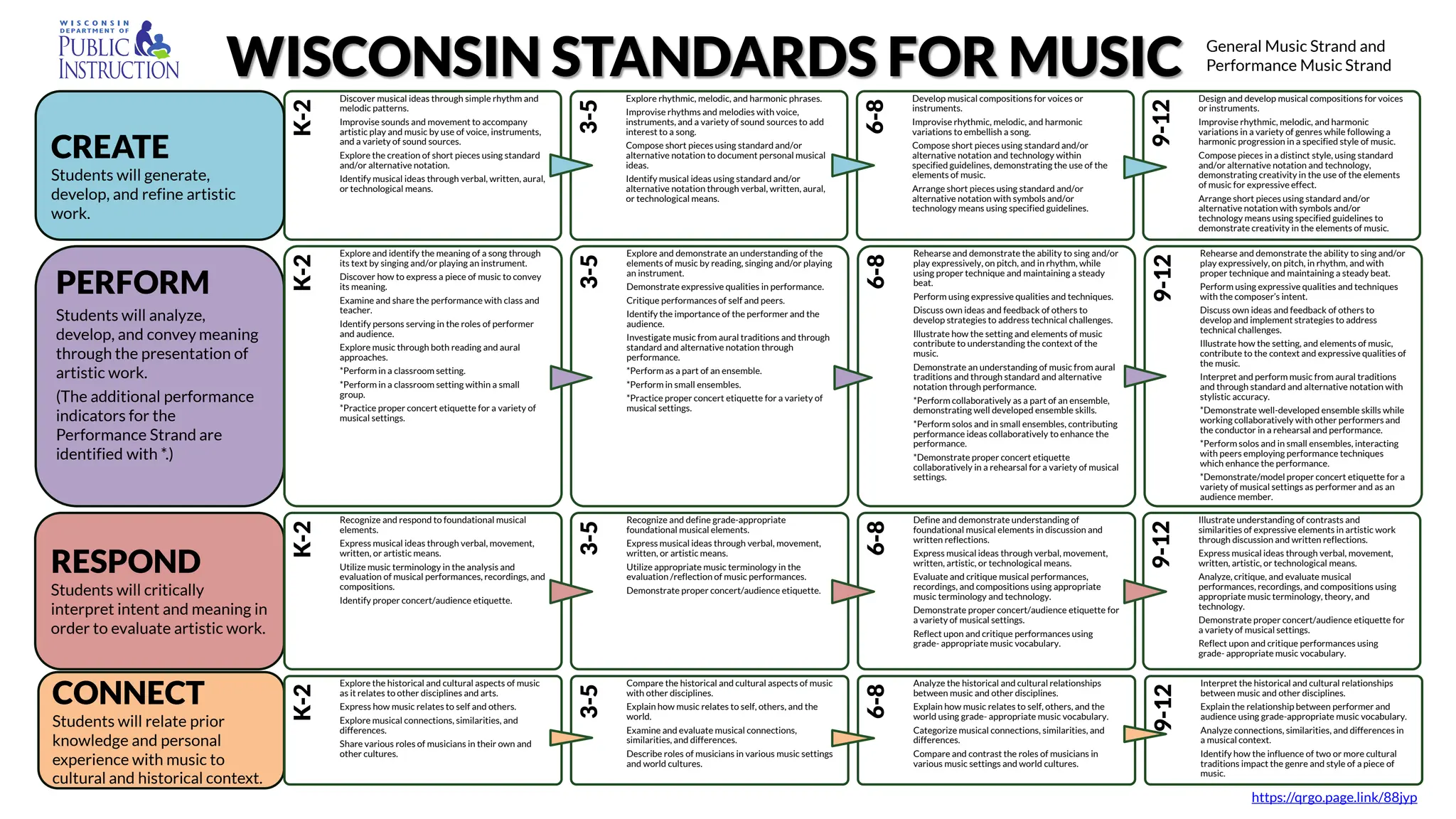
WISCONSIN STANDARDS FORMUSIC
K-2
Discover musical ideas through simple rhythm and
melodic patterns.
Improvise sounds and movement to accompany
artistic play and music by use of voice, instruments,
and a variety of sound sources.
Explore the creation of short pieces using standard
and/or alternative notation.
Identify musical ideas through verbal, written, aural,
or technological means.
3-5
Explore rhythmic, melodic, and harmonic phrases.
Improvise rhythms and melodies with voice,
instruments, and a variety of sound sources to add
interest to a song.
Compose short pieces using standard and/or
alternative notation to document personal musical
ideas.
Identify musical ideas using standard and/or
alternative notation through verbal, written, aural,
or technological means.
6-8
Develop musical compositions for voices or
instruments.
Improvise rhythmic, melodic, and harmonic
variations to embellish a song.
Compose short pieces using standard and/or
alternative notation and technology within
specified guidelines, demonstrating the use of the
elements of music.
Arrange short pieces using standard and/or
alternative notation with symbols and/or
technology means using specified guidelines.
9-12
Design and develop musical compositions for voices
or instruments.
Improvise rhythmic, melodic, and harmonic
variations in a variety of genres while following a
harmonic progression in a specified style of music.
Compose pieces in a distinct style, using standard
and/or alternative notation and technology,
demonstrating creativity in the use of the elements
of music for expressive effect.
Arrange short pieces using standard and/or
alternative notation with symbols and/or
technology means using specified guidelines to
demonstrate creativity in the elements of music.
CREATE
Students will generate,
develop, and refine artistic
work.
PERFORM
Students will analyze,
develop, and convey meaning
through the presentation of
artistic work.
(The additional performance
indicators for the
Performance Strand are
identified with *.)
RESPOND
Students will critically
interpret intent and meaning in
order to evaluate artistic work.
CONNECT
Students will relate prior
knowledge and personal
experience with music to
cultural and historical context.
K-2
Explore and identify the meaning of a song through
its text by singing and/or playing an instrument.
Discover how to express a piece of music to convey
its meaning.
Examine and share the performance with class and
teacher.
Identify persons serving in the roles of performer
and audience.
Explore music through both reading and aural
approaches.
*Perform in a classroom setting.
*Perform in a classroom setting within a small
group.
*Practice proper concert etiquette for a variety of
musical settings.
3-5
Explore and demonstrate an understanding of the
elements of music by reading, singing and/or playing
an instrument.
Demonstrate expressive qualities in performance.
Critique performances of self and peers.
Identify the importance of the performer and the
audience.
Investigate music from aural traditions and through
standard and alternative notation through
performance.
*Perform as a part of an ensemble.
*Perform in small ensembles.
*Practice proper concert etiquette for a variety of
musical settings.
6-8
Rehearse and demonstrate the ability to sing and/or
play expressively, on pitch, and in rhythm, while
using proper technique and maintaining a steady
beat.
Perform using expressive qualities and techniques.
Discuss own ideas and feedback of others to
develop strategies to address technical challenges.
Illustrate how the setting and elements of music
contribute to understanding the context of the
music.
Demonstrate an understanding of music from aural
traditions and through standard and alternative
notation through performance.
*Perform collaboratively as a part of an ensemble,
demonstrating well developed ensemble skills.
*Perform solos and in small ensembles, contributing
performance ideas collaboratively to enhance the
performance.
*Demonstrate proper concert etiquette
collaboratively in a rehearsal for a variety of musical
settings.
9-12
Rehearse and demonstrate the ability to sing and/or
play expressively, on pitch, in rhythm, and with
proper technique and maintaining a steady beat.
Perform using expressive qualities and techniques
with the composer’s intent.
Discuss own ideas and feedback of others to
develop and implement strategies to address
technical challenges.
Illustrate how the setting, and elements of music,
contribute to the context and expressive qualities of
the music.
Interpret and perform music from aural traditions
and through standard and alternative notation with
stylistic accuracy.
*Demonstrate well-developed ensemble skills while
working collaboratively with other performers and
the conductor in a rehearsal and performance.
*Perform solos and in small ensembles, interacting
with peers employing performance techniques
which enhance the performance.
*Demonstrate/model proper concert etiquette for a
variety of musical settings as performer and as an
audience member.
K-2
Recognize and respond to foundational musical
elements.
Express musical ideas through verbal, movement,
written, or artistic means.
Utilize music terminology in the analysis and
evaluation of musical performances, recordings, and
compositions.
Identify proper concert/audience etiquette.
3-5
Recognize and define grade-appropriate
foundational musical elements.
Express musical ideas through verbal, movement,
written, or artistic means.
Utilize appropriate music terminology in the
evaluation /reflection of music performances.
Demonstrate proper concert/audience etiquette.
6-8
Define and demonstrate understanding of
foundational musical elements in discussion and
written reflections.
Express musical ideas through verbal, movement,
written, artistic, or technological means.
Evaluate and critique musical performances,
recordings, and compositions using appropriate
music terminology and technology.
Demonstrate proper concert/audience etiquette for
a variety of musical settings.
Reflect upon and critique performances using
grade- appropriate music vocabulary.
9-12
Illustrate understanding of contrasts and
similarities of expressive elements in artistic work
through discussion and written reflections.
Express musical ideas through verbal, movement,
written, artistic, or technological means.
Analyze, critique, and evaluate musical
performances, recordings, and compositions using
appropriate music terminology, theory, and
technology.
Demonstrate proper concert/audience etiquette for
a variety of musical settings.
Reflect upon and critique performances using
grade- appropriate music vocabulary.
K-2
Explore the historical and cultural aspects of music
as it relates to other disciplines and arts.
Express how music relates to self and others.
Explore musical connections, similarities, and
differences.
Share various roles of musicians in their own and
other cultures.
3-5
Compare the historical and cultural aspects of music
with other disciplines.
Explain how music relates to self, others, and the
world.
Examine and evaluate musical connections,
similarities, and differences.
Describe roles of musicians in various music settings
and world cultures.
6-8
Analyze the historical and cultural relationships
between music and other disciplines.
Explain how music relates to self, others, and the
world using grade- appropriate music vocabulary.
Categorize musical connections, similarities, and
differences.
Compare and contrast the roles of musicians in
various music settings and world cultures.
9-12
Interpret the historical and cultural relationships
between music and other disciplines.
Explain the relationship between performer and
audience using grade-appropriate music vocabulary.
Analyze connections, similarities, and differences in
a musical context.
Identify how the influence of two or more cultural
traditions impact the genre and style of a piece of
music.
General Music Strand and
Performance Music Strand
https://qrgo.page.link/88jyp