
MostcommonSpanishconjunctionsConjuncionesCoordinanteswww.spanishsouthamerica.org
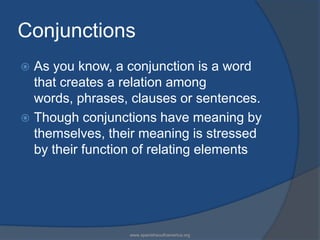
ConjunctionsAs you know, a conjunction is a word that creates a relation among words, phrases, clauses or sentences. Though conjunctions have meaning by themselves, their meaning is stressed by their function of relating elementswww.spanishsouthamerica.org
CoordinatingConjunctionswww.spanishsouthamerica.org
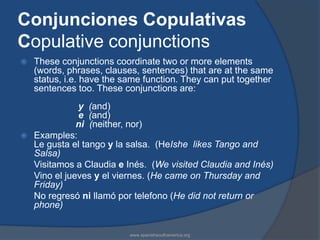
ConjuncionesCopulativasCopulative conjunctionsThese conjunctions coordinate two or more elements (words, phrases, clauses, sentences) that are at the same status, i.e. have the same function. They can put together sentences too. These conjunctions are:                 y  (and)                 e  (and)                ni  (neither, nor)Examples:Le gusta el tango y la salsa.  (HeIshe  likes Tango and Salsa)Visitamos a Claudia eInés. (We visited Claudia and Inés)Vino el juevesy el viernes. (He came on Thursday and Friday)No regresónillamóportelefono (He did not return or phone)www.spanishsouthamerica.org
Remember	Before a word beginning with i or hi, "y" is replaced by e :Madre e hijo se levantantemprano (Mother and son get up early)Ni is regularly used in double negationJosé luis has neither girlfriend nor moneyJosé Luis no tienenienamoradanidinerowww.spanishsouthamerica.org
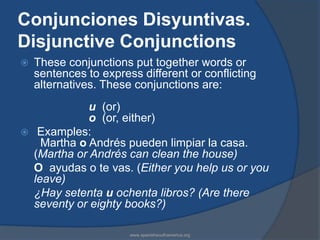
ConjuncionesDisyuntivas.Disjunctive ConjunctionsThese conjunctions put together words or sentences to express different or conflicting alternatives. These conjunctions are:                 u  (or)                 o  (or, either) Examples:  Martha o Andrés puedenlimpiar la casa. (Martha or Andrés can clean the house)	O  ayudas o te vas. (Either you help us or you leave)¿Hay setentau ochentalibros? (Are there seventy or eighty books?)www.spanishsouthamerica.org
Remember	Before a word beginning with o or ho, "o" is replaced by u :¿Quiéntrajo la torta? ¿Mirtau Ofelia? (Who brought the cake, Mirta or Ofelia?)www.spanishsouthamerica.org
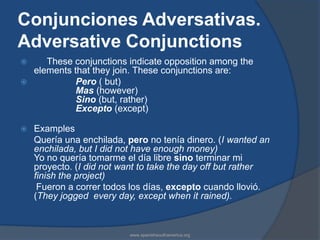
Conjunciones Adversativas.AdversativeConjunctions     Theseconjunctionsindicateoppositionamongtheelementsthattheyjoin. Theseconjunctions are:                Pero ( but)                Mas (however)                   Sino(but, rather)               Excepto (except)                ExamplesQuería una enchilada, pero no tenía dinero. (I wantedan enchilada, but I didnothaveenoughmoney)Yo no quería tomarme el día libre sino terminar mi proyecto. (I didnotwanttotaketheday off butratherfinishtheproject)      Fueron a correr todos los días, excepto cuando llovió. (Theyjoggedeveryday, exceptwhenitrained). www.spanishsouthamerica.org
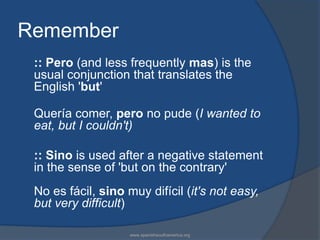
Remember	::Pero (and less frequently mas) is the usual conjunction that translates the English 'but'Quería comer, pero no pude(I wanted to eat, but I couldn't)::Sino is used after a negative statement in the sense of 'but on the contrary'No esfácil, sinomuydifícil (it's not easy, but very difficult)www.spanishsouthamerica.org
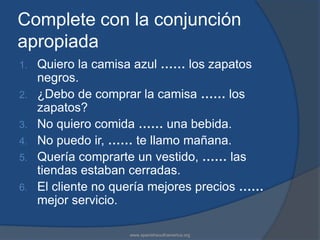
Complete conlaconjunciónapropiadaQuiero la camisa azul …… los zapatos negros. ¿Debo de comprar la camisa …… los zapatos? No quiero comida …… una bebida. No puedo ir, …… te llamo mañana. Quería comprarte un vestido, …… las tiendas estaban cerradas.El cliente no quería mejores precios …… mejor servicio.www.spanishsouthamerica.org
Next are thekeyanswersplustranslationwww.spanishsouthamerica.org
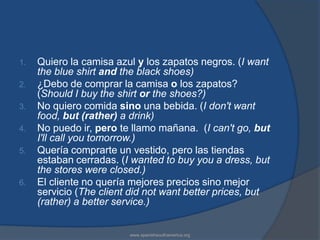
Quiero la camisa azul y los zapatos negros. (I wanttheblueshirtandtheblackshoes)¿Debo de comprar la camisa o los zapatos?  (Should I buytheshirtortheshoes?)No quiero comida sino una bebida. (I don'twantfood, but (rather) a drink)No puedo ir, pero te llamo mañana.  (I can'tgo, butI'llcallyoutomorrow.)Quería comprarte un vestido, pero las tiendas estaban cerradas. (I wantedtobuyyou a dress, butthestoreswereclosed.)El cliente no quería mejores precios sino mejor servicio (Theclientdidnotwantbetterprices, but (rather) a betterservice.)www.spanishsouthamerica.org
¡Muchasgracias!A few reminders:We give private one-on-one and small group classes online in virtual classrooms, over the phone and with VoIP.We are featuring two new language courses: Brasil: Língua, Cultura e Paixão. (Portuguese for Foreigners) by Tutors Edith and Mariano; and Français pour vous (French for you: all levels, all ages) by Tutor Samhae.We are on Twitter: spanishsa is our id and on Facebook: Edith Spanish S A We have new self-study material: LISTEN-AND-LEARN sets (mp3 or video link plus worksheets)There are Spanish language public demo classes here and there, so please, check the WiZiQ public classes to get the updates. Remember that you can check on the time for the time zone of your location at http://www.timeanddate.com/worldclock/converter.htmlWe are constantly updating our website www.spanishsouthamerica.org and blog www.spanishsouthamerica.blogspot.comIf you follow us in WIZIQ, Facebookor Twitter, you get updates of tutorials, discussions, anything, a minute after it happens! So, we recommend you be a follower and a contact (which makes it easier to send you personal invitations to public and private classes)www.spanishsouthamerica.org
We are re-launching the CLUB DEL CHISTE (Joke’s club) to help you develop or improve oral skills. This is one of our four clubs: CLUB DE LECTURA ELECTRÓNICA (E-reading group to develop reading skills; these days focusing on poetry); CLUB DE MELÓMANOS (the listen-and-learn club version); REPORTEROS GLOBALES (global reporters; to develop written skills through news reporting; These clubs meetings price goes from $3 to $6Spread the word please and invite your friends to join us!Hastapronto/See you soonwww.spanishsouthamerica.org

Most Common Spanish conjunctions

  • 1.
  • 2.
    ConjunctionsAs you know,a conjunction is a word that creates a relation among words, phrases, clauses or sentences. Though conjunctions have meaning by themselves, their meaning is stressed by their function of relating elementswww.spanishsouthamerica.org
  • 3.
  • 4.
    ConjuncionesCopulativasCopulative conjunctionsThese conjunctionscoordinate two or more elements (words, phrases, clauses, sentences) that are at the same status, i.e. have the same function. They can put together sentences too. These conjunctions are:                 y (and)                 e (and)                ni (neither, nor)Examples:Le gusta el tango y la salsa. (HeIshe likes Tango and Salsa)Visitamos a Claudia eInés. (We visited Claudia and Inés)Vino el juevesy el viernes. (He came on Thursday and Friday)No regresónillamóportelefono (He did not return or phone)www.spanishsouthamerica.org
  • 5.
    Remember Before a wordbeginning with i or hi, "y" is replaced by e :Madre e hijo se levantantemprano (Mother and son get up early)Ni is regularly used in double negationJosé luis has neither girlfriend nor moneyJosé Luis no tienenienamoradanidinerowww.spanishsouthamerica.org
  • 6.
    ConjuncionesDisyuntivas.Disjunctive ConjunctionsThese conjunctionsput together words or sentences to express different or conflicting alternatives. These conjunctions are:                 u (or)                 o (or, either) Examples:  Martha o Andrés puedenlimpiar la casa. (Martha or Andrés can clean the house) O  ayudas o te vas. (Either you help us or you leave)¿Hay setentau ochentalibros? (Are there seventy or eighty books?)www.spanishsouthamerica.org
  • 7.
    Remember Before a wordbeginning with o or ho, "o" is replaced by u :¿Quiéntrajo la torta? ¿Mirtau Ofelia? (Who brought the cake, Mirta or Ofelia?)www.spanishsouthamerica.org
  • 8.
    Conjunciones Adversativas.AdversativeConjunctions     Theseconjunctionsindicateoppositionamongtheelementsthattheyjoin. Theseconjunctionsare:                Pero ( but)                Mas (however)                   Sino(but, rather)               Excepto (except)                ExamplesQuería una enchilada, pero no tenía dinero. (I wantedan enchilada, but I didnothaveenoughmoney)Yo no quería tomarme el día libre sino terminar mi proyecto. (I didnotwanttotaketheday off butratherfinishtheproject)      Fueron a correr todos los días, excepto cuando llovió. (Theyjoggedeveryday, exceptwhenitrained). www.spanishsouthamerica.org
  • 9.
    Remember ::Pero (and lessfrequently mas) is the usual conjunction that translates the English 'but'Quería comer, pero no pude(I wanted to eat, but I couldn't)::Sino is used after a negative statement in the sense of 'but on the contrary'No esfácil, sinomuydifícil (it's not easy, but very difficult)www.spanishsouthamerica.org
  • 10.
    Complete conlaconjunciónapropiadaQuiero lacamisa azul …… los zapatos negros. ¿Debo de comprar la camisa …… los zapatos? No quiero comida …… una bebida. No puedo ir, …… te llamo mañana. Quería comprarte un vestido, …… las tiendas estaban cerradas.El cliente no quería mejores precios …… mejor servicio.www.spanishsouthamerica.org
  • 11.
  • 12.
    Quiero la camisaazul y los zapatos negros. (I wanttheblueshirtandtheblackshoes)¿Debo de comprar la camisa o los zapatos? (Should I buytheshirtortheshoes?)No quiero comida sino una bebida. (I don'twantfood, but (rather) a drink)No puedo ir, pero te llamo mañana. (I can'tgo, butI'llcallyoutomorrow.)Quería comprarte un vestido, pero las tiendas estaban cerradas. (I wantedtobuyyou a dress, butthestoreswereclosed.)El cliente no quería mejores precios sino mejor servicio (Theclientdidnotwantbetterprices, but (rather) a betterservice.)www.spanishsouthamerica.org
  • 13.
    ¡Muchasgracias!A few reminders:Wegive private one-on-one and small group classes online in virtual classrooms, over the phone and with VoIP.We are featuring two new language courses: Brasil: Língua, Cultura e Paixão. (Portuguese for Foreigners) by Tutors Edith and Mariano; and Français pour vous (French for you: all levels, all ages) by Tutor Samhae.We are on Twitter: spanishsa is our id and on Facebook: Edith Spanish S A We have new self-study material: LISTEN-AND-LEARN sets (mp3 or video link plus worksheets)There are Spanish language public demo classes here and there, so please, check the WiZiQ public classes to get the updates. Remember that you can check on the time for the time zone of your location at http://www.timeanddate.com/worldclock/converter.htmlWe are constantly updating our website www.spanishsouthamerica.org and blog www.spanishsouthamerica.blogspot.comIf you follow us in WIZIQ, Facebookor Twitter, you get updates of tutorials, discussions, anything, a minute after it happens! So, we recommend you be a follower and a contact (which makes it easier to send you personal invitations to public and private classes)www.spanishsouthamerica.org
  • 14.
    We are re-launchingthe CLUB DEL CHISTE (Joke’s club) to help you develop or improve oral skills. This is one of our four clubs: CLUB DE LECTURA ELECTRÓNICA (E-reading group to develop reading skills; these days focusing on poetry); CLUB DE MELÓMANOS (the listen-and-learn club version); REPORTEROS GLOBALES (global reporters; to develop written skills through news reporting; These clubs meetings price goes from $3 to $6Spread the word please and invite your friends to join us!Hastapronto/See you soonwww.spanishsouthamerica.org