
It’sallaboutEnglishEnglishRefresherCoursewww.spanishsouthamerica.orgTellingstories
TellingstoriesWhen you were a child:Where did you usually listen to stories?What time of day was it, typically?Who told you or read you stories?How did you react to the stories?Now that you are older:Have you read or told stories as a parent/uncle/aunt/ teacher?What are your feelings in this role?www.spanishsouthamerica.org
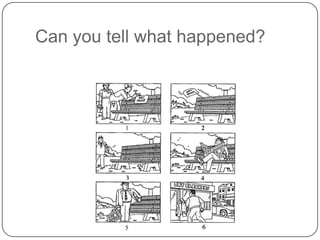
Can youtellwhathappened?
AbouttellingstoriesLet’swatchthis video http://www.metacafe.com/watch/2972569/learn_english_language_mini_story_the_train_ride/Didyoulikeit?What do youremember?NowwatchitagainbutfocusonthepicturesWriteonesentenceforeachpicturewww.spanishsouthamerica.org
NowTelling stories is common in any language. Think of situations in which you can tell a story: Talking about your pastTelling anecdotesGiving details about something that happened during a job interview Relating information about family stories to your children Telling colleagues about what happened on a business tripTelling jokes…www.spanishsouthamerica.org
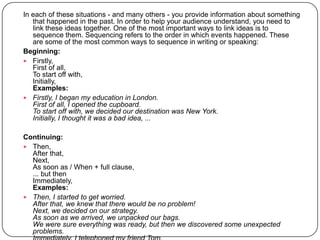
In each of these situations - and many others - you provide information about something that happened in the past. In order to help your audience understand, you need to link these ideas together. One of the most important ways to link ideas is to sequence them. Sequencing refers to the order in which events happened. These are some of the most common ways to sequence in writing or speaking: Beginning:Firstly,First of all,To start off with, Initially, Examples:Firstly, I began my education in London.First of all, I opened the cupboard.To start off with, we decided our destination was New York.Initially, I thought it was a bad idea, ...Continuing:Then,After that,Next,As soon as / When + full clause,... but thenImmediately, Examples:Then, I started to get worried.After that, we knew that there would be no problem!Next, we decided on our strategy.As soon as we arrived, we unpacked our bags.We were sure everything was ready, but then we discovered some unexpected problems.Immediately, I telephoned my friend Tom.
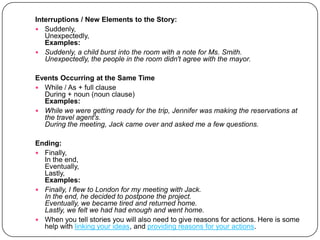
Interruptions / New Elements to the Story:Suddenly, Unexpectedly, Examples:Suddenly, a child burst into the room with a note for Ms. Smith.Unexpectedly, the people in the room didn't agree with the mayor.Events Occurring at the Same TimeWhile / As + full clauseDuring + noun (noun clause)Examples:While we were getting ready for the trip, Jennifer was making the reservations at the travel agent's.During the meeting, Jack came over and asked me a few questions.Ending:Finally,In the end,Eventually,Lastly,Examples:Finally, I flew to London for my meeting with Jack.In the end, he decided to postpone the project.Eventually, we became tired and returned home.Lastly, we felt we had had enough and went home.When you tell stories you will also need to give reasons for actions. Here is some help with linking your ideas, and providing reasons for your actions.
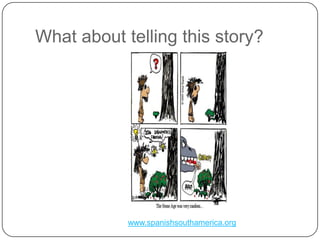
Whatabouttellingthisstory?www.spanishsouthamerica.org
Let’sthink of somethingtotell	It can be:FunnyWeirdSadFreakyAbout ghostsAbout loveAbout hatredAbout an event that entailed police actionAnything www.spanishsouthamerica.org
What do youremember of thestoryyou are goingtotell?Take a few notes tohelpyourememberthestoryOrganizethosewords/phrases/ sentencesaccordingtotheorder in whichtheyhappenAdd more detailsAddlinkingwordswww.spanishsouthamerica.org
Well, you are ready…orkind ofWouldyouliketo share itwithus?Thanks a lot!salavirtual1@hotmail.com www.spanishsouthamerica.blogspot.comOnFacebook: Edith Spanish S AOnTwitter: spanishsawww.spanishsouthamerica.org

Telling stories (English Refresher Course)

  • 1.
  • 2.
    TellingstoriesWhen you werea child:Where did you usually listen to stories?What time of day was it, typically?Who told you or read you stories?How did you react to the stories?Now that you are older:Have you read or told stories as a parent/uncle/aunt/ teacher?What are your feelings in this role?www.spanishsouthamerica.org
  • 3.
  • 4.
    AbouttellingstoriesLet’swatchthis video http://www.metacafe.com/watch/2972569/learn_english_language_mini_story_the_train_ride/Didyoulikeit?Whatdo youremember?NowwatchitagainbutfocusonthepicturesWriteonesentenceforeachpicturewww.spanishsouthamerica.org
  • 5.
    NowTelling stories iscommon in any language. Think of situations in which you can tell a story: Talking about your pastTelling anecdotesGiving details about something that happened during a job interview Relating information about family stories to your children Telling colleagues about what happened on a business tripTelling jokes…www.spanishsouthamerica.org
  • 6.
    In each ofthese situations - and many others - you provide information about something that happened in the past. In order to help your audience understand, you need to link these ideas together. One of the most important ways to link ideas is to sequence them. Sequencing refers to the order in which events happened. These are some of the most common ways to sequence in writing or speaking: Beginning:Firstly,First of all,To start off with, Initially, Examples:Firstly, I began my education in London.First of all, I opened the cupboard.To start off with, we decided our destination was New York.Initially, I thought it was a bad idea, ...Continuing:Then,After that,Next,As soon as / When + full clause,... but thenImmediately, Examples:Then, I started to get worried.After that, we knew that there would be no problem!Next, we decided on our strategy.As soon as we arrived, we unpacked our bags.We were sure everything was ready, but then we discovered some unexpected problems.Immediately, I telephoned my friend Tom.
  • 7.
    Interruptions / NewElements to the Story:Suddenly, Unexpectedly, Examples:Suddenly, a child burst into the room with a note for Ms. Smith.Unexpectedly, the people in the room didn't agree with the mayor.Events Occurring at the Same TimeWhile / As + full clauseDuring + noun (noun clause)Examples:While we were getting ready for the trip, Jennifer was making the reservations at the travel agent's.During the meeting, Jack came over and asked me a few questions.Ending:Finally,In the end,Eventually,Lastly,Examples:Finally, I flew to London for my meeting with Jack.In the end, he decided to postpone the project.Eventually, we became tired and returned home.Lastly, we felt we had had enough and went home.When you tell stories you will also need to give reasons for actions. Here is some help with linking your ideas, and providing reasons for your actions.
  • 8.
  • 9.
    Let’sthink of somethingtotell Itcan be:FunnyWeirdSadFreakyAbout ghostsAbout loveAbout hatredAbout an event that entailed police actionAnything www.spanishsouthamerica.org
  • 10.
    What do yourememberof thestoryyou are goingtotell?Take a few notes tohelpyourememberthestoryOrganizethosewords/phrases/ sentencesaccordingtotheorder in whichtheyhappenAdd more detailsAddlinkingwordswww.spanishsouthamerica.org
  • 11.
    Well, you areready…orkind ofWouldyouliketo share itwithus?Thanks a lot!salavirtual1@hotmail.com www.spanishsouthamerica.blogspot.comOnFacebook: Edith Spanish S AOnTwitter: spanishsawww.spanishsouthamerica.org