MOSCOW CITY : COMPREHENSIVE MOBILITY PLAN
Department of Civil Engineering
P. G. Section in Transportation Engineering & Planning
Submitted by –
Roll No. P17TP002 Shubham Sharma (M. Tech , 1st semester)
CONTENTS :
 Comprehensive Mobility Plan
 Moscow City
 Current transportation Scenario
 Problem associated with Transportation System
 Targets set by Government
 Transportation strategies
 Examples of implemented initiatives
 Strategies need to work on
COMPREHENSIVE MOBILITY PLAN:
Vision
Strategies
and Policies
Investments Emphasis
 Long-term vision
oDesirable mobility patterns
(people and goods) for a city
oTo improve accessibility
and mobility for its residents.
o Provides strategy and
policy measures to
achieve this vision.
o Short term investments
oMedium term investments
oLong term investments
It should emphasizes the
importance of
1. Pedestrian
facilities
2. Non-motorized
transport
measures
3. Public transport
systems, including
buses and
sustainable mass
rapid transit
systems
A key document to justify and support transport proposals of the city, to the Central
Government and multilateral funding agencies
MOSCOW CITY :
 Capital of Russia
 More than 13.2 million(2015) residents within the city limits
 17.1 million(2015) within the urban area.
 Major political, economic, cultural, and scientific centre of Russia and Eastern Europe
 Largest city entirely on the European continent Based on population within city limits.
 Among world's largest cities
1. 14th largest metro area
2. 15th largest urban area
3. One of the fastest growing tourist destinations in the world according to the MasterCard Global Destination Cities
Index
 Territorial expansion on July 1, 2012 southwest into the Moscow Oblast
1. The area of the capital more than doubled, going from 1,091 to 2,511 square kilometers (421 to 970 sq mi)
2. additional population of 233,000 people.
 Over 40 percent of its territory covered by greenery
 Have the largest forest in an urban area within its border.
CURRENT DEVELOPMENT &TRANSPORTATION SCENARIO:
 Characterized by high population density
 Insufficient supply of roadway network
 The public transport system comparable by its size to the largest megalopolises
0 2 4 6 8 10 12 14
Moscow
Singapore
Hong Kong
Tokyo
London
Berlin
Paris
12.1
5.5
7.2
13.2
7.8
3.5
10.4
Population (Millions)
Population comparison of different Cities
(2012)
0
20
40
60
80
100
100
77
65 57
55 55
41
PopulationDensity
(Persons/Hectare)
Population Density of Different Cities (2012)
0
5
10
15
20
25
30
35
40
19
25
12
35
30
35
38
Availability of Living Space ( sq. m per person), 2012
0
1
2
3
4
5
6
1 1 1
4
5
3
6
Office space availability
(sq. m per person), 2012
CONTD.
 Huge amount of transportation by public transport ~6 billion passengers per year (~16.5 million per day) by 2020
0
1
2
3
4
5
6
7
Metro Suburban
Railway Trains
Municipal
Surface
Transport
Taxi Total
2.49
0.67
2.1
0.08
5.34
2.5
0.68
2.2
0.1
5.48
2.8
1.32
2.5
0.21
6.83
Annual Ridership, Billion/year
2013
2014
2020
PROBLEMS ASSOCIATED WITH TRANSPORTATION :
Landuse
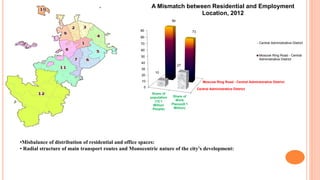
• A mismatch between
the employment and
residential location is
a serious problem
• 20% of people spend
over 3 hours daily
commuting
Private vehicles
• The situation is
aggravated by the
growth of number of
private cars
• High share of
personal vehicles
usage
Road networks
• The route network of
municipal ground
public transport is
outdated
• Roads are heavily
congested
Public Transport
• Public transport is
overcrowded by 20–
30%
• Inability of surface
public transport to
keep to schedule due
to the congestion of
roads
Parking and NMT
infrastructure
• Underdeveloped
pedestrian and
cycling infrastructure
• Violation of parking
rules causes
problems for
movement of
pedestrians
Taxi Services
• Inadequate number
of legal taxis
• Unpredictable taxi
rates
0
50
100
150
200
250
300
350
318
101
63
181
305
320 320
NumberofPrivateCarsper1000
People
Number of Private Cars per 1000 People
0
0.5
1
1.5
2
0.3
0.6
0.3
0.6
1.6
1.8
0.9
kmper1000people
Availability of Roads (km per 1000 people)
0 1 2 3 4 5 6 7
Metro
Suburban Railway Trains
Municipal Surface Transport
Taxi
6.85
1.86
6.02
0.26
Daily Ridership, 2014 in millions
45.7
12.4
40.2
1.7
Daily Ridership, 2014 in millions
Metro
Suburban Railway Trains
Municipal Surface Transport
Taxi
Central Administrative District
Moscow Ring Road - Central Administrative District
0
10
20
30
40
50
60
70
80
90
Share of
population
(12.1
Million
People)
Share of
Work
Places(8.1
Million)
10
27
90
73
A Mismatch between Residential and Employment
Location, 2012
Central Administrative District
Moscow Ring Road - Central
Administrative District
•Misbalance of distribution of residential and office spaces:
• Radial structure of main transport routes and Monocentric nature of the city's development:
CONGESTION
AMBITIOUS GOALS OF MOSCOW GOVERNMENT
1. No traffic congestion
2. Comfortable, high speed, reliable public transport that keeps to schedule
3. Comfortable and safe movement for pedestrians and cyclists
4. Safe taxis operating under accepted quality standards
5. Reduce the average trip time during rush hour by 10 minutes by 2020
6. Initiatives encouraging the use of public transport
7. To attract about USD 24 billion of private investments along with investing ~ USD 60 billion of public funds
8. Average time of car driving and taking public transport – 50 minutes
IN 2012
In 2020(target)0
10
20
30
40
50
60
70
80
Average time travel at rush
hours(min) Personal
vehicle
Average time travel at rush
hours(min) Public
Transport
Total capacity of public
transport(million per day)
Share of public using
Public Transport (%)
67
60
31
61
55
50
40
71
IN 2012
In 2020(target)
THE TARGET STATE OF TRANSPORT SYSTEM
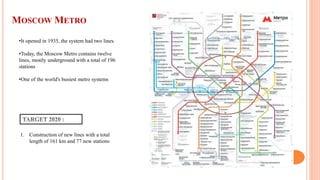
MOSCOW METRO
1. Construction of new lines with a total
length of 161 km and 77 new stations
•It opened in 1935, the system had two lines.
•Today, the Moscow Metro contains twelve
lines, mostly underground with a total of 196
stations
•One of the world's busiest metro systems
MOSCOW RAILWAY
1. Construction of additional rails with a total
length of 161 km
2. Construction of the Small Ring of the Moscow
Railway
3. Achievement of the annual ridership of 300 mln.
passengers
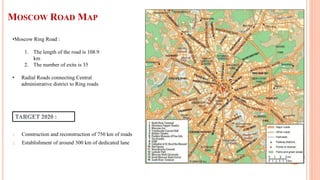
MOSCOW ROAD MAP
1. Construction and reconstruction of 750 km of roads
2. Establishment of around 300 km of dedicated lane
•Moscow Ring Road :
1. The length of the road is 108.9
km
2. The number of exits is 35
• Radial Roads connecting Central
administrative district to Ring roads
MOSCOW TRAM
1. 100% upgrade of the rolling stock that consists of around
12,000 rolling stock units
2. Modernization and construction of around 300 km of
tramlines
• Opened in 1872
• Divided into two sub-networks
• The two sub-networks had a combined total route length
of 181 km
• Whole network the fourth largest in the world
MOSCOW BICYCLE TRACK
1. Development of bicycle and pedestrian zones
2. Development of a bike rental system, building
up to 300 km of cycle paths and up to 14
thousand of bicycle parking lots
VELO-BIKE STATION MAP
 Velobike is a bicycle sharing system,
implemented by City of Moscow, Russia.
 The system began on the 31st of May 2013
 Provides over 2700 bicycles available from
over 300 stations situated around the city
of Moscow.
 The bicycles can be returned to any other
station.
Tariffs
• Establishing a complex of
new ticket and tariff
solutions
• 80% Completed by 2014
Taxi
• Legalization of a taxi
market and development of
clear rules for its operation
• Establishment 55 thousand
legal taxis network
• Promoting Taxi sharing
Parking lots and
transfer hubs
• Paid parking lots in the city
center
• Creation of park and ride
and park and pool facilities
• Establishment of 273
transfer hubs
Traffic organization
and ITS
• ITS deployment all over the
city
• Creation of a unified city
dispatch center for traffic
control
• Creation of truck routes,
implementing restrictions
for trucks movement in
various city zones,
including restrictions on
emission levels
OTHER TRANSPORTATION STRATEGIES -
TECHNOLOGIES/FACILITIES UNDER DEVELOPMENT/UPGRADATION -
s
• Solar battery parking meters: Located on the streets: 1 parking meter for every 65
car spaces
• Mobile systems (SMS, applications)
Payment technologies
• Hand-held devices for traffic wardens capable of taking photographs and
number plate recognition
• Mobile devices capable of taking photographs and number plate recognition
for installation in an inspector's car
Technologies enforcing the
Requirements
• Data collection Special sensors for collecting data on parking lot occupancy and
providing corresponding information to drivers, may be used in the streets and in
other areas.
• Information boards Used to inform the drivers on the availability of street parking
lots
• Web Portal Used to inform the driver
Communication technologies
OUTCOMES OF SOME OF STRATEGIES:
2013 Improvements(Paid
Parking Spaces)
• More than 47000 new
paid parking lots created
in the center of the city
since the end of 2012
• Technologies
implemented to increase
system efficiency and
customer experience
The situation before the
establishment of paid
parking and traffic rules
enforcement
• Parking on the pavement
creates obstacles for
pedestrians
• There are no available
parking spaces near points
of attraction
The situation after the
establishment of paid
parking and traffic rules
enforcement
• Organized safe and
convenient movement for
pedestrians
• Availability of 1-2 parking
places in every street makes
parking easier
Impact
• The roads in the city center
have been freed up
• The safety of pedestrians
has been increased
• A positive impact on the
transport situation in the
city center
• The number of vehicles
has decreased
• The traffic speed has
increased
• Pedestrians feel more
comfortable walking on
the pavements.
REFERENCES:
 https://en.investmoscow.ru/media/2705152/development-priorities-of-urban-transport-system-in-moscow-
agglomeration.pdf
 https://russiable.co.uk/official-tourist-maps-moscow-pdf-print/
 https://www.mos.ru/en/services/advisor/story/Moscow_public_transport/
 www.uitp.org/moscow’s-transport-development-programme
 www.transrussia.ru/en-GB
 https://link.springer.com/content/pdf/10.1007/3-540-28397-8_23.pdf

Moscow, comprehensive mobility plan

  • 1.
    MOSCOW CITY :COMPREHENSIVE MOBILITY PLAN Department of Civil Engineering P. G. Section in Transportation Engineering & Planning Submitted by – Roll No. P17TP002 Shubham Sharma (M. Tech , 1st semester)
  • 2.
    CONTENTS :  ComprehensiveMobility Plan  Moscow City  Current transportation Scenario  Problem associated with Transportation System  Targets set by Government  Transportation strategies  Examples of implemented initiatives  Strategies need to work on
  • 3.
    COMPREHENSIVE MOBILITY PLAN: Vision Strategies andPolicies Investments Emphasis  Long-term vision oDesirable mobility patterns (people and goods) for a city oTo improve accessibility and mobility for its residents. o Provides strategy and policy measures to achieve this vision. o Short term investments oMedium term investments oLong term investments It should emphasizes the importance of 1. Pedestrian facilities 2. Non-motorized transport measures 3. Public transport systems, including buses and sustainable mass rapid transit systems A key document to justify and support transport proposals of the city, to the Central Government and multilateral funding agencies
  • 4.
    MOSCOW CITY : Capital of Russia  More than 13.2 million(2015) residents within the city limits  17.1 million(2015) within the urban area.  Major political, economic, cultural, and scientific centre of Russia and Eastern Europe  Largest city entirely on the European continent Based on population within city limits.  Among world's largest cities 1. 14th largest metro area 2. 15th largest urban area 3. One of the fastest growing tourist destinations in the world according to the MasterCard Global Destination Cities Index  Territorial expansion on July 1, 2012 southwest into the Moscow Oblast 1. The area of the capital more than doubled, going from 1,091 to 2,511 square kilometers (421 to 970 sq mi) 2. additional population of 233,000 people.  Over 40 percent of its territory covered by greenery  Have the largest forest in an urban area within its border.
  • 5.
    CURRENT DEVELOPMENT &TRANSPORTATIONSCENARIO:  Characterized by high population density  Insufficient supply of roadway network  The public transport system comparable by its size to the largest megalopolises 0 2 4 6 8 10 12 14 Moscow Singapore Hong Kong Tokyo London Berlin Paris 12.1 5.5 7.2 13.2 7.8 3.5 10.4 Population (Millions) Population comparison of different Cities (2012) 0 20 40 60 80 100 100 77 65 57 55 55 41 PopulationDensity (Persons/Hectare) Population Density of Different Cities (2012)
  • 6.
    0 5 10 15 20 25 30 35 40 19 25 12 35 30 35 38 Availability of LivingSpace ( sq. m per person), 2012 0 1 2 3 4 5 6 1 1 1 4 5 3 6 Office space availability (sq. m per person), 2012
  • 7.
    CONTD.  Huge amountof transportation by public transport ~6 billion passengers per year (~16.5 million per day) by 2020 0 1 2 3 4 5 6 7 Metro Suburban Railway Trains Municipal Surface Transport Taxi Total 2.49 0.67 2.1 0.08 5.34 2.5 0.68 2.2 0.1 5.48 2.8 1.32 2.5 0.21 6.83 Annual Ridership, Billion/year 2013 2014 2020
  • 8.
    PROBLEMS ASSOCIATED WITHTRANSPORTATION : Landuse • A mismatch between the employment and residential location is a serious problem • 20% of people spend over 3 hours daily commuting Private vehicles • The situation is aggravated by the growth of number of private cars • High share of personal vehicles usage Road networks • The route network of municipal ground public transport is outdated • Roads are heavily congested Public Transport • Public transport is overcrowded by 20– 30% • Inability of surface public transport to keep to schedule due to the congestion of roads Parking and NMT infrastructure • Underdeveloped pedestrian and cycling infrastructure • Violation of parking rules causes problems for movement of pedestrians Taxi Services • Inadequate number of legal taxis • Unpredictable taxi rates 0 50 100 150 200 250 300 350 318 101 63 181 305 320 320 NumberofPrivateCarsper1000 People Number of Private Cars per 1000 People 0 0.5 1 1.5 2 0.3 0.6 0.3 0.6 1.6 1.8 0.9 kmper1000people Availability of Roads (km per 1000 people) 0 1 2 3 4 5 6 7 Metro Suburban Railway Trains Municipal Surface Transport Taxi 6.85 1.86 6.02 0.26 Daily Ridership, 2014 in millions 45.7 12.4 40.2 1.7 Daily Ridership, 2014 in millions Metro Suburban Railway Trains Municipal Surface Transport Taxi
  • 9.
    Central Administrative District MoscowRing Road - Central Administrative District 0 10 20 30 40 50 60 70 80 90 Share of population (12.1 Million People) Share of Work Places(8.1 Million) 10 27 90 73 A Mismatch between Residential and Employment Location, 2012 Central Administrative District Moscow Ring Road - Central Administrative District •Misbalance of distribution of residential and office spaces: • Radial structure of main transport routes and Monocentric nature of the city's development:
  • 10.
  • 11.
    AMBITIOUS GOALS OFMOSCOW GOVERNMENT 1. No traffic congestion 2. Comfortable, high speed, reliable public transport that keeps to schedule 3. Comfortable and safe movement for pedestrians and cyclists 4. Safe taxis operating under accepted quality standards 5. Reduce the average trip time during rush hour by 10 minutes by 2020 6. Initiatives encouraging the use of public transport 7. To attract about USD 24 billion of private investments along with investing ~ USD 60 billion of public funds 8. Average time of car driving and taking public transport – 50 minutes
  • 12.
    IN 2012 In 2020(target)0 10 20 30 40 50 60 70 80 Averagetime travel at rush hours(min) Personal vehicle Average time travel at rush hours(min) Public Transport Total capacity of public transport(million per day) Share of public using Public Transport (%) 67 60 31 61 55 50 40 71 IN 2012 In 2020(target) THE TARGET STATE OF TRANSPORT SYSTEM
  • 13.
    MOSCOW METRO 1. Constructionof new lines with a total length of 161 km and 77 new stations •It opened in 1935, the system had two lines. •Today, the Moscow Metro contains twelve lines, mostly underground with a total of 196 stations •One of the world's busiest metro systems
  • 14.
    MOSCOW RAILWAY 1. Constructionof additional rails with a total length of 161 km 2. Construction of the Small Ring of the Moscow Railway 3. Achievement of the annual ridership of 300 mln. passengers
  • 15.
    MOSCOW ROAD MAP 1.Construction and reconstruction of 750 km of roads 2. Establishment of around 300 km of dedicated lane •Moscow Ring Road : 1. The length of the road is 108.9 km 2. The number of exits is 35 • Radial Roads connecting Central administrative district to Ring roads
  • 16.
    MOSCOW TRAM 1. 100%upgrade of the rolling stock that consists of around 12,000 rolling stock units 2. Modernization and construction of around 300 km of tramlines • Opened in 1872 • Divided into two sub-networks • The two sub-networks had a combined total route length of 181 km • Whole network the fourth largest in the world
  • 17.
    MOSCOW BICYCLE TRACK 1.Development of bicycle and pedestrian zones 2. Development of a bike rental system, building up to 300 km of cycle paths and up to 14 thousand of bicycle parking lots
  • 18.
    VELO-BIKE STATION MAP Velobike is a bicycle sharing system, implemented by City of Moscow, Russia.  The system began on the 31st of May 2013  Provides over 2700 bicycles available from over 300 stations situated around the city of Moscow.  The bicycles can be returned to any other station.
  • 19.
    Tariffs • Establishing acomplex of new ticket and tariff solutions • 80% Completed by 2014 Taxi • Legalization of a taxi market and development of clear rules for its operation • Establishment 55 thousand legal taxis network • Promoting Taxi sharing Parking lots and transfer hubs • Paid parking lots in the city center • Creation of park and ride and park and pool facilities • Establishment of 273 transfer hubs Traffic organization and ITS • ITS deployment all over the city • Creation of a unified city dispatch center for traffic control • Creation of truck routes, implementing restrictions for trucks movement in various city zones, including restrictions on emission levels OTHER TRANSPORTATION STRATEGIES -
  • 20.
    TECHNOLOGIES/FACILITIES UNDER DEVELOPMENT/UPGRADATION- s • Solar battery parking meters: Located on the streets: 1 parking meter for every 65 car spaces • Mobile systems (SMS, applications) Payment technologies • Hand-held devices for traffic wardens capable of taking photographs and number plate recognition • Mobile devices capable of taking photographs and number plate recognition for installation in an inspector's car Technologies enforcing the Requirements • Data collection Special sensors for collecting data on parking lot occupancy and providing corresponding information to drivers, may be used in the streets and in other areas. • Information boards Used to inform the drivers on the availability of street parking lots • Web Portal Used to inform the driver Communication technologies
  • 21.
    OUTCOMES OF SOMEOF STRATEGIES: 2013 Improvements(Paid Parking Spaces) • More than 47000 new paid parking lots created in the center of the city since the end of 2012 • Technologies implemented to increase system efficiency and customer experience The situation before the establishment of paid parking and traffic rules enforcement • Parking on the pavement creates obstacles for pedestrians • There are no available parking spaces near points of attraction The situation after the establishment of paid parking and traffic rules enforcement • Organized safe and convenient movement for pedestrians • Availability of 1-2 parking places in every street makes parking easier Impact • The roads in the city center have been freed up • The safety of pedestrians has been increased • A positive impact on the transport situation in the city center • The number of vehicles has decreased • The traffic speed has increased • Pedestrians feel more comfortable walking on the pavements.
  • 22.
    REFERENCES:  https://en.investmoscow.ru/media/2705152/development-priorities-of-urban-transport-system-in-moscow- agglomeration.pdf  https://russiable.co.uk/official-tourist-maps-moscow-pdf-print/ https://www.mos.ru/en/services/advisor/story/Moscow_public_transport/  www.uitp.org/moscow’s-transport-development-programme  www.transrussia.ru/en-GB  https://link.springer.com/content/pdf/10.1007/3-540-28397-8_23.pdf