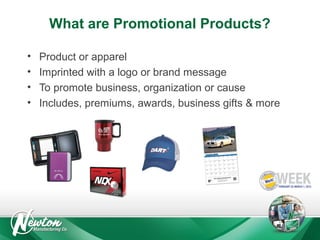
What are Promotional Products?
•
•
•
•

Product or apparel
Imprinted with a logo or brand message
To promote business, organization or cause
Includes, premiums, awards, business gifts & more
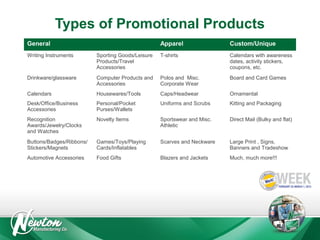
Types of Promotional Products
General

Apparel

Custom/Unique

Writing Instruments

Sporting Goods/Leisure
Products/Travel
Accessories

T-shirts

Calendars with awareness
dates, activity stickers,
coupons, etc.

Drinkware/glassware

Computer Products and
Accessories

Polos and Misc.
Corporate Wear

Board and Card Games

Calendars

Housewares/Tools

Caps/Headwear

Ornamental

Desk/Office/Business
Accessories

Personal/Pocket
Purses/Wallets

Uniforms and Scrubs

Kitting and Packaging

Recognition
Awards/Jewelry/Clocks
and Watches

Novelty Items

Sportswear and Misc.
Athletic

Direct Mail (Bulky and flat)

Buttons/Badges/Ribbons/
Stickers/Magnets

Games/Toys/Playing
Cards/Inflatables

Scarves and Neckware

Large Print , Signs,
Banners and Tradeshow

Automotive Accessories

Food Gifts

Blazers and Jackets

Much, much more!!!
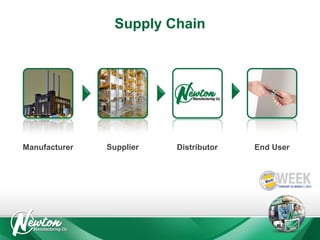
Supply Chain

Manufacturer

Supplier

Distributor

End User
How are Promotional Products Used?
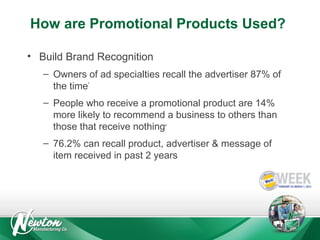
• Build Brand Recognition
– Owners of ad specialties recall the advertiser 87% of
the time*
– People who receive a promotional product are 14%
more likely to recommend a business to others than
those that receive nothing
#

– 76.2% can recall product, advertiser & message of
item received in past 2 years
How are Promotional Products Used?
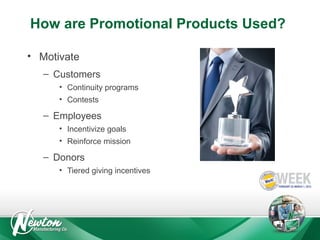
• Motivate
– Customers
• Continuity programs
• Contests

– Employees
• Incentivize goals
• Reinforce mission

– Donors
• Tiered giving incentives
How are Promotional Products Used?
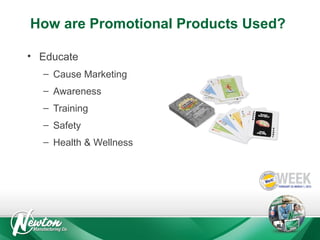
• Educate
– Cause Marketing
– Awareness
– Training
– Safety
– Health & Wellness
How are Promotional Products Used?
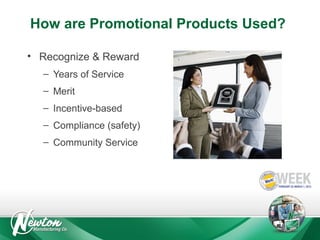
• Recognize & Reward
– Years of Service
– Merit
– Incentive-based
– Compliance (safety)
– Community Service
How are Promotional Products Used?
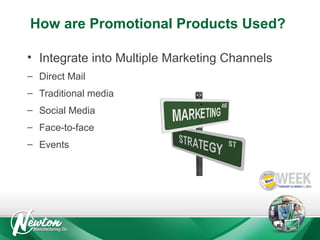
• Integrate into Multiple Marketing Channels
– Direct Mail
– Traditional media
– Social Media
– Face-to-face
– Events
Why Promotional Products Work
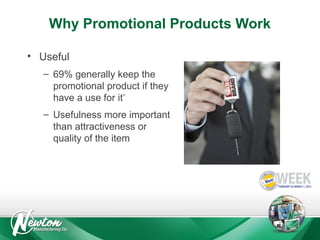
• Useful
– 69% generally keep the
promotional product if they
have a use for it**
– Usefulness more important
than attractiveness or
quality of the item
Why Promotional Products Work
• Move people to action
– Reciprocity – after receiving an item, people feel the
need to return the favor
– 31% of recipients are more likely to do business with
advertisers after receiving a promotional item*
– 62% of end-buyers say promotional products are
effective in achieving advertising, promotional, and
motivational objectives***
Why Promotional Products Work
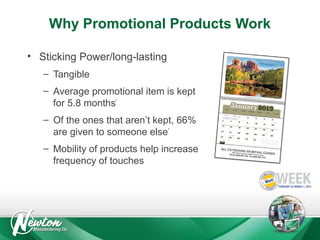
• Sticking Power/long-lasting
– Tangible
– Average promotional item is kept
for 5.8 months*
– Of the ones that aren’t kept, 66%
are given to someone else*
– Mobility of products help increase
frequency of touches
Why Promotional Products Work
• Flexibility
– Reach any target audience or niche effectively
– Fit budgets of any size
– Relevance with any brand/campaign
Why Promotional Products Work
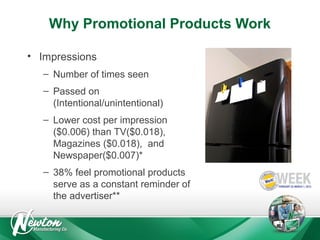
• Impressions
– Number of times seen
– Passed on
(Intentional/unintentional)
– Lower cost per impression
($0.006) than TV($0.018),
Magazines ($0.018), and
Newspaper($0.007)*
– 38% feel promotional products
serve as a constant reminder of
the advertiser**
Why Promotional Products Work
• Non-interruptive
– 83% of American consumers surveyed like receiving a
promotional product with an advertising message**
– People choose to keep most promotional products
• 91% had at least one promotional product in their kitchen**
• 74% had at least one promotional product in their work area**
Make Promotional Product Work for You
1. Identify specific, measurable objectives
2. Develop a central theme and messaging
3. Select a promotional product that’s relevant to nature of
business, theme and audience
4. Determine a workable distribution plan (Mail, leave
behind, trade show giveaway, etc.)
5. Craft and execute the theme and distribution plan
Case Study
Objective: A hearing aid center wanted to reach a senior audience to further
promote their revolutionary Concept Hearing Aid.

Strategy: Several hundred coffee mugs imprinted with the organization’s logo,
locations and phone numbers were donated to local coffee houses where many
seniors visited particularly those in close proximity to the testing offices.

Results: There was significant ROI measured when many seniors mentioned
how they heard about the hearing center; they were reading the mugs while having
coffee and the information imprinted on the mug reminded them to get their hearing
checked.
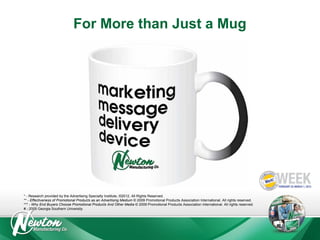
For More than Just a Mug

* - Research provided by the Advertising Specialty Institute, ©2012, All Rights Reserved.
** - Effectiveness of Promotional Products as an Advertising Medium © 2009 Promotional Products Association International. All rights reserved.
*** - Why End Buyers Choose Promotional Products And Other Media © 2009 Promotional Products Association International. All rights reserved.
# - 2005 Georgia Southern University

More Than a Mug

  • 2.
    What are PromotionalProducts? • • • • Product or apparel Imprinted with a logo or brand message To promote business, organization or cause Includes, premiums, awards, business gifts & more
  • 3.
    Types of PromotionalProducts General Apparel Custom/Unique Writing Instruments Sporting Goods/Leisure Products/Travel Accessories T-shirts Calendars with awareness dates, activity stickers, coupons, etc. Drinkware/glassware Computer Products and Accessories Polos and Misc. Corporate Wear Board and Card Games Calendars Housewares/Tools Caps/Headwear Ornamental Desk/Office/Business Accessories Personal/Pocket Purses/Wallets Uniforms and Scrubs Kitting and Packaging Recognition Awards/Jewelry/Clocks and Watches Novelty Items Sportswear and Misc. Athletic Direct Mail (Bulky and flat) Buttons/Badges/Ribbons/ Stickers/Magnets Games/Toys/Playing Cards/Inflatables Scarves and Neckware Large Print , Signs, Banners and Tradeshow Automotive Accessories Food Gifts Blazers and Jackets Much, much more!!!
  • 4.
  • 5.
    How are PromotionalProducts Used? • Build Brand Recognition – Owners of ad specialties recall the advertiser 87% of the time* – People who receive a promotional product are 14% more likely to recommend a business to others than those that receive nothing # – 76.2% can recall product, advertiser & message of item received in past 2 years
  • 6.
    How are PromotionalProducts Used? • Motivate – Customers • Continuity programs • Contests – Employees • Incentivize goals • Reinforce mission – Donors • Tiered giving incentives
  • 7.
    How are PromotionalProducts Used? • Educate – Cause Marketing – Awareness – Training – Safety – Health & Wellness
  • 8.
    How are PromotionalProducts Used? • Recognize & Reward – Years of Service – Merit – Incentive-based – Compliance (safety) – Community Service
  • 9.
    How are PromotionalProducts Used? • Integrate into Multiple Marketing Channels – Direct Mail – Traditional media – Social Media – Face-to-face – Events
  • 10.
    Why Promotional ProductsWork • Useful – 69% generally keep the promotional product if they have a use for it** – Usefulness more important than attractiveness or quality of the item
  • 11.
    Why Promotional ProductsWork • Move people to action – Reciprocity – after receiving an item, people feel the need to return the favor – 31% of recipients are more likely to do business with advertisers after receiving a promotional item* – 62% of end-buyers say promotional products are effective in achieving advertising, promotional, and motivational objectives***
  • 12.
    Why Promotional ProductsWork • Sticking Power/long-lasting – Tangible – Average promotional item is kept for 5.8 months* – Of the ones that aren’t kept, 66% are given to someone else* – Mobility of products help increase frequency of touches
  • 13.
    Why Promotional ProductsWork • Flexibility – Reach any target audience or niche effectively – Fit budgets of any size – Relevance with any brand/campaign
  • 14.
    Why Promotional ProductsWork • Impressions – Number of times seen – Passed on (Intentional/unintentional) – Lower cost per impression ($0.006) than TV($0.018), Magazines ($0.018), and Newspaper($0.007)* – 38% feel promotional products serve as a constant reminder of the advertiser**
  • 15.
    Why Promotional ProductsWork • Non-interruptive – 83% of American consumers surveyed like receiving a promotional product with an advertising message** – People choose to keep most promotional products • 91% had at least one promotional product in their kitchen** • 74% had at least one promotional product in their work area**
  • 16.
    Make Promotional ProductWork for You 1. Identify specific, measurable objectives 2. Develop a central theme and messaging 3. Select a promotional product that’s relevant to nature of business, theme and audience 4. Determine a workable distribution plan (Mail, leave behind, trade show giveaway, etc.) 5. Craft and execute the theme and distribution plan
  • 17.
    Case Study Objective: Ahearing aid center wanted to reach a senior audience to further promote their revolutionary Concept Hearing Aid. Strategy: Several hundred coffee mugs imprinted with the organization’s logo, locations and phone numbers were donated to local coffee houses where many seniors visited particularly those in close proximity to the testing offices. Results: There was significant ROI measured when many seniors mentioned how they heard about the hearing center; they were reading the mugs while having coffee and the information imprinted on the mug reminded them to get their hearing checked.
  • 18.
    For More thanJust a Mug * - Research provided by the Advertising Specialty Institute, ©2012, All Rights Reserved. ** - Effectiveness of Promotional Products as an Advertising Medium © 2009 Promotional Products Association International. All rights reserved. *** - Why End Buyers Choose Promotional Products And Other Media © 2009 Promotional Products Association International. All rights reserved. # - 2005 Georgia Southern University

Editor's Notes

  • #3 Product or apparel Imprinted with a logo or brand message To promote business, organization or cause Includes, premiums, awards, business gifts & more What they are Not (If properly used) Trinkets and Trash Source of bribe instead of a “thank you”
  • #5 Manufacturer Supplier Distributor End-User/Customer
  • #6 Build Brand Recognition Owners of ad specialties recall the advertiser 87% of the time* People who receive a promotional product are significantly more likely to recommend the business to others than the group that received nothing* Consumers were asked to think of a promotional product they had received in the past two years and to recall the specific product, the advertiser and the message: A whopping 76.2% recalled all three key pieces of information
  • #7 Incentive Continuity Programs (customer retention) Give multiple companion items over a period of time Contests Retention of Employees Employees like awards and incentives Employees are motivated to win awards Employees work hard to win awards Employees encourage their co-workers to work toward awards and incentives.
  • #8 Educate Cause Marketing Awareness Training Safety Health & Wellness
  • #9 Recognize & Reward Years of Service Merit Incentive-based Compliance (safety) Community Service Rallies and Kick-offs
  • #10 By integrating with other marketing channels, time an money are saved, thus a significant ROI is realized. When examining the synergistic effects of promotional products when used along with other media, findings of the study revealed: - Integrating a promotional product with television and print ads increased referral value as well as credibility of the message - Groups who were exposed to promotional products tended to rate the advertising message more positively than those groups not exposed to a promotional product
  • #11 Useful 25% like getting promotional products to refer to the advertiser’s contact info if needed** 69% generally keep the promotional product if they have a use for it**
  • #12 Move people to action Reciprocity – after receiving an item, people feel the need to return the favor 31% of recipients are more likely to do business with advertisers after receiving a promotional item* 62% of end-buyers say promotional products effective in achieving advertising, promotional, motivational objectives***
  • #13 Sticking Power/long-lasting Average promotional item is kept for 5.8 months* Of the ones that aren’t kept, 66% are given to someone else* Mobility of products help increase frequency of touches
  • #14 Flexibility Reach any target audience or niche effectively Fit budgets of any size Relevance with any brand/campaign
  • #15 Impressions (the result of usefulness and sticking power) Impressive number of impressions Lower cost per impression ($0.006) than TV($0.018), Magazines ($0.018), and Newspaper($0.007)* Passed on (Intentional/unintentional) 38% feel promotional products serve as a constant reminder of the advertiser** 89% of consumers surveyed could recall the name of the advertiser on a promotional product they received in the past 24 months** 91.4% could identify the one promotional product they had in their desk or workspace that they received and 45% could identify the advertiser of that product**
  • #16 Uninterruptive 83% of American consumers surveyed like receiving a promotional product with an advertising message** People choose to keep most promotional products 91% had at least one promotional product in their kitchen 74% had at least one promotional product in their work area
  • #17 Identify a specific objective(s) Develop a central theme and messaging Select a promotional product that bears a natural relationship to your profession or communications theme (relevant to nature of business, theme and audience) Determine a workable distribution plan (Mail, leave behind, trade show giveaway, etc.) Craft and execute the theme and distribution plan to include measurables (ROI)
  • #18 Objective: A hearing aid center wanted to reach a senior audience in a non-aggressive way to further promote their revolutionary Concept Hearing Aid. It was important for the organization to reach the senior demographic in a warm and friendly way that’s both relaxing, and informative, to further promote the newest line of hearing instruments. Strategy: Several hundred White retro coffee mugs imprinted with the organization’s logo, locations and phone numbers were donated to local coffee houses where many seniors visited. Strategically, some of the targeted coffee houses were in close proximity to the testing offices. Results: There was significant ROI measured when many seniors mentioned how they heard about the hearing center; they were reading the mugs while having coffee and the information imprinted on the mug reminded them to get their hearing checked.