Moral Dilemmas
Moral Dilemmas
Moral dilemmas
Moral dilemmas
A situation in which, whatever choice is made,
the agent commits a moral wrong
Moral Dilemmas
Moral Dilemmas
 Example from Book I of Plato's
Example from Book I of Plato's Republic
Republic
Cephalus defines ‘justice’ as speaking the truth
and paying one's debts.
Socrates quickly refutes this account by
suggesting that it would be wrong to repay
certain debts (weapon)
Moral dilemmas
Moral dilemmas
Socrates' point is not that repaying debts is
without moral import; rather, he wants to show
that it is not always right to repay one's
debts….
debts….
Moral Dilemmas
Moral Dilemmas
There is a conflict between two moral norms:
repaying one's debts and protecting others
from harm.
from harm.
Moral Dilemmas
Moral Dilemmas
The agent regards herself as having moral
reasons to do each of two actions, but doing
both is not possible
Moral Dilemmas
Moral Dilemmas
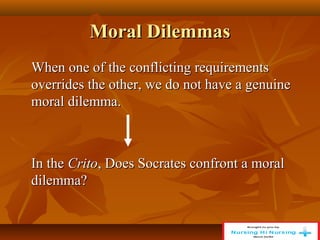
When one of the conflicting requirements
overrides the other, we do not have a genuine
moral dilemma.
moral dilemma.
In the
In the Crito
Crito, Does Socrates confront a moral
, Does Socrates confront a moral
dilemma?
dilemma?
Moral Dilemmas
Moral Dilemmas
1.
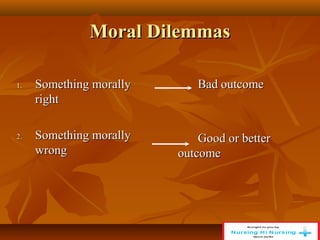
1. Something morally
Something morally
right
right
2.
2. Something morally
Something morally
wrong
wrong
Bad outcome
Bad outcome
Good or better
Good or better
outcome
outcome
Moral Dilemma
Moral Dilemma
A woman was near death from a unique kind of
cancer. There is a drug that might save her. The drug
costs $4,000 per dosage. The sick woman's husband,
Heinz, went to everyone he knew to borrow the
money and tried every legal means, but he could only
get together about $2,000. He asked the doctor
scientist who discovered the drug for a discount or
that he let him pay later. But the doctor scientist
refused.
refused.
Moral Dilemma
Moral Dilemma
Should Heinz break into the laboratory to steal
the drug for his wife?
(Why or why not?)
(Why or why not?)
Moral Stages
Moral Stages
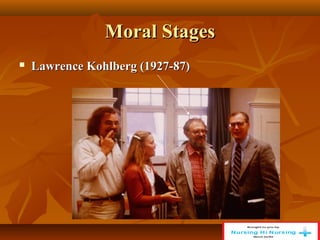
 Lawrence Kohlberg (1927-87)
Lawrence Kohlberg (1927-87)
Kohlberg
Kohlberg
Kohlberg proposed that moral reasoning,
which he thought to be the basis for ethical
behavior, develops through stages.
Moral Stages
Moral Stages
Level 1: PRE-CONVENTIONAL
Level 2: CONVENTIONAL
Level 3: POST-CONVENTIONAL
Kohlberg’s Stages
Kohlberg’s Stages
Level 1 (Pre-conventional)
Reasoners judge the morality of an action by its
direct consequences
direct consequences
Stage One: Obedience and Punishment
Stage Two: Individualism, Instrumentalism, and
Exchange
Exchange
Heinz Dilemma
Heinz Dilemma
Stage One (
Stage One (obedience
obedience): Heinz should not steal
): Heinz should not steal
the medicine, because otherwise he will be put
in prison.
in prison.
Pre-conventional level
Stage One (
Stage One (obedience orientation
obedience orientation)
)
Individuals focus on the direct consequences
that their actions will have for themselves.
Socrates’ Dilemma
Socrates’ Dilemma
 From the point of view of Stage One, Socrates
From the point of view of Stage One, Socrates
should not die because…
Heinz Moral Dilemma
Heinz Moral Dilemma
 Pre-conventional Level
Pre-conventional Level
Stage Two (
Stage Two (self-interest
self-interest): Heinz should steal
): Heinz should steal
the medicine, because he will be much happier
if he saves his wife, even if he will have to
serve a prison sentence.
Kohlberg’s Stages
Kohlberg’s Stages
Stage Two (
Stage Two (self-interest orientation
self-interest orientation):
):
what's in it for me
what's in it for me position. Right behavior is
position. Right behavior is
defined by what is in one's own best interest.
Socrates’ Dilemma
Socrates’ Dilemma
 From a level two perspective, Socrates should
From a level two perspective, Socrates should
not die because…
not die because…
Kohlberg’s Stages
Kohlberg’s Stages
Level 2 (Conventional)
People who reason in a conventional way judge the
morality of actions by comparing these actions to
social rules and expectations.
Stage Three: Interpersonal Concordance ("Good
boy/girl")
boy/girl")
Stage Four: Law and Order
Heinz Moral Dilemma
Heinz Moral Dilemma
CONVENTIONAL LEVEL
CONVENTIONAL LEVEL
 Stage Three (
Stage Three (conformity
conformity): Heinz should steal
): Heinz should steal
the medicine, because his wife expects it.
Conventional level
Conventional level
Stage Three (
Stage Three (conformity orientation
conformity orientation)
)
Individuals seek approval from other people.
They judge the morality of actions by
evaluating the consequences of these actions
for a person's relationships.
Socrates dilemma
Socrates dilemma
 Socrates should not die because…
Socrates should not die because…
Heinz Dilemma
Heinz Dilemma
Stage Four (
Stage Four (law-and-order
law-and-order): Heinz should not
): Heinz should not
steal the medicine, because the law prohibits
stealing.
stealing.
Conventional level
Conventional level
Stage Four (
Stage Four (law-and-order mentality
law-and-order mentality).
).
In stage four, individuals think it is important
to obey the law and conventions of society.
Socrates Dilemma
Socrates Dilemma
 Socrates should die because…
Socrates should die because…
Kohlberg’s Stages
Kohlberg’s Stages
Level 3 (Post-conventional)
(Most people do not reach this level of moral
reasoning)
reasoning)
 Stage Five: Human Rights
Stage Five: Human Rights
 Stage Six: Universal Ethical Principles
Stage Six: Universal Ethical Principles
(Principled Conscience)
Heinz moral dilemma
Heinz moral dilemma
Stage five (
Stage five (human rights
human rights):
):
Heinz should steal the medicine because
saving his wife is more important than obeying
the law.
the law.
Post-conventional level
Stage Five (
Stage Five (human rights orientation
human rights orientation)
)
 People have certain principles to which they
People have certain principles to which they
attach more value than laws, such as human
rights.
rights.
 An action is wrong if it violates certain ethical
An action is wrong if it violates certain ethical
principles.
principles.
 Laws that do not promote general social
Laws that do not promote general social
welfare should be changed
Socrates dilemma
Socrates dilemma
 Socrates should not die…?
Socrates should not die…?
We are at level 3!!!!
Post-conventional level
 Stage six (
Stage six (universal human ethics
universal human ethics):
):
Heinz should steal the medicine, because
saving a human life is a more fundamental
value than respecting the property of another
person.
person.
Post-conventional level
Stage Six (
Stage Six (ethical principle orientation
ethical principle orientation).
).
Moral reasoning is based on the use of abstract
reasoning using universal principles.


(People rarely, if ever, reach stage 6 of
Kohlberg's model)
Kohlberg's model)
Socrates’ Decision
Socrates’ Decision
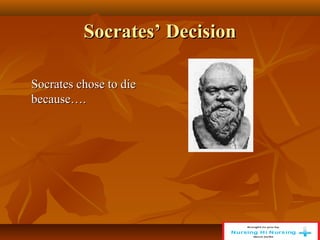
Socrates chose to die
because….
because….
Socrates
Socrates
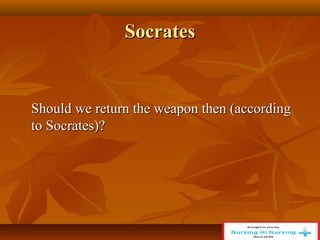
Should we return the weapon then (according
to Socrates)?
to Socrates)?
Socrates
Socrates
Socrates maintains that protecting others from
harm is the norm that takes priority
Our views have increased the
mark of the 10,000
mark of the 10,000
 Thank you viewers
Thank you viewers
 Looking forward to franchise, collaboration,
Looking forward to franchise, collaboration,
partners.
partners.
This platform has been started by
Parveen Kumar Chadha with the
vision that nobody should suffer
the way he has suffered because of
lack and improper healthcare
facilities in India. We need lots of
funds manpower etc. to make this
vision a reality please contact us.
Join us as a member for a noble
cause.
cause.
Contact us:- 011-25464531, 9818569476
E-mail:- nursingnursing@yahoo.in

moraldilemmas-140714015300-phpapp02.pdf

  • 1.
  • 2.
    Moral dilemmas Moral dilemmas Asituation in which, whatever choice is made, A situation in which, whatever choice is made, the agent commits a moral wrong the agent commits a moral wrong
  • 3.
    Moral Dilemmas Moral Dilemmas Example from Book I of Plato's Example from Book I of Plato's Republic Republic Cephalus defines ‘justice’ as speaking the truth Cephalus defines ‘justice’ as speaking the truth and paying one's debts. and paying one's debts. Socrates quickly refutes this account by Socrates quickly refutes this account by suggesting that it would be wrong to repay suggesting that it would be wrong to repay certain debts (weapon) certain debts (weapon)
  • 4.
    Moral dilemmas Moral dilemmas Socrates'point is not that repaying debts is Socrates' point is not that repaying debts is without moral import; rather, he wants to show without moral import; rather, he wants to show that it is not always right to repay one's that it is not always right to repay one's debts…. debts….
  • 5.
    Moral Dilemmas Moral Dilemmas Thereis a conflict between two moral norms: There is a conflict between two moral norms: repaying one's debts and protecting others repaying one's debts and protecting others from harm. from harm.
  • 6.
    Moral Dilemmas Moral Dilemmas Theagent regards herself as having moral The agent regards herself as having moral reasons to do each of two actions, but doing reasons to do each of two actions, but doing both is not possible both is not possible
  • 7.
    Moral Dilemmas Moral Dilemmas Whenone of the conflicting requirements When one of the conflicting requirements overrides the other, we do not have a genuine overrides the other, we do not have a genuine moral dilemma. moral dilemma. In the In the Crito Crito, Does Socrates confront a moral , Does Socrates confront a moral dilemma? dilemma?
  • 8.
    Moral Dilemmas Moral Dilemmas 1. 1.Something morally Something morally right right 2. 2. Something morally Something morally wrong wrong Bad outcome Bad outcome Good or better Good or better outcome outcome
  • 9.
    Moral Dilemma Moral Dilemma Awoman was near death from a unique kind of A woman was near death from a unique kind of cancer. There is a drug that might save her. The drug cancer. There is a drug that might save her. The drug costs $4,000 per dosage. The sick woman's husband, costs $4,000 per dosage. The sick woman's husband, Heinz, went to everyone he knew to borrow the Heinz, went to everyone he knew to borrow the money and tried every legal means, but he could only money and tried every legal means, but he could only get together about $2,000. He asked the doctor get together about $2,000. He asked the doctor scientist who discovered the drug for a discount or scientist who discovered the drug for a discount or that he let him pay later. But the doctor scientist that he let him pay later. But the doctor scientist refused. refused.
  • 10.
    Moral Dilemma Moral Dilemma ShouldHeinz break into the laboratory to steal Should Heinz break into the laboratory to steal the drug for his wife? the drug for his wife? (Why or why not?) (Why or why not?)
  • 11.
    Moral Stages Moral Stages Lawrence Kohlberg (1927-87) Lawrence Kohlberg (1927-87)
  • 12.
    Kohlberg Kohlberg Kohlberg proposed thatmoral reasoning, Kohlberg proposed that moral reasoning, which he thought to be the basis for ethical which he thought to be the basis for ethical behavior, develops through stages. behavior, develops through stages.
  • 13.
    Moral Stages Moral Stages Level1: PRE-CONVENTIONAL Level 1: PRE-CONVENTIONAL Level 2: CONVENTIONAL Level 2: CONVENTIONAL Level 3: POST-CONVENTIONAL Level 3: POST-CONVENTIONAL
  • 14.
    Kohlberg’s Stages Kohlberg’s Stages Level1 (Pre-conventional) Level 1 (Pre-conventional) Reasoners judge the morality of an action by its Reasoners judge the morality of an action by its direct consequences direct consequences Stage One: Obedience and Punishment Stage One: Obedience and Punishment Stage Two: Individualism, Instrumentalism, and Stage Two: Individualism, Instrumentalism, and Exchange Exchange
  • 15.
    Heinz Dilemma Heinz Dilemma StageOne ( Stage One (obedience obedience): Heinz should not steal ): Heinz should not steal the medicine, because otherwise he will be put the medicine, because otherwise he will be put in prison. in prison.
  • 16.
    Pre-conventional level Pre-conventional level StageOne ( Stage One (obedience orientation obedience orientation) ) Individuals focus on the direct consequences Individuals focus on the direct consequences that their actions will have for themselves. that their actions will have for themselves.
  • 17.
    Socrates’ Dilemma Socrates’ Dilemma From the point of view of Stage One, Socrates From the point of view of Stage One, Socrates should not die because… should not die because…
  • 18.
    Heinz Moral Dilemma HeinzMoral Dilemma  Pre-conventional Level Pre-conventional Level Stage Two ( Stage Two (self-interest self-interest): Heinz should steal ): Heinz should steal the medicine, because he will be much happier the medicine, because he will be much happier if he saves his wife, even if he will have to if he saves his wife, even if he will have to serve a prison sentence. serve a prison sentence.
  • 19.
    Kohlberg’s Stages Kohlberg’s Stages StageTwo ( Stage Two (self-interest orientation self-interest orientation): ): what's in it for me what's in it for me position. Right behavior is position. Right behavior is defined by what is in one's own best interest. defined by what is in one's own best interest.
  • 20.
    Socrates’ Dilemma Socrates’ Dilemma From a level two perspective, Socrates should From a level two perspective, Socrates should not die because… not die because…
  • 21.
    Kohlberg’s Stages Kohlberg’s Stages Level2 (Conventional) Level 2 (Conventional) People who reason in a conventional way judge the People who reason in a conventional way judge the morality of actions by comparing these actions to morality of actions by comparing these actions to social rules and expectations. social rules and expectations. Stage Three: Interpersonal Concordance ("Good Stage Three: Interpersonal Concordance ("Good boy/girl") boy/girl") Stage Four: Law and Order Stage Four: Law and Order
  • 22.
    Heinz Moral Dilemma HeinzMoral Dilemma CONVENTIONAL LEVEL CONVENTIONAL LEVEL  Stage Three ( Stage Three (conformity conformity): Heinz should steal ): Heinz should steal the medicine, because his wife expects it. the medicine, because his wife expects it.
  • 23.
    Conventional level Conventional level StageThree ( Stage Three (conformity orientation conformity orientation) ) Individuals seek approval from other people. Individuals seek approval from other people. They judge the morality of actions by They judge the morality of actions by evaluating the consequences of these actions evaluating the consequences of these actions for a person's relationships. for a person's relationships.
  • 24.
    Socrates dilemma Socrates dilemma Socrates should not die because… Socrates should not die because…
  • 25.
    Heinz Dilemma Heinz Dilemma StageFour ( Stage Four (law-and-order law-and-order): Heinz should not ): Heinz should not steal the medicine, because the law prohibits steal the medicine, because the law prohibits stealing. stealing.
  • 26.
    Conventional level Conventional level StageFour ( Stage Four (law-and-order mentality law-and-order mentality). ). In stage four, individuals think it is important In stage four, individuals think it is important to obey the law and conventions of society. to obey the law and conventions of society.
  • 27.
    Socrates Dilemma Socrates Dilemma Socrates should die because… Socrates should die because…
  • 28.
    Kohlberg’s Stages Kohlberg’s Stages Level3 (Post-conventional) Level 3 (Post-conventional) (Most people do not reach this level of moral (Most people do not reach this level of moral reasoning) reasoning)  Stage Five: Human Rights Stage Five: Human Rights  Stage Six: Universal Ethical Principles Stage Six: Universal Ethical Principles (Principled Conscience) (Principled Conscience)
  • 29.
    Heinz moral dilemma Heinzmoral dilemma Stage five ( Stage five (human rights human rights): ): Heinz should steal the medicine because Heinz should steal the medicine because saving his wife is more important than obeying saving his wife is more important than obeying the law. the law.
  • 30.
    Post-conventional level Post-conventional level StageFive ( Stage Five (human rights orientation human rights orientation) )  People have certain principles to which they People have certain principles to which they attach more value than laws, such as human attach more value than laws, such as human rights. rights.  An action is wrong if it violates certain ethical An action is wrong if it violates certain ethical principles. principles.  Laws that do not promote general social Laws that do not promote general social welfare should be changed welfare should be changed
  • 31.
    Socrates dilemma Socrates dilemma Socrates should not die…? Socrates should not die…? We are at level 3!!!! We are at level 3!!!!
  • 32.
    Post-conventional level Post-conventional level Stage six ( Stage six (universal human ethics universal human ethics): ): Heinz should steal the medicine, because Heinz should steal the medicine, because saving a human life is a more fundamental saving a human life is a more fundamental value than respecting the property of another value than respecting the property of another person. person.
  • 33.
    Post-conventional level Post-conventional level StageSix ( Stage Six (ethical principle orientation ethical principle orientation). ). Moral reasoning is based on the use of abstract Moral reasoning is based on the use of abstract reasoning using universal principles. reasoning using universal principles. (People rarely, if ever, reach stage 6 of (People rarely, if ever, reach stage 6 of Kohlberg's model) Kohlberg's model)
  • 34.
    Socrates’ Decision Socrates’ Decision Socrateschose to die Socrates chose to die because…. because….
  • 35.
    Socrates Socrates Should we returnthe weapon then (according Should we return the weapon then (according to Socrates)? to Socrates)?
  • 36.
    Socrates Socrates Socrates maintains thatprotecting others from Socrates maintains that protecting others from harm is the norm that takes priority harm is the norm that takes priority
  • 37.
    Our views haveincreased the Our views have increased the mark of the 10,000 mark of the 10,000  Thank you viewers Thank you viewers  Looking forward to franchise, collaboration, Looking forward to franchise, collaboration, partners. partners.
  • 38.
    This platform hasbeen started by This platform has been started by Parveen Kumar Chadha with the Parveen Kumar Chadha with the vision that nobody should suffer vision that nobody should suffer the way he has suffered because of the way he has suffered because of lack and improper healthcare lack and improper healthcare facilities in India. We need lots of facilities in India. We need lots of funds manpower etc. to make this funds manpower etc. to make this vision a reality please contact us. vision a reality please contact us. Join us as a member for a noble Join us as a member for a noble cause. cause.
  • 39.
    Contact us:- 011-25464531,9818569476 E-mail:- nursingnursing@yahoo.in