Introduction
•

•

Perfect Competition was one type of market
structure. It had to satisfy many assumptions
- some of which are not all that realistic. Now
we will look at another market structure which
is nearly he opposite of perfect competition
Monopoly - a single firm that produces all the
output in a particular market with no close
substitutes and high barriers to entry.
Barriers to Entry
•

•
•

Barriers to Entry are what keeps monopoly
from becoming like a perfectly competitive
market
Barriers to entry are things that prevent firms
from entering the market. Such as...
Control of Raw Materials
•

•

Example: The DeBeer’s family owns most of the
diamond mines in the world

Economies of Scale
Barriers to Entry (Cont.)
•

Patents and Copyrights
 Patents

- an exclusive right, granted by the
government, to market a product or
process for a period of time.
 Copyrights - an exclusive right, granted by
the government, to publish, copy or sell a
piece of music, art or literature.
•

Other Legal Restrictions
 Example:Turk

Telekom, etc.
Monopoly in the Short-Run
What makes monopoly different from
perfect competition is the firm’s demand
curve.
• Since the firm is the market, the firm’s
demand curve is the market demand
curve
• Hence, it’s downward sloping
•
Monopoly in the Short Run
•

•

A profit-maximizing monopolist, then not only
chooses how much to produce, but also
chooses what price to charge.
What prevents a monopolist from charging an
amazingly high price?


•

there may not be much demand at that price

So a monopolist wants to get the highest
price that maximizes their profit
Monopoly and Total Revenue
•
•
•

•

Profits = Total Revenue - Total Cost
But Total Revenue is different for a
monopolist than in perf. comp.
In perf. comp. the moreyou sell, the more the
total revenue, but now if you sell more you
have to lower your price.
Remember when we discussed elasticity, we
looked at how total revenue changes as you
move down a demand curve
Monopoly and Total Revenue
$

Elastic

Elasticity = 1
Inelastic
Demand
Q

$
Total Revenue
Q
Monopoly Profit
•

So does a monopolist want to produce
at the quantity where elasticity equals 1
and total revenue is at a maximum?
 Not

necessarily. Remember we need to
consider total cost, as well

•

The monopolist wants to maximize the
difference between total revenue and
total cost
Total Revenue and Total Cost
TC

$

TR
Q*

Q
Monopoly Profit Maximization
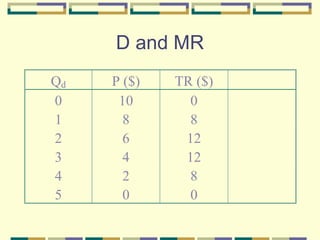
• Like perfect competition, this is the quantity
where the slopes of the TC and TR curves
are the same
• And also like perfect competition, this is the
quantity where MR=MC.
• But the MR curve looks different, since the
demand curve is downward sloping
D and MR
Qd
0
1
2
3
4
5

P ($)
10
8
6
4
2
0
D and MR
Qd
0
1
2
3
4
5

P ($)
10
8
6
4
2
0

TR ($)
0
8
12
12
8
0
D and MR
Qd
0
1
2
3
4
5

P ($)
10
8
6
4
2
0

TR ($)
0
8
12
12
8
0

MR ($)
--8
4
0
-4
-8
D and MR
P

$10
8
6
4
2
0

D
1

2

3

4

5

Q
D and MR
P

$10
8
6
4
2
0

MR
1

2

D
3

4

5

Q
Profit Maximizing
P

MC

$10
8
6
4
2
0

MR
1

2

D
3

4

5

Q
Profit Maximizing
P

MC

$10
8
6
4
2
0

MR
1

2

D
3

4

5

Q
Profit Maximizing
•

•

•
•

So the monopolist chooses the quantity
where MC=MR (a quantity of 2, in this
example)
If they chose less, MR>MC so they could get
more money from selling one more than it
would cost to make one more.
But they also get to choose the price
They choose the highest price they can
charge in order to sell Q*
Profit Maximizing
P

MC

$10
8
6
4
2
0

MR
1

2

D
3

4

5

Q
Profit Maximizing
The price is found by looking to the
demand curve and finding the price
people are will to pay in order to buy the
quantity the firm wants to produce
• In the case of this example, this is a
price of about $6.50
• How do we show the profit in this case?
•
Profit Maximizing
P

MC

$10

ATC
AVC

8
6
4
2
0

MR
1

2

D
3

4

5

Q
Profit Maximizing
P

MC

$10

ATC
AVC

8
p*

6
atc*
4
2
0

MR
1

2

D
3

4

5

Q
Profit Maximizing
P

MC

$10

ATC
AVC

8
p*

6
atc*

Profit

4
2
0

MR
1

2

D
3

4

5

Q
Shut Down Rules
•

•

•

A monopolist faces the same short run shut
down rules as a perfectly competitive firm for
all of the same reasons
As long as P>AVC, the firm is paying off
some fixed cost and should stay open in the
short run
If P<AVC, the firm should shut down. Just
because the firm is a monopolist, does not
guarantee a profit.
A Monopolist Who Should
Shut Down
ATC
AVC

P

MC

$10
atc*
8
p*

6
4
2

0

MR
1

2

D
3

4

5

Q
Profit Maximizing
•
•

Q* - where MR = MC (profit maximization)
P* - highest P consumers are willing and able
to pay for Q*
•

•

Demand curve at Q*

In the Short-Run a Monopolist may
•
•
•

Make Profits
Break Even
Operate at a Loss
Profit Maximizing
•

Note that a Monopolist always Operates
on Elastic Portion of Demand Curve
•
•
•

Profit Maximizing - MR = MC
MC > 0 always
MR > 0 when demand is elastic
Benefits of Monopoly
•

Technological Innovations
•

Incentive for monopoly profits gives firm an
incentive to innovate.
Costs of Monopoly
•

To begin to understand the costs of
monopoly, we need to introduce
another concept
 Producer

•

Surplus

Producer Surplus - the revenue
received by the firm above the marginal
cost
Producer Surplus
P

MC
p

Q

Q
Producer Surplus
P

MC
p

The Shaded
Area is the
Producer
Surplus

Q

Q
Comparison of Monopoly and
Perfect Competition
•

We can compare Monopoly and Perfect
Competition by looking at the total
amount of social surplus (consumer
surplus plus producer surplus)
generated by both and then comparing
them.
Monopoly vs Perfect Comp.
P

MC
MR

P
P

Monop
perf comp

D
0

Q

Monop

Q

perf comp

Q
Monopoly vs Perfect Comp.
P

MC
MR

P
P

Monop
perf comp

Total Surplus
for Perfect
Competition

D
0

Q

Monop

Q

perf comp

Q
Monopoly vs Perfect Comp.
P

MC
MR

P
P

Monop
perf comp

Total Surplus
for Monopoly

D
0

Q

Monop

Q

perf comp

Q
Dead Weight Loss
If we take the difference between the
total social surplus under perfect
competition and subtract the total
surplus under monopoly we find the
dead weight loss
• This is the loss in surplus to consumers
and producers from having a monopoly
•
Monopoly vs Perfect Comp.
P

MC
MR

P
P

The area of this triangle
is the dead weight loss

Monop
perf comp

D
0

Q

Monop

Q

perf comp

Q
Disadvantages of Monopoly
•

Inefficient Allocation of Resources
•
•

Allocatively Inefficient (P > MC)
Productively Inefficient (P not = min ATC)

Monopoly1

  • 1.
    Introduction • • Perfect Competition wasone type of market structure. It had to satisfy many assumptions - some of which are not all that realistic. Now we will look at another market structure which is nearly he opposite of perfect competition Monopoly - a single firm that produces all the output in a particular market with no close substitutes and high barriers to entry.
  • 2.
    Barriers to Entry • • • Barriersto Entry are what keeps monopoly from becoming like a perfectly competitive market Barriers to entry are things that prevent firms from entering the market. Such as... Control of Raw Materials • • Example: The DeBeer’s family owns most of the diamond mines in the world Economies of Scale
  • 3.
    Barriers to Entry(Cont.) • Patents and Copyrights  Patents - an exclusive right, granted by the government, to market a product or process for a period of time.  Copyrights - an exclusive right, granted by the government, to publish, copy or sell a piece of music, art or literature. • Other Legal Restrictions  Example:Turk Telekom, etc.
  • 4.
    Monopoly in theShort-Run What makes monopoly different from perfect competition is the firm’s demand curve. • Since the firm is the market, the firm’s demand curve is the market demand curve • Hence, it’s downward sloping •
  • 5.
    Monopoly in theShort Run • • A profit-maximizing monopolist, then not only chooses how much to produce, but also chooses what price to charge. What prevents a monopolist from charging an amazingly high price?  • there may not be much demand at that price So a monopolist wants to get the highest price that maximizes their profit
  • 6.
    Monopoly and TotalRevenue • • • • Profits = Total Revenue - Total Cost But Total Revenue is different for a monopolist than in perf. comp. In perf. comp. the moreyou sell, the more the total revenue, but now if you sell more you have to lower your price. Remember when we discussed elasticity, we looked at how total revenue changes as you move down a demand curve
  • 7.
    Monopoly and TotalRevenue $ Elastic Elasticity = 1 Inelastic Demand Q $ Total Revenue Q
  • 8.
    Monopoly Profit • So doesa monopolist want to produce at the quantity where elasticity equals 1 and total revenue is at a maximum?  Not necessarily. Remember we need to consider total cost, as well • The monopolist wants to maximize the difference between total revenue and total cost
  • 9.
    Total Revenue andTotal Cost TC $ TR Q* Q
  • 10.
    Monopoly Profit Maximization •Like perfect competition, this is the quantity where the slopes of the TC and TR curves are the same • And also like perfect competition, this is the quantity where MR=MC. • But the MR curve looks different, since the demand curve is downward sloping
  • 11.
    D and MR Qd 0 1 2 3 4 5 P($) 10 8 6 4 2 0
  • 12.
    D and MR Qd 0 1 2 3 4 5 P($) 10 8 6 4 2 0 TR ($) 0 8 12 12 8 0
  • 13.
    D and MR Qd 0 1 2 3 4 5 P($) 10 8 6 4 2 0 TR ($) 0 8 12 12 8 0 MR ($) --8 4 0 -4 -8
  • 14.
  • 15.
  • 16.
  • 17.
  • 18.
    Profit Maximizing • • • • So themonopolist chooses the quantity where MC=MR (a quantity of 2, in this example) If they chose less, MR>MC so they could get more money from selling one more than it would cost to make one more. But they also get to choose the price They choose the highest price they can charge in order to sell Q*
  • 19.
  • 20.
    Profit Maximizing The priceis found by looking to the demand curve and finding the price people are will to pay in order to buy the quantity the firm wants to produce • In the case of this example, this is a price of about $6.50 • How do we show the profit in this case? •
  • 21.
  • 22.
  • 23.
  • 24.
    Shut Down Rules • • • Amonopolist faces the same short run shut down rules as a perfectly competitive firm for all of the same reasons As long as P>AVC, the firm is paying off some fixed cost and should stay open in the short run If P<AVC, the firm should shut down. Just because the firm is a monopolist, does not guarantee a profit.
  • 25.
    A Monopolist WhoShould Shut Down ATC AVC P MC $10 atc* 8 p* 6 4 2 0 MR 1 2 D 3 4 5 Q
  • 26.
    Profit Maximizing • • Q* -where MR = MC (profit maximization) P* - highest P consumers are willing and able to pay for Q* • • Demand curve at Q* In the Short-Run a Monopolist may • • • Make Profits Break Even Operate at a Loss
  • 27.
    Profit Maximizing • Note thata Monopolist always Operates on Elastic Portion of Demand Curve • • • Profit Maximizing - MR = MC MC > 0 always MR > 0 when demand is elastic
  • 28.
    Benefits of Monopoly • TechnologicalInnovations • Incentive for monopoly profits gives firm an incentive to innovate.
  • 29.
    Costs of Monopoly • Tobegin to understand the costs of monopoly, we need to introduce another concept  Producer • Surplus Producer Surplus - the revenue received by the firm above the marginal cost
  • 30.
  • 31.
    Producer Surplus P MC p The Shaded Areais the Producer Surplus Q Q
  • 32.
    Comparison of Monopolyand Perfect Competition • We can compare Monopoly and Perfect Competition by looking at the total amount of social surplus (consumer surplus plus producer surplus) generated by both and then comparing them.
  • 33.
    Monopoly vs PerfectComp. P MC MR P P Monop perf comp D 0 Q Monop Q perf comp Q
  • 34.
    Monopoly vs PerfectComp. P MC MR P P Monop perf comp Total Surplus for Perfect Competition D 0 Q Monop Q perf comp Q
  • 35.
    Monopoly vs PerfectComp. P MC MR P P Monop perf comp Total Surplus for Monopoly D 0 Q Monop Q perf comp Q
  • 36.
    Dead Weight Loss Ifwe take the difference between the total social surplus under perfect competition and subtract the total surplus under monopoly we find the dead weight loss • This is the loss in surplus to consumers and producers from having a monopoly •
  • 37.
    Monopoly vs PerfectComp. P MC MR P P The area of this triangle is the dead weight loss Monop perf comp D 0 Q Monop Q perf comp Q
  • 38.
    Disadvantages of Monopoly • InefficientAllocation of Resources • • Allocatively Inefficient (P > MC) Productively Inefficient (P not = min ATC)