MONOLITHS TO MICROSERVICES: APP
TRANSFORMATION
Hands-on Technical Workshop Overview
Ram Maddali
Senior Architect
@RamMaddali
rmaddali@redhat.com
Anand Akella
Senior Architect
aakella@redhat.com
MONOLITHS TO MICROSERVICES: APP TRANSFORMATION HANDS-ON LAB2
● WIFI: DT Banquet
● Password: <No password>
● Parking is free ( Please validate your parking at front desk before you leave)
● Please visit below URL and click on ‘Getting Started With the Course’
○ http://openshift-modernize-apps.katacoda.com/
MONOLITHS TO MICROSERVICES: APP TRANSFORMATION HANDS-ON LAB3
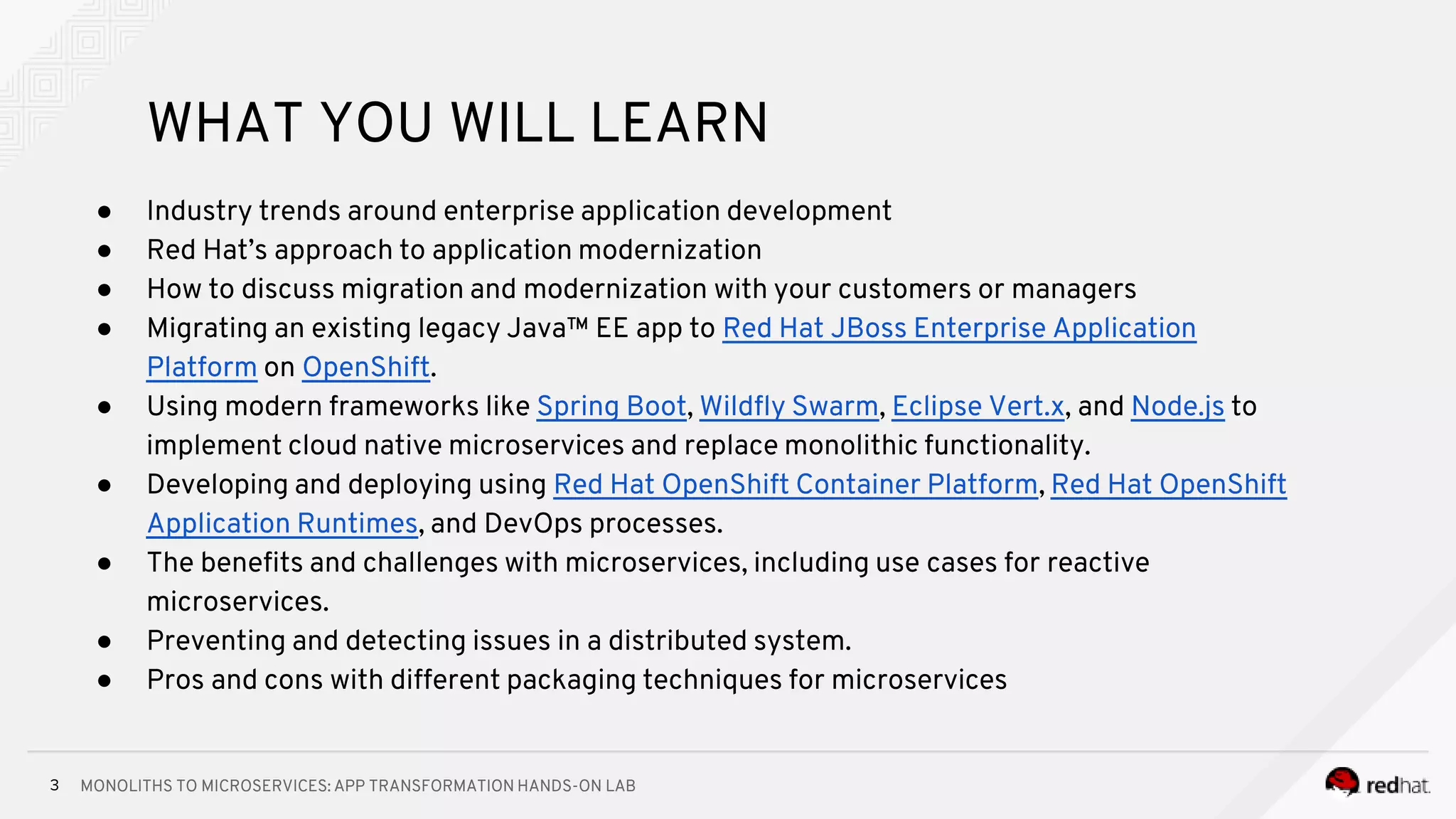
WHAT YOU WILL LEARN
● Industry trends around enterprise application development
● Red Hat’s approach to application modernization
● How to discuss migration and modernization with your customers or managers
● Migrating an existing legacy Java™ EE app to Red Hat JBoss Enterprise Application
Platform on OpenShift.
● Using modern frameworks like Spring Boot, Wildfly Swarm, Eclipse Vert.x, and Node.js to
implement cloud native microservices and replace monolithic functionality.
● Developing and deploying using Red Hat OpenShift Container Platform, Red Hat OpenShift
Application Runtimes, and DevOps processes.
● The benefits and challenges with microservices, including use cases for reactive
microservices.
● Preventing and detecting issues in a distributed system.
● Pros and cons with different packaging techniques for microservices
MONOLITHS TO MICROSERVICES: APP TRANSFORMATION HANDS-ON LAB4
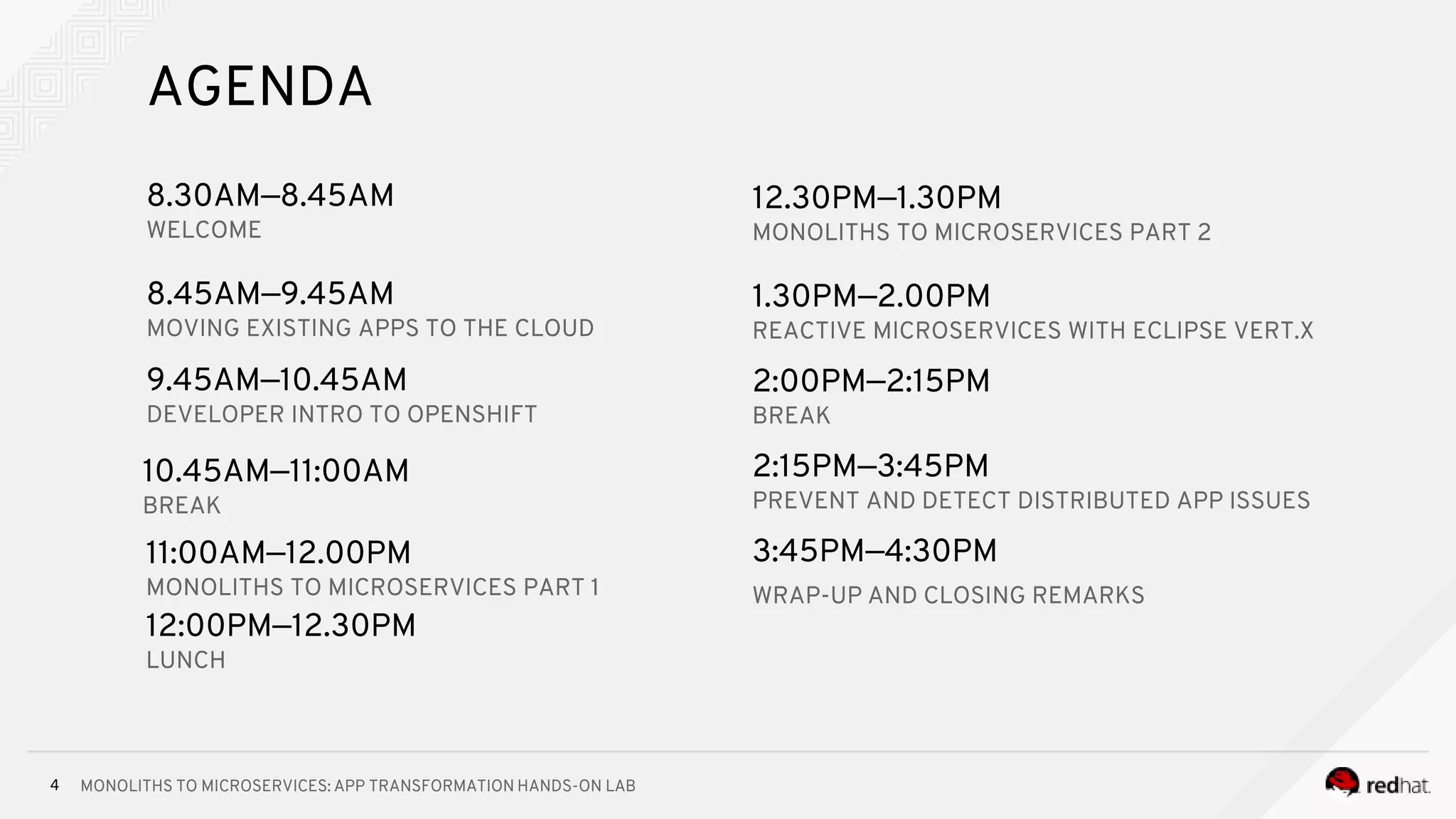
8.30AM—8.45AM
WELCOME
10.45AM—11:00AM
BREAK
8.45AM—9.45AM
MOVING EXISTING APPS TO THE CLOUD
11:00AM—12.00PM
MONOLITHS TO MICROSERVICES PART 1
9.45AM—10.45AM
DEVELOPER INTRO TO OPENSHIFT
12.30PM—1.30PM
MONOLITHS TO MICROSERVICES PART 2
1.30PM—2.00PM
REACTIVE MICROSERVICES WITH ECLIPSE VERT.X
AGENDA
2:00PM—2:15PM
BREAK
2:15PM—3:45PM
PREVENT AND DETECT DISTRIBUTED APP ISSUES
3:45PM—4:30PM
WRAP-UP AND CLOSING REMARKS
12:00PM—12.30PM
LUNCH
MONOLITHS TO MICROSERVICES: APP TRANSFORMATION HANDS-ON LAB5
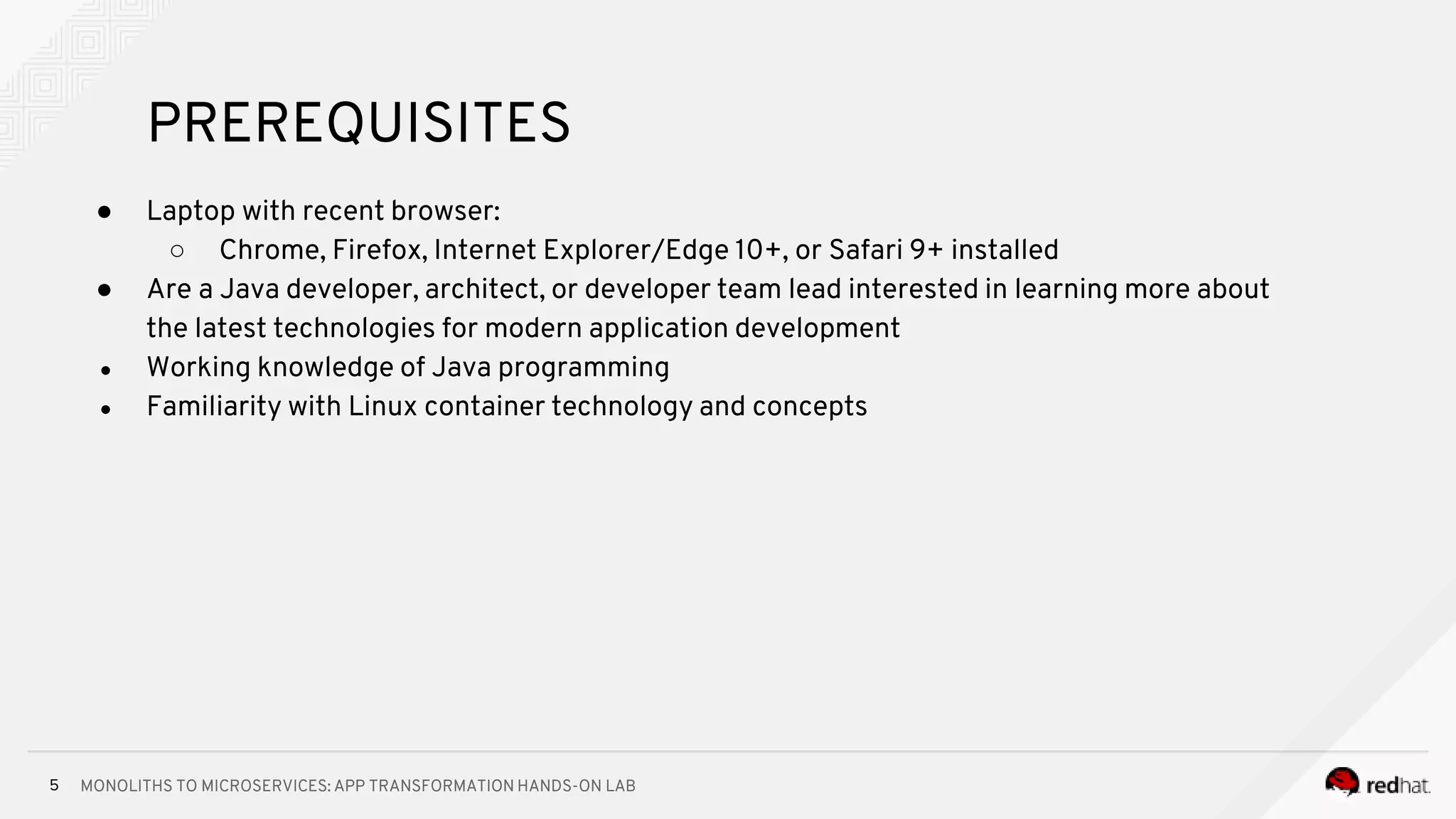
PREREQUISITES
● Laptop with recent browser:
○ Chrome, Firefox, Internet Explorer/Edge 10+, or Safari 9+ installed
● Are a Java developer, architect, or developer team lead interested in learning more about
the latest technologies for modern application development
● Working knowledge of Java programming
● Familiarity with Linux container technology and concepts
MONOLITHS TO MICROSERVICES: APP TRANSFORMATION HANDS-ON LAB6
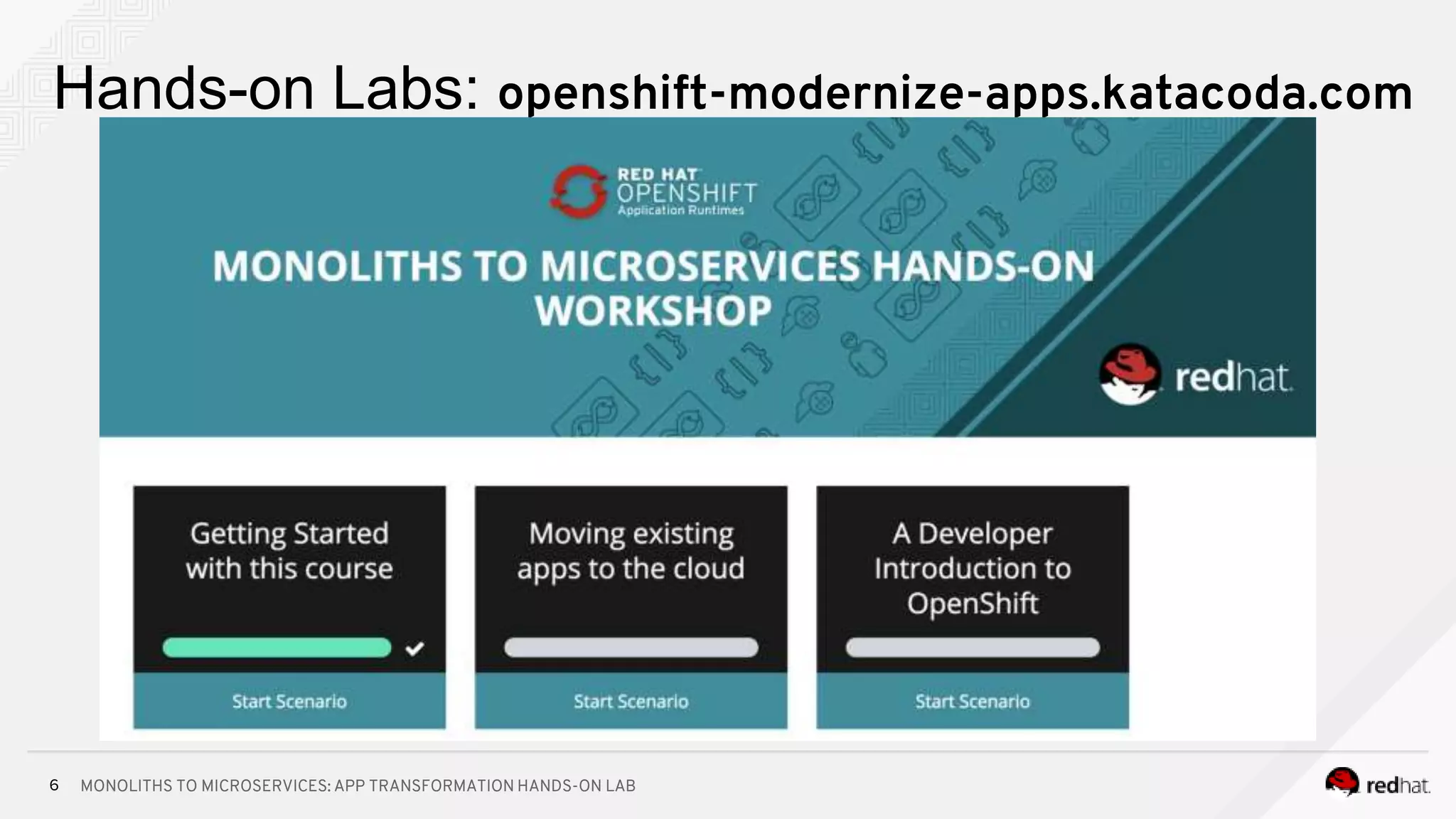
Hands-on Labs: openshift-modernize-apps.katacoda.com
THANK YOU
plus.google.com/+RedHat
linkedin.com/company/red-hat
youtube.com/user/RedHatVideos
facebook.com/redhatinc
twitter.com/RedHatNews

Monoliths to Microservices: App Transformation - introduction

  • 1.
    MONOLITHS TO MICROSERVICES:APP TRANSFORMATION Hands-on Technical Workshop Overview Ram Maddali Senior Architect @RamMaddali rmaddali@redhat.com Anand Akella Senior Architect aakella@redhat.com
  • 2.
    MONOLITHS TO MICROSERVICES:APP TRANSFORMATION HANDS-ON LAB2 ● WIFI: DT Banquet ● Password: <No password> ● Parking is free ( Please validate your parking at front desk before you leave) ● Please visit below URL and click on ‘Getting Started With the Course’ ○ http://openshift-modernize-apps.katacoda.com/
  • 3.
    MONOLITHS TO MICROSERVICES:APP TRANSFORMATION HANDS-ON LAB3 WHAT YOU WILL LEARN ● Industry trends around enterprise application development ● Red Hat’s approach to application modernization ● How to discuss migration and modernization with your customers or managers ● Migrating an existing legacy Java™ EE app to Red Hat JBoss Enterprise Application Platform on OpenShift. ● Using modern frameworks like Spring Boot, Wildfly Swarm, Eclipse Vert.x, and Node.js to implement cloud native microservices and replace monolithic functionality. ● Developing and deploying using Red Hat OpenShift Container Platform, Red Hat OpenShift Application Runtimes, and DevOps processes. ● The benefits and challenges with microservices, including use cases for reactive microservices. ● Preventing and detecting issues in a distributed system. ● Pros and cons with different packaging techniques for microservices
  • 4.
    MONOLITHS TO MICROSERVICES:APP TRANSFORMATION HANDS-ON LAB4 8.30AM—8.45AM WELCOME 10.45AM—11:00AM BREAK 8.45AM—9.45AM MOVING EXISTING APPS TO THE CLOUD 11:00AM—12.00PM MONOLITHS TO MICROSERVICES PART 1 9.45AM—10.45AM DEVELOPER INTRO TO OPENSHIFT 12.30PM—1.30PM MONOLITHS TO MICROSERVICES PART 2 1.30PM—2.00PM REACTIVE MICROSERVICES WITH ECLIPSE VERT.X AGENDA 2:00PM—2:15PM BREAK 2:15PM—3:45PM PREVENT AND DETECT DISTRIBUTED APP ISSUES 3:45PM—4:30PM WRAP-UP AND CLOSING REMARKS 12:00PM—12.30PM LUNCH
  • 5.
    MONOLITHS TO MICROSERVICES:APP TRANSFORMATION HANDS-ON LAB5 PREREQUISITES ● Laptop with recent browser: ○ Chrome, Firefox, Internet Explorer/Edge 10+, or Safari 9+ installed ● Are a Java developer, architect, or developer team lead interested in learning more about the latest technologies for modern application development ● Working knowledge of Java programming ● Familiarity with Linux container technology and concepts
  • 6.
    MONOLITHS TO MICROSERVICES:APP TRANSFORMATION HANDS-ON LAB6 Hands-on Labs: openshift-modernize-apps.katacoda.com
  • 7.

Editor's Notes

  • #2 Welcome to the monoliths to microservices app transformation hands-on workshop. This workshop delivers a full day of training, including details about Red Hat’s philosophy to modern application transformation and a set of hands-on learning modules for participants to complete throughout the day.
  • #3 Participants will use a browser-based environment, so no heavy requirements on the hardware side - all that’s needed is a modern browser, and even iPads or Android tablets will work, though your mileage may vary. As the lab material is rather technical, participants should be a Java developer or architect, or at least have a development background. Familiarity with linux container technology is good to have, though not required.
  • #4 Participants will learn about how application modernization plays a key role in the new digital transformation era, and how Red Hat technologies and approach can bring real business value to organizations looking to modernize. The workshop teaches fundamentals of migrating and modernizing existing applications from legacy platforms like Weblogic to modern and flexible platforms like Red Hat JBoss Enterprise Application Platform. Participants will use the Red Hat Application Migration Toolkit to provide detailed analysis of an example application, perform the migration, and then complete the journey to cloud and containers using Red Hat OpenShift. Next, a developer-centric module on OpenShift developer fundamentals shows participants how to streamline application development in the cloud using DevOps principles, containers, and OpenShift, including the use of OpenShift pipelines to automate promotion of applications across different environments, from the developer’s desktop to production. Microservices are then introduced, and participants will build them using a variety of different microservice runtimes offered through Red Hat OpenShift Application Runtimes, including Spring Boot, WildFly Swarm, Eclipse Vert.x, and Node.js. The workshop also discuss the benefits and challenges of microservices, including how reactive systems and reactive programming can solve thorny issues around performance, and how service mesh concepts can reduce the burden on developers while at the same time providing rich features for operators of microservice applications. Finally, the workshop closes with a discussion on microservice packaging techniques, such as Uber JARs and their application in a containerized world, and how API-led modernization featuring Red Hat 3Scale provides new business aveues with customers and partners.
  • #5 A typical agenda for the day looks like this. In the morning, after introductions, a short discussion on how migration and modernization can breathe new life into existing apps. Participants will then spend time completing the lab, followed by a short wrap-up for the first module. Each module is presented roughly in the same style, with a short introduction followed by participants getting hands-on with Red Hat, and a short wrap-up to reinforce what they just learned.
  • #6 Participants will use a browser-based environment, so no heavy requirements on the hardware side - all that’s needed is a modern browser, and even iPads or Android tablets will work, though your mileage may vary. As the lab material is rather technical, participants should be a Java developer or architect, or at least have a development background. Familiarity with linux container technology is good to have, though not required.
  • #7 The hands-on portion of the workshop uses a browser-based environment called Katacoda. Each of the modules in the workshop is supported by one or more Scenarios, which are completed in the order on the agenda.
  • #8 For more information on this workshop, please continue reading below to get additional instructions on how to deliver this workshop. If you have any follow-up questions, follow the links below including red hatters who can assist you in getting set up. This is a very informative and fun workshop, and we hope you enjoy delivering it!