Monitoring REDD+ landscapes

Martin Herold
Wageningen University

UNFCCC COP 19, Warsaw
GLF, 17. Nov. 2013
GOFC-GOLD REDD+ Sourcebook
http://www.gofcgold.wur.nl/redd

A sourcebook of methods and procedures for
monitoring and reporting anthropogenic greenhouse
gas emissions and removals caused by deforestation,
gains and losses of carbon stocks in forests
remaining forests, and forestation
Latest version published for COP-19 in Warsaw
Training material for REDD+ monitoring and reporting
REDD+
background
and design

REDD+
measuring
and
monitoring

REDD+
assessment
and
reporting

1 UNFCCC context and requirements and introduction to IPCC guidelines
M. Herold, E. Romijn, B. Mora
2 Framework for building national forest monitoring systems for REDD+
E. Romijn, M. Herold, B. Mora
3 Assessing and analyzing drivers of deforestation and forest degradation
E. Romijn, M. Herold

4 Monitoring activity data for forests using remote sensing
J. Miettinen, A. Langner, F. Achard, B. Mora
5 Monitoring activity data for forests remaining forests (incl. forest degr.)
C. Souza, S. Brown, J. Miettinen, F. Achard
6 Estimating emission factors for forest cover change (def. and degr.)
S. Brown & N. Harris
7 Approaches to community/local expert forest monitoring
M. Skutsch
8 Estimation of carbon emissions from deforestation and forest degr.
N. Harris & S. Brown
9 Estimation of GHG emissions from biomass burning
L. Boschetti
10 Estimation of uncertainties
G. Grassi, S. Monni, A. Langner, F. Achard, M. Herold
11 Overview and status of evolving technologies
B. Mora, E. Romijn

12 Data and guidance on developing REDD+ reference levels
M. Herold, E. Romijn, S. Brown
13 Guidance on reporting using IPCC Guidelines and Guidance
G. Grassi
14 Reporting interim REDD+ performance
M. Herold, E. Romijn
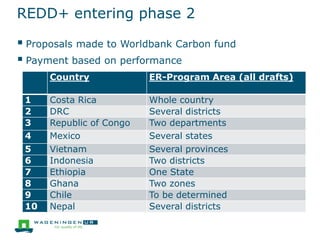
REDD+ entering phase 2
 Proposals made to Worldbank Carbon fund
 Payment based on performance
Country
1
2
3
4
5
6
7
8
9
10

ER-Program Area (all drafts)

Costa Rica
DRC
Republic of Congo
Mexico
Vietnam
Indonesia
Ethiopia
Ghana
Chile
Nepal

Whole country
Several districts
Two departments
Several states
Several provinces
Two districts
One State
Two zones
To be determined
Several districts
Proximate drivers of deforestation

Hosonuma et al 2012, ERL

http://www.decc.gov.uk/assets/decc/11/tacklingclimate-change/international-climatechange/6316-drivers-deforestation-report.pdf
SBSTA guidance on drivers of DD

 Noting the complexity of the problem, different
national circumstances and multiple drivers

 Countries to address drivers when developing and
implementing their national strategies

 Participation of relevant stakeholders
 Importance of cross-sector coordination
 International cooperation can contribute
 Encourage parties, organizations and the private
sector to reduce the drivers

 Noting that livelihoods may dependent drivers;

implications for economic costs & domestic resources
Interlinking drivers, interventions and monitoring

Based on assessment of 43 REDD+ countries in 98 readiness
documents

Salvini et al. in review, ERL
Links to performance & benefit sharing

 Many REDD+ interventions are outside forests
and cannot be traced to specific forest areas:

 REDD+ monitoring of activities
 National forest-related (GHG) impact to be
assessed

 Sub-national/local REDD+ performance maybe
hard to link to carbon-related compensation:

 Input-based benefit distribution systems
based on stakeholder participation in
REDD+ activities?

http://redd.ciga.unam.mx/images/InfoBrief2.pdf
Objectives for REDD+ monitoring

 Besides meeting international reporting needs (IPCC
GPG) - REDD+ national monitoring objectives:

● Underpin and stimulate strategies and priorities
for REDD+ implementation

● Track performance of REDD+ activities and their
impacts (carbon & non-carbon)

● Support the generation and sharing of benefits

 SBSTA guidance on drivers: multi-sector,
stakeholders, livelihoods, ...:

● REDD+ performance in landscape context

 Simplicity versus complexity
Landscape objectives
and examples of measures

• Easy to understand
• Apply to any scale
• Apply to any location
• Measurable
• Sustainability can mean
improvement over time

Courtesy of P. Holmgren
Global forest cover gains/losses 2000-12

http://earthenginepartners.appspot.com/science-2013-global-forest
Hansen et al., 2013. Science , 342
Definitions & accounting of forest changes

Kurz et al., 2008, PNAS
Conclusions

 Landscape thinking inherent to REDD+
 National REDD+ monitoring goes beyond

forests:
● Drivers and interventions
● Carbon and non-carbon impacts
● Benefit sharing
 Monitoring REDD+ landscapes:
● Need for simple, measureable indicators
 REDD+ moving to phase 2

Monitoring REDD+ landscapes

  • 1.
    Monitoring REDD+ landscapes MartinHerold Wageningen University UNFCCC COP 19, Warsaw GLF, 17. Nov. 2013
  • 2.
    GOFC-GOLD REDD+ Sourcebook http://www.gofcgold.wur.nl/redd Asourcebook of methods and procedures for monitoring and reporting anthropogenic greenhouse gas emissions and removals caused by deforestation, gains and losses of carbon stocks in forests remaining forests, and forestation Latest version published for COP-19 in Warsaw
  • 3.
    Training material forREDD+ monitoring and reporting REDD+ background and design REDD+ measuring and monitoring REDD+ assessment and reporting 1 UNFCCC context and requirements and introduction to IPCC guidelines M. Herold, E. Romijn, B. Mora 2 Framework for building national forest monitoring systems for REDD+ E. Romijn, M. Herold, B. Mora 3 Assessing and analyzing drivers of deforestation and forest degradation E. Romijn, M. Herold 4 Monitoring activity data for forests using remote sensing J. Miettinen, A. Langner, F. Achard, B. Mora 5 Monitoring activity data for forests remaining forests (incl. forest degr.) C. Souza, S. Brown, J. Miettinen, F. Achard 6 Estimating emission factors for forest cover change (def. and degr.) S. Brown & N. Harris 7 Approaches to community/local expert forest monitoring M. Skutsch 8 Estimation of carbon emissions from deforestation and forest degr. N. Harris & S. Brown 9 Estimation of GHG emissions from biomass burning L. Boschetti 10 Estimation of uncertainties G. Grassi, S. Monni, A. Langner, F. Achard, M. Herold 11 Overview and status of evolving technologies B. Mora, E. Romijn 12 Data and guidance on developing REDD+ reference levels M. Herold, E. Romijn, S. Brown 13 Guidance on reporting using IPCC Guidelines and Guidance G. Grassi 14 Reporting interim REDD+ performance M. Herold, E. Romijn
  • 4.
    REDD+ entering phase2  Proposals made to Worldbank Carbon fund  Payment based on performance Country 1 2 3 4 5 6 7 8 9 10 ER-Program Area (all drafts) Costa Rica DRC Republic of Congo Mexico Vietnam Indonesia Ethiopia Ghana Chile Nepal Whole country Several districts Two departments Several states Several provinces Two districts One State Two zones To be determined Several districts
  • 5.
    Proximate drivers ofdeforestation Hosonuma et al 2012, ERL http://www.decc.gov.uk/assets/decc/11/tacklingclimate-change/international-climatechange/6316-drivers-deforestation-report.pdf
  • 6.
    SBSTA guidance ondrivers of DD  Noting the complexity of the problem, different national circumstances and multiple drivers  Countries to address drivers when developing and implementing their national strategies  Participation of relevant stakeholders  Importance of cross-sector coordination  International cooperation can contribute  Encourage parties, organizations and the private sector to reduce the drivers  Noting that livelihoods may dependent drivers; implications for economic costs & domestic resources
  • 7.
    Interlinking drivers, interventionsand monitoring Based on assessment of 43 REDD+ countries in 98 readiness documents Salvini et al. in review, ERL
  • 8.
    Links to performance& benefit sharing  Many REDD+ interventions are outside forests and cannot be traced to specific forest areas:  REDD+ monitoring of activities  National forest-related (GHG) impact to be assessed  Sub-national/local REDD+ performance maybe hard to link to carbon-related compensation:  Input-based benefit distribution systems based on stakeholder participation in REDD+ activities? http://redd.ciga.unam.mx/images/InfoBrief2.pdf
  • 9.
    Objectives for REDD+monitoring  Besides meeting international reporting needs (IPCC GPG) - REDD+ national monitoring objectives: ● Underpin and stimulate strategies and priorities for REDD+ implementation ● Track performance of REDD+ activities and their impacts (carbon & non-carbon) ● Support the generation and sharing of benefits  SBSTA guidance on drivers: multi-sector, stakeholders, livelihoods, ...: ● REDD+ performance in landscape context  Simplicity versus complexity
  • 10.
    Landscape objectives and examplesof measures • Easy to understand • Apply to any scale • Apply to any location • Measurable • Sustainability can mean improvement over time Courtesy of P. Holmgren
  • 11.
    Global forest covergains/losses 2000-12 http://earthenginepartners.appspot.com/science-2013-global-forest Hansen et al., 2013. Science , 342
  • 12.
    Definitions & accountingof forest changes Kurz et al., 2008, PNAS
  • 13.
    Conclusions  Landscape thinkinginherent to REDD+  National REDD+ monitoring goes beyond forests: ● Drivers and interventions ● Carbon and non-carbon impacts ● Benefit sharing  Monitoring REDD+ landscapes: ● Need for simple, measureable indicators  REDD+ moving to phase 2