Understanding Your Credit Report Nick Sosnowski, V.P. of Lending, IAA Credit Union
What the Heck is “Credit”
What the Heck is “Credit” “Credit” is referring to your Credit Report.  It is used to… Help you borrow money Credit Cards, Car, House, etc… Qualify you for a job. Underwrite Insurance* How you manage your finances today can haunt you almost… Forever
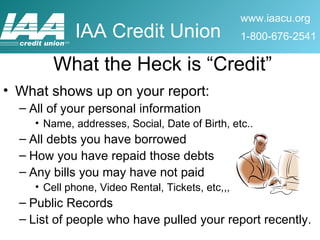
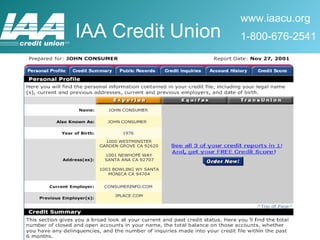
What shows up on your report: All of your personal information Name, addresses, Social, Date of Birth, etc.. All debts you have borrowed How you have repaid those debts Any bills you may have not paid Cell phone, Video Rental, Tickets, etc,,, Public Records List of people who have pulled your report recently. What the Heck is “Credit”
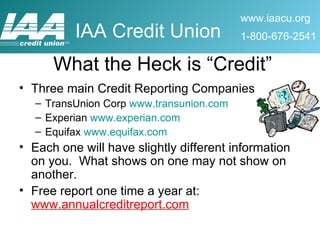
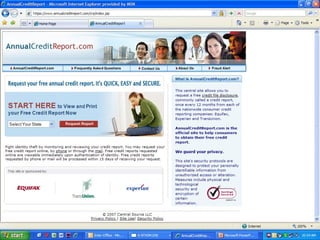
Three main Credit Reporting Companies TransUnion Corp  www.transunion.com Experian  www.experian.com Equifax  www.equifax.com Each one will have slightly different information on you.  What shows on one may not show on another. Free report one time a year at:  www.annualcreditreport.com What the Heck is “Credit”
So Lets jump on in and take a look…
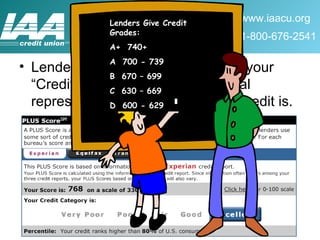
Lenders are most concerned with your “Credit Score”.  This is a numerical representation of how good your credit is. Lenders Give Credit Grades: A+  740+ A  700 - 739 B  670 – 699 C  630 – 669 D  600 - 629
Credit Score There are many different types of score, but they are all pretty close. Many factors can affect your score: Slow Pay, Collections, Bankruptcy, Foreclosure How Long (Oldest Account, Age of items above) Percentage of Credit Limits Used Number of inquiries (How many how long)
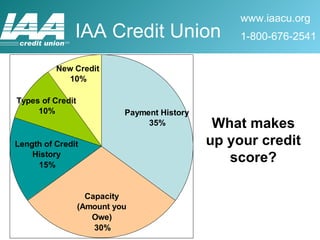
What makes up your credit score?
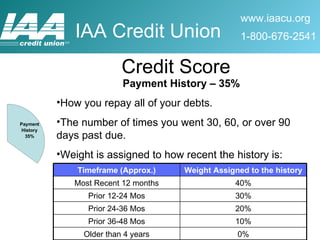
Payment History – 35% How you repay all of your debts. The number of times you went 30, 60, or over 90 days past due. Weight is assigned to how recent the history is: Credit Score 10% Prior 36-48 Mos 20% Prior 24-36 Mos 0% Older than 4 years 30% Prior 12-24 Mos 40% Most Recent 12 months Weight Assigned to the history Timeframe (Approx.)
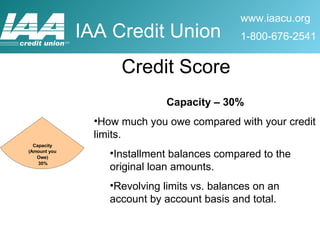
Capacity – 30% How much you owe compared with your credit limits. Installment balances compared to the original loan amounts. Revolving limits vs. balances on an account by account basis and total. Credit Score
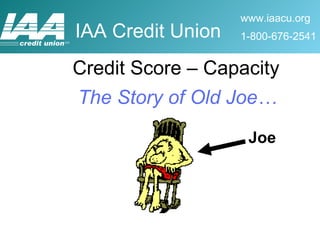
Credit Score – Capacity Joe The Story of Old Joe…
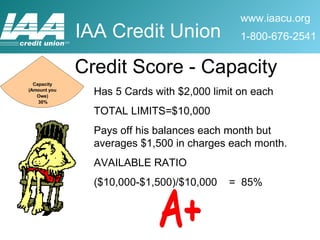
Has 5 Cards with $2,000 limit on each TOTAL LIMITS=$10,000 Pays off his balances each month but averages $1,500 in charges each month. AVAILABLE RATIO ($10,000-$1,500)/$10,000  =  85% Credit Score - Capacity A+
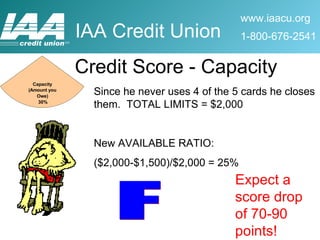
Since he never uses 4 of the 5 cards he closes them.  TOTAL LIMITS = $2,000 New AVAILABLE RATIO: ($2,000-$1,500)/$2,000 = 25% Credit Score - Capacity F Expect a score drop of 70-90 points!
Length of Credit History – 15% How long your credit goes back. Leave your older cards open since they produce a greater impact in the score. Avoid opening multiple accounts in a short period of time. Credit Score
Types of Credit – 10% Look for an overall mix of Credit Cards, Mortgages, and installment debt.  Avoid consumer finance companies. Credit Score New Credit – 10% Looks at Number of new accounts and recent credit requests (Inquiries) Shop for credit within a 2 week window to avoid negative effect.
So what does my report look like?
 
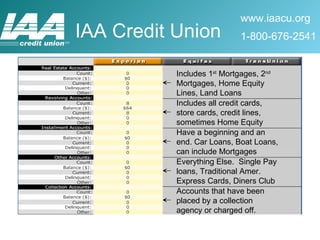
Accounts that have been placed by a collection agency or charged off. Includes 1 st  Mortgages, 2 nd  Mortgages, Home Equity Lines, Land Loans Includes all credit cards, store cards, credit lines, sometimes Home Equity Have a beginning and an end. Car Loans, Boat Loans, can include Mortgages  Everything Else.  Single Pay loans, Traditional Amer. Express Cards, Diners Club
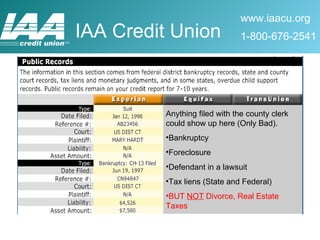
Anything filed with the county clerk could show up here (Only Bad).  Bankruptcy Foreclosure Defendant in a lawsuit Tax liens (State and Federal) BUT  NOT  Divorce, Real Estate Taxes
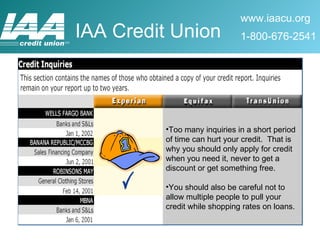
Too many inquiries in a short period of time can hurt your credit.  That is why you should only apply for credit when you need it, never to get a discount or get something free.  You should also be careful not to allow multiple people to pull your credit while shopping rates on loans.
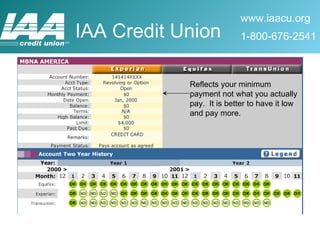
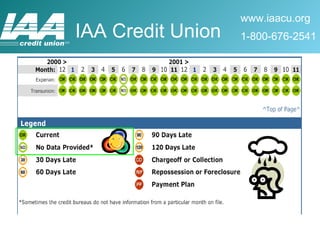
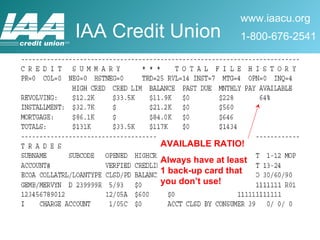
Reflects your minimum payment not what you actually pay.  It is better to have it low and pay more.
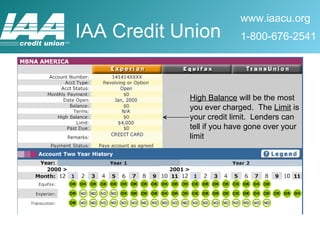
High Balance  will be the most you ever charged.  The  Limit  is your credit limit.  Lenders can tell if you have gone over your limit
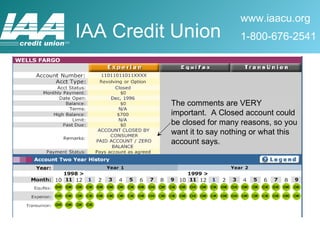
The comments are VERY important.  A Closed account could be closed for many reasons, so you want it to say nothing or what this account says.
 
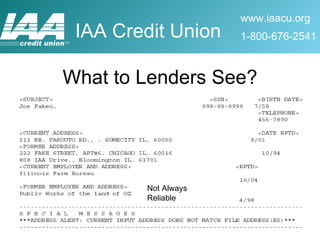
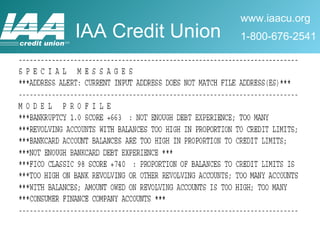
What to Lenders See? Not Always Reliable
 
AVAILABLE RATIO! Always have at least 1 back-up card that you don’t use!
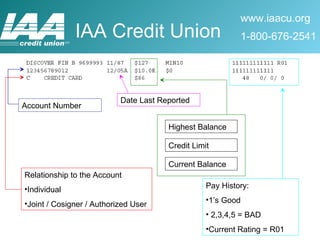
Account Number Relationship to the Account Individual Joint / Cosigner / Authorized User Date Last Reported Credit Limit Highest Balance Current Balance Pay History: 1’s Good 2,3,4,5 = BAD Current Rating = R01
Do not believe these statements: “Credit problems? No problem!” “We can erase your bad credit-100% guaranteed.” “We can remove bankruptcies, judgments, liens, and bad loans from your credit file forever.” How to take care of your Credit
The Truth No one can legally remove accurate and timely negative information from your members credit reports. There is only one way…. How to take care of your Credit
How to take care of your Credit ONLY TIME BUILDS GOOD CREDIT! For your kids…Make sure they open a credit card early and use it at least once a month.  Pay if off to avoid finance charges. Track your bills and make sure your payments are made promptly. Don’t panic if you make a mistake, just call.
Don’t apply for a lot of credit in a short period of time.  Comparison shop within 14 day window. Save 10% if you open a card / Beware of the free hat.  Don’t open new cards to get special rates.  Ask your current card companies if they can match a deal. Make sure you pay your obligations. Even though tickets stink, it is better to pay them now than have to deal with the credit blemish when you buy a car or house. Keep your available amount high. Avoid closing cards. Spread your balances around several different cards. How to take care of your Credit
WATCH YOUR CREDIT REPORTS Obtain a free credit report annually at  www.annualcredit report.com Watch for fake websites offering free reports! Beware of Credit monitoring services.  They are even offered by the big three.  How to take care of your Credit
 
So now I know everything about credit reports, what do I do next?
What to do next… Go out to  www.annualcreditreport.com  and get a copy of your credit report. Review it and look for errors. Get errors corrected by filing disputes. Confused and need help interpreting what you see? Let us help. Give us a call and let us guide you through your report. Don’t be embarrassed, we see this stuff every day! We can help you read it, guide you to improve it, but we  CAN’T help you correct  your credit.
QUESTIONS? Nick Sosnowski V.P. of Lending 557-2541 [email_address]

Understanding your Credit

  • 1.
    Understanding Your CreditReport Nick Sosnowski, V.P. of Lending, IAA Credit Union
  • 2.
    What the Heckis “Credit”
  • 3.
    What the Heckis “Credit” “Credit” is referring to your Credit Report. It is used to… Help you borrow money Credit Cards, Car, House, etc… Qualify you for a job. Underwrite Insurance* How you manage your finances today can haunt you almost… Forever
  • 4.
    What shows upon your report: All of your personal information Name, addresses, Social, Date of Birth, etc.. All debts you have borrowed How you have repaid those debts Any bills you may have not paid Cell phone, Video Rental, Tickets, etc,,, Public Records List of people who have pulled your report recently. What the Heck is “Credit”
  • 5.
    Three main CreditReporting Companies TransUnion Corp www.transunion.com Experian www.experian.com Equifax www.equifax.com Each one will have slightly different information on you. What shows on one may not show on another. Free report one time a year at: www.annualcreditreport.com What the Heck is “Credit”
  • 6.
    So Lets jumpon in and take a look…
  • 7.
    Lenders are mostconcerned with your “Credit Score”. This is a numerical representation of how good your credit is. Lenders Give Credit Grades: A+ 740+ A 700 - 739 B 670 – 699 C 630 – 669 D 600 - 629
  • 8.
    Credit Score Thereare many different types of score, but they are all pretty close. Many factors can affect your score: Slow Pay, Collections, Bankruptcy, Foreclosure How Long (Oldest Account, Age of items above) Percentage of Credit Limits Used Number of inquiries (How many how long)
  • 9.
    What makes upyour credit score?
  • 10.
    Payment History –35% How you repay all of your debts. The number of times you went 30, 60, or over 90 days past due. Weight is assigned to how recent the history is: Credit Score 10% Prior 36-48 Mos 20% Prior 24-36 Mos 0% Older than 4 years 30% Prior 12-24 Mos 40% Most Recent 12 months Weight Assigned to the history Timeframe (Approx.)
  • 11.
    Capacity – 30%How much you owe compared with your credit limits. Installment balances compared to the original loan amounts. Revolving limits vs. balances on an account by account basis and total. Credit Score
  • 12.
    Credit Score –Capacity Joe The Story of Old Joe…
  • 13.
    Has 5 Cardswith $2,000 limit on each TOTAL LIMITS=$10,000 Pays off his balances each month but averages $1,500 in charges each month. AVAILABLE RATIO ($10,000-$1,500)/$10,000 = 85% Credit Score - Capacity A+
  • 14.
    Since he neveruses 4 of the 5 cards he closes them. TOTAL LIMITS = $2,000 New AVAILABLE RATIO: ($2,000-$1,500)/$2,000 = 25% Credit Score - Capacity F Expect a score drop of 70-90 points!
  • 15.
    Length of CreditHistory – 15% How long your credit goes back. Leave your older cards open since they produce a greater impact in the score. Avoid opening multiple accounts in a short period of time. Credit Score
  • 16.
    Types of Credit– 10% Look for an overall mix of Credit Cards, Mortgages, and installment debt. Avoid consumer finance companies. Credit Score New Credit – 10% Looks at Number of new accounts and recent credit requests (Inquiries) Shop for credit within a 2 week window to avoid negative effect.
  • 17.
    So what doesmy report look like?
  • 18.
  • 19.
    Accounts that havebeen placed by a collection agency or charged off. Includes 1 st Mortgages, 2 nd Mortgages, Home Equity Lines, Land Loans Includes all credit cards, store cards, credit lines, sometimes Home Equity Have a beginning and an end. Car Loans, Boat Loans, can include Mortgages Everything Else. Single Pay loans, Traditional Amer. Express Cards, Diners Club
  • 20.
    Anything filed withthe county clerk could show up here (Only Bad). Bankruptcy Foreclosure Defendant in a lawsuit Tax liens (State and Federal) BUT NOT Divorce, Real Estate Taxes
  • 21.
    Too many inquiriesin a short period of time can hurt your credit. That is why you should only apply for credit when you need it, never to get a discount or get something free. You should also be careful not to allow multiple people to pull your credit while shopping rates on loans.
  • 22.
    Reflects your minimumpayment not what you actually pay. It is better to have it low and pay more.
  • 23.
    High Balance will be the most you ever charged. The Limit is your credit limit. Lenders can tell if you have gone over your limit
  • 24.
    The comments areVERY important. A Closed account could be closed for many reasons, so you want it to say nothing or what this account says.
  • 25.
  • 26.
    What to LendersSee? Not Always Reliable
  • 27.
  • 28.
    AVAILABLE RATIO! Alwayshave at least 1 back-up card that you don’t use!
  • 29.
    Account Number Relationshipto the Account Individual Joint / Cosigner / Authorized User Date Last Reported Credit Limit Highest Balance Current Balance Pay History: 1’s Good 2,3,4,5 = BAD Current Rating = R01
  • 30.
    Do not believethese statements: “Credit problems? No problem!” “We can erase your bad credit-100% guaranteed.” “We can remove bankruptcies, judgments, liens, and bad loans from your credit file forever.” How to take care of your Credit
  • 31.
    The Truth Noone can legally remove accurate and timely negative information from your members credit reports. There is only one way…. How to take care of your Credit
  • 32.
    How to takecare of your Credit ONLY TIME BUILDS GOOD CREDIT! For your kids…Make sure they open a credit card early and use it at least once a month. Pay if off to avoid finance charges. Track your bills and make sure your payments are made promptly. Don’t panic if you make a mistake, just call.
  • 33.
    Don’t apply fora lot of credit in a short period of time. Comparison shop within 14 day window. Save 10% if you open a card / Beware of the free hat. Don’t open new cards to get special rates. Ask your current card companies if they can match a deal. Make sure you pay your obligations. Even though tickets stink, it is better to pay them now than have to deal with the credit blemish when you buy a car or house. Keep your available amount high. Avoid closing cards. Spread your balances around several different cards. How to take care of your Credit
  • 34.
    WATCH YOUR CREDITREPORTS Obtain a free credit report annually at www.annualcredit report.com Watch for fake websites offering free reports! Beware of Credit monitoring services. They are even offered by the big three. How to take care of your Credit
  • 35.
  • 36.
    So now Iknow everything about credit reports, what do I do next?
  • 37.
    What to donext… Go out to www.annualcreditreport.com and get a copy of your credit report. Review it and look for errors. Get errors corrected by filing disputes. Confused and need help interpreting what you see? Let us help. Give us a call and let us guide you through your report. Don’t be embarrassed, we see this stuff every day! We can help you read it, guide you to improve it, but we CAN’T help you correct your credit.
  • 38.
    QUESTIONS? Nick SosnowskiV.P. of Lending 557-2541 [email_address]