5
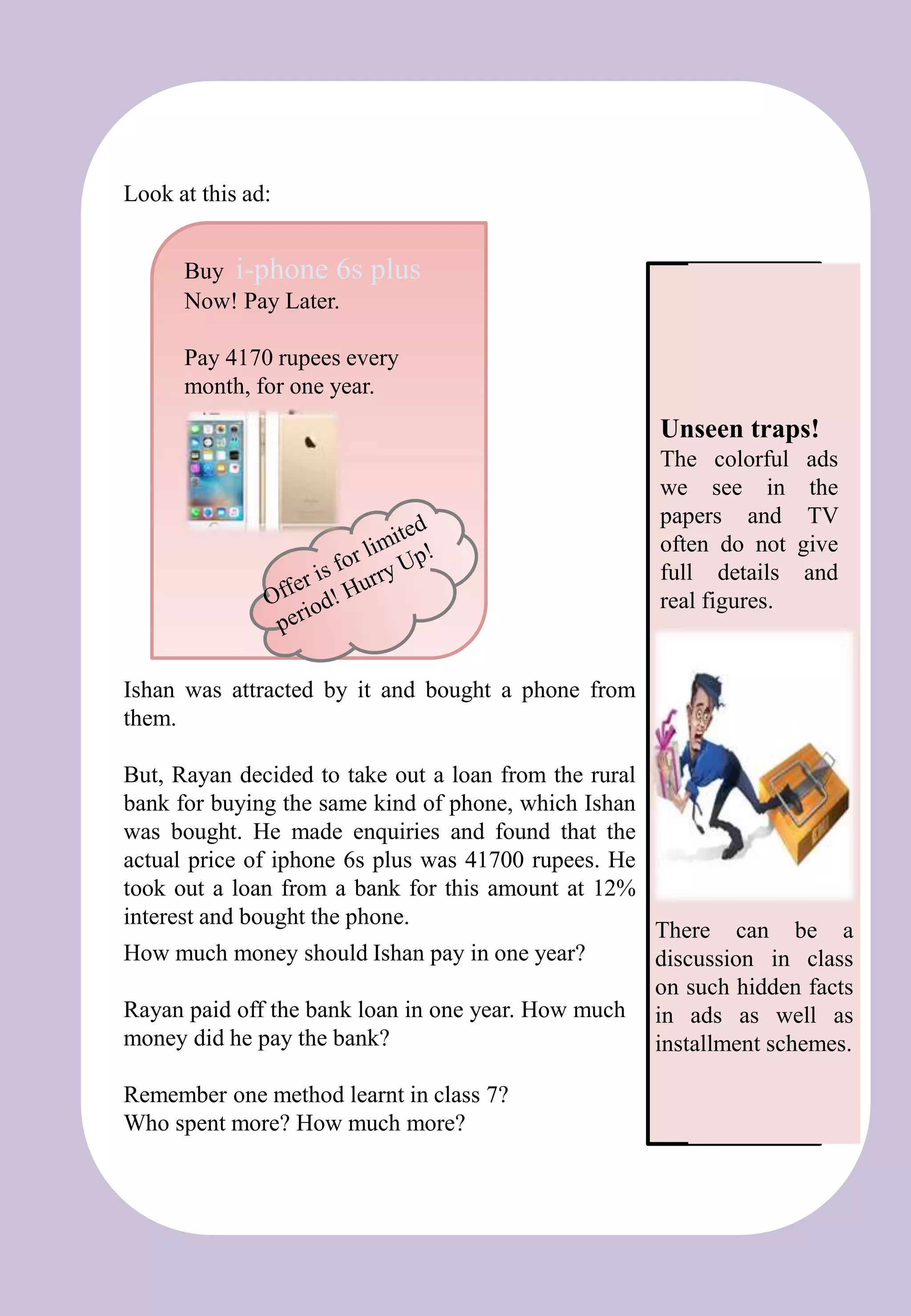
Look at this ad:
Buy i-phone 6s plus
Now! Pay Later.
Pay 4170 rupees every
month, for one year.
How much money should Ishan pay in one year?
Rayan paid off the bank loan in one year. How much
money did he pay the bank?
Remember one method learnt in class 7?
Who spent more? How much more?
Ishan was attracted by it and bought a phone from
them.
But, Rayan decided to take out a loan from the rural
bank for buying the same kind of phone, which Ishan
was bought. He made enquiries and found that the
actual price of iphone 6s plus was 41700 rupees. He
took out a loan from a bank for this amount at 12%
interest and bought the phone.
Unseen traps!
The colorful ads
we see in the
papers and TV
often do not give
full details and
real figures.
fs
There can be a
discussion in class
on such hidden facts
in ads as well as
installment schemes.
Concession in Interest
Remember about Rayan’s case. He paid off the bank loan of
rupees 41700 in one year at 12% interest.
Here, Rayan gives interest for 1 year. That is,
41700 × 1 × 12/100 = 5004
So, how much does he paid back in 1year?
41700 + 5004 = 46704 rupees.
Since it was onam season, the bank offers 2% concession on
the interest, if the loan is paid back in half an year. Otherwise
there is no concession.
After knew about the special offer, Akshaj also took out a loan
of same amount and same rate of interest as Rayan took. And
he paid all dues on the exact day of completing half an year.
How much did he pay back?
Amount of loan = 41700 rupees.
Rate of interest = 12%
Concession = 2%
Actual rate of interest = 10%
Interest = 41700 × 10/100 × ½
= 2085 rupees.
Total amount paid = 41700 + 2085
= 43785 rupees.
Who paid more?
See the difference in each case.
Interest for interest
Look at a question:
Joseph and Sunny deposit 20,000 rupees each in a bank giving
8% interest annually. After one year, Joseph withdraw the
entire amount including interest and re-deposited it the same
day. After one more year, both with drew the total amounts.
Who got more? How much more?
Have you
ever seen
such offers in
special
season?
Buy One!
Get One
Free!
Sunny gets interest for 2 years. That is,
20000 × 8/100 × 2 =3200.
So how much does he get in all after two years?
20000 + 3200 = 23200 rupees.
What about Joseph?
How much did he get as first year’s interest?
20000 × 8/100 = 1600
So how much did he withdraw first?
20000 + 1600 = 21600
It is the amount that he re-deposited.
So how much interest does he get after one more year?
21600 × 8/100 = 1728
What is the total amount?
21600 + 1728 = 23328 rupees.
How much more does Joseph get?
The amount he got more is the interest for the first
year’s interest for 20000 rupees.
In many schemes, interest for each year is added to the
current amount in calculating interest for the next year,
without actual withdrawal and re-investment. Interest
calculated thus is called ‘Compound Interest’. Interest
calculated only on the original investment each year is
called ‘Simple Interest’.
Look at another problem:
Ram deposited 35000 rupees in a bank which pays 10%
interest compounded annually. How much would he get
back after two years?
First year’s amount = 35000 rupees
First year’s interest = 35000 × 10/100
= 3500 rupees.
Second year’s amount = 35000+ 3500
= 38500 rupees.
Second year’s interest = 38500 × 10/100
= 3850 rupees.
Amount Ram gets after two years
= 35000 + 3850
= 38850 rupees.
(1) Arun deposited 43500 rupees in a bank which gives 8%
interest compounded annually. How much would he get
after 2 years?
(2) Jacob took out an agricultural loan of 13000 rupees from
the co-operative bank. They charge 5% interest. How
much should Jacob pay back after 6 months?
(3) The simple interest at 10% got for a certain amount after
a year is 400 rupees. If interest is compound annually,
what would be the interest for some amount at the same
rate after 3 years?
Computational trick
Activities
Let’s see how we can compute the total amount including
interest, using algebra.
If we denote the current amount by p, the rate of compound
interest by r % and compute the total amount including interest
to be paid back after n years.
Amount for the first year = p
Interest for the first year = p × r/100
Amount for the second year = p + ( p × r/100 )
= P ( 1 + r/100 )
Interest for the second year = p ( 1 + r/100 ) × r/100
Interest for the third year = p ( 1 + r/100 ) × r/100 × r/100
= p ( 1+ r/100 ) + p ( 1 + r/100 ) × r/100
= p ( 1+ r/100 ) ( 1 + r/100 )
= p ( 1 + r/100)2
OMG! Is
there any trick
to find compo-
und interest?
Continuing like this, the total amount A, including
interest after n years is given by,
A = p ( 1 + r/100 ) n
In general, we can say this:
If p rupees is invested in a scheme giving r %
interest compounded annually. The amount got
after n years is p ( 1 + r/100 )n
Now look at this problem:
James deposited 10500 rupees in a bank which pays 8%
interest compounded annually. How much would she
get after 2 years?
By using formula, we can find the amount directly.
A = p ( 1 + r/100 ) n
So, amount got after 2 years = 10500 ( 1+ 8/100 ) c
= 10500 ( [ 100 + 8 ] ÷ 100 )2
= 10500 ( 108/100 ) 2
= 10500 × ( 1.08 )2
= 10500 × 1.1664
= 12247.2000
= 12247 rupees 20 paisa.
In financial transactions, amounts between 5o paisa and
1 rupee is rounded to 1 rupee and amounts less than 50
paisa are ignored.
So, James would get 12247 rupees after 2 years.
108 × 108 = ( 100 + 8 ) 2
= 10000 + 1600 +64
= 11664
1.082 = 1.1664
“ Compound
interest is the 8th
wonder of the
world… He who
understands it,
earns it… He who
doesn’t pays it”
- Albert Einstein
Activities
1) Compute the compound interest for 50050 rupees at
9% for 3 years?
2) Nancy took out a loan of 15000 rupees from a bank,
which charges 8% interest compounded annually. She
paid back 5000 rupees after 2 years. How much should
she pay after one more year to settle the loan?
3) Binny deposited 5000 rupees in a bank, which gives
11% interest compounded annually. After 2 years, he
withdraw 3000 rupees. After one more year, how much
would she have in her account?
Changing times
There are several schemes in which interest is calculated
every 6 months (half yearly), instead of every year. It is half
yearly compounding.
Jincy deposited 36000 rupees in the co-operative bank,
which pays interest compound half-yearly. The annual rate
of interest is 8%. How much would she get back after one
year?
Since interest is compounded half yearly, interest has to be
calculated twice a year. Since the interest is 12% each year,
it is 6% for 6 months.
Amount for the first 6 months = 36000 rupees
Interest for the first 6 months = 36000 × 6/100
= 2160 rupees.
Amount for the next 6 months = 36000 + 2160
= 38160 rupees.
Interest for the next 6 months = 38160 × 6/100
= 2289.6
= 2290 rupees
Amount got after 1 year = 38160 + 2290
= 40450 rupees.
Let’s look how can we find this by using formula;
Amount got after 1 year = 36000 × ( 1 + 6/100)2
= 36000 × ( 106/100 ) 2
= 36000 × 1.062
= 40449.6
So, amount got after one year is 40450 rupees.
There are also schemes in which interest is
compounded every three month. Such a method is
called quarterly compounding.
Suppose Jincy made her deposit in a bank which
compounds interest quarterly?
She would get 3% interest every 3 months. So after one
year she would get;
36000 × ( 1 + 3/100 ) 4 = 36000 × (103/100 ) 4
= 36000 × 1.034
Compute this with a calculator.
1) Mohan, Ravi and James deposited 10,000 rupees
each, under different schemes, in a bank which
gives 8% interest. Mohan gets simple interest, Ravi
gets interest compounded half and James gets
interest compounded quarterly. Compute the total
amount each of them gets back after one year and
compare these amounts?
2) Kiran deposited 25,000 rupees in a financial
company, which gives 9% interest compounded
every six months. How much would he get back
after two years?
3) Ravi deposited 30,000 rupees in a bank, which
gives 6% interest, compounded quarterly. How
much would he get back after 9 months?
Activities
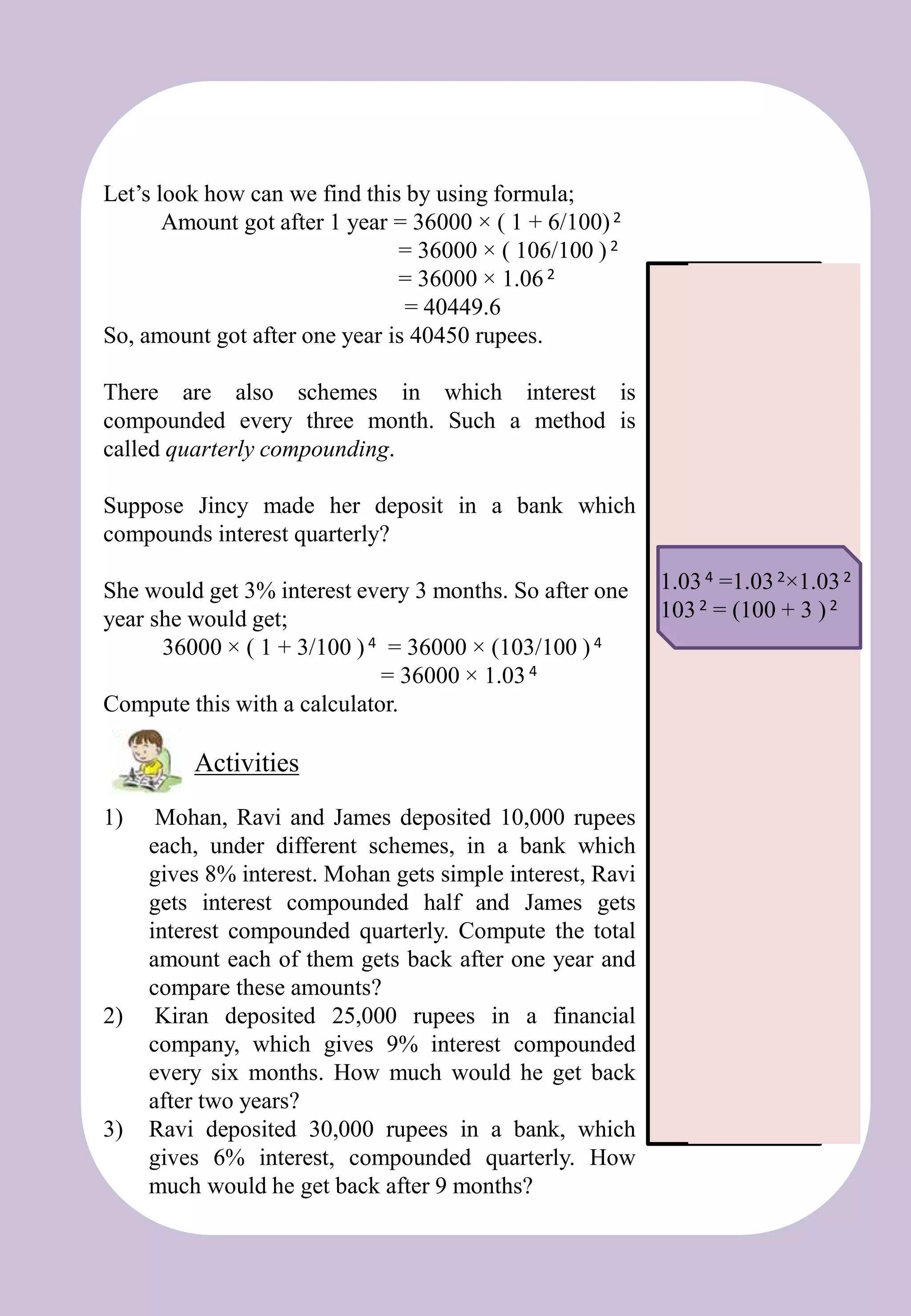
1.034 =1.032×1.032
1032 = (100 + 3 )2
Et
4) Lathika took out a loan of 40,000 rupees from a bank
which charges interest compounded quarterly. The annual
rate of interest is 8%. How much should she pay back
after 9 months to settle the loan?
5) Sujith deposited 15,000 rupees in a bank which
compounded interest half yearly and Pranav deposited
the same amount in another bank which compounds
interest quarterly. The annual rate of interest is 5% at
both the banks. How much more would Pranav get after
one year?
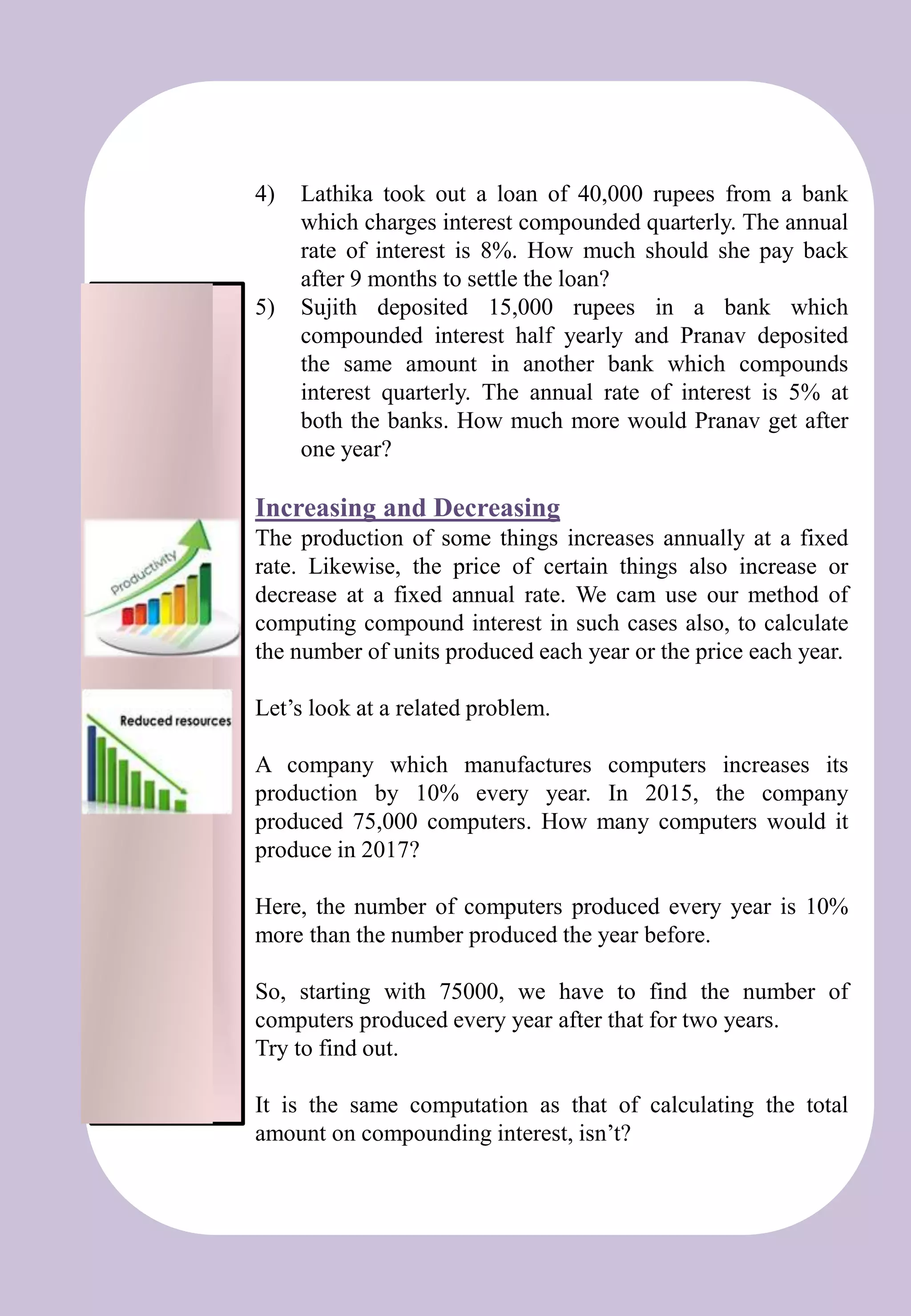
Increasing and Decreasing
The production of some things increases annually at a fixed
rate. Likewise, the price of certain things also increase or
decrease at a fixed annual rate. We cam use our method of
computing compound interest in such cases also, to calculate
the number of units produced each year or the price each year.
Let’s look at a related problem.
A company which manufactures computers increases its
production by 10% every year. In 2015, the company
produced 75,000 computers. How many computers would it
produce in 2017?
Here, the number of computers produced every year is 10%
more than the number produced the year before.
So, starting with 75000, we have to find the number of
computers produced every year after that for two years.
Try to find out.
It is the same computation as that of calculating the total
amount on compounding interest, isn’t?
Look at another problem:
The price of a car is 3 lakh rupees and it depreciates by 4%
every year. What would be the price after 2 years?
Here the price on every year is 4% less than the previous
year’s price.
First year’s price = 3,00,000
First year’s depreciation = 3,00,000 × 4/100
= 12,000 rupees.
Second year’s price = 300000 – 12000
= 2,88,000
Second year’s depreciation = 288000 × 4/100
= 11520
Price at the end of two years = 288000 – 11520
= 276480 rupees.
Here, since the depreciation is at the same rate on every
year, we can write
Price at the end of two years = 3,00,000 × ( 1 – 4/100)2
1) The population of Kerala increases by 2% in every
year. The current population is 3 crores. What would be
the population after 3 years?
2) A I.T company reduces the price of a particular model
by 4% in every year. The current price of this model is
5000 rupees. What would be the price after 2 years?
3) Tiger is our National Animal. Their number decreases
on every year. Figures show 3% annual decrease.
According to the census of National Tiger
Conservation Authority, there were 1700 tigers in India
in 2011. If the trend continues, how many tigers would
be there in 2016?
Activities
One problem
from Lilavathi,
Baskara
Charya’s book:
Oh!
Mathematician!
If the interest
for 100 is 5 per
month, say what
the interest for
16, for one year
is. Then from
principal and
interest, say
what the period
is and from
period and
interest, say
what the
principal is.
t
Project:
 A report estimates e-waste increasing by 15% every year
and the e-waste in 2014 is about 9 crore tons. What is the
expected amount of e-waste in 2020?
Collect the
details of
various
schemes for
deposits and
loans from
different
banks and
compare the
rates of
interest.
Et
Learning outcomes What I can With
teacher’s
help
Must
improve
 Explaining the method of
computing interest by
compounding interest for
interest.
 Explaining the method of
computing amounts under
interest compounded, half
yearly, quarterly or in any
frequencies.
 Solving other practical
problems, using the method of
compound interest.
Looking backLooking back

Money Math, SCERT Maths textbook MODEL, Chapter5

  • 1.
  • 2.
    Look at thisad: Buy i-phone 6s plus Now! Pay Later. Pay 4170 rupees every month, for one year. How much money should Ishan pay in one year? Rayan paid off the bank loan in one year. How much money did he pay the bank? Remember one method learnt in class 7? Who spent more? How much more? Ishan was attracted by it and bought a phone from them. But, Rayan decided to take out a loan from the rural bank for buying the same kind of phone, which Ishan was bought. He made enquiries and found that the actual price of iphone 6s plus was 41700 rupees. He took out a loan from a bank for this amount at 12% interest and bought the phone. Unseen traps! The colorful ads we see in the papers and TV often do not give full details and real figures. fs There can be a discussion in class on such hidden facts in ads as well as installment schemes.
  • 3.
    Concession in Interest Rememberabout Rayan’s case. He paid off the bank loan of rupees 41700 in one year at 12% interest. Here, Rayan gives interest for 1 year. That is, 41700 × 1 × 12/100 = 5004 So, how much does he paid back in 1year? 41700 + 5004 = 46704 rupees. Since it was onam season, the bank offers 2% concession on the interest, if the loan is paid back in half an year. Otherwise there is no concession. After knew about the special offer, Akshaj also took out a loan of same amount and same rate of interest as Rayan took. And he paid all dues on the exact day of completing half an year. How much did he pay back? Amount of loan = 41700 rupees. Rate of interest = 12% Concession = 2% Actual rate of interest = 10% Interest = 41700 × 10/100 × ½ = 2085 rupees. Total amount paid = 41700 + 2085 = 43785 rupees. Who paid more? See the difference in each case. Interest for interest Look at a question: Joseph and Sunny deposit 20,000 rupees each in a bank giving 8% interest annually. After one year, Joseph withdraw the entire amount including interest and re-deposited it the same day. After one more year, both with drew the total amounts. Who got more? How much more? Have you ever seen such offers in special season? Buy One! Get One Free!
  • 4.
    Sunny gets interestfor 2 years. That is, 20000 × 8/100 × 2 =3200. So how much does he get in all after two years? 20000 + 3200 = 23200 rupees. What about Joseph? How much did he get as first year’s interest? 20000 × 8/100 = 1600 So how much did he withdraw first? 20000 + 1600 = 21600 It is the amount that he re-deposited. So how much interest does he get after one more year? 21600 × 8/100 = 1728 What is the total amount? 21600 + 1728 = 23328 rupees. How much more does Joseph get? The amount he got more is the interest for the first year’s interest for 20000 rupees. In many schemes, interest for each year is added to the current amount in calculating interest for the next year, without actual withdrawal and re-investment. Interest calculated thus is called ‘Compound Interest’. Interest calculated only on the original investment each year is called ‘Simple Interest’. Look at another problem: Ram deposited 35000 rupees in a bank which pays 10% interest compounded annually. How much would he get back after two years? First year’s amount = 35000 rupees First year’s interest = 35000 × 10/100 = 3500 rupees.
  • 5.
    Second year’s amount= 35000+ 3500 = 38500 rupees. Second year’s interest = 38500 × 10/100 = 3850 rupees. Amount Ram gets after two years = 35000 + 3850 = 38850 rupees. (1) Arun deposited 43500 rupees in a bank which gives 8% interest compounded annually. How much would he get after 2 years? (2) Jacob took out an agricultural loan of 13000 rupees from the co-operative bank. They charge 5% interest. How much should Jacob pay back after 6 months? (3) The simple interest at 10% got for a certain amount after a year is 400 rupees. If interest is compound annually, what would be the interest for some amount at the same rate after 3 years? Computational trick Activities Let’s see how we can compute the total amount including interest, using algebra. If we denote the current amount by p, the rate of compound interest by r % and compute the total amount including interest to be paid back after n years. Amount for the first year = p Interest for the first year = p × r/100 Amount for the second year = p + ( p × r/100 ) = P ( 1 + r/100 ) Interest for the second year = p ( 1 + r/100 ) × r/100 Interest for the third year = p ( 1 + r/100 ) × r/100 × r/100 = p ( 1+ r/100 ) + p ( 1 + r/100 ) × r/100 = p ( 1+ r/100 ) ( 1 + r/100 ) = p ( 1 + r/100)2 OMG! Is there any trick to find compo- und interest?
  • 6.
    Continuing like this,the total amount A, including interest after n years is given by, A = p ( 1 + r/100 ) n In general, we can say this: If p rupees is invested in a scheme giving r % interest compounded annually. The amount got after n years is p ( 1 + r/100 )n Now look at this problem: James deposited 10500 rupees in a bank which pays 8% interest compounded annually. How much would she get after 2 years? By using formula, we can find the amount directly. A = p ( 1 + r/100 ) n So, amount got after 2 years = 10500 ( 1+ 8/100 ) c = 10500 ( [ 100 + 8 ] ÷ 100 )2 = 10500 ( 108/100 ) 2 = 10500 × ( 1.08 )2 = 10500 × 1.1664 = 12247.2000 = 12247 rupees 20 paisa. In financial transactions, amounts between 5o paisa and 1 rupee is rounded to 1 rupee and amounts less than 50 paisa are ignored. So, James would get 12247 rupees after 2 years. 108 × 108 = ( 100 + 8 ) 2 = 10000 + 1600 +64 = 11664 1.082 = 1.1664
  • 7.
    “ Compound interest isthe 8th wonder of the world… He who understands it, earns it… He who doesn’t pays it” - Albert Einstein Activities 1) Compute the compound interest for 50050 rupees at 9% for 3 years? 2) Nancy took out a loan of 15000 rupees from a bank, which charges 8% interest compounded annually. She paid back 5000 rupees after 2 years. How much should she pay after one more year to settle the loan? 3) Binny deposited 5000 rupees in a bank, which gives 11% interest compounded annually. After 2 years, he withdraw 3000 rupees. After one more year, how much would she have in her account? Changing times There are several schemes in which interest is calculated every 6 months (half yearly), instead of every year. It is half yearly compounding. Jincy deposited 36000 rupees in the co-operative bank, which pays interest compound half-yearly. The annual rate of interest is 8%. How much would she get back after one year? Since interest is compounded half yearly, interest has to be calculated twice a year. Since the interest is 12% each year, it is 6% for 6 months. Amount for the first 6 months = 36000 rupees Interest for the first 6 months = 36000 × 6/100 = 2160 rupees. Amount for the next 6 months = 36000 + 2160 = 38160 rupees. Interest for the next 6 months = 38160 × 6/100 = 2289.6 = 2290 rupees Amount got after 1 year = 38160 + 2290 = 40450 rupees.
  • 8.
    Let’s look howcan we find this by using formula; Amount got after 1 year = 36000 × ( 1 + 6/100)2 = 36000 × ( 106/100 ) 2 = 36000 × 1.062 = 40449.6 So, amount got after one year is 40450 rupees. There are also schemes in which interest is compounded every three month. Such a method is called quarterly compounding. Suppose Jincy made her deposit in a bank which compounds interest quarterly? She would get 3% interest every 3 months. So after one year she would get; 36000 × ( 1 + 3/100 ) 4 = 36000 × (103/100 ) 4 = 36000 × 1.034 Compute this with a calculator. 1) Mohan, Ravi and James deposited 10,000 rupees each, under different schemes, in a bank which gives 8% interest. Mohan gets simple interest, Ravi gets interest compounded half and James gets interest compounded quarterly. Compute the total amount each of them gets back after one year and compare these amounts? 2) Kiran deposited 25,000 rupees in a financial company, which gives 9% interest compounded every six months. How much would he get back after two years? 3) Ravi deposited 30,000 rupees in a bank, which gives 6% interest, compounded quarterly. How much would he get back after 9 months? Activities 1.034 =1.032×1.032 1032 = (100 + 3 )2
  • 9.
    Et 4) Lathika tookout a loan of 40,000 rupees from a bank which charges interest compounded quarterly. The annual rate of interest is 8%. How much should she pay back after 9 months to settle the loan? 5) Sujith deposited 15,000 rupees in a bank which compounded interest half yearly and Pranav deposited the same amount in another bank which compounds interest quarterly. The annual rate of interest is 5% at both the banks. How much more would Pranav get after one year? Increasing and Decreasing The production of some things increases annually at a fixed rate. Likewise, the price of certain things also increase or decrease at a fixed annual rate. We cam use our method of computing compound interest in such cases also, to calculate the number of units produced each year or the price each year. Let’s look at a related problem. A company which manufactures computers increases its production by 10% every year. In 2015, the company produced 75,000 computers. How many computers would it produce in 2017? Here, the number of computers produced every year is 10% more than the number produced the year before. So, starting with 75000, we have to find the number of computers produced every year after that for two years. Try to find out. It is the same computation as that of calculating the total amount on compounding interest, isn’t?
  • 10.
    Look at anotherproblem: The price of a car is 3 lakh rupees and it depreciates by 4% every year. What would be the price after 2 years? Here the price on every year is 4% less than the previous year’s price. First year’s price = 3,00,000 First year’s depreciation = 3,00,000 × 4/100 = 12,000 rupees. Second year’s price = 300000 – 12000 = 2,88,000 Second year’s depreciation = 288000 × 4/100 = 11520 Price at the end of two years = 288000 – 11520 = 276480 rupees. Here, since the depreciation is at the same rate on every year, we can write Price at the end of two years = 3,00,000 × ( 1 – 4/100)2 1) The population of Kerala increases by 2% in every year. The current population is 3 crores. What would be the population after 3 years? 2) A I.T company reduces the price of a particular model by 4% in every year. The current price of this model is 5000 rupees. What would be the price after 2 years? 3) Tiger is our National Animal. Their number decreases on every year. Figures show 3% annual decrease. According to the census of National Tiger Conservation Authority, there were 1700 tigers in India in 2011. If the trend continues, how many tigers would be there in 2016? Activities One problem from Lilavathi, Baskara Charya’s book: Oh! Mathematician! If the interest for 100 is 5 per month, say what the interest for 16, for one year is. Then from principal and interest, say what the period is and from period and interest, say what the principal is.
  • 11.
    t Project:  A reportestimates e-waste increasing by 15% every year and the e-waste in 2014 is about 9 crore tons. What is the expected amount of e-waste in 2020? Collect the details of various schemes for deposits and loans from different banks and compare the rates of interest.
  • 12.
    Et Learning outcomes WhatI can With teacher’s help Must improve  Explaining the method of computing interest by compounding interest for interest.  Explaining the method of computing amounts under interest compounded, half yearly, quarterly or in any frequencies.  Solving other practical problems, using the method of compound interest. Looking backLooking back