Compound Interest
Compound Interest Definition:
Compound interest is the interest calculated on the principal
and the interest accumulated over the previous period. It is unlike
simple interest where interest is not added to the principal while
calculating the interest during the next period. Compound interest finds
its usage in most of the transactions in the banking and finance sectors
and also in other areas as well. Some of its applications are:
 Increase or decrease in population.
 The growth of bacteria.
 Rise or depreciation in the value of an item.
Compound Interest
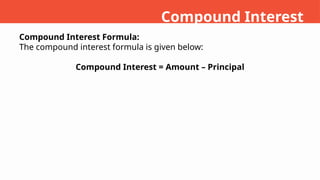
Compound Interest Formula:
The compound interest formula is given below:
Compound Interest = Amount – Principal
Compound Interest
Where the amount is given by:
Compound Interest
Where,
A= amount
P= principal
R= rate of interest
n= number of years
It is to be noted that the above formula is the general formula for the
number of times the principal is compounded in an year. If the amount
is compounded annually, the amount is given as-
A=P(1+(R/100))t
Compound Interest
Compound Interest
If interest is not compounded yearly then,
Find the compound interest on Rs.8000 at 5% per annum for 3 years
when C.I is reckoned yearly.
A)
B)
C)
D)
Rs. 1262
Rs. 1261
Rs. 1260
Rs. 1361
Question 1
At what rate percentage per annum will Ron lends a sum of $ 2000 to
Ben. Ben returned after 2 years $ 2205, compounded annually?
A)
B)
C)
D)
2%
3%
4%
5%
Question 3
Find the compound interest on Rs. 500 for 1 year at 40% per annum
compounded quarterly.
A)
B)
C)
D)
Rs. 146.01
Rs. 133.1
Rs. 732.50
Rs. 232.05
Question 4
The annual sales of a company in the year 2000 was Rs. 1000 and in the
year 2005 was Rs. 2490. Find the compounded annual growth rate of
sales in the given period of the same company.
A)
B)
C)
D)
14.28%
125%
17.86%
20%
Question 5
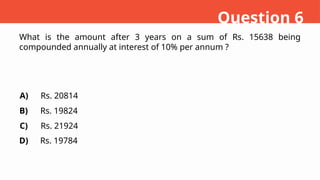
What is the amount after 3 years on a sum of Rs. 15638 being
compounded annually at interest of 10% per annum ?
A)
B)
C)
D)
Rs. 20814
Rs. 19824
Rs. 21924
Rs. 19784
Question 6
Ram purchased a Hyundai car 3 years ago for Rs. 0.4 million. Its value
depreciated each year @ 20% p.a. What is the present value of the car?
A)
B)
C)
D)
691200
241800
204800
24800
Question 7
Reena got a loan of Rs. 12000 against her fixed deposits to purchase a
mobile phone. If the rate of interest is 12% p.a. compounded half
yearly, then the amount (in Rs.) that she has to pay back after 2 years is
_______.
A)
B)
C)
D)
24883
13483
18882
15149
Question 10
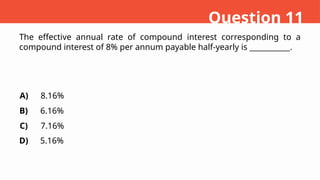
The effective annual rate of compound interest corresponding to a
compound interest of 8% per annum payable half-yearly is ___________.
A)
B)
C)
D)
8.16%
6.16%
7.16%
5.16%
Question 11
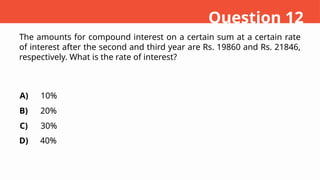
The amounts for compound interest on a certain sum at a certain rate
of interest after the second and third year are Rs. 19860 and Rs. 21846,
respectively. What is the rate of interest?
A)
B)
C)
D)
10%
20%
30%
40%
Question 12
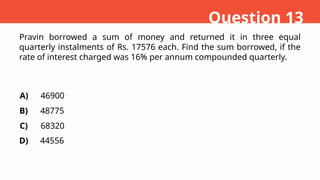
Pravin borrowed a sum of money and returned it in three equal
quarterly instalments of Rs. 17576 each. Find the sum borrowed, if the
rate of interest charged was 16% per annum compounded quarterly.
A)
B)
C)
D)
46900
48775
68320
44556
Question 13
Mr. Venu invests Rs. 20000 in an account that pays 4% interest per year,
compounded quarterly. What is the amount of money that he will have
after 2 years?
A)
B)
C)
D)
21657.12
20282.52
22802.56
22028.58
Question 14
The death rate of a town with a population of 5000 is 20%. Considering
that there are no new births, what is the population of town after 3
years?
A)
B)
C)
D)
1280
3600
2560
2780
Question 16
Kishore invests Rs. 3000 for three years at a certain rate of interest,
compounded annually. At the end of one year it amounts to Rs. 3540.
Calculate the amount due at the end of the second year.
A)
B)
C)
D)
4035.6
4071
4080
4177.2
Question 17
A bank offers 10% compound interest calculated on half-yearly basis. A
customer deposits Rs. 1000 each on 1st January and 1st July of a year.
Find the interest he would have gained at the end of a year.
A)
B)
C)
D)
Rs. 2152.50
Rs. 152.50
Rs. 1152.50
Rs. 315
Question 18
The population of goats in a village was 5200 three years back. It is
6600 right now. What will be the population three years down the line, if
the rate of growth of population of goats is constant over the years?
A)
B)
C)
D)
6400
8000
8800
6600
Question 19
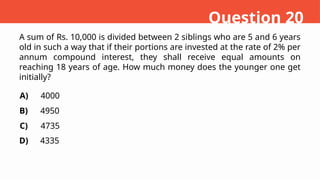
A sum of Rs. 10,000 is divided between 2 siblings who are 5 and 6 years
old in such a way that if their portions are invested at the rate of 2% per
annum compound interest, they shall receive equal amounts on
reaching 18 years of age. How much money does the younger one get
initially?
A)
B)
C)
D)
4000
4950
4735
4335
Question 20
THANK YOU

Logical reasoning Compound Interest.pptx

  • 1.
  • 2.
    Compound Interest Definition: Compoundinterest is the interest calculated on the principal and the interest accumulated over the previous period. It is unlike simple interest where interest is not added to the principal while calculating the interest during the next period. Compound interest finds its usage in most of the transactions in the banking and finance sectors and also in other areas as well. Some of its applications are:  Increase or decrease in population.  The growth of bacteria.  Rise or depreciation in the value of an item. Compound Interest
  • 3.
    Compound Interest Formula: Thecompound interest formula is given below: Compound Interest = Amount – Principal Compound Interest
  • 4.
    Where the amountis given by: Compound Interest
  • 5.
    Where, A= amount P= principal R=rate of interest n= number of years It is to be noted that the above formula is the general formula for the number of times the principal is compounded in an year. If the amount is compounded annually, the amount is given as- A=P(1+(R/100))t Compound Interest
  • 6.
    Compound Interest If interestis not compounded yearly then,
  • 7.
    Find the compoundinterest on Rs.8000 at 5% per annum for 3 years when C.I is reckoned yearly. A) B) C) D) Rs. 1262 Rs. 1261 Rs. 1260 Rs. 1361 Question 1
  • 8.
    At what ratepercentage per annum will Ron lends a sum of $ 2000 to Ben. Ben returned after 2 years $ 2205, compounded annually? A) B) C) D) 2% 3% 4% 5% Question 3
  • 9.
    Find the compoundinterest on Rs. 500 for 1 year at 40% per annum compounded quarterly. A) B) C) D) Rs. 146.01 Rs. 133.1 Rs. 732.50 Rs. 232.05 Question 4
  • 10.
    The annual salesof a company in the year 2000 was Rs. 1000 and in the year 2005 was Rs. 2490. Find the compounded annual growth rate of sales in the given period of the same company. A) B) C) D) 14.28% 125% 17.86% 20% Question 5
  • 11.
    What is theamount after 3 years on a sum of Rs. 15638 being compounded annually at interest of 10% per annum ? A) B) C) D) Rs. 20814 Rs. 19824 Rs. 21924 Rs. 19784 Question 6
  • 12.
    Ram purchased aHyundai car 3 years ago for Rs. 0.4 million. Its value depreciated each year @ 20% p.a. What is the present value of the car? A) B) C) D) 691200 241800 204800 24800 Question 7
  • 13.
    Reena got aloan of Rs. 12000 against her fixed deposits to purchase a mobile phone. If the rate of interest is 12% p.a. compounded half yearly, then the amount (in Rs.) that she has to pay back after 2 years is _______. A) B) C) D) 24883 13483 18882 15149 Question 10
  • 14.
    The effective annualrate of compound interest corresponding to a compound interest of 8% per annum payable half-yearly is ___________. A) B) C) D) 8.16% 6.16% 7.16% 5.16% Question 11
  • 15.
    The amounts forcompound interest on a certain sum at a certain rate of interest after the second and third year are Rs. 19860 and Rs. 21846, respectively. What is the rate of interest? A) B) C) D) 10% 20% 30% 40% Question 12
  • 16.
    Pravin borrowed asum of money and returned it in three equal quarterly instalments of Rs. 17576 each. Find the sum borrowed, if the rate of interest charged was 16% per annum compounded quarterly. A) B) C) D) 46900 48775 68320 44556 Question 13
  • 17.
    Mr. Venu investsRs. 20000 in an account that pays 4% interest per year, compounded quarterly. What is the amount of money that he will have after 2 years? A) B) C) D) 21657.12 20282.52 22802.56 22028.58 Question 14
  • 18.
    The death rateof a town with a population of 5000 is 20%. Considering that there are no new births, what is the population of town after 3 years? A) B) C) D) 1280 3600 2560 2780 Question 16
  • 19.
    Kishore invests Rs.3000 for three years at a certain rate of interest, compounded annually. At the end of one year it amounts to Rs. 3540. Calculate the amount due at the end of the second year. A) B) C) D) 4035.6 4071 4080 4177.2 Question 17
  • 20.
    A bank offers10% compound interest calculated on half-yearly basis. A customer deposits Rs. 1000 each on 1st January and 1st July of a year. Find the interest he would have gained at the end of a year. A) B) C) D) Rs. 2152.50 Rs. 152.50 Rs. 1152.50 Rs. 315 Question 18
  • 21.
    The population ofgoats in a village was 5200 three years back. It is 6600 right now. What will be the population three years down the line, if the rate of growth of population of goats is constant over the years? A) B) C) D) 6400 8000 8800 6600 Question 19
  • 22.
    A sum ofRs. 10,000 is divided between 2 siblings who are 5 and 6 years old in such a way that if their portions are invested at the rate of 2% per annum compound interest, they shall receive equal amounts on reaching 18 years of age. How much money does the younger one get initially? A) B) C) D) 4000 4950 4735 4335 Question 20
  • 23.

Editor's Notes

  • #7 Answer: B Formula for CI=P(1+R/100)n - P C= 8000(21/20)3 - 8000 CI= 9261 - 8000= 1261
  • #8 Answer: A This means that, simple Interest on Rs.400 for 1 year = 420 - 400 = 20 Rate = (100×SI)/PT= (100×20)/400×1 = 5% Rs. 400 is the interest on the sum for 1st year Hence, Sum = (100×SI)/RT= (100×400)/5×1= Rs. 8000
  • #9 Answer: D Let the required rate be R% per annum. Here, A = $ 2205, P = $ 2000 and n = 2 years. Using the formula A = P(1 + R/100)ⁿ, 2205 = 2000 × ( 1 + R/100)² ⇒ (1 + R/100)² = 2205/2000 = 441/400 = (21/20)² ⇒ ( 1 + R/100) = 21/20 ⇒ R/100 = (21/20 – 1) = 1/20 ⇒ R = (100 × 1/20) = 5%
  • #10 Answer: D A = P(1 + R/100)^n A = 500(1+40/400)4 = Rs. 732.05 CI = Rs. 732.05 - Rs. 500 CI = Rs. 232.05
  • #11 Answer: D This question could be solved with a basic assumption.From the question it is clear that, the interest amount = (2490-1000) = 1490Assumed interest amount = 1490/5 = 295 Since this is compound interest the interest amount will be greater than the previous years interest amount.Therefore let us assume the first years interest amount = 200 So the rate of interest should 20% or 0.2 When n=1, 20%(1000)    = 200                   20%(1200)    = 240                   20%(1440)    = 288                   20%(1728)    = 345.6                   20%(2073.6) = 414.72     Total Interest amount = 1488.32 approximately 1490 Therefore it is clear that rate of interest = 20%
  • #12 Answer: A Amount after ‘n’ years is: P[ 1 + (r/100)]^n = 15638 [1 + (10/100)]^3 Hence, Amount = 15638[1.1]^3 Amount = Rs. 20814
  • #13 Answer: C Since 20% deducted = 1/5 is deducted every year 1/5 (400000) = 80000 1/5 (320000) = 64000 1/5 (256000) = 51200 value = (256000-51200)           =  204800
  • #14 Answer: D Since compounded half yearly, r% = 12%/2 = 6% n=1, 6%(12000)  =  720 n=2, 6%(12720)  = 763.2 n=3, 6%(13483)  =  808.96 n=4, 6%(14292)  =  857.52 Amount at the end of two years = (14292+857.52)                                                    = 15149
  • #15 Answer: A Assume P = Rs. 100 A = 100 ( 1 + 4 / 100 )2     =  100 * 1.0816 =108.16 I=108.16-100=8.16%
  • #16 Answer: A (P[1+R/100]^3)/(P[1+R/100]^2) = 21846/19860 [1+R/100] = [1 + (1986/19860)] R = 10% Alternate Method: The difference between the two compound interest of any two consecutive years will be same as the interest on the amount of total previous years. So, 21846 - 19860 = 1986 Therefore, R = 1986/19860 = 10%
  • #17 Answer: B Image: View->Notes page
  • #18 Answer: A Since compounded quarterly, r%/4 = 1% for two years = interest should be calculated 8 times n = 1,  1%(20000) = 200 n = 2,  1%(20200) = 202 n = 3,  1%(20402) = 204.02 n = 4,  1%(20606.02) = 206.06 n = 5,  1%(20812.08) = 208.12 n = 6,  1%(21020.2) = 210.20 n = 7,  1%(21230.4) = 212.30 n = 8,  1%(21442.7) = 214.42 amount = (21442.7+214.42) = 21657.12
  • #19 Answer: D C.I. = [p ( 1 + r / 100 )n] - p [for yearly C.I.]C.I. = [p ( 1 + r /2* 100 )2n] - p [for half yearly C.I.] A/Q, Assume principal amount = Rs. P P[( 1.2 )4  - (1.4)2 ] = 568 P [ 0.1136 ] = 568 P = Rs. 5000
  • #20 Answer: C Decreased Population = P (1 - R/100)^n = 5000(1- 20/100)3 = 2560
  • #21 Answer: D P = 3000 I = (3540-3000) = 540 r%(P) = 540 r/100 * (3000) =540 r = 54/3 r = 18% second year interest amount = 18%(3000+540) = 637.2 Amount at the end of second year = 3540+637.2                                                        = 4177.2
  • #22 Answer: B At the end of June, interest obtained = 50. Amount = 1000 + 50 = 1050 Now, he invests 1000 more. New principal = 1000 + 1050 = 2050 At the end of the year, interest = 5% of 2050 = 102.50 A = 2050 + 102.50 = Rs. 2152.50 Total I = A - P = 2152.5 - 2000 = Rs. 152.50 Alternate Method: Amount after 1 year on Rs. 1600 (deposited on 1st Jan) at 5% when interest calculated half-yearly = P(1+(R/2)/100)^2T =1600(1+(5/2)/100)^2×1 =1600(1+1/40)^2 Amount after 1/2 year on Rs. 1600 (deposited on 1st Jul) at 5% when interest calculated half-yearly = P(1+(R/2)/100)^2T = 1600(1+(5/2)/100)^2×1/2 =1600(1+1/40) Total Amount after 1 year = 1600(1+1/40)^2 + 1600(1+1/40) = 1600(41/40)^2 + 1600(41/40) = 1600(41/40) [1 + 41/40] = 1600 (41/40)(81/40) = Rs. 3321 Compound Interest = Rs.3321 - Rs.3200 = Rs.121
  • #23 Answer: C Before three years population was 5200 Present population is 6600 The rate of growth = (1400/5200) x 100                               = 33.33% or 1/3 Since rate of growth is constant, the population growth after three years = 1/3 (6600) = 2200 The population after three years = 6600 + 2200                                                     = 8800
  • #24 Answer: B The number of years  the money will be invested for both the siblings are 13 and 12 years respectively. The principal 10,000 is divided between the two. Let their individual principals be X and Y X is older one’s  principal and Y is younger one’s principal X+Y=10,000 R=2 n1=12 n2=13 X(1+R/100)n1=Y(1+R/100)n2 X(1.02)12=Y(1.02)13 X=1.02Y X+Y=10,000 1.02Y+Y=10,000 Y=10,000/2.02 Y=4950